



Users’ Perspectives of Bidirectional Charging in Public Environments


Abstract
1. Introduction
Literature Overview
- Energy consumption at the household level
- 2.
- Parking behavior
- 3.
- Perceived barriers
- 4.
- Incentives
2. Methods
2.1. Survey
2.2. Interviews
2.2.1. Interviews—Wave 1
2.2.2. Interviews—Wave 2
3. Results
3.1. Results from the Survey
3.1.1. Factor Analysis
3.1.2. Linear Regression Models
3.2. Results from the Interviews
3.2.1. First Wave Interviews
- Convenient and resilient home
“We have a charging box at home. So, we always charge at home. I’ve charged away from home once in a year, so I have the habit of plugging in and charging every time we come home.”Participant M.
“No, it’s the same thing there. In that parking lot, there are charging stations, but since they are from an external provider, I feel it’s too complicated for me to connect the car, charge it so that I maybe have a driving range of two miles. And then I go home again. It’s way too complicated. So, I just park.”Participant K.
- Minimum range for emergencies
“If I’m driving only in the city, but still, I will want to charge it when it’s like close to 60–50 km [Remaining range]. That’s when I feel like I need to charge. But my husband usually let it go to like 30 km. He said, “yeah, but we don’t need to charge it”. “Yes, we do.”Participant A.
“That it never discharges more than 50% [Battery level]. But I could allow it to discharge down to 20%, provided that by the time I need to leave, it is back to at least 50%.”Participant JN.
- Fears of battery degradation
“So, if I had owned the car, I would definitely have been more worried about the wear and tear on the battery. Eh, because then I would have invested in the car in a different way.”Participant M.
“I need to be sure somehow that doesn’t affect too much, doesn’t degrade too much.”Participant D.
- Trust in the system/providers
“It’s less likely that they’re going to be working [Public charging]. So you run into ones where the screen doesn’t work or the payment system doesn’t work and you have to download a new app and it’s kind of frustrating thing.”Participant J.
“Yeah, because I mean, that from, I think that is one if you look at the society as a whole and then, the aspect of bidirectional becomes more relevant to me if it’s clear how it’s being used and if it’s being used as a benefit to society, then I would be more likely to use it rather than if I just, ok, it’s some electrical company who has some sort of gain, then I would be less interested for my liking”Participant K.
- Economic and social incentives
“One would like to see perhaps the needs of the grid if one can somehow predict it. When will the next need arise? Uh, in time, so one might be able to adapt oneself. Okay. Yes, but then one might be able to park here and help out, right?”Participant P.
“And then it is the case that when I have looked at charging in places other than at home, I have never seen dynamic prices there, but it is the same price regardless of when I would charge. And since those prices are significantly higher than what I charge at home, it is not interesting because it [home charging] take me back and forth. It is more of an emergency solution.”Participant JN.
- User preferences and need for control of V2G services
“I want to see the numbers and the values and build trust for the numbers and the estimations. And when I get an idea of how much error there is in the estimations”Participant D.
“I always sort of connect [Charging cable] and then normally it will be used either as a vehicle to grid or charging or whatever. Yeah. As long as it doesn’t go below my threshold [minimum battery level]. But I always want the possibility to say, ah, today I want something else.”Participant L.
3.2.2. Second Wave Interviews
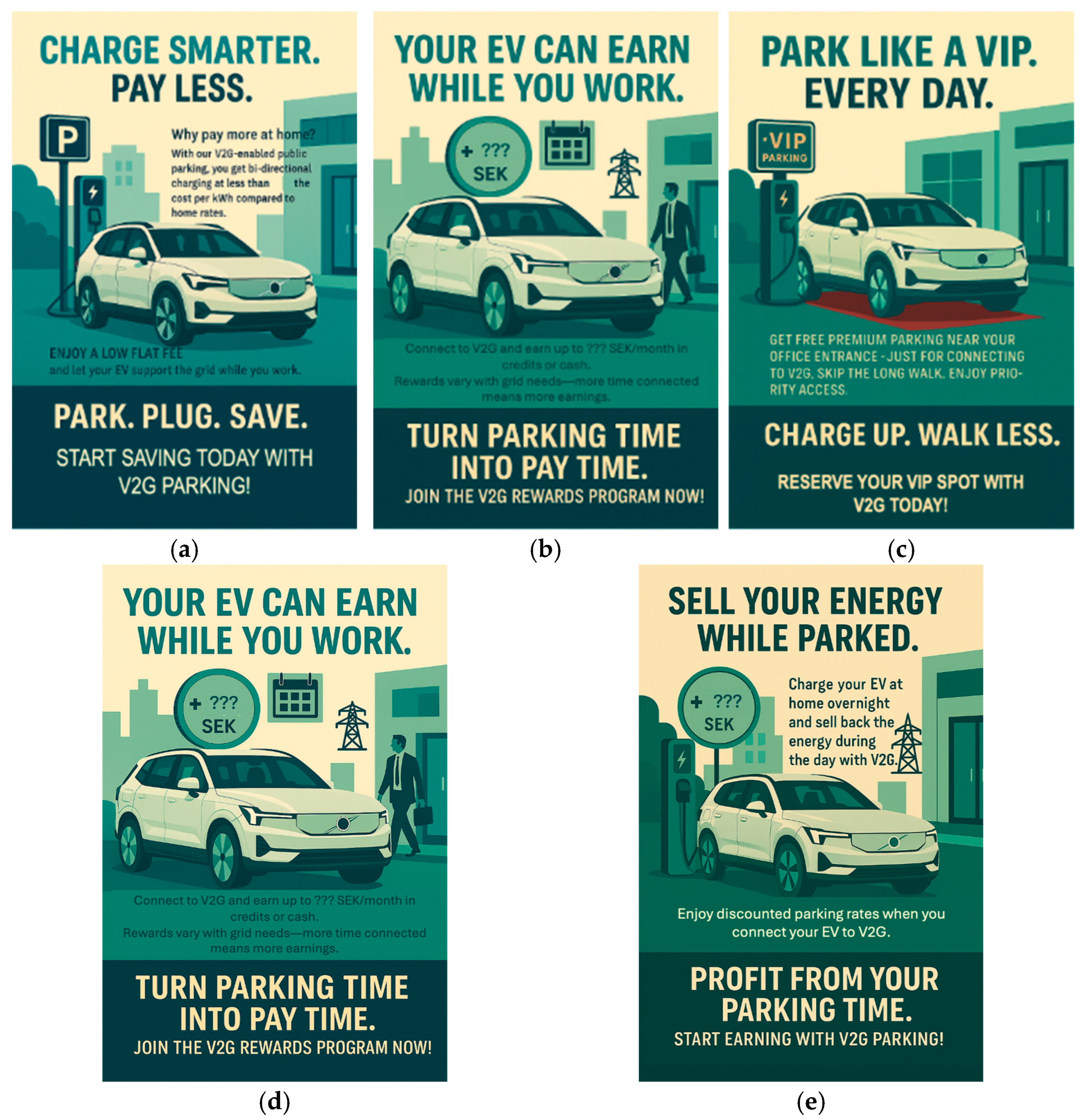
“Yes, I’m probably too comfortable there. I had counted it out first. Time is too big a factor rather than this [selling energy V2G offer] to think about. Because then I need to know what my price is right now. It’s not worth the effort.”Participant SK.
“This one [Cheap charging] is absolutely interesting… Then the other can charge at home, so you don’t have to worry about whose turn it is to charge.”Participant SK.
“Yes, I like that idea [Cheap Parking]. Because you could apply it not only at work, but I can still see it in front of me when you go to a football game in Ullevi or something else.”Participant NA.
“Spontaneously, I think it’s interesting. Time is a factor that is not to be underestimated. So this one close by [VIP parking] is easy. Then I’m also a bit picky when it comes to too tight parking spaces, for example. I usually park at the far end where no one else parks just so I don’t have to mess with it.”Participant SK.
“This one is the most attractive to me [Selling electricity]. I would go for this one in that case. … Then I can discharge out 50%. In that case, I would have calculated it a bit and tried to charge at home overnight in that case and then discharged during the day.”Participant MH.
“This one is [Selling energy] …, now you know me. This is where my laziness comes in. This was too many parameters for me to try to keep track of for me to think that this feels, yes”.Participant CE.
“But there [Point system], the business case is a little fuzzier. What is it? It’s not real money?”Participant PL.
4. Discussion
Limitations
Author Contributions
Funding
Institutional Review Board Statement
Informed Consent Statement
Data Availability Statement
Acknowledgments
Conflicts of Interest
Abbreviations
| BEV | Battery Electric Vehicle |
| EV | Electric Vehicle |
| FC | Financial Compensation |
| ICE | Internal Combustion Engine |
| OEM | Original Equipment Manufacturer |
| PHEV | Plug-in Hybrid Electric Vehicle |
| PV | Solar Photovoltaics |
| SoC | State of Charge |
| ToU | Time of Use |
| V2G | Vehicle-to-Grid |
| V2X | Vehicle-to-Everything |
| V2H | Vehicle-to-Home |
| VKT | Vehicle-kilometers traveled |
Appendix A

| J Male | D Male | A Female | JN Male | K Male | M Female | P Male | L Male | |
|---|---|---|---|---|---|---|---|---|
| Car ownership | Owner | Owner | Owner | Owner | Leased | Leased | Leased | Leased |
| Household | 2 adults, 3 children | 2 adults | 2 adults, 2 children | 1 adult | 1 adult | 2 adults | 3 adults | 3 adults |
| Housing type | House | House | House | House | Apartment | House | House | House |
| Energy contracts | ToU (Hourly based) | ToU (Hourly based) | ToU (Hourly based) | ToU (Hourly based) | NA | Fixed | ToU (Hourly based) | ToU (Monthly based) |
| House’s energy system | Pellets | Heat pump, radiator and fireplace | Solar panels | Floor heating with an exhaust air heat pump | NA | NA | Solar panels | Heat pump |
| Commuting driving distances | Short | Long | Long | Long | Long | Long | Long | Long |
| Charging location | Home mostly | Home only | Home mostly | Home mostly | Public | Home mostly | Home—sunny days | Home mostly |
| Minimum SoC | 30% | 60% | 60% | 40% | NA | NA | NA | NA |
| Other modes of transport | Active commuting | None | Active commuting | None | None | None | Active commuting | None |
| Battery degradation | Not much concerned | Concerned | NA | Not much concerned | Concerned | Concerned if private owner | Concerned | Not much concerned |
| SK Female | PL Female | NÅ Female | CU Male | NH Male | MW Male | CE Female | MH Male | |
|---|---|---|---|---|---|---|---|---|
| N Cars | 3 (2 BEVs) | 1 BEV | 2 BEVs | 2 (1 BEV) | 2 (1 BEV) | 2 (1 BEV) | Leased | 2 BEVs |
| Household | 2 adults with teens | 2 adults | 2 adults with teens | 2 adults with children | 2 adults with teens/children | 2 adults with children | 2 adults with children | 2 adults with teens/children |
| Housing type | House | Apartment | House | House | House | House | House | House |
| Energy contracts | ToU (Hourly + power tariff) | ToU (Monthly) | ToU (Hourly + power tariff) | ToU (Hourly + power tariff) | ToU (Monthly) | ToU (Hourly) | ToU (Monthly) | ToU (Monthly + power tariff) |
| Charging set up | Wallbox | Wallbox | Wallbox | Wallbox | Wallbox | Wallbox + solar +battery | Wallbox | Wallbox + solar |
| Commuting (km) | 40 | 10 | 20 | 15 | 20 | 15 | 70 | 60 |
| Charging location | Home mostly | Home mostly | Home only | Home only | Home only | Home only | Home and Workplace | Home only |
| Sustainability (std. α = 0.77) | Efficiency (std. α = 0.85) | Uncertainties (std. α = 0.85) | |
|---|---|---|---|
| “I believe that the use of renewable energy will increase” | 0.58 | 0.22 | −0.09 |
| “I believe that parked cars will be better used if connected to V2G” | 0.96 | 0.25 | −0.11 |
| “I believe that the energy prices on the market will decrease” | 0.24 | 0.80 | −0.16 |
| “I believe that the risk of power outages will decrease” | 0.25 | 0.81 | −0.15 |
| “I believe that the need for energy production will decrease” | 0.11 | 0.71 | −0.01 |
| “I would fear that I would not have sufficient range to complete my transport needs” | −0.05 | −0.15 | 0.71 |
| “I would be afraid that battery life would be shorter than without bidirectional charging” | −0.04 | −0.07 | 0.60 |
| “I would expect an increase of charging failures on public spaces” | −0.16 | −0.09 | 0.62 |
| “I fear that V2G will add complexity to planning the charging of my vehicle” | −0.05 | −0.06 | 0.84 |
| “I will lose some control of charging my electric vehicle” | −0.07 | −0.01 | 0.83 |
| Cumulative Variance explained | 0.27 | 0.20 | 0.14 |
Appendix B
Appendix B.1. Interview Guide—Wave 1
Appendix B.2. Interview Guide—Wave 2
- Introduction (5 min)
- 2.
- Individual ranking (5 min)
- 3.
- In-depth discussion per offer (20 min)
- 4.
- Critical Parameters (10 min)
- 5.
- Conclusion (5 min)
References
- Zhang, C.; Kitamura, H.; Goto, M. A New Framework of Vehicle-to-Grid Economic Evaluation: From Semi-Systematic Review of 132 Prior Studies. Energies 2025, 18, 3088. [Google Scholar] [CrossRef]
- Sovacool, B.K.; Kester, J.; Noel, L.; Zarazua de Rubens, G. Actors, business models, and innovation activity systems for vehicle-to-grid (V2G) technology: A comprehensive review. Renew. Sustain. Energy Rev. 2020, 131, 109963. [Google Scholar] [CrossRef]
- Liu, F.; Wei, Z.; Lin, Y.; Huang, X.; Li, Y.; Huang, Y.; Lim, M.K. Vehicle-To-Grid Technology Acceptance for Electric Vehicle Users: A Systematic Literature Review and Future Research Agenda. Int. J. Consum. Stud. 2025, 49, e70065. [Google Scholar] [CrossRef]
- Baumgartner, N.; Kellerer, F.; Ruppert, M.; Hirsch, S.; Mang, S.; Fichtner, W. Does experience matter? Assessing user motivations to accept a vehicle-to-grid charging tariff. Transp. Res. Part D Transp. Environ. 2022, 113, 103528. [Google Scholar] [CrossRef]
- Nagel, N.O.; Jåstad, E.O.; Martinsen, T. The grid benefits of vehicle-to-grid in Norway and Denmark: An analysis of home- and public parking potentials. Energy 2024, 293, 130729. [Google Scholar] [CrossRef]
- Bakhuis, A.; Ghotge, R.; Annema, J.A.; Lukszo, Z. Exploring user willingness to adopt vehicle-to-grid (V2G): A statistical analysis of stated intentions. Energy Policy 2025, 203, 114619. [Google Scholar] [CrossRef]
- van Heuveln, K.; Ghotge, R.; Annema, J.A.; van Bergen, E.; van Wee, B.; Pesch, U. Factors influencing consumer acceptance of vehicle-to-grid by electric vehicle drivers in the Netherlands. Travel Behav. Soc. 2021, 24, 34–45. [Google Scholar] [CrossRef]
- Goncearuc, A.; de Cauwer, C.; Sapountzoglou, N.; Kriekinge, G.v.; Huber, D.; Messagie, M.; Coosemans, T. The barriers to widespread adoption of vehicle-to-grid: A comprehensive review. Energy Rep. 2024, 12, 27–41. [Google Scholar] [CrossRef]
- ACER/CEER. The European Union Agency for the Cooperation of Energy Regulators/the European Energy Regulators. Annual Report on the Results of Monitoring the Internal Electricity and Natural Gas Markets in 2021. 2022. Available online: https://www.acer.europa.eu/sites/default/files/documents/Publications/MMR_2021_Energy_Retail_Consumer_Protection_Volume.pdf (accessed on 17 March 2026).
- SCB. Statistics Sweden. Distribution of Electricity Contracts by Bidding Zone and Contract Type. Month 2013M04–2025M01. 2025. Available online: https://www.statistikdatabasen.scb.se/pxweb/sv/ssd/START__EN__EN0301__EN0301A/SSDManadElAvtalstyp/ (accessed on 17 March 2026).
- Hennlock, M.; Karlsson, A.; Nilsson, A.; Grahn, D.; Fransson, N. Consumer Perspective on Demand Flexibility; IVL Swedish Environmental Research Institute: Stockholm, Sweden, 2023; Available online: https://ei.se/download/18.4ed2158a18722d7df785bc9/1680686319221/Konsultrapport-Konsumentperspektiv-p%C3%A5-efterfr%C3%A5geflexibilitet-IVL.pdf (accessed on 29 December 2025).
- Sovacool, B.K.; Axsen, J.; Kempton, W. The Future Promise of Vehicle-to-Grid (V2G) Integration: A Sociotechnical Review and Research Agenda. Annu. Rev. Environ. Resour. 2017, 42, 377–406. [Google Scholar] [CrossRef]
- Santinha, G.; Tavares, J. A systematic review of citizen perceptions and expectations of V2G adoption in the context of sustainable transitions. Discov. Sustain. 2025, 6, 957. [Google Scholar] [CrossRef]
- Chamberlain, K.; al Majeed, S. Evaluating the barrier effects of charge point trauma on uk electric vehicle growth. World Electr. Veh. J. 2021, 12, 152. [Google Scholar] [CrossRef]
- Sagaria, S.; van der Kam, M.; Boström, T. Vehicle-to-grid impact on battery degradation and estimation of V2G economic compensation. Appl. Energy 2025, 377, 124546. [Google Scholar] [CrossRef]
- Torkey, A.; Zaki, M.H.; el Damatty, A.A. Transportation Electrification: A Critical Review of EVs Mobility during Disruptive Events. Transp. Res. Part D Transp. Environ. 2024, 128, 104103. [Google Scholar] [CrossRef]
- Noel, L.; Papu Carrone, A.; Jensen, A.F.; Zarazua De Rubens, G.; Kester, J.; Sovacool, B.K. Willingness to pay for electric vehicles and vehicle-to-grid applications: A Nordic choice experiment. Energy Econ. 2019, 78, 525–534. [Google Scholar] [CrossRef]
- Noel, L.; Zarazua de Rubens, G.; Kester, J.; Sovacool, B.K. Leveraging user-based innovation in vehi-cle-to-X and vehicle-to-grid adoption: A Nordic case study. J. Clean. Prod. 2021, 287, 125591. [Google Scholar] [CrossRef]
- Zhang, C.; Kitamura, H.; Goto, M. Behavioral insights into vehicle-to-grid (V2G) adoption: Beyond economic perspectives. Renew. Sustain. Energy Rev. 2026, 228, 116603. [Google Scholar] [CrossRef]
- Helferich, M.; Tröger, J.; Stephan, A.; Preuß, S.; Pelka, S.; Stute, J.; Plötz, P. Tariff option preferences for smart and bidirectional charging: Evidence from battery electric vehicle users in Germany. Energy Policy 2024, 192, 114240. [Google Scholar] [CrossRef]
- Sovacool, B.K.; Kester, J.; Noel, L.; Zarazua de Rubens, G. Are electric vehicles masculinized? Gender, identity, and environmental values in Nordic transport practices and vehicle-to-grid (V2G) preferences. Transp. Res. Part D Transp. Environ. 2019, 72, 187–202. [Google Scholar] [CrossRef]
- Mehdizadeh, M.; Nayum, A.; Nordfjærn, T.; Klöckner, C.A. Are Norwegian car users ready for a transition to vehicle-to-grid technology? Transp. Policy 2024, 146, 126–136. [Google Scholar] [CrossRef]
- Khezri, R.; Steen, D.; Anh Tuan, L. Willingness to Participate in Vehicle-to-Everything (V2X) in Sweden, 2022—Using an Electric Vehicle’s Battery for More Than Transport. Sustainability 2024, 16, 1792. [Google Scholar] [CrossRef]
- Kaviani, F.; Dahlgren, K.; Koppel, S.; Strengers, Y.; Martin, R.; Korsmeyer, H.; Pink, S. “We’d rather have a clean planet than anything else”: Household values and automated future electric vehicle charging. Energy Res. Soc. Sci. 2025, 121, 103965. [Google Scholar] [CrossRef]
- Mehdizadeh, M.; Nordfjaern, T.; Klöckner, C.A. Estimating financial compensation and mini-mum guaranteed charge for vehicle-to-grid technology. Energy Policy 2023, 180, 113649. [Google Scholar] [CrossRef]
- Martins Silva Ramos, É.; Hagman, J. Swedish EV Users’ Routines and Behaviors Without Home Charging Availability. In Proceedings of the EVS38 International Battery, Hybrid and Fuel Cell Electric Vehicle Symposium, Göteborg, Sweden, 15–18 June 2025; Available online: https://ri.diva-portal.org/smash/record.jsf?pid=diva2%3A1989003 (accessed on 29 December 2025).
- Lindkvist, C. Gendered mobility strategies and challenges to sustainable travel—Patriarchal norms controlling women’s everyday transportation. Front. Sustain. Cities 2024, 6, 1367238. [Google Scholar] [CrossRef]
- UN Women. Gender Analysis in Technical Areas: Digital Inclusion; Guidance Note; UN Women: New York, NY, USA, 2022; Available online: https://knowledge.unwomen.org/sites/default/files/2022-12/Gender%20Analysis%20Guidance_Digital_Inclusion.pdf (accessed on 17 March 2026).
- Elldér, E.; Haugen, K.; Vilhelmson, B. When local access matters: A detailed analysis of place, neighbourhood amenities and travel choice. Urban Stud. 2022, 59, 120–139. [Google Scholar] [CrossRef]
| Sustainability | Efficiency | Uncertainties | |||||||
|---|---|---|---|---|---|---|---|---|---|
| ß (SE) | t | p | ß (SE) | t | p | ß (SE) | t | p | |
| Car type ICE | −0.45 (0.24) | −1.86 | 0.063 | 0.56 (0.23) | 2.46 | 0.014 | −0.27 (0.23) | −1.15 | 0.248 |
| Car type PHEV | −0.28 (0.23) | −1.17 | 0.241 | 0.42 (0.22) | 1.86 | 0.062 | −0.17 (0.23) | −0.72 | 0.468 |
| Gender (woman) | −0.33 (0.14) | −2.25 | 0.024 | 0.31 (0.13) | 2.23 | 0.026 | −0.25 (0.14) | −1.78 | 0.075 |
| Age (26–35 years) | −0.13 (0.56) | −0.23 | 0.817 | −0.12 (0.53) | −0.23 | 0.813 | −0.44 (0.55) | −0.80 | 0.420 |
| Age (36–45 years) | −0.33 (0.56) | −0.59 | 0.554 | 0.13 (0.53) | 0.24 | 0.803 | −0.58 (0.55) | −1.06 | 0.289 |
| Age (46–55 years) | −0.33 (0.56) | −0.59 | 0.552 | 0.37 (0.53) | 0.69 | 0.487 | −0.50 (0.55) | −0.91 | 0.359 |
| Age (56–65 years) | −0.53 (0.56) | −0.93 | 0.348 | 0.39 (0.54) | 0.72 | 0.468 | −0.65 (0.56) | −1.16 | 0.244 |
| Age (66+ years) | 0.35 (1.09) | 0.32 | 0.745 | −0.78 (1.04) | −0.75 | 0.450 | −1.23 (1.07) | −1.14 | 0.253 |
| El_plan Others | −0.25 (0.29) | −0.86 | 0.389 | −0.13 (0.27) | −0.49 | 0.617 | −0.08 (0.28) | −0.30 | 0.764 |
| EL_plan Variable rate (hourly) | 0.35 (0.13) | 2.62 | 0.008 | −0.21 (0.12) | −1.67 | 0.094 | 0.13 (0.13) | 0.99 | 0.322 |
|
EL_plan Variable rate (monthly) | −0.11 (0.13) | −0.84 | 0.400 | −0.03 (0.12) | −0.28 | 0.776 | −0.19 (0.13) | −1.49 | 0.136 |
| Housing_Rented apartment | −0.05 (0.17) | −0.28 | 0.776 | 0.25 (0.16) | 1.53 | 0.125 | −0.14 (0.17) | −0.81 | 0.418 |
| Housing_Owned apartment | −0.34 (0.16) | −2.08 | 0.037 | 0.38 (0.15) | 2.45 | 0.014 | −0.00 (0.16) | −0.02 | 0.977 |
| Housing_Other | 1.06 (0.98) | 1.08 | 0.279 | −0.75 (0.93) | −0.81 | 0.417 | 0.06 (0.96) | 0.06 | 0.948 |
| Model | R2 adju = 0.08, F(14, 369) = 3.5, p < 0.001 | R2 adju = 0.07, F(14, 369) = 3.07, p < 0.001 | R2 adju = 0.01, F(14, 369) = 1.48, p = 0.112 | ||||||
| Location L | Location T | ||||||||
|---|---|---|---|---|---|---|---|---|---|
| Offer | NH | CU | NA | Total | PL | MH | CE | SK | Total |
| A—Cheaper charging | 3 | 1 | 3 | 7 | 5 | 3 | 4 | 5 | 17 |
| B—Point system | 1 | 3 | 1 | 5 | 1 | 4 | 2 | 2 | 9 |
| C—VIP parking | 4 | 2 | 2 | 8 | 3 | 1 | 5 | 4 | 13 |
| D—Cheaper parking | 5 | 4 | 5 | 14 | 2 | 2 | 3 | 3 | 10 |
| E—Selling electricity/capacity | 2 | 5 | 4 | 11 | 4 | 5 | 1 | 1 | 11 |
Disclaimer/Publisher’s Note: The statements, opinions and data contained in all publications are solely those of the individual author(s) and contributor(s) and not of MDPI and/or the editor(s). MDPI and/or the editor(s) disclaim responsibility for any injury to people or property resulting from any ideas, methods, instructions or products referred to in the content. |
© 2026 by the authors. Published by MDPI on behalf of the World Electric Vehicle Association. Licensee MDPI, Basel, Switzerland. This article is an open access article distributed under the terms and conditions of the Creative Commons Attribution (CC BY) license.
Share and Cite
Martins Silva Ramos, É.; Lindgren, T.; Andersson, J.; Hagman, J. Users’ Perspectives of Bidirectional Charging in Public Environments. World Electr. Veh. J. 2026, 17, 176. https://doi.org/10.3390/wevj17040176
Martins Silva Ramos É, Lindgren T, Andersson J, Hagman J. Users’ Perspectives of Bidirectional Charging in Public Environments. World Electric Vehicle Journal. 2026; 17(4):176. https://doi.org/10.3390/wevj17040176
Chicago/Turabian StyleMartins Silva Ramos, Érika, Thomas Lindgren, Jonas Andersson, and Jens Hagman. 2026. "Users’ Perspectives of Bidirectional Charging in Public Environments" World Electric Vehicle Journal 17, no. 4: 176. https://doi.org/10.3390/wevj17040176
APA StyleMartins Silva Ramos, É., Lindgren, T., Andersson, J., & Hagman, J. (2026). Users’ Perspectives of Bidirectional Charging in Public Environments. World Electric Vehicle Journal, 17(4), 176. https://doi.org/10.3390/wevj17040176

