Article

Research on Hierarchical Collaborative Control of Dual-Axis Drive Hybrid Electric Tractor for Hill and Mountain Terrain Considering Traction Efficiency and Energy Consumption Economy

1
Undergraduate School, Henan University of Science and Technology, Luoyang 471023, China
2
College of Vehicle and Traffic Engineering, Henan University of Science and Technology, Luoyang 471023, China
3
YTO·Group Corporation, Luoyang 471004, China
*
Authors to whom correspondence should be addressed.
World Electr. Veh. J. 2026, 17(3), 136; https://doi.org/10.3390/wevj17030136
Submission received: 17 January 2026 / Revised: 24 February 2026 / Accepted: 28 February 2026 / Published: 6 March 2026
(This article belongs to the Section Vehicle and Transportation Systems)

Abstract

Hybrid tractors operating in hilly terrain often suffer from reduced overall performance due to unregulated slip rate variations. To address this issue, this paper proposes a hierarchical cooperative control strategy that jointly optimizes traction efficiency and energy consumption. First, a traction force–slip rate coupling model is developed, and an adaptive slip rate control method is designed to determine the optimal traction force distribution range, thereby improving traction efficiency. Next, an equivalent consumption minimization strategy (ECMS) is formulated to minimize equivalent fuel consumption, using the torque coupler ratio and torque distribution ratio as optimization variables. These two methods are then integrated through slip rate and traction force as transfer variables, forming a hierarchical cooperative control framework that simultaneously considers both objectives. The proposed method is validated under plowing conditions through MATLAB simulations and Hardware-in-the-Loop (HIL) tests, using a fixed coordinated traction force allocation method as a benchmark. Results show that, compared to the benchmark, the proposed method reduces slip rate loss by 29.6%, increases traction efficiency by 8.7%, and decreases equivalent fuel consumption by 14.4%. This study provides new insights into improving the energy efficiency of hybrid tractors in complex terrains.

1. Introduction

The continuous advancement of agricultural mechanization drives innovation in agricultural production efficiency [1,2]. As the core power equipment in agriculture, the performance of tractors directly impacts the quality and efficiency of agricultural production [3,4]. Hilly and mountainous terrain accounts for approximately 36% of the world’s land area [5]. Its significant elevation differences, complex soil textures, and dynamic operating conditions present new challenges for tractor research. Enhancing tractor performance in complex terrain has become a critical breakthrough topic in the field of agricultural engineering [6,7,8]. Against this backdrop, hybrid tractors offer a novel solution to energy efficiency and performance challenges in complex terrains due to their flexible power switching capabilities [9,10,11]. During light-load or low-speed operations, the electric motor operates independently to reduce fuel consumption, aligning with green agricultural development trends [3]. Simultaneously, dual-axle drive significantly improves tire traction performance by increasing the number of effective traction wheels and optimizing power distribution, thereby effectively enhancing traction stability. Therefore, researching control strategies to enhance the energy efficiency of dual-axle drive hybrid tractors in hilly and mountainous regions can promote the high-end and intelligent upgrading of agricultural machinery. This provides robust equipment support for modernizing agriculture in hilly and mountainous areas [12,13,14].
Given the limited research on hybrid tractors for hilly and mountainous terrain, this paper investigates control strategies for hybrid tractors. Current hybrid tractor control strategies can be broadly categorized into rule-based control strategies and optimization-based control strategies [15,16,17]. Rule-based energy management strategies allocate energy through manually defined logical rules, characterized by simple implementation and strong engineering adaptability. For instance, Hyun-Sub Lee [18] proposed a rule-based power allocation strategy for the powertrain of a parallel hybrid tractor, improving its fuel consumption rate. Results demonstrated an 11.78% increase in fuel economy compared to conventional tractors. Although this control strategy effectively reduced fuel consumption in hybrid tractors, it did not address battery utilization efficiency. To tackle the issue of insufficient battery energy utilization in range-extended electric tractors, Xu [19] proposed a predefined energy-saving control strategy. By adjusting control parameters between the battery power consumption and diesel engine energy management strategies, the results demonstrated a 34.22% improvement in fuel economy compared to the fixed-point energy management strategy, while boosting the power battery utilization rate by 40.08%. Although this strategy effectively increased battery utilization, it did not account for battery lifespan. Therefore, addressing the co-optimization of fuel economy and battery life for hybrid tractors, Simone Lombardi proposed a rule-based energy management strategy. This approach dynamically adjusts fuel cell power settings based on battery state of charge (SOC), effectively reducing instantaneous fuel cell load. This simultaneously lowers tractor fuel consumption and extends fuel cell lifespan [20]. However, rule-based algorithms require extensive debugging to obtain optimal control parameters, and their efficiency cannot be guaranteed.
Optimization-based control algorithms adaptively generate globally optimal control strategies by solving dynamic optimization problems [21]. Compared to rule-based control methods, these algorithms demonstrate superior robustness and environmental adaptability when managing complex systems characterized by uncertainty, time-varying dynamics, and multiple constraints (as shown in Table 1). Zhang proposed a mass-constrained algorithm that addresses the influence of tractor mass on performance. By integrating instantaneous optimization with genetic algorithms to optimize power source efficiency and torque distribution, this method reduced tractor mass and energy consumption by 8.54% and 4.15%, respectively, compared to rule-based designs [22]. Although these control strategies effectively improve tractor fuel economy, they primarily target fixed operating conditions. To enhance fuel efficiency under variable conditions, Feng introduced a predictive control strategy based on Pontryagin’s Minimum Principle combined with operating condition prediction. Using an adaptive cubic exponential prediction method, this approach forecasts future operating states based on historical data to minimize overall energy costs. While effective for variable conditions, this strategy overlooks the impact of tractor traction efficiency on fuel economy. To better improve traction efficiency and reduce energy losses, Lee employed a combined approach of multi-island genetic algorithms and dynamic programming to optimize the tractor’s power and energy systems [23]. The results showed average efficiency improvements of 0.38% and 3.82% for the transmission and energy systems, respectively, alongside energy loss reductions of 25.40% and 15.39%, thereby enhancing both traction efficiency and fuel economy [24]. Li Tonghui developed a real-time adaptive energy management strategy based on stochastic dynamic programming (SDP) and extremum search algorithms. This strategy uses an offline-generated control table from SDP as a reference, approximating a global optimum. Building upon this, an extremum search algorithm dynamically searches for local maxima in system outputs to adjust the SDP control inputs via feedback. Results indicate that this approach improves overall traction efficiency compared to pure SDP, reducing average energy consumption by 10.17% and further enhancing tractor traction and fuel economy [25]. While these studies contribute to improving tractor traction efficiency and fuel economy, none explicitly consider the impact of slip rate on these performance metrics. The relevant references are presented in tabular form, as shown in Table 1.
Slip rate is a core parameter for tractor traction performance [26]. An excessive slip rate can cause a sharp deterioration in traction efficiency, leading to a significant increase in energy consumption during operations in complex terrains [27]. To enhance the operational performance of hybrid tractors in hilly and mountainous terrains, this study aims to address the issue of reduced energy efficiency caused by existing control methods that neglect the slip rate. Focusing on a dual-axle hybrid drive system, a hierarchical cooperative control method is proposed.
A bidirectional coupling framework between traction efficiency and fuel economy is established through a “traction efficiency optimization layer-fuel economy optimization layer” architecture to achieve dual-objective cooperative optimization. Specifically, the first layer, the Traction Efficiency Optimization Layer, focuses on enhancing overall traction efficiency. It synchronously constrains the front and rear axle slip rates to their theoretically optimal values by dynamically adjusting the traction force distribution. These optimal slip rates and traction forces serve as the core input constraints for the second layer, completing the mapping from the “traction efficiency target” to the “optimal slip rate”. The second layer, the Fuel Economy Optimization Layer, aims to minimize the instantaneous equivalent fuel consumption upon receiving the optimal slip rate and traction force. First, it calculates the target speed and torque required at the power coupling end for the current operating condition based on the slip rate and traction force. Then, it solves for the optimal torque of the diesel engine and the motor based on the speed, while traversing the torque coupler ratio for optimization. This ensures that the power system always operates within the most efficient range with the lowest fuel consumption rate. The two layers form coupling with slip rate and traction force as transfer variables: the traction efficiency optimization layer provides the “optimal slip rate and traction force” for the fuel economy optimization layer; equivalent consumption minimization strategy (ECMS), with the goal of minimizing equivalent fuel consumption, solves the optimal torque distribution of power sources and the speed ratio of the torque coupler based on the slip rate to achieve fuel economy, thereby forming a collaborative optimization of “traction efficiency → fuel economy”. The main contributions can be summarized as follows:
  • To address the issue of reduced traction efficiency caused by excessive slip rate fluctuations during operation in hilly terrain, this study proposes an adaptive slip rate control method based on a traction force slip rate coupling model. By dynamically allocating traction force between the front and rear axles, this method maintains the slip rate within an optimal efficiency range, overcoming the limitations of traditional control strategies in adapting to changing operating conditions.
  • Building upon the adaptive slip rate control method’s outputs—namely, the slip rates and traction forces at the front and rear axles—this approach derives the required speed and torque at the power coupling interface. Aiming to minimize the tractor’s equivalent fuel consumption, it introduces an ECMS that optimizes the torque coupler ratio and torque distribution range as optimize variables to achieve energy-efficient tractor operation.
  • By integrating the adaptive slip rate control method with the ECMS, this study puts forward a hierarchical cooperative control method that takes into account both traction efficiency and energy-consumption economy. This approach enables the simultaneous optimization of traction efficiency and fuel economy.
This paper is organized as follows: Section 2 introduces the topology of the hybrid tractor designed for hilly terrain and models its key components, establishing the theoretical basis for the hierarchical cooperative control method detailed in Section 3. In Section 3.1, the hierarchical cooperative control architecture is introduced, and an overview of the coupling mechanisms, the adaptive slip rate control method, and the ECMS that are detailed in Section 3.2 and Section 3.3, is provided. Section 3.4 presents the comparison method. Section 4.1 and Section 4.2 cover the simulation validation and HIL testing. Finally, Section 5 discusses the results and their implications.

2. Model Development of Dual-Axis Hybrid Tractors for Hilly and Mountainous Terrains

2.1. Dual-Axis Hybrid Tractor Model for Hilly and Mountainous Terrain

This paper investigates a dual-axle drive hybrid tractor designed for hilly terrain. The overall structure, as shown in Figure 1, primarily comprises a power battery, traction motor, power take-off (PTO) motor, diesel engine, and power coupling device. The power battery supplies electricity to both motors. The traction motor primarily drives the front wheels. The power coupling device connects the PTO motor and diesel engine to drive the rear wheels and provide power output for plowing. The rear-wheel drive system comprises a transmission, main reduction gear, central drive unit, and rear wheels.

2.2. Dynamic Model of a Plowing Unit

When tractors operate in fields, plowing resistance is influenced by factors such as the attached agricultural implements, soil type, and soil hardness. The plowing resistance is specifically expressed by Equation (1):
F r = Z b 0 h 0 k 0
where Fr is the plowing resistance; Z is the number of plowshares; b0 is the width of a single plowshare; h0 is the plowing depth; k0 is the soil-specific resistance.
During tractor operations, the operating environments are variable, the working conditions are complex, and load fluctuations lead to changes in resistance. As a result, a power reserve of 10–20% is typically allocated in actual work. Therefore, the rated traction force of hybrid tractors can be expressed as follows [28]:
F r max = 1.2 F r
where F r max represents the rated traction force.

2.3. Diesel Engine Model

Based on the operating conditions of the hybrid tractor, an appropriate-rated-power diesel engine should be selected. When neglecting the heat losses in the diesel engine and only considering the parameter relationship between input and output, the engine power must satisfy Equation (3):
P e = n e T e 9550
where ne is the diesel engine speed; Te is the diesel engine torque.
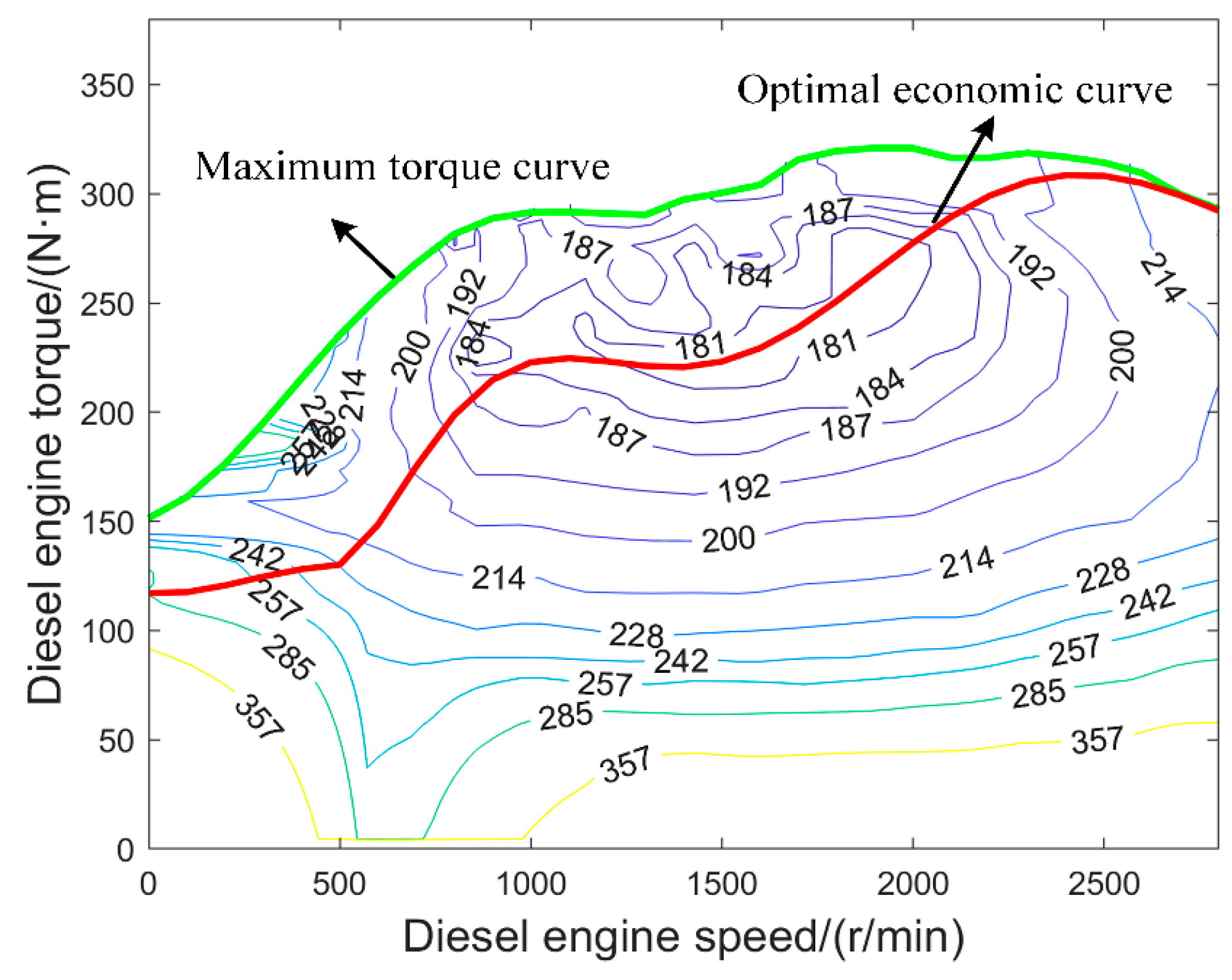
Diesel engine modeling aims to quantitatively describe the engine’s operating processes, performance characteristics, and control strategies using mathematical and computer simulation techniques. Primarily, diesel engine modeling methods can be classified into physics-based models and data-driven models [29]. In the simulation process, only the input and output parameters of the diesel engine are taken into account, while energy losses resulting from internal combustion and heat transfer processes are ignored. Figure 2 presents a numerical model for the diesel engine’s fuel consumption rate, which is obtained through a data-driven modeling approach.

2.4. Motor Model

This paper selects a permanent magnet synchronous motor as the motor model for tractors. The relationship among its power, rotational speed, and torque is expressed as shown in Equation (4):
P m = n m T m 9550
where nm is the motor speed; Tm is the motor torque.
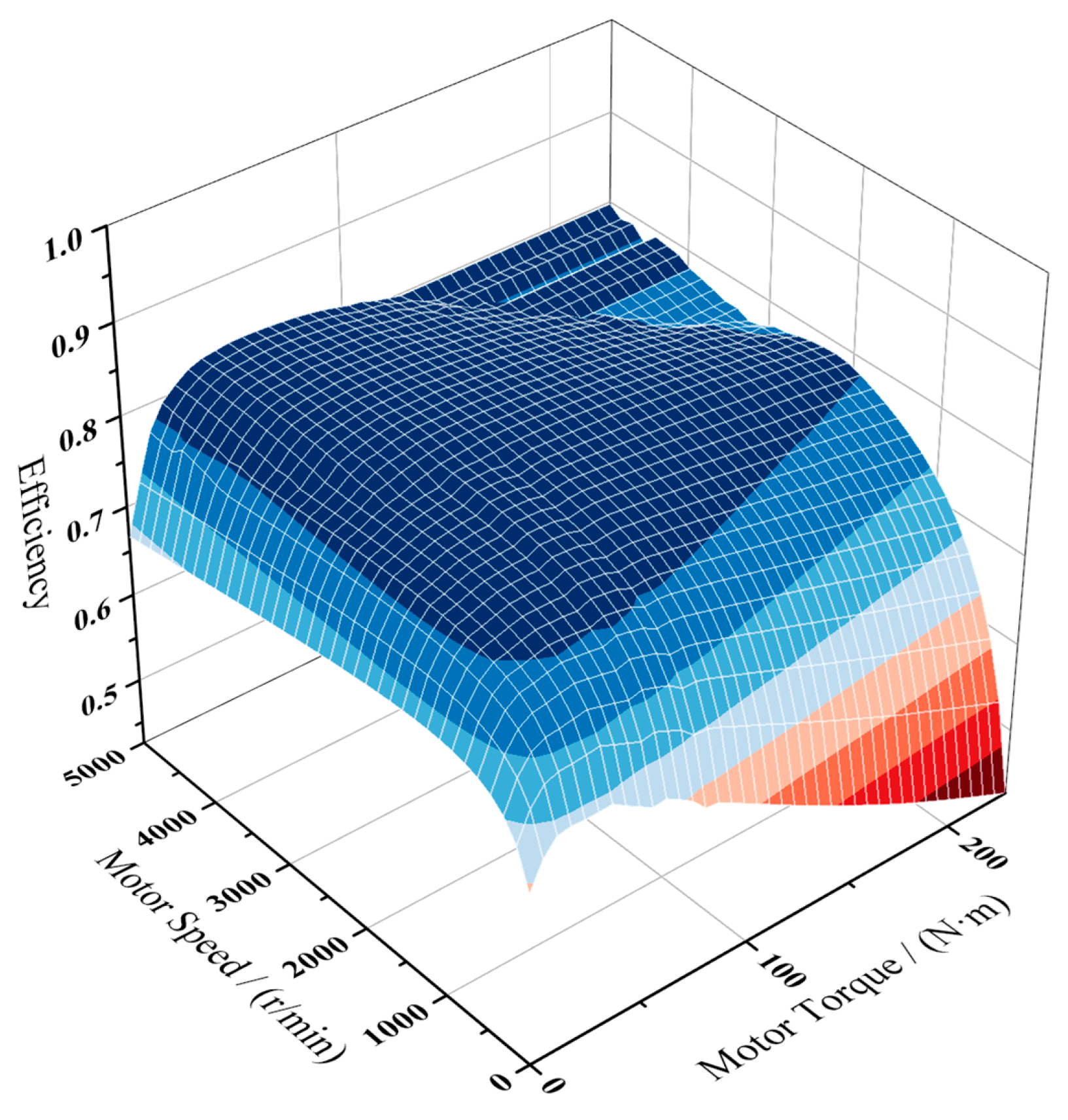
A motor model was developed through a numerical modeling approach. Relying on the motor efficiency test data, a spline interpolation method was applied to establish the relationship among motor system efficiency, torque, and rotational speed. To simplify the model, the same numerical motor model is adopted for both the traction motor and the PTO motor. Figure 3 depicts the numerical motor efficiency model.

2.5. Power Battery Model

A power battery model is a mathematical or physical representation that describes the operational characteristics and internal dynamic behavior of power batteries. Its purpose is to predict the battery’s charge/discharge performance, efficiency degradation, and thermal behavior by quantifying key parameters, including voltage, current, temperature, state of charge, and state of health. At present, most methods adopt equivalent circuit models, which represent power batteries as a circuit composed of an ideal voltage source and a resistor connected in series. Consequently, this paper uses the equivalent resistance model within equivalent circuits for power battery modeling [30].
According to Ohm’s law, the voltage characteristic equation of a power battery is shown in Equation (5):
U b = E 0 I b R 0
where Ub is the output voltage of the power battery; E0 is the terminal voltage of the power battery; I0 is the output current of the power battery; R0 is the internal resistance of the power battery.
Neglecting the effect of internal resistance (i.e., discharge factors) on the electromotive force, and assuming it as a constant, the output power of the power battery Pbmax is given by
P b max = U b I b = ( E 0 I b R 0 ) I b
From Equations (5) and (6), the total current Ib in the circuit is given by
I b = E b E b 2 4 R b P b a t 2 R b
The state-of-charge (SOC) value of power batteries is calculated using the ampere-hour integration method, with the calculation formula as follows [31,32]:
S O C ( t ) = S O C 0 0 t I b ( t ) d t Q b
where SOC0 represents the initial SOC value; Qb denotes the rated capacity of the power battery, A h .

2.6. Hybrid Tractor Transmission System Model

The power demand of a hybrid tractor originates from both the electric motor and the diesel engine. The total power of the machine is determined by the input power at the traction motor and the input power at the torque coupler, as shown in Equations (9) and (10) [33]:
P r e = P p η p + P e η e
P = P r e + P f η f
where Pre represents the power at the drive coupling end, kW; P denotes the total power of the tractor, kW; Pp represents the PTO motor power; η e denotes the diesel engine efficiency; η p denotes the PTO motor efficiency; η f denotes the traction motor efficiency.
Calculate the power source rotational speed based on the tractor’s operating speed and component parameters, as shown in Equations (11) and (12):
n e = n r e = v i g i 0 0.377 r 2 δ 2
n f = v i 0 0.377 r 1 δ 1
where n r e is the rotational speed at the power coupling end; n e is the diesel engine speed; n f is the traction motor speed; i g is the transmission gear ratio; i 0 is the main reduction gear ratio; v is the working vehicle speed.

2.7. Vehicle Driving Dynamics Model

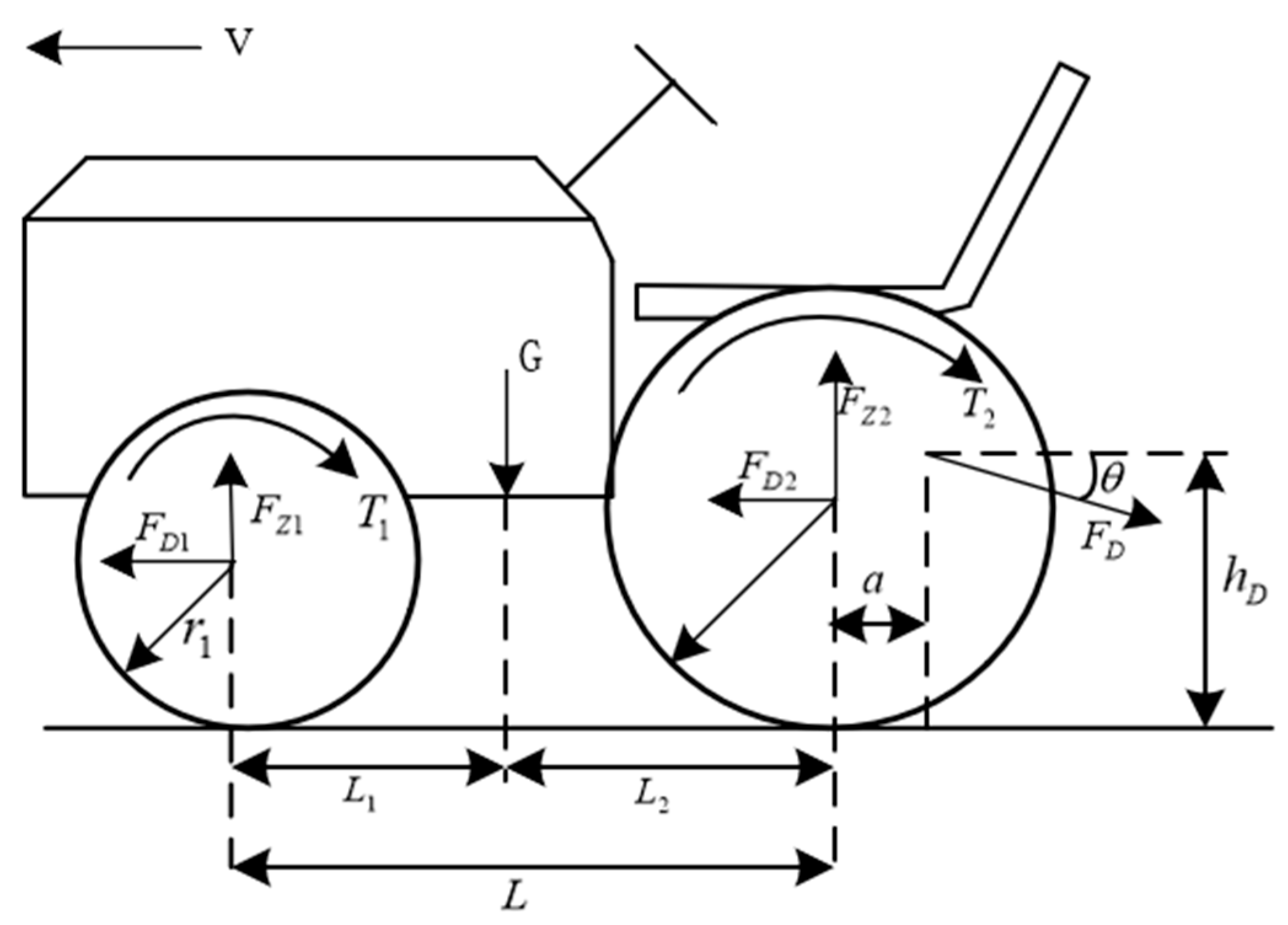
When a tractor is working in the field, assuming it is traveling at a constant speed on level ground, the force analysis for a hybrid dual-axle drive tractor is shown in Figure 4.
Assuming identical rolling resistance coefficients during wheel operation, the horizontal and vertical forces and moments acting on the tractor can be obtained as shown in Equations (13) and (14) [34,35]:
G = F Z 1 + F Z 2 F D sin θ F D cos θ = F D 1 + F D 2
F Z 2 L T 1 T 2 + F D 1 r 1 + F D 2 r 2 G L 1 F D h D cos θ F D ( L + a ) sin θ = 0 F Z 1 L + T 1 + T 2 F D 1 r 1 F D 2 r 2 G L 2 + F D h D cos θ + F D a sin θ = 0
where G is the total weight of the tractor; F D is the tractor’s traction resistance; L is the tractor’s wheelbase, m; h D is the height of the traction point; θ is the angle between the traction resistance and the horizontal plane; a is the horizontal distance from the implement’s traction point to the rear axle; F Z 1 / F Z 2 is the vertical load on the front/rear axle; F D 1 / F D 2 is the traction force on the front/rear axle; r 1 / r 2 denotes the radius of the front/rear drive wheels; T 1 / T 2 denotes the front/rear drive resistance moment; L 1 / L 2 denotes the distance from the center of gravity to the front/rear axle.
Based on the wheel contact point torque analysis and Equation (2), the vertical load calculation formula for the front and rear wheels is derived as follows:
F Z 1 = G L 2 T 1 T 2 + F D 1 r + F D 2 r 2 F D h D cos θ F D a sin θ L F Z 2 = G L 1 + T 1 + T 2 F D 1 r F D 2 r 2 + F D h D cos θ + F D ( L + a ) sin θ L
For the dual-axle drive configuration of hybrid tractors, the axle load distribution coefficient must be considered. This coefficient is defined as the ratio of the vertical reaction force on the rear axle to the tractor’s gravitational force, as shown in Equation (16):
k m = F Z 2 G
Neglecting changes in wheelbase during tractor operation, the speed relationship between front and rear wheels is shown in Equation (17) [36]:
ω f r 1 ( 1 δ 1 ) = ω r r 2 ( 1 δ 2 )
where ω f / ω r denotes the angular velocity of the front/rear drive wheels; δ 1 represents the slip rate of the front axle; δ 2 indicates the slip rate of the rear axle.
It is worth noting that the dynamic model presented above is based on a quasi-static equilibrium assumption. It neglects both the translational inertia of the tractor mass and the rotational inertia of the wheels, as well as the explicit representation of rolling resistance forces. These simplifications are justified under the typical operating conditions considered in this study, namely steady-state plowing with approximately constant forward speed and slowly varying load. Under such conditions, the inertial terms M d v / d t and J d ω / d t are negligible compared to the dominant traction and resistance forces. Rolling resistance is implicitly accounted for through the load distribution coefficients and the slip rate–traction force coupling model (Equation (18)), rather than being modeled as a separate force term. These assumptions are commonly adopted in control-oriented tractor modeling and do not compromise the validity of the comparative performance analysis presented in this work. For more dynamic maneuvers such as starting, acceleration, or rapid load changes, inclusion of inertia and explicit rolling resistance would be necessary, and this extension is left for future work.

2.8. Traction Force Slip Rate Coupling Model

In field operation scenarios, the slip rate of dual-axle hybrid-drive tractors is affected by various factors, including the traction distribution between the front and rear axles, soil type, and the tractor’s load distribution [37]. Meanwhile, the slip rate plays a crucial role in enhancing traction performance. When the wheel slip rate is maintained within an optimal range, the tractor can operate at its maximum efficiency [38]. Therefore, analyzing the impact of slip rate on the overall energy efficiency of tractors is crucial.
In this paper, the characteristic parameters of the slip rate were obtained through mathematical simulation of the slip rate curve. The average values of the characteristic parameters for the slip rate curve equations of the drive wheel on various surfaces were derived, as presented in Table 2.
Assuming identical slip characteristics and maximum load utilization coefficients for front and rear drive wheels, the slip rate of each drive wheel [39] can be expressed through characteristic parameters and the drive wheel load utilization coefficient φ q i , as shown in Equation (18):
δ i = δ ln φ max φ max φ q i φ q i = F D i F Z i
where δ i is the slip rate for the front axle/rear axle; δ * is the characteristic slip value; φ max is the maximum load utilization coefficient for the drive wheels; φ q i is the load utilization coefficient for the drive wheels.
In dual-axle drive tractors, the drive forces of the front and rear axles differ, which leads to variations in the slip rates of the front and rear wheels. To clearly demonstrate the influence of the traction forces of the front and rear axles on the slip rates, the tractor traction distribution coefficient is introduced. This coefficient is defined as the ratio of the horizontal traction force of the rear axle to the tractor’s traction resistance, as presented in Equation (19) [40]:
K P = F D 2 F D cos θ
where K p is the tractor driving force distribution coefficient.
By substituting Equation (19) into Equation (18), it can be found that the relationship between the slip rates of the front and rear axles in a dual-axle drive system and the tractor traction force distribution coefficient is expressed as follows in Equation (20):
δ 1 = δ * F Z 1 φ max F Z 1 φ max F D cos θ K p δ 2 = δ * F Z 2 φ max F Z 2 φ max F D cos θ ( 1 K p )
where δ 1 is the front axle slip rate; δ 2 is the rear axle slip rate.
According to Equation (20), when the axle load distribution is fixed, the slip rates of the front and rear axles of a dual-axle hybrid tractor are related to the traction force distribution coefficients of the front and rear axles.
The traction efficiency of a hybrid tractor refers to the ratio of the tractor’s traction power to the output power of its powertrain, as shown in Equation (21):
η T = v F D cos θ T f ω f + T r e ω e
where T r e represents the front axle motor output torque; T f represents the rear axle output torque; ω f represents the front axle motor output angular velocity; ω e represents the rear axle motor output angular velocity.
To analyze the influence of front and rear axle slip rates on traction efficiency, the above equations were combined. The traction efficiency of the dual-axle drive hybrid tractor was derived, and its expression is shown in Equation (22):
η T = 1 δ 1 1 δ 2 δ 1 δ 2 K p 1 δ 2 δ 1 δ 2 K p
where η T is the traction efficiency under dual-axle drive for tractors.
According to Equation (22), the traction efficiency of a tractor depends not only on the slip rates of the front and rear wheels but also on the drive force distribution coefficient. Taking the first-order partial derivative of η δ with respect to K d yields Equation (23):
f = η T K d = ( 1 δ 1 ) ( 1 δ 2 ) ( δ 1 δ 2 ) ( 1 δ 2 ) ( δ 1 δ 2 ) K d 2
When the partial derivative is equal to zero, that is, when f = 0, the optimal traction efficiency η T can be achieved. Considering that the wheel slip rate during the normal operation of a tractor is less than 100%, the first-order partial derivative is zero only when δ 1 = δ 2 . That is, the front wheel slip rate must equal the rear wheel slip rate, In other words, the equality of the front and rear wheel slip rates is a necessary condition for attaining the optimal traction efficiency [36]. In actual operation, maintaining the same slip rates for the front and rear axles is challenging because of the dynamically changing ground adhesion conditions and axle load transfer effects. To address this, an optimal slip-rate interval can be established by expanding the allowable slip-rate range for both axles. Equation (12) reveals that the slip rates of the tractor’s front and rear axles are closely associated with the magnitudes of their respective traction forces. By adjusting these traction forces, the slip rates of both axles can be changed. Consequently, through the rational adjustment of the front and rear axle traction forces, the slip rates of the front and rear wheels can be regulated within the optimal slip-rate range. This meets the necessary conditions for achieving optimal traction efficiency, ultimately enabling the tractor to reach its maximum traction efficiency. The “Traction Force Slip Rate Coupling Model” and the optimal slip rate allocation range presented in this section serve as the theoretical foundation for the subsequent adaptive slip rate control method.

3. Design of a Hierarchical Cooperative Control Method

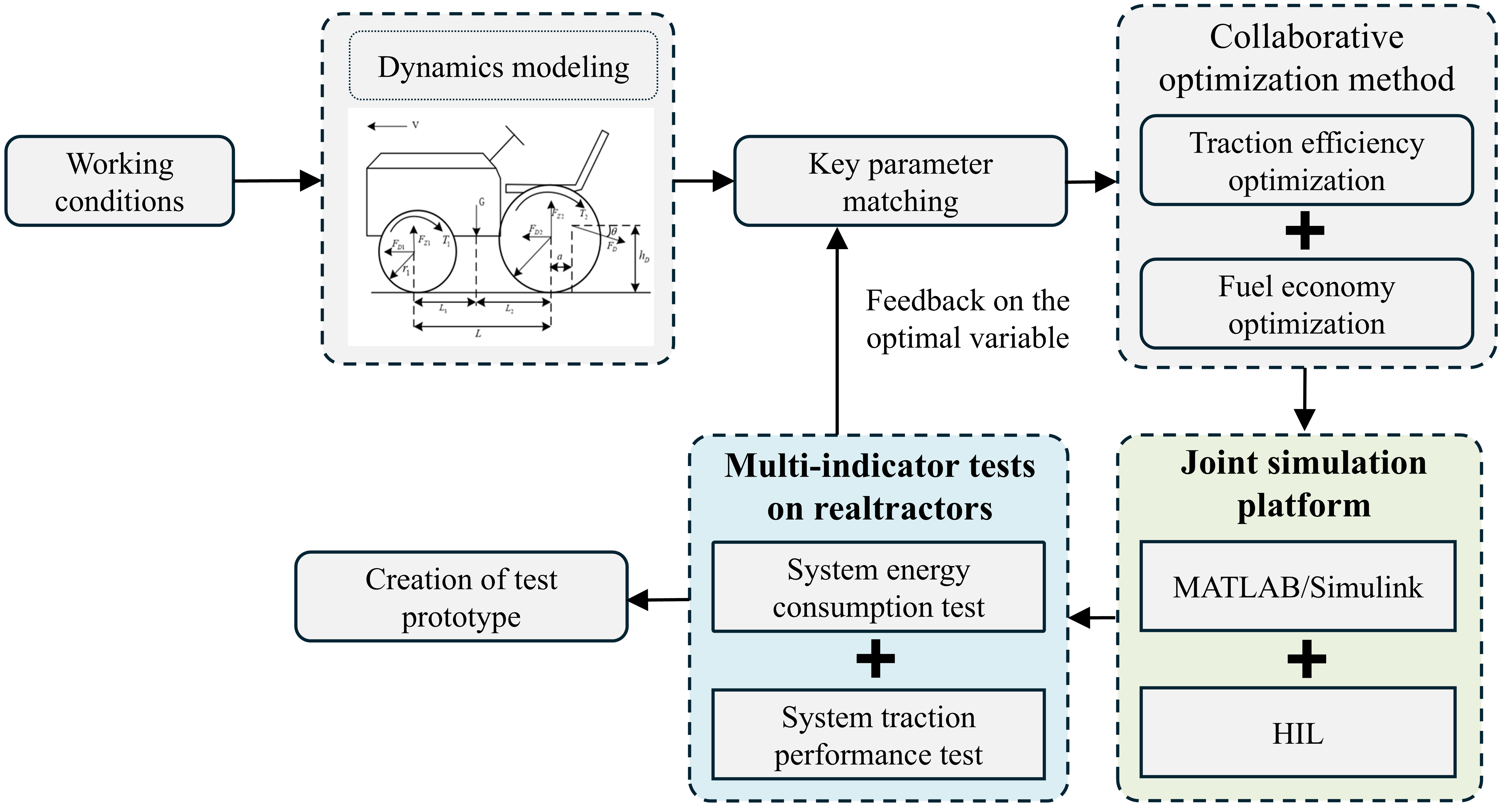
When dual-axle hybrid tractors operate in complex terrains of hilly and mountainous regions, they experience significantly higher slip rates compared to those in flat areas because of the dynamically changing ground adhesion conditions. This phenomenon results in reduced traction efficiency and increased energy consumption. To tackle this crucial problem, this paper puts forward a Dynamic Coordinated Hierarchical Collaborative Control (DCHC) method based on a dual-axle drive hybrid configuration. Taking the slip rate and traction force as the core transfer variables, the method establishes a layered architecture that consists of a “Traction Efficiency Optimization Layer” and a “Fuel Economy Optimization Layer.” By integrating the adaptive slip rate control and ECMS methods, a dynamic coordinated hierarchical collaborative control approach is developed. This approach not only enhances the traction efficiency of tractors in hilly and mountainous regions but also minimizes fuel consumption. With the “Traction Efficiency Optimization Layer-Fuel Economy Optimization Layer” hierarchical architecture and the integration of the adaptive slip rate control and ECMS methods, this approach realizes the synergistic optimization of traction efficiency and fuel economy for tractors in hilly terrains. The specific control process is shown in the following Figure 5.

3.1. Hierarchical Collaborative Control Architecture

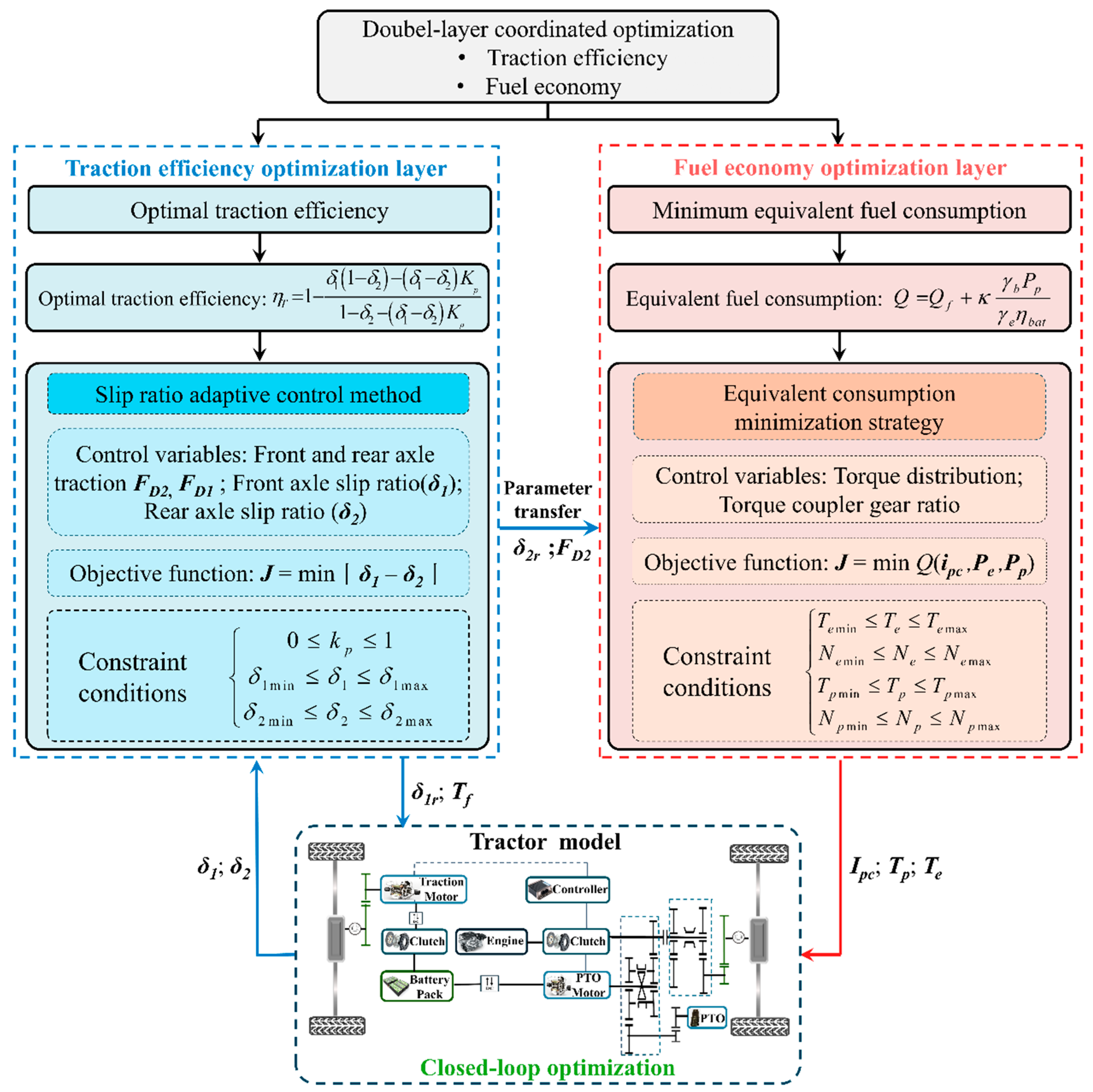
The DCHC method employs a “hierarchical and dynamic coordination” control framework (as shown in Figure 6), comprising two key levels:
(1) First Layer(Traction Efficiency Optimization Layer): Adaptive Slip Rate Control Method
To enhance the overall traction efficiency, an analysis of the optimal traction efficiency indicates that the traction efficiency reaches its peak when the front and rear slip rates are equal. Therefore, the adaptive slip rate control method controls the front and rear axle slip rates by reasonably distributing the traction force between the two axles. It incorporates a slip rate differential constraint mechanism, where the objective function is set to minimize the difference between the front and rear slip rates, aiming to achieve optimal traction efficiency. The output of this layer includes the optimal slip rate of the rear axle δ 2 r and the rear-axle traction force F D 2 , which serve as input variables for the next layer. Meanwhile, the optimized slip rate of the front axle δ 1 r and the front-axle traction force F D 1 are transmitted to the tractor model as input variables.
(2) Second Layer (Fuel Economy Optimization Layer): ECMS
Subject to the constraints of the optimal rear-axle slip rate δ 2 r and rear-axle traction F D 2 selected in the first layer, an equivalent fuel consumption minimization model is developed. This model analyzes the equivalent fuel consumption (as shown in Equation (28)). The control variables of this model are the torque coupler ratio and the power-source torque distribution, and the optimization objective is to minimize the instantaneous equivalent fuel consumption. Through this approach, fuel economy for the hybrid tractor is achieved. The outputs of this layer, namely the diesel engine torque Te, PTO motor torque Tp, and torque coupler transmission ratio ipc, serve as input variables for the tractor model.
The core coupling mechanism between the two layers is as follows: Traction Efficiency Optimization Layer provides the Fuel Economy Optimization Layer with the optimal slip rate range and optimal traction force range through the “traction efficiency target → slip rate optimization” mapping (as shown in Equations (20) and (21)). Meanwhile, the ECMS achieves the lowest equivalent fuel consumption via the “slip rate-power demand-torque distribution” chain (as shown in Equations (11) and (12) and (24)–(28)), thus forming a synergistic optimization of “traction efficiency and fuel economy.” The slip rate adaptive control method inputs the front-axle traction force Tf and front-axle slip rate δ 1 r into the tractor model. The ECMS inputs the engine torque T e , PTO motor torque T p , and torque coupler transmission ratio i p c into the tractor model. During operation, the tractor model feeds the actual front/rear axle slip rates δ 1 / δ 2 as input variables back to the traction efficiency layer. Achieving the synergy of “traction efficiency—fuel economy optimization”.
The steps of the DCHC method are as follows:
(1) Employ an adaptive slip rate method to rationally distribute the traction force between the front and rear axles, enabling both axles to reach optimal traction efficiency conditions. This step outputs the slip rates and traction forces of the front and rear wheels.
(2) Based on the current rear axle slip rates and traction forces, the ECMS calculates the required speed and torque at the power-coupling end.
(3) Aiming to minimize the equivalent fuel consumption, the ECMS determines the optimal torque-distribution range according to the required speed and conducts an iterative optimization of the torque-coupling coefficient.
(4) It outputs the optimal torque-coupling ratio and the best torque distribution between the diesel engine and the PTO motor.
The above optimization process shows that the DCHC method achieves the optimal tractor traction efficiency through an adaptive slip rate method. By using the rear-axle slip rate and rear-axle traction force as transfer variables for the ECMS, it solves for the optimal torque distribution between the diesel engine and the PTO motor and the torque-coupler coefficient, thus realizing tractor fuel economy. The specific implementation process and theoretical derivation of the adaptive slip rate control method and the ECMS method are detailed in Section 3.2 and Section 3.3 of this paper and will not be elaborated on in this section.

3.2. Adaptive Slip Rate Control Method

To mitigate the influence of front and rear axle slip rates on the overall tractor traction efficiency, an adaptive slip rate control method is proposed.
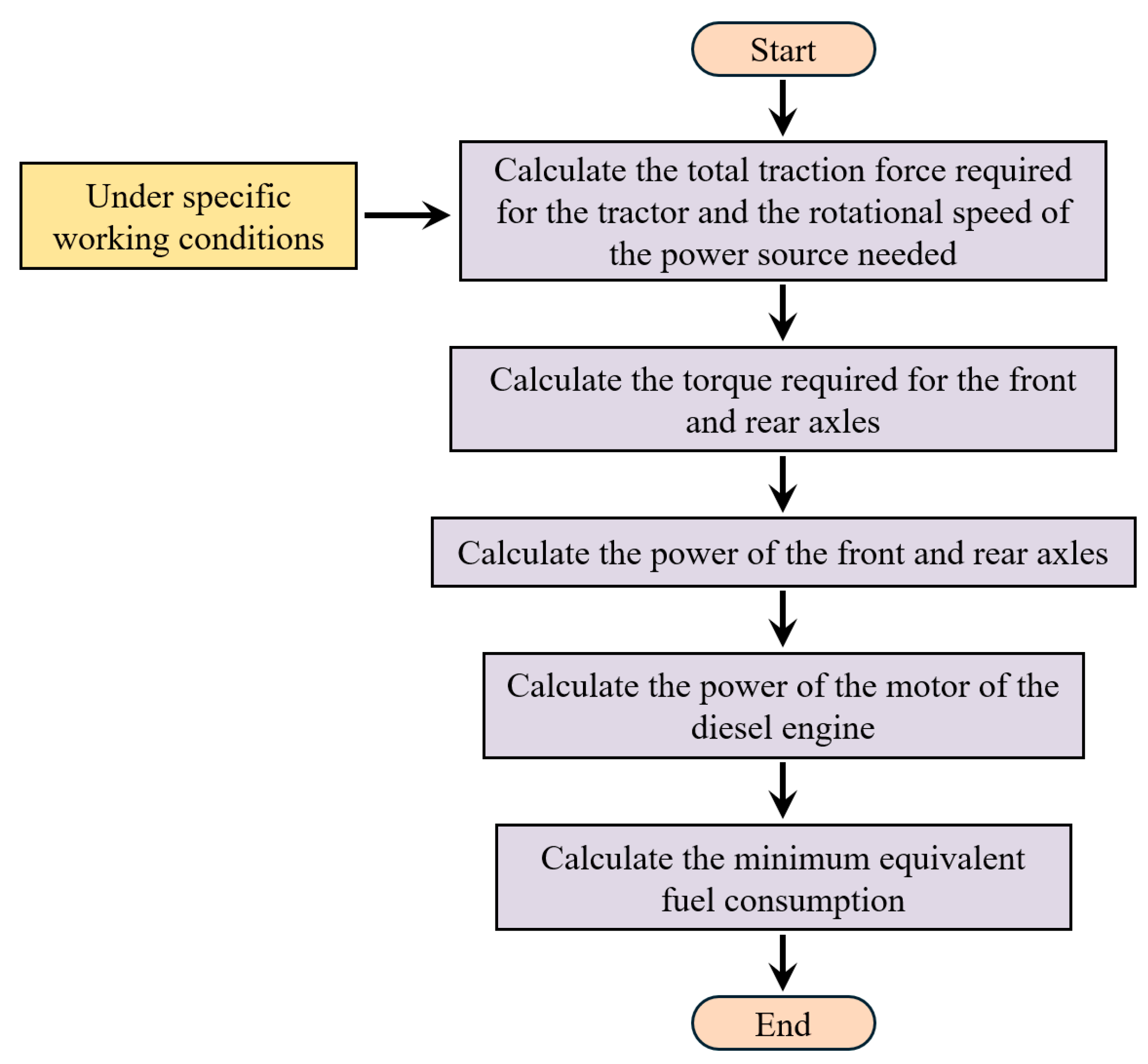
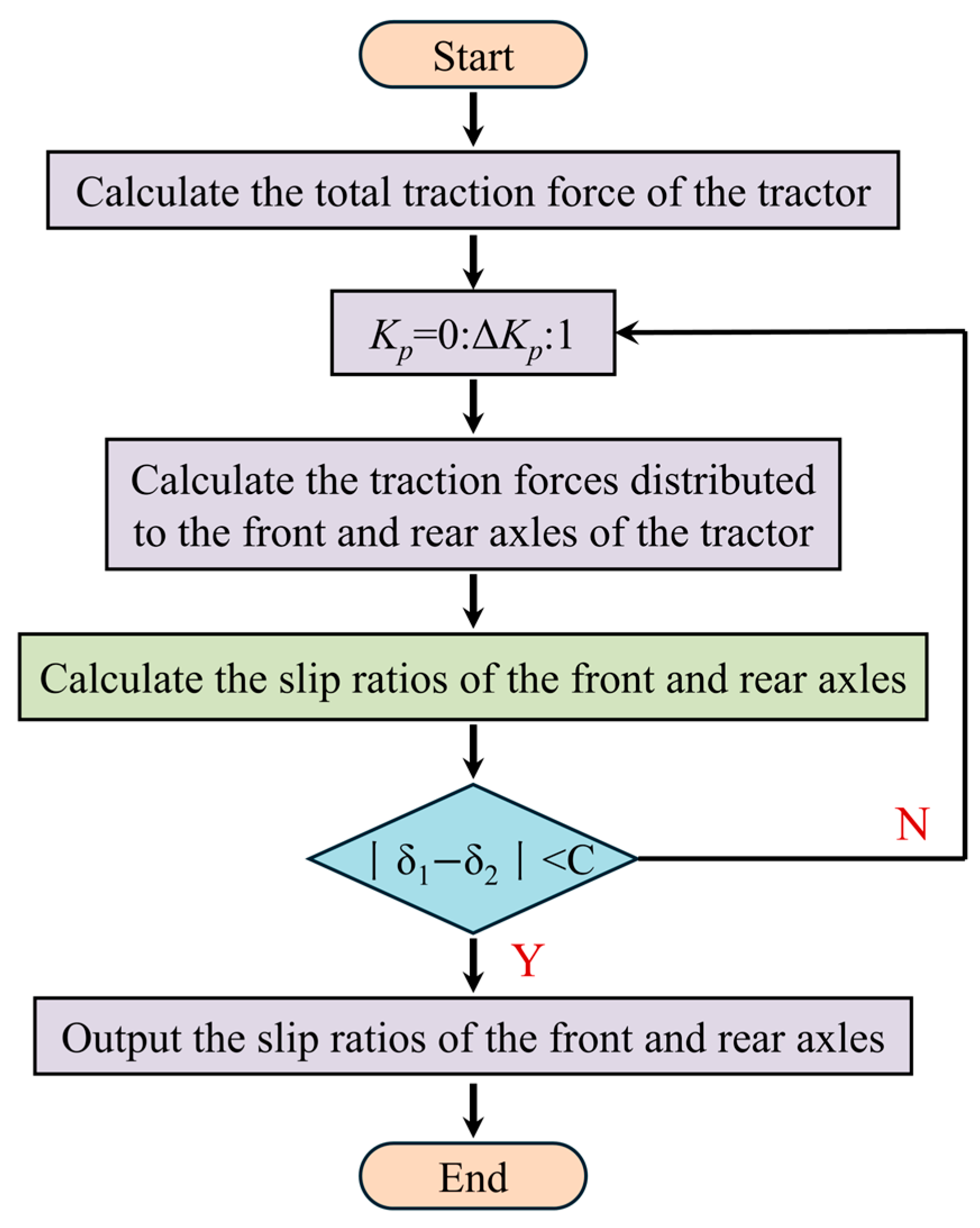
This method dynamically adjusts the distribution of traction force between the front and rear axles. As indicated by the 1.8 traction force–slip rate coupling model, the slip rates of the tractor’s front and rear axles are correlated with their corresponding traction forces. Therefore, the adaptive slip rate control method reduces the tractor’s slip rate by regulating the traction force distribution between the front and rear axles. Simultaneously, the tractor’s slip rate has a significant impact on the overall traction efficiency. When the front and rear axle slip rates are equal, the overall traction efficiency reaches its maximum. Consequently, this paper introduces a slip rate differential constraint mechanism. When the difference in the front–rear axle slip rates meets the preset conditions, the slip rates and traction forces of the front and rear axles are output. Through iterative optimization of the front and rear axle traction forces in each generation, the optimal slip rates and traction forces for the tractor’s front and rear wheels are ultimately determined. Subsequently, the tractor’s traction efficiency at this point is calculated. The flowchart of the slip rate adaptive control method is shown in Figure 7.
The implementation steps for the adaptive slip rate control method are as follows:
1. First, calculate the total traction force required by the tractor during operation.
2. Then, determine the current traction forces on the front and rear axles based on the traction force distribution coefficient.
3. Next, using the obtained traction forces for the front and rear axles, calculate the slip rates of the front and rear axles under the same characteristic slip rate and adhesion coefficient conditions.
4. Subsequently, determine whether the absolute value of the difference between the front and rear wheel slip rate of the i-th generation is less than the constant C (a constant with an extremely small value). If it is less than C, proceed to Step 5; otherwise, return to Step 2.
5. Finally, output the optimized front/rear axle slip rates ( δ 1 / δ 2 ) and front/rear axle traction forces ( F D 1 / F D 2 ).
Selection of the Constant C: The constant C in the judgment condition δ 1 −, < C serves as the convergence threshold for the iterative optimization of front and rear axle slip rates. Its value directly affects both the accuracy of achieving optimal traction efficiency and the computational speed of the algorithm. In this study, C is selected based on the following considerations: Physical meaning: The optimal traction efficiency condition requires that the front and rear axle slip rates be exactly equal ( δ 1 = δ 2 ,). However, in numerical optimization, achieving exact equality is neither practical nor necessary. Therefore, a small tolerance C is introduced to define an acceptable range of slip rate difference that still ensures near-optimal traction efficiency. Selection criteria: The value of C is chosen as a trade-off between optimization accuracy and computational efficiency. A smaller C yields slip rates closer to the theoretical optimum but increases the number of iterations and computation time. Conversely, a larger C speeds up convergence but may result in a slip rate difference that degrades traction efficiency. Empirical determination: Based on extensive simulations under varying soil conditions and load profiles, we found that setting C = 0.001 (i.e., 0.1% slip rate difference) consistently achieves traction efficiency within 99.5% of the theoretical maximum while maintaining fast convergence (typically within 5–8 iterations). This value has been validated across all test scenarios in this study.

3.3. Equivalent Consumption Minimization Strategy

The core of ECMS lies in the mapping relationship among “rear—axle traction force, slip rate, power demand, and torque distribution”. Under the constraints of the optimal slip rate and rear—axle traction force determined by traction efficiency optimization layer, ECMS dynamically optimizes the torque distribution ratio between the diesel engine and the PTO motor, as well as the speed ratio of the torque coupler. This optimization is aimed at minimizing the instantaneous equivalent fuel consumption while meeting the safe operating constraints of the power source [41].
To establish a clear mapping from the traction efficiency optimization layer to the energy management layer, this section first details how the optimal rear-axle slip rate δ 2 and traction force F D 2 are used to derive the required torque T r e q , speed n r e q , and power P r e q at the coupler input end. This derivation proceeds in the following logical steps:
Step 1: Determining rear wheel angular velocity from slip rate
Based on the definition of slip rate, the relationship between the actual travel speed v and the theoretical wheel speed v t is given by
v = v t ( 1 δ 2 )
where the theoretical speed is related to the rear wheel angular velocity ω w and tire radius r as v t = ω w r . Thus, the rear wheel angular velocity can be expressed as
ω w = v r ( 1 δ 2 )
Step 2: Calculating rear wheel driving torque
The torque required at the rear wheels to generate the traction force F D 2 is
T w = F D 2 r
Step 3: Back-propagating torque through the driveline
The rear wheel torque T w is transmitted through the final drive, transmission, and torque coupler. Let i f be the final drive ratio, i g the transmission ratio, and η t the overall driveline efficiency. The torque at the coupler output shaft T o u t is then
T o u t = T w i f i g η t
Step 4: Relating coupler output torque to input torque
The coupler input torque T r e q is the combined torque from the diesel engine and PTO motor, related to the output torque via the coupler efficiency η c :
T o u t = T r e q η c
Thus, the required coupler input torque becomes
T r e q = T o u t η c = F D 2 r i f i g η t η c
Step 5: Determining coupler input speed
The rotational speed at the coupler input shaft n r e q (in rpm) is obtained by multiplying the rear wheel angular velocity by the driveline ratios:
n r e q = ω w 2 π i f i g = v 2 π r ( 1 δ 2 ) i f i g
Step 6: Calculating required power
Finally, the required power at the coupler input end is given by
P r e q = T r e q n r e q 9550 ( in   kW )
This completes the derivation: starting from the optimal slip rate   δ 2 and traction force F D 2 provided by the traction efficiency optimization layer, combined with vehicle speed v , tire radius r , and driveline parameters, we obtain the required torque T r e q , speed n r e q , and power P r e q at the coupler input end. These quantities serve as the input constraints for the ECMS optimization, which then determines the optimal torque split between the diesel engine and the PTO motor, as well as the optimal torque coupler ratio i p c .
To achieve optimal traction efficiency, the drive torque at the traction motor end is given by Equation (32):
T f = F D 1 * r 1 i 0
The drive torque of the rear axle is given by Equation (33):
T r = F D 2 * r 2 i 0 i g
In the hybrid tractor, the front-axle drive is designed for traction only. The motor torque of the front axle is determined by a slip-rate adaptive algorithm, so there is no need for optimization. In contrast, the rear-axle drive combines a PTO motor with a diesel engine. Since the torques of both the PTO motor and the diesel engine are unknown, it is necessary to optimize the torques of both the diesel engine and the motor. When the tractor is powered by the combined operation of the diesel engine and the PTO motor, the required torque and speed at the power-coupling end are presented in Equation (34):
T v = T r + I ω ω ˙ ω + ( I e ω ˙ e + I r ω ˙ r i p c ) i g i 0 i g i 0 i c η d N v = i g i 0 v 0.377 r 2 δ 2
where T v is the torque at the torque coupler end; i p c is the torque coupler speed ratio; I r is the rotational inertia of the PTO motor; ω ˙ r is the angular acceleration of the PTO motor; ω ˙ ω is the angular acceleration of the diesel engine; I ω is the rotational inertia of the diesel engine.
During the optimization process, the power of the diesel engine and the PTO motor in the hybrid tractor are expressed as shown in Equations (35) and (36):
P e = T e n e 9550 η e
P p = T p N p 9550 η p
where P e represents the power of the diesel engine; P p represents the power of the PTO motor.
The equivalent fuel consumption during the operation of the hybrid tractor can be represented by Equation (37):
Q t = 0 t f Q f t + κ γ b P p t γ e η b a t d t
where Q f ( t ) = f e P e 1000 × 3600 × 0.84 ; κ is the equivalence factor; γ b is the electrical energy released per kilowatt-hour; γ e is the thermal energy released per liter of fuel; P b is the motor power; η b a t is the battery charge/discharge efficiency; η p is the traction motor efficiency.
The equivalent factor of ECMS is adjusted using an adaptive method. κ is dynamically adjusted according to the system state SOC to maintain the overall energy balance. When the SOC deviates from the target value, κ is increased or decreased to facilitate charging or discharging [42,43].
κ ( t ) = κ 0 + K p ( S O C r e f S O C ( t ) )
where K p is the proportionality coefficient, which is designed based on Lyapunov stability theory, and S O C r e f is the reference value of SOC.
The choice of the torque coupler speed ratio has a significant impact on the overall energy consumption of the machine. Therefore, it is necessary to optimize this ratio. We set the range of the torque coupler speed ratio to (0, 4). Then, the objective function is defined as presented in Equation (39), aiming to minimize the equivalent fuel consumption:
Q c = min ( Q = f ( i p c , P e , P p ) )
To ensure the safe operation of diesel engines and electric motors, the following limitations must be considered, as shown in Equation (40):
T e min T e T e max N e min N e N e max T p min T p T p max N p min N p N p max
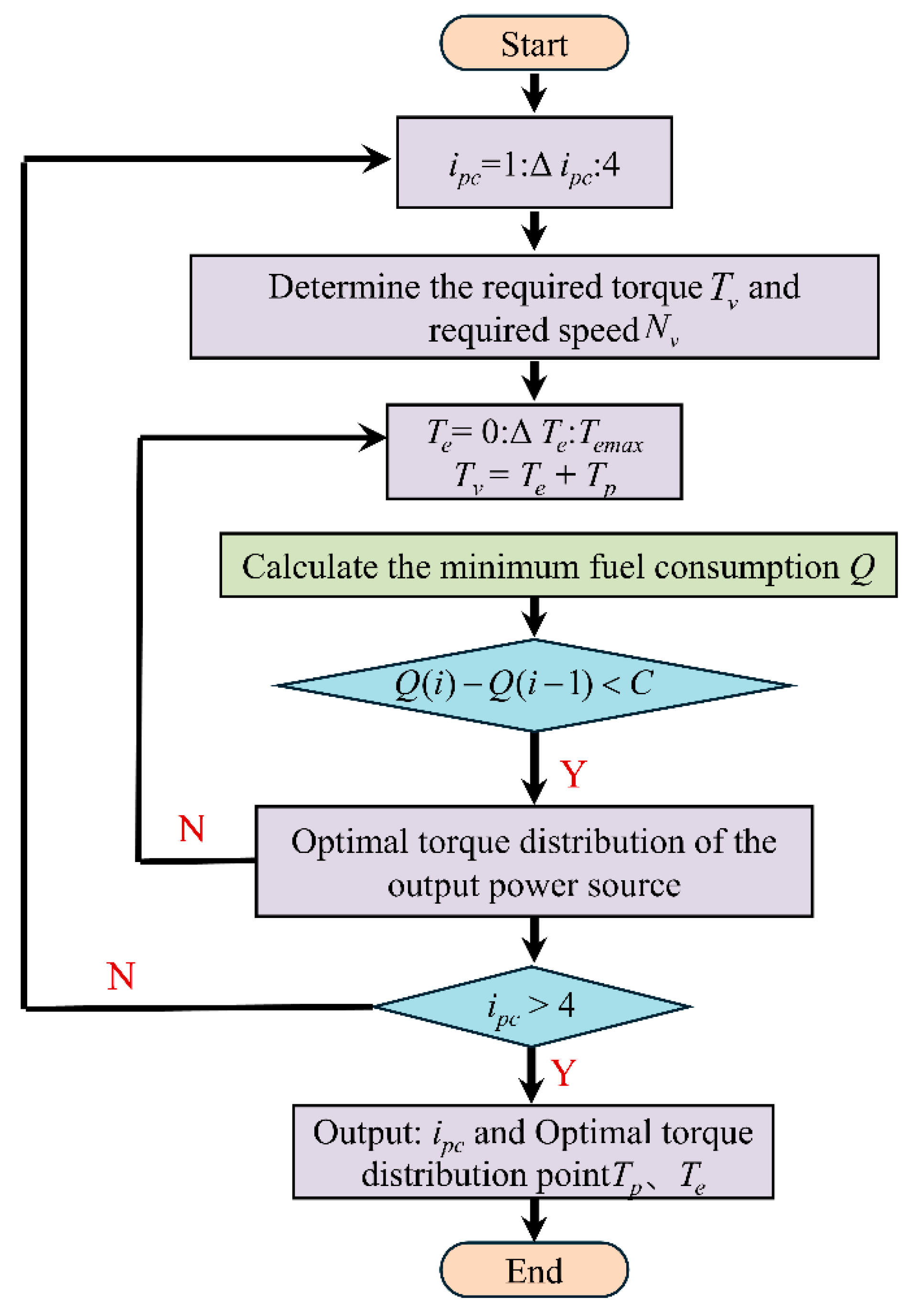
The specific steps are as follows (the solution process is shown in Figure 8):
1. First, allocate the torque-coupler transmission ratio. Then, the adaptive slip rate method will output the optimal slip rate and rear-axle traction force. Next, use Equation (11) to calculate the speed Nv and torque Tv at the power-coupling end, thus defining the power-output requirements.
2. Subsequently, based on the power-coupling end speed Nv, refer to a lookup table to determine the maximum torque Temax at the diesel-engine end and the maximum torque Tpmax at the motor end.
3. Then, calculate the instantaneous equivalent fuel consumption under the current torque coupling ratio and torque distribution ratio.
4. Next, determine whether the constraint conditions are satisfied: check if the absolute value of the difference between the minimum fuel consumption of the n-th generation and the equivalent fuel consumption of the (n − 1)-th generation is less than C (where C is a constant with an extremely small value). If these conditions are satisfied, proceed to Step 5; if not, return to Step 2 and restart the process.
5. Finally, after iterating through all possible torque-coupler ratios, output the optimal torque distribution between the diesel engine and the PTO motor of the hybrid tractor, along with the optimal torque-coupler ratio.

3.4. Comparative Method Design

To validate the effectiveness of the designed hierarchical cooperative control method, this paper chooses the fixed coordinated traction force one-step allocation method as a comparison approach. In contrast to the proposed hierarchical cooperative control method, the fixed coordinated traction force one-step allocation method adopts a fixed proportional distribution for the traction force allocation between the front and rear axles. This fixed proportion is determined by the tractor’s axle load distribution. At the rear-axle power coupling end, a fixed power allocation method is used to control the diesel engine and the electric motor. Additionally, a power coupling device with a fixed transmission ratio is utilized, which obviates the need for optimizing the torque coupler transmission ratio. The fixed coordinated traction force one-step allocation method is shown in Figure 9.
(1) Based on the vehicle speed v and the driving resistance (as shown in Equation (2)), the total traction force required by the tractor during the working process and the required rotational speed of the power source are calculated, as presented in Equations (11) and (12).
(2) Determine the required torque for the front and rear axles based on the traction force distribution ratio.
(3) Calculate the power of the front and rear axles based on the rotational speed and torque required by the power source.
(4) Calculate the power of the diesel engine and the PTO motor under the fixed power distribution ratio.
(5) Compute the equivalent fuel consumption Q of the tractor using Equation (28).

4. Results

4.1. Simulation Validation

To verify the effectiveness of the proposed parameter design method, a simulation model was built using MATLAB. Prior to starting the simulation, all data were initialized, and tractor parameter information along with the measured operating condition data was fed into the system. The simulation step size was set at 1 s.
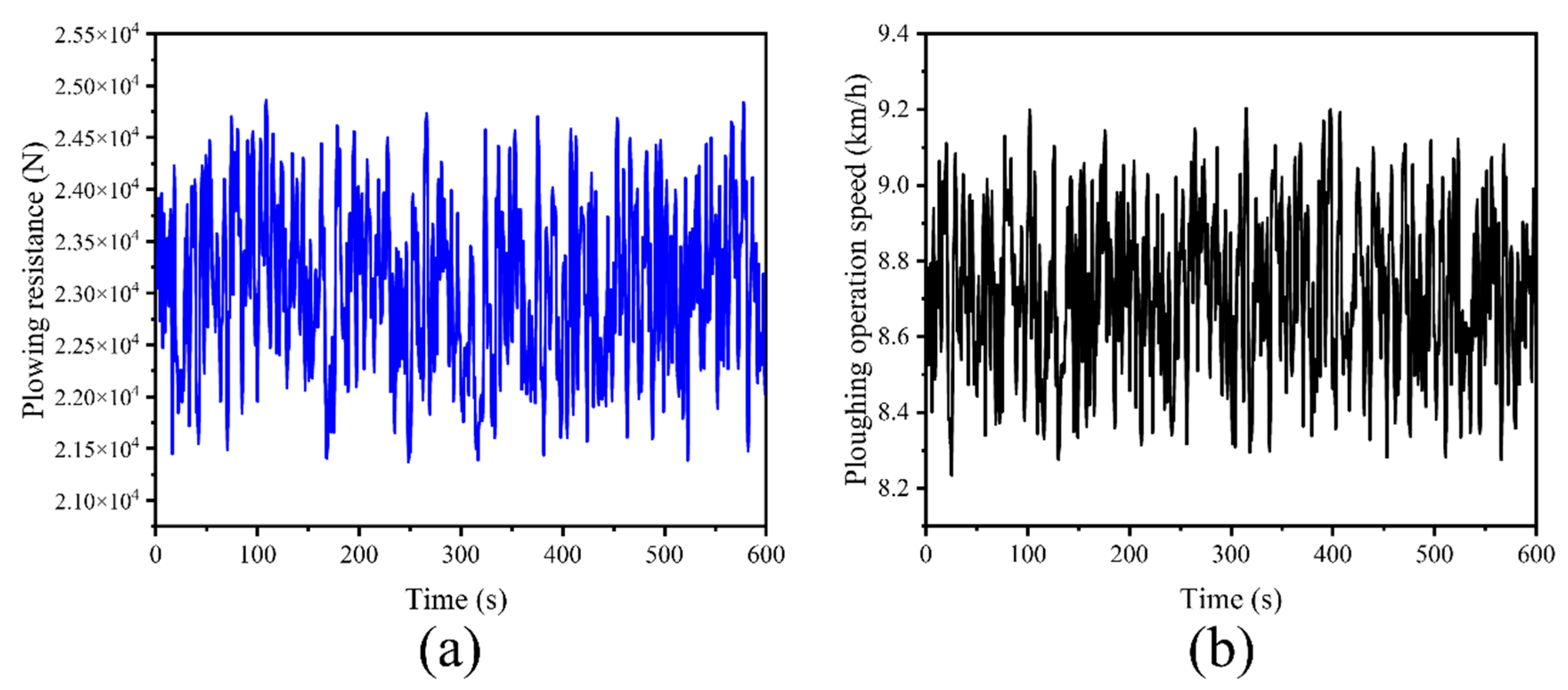
Actual test data from tractor plowing operations were chosen as the load to simulate the plowing conditions of a dual-axle hybrid tractor in hilly terrain. These measured data were then input into the simulation model. The measured plowing operation data are presented in Figure 10:
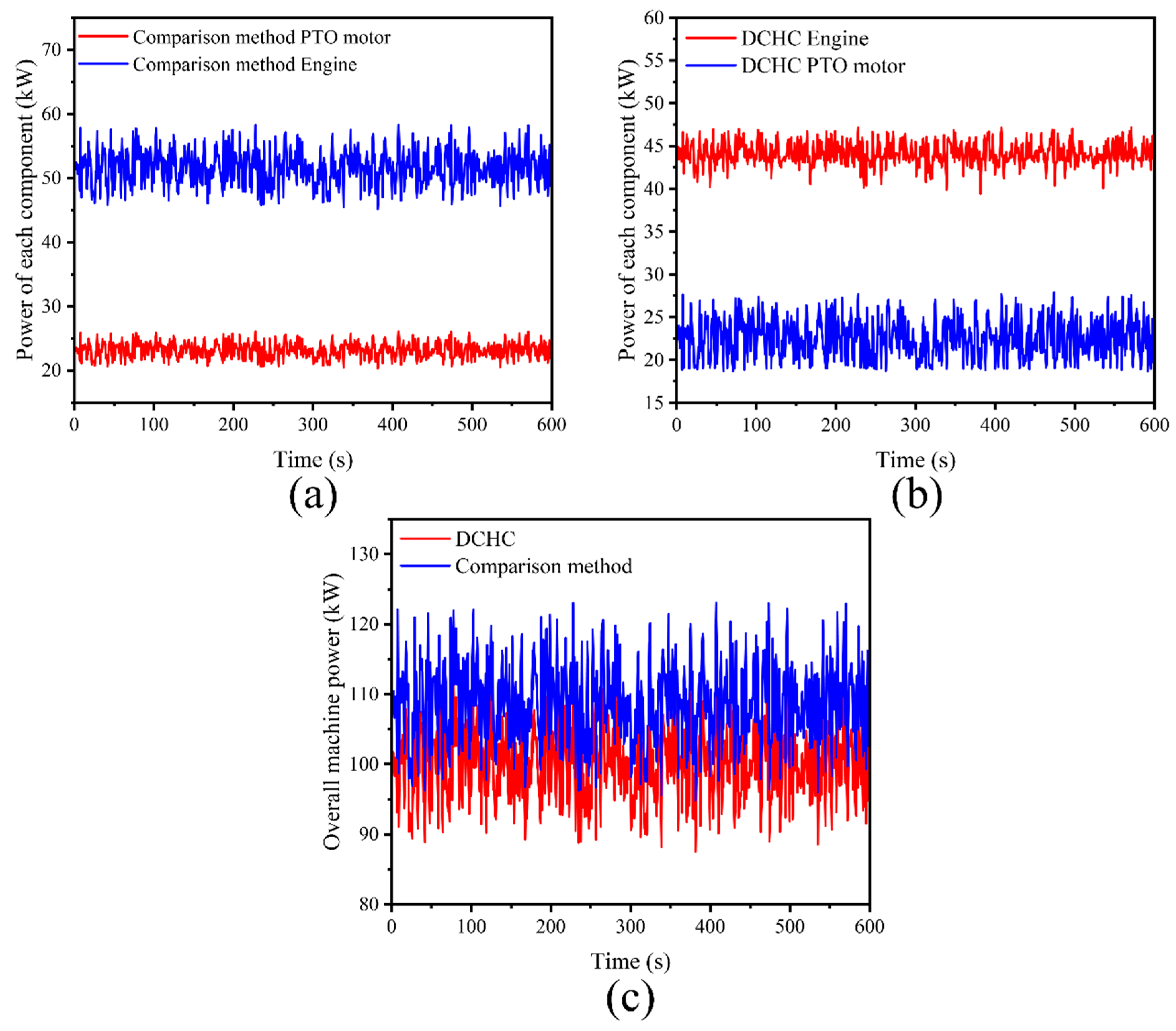
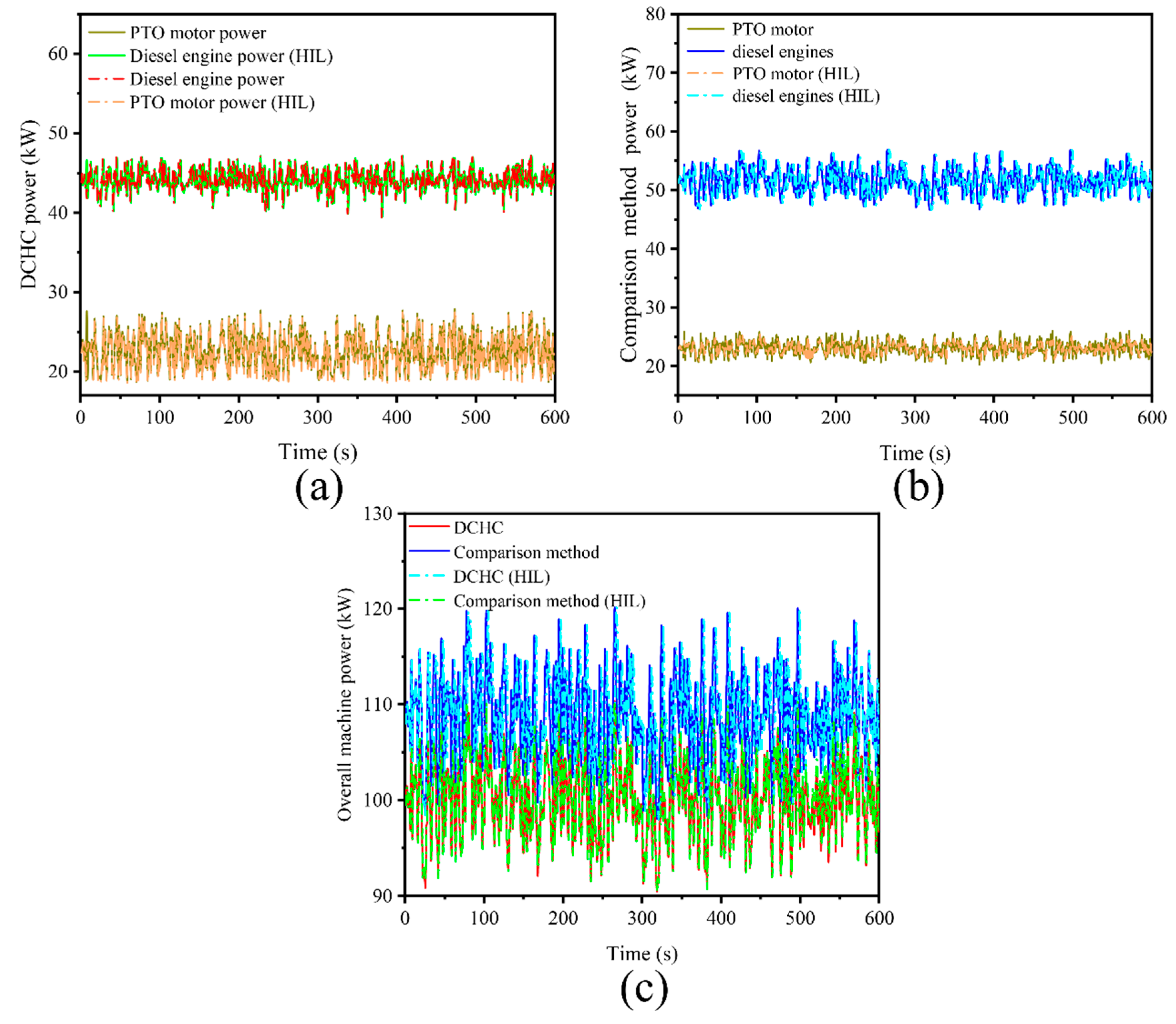
When the dual-axle drive hybrid tractor is plowing on hilly terrain, Figure 11 shows the power output of each power source under two control methods. Specifically, Figure 11a presents the power distribution of each component under the fixed coordinated traction force one-step allocation method, and Figure 11b illustrates the power distribution of each component under the DCHC method. The results show that, under the DCHC method, the diesel engine has an average power output of 44.0798 kW and the PTO motor has an average power output of 22.5 kW. In contrast, through the fixed coordinated traction one-step allocation method, the diesel engine averages at 51.682 kW and the PTO motor averages at 23.09 kW. Compared with the fixed coordinated traction one-step allocation method, the DCHC method reduces the diesel engine’s power by 14.71% and increases the PTO motor’s power by 2.5%. This is because the diesel engine operates inefficiently under low-load conditions, while the motor operates more efficiently at low loads. The ECMS aims to minimize the equivalent fuel consumption by reducing the diesel engine’s power output and increasing the PTO motor’s power output. Figure 11c shows the total system power under both methods. The results indicate that the DCHC-optimized hybrid tractor has an average total system power of 101.38 kW, while the fixed coordinated traction one-step allocation method results in an average of 109.82 kW. The DCHC method reduces the total system power by an average of 7.7% compared to the conventional design. This reduction is due to the DCHC method’s capability to continuously adjust the torque of each power source to adapt to the current load and environmental conditions. This ensures that all power sources operate within their high-efficiency ranges, allowing for quick decision-making on optimal power allocation during operational changes to minimize redundant energy losses. Meanwhile, by controlling the traction of the front and rear axles to reduce slip rates, the method improves the overall traction efficiency, which in turn reduces power losses during tractor operation and achieves an optimized reduction in total power consumption.
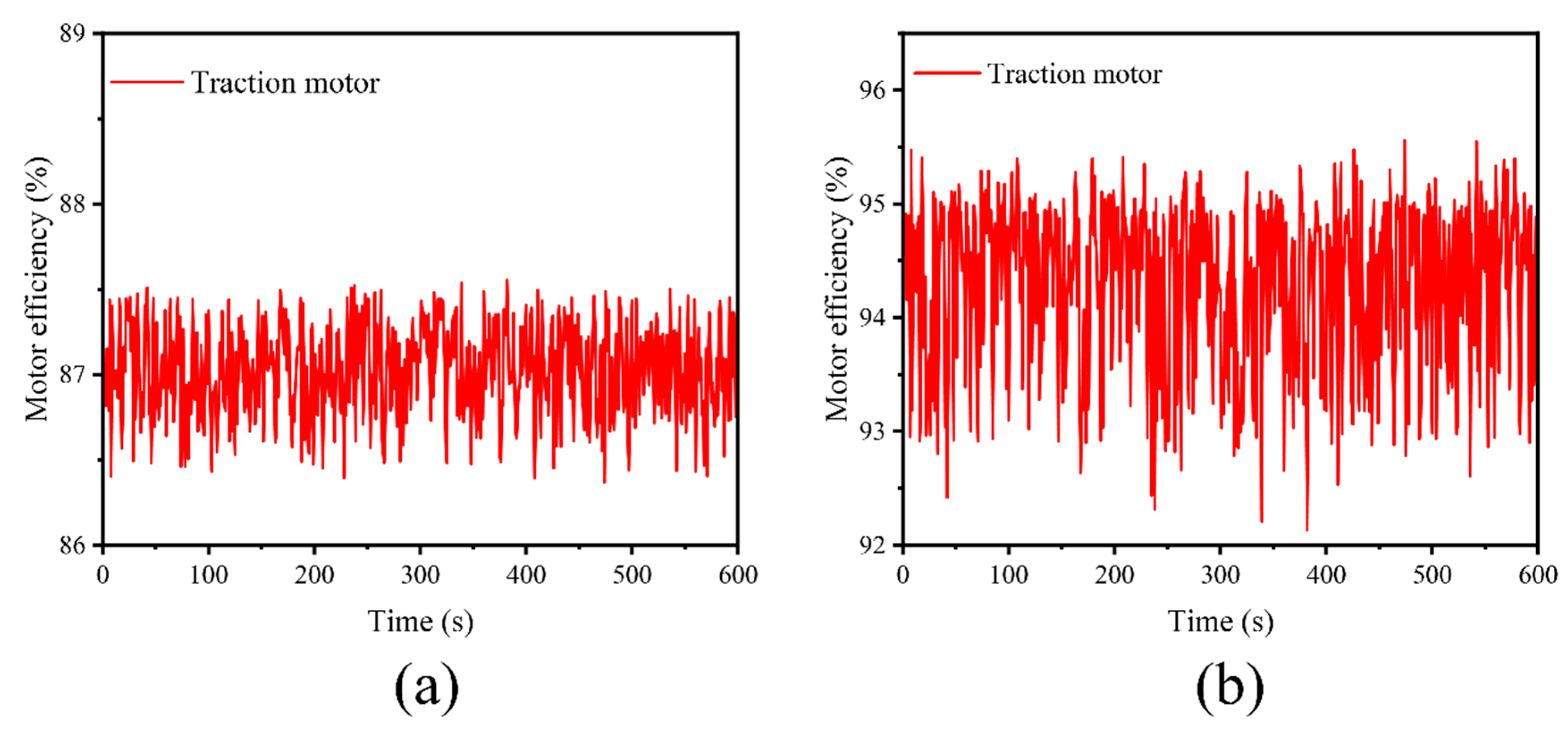
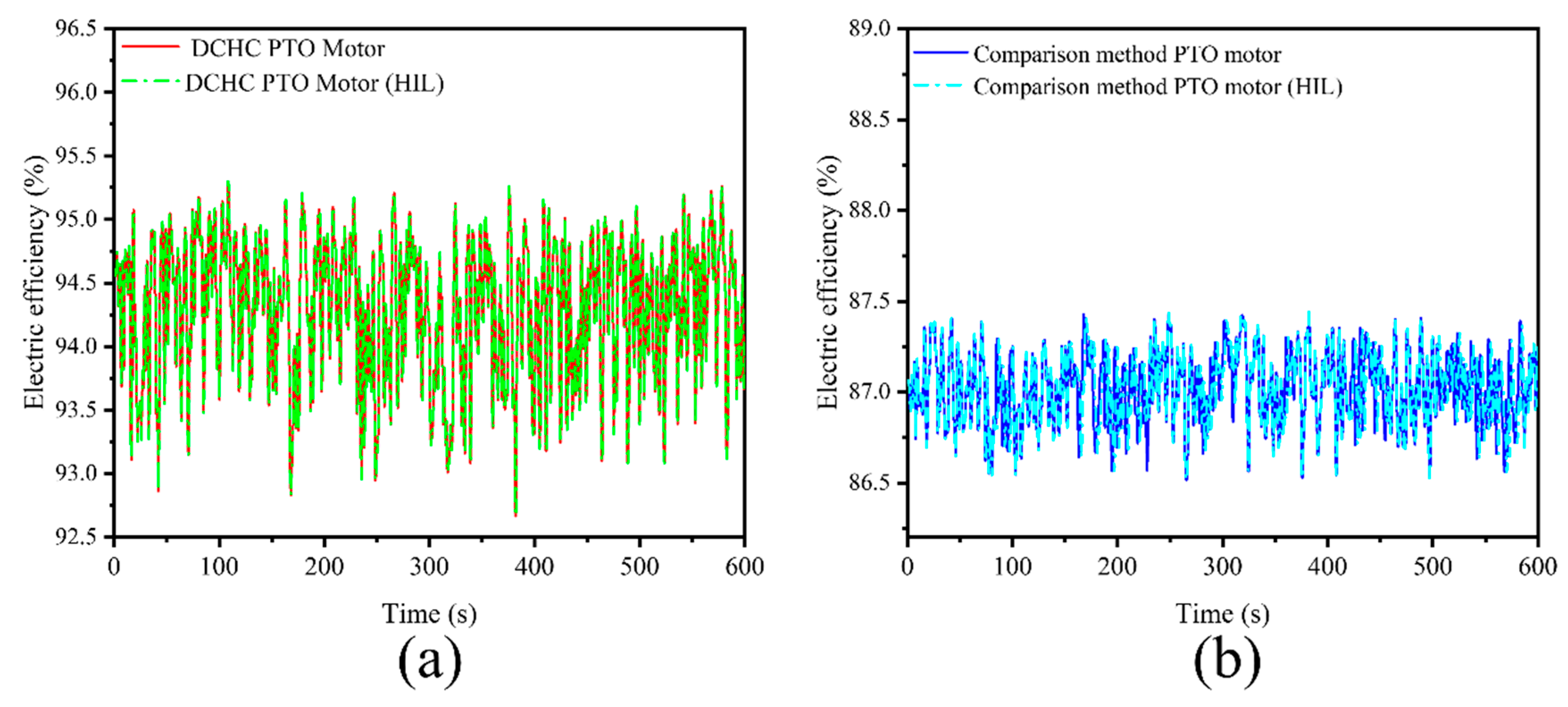
In terms of motor efficiency, Figure 12 presents the efficiency curves of the PTO motor under two control methods. Under the fixed coordinated traction force one-step allocation method, the PTO motor had an average efficiency of 87.13%. In contrast, under the DCHC method, the PTO motor achieved an average efficiency of 94.29%. Compared with the fixed coordinated traction one-step allocation method, the PTO motor efficiency under the DCHC method increased by an average of 8.27%. This improvement is attributed to the DCHC method’s capability to monitor the motor’s operating conditions in real-time and dynamically adjust the voltage, current, or frequency. This enables precise adaptation to instantaneous operational demands, eliminating the “over-supply” or “under-supply” issues caused by load fluctuations in conventional tractors during operation. As a result, the motor efficiency is improved.
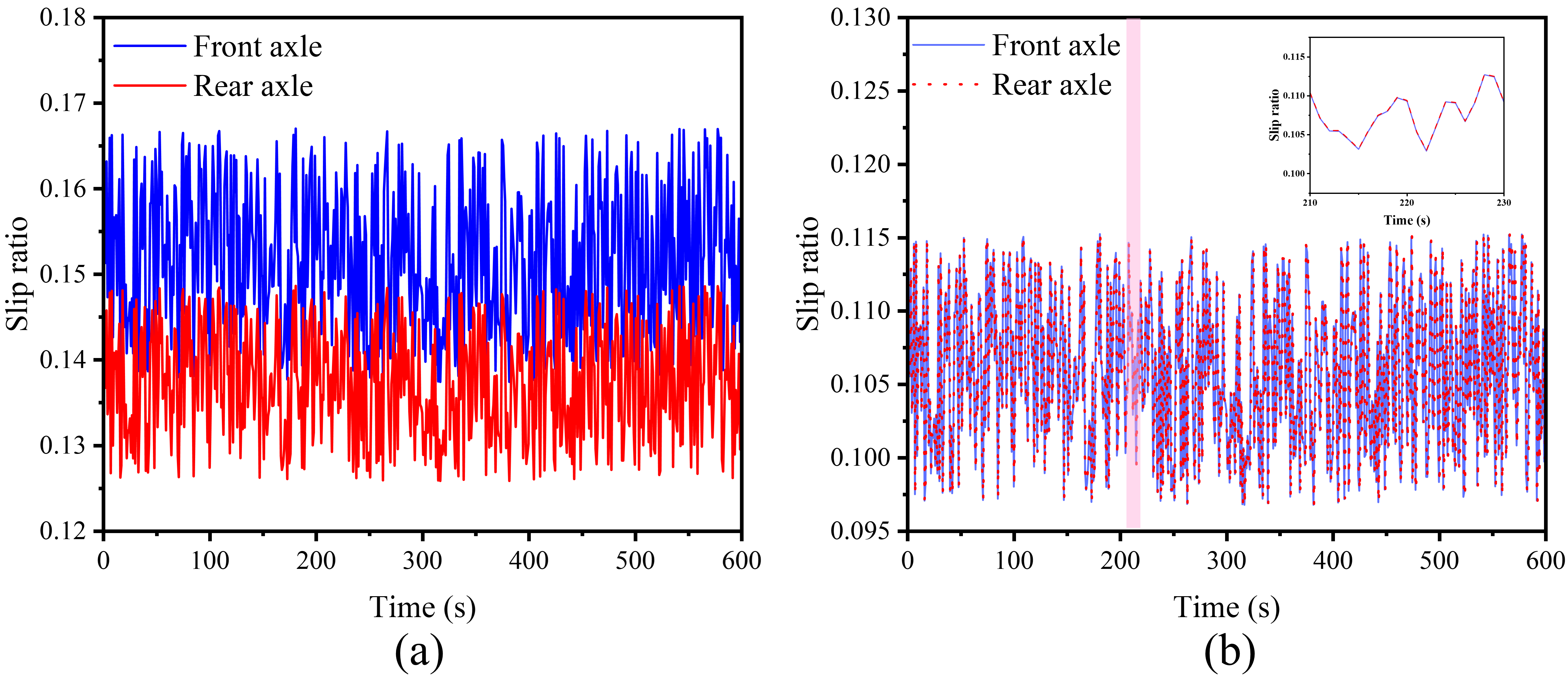
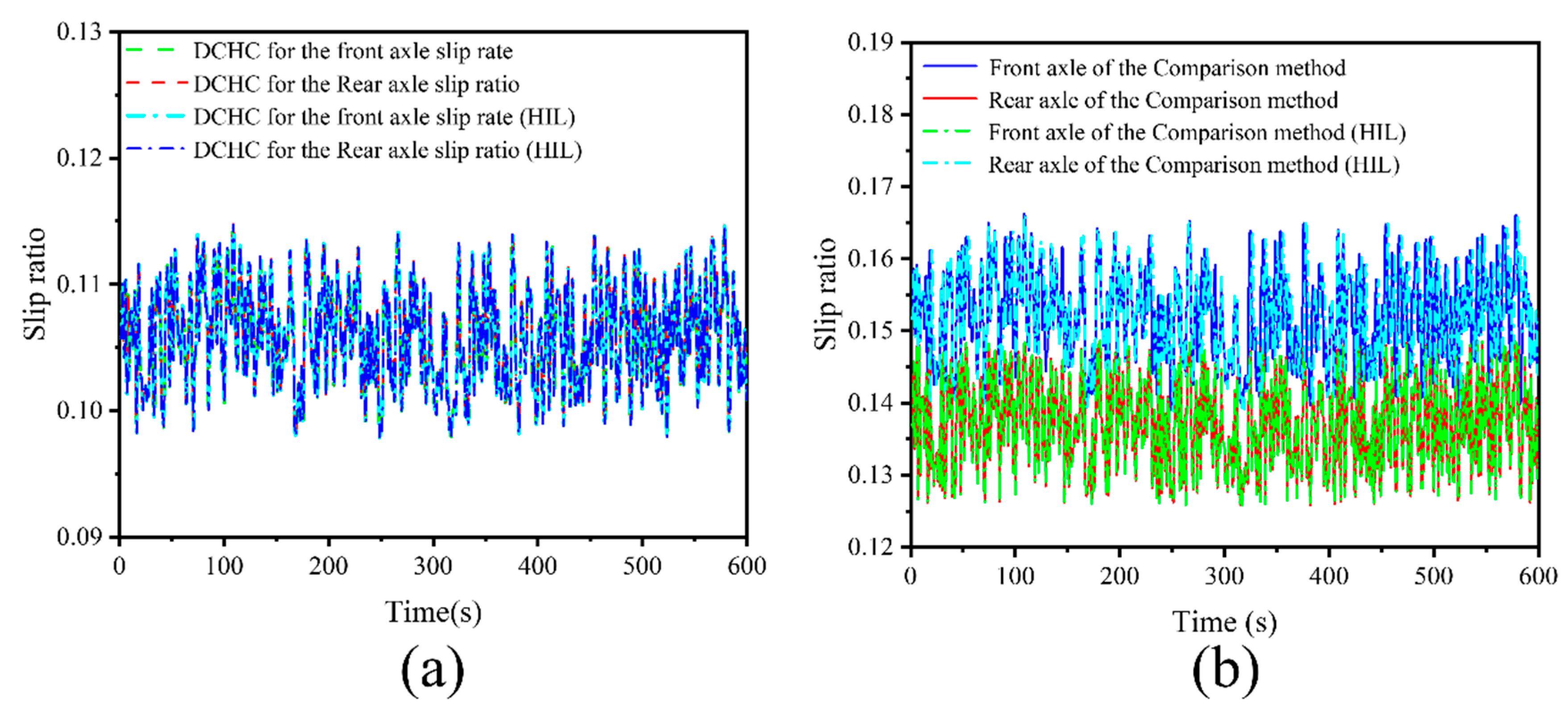
Figure 13 presents the slip rates of a dual-axle drive hybrid tractor operating in hilly terrain under two strategies. As shown in Figure 13a, the front-axle slip rate under the fixed coordinated traction force one-step allocation method is around 15.12%, and the rear-axle slip rate is around 13.79%. Figure 13b illustrates the slip rates of the front and rear axles of the hybrid tractor under the DCHC method. The average front-axle slip rate is 10.17%, which means a 32.73% reduction compared with the conventional design. Meanwhile, the average rear-axle slip rate is 10.16%, indicating a 26.32% reduction compared with the conventional design. This phenomenon occurs because, according to Equation (12) under the DCHC method, the distribution of traction force between the front and rear axles has a significant impact on their slip rates. By reasonably allocating the traction force between the tractor’s front and rear axles, the slip rates of both axles can be effectively decreased.
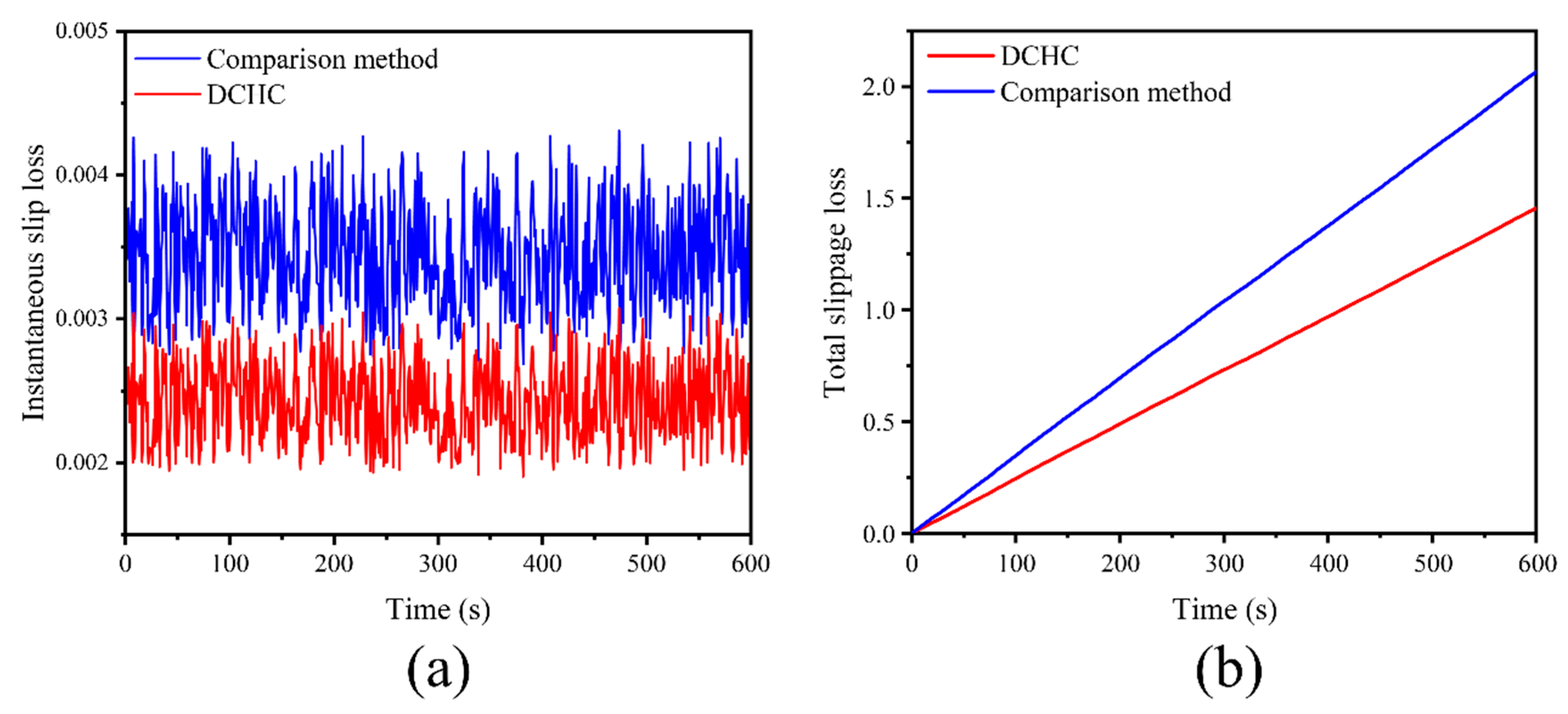
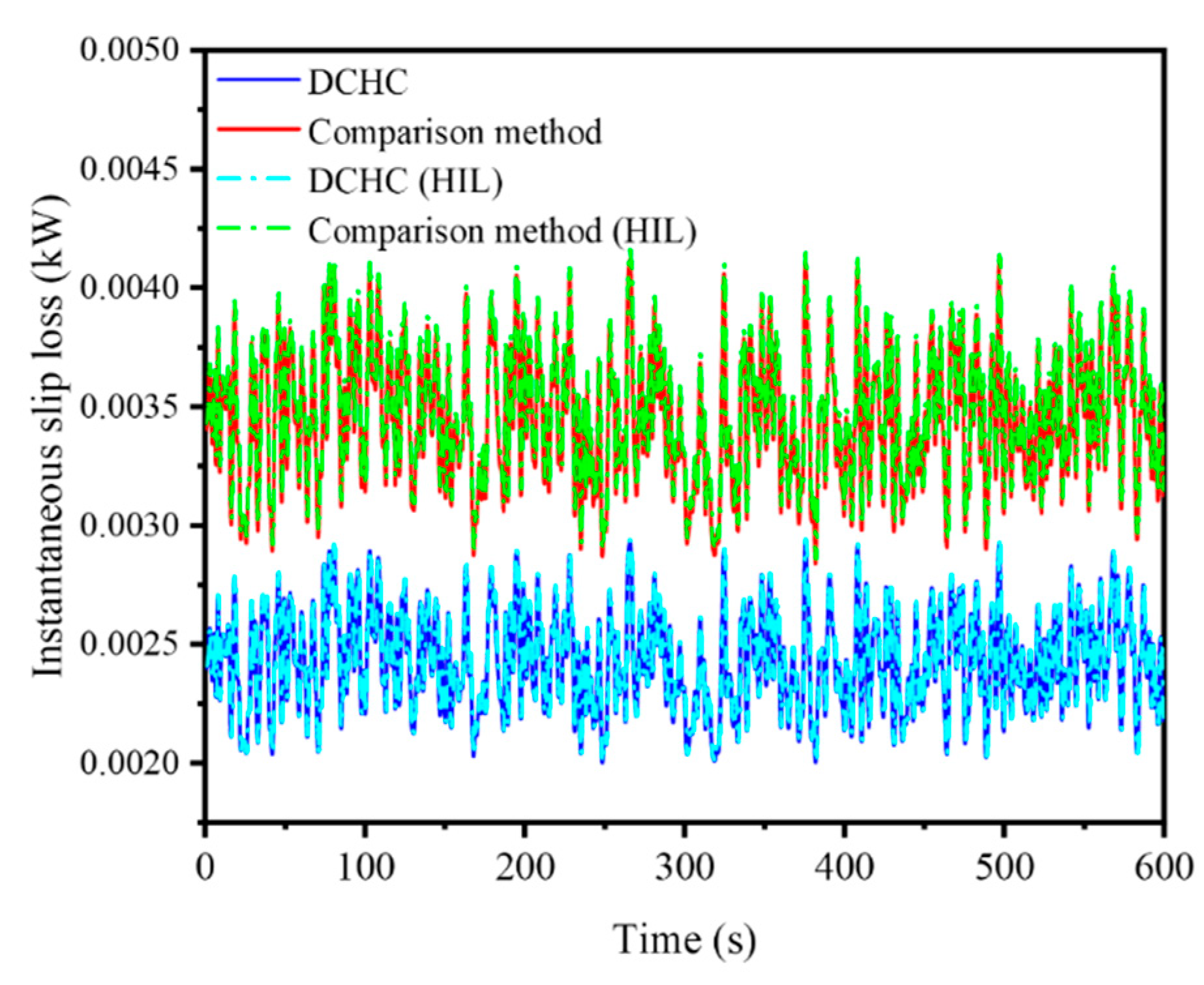
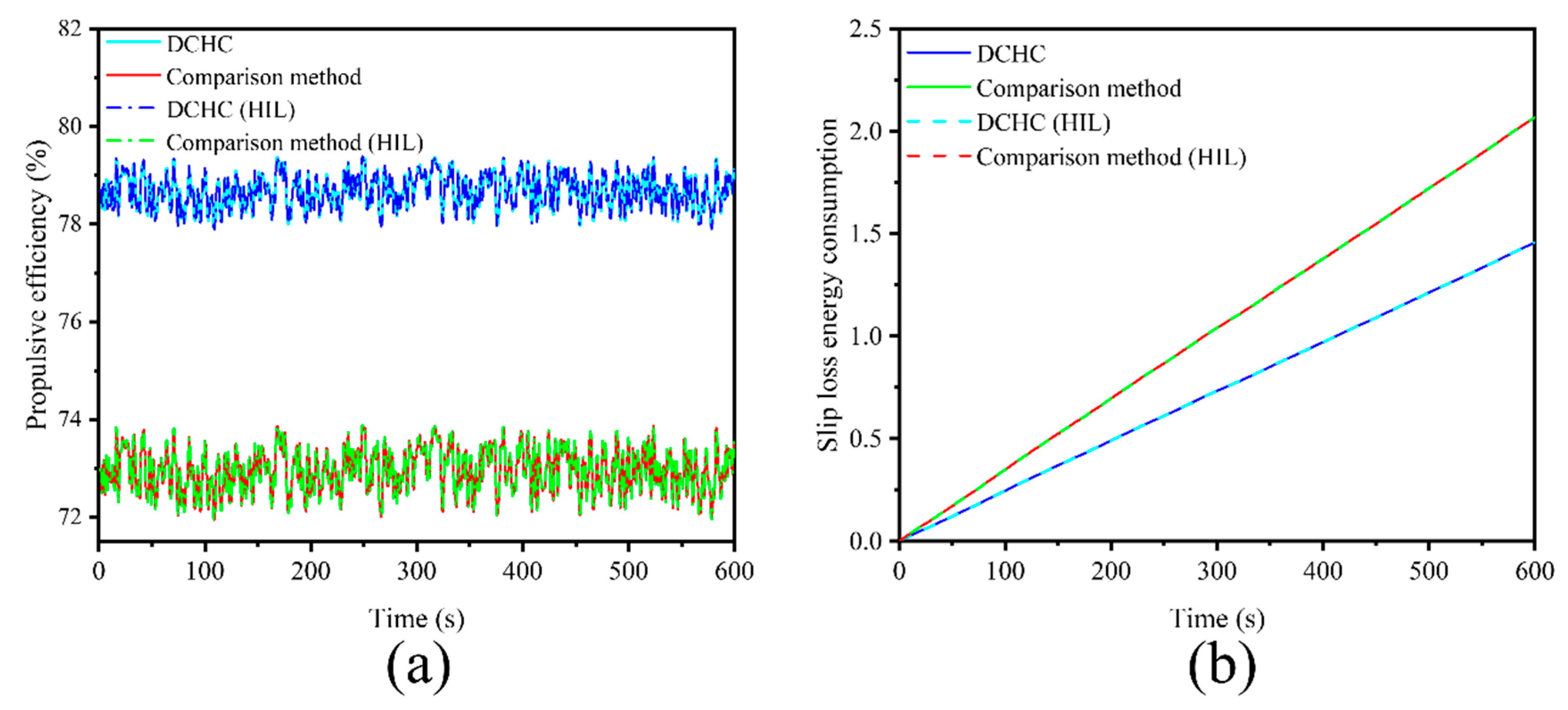
Figure 14a presents the instantaneous slip rate losses of the dual-axle drive hybrid tractor under two control methods. For the fixed coordinated traction force one-step allocation method, the average instantaneous slip loss is 0.0036 kW, whereas for the DCHC method, it is 0.0024 kW. Figure 14b depicts the total slip loss of the hybrid tractor during operation. The average total slip loss for the fixed coordinated traction one-step allocation method is 2.067 kW, while that for the DCHC method is 1.455 kW.
Compared with the fixed coordinated traction force one-step allocation method, the DCHC method reduces slip loss consumption by 29.6%. This reduction can be attributed to the fact that the DCHC method adjusts the traction forces of both the front and rear axles, which in turn lowers their slip rates and consequently reduces the tractor’s slip loss power. When the slip rate changes, the adaptive slip rate control algorithm achieves effective slip regulation by adjusting the traction force distribution between the front and rear axles. Specifically, the rear axle traction force is primarily provided by the diesel engine and the PTO motor. Based on this, the required traction force at the rear axle is transmitted via the adaptive slip rate control algorithm to the equivalent consumption minimization strategy for the rear axle. In combination with the current tractor speed, this strategy optimally distributes the output torque between the diesel engine and the motor to minimize overall equivalent fuel consumption. This approach not only ensures stable slip rate control but also optimizes energy utilization efficiency.
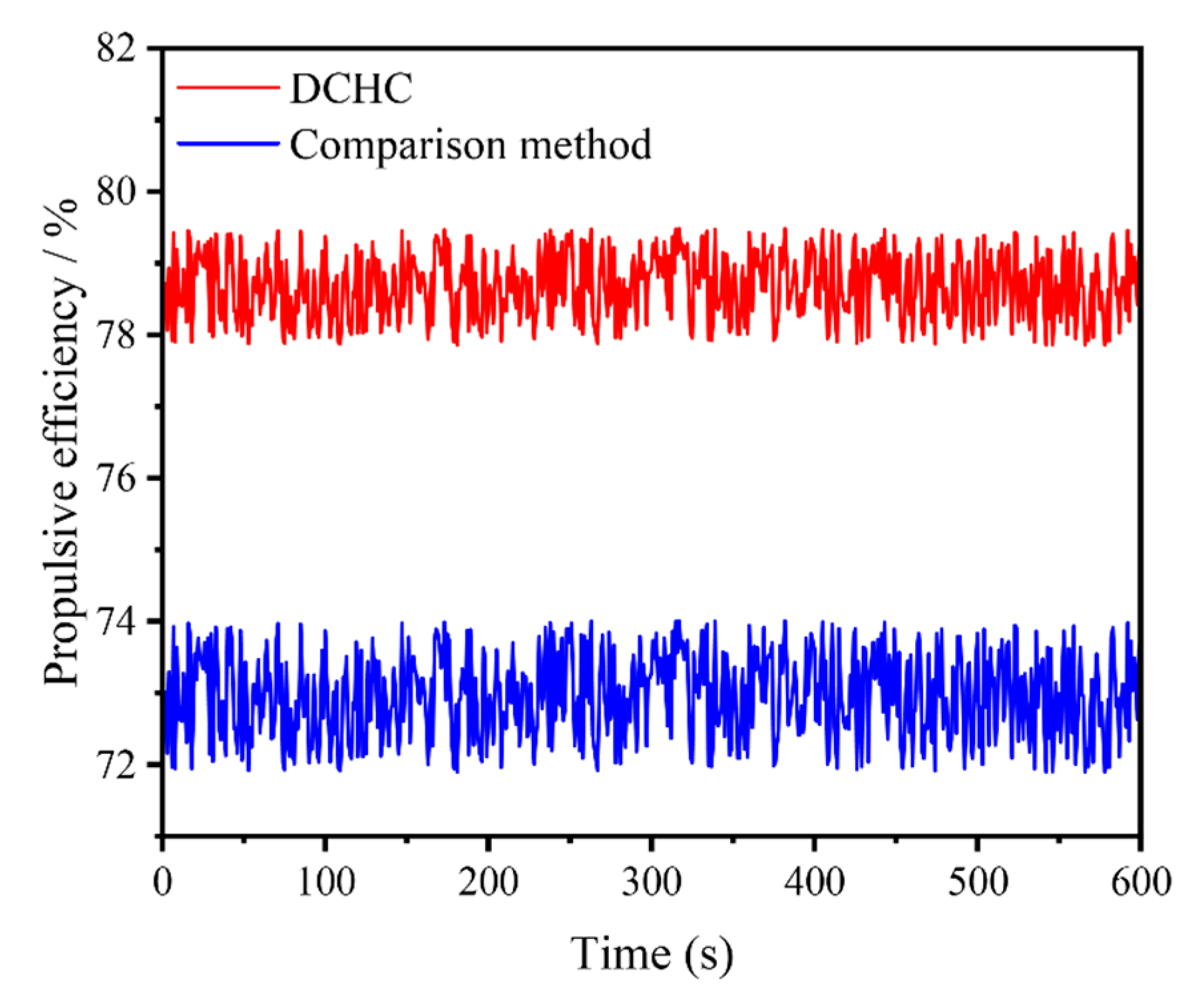
Figure 15 illustrates the traction efficiency of the dual-axle hybrid tractor under two control methods. The fixed coordinated traction force one-step allocation method yields an average traction efficiency of 0.724, whereas the DCHC method attains an average of 0.787. When compared with the fixed coordinated traction force one-step allocation method, the DCHC method enhances the overall traction efficiency by 8.7%. As indicated in Equation (15), this improvement can be ascribed to the fact that the DCHC method distributes the traction force to minimize the slip rate difference between the front and rear axles, consequently boosting the tractor’s overall traction efficiency.
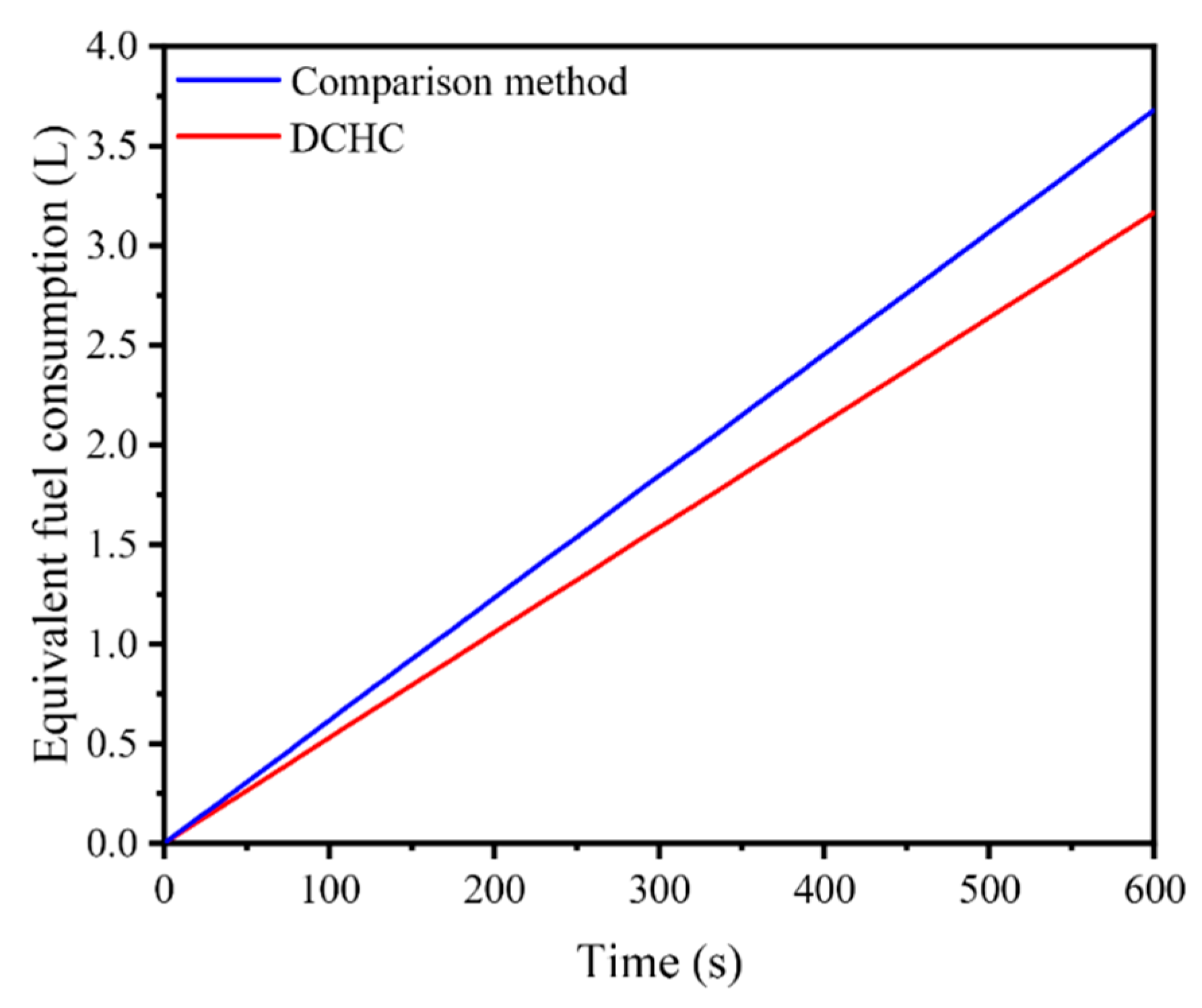
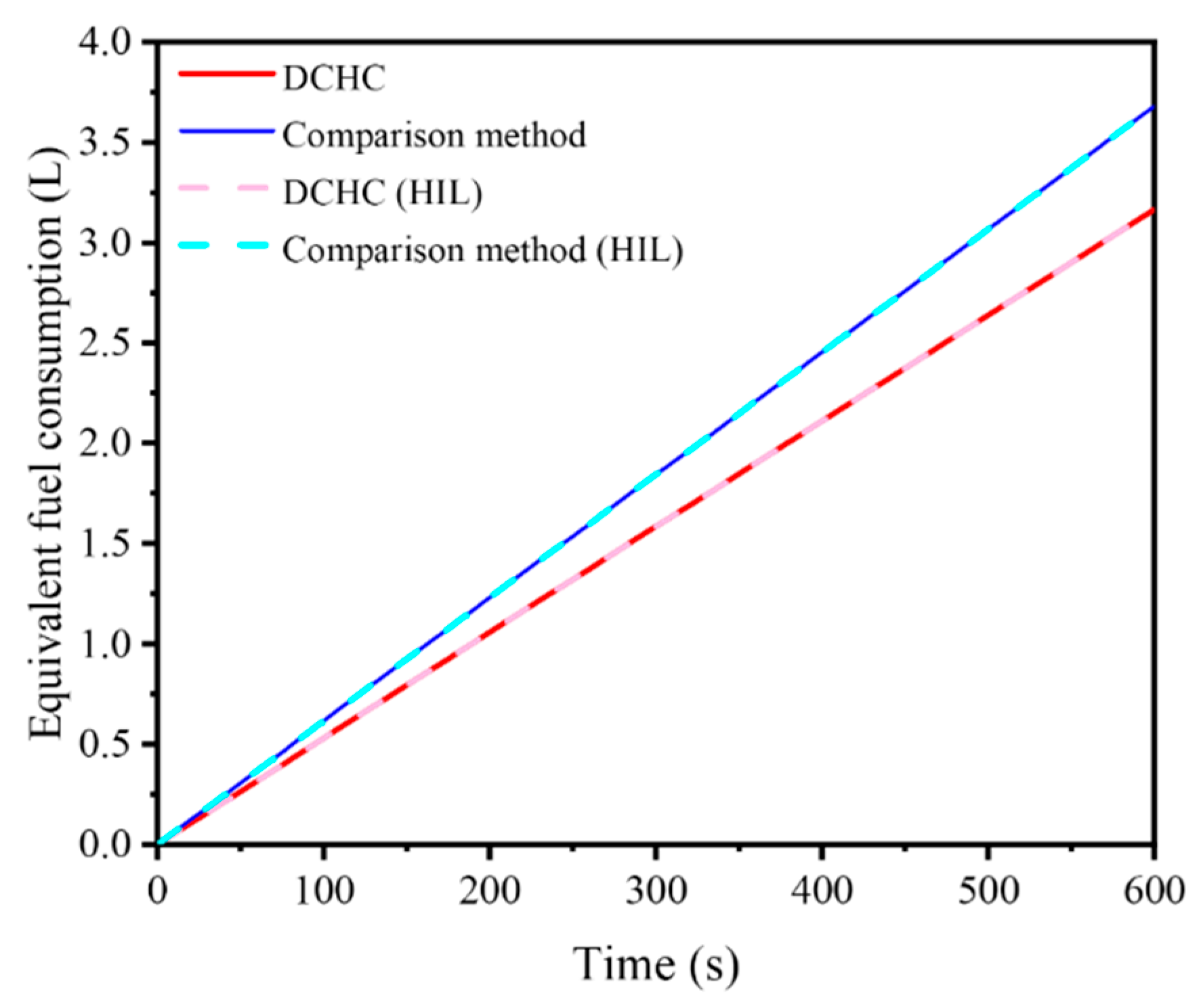
Figure 16 presents the equivalent fuel consumption of the dual-axle drive hybrid tractor under two control methods. For the fixed coordinated traction one-step allocation method, the average equivalent fuel consumption is 3.68 L, whereas the DCHC method has an average of 3.15 L. Compared with the fixed coordinated traction one-step allocation method, the DCHC control method attains an average reduction of 14.4% in equivalent fuel consumption. This improvement can be ascribed to the DCHC’s capacity to dynamically coordinate the torque distribution ratios and operating modes between the diesel engine and the electric motor according to the hybrid tractor’s workload, driving conditions, and battery status. This ensures that both power sources operate continuously within their most fuel-efficient regions. Meanwhile, the adaptive slip rate method enhances the overall traction efficiency by rationally allocating the traction forces of the front and rear axles. As a result, the slip rates of both axles are reduced, minimizing the energy loss during the tractor’s operation and thus improving the fuel economy.
In summary, the analysis of the simulation results for tractor plowing operations indicates that the DCHC method can reduce the slip rates of the front and rear axles by adjusting the traction force distribution between them. This minimizes the slip losses during the tractor’s operation and controls the slip rate difference between the axles to achieve the optimal traction efficiency conditions, effectively enhancing the overall traction efficiency of the tractor. In terms of fuel economy, this approach ensures that both the electric motor and the diesel engine operate within their optimal efficiency regions, thereby improving the power source efficiency and reducing the tractor’s equivalent fuel consumption. In contrast, the fixed coordinated traction one-step distribution method allocates the overall power and the front/rear axle traction forces according to a fixed ratio. When the tractor operates on complex terrain, the slip rates of the front and rear wheels increase significantly, leading to increased slip losses, reduced overall traction efficiency, and poor power performance. Meanwhile, the electric motor and the diesel engine operate in low-efficiency regions, resulting in higher overall equivalent fuel consumption.

4.2. HIL Validation

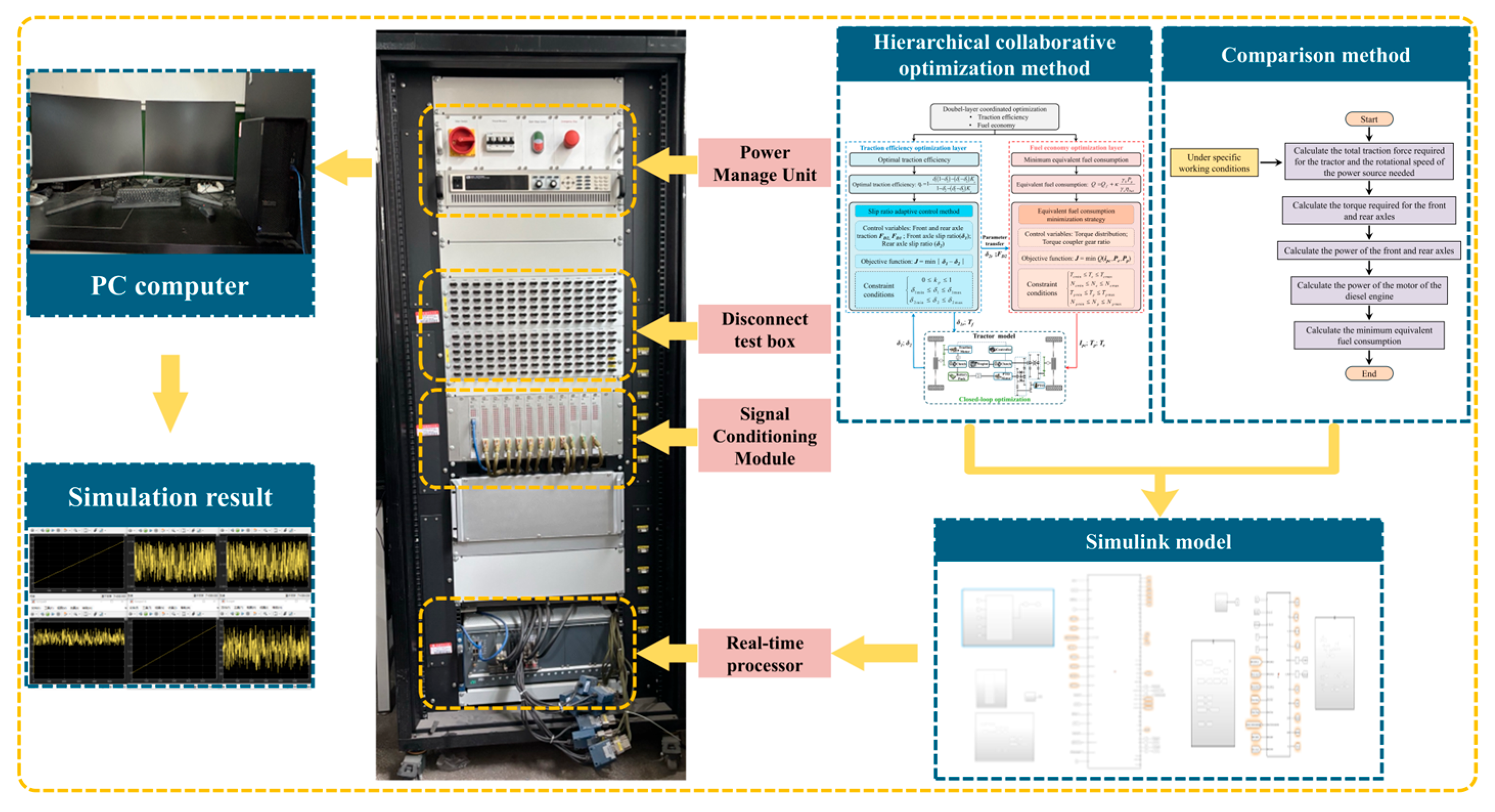
To further validate the effectiveness of DCHC method, this section employs a HIL test platform to conduct experimental verification on both DCHC method and the fixed coordinated traction one-step allocation method. The HIL test platform constructed for this purpose mainly comprises an HIL test cabinet, a PC, and a controller.
The HIL test cabinet is mainly composed of a power management unit, an open-circuit test box, a signal conditioning module, a real-time processor, and other components. The PC is connected to the HIL test cabinet via Ethernet and is ultimately controlled by VeriStand software. According to the actual test requirements, first, the HIL test environment is configured through the PC, and the hierarchical collaborative optimization method and the fixed coordinated traction force one-step allocation method are written into the controller under testing. Then, the tractor control model is loaded into the real-time processor, and the HIL test data is observed and exported through the VeriStand software on the PC. The real-time processor uses the NI PXIe-8880 controller. The upper level adopts the Windows 10 64-bit operating system. The north-side controller is the Woodward SECM-70 type controller. The control strategy is written based on the D2P (From Development to Production) development platform. The I/O boards PXle-6363 and PXle-6738 are used for hard-wired signal communication with the HIL test cabinet, and the communication board PXle-8510 is used for CAN signal communication with the HIL test cabinet. The specific steps are shown in Figure 17.
The HIL verification results of the dynamic coordinated hierarchical collaborative control method and the fixed coordinated traction force one-step allocation method are shown in Figure 18.
After HIL validation (as shown in Figure 19), the root-mean-square errors (RMSEs) were analyzed for different power parameters under two strategies. For the DCHC method, the RMSEs of engine power and PTO motor power were 0.0101 and 0.0008, respectively. In contrast, under the fixed coordinated traction force one-step allocation method, the RMSEs of engine power and PTO power were 0.003 and 0.001, respectively. Regarding the total system power, the RMSEs under the DCHC method and the fixed coordinated traction force one-step allocation method were 0.007 and 0.0107, respectively. The HIL validation tests indicated that there were no significant errors in the diesel engine power, PTO motor power, or total system power under either strategy.
After HIL validation (as shown in Figure 20), the RMSEs of the PTO motor efficiency were examined under two different methods. Specifically, for the dynamic coordinated hierarchical cooperative control optimization method, the RMSE of the PTO motor efficiency was 0.002, while for the fixed coordinated traction one-step allocation method, it was 0.005. The results of the HIL validation tests demonstrated that there was no significant error in the PTO motor efficiency under either of the two strategies.
After HIL validation(as shown in Figure 21), the RMSEs of the front and rear axle slip rates were analyzed under two different control methods. Under the dynamic coordinated hierarchical cooperative control optimization method, the RMSEs of the front and rear axle slip rates were 0.003 and 0.006, respectively. In comparison, when the fixed coordinated traction force one-step allocation method was applied, the RMSEs of the front and rear axle slip rates were 0.0104 and 0.007, respectively. The HIL validation tests showed that there were no significant errors in the front and rear axle slip rates between the two methods.
After HIL validation(as shown in Figure 22), the RMSEs of instantaneous slip loss and total slip loss were evaluated for two control methods. The dynamic coordinated hierarchical cooperative control optimization method resulted in RMSEs of 0.004 for instantaneous slip loss and 0.0002 for total slip loss. On the other hand, the fixed coordinated traction one-step allocation method produced RMSEs of 0.002 for instantaneous slip loss and 0.0001 for total slip loss. The results of the HIL validation tests indicated that there were no significant errors in the instantaneous slip loss and total slip loss for both methods.
After HIL validation the RMSE of the overall traction efficiency was calculated for two control strategies. For the dynamic coordinated hierarchical cooperative control optimization method, the RMSE of the overall traction efficiency was 0.003. In contrast, the fixed coordinated traction force one-step allocation method had an RMSE of 0.005 for the overall traction efficiency. The HIL validation tests indicated that there was no significant difference in the overall traction efficiency between the two methods.
Following the HIL validation (as shown in Figure 23), the dynamic coordinated hierarchical cooperative control optimization method achieved a RMSE of 0.001 for equivalent fuel consumption, whereas the fixed coordinated traction one-step allocation method had a RMSE of 0.002. The HIL validation tests indicated that there was no significant difference in the overall equivalent fuel consumption between the two methods.
In summary, the MATLAB simulation results are largely consistent with the HIL outcomes, which validates the effectiveness of the hierarchical cooperative optimization approach. Moreover, the dynamically coordinated hierarchical cooperative optimization control method shows better performance than the fixed coordinated traction one-step allocation method in HIL testing.

4.3. Discussion on the Homogeneous Soil Assumption

In Section 2.8, the derivation of the optimal traction efficiency condition assumed identical rolling resistance coefficients and slip characteristics for the front and rear axles. This simplification is commonly adopted in control-oriented modeling to establish a clear theoretical foundation, and it enables the derivation of the necessary condition for optimal efficiency: equal front and rear slip rates. However, in real-world hilly terrain, soil properties such as adhesion coefficient and rolling resistance may differ between the front and rear wheel contact points due to spatial heterogeneity in soil texture, moisture, or compaction.
While a full sensitivity analysis under heterogeneous conditions is beyond the scope of this study, the inherent adaptability of the proposed DCHC method provides robustness against such variations. The adaptive slip rate control layer continuously monitors the slip rates of both axles and adjusts the traction force distribution to minimize their difference. Even if the soil parameters differ, the controller will still strive to equalize slip rates, thereby maintaining near-optimal traction efficiency. In extreme cases where soil heterogeneity is severe, the algorithm may require more iterations to converge, but it will still improve performance compared to fixed-ratio allocation methods.
Future work could incorporate online estimation of soil parameters (e.g., using wheel speed and torque measurements) to further optimize the control action under heterogeneous conditions. Nevertheless, the current results under homogeneous assumption provide a valid benchmark for evaluating the core contribution of the hierarchical cooperative framework.

5. Conclusions

To tackle the decrease in overall traction efficiency and fuel economy of hybrid tractors operating in hilly terrain, which is caused by varying slip rates, this paper proposes a DCHC method. First, an adaptive slip rate control method is employed to optimize the slip rates of the front and rear axles. This effectively reduces energy losses resulting from traction slip. Meanwhile, it regulates the distribution of traction force between the front and rear axles to attain optimal traction efficiency conditions, thereby enhancing the tractor’s overall traction efficiency. Subsequently, the ECMS is utilized. Based on the rear-axle slip rate and traction force, it calculates the required speed and torque at the end of the torque coupler. With the objective of minimizing the instantaneous equivalent fuel consumption loss, it optimizes the transmission ratio of the torque coupler and the torque distribution between the diesel engine and the PTO motor. This ensures the efficient operation of the diesel engine within its optimal range and enables precise regulation of the auxiliary torque from the PTO motor, effectively reducing the equivalent fuel consumption. Finally, by integrating the adaptive slip rate control method and the ECMS, with the slip rate and traction force as transfer variables, a hierarchical cooperative control method is developed. This method allows for the simultaneous optimization of traction efficiency and fuel economy.
To validate the effectiveness of the proposed method, this paper adopts a fixed coordinated traction force one-step allocation method as a comparison approach. Both methods are subjected to MATLAB simulation verification and HIL testing under plowing conditions. The results show that, compared with the fixed coordinated traction force one-step allocation method, the proposed method leads to an average reduction of 32.73% and 26.32% in the front and rear axle slip rates, respectively. The slip power loss decreases by an average of 29.6%, the traction efficiency improves by an average of 8.7%, and the equivalent fuel consumption is reduced by 14.4%. The simulation results are consistent with the HIL outcomes, which validates the effectiveness of the design method. The DCHC method effectively reduces the front and rear axle slip rates during tractor operation, thereby minimizing the slip losses. Meanwhile, the adaptive slip rate method restricts the difference between the front and rear slip rates to meet the optimal traction efficiency conditions. This enhances the traction efficiency of tractors operating in hilly terrain. Using the front and rear slip rates as transfer variables, the method calculates the required speed of the power source based on these slip rates. The ECMS adjusts the power source torque according to the required speed. This improves the operational efficiency of the power source and reduces the equivalent fuel consumption during tractor operation, achieving the synergistic optimization of traction efficiency and fuel economy for dual-axle hybrid tractors in hilly terrain.
Therefore, the hierarchical cooperative control method proposed in this paper provides new perspectives for improving the energy efficiency of hybrid tractors operating in hilly terrain. It also offers a novel theoretical framework for optimizing energy efficiency and dynamic control in hybrid agricultural machinery. Future development of the proposed design methodology will address constraints on traction efficiency improvement by considering response delays associated with existing powertrain mode switching and other factors. It should be noted that the current ECMS formulation focuses on instantaneous equivalent fuel consumption and SOC balance, without explicitly accounting for battery State-of-Health (SOH). While this does not affect the relative improvements demonstrated in this study, incorporating battery degradation costs into the optimization objective would provide a more comprehensive assessment of long-term energy economy. Future work will focus on integrating battery aging models—accounting for depth-of-discharge, C-rate, and thermal effects—into the hierarchical control framework, supported by experimental characterization of battery cells under agricultural duty cycles.

List of Abbreviations and Symbols

Fr—plowing resistance; Z—number of plowshares; b0—width of a single plowshare; h0—plowing depth; k0—soil-specific resistance; F T —rated traction force; ne—diesel engine speed; Te—diesel engine torque; nm—motor speed; Tm—motor torque; Ub—output voltage of the power battery; E0—terminal voltage of the power battery; I0—output current of the power battery; R0—internal resistance of the power battery; Pbmax—maximum output power of the battery; SOC0—initial SOC value; CI—cone index (soil strength parameter); Qb—rated capacity of the power battery (A·h); Pre—power at the drive-coupling end (kW); P—total power of the tractor (kW); Pp—PTO motor power; η e —diesel engine efficiency; η p —PTO motor efficiency; η f —traction motor efficiency; n r e —rotational speed at the power-coupling end; n e —diesel engine speed; n f —traction motor speed; i g —transmission gear ratio; i 0 —main reduction gear ratio; v—working vehicle speed; G—total weight of the tractor; F D —tractor’s traction resistance; L—tractor’s wheelbase (m); h D —height of the traction point; θ—angle between traction resistance and horizontal plane; a—horizontal distance from implement’s traction point to rear axle; F Z 1 / F Z 2 —vertical load on front/rear axle; F D 1 / F D 2 —traction force on front/rear axle; r 1 / r 2 —radius of front/rear drive wheels; T 1 / T 2 —front/rear drive resistance moment; L 1 / L 2 —distance from center of gravity to front/rear axle; ω f / ω r —angular velocity of front/rear drive wheels; δ s 1 —slip rate of front axle; δ s 2 —slip rate of rear axle; δ i —slip rate for front/rear axle; δ * —characteristic slip value; φ m a x —maximum load utilization coefficient for drive wheels; φ q i —load utilization coefficient for drive wheels; K p —tractor driving force distribution coefficient; T r e —front axle motor output torque; T f —rear axle motor output torque; ω f —front axle motor output angular velocity; ω e —rear axle motor output angular velocity; η T —traction efficiency under dual-axle drive; T v —torque at the torque coupler end; i p c —torque coupler speed ratio; I r —rotational inertia of PTO motor; ω ˙ r —angular acceleration of PTO motor; ω ˙ ω —angular acceleration of diesel engine; I ω —rotational inertia of diesel engine; P e —power of diesel engine; P p —power of PTO motor; κ —equivalence factor; γ b —electrical energy released per kilowatt-hour; γ e —thermal energy released per liter of fuel; P b —motor power; η b a t —battery charge/discharge efficiency; K p —proportionality coefficient (Lyapunov-based); S O C r e f —reference value of SOC; Treq—required torque at the coupler input end; nreq—required rotational speed at the coupler input end; Preq—required power at the coupler input end.

Author Contributions

Conceptualization, G.C. and X.Y.; methodology, G.C. and J.Z.; software, G.C. and Y.J.; validation, G.C., Y.J. and M.L.; formal analysis, G.C.; investigation, G.C.; resources, L.X. and Y.T.; data curation, G.C. and Y.T.; writing—original draft preparation, G.C.; writing—review and editing, X.Y.; J.Z. and L.X.; visualization, G.C.; supervision, X.Y. and L.X.; project administration, X.Y.; funding acquisition, X.Y. and L.X. All authors have read and agreed to the published version of the manuscript.

Funding

This research was funded by the Henan Province K&D Project (231111112600, 251111111400), the Postdoctoral Research Project of Henan Province (HN2026073),the Open Fund of State Key Laboratory of Mechanical Transmission for Advanced Equipment (SKLMT-MSKFKT-202506), the National Key R&D Program of China (2022YFD2001200), the Henan Provincial Natural Science Foundation Project (242300420369), the Opening Foundation of Key Laboratory of Advanced Manufacture Technology for Automobile Parts, Ministry of Education (2024KLMT03), and the Heluo Youth Talent Support Program (2025HLTJ38).

Data Availability Statement

The original contributions presented in this study are included in the article. Further inquiries can be directed to the corresponding author.

Conflicts of Interest

Authors Junjiang Zhang, Xianghai Yan, Mengnan Liu and Yuan Tao were employed by the company YTO Group Corporation. The remaining authors declare that the research was conducted in the absence of any commercial or financial relationships that could be construed as a potential conflict of interest.

References

  1. Xue, C.; Shi, X.; Zhou, H. Influence Path of Agricultural Mechanizationon Total Factor Productivity Growth in Planting Industry. J. Agrotech. Econ. 2020, 10, 87–102. [Google Scholar] [CrossRef]
  2. Caban, J.; Vrabel, J.; Šarkan, B.; Zarajczyk, J.; Marczuk, A. Analysis of the Market of Electric Tractors in Agricultural Production. MATEC Web Conf. 2018, 244, 03005. [Google Scholar] [CrossRef]
  3. Liu, H.; Shen, C.; Hu, L.; Chang, C.; Cao, G. Research Progress and Development Trend of Electric Agricultural Equipments. Trans. Chin. Soc. Agric. Eng. 2024, 40, 39–51. [Google Scholar] [CrossRef]
  4. Zhang, T.; Yan, G.; Wen, L.; Liao, Y. Current Situation and Development of Electric Agricultural Machinery in China. J. Agric. Mech. Res 2012, 34, 236–240. [Google Scholar] [CrossRef]
  5. Kemppinen, J.; Niittynen, P.; Happonen, K.; Le Roux, P.C.; Aalto, J.; Hjort, J.; Maliniemi, T.; Karjalainen, O.; Rautakoski, H.; Luoto, M. Geomorphological Processes Shape Plant Community Traits in the Arctic. Glob. Ecol. Biogeogr. 2022, 31, 1381–1398. [Google Scholar] [CrossRef]
  6. Xie, B.; Wu, Z.; Mao, E. Development and Prospect of Key Technologies on Agricultural Tractor. Trans. Chin. Soc. Agric. Mach. 2018, 49, 1–17. [Google Scholar] [CrossRef]
  7. Zhang, Y. Research and Reflection on the Application of Hybrid Power in Tractors. Agric. Eng. Technol. 2021, 41, 56–57. [Google Scholar] [CrossRef]
  8. Liu, H.; Ren, J. Intelligent Manufacturing Policy, Esg Performance, and Total Factor Productivity: Evidence from China. PLoS ONE 2025, 20, e0311369. [Google Scholar] [CrossRef]
  9. Liu, W.; Yang, R.; Li, L.; Zhao, C.; Li, G. Energy and Environmental Evaluation and Comparison of a Diesel-Electric Hybrid Tractor, a Conventional Tractor, and a Hillside Mini-Tiller Using the Life Cycle Assessment Method. J. Clean. Prod. 2024, 469, 143232. [Google Scholar] [CrossRef]
  10. Zhou, R.; Wang, L.; Deng, X.; Su, C.; Fang, S.; Lu, Z. Research on Energy Distribution Strategy of Tandem Hybrid Tractor Based on the Pontryagin Minimum Principle. Agriculture 2024, 14, 440. [Google Scholar] [CrossRef]
  11. Ozturk, M.; Sandalci, T.; Buyuk, C.; Guclu, M.; Karagoz, Y. The Effect of Converting a Conventional Tractor into a Hybrid Drive Tractor Using the Ecms Method on Fuel Consumption and Emissions. Int. J. Energy Res. 2024, 2024, 8832086. [Google Scholar] [CrossRef]
  12. Li, X.; Xu, L.; Liu, M.; Yan, X.; Zhang, M. Research on Torque Cooperative Control of Distributed Drive System for Fuel Cell Electric Tractor. Comput. Electron. Agric. 2024, 219, 108811. [Google Scholar] [CrossRef]
  13. Regazzi, N.; Maraldi, M.; Molari, G. A Theoretical Study of the Parameters Affecting the Power Delivery Efficiency of an Agricultural Tractor. Biosyst. Eng. 2019, 186, 214–227. [Google Scholar] [CrossRef]
  14. Shang, G.; Liu, T.; Han, J. Optimized Design of Four-Wheel Drive Tractor Drive System Based on Drive Efficiency. J. Agric. Mech. Res 2022, 44, 242–247. [Google Scholar] [CrossRef]
  15. He, H.; Meng, X. A Review on Energy Management Technology of Hybrid Electric Vehicles. Trans. Beijing Inst. Technol. 2022, 42, 773–783. [Google Scholar] [CrossRef]
  16. Zhang, F.; Hu, X.; Xu, K.; Tang, X.; Cui, Y. Current Status and Prospects for Model Predictive Energy Management Ind Hybrid Electric Vehicles. J. Mech. Eng. 2019, 55, 86–108. [Google Scholar] [CrossRef]
  17. Yin, B.; Yun, L.; Xie, X.; Wang, J.; Huang, Y. Optimized Fuzzy Control Energy Management Strategy for Hybrid Tractors Considering Working Conditions Adaptation. J. Mech. Sci. Technol. 2025, 39, 3443–3455. [Google Scholar] [CrossRef]
  18. Lee, H.-S.; Kim, J.-S.; Park, Y.-I.; Cha, S.-W. Rule-Based Power Distribution in the Power Train of a Parallel Hybrid Tractor for Fuel Savings. Int. J. Precis. Eng. Manuf.-Green Technol. 2016, 3, 231–237. [Google Scholar] [CrossRef]
  19. Xu, L.; Zhang, J.; Liu, M.; Zhou, Z.; Liu, C. Control Algorithm and Energy Management Strategy for Extended Range Electric Tractors. Int. J. Agric. Biol. Eng. 2017, 10, 35–44. [Google Scholar] [CrossRef]
  20. Lombardi, S.; Di Ilio, G.; Tribioli, L.; Jannelli, E. Optimal Design of an Adaptive Energy Management Strategy for a Fuel Cell Tractor Operating in Ports. Appl. Energy 2023, 352, 121917. [Google Scholar] [CrossRef]
  21. Zhang, M.; Li, X.; Han, D.; Shang, L.; Xu, L. Energy Management Strategy for Fuel Cell Hybrid Tractor Considering Demand Power Frequency Characteristic Compensation. Sci. Rep. 2024, 14, 27844. [Google Scholar] [CrossRef]
  22. Zhang, J.J.; Shi, M.Y.; Liu, M.N.; Wang, D.Q.; Yan, X.H.; Xu, L.Y.; Wu, Y.W. Design Method of Dual-Motor Electric Tractor Drive System Based on Mass Constraint Algorithm under Uncertainty Using Mass. Energy 2025, 322, 135140. [Google Scholar] [CrossRef]
  23. Feng, G.H.; Zhang, J.J.; Yan, X.H.; Dong, C.H.; Liu, M.N.; Xu, L.Y. Research on Energy-Saving Control of Agricultural Hybrid Tractors Integrating Working Condition Prediction. PLoS ONE 2024, 19, e0299658. [Google Scholar] [CrossRef]
  24. Li, X.Z.; Liu, M.N.; Hu, C.M.; Yan, X.H.; Zhao, S.X.; Zhang, M.Z.; Xu, L.Y. Parameters Collaborative Optimization Design and Innovation Verification Approach for Fuel Cell Distributed Drive Electric Tractor. Energy 2024, 292, 130485. [Google Scholar] [CrossRef]
  25. Li, T.; Xie, B.; Wang, D.; Zhang, S.; Wu, L. Real-Time Adaptive Energy Management Strategy for Dual-Motor-Driven Electric Tractors. Trans. Chin. Soc. Agric. Mach. 2020, 51, 530–543. [Google Scholar]
  26. Soylu, S.; Carman, K. Fuzzy Logic Based Automatic Slip Control System for Agricultural Tractors. J. Terramech. 2021, 95, 25–32. [Google Scholar] [CrossRef]
  27. Wang, Q.; Wang, X.; Wang, W.; Song, Y.; Cui, Y. Joint Control Method Based on Speed and Slip Rate Switching in Plowing Operation of Wheeled Electric Tractor Equipped with Sliding Battery Pack. Comput. Electron. Agric. 2023, 215, 108426. [Google Scholar] [CrossRef]
  28. Deng, X.T.; Sun, H.L.; Lu, Z.X.; Cheng, Z.; An, Y.H.; Chen, H. Research on Dynamic Analysis and Experimental Study of the Distributed Drive Electric Tractor. Agriculture 2023, 13, 40. [Google Scholar] [CrossRef]
  29. Wang, H.; Zhuang, X.; Xie, W.; Jin, H.; Liu, R.; Yu, B.; Duan, J.; Huang, L.; Zhou, J. Thermosensitive-Csi3-Crystal-Driven High-Power I−/I3− Thermocells. Cell Rep. Phys. Sci. 2022, 3, 100737. [Google Scholar] [CrossRef]
  30. Guo, H.; Shangguan, J.; Tang, J.; Sun, Q.; Wu, H. Receding Horizon Control Strategy for an Electric Vehicle with Dual-Motor Coupling System in Consideration of Stochastic Vehicle Mass. PLoS ONE 2018, 13, e0205212. [Google Scholar] [CrossRef]
  31. Yang, H.; Sun, Y.; Xia, C.; Zhang, H. Research on Energy Management Strategy of Fuel Cell Electric Tractor Based on Multi-Algorithm Fusion and Optimization. Energies 2022, 15, 6389. [Google Scholar] [CrossRef]
  32. Tchanche, B.F.; Lambrinos, G.; Frangoudakis, A.; Papadakis, G. Low-Grade Heat Conversion into Power Using Organic Rankine Cycles–A Review of Various Applications. Renew. Sustain. Energy Rev. 2011, 15, 3963–3979. [Google Scholar] [CrossRef]
  33. Zhang, J.; Feng, G.; Xu, L.; Wang, W.; Yan, X.; Liu, M. Energy-Saving Control of Hybrid Tractor Based on Pontryagin’s Minimum Principle. Trans. Chin. Soc. Agric. Mach. 2023, 54, 396–406. [Google Scholar]
  34. Yu, Q.; He, X.; Chen, Y.; Jiang, Z.; Tan, Y.; Liu, L.; Xie, B.; Wen, C. Multi-Objective Optimization for Energy-Efficient Management of Electric Tractors via Hybrid Energy Storage Systems and Scenario Recognition. Appl. Energy 2025, 391, 125898. [Google Scholar] [CrossRef]
  35. Curiel-Olivares, G.; Johnson, S.; Escobar, G.; Schacht-Rodríguez, R. Model Predictive Control-Based Energy Management System for a Hybrid Electric Agricultural Tractor. IEEE Access 2023, 11, 118801–118811. [Google Scholar] [CrossRef]
  36. Zeng, X.; Li, G.; Yin, G.; Song, D.; Li, S.; Yang, N. Model Predictive Control-Based Dynamic Coordinate Strategy for Hydraulic Hub-Motor Auxiliary System of a Heavy Commercial Vehicle. Mech. Syst. Sig. Process. 2018, 101, 97–120. [Google Scholar] [CrossRef]
  37. Salo, V.; Pastukhov, V.; Leshchenko, S.; Shchur, T.; Dzhidzhora, O.; Szwedziak, K.; Parafiniuk, S. Differentiation of the Composition of Combined Soil-Tillage Machines Depending on the Conditions of Use. Agric. Eng. 2024, 28, 353–365. [Google Scholar] [CrossRef]
  38. Iro, Z.S.; Subramani, C.; Dash, S.S. A Brief Review on Electrode Materials for Supercapacitor. Int. J. Electrochem. Sci. 2016, 11, 10628–10643. [Google Scholar] [CrossRef]
  39. Abdolmaleki, H.; Jafari, A.; Tabatabaeifar, A.; Hajiahmad, A.; Goli, H. Development and Evaluation of an in-Situ Tire Testing Facility with Variable Side Slip Angles. J. Terramech. 2015, 59, 49–58. [Google Scholar] [CrossRef]
  40. Wang, Y.; Zhang, Y.; Xin, X.; Yang, J.; Wang, M.; Wang, R.; Guo, P.; Huang, W.; Sobrido, A.J.; Wei, B.; et al. In Situ Photocatalytically Enhanced Thermogalvanic Cells for Electricity and Hydrogen Production. Science 2023, 381, 291–296. [Google Scholar] [CrossRef] [PubMed]
  41. Zhang, Y.; Li, Q.; Wen, C.; Liu, M.; Yang, X.; Xu, H.; Li, J. Predictive Equivalent Consumption Minimization Strategy Based on Driving Pattern Personalized Reconstruction. Appl. Energy 2024, 367, 123424. [Google Scholar] [CrossRef]
  42. Jin, Y.; Zhao, W.; Li, Z.; Liu, B.; Wang, K. Soc Estimation of Lithium-Ion Battery Considering the Influence of Discharge Rate. Energy Rep. 2021, 7, 1436–1446. [Google Scholar] [CrossRef]
  43. Sanín, R.; Fernández-Montoya, M.; Garzón-Vargas, M.A.; Velásquez-López, A. Battery State of Charge Estimation Error Comparison across Different Ocv-Soc Curve Approximating Methods. In Applied Computer Sciences in Engineering; Springer: Cham, Switzerland, 2019. [Google Scholar]
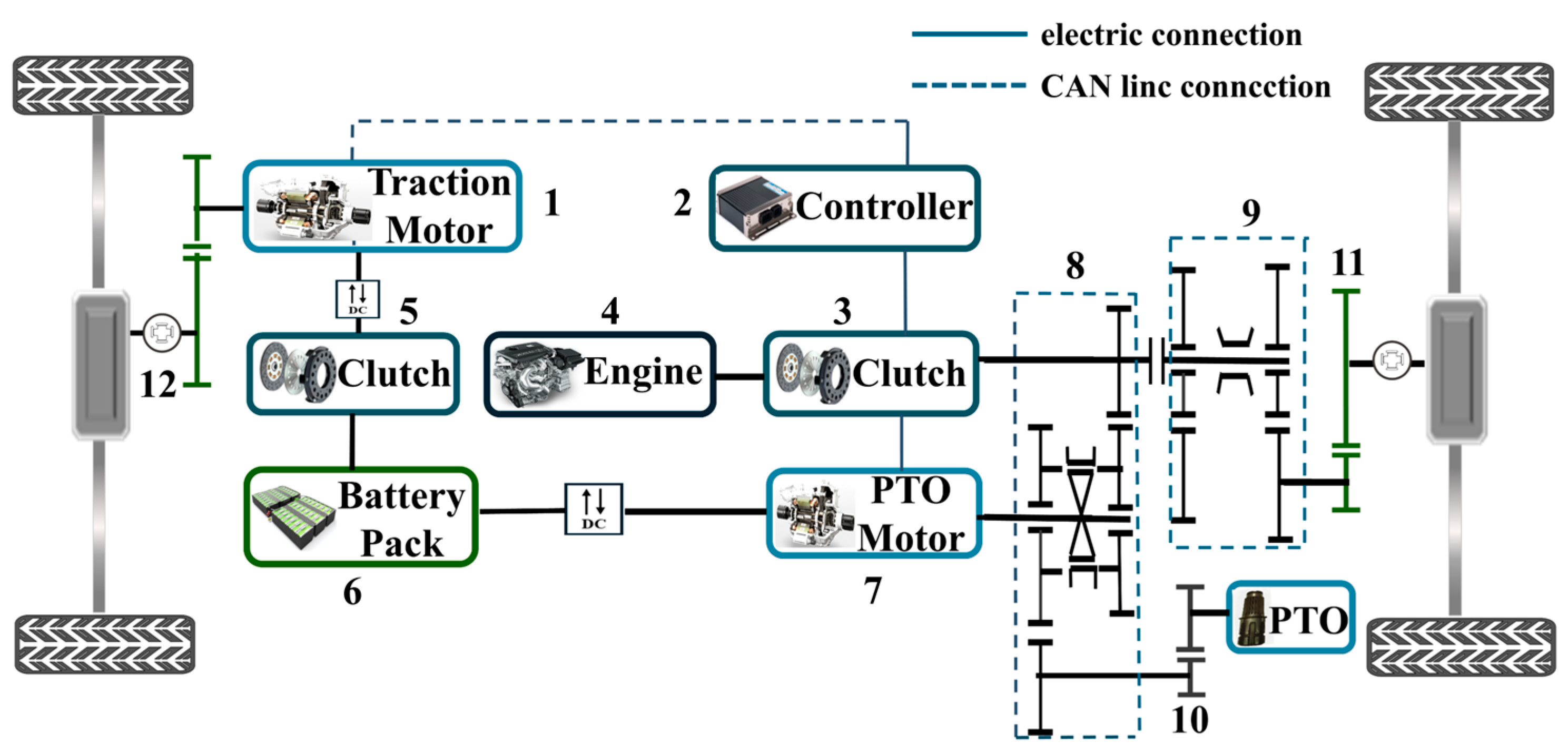
Figure 1. Topology diagram of dual-axis hybrid tractor for hilly terrain. 1. Traction Motor; 2. Vehicle Controller; 3. Clutch; 4. Diesel Engine; 5. Clutch; 6. Power Battery; 7. PTO Motor; 8. Torque Coupler; 9. Central Transmission Unit; 10. PTO Reducer; 11. Reducer; 12. Universal Joint.
Wevj 17 00136 g001
Figure 2. Diesel engine model map chart.
Wevj 17 00136 g002
Figure 3. Motor model MAP chart.
Wevj 17 00136 g003
Figure 4. Schematic diagram of the forces acting on a tractor.
Wevj 17 00136 g004
Figure 5. Control Flow.
Wevj 17 00136 g005
Figure 6. Hierarchical collaborative control architecture.
Wevj 17 00136 g006
Figure 7. Steps of the adaptive slip rate control method.
Wevj 17 00136 g007
Figure 8. ECMS steps.
Wevj 17 00136 g008
Figure 9. Steps of the fixed coordinated traction one-step allocation method.
Wevj 17 00136 g009
Figure 10. Field-measured data during plowing operations: (a) Plowing resistance. (b) Plowing vehicle speed.
Wevj 17 00136 g010
Figure 11. Power performance of the two strategies: (a) Fixed coordinated traction force one-step allocation method; (b) DCHC method; (c) Comparison of total system power consumption between the two strategies.
Wevj 17 00136 g011
Figure 12. Motor efficiency of two strategies: (a) Fixed Coordinated Traction Force One-Step Allocation Method; (b) DCHC Method.
Wevj 17 00136 g012
Figure 13. Front and rear axle slip rates for two strategies: (a) Fixed Coordinated traction force one-step allocation method; (b) DCHC method.
Wevj 17 00136 g013
Figure 14. (a) Instantaneous slip rate of the two strategies; (b) Total slip loss of the two control strategies.
Wevj 17 00136 g014
Figure 15. Traction efficiency of the two control strategies.
Wevj 17 00136 g015
Figure 16. Equivalent fuel consumption of the two strategies.
Wevj 17 00136 g016
Figure 17. HIL test validation flowchart.
Wevj 17 00136 g017
Figure 18. HIL verification results of component and overall machine power under the two strategies: (a) Component power of the DCHC method; (b) Component power of the fixed coordinated traction force one-step allocation method; (c) Overall machine power.
Wevj 17 00136 g018
Figure 19. HIL verification results for motor efficiency under two strategies: (a) Motor efficiency of the DCHC method; (b) motor efficiency of the fixed coordination traction one-step allocation method.
Wevj 17 00136 g019
Figure 20. HIL validation results for front and rear axle slip rates under two strategies: (a) DCHC method slip rate; (b) Fixed coordination traction one-step allocation method slip rate.
Wevj 17 00136 g020
Figure 21. HIL validation results for instantaneous slip rate of two strategies.
Wevj 17 00136 g021
Figure 22. (a) HIL validation results for traction efficiency under two control strategies; (b) HIL validation results for total slip loss of two control strategies.
Wevj 17 00136 g022
Figure 23. HIL validation results showing equivalent fuel consumption for two strategies.
Wevj 17 00136 g023
Table 1. Review table.
MethodMain AchievementsLimitations
Rule-Based Power Distribution Strategy for Parallel Hybrid TractorThe fuel economy has increased by 11.78%.Does not into account the utilization rate of the power battery
Predefined Energy-Saving Control Strategy for Range-Extended Electric TractorsImproved the utilization rate of the power battery.Does not into account the service life of the power battery
SOC-Based Rule Design Method for Fuel Cell Power AdjustmentReduced the instantaneous load of the fuel cell while extending its service life.
Mass-Constrained Drive System Design MethodThe usage quality and energy consumption of the tractor have decreased by 8.54% and 4.15%, respectively.Only considers the fuel economy under fixed operating conditions
Predictive Energy Management Strategy Based on Pontryagin’s Minimum Principle and Operating Condition PredictionImproving the fuel economy of tractors under varying operating conditions.Does not consider the towing efficiency of the tractor
Multi-Island Genetic Algorithm and Dynamic Programming for Powertrain OptimizationImproved the traction efficiency and fuel economy of the tractor.
Real-Time Adaptive Energy Management Strategy Combining Stochastic Dynamic Programming and Extremum SearchThe overall traction efficiency of the machine has been improved.The influence of slip rate on the tractor’s traction efficiency and fuel economy has not been taken into account
Table 2. Characteristic values of the rotational rate curve equations for various ground-driven wheels.
Soil TypeCI/kPaφmaxδ*
Asphalt pavement900
700
0.7630.060
Wheat stubble field0.7140.131
0.7140.150
Dirt road0.7200.090
Disclaimer/Publisher’s Note: The statements, opinions and data contained in all publications are solely those of the individual author(s) and contributor(s) and not of MDPI and/or the editor(s). MDPI and/or the editor(s) disclaim responsibility for any injury to people or property resulting from any ideas, methods, instructions or products referred to in the content.