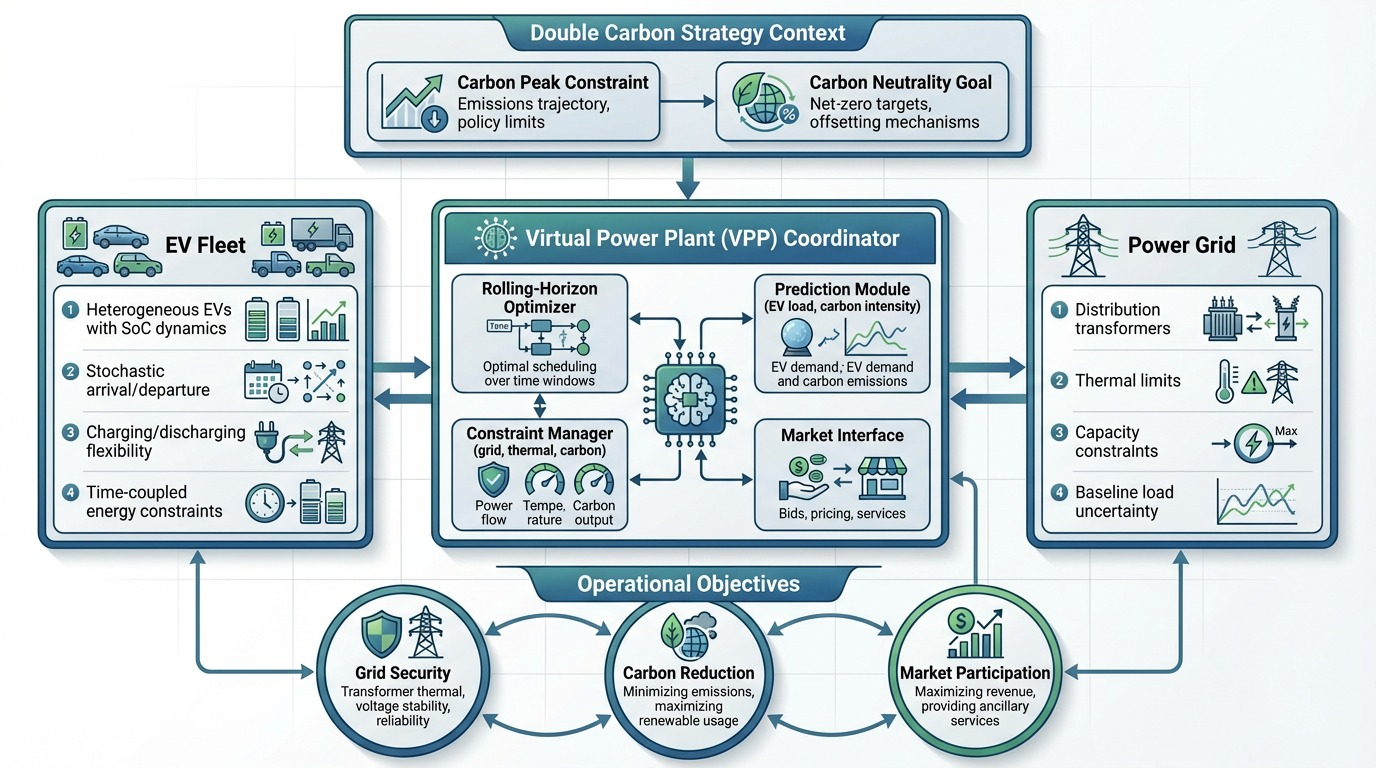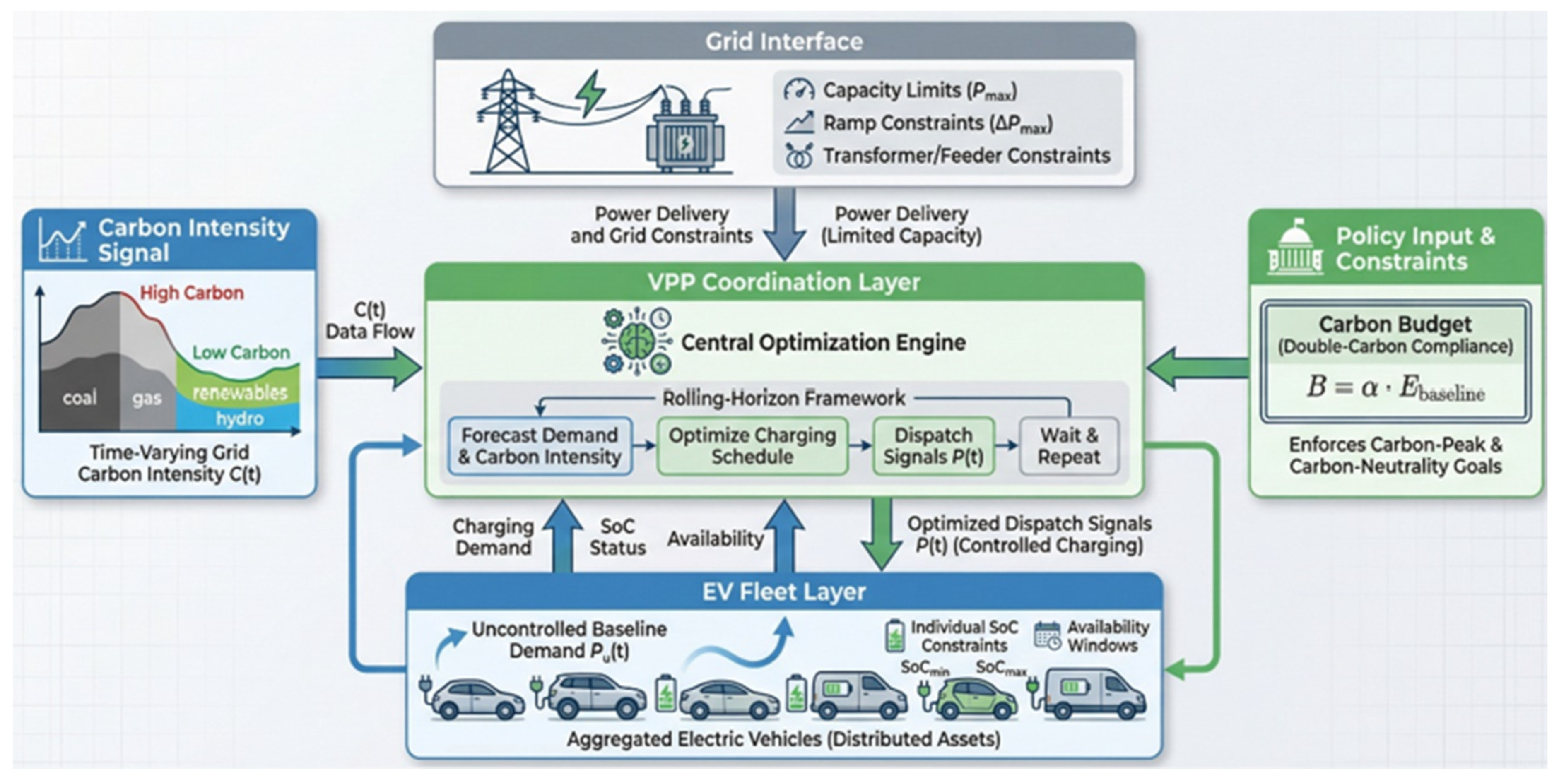

Carbon-Aware Rolling-Horizon Energy Management of Electric Vehicles via Virtual Power Plants Under Carbon–Grid Conflict



Abstract
1. Introduction
1.1. Related Work
1.2. Research Gaps and Contributions
- Explicitly characterises carbon–grid conflict conditions through time-varying marginal carbon intensity signals, revealing limitations of grid-only EV coordination strategies.
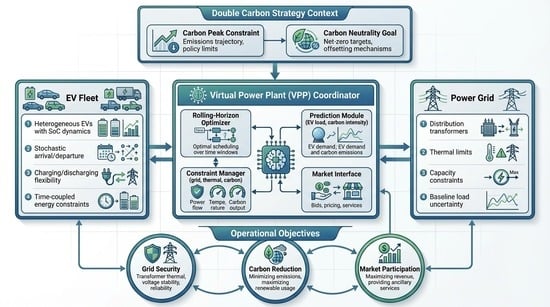
- A rolling-horizon EV energy management formulation is developed for VPPs that explicitly embeds carbon policy compliance through an absolute carbon budget while preserving grid-friendly operation.
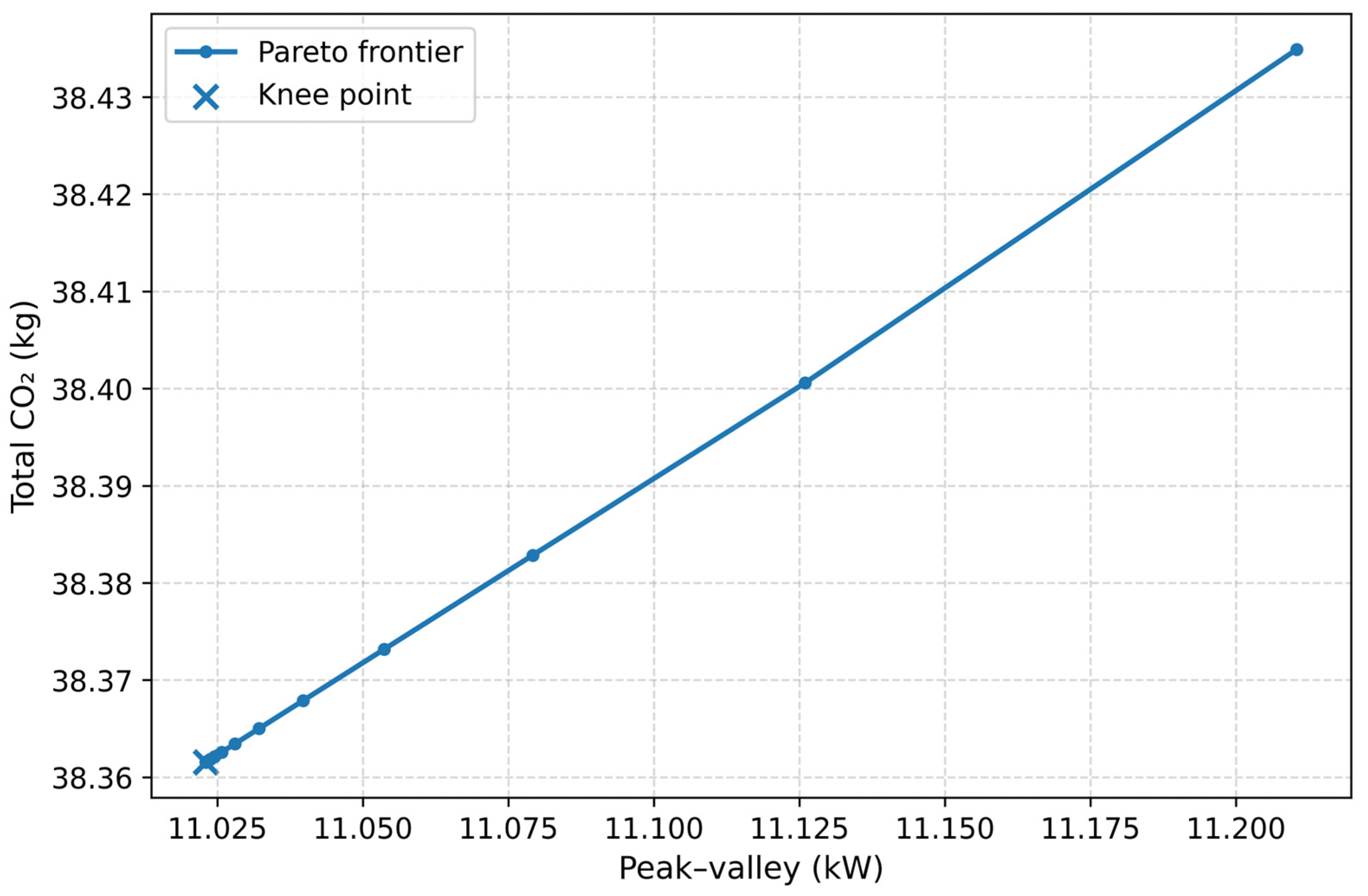
- A systematic Pareto frontier is constructed to characterise the trade-off between peak–valley load smoothing and carbon emissions, with a knee-point selection methodology to identify balanced operating regimes.
1.3. Paper Organisation
2. System Model and Mathematical Formulation
3. Proposed Carbon-Aware Rolling-Horizon Energy Management
3.1. Motivation for Rolling-Horizon Scheduling
3.2. Rolling-Horizon Problem Formulation
| Algorithm 1: Carbon-Aware Rolling-Horizon Energy Management via VPP. |
| Inputs: Baseline EV charging profile PUC(1:T), carbon intensity signal λ(1:T), sampling interval Δ t, horizon length H, power limit , ramp limit R, carbon reduction ratio ρ and weighting parameters . |
| Outputs: Controlled EV charging schedule P(1:T) |
| 1. Compute total energy requirement |
| 2. Compute carbon budget |
| 3. Initialise |
| 4. do |
| a. Compute remaining energy |
| b. Set horizon energy target |
| c. Solve the rolling-horizon problem over |
| d Apply first-step decision |
| e. Update: |
| 5. Terminal energy completion |
| Assign the remaining energy while satisfying power and ramp constraints over the last H steps to solve a terminal constrained optimisation: |
| Return |
3.3. Theoretical Guarantees of Rolling-Horizon Formulations
3.4. Design Insights and Operational Interpretation
4. Simulation Studies and Results
4.1. Simulation Setup and Scenarios
4.2. Grid Stress Mitigation Performance
4.3. Charging Behaviour Interpretation
4.4. Critical Performance Analysis
4.5. Sensitivity Analysis with EV Penetration
4.6. Robustness to Carbon-Intensity Profiles and Multi-Day Evaluation
4.7. Computational Performance and Scalability
5. Conclusions and Future Work
Author Contributions
Funding
Data Availability Statement
Conflicts of Interest
Nomenclature
| Sets and Indices | |
| Discrete time index | |
| Set of time indices | |
| Total number of time intervals | |
| Rolling-horizon length | |
| Uncontrolled baseline charging power | |
| Parameters | |
| Sampling interval (hours) | |
| Maximum admissible aggregate EV charging power (kW) | |
| Maximum allowable ramp rate (kW per interval) | |
| Total daily EV energy requirement (kWh) | |
| Time-varying marginal carbon intensity (kg CO2/kWh) | |
| Target carbon reduction ratio | |
| Carbon-weight coefficient in objective function | |
| Decision Variables | |
| Scheduled EV charging power at time (kW) | |
| Derived Quantities | |
| Cumulative delivered energy up to time (kWh) | |
| Cumulative carbon emissions up to time (kg CO2) | |
References
- Zhang, L.; Ruan, J.; Zhang, Z.; Qin, Z.; Lei, Z.; Cai, B.; Wang, S.; Tang, L. City-level pathways to carbon peak and neutrality in China. Cell Rep. Sustain. 2024, 1, 100102. [Google Scholar] [CrossRef] [Scilit]
- Diaz-Londono, C.; Maffezzoni, P.; Daniel, L.; Gruosso, G. Comparison and analysis of algorithms for coordinated EV charging to reduce power grid impact. IEEE Open J. Veh. Technol. 2024, 5, 990–1003. [Google Scholar] [CrossRef] [Scilit]
- Martin, S.; Powell, S.; Rajagopal, R. Cascading marginal emissions signals for green charging with growing electric vehicle adoption. Nat. Commun. 2025, 16, 10150. [Google Scholar] [CrossRef] [Scilit] [PubMed]
- Arowosola, A.; Norris, G.; Kirchain, R.; De Kleine, R.; Kim, H.C.; Anderson, J.E. Electric vehicle greenhouse gas benefits considering grid emission allocation and charging scheduling. Cell Rep. Sustain. 2025, 2, 100486. [Google Scholar] [CrossRef] [Scilit]
- Štogl, O.; Miltner, M.; Zanocco, C.; Traverso, M.; Starý, O. Electric vehicles as facilitators of grid stability and flexibility: A multidisciplinary overview. WIREs Energy Environ. 2024, 13, e536. [Google Scholar] [CrossRef] [Scilit]
- Hermans, B.; Walker, S.; Ludlage, J.; Özkan, L. Model predictive control of vehicle charging stations in grid-connected microgrids: An implementation study. Appl. Energy 2024, 368, 123210. [Google Scholar] [CrossRef] [Scilit]
- Jokinen, I.; Lehtonen, M. Flexibility of Electric Vehicle Charging With Demand Response and Vehicle-to-Grid for Power System Benefit. IEEE Access 2024, 12, 131419–131441. [Google Scholar] [CrossRef] [Scilit]
- Khou, S.A.; Olamaei, J.; Hosseini, M.H. Strategic scheduling of the electric vehicle-based microgrids under the enhanced particle swarm optimization algorithm. Sci. Rep. 2024, 14, 30795. [Google Scholar] [CrossRef] [Scilit]
- Azadikhouy, M. Multi objective moth swarm algorithm for optimizing electric vehicle integration in distribution grids. Sci. Rep. 2025, 15, 25320. [Google Scholar] [CrossRef] [Scilit]
- Zhao, A.P.; Li, S.; Li, Z.; Wang, Z.; Fei, X.; Hu, Z.; Alhazmi, M.; Yan, X.; Wu, C.; Lu, S.; et al. Electric vehicle charging planning: A complex systems perspective. IEEE Trans. Smart Grid 2024, 16, 754–772. [Google Scholar] [CrossRef] [Scilit]
- Khan, B.; Ullah, Z.; Gruosso, G. Enhancing Grid Stability Through Physics-Informed Machine Learning Integrated-Model Predictive Control for Electric Vehicle Disturbance Management. World Electr. Veh. J. 2025, 16, 292. [Google Scholar] [CrossRef] [Scilit]
- Thrän, J.; Mareček, J.; Shorten, R.N.; Green, T.C. Reserve Provision From Electric Vehicles: Aggregate Boundaries and Stochastic Model Predictive Control. IEEE Trans. Power Syst. 2025, 40, 4081–4092. [Google Scholar] [CrossRef] [Scilit]
- Diaz-Londono, C.; Orfanoudakis, S.; Vergara, P.P.; Palensky, P.; Ruiz, F.; Gruosso, G. Open source algorithms for maximizing V2G flexibility based on model predictive control. Electr. Power Syst. Res. 2025, 250, 112082. [Google Scholar] [CrossRef] [Scilit]
- Kern, T.; Dossow, P.; Morlock, E. Revenue opportunities by integrating combined vehicle-to-home and vehicle-to-grid applications in smart homes. Appl. Energy 2022, 307, 118187. [Google Scholar] [CrossRef] [Scilit]
- Onsomu, O.N.; Terciyanlı, E.; Yeşilata, B. Comprehensive review of energy management strategies: Considering battery energy storage system and renewable energy sources. Eng. Rep. 2024, 6, e12995. [Google Scholar] [CrossRef] [Scilit]
- Omidi, A.; Mishra, T.; Almassalkhi, M.R. Towards input-convex neural network modeling for battery optimization in power systems. In Proceedings of the 2025 American Control Conference (ACC), Denver, CO, USA, 8–10 July 2025; IEEE: New York, NY, USA, 2025; pp. 2823–2829. [Google Scholar]
- Montoya, O.D.; Serra, F.M.; Gil-González, W.; Grisales-Noreña, L.F.; Hernández, J.C. Multi-objective dispatch for batteries and renewable generation sources in distribution grids using a weighting-based convex approach while considering uncertainty. IEEE Access 2024, 12, 92020–92034. [Google Scholar] [CrossRef] [Scilit]
- Al Taha, F.; Bitar, E. When are Lossy Energy Storage Optimization Models Convex? In Proceedings of the 2025 IEEE Power & Energy Society General Meeting (PESGM), Austin, TX, USA, 27–31 July 2025; IEEE: New York, NY, USA, 2025; pp. 1–5. [Google Scholar]
- Dumont, P.; Petit, M.; Sainflou, D.-P. Reducing Marginal Emissions of an Electric Vehicle Fleet through Smart Charging and Vehicle-to-grid. In Proceedings of the 2023 IEEE PES Innovative Smart Grid Technologies Europe (ISGT EUROPE), Grenoble, France, 23–26 October 2023; IEEE: New York, NY, USA, 2023; pp. 1–5. [Google Scholar]
- Alwosheel, A.; Koroma, M.S. Context matters: Life cycle emissions and policy implications of electric vehicles in evolving carbon-intensive energy systems. Energy 2025, 338, 138845. [Google Scholar] [CrossRef] [Scilit]
- Lechowicz, A.; Christianson, N.; Sun, B.; Bashir, N.; Hajiesmaili, M.; Wierman, A.; Shenoy, P. Chasing convex functions with long-term constraints. arXiv 2024, arXiv:2402.14012. [Google Scholar] [CrossRef] [Scilit]
- Ekechukwu, D.E.; Simpa, P. A comprehensive review of renewable energy integration for climate resilience. Eng. Sci. Technol. J. 2024, 5, 1884–1908. [Google Scholar] [CrossRef] [Scilit]
- Prasad, M.B.; Ganesh, P.; Kumar, K.V.; Mohanarao, P.; Swathi, A.; Manoj, V. Renewable Energy Integration in Modern Power Systems: Challenges and Opportunities. In E3S Web of Conferences; EDP Sciences: Les Ulis, France, 2024; Volume 591, p. 03002. [Google Scholar]
- Mylonas, C.; Borić, D.; Marić, L.L.; Tsitsanis, A.; Petrianou, E.; Foti, M. Empowering aggregators with practical data-driven tools: Harnessing aggregated and disaggregated flexibility for demand response. In IET Conference Proceedings CP904; The Institution of Engineering and Technology: Stevenage, UK, 2024; Volume 2024, pp. 199–204. [Google Scholar] [CrossRef] [Scilit]
- Yao, H.; Xiang, Y.; Gu, C.; Liu, J. Optimal planning of distribution systems and charging stations considering PV-Grid-EV transactions. IEEE Trans. Smart Grid 2024, 16, 691–703. [Google Scholar] [CrossRef] [Scilit]
- Elghanam, E.; Abdelfatah, A.; Hassan, M.S.; Osman, A.H. Optimization techniques in electric vehicle charging scheduling, routing and spatio-temporal demand coordination: A systematic review. IEEE Open J. Veh. Technol. 2024, 5, 1294–1313. [Google Scholar] [CrossRef] [Scilit]
- Swan, B. EV Charging Station Data—California Region. Kaggle 2024. [Google Scholar] [CrossRef]



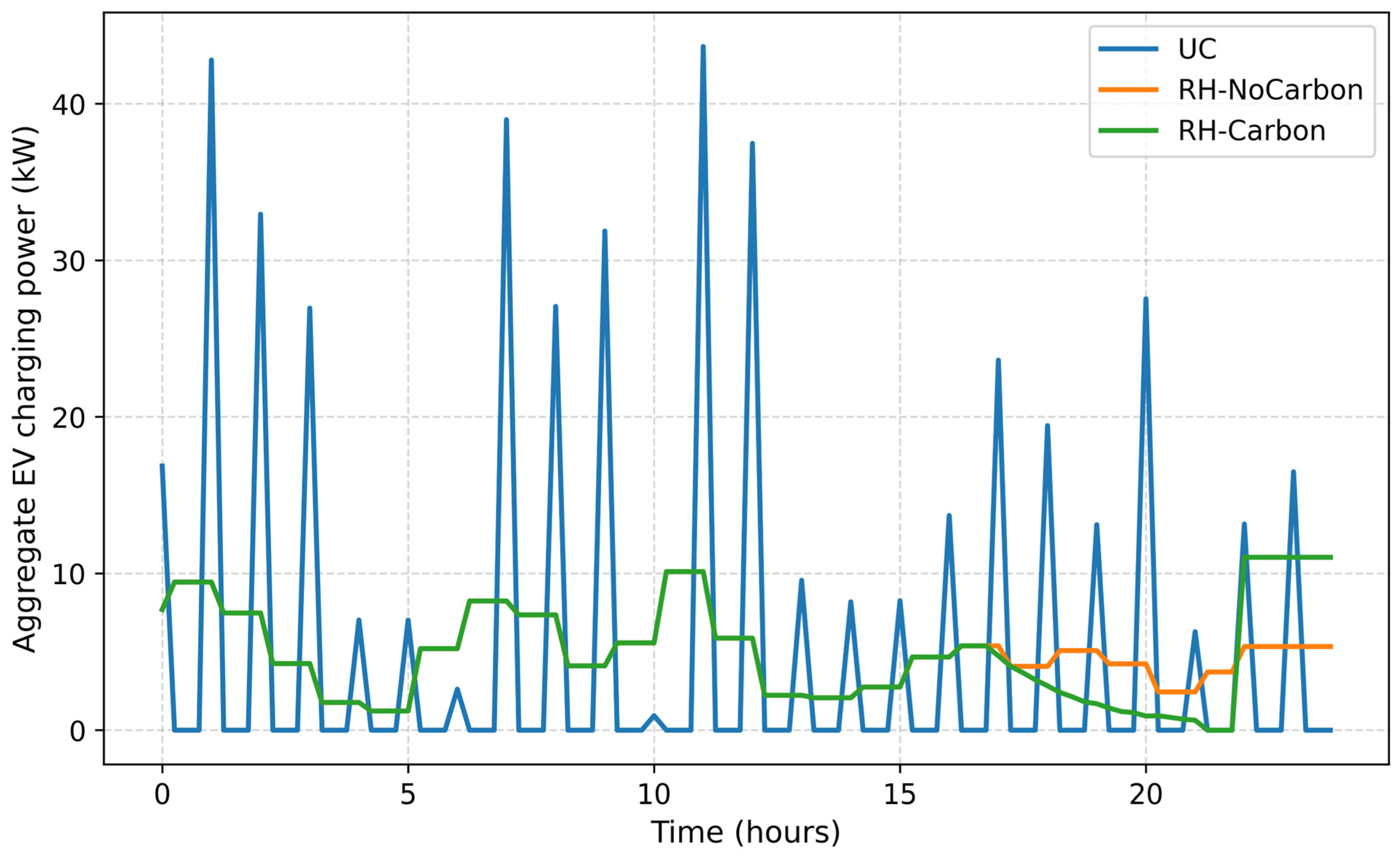
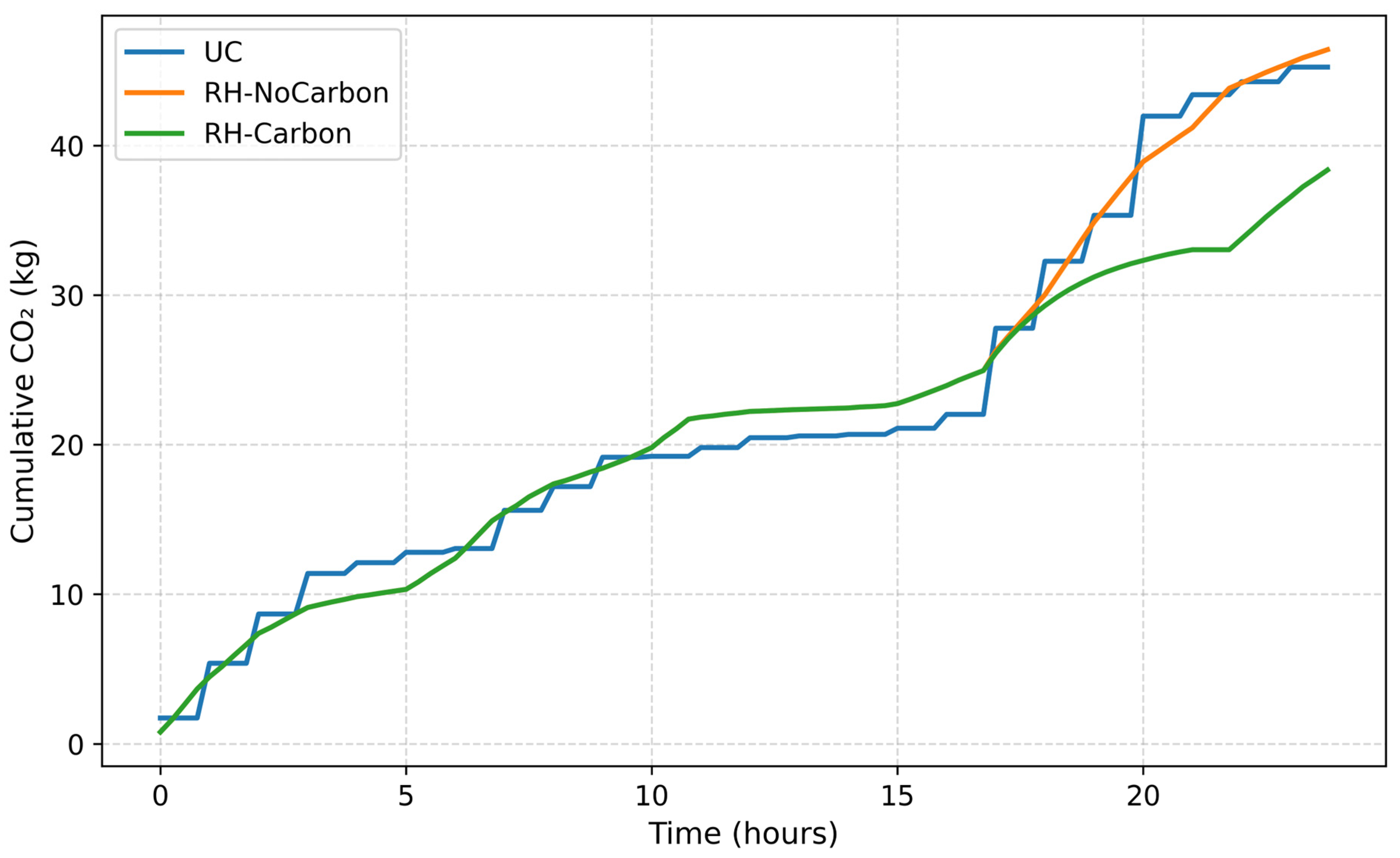
| Method | Total Energy (kWh) | Peak–Valley (kW) | Std Dev (kW) | Total CO2 (kg) | CO2 Reduction vs. UC (%) | CO2 Reduction vs. RH-NoCarbon (%) |
|---|---|---|---|---|---|---|
| UC | 118.844 | 43.646 | 10.712 | 45.244 | 0.000 | 2.517 |
| RH-NoCarbon | 118.844 | 8.888 | 2.310 | 46.412 | −2.582 | 0.000 |
| RH-Carbon | 118.844 | 11.023 | 3.255 | 38.362 | 15.212 | 17.346 |
| Scaling Factor | Method | Peak–Valley (kW) | Total CO2 (kg) | CO2 Reduction vs. RH-NoCarbon (%) |
|---|---|---|---|---|
| ×10 | RH-NoCarbon | 1.778 | 9.282 | - |
| RH-Carbon | 2.205 | 7.672 | 17.346 | |
| ×25 | RH-NoCarbon | 4.444 | 23.206 | - |
| RH-Carbon | 5.512 | 19.181 | 17.346 | |
| ×50 | RH-NoCarbon | 8.888 | 46.412 | - |
| RH-Carbon | 11.023 | 38.362 | 17.346 | |
| ×50 Evening-Peak (Workplace) | RH-NoCarbon | 29.257 | 92.890 | - |
| RH-Carbon | 28.461 | 78.070 | 15.954 |
| Carbon Profile | RH-NoCarbon CO2 (kg) | RH-Carbon CO2 (kg) | Reduction (%) | PV NoCarbon (kW) | PV Carbon (kW) |
|---|---|---|---|---|---|
| Scenario A (baseline conflict) | 46.412 | 38.362 | 17.346 | 8.888 | 11.023 |
| Scenario B (volatile + 10% forecast error) | 28.135 | 22.884 | 18.662 | 8.888 | 15.740 |
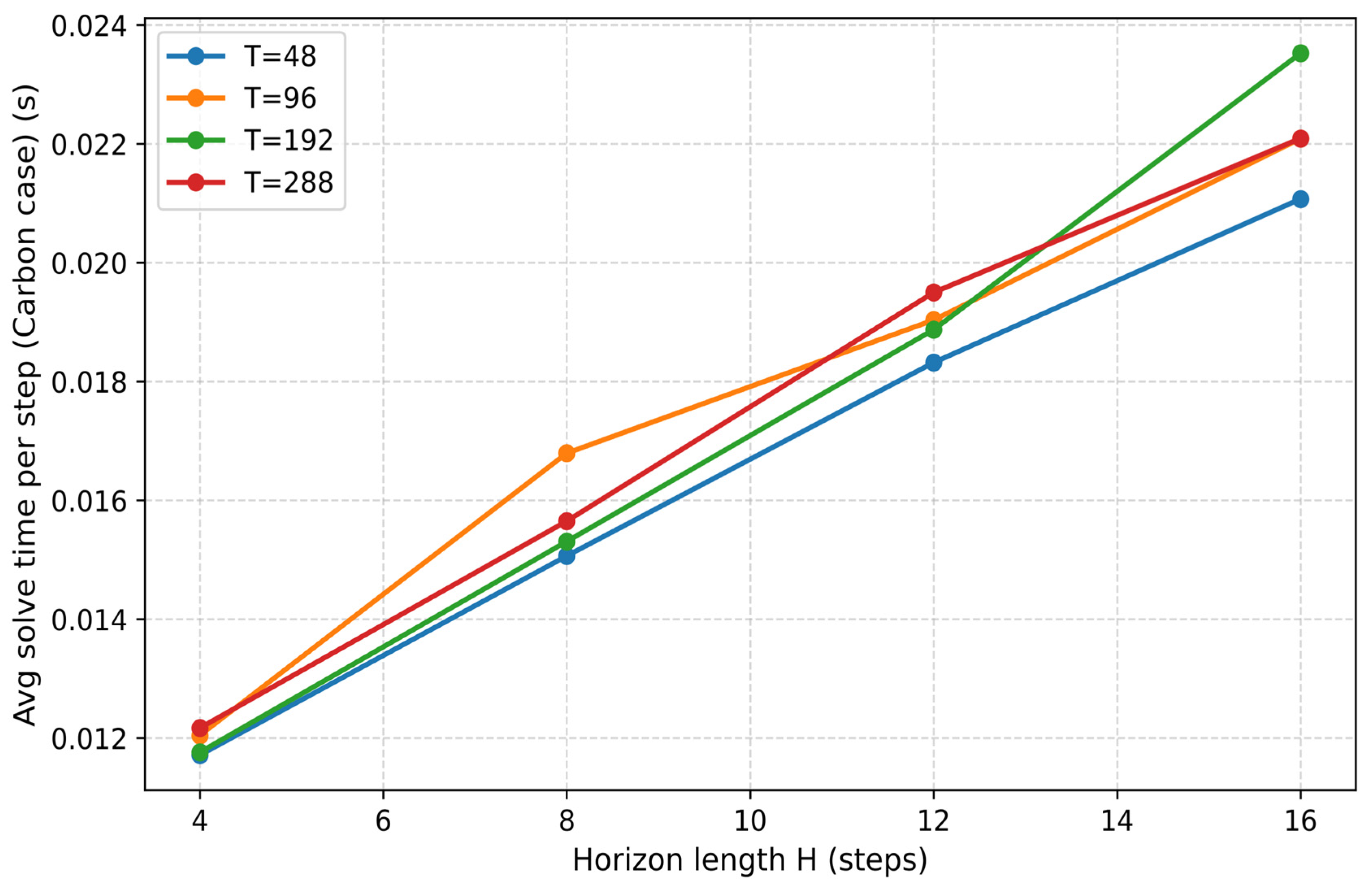
| Avg Step Time (RH-Carbon) (Seconds) | Total Time (RH-Carbon) (Seconds) | ||
|---|---|---|---|
| 96 | 4 | 0.0120 | 1.1200 |
| 96 | 8 | 0.0168 | 1.4943 |
| 96 | 16 | 0.0221 | 1.7889 |
| 192 | 8 | 0.0153 | 2.8314 |
| 288 | 8 | 0.0156 | 4.3969 |
| 288 | 16 | 0.0221 | 6.0303 |
Disclaimer/Publisher’s Note: The statements, opinions and data contained in all publications are solely those of the individual author(s) and contributor(s) and not of MDPI and/or the editor(s). MDPI and/or the editor(s) disclaim responsibility for any injury to people or property resulting from any ideas, methods, instructions or products referred to in the content. |
© 2026 by the authors. Published by MDPI on behalf of the World Electric Vehicle Association. Licensee MDPI, Basel, Switzerland. This article is an open access article distributed under the terms and conditions of the Creative Commons Attribution (CC BY) license.
Share and Cite
Khan, B.; Ullah, Z. Carbon-Aware Rolling-Horizon Energy Management of Electric Vehicles via Virtual Power Plants Under Carbon–Grid Conflict. World Electr. Veh. J. 2026, 17, 120. https://doi.org/10.3390/wevj17030120
Khan B, Ullah Z. Carbon-Aware Rolling-Horizon Energy Management of Electric Vehicles via Virtual Power Plants Under Carbon–Grid Conflict. World Electric Vehicle Journal. 2026; 17(3):120. https://doi.org/10.3390/wevj17030120
Chicago/Turabian StyleKhan, Bilal, and Zahid Ullah. 2026. "Carbon-Aware Rolling-Horizon Energy Management of Electric Vehicles via Virtual Power Plants Under Carbon–Grid Conflict" World Electric Vehicle Journal 17, no. 3: 120. https://doi.org/10.3390/wevj17030120
APA StyleKhan, B., & Ullah, Z. (2026). Carbon-Aware Rolling-Horizon Energy Management of Electric Vehicles via Virtual Power Plants Under Carbon–Grid Conflict. World Electric Vehicle Journal, 17(3), 120. https://doi.org/10.3390/wevj17030120