1. Introduction
The rapid rise in greenhouse gas emissions has compelled humankind to rethink its reliance on fossil fuels, driving a substantial shift toward renewable energy adoption, particularly in the transportation industry. In recent years, electric vehicles (EVs) have established themselves as a feasible substitute for conventional internal combustion engine vehicles. One of the major hurdles in EV adoption is the charging infrastructure. While EVs are often charged from the grid, this approach indirectly relies on fossil fuels and undermines environmental benefits. Consequently, renewable energy-based EV charging has gained prominence.
Solar photovoltaic (PV) systems are the most popular renewable energy source for EV charging due to their greater feasibility and availability compared to wind energy. Charging EVs using solar energy not only promotes clean transportation but also enhances energy independence and grid resilience. Additionally, EV batteries can act as localized energy storage devices, supporting vehicle-to-grid (V2G) operation during peak load periods and grid-to-vehicle (G2V) operation during off-peak periods.
EV charging strategies and infrastructure are being extensively studied. The feasibility, possibility, and challenges during the integration of renewable source-powered electric vehicles to the grid are discussed in many papers. Abdelsattar et al. [
1] analyze the operational impacts of combining EVs with renewable energy sources in microgrids. Casini et al. [
2] examine the coordinated control of plug-in EVs in industrial microgrids. Abuelrub et al. [
3] and Singh et al. [
4] evaluate the feasibility of renewable-assisted EV charging infrastructures. Mahfouz [
5] and Iravani [
6] study grid-integrated fast-charging architectures and autonomous operating modes. Khazali et al. [
7] and Stanko et al. [
8] assess storage-supported charging stations and their power quality effects. Villa-Ávila et al. [
9] have demonstrated improved renewable utilization through EV-based power smoothing. In all these studies, the feasibility of renewable-EV integration into the grid is addressed, considering charging stations as energy interfaces rather than multifunctional conditioning units.
The energy management and scheduling strategies of EV charging systems are discussed in many studies. Ahmad et al. [
10] propose a cost-efficient community charging strategy, while Preusser and Schmeink [
11], Swief et al. [
12], and Masrur et al. [
13] propose optimal scheduling frameworks with renewable sources that are highly uncertain. Mahmud et al. [
14] and Bayani et al. [
15] investigate coordinated peak-load reduction and renewable dispatchability. Tiwari et al. [
16] and Nam et al. [
17] explore distributed resource allocation and renewable curtailment mitigation. These studies focus on operational and economic optimization, but they treat the EV battery as a variable load instead of a grid-balancing device.
Several studies focus on EV participation in grid support. Li et al. [
18] incorporate battery protection into V2G scheduling, while Arani and Mohamed [
19] demonstrate frequency regulation support using EVs. Yu et al. [
20] provide ancillary services in DC microgrids, and Bayati et al. [
21] examine decentralized V2G interaction. Mazumder and Debbarma [
22] and Islam et al. [
23] address voltage support and unbalance compensation, while Xu et al. [
24] optimize reactive power regulation. These studies show EVs can support grid stability, yet harmonic mitigation and charging are usually handled by separate devices.
The power quality impacts of EV charging are a major concern. Alharbi et al. [
25] optimize distribution static compensator (DSTATCOM)-based compensation, and Irfan et al. [
26] develop control strategies for grid-interactive PV-EV systems. Hampannavar et al. [
27] introduce synchrophasor-based monitoring, while Kien et al. [
28] analyze loss reduction using compensators. Tayri and Ma [
29] discuss voltage stability and congestion issues caused by charging demand. Most of these works employ dedicated compensators rather than embedding a compensation functionality within the EV charger itself.
The planning, deployment, and economic viability of charging stations are topics of discussion for many researchers. Yuvaraj et al. [
30] and Aljumah et al. [
31] review optimal placement methods, while Shaaban et al. [
32] and Eid [
33] propose optimal sizing and planning strategies considering distributed generators and compensation devices. Wu [
34] surveys battery swapping systems, and Dahiwale et al. [
35] review smart charging strategies. Alrubaieie et al. [
36] and Martínez-Gómez and Espinoza [
37] discuss deployment challenges and market considerations, while Cheikh-Mohamad et al. [
38] analyze the feasibility conditions of PV-powered charging stations. Several works investigate real-world behavior and system modeling. Robisson et al. [
39] present experimental solar charging results, and Phan et al. [
40] develop empirical EV load models. The works in [
41,
42,
43,
44,
45] collectively address power quality enhancement in grid-connected renewable and electric vehicle (EV) systems through advanced converter topologies, control strategies, and infrastructure considerations. Singh et al. [
41] and Kushwaha and Singh [
42] focus on improved converter-based interfaces for PV–battery and EV charging systems with reduced harmonics and an enhanced power factor. A practical bidirectional EVCS architecture with DSTAT-COM-based power-quality mitigation and experimental validation is proposed by Balasundar et al. [
43]. The co-optimization of PV-DSTATCOM siting and sizing is developed by S. Chakraborty et al. [
44] to reduce the effects of EV charging and enhance distribution voltage stability. In a recent study by Dushyanta et al. [
45], modeling, control optimization (metaheuristic tuning), and use cases for balanced and unbalanced loads in distribution systems with EV charging are covered. Battery aging and degradation studies are detailed in [
46,
47,
48,
49,
50,
51,
52,
53]. The reports assure us of the fact that controlled V2G operation causes only marginal additional degradation, whereas aggressive grid cycling significantly accelerates battery wear. Diagnostic and modeling frameworks are developed that can predict the lifespan accurately based on the operating conditions.
Existing studies have addressed renewable integration, scheduling strategies, grid support, and power quality mitigation as largely independent problems. Most EV charging configurations operate either in grid-connected or standalone modes, and their control schemes primarily emphasize power transfer without simultaneously addressing disturbance rejection. Consequently, under nonlinear loading, unbalanced currents, or grid disturbances, grid current quality depends on supplementary compensation devices.
Moreover, reported V2G implementations predominantly focus on ancillary service provision or scheduling optimization, while often neglecting strict power quality compliance. Only a limited number of investigations have examined a unified converter topology that integrates EV charging functionality with active power conditioning.
The present study addresses this gap by developing a controller capable of EV charging, harmonic mitigation, unbalance correction, neutral current compensation, and grid support under both grid-connected and islanded operating modes. The proposed EV charger inherently operates as a DSTATCOM, thereby suppressing harmonics, neutral currents, and reactive power within the local network while maintaining sinusoidal grid currents. Seamless transition between G2V and V2G modes is achieved through coordinated control.
The Kalman filter-based control strategy enables accurate extraction of fundamental components even under distorted supply conditions, ensuring stable system performance in both grid-connected and islanded modes. Furthermore, the architecture facilitates bidirectional energy exchange without degrading power quality. This capability addresses a key limitation of prior V2G research, where ancillary services were frequently delivered at the expense of waveform distortion.
2. Topology of the System
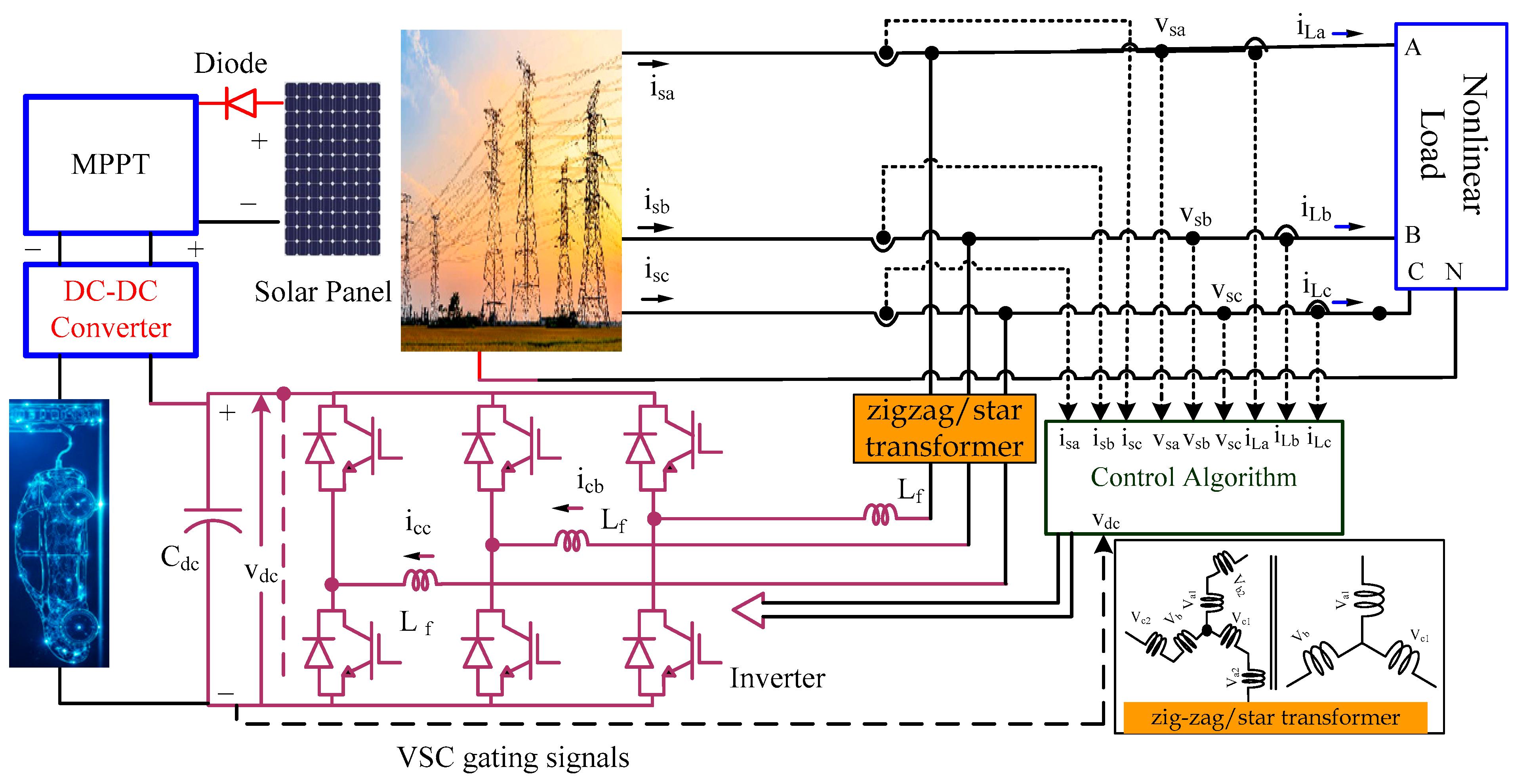
Figure 1 illustrates the detailed configuration of the grid-integrated EV charging system under study. The architecture centers around a solar PV array whose DC power output is conditioned and elevated using a high-efficiency DC–DC converter, which dynamically adjusts the PV voltage to maximize the energy harvest by employing the Perturb and Observe (P&O) method as the maximum power point tracking (MPPT) algorithm. The solar output voltage from the boost converter is stored in the capacitor.
The DC-link capacitor functions as a common energy buffer for both the inverter and the EV battery charging interface. The EV battery is directly connected across the capacitor terminals, enabling regulated charging according to the battery state of charge (SoC) and the prevailing grid conditions. The stored energy supplies the EV battery, supports auxiliary loads, and exports excess power to the utility grid during V2G operation.
The system is configured to interface the grid with either linear or nonlinear loads. Harmonic currents generated by nonlinear loads are actively mitigated using a DSTATCOM equipped with insulated gate bipolar transistor (IGBT) switches. The switching operation of these IGBT devices is governed by the Linear Kalman Algorithm. The DSTATCOM is positioned at the grid–load interface, connecting the utility and the load. Its bidirectional converter operates in voltage regulation mode, thereby stabilizing the grid voltage at the point of interconnection.
Current imbalances arising from load unbalance or nonlinear loads are compensated using a zigzag transformer installed between the utility and the load. This ensures that the source current is not polluted when any type of imbalance occurs on the load side.
The electric vehicle is interfaced with DSTATCOM through the DC-link side, enabling bidirectional energy exchange. In G2V mode, the battery undergoes charging, whereas in V2G mode, it discharges to support the grid during peak demand periods. During daytime operation, the solar PV system integrated with the DC link supplies energy to the EV, and surplus power is injected into the grid.
By integrating EV charging within microgrid operation, the proposed system improves grid stability and operational efficiency. Microgrids function as localized energy networks capable of autonomous generation, management, and distribution. Coordinated EV charging within this framework enables optimized energy utilization, cost reduction, and mitigation of grid congestion.
The component ratings and design justification for the principal subsystems of the proposed EV charger, rated at 415 V, 50 Hz on the AC side and 400 V at the DC link, are presented in
Table 1.
In electric vehicles, the traction motor is powered by the onboard battery pack. Therefore, battery characteristics critically determine its suitability for EV applications. The charger under consideration represents an AC level-2, low DC fast charger. The battery is charged through a regulated DC link supplied by both photovoltaic generation and the grid, so the charger typically operates in DC fast charging mode. The charging process follows a constant-current/constant-voltage (CC-CV) profile in which the charger dynamically regulates current during bulk charging and voltage during the final charging stage. The charging power varies with the battery state of charge and available solar energy, while the grid compensates for the power deficit. Thus, the charger acts as a power balancing device, not just as a DC load. The charging current varies, and these dynamic changes must be adapted by the charger. The charger must operate under communication protocols like IEC 61851 and ISO 15118 to coordinate charging power. The battery is charged from the DC link, which is dynamically adjusted to maintain a constant voltage, taking the role of a constant voltage charge controller.
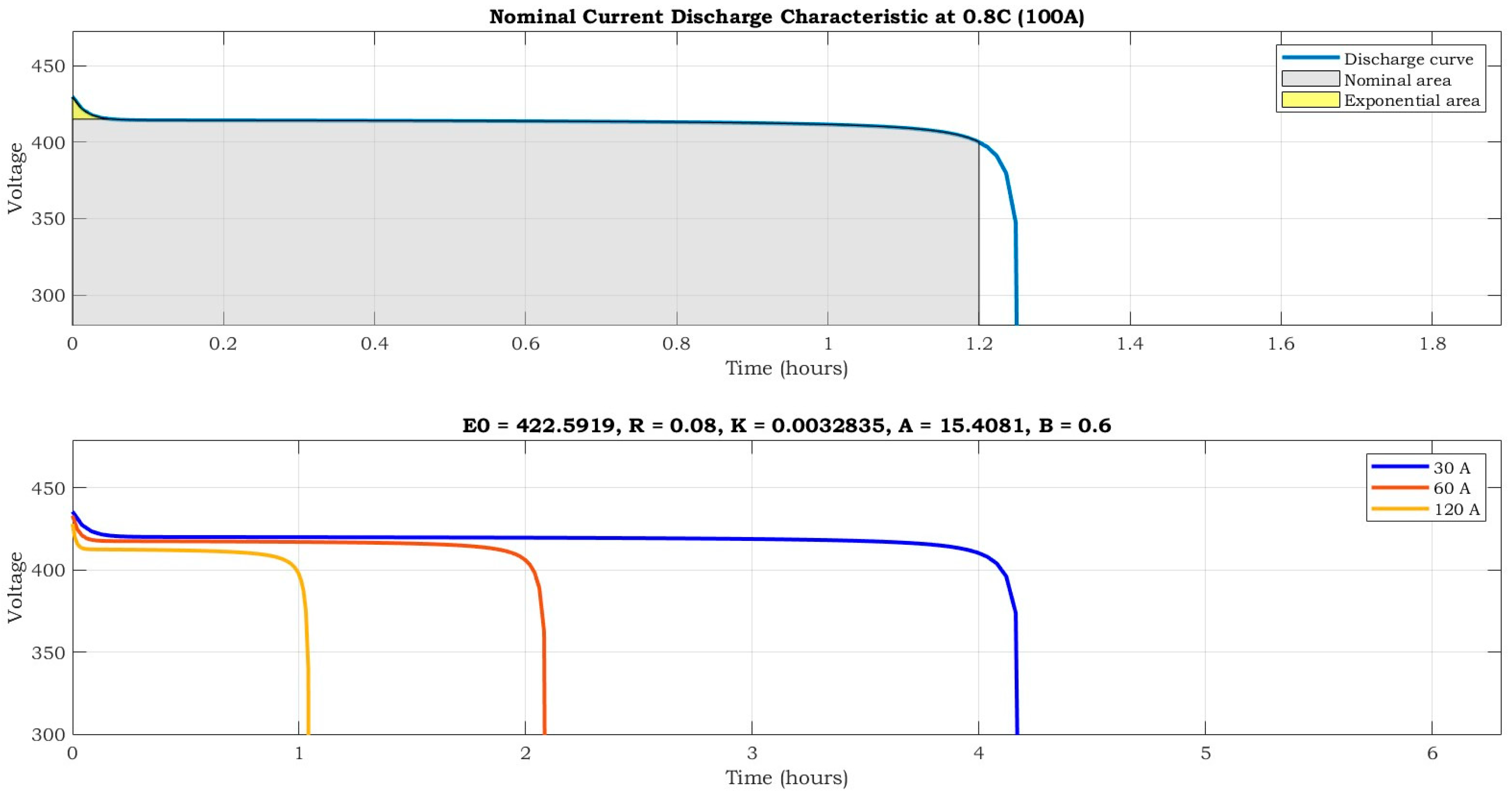
The typical discharge profile of a lithium-ion battery pack intended for EV use is illustrated in
Figure 2.
The characteristic curve consists of three distinct regions as follows: an initial transient exponential region, an extended nominal operating region, and a final phase characterized by rapid voltage decay.
At the onset of discharge, a slight exponential decrease in terminal voltage is observed. This phenomenon arises from internal resistance and electrochemical stabilization effects. Although the voltage initially declines, it stabilizes rapidly, indicating satisfactory internal impedance characteristics. Such behavior is well-suited for EV applications, as it demonstrates voltage stability under load and enhances overall power delivery efficiency.
Following the initial transient, the voltage profile remains nearly constant for an extended duration. This region ensures a stable DC bus voltage for the inverter and traction motor, thereby enabling consistent torque production and effective speed regulation. According to the characteristics, a vehicle drawing 100 A can operate for approximately 1.2h while maintaining a stable speed and constant torque.
As the battery state of charge decreases to low levels, a pronounced voltage drop becomes evident. This sharp decline represents the practical end-of-discharge condition and reflects the depletion of active lithium. To preserve battery health and extend cycle life, the battery management system typically enforces predefined cutoff limits to prevent deep discharge in EV applications.
The second section of the figure displays discharge characteristics at various current levels (30 A, 60 A, and 120 A). As the discharge current rises, the voltage drop becomes greater, and the discharge duration becomes shorter. This is due to the internal resistive losses and polarization effects, which rise in proportion to the current.
3. MPPT-Assisted Boost Converter
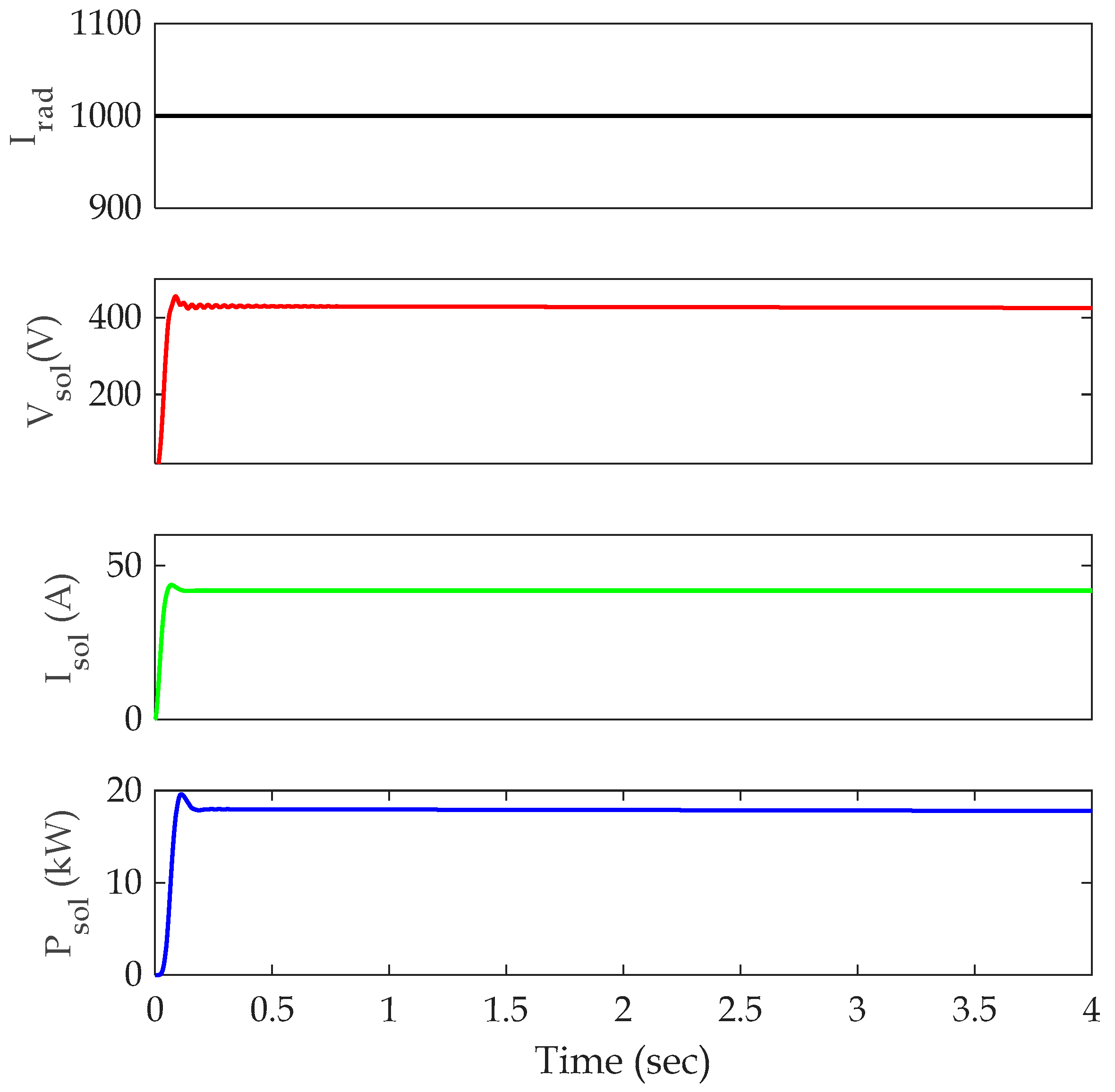
In
Figure 3, the voltage, current, and power of the solar panel for an irradiance of 1000 W/m
2 are plotted. The PV module used here has a capacity of 250 W under standard test conditions (1000 W/m
2 irradiance and 25 °C temperature). In order to accommodate the needs of a 400 V DC-link grid-connected inverter with EV charging, the output of the solar panel is increased by connecting many modules. To boost the output voltage, fifteen modules are connected in series, and five such series-connected modules are connected in parallel to increase the current capacity to 40 A. This gives a total of 75 modules in the array, increasing the total rated power capacity of the PV array to around 18.75 kW.
Since the PV panel output voltage depends on sunlight intensity and varies, a boost converter is required to ensure a stabilized output voltage. An inductor, a power electronic switch like an IGBT, a diode, a capacitor, and a controller for MPPT make a boost converter. Power is saved in the inductor when the switch is ON and released when OFF, boosting the voltage. Adjusting the IGBT’s duty cycle helps to maintain a stable output voltage. The generated power in the solar panel is regulated and is fed to the capacitor in the DC bus, where the EV is connected. The boost converter, which steps up the DC voltage, plays an important role by regulating the voltage produced by PV panels, ensuring that constant power is delivered to loads or energy storage devices like batteries.
It offers the convenience of connecting low-power PV modules with high-power grids and also improves efficiency.
The equations pertaining to the boost converter are as given as follows:
.
D is the duty ratio, and T is the total time period.
The boost converter in the off state is expressed as follows:
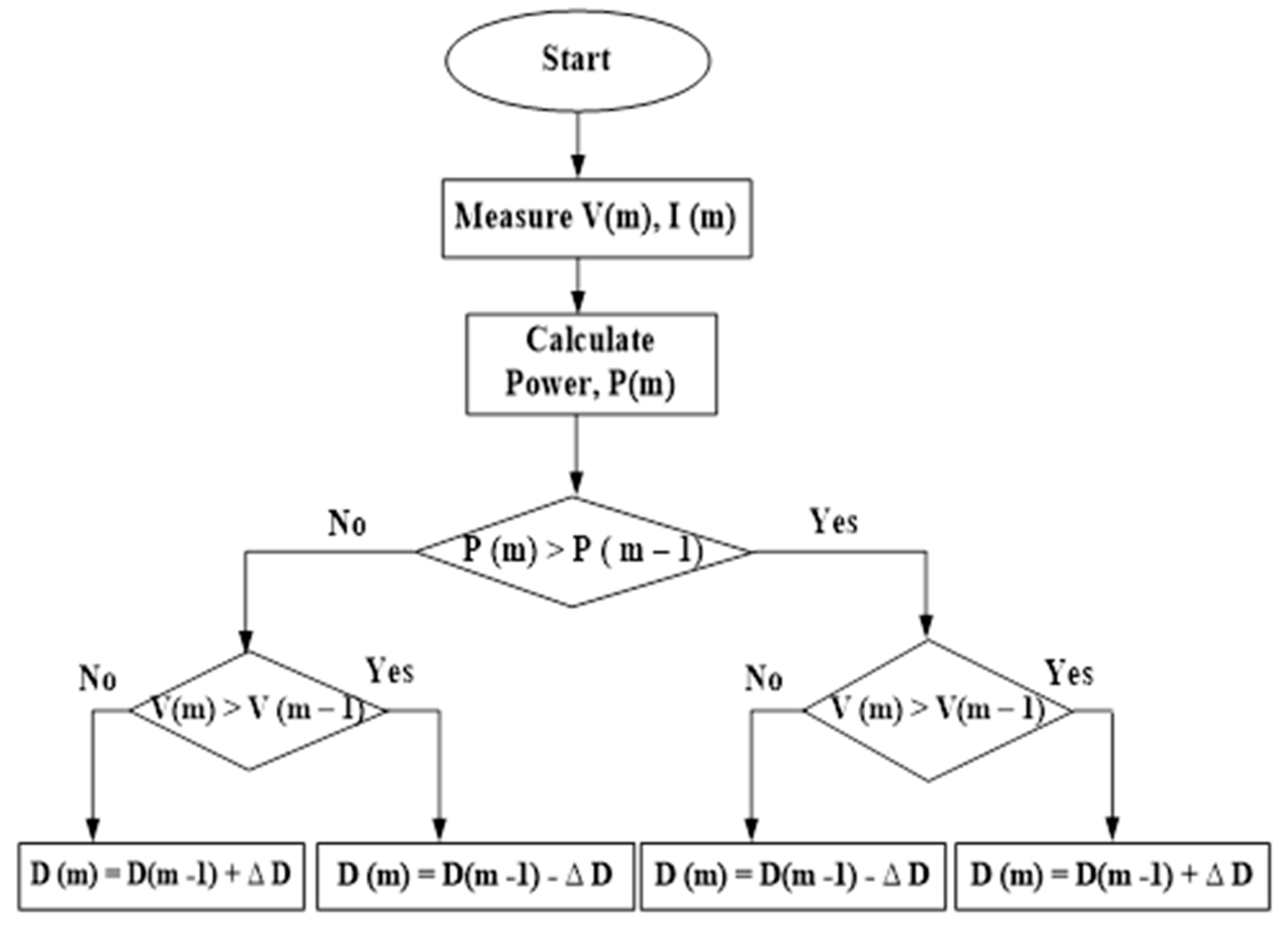
The primary objective of the maximum power point tracking algorithm is to minimize power oscillations caused by varying weather conditions while ensuring rapid and accurate tracking of the optimal operating point. In this system, the P&O method is employed, wherein the operating point is continuously maintained near the maximum power point, thereby reducing energy losses. The MPPT algorithm is explained in the flowchart shown in
Figure 4.
The algorithm operates by selecting a reference value, based on which the duty cycle is estimated and used to generate triggering signals for the IGBT. Upon detecting changes in irradiance or PV output current, the algorithm actively adjusts the operating parameters to maintain maximum power extraction.
4. Operational Modes of EV Charging Infrastructure
The proposed system represents an advanced hybrid energy architecture that integrates solar PV generation with grid connectivity, inverter functionality, and EV charging capabilities. A DC–DC converter employing the MPPT technique optimizes the power produced by the solar panels. This converter suitably elevates the DC potential to the required level. This potential energizes the VSC-based inverter.
The inverter converts the conditioned DC power into three-phase alternating current for grid interfacing. The system exhibits dual functionality as follows: it supplies solar-generated power to the utility grid with excellent power quality and zero voltage regulation, and it simultaneously delivers DC power to connected loads. The inverter dynamically adjusts its output based on grid and load conditions, governed by a control algorithm that ensures efficient and reliable operation. The control algorithm monitors a variety of system parameters, including the phase voltages (Vsa, Vsb, and Vsc), phase currents (isa, isb, and isc), and load currents (iLa, iLb, iLc), as well as the DC bus voltage.
One distinguishing element of the system is its capacity to perform under a variety of operational situations. If the load in one phase is disconnected, the grid will continue to support the remaining phases, ensuring an uninterrupted power supply. This fault tolerance improves system reliability, especially under nonlinear and unbalanced load circumstances. When the operation is changed to the vehicle-to-grid mode, the stored energy in the vehicle is fed back to the grid. If the entire grid is turned off, the solar panel continues to operate as an independent power source, powering both the DC load and the linked AC loads via the inverter.
Furthermore, the presence of a battery enables energy storage. The battery can be charged directly from the solar panel during peak sunlight hours, or from the grid when solar power is insufficient. This dual-charging capacity improves energy dependability and grid stability by lowering peak demand.
5. Control Structure and Harmonic Elimination
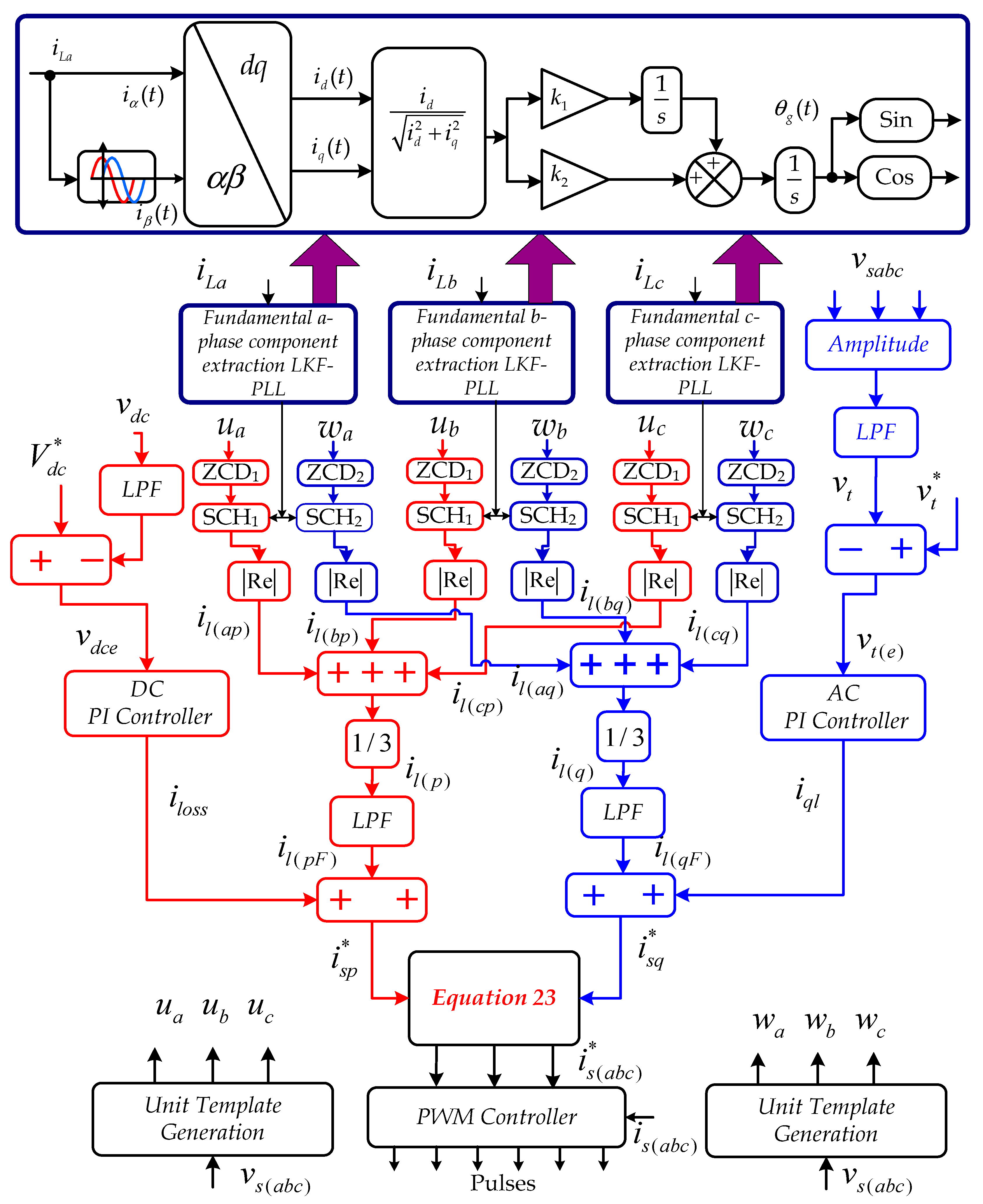
The IGBTs in the control circuit switch on and off based on the pulses generated from the control algorithm. The control circuit uses the Linear Kalman Filter (LKF), which ensures precise filtering of signals, even in the presence of noise, drawing upon its noise robustness and accurate state tracking capabilities. This adaptability allows the LKF to respond rapidly to changes in system dynamics and ensure effective regulation of the controller output. The capability of LKF in converting any polluted waveform to a pure sinusoidal one makes it a sought-after control algorithm.
5.1. Evaluation of Active Components of Load Currents
Figure 5 explains the steps incorporated in the control algorithm.
The transfer function of the steady-state LKF-PLL is given by
where k
1 and k
2 are the Kalman gains.
The extracted fundamental voltage components are processed through a zero-crossing detector and the sample and hold block. These processed signals are combined with the unit vectors ua, ub, and uc. The real components of the resultant vectors are combined with the proportional–integral block output to form the active components of the load currents.
The voltage at the PCC (
vt) is calculated as
The direct-phase unit templates of voltages are established as follows:
The average of the direct axis current components is calculated as
The DC bus voltage is evaluated against the reference value, generating an error signal. At the
jth sampling instant, the error voltage is expressed as
is the DC voltage reference value, and is the voltage at the DC bus at instant j.
The PI controller tries to regularize this error. The output is given by
is the integral gain, and is the proportional gain.
The output of the PI controller is added to the average current.
This output is scaled by the unit vectors to form the direct axis components of the reference currents for each phase.
5.2. Reactive Components of Load Voltages
The reactive components of the reference values of the phase voltages are derived from the quadrature unit vectors. The extracted fundamental voltage components are processed through a zero-crossing detector and the sample and hold block. These processed signals are combined with the quadrature unit vectors wa, wb, and wc. The real components of the resultant vectors are combined with the proportional–integral block output to form the quadrature components of the load currents.
The quadrature components of the unit vectors are extracted in the following way:
The average of the indirect axis components of the load voltage is calculated as
The voltage at the Point of Common Coupling (PCC) is matched with the standard value, and an error is produced. The error at the
jth sampling instant is given by
is the reference value, and is the voltage at the PCC at instant j.
The PI controller acts to regularize this error. The output is given by
is the proportional gain, and is the integral gain.
The output of the PI controller is added to the average voltage.
This output is proportioned by the unit vectors to form the quadrature axis components of the reference values of source currents for each phase.
The reference values of source currents are formed as
5.3. Generation of Pulses
The reference values have the desired waveforms of the generated currents. The reference currents at each phase are checked against the actual source currents in a hysteresis loop. The result of this comparison produces the pulses for switching the IGBTs.
6. Optimization Technique
The proposed EV charging controller employs proportional gain (Kp) and integral gain (Ki), which play important roles in the frequency and voltage regulation loops. The performance of the system largely depends upon these gain values. Analytical tuning of these gains by using the conventional methods is not efficient under dynamic conditions and nonlinear loads. Also, a trial-and-error method for finding these gains is a long process. In this study, an optimization technique is used for deciding the gain values.
The proportional and integral gains used in the frequency regulation control loop (Kpf and Kif) and the voltage regulation control loop (Kpv and Kiv) contribute significantly to ensuring that the output parameters track and maintain their respective reference values. These gains directly influence the frequency deviation, voltage deviation, dynamic response speed, reactive power compensation, and the effectiveness in harmonic reduction, which means that these gain values indirectly affect the dynamic stability of the system. The PI controllers are tuned for the correct values by using the Salp Swarm Algorithm. This optimization method provides systematic and repeatable tuning, which helps to maintain the dynamic stability of the system.
The Salp Swarm Algorithm (SSA) is a nature-inspired optimization technique derived from the behavior of salps hunting in swarms. Salps are marine organisms with barrel-shaped, jellyfish-like bodies that form swarms in deep ocean waters like chains. The pack is split into two units, referred to as the leader and the disciples. The Salp at the front is the leader, while the other salps are the disciples. The leader guides the swarm toward the target, and each follower aligns its movement based on the salp ahead, ultimately tracing the leader’s path.
The objective of this chain-like movement is to reach a food source, denoted as F, located within a defined search space. Initially, the algorithm assigns random positions to all salps and evaluates their fitness. Based on this evaluation, the leader and follower positions are updated using specific mathematical equations.
The salp with the highest fitness value is considered to have reached the food source, and its position is treated as the best solution. This position is referred to as the global optimum. The process then iteratively refines the positions of salps, excluding the initialization phase, until a stopping condition is satisfied.
Throughout the optimization, the search space is confined within predefined boundaries using boundary constraints. A search space with m dimensions is declared. The number of variables is m.
The salp positions are stored in P, which is a two-dimensional matrix.
In the Salp Swarm Algorithm (SSA), only the leader’s position is upgraded directly with reference to the food source, as defined by the following equation:
Here,
is the leader’s position in the qth dimension, and
Fq is the location of the food source in the qth dimension.
and
are the upper and lower boundaries of the qth dimension.
is a random number which directs the leader towards the food source and has values between 0 and 1. The random number
also has values between 0 and 1 and it diversifies the search space.
is the random number which decides the direction of movement. To maintain the equilibrium between exploration and exploitation, another coefficient
is introduced.
is given by
where
ir is the current iteration and
irmax is the maximum iteration.
The position of the follower is updated by using Newton’s second law of motion and is given by
In the Salp Swarm Algorithm (SSA), the position of the food source is revised based on the leader’s position, while the positions of the followers are adjusted relative to one another. This coordinated movement ensures a gradual convergence toward the leader, effectively reducing the risk of getting trapped in local optima.
In the power quality context, each salp represents one dynamic behavior of the system. The salp position vector is given by
Fq is the best gain value obtained, which will give the best response with the least distortion. The boundary limits help the gain values to be confined within the stability limits. An excessive value of gain creates overshoot and oscillations, whereas low values of gain lead to slow response and voltage sag.
The number of salps (search agents) was set to five, and the maximum number of iterations was fixed at ten. The optimization problem dimension was four, corresponding to the PI controller gains for the DC controller and for the AC controller. The lower and upper bounds of the PI gains were defined as [0, 0, 0, 0] and [5, 5, 5, 5], respectively.
The objective function is designed to minimize the steady-state errors of the PI controllers implemented in the DC bus comparator and the PCC voltage comparator, thereby enhancing overall control accuracy.
The objective function is given by
where
ITSE1 and
ITSE2 represent integrated squared error and are the inputs to the DC bus and AC PI controllers.
and
are the weights of
ITSE1 and
ITSE2. They are taken as 0.5.
The optimization technique finds the best values for the gains for both PI controllers to minimize the errors. These values are extracted and then applied in the algorithms to obtain the best results.
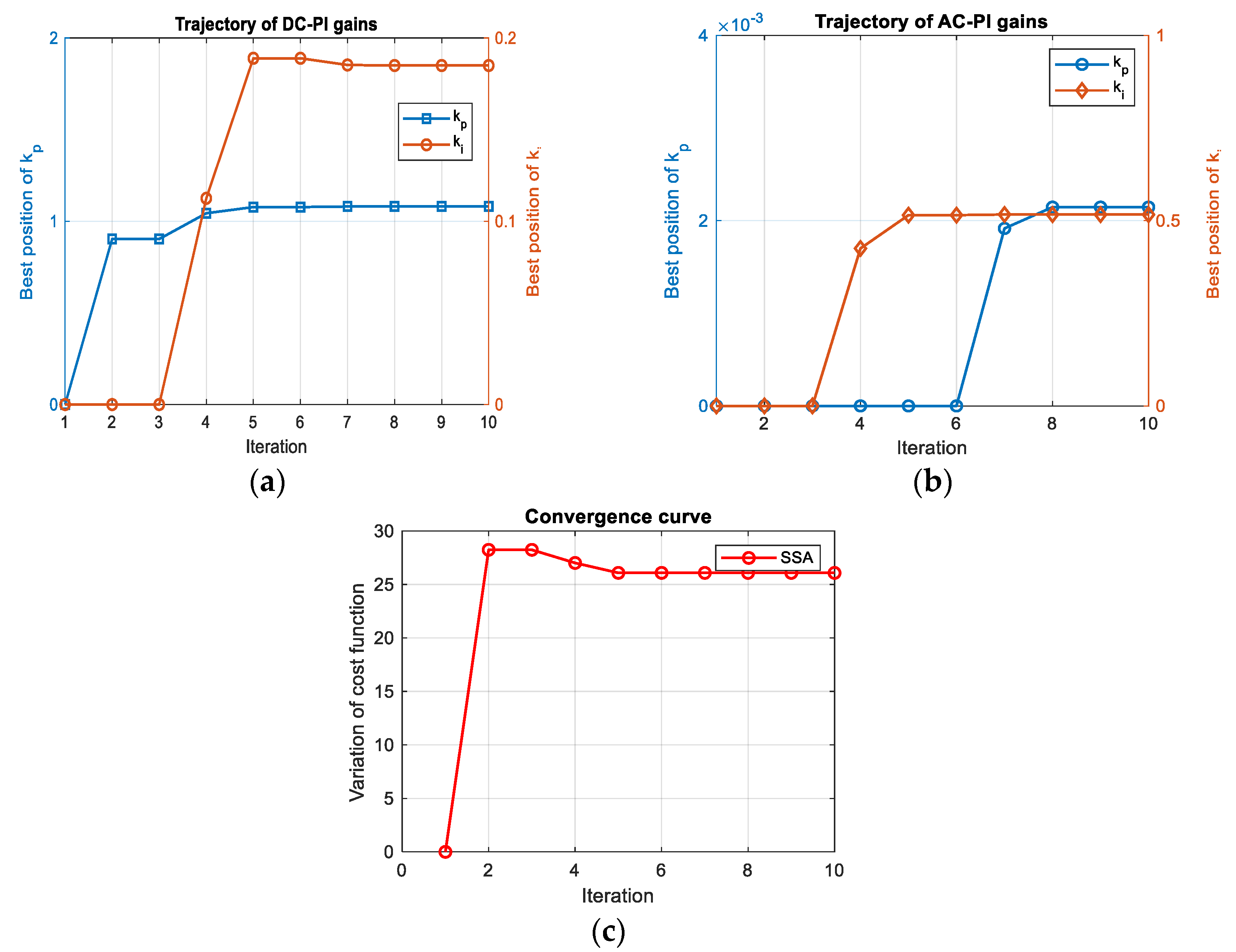
The results of the optimization techniques are displayed in
Figure 6a–c.
Figure 6a,b exhibits the trajectories of DC and AC gains. For DC voltage regularization, the proportional constant obtained is 1.08, and the integral constant is 0.185. For maintaining constant voltage at the PCC, the proportional constant is 0.002, and the integral constant is 0.52. The trajectories show that the Kp and Ki values reach the final steady state values with a smooth trajectory.
Figure 6c is the convergence graph (convergence value). The trajectory of the convergence curve shows the path through which the objective function rises to the final value. It can be seen that the cost function jumps to a value of 28 in the second iteration itself. Immediately, it settles down to around 26, and then it maintains the value. The trajectory shows the efficiency of the optimization algorithm to quickly move towards a promising solution.
Table 2 shows the values of Kp and Ki, which are obtained using the SSA optimization algorithm. The same valuesare substituted in the control block. The results obtained show the performance efficacy of the optimization algorithm in finding the gain values of the proportional–integral controller.
7. Results and Discussion
7.1. G2V Operation with Linear Loads
In the solar panel which is connected to the three-phase grid with a non-isolated zigzag transformer and an inverter, a three-phase measurement is used to continuously measure the voltage and current values.
The proposed PV–EV integrated system is evaluated under Grid-to-Vehicle (G2V) operation with linear loads connected on the AC side.
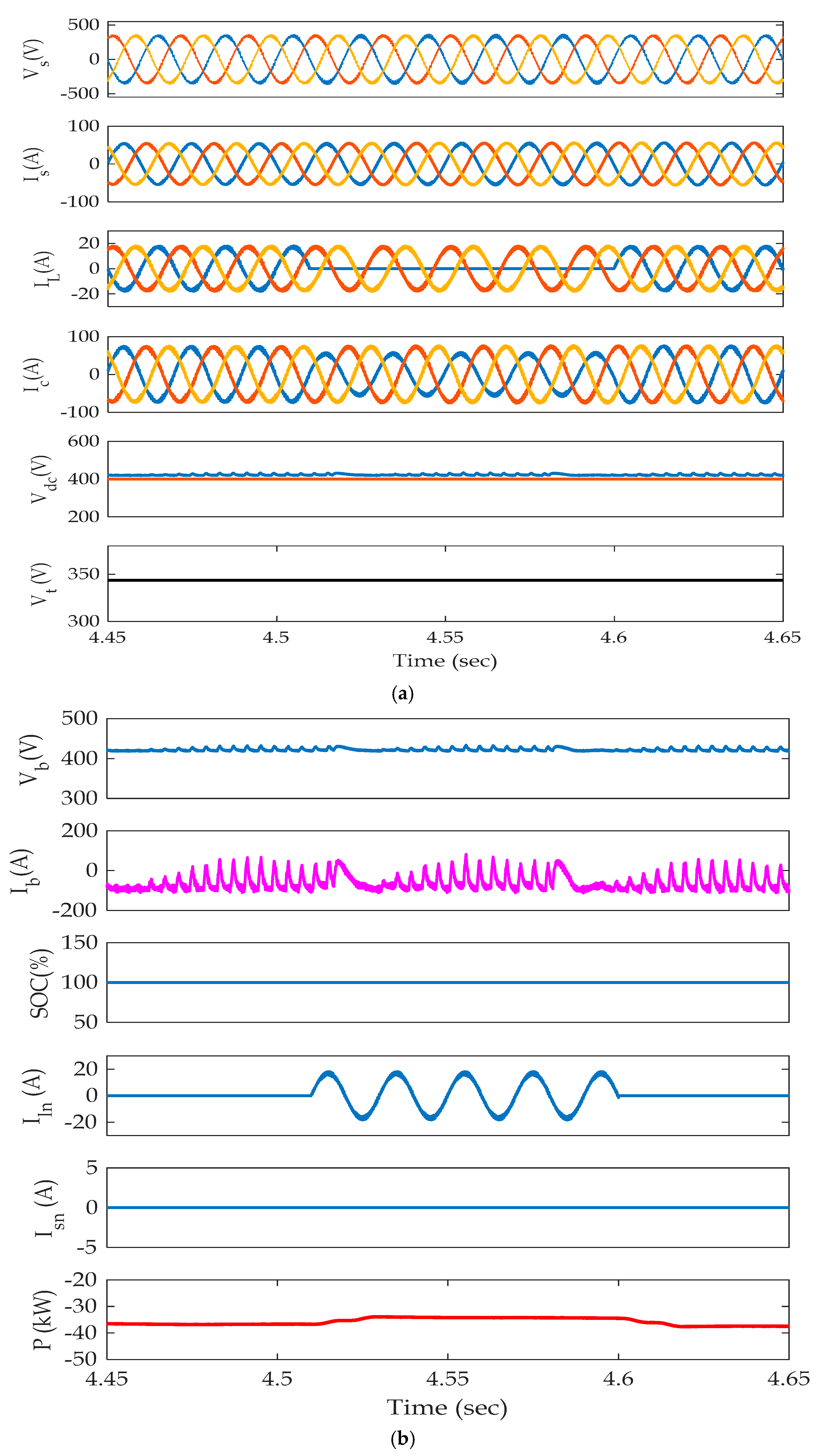
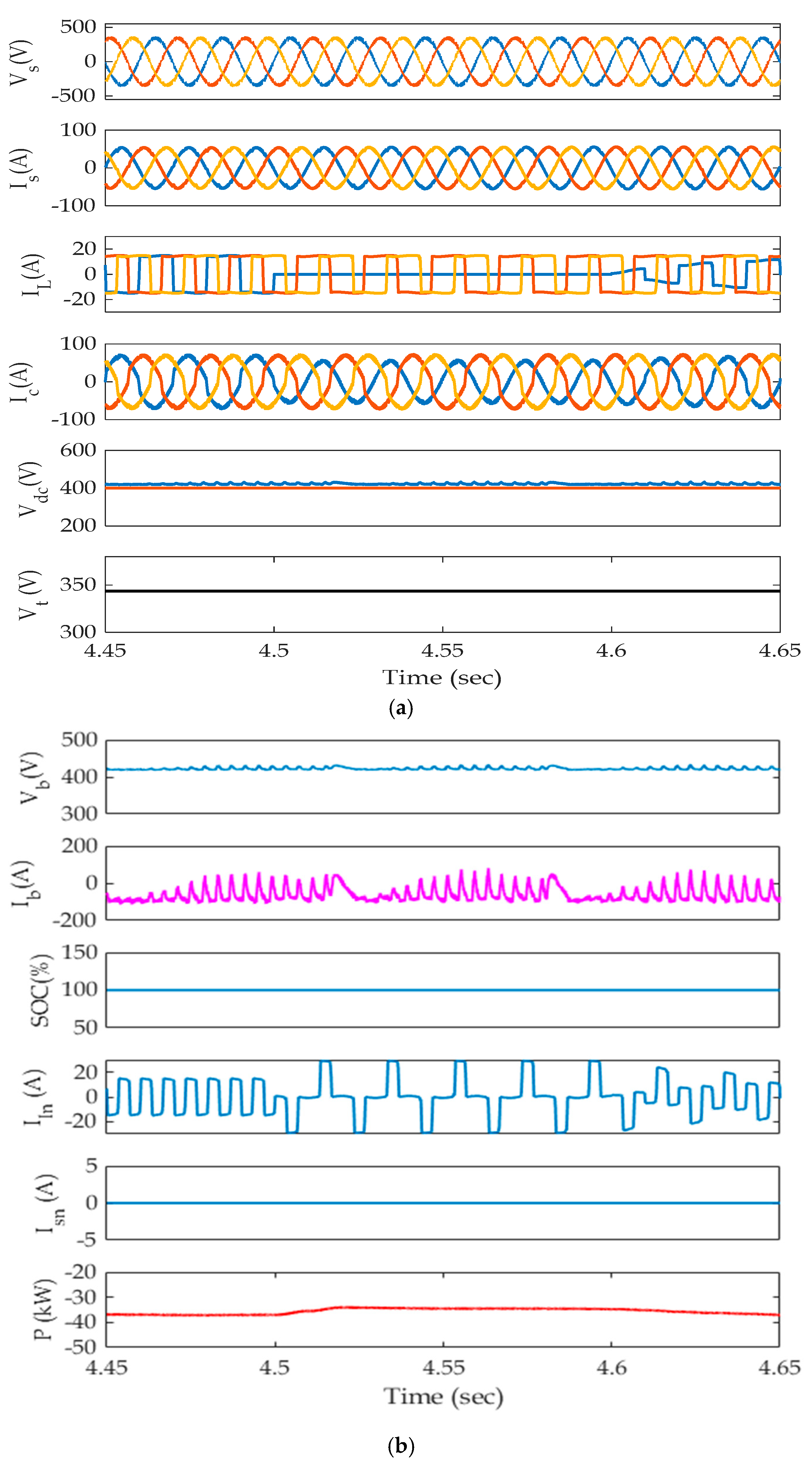
Figure 7a shows the grid voltage, grid current, load current, compensating current, DC bus voltage, and terminal voltage at the point of common coupling, and
Figure 7b displays the battery voltage, battery current and state of charge of the battery at different instances, load neutral current, source neutral current, and the charging power when a linear load is connected. The three-phase grid voltages remain balanced and sinusoidal at rated magnitude, confirming proper synchronization and stable inverter operation. No noticeable distortion is observed due to the presence of linear loads, and current tracking follows the reference accurately. The grid currents are also sinusoidal and in phase with the supply voltages, indicating near-unity power factor operation during battery charging.
It is observed that even when the load in one phase is disconnected, the source quantities remain sinusoidal. Any disturbance due to the change in load is effectively compensated by the controller so that the source current remains undistorted. The load current waveform shows that the current in one of the phases is zero from 4.5 s to 4.6 s. Immediately, the compensating current changes in such a way that the source current becomes sinusoidal. The transient response is fast, with negligible overshoot and settling within less than 40 ms. The DC-link voltage is effectively regulated around 400 V, with steady-state deviation limited to within ±3% and ripple below ±5 V. This demonstrates strong coordination between the grid-side converter and the PV-fed DC–DC stage. The battery charging current remains controlled and within rated limits, delivering approximately 35–40 kW of charging power without oscillatory behavior. The state of charge (SOC) remains nearly constant during the short simulation interval due to the initially high SOC. The positive direction of the battery current shows that the battery is powering up. When the load power demand is smaller than that supplied, the battery absorbs the extra power and is charged, and the SOC remains constant. The load neutral current was absent for the linear load during the balanced condition. When one of the phases was disconnected, there was an imbalance in the system, and the neutral current flowed through the transformer neutral and the load neutral. Due to this arrangement, the source neutral current remains zero.
7.2. G2V Operation with Nonlinear Loads
The proposed EV charger circuit was analyzed for Grid-to-Vehicle (G2V) operation with a nonlinear load, and it is shown in
Figure 8a,b. The AC-side voltages remain balanced and sinusoidal at rated magnitude and frequency, confirming proper grid synchronization. The grid currents are also sinusoidal and nearly in phase with the supply voltages, indicating unity power factor operation. During battery charging, the lithium-ion battery draws a controlled current within rated limits, delivering approximately 35–40 kW charging power without oscillatory behavior.
Under nonlinear loading conditions, the load current exhibits distortion; however, the grid current remains sinusoidal, indicating effective harmonic compensation by the inverter. The estimated grid current THD is below 5%, satisfying IEEE-519 limits, and the zigzag transformer suppresses neutral current effectively. Overall, the system demonstrates stable DC regulation, unity power factor operation, harmonic mitigation, and coordinated PV–grid–battery integration during G2V operation.
When one phase is disconnected at 4.5 s, the load current shows variation, whereas the source quantities remain sinusoidal. The DC-link voltage is tightly regulated around 400 V with a steady-state deviation within ±3% and ripple limited to less than ±5 V, demonstrating effective coordination between the inverter and the PV-fed DC–DC converter. The inverter filter successfully attenuates switching ripple, ensuring smooth grid current injection. Settling time, after the disturbance, is below 40 ms for nonlinear loads also.
7.3. Transition from G2V to V2G Operation
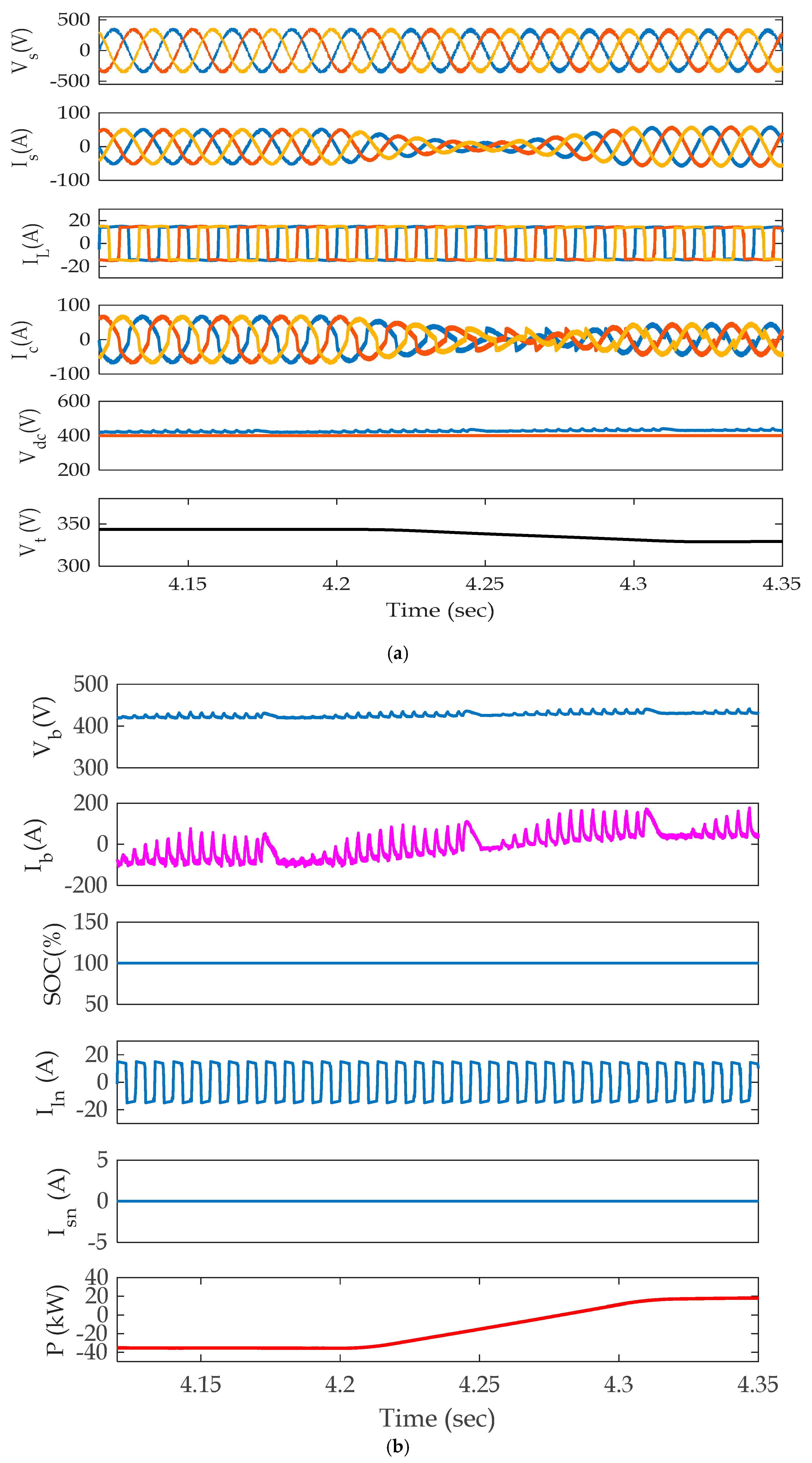
The proposed PV–EV integrated system is evaluated for its transition from Grid-to-Vehicle (G2V) to Vehicle-to-Grid (V2G) operating mode. In G2V mode (before 4.2 s), power flows from the grid to charge the battery, while the PV array supports the DC bus through a DC–DC converter operating under MPPT control. The AC-side voltages remain balanced and sinusoidal at rated magnitude and frequency, confirming proper grid synchronization. The grid currents are sinusoidal and nearly in phase with the supply voltages, indicating unity power factor charging.
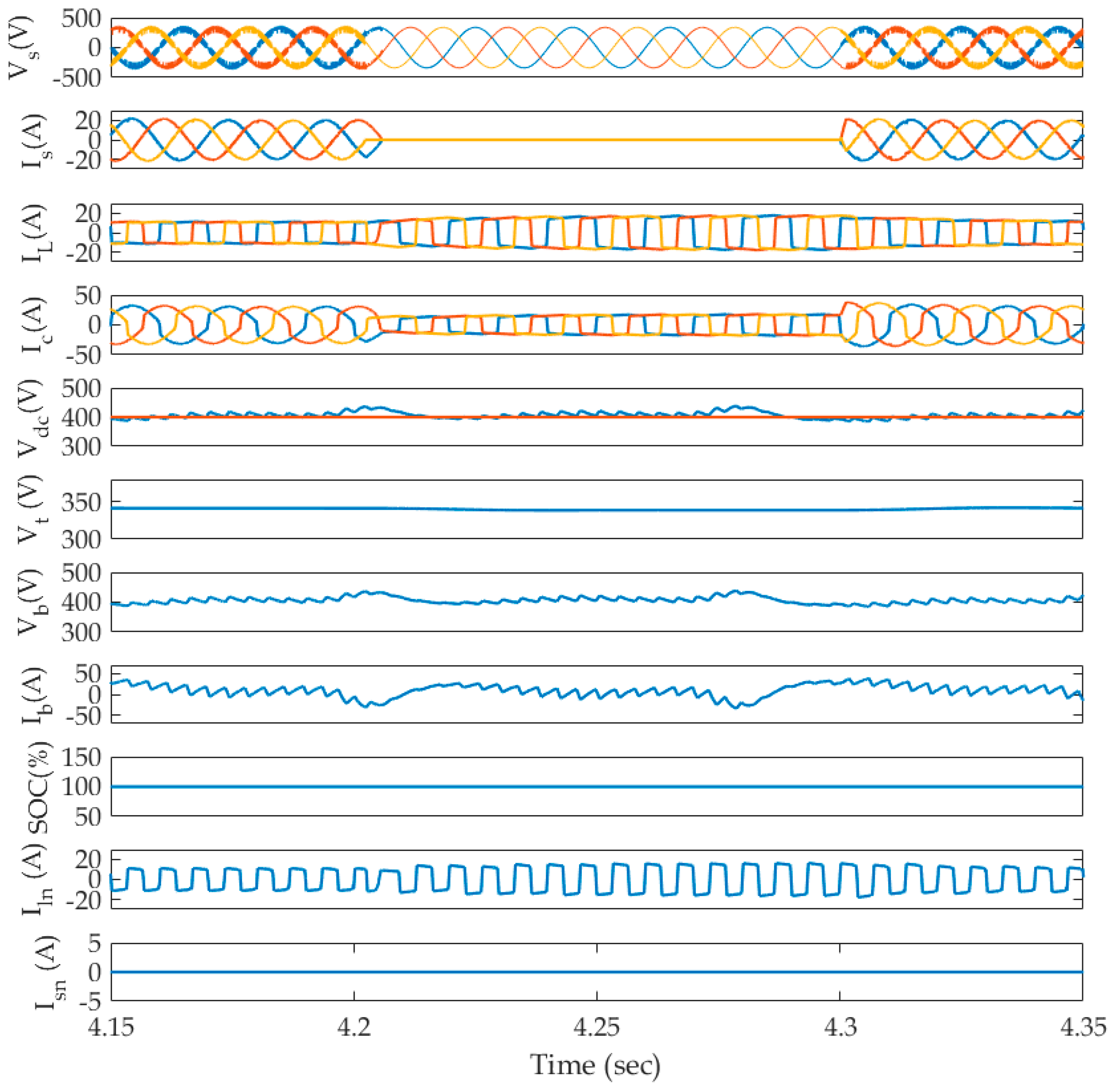
At 4.2 s, the system is made to have a transition to V2G mode, where power flow reverses, and the battery begins supplying energy back to the grid. This is shown in
Figure 9a,b. By 4.3 s, the source current direction is reversed, which indicates that the current flows into the grid. The active power waveform clearly shows a smooth transition from negative (charging) to positive (discharging) values without oscillatory spikes. The grid current phase reverses while remaining sinusoidal and synchronized with the grid voltage, confirming stable bidirectional control. The DC-link voltage remains regulated within the same ±3% band during the transition, demonstrating robust dynamic performance. The battery current polarity reverses smoothly, and no excessive overshoot is observed. The power changes from negative to positive. Overall, the system ensures a smooth G2V–V2G transition, stable DC regulation, unity power factor operation, and effective harmonic mitigation under both operating conditions.
Figure 10 represents the analysis of the dynamic response of the solar-assisted grid-connected circuit when the grid is disconnected. The grid is disconnected at 4.2 s. The solar energy source works in the islanding mode (or when AC power is disconnected). The DC bus supplies power to the nonlinear loads connected on the AC side, which represents the islanded mode of operation for the solar power generating unit. The source current from the grid is zero at this point, which shows that the grid is disconnected. As long as the load current continues to flow, the compensator immediately responds, injecting the compensating current and supplying quality power to the load. The DC link voltage is maintained tightly at 400 V, with a slight surge in the voltage at the time of disconnection and reconnection of the grid. The terminal voltage remains steady, showing excellent voltage regulation, which is a testimony to the efficiency of the controller. The battery voltage is the same as the DC-link voltage.
The battery current goes negative when the grid is disconnected, which indicates that the battery is discharging. SOC remains constant, showing that the battery is correctly sized and is capable of supporting the load during the transients. The load neutral current continues to flow, but it is localized and is not allowed to pollute the source waveform. The source neutral current is zero even when a nonlinear load is connected.
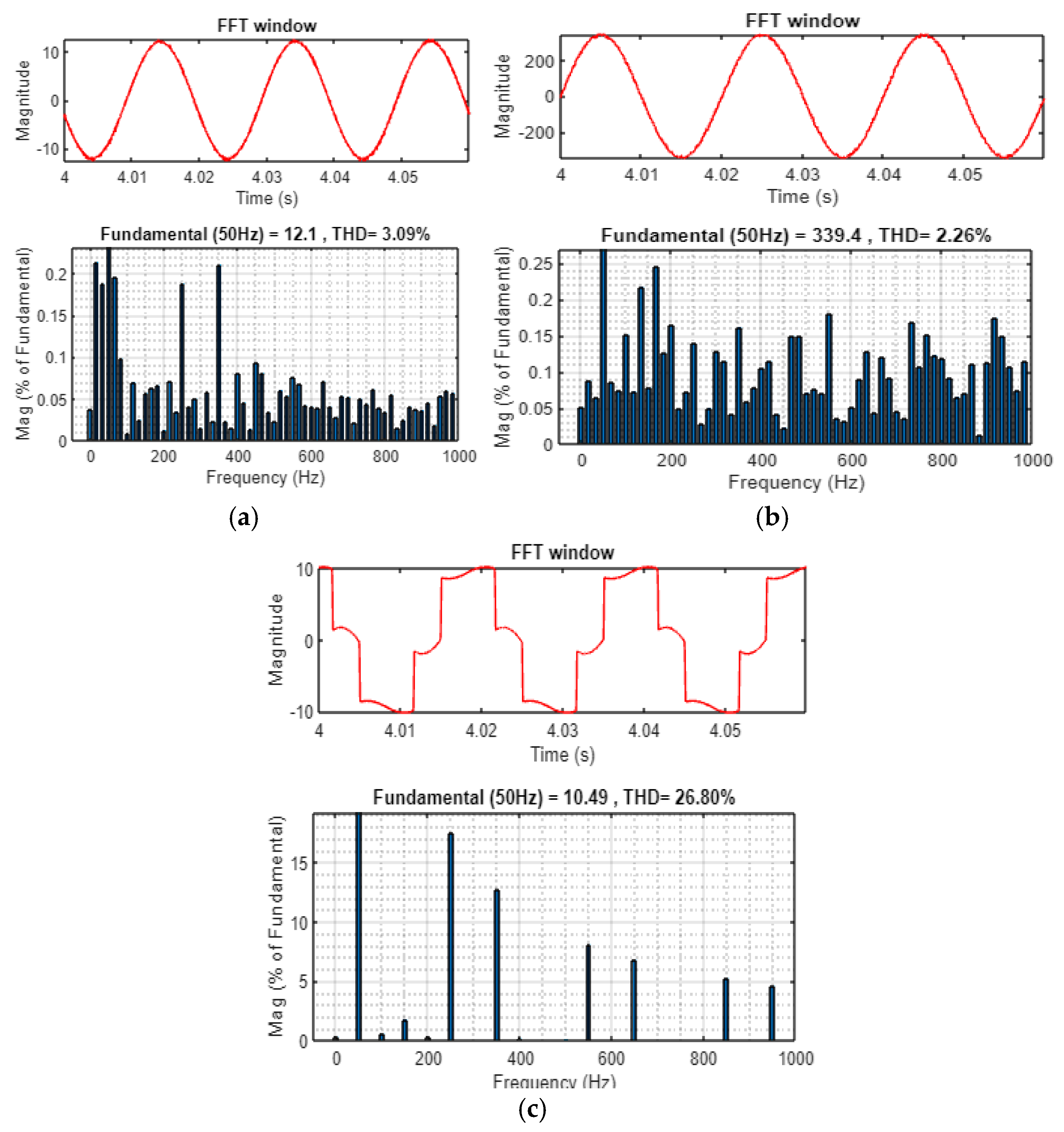
Figure 11a,b shows the THD plots and values of the source voltage and source current. The source current is sinusoidal in nature. There are fewer harmonics. THD of source voltage is 2.26%, and THD of source current is 3.09%, which is less than the maximum limit specified by IEEE 519 standards [
54].
Figure 11c is the THD of the load current; the load current is not sinusoidal in nature. This non-sinusoidal nature is due to the presence of harmonics. THD = 26.80%, which is very high in nature due to the presence of distortions. The source current THD decreased from a highly distorted 26.8% load condition to 2.26%, indicating a twelvefold attenuation of harmonic content, demonstrating effective harmonic confinement and DSTATCOM functionality. The control algorithm effectively compensates the harmonic currents generated by the nonlinear load, which confines the harmonic distortion locally and prevents it from propagating to the grid, thus ensuring that the source current complies with high power quality standards. The inverter may experience increased thermal and switching stress during the harmonic current distortion. But since the electric vehicle is charged from the well-regulated DC bus, the highly distorted load current does not degrade the charging quality of the electric vehicle. Stable voltage regulation is confirmed by the grid voltage distortion staying within allowable bounds.
8. Conclusions
This paper has proposed a grid-connected solar-assisted EV charging system with a DSTATCOM feature, controlled with a linear Kalman filter and PI gains tuned with SSA. This EV charging unit, along with maintaining a robust and reliable DC supply for the vehicle charging, acts as an active power balancer. The system is tested under nonlinear, unbalanced, and bidirectional operating conditions. G2V and V2G operation with high power quality preservation is ensured under nonlinear and unbalanced loading. The system performance is further assessed under grid-connected and isolated modes. Simulation results demonstrate the efficiency of the controller in maintaining the quality of the output waveforms. The fast response of the controller helps the system to maintain dynamic stability in case of disturbances. The THD analysis shows that although the load current has a total harmonic distortion (THD) of 26.8%, the source current THD is barely 2.26%, demonstrating significant harmonic reduction and compliance with the IEEE-519 requirements. The voltage at the point of common contact is maintained at 3.09%, indicating efficient voltage regulation. The zigzag–star transformer guarantees neutral current suppression during imbalance, which ensures that the source current is not affected by this imbalance. The optimized control of the PI controller contributes to repeated and systematic tuning, which in turn improves the transient response and dynamic stability. In contrast to the traditional EV charging systems, which require separate compensation units, the proposed system allows bidirectional power exchange and acts as an active power conditioner. Thus, in this era of modern distribution networks with high renewable and EV penetration, this multifunctional charger network is highly recommended.




 ,
,