


Abstract
As the electrification of heavy-duty trucks accelerates, conventional charging methods face challenges, including long charging durations and reduced transportation efficiency. This paper compares and evaluates various charging methods for electric heavy-duty trucks (EHDTs), including slow charging, fast charging, battery swapping, and electric roads, from both technological and economic perspectives. A case study in a harbor setting further examines the cost and efficiency implications of a 22 kW slow charger, a 150 kW fast charger, and battery swapping (the swappable battery is charged with 150 kW). The analysis provides insights into selecting the most suitable charging solution by assessing annual charging costs, truck and infrastructure cost amortization, and downtime across different scenarios. The findings of this paper indicate that slow charging is cost-effective in low-demand operations but becomes impractical as operational demand increases, leading to excessive downtime exceeding 37,000 h annually in high-demand scenarios. Fast charging significantly reduces downtime but requires higher infrastructure investment and charging costs. Battery swapping minimizes downtime to less than 300 h annually in high-demand scenarios, and, despite a higher initial infrastructure cost, it emerges as the most cost-effective option over five years for medium- and high-utilization fleets, with a total cost of approximately €1.67 million in the studied harbor case. Thus, selecting a suitable charging solution depends on operational priorities, such as minimizing cost or maximizing fleet availability within a specific use-case context.
1. Introduction
In 2023, the transportation sector was responsible for approximately 16% of global carbon emissions, equivalent to around 8.4 billion metric tons of carbon dioxide [1]. Heavy-duty trucks (HDTs) are a significant contributor to these emissions, accounting for 41% of the sector’s carbon output, despite comprising only 7% of the total vehicle population [2,3]. This imbalance highlights the need for targeted solutions in this area. Due to increased awareness of climate change, the concept of electrification is rapidly emerging as a clean, eco-friendly alternative to traditional diesel trucks, helping address pollution and global warming [4]. While these challenges are international in nature, their mitigation ultimately depends on local, operational decisions, such as how freight vehicles are charged and scheduled in energy-intensive nodes like ports and logistics hubs.
Electrification of heavy-duty trucks has emerged as a promising approach to reducing emissions, as lithium battery technology [5,6] has improved, making EHDTs technically and economically viable compared to diesel and alternative-fuel trucks [7,8]. Existing studies [6,7,9,10] have examined the potential advantages of EHDTs over diesel trucks throughout their life cycle. These studies indicate that, although EHDTs require a significant initial investment, their life cycle costs can be comparable to those of their diesel truck counterparts, particularly when the trucks are driven with high annual mileage and equipped with durable batteries.
The adoption of EHDTs has been accelerated by government support through regulations and incentives to promote zero-emission vehicles [11,12,13]. The electrification of HDTs in China was in its early stages in 2020, with an electrification rate of approximately 0.16% [14]. However, with strong policy support and efforts to promote decarbonization, adopting EHDTs is expected to gain momentum and become a growing trend. Forecasts indicate that the electrification rate of HDTs in China will grow from 0.16% in 2020 to 18% by 2030 [15]. Several truck manufacturers, including Van Doorne’s Aanhangwagen Fabriek (DAF), Daimler, Maschinenfabrik Augsburg-Nürnberg (MAN), Navistar, Nikola, PACCAR (originally Pacific Car and Foundry Company), Volkswagen, Volvo, Tesla Inc., and Thor Trucks, have unveiled ambitious plans to electrify their HDTs [16]. These plans feature battery capacities ranging from 300 kWh to approximately 990 kWh [17].
Meanwhile, many companies have begun incorporating EHDTs into their fleets or have announced plans to procure them. For instance, Amazon announced in January 2025 plans to deploy about 150 EHDT across the UK, including over 140 from Mercedes-Benz and 8 from Volvo. This initiative aligns with the company’s goal of reaching net-zero carbon emissions by 2040 [18]. Similarly, in September 2024, Australian mining firm Fortescue entered a $2.8 billion agreement with Liebherr to create a zero-emission mining fleet. The deal involves acquiring 360 autonomous EHTs, 55 electric excavators, and 60 battery-powered dozers, accounting for approximately two-thirds of Fortescue’s total mining fleet [19]. By the end of 2023, Schneider National had incorporated approximately 100 Freightliner eCascadia battery-electric semi-trucks into its operations, achieving over 1 million zero-emission freight miles [20]. Nestlé has expanded its fleet with electric HGVs capable of traveling 120 miles per charge, ensuring zero tailpipe emissions [21]. Swedish company Einride has partnered with major corporations such as Mars, Heineken, PepsiCo, and Maersk to facilitate the transition to electric trucking, improving operational efficiency while lowering emissions [22].
Despite government support, accelerating the adoption of EHDTs in trucking fleets is considered more challenging than electrifying passenger vehicles. One of the most significant hurdles in this process is addressing the challenges associated with charging EHDTs [23]. The potential for electrifying commercial vehicles increases with the availability of charging infrastructure that meets these vehicles’ charging requirements [7,9,24,25,26]. Operators of commercial vehicles are unlikely to switch to EHDTs if the charging process is more complex, time-consuming, and uncertain [27]. Additionally, the operational schedules of commercial EHDTs can affect the charging of these trucks at charging infrastructure compared to passenger vehicles [8]. Thus, successfully adopting EHDTs across various commercial fleets requires selecting appropriate charging methods tailored to specific contexts and conditions.
Despite growing literature on charging strategies for EHDTs, most existing studies focus on general freight transport, long-haul operations, or passenger vehicle analogies, with limited attention to logistics-intensive nodes such as ports. Harbor transport is characterized by short travel distances, high vehicle utilization, strict time constraints, and sensitivity to downtime, which fundamentally alter the suitability of different charging solutions. This study addresses this gap by examining how operational constraints in a harbor environment influence the technical feasibility and economic performance of slow charging, fast charging, and battery swapping.
This paper compares and analyzes different charging methods for EHDTs, including slow charging, fast charging, battery swapping, and electric roads. The main contributions of this paper are to provide operationally grounded, case-based insights into charging strategy selection for EHDTs under high-utilization harbor conditions, as summarized as follows: (1) To provide a comprehensive overview of different technological and economic perspectives of various charging methods for EHDTs to understand their feasibility, efficiency, costs, and suitability from a general perspective by reviewing existing literature. (2) In real-life applications, the suitability of different charging methods depends highly on the specific use case. Therefore, to provide deeper insights, this paper also evaluates different charging methods (slow charging, fast charging, and battery swapping) for a specific harbor use case. This is achieved by comparing and analyzing technical feasibility, annual charging costs, annual amortization of truck and charging infrastructure costs, and annual downtime for EHDTs.
2. Literature Review
To improve clarity, the literature reviewed in this section is structured around four interrelated themes: technological readiness of charging solutions, infrastructure and power grid implications, operational performance and flexibility, and economic and business model considerations. Together, these themes provide a basis for comparing different charging strategies for EHDTs.
The establishment of charging infrastructure has become increasingly important as new EHDTs advance rapidly. Cable charging and battery swapping are the two primary methods of energy supply for these trucks [14]. Thus, this literature review explores charging technologies that are evolving to meet diverse consumer and industry needs. The four charging solutions covered here are slow charging, fast charging, battery swapping, and electric road charging. These solutions differ significantly in terms of technological and economic perspectives.
2.1. Technological Perspective of Various Charging Methods
The International Electrotechnical Commission (IEC) and the Society of Automotive Engineers (SAE) classify the charging power of EHVs into four levels. Levels 1 to 3 involve AC (alternating current) charging, while Level 4 corresponds to DC (direct current) fast charging. Table 1 compares various energy supply methods for EHVs from different perspectives [28,29]. Currently, AC slow charging is the most used method due to its well-established technology and standards, low investment cost, minimal impact on battery degradation, and limited strain on the power grid. However, its major drawback is the long charging time, often requiring several hours, which results in low transport efficiency, occupying substantial space as trucks remain stationary for extended periods during charging, and inconvenience for EHDT drivers and smooth operation [30].
Table 1.
Literature-based synthesis of technological and operational characteristics of slow charging, fast charging, battery swapping, and electric road systems for EHDTs.
In response, DC fast charging technology has advanced rapidly in recent years. The charging speed of a battery is typically measured by the C-rate (C), defined as the ratio of the charge or discharge current to the battery’s nominal capacity. Presently, DC fast charging operates mainly at 1–2 C, with ongoing development of supercharging technology capable of achieving charge rates exceeding 4 C [14]. While fast charging significantly reduces charging times, it presents various challenges. Organizations such as Argonne National Laboratory are conducting comprehensive studies on vehicle performance, battery behavior, and economic factors to address these challenges and support the development of fast charging technologies [30,31,32]. Battery safety and lifespan optimization during fast charging have become key research areas in transportation and energy [33]. Additionally, large-scale deployment of high-power charging poses a challenge to power grid stability, particularly under high-power DC fast charging conditions [34,35].
An alternative approach is battery swapping, where the truck’s battery is replaced within minutes of arrival at a swapping station [36,37]. However, battery swapping requires significant investment due to the cost of specialized swapping infrastructure and the need for extra batteries stored at the station [38]. Despite these challenges, the concept of battery swapping introduces a new business strategy that separates vehicle batteries, lowering the upfront cost for vehicle owners and enhancing battery management and utilization throughout their lifecycle [39]. The concept of battery swapping was described by Better Place in 2007 and later tested by Tesla in 2013. However, both attempts were unsuccessful due to multiple factors, including limited adoption of new energy vehicles, insufficient policy and financial support, compatibility issues, and high initial investment costs [40].
In China, battery swapping for electric buses has been demonstrated since 2008, whereas energy supply solutions for EHDTs have evolved. Initially, swapping technology was explored, followed by a shift toward charging-based solutions. Since 2018, the government has once again encouraged the adoption of battery swapping [14]. Several factors have emerged that support the growth of battery swapping: (1) Rapid expansion of new energy vehicles—The increasing adoption of electric vehicles is driving demand for efficient energy supply solutions. (2) Clear policy support—The government has introduced multiple policies promoting battery swapping, including pilot projects and establishing industry standards [41,42]. (3) Technological advancements—Leading automotive and energy companies, such as BAIC BluePark New Energy Technology Co., Ltd. (BAIC New Energy), NIO, and the State Power Investment Group Corporation, have been actively developing and commercializing battery swapping for EHDTs. This has led to the introduction of innovative concepts such as battery-as-a-service (BaaS) by NIO and EVOGO by Contemporary Amperex Technology Co., Limited (CATL) [14]. Thus, given these developments, while battery swapping has faced setbacks in the past, its feasibility should now be reassessed in light of specific application scenarios.
Another emerging charging method is electric roads, which enable electric vehicles to be charged dynamically while driving. This method offers a promising solution to electrification challenges by enhancing travel range and significantly reducing charging times [43,44]. Sweden and Germany have initiated government-to-government agreements to strengthen collaboration on research into Electric Road Systems (ERS) [45]. Germany is exploring the use of overhead ERS technology, designed exclusively for heavy-duty vehicles [46]. Sweden continues to evaluate various technologies that could accommodate a broader range of vehicle types. Sweden’s primary motivation for implementing ERS technology is to accelerate the electrification of heavy-duty transport [47]. Various electric road concepts are being developed worldwide, primarily using two methods to transfer power to vehicles: conduction and induction. Conduction involves a physical connection between the vehicle and the road, as in electric trains, trams, and trolleybuses. This technology is well-established but requires modifications to be compatible with road vehicles. Induction, on the other hand, transfers electricity wirelessly through a magnetic field, eliminating the need for a direct connection [48,49]. While promising, inductive charging is still in its early stages, with only a few pilot and demonstration projects in existence. Both charging methods can be integrated in different ways, depending on where the connection is made—above, beside, or beneath the vehicle. Initially, many designs used overhead connections, likely inspired by railway and tram systems. However, recent developments focus more on in-road connections, as they offer greater flexibility [50]. This approach allows both light-duty (e.g., passenger cars) and heavy-duty (e.g., trucks and buses) vehicles to share the same infrastructure, making it a more practical solution for widespread adoption.
It should be noted that, despite their long-term potential, electric road systems are currently at the pilot and demonstration stage in most countries. Large-scale deployment depends on factors such as corridor selection, technology standardization, public investment, and coordination between road authorities, grid operators, and vehicle manufacturers. As a result, while electric roads represent a promising future solution for heavy-duty transportation, their near-term applicability remains limited to specific test corridors and controlled use cases.
Table 1 summarizes key characteristics of charging strategies from the reviewed literature [28,29,30,31,32,33,34,35,36,37,38,39,40,41,42,43,44,45,46,47,48,49,50,51], including technological maturity, infrastructure requirements, operational implications, and economic considerations.
2.2. Economic Perspective of Various Charging Methods
The limited economic benefits have slowed down the widespread adoption of charging and swapping infrastructure [51]. To address this, extensive research is being conducted on economic analysis and the optimization of charging and battery-swapping infrastructure [52]. A study by Zhang, et al. [53] compared the cost-effectiveness of charging and swapping methods for taxis and buses. Their findings indicate that battery swapping is more beneficial for vehicle owners and station operators than conventional charging while providing the same level of service [54]. Additionally, various factors affecting the economic feasibility of these systems are being explored, including electricity cost policies, pricing models for battery leasing, and the optimal design of fast-charging stations integrated with energy storage systems [55,56]. Several researchers, including Tan, et al. [57] and Liu, et al. [58], have proposed optimized charging strategies for battery swapping to further enhance cost efficiency and economic viability. These strategies utilize the flexibility of battery swapping stations to reduce charging costs while improving overall operational performance.
Existing research primarily focuses on energy supply for passenger vehicles. However, for EHDTs, several challenges impact the feasibility and cost-effectiveness of charging infrastructure, including large onboard battery capacity, long recharge times, and high power demands that strain the electrical grid [16]. Both theoretical studies and real-world implementations are being explored to support the electrification of heavy trucks. In Europe and the United States, demonstration projects for charging EHDTs are ongoing, alongside the development of the Megawatt Charging Standard (MCS) to support high-power charging for EHDTs [59]. A study by Borlaug, et al. [60] examined the impact of heavy truck electrification on the U.S. power grid. Using real-world load data, they assessed the grid’s ability to handle the increased power demands from heavy truck charging. The commonly used approach to evaluating the economic viability of different vehicle types is the Total Cost of Ownership (TCO) metric. A study by Burnham, et al. [61] analyzed TCO across light-, medium-, and heavy-duty vehicles, breaking down the individual cost components. Several researchers have proposed the concept of an electrified highway, where EHDTs are powered through conductive power transfer and in-motion wireless power transfer [47,49,62,63,64]. TCO analysis indicated that this approach is more cost-effective than both internal combustion engine (ICE) trucks and long-range battery-EHDTs that rely on plug-in charging, particularly in high-traffic-volume scenarios. However, the standard TCO model does not account for freight revenue, traffic efficiency, or differences in load capacity across energy supply schemes. To address this gap, Nykvist and Olsson [62] proposed a high-power, fast-charging strategy for EHDTs using smaller batteries. This approach differs from traditional destination-based charging by introducing a new economic evaluation metric, the ton-kilometer cost index, rather than conventional metrics such as TCO or cost per kilometer. Their findings suggest that long-distance EHDTs powered by current battery technology are approaching economic feasibility.
Unlike standard TCO analyses, which primarily focus on ownership and operating costs per vehicle, this study explicitly incorporates operational downtime, charger availability, and amortized infrastructure utilization under specific scheduling constraints, which are particularly relevant in high-intensity harbor operations.
Additionally, Nykvist and Olsson [62] explored an alternative electrification strategy for freight trains. Instead of overhead contact lines, they proposed a battery-powered system for electrifying freight trains. Their analysis concluded that battery-powered freight trains could achieve cost equality with diesel trains at projected near-future battery prices.
Thus, each charging method has its own strengths and challenges. Slow charging is affordable and straightforward, but fast charging is time-efficient, though not always accessible. Battery swapping can be considered a competitive solution that provides unique transport efficiency and serves time-sensitive operations. On the other hand, electric road charging enables continuous journey operation, providing uninterrupted charging during travel. However, choosing any of them depends on various factors, such as cost, infrastructure availability, specific use cases, and the tendency to combine multiple solutions to meet different EHDT charging needs.
3. Research Method, Use Case, and Scenario Description
To complement the general findings from the literature review, this paper also evaluates slow charging, fast charging, and battery swapping in a specific case: a medium-sized harbor undergoing electrification and rapid expansion of in-harbor transportation. The harbor transport case involves unloading containers from vessels, transporting them by EHDTs to a warehouse, and then picking them up by external long-distance trucks for transport to inland destinations. The EHDTs then return to the next container to transport or proceed to recharge or swap batteries.
3.1. Scenarios and Operational Schedule
The operational schedule of the EHDTs transporting containers between a harbor and a warehouse is outlined in Table 2, which presents three scenarios. Scenarios 1 and 2 are based on real operational data extracted from Nåbo and Abrahamsson [63]. Scenario 3 is a modified scenario that represents continuous 24 h operation, introduced to add variation and provide deeper insights into EHDT operations. This scenario can further help determine whether different charging methods can effectively meet the operational demands of the EHDT fleet. Additionally, the model can be used to estimate the expansion needed for the EHDT fleet as port activity increases in the future.
Table 2.
Operational details for Scenarios 1, 2, and 3.
Table 2 summarizes the existing truck operation schedule for scenarios 1 to 3 at the harbor, specifically examining the workload and distance covered during morning, afternoon, evening, and night shifts.
Trucks operate between a harbor and a warehouse, covering an 8 km round trip. In scenario 1, the demand is 8 rounds per day, performed with a single truck. Including the time spent driving, loading and unloading goods, and taking short breaks, each round takes approximately 1 h, and the truck covers a total distance of 64 km each day. As per the first scenario, all these trips can be made in the morning shift, which runs from 06:00 to 14:00, with a lunch break from 10:00 to 10:30. In scenario 2, 4 more trucks are added to the fleet, and the total demand split among these 5 trucks will be 40 trips per day. Similarly, in scenario 3, the number of trucks will remain the same, but the number of trips will increase from 40 to 50 per 24 h.
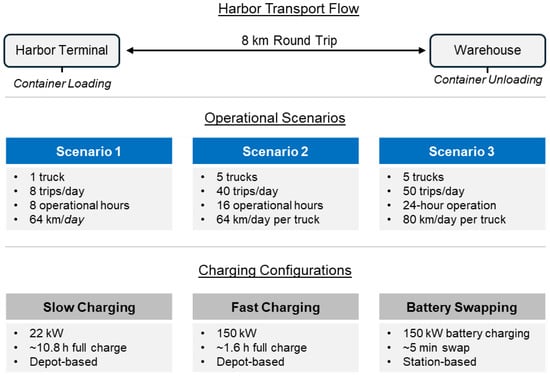
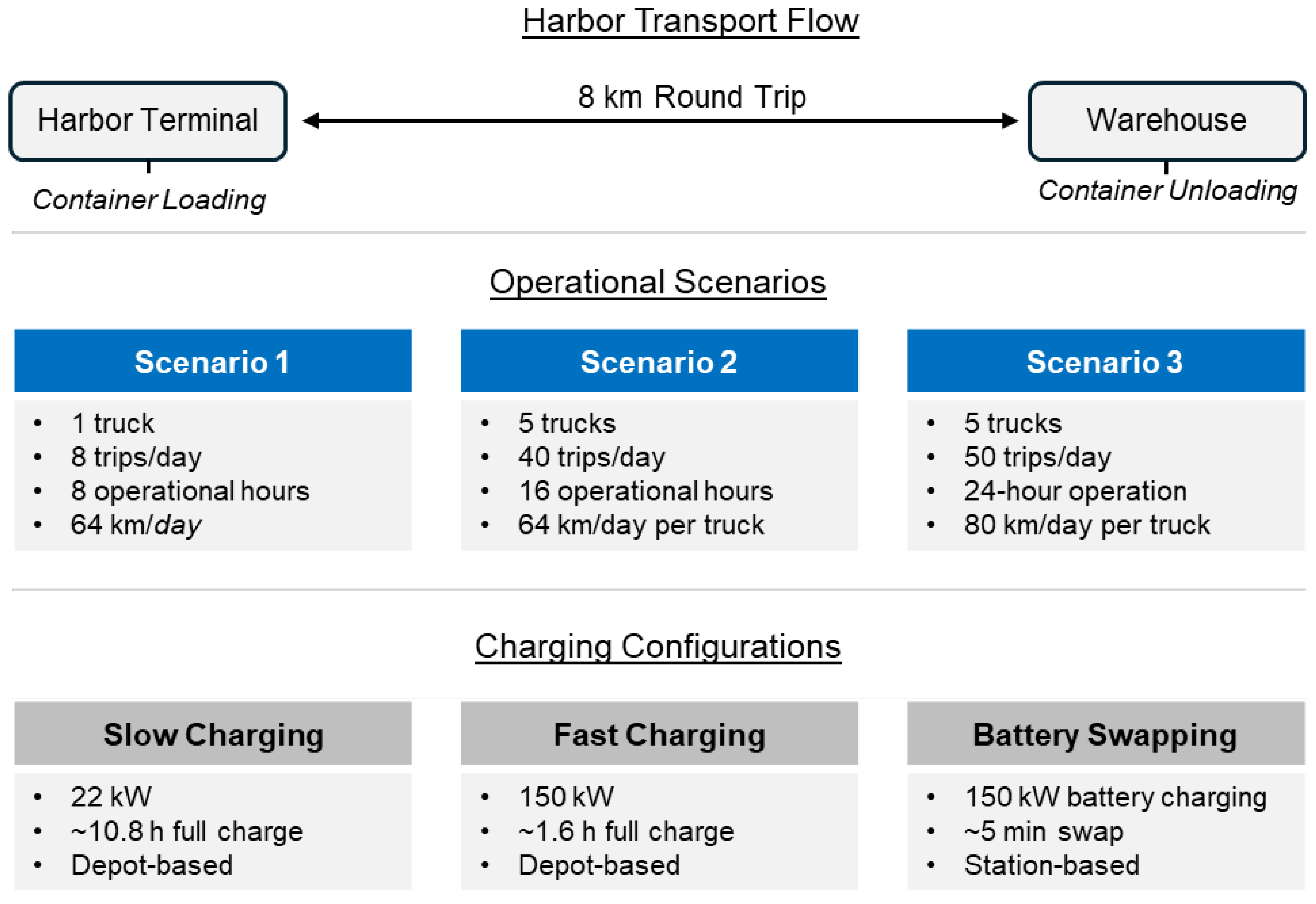
Figure 1 summarizes the fixed transport route, utilization levels, and charging strategies analyzed under consistent boundary conditions.
Figure 1.
Conceptual illustration of the harbor transport flow, operational scenarios, and charging configurations evaluated in this study.
3.2. Technical Assumptions
We assume an EHDT (XCMG E700) can be swapped with a 282-kWh battery. With a 15–20% battery charge as a reserve, the truck can travel between 140 and 160 km, consuming between 1.4 and 1.7 kWh of energy per kilometer [64]. However, we have considered the minimum values for the calculations, as represented in Table 3.
Table 3.
Performance characteristics of the EHDT (XCMG E700).
The vehicle range mentioned in Table 3 is derived using conservative assumptions to ensure feasibility across all scenarios. A usable state-of-charge window of approximately 80–85% is assumed, along with a vehicle energy consumption of 1.4 kWh/km, yielding an effective range of roughly 140 km. Minor deviations may occur depending on the exact SOC window and driving conditions; however, they do not affect the comparative results, as the same assumptions are consistently applied across all scenarios.
Table 3 outlines the key input parameters for calculating the daily energy consumption of the XCMG E700 EHDT, based on the number of rounds and the distance traveled each day. Today, the electricity supply to the harbor area is weak, which prevents the installation of more than 150 kW of cable chargers. The slow charging typically ranges from 3 kW to 22 kW. We assume that the depleted truck battery (282 kWh with a 15% residual charge) is charged with a 22 kW slow charger and a 150 kW fast charger. For battery swapping, the battery at the swapping station is charged at 150 kW. The charging time depends on several factors, such as the battery state, charging efficiency, and power losses/fluctuations [65]. However, we have assumed a simple linear charging process. Thus, the charging time of a 282-kWh battery with 22 kW and 150 kW charging power is calculated as
Charging Time (hours) = Battery capacity (kWh)/Charger power (kW)
The linear charging assumption is used to ensure transparency and comparability across charging strategies; in practice, nonlinear charging behavior would primarily affect fast charging durations and may further increase downtime under high-power charging conditions. A 22 kW AC charger can fully charge a 282 kWh battery in about 10.8 h. However, using a 150 kW DC charger significantly reduces the charging time to 1.6 h. For battery swapping, the battery can be charged at 150 kW while at the swapping station, which also takes 1.6 h. When the EHDT needs a fully charged battery, swapping takes approximately 5 min, ensuring minimal downtime.
3.3. Cost Assumptions
To calculate the annual charging cost, the annual truck and infrastructure cost amortization, and compare annual downtime, we have gathered data on electricity costs, swapping costs (including battery leasing and electricity fees), infrastructure investment, and the initial cost of the truck with or without a battery, as shown in Table 4. These inputs provide a comprehensive basis for analyzing the economic implications of each charging method in their respective scenarios.
Table 4.
Input data for cost analysis of slow charging, fast charging, and battery swapping.
The swapping fee is a service charge independent of electricity costs and covers battery handling, infrastructure operation, and service provision; electricity costs are calculated separately based on the energy charged to the battery.
The cost of charging EHDTs per kWh depends on factors such as charging power, location, country, and governmental policies aimed at decarbonizing transportation systems. The cost of electricity per kWh in Table 4 is taken from the price list of OKQ8 [66], the largest fuel company in Sweden, which provides charging facilities.
Similarly, the initial cost of charging infrastructure depends on several factors, including installation complexity, labor costs, different types of chargers (AC or DC), location-specific requirements, and grid upgrades [67]. However, in our case, the initial cost of the charging infrastructure mentioned above specifically refers to a 22 kW slow charger, including the charging pile and installation [68]. This cost estimate accounts for the necessary equipment and setup required for the 22 kW charging system. The 150 kW DC fast chargers are more expensive than slow chargers due to their advanced technology and higher power output [69]. On the other hand, the cost of establishing a battery-swapping station depends on several factors, including hardware, software, personnel, land, and utility infrastructure.
Additionally, general overhead costs can vary significantly, ranging from minor operational expenses to large-scale investments. These variations are influenced by the business model, geographical location, and any specific requirements unique to the operation [70]. According to Cui, et al. [71], the cost of setting up a battery swapping station in China in 2023 was approximately €970,000. This estimate includes a station with a 2000 kW power line, seven spare batteries, and one battery swapping operation space. In contrast, the cost of establishing a battery swapping station with minimal requirements is significantly lower when designed for a smaller-scale operation [70]. Thus, the price mentioned in Table 4 for establishing a basic swapping station in this context is approximately €250,000, capable of handling one EHDT battery swap at a time, which includes only one spare 282 kWh battery available at the swapping station and operates with a power line capacity of no more than 150 kW.
Buying an EHDT with or without a battery depends on several factors, including manufacturer, truck specifications, battery capacity, and technological advancement. The price is significantly higher when buying with a battery due to the cost of the battery pack, which is one of the most expensive components. In our case, we have taken the initial cost of the truck with a battery from ECG [72], as shown in Table 4. However, buying an EHDT without a battery can reduce upfront costs, making battery leasing or swapping a more viable alternative. Thus, in this case, we assume that half of the cost is allocated to the EHDT and the other half to the battery. The monthly 282 kWh battery leasing fee per truck and the swapping fee per swap, as presented in Table 4, are calculated based on the pricing of a 100 kWh battery provided by NIO, Sweden [73,74], and scaled by battery size. Extrapolating battery leasing and swapping costs from passenger vehicle systems introduces uncertainty; however, this approach is used here to establish an indicative cost level in the absence of publicly available heavy-duty pricing data.
3.4. Analytical Approach
We analyze three operational scenarios, as outlined in Table 2, each tested with three charging methods: slow charging at 22 kW, fast charging at 150 kW, and battery swapping, with a fully charged spare battery (charged at 150 kW) available at the swapping station. The analysis follows a structured approach, i.e., identifying truck availability determines when trucks are available for charging during operational and non-operational hours, assessing charging frequency analyzes how often a truck requires charging or battery swapping based on operational activities, evaluating operational feasibility determines which charging method suits the operational demand, calculating annual charging costs estimates the yearly expenses associated with each charging method, estimating amortized costs calculates the annual amortized cost of trucks and infrastructure investments, and comparing downtime analyzes the impact of each charging method on operational downtime across the different scenarios. This analysis helps us identify suitable charging methods based on operational efficiency and economic feasibility.
To ensure analytical transparency, the harbor case study intentionally abstracts from cargo-specific characteristics, road gradients, traffic congestion, and stochastic disturbances. The transported goods are assumed to be standardized containerized cargo typical for in-harbor logistics, where transport distances are short, routes are fixed, and driving conditions are relatively controlled compared to long-haul or urban delivery contexts. The purpose of this abstraction is not to predict exact operational costs under all possible conditions, but to enable a clear comparison of charging strategies under identical boundary conditions, thereby isolating the effects of charging-related downtime, infrastructure utilization, and cost structure.
4. Results and Discussion
4.1. Technical Feasibility
4.1.1. Scenario 1
In scenario 1, the daily demand requires completing 8 transportation rounds with a single truck. Each round trip covers 8 km between the harbor and the warehouse. The entire process, including driving, loading, unloading, and short breaks, takes approximately 1 h per round. All 8 rounds are scheduled during the morning shift, which operates from 06:00 to 14:00. Thus, the truck is available for charging or swapping a battery for only 8 h within 24 h.
With a daily driving distance of 64 km (8 km per round and 8 rounds each day), an EHDT consumes approximately 89.6 kWh of energy per day, calculated as
Energy consumption (kWh) per day truck (s) = Distance traveled (km) × Vehicle efficiency (kWh/km)
Thus, the truck, equipped with a 282-kWh battery and having a 15% residual charge, can operate for approximately two days before requiring a recharge or a battery swap within 48 hours. The truck can be recharged overnight when not in operation using a slow charger (22 kW), which takes about 10.8 h to fully charge the battery. Alternatively, a fast charger (150 kW) completes charging in about 1.6 h, allowing the truck to be recharged during non-operational hours. With a battery-swapping system, the truck’s battery can be swapped even during a short break. Therefore, any of these charging solutions, slow, fast, or battery swapping, can effectively meet the requirements of a truck traveling 64 km daily.
4.1.2. Scenario 2
In scenario 2, the fleet is expanded by 4 trucks, bringing the total to 5. The daily demand is distributed among these trucks, resulting in 40 trips per day. However, each truck still completes 8 round trips, each taking 1 h, as in scenario 1. The trips are now scheduled across four shifts, i.e., morning, lunch, afternoon, and evening, operating from 06:00 to 22:00. These 16 operational hours allow each truck to have 8 flexible hours, which can be used for charging or swapping the battery. After completing its assigned schedule, each truck remains continuously available for an additional 8 h within a 24 h period, which can also be used for charging or swapping the battery if needed.
In this scenario, each truck continues to travel 64 km per day (8 km per round trip and 8 rounds daily), the same as in scenario 1. As a result, 5 trucks consume approximately a total of 448 kWh of energy per day, and the total number of recharging or battery swaps needed per day would be approximately 2 times, calculated as
Total recharging or battery swapping required per day (times) = Total energy consumption per day/Battery capacity
Since trucks are not continuously available for charging during operational hours, the number of chargers required depends not only on total daily energy demand but also on the adequate charging time available for each truck. Equation (4) estimates the required number of chargers by dividing the fleet’s total daily energy consumption by the energy a single charger can deliver within the trucks’ realistic availability window. The term “available charging time minus charging time per battery” reflects the fact that trucks must have uninterrupted access to a charger for a sufficient duration to complete a full charging cycle.
No. of chargers required = Total energy consumption per day/(Charger power × (Available charging time − Charging time per battery))
To ensure smooth operation and meet the charging needs of 5 trucks with 282 kWh batteries, at least 4 slow chargers (22 kW) are required. On the other hand, a fast charger (150 kW) can fully charge a 282 kWh battery in approximately 1.6 h, allowing recharging during non-operational hours. Another option is battery swapping, which enables quick battery replacement, even during a short break. Thus, using slow, fast, or battery swapping, each method meets the daily energy demand of 5 trucks, each traveling 64 km per day.
4.1.3. Scenario 3
In Scenario 3, the fleet remains at 5 trucks, but the total number of daily round trips increases from 40 to 50. The trips are now distributed across five shifts, i.e., morning, lunch, afternoon, evening, and night, operating continuously over 24 h. Each truck completes 10 round trips, each taking 1 h, for a total of 10 h of operation per truck within 24 h. This leaves each truck with 14 h of flexible time during operational hours. However, these 14 h may not be continuous, as they are spread across various time slots throughout 24 h. Thus, there are no uninterrupted hours available for constant charging. Instead, each truck needs to be charged or have its battery swapped when needed during flexible time slots throughout the 24 h.
The number of trucks is intentionally kept constant at five in this scenario to isolate the effect of increased operational intensity and extended scheduling coverage, with the higher number of trips reflecting increased port activity and tighter dispatching rather than efficiency gains at the vehicle level.
As the number of rounds increases in this scenario to 10 and each truck travels 80 km per day, as a result, 5 trucks consume approximately a total of 560 kWh of energy per day, and the total number of recharging or battery swaps needed per day is approximately 2.3 times, as calculated using Equation (4).
A slow-charging (22 kW) option is not practical for meeting operational energy demand, as it takes approximately 10.8 h to fully charge a single truck. Within 24 operational hours, trucks do not have uninterrupted 10.8 h charging slots. This limitation makes the slow charging option unfeasible in this scenario. On the other hand, a fast charger (150 kW) can fully charge a 282 kWh battery in about 1.6 h, making it a reasonable option for recharging during flexible operational hours; at the same time, a battery swapping option could be a good fit, as the entire process to swap the battery of a truck takes merely 5 min. Thus, fast charging or battery swapping could be the practical solution to fulfill the energy demand of 5 trucks traveling 80 km per day for 24 operational hours.
4.1.4. Downtime Across Three Scenarios
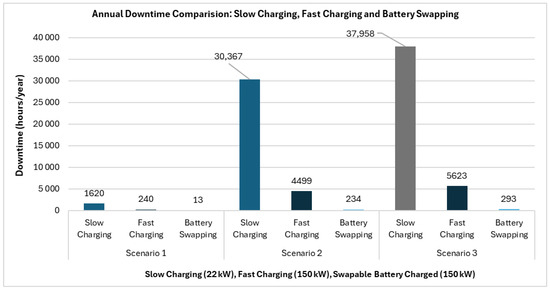
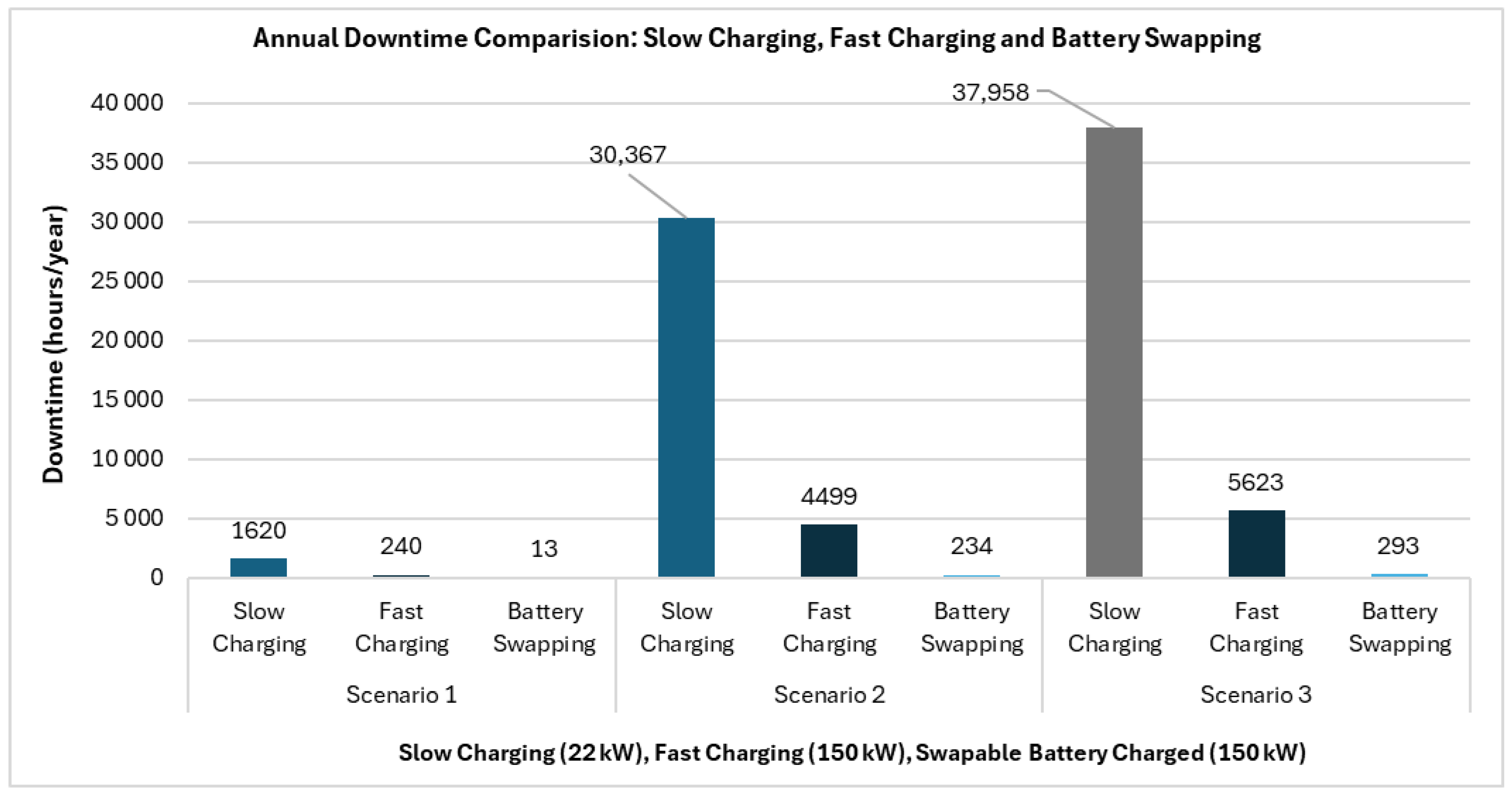
Figure 2 illustrates the annual downtime associated with each charging solution across the three scenarios, demonstrating that slow charging is a disadvantage from a time-efficiency perspective.
Figure 2.
Annual downtime comparison of slow charging, fast charging, and battery swapping across three operational scenarios (The grey bar indicates that the respective charging option is operationally infeasible under the stated assumptions, due to insufficient uninterrupted charging windows and/or limited charger accessibility. Downtime values represent aggregated annual downtime across the fleet).
The downtime for slow charging increases across scenarios, reaching 30,367 h in scenario 2 and 37,958 h in scenario 3; additionally, in scenario 3, the ‘gray bar’ also represents that slow charging is not a practical solution when the number of rounds, number of trucks, and the operational time duration increase to 24 h, making it the least viable option for high-demand operations. On the other hand, downtime was significantly reduced with the fast charging option, with only 240 h in scenario 1 and 5623 h in scenario 3. Battery swapping emerged as the most efficient method in terms of downtime, minimizing operational disruptions and requiring only 13 h in scenario 1 and 293 h in scenario 3. This significant difference indicates that, although battery swapping incurs the highest charging and infrastructure costs, its ability to eliminate downtime makes it a promising option for fleets that require maximum vehicle availability.
4.2. Economic Feasibility
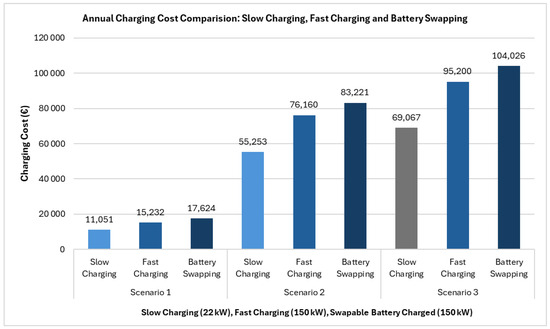
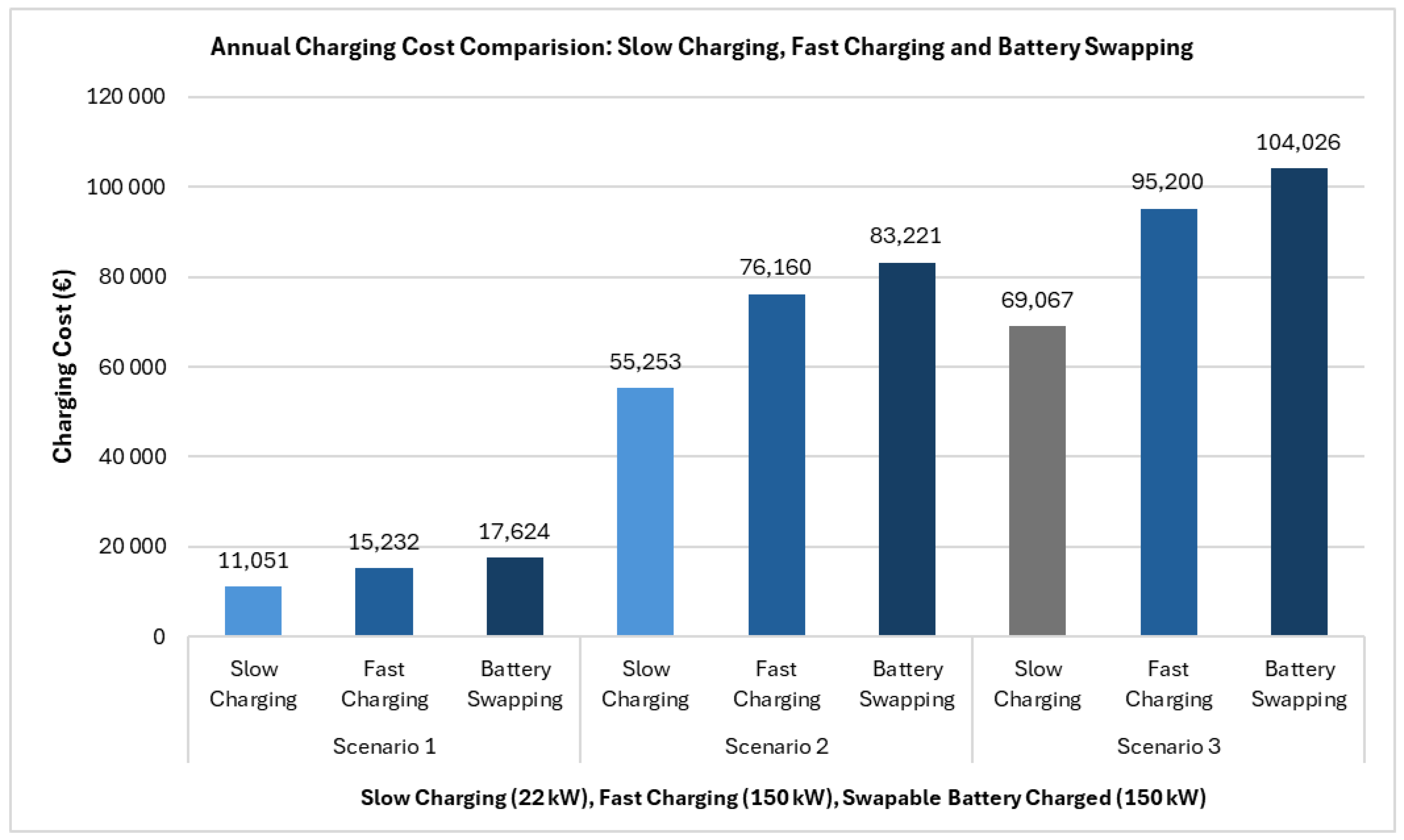
To assess the economic feasibility of slow charging, fast charging, and battery swapping, we analyze annual charging costs across three scenarios and evaluate the amortized annual costs of trucks and infrastructure investments. Figure 3 shows the yearly charging costs of three charging solutions across three operational scenarios. The charging cost increases significantly as operational demand rises from scenario 1 to scenario 3.
Figure 3.
Annual charging cost for slow charging, fast charging, and battery swapping across three operational scenarios (the gray bar indicates that the respective charging option is operationally infeasible under the stated assumptions, due to insufficient uninterrupted charging windows and/or limited charger accessibility).
The option of slow charging remains cost-effective where operationally feasible; however, it does not meet operational demand in scenario 3, as indicated by the ‘gray bar’ in Figure 3. Both fast charging and battery swapping offer operational flexibility, meeting the needs of various scenarios. However, battery swapping is the most expensive solution compared to fast charging, which is approximately €104,026, followed by fast charging at €95,200 in scenario 3. Thus, from a yearly charging cost perspective, slow charging is a better solution for scenarios 1 and 2, whereas fast charging is suitable for scenario 3.
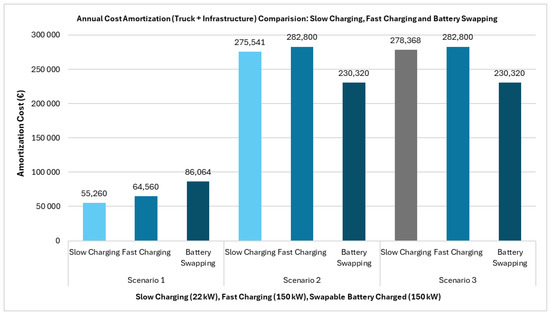
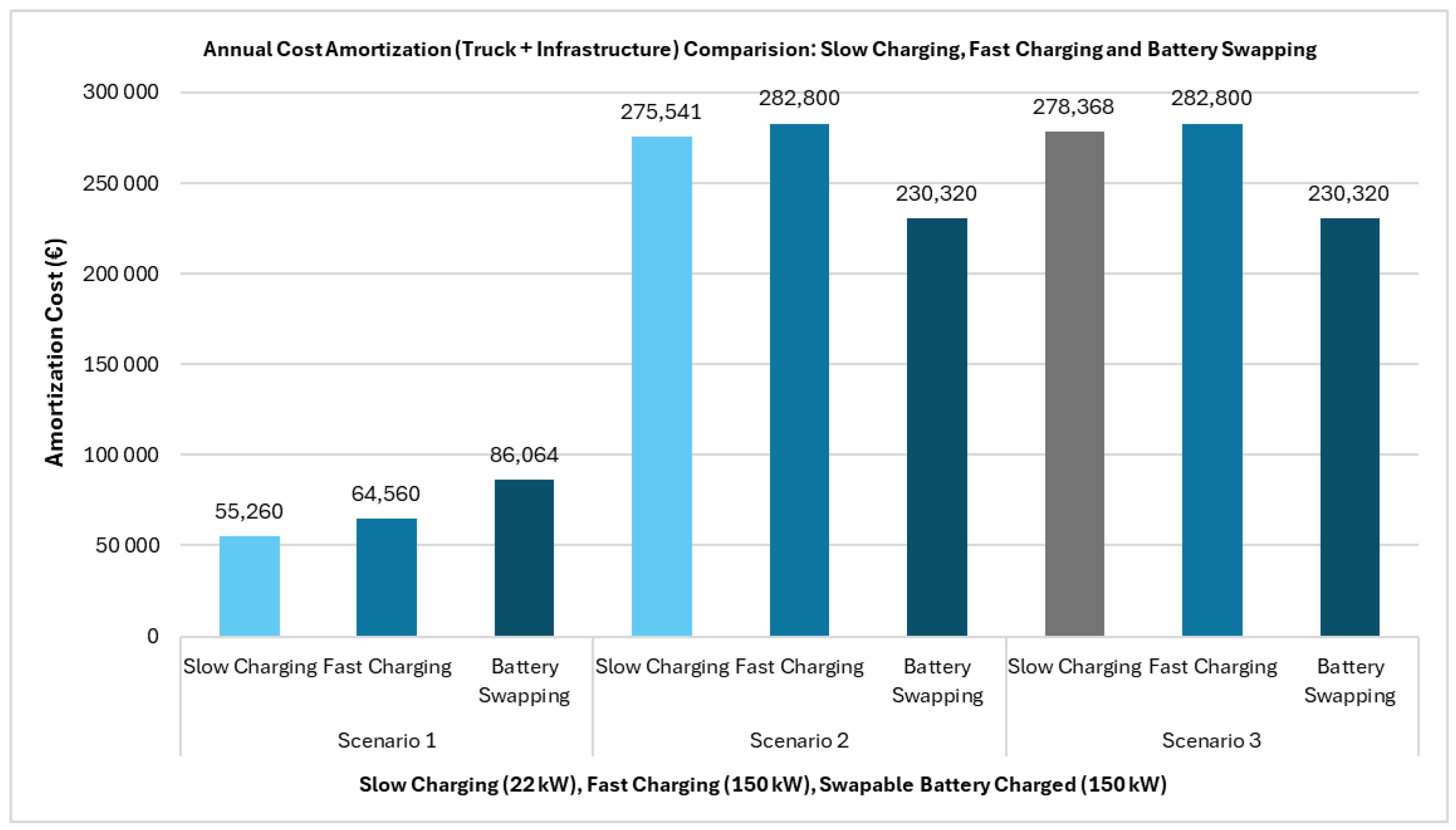
Figure 4 shows the annual amortization cost of trucks and infrastructure and the leasing fee (battery swapping), where fast charging and battery swapping require higher capital investment costs as compared to slow charging. In scenario 1, battery swapping has the highest amortization cost at approximately €86,064, while slow charging has the lowest, at about €55,260. As operational demand increases, the amortization costs for fast and slow charging rise significantly, reaching around €282,800 for fast charging and €278,368 for slow charging in scenario 3. The cost of additional trucks primarily drives this increase, as four more trucks are added in scenarios 2 and 3 to meet the operational demand. However, slow charging is not a practical solution, as it cannot meet the operational demand for scenario 3, as indicated by the ‘gray bar’ in Figure 4. The increase in amortization cost for battery swapping is lower in scenarios 2 and 3, as the investment is split; half goes into trucks, while the other half goes to the battery, which is paid over time through a battery leasing fee. Surprisingly, fast charging and battery swapping remain constant at €282,800 and €230,320 in scenarios 2 and 3, respectively, indicating that their fixed infrastructure costs do not scale with higher operational demand, unlike those of slow charging.
Figure 4.
Annual cost amortization for trucks and infrastructure for slow charging, fast charging, and battery swapping across three operational scenarios (the gray bar indicates that the respective charging option is operationally infeasible under the stated assumptions due to insufficient uninterrupted charging windows and/or limited charger accessibility).
To incorporate a five-year payback period and compare the cost-effectiveness of slow charging, fast charging, and battery swapping, both annual charging costs and annual amortization costs (including truck, infrastructure, and leasing fees for battery swapping) are analyzed over the five years. The total cost over five years provides a comprehensive economic evaluation of each charging solution across varying operational demands. As operational intensity increases from scenario 1 to scenario 3, the cost differences between these charging solutions become more pronounced. Table 5 represents the total cost over a 5-year payback period for slow charging, fast charging, and battery swapping across three different operational scenarios.
Table 5.
Total cost over a 5-year payback period and cost per kilometer for slow charging, fast charging, and battery swapping across three operational scenarios (Note: Cost per kilometer is calculated based on the total distance driven by the fleet over a five-year period. Values shaded in grey indicate operationally infeasible charging options, meaning that although a cost can be calculated, the respective charging strategy cannot satisfy the assumed operational requirements under the defined scenario constraints).
In Scenario 1, where demand is low and the operating duration is only 8 h per day with a single truck, slow charging appears to be the most cost-effective option, with a total five-year cost of €331,555. This is due to its low infrastructure and truck investment requirements. Fast charging, at €398,960, is slightly more expensive but remains a viable alternative. Battery swapping, at €518,440, is the most expensive option in this scenario, making it less favorable for low-demand operations. However, as demand increases in scenario 2, where five trucks operate for 16 h per day, the total cost of slow charging and fast charging rises significantly to €1,653,970 and €1,794,800, respectively, driven by the need for additional trucks to achieve the operational demand, but battery swapping, with a five-year cost of €1,567,705, becomes the most cost-effective solution. This is because battery swapping infrastructure costs remain relatively stable and do not increase proportionally with the number of trucks, as the battery leasing model distributes costs between vehicle investment and battery inventory.
In Scenario 3, where operational demand is at its highest with a 24 h operation cycle, battery swapping maintains a comparatively lower cost of €1,671,730 over five years. In contrast, slow charging reaches €1,737,175, making it impractical despite being cheaper than fast charging, as it cannot meet the energy demand of continuous operations. The ‘gray row’ in Table 5 highlights that slow charging is no longer viable in scenario 3. Fast charging becomes the most expensive solution at €1,890,000, primarily due to high infrastructure investments that scale with operational demand.
Over five years, battery swapping emerges as the most cost-effective option for large-scale fleet operations, particularly in medium- and high-demand scenarios. While slow charging is economical for low-demand scenarios, its scalability limitations and excessive downtime make it inefficient for higher operational demand. Fast charging serves as a balanced alternative, but its rising infrastructure costs over time make it less viable than battery swapping in high-utilization fleets.
It should be noted that, even though the assumptions stated in Section 3 are based on relevant and available data, they still involve uncertainties. It should also be noted that the residual value of trucks and infrastructure after 5 years differs across charging methods. Taking this into account, a more robust conclusion for this specific harbor use case is that slow charging is the preferred alternative for low-demand scenarios. In contrast, both fast charging and battery swapping are feasible for medium- and high-demand scenarios and are comparable in terms of cost.
From the charging infrastructure perspective, fast charging concentrates power demand over short time intervals, potentially creating high peak loads that challenge local grid capacity in harbor environments. Battery swapping shifts this demand to the swapping station, where charging can be managed more flexibly over time, although it still requires sufficient connection capacity. In both cases, increased electrification of port transport may necessitate grid reinforcement or the integration of buffering solutions such as stationary energy storage to mitigate peak demand and ensure reliable operation.
5. Conclusions
This work provides an overview of various charging solutions for EHDTs, along with a summary of their general pros and cons from technical, economic, and operational perspectives. In real-life applications, the feasibility of different charging solutions depends heavily on the specific operational demands. Therefore, this work also complements the general findings with a comparative analysis of various charging solutions for a specific harbor use case.
The findings of this specific use-case study highlight the balance between cost, operational efficiency, and downtime when selecting a charging solution for EHDTs. Initially, slow charging seems to be the cost-effective option. However, it becomes impractical as operational demand increases, particularly in scenario 3, where the duration of operation requires continuous 24 h operation. The downtime associated with slow charging increases significantly, making it unsuitable for fleets that require high EHDT utilization. Fast charging, despite its higher infrastructure costs, offers a flexible alternative with reduced downtime, enabling more flexible scheduling. However, its growing energy demand places additional strain on the power grid.
In contrast, battery swapping appears to be the practical solution for high-demand fleet operations, with significantly less downtime and providing maximum fleet availability. Although it requires higher initial infrastructure and operational costs, battery swapping supports continuous fleet operations, making it a strategic long-term investment for logistics companies prioritizing efficiency and operational availability. Additionally, as battery leasing evolves, the economic burden of battery ownership can be reduced, further improving its economic feasibility.
The economic feasibility analysis further highlights that slow charging is the cost-effective option in low-demand scenarios, as seen in scenario 1, where a single truck operates for merely 8 h per day, resulting in the lowest five-year cost of €331,555. However, as operational demand increases, the cost of slow charging also rises, requiring additional trucks to meet it, reaching €1,737,175 in Scenario 3. Along with the higher investment cost in scenario 3, slow charging becomes an impractical solution for high-utilization fleets, as it cannot sustain continuous 24 h operations. Fast charging, although more expensive than slow charging, remains a viable alternative with reduced downtime. However, its infrastructure and charging costs increase with operational demand, making it less attractive in high-intensity fleet operations, where the cost reaches €1,890,000 over five years in scenario 3.
On the other hand, battery swapping appears to be the most cost-effective and operationally efficient solution for medium- and high-demand scenarios, particularly for fleets that require continuous availability and minimal downtime. Although its initial investment costs are higher, the amortization remains stable across different operational scenarios, reaching €1,671,730 over five years in scenario 3, making it a viable long-term investment for large-scale fleet operations. Comparing slow charging, fast charging, and battery swapping, the cost structure of battery swapping remains relatively constant, as investment is divided between trucks and battery leasing, avoiding cost increases as the fleet expands.
Over five years, the cost-effectiveness of each solution depends on operational demand: slow charging remains the most economical in low-demand operations, while fast charging and battery swapping become viable options for fleets prioritizing availability and efficiency. While absolute cost and downtime magnitudes may vary with parameter assumptions, the relative performance differences across charging strategies are structurally driven by charging duration, fleet utilization intensity, and infrastructure availability constraints.
Thus, the findings of this study are specific to harbor transport operations with short driving distances, repetitive duty cycles, and constrained charging infrastructure. Other contexts, such as long-haul trucking or urban delivery, involve different operational patterns, access to high-power charging standards, depot dwell times, and electricity pricing structures, which may lead to different conclusions regarding the suitability of charging solutions.
Several aspects not quantified in this study may influence long-term economics, including electricity price volatility, battery degradation, residual asset value, and queuing effects at charging or swapping facilities. These factors are highly context-specific and warrant dedicated modeling efforts beyond the scope of this comparative case study.
Ultimately, selecting a suitable charging solution depends on factors such as fleet size, operational needs, and economic considerations, while balancing financial investment, fleet performance, and growth potential.
Author Contributions
Conceptualization, H.J.B.; methodology, H.J.B.; validation, H.J.B., A.N., and M.E.; formal analysis, H.J.B.; resources, H.J.B.; data curation, H.J.B.; writing—original draft preparation, H.J.B.; writing—review and editing, H.J.B., A.N., and M.E.; visualization, H.J.B.; supervision, H.J.B.; project administration, H.J.B.; funding acquisition, A.N. All authors have read and agreed to the published version of the manuscript.
Funding
This research was funded by the Swedish Energy Agency grant number P2022-01258.
Data Availability Statement
The original contributions presented in this study are included in the article. Further inquiries can be directed to the corresponding author.
Acknowledgments
The authors would also like to thank the respective organizations, Swedish Transport Administration and the Swedish National Road and Transport Research Institute (VTI), for their support.
Conflicts of Interest
The authors declare no conflicts of interest.
Abbreviations
The following abbreviations are used in this manuscript:
| EHVs | Electric Heavy Vehicles |
| EHDTs | Electric Heavy-Duty Trucks |
| HDTs | Heavy Duty Trucks |
| TCO | Total Cost of Ownership |
References
- Research, S. Transportation Emissions Worldwide—Statistics & Facts. Statista. 2024. Available online: https://www.statista.com/topics/7476/transportation-emissions-worldwide/#topicOverview (accessed on 7 January 2025).
- Zhang, C.; Zhao, X.; Sacchi, R.; You, F. Trade-off between critical metal requirement and transportation decarbonization in automotive electrification. Nat. Commun. 2023, 14, 1616. [Google Scholar] [CrossRef] [Scilit]
- Xue, L.; Jin, Y.; Yu, R.; Liu, Y.; Ren, H. Toward Net Zero Emissions in the Road Transport Sector in China; Report 2021-12; World Resources Institute: Washington, DC, USA, 2019. [Google Scholar]
- Mohanty, N.; Goyal, N.K.; Naikan, V. A comparative analysis of operational planning for battery swapping and fast charging in electric vehicles. Life Cycle Reliab. Saf. Eng. 2024, 13, 1–17. [Google Scholar] [CrossRef] [Scilit]
- Zhou, T.; Roorda, M.J.; MacLean, H.L.; Luk, J. Life cycle GHG emissions and lifetime costs of medium-duty diesel and battery electric trucks in Toronto, Canada. Transp. Res. Part D Transp. Environ. 2017, 55, 91–98. [Google Scholar] [CrossRef] [Scilit]
- Mareev, I.; Becker, J.; Sauer, D.U. Battery dimensioning and life cycle costs analysis for a heavy-duty truck considering the requirements of long-haul transportation. Energies 2017, 11, 55. [Google Scholar] [CrossRef] [Scilit]
- Sen, B.; Ercan, T.; Tatari, O. Does a battery-electric truck make a difference?—Life cycle emissions, costs, and externality analysis of alternative fuel-powered Class 8 heavy-duty trucks in the United States. J. Clean. Prod. 2017, 141, 110–121. [Google Scholar] [CrossRef] [Scilit]
- Liimatainen, O.; Aplyn, D. The potential of electric trucks—An international commodity-level analysis. Appl. Energy 2019, 236, 804–814. [Google Scholar] [CrossRef] [Scilit]
- Davis, B.A.; Figliozzi, M.A. A methodology to evaluate the competitiveness of electric delivery trucks. Transp. Res. Part E Logist. Transp. Rev. 2013, 49, 8–23. [Google Scholar] [CrossRef] [Scilit]
- Lee, D.-Y.; Thomas, V.M.; Brown, M.A. Electric urban delivery trucks: Energy use, greenhouse gas emissions, and cost-effectiveness. Environ. Sci. Technol. 2013, 47, 8022–8030. [Google Scholar] [CrossRef] [Scilit]
- IEA. The Future of Trucks: Implications for Energy and the Environment. International Energy Agency. 2017. Available online: https://www.iea.org/reports/the-future-of-trucks (accessed on 9 January 2025).
- Pi, D.; Cheng, Q.; Xie, B.; Wang, H.; Wang, X. A novel pneumatic brake pressure control algorithm for regenerative braking system of electric commercial trucks. IEEE Access 2019, 7, 83372–83383. [Google Scholar] [CrossRef] [Scilit]
- Kalla, U.K.; Suthar, R.; Singh, B. Improved power quality charging scheme for heavy-duty vehicle battery swapping stations. IET Power Electron. 2019, 12, 3422–3437. [Google Scholar] [CrossRef] [Scilit]
- Zhu, F.; Li, L.; Li, Y.; Li, K.; Lu, L.; Han, X.; Du, J.; Ouyang, M. Does the battery swapping energy supply mode have better economic potential for electric heavy-duty trucks? eTransportation 2022, 15, 100215. [Google Scholar] [CrossRef] [Scilit]
- Wang, F.Y.; Chen, Z.; Hu, Z. Comprehensive optimization of electrical heavy-duty truck battery swap stations with a SOC-dependent charge scheduling method. Energy 2024, 308, 132773. [Google Scholar] [CrossRef] [Scilit]
- Al-Hanahi, B.; Ahmad, I.; Habibi, D.; Masoum, M.A.S. Charging infrastructure for commercial electric vehicles: Challenges and future works. IEEE Access 2021, 9, 121476–121492. [Google Scholar] [CrossRef] [Scilit]
- International Energy Agency (IEA). Global Energy Review 2020: The Impacts of the Covid-19 Crisis on Global Energy Demand and CO2 Emissions; International Energy Agency: Paris, France, 2019. [Google Scholar]
- Butler, S. Amazon Makes ‘Largest ever’ UK Order of Electric Trucks to Cut Carbon Emissions. The Guardian. 2025. Available online: https://www.theguardian.com/technology/2025/jan/14/amazon-uk-electric-trucks-carbon-emissions-train (accessed on 18 February 2025).
- Reuters. Australia’s Fortescue Signs $2.8 Bln Green Equipment Partnership with Liebherr. Reuters. 2024. Available online: https://www.reuters.com/sustainability/climate-energy/australias-fortescue-signs-28-bln-green-equipment-partnership-with-liebherr-2024-09-24/ (accessed on 18 February 2025).
- Fleets, E. Top Companies Paving the Way in Heavy-Duty EV Fleets. EV Industry Blog. 2024. Available online: http://evchargingsummit.com/blog/top-companies-paving-the-way-in-heavy-duty-ev-fleets/ (accessed on 18 February 2025).
- Adams, H.S. Top 10: Companies Electrifying Commercial Vehicles. EV Magazine. 2024. Available online: https://evmagazine.com/fleet-and-commercial/top-10-companies-electrifying-commercial-vehicles (accessed on 18 February 2025).
- Falck, R. TIME100 Climate 2024. TIME. 2024. Available online: https://time.com/7172594/robert-falck/ (accessed on 18 February 2025).
- Wang, R.; Ju, Y.; Allybokus, Z.; Zeng, W.; Obrecht, N.; Moura, S. Optimal Sizing, Operation, and Efficiency Evaluation of Battery Swapping Stations for Electric Heavy-Duty Trucks. In Proceedings of the 2024 American Control Conference (ACC), Toronto, ON, Canada, 10–12 July 2024. [Google Scholar]
- Forrest, K.; Mac Kinnon, M.; Tarroja, B.; Samuelsen, S. Estimating the technical feasibility of fuel cell and battery electric vehicles for the medium and heavy duty sectors in California. Appl. Energy 2020, 276, 115439. [Google Scholar] [CrossRef] [Scilit]
- Çabukoglu, E.; Georges, G.; Küng, L.; Pareschi, G.; Boulouchos, K. Battery electric propulsion: An option for heavy-duty vehicles? Results from a Swiss case-study. Transp. Res. Part C Emerg. Technol. 2018, 88, 107–123. [Google Scholar] [CrossRef] [Scilit]
- Anderhofstadt, B.; Spinler, S. Factors affecting the purchasing decision and operation of alternative fuel-powered heavy-duty trucks in Germany–A Delphi study. Transp. Res. Part D Transp. Environ. 2019, 73, 87–107. [Google Scholar] [CrossRef] [Scilit]
- Lee, H.; Clark, A. Charging the Future: Challenges and Opportunities for Electric Vehicle Adoption; Harvard Kennedy School, Belfer Center for Science and International Affairs: Cambridge, MA, USA, 2018. [Google Scholar]
- Hemavathi, S.; Shinisha, A. A study on trends and developments in electric vehicle charging technologies. J. Energy Storage 2022, 52, 105013. [Google Scholar] [CrossRef] [Scilit]
- Rajendran, G.; Vaithilingam, C.A.; Misron, N.; Naidu, K.; Ahmed, R. A comprehensive review on system architecture and international standards for electric vehicle charging stations. J. Energy Storage 2021, 42, 103099. [Google Scholar] [CrossRef] [Scilit]
- Burnham, A.; Dufek, E.J.; Stephens, T.; Francfort, J.; Michelbacher, C.; Carlson, R.B.; Zhang, J.; Vijayagopal, R.; Dias, F.; Mohanpurkar, M.; et al. Enabling fast charging–Infrastructure and economic considerations. J. Power Sources 2017, 367, 237–249. [Google Scholar] [CrossRef] [Scilit]
- Meintz, A.; Zhang, J.; Vijayagopal, R.; Kreutzer, C.; Ahmed, S.; Bloom, I.; Burnham, A.; Carlson, R.B.; Dias, F.; Dufek, E.J.; et al. Enabling fast charging—Vehicle considerations. J. Power Sources 2017, 367, 216–227. [Google Scholar] [CrossRef] [Scilit]
- Ahmed, S.; Bloom, I.; Jansen, A.N.; Tanim, T.; Dufek, E.J.; Pesaran, A.; Burnham, A.; Carlson, R.B.; Dias, F.; Hardy, K.; et al. Enabling fast charging—A battery technology gap assessment. J. Power Sources 2017, 367, 250–262. [Google Scholar] [CrossRef] [Scilit]
- Tomaszewska, A.; Chu, Z.; Feng, X.; O′Kane, S.; Liu, X.; Chen, J.; Ji, C.; Endler, E.; Li, R.; Liu, L.; et al. Lithium-ion battery fast charging: A review. eTransportation 2019, 1, 100011. [Google Scholar] [CrossRef] [Scilit]
- Khalid, M.R.; Alam, M.S.; Sarwar, A.; Asghar, M.J. A Comprehensive review on electric vehicles charging infrastructures and their impacts on power-quality of the utility grid. eTransportation 2019, 1, 100006. [Google Scholar] [CrossRef] [Scilit]
- Ahmad, A.; Qin, Z.; Wijekoon, T.; Bauer, P. An overview on medium voltage grid integration of ultra-fast charging stations: Current status and future trends. IEEE Open J. Ind. Electron. Soc. 2022, 3, 420–447. [Google Scholar] [CrossRef] [Scilit]
- Ahmad, F.; Alam, M.S.; Alsaidan, I.S.; Shariff, S.M. Battery swapping station for electric vehicles: Opportunities and challenges. IET Smart Grid 2020, 3, 280–286. [Google Scholar] [CrossRef] [Scilit]
- Schmidt, S. Use of battery swapping for improving environmental balance and price-performance ratio of electric vehicles. eTransportation 2021, 9, 100128. [Google Scholar] [CrossRef] [Scilit]
- Revankar, S.R.; Kalkhambkar, V.N. Grid integration of battery swapping station: A review. J. Energy Storage 2021, 41, 102937. [Google Scholar] [CrossRef] [Scilit]
- Rivera, S.; Kouro, S.; Vazquez, S.; Goetz, S.M.; Lizana, R.; Romero-Cadaval, E. Electric vehicle charging infrastructure: From grid to battery. IEEE Ind. Electron. Mag. 2021, 15, 37–51. [Google Scholar] [CrossRef] [Scilit]
- Chen, Z. The combination of battery swapping system and connected vehicles technology in intelligent transportation. In Proceedings of the 2020 International Conference on Intelligent Transportation, Big Data & Smart City (ICITBS); IEEE: New York, NY, USA, 2020. [Google Scholar]
- Council, S. Notice on the Development Plan of the Transportation System. State Council. 2022. Available online: https://www.gov.cn/zhengce/content/2022-01/18/content_5669049.htm (accessed on 5 February 2025).
- Bhatti, H.J. Sustainable Electromobility: A System Approach to Transformation of Transportation; Halmstad University Press: Halmstad, Sweden, 2023. [Google Scholar]
- Domingues-Olavarría, G.; Márquez-Fernández, F.J.; Fyhr, P.; Reinap, A.; Alaküla, M. Electric roads: Analyzing the societal cost of electrifying all Danish road transport. World Electr. Veh. J. 2018, 9, 9. [Google Scholar] [CrossRef] [Scilit]
- Limb, B.J.; Asher, Z.D.; Bradley, T.H.; Sproul, E.; Trinko, D.A.; Crabb, B.; Zane, R.; Quinn, J.C. Economic viability and environmental impact of in-motion wireless power transfer. IEEE Trans. Transp. Electrif. 2018, 5, 135–146. [Google Scholar] [CrossRef] [Scilit]
- Jöhrens, J.; Helms, H.; Nebauer, G.; Jelica, D. Feasibility Study of Swedish-German Corridor with Electric Road System. In Proceedings of the Annual Transport Conference at Aalborg University, Aalborg, Denmark, 24–25 August 2020. [Google Scholar]
- Kühnel, S.; Hacker, F.; Görz, W. Oberleitungs-LKW im Kontext Weiterer Antriebs-und Energieversorgungsoptionen für den Straßengüterfernverkehr; Öko-Institut eV: Berlin, Germany, 2018; Volume 151. [Google Scholar]
- Morfeldt, J.; Shoman, W.; Johansson, D.J.; Yeh, S.; Karlsson, S. If Electric Cars Are Good for Reducing Emissions, They Could Be Even Better with Electric Roads. Environ. Sci. Technol. 2022, 56, 9593–9603. [Google Scholar] [CrossRef] [Scilit] [PubMed]
- Ranch, P. Elektriska Vägar-Elektrifiering av Tunga Vägtransporter; Grontmij AB: Stockholm, Sweden, 2010. [Google Scholar]
- Sundelin, H.; Gustavsson, M.G.; Tongur, S. The maturity of electric road systems. In Proceedings of the 2016 International Conference on Electrical Systems for Aircraft, Railway, Ship Propulsion and Road Vehicles & International Transportation Electrification Conference (ESARS-ITEC), Toulouse, France, 2–4 November 2016. [Google Scholar]
- Fyhr, P.; Domingues, G.; Andersson, M.; Márquez-Fernández, F.J.; Bängtsson, H.; Alaküla, M. Electric roads: Reducing the societal cost of automotive electrification. In Proceedings of the 2017 IEEE Transportation Electrification Conference and Expo (ITEC), Chicago, IL, USA, 22–24 June 2017. [Google Scholar]
- Hecht, C.; Das, S.; Bussar, C.; Sauer, D.U. Representative, empirical, real-world charging station usage characteristics and data in Germany. eTransportation 2020, 6, 100079. [Google Scholar] [CrossRef] [Scilit]
- Moghaddam, V.; Ahmad, I.; Habibi, D.; Masoum, M.A. Dispatch management of portable charging stations in electric vehicle networks. eTransportation 2021, 8, 100112. [Google Scholar] [CrossRef] [Scilit]
- Zhang, T.; Chen, X.; Wu, B.; Dedeoglu, M.; Zhang, J.; Trajkovic, L. Stochastic modeling and analysis of public electric vehicle fleet charging station operations. IEEE Trans. Intell. Transp. Syst. 2021, 23, 9252–9265. [Google Scholar] [CrossRef] [Scilit]
- Zhang, T.; Chen, X.; Yu, Z.; Zhu, X.; Shi, D. A Monte Carlo simulation approach to evaluate service capacities of EV charging and battery swapping stations. IEEE Trans. Ind. Inform. 2018, 14, 3914–3923. [Google Scholar] [CrossRef] [Scilit]
- Zhang, C.; Chen, P. Economic benefit analysis of battery charging and swapping station for pure electric bus based on differential power purchase policy: A new power trading model. Sustain. Cities Soc. 2021, 64, 102570. [Google Scholar] [CrossRef] [Scilit]
- Fachrizal, R.; Shepero, M.; van der Meer, D.; Munkhammar, J.; Widén, J. Smart charging of electric vehicles considering photovoltaic power production and electricity consumption: A review. eTransportation 2020, 4, 100056. [Google Scholar] [CrossRef] [Scilit]
- Tan, X.; Qu, G.; Sun, B.; Li, N.; Tsang, D.H.K. Optimal scheduling of battery charging station serving electric vehicles based on battery swapping. IEEE Trans. Smart Grid 2017, 10, 1372–1384. [Google Scholar] [CrossRef] [Scilit]
- Liu, N.; Chen, Q.; Lu, X.; Liu, J.; Zhang, J. A charging strategy for PV-based battery switch stations considering service availability and self-consumption of PV energy. IEEE Trans. Ind. Electron. 2015, 62, 4878–4889. [Google Scholar] [CrossRef] [Scilit]
- Tetik, S. Megawatt Charging System (MCS). CHARIN. 2022. Available online: https://www.charin.global/technology/mcs/ (accessed on 6 February 2025).
- Borlaug, B.; Muratori, M.; Gilleran, M.; Woody, D.; Muston, W.; Canada, T.; Ingram, A.; Gresham, H.; McQueen, C. Heavy-duty truck electrification and the impacts of depot charging on electricity distribution systems. Nat. Energy 2021, 6, 673–682. [Google Scholar] [CrossRef] [Scilit]
- Burnham, A.; Gohlke, D.; Rush, L.; Stephens, T.; Zhou, Y.; Delucchi, M.A.; Birky, A.; Hunter, C.; Lin, Z.; Ou, S. Comprehensive Total Cost of Ownership Quantification for Vehicles with Different Size Classes and Powertrains; Argonne National Lab. (ANL): Argonne, IL, USA, 2021. [Google Scholar]
- Nykvist, B.; Olsson, O. The feasibility of heavy battery electric trucks. Joule 2021, 5, 901–913. [Google Scholar] [CrossRef] [Scilit]
- Nåbo, A.; Abrahamsson, M.; Bhatti, H.J.; Björklund, M.; Daniels, D.; Danilovic, M.; Haugland, P.; Huddén, P.; Hylander, J.P.; Käck, S. Battery-Swapping for Heavy Duty Vehicles: A Feasibility Study on Up-Scaling in Sweden; Statens Väg-och Transportforskningsinstitut: Linköping, Sweden, 2024. [Google Scholar]
- Whittle, L. Cover Story: XCMG E700. Deals on Wheels. 2021. Available online: https://www.dealsonwheels.co.nz/trucks/features/2107/xcmg-e700-cover-story (accessed on 9 November 2023).
- Singh, R. Difference Between Slow Charging and Fast Charging. Saarj J. Bank. Insur. Res. 2022, 11, 45. [Google Scholar]
- OKQ8. How Much Does It Cost to Charge an Electric Car?: OKQ8. 2025. Available online: https://www.okq8.se/elbilsladdning/kostnad-ladda-elbil/ (accessed on 10 February 2025).
- Schroeder, A.; Traber, T. The economics of fast charging infrastructure for electric vehicles. Energy Policy 2012, 43, 136–144. [Google Scholar] [CrossRef] [Scilit]
- Mister.ev. Charging Station 22kW for Electric Car. mister.ev. 2025. Available online: https://www.mister-ev.com/en/collections/wallbox-22-kw (accessed on 10 February 2025).
- Chrg. Alpitronic Hypercharger HYC 150 kW DC Station. CHRG SHOP.EU. 2025. Available online: https://chargingshop.eu/product/alpitronic-hypercharger-150-kw-dc-station/ (accessed on 10 February 2025).
- Wu, X.; Liu, P.; Lu, X. Study on operating cost economy of battery-swapping heavy-duty truck in China. World Electr. Veh. J. 2021, 12, 144. [Google Scholar] [CrossRef] [Scilit]
- Cui, H.; Xie, Y.; Niu, T. China Is Propelling Its Electric Truck Market by Embracing Battery Swapping; International Council on Clean Transportation: Washington, DC, USA, 2023; Volume 9. [Google Scholar]
- ECG. On Costs for Electric Trucks: The Realities of Going Green for Europe′s FVL Trucks. ECG Business Intelligence. 2022. Available online: https://www.ecgassociation.eu/wp-content/uploads/2022/04/ECG-Business-Intelligence-22.04-Cost-of-going-electric.pdf (accessed on 11 February 2025).
- Undéhn, C. Size as Needed—Nio Introduces Flexible Battery Replacement. Elbilen. 2024. Available online: https://elbilen.se/nyheter/storlek-efter-behov-nio-infor-flexibelt-batteribyte/ (accessed on 11 February 2025).
- Undéhn, C. This Is How Much It Costs to Replace and Charge a Battery at NIO. Elbilen. 2023. Available online: https://elbilen.se/nyheter/sa-mycket-kostar-batteribyte-och-laddning-hos-nio/ (accessed on 11 February 2025).

Disclaimer/Publisher’s Note: The statements, opinions and data contained in all publications are solely those of the individual author(s) and contributor(s) and not of MDPI and/or the editor(s). MDPI and/or the editor(s) disclaim responsibility for any injury to people or property resulting from any ideas, methods, instructions or products referred to in the content. |
© 2026 by the authors. Published by MDPI on behalf of the World Electric Vehicle Association. Licensee MDPI, Basel, Switzerland. This article is an open access article distributed under the terms and conditions of the Creative Commons Attribution (CC BY) license.