1. Introduction
The transition toward sustainable transportation is driven by the necessity to mitigate climate change. Central to this transition is the electrification of the transportation sector, specifically the adoption of Electric Vehicles (EVs), which has been elevated to a strategic priority by governments worldwide [
1]. Policy interventions, ranging from purchase subsidies to emission regulations, have successfully catalyzed the initial market penetration of EVs. However, the sustained industrialization of electric mobility faces a critical bottleneck: the deployment of an efficient, accessible, and robust charging infrastructure network. Unlike the century-old refueling ecosystem for Internal Combustion Engine (ICE) vehicles, which benefits from ubiquity and standardized service speeds, the EV charging landscape remains fragmented and underdeveloped. Consequently, the provision of convenient charging services has become a decisive factor in overcoming the “chicken-and-egg” dilemma impeding widespread EV adoption [
2].
Despite the environmental benefits and policy tailwinds, the diffusion of EVs has been slower than anticipated in many regions. A primary psychological and operational barrier is “range anxiety”—the driver’s distress associated with the prospect of depleting battery power mid-journey without access to charging facilities. It is crucial to note that range anxiety is driven not only by limited battery capacity but critically by the uncertainty of accessing charging infrastructure and the potentially long dwell times associated with recharging. While the refueling of an ICE vehicle is a deterministic process taking minutes, EV charging is stochastic and time-consuming, heavily dependent on the type of infrastructure available. Thus, for the EV market to mature, the infrastructure network must evolve from a sparse collection of pilot projects into a scientifically planned system that rivals the convenience of traditional gas stations.
Recent market dynamics highlight the urgency of expanding infrastructure. By 2024, the global electric vehicle market witnessed a strong surge, with sales projected to hit 17 million units, representing a significant year-on-year increase [
3]. To support this exponential growth, the International Energy Agency (IEA) forecasts a massive scaling of public chargers. Concurrently, the battery swapping market is emerging as a vital complement, projected to grow at a Compound Annual Growth Rate (CAGR) of approximately 25.5% through 2030, driven by its potential to decouple battery costs from vehicle ownership [
3]. This massive infrastructure gap presents a Substantial market opportunity but also imposes severe operational challenges. The deployment of charging stations is capital-intensive and constrained by urban land scarcity, grid capacity limits, and complex traffic patterns [
4]. Therefore, how to optimize the spatial layout of charging infrastructure to maximize coverage and minimize costs while satisfying traveler demand has emerged as a central problem in the field of transportation operations research.
A distinguishing feature of the EV Charging Station Location Problem (EV-CSLP), which differentiates it from classical facility location problems, is the heterogeneity of charging technologies. Modern charging infrastructure is not monolithic; it comprises a spectrum of service levels ranging from slow charging to fast charging and battery swapping. As detailed in
Table 1, each technology entails distinct trade-offs between service speed, capital investment, and grid impact [
5,
6,
7,
8].
Fast charging (Level 3) utilizes high-voltage direct current to replenish batteries rapidly, mimicking the gas station experience, but it imposes significant stress on the power grid and requires substantial upfront investment. Conversely, slow charging (Level 1/2) is cost-effective and spatially flexible, ideal for locations where vehicles dwell for extended periods (e.g., residential areas or workplaces), yet it fails to meet the urgent refueling needs of en-route travelers. Battery swapping offers a premium service with near-instantaneous refueling but faces hurdles related to battery standardization and high operating costs. In practice, successful networks, such as the West Coast Electric Highway in the US, employ a hybrid mix of these technologies. This diversity allows travelers to make trade-offs between time and cost. For instance, a commercial logistics driver might prioritize speed (battery swapping) to meet delivery windows, whereas a commuter might prefer the lower cost of slow charging during parking.
The complexity of these multi-modal choices has attracted significant attention in the academic community. Early studies focused on single-type facility location, but recent literature has expanded to consider heterogeneous networks. Liu and Wang [
9] investigated the siting of mixed networks including plug-in and wireless charging. Nie and Ghamami [
10] developed a corridor-based model minimizing total system costs under the assumption of uniform EV distribution. Wang and Lin [
11] proposed a flow-based maximum coverage model allowing users to select charging modes based on budget constraints. Despite these advancements, a critical theoretical gap persists: the existing literature predominantly treats charging duration as an exogenous parameter.
In most prior optimization models, the time a vehicle spends at a station is assumed to be a fixed constant or a deterministic function of the distance traveled (e.g., [
12,
13]). This assumption simplifies the mathematical formulation but fails to capture the endogenous service duration decision. It is essential here to distinguish between queueing time (the delay caused by congestion waiting for a server) and service duration (or dwell time, the actual time spent connected to the charger). While queueing is a stochastic phenomenon, service duration is a decision variable governed by the traveler’s trade-off between time value and energy needs. Existing models often fix this duration, ignoring that travelers may actively choose to “top-up” partially at a fast charger to reach the next destination or wait for a full charge if they are resting.
Furthermore, regarding the physics of charging, we acknowledge that Li-ion batteries follow a non-linear Constant-Current/Constant-Voltage (CC-CV) profile. While incorporating this non-convexity directly into a macroscopic network design problem would render it computationally intractable, we adopt a linear approximation for the charging rate. Crucially, even under this linear assumption, the decision of when to stop charging remains endogenous. Travelers do not blindly charge to 100%; they optimize their dwell time based on the marginal utility of range versus the cost of time. Ignoring this behavioral flexibility leads to suboptimal infrastructure planning—potentially over-investing in expensive fast chargers where slow ones would suffice, or vice versa.
To bridge this gap, this study proposes a novel optimization framework for the location of multiple types of charging facilities, explicitly modeling the travelers’ joint choice of charging mode and service duration. This study formulates a location model that minimizes the weighted sum of facility construction costs and the generalized travel cost (including dwell time) for users. Mathematically, this introduces complexity: the decision of charging mode and duration appear as bilinear terms (products of decision variables) in the objective function and constraints. It is demonstrated that while the resulting model is a Mixed-Integer Non-Linear Programming (MINLP) problem, it can be reformulated into an equivalent Mixed-Integer Linear Programming (MILP) model using exact linearization techniques. This ensures that the model remains computationally tractable for real-world scale networks.
Specifically, the objectives of this article are threefold:
To formulate a multi-type facility location model that treats charging duration as an endogenous decision variable rather than a fixed parameter.
To develop an exact linearization technique that transforms the resulting non-convex MINLP into a tractable MILP, ensuring global optimality.
To characterize the structural trade-offs between infrastructure investment and service quality through a real-world case study, providing actionable insights for policymakers.
The main contributions and distinct novelties of this research are highlighted as follows:
Integration of Endogenous Service Duration: We advance the behavioral realism of EV location models by treating charging time as an endogenous decision variable. By capturing the traveler’s autonomous trade-off between time and energy, we provide a more holistic understanding of charging demand dynamics that previous “fixed-time” models overlook. Unlike classical queuing models that focus on operational stochastic delays, this strategic planning model optimizes the deterministic component of dwell time, capturing the fundamental trade-off between energy acquisition and time consumption.
Methodological Contribution via Exact Linearization: We formulate the problem as a non-linear optimization model that captures the complex interactions between facility type, charging speed, and user choice. We then derive an equivalent linear reformulation (MILP) by introducing auxiliary variables to handle the bilinear terms. This approach guarantees global optimality and allows for efficient solution using standard commercial solvers (e.g., CPLEX, Gurobi).
Empirical Validation and Policy Insights: The proposed framework is applied to a case study of the highway network in Hubei Province, China. Our analysis reveals a non-intuitive finding: infrastructure costs exhibit significant inelasticity to increases in EV battery range due to the dominance of coverage constraints. This suggests that foundational infrastructure investment is essential regardless of future battery technology breakthroughs.
The remainder of this paper is structured as follows.
Section 2 provides a comprehensive review of the relevant literature concerning charging infrastructure planning.
Section 3 details the problem description, mathematical formulation, and the associated linearization strategy for the proposed optimization model.
Section 4 then presents the reformulation of the proposed model and elucidates the specialized solution approach employed to efficiently solve the large-scale problem.
Section 5 presents the computational results and discussion based on the real-world case study. Finally,
Section 6 and
Section 7 conclude the paper with a summary of key findings and directions for future research.
2. Literature Review
The strategic planning and location of Electric Vehicle (EV) charging infrastructure is a critical research domain that falls squarely within the classical Facility Location Problem (FLP), a field extensively studied in Operations Research (OR) [
12]. Given the crucial role of charging availability in fostering EV adoption, significant research effort has been dedicated to developing optimization formulations that account for the unique characteristics of EV recharging [
13,
14,
15,
16]. These studies, building upon classic location problems, seek to determine the optimal sites and capacities of charging facilities while minimizing associated costs and meeting travelers’ refueling demands.
2.1. Modeling Approaches for Flow-Based Infrastructure Location
Models designed for optimizing refueling station arrangements—especially for Alternative Fuel Vehicles (AFVs) like EVs—are typically classified into three categories based on how refueling demand is conceptualized: node-based, arc-based, or flow-based [
17]. Since EV charging demand is generated by the movement of vehicles between origins and destinations (O-D pairs), flow-based approaches are the most appropriate framework for planning infrastructure that supports long-distance or intercity travel.
The foundational model for flow-based infrastructure planning is the Flow-Capturing Location Model (FCLM), initially introduced by Hodgson [
18]. The FCLM strategically allocates facilities with the objective of maximizing the total volume of traffic flow captured along covered routes. This framework has been instrumental in addressing the location challenges for AFV refueling stations. Kuby and Lim [
19] presented a mixed-integer programming (MIP) model for locating AFV stations, but the combinatorial complexity arises from the need to identify all feasible combinations of stations that can ensure vehicle range requirements along a path. Extensions like those by Kuby and Lim [
20] allowed for facilities to be located along the network arcs, providing greater flexibility in highway planning. Upchurch et al. [
21] introduced the Capacitated Flow Refueling Location Problem (CFRLP), integrating explicit capacity constraints which are crucial for real-world EV deployment due to power grid limitations.
The inherent difficulty in solving the FCLM stems from the necessity to enumerate feasible refueling paths, leading to immense computational burdens for real-world networks. Kuby et al. [
22] highlighted this complexity, noting that direct Mixed-Integer Linear Programming (MILP) approaches become impractical for moderately sized networks. To enhance tractability, Lim and Kuby [
23] proposed various heuristic algorithms, including greedy methods and genetic algorithms, focusing on speed and scalability for large FCLM applications. Capar et al. [
24] developed a highly efficient mixed-binary integer programming model that cleverly bypasses the need for pre-generating all feasible refueling combinations. MirHassani and Ebrazi [
25] contributed by using auxiliary network construction to reformulate the model, addressing both the Set Covering (ensuring all demand is met) and Maximum Covering (maximizing met demand given resource constraints) objectives.
2.2. Integrating User Behavior: Spatial Flexibility and Cost
A significant advancement in flow-based modeling is the integration of user behavioral factors, recognizing that drivers may not strictly adhere to the shortest path when seeking fuel. This introduces the concept of spatial flexibility.
Kim and Kuby [
26,
27] proposed the Deviation-Flow Refueling Location Model (DFRLM), which accounts for the necessary deviations drivers must take from their shortest paths to refuel, particularly in sparse networks. Building upon this logic, Li and Huang [
28] subsequently introduced the Multi-Path Refueling Location Model (MPRLM). Unlike the DFRLM, which often handles deviations continuously or via nodes, the MPRLM explicitly considers a set of feasible paths (including deviation paths) between O-D pairs, allowing users to select routes based on a set covering logic that ensures full demand connectivity. While these models successfully capture the spatial dimension of user behavior—the decision of where to go—they often treat the temporal dimension (charging time, service speed) as fixed. Although some heuristic approaches in vehicle routing literature allow for partial charging strategies to minimize delays, facility location models largely rely on fixed-duration assumptions to maintain tractability. This simplification overlooks the fundamental trade-off travelers make between time and cost, which is the core subject of our contribution.
It is worth noting that while the Electric Vehicle Routing Problem (E-VRP) literature has explored partial charging strategies to minimize travel time, these studies predominantly rely on heuristic algorithms due to NP-hardness. In contrast, facility location models, which operate at a strategic macroscopic level, have largely adhered to fixed-duration assumptions to maintain tractability. This study bridges this gap by incorporating the flexibility of partial charging into a location model solved to global optimality.
2.3. Specialized and Multi-Type EV Infrastructure Planning
Recognizing the heterogeneity of charging technologies, another crucial research stream focuses on the planning of specialized and multi-type facilities. A significant body of work is dedicated to battery-swapping stations (BSSs), which provide near-instantaneous service but require high inventory and specific vehicle compatibility.
Honma and Kurita [
29] pioneered the analysis of safety stocks in battery switch stations, clarifying the theoretical relationship between EV arrival rates, recharging times, and the required battery inventory using queuing theory. Yang and Sun [
30] studied the Electric Vehicle Battery Swap Station Location and Inventory Problem (EV-LIP), coupling facility placement with battery inventory decisions. Given the volatility of EV demand and technology, robust optimization has been leveraged. Mak et al. [
31] proposed distributionally robust optimization (DRO) models for BSS location, demonstrating that these uncertainty-aware problems can be approximated as Mixed-Integer Second-Order Conic Programs (MISOCPs), a complex but solvable class of models. The Location-Routing Problem (LRP) has also been applied to BSS placement by Yang and Sun [
32] and Hof et al. [
33], integrating facility location with the optimal dispatch of battery logistics. Yang et al. [
34] even integrated user range anxiety into a fuzzy optimization LRP model. Furthermore, recent operational studies have focused on the dynamic assignment of EVs to BSSs to manage queueing and battery availability [
35], highlighting the distinct logic of swapping where service is discrete rather than continuous.
Critically, for plug-in charging facilities, some studies have begun to address multi-type networks (e.g., fast vs. slow charging) such as Liu and Wang [
9] and Wang and Lin [
11]. However, these multi-type models have primarily focused on location and mode choice (e.g., choosing fast over slow), often presupposing a fixed charging time or a set charging level based on facility type. They have yet to fully integrate the endogenous decision of charging duration—the traveler’s autonomous choice of how much energy to add (and thus how long to stay)—which varies with individual time value and trip requirements.
2.4. Synthesis and Research Contribution
To position the current research,
Table 2 summarizes the features of representative studies within the AFV/EV location literature, highlighting the treatment of spatial flexibility, service heterogeneity, and—most crucially—charging duration.
The synthesis clearly reveals a critical theoretical gap: the existing literature has successfully addressed the complexities of spatial coverage and the need for multi-type facilities, yet it relies on the simplifying assumption of an exogenous or fixed charging duration. This assumption decouples the infrastructure decision from the core behavioral mechanism of the traveler: the trade-off between the time spent charging (a cost) and the convenience gained.
Our research directly addresses this limitation by developing a unified optimization model where the charging mode selection and the charging duration are treated as endogenous decision variables determined jointly with the optimal station locations. This modeling approach achieves greater behavioral realism and allows infrastructure planners to explicitly account for the economic value of traveler time, which is essential for minimizing the total system cost. Furthermore, we provide a robust solution methodology by converting the resulting complex Mixed-Integer Nonlinear Program (MINLP) into a Mixed-Integer Linear Program (MILP), ensuring computational tractability for large-scale applications.
3. Model Formulation and Theoretical Analysis
This section formally defines the electric vehicle charging facility location-allocation problem with multi-technology options (MT-P). We first delineate the fundamental assumptions that govern our model, followed by a precise description of the decision problem. Subsequently, we present the mathematical programming formulation and conclude with a linearization theorem that converts the non-linear model into an equivalent Mixed-Integer Linear Program (MILP).
3.1. Fundamental Assumptions
To capture the essential trade-offs inherent in the EV infrastructure planning problem while maintaining tractability for theoretical analysis, we adopt the following set of fundamental assumptions:
- 1.
Linear Charging Model: The increase in an EV’s driving range (State of Charge, SoC) is assumed to be linearly proportional to the charging time for plug-in charging technologies (fast and slow charging). While we acknowledge that lithium-ion battery charging follows a non-linear Constant-Current/Constant-Voltage (CC-CV) profile, incorporating this non-convexity would render the macroscopic network design problem computationally intractable. Following established literature [
36], we use a constant average charging rate (
) to approximate the charging process within the effective SoC window (e.g., 10–80%).
- 2.
Constant Energy Consumption: The energy consumed between any two adjacent nodes i and j, denoted by , is assumed to be deterministic and constant for all vehicles. This consumption is primarily associated with the physical distance between the nodes and abstracts away real-world complexities such as varying driving styles, terrain, and traffic conditions, enabling a focus on infrastructure coverage.
- 3.
Fixed Service Duration for Swapping: If a traveler opts for battery swapping (), the vehicle’s battery is replaced with one at its maximum capacity (R). Unlike plug-in charging where duration is endogenous, swapping is modeled with a fixed service time (e.g., 5 min) regardless of the remaining battery level. This reflects the operational reality of mechanical exchange processes.
- 4.
Traveler Autonomy and Discrete Choice: Travelers possess the autonomy to make a binary decision (charge or not charge) and, if charging is chosen, to select the specific facility type and the continuous charging duration . This reflects a user-centric decision process where facility provision must accommodate traveler preferences and range needs.
3.2. Problem Description
We consider a vast transportation network, such as an intercity highway corridor, modeled as a directed graph where the travel distance significantly surpasses the maximum range (R) of typical EVs. The critical challenge is to strategically deploy charging infrastructure to ensure that all travelers on defined paths can complete their journeys without range anxiety.
The decision-makers (e.g., public agencies or private investors) face a resource allocation problem that requires determining three interdependent elements:
- 1.
Location: Which candidate nodes should host charging facilities.
- 2.
Capacity and Technology Mix: The optimal type and the number of units () to install at each selected location i.
- 3.
Traveler Behavior: The optimal charging duration () and technology choice () for the traffic flow on each path q to satisfy their range requirements.
The overarching goal is to achieve an optimal balance between capital expenditure (facility construction cost) and the Quality of Service (QoS) provided to the EV users (measured by aggregate charging time). This trade-off is formalized as a weighted-sum objective function.
3.3. Mathematical Formulation (MT-P)
We utilize the notations introduced in
Table 3 to present the multi-objective optimization model, denoted as (MT-P). Considering the current main charging modes, which includes fast charging, slow charging, and battery swapping, this paper examines these three types of charging facilities, referred to as
. Specifically,
represents battery swapping, while
respectively denotes fast charging and slow charging.
Therefore, the aim of this study is to investigate the problem of locating multiple types of EV charging facilities, which can be expressed through the following mathematical programming:
In this case, , . The objective function (1) represents the minimization of the weighted sum of charging facility building costs and travelers’ charging time. Note that for swapping (), the dwell time is a fixed constant (e.g., 5 min), whereas for plug-in charging (), is a decision variable. Constraint (2) represents the variation pattern of EV battery level.
Constraints (
3)–(
5) define the range acquisition logic. Equation (
3) enforces that the added range cannot exceed the battery’s empty capacity. Equation (
4) constrains the range gain by the charging speed
for plug-in modes (
), but is relaxed by the Big-M term if swapping is chosen (
). Equation (
5) enforces that if swapping is chosen, the added range must be at least equal to the deficit
, ensuring the vehicle leaves with a full battery. Combined with Equation (
3), this effectively sets
for swapping.
Constraint (
6) states that travelers at candidate charging stations can only choose between fast charging, slow charging, battery swapping, or no charging at all. Constraint (
7) ensures that the total traffic flow utilizing facilities of type
k at node
i does not exceed the total daily service capacity of the installed units, where
denotes the capacity per unit.
3.4. In-Depth Constraint Interpretation
Constraint (
2) (Range Conservation): This constraint ensures the remaining range
is accurately tracked throughout the journey, providing the foundational link between infrastructure use and travel feasibility.
Constraints (
3)–(
5) (Technology-Specific Range Acquisition): These constraints physically distinguish the energy transfer mechanisms. For plug-in charging, energy transfer is time-dependent (linear rate
), creating a coupling between range gained (
) and dwell time (
). For battery swapping, the constraint enforces a “state reset” logic (
), decoupling the energy gain from time but requiring a fixed service duration in the objective function.
Constraint (
6) (Exclusive Technology Use): This constraint guarantees that a traveler flow
can select at most one charging mode (including the option of choosing *no* charging) at any candidate node
i.
Constraint (
7) (Flow-Capacity Linkage): This constraint ensures the operational feasibility of the network design. By introducing the parameter
, we correctly map the daily vehicle flow
to the required number of charging piles/bays
, accounting for the turnover rate of each technology type.
5. Case Study
5.1. Background and Motivation
This section validates the proposed model through a comprehensive case study based on the primary highway network of Hubei Province, China. Hubei acts as a critical transportation hub connecting the northern and southern regions of the country, characterized by a complex topology and high volumes of intercity logistics and passenger traffic. Consequently, the optimal configuration of charging infrastructure within this region serves as a representative benchmark for highway network planning in broader geographical contexts. In alignment with China’s national strategies for energy conservation and emission reduction, the provincial government has vigorously promoted the electrification of the transportation sector. Notably, the capital city, Wuhan, has emerged as a vanguard in municipal electrification, boasting a high penetration rate of electric vehicles (EVs) supported by a dense intra-city charging network.
Despite these urban successes, a significant “infrastructure deficit” remains for long-distance intercity travel. The distinct operational characteristics of highway travel—higher speeds, longer distances, and the lack of alternative transit options—exacerbate the “range anxiety” experienced by EV drivers. While urban centers benefit from market-driven facility deployment, the highway network constitutes a semi-closed system that requires centralized, strategic planning to ensure service continuity. The discrepancy between the mature urban charging ecosystem and the underdeveloped highway corridor necessitates a scientifically rigorous approach to facility location and capacity allocation. Therefore, applying the model to this specific context addresses an urgent practical need to bridge the gap between intra-city abundance and intercity scarcity.
5.2. Experimental Design and Objectives
The primary objective of this empirical analysis is to determine the optimal spatial distribution and configuration of multi-type charging facilities along Hubei’s highway arteries. Unlike simplified models that consider only a single facility type, our approach using the formulation explicitly accounts for the heterogeneity of charging technologies (e.g., varying power levels and costs) and the stochastic nature of traffic flows. By leveraging real-world geographical and traffic data, we aim to demonstrate how the proposed model can assist policymakers and infrastructure investors in navigating complex decision-making environments.
Furthermore, we conduct an extensive sensitivity analysis to derive robust managerial insights. The decision-making process for infrastructure deployment is inherently multi-objective, involving conflicts between minimizing capital expenditure (CAPEX) and maximizing the level of service (LoS) for travelers. We specifically investigate the trade-off mechanism between construction costs and system-wide dwell times. By varying critical parameters—such as the budget availability, EV driving ranges (reflecting technological advancements), and path flow distributions (reflecting seasonal or demand fluctuations)—we evaluate the resilience of the optimal network layout. This analysis allows us to quantify the marginal benefits of increased investment and provides a roadmap for dynamic capacity expansion, ensuring that the deployed network remains efficient as EV adoption rates accelerate.
5.3. Data Description and Parameter Estimation
5.3.1. Network Topology and Traffic Demand
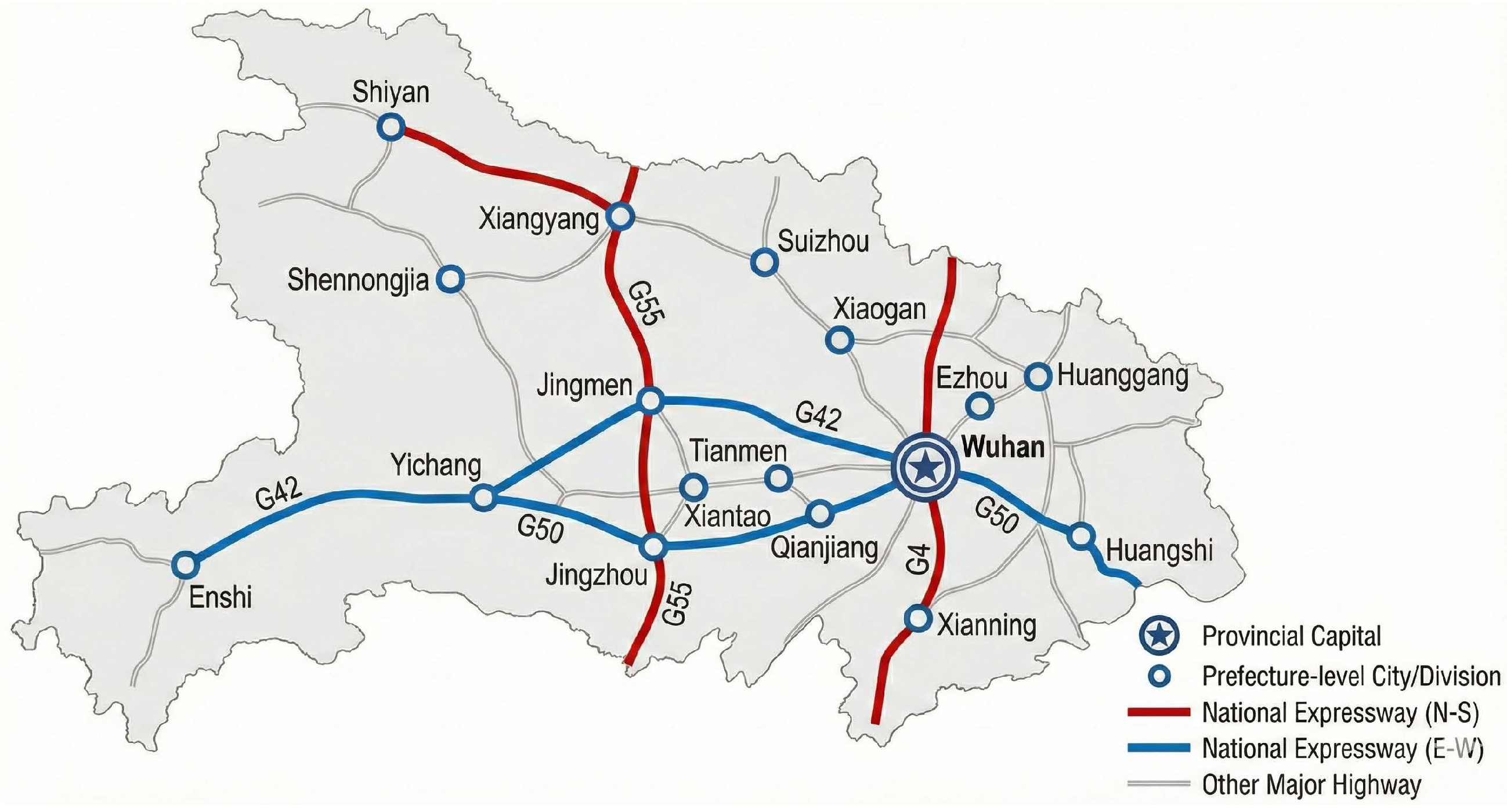
The numerical experiments are conducted on a simplified network topology representing the primary highway system of Hubei Province. We model the network as a directed graph where major cities and key transit hubs serve as nodes. As detailed in
Table 4, five national expressways (e.g., G4, G42) constitute the backbone of this network, connecting 17 major urban areas (nodes).
Figure 1 visualizes the topological structure of the studied highway network, highlighting the critical corridor nodes.
To estimate the intercity traffic demand, we utilize operational data from long-distance bus services, which provide a reliable proxy for regular intercity travel patterns. We selected 22 representative routes covering the major Origin-Destination (OD) pairs within the province. The traffic flow for each path is calibrated based on the average daily frequency of bus departures.
Table 5 summarizes the network nodes, path definitions, and their corresponding traffic volumes used in the model.
5.3.2. Facility Specifications and Cost Parameters
Our model considers three distinct types of charging facilities: slow charging (SC), fast charging (FC), and battery swapping (BS). The parameter settings for these facilities are grounded in recent industry reports and academic literature [
13,
31], ensuring that the trade-offs between cost and service speed reflect real-world market conditions.
Regarding the economic parameters, the total cost includes land acquisition, equipment procurement, installation, and long-term operation and maintenance (O&M). Fast charging and battery swapping stations generally incur higher capital and operational expenditures due to their grid impact and specialized equipment requirements. Specifically for battery swapping, we consider the cost of a “Modular Battery Swapping Unit” rather than a large-scale service center. Following the cost structures in [
31] and adjusting for recent modularization trends, we estimate the capital expenditure for a compact BS unit at approximately
$60,000. While full-scale stations (e.g., NIO Generation 2) can cost upwards of
$200,000, modular units represent a scalable entry point for highway deployment. To address the variance in BSS costs, we perform a sensitivity analysis with higher cost scenarios in
Section 5.5.
To incorporate this into our daily operational planning model, we amortize the capital cost over a 10-year lifespan. Including daily personnel and battery maintenance expenses, the equivalent daily cost for a BS unit is estimated at $850. Similarly, the daily costs for FC and SC stations are derived proportionally based on their lower complexity and land requirements.
In terms of service efficiency, we introduce the daily service capacity parameter
to enforce the flow-capacity constraint Equation (
7). Based on an operating window of 16 h/day and considering technical turnover times:
Slow Charging (SC, ): Average dwell time ≈ 4 h. vehicles/day/pile.
Fast Charging (FC, ): Average dwell time ≈ 40 min. vehicles/day/pile.
Battery Swapping (BS, ): Fixed service time 5 min + maneuvering. vehicles/day/unit.
This explicit capacity modeling ensures that the optimized facility numbers (
) are physically sufficient to handle the assigned traffic flow
.
Table 6 lists the representative charging times for typical EV models.
5.4. Numerical Results and Analysis
All computational experiments were performed on a workstation equipped with an Intel Core i7 processor and 16 GB of RAM. We implemented the proposed model using the IBM ILOG CPLEX optimization suite. To reflect real-world heterogeneity, land costs for candidate sites were drawn from a uniform distribution U. The total facility construction cost is defined as the sum of land costs and equipment-specific maintenance expenses.
5.4.1. Baseline Scenario Analysis: Cost vs. Time
We first establish the boundaries of the solution space by solving the model under two extreme objectives: (1) exclusively minimizing construction costs (
) and (2) exclusively minimizing travelers’ total dwell time (
).
Table 7 presents the optimal facility configurations for these limiting cases under a baseline EV range of
km.
The results reveal a stark contrast in network configuration strategies. When the decision-maker prioritizes cost minimization (Left Column,
Table 7), the model predominantly selects Slow Charging (SC) stations (denoted as type 3) at nodes with lower land costs. Due to the low service capacity
of slow chargers, a larger number of individual piles are required to meet the flow demand, yet the total cost remains low due to the minimal unit cost. While this strategy minimizes the capital expenditure to
$289,564, it drastically degrades the Level of Service (LoS), resulting in a system-wide dwell time of 9880 h. Conversely, when minimizing traveler time is the sole objective (Right Column,
Table 7), the optimal solution shifts towards high-performance infrastructure. The network is densely populated with Battery Swapping (BS) stations (denoted as type 1) and Fast Charging (FC) stations. This configuration reduces the total time to just 336 h—a 96.6% improvement—but escalates the construction cost to
$867,865, nearly tripling the budget. These findings underscore the inherent conflict between operator investment and user experience, necessitating a multi-objective approach to find a balanced compromise.
The spatial distribution of the selected nodes also offers strategic insights. Regardless of the objective, certain key nodes such as Wuhan (Node 1, a central hub), Jingmen (Node 10, a major intersection), and high-traffic cities like Qianjiang (Node 15) are consistently selected. These locations represent the “critical backbone” of the Hubei highway charging network, indicating their robustness against varying policy preferences.
5.4.2. Sensitivity Analysis: Impact of Weight (W) and EV Range (R)
To assist policymakers in navigating the trade-offs, we conducted a sensitivity analysis by varying the weight parameter
W (representing the preference for cost reduction) and the EV driving range
R. The results are summarized in
Table 8. The stepwise reduction in station counts (e.g., from 12 to 10) reflects the inherent combinatorial nature of the MILP model. Unlike continuous resource allocation, facility location decisions involve discrete ‘open/close’ binary variables, leading to jump discontinuities in the solution space.
Impact of Policy Preference (W). As expected, increasing W from 0 to 1 leads to a monotonic decrease in construction costs and a simultaneous increase in traveler delays. However, the rate of change is non-linear. This suggests that shifting from a purely cost-centric view to a balanced view (e.g., ) can yield significant service improvements with only moderate cost increases—impact of EV Technology (R). Technological advancements in battery range significantly alleviate the infrastructure burden. Comparing the rows for , 500, and 600 km, we observe that for a fixed weight W, an extended driving range reduces both the required number of stations and the total system cost. For example, with , increasing the range from 400 km to 600 km reduces the number of stations from 12 to 9 and cuts the construction cost by approximately 45%. This implies that as EV technology matures, the marginal utility of dense charging networks may diminish, allowing for leaner infrastructure planning.
5.4.3. Pareto Efficiency and Marginal Analysis
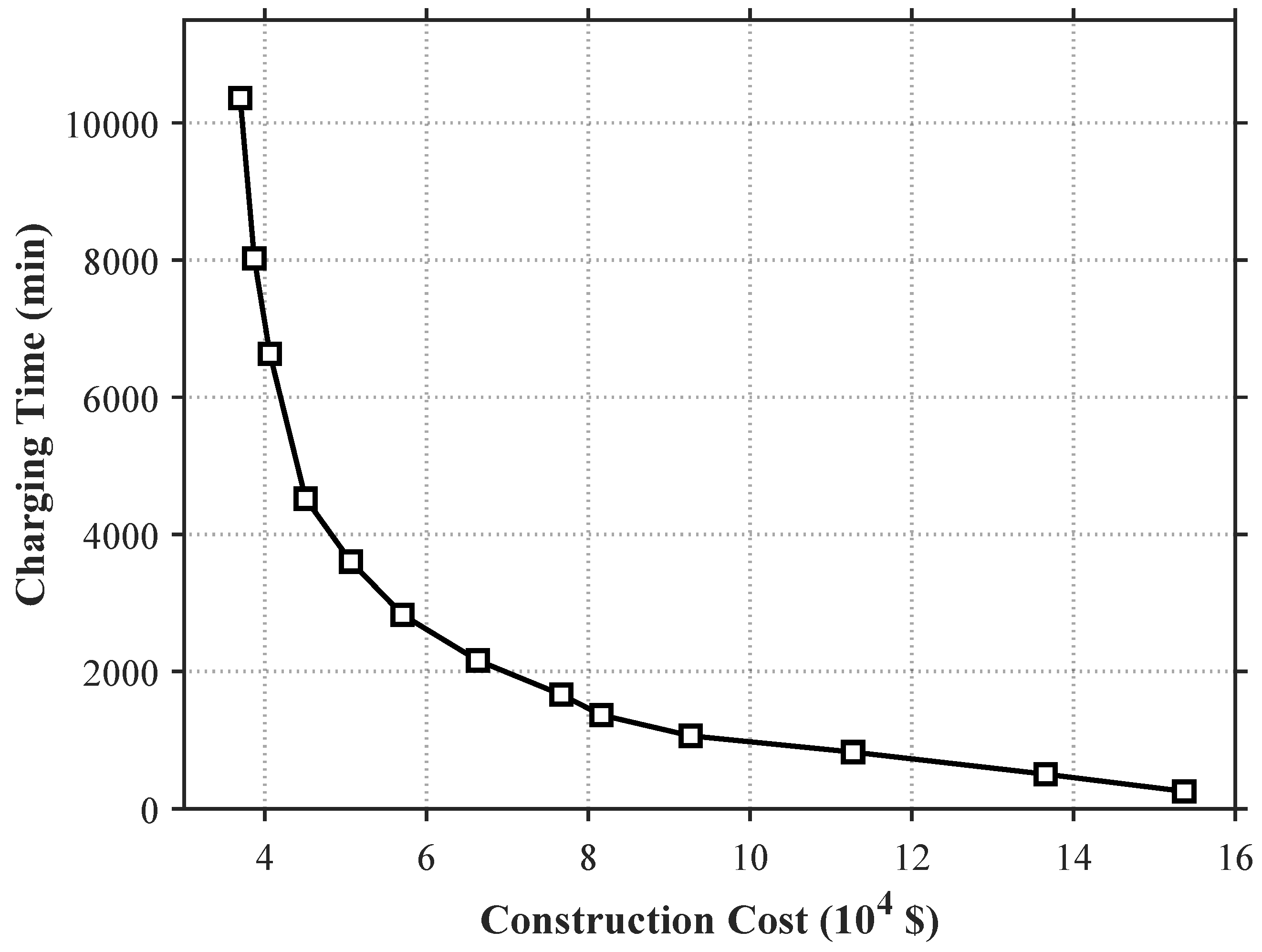
To quantify the trade-off mechanism more precisely,
Figure 2 plots the Pareto frontier of construction costs and user dwell time. The convexity of the derived curve reveals distinct phases in the return on investment (ROI), providing critical insights for budget allocation.
The first phase, corresponding to the steep left segment of the curve, represents a “high-return” zone. In this region, the elasticity of service quality with respect to investment is high. Moving from the minimum-cost solution (where the network relies on slow charging) to a slightly higher budget allocation enables the strategic upgrade of critical bottleneck nodes to fast-charging or battery-swapping facilities. Quantitatively, a modest 21.88% increase in the budget from the baseline cost yields a disproportionate 56.38% reduction in total charging time. This steep gradient indicates that the initial capital injections are highly efficient in alleviating the most severe system delays.
The second phase, appearing as the curve flattens towards the right, indicates the onset of diminishing marginal returns. As the investment continues to rise, the network becomes saturated with high-performance facilities. Further expenditure in this “saturation phase” contributes primarily to redundancy rather than essential service improvements. The curve eventually becomes nearly horizontal, implying that additional spending yields negligible reductions in dwell time.
Consequently, these analytical findings suggest that the optimal investment strategy lies near the “knee” of the Pareto curve. Operating at this inflection point allows decision-makers to maximize the utility of public funds, avoiding the “efficiency trap” of under-investment while simultaneously preventing wasteful over-provisioning of infrastructure in a market where technology is rapidly evolving.
5.5. Sensitivity Analysis of Exogenous Uncertainties
Real-world infrastructure planning is invariably subject to exogenous uncertainties. In this section, we examine the robustness of the optimal network configuration against variations in two critical parameters: the demand intensity (represented by path flow ) and technological maturity (represented by EV battery range R).
5.5.1. Impact of Demand Intensity (Path Flow)
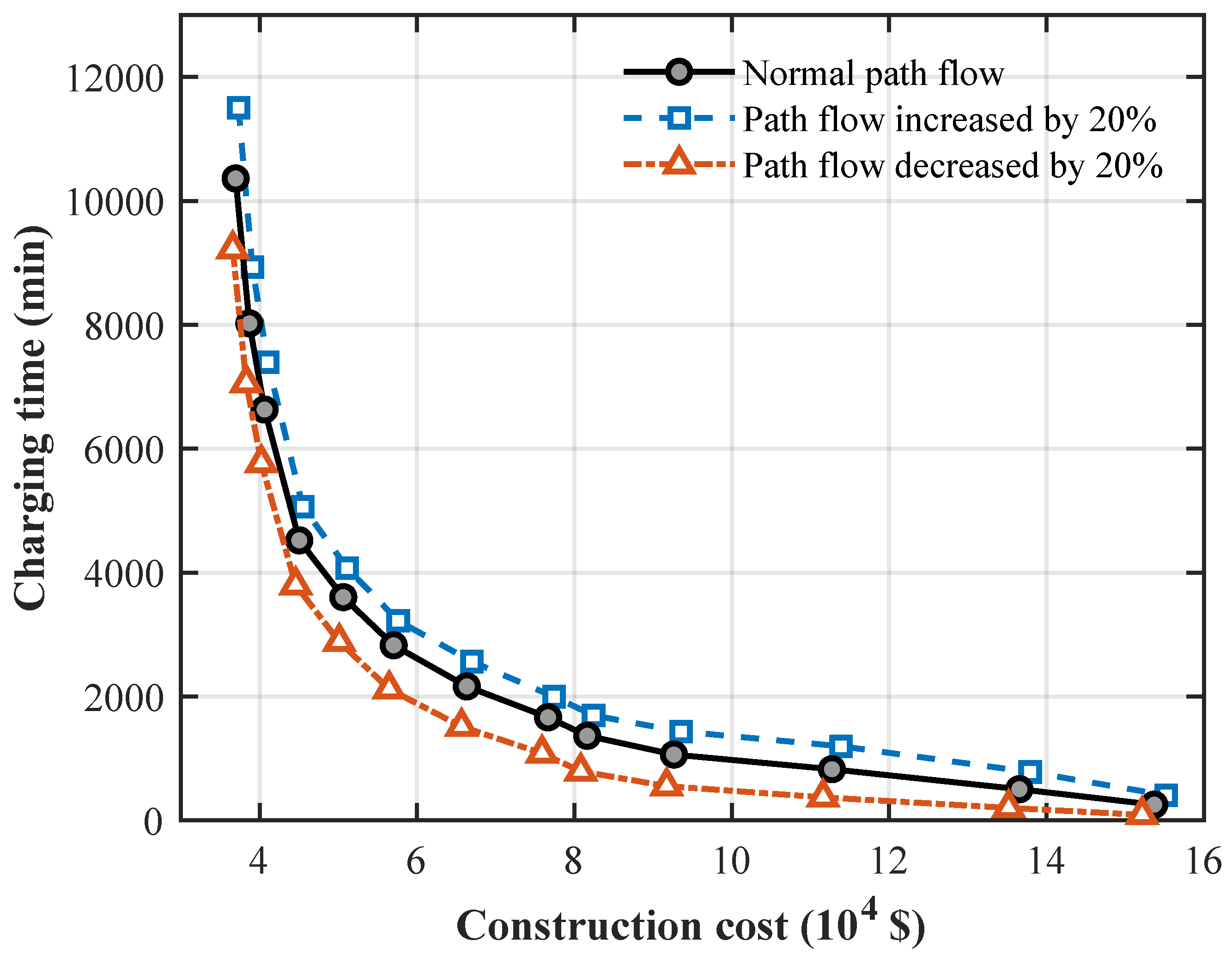
We first investigate the system’s response to demand fluctuations by scaling the path flow volumes (
) by
relative to the baseline scenario. The resulting shifts in the Pareto frontiers are illustrated in
Figure 3.
A superficial observation of
Figure 3 might suggest a simple shift in costs. However, a deeper analysis reveals a significant structural adaptation in the optimal solution. As illustrated by the synchronized movement of the curves, an increase in traffic flow leads to a simultaneous increase in construction costs and a reduction in average charging time. This counter-intuitive phenomenon—where higher demand correlates with faster service—is driven by an endogenous technology substitution mechanism.
When traffic volume remains low, the marginal benefit of high-speed charging is limited, and the model favors low-cost slow-charging facilities. However, as path flow surges, the opportunity cost of traveler dwell time escalates. To mitigate severe congestion penalties, the optimization model is forced to upgrade the facility mix from basic slow-charging piles to capital-intensive Fast Charging (FC) and Battery Swapping (BS) stations. Sensitivity analysis on BSS costs further confirms this: even when the capital cost of BSS is doubled to $120,000, the model continues to select BSS at critical bottleneck nodes where flow volume exceeds 80 vehicles/day, validating the economic robustness of swapping technology in high-demand scenarios.
5.5.2. Impact of Technological Maturity (Battery Range)
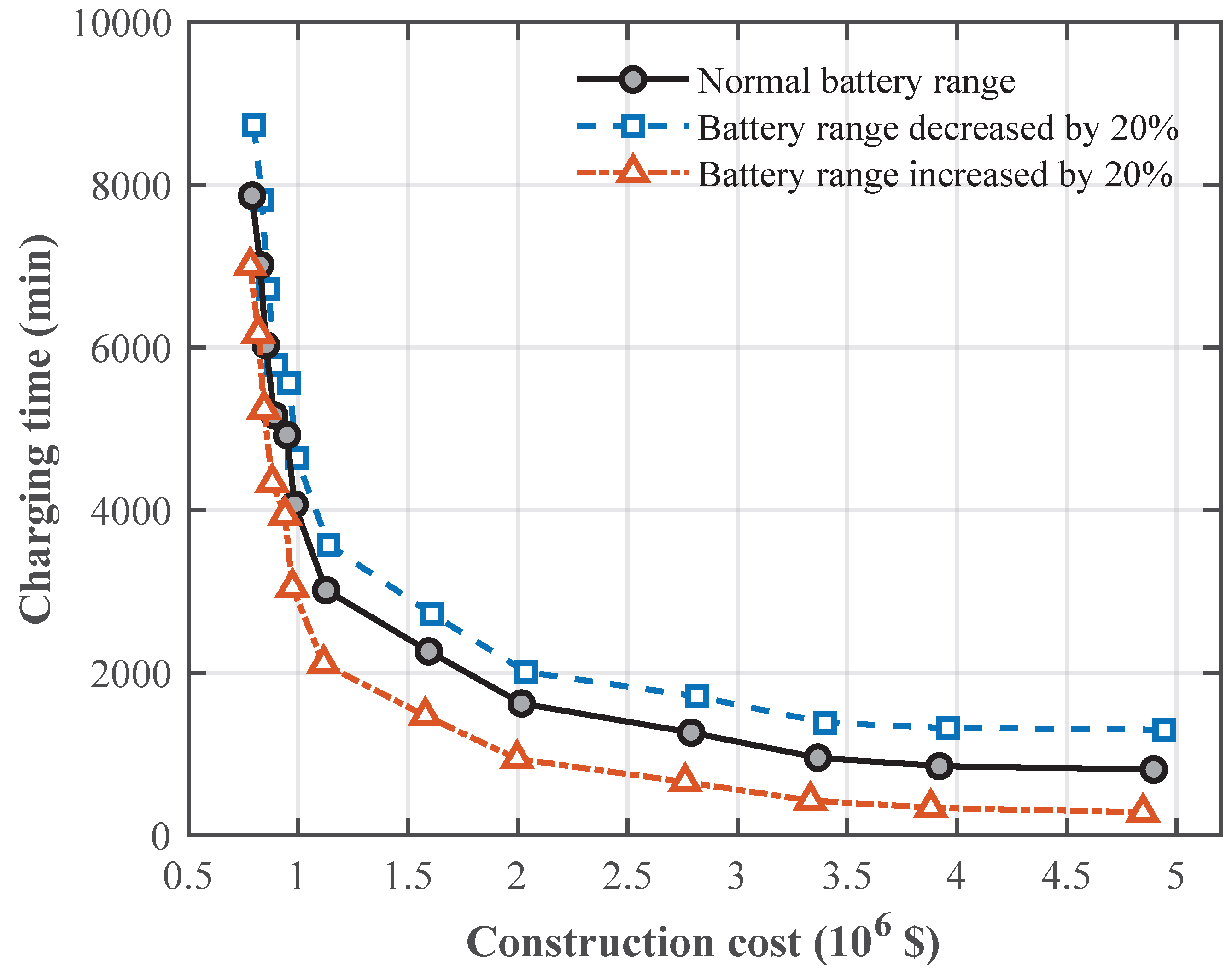
Next, we analyze the sensitivity of the optimal configuration to the EV battery range (
R), treating it as a proxy for the evolution of battery technology. We conducted experiments with battery ranges varying from
to
of the baseline. Additionally,
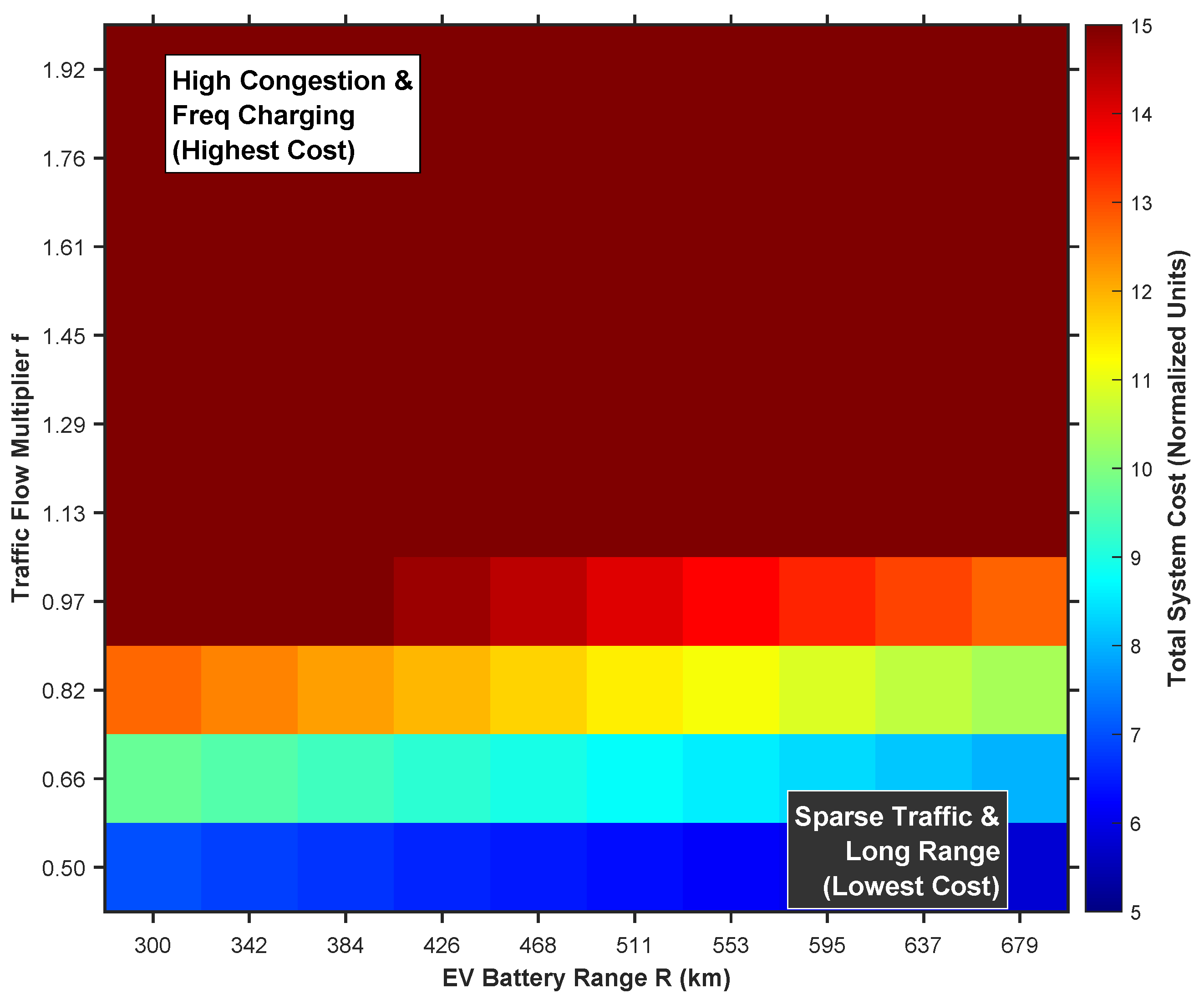
Figure 4 provides a heatmap visualization of the joint impact of range and flow. The trade-off curves under these scenarios are depicted in
Figure 5.
The results highlight a distinct asymmetry in how technological progress impacts the two objective functions. On one hand, the user dwell time exhibits high elasticity with respect to battery range. As the range increases, vehicles can traverse longer segments of the highway network without stopping, effectively “skipping” intermediate nodes. This leads to a substantial reduction in the frequency of charging events and total travel delay.
On the other hand, the infrastructure construction cost demonstrates a notable inelasticity. As shown in
Figure 5, the vertical displacement of the cost curve is minimal even when the battery range increases significantly. This stability is attributed to the “coverage constraint” inherent in highway networks. Even if the average EV can travel longer distances, a foundational skeleton of charging stations is required to ensure connectivity and alleviate range anxiety for worst-case scenarios. The fixed costs of establishing this minimum coverage dominate the variable savings from reduced station usage.
From a managerial perspective, these findings imply that infrastructure investors should not delay network construction in anticipation of future battery breakthroughs. While better batteries will significantly enhance the user experience by reducing wait times, they do not obviate the need for a comprehensive physical charging network. The optimal strategy, therefore, is to proceed with the layout of the backbone network while reserving flexibility for capacity adjustments.
7. Conclusions
7.1. Summary of Contributions
This study addresses the strategic planning of electric vehicle (EV) charging infrastructure on highway networks, a pivotal component in the global transition toward sustainable mobility. We successfully achieved the study’s primary objectives by:
- 1.
Formulating a multi-type facility location model () that explicitly incorporates traveler heterogeneity regarding charging modes (slow, fast, and battery swapping) and treats service duration as an endogenous decision variable.
- 2.
Developing an exact linearization technique via auxiliary variables to overcome the computational intractability of bilinear terms. This methodological innovation transforms the non-convex MINLP into a tractable MILP, guaranteeing global optimality.
- 3.
Demonstrating through the Hubei case study that the optimal network configuration relies on a specific mix of technologies, where battery swapping acts as a critical reliever for high-demand nodes.
7.2. Limitations and Future Research
While this study provides a rigorous foundation for facility location decisions, several limitations warrant further investigation to enhance the model’s fidelity and applicability.
First, regarding the physics of charging, our model assumes a linear relationship between charging time and energy replenished. In reality, lithium-ion battery charging follows a complex non-linear profile (CC-CV protocol). Future research could incorporate piecewise linear approximations to better capture the slowing charge rates at high States of Charge (SoC), balancing computational complexity with physical realism.
Second, regarding system uncertainty, the current model relies on deterministic parameters. Real-world operations are subject to stochastic disruptions. Future studies could extend our framework using Robust Optimization to design networks capable of withstanding worst-case demand surges. Additionally, the integration of Battery Swapping Stations (BSSs) with the power grid offers a promising avenue for research. Exploring “Grid-Interactive” BSS location problems, where stations serve as energy storage units for peak shaving, could unlock new value streams.
Third, regarding user behavior, the assumption of homogeneous decision-making (System Optimal) simplifies reality. Future work could integrate Game Theoretic models to capture the competitive behavior of users (User Equilibrium) and the strategic interactions between competing charging network operators. Furthermore, future research should integrate the interactions between charging networks and power grids, specifically exploring Vehicle-to-Grid (V2G) applications where endogenous dwell time decisions could be incentivized by real-time electricity pricing.
In summary, this paper provides a theoretically sound and computationally efficient tool for navigating the trade-offs in charging infrastructure planning. By bridging the gap between mathematical optimization and practical policy needs, it offers a roadmap for developing sustainable, user-centric, and economically viable electric transportation systems.