1. Introduction
1.1. EV Market Overview and Outlook
For a clean environment and energy sustainability, various hybrid electric vehicles (HEVs) and pure battery-powered electric vehicles (BEVs), such as the Toyota Prius, Tesla, and BYD, have been developed and sold worldwide. In contrast to traditional vehicles powered by internal combustion engines (ICE), EVs powered by batteries and electric motors exhibit low greenhouse gas emissions, low acoustic noise, smooth dynamics, and high efficiency across a wide speed range [
1,
2,
3,
4]. Since the torque/speed characteristics inherently meet the vehicle drive requirements, there is no need for continuously variable transmission, resulting in a simpler powertrain, higher reliability, and lower cost.
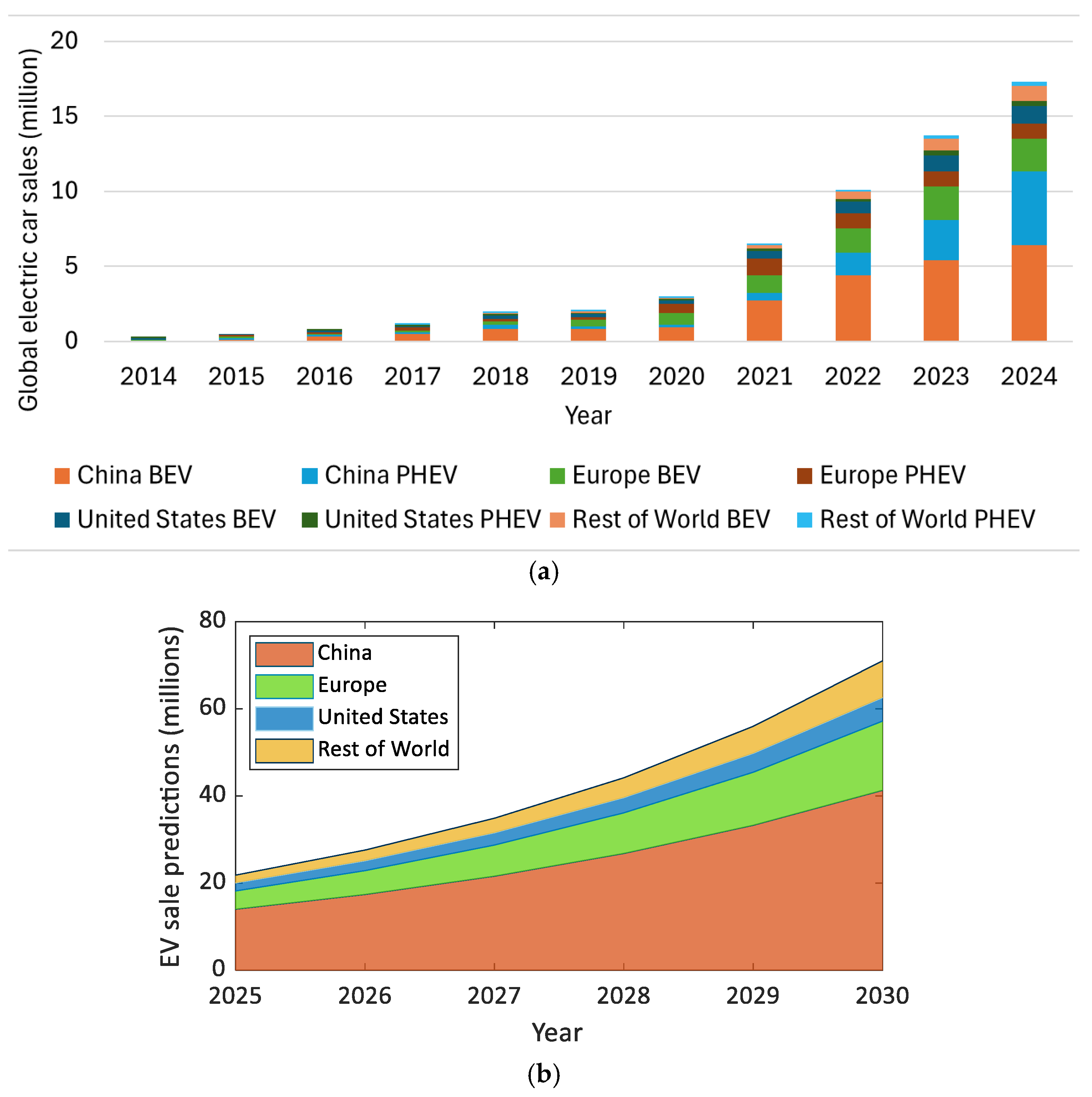
Figure 1 presents global electric car sales from 2014 to 2024, along with a five-year projection to 2030, based on the analysis and data of the International Energy Agency (IEA) [
5]. As shown, the EV market has expanded rapidly worldwide, particularly in China and Europe. It is also expected to accelerate further over the next five years, with China and Europe remaining the leading growth regions. The large-scale deployment of EVs delivers multifaceted benefits: reducing tailpipe emissions, lowering lifecycle greenhouse gas footprints, improving urban air quality, and making a substantial contribution toward the global net-zero emissions goal.
According to the analysis in the IEA Global EV Outlook 2024, a medium-sized BEV sold in 2023 emits roughly half the life-cycle greenhouse gas emissions of a comparable gasoline ICE car. Global EV deployment is projected to avoid nearly 2 gigatons (Gt) of CO
2-equivalent emissions annually by 2035, resulting in significant net savings despite increased electricity demand, particularly as power grids decarbonize [
6]. The U.S. Department of Energy reports that BEVs convert over 77% of grid electricity into power at the wheels, whereas conventional gasoline vehicles typically convert only 12–30% of the fuel energy into useful work [
7]. It is also reported that overall well-to-wheel drivetrain efficiencies are approximately 20–30% for gasoline- and diesel-powered ICE passenger cars, compared with roughly 50–60% for battery EVs [
8].
1.2. Electrical Drive Systems for EVs
At the core of an EV’s drive performance lies the electrical drive system, which typically comprises three major interdependent components: electrical machines, power converters, and controllers.
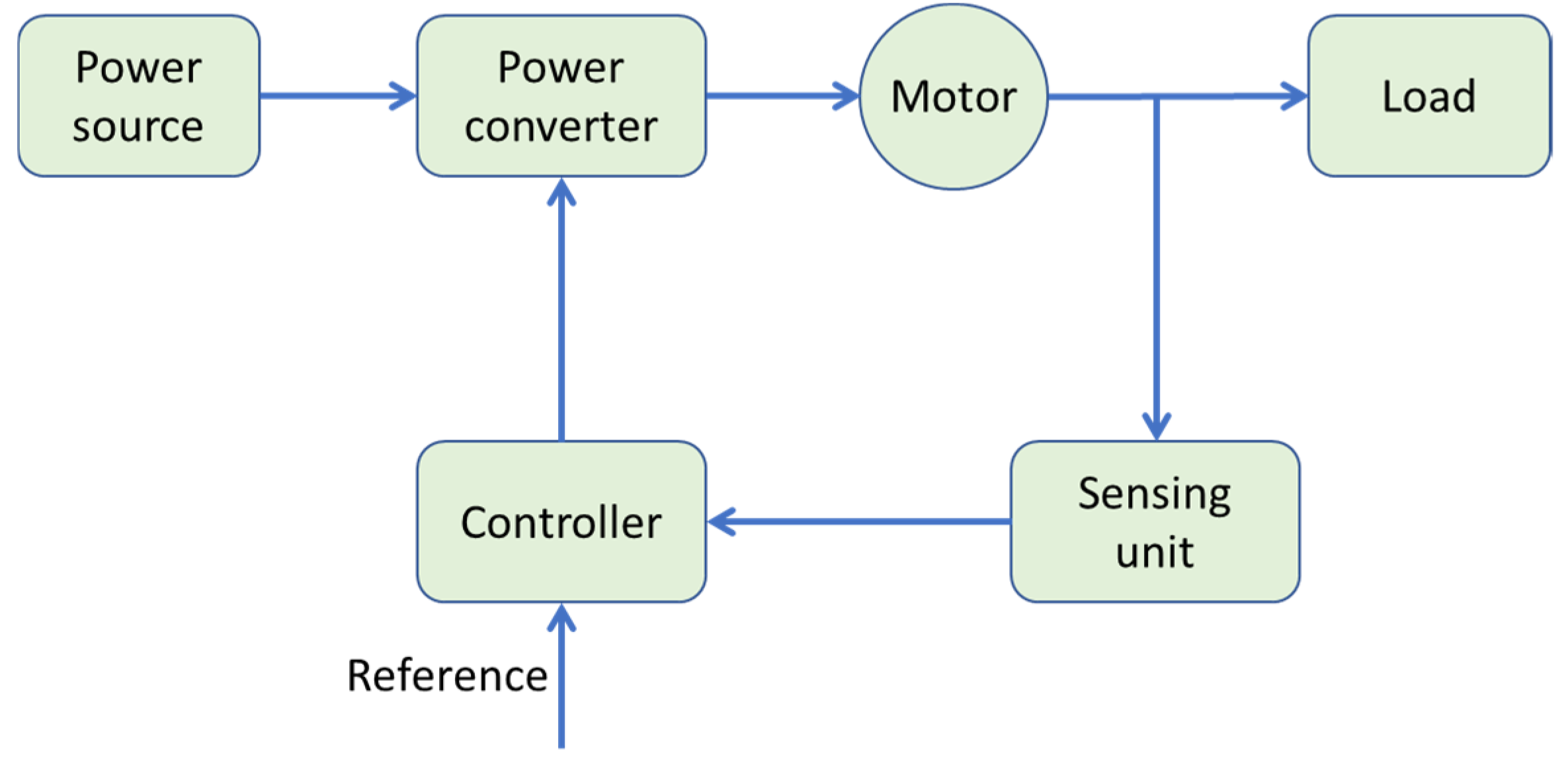
Figure 2 illustrates a general configuration for motor control systems. For EVs, power sources can be pure batteries or hybrid systems, such as battery-fuel cell, ICE, or supercapacitor systems, depending on the vehicle’s drivetrain topology [
4,
9].
To achieve optimal performance of the entire drive system, application-oriented system-level design optimization method is typically required.
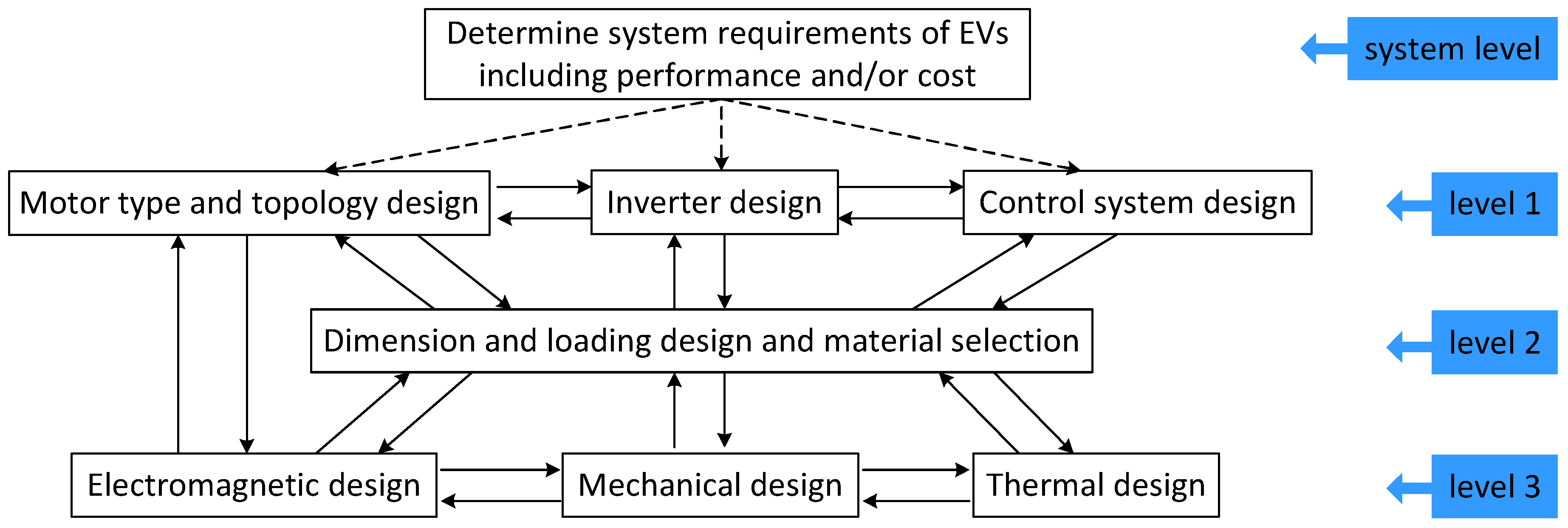
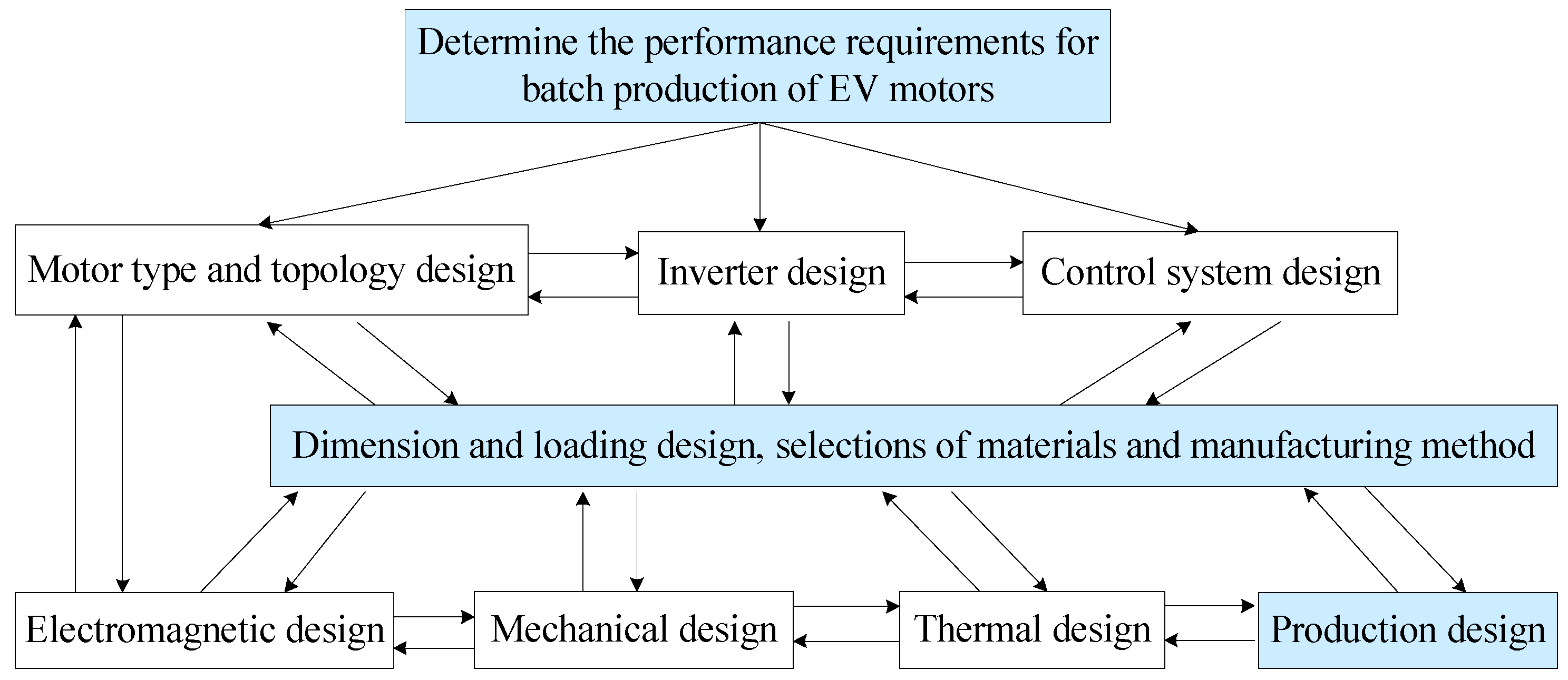
Figure 3 presents a typical system-level design framework for EV’s electrical drive systems. As shown, this is a multilevel design problem with four main levels [
10].
The first level is the system, which determines the system performance requirements for the electrical drive systems of the investigated EV, including driving cycles, rated torque, motor and inverter efficiencies, and motor volume.
Under the system level, there are 3 levels defined in order: level 1, level 2, and level 3. Level 1 primarily concerns the design of the three interacting components of electrical drive systems: the motor, inverter, and controller. Level 2 mainly investigates the materials and dimensions to be considered in designing the components at level 1. Level 3 is the bottom layer, which conducts fundamental multiphysics design and coupled analysis, including electromagnetic, thermal, and mechanical designs. This multilevel design framework clearly outlines the steps required to design an electrical drive system, from multiphysics analysis and materials and components selection to system integration.
1.3. The Necessity and Significance of System-Level Design Optimization
Component-level design optimization methods have been widely employed to optimize the three major components (i.e., motor, inverters, and controllers; see level 1 in
Figure 3) in EV research and industry for many years. Although various efficient methods have been developed, several challenges remain.
First, from an optimization-theory perspective, combining several optimized components does not guarantee the optimal performance of the entire drive system. For example, even if we select the most advanced motor and the best controller on the market and ignore cost, it is difficult to guarantee that they will deliver the best drive-system performance for an EV application [
10,
11,
12,
13,
14].
Table 1 lists five detailed aspects for comparing component-level and system-level design optimization of electrical drive systems. As shown, system-level design optimization is essential for EV drive systems because it enables coordinated trade-offs across tightly coupled subsystems, improves system energy efficiency, and provides greater flexibility in handling uncertainties, which cannot be adequately addressed through component-level optimization alone [
15,
16,
17,
18].
Second, from the application perspective, system-level design optimization is necessary to balance the performance and integration of all components in EV drive systems. Although various motor placement and drivetrain architectures have been used in EVs, including centralized motor drives with mechanical transmissions, dual-motor or multi-motor distributed drives, and in-wheel motor (IWM) configurations [
9], each architecture presents distinct trade-offs in efficiency, controllability, cost, and system integration, which cannot be handled by component-level optimization alone. Among these options, the IWM drive is a particularly challenging yet promising configuration due to its strong coupling among electromagnetic design, thermal management, vehicle dynamics, and control, making it an ideal case study for illustrating the necessity of system-level design optimization [
19,
20].
First, the integration of motors directly into the wheel hubs increases unsprung mass, which significantly amplifies vehicle vibrations and dynamic tire-load fluctuations [
21,
22,
23]. Second, the confined, sealed installation space of IWMs severely limits heat dissipation, resulting in high heat-loss densities [
24,
25]. Third, IWMs must deliver reliable torque and high efficiency over a wide speed range to satisfy real-world driving requirements, while simultaneously coordinating multiple motors; deviations from optimal operating points can increase vehicle energy consumption by 5–10%, raise battery thermal stress, and degrade dynamic performance [
26,
27]. These strong interactions among electromagnetic design, thermal management, vehicle dynamics, control coordination, and energy efficiency demonstrate that only a system-level optimization framework—jointly considering motor design, control strategies, thermal constraints, vehicle dynamics, and energy management—can fully exploit the potential of IWM drive systems while ensuring efficiency, reliability, and safety in EV applications [
19].
1.4. The Necessity and Contributions of This Review Paper
As a hot research topic, it has attracted many review papers.
Table 2 compares 10 review papers (i.e., [
28,
29,
30,
31,
32,
33,
34,
35,
36,
37]) published in the last 4 years (2022–2025) in this field. As shown, existing reviews primarily focus on specific aspects such as electric machine design, control strategies, topology optimization, surrogate modeling, reinforcement-learning (RL)-based control, or particular machine types including switched-reluctance motors (SRMs), synchronous reluctance motor (SynRMs), permanent magnet synchronous motors (PMSMs), as well as HEV applications. While these studies provide valuable insights at the component, algorithm, or application level, their scope is typically limited to subsystems or specific optimization techniques or applications.
In contrast, this review adopts a system-level perspective on EV drive systems. The objectives of this review are to
(i) systematically summarize state-of-the-art optimization models and methods for EV drive systems at the machine, control, converter, and system levels;
(ii) critically analyze existing optimization strategies and highlight the importance of an application-oriented robust system-level optimization approach for EV drive systems.
(iii) identify and articulate emerging directions toward automated, AI- and digital twin (DT)-enabled design optimization platforms for advanced EV drive systems.
The remainder of this paper is organized as follows.
Section 2 reviews typical EV drive systems.
Section 3 shows a review of various optimization models and methods for EV electrical machines, including multiphysics, multiobjective, multimode, robust, topology, and AI-based optimization methods. In addition, a multilevel optimization strategy is presented, followed by a case study of an axial-flux IWM.
Section 4 and
Section 5 review optimization methods for EV inverters and drive control systems, respectively.
Section 6 explores the application-oriented system-level optimization methods for EV drive systems. Another case study of an IWM drive system is presented in this section.
Section 7 and
Section 8 propose an AI-powered automatic design optimization platform and a DT-assisted system-level optimization framework for electrical drive systems, respectively, followed by the conclusion and recommendations.
2. Typical Electrical Drive Systems for EVs
Many types of electrical machines have been employed for EVs, with the most common being PMSMs [
38,
39,
40,
41,
42,
43,
44,
45], induction motors (IMs) [
46,
47,
48,
49,
50], and SRMs [
51,
52,
53,
54,
55]. Many research papers have been published for these machines, including review papers [
3,
4,
10,
29,
30,
31,
32,
56,
57].
Table 3 briefly compares these three motor types across several aspects, including efficiency, power-to-torque density, cost, and control complexity. Generally, PMSMs offer the highest efficiency and power density, making them dominant in most modern EVs. However, the cost and demagnetization risks of permanent magnets (PMs) are major drawbacks. IMs are cost-effective and robust, preferred in earlier EVs, but their lower efficiency reduces driving range compared to PMSMs. SRMs are robust, PM-free, and low-cost, attracting attention for EVs under rare-earth-free initiatives, but still face challenges with noise, vibration, and control complexity [
1,
2].
Table 4 briefly compares the performance of five control methods for EV electrical machines. They are field-oriented control (FOC) [
58,
59,
60,
61,
62], direct torque control (DTC) [
63,
64,
65,
66,
67,
68,
69], model predictive control (MPC) [
70,
71,
72,
73,
74,
75,
76,
77,
78], model-free predictive control (MFPC) [
79,
80,
81,
82,
83,
84], and AI-based control methods [
85,
86].
As shown in
Table 4, FOC and MPC are model-based control methods that exhibit excellent steady-state performance. However, parameter variations, such as stator resistance and inductance with temperature or saturation effects, can degrade performance, requiring online parameter estimation or adaptive control. AI-based control (e.g., RL-based predictive control) operates in a data-driven paradigm, reducing explicit model dependence but introducing data dependence. When the training data do not represent the full operating space, performance may degrade [
87,
88]. Please note that, unlike conventional control strategies, AI-based control methods typically rely on extensive offline or online training to achieve satisfactory performance. Their effectiveness depends strongly on the representativeness of the training data, and persistent training or adaptation is often required to accommodate changing operating conditions. As a result, scenarios outside the learned domain—such as rare faults, extreme temperatures, or unexpected load dynamics—may lead to degraded performance or unsafe behavior, posing potential risks to users [
89]. This highlights the need for safe learning frameworks, hybrid AI-model-based control, and formal verification methods before large-scale deployment in safety-critical EV applications.
3. Optimization of EV Electrical Machines
This section reviews several widely used optimization methods for EV electrical machines. Before the detailed comparisons (
Section 3.2 and
Section 3.3), an overview of the main optimization steps for EV electrical drive systems will be presented in
Section 3.1.
3.1. Main Optimization Framework and Steps
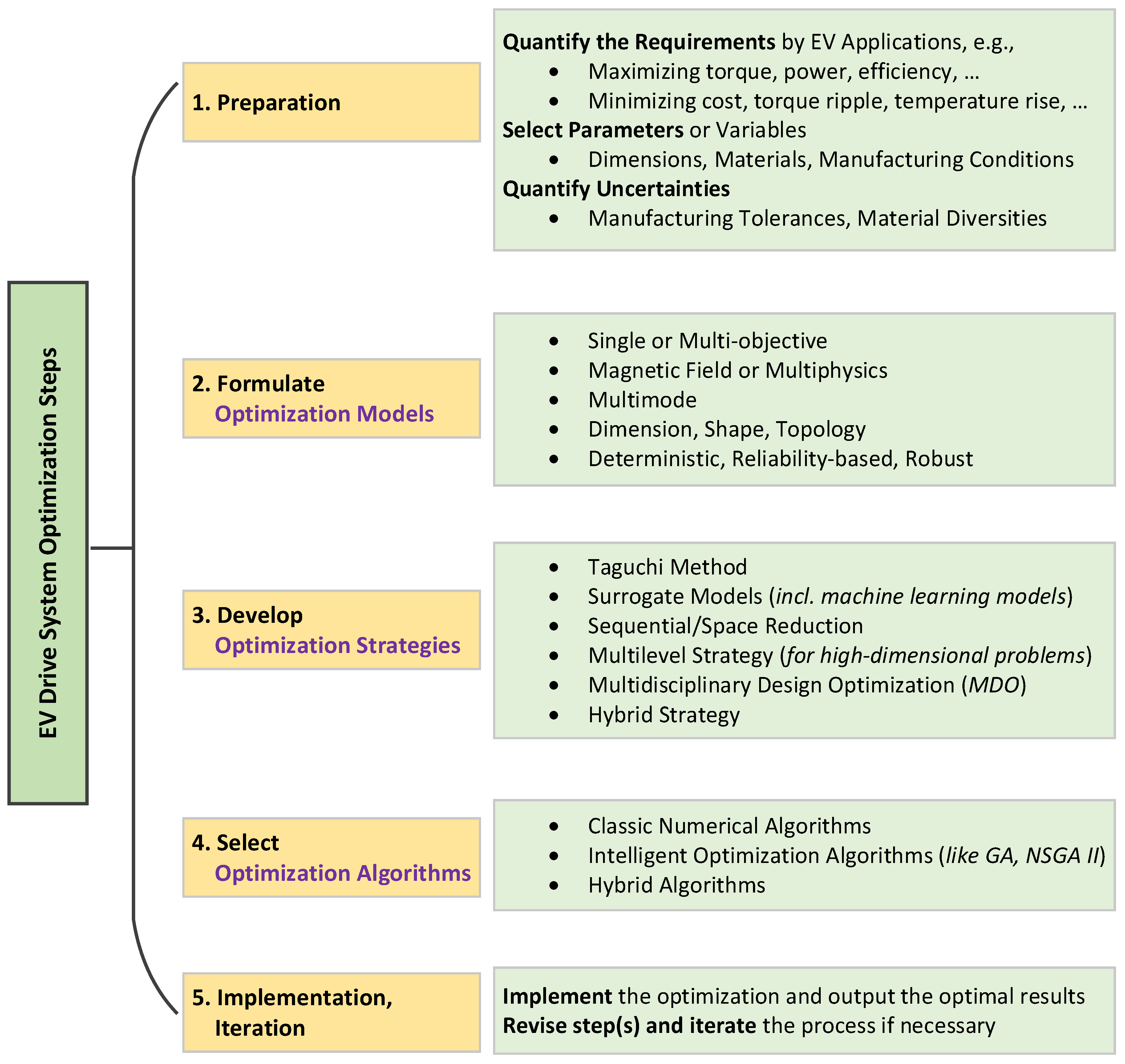
Figure 4 outlines an optimization framework for EV electrical drive systems. As shown, there are five main steps.
Step 1: Preparation. This step aims to collect and quantify the information necessary to develop the optimization models in the next step. This step should be completed in accordance with the design requirements of a specific EV application; therefore, it corresponds to the system-level design framework in
Figure 2. The outcomes of this step should answer the following questions.
How many performance requirements are there for the designed electrical drive systems? For example, what is the minimal torque and efficiency, and what are the maximums of material cost, temperature rise, and torque ripple?
How many material and dimensional parameters will be considered in the optimization, and what are their ranges? To answer this question, an initial design is normally required. The parameter ranges can be determined from the values in the initial design and the designers’ experience.
Will uncertainties be considered, and how to quantify them in the optimization? This question concerns reliability-based and robust optimization, as it examines the manufacturing quality (or manufacturability) and operational quality (or reliability) of electrical drive systems under practical uncertainties, including manufacturing tolerances, material variability, and operational variations.
Step 2: Formulate optimization models. This step aims to formulate a type of optimization problem using the information collected in step 1. An optimization model typically comprises one or more objectives and constraints, some of which require multiphysics analysis to yield results.
A complete EV drive cycle requires multimode optimization because each driving phase—such as launch, acceleration, cruising, and field-weakening—has different dominant physical behaviors and therefore different performance objectives.
Topology optimization is required to reduce motor mass and improve the dynamic performance of the motor drive system. Robust optimization is necessary if manufacturability and reliability of electrical drive systems are considered.
Step 3: Develop optimization strategies or methods. This step addresses how to conduct optimization to find solutions to the optimization models developed in step 2.
A direct approach is to optimize all parameters using a motor analysis model, such as the finite element model (FEM), and an optimization algorithm, such as a genetic algorithm (GA). This approach is quite straightforward and acceptable in some situations. For example, when we optimize 3 parameters of a PMSM using 2D FEM, we may be able to obtain the final solutions in one or two hours. However, it is quite challenging to use this approach for high-dimensional optimization problems (like more than 10 optimization parameters), and/or when a 3D complex FEM is needed (like axial-flux PM motors).
To address this challenge, various optimization strategies have been developed in this field and successfully applied to different types of EV motors, including surrogate models, sequential, and multilevel approaches. More details are provided in the following sections.
Step 4: Select or improve optimization algorithms. This step aims to select an appropriate optimization algorithm and/or refine it to implement the optimization strategy developed in step 3 and obtain optimal results.
Although several types of optimization algorithms exist, intelligent optimization algorithms are widely used today, including the Genetic Algorithm (GA), Multi-Objective Genetic Algorithm (MOGA), and Non-dominated Sorting Genetic Algorithm II (NSGA-II) [
10,
13,
14]. They have become powerful tools for EV motor optimization because they can efficiently explore complex, nonlinear, and strongly coupled design spaces. They enable simultaneous optimization of torque, efficiency, losses, thermal behavior, and material usage by using evolutionary strategies. Their ability to balance competing objectives, avoid local minima, and incorporate practical constraints makes them particularly suitable for the multidisciplinary nature of EV motor optimization.
Step 5: Implementation and iteration. After formulating the optimization problems and selecting the optimization methods/strategies, it is time to implement the optimization process.
If satisfactory optimal results are obtained, output them, and terminate the optimization process for the verification (by simulation and/or experiment). Otherwise, return to any step (1–4), revise the models and/or parameters, and reoptimize until satisfactory results are obtained.
Please note that steps 2 and 3 are the focus of this paper. For step 4, optimization algorithms have been discussed in many studies, including our books and papers [
10,
13,
14]. Please refer to them for more information. Therefore, the following review and discussion of optimization methods for EV machines will proceed according to the two major optimization steps. The limitations and recommendations for each type of optimization model and strategy are also discussed in the corresponding sections, drawing on our prior experience.
3.2. Main Optimization Models and Comparisons
The optimization problems of EV motors can be classified into several groups based on different aspects, such as the number of objectives and operating modes. There are five popular optimization problems or models for EV motors, i.e., multiobjective, multiphysics, multimode, robust, and topology optimizations [
90,
91,
92,
93,
94,
95,
96,
97,
98,
99,
100,
101].
Table 5 compares their generic characteristics.
As summarized in
Table 5, different optimization models for EV motors address distinct design objectives and application requirements, while inevitably involving trade-offs among computational efficiency, robustness, and practical applicability.
A multiobjective optimization method is widely adopted to handle trade-offs among conflicting design objectives, such as motor power density and cost. Its key advantage lies in generating a Pareto front that provides designers with multiple optimal solutions. However, it typically requires additional decision-making to select a final design and becomes increasingly difficult to interpret for high-dimensional optimization problems. Consequently, it is most suitable for early-stage design exploration, particularly when no clear preference among objectives exists.
Multiphysics optimization method normally integrates electromagnetic, thermal, and/or mechanical analyses. While the analysis model improves design accuracy and reliability, it requires efficient coupled-field analysis techniques and incurs a high computational cost. This trade-off limits its use primarily to offline optimization and high-performance motor design.
Multimode optimization method explicitly considers multiple operating conditions and driving scenarios, enabling realistic evaluation of EV motor performance over complete driving cycles. This method inherently involves multi-objective formulations and requires detailed driving-cycle data, thereby increasing modeling and computational complexity.
Robust optimization method focuses on addressing variations and uncertainties arising from manufacturing and operating conditions. By incorporating uncertainty information, this method improves manufacturability, particularly in mass production scenarios. However, its effectiveness strongly depends on the availability and accuracy of uncertainty data.
Topology optimization method aims to achieve lightweight and novel motor structures through material layout and geometric optimization. Despite its potential for significant performance improvements and material reduction—especially when combined with advanced manufacturing techniques such as additive manufacturing—it poses challenges in ensuring manufacturability and often requires integration with multiphysics, multiobjective, and robust optimization frameworks. As a result, topology optimization is currently more suitable for innovative motor concepts and advanced manufacturing applications rather than conventional mass production.
Overall, the comparison in
Table 5 highlights that no single optimization method is universally optimal. Instead, the choice of optimization model should be guided by the specific application requirements, design stage, computational resources, and manufacturing constraints of EV motor and drive systems.
Table 6 provides a detailed analysis and comparison of several papers in this field. As shown, torque and torque ripple have been considered in most of them, either in the objectives or constraints. Regarding constraints, additional factors include PM mass, motor volume, current density, temperature rise, and manufacturing quality. Many of these factors are incorporated to enhance the reliability and quality of the motors, particularly with respect to temperature rise.
3.3. Optimization Strategies
3.3.1. Comparison of Various Optimization Strategies
Optimization strategies are essential for efficiently finding optimal solutions to both electrical machine optimization and other engineering optimization problems. Their main aim is to minimize computational cost while maximizing motor performance. In general, there are two main types of optimization strategies for electrical machines: direct and indirect.
For the direct strategy, one uses an optimization algorithm (e.g., a GA) to optimize the developed models directly based on the FEM. Though this approach is quite straightforward and efficient for some applications, it normally requires a high computational cost, especially for high-dimensional problems, for example, an optimization problem with 3D-FEM and more than 9 optimization parameters [
10,
13].
For the indirect strategies, there are several options.
Table 7 compares the features and limitations of six optimization strategies for electrical machines, including the Taguchi parameter design approach, surrogate-model-based approach, sequential/space reduction strategy, multilevel strategy, multidisiplinary design optimization (MDO) strategy, and hybrid approach. Their features and limitations are summarized as follows.
The Taguchi method is one of the most computationally efficient indirect optimization strategies. By employing orthogonal arrays for parameter screening and engineering design experience, it enables low-cost and fast identification of influential design factors and robust parameter settings [
13]. However, it does not guarantee global optimality and struggles to handle large design spaces. As a result, the Taguchi method is primarily recommended for early-stage design exploration and robustness screening, but it is very efficient for applications with rich prior design experience.
Surrogate-model-based optimization, including ML-assisted approaches, replaces expensive FEM evaluations with fast, data-driven approximations. This strategy offers excellent scalability and is well-suited to multi-objective optimization and Pareto front exploration. The main trade-off lies in its dependence on data quality: insufficient training samples may lead to inaccurate predictions, and retraining is often required when the design space changes. Nevertheless, surrogate models remain among the most widely adopted indirect strategies for EV motor optimization. Typical surrogate models include Response Surface Methodology (RSM), Kriging/Gaussian Process Regression (GPR), Random Forest (RF), Support Vector Regression (SVR), Deep Neural Networks (DNN), Convolutional Neural Networks (CNN), and Physics-informed Neural Networks (PINN). Please note that transfer learning (TL) is a promising and powerful training strategy when using deep learning surrogates [
102,
103].
Table 8 lists a detailed analysis and comparison of several papers about AI-enabled design optimization methods. As shown, various AI-based surrogate models have been employed to develop efficient approximations of several motor performance parameters, including magnetic field, motor torque, and temperature rise [
102,
103,
104,
105,
106,
107,
108,
109,
110]. There are many review papers in this field, such as refs. [
10,
36,
56].
The sequential or space reduction strategy further improves efficiency by progressively refining the design space and focusing computational effort on promising regions. This approach significantly reduces the number of FEMs required evaluations and is particularly effective for robust optimization and problems with large design spaces [
10,
13,
111]. However, its performance depends on the reliability of the sensitivity analysis and reduction criteria; overly aggressive reduction may result in the omission of optimal solutions. Therefore, careful validation and iteration are essential when applying this strategy.
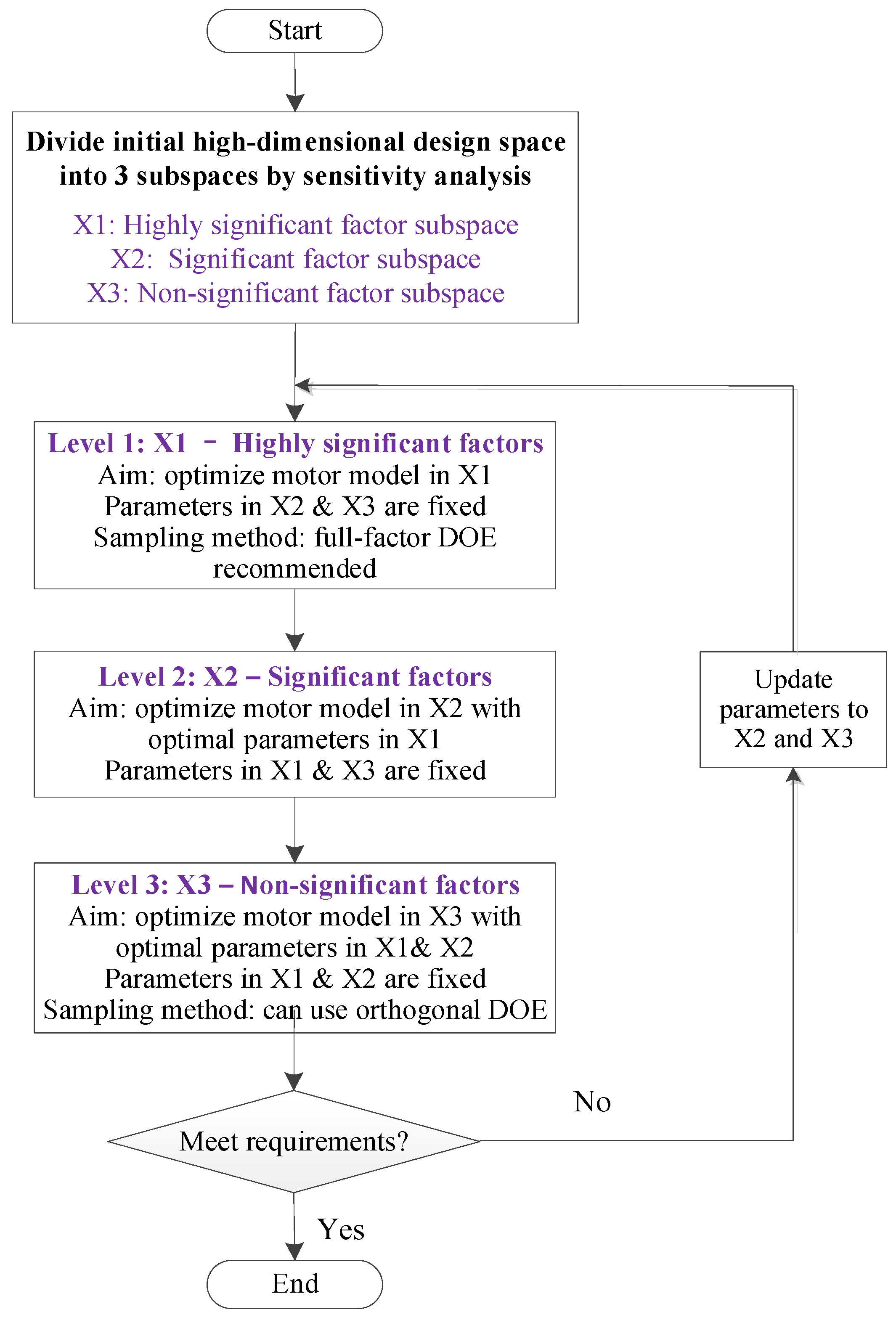
The idea of multilevel optimization strategy is to decompose a high-dimensional (single or multiobjective) problem into several lower-dimensional subproblems or levels. Parameters are often grouped based on sensitivity analysis results and optimized sequentially or iteratively [
10,
13].
Figure 5 shows a framework for the multilevel optimization strategy. For a 9-parameter optimization, it can be divided into three 3-parameter (low-dimensional) optimization problems.
Multidisciplinary design optimization (MDO) explicitly accounts for coupled multiphysics interactions by using various collaborative optimization approaches. While this strategy is essential for system-level EV drive design, it requires substantial modeling effort and incurs high computational cost, especially when multiple disciplines are tightly coupled. As such, MDO is typically applied in later design stages or high-fidelity system-level optimization studies.
Finally, the hybrid optimization strategy integrates two or more of the above approaches—such as surrogate modeling combined with multilevel or space reduction strategies—to achieve a balanced trade-off between accuracy and computational efficiency. Although a hybrid strategy introduces additional integration complexity, it is particularly attractive for industrial-oriented EV optimization, where accuracy, robustness, and computational efficiency must be simultaneously satisfied.
3.3.2. Recommendations on the Application of Optimization Strategies
Table 9 presents practical recommendations, based on our previous experience, for selecting optimization strategies for EV motor design as a function of problem dimensionality and design-space size. For low-dimensional problems (
N ≤ 5), most strategies, including the Taguchi method, surrogate-based optimization, sequential/space-reduction strategies, multilevel strategies, and MDO, can be applied efficiently, particularly when prior design experience is available and the design space is relatively small.
As dimensionality increases to moderate levels (5 < N ≤ 12), surrogate-based methods and MDO remain efficient mainly for problems based on 2D FEMs. At the same time, sequential/space-reduction and multilevel strategies become increasingly attractive due to their ability to manage expanding design spaces.
Table 10 presents a quantitative comparison of three representative optimization strategies with respect to the number of FEM evaluations required for problems of varying dimensionality. For a low-dimensional case with three design parameters, direct optimization using a GA coupled with FEM requires approximately 3000 FEM evaluations, whereas surrogate-based optimization based on a 5-level full-factor design of experiments (DOE) reduces this number to 125. As the number of design parameters increases to nine, the computational burden of direct optimization grows rapidly, requiring approximately 9000 FEM evaluations, whereas surrogate-based optimization becomes impractical due to the exponential growth in DOE samples, reaching nearly two million FEM evaluations (9
5 = 1,953,125).
In contrast, the multilevel optimization strategy significantly alleviates this scalability issue by decomposing the original high-dimensional problem into several lower-dimensional subproblems. Depending on the specific multilevel implementation, the total number of FEM evaluations for the nine-parameter case is reduced to the order of 10
3, representing a reduction of more than one order of magnitude compared with direct optimization and several orders of magnitude compared with conventional surrogate-based approaches. These results clearly demonstrate the superior computational efficiency and scalability of multilevel strategies for high-dimensional EV motor optimization problems. According to our previous work on motor optimizations for various applications, this method is very efficient in practice, which can save about 90% FEM cost, compared with the direct optimization method [
111,
112,
113,
114,
115,
116].
For ultra-high-dimensional problems (
N > 12), conventional surrogate-based and MDO approaches tend to lose efficiency, whereas multilevel and space-reduction strategies demonstrate superior scalability by decomposing or iteratively shrinking the design space. In this case, a problem can be divided into 4 to 5 subspaces or levels, and each level can choose different optimization strategies [
117]. For example, in the level-3 optimization in
Figure 5, the Taghchi method can be applied because the parameters at this level are not significant to the design objectives.
When large parameter ranges are involved, we found that it is more efficient to combine two or three strategies—such as integrating space reduction with multilevel optimization or embedding surrogate models within multilevel frameworks—to balance computational efficiency, robustness, and solution quality. Overall,
Table 9 emphasizes that no single optimization strategy is universally optimal; instead, effective EV motor optimization typically relies on carefully selected or hybrid strategies tailored to problem dimensionality and design-space characteristics.
Finally, in addition to computational cost, other metrics can be used to compare the effectiveness of different optimization methods.
Table 11 lists four typical performance metrics: motor performance, robustness, computational efficiency, and practicality.
3.4. A Case Study—Design Optimization of an Axial-Flux In-Wheel Motor
This section uses an axial-flux PMSM for IWM drives as an example to demonstrate the effectiveness of the multilevel, multiobjective optimization method [
118].
Table 12 lists several key design parameters of the axial-flux PMSM, including the DC voltage, maximum phase current, rated speed, and maximum speed.
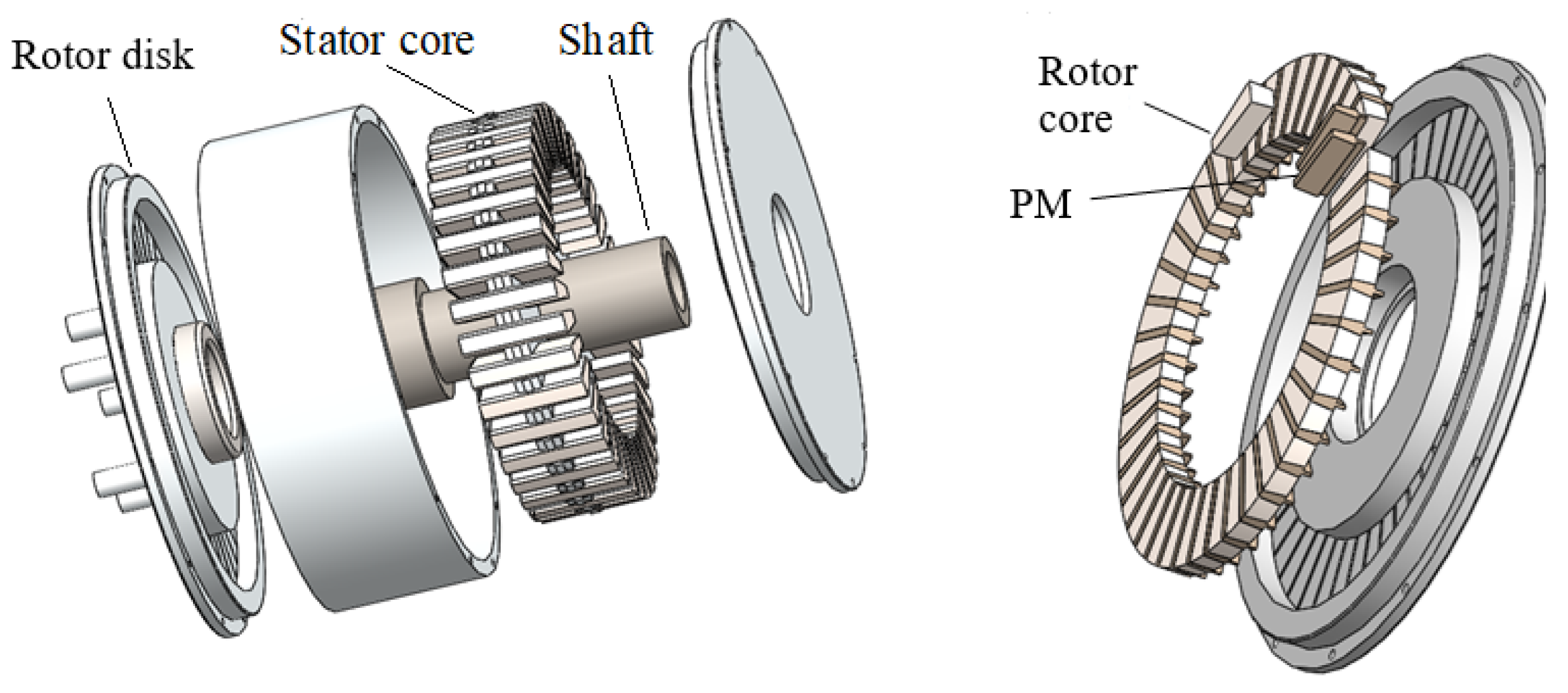
Figure 6 illustrates the topology of the investigated axial-flux PMSM.
Table 13 lists the optimization parameters, objectives, and constraints of the machine. A multilevel strategy and a Kriging model are also employed to further improve optimization efficiency.
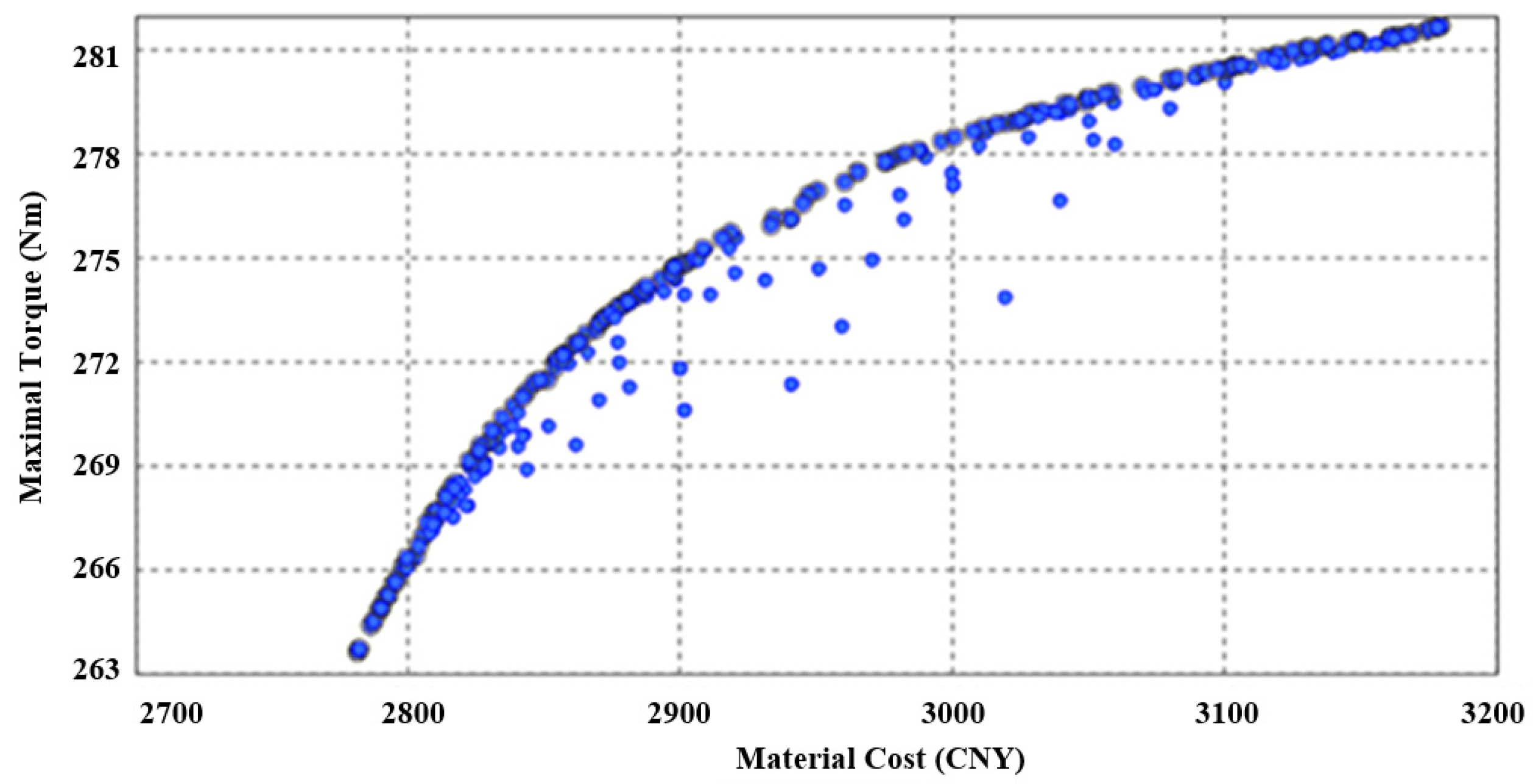
Figure 7 illustrates the Pareto front of a multi-objective optimization problem, with the objective of maximizing torque while minimizing material cost.
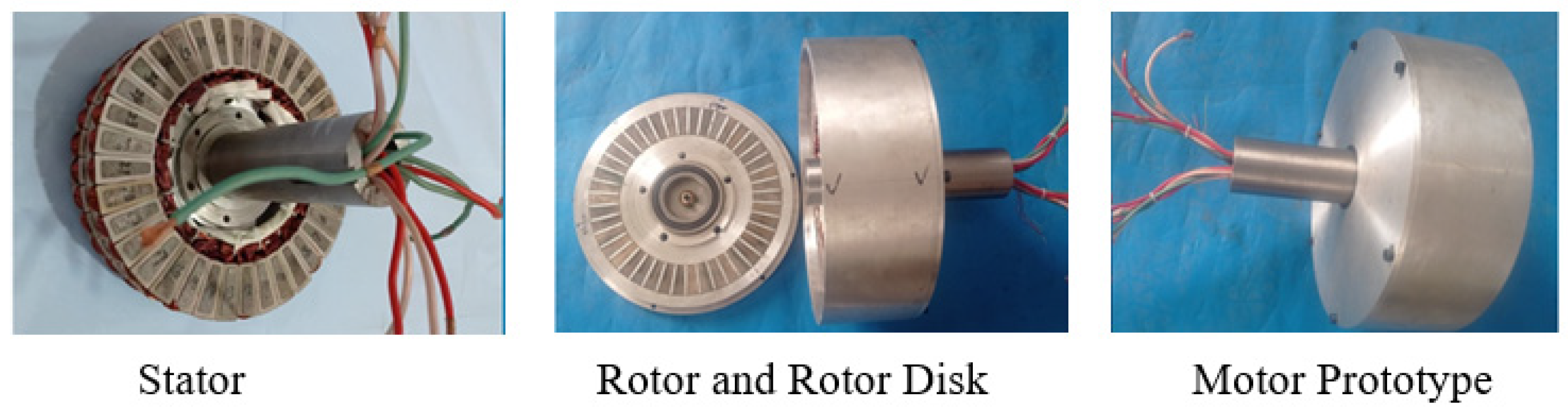
Figure 8 depicts a prototype of an optimized motor, and
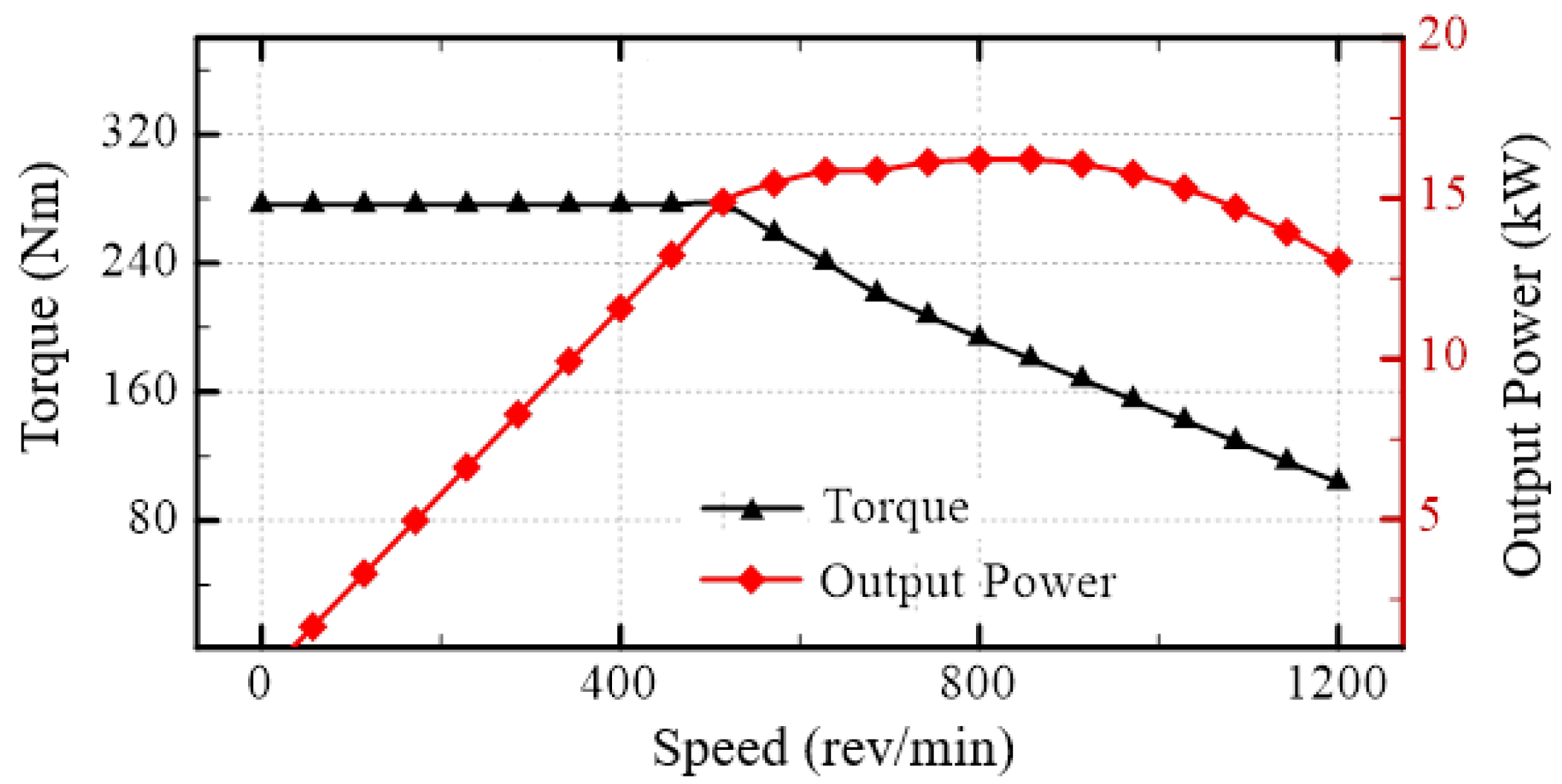
Figure 9 presents experimental results for torque and output power. The test is conducted at a DC voltage of 300 V and a current of 75 A. As shown, the prototype maintains its maximum torque across the 0–550 rev/min speed range. When the speed exceeds 550 rev/min, the DC-link voltage becomes insufficient to sustain MTPA control, prompting a transition to magnetic-field-weakening operation. At 800 rev/min, the prototype delivers a peak power of 15 kW, and it can reach 1200 rev/min while maintaining more than 90 Nm of torque.
In terms of computational cost, the adoption of a multilevel optimization strategy reduces the number of required model evaluations by more than 60%. In addition, integrating the Kriging surrogate model enables optimization to be completed with only 200 FEM evaluations, whereas a FEM-only optimization would require more than 3000 evaluations to achieve reliable convergence. Therefore, the multilevel strategy together with the Kriging model significantly enhances the efficiency of the overall optimization process. Further details on this machine and the design optimization of this IWM are provided in [
118].
4. Optimization of EV Inverters
Inverters serve as a critical interface between the power source and the electrical machine in EVs, converting DC power from the battery into AC power to drive electric machines. Modern EV traction inverters must operate efficiently over wide speed and torque ranges, support advanced motor control strategies, and meet stringent requirements on power density, thermal performance, reliability, and electromagnetic compatibility [
119,
120,
121]. Recent studies have shown that advances in inverter topologies, wide-bandgap semiconductor devices, and control techniques have significantly improved EV drive efficiency and performance, while also introducing new design challenges and trade-offs. Consequently, the inverter is no longer a standalone power-conversion unit but a tightly coupled subsystem whose design and optimization strongly influence vehicle-level efficiency, driving range, thermal behavior, and overall system reliability. Therefore, this motivates extensive research into inverter technologies and optimization methods for EV applications.
Table 14 presents a comparison of recent optimization studies ([
120,
121,
122,
123,
124,
125,
126,
127,
128,
129,
130]) on EV inverters.
As summarized in
Table 14, existing studies on EV inverter optimization span a broad range of design layers, including inverter topology selection/design, semiconductor device selection, thermal design and management, control strategy design, and optimization. Early work primarily focuses on improving efficiency and power density through analytical modeling or parametric studies. In contrast, more recent research increasingly employs multi-objective optimization frameworks and data-driven techniques to address competing design requirements between high-quality optimization results and computation cost.
Specifically, a comprehensive multi-objective optimization framework that simultaneously considers the efficiency, physical volume, and reliability of EV traction inverters was presented in [
120]. It clearly reveals Pareto trade-offs and strong interactions among electrical, thermal, and packaging constraints. Ref. [
121] focused on SiC-based drivetrain inverters and systematically explored the impact of device voltage ratings and switching frequency on efficiency and power density, providing globally optimal design guidelines across different power levels.
Inverter optimization was extended for thermal management by integrating high-fidelity CFD modeling with artificial neural networks in [
122]. The proposed method enabled real-time prediction of junction temperature and supported reliability-oriented design and control of SiC traction inverters. In addition, Ref. [
124] conducted a large-scale comparative study of multilevel inverter configurations using Pareto optimization with loss, cost, and harmonic distortion as objectives, demonstrating that carefully optimized multilevel topologies can significantly outperform conventional two-level SiC inverters.
Despite these advances, most existing studies still focus on specific aspects of inverter design or control in isolation, underscoring the need for system-level design optimization frameworks that jointly consider inverter topology, device technology, control strategies, and their interactions with electric machines and vehicle-level performance. Additionally, optimization strategies for electrical machines, such as surrogate models, can accelerate the optimization of EV inverters.
5. Optimization of EV Control Systems
The general aim of control-system optimization in EV drive systems is to systematically tune key controller parameters—such as PI gains in FOC, flux and torque regulators in DTC, or weighting factors in MPC—to achieve optimal dynamic and steady-state performance across various operating conditions. Instead of relying on manual, trial-and-error tuning, optimization-based methods treat controller gains and weighting factors as decision variables and evaluate them against performance indices that reflect rise time, overshoot, torque ripple, current distortion, robustness to parameter variations, and overall efficiency. By embedding the machine’s electrical, mechanical, and inverter dynamics into the optimization framework, these methods ensure fast transient response, stable current regulation, smooth torque production, and resilient behavior under load disturbances and parameter uncertainties.
Table 15 lists a brief comparison of various optimization methods for EV control systems [
131,
132,
133,
134,
135,
136,
137,
138,
139,
140,
141]. As shown, the optimization objectives primarily concern loss and torque response. Also, robustness considerations have become increasingly important in EV control systems. Please note that this kind of optimization is mostly implemented in MATLAB, like using GA to call a parametric Simulink model. Therefore, high computational cost is a general issue in most cases, especially when a wide range of control periods is required. Optimization strategies for electrical machines, particularly surrogate models, can reduce computational cost in robustness analysis.
6. System-Level Design Optimization of EV Drive Systems
6.1. System-Level Design Optimization Framework
As indicated in
Section 1, system-level design optimization is essential for EV drive systems because the motor, power electronics, control algorithms, and operating conditions are tightly coupled [
15,
16,
17,
18,
142]. Optimizing the motor alone or tuning the controller independently cannot guarantee optimal overall performance in real driving scenarios. IMW drive systems, for example, require high torque at low speed, excellent efficiency at cruising speed, precise torque control for stability and traction, and robust behavior under road disturbances—demands that can only be met by co-designing and co-optimizing both the motor structure and its control strategies. Therefore, application-oriented system-level design optimization methods must be developed to integrate motor topology, material selection, inverter design, control parameter tuning, thermal management, and even vehicle dynamics into a unified framework.
The theoretical foundation for such integrated optimization has already been established, which highlights multilevel, multidisciplinary, and system-driven optimization methodology [
10]. Building upon this theoretical framework, EV-specific, application-driven system-level optimization will enable next-generation drive systems that are lighter, more efficient, more controllable, and better aligned with the stringent performance requirements of modern EVs.
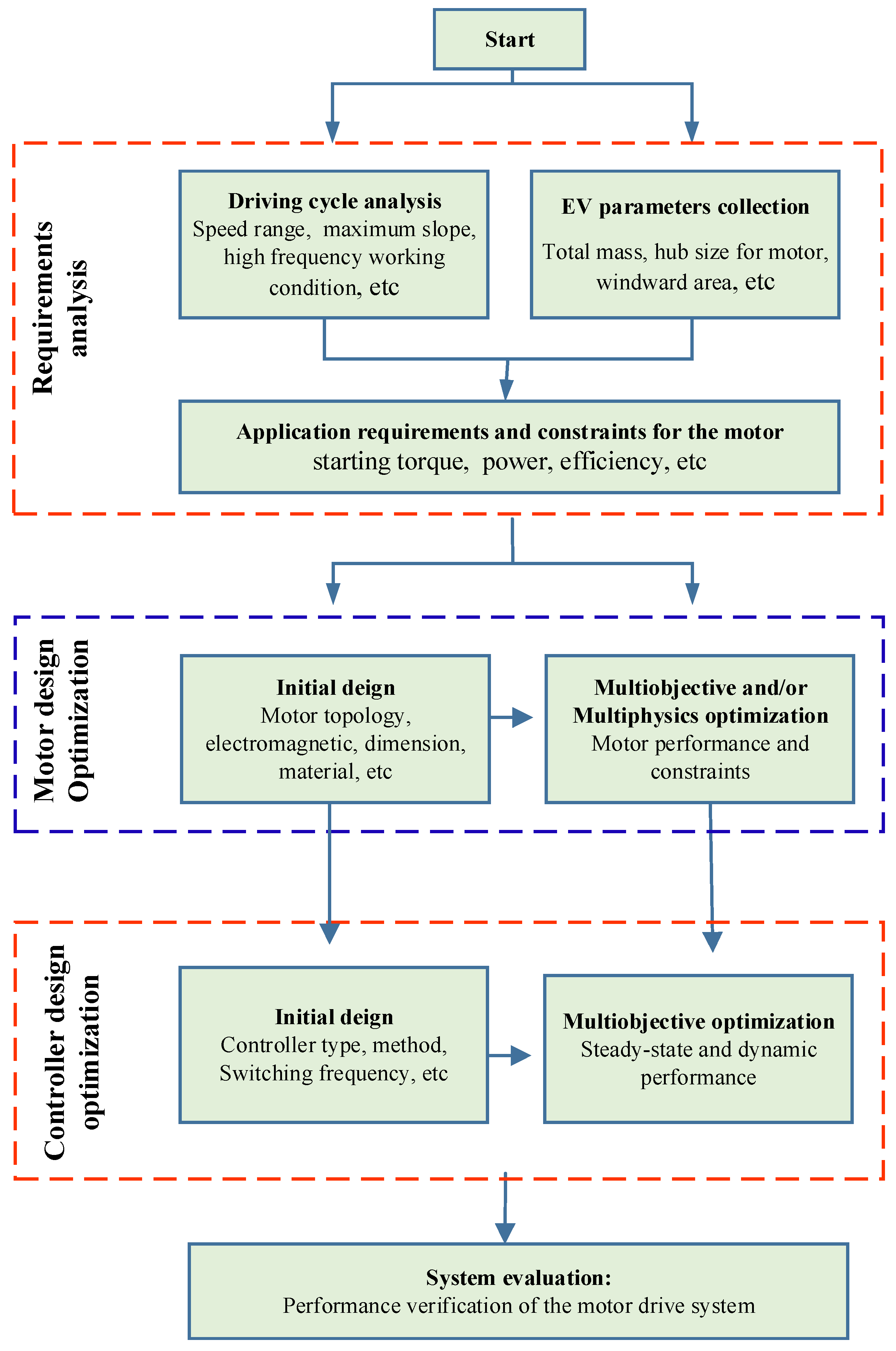
Figure 2 in the Introduction presents a general system-level framework for designing electrical drive systems in EVs. With optimization in mind,
Figure 10 illustrates a framework for the system-level design and optimization of EV electrical drive systems. As shown, there are four main steps, during which optimizations occur in steps 2 and 3.
Although system-level design optimization methods are important for designing advanced motor drive systems for EVs, the problem is challenging due to its multidisciplinary, multiobjective, and multilevel nature. Moreover, it is a high-dimensional, highly nonlinear optimization problem, as the dynamic performance of control systems is more nonlinear than that of electrical machines. In papers investigating system-level design optimization methods, several types of PM hub motors, such as SPMSMs, and various control methods, including FOC and MPC, have been considered to maximize the drive system’s efficiency and output torque. Meanwhile, multimode optimization models have been developed, as there are multiple modes in the whole driving cycle of EVs. Regarding the optimization strategy, multilevel optimization has been employed for some of them due to its high efficiency.
6.2. A Case Study—Driving-Cycle Oriented Design Optimization of a Hub Motor Drive System for an EV
This section presents a case study on system-level design optimization of a PM hub-motor drive system for a campus-patrol EV, using a practical driving cycle [
12]. An outer-rotor permanent-magnet synchronous hub motor (PMSHM) is employed, along with an improved model-predictive current control (MPCC) strategy.
To capture realistic performance requirements, representative driving cycles were collected from the campus environment. A multi-objective optimization framework was then applied to enhance the motor performance under multiple operating scenarios. FEM electromagnetic analysis and thermal-network modeling were used to evaluate the optimized designs, and the superior scheme was selected through a comprehensive performance comparison. In addition, an MPCC method was implemented for motor control. Finally, a hardware prototype of the optimized PMSHM drive system was built and experimentally validated, with the corresponding test results presented in this case study.
Table 16 lists the main parameters for the test EV on campus.
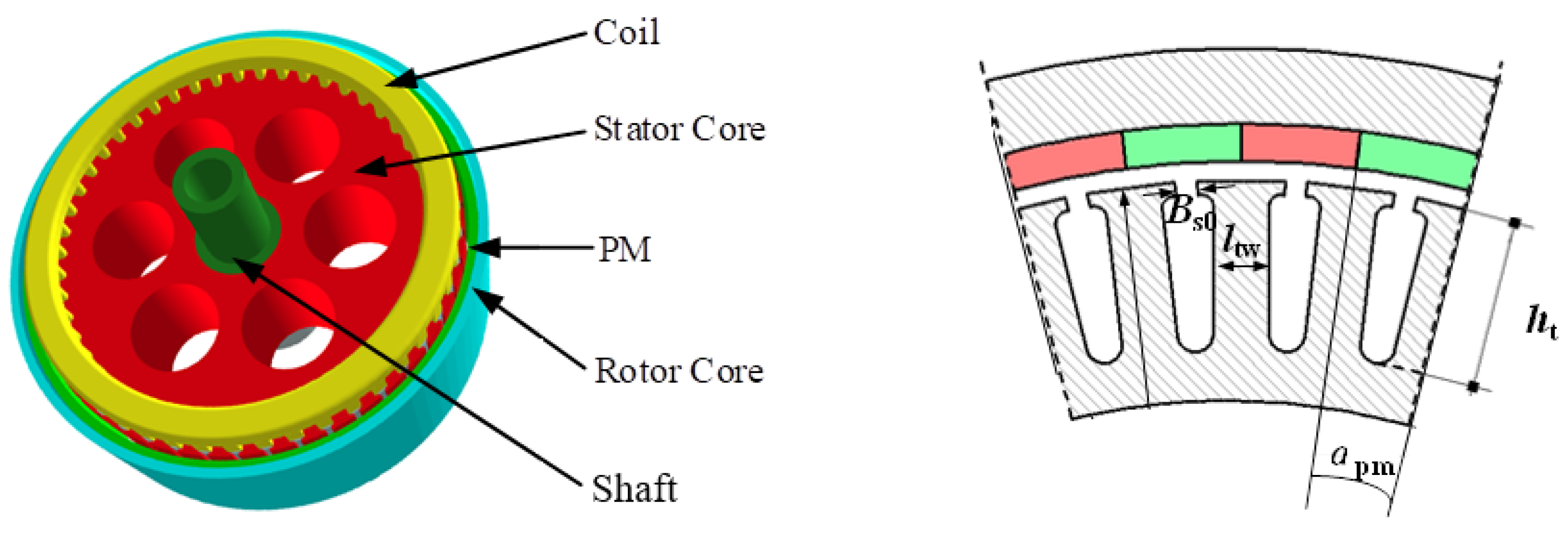
Figure 11 illustrates the topology and main parameters (meaning shown in
Table 17) of the PHSHM.
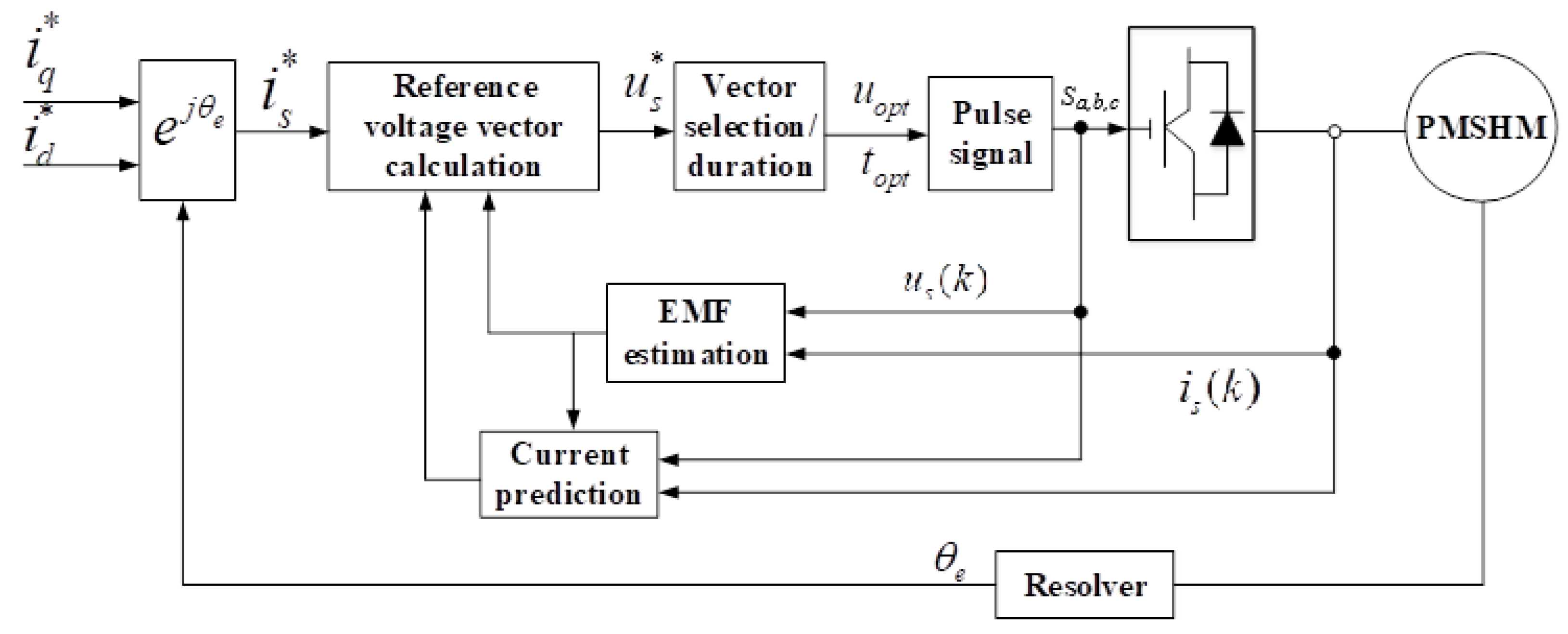
Figure 12 illustrates the control diagram for the motor.
Table 17 lists the key parameters of the initial and optimized designs, using the optimization framework shown in
Figure 10.
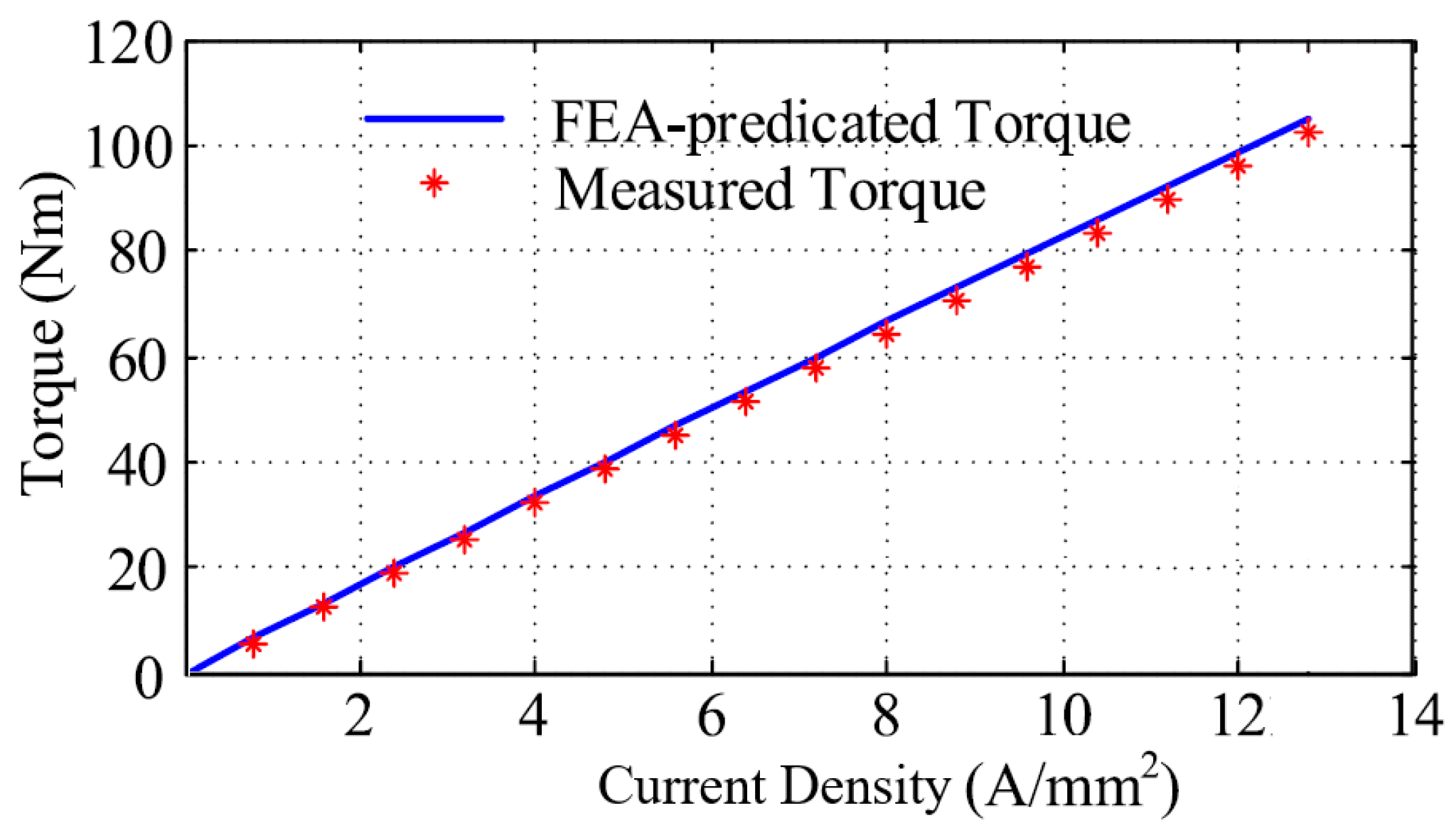
Figure 13 presents the experimental results for the output torque of the proposed motor drive after multi-objective and multi-level optimization. In the test, an induction motor drives the prototype and measures torque at 100 rev/min in terms of winding current density (RMS values). The motor efficiency in the main working area exceeds 90%. At the start-up condition, the motor efficiency exceeds 80%. The measured results are basically consistent with the simulation results. More details about the simulated and measured motor performance, including efficiency, can be found in ref. [
12].
Finally, regarding computational cost, the number of FEM samples required for optimization is 636, which is only 2.12% of that required by the direct multiobjective FEM optimization with a multiobjective GA, which requires about 30,000 FEM samples. Further details on the motor drive system and optimization process are provided in [
12].
6.3. Robust System-Level Design Optimization Framework for EV Drive Systems
Figure 2 and
Figure 10 show system-level design and optimization frameworks for EV drive systems. However, they have not included uncertainties in manufacturing and operation. In practical EV drive systems, the performance of motors and controllers is inevitably affected by manufacturing uncertainties, material variability, and fluctuations in operational parameters, making robust system-level design optimization indispensable.
Figure 14 shows a framework for the robust design of electrical drive systems. Compared with the deterministic design framework in
Figure 2, there are three main differences. First, production design and manufacturing tolerances are considered in parallel with multiphysics designs. Second, uncertainties are considered in the control system. Both manufacturing tolerances and operating conditions will cause variations in motor parameters, affecting control performance. Third, the final optimization objectives and constraints should be revised to account for the impact of uncertainties. For example, manufacturing quality and system reliability under operation can be added.
Optimizing this kind of robust system-level design will be substantially more challenging than the deterministic optimizations discussed in
Figure 3 and
Figure 10. In our previous work, we applied this optimization framework to an SRM drive system with angle-position control, incorporating multiple EV driving cycles [
18]. To simplify the optimization process, only 4 parameters were ultimately considered in a multimode optimization problem, and a sequential Taguchi method was employed to identify the optimal solution. Although performance has improved, further research is needed to address multi-objective, multiphysical, and high-dimensional problems.
7. AI for Automatic Design Optimization Platform
Based on the review and discussions in previous sections, it is found that AI, particularly machine learning models, has been widely employed in the design optimization of electrical machines and EV drive systems. Although some discussions have addressed various optimizations, it remains important to include a dedicated section to systematically review them and propose future directions. Please note that the AI models and methods discussed in this section are applicable not only to EV drive systems but also to drive systems in many other applications, such as robotics, renewable energy systems, and electric aircraft.
7.1. State-of-the-Art
Machine learning models have been applied to the following aspects in the design optimization of electrical machines and control systems.
First, for electrical machines, various machine learning models have been used to estimate magnetic field distributions and machine performance (as surrogate models), including output power, efficiency, and torque ripple [
10,
143,
144]. These surrogate models will be used to improve the optimization efficiency. This type of application predominates in current AI applications for electrical machines. To enhance the explainability of neural networks, physics-informed neural networks (PINNs) have also been introduced to estimate magnetic fields in various magnetic devices, including PMSMs [
145,
146].
Furthermore, to reduce computational cost, transfer learning can be employed as an additional strategy in using machine learning for electrical machine optimization.
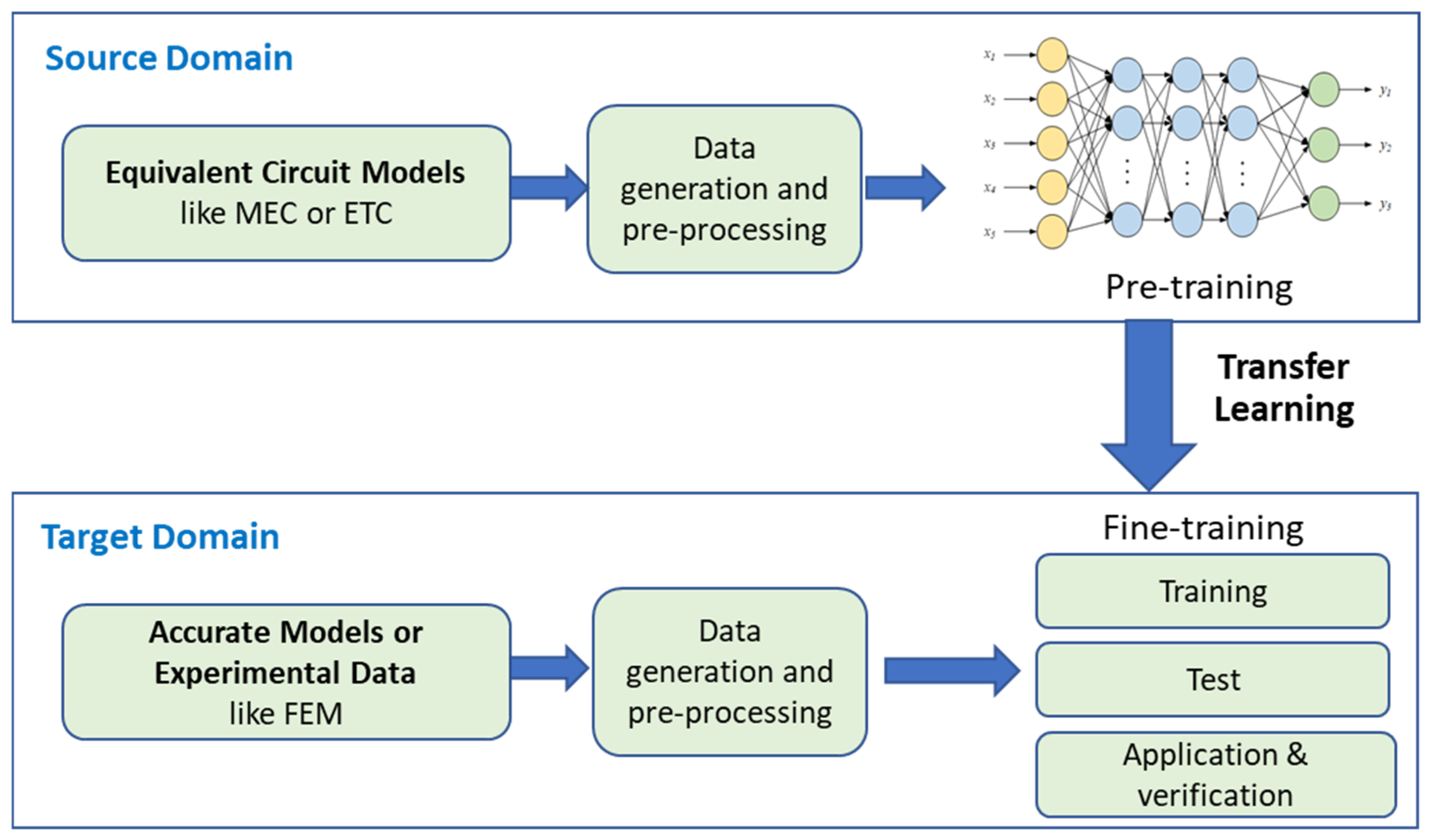
Figure 15 illustrates a general framework for applying transfer learning to the optimization of electrical machines. As shown, there are two domains for model training. In the source domain, fast analysis models, such as the magnetic equivalent circuit (MEC) and equivalent thermal circuit (ETC), can be developed to generate numerous samples for the investigated electrical machines. Subsequently, after data preprocessing, a deep learning model, such as a CNN or DNN, can be trained as a pre-trained model. Then, in the target domain, high-fidelity data are needed, which can be obtained from accurate analysis models of the motors, like FEM, and/or experimental results. With these data, transfer learning can be used to fine-tune the pre-trained model. Based on our previous work on a tubular permanent-magnet linear synchronous motor, we found that this method is highly efficient for both electromagnetic and thermal approximations of the motor, while reducing computational cost [
102,
103]. Please note that all these AI-based optimization methods for electrical machines can also be applied to power converter optimization.
Second, for control systems, various machine learning models have been used to develop control algorithms for electrical machines. These models can be developed to replace PI controllers and/or other blocks in the control frameworks.
For example,
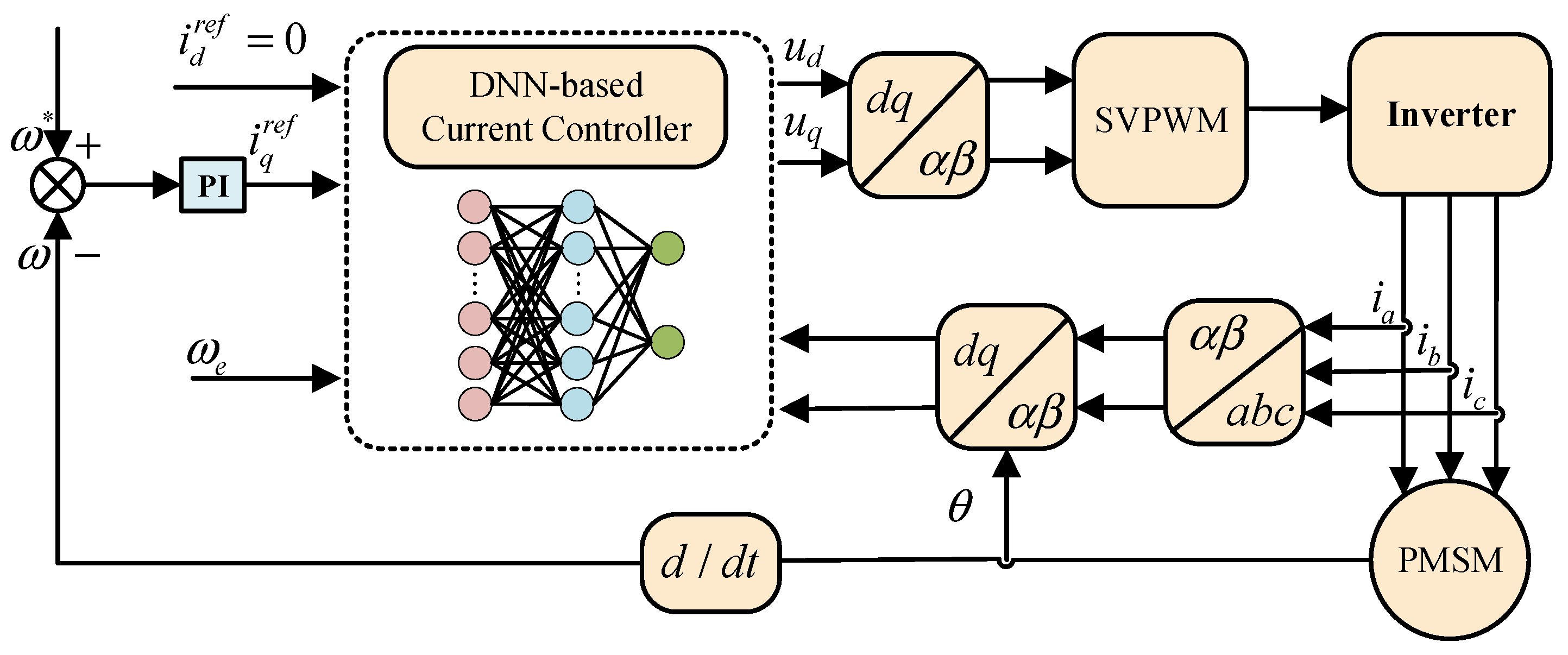
Figure 16 illustrates a control block diagram in which a DNN replaces the current-loop PI controller. Moreover, the cost function in the MPC can be converted into a classification problem in machine learning, with inputs as motor current, voltage, speed, and output as the eight space voltage vectors. In this case, simulation and/or experimental results can be used to train the model. Additionally, robust machine learning can be used to enhance the robustness of certain control methods against parameter variations in operation. In particular, RL-based control strategies can achieve robust current and torque control under parameter variations and uncertainties, as demonstrated in our recent work [
34].
7.2. A Proposal for an AI-Powered Automatic Design Platform for Drive Systems
Beyond achieving high performance, future electrical machine and drive designs must also address demanding objectives, including lifetime reliability, robustness to parameter and environmental variations, manufacturing quality, and design flexibility. Meeting these requirements will require new optimization strategies and platforms that integrate AI. Given the rapid development and high potential of AI, it is highly feasible and necessary to develop a platform for systematically integrating the design and optimization of all components of electrical drive systems.
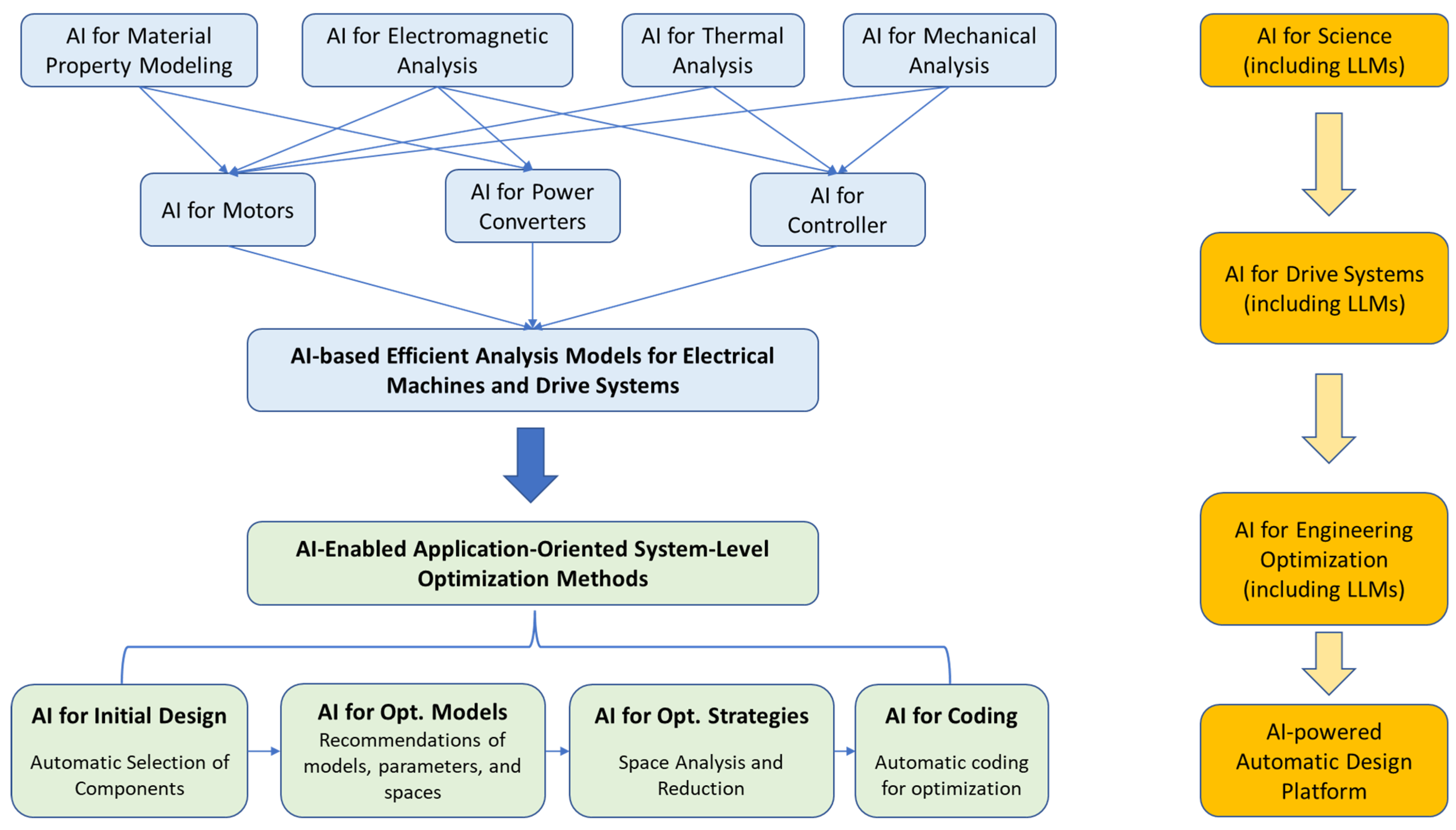
Figure 17 proposes an AI-powered automatic design platform for electrical drive systems. As shown, there are two main parts: AI-based analysis models and AI-enabled optimization methods.
Regarding AI-based analysis models, the primary aim is to develop fast and accurate analysis models for electrical machines, power converters, and controllers. To achieve this goal, AI for science, including AI for material property Modeling and AI for multiphysics analysis, is needed. These models can be used to generate digital twins (DTs) of electrical drive systems.
Regarding AI-enabled optimization methods, the primary aim is to develop automated, efficient algorithms and strategies to implement the optimization process. These methods will help the designer automatically determine initial design and optimization models, identify the optimal optimization strategy for the developed model, write the optimization code, implement it online (e.g., in a cloud service), and analyze the effectiveness of the resulting optimal solutions. Finally, a design optimization report should be generated and reviewed by the designer.
Please note that, in addition to conventional machine learning models, large language models (LLMs) will play a major role in the proposed automatic design platform for electrical drive systems. The following outlines the aspects we expect.
First, at the AI for Science level, LLMs can be used to analyze large datasets of electrical and magnetic materials to inform the design of new materials and recommend the most suitable material type for a given design. Additionally, LLMs can support multiphysics analysis of electrical machines by coordinating electromagnetic, thermal, mechanical, and control models, thereby assisting with workflow automation, data interpretation, and physics-consistent reasoning across domains.
Second, at the level of AI for drive systems, a promising approach is to train models to capture the current designs and topologies of motors, power converters, and controllers from papers, books, videos, and websites. The main challenge is how to efficiently and systematically convert unstructured datasets, such as videos and designers’ experiences, into structured datasets that can be processed by machine learning models. The aim of this step is to enable the designer to automatically generate initial designs, including information on topology, materials, and dimensions.
Third, at the level of AI for engineering optimization, LLMs can be used to design an optimization workflow and automatically implement it. With AI analysis models, this optimization tool is expected to perform most data science tasks, including feature analysis, model training, and model verification.
8. A Proposal for DT-Assisted System-Level Optimization in EVs
Recently, DTs have emerged as a promising technology for developing dynamic virtual models of physics devices/systems. They use real-time sensor data to replicate the behavior of real-world counterparts, enabling simulation, analysis, and optimization in a digital environment before applying changes to the physical world, thereby improving decision-making and predictive maintenance. Therefore, the development of DTs for the design and optimization of EV drive systems is a promising direction, with several promising approaches [
147,
148,
149]. Using the efficient AI-based analysis models shown in
Figure 17, a new system-level optimization framework can be developed.
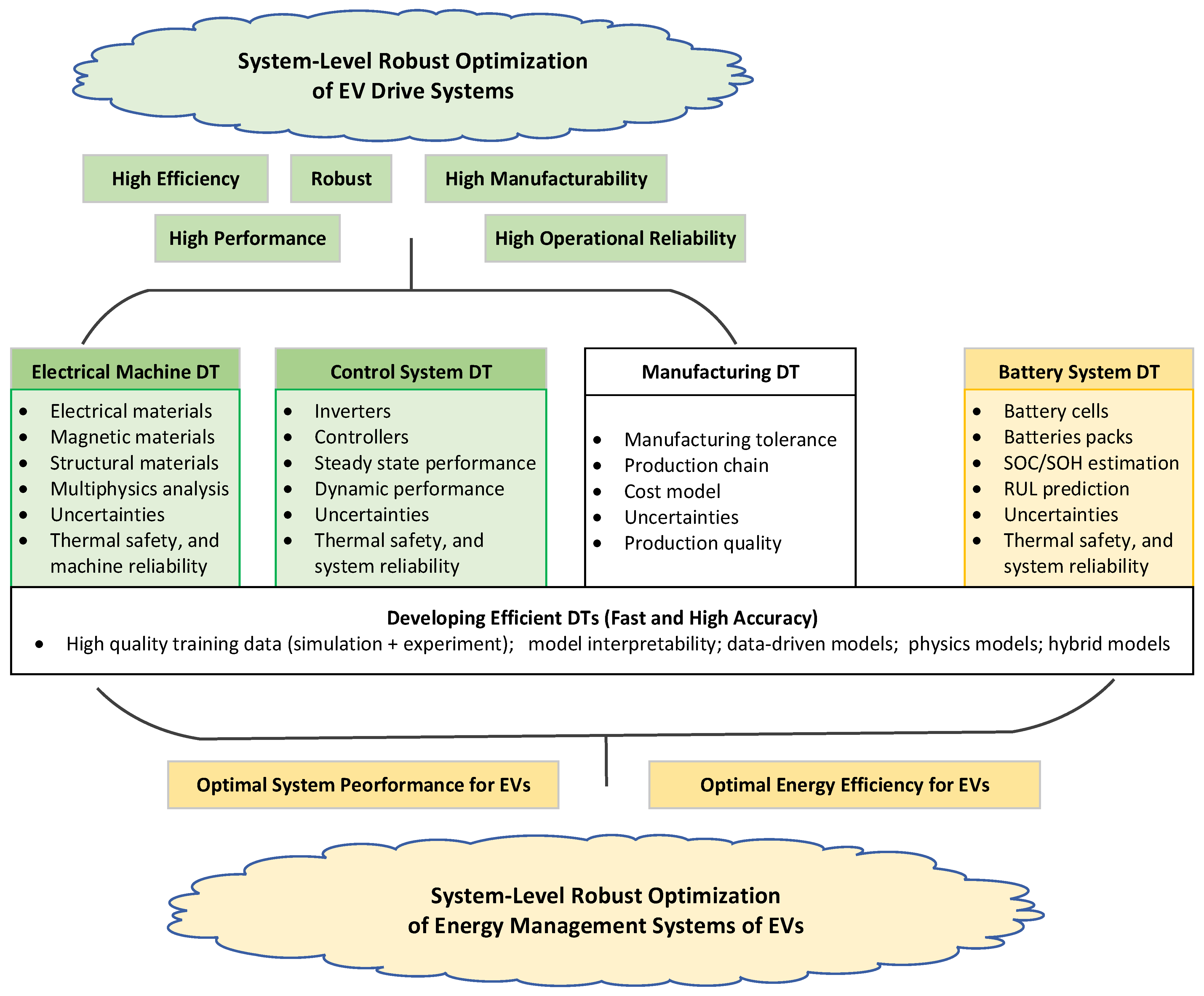
Figure 18 proposes a system-level robust optimization framework for EV drive systems that integrates three DTs: the electrical machine DT, the control system DT, and the manufacturing system DT. The overall objective is to achieve system-level robust optimization that simultaneously satisfies high efficiency, high performance, high manufacturability, and high operational reliability under modeling, operating, and manufacturing uncertainties.
Within this framework, AI-enabled models are explicitly embedded into different DT layers to serve distinct roles. For the electrical machine DT, AI–based models are employed to rapidly estimate electromagnetic field distributions, predict motor performance metrics (e.g., torque, losses, and temperature rise), and replace high-cost finite-element evaluations during optimization. In the control system DT, AI methods are used not only for prediction but also for real-time control and decision-making. The manufacturing DT further incorporates AI-assisted models for quality prediction, tolerance analysis, and cost estimation, thereby enabling manufacturability and mass-production constraints to be explicitly incorporated into system-level optimization. By combining robust topology optimization, advanced manufacturing processes, and DT-enabled evaluation, future EV motors can achieve higher performance, improved reliability, and superior manufacturability compared with current design practices.
Beyond optimizing electrical drive systems, an important future direction is the integration with battery management systems (BMSs) via coordinated DTs. As shown in
Figure 18, by incorporating DTs of BMSs and electrical drive systems, a unified energy management system (EMS) can optimally allocate power among the drive system, battery, and auxiliary loads to improve overall vehicle efficiency and durability. In this framework, the BMS DT provides real-time estimates and predictions of key battery metrics, including state of charge, state of health, remaining useful life, and temperature, while the DT of electrical machines captures the efficiency, thermal behavior, and dynamic performance of the electrical drive systems.
At the EMS level, predictive and robust optimization methods can be used to balance competing objectives, including short-term motor efficiency versus long-term battery degradation, and aggressive power demand versus thermal and aging constraints. Although initial studies on integrated drive–battery optimization have been reported [
150], further research is needed on unified performance metrics, conflict-aware optimization, and scalable DT updating mechanisms to fully realize the potential of integrated energy management for next-generation EVs.
The effectiveness of this framework relies on the development of efficient and trustworthy DTs, which introduces several critical challenges. Data scarcity remains a key issue, particularly for new materials, extreme operating conditions, and fault scenarios. This motivates the use of hybrid modeling approaches that combine limited experimental data with high-fidelity simulations. Model interpretability is another important challenge, particularly for safety-critical applications. Furthermore, purely data-driven models may suffer from poor generalization beyond the training domain, underscoring the need to integrate physics-based constraints via PINNs and hybrid physics–AI models.
9. Conclusions and Recommendations
This paper comprehensively reviewed the state of the art in the design optimization of electrical drive systems for EVs, with particular emphasis on electrical machines and their control systems. A wide range of optimization models and strategies—including multiphysics, multiobjective, multilevel, robust, topology, and AI-based approaches—have been systematically discussed, along with recommendations for their practical application in EV drive design. Two case studies on IWMs were presented to demonstrate the effectiveness of various optimization methods. Although IWMs and systems were used as case studies, the reviewed system-level optimization frameworks and methodologies are equally applicable to all centralized and distributed EV drive architectures.
This review goes beyond existing surveys by providing a unified, system-level perspective on EV drive optimization. Compared with prior reviews that focus on individual components or specific optimization techniques, this work synthesizes results from more than 100 recent representative studies and introduces structured comparisons across optimization goals, methods, and result representations. The reviewed case studies demonstrated that advanced optimization techniques can achieve, for example, a 19% increase in torque, over 90% reduction in computational cost using AI models and a multilevel optimization strategy, and significant improvements in thermal and reliability performance. These early-stage research efforts and successful implementations highlight the potential of AI tools and underscore the importance of developing next-generation AI platforms for modern EV drive and energy management systems, which constitute a major contribution of this review paper.
Finally, two recommendations for future work are summarized as follows. The first recommendation is to develop an AI-powered automatic design platform for EV drive systems that integrates LLMS applications. LLMs offer a promising pathway to learn from unstructured knowledge sources—such as journal papers, books, technical reports, videos, and designers’ experiential knowledge—by converting them into structured representations for use in optimization. LLMs can also be used to design optimization workflows, automatically implementing tasks such as feature analysis, training, and validation. This platform has the potential to significantly reduce design cycles and support application-oriented optimization for next-generation EV drive systems. The second recommendation is to develop a DT-assisted system-level optimization framework as a critical enabler for future EV technologies. Coordinated DTs of electrical drive systems and BMSs can facilitate integrated energy management and system-level optimization, enabling next-generation EMSs that jointly enhance efficiency, durability, and overall system reliability.
Author Contributions
Conceptualization, G.L., X.S. and J.Z.; methodology, G.L.; software, H.J., Y.W. and G.L.; validation, H.J. and Y.W.; formal analysis, H.J. and Y.W.; investigation, H.J. and Y.W.; data curation, H.J. and Y.W.; writing—original draft preparation, G.L., H.J. and Y.W.; writing—review and editing, G.L., H.J., Y.W., X.S. and J.Z.; visualization, H.J. and Y.W.; supervision, G.L., X.S. and J.Z. All authors have read and agreed to the published version of the manuscript.
Funding
This research received no external funding.
Data Availability Statement
No new data were created or analyzed in this study. Data sharing is not applicable to this article.
Acknowledgments
During the preparation of this manuscript, the authors used ChatGPT 5.1 for the purposes of writing polishing. The authors have reviewed and edited the output and take full responsibility for the content of this publication.
Conflicts of Interest
The authors declare no conflicts of interest.
References
- Zhu, Z.Q.; Howe, D. Electrical machines and drives for electric hybrid fuel cell vehicles. Proc. IEEE 2007, 95, 746–765. [Google Scholar] [CrossRef]
- Emadi, A.; Lee, Y.J.; Rajashekara, K. Power electronics and motor drives in electric hybrid electric plug-in hybrid electric vehicles. IEEE Trans. Ind. Electron. 2008, 55, 2237–2245. [Google Scholar] [CrossRef]
- Liu, C.; Chau, K.T.; Lee, C.H.T.; Song, Z. A Critical Review of Advanced Electric Machines and Control Strategies for Electric Vehicles. Proc. IEEE 2021, 109, 1004–1028. [Google Scholar] [CrossRef]
- Husain, I.; Ozpineci, B.; Islam, M.S.; Gurpinar, E.; Su, G.-J.; Yu, W.; Chowdhury, S.; Xue, L.; Rahman, D.; Sahu, R. Electric Drive Technology Trends, Challenges, and Opportunities for Future Electric Vehicles. Proc. IEEE 2021, 109, 1039–1059. [Google Scholar] [CrossRef]
- International Energy Agency (IEA). Global EV Outlook 2025: Driving Ambition for Electric Mobility; IEA Publications: Paris, France, 2025; Available online: https://www.iea.org/reports/global-ev-outlook-2025 (accessed on 19 December 2025).
- International Energy Agency (IEA). Global EV Outlook 2024; IEA Publications: Paris, France, 2024; Available online: https://www.iea.org/reports/global-ev-outlook-2024 (accessed on 19 December 2025).
- FuelEconomy.gov, U.S. Department of Energy and U.S. Environmental Protection Agency, n.d. All-Electric Vehicles. Available online: www.fueleconomy.gov/feg/evtech.shtml (accessed on 9 December 2025).
- Albatayneh, A.; Assaf, M.N.; Alterman, D.; Jaradat, M. Comparison of the overall energy efficiency for internal combustion engine vehicles and electric vehicles. Rigas Teh. Univ. Zinat. Raksti 2020, 24, 669–680. [Google Scholar] [CrossRef]
- Mohammed, S.A.Q.; Hakami, S.S.; Kassas, M.; Almuhaini, M.M. Critical Review on Powertrain Technologies for Electric Vehicles: Classification, Broadly Adopted Topologies, and Future Challenges. IEEE Access 2025, 13, 71755–71772. [Google Scholar] [CrossRef]
- Lei, G.; Zhu, J.; Guo, Y.; Liu, C.; Ma, B. A Review of Design Optimization Methods for Electrical Machines. Energies 2017, 10, 1962. [Google Scholar] [CrossRef]
- Silvas, E.; Hofman, T.; Murgovski, N.; Etman, L.F.P.; Steinbuch, M. Review of Optimization Strategies for System-Level Design in Hybrid Electric Vehicles. IEEE Trans. Veh. Technol. 2017, 66, 57–70. [Google Scholar] [CrossRef]
- Sun, X.; Shi, Z.; Cai, Y.; Lei, G.; Guo, Y.; Zhu, J. Driving-Cycle-Oriented Design Optimization of a Permanent Magnet Hub Motor Drive System for a Four-Wheel-Drive Electric Vehicle. IEEE Trans. Transp. Electrif. 2020, 6, 1115–1125. [Google Scholar] [CrossRef]
- Lei, G.; Zhu, J.; Guo, Y. Multidisciplinary Design Optimisation Methods for Electrical Machines and Drive Systems; Springer: Berlin/Heidelberg, Germany, 2016. [Google Scholar]
- Sun, X.; Diao, K.; Lei, G.; Zhu, J. Multi-Objective Design Optimisation of Switched Reluctance Motor Systems; Springer: Berlin/Heidelberg, Germany, 2024. [Google Scholar]
- Lei, G.; Wang, T.; Zhu, J.; Guo, Y.; Wang, S. System-Level Design Optimization Method for Electrical Drive Systems—Robust Approach. IEEE Trans. Ind. Electron. 2015, 62, 4702–4713. [Google Scholar] [CrossRef]
- Mohammadi, A.S.; Trovão, J.P.F. System-Level Optimization of Hybrid Excitation Synchronous Machines for a Three-Wheel Electric Vehicle. IEEE Trans. Transp. Electrif. 2020, 6, 690–702. [Google Scholar] [CrossRef]
- Lei, G.; Wang, T.; Guo, Y.; Zhu, J.; Wang, S. System-Level Design Optimization Methods for Electrical Drive Systems: Deterministic Approach. IEEE Trans. Ind. Electron. 2014, 61, 6591–6602. [Google Scholar] [CrossRef]
- Diao, K.; Sun, X.; Lei, G.; Bramerdorfer, G.; Guo, Y.; Zhu, J. System-Level Robust Design Optimization of a Switched Reluctance Motor Drive System Considering Multiple Driving Cycles. IEEE Trans. Energy Convers. 2021, 36, 348–357. [Google Scholar] [CrossRef]
- Deepak, K.; Frikha, M.A.; Benômar, Y.; El Baghdadi, M.; Hegazy, O. In-Wheel Motor Drive Systems for Electric Vehicles: State of the Art, Challenges, and Future Trends. Energies 2023, 16, 3121. [Google Scholar] [CrossRef]
- Li, L.; Dai, L.; Niu, S.; Fu, W.; Chau, K.T. Critical Review of Direct-Drive In-Wheel Motors in Electric Vehicles. Energies 2025, 18, 1521. [Google Scholar] [CrossRef]
- Bunlapyanan, C.; Chantranuwathana, S.; Phanomchoeng, G. Analytical Investigation of Vertical Force Control in In-Wheel Motors for Enhanced Ride Comfort. Appl. Sci. 2024, 14, 6582. [Google Scholar] [CrossRef]
- Li, C.; Zhou, C.; Xiong, J. New Method to Coordinate Vibration Energy Regeneration and Dynamic Performance of In-Wheel Motor Electrical Vehicles. Energies 2023, 16, 2968. [Google Scholar] [CrossRef]
- Wu, P.; Luo, R.; Yu, Z.; Hou, Z. Evaluation of the Unsprung Mass Effect on Ride Comfort of In-Wheel Motor Driving Vehicles. Proc. Inst. Mech. Eng. Part D J. Automob. Eng. 2025, 239, 5336–5352. [Google Scholar] [CrossRef]
- Wang, Q.; Li, R.; Zhao, Z.; Liang, K.; Xu, W.; Zhao, P. Temperature Field Analysis and Cooling Structure Optimization for Integrated Permanent Magnet In-Wheel Motor Based on Electromagnetic-Thermal Coupling. Energies 2023, 16, 1527. [Google Scholar] [CrossRef]
- Albana, M.H.; Guntur, H.L.; Putra, A.B.K. Modification of the In-Wheel Motor Housing and Its Effect on Temperature Reduction. World Electr. Veh. J. 2024, 15, 78. [Google Scholar] [CrossRef]
- Wu, X.; Zheng, D.; Wang, T.; Du, J. Torque Optimal Allocation Strategy of All-Wheel Drive Electric Vehicle Based on Difference of Efficiency Characteristics between Axis Motors. Energies 2019, 12, 1122. [Google Scholar] [CrossRef]
- Zhao, Y.; Mi, J.; Guo, C.; Wang, H.; Wang, L.; Zhang, H. Multi-Objective Energy-Efficient Driving for Four-Wheel Hub Motor Unmanned Ground Vehicles. Energies 2025, 18, 4468. [Google Scholar]
- Sun, X.; Dong, Z.; Cai, Y.; Jin, Z.; Lei, G.; Tian, X. A comprehensive review of design optimization methods for hybrid electric vehicles. Renew. Sustain. Energy Rev. 2025, 217, 115765. [Google Scholar] [CrossRef]
- Diao, K.; Sun, X.; Bramerdorfer, G.; Cai, Y.; Lei, G.; Chen, L. Design optimization of switched reluctance machines for performance and reliability enhancements: A review. Renew. Sustain. Energy Rev. 2022, 168, 112785. [Google Scholar] [CrossRef]
- Omar, M.; Sayed, E.; Abdalmagid, M.; Bilgin, B.; Bakr, M.H.; Emadi, A. Review of Machine Learning Applications to the Modeling and Design Optimization of Switched Reluctance Motors. IEEE Access 2022, 10, 130444–130468. [Google Scholar] [CrossRef]
- Mirzaei, A.; Rafiee, M. A Brief Review of Design and Optimization Methods in Performance Improvement of SynRMs. In Proceedings of the 2024 4th International Conference on Electrical Machines and Drives (ICEMD), Tehran, Iran, 24–25 December 2024; pp. 1–8. [Google Scholar]
- Gadiyar, N.; Van Verdeghem, J.; Severson, E.L. A Review of Axial Flux Permanent Magnet Machine Technology. IEEE Trans. Ind. Appl. 2023, 59, 3920–3933. [Google Scholar] [CrossRef]
- Mahmoud, M.R.; Ibrahim, M.N.; Sergeant, P. Topology Optimization for Enhancing Electric Machine Performance: A Review. In Proceedings of the 2024 International Conference on Electrical Machines (ICEM), Torino, Italy, 1–4 September 2024; pp. 1–7. [Google Scholar]
- Farah, N.; Lei, G.; Bramerdorfer, G.; Zhu, J. A Review of Machine-Learning-Based Control Methods for Permanent Magnet Synchronous Machines. IET Electr. Power Appl. 2025, 19, e70126. [Google Scholar] [CrossRef]
- Liu, L.; Li, Z.; Kang, H.; Xiao, Y.; Sun, L.; Zhao, H.; Zhu, Z.Q.; Ma, Y. Review of surrogate model assisted multi-objective design optimization of electrical machines: New opportunities and challenges. Renew. Sustain. Energy Rev. 2025, 215, 115609. [Google Scholar] [CrossRef]
- Cheng, M.; Zhao, X.; Dhimish, M.; Qiu, W.; Niu, S. A Review of Data-Driven Surrogate Models for Design Optimization of Electric Motors. IEEE Trans. Transp. Electrif. 2024, 10, 8413–8431. [Google Scholar] [CrossRef]
- Liu, L.; Guo, Y.; Yin, W.; Lei, G.; Zhu, J. Design and optimization technologies of permanent magnet machines and drive systems based on digital twin model. Energies 2022, 15, 6186. [Google Scholar] [CrossRef]
- Geng, W.; Wang, J.; Fu, Y.; Guo, J.; Li, W. Design and Performance Analysis of a Novel Axial-Flux IPM Machine for Electric Vehicles. IEEE Trans. Transp. Electrif. 2025, 11, 5569–5577. [Google Scholar] [CrossRef]
- Xiao, Y.; Zhu, Z.Q.; Jewell, G.W.; Chen, J.T.; Wu, D.; Gong, L.M. A Novel Asymmetric Interior Permanent Magnet Synchronous Machine. IEEE Trans. Ind. Appl. 2022, 58, 3370–3382. [Google Scholar] [CrossRef]
- Dai, L.; Gao, J.; Niu, S.; Huang, S. Multi-Electromagnetic Performance Optimization of Double-Layer Interior Permanent Magnet Synchronous Machine. IEEE Trans. Ind. Electron. 2024, 71, 14535–14545. [Google Scholar]
- Tokgoz, F.; Zhu, Z.Q.; Chen, X.; Liu, C.; Yang, L.; Yuan, Y.; Yang, H.; Huang, Y. Feasibility Analysis of Multiphase Machines for Electric Vehicle Applications. IEEE Trans. Ind. Appl. 2025, 61, 9216–9231. [Google Scholar] [CrossRef]
- Song, Z.; Liu, C.; Chen, Y.; Huang, R. Air-Gap Permeance and Reluctance Network Models for Analyzing Vibrational Exciting Force of In-Wheel PMSM. IEEE Trans. Veh. Technol. 2022, 71, 7122–7133. [Google Scholar]
- Yang, T.; Chau, K.T.; Ching, T.W.; Xue, Z.; Zhao, H. Design and Analysis of Double-Rotor Flux-Reversal PM Magnetic Differential Motor with Suppressed Rotor Coupling. IEEE Trans. Transp. Electrif. 2024, 10, 5506–5519. [Google Scholar] [CrossRef]
- Brody, R.M.; Ohodnicki, P.R.; Ghosh, M.K.; Macias, C.; Sherman, A.; Talaat, A.; Cui, J.; Grainger, B. Trade Study for Rare-Earth-Free Interior Permanent Magnet Synchronous Machine Using MnBi Permanent Magnets. IEEE Trans. Ind. Appl. 2024, 60, 6010–6022. [Google Scholar]
- Jiang, X.; Zhang, Z.; Ma, K.; Niu, J.; Zhou, W.; Liu, H.; Li, W. Analysis and Optimization on Structural Parameters of a Fault-Tolerant Permanent Magnet Steering Motor for Electric Vehicles. IEEE Trans. Veh. Technol. 2025, 74, 7458–7467. [Google Scholar]
- Roshandel, E.; Mahmoudi, A.; Soong, W.L.; Kahourzade, S. Optimal Design of Induction Motors Over Driving Cycles for Electric Vehicles. IEEE Trans. Veh. Technol. 2023, 72, 15548–15562. [Google Scholar] [CrossRef]
- Mei, J.; Zuo, Y.; Lee, C.H.T.; Kirtley, J.L. Modeling and Optimizing Method for Axial Flux Induction Motor of Electric Vehicles. IEEE Trans. Veh. Technol. 2020, 69, 12822–12831. [Google Scholar] [CrossRef]
- Attaianese, C.; Di Monaco, M.; Spina, I.; Tomasso, G. A Variational Approach to MTPA Control of Induction Motor for EVs Range Optimization. IEEE Trans. Veh. Technol. 2020, 69, 7014–7025. [Google Scholar] [CrossRef]
- Çavuş, B.; Aktaş, M. MPC-Based Flux Weakening Control for Induction Motor Drive with DTC for Electric Vehicles. IEEE Trans. Power Electron. 2023, 38, 4430–4439. [Google Scholar]
- Kousalya, V.; Rai, R.; Singh, B. Sliding Model-Based Predictive Torque Control of Induction Motor for Electric Vehicle. IEEE Trans. Ind. Appl. 2022, 58, 742–752. [Google Scholar]
- Bhaktha, B.S.; Jose, N.; Vamshik, M.; Pitchaimani, J.; Gangadharan, K.V. Driving Cycle-Based Design Optimization and Experimental Verification of a Switched Reluctance Motor for an E-Rickshaw. IEEE Trans. Transp. Electrif. 2024, 10, 9959–9974. [Google Scholar]
- Davarpanah, G.; Mohammadi, S.; Kirtley, J.L. PM-Assisted Double-Teeth C-Core Two-Phase SRMs: Design and Optimal Drive for Torque Density Enhancement. IEEE Trans. Ind. Appl. 2025, 1–14. [Google Scholar] [CrossRef]
- Siddique, F.; Singh, B.; Shastri, S. RSM Assisted MOGA for SRM EV Drive Control Factors Optimization. IEEE Trans. Ind. Appl. 2024, 60, 3200–3209. [Google Scholar]
- Ge, L.; Zhong, J.; Cheng, Q.; Fan, Z.; Song, S.; De Doncker, R.W. Model Predictive Control of Switched Reluctance Machines for Suppressing Torque and Source Current Ripples Under Bus Voltage Fluctuation. IEEE Trans. Ind. Electron. 2023, 70, 11013–11021. [Google Scholar]
- Lan, Y.; Frikha, M.A.; Croonen, J.; Benômar, Y.; El Baghdadi, M.; Hegazy, O. Design Optimization of a Switched Reluctance Machine with an Improved Segmental Rotor for Electric Vehicle Applications. Energies 2022, 15, 5772. [Google Scholar] [CrossRef]
- Qiu, W.; Zhao, X.; Tyrrell, A.; Perinpanayagam, S.; Niu, S.; Wen, G. Application of Artificial Intelligence-Based Technique in Electric Motors: A Review. IEEE Trans. Power Electron. 2024, 39, 13543–13568. [Google Scholar] [CrossRef]
- Abdalmagid, M.; Sayed, E.; Bakr, M.H.; Emadi, A. Geometry and Topology Optimization of Switched Reluctance Machines: A Review. IEEE Access. 2022, 10, 5141–5170. [Google Scholar] [CrossRef]
- Ghanayem, H.; Alathamneh, M.; Nelms, R. PMSM Field-Oriented Control with Independent Speed and Flux Controllers for Continuous Operation under Open-Circuit Fault at Light Load Conditions. Energies 2024, 17, 593. [Google Scholar] [CrossRef]
- Deng, W.; Zuo, S. Analysis of the Sideband Electromagnetic Noise in Permanent Magnet Synchronous Motors Generated by Rotor Position Error. IEEE Trans. Ind. Electron. 2022, 69, 4460–4471. [Google Scholar] [CrossRef]
- Yoo, J.; Lee, J.-H.; Sul, S.-K. FEA-Assisted Experimental Parameter Map Identification of Induction Motor for Wide-Range Field-Oriented Control. IEEE Trans. Power Electron. 2024, 39, 1353–1363. [Google Scholar] [CrossRef]
- Singh, S.; Arya, A.; Anand, S.; Chatterjee, K. Rotor position error based adaptive controller for improved average torque in PMSM drives for electric vehicles. IEEE Trans. Transp. Electrif. 2025. [Google Scholar] [CrossRef]
- RDissanayake, K.; Kuruppu, S.S. Extremum-Seeking Approach for Real-Time Self-Healing of Position Sensor Offset Error in PMSMs. IEEE Trans. Transp. Electrif. 2025, 11, 3125–3136. [Google Scholar] [CrossRef]
- Harikrishnan, P.; Hatua, K.; Rao, S.E. A Quick Dynamic Torque Control for an Induction-Machine-Based Traction Drive During Square-Wave Mode of Operation. IEEE Trans. Ind. Electron. 2022, 69, 6519–6529. [Google Scholar]
- Nicola, M.; Nicola, C.-I.; Selișteanu, D.; Ionete, C.; Șendrescu, D. Improved Performance of the Permanent Magnet Synchronous Motor Sensorless Control System Based on Direct Torque Control Strategy and Sliding Mode Control Using Fractional Order and Fractal Dimension Calculus. Appl. Sci. 2024, 14, 8816. [Google Scholar] [CrossRef]
- Deepak, M.; Bharatiraja, C.; Williamson, S.S.; Krishnamurthy, M. Enhanced Direct Torque Control of SRM Based on a Novel Multilevel Hysteresis Torque Band with Effective Voltage Vectors for Low Torque Ripple. IEEE Trans. Transp. Electrif. 2025, 11, 12758–12770. [Google Scholar] [CrossRef]
- Wang, Z.; Zhu, X.; Xu, L.; Chen, W.-H.; Liu, Q.; Quan, L. Multivoltage-Vector-Modulation-Based Integrated Direct Torque Control of Dual in-Wheel PM Motors for Distributed Drive Electric Vehicles. IEEE Trans. Ind. Electron. 2025, 72, 5538–5548. [Google Scholar] [CrossRef]
- Cai, J.; Dou, X.; Cheok, A.D.; Yan, Y.; Zhang, X. Overview of the Direct Torque Control Strategy in Switched Reluctance Motor Drives. IEEE Trans. Transp. Electrif. 2025, 11, 1617–1628. [Google Scholar] [CrossRef]
- Wei, J.; Kong, X.; Tao, W.; Zhang, Z.; Zhou, B. The Torque Ripple Optimization of Open-Winding Permanent Magnet Synchronous Motor with Direct Torque Control Strategy Over a Wide Bus Voltage Ratio Range. IEEE Trans. Power Electron. 2022, 37, 7156–7168. [Google Scholar] [CrossRef]
- Geng, Q.; Qin, Z.; Jin, X.; Zhang, G.; Zhou, Z. Direct Torque Control of Dual Three-Phase Permanent Magnet Synchronous Motors Based on Master–Slave Virtual Vectors. World Electr. Veh. J. 2024, 15, 199. [Google Scholar] [CrossRef]
- An, X.; Liu, G.; Chen, Q.; Zhao, W.; Song, X. Adjustable Model Predictive Control for IPMSM Drives Based on Online Stator Inductance Identification. IEEE Trans. Ind. Electron. 2022, 69, 3368–3381. [Google Scholar] [CrossRef]
- Chen, L.; Xu, H.; Sun, X.; Cai, Y. Three-Vector-Based Model Predictive Torque Control for a Permanent Magnet Synchronous Motor of EVs. IEEE Trans. Transp. Electrif. 2021, 7, 1454–1465. [Google Scholar] [CrossRef]
- Zhang, Z.; Sun, Q.; Zhang, Q. A Computationally Efficient Model Predictive Control Method for Dual Three-Phase PMSM of Electric Vehicle with Fixed Switching Frequency. IEEE Trans. Ind. Appl. 2024, 60, 1105–1116. [Google Scholar] [CrossRef]
- Çavuş, B.; Aktaş, M. A New Adaptive Terminal Sliding Mode Speed Control in Flux Weakening Region for DTC Controlled Induction Motor Drive. IEEE Trans. Power Electron. 2024, 39, 449–458. [Google Scholar] [CrossRef]
- Djouadi, H.; Ouari, K.; Belkhier, Y.; Lehouche, H.; Bajaj, M.; Blazek, V. Improved Robust Model Predictive Control for PMSM Using Backstepping Control and Incorporating Integral Action with Experimental Validation. Results Eng. 2024, 23, 102416. [Google Scholar] [CrossRef]
- Li, T.; Sun, X.; Yao, M.; Guo, D.; Sun, Y. Improved Finite Control Set Model Predictive Current Control for Permanent Magnet Synchronous Motor with Sliding Mode Observer. IEEE Trans. Transp. Electrif. 2024, 10, 699–710. [Google Scholar] [CrossRef]
- Ge, L.; Song, J.; Shen, Y.; Liu, C.; Fu, Q.; Song, S.; Xiao, D. Model Predictive Torque Control of a Novel Multilevel Power Converter for Four-Phase SRMs. IEEE Trans. Ind. Electron. 2025. [Google Scholar] [CrossRef]
- Nguyen, N.-D.; Nam, N.N.; Yoon, C.; Lee, Y.I. Speed Sensorless Model Predictive Torque Control of Induction Motors Using a Modified Adaptive Full-Order Observer. IEEE Trans. Ind. Electron. 2022, 69, 6162–6172. [Google Scholar] [CrossRef]
- Wang, Z.; Lin, Z.; Jin, X.; Yan, Y. Predictive Torque Control of Permanent Magnet Motor for New-Energy Vehicles Under Low-Carrier-Ratio Conditions. World Electr. Veh. J. 2025, 16, 146. [Google Scholar] [CrossRef]
- Fang, Y.; Chen, J. Improved Model-Free Deadbeat Predictive Current Controller for PMSMs Based on Ultralocal Model and H∞ Norm. Energies 2024, 17, 2649. [Google Scholar] [CrossRef]
- Wu, Q.; Zhang, H.; Xiang, X.; Li, H. Enhanced Model-Free Predictive Current Control for PMSM Based on Ultra-Local Models: An Efficient Approach for Parameter Mismatch Handling. Energies 2025, 18, 3049. [Google Scholar] [CrossRef]
- Gao, S.; Wei, Y.; Zhang, D.; Qi, H.; Wei, Y.; Yang, Z. Model-Free Hybrid Parallel Predictive Speed Control Based on Ultralocal Model of PMSM for Electric Vehicles. IEEE Trans. Ind. Electron. 2022, 69, 9739–9748. [Google Scholar] [CrossRef]
- Fu, R. Model-Free Predictive Current and Speed Control with Ultralocal Model for PMSM Drives Using Exponential High-Gain Extended State Observer. IEEE J. Emerg. Sel. Top. Power Electron. 2025, 13, 6099–6108. [Google Scholar] [CrossRef]
- Zhang, Y.; Jin, J.; Huang, L. Model-Free Predictive Current Control of PMSM Drives Based on Extended State Observer Using Ultralocal Model. IEEE Trans. Ind. Electron. 2021, 68, 993–1003. [Google Scholar] [CrossRef]
- Wei, Y.; Young, H.; Ke, D.; Wang, F.; Rodríguez, J. Model-Free Predictive Current Control Using Extended Affine Ultralocal for PMSM Drives. IEEE Trans. Ind. Electron. 2024, 71, 6719–6729. [Google Scholar] [CrossRef]
- Guan, Q.; Yao, X.; Lin, Z.; Wang, J.; Ho Ching Iu, H.; Fernando, T.; Zhang, X. A Robust Control Scheme for PMSM Based on Integral Reinforcement Learning. IEEE Trans. Transp. Electrif. 2025, 11, 4214–4223. [Google Scholar]
- Szoke, E.; Szabo, C.; Pintilie, L.N. Artificial Intelligence-Based Sensorless Control of Induction Motors with Dual-Field Orientation. Appl. Sci. 2025, 15, 8919. [Google Scholar] [CrossRef]
- Ngo, P.D.; Tejedor, M.; Godtliebsen, F. Data-Driven Robust Control Using Reinforcement Learning. Appl. Sci. 2022, 12, 2262. [Google Scholar] [CrossRef]
- Munoz, S.A.; Park, J.; Stewart, C.M.; Martin, A.M.; Hedengren, J.D. Deep Transfer Learning for Approximate Model Predictive Control. Processes 2023, 11, 197. [Google Scholar] [CrossRef]
- Stoffel, P.; Henkel, P.; Rätz, M.; Kümpel, A.; Müller, D. Safe Operation of Online Learning Data Driven Model Predictive Control of Building Energy Systems. Energy AI 2023, 14, 100296. [Google Scholar] [CrossRef]
- Wang, X.; Fan, Y.; Yang, C.; Wu, Z.; Lee, C.H.T. Multi-Objective Optimization Framework of a Radial-Axial Hybrid Excitation Machine for Electric Vehicles. IEEE Trans. Veh. Technol. 2023, 72, 1638–1648. [Google Scholar] [CrossRef]
- Liu, L.; Ma, Y.; Sun, L.; Kang, H.; Shuai, K.; Zhu, Z.; Xiao, Y. Efficient Multi-Objective Optimization of an Asymmetric Rotor IPMSM with Hybrid Poles. IEEE Trans. Transp. Electrif. 2025. [Google Scholar] [CrossRef]
- Zhang, L.; Li, X.; Zhu, X.; Zhang, C. Design and Optimization of a Five-Phase Reverse-Salient Fault-Tolerant Permanent Magnet Motor for Electric Vehicles. IEEE Trans. Ind. Electron. 2025, 72, 6762–6774. [Google Scholar]
- Yan, W.; Wang, W.; Li, H.; Chen, H.; Yu, F.; Zhang, D.; Yang, H. Performance Analysis of a Novel Axial Radial Flux Segmental Rotor Switched Reluctance Motor. IEEE Trans. Transp. Electrif. 2024, 10, 1031–1042. [Google Scholar] [CrossRef]
- Mahmouditabar, F.; Vahedi, A.; Takorabet, N. Robust Design of BLDC Motor Considering Driving Cycle. IEEE Trans. Transp. Electrif. 2024, 10, 1414–1424. [Google Scholar] [CrossRef]
- Wu, J.; Zhu, X.; Xiang, Z.; Fan, D.; Quan, L.; Xu, L. Robust Optimization of a Rare-Earth-Reduced High-Torque-Density PM Motor for Electric Vehicles Based on Parameter Sensitivity Region. IEEE Trans. Veh. Technol. 2022, 71, 10269–10279. [Google Scholar] [CrossRef]
- Xu, L.; Wu, W.; Zhao, W.; Liu, G.; Niu, S. Robust Design and Optimization for a Permanent Magnet Vernier Machine with Hybrid Stator. IEEE Trans. Energy Convers. 2020, 35, 2086–2094. [Google Scholar] [CrossRef]
- Zhou, X.; Zhu, X.; Wu, W.; Xiang, Z.; Liu, Y.; Quan, L. Multi-objective Optimization Design of Variable-Saliency-Ratio PM Motor Considering Driving Cycles. IEEE Trans. Ind. Electron. 2021, 68, 6516–6526. [Google Scholar] [CrossRef]
- Cheng, Y.; Wang, Y.; Ma, J.; Liu, G.; Li, D.; Qu, R. Fast Evaluation of Driving Cycle Efficiency of Interior Permanent Magnet Synchronous Machines for Electric Vehicles Considering Step-Skewing. IEEE Trans. Ind. Appl. 2024, 60, 4396–4407. [Google Scholar] [CrossRef]
- Mohammadi, A.; Chulaee, Y.; Cramer, A.M.; Boldea, I.G.; Ionel, D.M. Large-Scale Design Optimization of an Axial-Flux Vernier Machine with Dual Stator and Spoke PM Rotor for EV In-Wheel Traction. IEEE Trans. Transp. Electrif. 2025, 11, 2477–2488. [Google Scholar] [CrossRef]
- Wu, J.; Zhu, X.; Yang, Z.; Xiang, Z.; Chen, Y.; Quan, L. Torque Quality Enhancement Design of an Interior Permanent Magnet Synchronous Motor by Reluctance-Network-Based Topology Optimization. IEEE Trans. Transp. Electrif. 2025, 11, 5628–5640. [Google Scholar]
- Cheng, Y.; Ding, L.; Zhao, T.; Cui, S. Design and Optimization of Electric Vehicle Traction Motor Considering Rotor Topology and Manufacturing Uncertainty. IEEE Trans. Ind. Electron. 2024, 71, 5034–5044. [Google Scholar] [CrossRef]
- Wu, T.; Xue, G.; Lei, G.; Guo, Y.; Zhu, J. A Hybrid Electromagnetic Model of Tubular Permanent Magnet Linear Synchronous Motors Based on Transfer Learning. IEEE Trans. Ind. Electron. 2025. [Google Scholar] [CrossRef]
- Wu, T.; Dai, P.; Xue, G.; Guo, Y.; Lei, G.; Zhu, J.; Wang, Y. A Novel Thermal Analysis Method for Tubular PM Linear Motors Based on Transfer Learning. IEEE Trans. Transp. Electrif. 2025, 11, 7379–7388. [Google Scholar] [CrossRef]
- Cho, J.-H.; Yoon, H.-J.; Wang, C.-H.; Cheo, D.; Lee, J.H.; Jung, S.-W.; Jung, S.-Y. Design of IPMSM for EV Propulsion to Improve Torque and Efficiency Characteristics Considering Temperature Variation. IEEE Trans. Magn. 2025. [Google Scholar] [CrossRef]
- Kwon, M.-S.; Lim, D.-K. A Study on the Optimal Design of PMa-SynRM for Electric Vehicles Combining Random Forest and Genetic Algorithm. IEEE Access 2023, 11, 52357–52369. [Google Scholar] [CrossRef]
- Chen, N.; Digel, C.; Doppelbauer, M. Uncertainty Quantification-Based Multi-Objective Optimization Design of Electrical Machines Using Probabilistic Metamodels. IEEE Trans. Energy Convers. 2025, 40, 860–872. [Google Scholar] [CrossRef]
- Doi, S.; Sasaki, H.; Igarashi, H. Multi-Objective Topology Optimization of Rotating Machines Using Deep Learning. IEEE Trans. Magn. 2019, 55, 7202605. [Google Scholar] [CrossRef]
- Pop, A.-C.; Cai, Z.; Gyselinck, J.J.C. Machine-Learning Aided Multiobjective Optimization of Electric Machines—Geometric-Feasibility and Enhanced Regression Models. IEEE J. Emerg. Sel. Top. Ind. Electron. 2023, 4, 844–854. [Google Scholar] [CrossRef]
- Dhulipati, H.; Ghosh, E.; Mukundan, S.; Korta, P.; Tjong, J.; Kar, N.C. Advanced Design Optimization Technique for Torque Profile Improvement in Six-Phase PMSM Using Supervised Machine Learning for Direct-Drive EV. IEEE Trans. Energy Convers. 2019, 34, 2041–2051. [Google Scholar] [CrossRef]
- Gu, A.; Ruan, B.; Cao, W.; Yuan, Q.; Lian, Y.; Zhang, H. A General SVM-Based Multi-Objective Optimization Methodology for Axial Flux Motor Design: YASA Motor of an Electric Vehicle as a Case Study. IEEE Access 2019, 7, 180251–180257. [Google Scholar] [CrossRef]
- Lei, G.; Bramerdorfer, G.; Liu, C.; Guo, Y.; Zhu, J. Robust Design Optimisation of Electrical Machines: A Comparative Study and Space Reduction Strategy. IEEE Trans. Energy Convers. 2021, 36, 300–313. [Google Scholar] [CrossRef]
- Li, Y.; Lei, G.; Bramerdorfer, G.; Peng, S.; Sun, X.; Zhu, J. Machine learning for design optimisation of electromagnetic devices: Recent developments and future directions. Appl. Sci. 2021, 11, 1627. [Google Scholar] [CrossRef]
- Lei, G.; Bramerdorfer, G.; Ma, B.; Guo, Y.; Zhu, J. Robust Design Optimisation of Electrical Machines: Multi-Objective Approach. IEEE Trans. Energy Convers. 2021, 36, 390–401. [Google Scholar] [CrossRef]
- Ma, B.; Lei, G.; Zhu, J.; Guo, Y.; Liu, C. Application-Oriented Robust Design Optimisation Method for Batch Production of Permanent-Magnet Motors. IEEE Trans. Ind. Electron. 2018, 65, 1728–1739. [Google Scholar] [CrossRef]
- Lei, G.; Liu, C.; Zhu, J.; Guo, Y. Techniques for Multilevel Design Optimization of Permanent Magnet Motors. IEEE Trans. Energy Convers. 2015, 30, 1574–1584. [Google Scholar] [CrossRef]
- Sun, X.; Shi, Z.; Lei, G.; Guo, Y.; Zhu, J. Multi-Objective Design Optimization of an IPMSM Based on Multilevel Strategy. IEEE Trans. Ind. Electron. 2021, 68, 139–148. [Google Scholar] [CrossRef]
- Liu, C.; Zhang, S.; Zhang, H.; Wang, Y.; Liu, L. Ultra-high-dimensional Multi-level Optimisation Strategies for Electrical Machines. IET Electr. Power Appl. 2024, 18, 1507–1517. [Google Scholar] [CrossRef]
- Shi, Z.; Sun, X.; Yang, Z.; Cai, Y.; Lei, G.; Zhu, J.; Lee, C.H.T. Design Optimization of a Spoke-Type Axial-Flux PM Machine for In-Wheel Drive Operation. IEEE Trans. Transp. Electrif. 2024, 10, 3770–3781. [Google Scholar] [CrossRef]
- Su, H.; Zhang, L.; Meng, D.; Li, Y. Modeling and Evaluation of SiC Inverters for EV Applications. Energies 2022, 15, 7025. [Google Scholar] [CrossRef]
- Gill, L.; Neely, J.; Yates, L.; Kaplar, R.; Michaels, A.J. Multi-Objective Design Optimization of EV Inverter for Efficiency, Volume, and Reliability. In Proceedings of the 2025 IEEE/AIAA Transportation Electrification Conference and Electric Aircraft Technologies Symposium (ITEC+EATS), Anaheim, CA, USA, 18–20 June 2025; pp. 1–6. [Google Scholar]
- Ming, K.; Saha, J.; Panda, S.K.; Poh, L.A. Multi-Objective Design Optimization of SiC-Based Electric Vehicle Drive-train Inverter. In Proceedings of the 2022 IEEE International Conference on Power Electronics, Drives and Energy Systems (PEDES), Jaipur, India, 14–17 December 2022; pp. 1–6. [Google Scholar]
- Martin, G.E.; Verbrugge, B.; Hasan, M.M.; El Baghdadi, M.; Romano, C.; Hegazy, O. Artificial Intelligence-Driven Thermal Management in Electric Vehicle Traction Inverters: Cooling System Optimization and Real-Time Temperature Prediction. IEEE Access 2025, 13, 167632–167648. [Google Scholar] [CrossRef]
- Roemer, F.; Ahmad, M.; Chang, F.; Lienkamp, M. Optimization of a Cascaded H-Bridge Inverter for Electric Vehicle Applications Including Cost Consideration. Energies 2019, 12, 4272. [Google Scholar] [CrossRef]
- Stöttner, J.; Hanzl, C.; Terbrack, C.; Endisch, C. Holistic evaluation and optimization of multilevel inverter designs for electric vehicle applications. Energy Rep. 2025, 13, 3561–3573. [Google Scholar] [CrossRef]
- Li, J. Design and Control Optimisation of a Novel Bypass-embedded Multilevel Multicell Inverter for Hybrid Electric Vehicle Drives. In Proceedings of the 2020 IEEE 11th International Symposium on Power Electronics for Distributed Generation Systems (PEDG), Dubrovnik, Croatia, 28 September–1 October 2020; pp. 382–385. [Google Scholar]
- Rafiezadeh, R.; Busquets-Monge, S.; Alepuz, S.; Garcia-Rojas, G.; Puigjaner, G.F. Design Optimization of a Three-Level Neutral-Point-Clamped Traction Inverter for Electric Vehicles based on Switching-Cell Arrays. In Proceedings of the 2023 25th European Conference on Power Electronics and Applications (EPE’23 ECCE Europe), Aalborg, Denmark, 4–8 September 2023; pp. 1–8. [Google Scholar]
- Rtibi, W.; Yaich, M.; Hanini, W.; M’barki, L.; Ayadi, M. The Ant Colony optimization Algorithm Application on The Speed Control of The Electrical Vehicle System Powered by The Five-Level NPC Inverter. In Proceedings of the 2020 1st International Conference on Innovative Research in Applied Science, Engineering and Technology (IRASET), Meknes, Morocco, 16–19 April 2020; pp. 1–6. [Google Scholar]
- Kesbia, N.; Schanen, J.-L.; Alawieh, H.; Garbuio, L.; Avenas, Y. Design by Optimization of multiphase inverter for electric vehicle drive. In Proceedings of the 2020 22nd European Conference on Power Electronics and Applications (EPE’20 ECCE Europe), Lyon, France, 7–11 September 2020; pp. 1–8. [Google Scholar]
- Jujjuvarapu, R.K. Machine Learning-Driven Optimization of Inverter Drive Parameters for Enhanced Electric Vehicle Efficiency: An In-Depth Analysis and Application. In Proceedings of the 2023 World Conference on Communication & Computing (WCONF), Raipur, India, 14–16 July 2023; pp. 1–7. [Google Scholar]
- Abbas, K.; Nee, H.-P. Analysis and Optimization of LC Filter Components for TCM-based Zero Voltage Switching Two-Level Three-Phase Inverters for Electric Vehicle Drive Systems. In Proceedings of the 2024 IEEE 10th International Power Electronics and Motion Control Conference (IPEMC2024-ECCE Asia), Chengdu, China, 17–20 May 2024; pp. 2064–2071. [Google Scholar]
- Naganathan, P.; Srinivas, S. MTPA Associated DTC Methodologies for Enhanced Performance and Energy Savings in Electric Vehicle Mobility with Induction Motor Drive. IEEE Trans. Transp. Electrif. 2022, 8, 1853–1862. [Google Scholar] [CrossRef]
- Wu, X.; Wang, Y.; Wang, N.; Xing, H.; Xie, W.; Han, B.; Song, Y.; Lee, C.H.T. A Current Ripple Suppression Strategy for Model Predictive Current Control with an Improved Model of PMSM. IEEE J. Emerg. Sel. Top. Power Electron. 2025, 13, 1455–1466. [Google Scholar] [CrossRef]
- Li, T.; Sun, X.; Yang, Z.; Lei, G. Simplified Two-Step Model Predictive Control with Fast Voltage Vector Search. IEEE Trans. Ind. Electron. 2025, 72, 3303–3312. [Google Scholar] [CrossRef]
- Zhou, H.; Zhou, C.; Tao, W.; Wang, J.; Liu, G. Virtual-Stator-Flux-Based Direct Torque Control of Five-Phase Fault-Tolerant Permanent-Magnet Motor with Open-Circuit Fault. IEEE Trans. Power Electron. 2020, 35, 5007–5017. [Google Scholar] [CrossRef]
- Tao, T.; Zhao, W.; Du, Y.; Cheng, Y.; Zhu, J. Simplified Fault-Tolerant Model Predictive Control for a Five-Phase Permanent-Magnet Motor with Reduced Computation Burden. IEEE Trans. Power Electron. 2020, 35, 3850–3858. [Google Scholar] [CrossRef]
- Wang, P.; Zhu, Z.Q.; Liang, D. Virtual Signal Injection-Based Online Full-Parameter Estimation of Surface-Mounted PMSMs Without Influence of Position Error and Inverter Nonlinearity. IEEE J. Emerg. Sel. Top. Power Electron. 2025, 13, 2341–2357. [Google Scholar] [CrossRef]
- Kumar, P.; Bhaskar, D.V.; Muduli, U.R.; Beig, A.R.; Behera, R.K. Iron-Loss Modeling with Sensorless Predictive Control of PMBLDC Motor Drive for Electric Vehicle Application. IEEE Trans. Transp. Electrif. 2021, 7, 1506–1515. [Google Scholar] [CrossRef]
- Ali, S.M.N.; Hossain, M.J.; Wang, D.; Lu, K.; Rasmussen, P.O.; Sharma, V.; Kashif, M. Robust Sensorless Control Against Thermally Degraded Speed Performance in an IM Drive Based Electric Vehicle. IEEE Trans. Energy Convers. 2020, 35, 896–907. [Google Scholar] [CrossRef]
- Wang, X.; Wang, Z.; Gu, M.; Wang, B.; Wang, W.; Cheng, M. Current Optimization-Based Fault-Tolerant Control of Standard Three-Phase PMSM Drives. IEEE Trans. Energy Convers. 2021, 36, 1023–1035. [Google Scholar] [CrossRef]
- Wang, X.; Wang, Z.; Xu, Z.; Cheng, M.; Hu, Y. Optimization of Torque Tracking Performance for Direct-Torque-Controlled PMSM Drives with Composite Torque Regulator. IEEE Trans. Ind. Electron. 2020, 67, 10095–10108. [Google Scholar] [CrossRef]
- Jin, Z.; Sun, X.; Lei, G.; Guo, Y.; Zhu, J. Sliding Mode Direct Torque Control of SPMSMs Based on a Hybrid Wolf Optimization Algorithm. IEEE Trans. Ind. Electron. 2022, 69, 4534–4544. [Google Scholar] [CrossRef]
- Zhou, X.; Zhu, X.; Xiang, Z.; Fan, W.; Chen, Y.; Quan, L. System-Level Vibration Optimization for a Consequent-Pole In-Wheel Motor Based on Multiple Dominant Sources Cosuppression. IEEE Trans. Ind. Electron. 2025, 72, 11023–11034. [Google Scholar] [CrossRef]
- Khan, A.; Ghorbanian, V.; Lowther, D. Deep Learning for Magnetic Field Estimation. IEEE Trans. Magn. 2019, 55, 7202304. [Google Scholar] [CrossRef]
- Demidova, G.; Justo, J.J.; Lukichev, D.; Poliakov, N.; Anuchin, A. Neural Network Models for Predicting Magnetization Surface Switched Reluctance Motor: Classical, Radial Basis Function, and Physics-Informed Techniques. IEEE Access 2025, 13, 54987–54996. [Google Scholar] [CrossRef]
- Wan, B.; Lei, G.; Guo, Y.; Zhu, J. Physics-Informed Neural Networks Based on Unsupervised Learning for Multidomain Electromagnetic Analysis. IET Electr. Power Appl. 2025, 19, e70083. [Google Scholar] [CrossRef]
- Beltrán-Pulido, A.; Aliprantis, D.; Bilionis, I.; Munoz, A.R.; Chase, N. Physics-Informed Neural Networks for Parametric Modeling of Permanent Magnet Synchronous Machines. IEEE Trans. Energy Convers. 2025. [Google Scholar] [CrossRef]
- Torchio, R.; Conte, F.; Martin, A.; Bianchi, N.; De Soricellis, M.; Toso, F.; Pase, F.; Scarpa, M.; Filippini, M.; Lurtz, M.; et al. Design and Experimental Validation of a Multiphysics Twin of a High-Voltage EV Motor. IEEE Trans. Transp. Electrif. 2025, 11, 3287–3297. [Google Scholar] [CrossRef]
- Lukman, G.F.; Lee, C. Towards Digital Twin Modeling and Applications for Permanent Magnet Synchronous Motors. Energies 2025, 18, 956. [Google Scholar] [CrossRef]
- Qiu, Z.-H.; Lai, Y.-S. Rapid Prototyping of Digital Twins Control System for IPM Drives Considering Both Saturation and Spatial Harmonics to Achieve Fast Development and Accurate Emulation. IEEE Trans. Ind. Electron. 2025, 72, 12231–12241. [Google Scholar] [CrossRef]
- Sun, X.; Chen, Z.; Pan, M.; Cai, Y.; Jin, Z.; Lei, G.; Tian, X. Robust Energy Management Optimization for PHEB Considering Driving Uncertainties by Using Sequential Taguchi Method. IEEE Trans. Transp. Electrif. 2025, 11, 5191–5200. [Google Scholar] [CrossRef]
Figure 1.
IEA data for EV market by region, (
a) global electric car sales shares from 2014 to 2024, and (
b) five-year future prediction of electric car sales from 2025 to 2030 [
5].
Figure 1.
IEA data for EV market by region, (
a) global electric car sales shares from 2014 to 2024, and (
b) five-year future prediction of electric car sales from 2025 to 2030 [
5].
Figure 2.
A general configuration of motor control systems.
Figure 2.
A general configuration of motor control systems.
Figure 3.
A typical system-level design framework for electrical drive systems of EVs.
Figure 3.
A typical system-level design framework for electrical drive systems of EVs.
Figure 4.
An overview of the main optimization steps for electrical drive systems of EVs.
Figure 4.
An overview of the main optimization steps for electrical drive systems of EVs.
Figure 5.
Optimization flowchart of the multilevel optimization method with three levels.
Figure 5.
Optimization flowchart of the multilevel optimization method with three levels.
Figure 6.
The topology of the investigated axial-flux PMSM [
118].
Figure 6.
The topology of the investigated axial-flux PMSM [
118].
Figure 7.
Multiobjective optimization results for the investigated axial-flux PMSM [
118].
Figure 7.
Multiobjective optimization results for the investigated axial-flux PMSM [
118].
Figure 8.
The prototype of the investigated axial-flux PMSM [
118].
Figure 8.
The prototype of the investigated axial-flux PMSM [
118].
Figure 9.
Experimental results of the prototype [
118].
Figure 9.
Experimental results of the prototype [
118].
Figure 10.
Framework of system-level design optimization of electrical drive systems for EVs.
Figure 10.
Framework of system-level design optimization of electrical drive systems for EVs.
Figure 11.
Topology and main design optimization parameters for the PMSHM [
12].
Figure 11.
Topology and main design optimization parameters for the PMSHM [
12].
Figure 12.
The diagram of a duty-cycle model predictive current control [
12].
Figure 12.
The diagram of a duty-cycle model predictive current control [
12].
Figure 13.
Experimental results for the motor torque of the optimized design [
12].
Figure 13.
Experimental results for the motor torque of the optimized design [
12].
Figure 14.
A framework for robust design of electrical drive systems for EVs.
Figure 14.
A framework for robust design of electrical drive systems for EVs.
Figure 15.
A framework for the application of transfer learning to develop accurate surrogate models for electrical machines.
Figure 15.
A framework for the application of transfer learning to develop accurate surrogate models for electrical machines.
Figure 16.
A control diagram for motor control based on DNN.
Figure 16.
A control diagram for motor control based on DNN.
Figure 17.
A proposal for an AI-powered automatic design platform for electrical drive systems.
Figure 17.
A proposal for an AI-powered automatic design platform for electrical drive systems.
Figure 18.
A proposal for the application of DTs for system-level optimization of electrical drive systems and energy management systems in EVs.
Figure 18.
A proposal for the application of DTs for system-level optimization of electrical drive systems and energy management systems in EVs.
Table 1.
A comparison of component-level and system-level design optimization of EV drive systems.
Table 1.
A comparison of component-level and system-level design optimization of EV drive systems.
| Aspect | Component-Level Method | System-Level Method | Significance/Necessity |
|---|
Subsystem
coupling | Optimizes motor, inverter, or control independently | Jointly optimizes motor, inverter, controller, and others | Avoids suboptimal designs |
| Performance objectives | Single or limited objectives (e.g., efficiency, torque) | Multi-objective trade-offs of all components | Enables balanced solutions aligned with real EV requirements |
| Energy efficiency and range | Local efficiency improvement | System energy optimization across drivetrain and battery | Improves vehicle range and reduces energy consumption |
Control
interaction | Controller is designed after motor and hardware are fixed | Co-design of control strategies and hardware parameters | Improves stability and reduces the cost |
| Robustness to uncertainty | Considers uncertainties only for components | The impact of motor uncertainties can be minimized by robust control | Enhances consistency and safety in real operation |
Table 2.
A comparison of 10 recent review papers in this field.
Table 2.
A comparison of 10 recent review papers in this field.
| Ref | Year | Focus | Main Differences Compared with This Review |
|---|
| [28] | 2025 | HEV design optimization | Focus is different; the methods in this review apply to all EVs, including BEVs and HEVs |
| [29] | 2022 | SRM design optimization | This review focuses on motor drive system optimization, and methods can be applied to the motor optimization, including SRMs, SyRMs, and axial-flux motors |
| [30] | 2022 |
| [31] | 2024 | SynRM design optimization |
| [32] | 2023 | Axial-flux PMSM |
| [33] | 2024 | Topology optimization of electrical machines | Section 3 reviews five optimization methods for electrical machines, including topology optimization |
| [34] | 2025 | RL-based controller for PMSMs | Section 5 is about controller optimization, including RL-based methods |
| [35] | 2025 | Surrogate models for design optimization of electrical machines | Section 3 reviews various optimization strategies for electrical machines, including surrogate models |
| [36] | 2024 |
| [37] | 2022 | PMSM design optimization and digital twin application | This paper focuses on system-level optimization methods for EV drive systems |
Table 3.
A brief comparison of PMSMs, IMs, and SRMs for EVs.
Table 3.
A brief comparison of PMSMs, IMs, and SRMs for EVs.
| Feature | PMSMs | IMs | SRMs |
|---|
| Efficiency | Very high | Moderate to high | Moderate |
Power/Torque
Density | Very high | Moderate | High torque density possible with advanced designs |
| Cost | High | Moderate | Low due to simple and magnet-free construction |
Reliability,
Robustness | PM demagnetization | Robust and tolerant | Very robust;
simple rotor structure |
Control
Complexity | Moderate to high; requires precise rotor position | Moderate; mature
vector control | High; requires advanced control and current profiling. |
Noise,
Vibration | Low; smooth torque output and sinusoidal back-EMF | Moderate; may be higher than PMSMs in transient | High; requires advanced designs and control methods. |
Table 4.
A brief comparison of five control methods for the electrical machines of EVs.
Table 4.
A brief comparison of five control methods for the electrical machines of EVs.
| Feature | FOC | DTC | MPC | MFPC | AI-Based Control |
|---|
| Steady-State Performance | Excellent | Moderate | Excellent | Good | Potentially excellent; adaptive and self-learning |
Dynamic
Response | Good | Very fast | Very fast | Fast | Very fast |
Switching
Loss | Moderate | High | High | Moderate
to high | Variable, depending on optimization |
| Computational Cost | Low | Low to
moderate | High | Moderate | High; depends on AI models |
| Sensitivity to Models | Moderate | Low to
moderate | High | Low | Low to moderate |
Main
Challenges | Parameter variation sensitivity | High torque ripple, vibration | Accuracy and computation cost | Stability guarantees | Safety, data quality, generalization, and updating |
Table 5.
A brief comparison of five optimization models for EV motors.
Table 5.
A brief comparison of five optimization models for EV motors.
| Type | Focus | Strengths | Limitations | Recommendations |
|---|
Multiobjective
Optimization | Trade-offs between conflicting objectives | Pareto front
with many optimal points | | Many objectives are considered, such as motor efficiency, torque, power, mass, and cost. There are no preferences at the design optimization stage
|
Multiphysics
Optimization | EM, thermal,
Mechanical | Ensures reliability, high speed | | Motor designs with new materials, like amorphous Applications such as high-speed motors, IWMs
|
Multimode
Optimization | Multiple operating conditions | Realistic driving
cycle performance | | |
Robust
Optimization | Variations and
uncertainties | Manufacturable, reliable | | |
Topology
Optimization | Material layout
and geometry | Novel shapes,
lightweight | Hard to ensure the manufacturability of the optimized designs A combined multiobjective, multiphysics, and robust optimization problem in nature
| For applications requiring less mass of the motors, like IWMs For applications to reduce the cost of materials For novel motor designs with advanced manufacturing methods, like 3D printing
|
Table 6.
A comparison of several papers on the optimization of EV motors.
Table 6.
A comparison of several papers on the optimization of EV motors.
| Ref. | Motor Type | Optimization
Type | Objectives | Constraints |
|---|
| [46] | IM | Multiphysics | Max efficiency;
Min motor volume; | Outer diameter, thermal constraint, loss, driving cycle |
| [91] | IPMSM | Multiobjective | Max torque density, efficiency | Volume; operation point requirement. |
| [92] | PMSM | Multiobjective | Max efficiency;
Min torque ripple;
Wide speed range. | Five-phase fault-tolerant. |
| [93] | SRM | Multiobjective | Max torque;
Min torque ripple. | Rotor manufacturability; air-gap shape. |
| [94] | BLDC | Multiphysics | Max torque;
Min torque ripple;
Robustness under manufacturing tolerances. | Driving cycle requirement;
Magnet volume; stator core geometry. |
| [95] | IPMSM | Robust | Max torque; Min torque ripple, mechanical stress | PM volume, torque, ripple, stress, current density |
| [96] | PM Vernier
Machine | Robust | Max torque, power factor, robustness | Torque, power factor, ripple |
| [97] | PMSM | Multimode | Max torque at low speed
Min core loss in high speed | Output torque, torque ripple, saliency ratio |
| [98] | IPMSM | Multimode | Max efficiency;
Min torque ripple. | Skew step; manufacturability. |
| [100] | IPMSM | Topology | Max torque;
Min ripple. | PM volume; manufacturing constraints. |
| [101] | IPMSM | Topology | Max torque; min total loss, performance fluctuation. | Line voltage, torque, PM mass, temperature |
Table 7.
A comparison of various indirect optimization strategies for the optimization of EV motors.
Table 7.
A comparison of various indirect optimization strategies for the optimization of EV motors.
| Strategy | Features | Strengths | Limitations | Application Recommendations |
|---|
| Taguchi | Orthogonal arrays; parameter screening | Low cost; robust tuning; fast | No global optimum; limited nonlinearity | Early-stage design; prior information;
robustness screening |
| Surrogate Models (incl. ML) | FEM replacement; data-driven approximation | Fast evaluation; scalable; Pareto search | Data quality dependent; retraining needed | High-dimensional optimization; multiobjective design |
| Sequential/Space Reduction | Progressive refinement; reduced design space | Efficient, fewer evaluations | Risk of missed optima; sensitivity dependent | Robust optimization; large design spaces |
| Multilevel | Coarse-to-fine; variable grouping | Handles many variables; scalable | Difficult for multiobjective problems | High-dimensional problems with large design spaces |
| MDO | Coupled multiphysics analysis | System-level consistency | High modeling effort; heavy computation | System-level EV drive design |
| Hybrid Strategy | Combinations of two or several of the above, like surrogate + multilevel | Best accuracy–speed balance | Integration complexity | Industrial-oriented EV optimization |
Table 8.
A brief comparison of surrogate models for the optimization of EV motors.
Table 8.
A brief comparison of surrogate models for the optimization of EV motors.
| Models | Ref. | Motor | Objectives |
|---|
| DNN + TL | [102] | Tubular Linear
PMSM | Max electromagnetic modeling accuracy with small-sample FEM data; Minimize prediction error |
| DNN + TL | [103] | Tubular Linear
PMSM | Max modeling accuracy; Min thermal prediction error |
| DNN | [104] | PMSM | Improve torque and efficiency |
| RF | [105] | SynRM | Max torque and efficiency; Min ripple and THD |
| BNN | [106] | PMSM | Max efficiency and torque density; Min uncertainty |
| CNN | [107] | PMSM | Max torque; Min ripple, and iron loss |
| ANN | [108] | PMSM | Max phase back-EMF; Min PM volume, cogging torque |
| SVM | [109] | PMSM | Improve torque-profile smoothness; Min torque ripple |
| SVM | [110] | PMSM | Max torque density; Min torque ripple |
Table 9.
Recommendations on the application of optimization strategies for EV motors.
Table 9.
Recommendations on the application of optimization strategies for EV motors.
| Strategy | Low
Dimension
(N ≤ 5) | High
Dimension
(5 < N ≤ 12) | Ultra-High
Dimension
(N > 12) | Large Design Spaces
(Large Ranges for the Parameters) |
|---|
| Taguchi | | |
| Surrogate Models (including ML) | Efficient | Efficient for 2D FEM | Not efficient | |
| Sequential/Space Reduction | Efficient | Efficient for a small design space | Efficient for a small design space | |
Multilevel
Strategy | Efficient | Efficient | Efficient | |
| MDO | Efficient | Efficient for 2D FEM | Not efficient | |
Table 10.
A quantitative comparison of three optimization strategies on a problem.
Table 10.
A quantitative comparison of three optimization strategies on a problem.
| Strategy | Features | 3 Parameters
(N = 3) | 9 Parameters
(N = 9) | Remarks |
|---|
Direct
optimization | GA + FEM | 3 × 5 × 200 = 3000
FEM samples | 9 × 5 × 200 = 9000
FEM samples | Assume GA requires 200 iterations, and the population size is 5 × N |
| Surrogate Models (including ML) | GA + FEM | 53 = 125
FEM samples | 59 = 1,953,125
FEM samples | Assume a 5-level full-factor DOE is applied |
Multilevel
Strategy | GA + FEM
for all levels | 53 = 125
FEM samples
(1 level) | 3 × 3 × 53 = 1125
FEM samples
(3 levels) | Assume a 5-level full-factor DOE is applied, and 3 iterations are needed for multilevel optimization |
| 53 = 125
FEM samples
(1 level) | 3 × 2 × 53 + 3 × 25 = 825
FEM samples
(3 levels) | Assume a 5-level full-factor DOE is applied for level 3, and others remain unchanged. |
Table 11.
Performance Metrics for Evaluating Optimization Methods in EV Motors.
Table 11.
Performance Metrics for Evaluating Optimization Methods in EV Motors.
| Category | Typical Metrics |
|---|
| Motor Performance | Rated efficiency, drive-cycle efficiency, Torque density, power density |
| Robustness | Manufacturability, sensitivity to parameter variations, like sigma level in the six-sigma robust design optimization, and probability of failure |
| Computation | FEM samples, computation time, total optimization time |
| Practicality | Material cost, production cost |
Table 12.
Key design parameters for the axial-flux PMSM.
Table 12.
Key design parameters for the axial-flux PMSM.
| Parameter | Value | Unit |
|---|
| DC voltage | 300 | V |
| Max phase current | 75 | A |
| Rated speed | 600 | rev/min |
| Maximum speed | 1200 | rev/min |
| Maximum power | 15 | kW |
Table 13.
Optimization Parameters, Objectives, and Constraints of the Axial-flux PMSM.
Table 13.
Optimization Parameters, Objectives, and Constraints of the Axial-flux PMSM.
| Part 1: Parameters and Ranges |
| Name | Symbol | Range |
| Split ratio | k1 | 0.6–0.8 |
| Slot width | Wcoil | 6–8 mm |
| Height of the PM | hPM | 11–16 mm |
| Polar arc coefficient | kPM | 0.3–0.5 |
| PM skew rate | kPM1 | 0.1–0.25 |
| PM pole arc correction factor | kPM2 | 0–1 |
| Stator inner lip | Lipin | 0–3 mm |
| Stator outer lip | Lipout | 0–3 mm |
| Part 2: Objectives and Constraints |
| Maximum torque | Tmax | >250 Nm |
| Torque ripple | Trip | <6% |
| Driving cycle efficiency | Efficycle | >90% |
| Minimize cost | Cost | |
Table 14.
A comparison of various optimizations for EV inverters.
Table 14.
A comparison of various optimizations for EV inverters.
| Ref. | Inverter/Topology | Optimization Focus | Optimization Method | Objectives |
|---|
| [120] | EV traction inverter | Multiobjective design | NSGA + EV simulation | Efficiency, volume,
reliability |
| [121] | SiC drivetrain inverter | Device category,
switching | Analytical Pareto search | Efficiency, power
density |
| [122] | Dual SiC traction inverter | Cooling, thermal
management | ANN + CFD + ROM | Temperature,
reliability |
| [123] | Cascaded H-bridge | Topology, modularity | Parametric + cost analysis | Efficiency, cost |
| [124] | Multilevel inverter | Topology,
microtopologies | Pareto optimization | Loss, cost, THD |
| [125] | Multilevel inverter | Control & modulation | Control optimization | THD, switching loss |
| [126] | 3-level inverter | Configuration | Design-space optimization | Efficiency, reliability |
| [127] | 5-level inverter | Control tuning | Ant Colony Optimization | Speed error |
| [128] | Multiphase inverter | Structural sizing | Gradient-based optimization | Volume |
| [129] | EV inverter drive | Parameter tuning | Machine learning | Efficiency |
| [130] | Two-level inverter | Passive components | Analytical optimization | Loss, EMI, THD |
Table 15.
A comparison of various optimization methods for EV control systems.
Table 15.
A comparison of various optimization methods for EV control systems.
| Ref. | Controller | Optimization
Type | Objectives |
|---|
| [48] | Vector
Control | Deterministic | - ✓
Minimize stator current amplitude in transients - ✓
maximize drive efficiency and EV range per charge
|
| [131] | DTC | Deterministic | - ✓
Minimize stator current and power loss - ✓
Reduce torque ripple - ✓
Achieve high dynamic response
|
| [132] | MPC | Deterministic | - ✓
Reduce current and torque ripple - ✓
Improve torque accuracy
|
| [133] | FCS-MPC | Deterministic | - ✓
Reduce switching frequency and THD - ✓
Improve steady-state performance
|
| [134] | DTC | Deterministic | - ✓
Maintain smooth torque under open-circuit fault - ✓
Achieve fault-tolerant operation
|
| [135] | FCS-MPC | Robustness | - ✓
Reduce computation burden - ✓
Improve steady-state and fault performance
|
| [136] | Sensorless
Control | Robustness | - ✓
Eliminate the position error influence - ✓
Reduce the inverter nonlinearity effect
|
| [137] | Sensorless
MPC | Robustness | - ✓
Reduce torque ripple - ✓
Minimize total loss
|
| [138] | Sensorless
FOC | Robustness | - ✓
Mitigate thermal degradation - ✓
maintain stability and speed accuracy under varying resistance
|
| [139] | Fault-Tolerant
Control | Robustness | - ✓
Minimize torque and loss - ✓
Enhance reliability and balance torque and current distribution
|
| [140] | DTC | Robustness | - ✓
Optimize torque tracking accuracy - ✓
eliminate torque deviation and sampling delay effect - ✓
reduce torque ripple while maintaining DTC dynamics
|
| [141] | DTC | Robustness | - ✓
Minimize torque ripple - ✓
Improve flux tracking and dynamic response
|
Table 16.
The Parameter Values of The Test EV.
Table 16.
The Parameter Values of The Test EV.
| Parameters | Value |
|---|
| Total mass of the EV | 900 kg |
| Front cross-sectional area | 2.1 m2 |
| Air drag coefficient | 0.34 |
| Rolling friction coefficient | 0.015 |
| Radius of wheel | 0.275 m |
| Coefficient of the revolving mass | 1.05 |
Table 17.
Key parameters of the initial and optimized designs.
Table 17.
Key parameters of the initial and optimized designs.
| Parameters | Initial Design | Optimal Design | Unit |
|---|
| Stator tooth width (ltw) | 5.8 | 6.4 | mm |
| Stator tooth height (ht) | 15.8 | 18.0 | mm |
| Slot opening (Bs0) | 1.80 | 2.38 | mm |
| PM arc coefficient (51αPM/2π) | 0.85 | 0.98 | degree |
| Maximum torque | 98.4 | 117.0 | Nm |
| Torque ripple | 5.70 | 4.60 | % |
| Efficiency | 91.6 | 92.15 | % |
| Disclaimer/Publisher’s Note: The statements, opinions and data contained in all publications are solely those of the individual author(s) and contributor(s) and not of MDPI and/or the editor(s). MDPI and/or the editor(s) disclaim responsibility for any injury to people or property resulting from any ideas, methods, instructions or products referred to in the content. |
© 2026 by the authors. Published by MDPI on behalf of the World Electric Vehicle Association. Licensee MDPI, Basel, Switzerland. This article is an open access article distributed under the terms and conditions of the Creative Commons Attribution (CC BY) license.