Article

Energy Harvesting Devices for Extending the Lifespan of Lithium-Polymer Batteries: Insights for Electric Vehicles


by
David Gutiérrez-Rosales
1,
Omar Jiménez-Ramírez
1,
Daniel Aguilar-Torres
2,3,
Juan Carlos Paredes-Rojas
1,
Eliel Carvajal-Quiroz
1 and
Rubén Vázquez-Medina
3,*
1
Instituto Politécnico Nacional, Escuela Superior de Ingeniería Mecánica y Eléctrica unidad Culhuacan, Santa Ana 1000, San Francisco Culhuacan, Coyoacán, Mexico City 04440, Mexico
2
Secretaría de Ciencia, Humanidades, Tecnología e Innovación, Insurgentes Sur 1582, Crédito Constructor, Benito Juárez, Mexico City 03940, Mexico
3
Instituto Politécnico Nacional, Centro de Investigación en Ciencia Aplicada y Tecnología Avanzada Unidad Querétaro, Cerro Blanco 141, Colinas del Cimatario, Querétaro City 76090, Mexico
*
Author to whom correspondence should be addressed.
World Electr. Veh. J. 2025, 16(12), 682; https://doi.org/10.3390/wevj16120682
Submission received: 31 October 2025 / Revised: 11 December 2025 / Accepted: 16 December 2025 / Published: 18 December 2025

Abstract

This study rigorously evaluated the integration of energy-harvesting systems within electric vehicles to prolong battery service life. A laboratory-scale system was configured utilizing a scale electric vehicle with a 12.6 V lithium-polymer (Li-Po) battery alongside an automated control platform to precisely estimate the real-time State of Charge (SoC) through monitoring of current, voltage, and temperature of the vehicle battery under three distinct driving conditions: (A) constant velocity at 30 km/h, (B) variable velocities exhibiting a sawtooth profile, and (C) random speed variations. Wind energy was harvested employing Savonius rotor microturbines, with assessments conducted on efficiency losses and drag coefficients to determine the net power yield for each operational profile, which was found to be marginally positive. Considering the energy consumption of electric vehicles based on 2017 U.S. EPA fuel economy data, the maximal recovered energy corresponded to 0.0833% of auxiliary system demand, while the minimal recovery was 0.0398%. These results substantiated the necessity for continued research into sustainable energy management frameworks for electric vehicles. They emphasized the critical importance of optimizing the incorporation of renewable energy technologies to mitigate the environmental ramifications of the transportation sector.

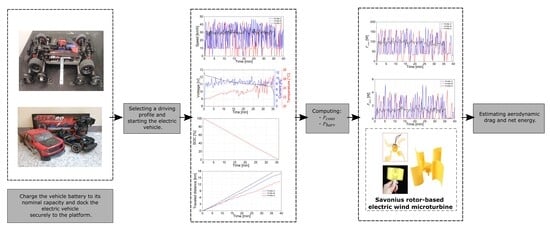
Graphical Abstract

1. Introduction

The widespread adoption of battery technology, while fundamental to global efforts to reduce operational carbon emissions, introduces a parallel environmental challenge. Specifically, the battery’s entire life cycle—from the initial extraction of raw materials through manufacturing to final disposal—is inherently associated with significant polluting outcomes. This study proposes a methodological approach to mitigate this trade-off by attempting to extend the functional lifespan of used batteries. The core objective is to integrate wind energy harvesters, specifically those utilizing a Savonius rotor microturbine design, as supplemental power sources. The performance of any battery system is multifaceted, necessitating the evaluation of several key parameters, among which the State of Charge (SoC) holds paramount importance. For this empirical study, the research focuses on Lithium-Polymer (Li-Po) batteries, selected for their widespread use in electric vehicles (EVs) owing to their high energy density, low self-discharge, and immunity to the memory effect. It is crucial to recognize that ambient energy harvesting devices—which convert environmental sources such as kinetic motion, thermal gradients, light, and radio frequency (RF) waves into electrical power—are not designed to replace conventional batteries. Rather, in low-power applications, they serve a vital supplementary function that reduces stress on the primary power source. Acknowledging the inherent limitations of these devices, namely their constrained conversion efficiency and lower power output compared to chemical batteries, this study explores their capacity to enhance battery lifespan. A preliminary comparison detailing the attributes of Li-Po batteries versus typical energy harvesting systems is presented in Table 1.
Table 1 presents an idealized comparison; however, device longevity varies significantly. Energy harvesters, when meticulously engineered, can sustain operational functionality for up to two decades with minimal maintenance, contingent upon the intrinsic resilience of their constituent components. Conversely, Li-Po batteries undergo progressive capacity degradation influenced by cumulative charge-discharge cycling, elevated charge-discharge rates, profound depth of discharge events, and thermal stress. Although energy harvesters exhibit superior longevity, their current power output constraints prevent standalone support of high-demand energy systems. Therefore, they are predominantly deployed within hybrid configurations designed to supplement electrochemical storage devices—such as batteries or supercapacitors—by enabling auxiliary recharging, which mitigates maintenance requirements and prolongs effective battery lifespan. Despite their incompatibility with high-power applications, advances in nanomaterials science and microelectronic engineering have expanded their applicability to miniaturized, low-power platforms, including wearable sensors and Internet of Things (IoT) nodes. Current research focuses on improving their efficiency and miniaturization [1,2,3,4,5].

1.1. Related Works

Recent investigations in energy harvesting focus on enhancing both efficiency and sustainability within vehicular and micromobility platforms. Hybrid suspension systems integrating hydraulic and electromagnetic modules have demonstrated significant improvements in ride comfort alongside increased energy recovery [6], while regenerative designs for heavy-duty trucks and magnetic mass-spring configurations harness vibrations for power generation [7]. Other approaches integrate harvesters into components such as shock absorbers and brake systems [8]. In the context of micromobility, piezoelectric and electromagnetic generators installed in bicycles convert motion into electrical energy to power sensors and portable devices, supporting greener transport solutions. The growing demand for sustainable energy in portable and wearable electronics has driven the development of self-charging systems that combine energy storage with solar, mechanical, thermal, or chemical harvesting methods to extend battery life and reduce the need for recharging. As the number of IoT devices continues to grow, battery-free energy harvesting is emerging as a promising solution to power low-energy sensors and wearables autonomously and sustainably.
Numerous studies have substantiated the role of energy harvesting as a viable complement to, or alternative for, conventional battery systems. Liu et al. [9] conducted a comprehensive review of advanced harvesting applications spanning smart homes, IoT, transportation, and aerospace sectors. De Oliveira et al. [10] proposed an RF-based power system for low-voltage batteryless devices, while Hosseini et al. [11] and Mhatre and Shukla [12] examined regenerative systems in electric vehicles, highlighting improvements in efficiency and battery life. Gao et al. [13] explored the integration of energy harvesters and energy storage for wearable and implantable medical batteryless devices. Currently, Ali et al. [14] and Safaei et al. [15] emphasized sustainable IoT powered by piezoelectric harvesters. Collectively, these studies illustrate that energy harvesting could reduce maintenance, improve reliability, and enable autonomous operation in a wide range of applications.
Several recent studies have particularly explored the integration of energy harvesting systems into electric vehicles (EVs) to boost sustainability and battery performance. Hussain et al. [16] focused on using vertical-axis wind turbines (VAWT) in EV front grilles to capture wind energy during motion and charge the battery. Broader approaches, such as that of Surendran et al. [17], have combined smart energy harvesting with automation in EVs, highlighting technologies such as wind turbines, solar panels, and regenerative braking to reduce reliance on grid charging and enhance overall efficiency. Helera and Stoichescu [18] examined the feasibility and aerodynamic optimization of vehicle-mounted wind turbines for dynamic charging to extend the EV range.
Recent review studies have provided an in-depth analysis of energy harvesting technologies for electric vehicles, including wind, solar, regenerative braking, piezoelectric, and thermoelectric systems. Hosseini et al. [11] examined the role of these technologies in battery electric and fuel cell hybrid vehicles, identifying key research gaps and future directions. Similarly, Mhatre et al. [12] evaluated the strengths, limitations, and applicability of these technologies in various scenarios. Both studies have highlighted the potential of these technologies to reduce energy consumption, extend battery life, and minimize environmental impact while addressing challenges such as low power output, conversion inefficiencies, and integration complexity. These studies also emphasized the importance of hybrid approaches that combine multiple methods, as well as future trends such as smart control systems and advanced materials to improve energy conversion and storage. In essence, these studies identified energy harvesting as a crucial element in the design of sustainable electric vehicles, albeit primarily as a supplementary rather than primary energy source.
Moreover, Savonius rotor-based wind turbines have been extensively studied due to their simplicity, low manufacturing cost, and reliable performance at low wind speeds, making them suitable for vehicle-mounted applications. Research by Dinh et al. [19] has focused on optimizing the rotor blade geometry, curvature, and auxiliary blade configurations to improve efficiency and energy output. Savonius rotors have been unable to generate enough power for propulsion, though. Arbiyani and Lasut et al. [20] reported that they were able to supply energy for auxiliary systems and marginally extend battery life. Design improvements, such as multi-curve blades and aerodynamic enhancements, have significantly increased performance compared to traditional designs. These findings highlight the potential of Savonius rotors as practical energy harvesters for EVs, particularly in urban environments with variable wind conditions.

1.2. Research Context

No research indicates the total substitution of batteries with energy harvesters. Research underscores the incorporation of energy harvesters into hybrid systems to augment energy supply and prolong battery longevity, especially in low-power devices. These systems help manage intermittent power sources and allow for smaller battery sizes. Current efforts primarily explore how energy harvesters can complement batteries. The key strategies are summarized below:
  • Research and development to improve energy harvesting efficiency. Innovations such as triboelectric nanogenerators and hybrid systems improve power output by utilizing multiple energy sources. For instance, Khan et al. [21] developed a solar optimizer based on maximum power point tracking (MPPT), while Liao et al. [22] explored cellulose-based harvesters. Mondal et al. [23] and Sevcik et al. [24] reviewed hybrid devices and energy transducer technologies. Further research focuses on the advancement of thermal and solar harvesting techniques [25,26,27,28].
  • Hybrid systems for IoT and wearable devices. Various studies investigate the integration of energy harvesting in IoT systems and wearable devices to reduce the need for battery replacement and optimize energy use [29,30]. Abdulmalek et al. [31] developed a hybrid wearable healthcare system for real-time monitoring. Nishanth and Senthilkumar [3] proposed using solar or piezoelectric harvesters to extend the battery life of the fitness tracker. Ali et al. [32] reviewed wearable energy harvesting methods, focusing on the heat and motion of the human body, and examined various technologies, including piezoelectric, triboelectric, thermoelectric, and hybrid systems.
  • Electric and hybrid vehicles. In recent years, several studies have examined how best to utilize the energy of electric and hybrid vehicles. Particularly, Prasad et al. [33] introduced a method that integrates an optimization algorithm with a neural architecture to determine the optimal energy distribution. In addition, Manivannan [34] applied machine learning to create a smart energy management system for hybrid electric vehicles. To enhance its performance, an IoT-based smart charging system was implemented to schedule vehicle-to-grid connections. Finally, Shen [35] studied the trends in IoT-based charging stations for electric vehicles and their roles in smart energy dispatch, load balancing, remote monitoring, and the integration of renewable energy. Furthermore, the study highlighted the primary challenges of scaling and implementing IoT-based systems, including cost ineffectiveness, interoperability issues, and security concerns.
  • Advanced energy storage and harvesting systems. Portable energy storage and harvesting systems are vital for daily use, especially in healthcare and wearable technology. Traditional batteries tend to be bulky, but advances in materials have allowed for flexible, lightweight alternatives. These integrated systems support continuous operation and reduce dependency on external power. Zhang et al. [36] reviewed technologies such as solar cells, biofuel cells, nanogenerators, super-capacitors, and various batteries, analyzing energy density, power, and durability. To address the mismatch between intermittent energy harvesting and constant power needs, advanced storage solutions such as super-capacitors are being explored [37,38,39,40,41]. Their fast charge/discharge capabilities and long cycle life make them a promising option for hybrid systems [42,43,44,45,46,47,48,49].
  • Smart energy management systems. Hybrid systems are based on smart circuits to efficiently manage the energy of both harvesters and batteries [50,51,52]. These systems dynamically balance power sources to ensure a stable supply and maximize the use of harvested energy [53,54,55,56]. In this sense, Yaseen et al. [57] developed a framework for resilient IoT systems using dynamic energy management and sustainable harvesting methods.

1.3. Contribution

Among the five focus areas outlined in Section 1.2, this study centers on “Electric and hybrid vehicles.” To that end, a case study was performed using a scaled electric vehicle prototype, three representative driving profiles, and an integrated control system. The primary contributions of this study are as follows.
  • Experimental data link driving profiles to the battery SoC in an electric vehicle. It supports safe and efficient operation, helps estimate battery life through charge-discharge cycles, and enables discharge curve analysis to assess the available energy.
  • Test findings on the application of wind energy harvesters as supplementary power sources in small EVs are presented. These results help estimate the potential improvement in the SoC and lifespan of the battery.
  • Reckoning how much of the total energy consumed by an electric vehicle can be attributed to energy harvesters based on the 2017 U.S. EPA fuel economy data [58,59].
  • A detailed assessment is conducted to quantify efficiency losses and estimate the net energy contribution of the energy harvesters. This assessment is based on the technical specifications of the Savonius-rotor microturbine.
This study specifically addresses the integration of renewable energy within electric vehicles, concentrating on energy harvesting through Savonius-type wind microturbines and real-time battery SoC monitoring. The research scope encompasses the development of sustainable energy management strategies for EVs, with particular attention to the aerodynamic implications of the energy harvesting devices and the auxiliary power demands of the EV systems. Additionally, this study adds value by examining the integration of energy-harvesting devices into EVs, an innovative approach to improving sustainability and energy efficiency. It further contributes by quantitatively assessing feasibility through real-time SoC measurements across different driving profiles and by calculating net power after accounting for drag and efficiency losses. Therefore, this study intends to provide empirical evidence rather than theoretical assumptions. It also identifies technical limitations such as low energy recovery and aerodynamic drag of energy harvesters and sets the stage for further improvements in the design and integration of these devices.
This study is systematically organized to fulfill its research objectives. Section 2 delineates the theoretical framework, details the employed methodology, describes the case study, and specifies the experimental conditions. Section 3 presents the results derived from three distinct driving profiles, elucidating the contribution of energy harvesters to battery energy demands. Additionally, this section discusses the strengths of the experimental design, alongside the study’s limitations and potential future directions. Section 4 provides a comparative analysis of energy consumption, benchmarking wind-based harvesting against RF and solar energy harvesting systems. Finally, Section 5 offers a comprehensive conclusion, synthesizing the principal findings of the investigation.

2. Materials and Methods

2.1. Considerations

A battery converts chemical energy into electricity using cells composed of an anode, cathode, and electrolyte. Its theoretical capacity depends on the amount of reactive material. As one of the costliest components of an electric vehicle, monitoring the SoC is crucial for estimating remaining energy, travel range, and battery health. SoC management helps prevent premature degradation, and analyzing the discharge curve reveals how voltage drops under different driving conditions.
This study focuses on the battery discharge curve, a key tool for evaluating the performance, efficiency, and lifespan of a battery under three different driving conditions. Engineers use it to design battery management systems (BMS) that handle voltage variations and determine cut-off voltage to prevent over-discharge. As the battery ages, shifts in the curve indicate degradation, providing insight into when a replacement will be needed. Manufacturers provide discharge curves to guide battery selection.

2.2. Method Description

A ten-step method was implemented to rigorously assess the proposed energy harvesting. This method was applied to three distinct EV driving profiles established on the docking platform. The primary goal was twofold: to estimate the battery SoC and to determine the requisite number of energy harvesting circuits needed to balance power consumption and generation. SoC indicates the remaining battery capacity but not power demand. From a battery perspective, it is essential to accurately estimate the SoC, as it is used to prevent the battery from overcharging or over-discharging, optimize its lifespan, and estimate its State of Health (SoH). Operationally, accurate SoC estimation for EVs enables the reliable prediction of vehicle autonomy, facilitating efficient route planning and stop logistics.
Balasingam et al. [60] categorized SoC estimation into three different approaches: (i) current-based, (ii) voltage-based, and (iii) combined methods using nonlinear filters, such as the extended Kalman filter. For the present study, the Coulomb counting method was chosen due to its simplicity and cost effectiveness. This current-based technique requires only a sensor and integration logic, enabling real-time monitoring during charge/discharge without resting periods. It tracks charge flow over time and applies to various battery types [61,62].
The proposed method is outlined as follows:
  • Fully charge the vehicle battery to its nominal capacity.
  • Connect the electric vehicle to the docking platform, ensuring a secure coupling.
  • Select a driving profile and start the electric vehicle to begin the experimental procedure.
  • Acquire the voltage, current, and temperature of the vehicle battery.
  • Save the data to the microSD memory card, enabling subsequent review via the organic LED screen integrated within the electronic system.
  • Estimate the battery SoC using the Coulomb counting method as defined by Equation (1)
    S o C ( t ) = S o C 0 1 C n o m t 0 t I ( t ) d t ,
    where S o C 0 represents the initial battery SoC at full capacity (100%), I ( t ) is the instantaneous battery current, and C n o m denotes the nominal battery capacity.
  • Terminate the experiment once the battery voltage, V b a t , approaches the predefined cut-off voltage, V c o .
  • Compute the instantaneous power consumption as P ( t ) = V ( t ) I ( t ) .
  • Ascertain the power output ( P h a r v ) of a single energy harvester using the manufacturer specifications or design-based calculations, accounting for the efficiencies of both the power source and conversion circuitry.
  • Determine the minimum number of energy harvesting circuits ( N m i n ) required to sustain continuous system operation, ensuring that the aggregated power output meets or exceeds the system’s average energy demand, formally expressed as:
    N P h a v P c o n s .
    Note that if P h a r v = 0, then N = 0, since there is no energy available for harvesting. Therefore, N m i n should be estimated according to Equation (3) when P h a r v > 0.
    N m i n = P c o n s / P h a r v ,
    where · indicates that the number should be rounded up to the next whole number, as using only a fraction of an energy harvesting circuit is not feasible.
This method provides three key outcomes: (i) battery SoC, (ii) system power consumption, and (iii) the number of energy harvesting circuits required. In this approach, the battery acts as a buffer between the intermittent power supply and the system’s energy demand. SoC is the primary metric for validating the accuracy of the energy supply system design.

2.3. Case Study

This section presents a case study in which the voltage and current supplied by a lithium-ion battery were measured to monitor and control the systems of a small-scale electric vehicle. The total energy consumption was quantified to estimate the battery discharge curves. The battery was installed in the 1:10 scale model of the electric vehicle shown in Figure 1a, whose technical specifications are shown in Table 2.
In this case, “Small-scale” refers to the reduced-size models used for testing. Note that this electric vehicle consists of mechanical, electrical, and electronic components. It was coupled to the docking platform shown in Figure 1b with bearings that allow the vehicle’s wheels to rotate without moving the vehicle.
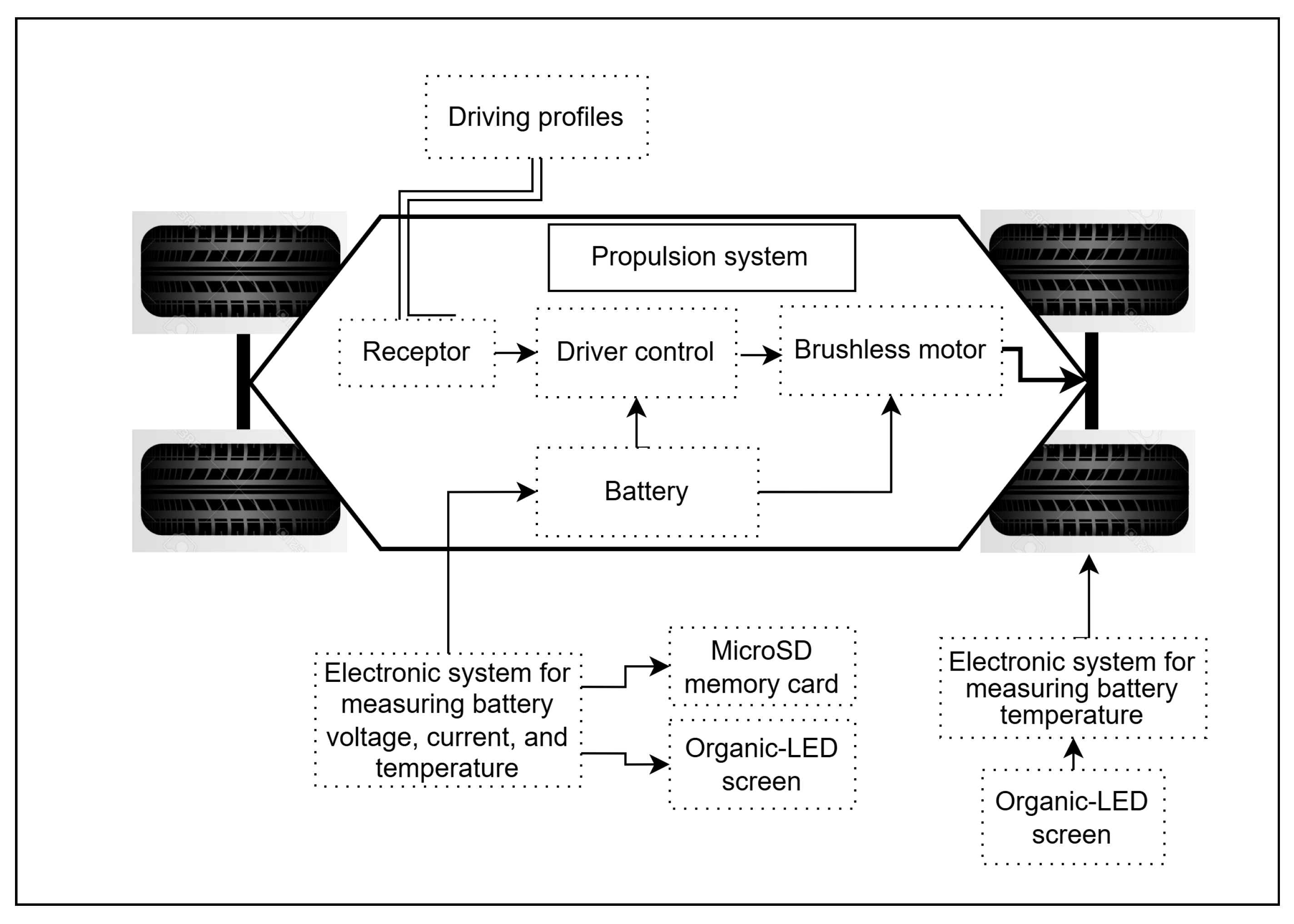
Figure 2 presents a schematic diagram of the docking platform used to perform the experiments. This platform was utilized with the 1:10 scale model of the electric vehicle shown in Figure 1a. In this diagram, all subsystems of the docking platform (as seen in Figure 1b) are labeled. Furthermore, Table 3 offers specifications for the sensors utilized in the experiments, which are detailed in the box labeled “Electronic system for measuring battery voltage, current, and temperature” of Figure 2.
The calibration of the modified INA219 sensor was performed using software by calculating two essential parameters in the device: C u r r e n t _ L S B and C a l _ V a l u e . Firstly, C u r r e n t _ L S B is the smallest current that can be measured, which determines the measuring range, and it should be estimated using a practical approximation defined by Equation (4)
C u r r e n t _ L S B = I m a x 2 15 ,
where I m a x represents the maximum current that should be measured in the experiments; in this case, I m a x = 32 A, and 215 represents the range of the current registered on the chip since its resolution is 15 bits.
C a l _ V a l u e , the integer written to the calibration register, can then be calculated using Equation (5). This equation accounts for the maximum differential shunt voltage (in Volts) that the modified INA219 can handle, which is 0.04096 V, an internal fixed reference that ensures proper scaling. The operator · denotes the integer part function, and R S h u n t refers to the low value resistor used to prevent instrument damage and facilitate the measurement of higher currents. It is the value of the external shunt used to develop the differential voltage across the input pins.
C a l _ V a l u e = 0.04086 C u r r e n t _ L S B R S h u n t .
The KY-013 sensor uses an NTC (Negative Temperature Coefficient) thermistor, which decreases resistance as temperature increases. Its analogous nature and sensitivity can lead to fluctuations that appear as temperature changes, causing inaccurate readings. These inaccuracies are influenced by the resolution of the analog-to-digital conversion and the linearization by software. Since the response of the thermistor is nonlinear, the Steinhart-Hart equation should be used to linearize and calibrate the sensor by determining its specific coefficients, as shown in Equation (6). Note that this equation represents a model relating the varying resistance, R T , of a device to its varying temperature, T.
T = 1 A + B l n R T + C l n R T 3 ,
where
R T = R f V c c V o u t 1 .
R f is the reference resistor, V C C is the supply voltage, V o u t is the voltage measured at the analog pin, and A, B, and C are the Steinhart-Hart coefficients indicated in Table 3.
Although ideal calibration involves measuring resistance at three known temperatures using a high-precision thermometer, this case used the recommended values from the sensor datasheet, assuming a nominal resistance of 10 kΩ. The typical reference points are ice water (~0 °C), warm water (~40 °C), and room temperature (~25 °C) to calculate the Steinhart-Hart coefficients. The electric vehicle uses a Velineon 3500 brushless motor with Neodymium magnets and a coil-based stator, controlled by an electronic drive that regulates speed and power. A radio transceiver manages control signals during docking tests. The motor drive acts as an actuator, and its shaft connects to a gear system that increases torque, enabling bidirectional wheel movement.

2.4. Experimental Conditions and Settings

This section describes the fundamentals and key components of experimental design. The fundamentals are the assumptions that ensure the validity and reliability of the experimental design, including unbiasedness, sufficiency, applicability, and replicability. Key components include defining variables, identifying experimental units, and using the procedures for measurement.
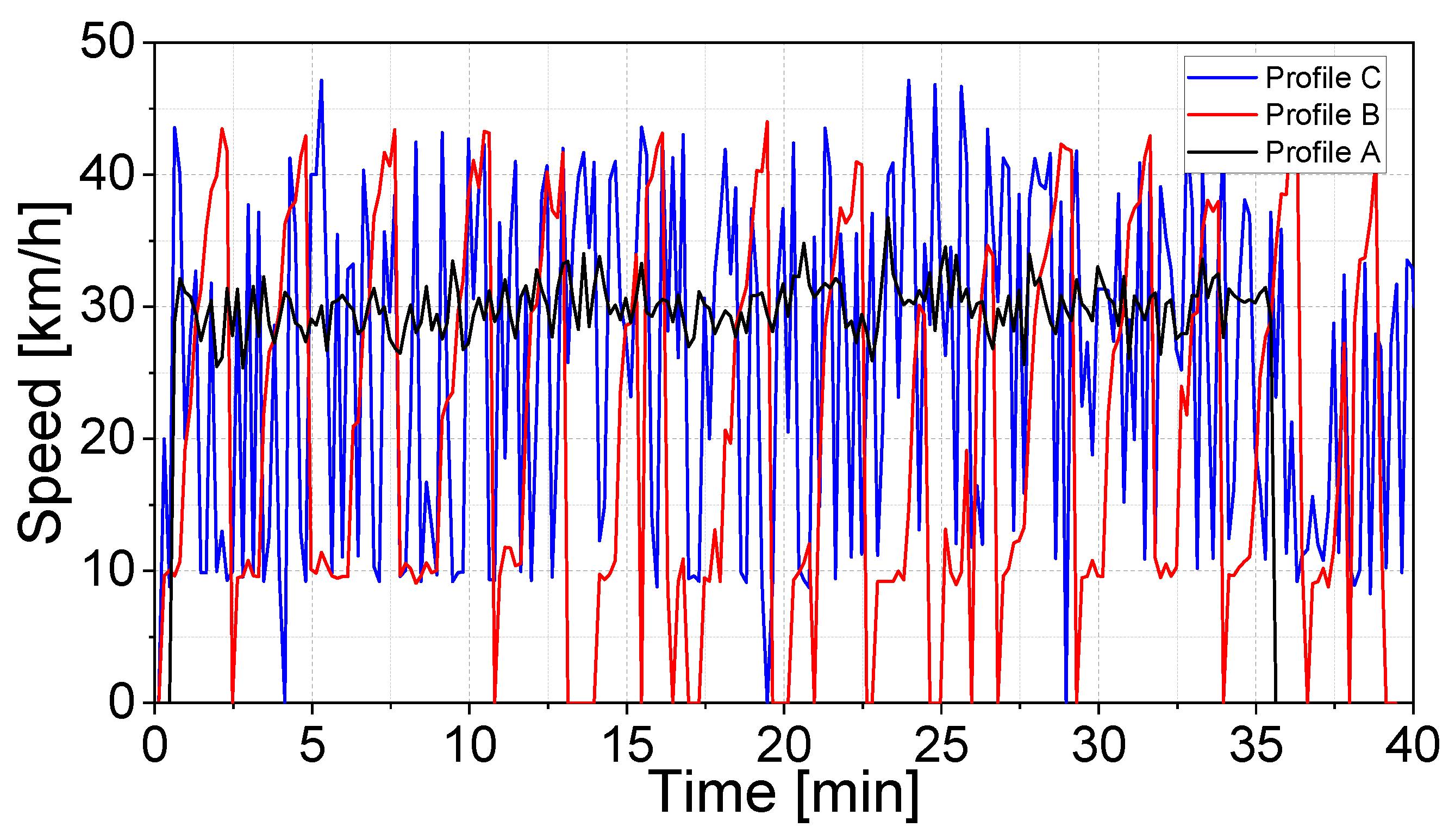
Firstly, to ensure the validity and reliability of the experimental design, three driving profiles were defined. These driving profiles were generated by a software module based on an external microcontroller, which was programmed in C to generate three digital signals that control vehicle speed. It stores three driving profiles in nonvolatile memory.
  • Profile A. It is characterized by a constant speed of approximately 30 km/h.
  • Profile B. It features a variable speed according to a sawtooth signal.
  • Profile C. It entails a driving profile with randomly varying speeds.
Figure 3 shows the speed of an electric vehicle for three driving profiles.
Additionally, to ensure the validity and reliability of the experimental design by addressing aspects such as unbiasedness, sufficiency, applicability, and replicability, the variables were continuously monitored for 40 min, yielding 2404 samples for each at an approximate sampling frequency of 1 Hz. In the context of energy harvesting and electrochemical systems, extended single-run experiments are considered valid because these systems often exhibit both rapid transient responses and slower steady-state dynamics that must be captured simultaneously. A sufficiently long monitoring time ensures that transient phenomena, such as start-up instabilities or short-term oscillations, are recorded. Meanwhile, the sampling resolution contributes to ensuring that steady-state behavior and recurring cycles are adequately characterized. Therefore, this strategy captures both the fast transient responses and the repetitive steady-state cycles inherent to conduction profiles, thereby providing a comprehensive representation of system behavior [63,64].
This methodological choice aligns with reliability engineering practices, which commonly employ prolonged single-run experiments to evaluate degradation trajectories and performance consistency in battery systems [65]. In this study, repeatability was confirmed for driving profile B; during the 40-min monitoring period, the phenomenon repeated approximately every 3.1 min, resulting in 13 reproducible cycles within the same run due to the sawtooth signal. Thus, in addition to the statistical robustness provided by the sample size, the internal repetition of the phenomenon provides further evidence of reproducibility and enhances the dataset’s validity. Taken together, these methodological and analytical considerations demonstrate that the single, long-duration experiment provides statistically representative and scientifically credible evidence to support the reported results.
To strengthen replicability, two electronic systems were employed: one for measuring the current, voltage, and temperature of the vehicle battery, and the other for recording vehicle speed. The digital voltage generated for each driving profile was subsequently converted to an analog format using a digital-to-analog converter and transmitted to the electric vehicle via an RF transceiver.
For the electronic system measuring battery parameters, it was assumed that the electric vehicle operates with a 12.6 V, 5000 mAh Li-Po battery. Accordingly, battery voltage, current, and temperature were monitored through sensors during docking tests, with data displayed on an OLED screen and stored on a microSD card for subsequent analysis. All tests were conducted within safe temperature ranges from 0 to 43 °C for charging and from 0 to 60 °C to ensure reliable data on power consumption, as detailed in Table 2.
For the electronic system implemented to monitor vehicle speed, a photoelectric sensor positioned behind the wheel detects light interruptions caused by notches on the wheel. The microcontroller processes these digital pulses to calculate RPM, converts the values to km/h, and displays the speed on an OLED screen. In this way, the independent variables are battery voltage, current, and temperature, as well as vehicle speed. The dependent variable is the battery SoC.
This study considered three experiments, each aligned with driving profiles A, B, and C. The Li-Po battery was fully charged to 12.6 V, with a cut-off voltage of V c o = 9.25 V to prevent damage. The tests were carried out at ambient temperatures between 21 and 25 °C. A KY-013 sensor, linearized using the Steinhart-Hart equation, was placed on the battery surface. The ESP32 (10-bit ADC) sampled data every 5 s.

3. Results

3.1. Experiment Based on Driving Profile A

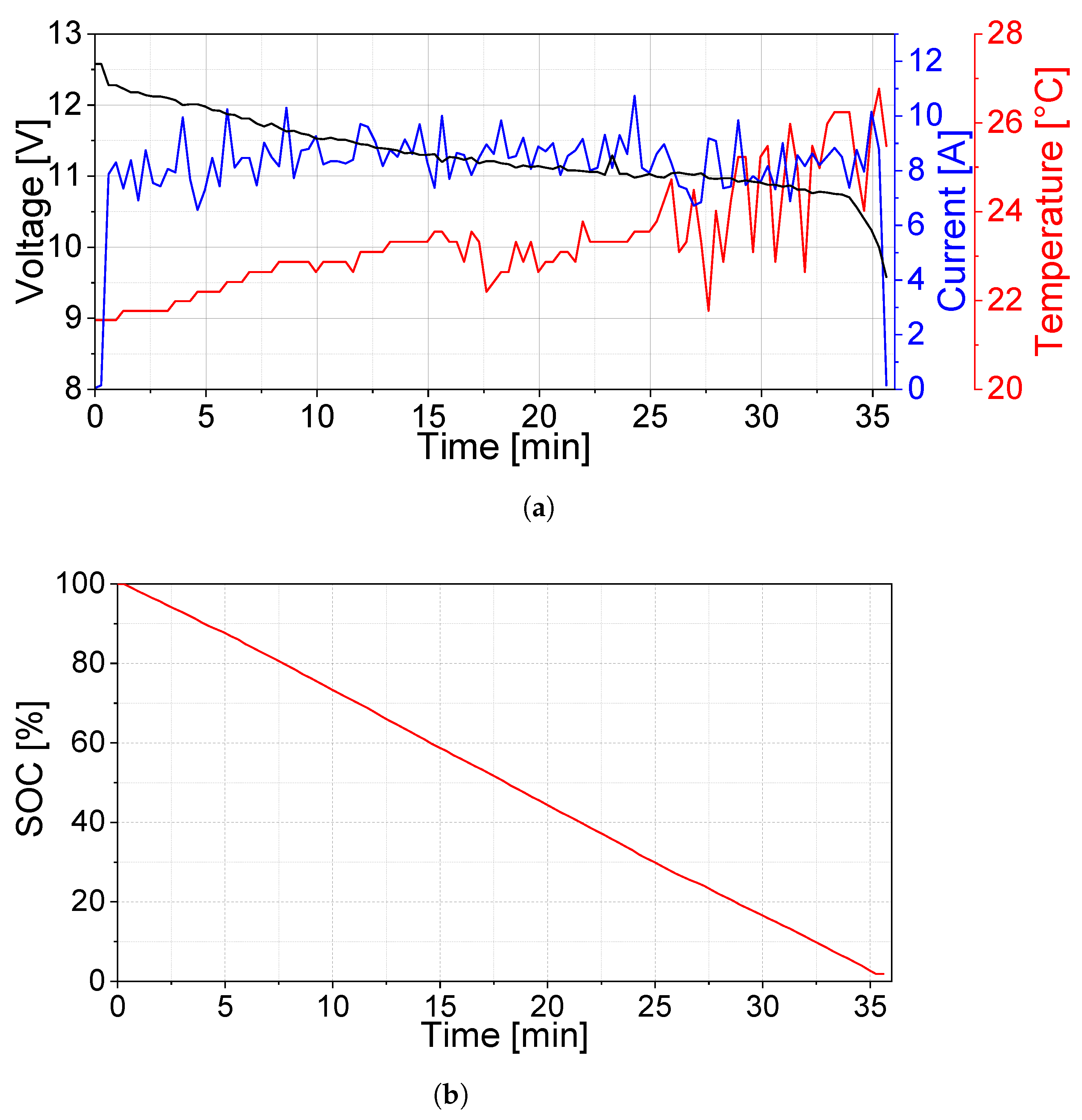
Figure 4 presents the voltage, current, temperature, and SoC of the battery for driving profile A. As shown in Figure 4a, the autonomy of the electric vehicle was 36 min, at which point the battery voltage reached V b a t = 9.58 V—exceeding the specified cutoff voltage V c o . In this case, the vehicle speed was around 30 km/h. Additionally, Figure 4a shows that the current demand ranged from 6.5 A to 11.0 A, and the temperature increased from 21.5 °C to 26.75 °C.
Moreover, fluctuations in temperature measurements were evident, attributable both to the limitations of the KY-013 sensor, as detailed in Section 2.3, and to variations in the battery’s current demand from driving profile A. To better model the behavior of the battery current, a sigmoidal fit was used with a BiDoseResp model (R2 = 0.77) to capture the trend of non-linear temperature. There are notable inflection points at approximately 25 and 31 min that show distinct, sequential heating phases, which are characteristic of this driving profile. Additionally, Figure 4b illustrates the battery SoC behavior, highlighting that the SoC remains at 1.80% while the battery voltage V b a t stays above the cut-off voltage, V c o , thereby safeguarding against battery damage.

3.2. Experiment Based on Driving Profile B

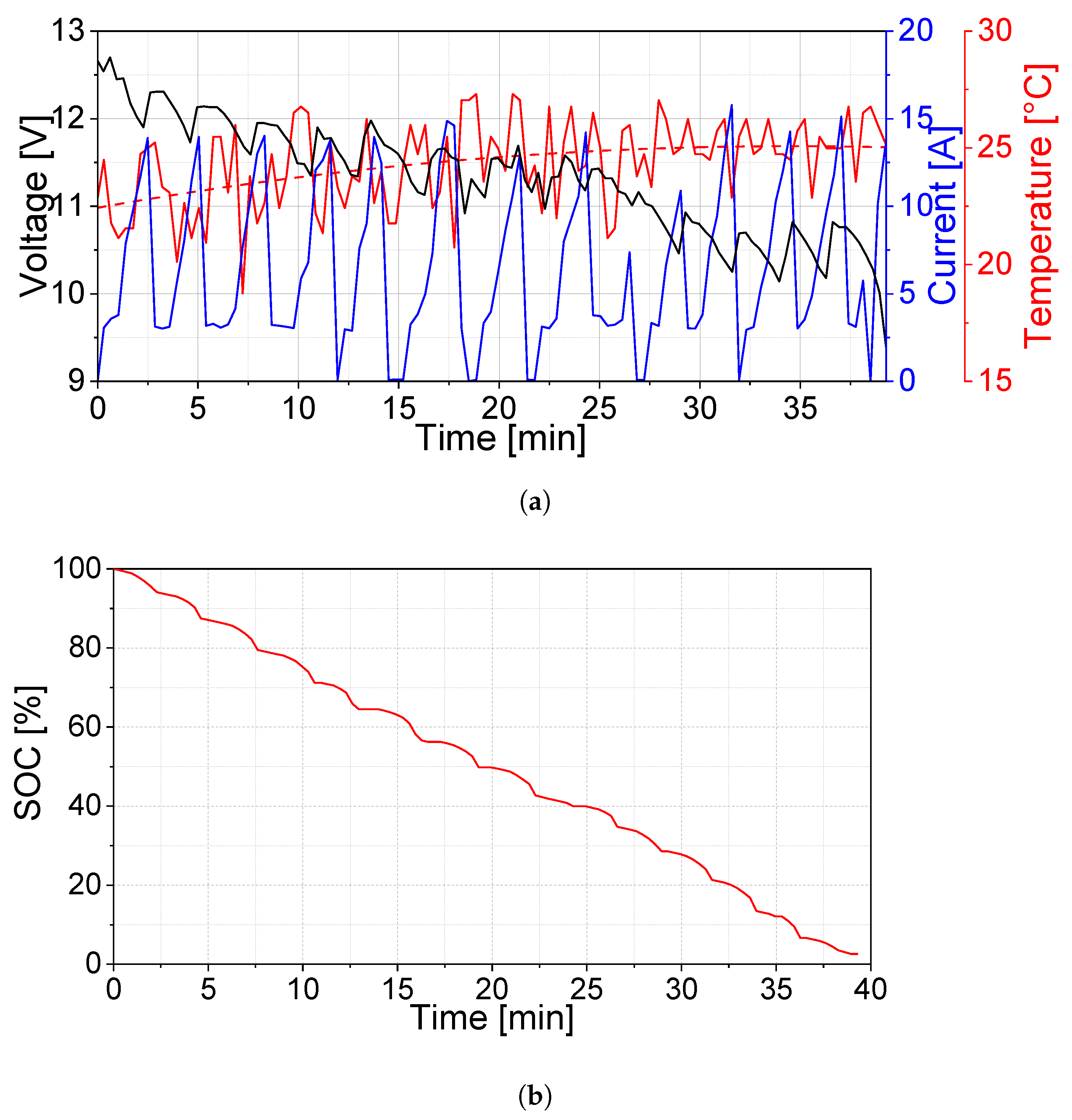
Under driving profile B, the vehicle operated for over 39 min at a variable speed between 0 and 44 km/h, following a sawtooth signal (see Figure 3). Figure 5 displays the corresponding battery voltage, current, temperature, and SoC throughout this profile. As shown in Figure 5a, the EV autonomy lasted 39 min, at which point the battery voltage reached V b a t = 9.38 V, slightly above V c o . During this period, the current demand fluctuated between 5.0 A and 15.0 A, while the battery temperature rose from 23.0 °C to 27.0 °C.
Similar to driving profile A, the temperature fluctuations observed in driving profile B stemmed from both the inherent limitations of the KY-013 sensor (refer to Section 2.3) and variations in the battery’s current demand. Subsequently, a polynomial regression (R2 = 0.19), shown in Figure 5a with the dotted red line, was used to model the trend of nonlinear temperature, reflecting a steady increase from 22 °C to 25 °C. Note that a small coefficient of determination (R2) was obtained due to the high variability of the measured temperatures. In contrast to driving profile A, driving profile B exhibited significant temperature changes due to sensor quality issues and abrupt signal fluctuations caused by the sawtooth signal. However, the trend in the temperature signal was preserved. Therefore, this behavior in the battery temperature represented the overall thermal response to driving profile B. Note that S o C = 5.11% and V b a t V c o , which prevented damage to the battery.

3.3. Experiment Based on Driving Profile C

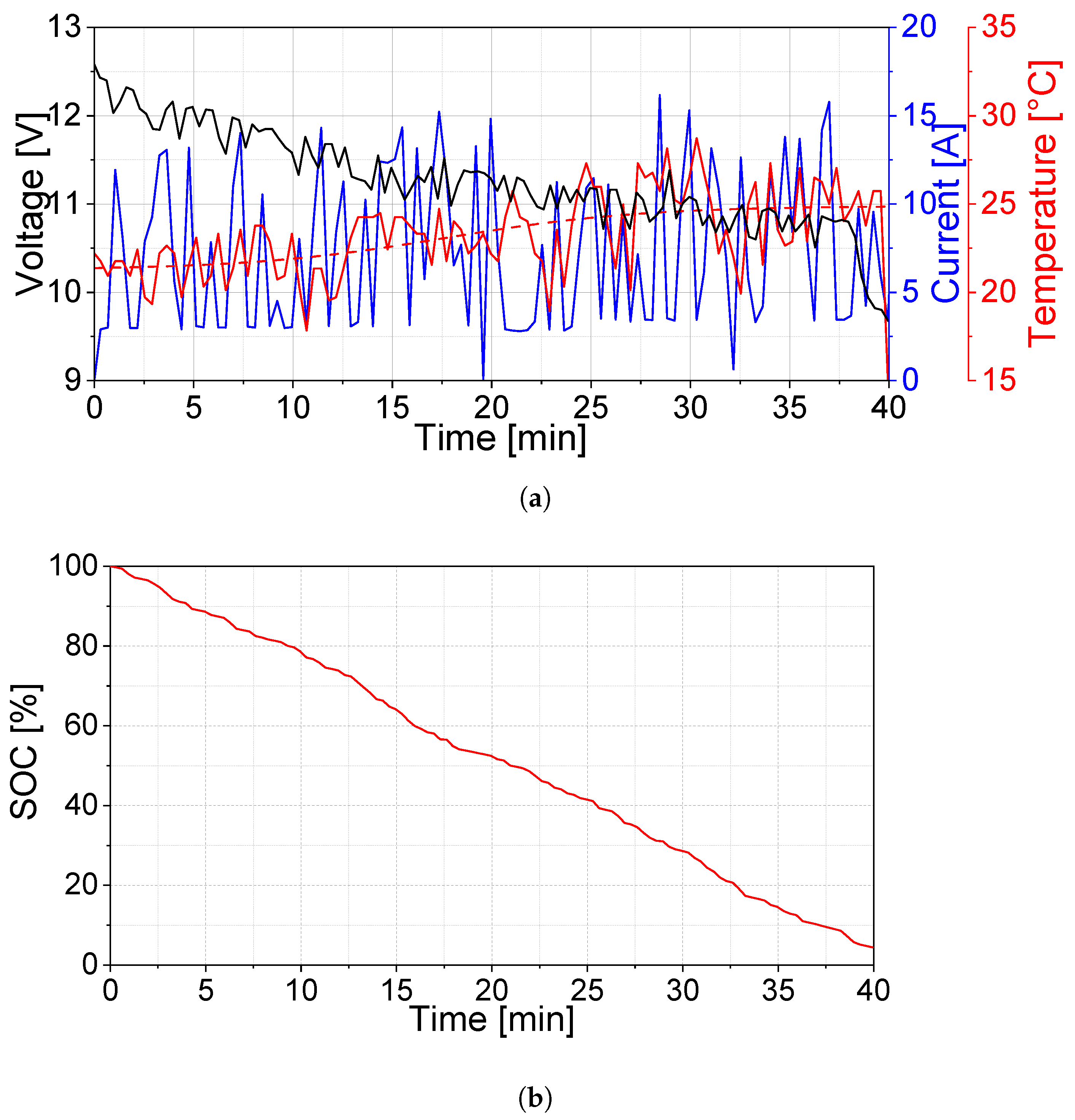
For driving profile C, the vehicle operated at random speeds between 0 and 48 km/h for 40 min (see Figure 3). Figure 6 presents the voltage, current, temperature, and SoC of the vehicle’s battery for driving profile C. As shown in Figure 6a, the EV autonomy was 39 min, at which point the battery voltage reached V b a t = 9.68 V—exceeding V c o . In this case, the current demand ranged from 9.0 A to 15.0 A, and the temperature increased from 18.0 °C to 28.0 °C.
As with driving profiles A and B, temperature fluctuations in driving profile C were linked to the limitations of the KY-013 sensor (see Section 2.3) and variations in the battery’s current demand. Subsequently, a peak function model, shown in Figure 6a with the dotted red line, was used to fit the non-monotonic temperature trend (R2 = 0.28), indicating partial capture of thermal fluctuations. Despite limitations, the model confirmed real transient heat transfer events, offering a useful framework for analyzing temperature behavior under dynamic conditions. Note that S o C = 4.44% and V b a t V c o , which prevented battery damage.
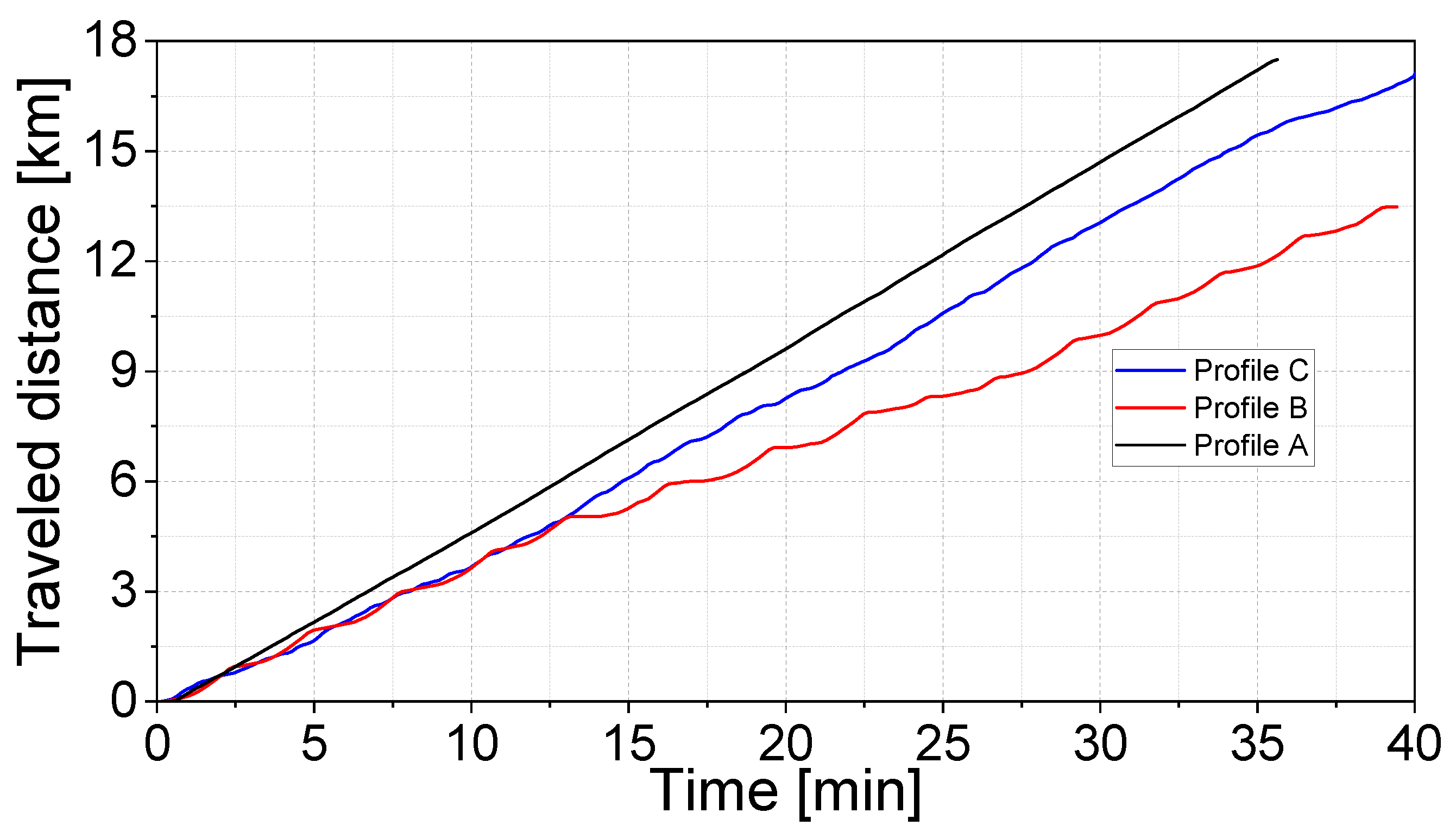
Finally, Figure 7 shows the distances traveled by the electric vehicle for each driving profile, and Table 4 presents a summary of the results obtained.

3.4. Integration of Wind Energy Harvesters into the Li-Po Battery System

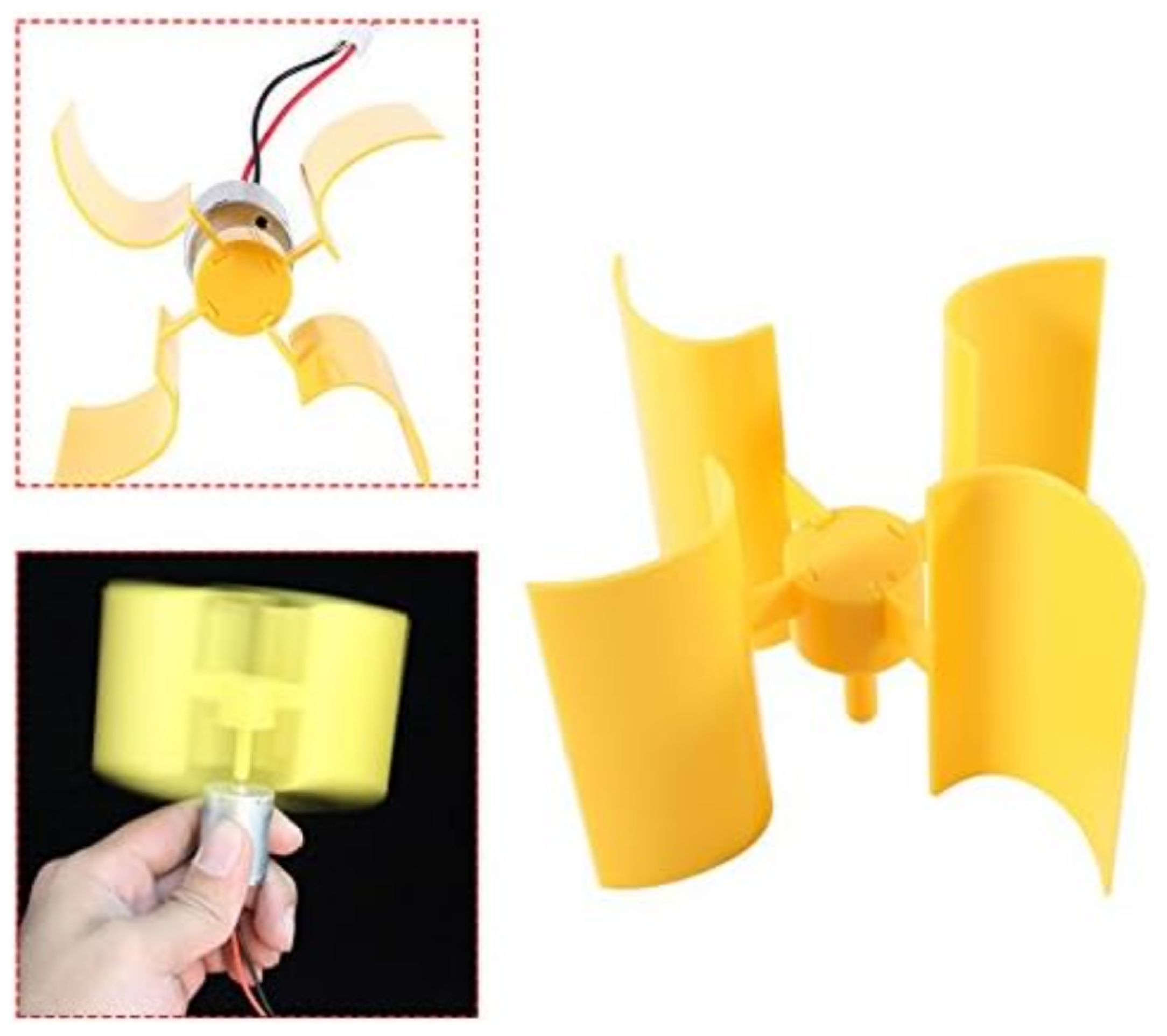
This section outlines a 1:10 scale electric vehicle powered by a Li-Po battery, supported by a 100 mm Savonius rotor-based electric wind microturbine. The turbine featured a 4-vane, 50 mm-high fan and a high-speed motor (3–12 V DC, 0–25,000 RPM, 130 magnetic brushed torque). The motor body measures 27 mm in diameter and 38 mm in length, with a shaft of 10 mm × 22 mm. As shown in Figure 8, the vertical vane is able to capture energy from any wind direction. This setup followed the procedure in Section 2.2.
Given these considerations, it was essential to determine P c o n s , P h a r v , the efficiency losses of the microturbine, and N m i n for each driving profile.
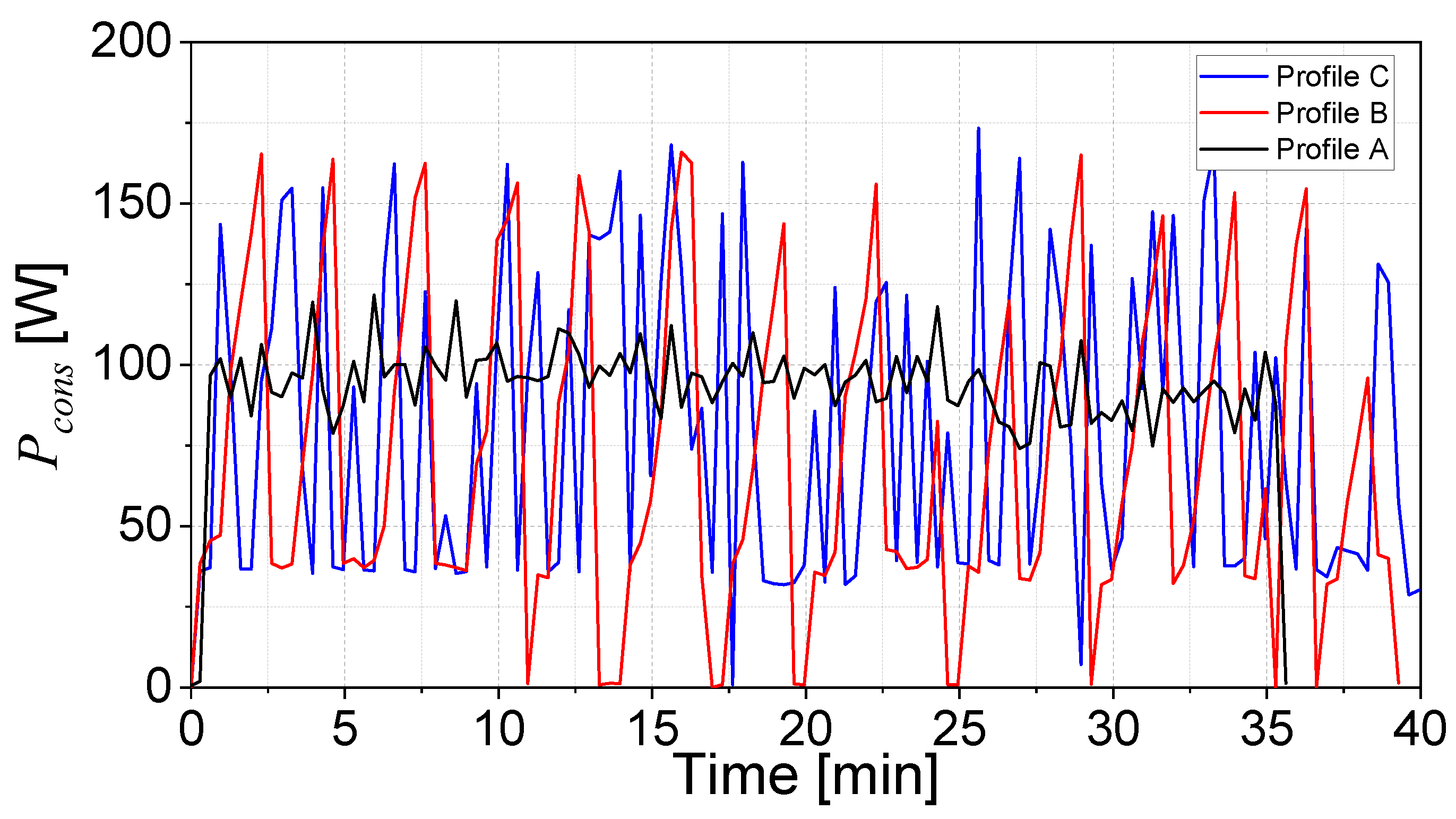
  • Estimation of P c o n s . Figure 9 shows the instantaneous power consumption of the 1:10 scale electric vehicle under each driving profile. The black, red, and blue lines represent profiles A, B, and C, respectively. Instantaneous consumed power, P c o n s ( t ) = V ( t ) I ( t ) was calculated from the voltage and current of the battery over time.
  • Determine P h a r v and the efficiency losses of the microturbine. In the first term, considering that the microturbine was based on a Savonius rotor [66]. P h a r v was given according to Equation (8).
    P h a r v = P w i n d C p η g l o ,
    where η g l o = η m e c η g e n , with η m e c representing the mechanical efficiency and η g e n denoting the generator efficiency of the microturbine.
    It is assumed that C p is the power coefficient and P w i n d is the available wind power calculated using Equation (9), where A T = H × D , H is the height of the rotor in m, D is the diameter of the rotor in m, ρ is the air density in kg/m3, and v is the wind speed in m/s.
    P w i n d = 1 2 ρ A T v 3 .
    Assuming that η m e c = 0.95 due to the direct gear system with minimal friction, η g e n = 0.7 reflecting the simplicity of the microturbine electronics, and ρ = 0.923 kg/m3 at 27 °C and 2000 m altitude, P h a r v was given by Equation (10). Since the power coefficient of the Savonius microturbine is usually between 0.15 and 0.25, a worst-case scenario was assumed, and C p was set to 0.15.
    P h a r v = 0.9975 P w i n d .
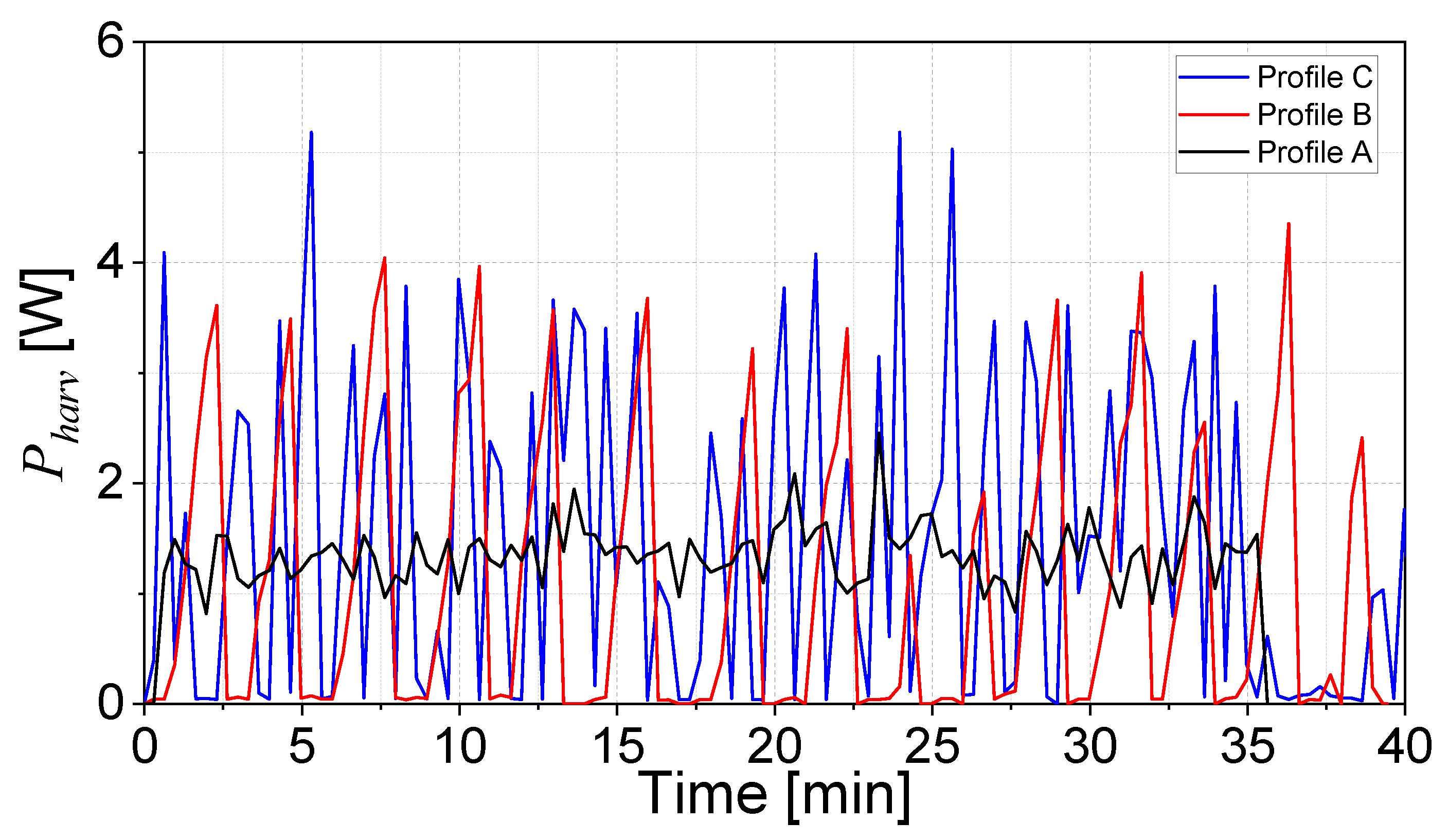
    Similar to Figure 9, Figure 10 shows the harvested electric power, P h a r v , for driving profiles A (black), B (red), and C (blue).
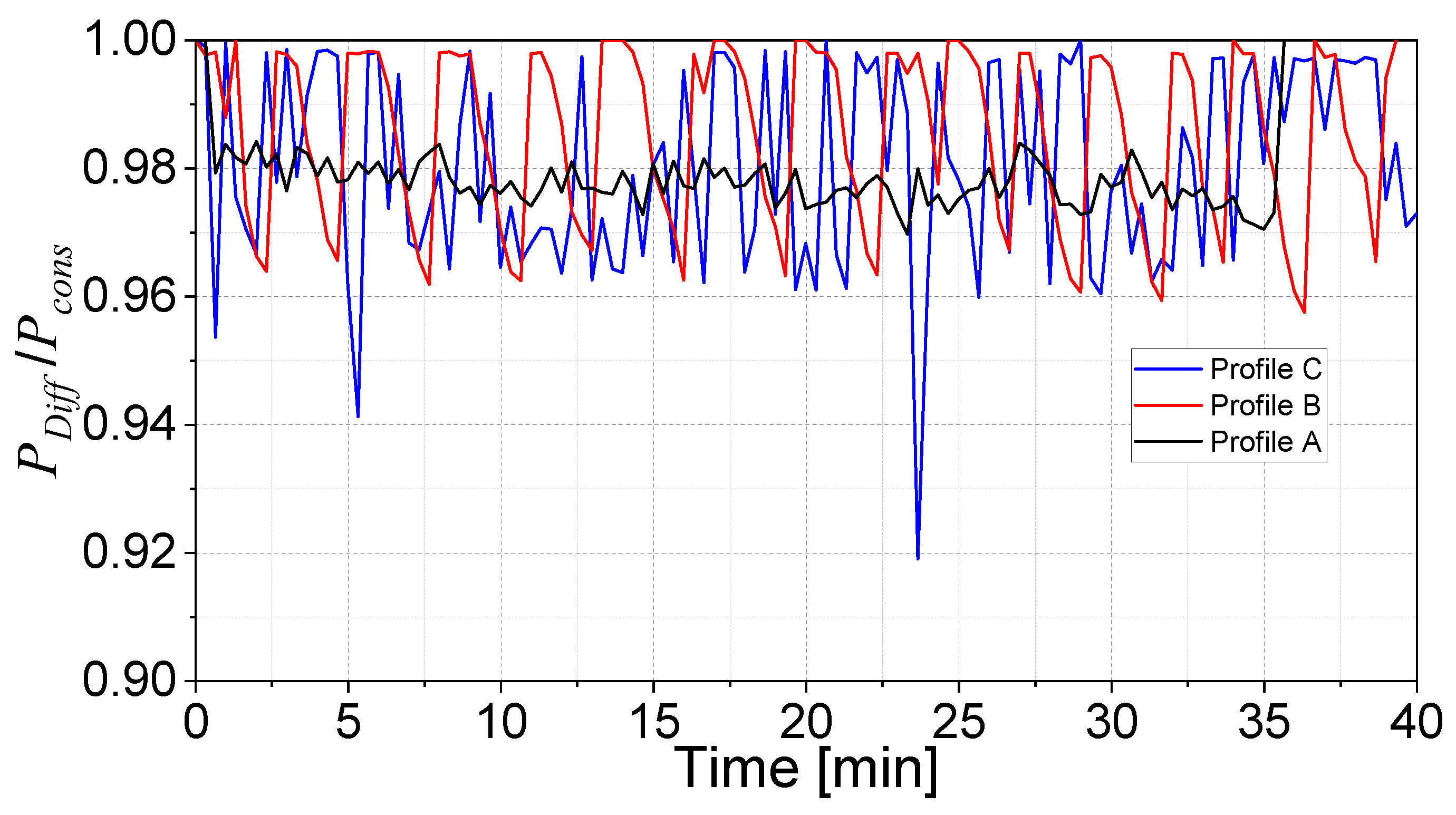
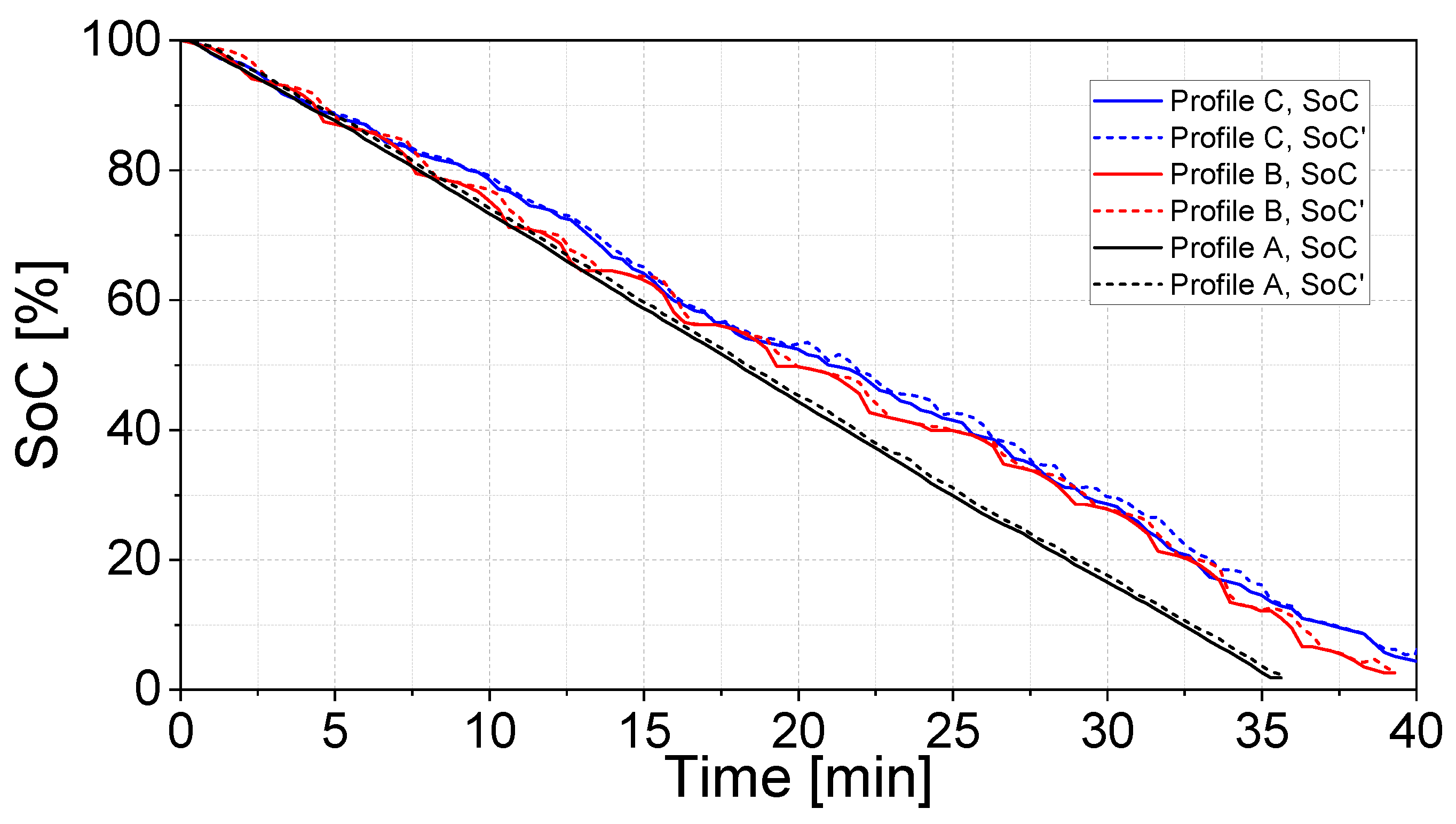
    Using battery power data (Figure 9) and microturbine output (Figure 10), Figure 11 illustrates how the integration of two microturbines reduced the power demand of the Li-Po battery over time across driving profiles A, B, and C, assuming that P D i f f ( t ) = P w i n d ( t ) 2 P h a r v ( t ) . Figure 11 shows that by integrating two microturbines, the energy demand was reduced to 97.21%, 98.06%, and 95.64% for the driving profiles A, B, and C, respectively. In this way, the use of two microturbines suggests that the battery life could be extended by up to 2.79%, 1.94%, and 4.36% for driving profiles A, B, and C, respectively. This gain is proportional to the reduced energy demand from harvested power.
    As demonstrated in Figure 12, the results indicate enhancements in the SoC of the battery, attributable to the energy yield of the microturbine-based energy harvester. Note that SoC’ represents the estimated SoC when the wind energy harvester was used in the EV.
    To confirm that the microturbine rotational speed, n, ranged from 0 to 25,000 RPM as indicated in Section 3.4, Equation (11) was considered.
    n = 60 λ v π D .
    Note that λ is a dimensionless quantity representing the specific speed of the microturbine. For a Savonius system, λ 1, since the tangential speed at the end of the rotor vanes is nearly equal to the wind speed. During the experiments, n ranged from 0 to 2800 RPM, which is well within the operating range of 25,000 RPM for the motor. The efficiency losses for any wind speed could be estimated using Equation (12).
    L = 1 P h a r v P w i n d C p = 1 η m e c η g e n = 0.335 .
    Note that L was estimated using the worst-case scenario for a Savonius microturbine, with η m e c = 0.95 and η g e n = 0.7.
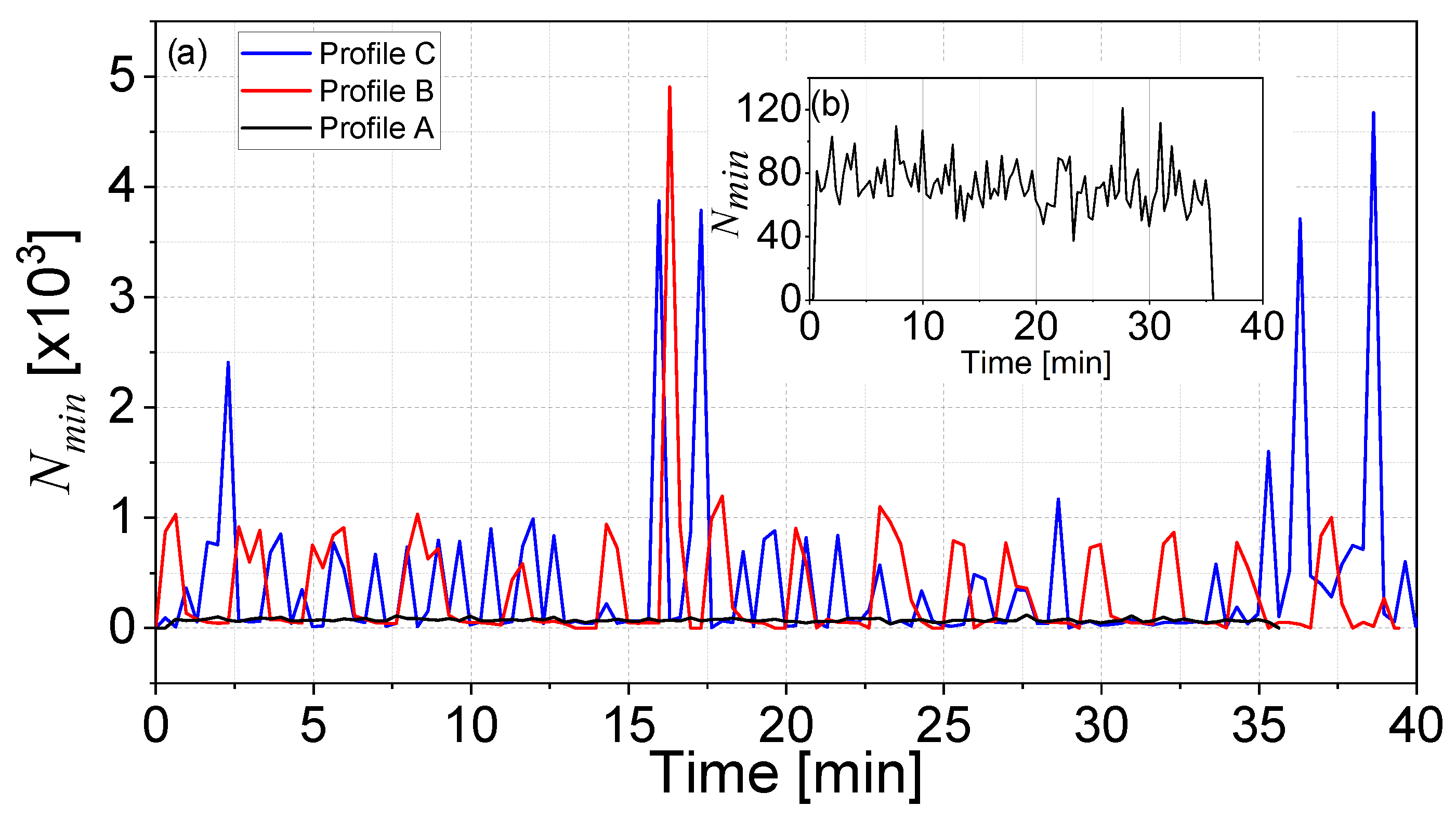
  • Determine N m i n . Figure 13 shows N m i n calculated using Equation (3), which accounts for how the speed of the electric vehicle impacted P h a r v for each driving profile. Table 5 shows a summary and comparison of the results from the three driving profiles.
    Note that with only two microturbines ( N m i n = 2 ) and assuming P c o n s = 100 W under driving profile A, each harvester must supply at least 50 W. To achieve this, the EV must maintain a speed greater than v = 27.88 m/s (100.36 km/h). However, such conditions increase power demands under other profiles.

3.5. Aerodynamic Drag Introduced by Microturbines

In EV applications, it is crucial to consider the aerodynamic drag introduced by Savonius microturbines. These turbines harvested wind energy while operating, but they also increased the aerodynamic drag coefficient of the vehicle. This increase in aerodynamic drag led to higher energy consumption and could counteract the energy that was harvested. Therefore, this study assessed the impact of utilizing Savonius microturbines by determining whether the energy savings exceeded the energy costs caused by the additional drag.
According to the prevailing view, the Savonius turbine is a drag-based machine. This means that it operates based on the difference in drag force between its two blades. Therefore, a turbine of this type, when mounted on an EV, especially at the front or top, acts as an additional obstacle, increasing the aerodynamic drag coefficient. Thus, the net energy equals the energy generated by the two turbines minus the additional energy consumed due to increased aerodynamic drag, as indicated by Equation (13).
P n e t = 2 P h a r v Δ P d r a g .
Assuming that,
Δ P d r a g = 1 2 ρ A E V v 3 Δ C d ,
where Δ C d is the increase in the EV drag coefficient due to the microturbine, and A E V is the EV frontal area.
Thus,
P n e t = 1 2 ρ v 3 { 2 A T C p η m e c η g e n A E V Δ C d η m e c } .
For P n e t > 0, p h a r v > P d r a g , and consequently, Equation (16) must be satisfied.
Δ C d 2 A T A E V C p η m e c 2 η g e n .
Thus, according to Equation (16), for the harvested energy to be relevant to the EV used in this case, a microturbine contributing with a Δ C d 0.038211 must be considered.
To validate this condition, Δ C d must be determined by considering one of three approaches: (i) experimental measurements placing the EV with the turbine in a wind tunnel, (ii) using computational fluid dynamic (CFD) to simulate airflow around the vehicle with and without the turbine, and (iii) empirical estimation when the experimental or CFD data are unavailable.
Based on specialized studies, an empirical estimation was applied in this study. El et al. [67] used the shear stress transport (SST) k- ω turbulence model in ANSYS-Fluent to simulate a vehicle with a front-mounted horizontal-axis wind turbine, recovering 5.13% of energy. The vehicle (4625 mm × 1730 mm × 1482 mm), modeled in SOLIDWORKS, showed a drag coefficient increase of 4.0512% (from 0.2814 to 0.2928) at a wind speed of up to 27 m/s (97.2 km/h) while traveling 100 km. Similarly, Yildiz and Besir [68], using the Viscous-Standard k- ε turbulence model, reported a 6.5% energy recovery and a drag coefficient increase of only 0.3864% (from 0.5693 to 0.5715) for a vehicle model (4000 mm × 1810 mm × 1482 mm) that included a front-mounted horizontal-axis wind turbine, as used by El et al. [67], operating at a wind speed of 27 m/s (97.2 km/h) while traveling 100 km. Finally, to determine the optimal location for the wind microturbine on the vehicle (front, hood, or roof), the study by Sofian et al. was reviewed [69]. Using ANSYS-Fluent, they modeled a sedan vehicle (4200 mm × 1700 mm × 1800 mm) to determine its drag coefficient while traveling at 25 m/s (90 km/h). They demonstrated that the drag coefficient of the vehicle changed by 0% at the front, 15.3846% at the hood, and 30.7692% at the roof. In other words, the drag coefficient increased from 0.39 to 0.45 at the hood and to 0.51 at the roof. However, the drag coefficient did not change when the turbine was located at the front of the vehicle.
Thus, following Sofian et al. [69], the microturbine was positioned at the front of the vehicle. Based on the studies by El et al. [67] and Yildiz and Dandil [68], the drag coefficient ( C d 0 ) ranged from 0.28 to 0.57 for a vehicle, and the change ( Δ C d ) ranged from 0.0039 to 0.0405. For this study, the midpoints were selected; that is, C d 0 = 0.4250 and Δ C d = 0.0222.
Consequently, based on Equations (13) and (14), P n e t > 0 at any EV speed, since η m e c = 0.95, η g e n = 0.7, and C p = 0.15 (See Equation (17)).
P n e t = 2.0898 × 10 4 ρ v 3 .
This result confirms the findings of previous studies, such as those conducted by Rogowski et al. [70] and Yildiz and Dandil [68], which concluded that aerodynamic drag is a significant factor in the use of microturbines in EVs. These studies also suggested that the net energy generated is marginal and may be insufficient to offset the increased aerodynamic drag.

4. Discussion

4.1. Energy Requirements in an Electric Vehicle

To determine the baseline energy needs for a scaled vehicle, this study used 2017 EPA fuel economy data, highlighting the superior efficiency of electric vehicles over gasoline models. The energy use aligns with Table 6, particularly for a 2012 Nissan Leaf, which accounts for the charging losses estimated by the Argonne National Laboratory.
Thus, according to Equation (17), the energy harvester has a marginal capacity to generate energy to cover a portion of a vehicle’s accessory energy demand in various driving scenarios, including combined city-highway, city, and highway conditions. Table 7 shows the proportion of the energy demand covered by this energy harvester for each driving profile and scenario. These results demonstrate how the energy harvested provides a marginal contribution to the energy demands of electric vehicles. While this harvested energy is insufficient to eliminate reliance on batteries or enable full battery-free sustainable mobility, it partially meets the energy needs of electric vehicles. Consequently, this technology holds promise for low power applications, including the Internet of Things and wireless sensor networks. Nevertheless, current limitations in power density and efficiency underscore the need for further research into scalable hybrid solutions. Additionally, reducing dependence on lithium involves exploring alternatives such as Sodium-ion batteries and improved recycling methods. These findings show that energy harvesting systems could be used in new ways to strengthen electric mobility, supporting a more sustainable and diversified transportation future.

4.2. Comparison Between Wind Energy Harvesters and Ambient RF Energy Harvesters

An analysis comparing micro wind turbines, ambient RF, and photovoltaic energy harvesting systems is required. All of them harvest energy from the environment, but they differ in size and use. Table 8 shows the important aspects to compare, such as energy source, power output, environment, physical size, maintenance, appearance, and applications.
Wind energy harvesters offer higher power output but require consistent wind and are often large and complex, making them suitable for large-scale applications. In contrast, ambient RF harvesters offer reduced power consumption but are compact, low-maintenance, and effective in wireless environments, albeit with limitations for ultra-low-power applications. In the context of electric vehicles, wind microturbines have emerged as a more viable energy harvesting option compared to RF systems. Wireless charging systems [78], such as the Qi standard for smartphones, are not energy harvesting systems. Consequently, a direct comparison between wireless charging systems and the energy harvesting systems described in this study is not possible. While wireless charging systems are designed for energy transfer, the systems used in this study are intended for energy harvesting.

4.3. Comparison Between Wind Energy Harvesters and Photovoltaic Harvesters

According to Table 9, the most suitable type of energy collector—wind or photovoltaic—depends on at least nine factors. This implies that each type works best under different conditions.
Microturbine-based wind energy harvesters are typically large, despite research on smaller, non-rotating alternatives such as piezoelectric and aeroelastic systems. Conversely, because they are small, silent, and simple to incorporate into surfaces, photovoltaic energy harvesters are favored for urban use. While wind energy harvesters are more appropriate for off-vehicle recharging, photovoltaic energy harvesters are more useful for electric vehicles. The two methods are contrasted in relation to electric vehicles in Table 10.
Despite the clear advantages of photovoltaic energy harvesters for electric vehicles, this study aims to establish a baseline and define the context for exploring Venturi microturbine–based energy harvesters. The achievement of a positive net energy gain with these microturbines poses significant engineering challenges.

4.4. Advantages of Experimental Design

The experimental design used in this study offers four main advantages that strengthen its validity and applicability. First, it incorporates real-time monitoring of key battery parameters—current, voltage, and temperature—under controlled conditions, ensuring accurate estimation of the battery SoC. Second, the use of three distinct driving profiles (constant, sawtooth, and random speeds) provides a comprehensive representation of real-world driving scenarios, enhancing the generalization of the findings. Third, the integration of an automated control platform allows for precise data acquisition and minimizes human error, improving reliability and replicability. Additionally, the design accounts for aerodynamic drag and efficiency losses when evaluating energy recovery, which adds rigor by considering practical constraints rather than idealized conditions. Finally, continuous monitoring over an extended period ensures that both transient and steady-state behaviors of the electrochemical system are captured, resulting in a robust dataset for analysis.

4.5. Perspectives and Limitations

This research has the potential to stimulate innovative strategies for the sustainable integration of renewable energy into electric vehicles. Although current wind energy recovery is minimal, future improvements in turbine design, aerodynamic optimization, and lightweight materials could significantly increase the efficiency of energy harvesters. Furthermore, combining wind energy with other renewable sources, such as solar panels or regenerative braking, along with implementing intelligent energy management systems, could transform this concept into a practical solution for powering a vehicle’s auxiliary systems. These advances would reduce the environmental impact of transportation and support the development of greener mobility technologies.
However, this approach is not yet commercially viable due to the extremely low amount of captured energy, below 0.05% of the auxiliary system’s energy demand. Aerodynamic drag and efficiency losses limit its practicality. While the concept demonstrates technical feasibility, substantial research and development are needed to overcome these limitations and achieve significant energy gains.

5. Conclusions

This study employed a docking platform integrating an electric vehicle with three systems: a driving profile module, an electronic system for monitoring battery-related parameters, and an electronic system to track the speed of a scaled-down electric vehicle. Utilizing current, voltage, and temperature data from the Traxxas 3-cell Li-Po battery under three distinct driving profiles—the SoC was estimated. Despite significant differences in driving conditions, SoC behavior remained consistent across all profiles. To avoid battery damage during testing, continuous monitoring of voltage and temperature was critical. However, the high sensitivity of the temperature sensor occasionally led to inaccuracies, indicating a need for more reliable sensors in future experiments. Two Savonius microturbine-based energy harvesters were used. Although the energy harvested was insufficient to meet the total energy demand of the system, it could reasonably support the accessory electric systems of the vehicle. Notably, in the optimal scenario—using the driving profile C on a highway—the energy harvested was 2.18 times the energy required by the accessories. Using the driving profile B (city scenario), in the best case, the recovered energy could supply up to 0.0833% of the auxiliary electric system demand, and 0.0398% in the worst case, using two microturbines. This projection was based on the 2017 EPA Fuel Economy Data, considering that the energy distribution among the components of the electric vehicle was 3%, the midpoint in the declared range. Even though the recovered energy is marginal (0.0833% at best), the study emphasizes sustainable energy management strategies for EVs, aligning with global efforts to reduce transportation-related emissions. During energy harvesting, the Savonius rotor’s RPM was monitored to ensure operation within the technical specifications of the microturbine. Although considered inefficient and low in energy output, a Savonius-based microturbine was chosen because of its advantages: low rotational speed, high torque, low sensitivity to wind direction, and a simple design. With these features, this microturbine is appropriate for driving in a city. Based on these factors, a prediction was made indicating that, depending on the driving profile, the harvested energy could marginally extend the battery life. In addition, the number of microturbine-based wind energy harvesters required to fully meet the energy needs of the system was estimated, yielding averages of 71, 327, and 405 devices for driving profiles A, B, and C, respectively, without considering losses due to drag forces in EVs when the microturbine is added. A comparative analysis was also conducted between microturbine-based energy harvesters, ambient radio frequency (RF) harvesters, and photovoltaic systems. The analysis showed that each type of harvester has its own advantages and disadvantages, depending on the specific application and context. The following key factors were considered in the comparison: energy source, functionality, power output, environmental conditions, size, maintenance, and aesthetics. Finally, aerodynamic drag emerges as the principal factor limiting the efficacy of Savonius turbines (or any other type of turbine) for substantial power generation on a moving EV. Thus, reducing the vehicle’s overall drag coefficient remains the most effective strategy for extending EV range, rather than incorporating additional components that increase aerodynamic resistance.

Author Contributions

Conceptualization, O.J.-R. and R.V.-M.; Methodology, D.A.-T., O.J.-R. and J.C.P.-R.; Software, D.G.-R.; Validation, O.J.-R., E.C.-Q., D.A.-T. and R.V.-M.; Formal analysis, O.J.-R. and D.A.-T.; Investigation, D.A.-T. and J.C.P.-R.; Resources, O.J.-R. and R.V.-M.; Data curation, E.C.-Q. and D.G.-R.; Writing—original draft preparation, R.V.-M., D.A.-T. and D.G.-R.; Writing—review and editing, E.C.-Q., J.C.P.-R., D.A.-T. and O.J.-R.; Visualization, J.C.P.-R.; Supervision, R.V.-M. and O.J.-R.; Project administration, R.V.-M.; Funding acquisition, R.V.-M., O.J.-R. and E.C.-Q. All authors have read and agreed to the published version of the manuscript.

Funding

This research was funded by Instituto Politécnico Nacional [Grant numbers: SIP-20250094 (E. Carvajal-Quiroz), SIP-20250154 (O. Jiménez-Ramírez), and SIP-20250150, SIP-20250321 (R. Vázquez-Medina)].

Institutional Review Board Statement

Not applicable.

Informed Consent Statement

Not applicable.

Data Availability Statement

Dataset available on request from the authors.

Acknowledgments

D. Aguilar-Torres (CVU-829790) and D. Gutiérrez-Rosales (CVU-1269306) would like to express their gratitude for the scholarship awarded by Secretaría de Ciencia, Humanidades, Tecnología e Innovación (SECIHTI, Mexico).

Conflicts of Interest

The authors declare no conflicts of interest.

Abbreviations

The following abbreviations are used in this manuscript:
BMSBattery management system
CFDComputational fluid dynamic
C-ratesDischarge rates
DCDirect current
EPAEnvironmental Protection Agency
EVElectric vehicle
IoTInternet of Things
LEDLight-emitting diode
Li-PoLithium-polymer
MPPTMaximum power point tracking
NTCNegative temperature coefficient
RFRadio frequency
RPMRevolutions per minute
SoCState of Charge
SSTShear stress transport
SoHState of health
VAWTVertical-axis wind turbine

References

  1. Umamaheswari, B.; Santhosh, S.; Ulugbek, A.; Singh, R.; Abbas, A.H.R.; Sherje, N.P. Innovative approaches to harvesting and storing renewable energy from ambient sources. E3S Web Conf. 2024, 540, 13016. [Google Scholar] [CrossRef]
  2. Kang, M.; Yeo, W.H. Advances in energy harvesting technologies for wearable devices. Micromachines 2024, 15, 884. [Google Scholar] [CrossRef]
  3. Nishanth, J.R.; Senthilkumar, B. Hybrid energy harvesting by reverse di-electric on a piezo-electric generator with thermo-couple and monitoring in WSN. Automatika 2024, 65, 738–748. [Google Scholar] [CrossRef]
  4. Xu, J.; Ma, S.; Gao, P.; Guo, Y.; Sun, J.; Qiao, D.; Ma, B.; Yuan, W.; Ramakrishna, S.; Ye, T. The state-of-the-art fundamentals and applications of micro-energy systems on chip (MESOC). Natl. Sci. Open 2025, 4, 20240044. [Google Scholar] [CrossRef]
  5. Adhikari, C. High-efficiency nanostructured materials for flexible and wearable energy harvesting technologies. EPJ Web Conf. 2025, 325, 01002. [Google Scholar] [CrossRef]
  6. Xing, L.; Kou, F.; Wang, G.; Liu, P.; Lv, W.; Yang, C. Energy recovery and energy-saving control of a novel hybrid electromagnetic active suspension system for electric vehicles. Energy 2025, 335, 138030. [Google Scholar] [CrossRef]
  7. Zhang, B.; Luo, M.; Tan, C.A. Ride comfort and energy harvesting of inflatable hydraulic-electric regenerative suspension system for heavy-duty vehicles. J. Mech. Sci. Technol. 2024, 38, 2277–2289. [Google Scholar] [CrossRef]
  8. Behara, N.S.R.; Rao, P.S. Vibration energy harvesting using telescopic suspension system for conventional two-wheeler and EV. Res. Eng. Struct. Mater. 2023, 9, 687–707. [Google Scholar] [CrossRef]
  9. Liu, L.; Guo, X.; Liu, W.; Lee, C. Recent progress in the energy harvesting technology—From self-powered sensors to self-sustained IoT, and new applications. Nanomaterials 2021, 11, 2975. [Google Scholar] [CrossRef]
  10. De Oliveira, T.; Girardi, A.; De Aguirre, P.C.; Severo, L. A 915 MHz closed-loop self-regulated RF energy harvesting system for batteryless devices. J. Integr. Circuits Syst. 2023, 18, 1–11. [Google Scholar] [CrossRef]
  11. Hosseini, S.M.; Soleymani, M.; Kelouwani, S.; Amamou, A.A. Energy recovery and energy harvesting in electric and fuel cell vehicles, a review of recent advances. IEEE Access 2023, 11, 83107–83135. [Google Scholar] [CrossRef]
  12. Mhatre, A.S.; Shukla, P. A comprehensive review of energy harvesting technologies for sustainable electric vehicles. Environ. Sci. Pollut. Res. 2024. [Google Scholar] [CrossRef]
  13. Gao, Z.; Zhou, Y.; Zhang, J.; Foroughi, J.; Peng, S.; Baughman, R.H.; Wang, Z.L.; Wang, C.H. Advanced energy harvesters and energy storage for powering wearable and implantable medical devices. Adv. Mater. 2024, 36, 2404492. [Google Scholar] [CrossRef]
  14. Ali, A.; Shaukat, H.; Elahi, H.; Taimur, S.; Manan, M.Q.; Altabey, W.A.; Kouritem, S.A.; Noori, M. Advancements in energy harvesting techniques for sustainable IoT devices. Results Eng. 2025, 26, 104820. [Google Scholar] [CrossRef]
  15. Safaei, B.; Peiravian, M.; Siamaki, M. Eco-friendly IoT: Leveraging energy harvesting for a sustainable future. IEEE Sens. Rev. 2025, 2, 32–75. [Google Scholar] [CrossRef]
  16. Hussain, Z.M.; Anbalagan, R.; Jayabalakrishnan, D.; Naga Muruga, D.B.; Prabhahar, M.; Bhaskar, K.; Sendilvelan, S. Charging of car battery in electric vehicle by using wind energy. Mater. Today Proc. 2021, 45, 5873–5877. [Google Scholar] [CrossRef]
  17. Surendran, A.; Baig, A.; Acharya, R.K. Smart energy harvesting in electric vehicles: Integrating automation for enhanced sustainability. Int. J. Res. Publ. Rev. 2023, 4, 1650–1662. [Google Scholar] [CrossRef]
  18. Helera, C.; Stoichescu, D.A. Utilizing relative wind energy for dynamic charging in electric and hybrid vehicles. In Wind Power—From Energy Conversion to Technological and Operational Challenges; Ismail, D.B.I.A., Ed.; IntechOpen: London, UK, 2025; Volume Chapter 4. [Google Scholar] [CrossRef]
  19. Dinh Le, A.; Minh, B.D.; Trinh, C.D. High efficiency energy harvesting using a Savonius turbine with multicurve and auxiliary blade. J. Fluids Eng. 2022, 144, 111207. [Google Scholar] [CrossRef]
  20. Arbiyani, F.; Lasut, F.P. Design of Savonius vertical axis wind turbine for vehicle. J. Mech. Eng. Sci. Technol. 2020, 4, 125–134. [Google Scholar] [CrossRef]
  21. Kamran Khan, M.; Hamza Zafar, M.; Riaz, T.; Mansoor, M.; Akhtar, N. Enhancing efficient solar energy harvesting: A process-in-loop investigation of MPPT control with a novel stochastic algorithm. Energy Convers. Manag. X 2024, 21, 100509. [Google Scholar] [CrossRef]
  22. Liao, H.; Na, J.; Zhou, W.; Hur, S.; Chien, P.M.; Wang, C.; Wang, L.; Yamauchi, Y.; Yuan, Z. Enhancing energy harvesting performance and sustainability of cellulose-based triboelectric nanogenerators: Strategies for performance enhancement. Nano Energy 2023, 116, 108769. [Google Scholar] [CrossRef]
  23. Mondal, A.; Gautam, A.K.; Khare, N. Boosting electrical efficiency in hybrid energy harvesters by scavenging ambient thermal and mechanical energy. Energy Convers. Manag. 2025, 332, 119739. [Google Scholar] [CrossRef]
  24. Sevcik, P.; Sumsky, J.; Baca, T.; Tupy, A. Self-sustaining operations with energy harvesting systems. Energies 2025, 18, 4467. [Google Scholar] [CrossRef]
  25. Nkele, A.; Ikhioya, I.; Chime, C.; Ezema, F. Improving the performance of solar thermal energy storage systems. J. Energy Power Technol. 2023, 5, 24. [Google Scholar] [CrossRef]
  26. Khan, S.Y.; Rauf, S.; Liu, S.; Chen, W.; Shen, Y.; Kumar, M. Revolutionizing the solar photovoltaic efficiency: A comprehensive review on the cutting-edge thermal management methods for advanced and conventional solar photovoltaics. Energy Environ. Sci. 2025, 18, 1130–1175. [Google Scholar] [CrossRef]
  27. Guarino, S.; Lo Brano, V.; Kosny, J. Understanding the transformative potential of solar thermal technology for urban sustainability. Front. Sustain. Cities 2025, 7, 1583316. [Google Scholar] [CrossRef]
  28. Appalasamy, K.; Mamat, R.; Kumarasamy, S. Smart thermal management of photovoltaic systems: Innovative strategies. AIMS Energy 2025, 13, 309–353. [Google Scholar] [CrossRef]
  29. Sun, Y.; Li, Y.Z.; Yuan, M. Requirements, challenges, and novel ideas for wearables on power supply and energy harvesting. Nano Energy 2023, 115, 108715. [Google Scholar] [CrossRef]
  30. Rogdakis, K.; Psaltakis, G.; Fagas, G.; Quinn, A.; Martins, R.; Kymakis, E. Hybrid chips to enable a sustainable internet of things technology: Opportunities and challenges. Discov. Mater. 2024, 4, 4. [Google Scholar] [CrossRef]
  31. Abdulmalek, S.; Nasir, A.; Jabbar, W.A. LoRaWAN-based hybrid internet of wearable things system implementation for smart healthcare. Internet Things 2024, 25, 101124. [Google Scholar] [CrossRef]
  32. Ali, A.; Shaukat, H.; Bibi, S.; Altabey, W.A.; Noori, M.; Kouritem, S.A. Recent progress in energy harvesting systems for wearable technology. Energy Strategy Rev. 2023, 49, 101124. [Google Scholar] [CrossRef]
  33. Prasad, P.V.; Mallala, B.; Chinnave, S.; Arunachalam, K.P. Enhanced energy management in IoT-assisted hybrid microgrids through builder optimization algorithm and neural architecture search-guided physics-informed neural network. Wind. Eng. 2025, 0309524X251389729. [Google Scholar] [CrossRef]
  34. Manivannan, R. Research on IoT-based hybrid electrical vehicles energy management systems using machine learning-based algorithm. Sustain. Comput. Inform. Syst. 2024, 41, 100943. [Google Scholar] [CrossRef]
  35. Shen, J. The convergence of internet of things and electric vehicles: A path toward smarter charging solutions. Intell. Decis. Technol. 2025, 19, 3692–3706. [Google Scholar] [CrossRef]
  36. Zhang, Q.; Soham, D.; Liang, Z.; Wan, J. Advances in wearable energy storage and harvesting systems. Med-X 2025, 3, 3. [Google Scholar] [CrossRef]
  37. Yu, X.; Manthiram, A. Sustainable battery materials for next-generation electrical energy storage. Adv. Energy Sustain. Res. 2021, 2, 2000102. [Google Scholar] [CrossRef]
  38. Bao, J.; Mao, Y.; Zhang, Z.; Jiang, Y.; Zhang, Y.; Yang, Y. A data-driven-aided thermoelectric equivalent circuit model for accurate temperature prediction of Lithium-ion batteries. Int. J. Energy Res. 2024, 2024, 5544635. [Google Scholar] [CrossRef]
  39. Khan, M.K.; Raza, M.; Shahbaz, M.; Farooq, U.; Akram, M.U. Recent advancement in energy storage technologies and their applications. J. Energy Storage 2024, 92, 112112. [Google Scholar] [CrossRef]
  40. Adeyinka, A.M.; Esan, O.C.; Ijaola, A.O.; Farayibi, P.K. Advancements in hybrid energy storage systems for enhancing renewable energy-to-grid integration. Sustain. Energy Res. 2024, 11, 26. [Google Scholar] [CrossRef]
  41. Alphonse Raj, R.; Raaju Sundhar, A.S.; Bejigo, K.S.; Kim, S. Interfacial engineering with Lithium Titanate on MCMB anode for Lithium-ion batteries. Energy Environ. Mater. 2025, e70099. [Google Scholar] [CrossRef]
  42. Srivastava, S.K.; Awasthi, H.; Hota, C.; Goel, S. Synthetic data–based approach for supercapacitor characterization and areal capacitance optimization using cyclic voltammetry data. Int. J. Energy Res. 2024, 2024, 3993551. [Google Scholar] [CrossRef]
  43. Czagany, M.; Hompoth, S.; Keshri, A.K.; Pandit, N.; Galambos, I.; Gacsi, Z.; Baumli, P. Supercapacitors: An efficient way for energy storage application. Materials 2024, 17, 702. [Google Scholar] [CrossRef]
  44. Shuja, A.; Khan, H.R.; Murtaza, I.; Ashraf, S.; Abid, Y.; Farid, F.; Sajid, F. Supercapacitors for energy storage applications: Materials, devices and future directions: A comprehensive review. J. Alloys Compd. 2024, 1009, 176924. [Google Scholar] [CrossRef]
  45. Iqbal, M.F.; Nasir, F.; Shabbir, F.; Babar, Z.U.D.; Saleem, M.F.; Ullah, K.; Sun, N.; Ali, F. Supercapacitors: An emerging energy storage system. Adv. Energy Sustain. Res. 2025, 6, 2400412. [Google Scholar] [CrossRef]
  46. Liu, H.; Liu, X.; Wang, S.; Liu, H.K.; Li, L. Transition metal based battery-type electrodes in hybrid supercapacitors: A review. Energy Storage Mater. 2020, 28, 122–145. [Google Scholar] [CrossRef]
  47. Benoy, S.M.; Pandey, M.; Bhattacharjya, D.; Saikia, B.K. Recent trends in supercapacitor-battery hybrid energy storage devices based on carbon materials. J. Energy Storage 2022, 52, 104938. [Google Scholar] [CrossRef]
  48. Almusawi, M.; Shukla, A.; S., H.; Kavitha, P.; Gambhire, G.M.; Pardeshi, P.R.; Pragathi, B. Comparative analysis of supercapacitors vs. batteries. E3S Web Conf. 2024, 591, 01010. [Google Scholar] [CrossRef]
  49. Muralee Gopi, C.V.V.; Alzahmi, S.; Narayanaswamy, V.; Vinodh, R.; Issa, B.; Obaidat, I.M. Supercapacitors: A promising solution for sustainable energy storage and diverse applications. J. Energy Storage 2025, 114, 115729. [Google Scholar] [CrossRef]
  50. Kabeyi, M.J.B.; Olanrewaju, O.A. Smart grid technologies and application in the sustainable energy transition: A review. Int. J. Sustain. Energy 2023, 42, 685–758. [Google Scholar] [CrossRef]
  51. Han, D.; Song, C.K.; Lee, G.; Song, W.; Park, S. A comprehensive review of battery-integrated energy harvesting systems. Adv. Mater. Technol. 2024, 9, 2302236. [Google Scholar] [CrossRef]
  52. Sheng, H.; Ma, Y.; Zhang, H.; Yuan, J.; Li, F.; Li, W.; Xie, E.; Lan, W. Integration of supercapacitors with sensors and energy-harvesting devices: A review. Adv. Mater. Technol. 2024, 9, 2301796. [Google Scholar] [CrossRef]
  53. Lund, H.; Østergaard, P.A.; Connolly, D.; Mathiesen, B.V. Smart energy and smart energy systems. Energy 2017, 137, 556–565. [Google Scholar] [CrossRef]
  54. Mohammadi, M.; Noorollahi, Y.; Mohammadi-Ivatloo, B. An introduction to smart energy systems and definition of smart energy hubs. In Operation, Planning, and Analysis of Energy Storage Systems in Smart Energy Hubs; Springer International Publishing: Cham, Switzerland, 2018; pp. 1–21. [Google Scholar] [CrossRef]
  55. Xu, Y.; Yan, C.; Liu, H.; Wang, J.; Yang, Z.; Jiang, Y. Smart energy systems: A critical review on design and operation optimization. Sustain. Cities Soc. 2020, 62, 102369. [Google Scholar] [CrossRef]
  56. Kechida, A.; Gozim, D.; Toual, B.; Alharthi, M.M.; Agaije, T.F.; Ghoneim, S.M.S.; Ghaly, R.N.R. Smart control and management for a renewable energy based stand-alone hybrid system. Sci. Rep. 2024, 14, 32039. [Google Scholar] [CrossRef]
  57. Yaseen, D.; Qays, H.; Abdulkareem, H.; Ahmed, F. Enhancing energy efficiency utilized IoT: Power optimization and energy harvesting techniques for sustainable and resilient systems. J. Educ. Sci. 2025, 34, 45–54. [Google Scholar] [CrossRef]
  58. Lohse-Busch, H.; Duoba, M.; Rask, E.; Stutenberg, K.; Gowri, V.; Slezak, L.; Anderson, D. Ambient Temperature (20 °F, 72 °F and 95 °F) Impact on Fuel and Energy Consumption for Several Conventional Vehicles, Hybrid and Plug-in Hybrid Electric Vehicles and Battery Electric Vehicle; SAE Technical Paper Series; SAE International: Warrendale, PA, USA, 2013; p. 33. [Google Scholar] [CrossRef]
  59. United States, Department of Energy and Environmental Protection Agency, Office of Energy Efficiency and Renewable Energy. Where the Energy Goes: Electric Cars. 2017. U.S. Government Source for Fuel Economy Information. Available online: https://www.fueleconomy.gov/feg/atv-ev.shtml (accessed on 30 October 2025).
  60. Balasingam, B.; Ahmed, M.; Pattipati, K. Battery management systems—Challenges and some solutions. Energies 2020, 13, 2825. [Google Scholar] [CrossRef]
  61. Movassagh, K.; Raihan, A.; Balasingam, B.; Pattipati, K. A critical look at Coulomb counting approach for State of Charge estimation in batteries. Energies 2021, 14, 4074. [Google Scholar] [CrossRef]
  62. Das, S.; Samanta, S.; Gupta, S. Online state-of-charge estimation by modified Coulomb counting method based on the estimated parameters of lithium-ion battery. Int. J. Circuit Theory Appl. 2023, 52, 749–768. [Google Scholar] [CrossRef]
  63. Montgomery, D.C. Design and Analysis of Experiments, 10th ed.; Wiley: Hoboken, NJ, USA, 2020. [Google Scholar]
  64. Box, G.E.P.; Hunter, J.S.; Hunter, W.G. Statistics for Experimenters, 2nd ed.; Wiley Series in Probability and Statistics; Wiley: New York, NY, USA, 2005. [Google Scholar]
  65. Zhang, J.; Lee, J. A review on prognostics and health monitoring of Li-ion battery. J. Power Sources 2011, 196, 6007–6014. [Google Scholar] [CrossRef]
  66. Mohamed, M.H.; Alqurashi, F.; Thévenin, D. Performance enhancement of a Savonius turbine under effect of frontal guiding plates. Energy Rep. 2021, 7, 6069–6076. [Google Scholar] [CrossRef]
  67. El, E.; Yildiz, C.; Dandil, B.; Yildiz, A. Effect of wind turbine designed for electric vehicles on aerodynamics and energy performance of the vehicle. Therm. Sci. 2022, 26, 2907–2917. [Google Scholar] [CrossRef]
  68. Yildiz, A.; Dandil, B. Influence of wind turbine mounted on vehicle on aerodynamic drag and energy gain. Sci. Iran. 2025, in press. [Google Scholar] [CrossRef]
  69. Sofian, M.; Nurhayati, R.; Rexca, A.J.; Syariful, S.S.; Aslam, A. An evaluation of drag coefficient of wind turbine system installed on moving car. Appl. Mech. Mater. 2014, 660, 689–693. [Google Scholar] [CrossRef]
  70. Rogowski, K.; Maroński, R. CFD computation of the Savonius rotor. J. Theor. Appl. Mech. 2015, 53, 37–45. [Google Scholar] [CrossRef]
  71. Nabavi, S.; Zhang, L. Portable wind energy harvesters for low-power applications: A survey. Sensors 2016, 16, 1101. [Google Scholar] [CrossRef]
  72. Calautit, K.; Nasir, D.S.N.M.; Hughes, B.R. Low power energy harvesting systems: State of the art and future challenges. Renew. Sustain. Energy Rev. 2021, 147, 111230. [Google Scholar] [CrossRef]
  73. Yathavi, T.; Maunasree, K.; Meenakshi, G.B.; Malika, M.V.; Santhoshini, M. RF energy harvesting for low power applications. In Proceedings of the 2021 10th International Conference on Internet of Everything, Microwave Engineering, Communication and Networks (IEMECON), Jaipur, India, 1–2 December 2021; IEEE: New York, NY, USA, 2021; pp. 1–6. [Google Scholar] [CrossRef]
  74. Lee, J.H.; Kim, S.J.; Kim, S.; Oh, J.I.; Lee, C.H.; Yu, J.W. Feasibility analysis of ambient RF energy harvesting for low-power IoT devices. In Proceedings of the 2022 International Symposium on Antennas and Propagation (ISAP), Sydney, Australia, 31 October–3 November 2022; IEEE: New York, NY, USA, 2022; pp. 329–330. [Google Scholar] [CrossRef]
  75. Zheng, J.; Li, Z.; Zhang, H. Low-wind-speed galloping wind energy harvester based on a W-shaped bluff body. Energies 2024, 17, 958. [Google Scholar] [CrossRef]
  76. Su, B.; Guo, T.; Alam, M.M. A review of wind energy harvesting technology: Civil engineering resource, theory, optimization, and application. Appl. Energy 2025, 389, 125771. [Google Scholar] [CrossRef]
  77. Bzzou, M.; Karfa Bekali, Y.; El Bhiri, B. RF energy-harvesting systems: A systematic review of receiving antennas, matching circuits, and rectifiers. Eng. Proc. 2025, 112, 48. [Google Scholar] [CrossRef]
  78. Niu, S.; Yu, H.; Niu, S.; Jian, L. Power loss analysis and thermal assessment on wireless electric vehicle charging technology: The over-temperature risk of ground assembly needs attention. Appl. Energy 2020, 275, 115344. [Google Scholar] [CrossRef]
  79. Hao, D.; Qi, L.; Tairab, A.M.; Ahmed, A.; Azam, A.; Luo, D.; Pan, Y.; Zhang, Z.; Yan, J. Solar energy harvesting technologies for PV self-powered applications: A comprehensive review. Renew. Energy 2022, 188, 678–697. [Google Scholar] [CrossRef]
  80. Roga, S.; Bardhan, S.; Kumar, Y.; Dubey, S.K. Recent technology and challenges of wind energy generation: A review. Sustain. Energy Technol. Assessments 2022, 52, 102239. [Google Scholar] [CrossRef]
  81. Bhatt, K.; Kumar, S.; Kumar, S.; Sharma, S.; Singh, V. A review on energy harvesting technologies: Comparison between non-conventional and conceptual approaches. Energy Rep. 2024, 12, 4717–4740. [Google Scholar] [CrossRef]
  82. Du, H.; Lu, J.; Zhang, W.; Yang, G.; Zhang, W.; Xu, Z.; Wang, H.; Dai, K.; Gao, L. Advancements and future prospects of energy harvesting technology in power systems. Micromachines 2025, 16, 964. [Google Scholar] [CrossRef]
  83. Saha, C.R.; Huda, M.N.; Mumtaz, A.; Debnath, A.; Thomas, S.; Jinks, R. Photovoltaic (PV) and thermo-electric energy harvesters for charging applications. Microelectron. J. 2020, 96, 104685. [Google Scholar] [CrossRef]
  84. Bai, S.; Liu, C. Overview of energy harvesting and emission reduction technologies in hybrid electric vehicles. Renew. Sustain. Energy Rev. 2021, 147, 111188. [Google Scholar] [CrossRef]
  85. Bentouba, S.; Zioui, N.; Breuhaus, P.; Bourouis, M. Overview of the potential of energy harvesting sources in electric vehicles. Energies 2023, 16, 5193. [Google Scholar] [CrossRef]
  86. Angamarca-Avendaño, D.A.; Flores-Vázquez, C.; Cobos-Torres, J.C. A photovoltaic and wind-powered electric vehicle with a charge equalizer. Energies 2024, 17, 4665. [Google Scholar] [CrossRef]
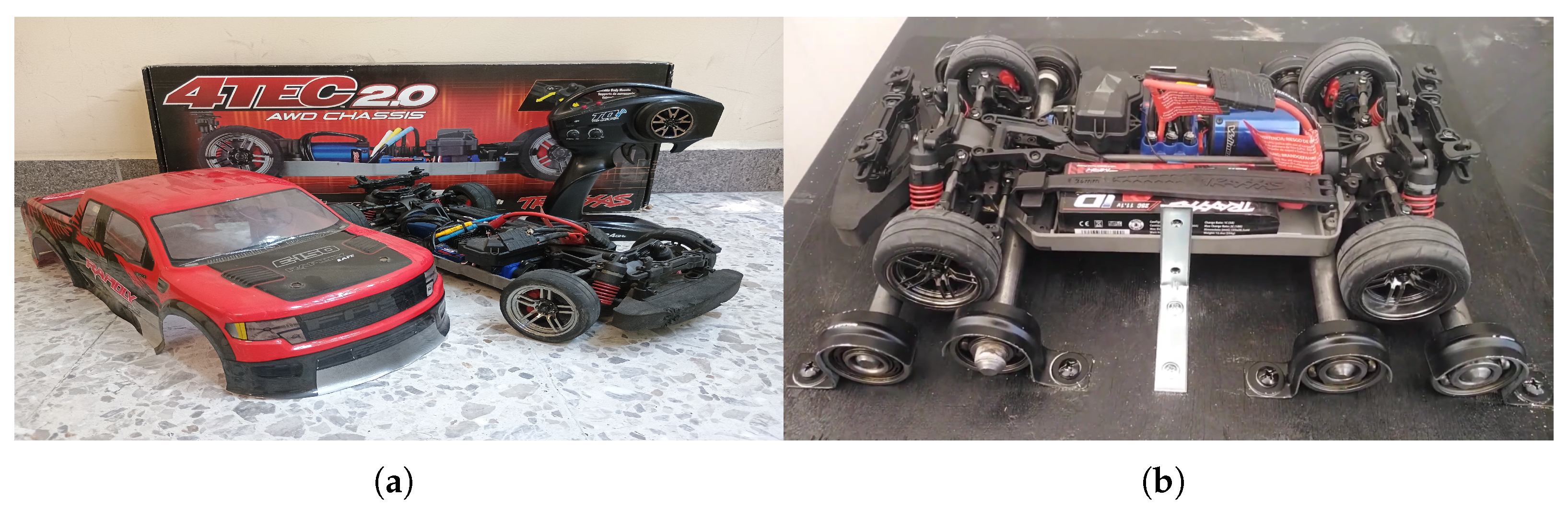
Figure 1. Electric vehicle prepared for this study. (a) A 1:10 scale model of the electric vehicle; (b) Docking platform with the electric vehicle coupled.
Wevj 16 00682 g001
Figure 2. Schematic diagram for the docking platform to conduct experiments using a 1:10 scale model of an electric vehicle.
Wevj 16 00682 g002
Figure 3. Speed of electric vehicles for three driving profiles.
Wevj 16 00682 g003
Figure 4. Results of the experiment based on Driving Profile A: (a) Interest variables of the battery of the electric vehicle when Driving Profile A was used in a 36-min experiment; (b) Behavior of the battery SoC.
Wevj 16 00682 g004
Figure 5. Results of the experiment based on driving profile B: (a) Interest variables of the vehicle battery when driving profile B was used during a 39-min experiment; the dotted red line indicates an approximation by using a polynomial regression. (b) Behavior of the battery SoC.
Wevj 16 00682 g005
Figure 6. Results of the experiment based on driving profile C: (a) Interest variables of the vehicle battery when driving profile C was used during a 40-min experiment; the dotted red line indicates an approximation by using a peak function model. (b) Behavior of the battery SoC.
Wevj 16 00682 g006
Figure 7. Distance traveled by electric vehicle for each driving profile.
Wevj 16 00682 g007
Figure 8. Configuration of microturbine based on a wind vane vertically oriented. Image taken from https://www.amazon.com.mx (accessed on 30 October 2025) when the seller is Astyer-X and the manufacturer is FTVogue.
Wevj 16 00682 g008
Figure 9. Instantaneous power consumed by the 1:10 scale model of the electric vehicle.
Wevj 16 00682 g009
Figure 10. Power produced by the microturbine considering the three driving profiles.
Wevj 16 00682 g010
Figure 11. Reduction in the power requirements of the Li-Po battery over time when two energy harvesters are integrated into the electric vehicle.
Wevj 16 00682 g011
Figure 12. Improvements in the battery SoC by using an energy harvester based on two microturbines. Dotted line represents, each case, the estimated SoC when the wind energy harvester is used in the electric vehicle.
Wevj 16 00682 g012
Figure 13. N m i n calculated using Equation (3): (a) for three driving profiles and (b) for driving profile A, when an appropriate scale was used for visualization.
Wevj 16 00682 g013
Table 1. Comparative Features of Energy Harvesters and Li-Po Batteries.
FeatureEnergy HarvesterLi-Po Batteries
Output powerExtremely low (μW to mW).Substantially high (tens to hundreds of watts) with even higher capacities in electric mobility applications.
Energy sourceAmbient, intermittent, and unpredictable (wind, solar, vibration, RF, heat).Internal stored self-contained chemical energy.
Energy densityExtremely low.High (150–250 Wh/kg).
Conversion efficiencyLimited (10–50%, source-dependent).High (>90%).
LongevityPractically unlimited (absent chemical degradation). It depends on power source availability and is affected by component wear and environmental conditions. 1Limited (300–500 cycles typical for Li-Po).
ApplicationsUltra-low power wireless sensor networks, implantable biomedical devices, and wearable wearable-mounted electronics.Smartphones, laptops, and electric vehicles.
MaintenanceMinimal, generally self-sustaining once deployed.Requires periodic monitoring and proper charging.
Environmental impactLow.Moderate to high (mining, disposal issues).
Note 1: They experience a gradual degradation in efficiency due to aging of the materials, but they tend to maintain their functionality longer than electrochemical storage systems.
Table 2. Technical specifications of the electric vehicle, battery, and motor used in the case study.
ComponentParameterSpecifications
Electric vehicleLength379 mm
Width200 mm
Height62 mm
Weight1.44 kg
Wheel diameter66 mm
TransmissionSingle speed direct drive
Battery-Traxxas 3 CellTechnologyLi-Po
Total capacity, C n o m 5000 mAh
Nominal voltage11.1 V
Continuous discharge125 A
Maximum explosion speed250 A
Watt Hours55.5
Loading rate5 A
Maximum load rate10 A
Dimensions155 mm × 26 mm × 44 mm
Weight376 g
Discharge cut-off voltage 19.25 V
Temperature range
(charging condition)
0 °C to 43 °C
Temperature range
(discharging condition)
0 °C to 60 °C
Temperature range
(storage condition) 2
15 °C to 25 °C
Velineon 3500 motorTechnologyBrushless
RPM/volt3500
Max RPM50,000
Magnet typeNeodymium
Connection type3.5 mm
Current65 A to 100 A
Diameter36 mm
Length55 mm
Weight262 g
Note 1: It refers to the battery voltage when its S o C ( t ) approaches 0. %Note 2: It is the condition of a cool, dry place that does not expose the battery to direct sunlight, and whose temperature does not exceed 60 °C.
Table 3. Specifications of the three sensors used.
SensorParameterTechnical SpecificationsAdditional Information
ESP32 ADCVoltageRange: 0–33 VVoltage divider 1:10
Sensitivity: 3.3 mV/LSB
Resolution: 10 bits
Modified INA219CurrentRange: 0–32 AModified for high currents
R S h u n t : 0.01 Ω (original 0.1 Ω)Accuracy: ±1%.
Resolution: 15 bits
KY-013TemperatureRange: −55 °C to 125 °CThermistor NTC 10 kΩ
Accuracy: ±0.5 °C.Linearized by software
Low energy consumptionResolution: 10 bits
Dimensions: 22 mm × 15 mm × 9 mmSteinhart-Hart coefficients:
A = 0.001129148,
B = 0.000234125, and
C = 0.0000000876741
Table 4. Comparison of the interest variables for the three driving profiles.
ParameterProfile AProfile BProfile C
Final S o C (%)1.805.114.44
Time (min)363940
Final V b a t (V)9.589.389.68
Battery temperature (°C)21.5 to 26.7523 to 2722 to 28
Traveled distance (km)17.4913.4817.12
Table 5. Comparison of the results considering the three driving profiles.
ParameterProfile AProfile BProfile C
Average of P h a r v [W]1.35 ± 0.261.08 ± 1.301.48 ± 1.47
Minimum of N m i n [devices]000
Average of N m i n [devices]71327405
Maximum of N m i n [devices]12249054672
Table 6. Energy consumption of electric vehicles based on 2017 U.S. EPA fuel economy data [58,59].
Usage and LossesCity & HighwayCityHighway
Charging battery10%10%10%
Auxiliary electric0–4%0–6%0–2%
Energy to wheels65–69%60–66%71–73%
Electric drive system18%20%15%
Accessories3%4%2%
Idle0%0%0%
Energy recovered from regenerative braking22%34%6%
Table 7. Power consumed by the EV for each driving profile, net power generated by the wind energy harvester, percentage of power covered by the energy harvester, and percentage of covered energy of the required energy by auxiliary electric systems in EV.
Driving Profile P cons P net P cov ( % ) Energy Covered
(Auxiliary Electric, %)
A (average values)92.28800.11020.11940.0398
A (max values)121.66750.20500.16850.0561
B (average values)66.69960.08880.13310.0444
B (max values)165.94920.36460.21970.0732
C (average values)79.65080.12080.15170.0506
C (max values)173.34240.43320.24990.0833
Table 8. Wind energy harvesters versus ambient RF energy harvesters [71,72,73,74,75,76,77].
FeatureWind Energy Harvesters
(Small-Scale)
Ambient RF Energy Harvesters
Energy sourceKinetic energy of moving air.Ambient electromagnetic energy.
Power outputmW to W.
Capable of powering more demanding electronic systems.
μW to tens of μW.
Suitable only for ultra-low-power devices.
EnvironmentOperates most effectively in outdoors.Operates reliably both indoors and outdoors.
Physical sizeTypically ranges from few cm to meters.Generally sub-centimeter in scale.
MaintenanceHigher. Subject to wear and tear.Lower/None. Solid-state components with no moving parts.
AppearancePotential visual and acoustic pollution even at small scales.Invisible and silent.
ApplicationsRemote sensing and monitoring, IoT, low-power street lighting.Wireless sensor networks, RFID tags, implantable medical devices, and battery-free IoT devices.
Table 9. Factors for selecting wind or photovoltaic energy harvesters [79,80,81,82].
FeatureWind Energy Harvesters
(Small-Scale)
Photovoltaic Energy Harvesters
Energy sourceKinetic energy of moving air.Solar radiation.
Time dependenceSupplies energy day and night with sufficient wind.Output varies with light intensity and cloud cover.
Form factor and sizeRequires a large swept area
Miniaturization is difficult.
Well-suited for integration on surfaces like roofs or casings.
Location suitabilityAreas with consistent, high-speed wind.Areas with high solar irradiation.
Space/footprintUses less land, allowing space for farming or grazing.Needs a large, flat, shadow-free area for optimal exposure.
Installation/MaintenanceHigher. Subject to wear and tear.Lower complexity and easier installation.
Environmental impactMay cause noise, visual impact, and pose risks to birds if poorly sited.Primarily associated with panel production and land use in large setups.
EfficiencyCan achieve high conversion rates, limited by Betz Law.Typical module efficiency is lower, but systems are often easier to install and scale.
ScalabilityChallenging—small turbines are inefficient at low wind speeds.High scalable—small cells power low-duty sensors effectively.
Table 10. Comparison between wind and photovoltaic energy harvesters [83,84,85,86].
FeatureWind Energy Harvesters
(Small-Scale)
Photovoltaic Energy Harvesters
Energy harvestingInefficient—harvested energy is minimal and outweighed by added drag.Highly efficient—harvests stable energy while parked or driving in sunlight.
IntegrationLow feasibility due to bulky, noisy turbines that add drag and reduce battery range.Highly feasible—easily integrated into flat surfaces like the roof or hood.
Aesthetics and safetyLow. Not only is it visually disruptive, but its moving parts also pose safety and noise hazards.Excellent. Flat, sleek, and safe.
Practical powerVery slow. Small turbine energy is negligible in electric vehicle power use.Moderate. It can extend driving range or supply power to low-demand auxiliary systems.
Disclaimer/Publisher’s Note: The statements, opinions and data contained in all publications are solely those of the individual author(s) and contributor(s) and not of MDPI and/or the editor(s). MDPI and/or the editor(s) disclaim responsibility for any injury to people or property resulting from any ideas, methods, instructions or products referred to in the content.