
Digital Twin in Vehicular Communications: Challenges and Opportunities


 ,
,
Abstract
1. Introduction
1.1. Scope, Intended Readership, and Distinction from Existing Surveys
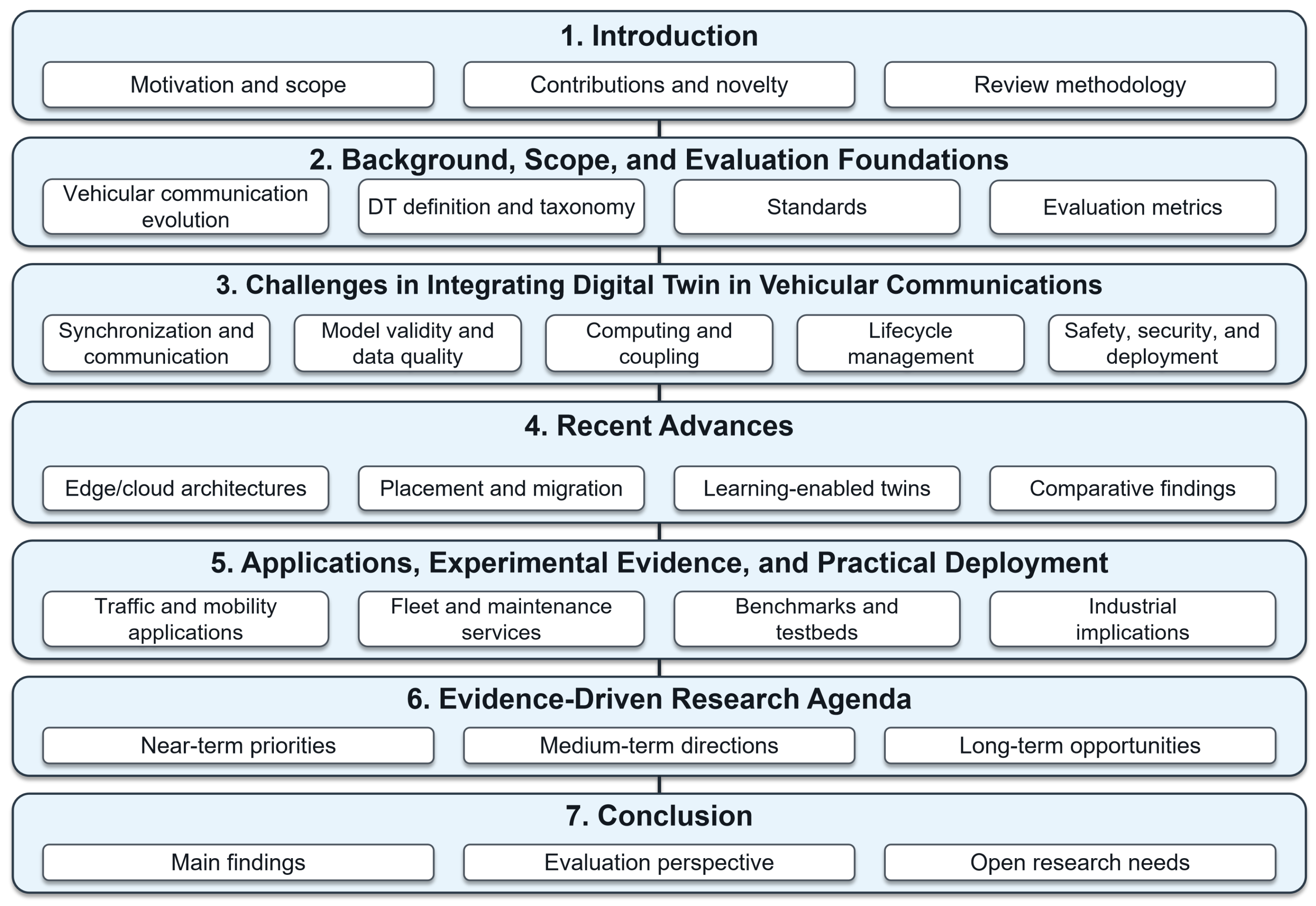
- We establish an operational definition and scope for vehicular DTs and introduce a granularity-oriented taxonomy that distinguishes component, vehicle, communication-network, fleet/traffic, and city-scale twins according to their physical subject, update relationship, communication role, and decision authority.
- We provide a communication-centric synthesis of DT architectures, emphasizing physical–virtual synchronization, state staleness, twin placement and migration, V2X connectivity, and vehicle–edge–cloud coordination rather than treating communication as a generic enabling layer.
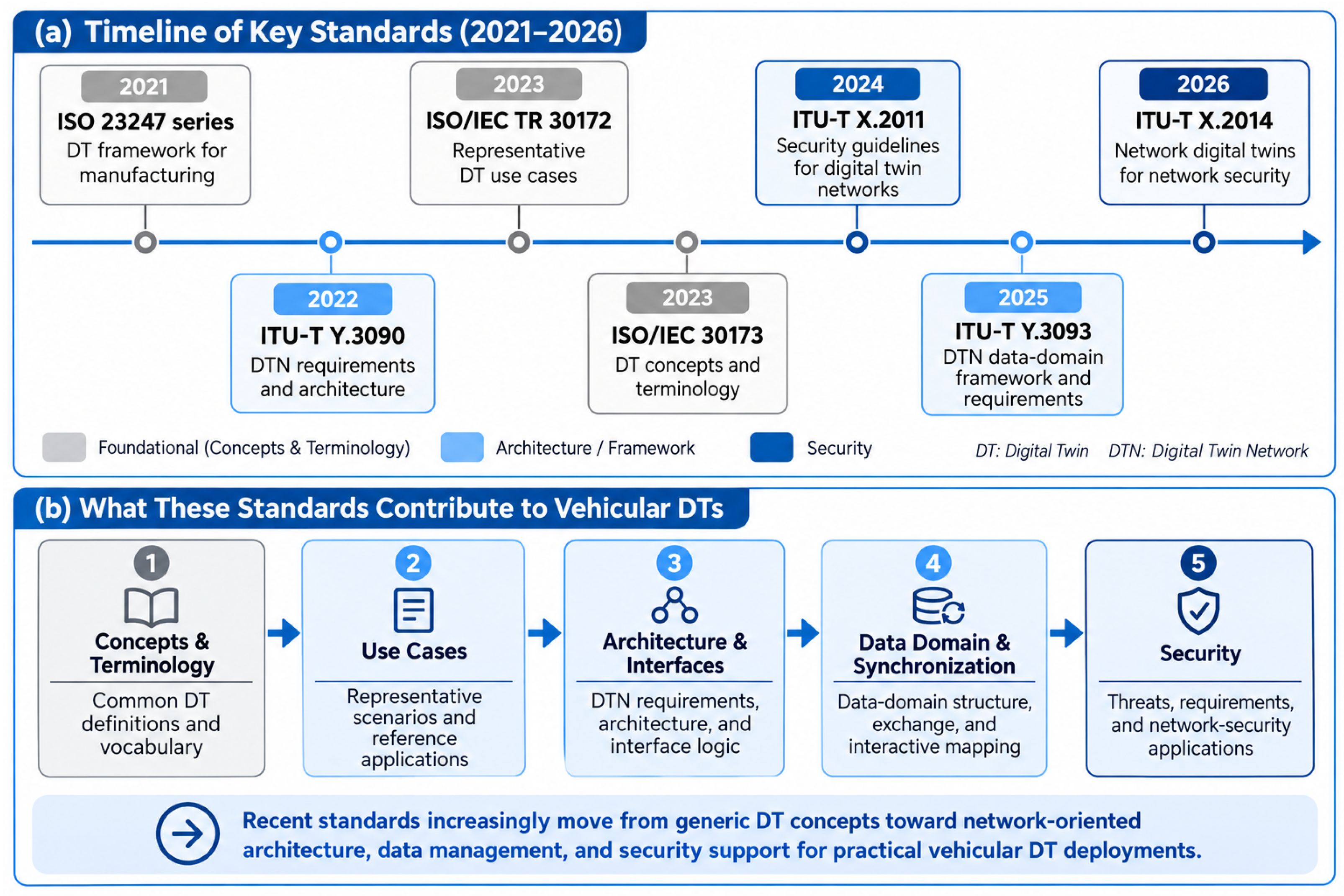
- We update the standards discussion through 5G-Advanced and ongoing 3GPP 6G work, and relate recent DT/network-DT standards to interfaces, data domains, synchronization, and security requirements relevant to vehicular systems.
- We develop an orthogonal challenge taxonomy spanning communication and synchronization, twin-model validity and data quality, communication–computation coupling, lifecycle and state management, safety, security, and privacy, together with deployment, interoperability, and governance. We further define measurable DT/network metrics and distinguish reported benefits from demonstrated evidence.
- We organize future work as an evidence-driven research agenda in which open questions are linked to limitations observed in the surveyed literature, with near-term engineering problems separated from longer-term research opportunities.
1.2. Literature Review Methodology
2. Background, Scope, and Evaluation Foundations
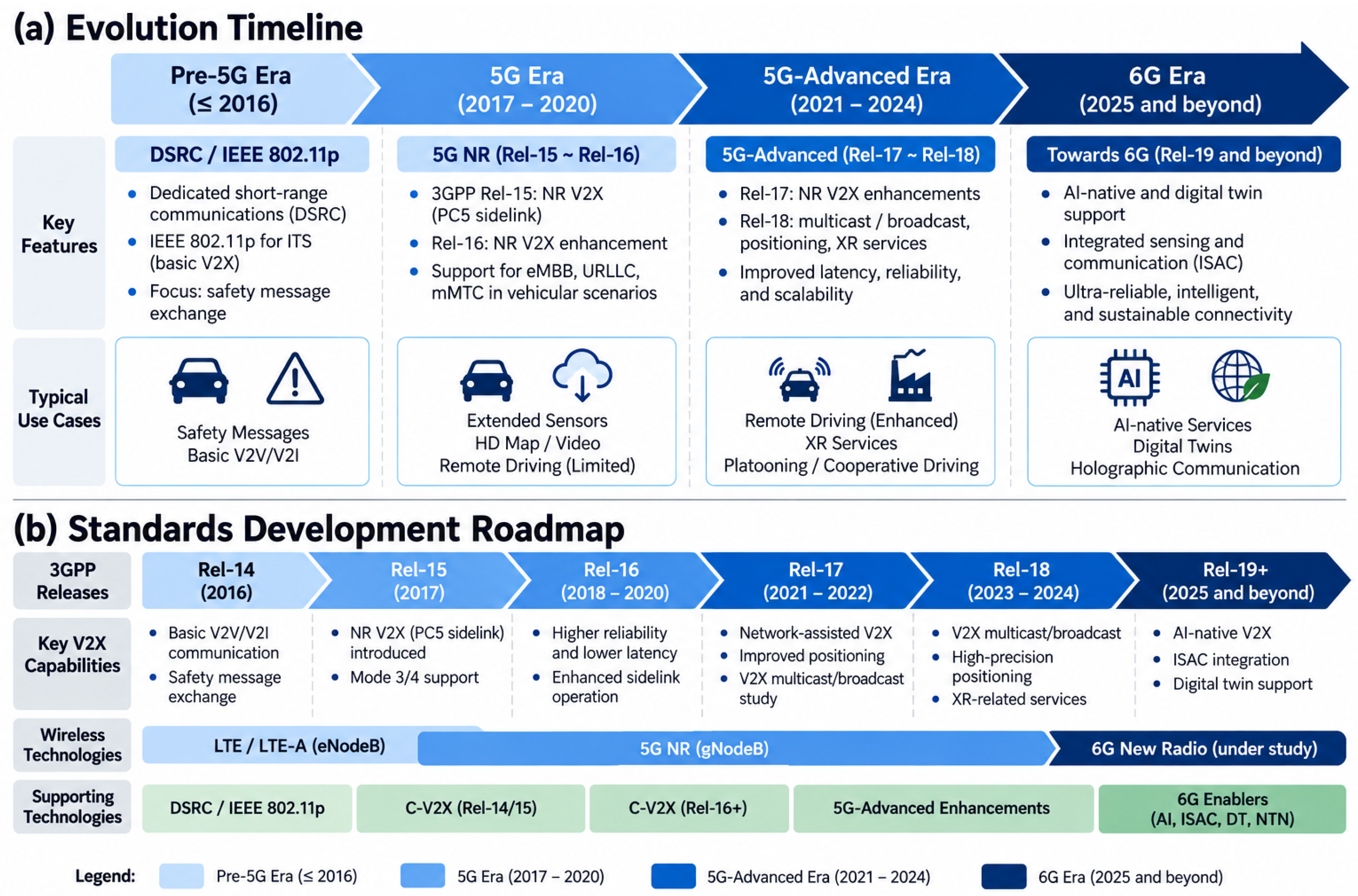
2.1. Vehicular Communication Standards and Evolution
2.1.1. From DSRC to 5G-Advanced and Emerging 6G
2.1.2. Vehicular Communication Requirements for DT Operation
2.2. Digital Twin Definition, Scope, and Standardization
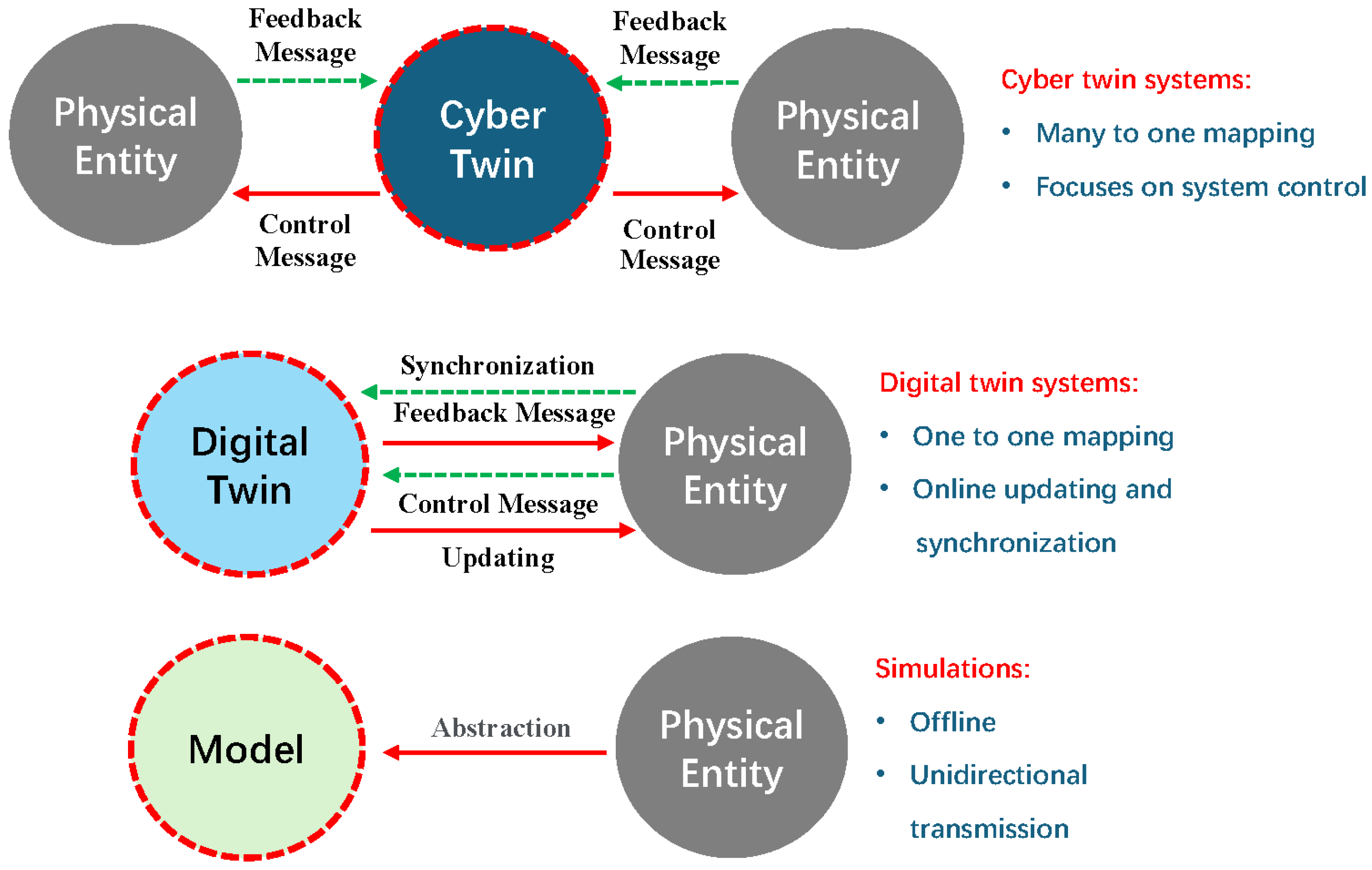
2.2.1. Operational Definition and Survey Boundary
2.2.2. Digital Twin and Network-Digital-Twin Standards
2.2.3. Evolution and Enabling Technologies of Digital Twins
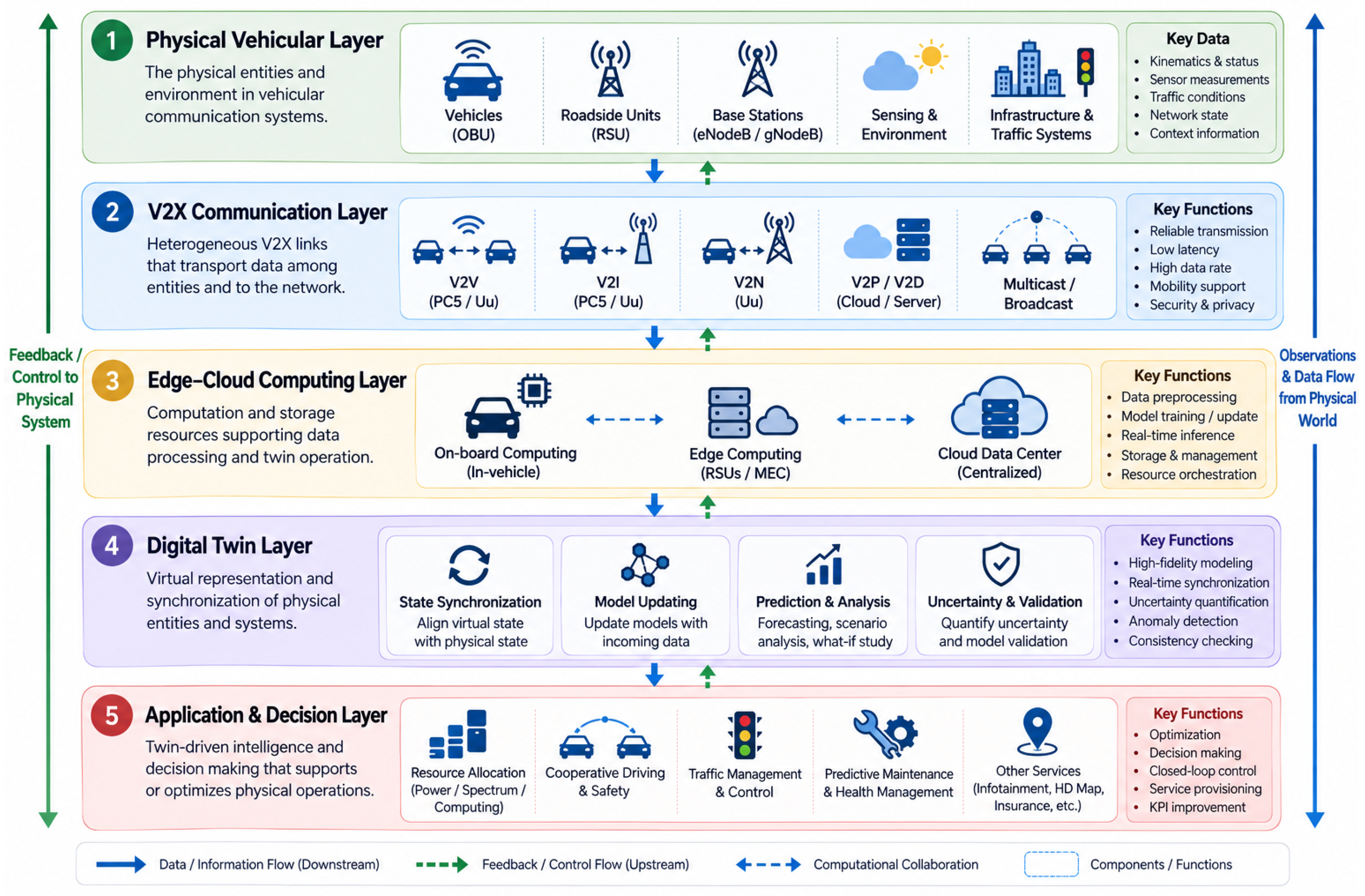
2.2.4. Layered Architecture Perspective
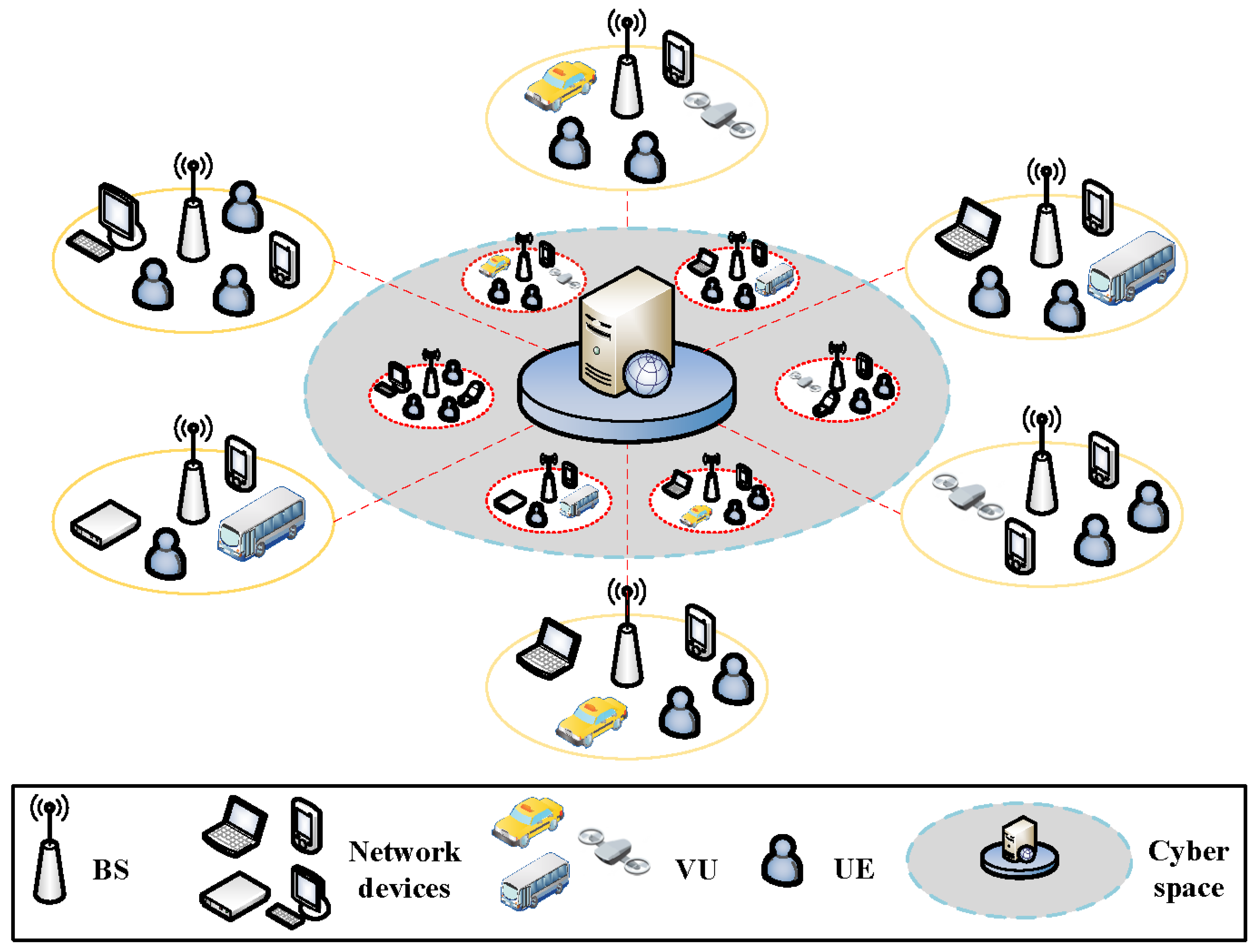
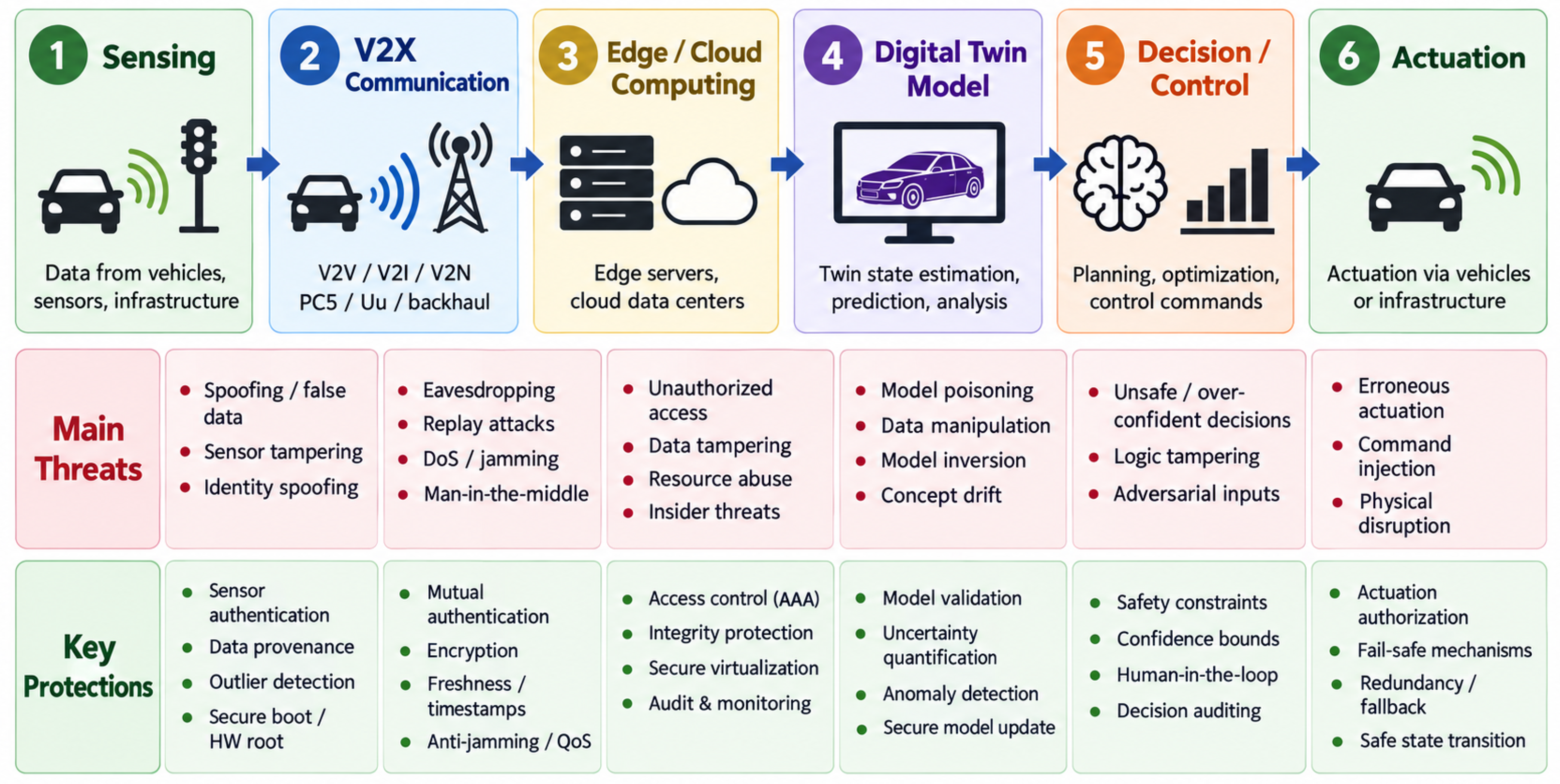
- Physical Vehicular Layer: The physical layer contains vehicles, onboard sensors and actuators, roadside units, base stations, and transportation infrastructure. These entities generate kinematic, environmental, traffic, and network observations and may also receive control or service decisions from the virtual side.
- V2X Communication Layer: The communication layer carries physical-to-virtual observations and, when feedback is enabled, virtual-to-physical decisions. It includes V2V, V2I, and V2N links over interfaces such as PC5 and Uu, together with multicast/broadcast and network-assisted communication. Reliability, latency, data freshness, mobility support, security, and privacy at this layer directly affect whether the twin state remains usable.
- Edge–Cloud Computing Layer: Vehicular DT functions can be placed on board, at RSU/MEC nodes, or in centralized cloud platforms. Onboard execution minimizes external communication dependence but has limited resources; edge execution can support low-latency local services; and cloud platforms provide larger shared computing and storage resources for global or long-horizon tasks. The placement decision therefore couples communication delay, computing load, migration overhead, energy consumption, and model consistency.
- Digital Twin Layer: The DT layer maintains the evolving virtual representation. Core functions include state synchronization, model updating, prediction and scenario analysis, and uncertainty/validation management. The layer should not be evaluated only by nominal model fidelity: freshness, calibration, consistency, and the communication/computation cost required to maintain the model are equally important.
- Application and Decision Layer: Twin states and predictions support application-specific functions such as communication-resource allocation, cooperative driving, traffic management, and predictive maintenance. Feedback may range from advisory recommendations to closed-loop control. The required synchronization bound, model confidence, reliability, and fail-safe behavior therefore depend on the authority and safety criticality of the application.
2.2.5. Lifecycle-Oriented Perspective
- Instantiation and Binding: A twin is created, associated with its physical vehicle, component, network element, or traffic entity, and assigned identities, access rights, and initial models.
- Calibration and Operational Synchronization: Physical observations are incorporated into the twin, model parameters are calibrated, and the virtual state is maintained at an application-appropriate freshness and fidelity.
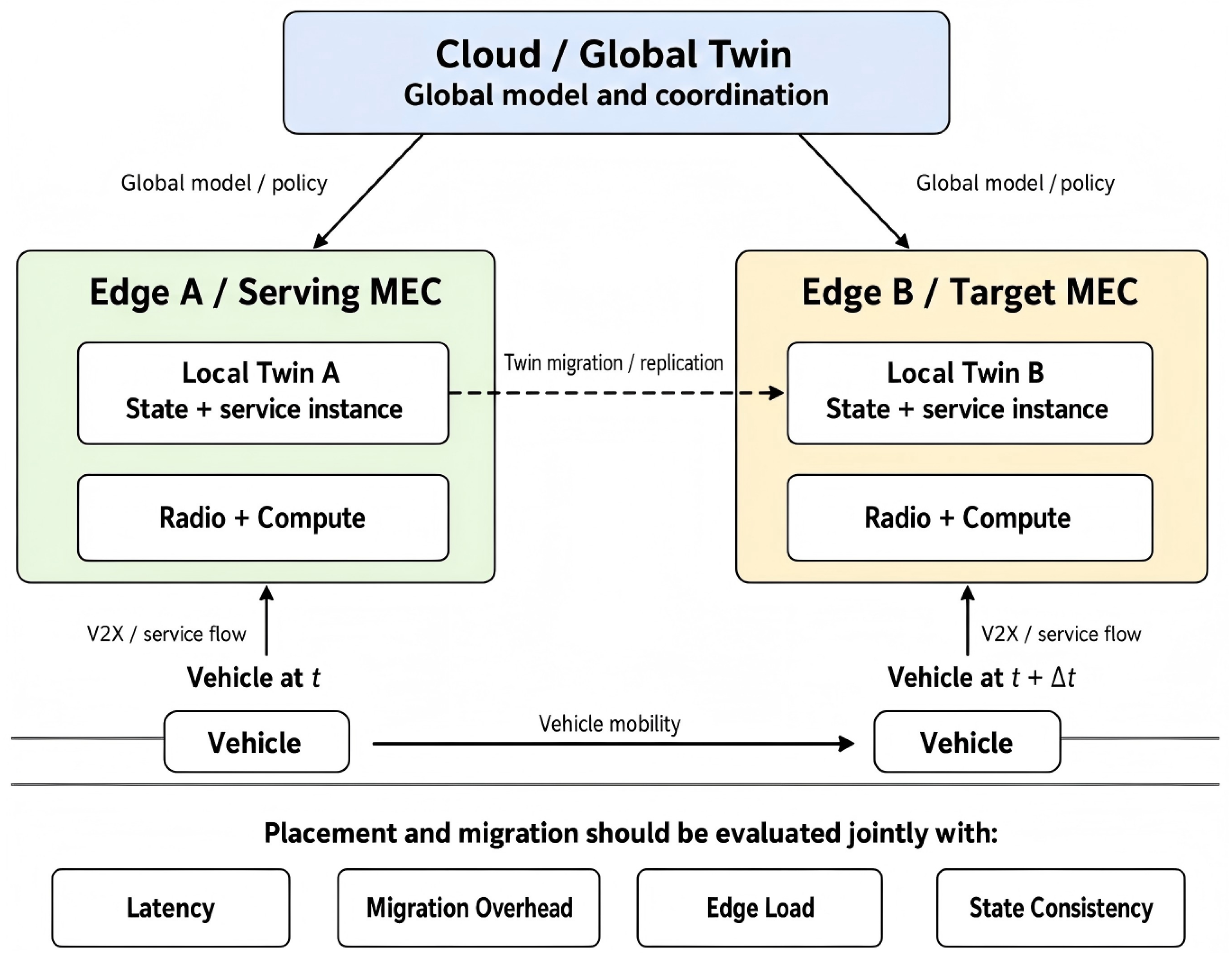
- Placement, Replication, and Migration: Twin functions or replicas may move among vehicle, edge, and cloud nodes as mobility, load, and service requirements change. These operations introduce transfer overhead and state-consistency requirements.
- Model and Software Evolution: Models, interfaces, and software can be updated as sensors, communication capabilities, environments, and service requirements change. Version compatibility and validation are therefore part of long-term operation.
- Retirement and Archival: A twin or one of its service instances must eventually be decommissioned, with explicit handling of retained data, credentials, historical models, and ownership obligations.
2.2.6. Function-Oriented Perspective
- Representation and State Estimation: Maintain a task-relevant representation of the physical entity and infer unobserved or noisy states when necessary.
- Data Aggregation and Synchronization: Fuse observations from vehicles, infrastructure, network telemetry, and other twins while preserving timing, provenance, and consistency.
- Prediction and Analysis: Forecast mobility, communication state, traffic evolution, failures, or resource demand and evaluate alternative scenarios.
- Optimization and Decision Support: Use the synchronized/predicted state for resource allocation, mobility management, cooperative services, or maintenance decisions.
- Feedback and Actuation: Return recommendations or control actions to the physical system when the application permits closed-loop operation.
2.3. Evaluation Metrics for Vehicular Digital Twins
2.4. Application Classes and Requirement Heterogeneity
3. Challenges in Integrating Digital Twin in Vehicular Communications
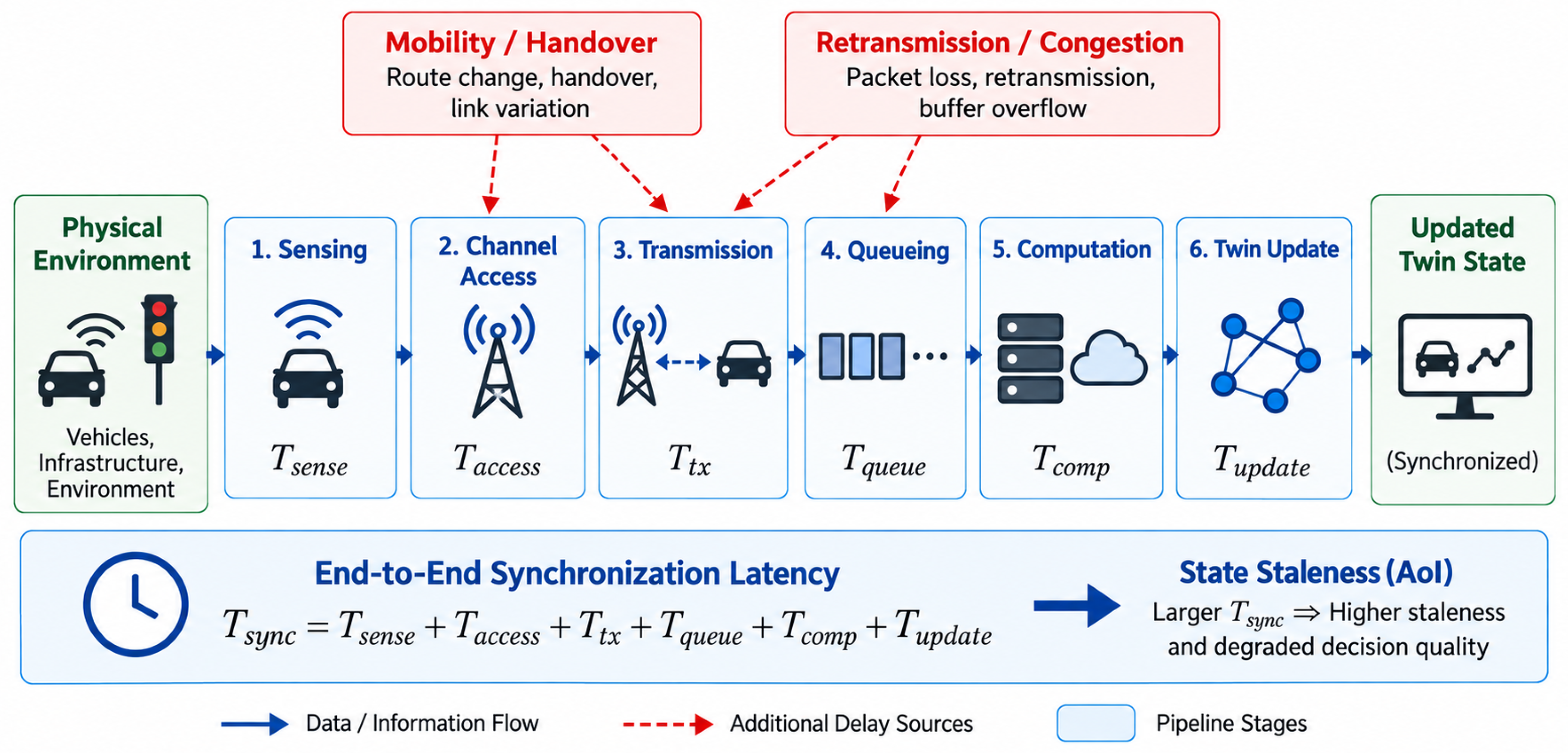
3.1. Communication and Physical–Virtual Synchronization
3.2. Twin-Model Validity, Validation, and Data Quality
3.3. Computing and Communication–Computation Coupling
3.4. Twin Lifecycle, Placement, Migration, and State Consistency
3.5. Safety, Security, and Privacy of the Physical–Twin Loop
3.6. Deployment, Interoperability, Standardization, and Governance
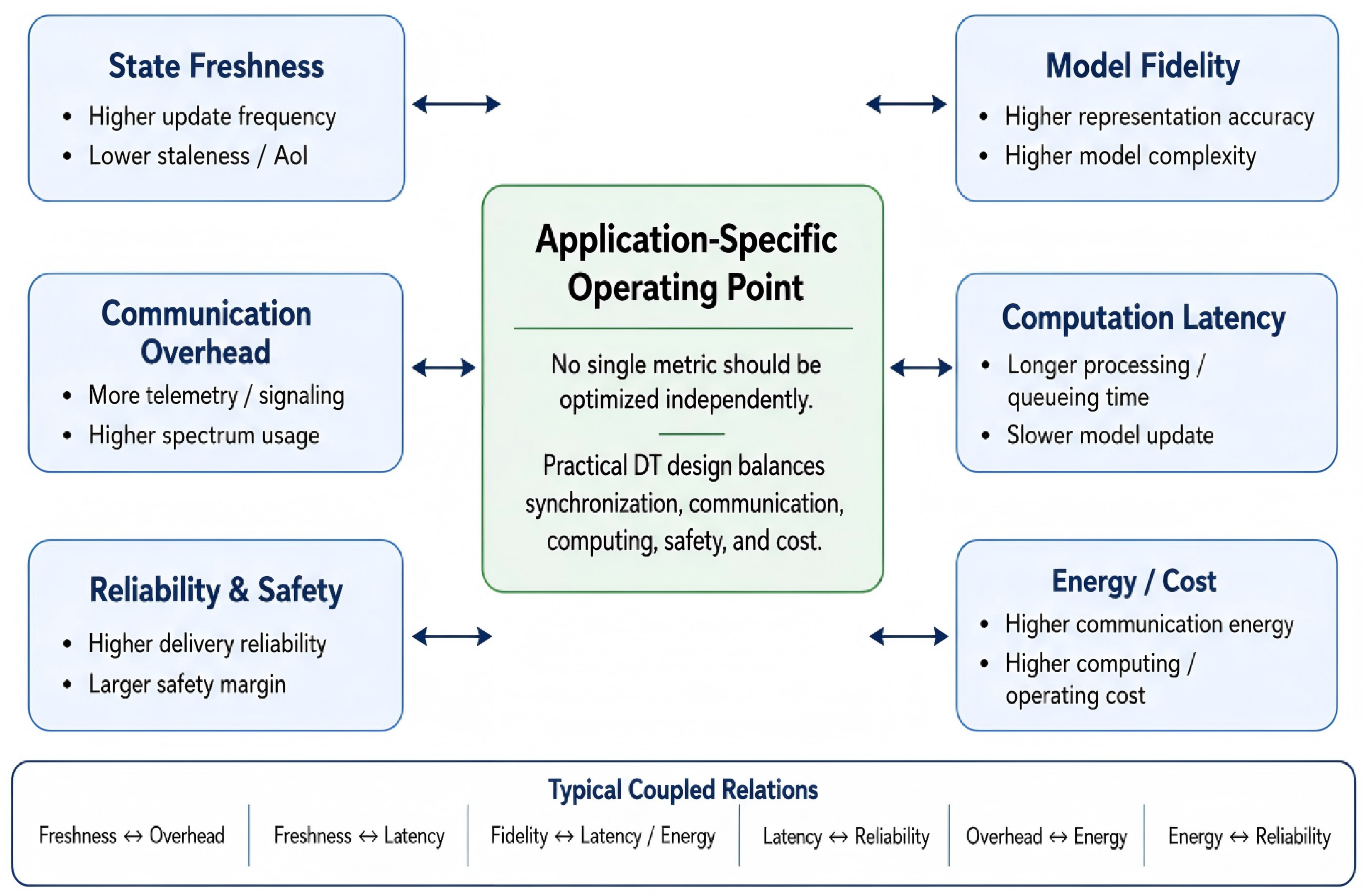
3.7. Cross-Cutting Interactions and Design Implications
4. Recent Advances: Representative Architectures and Comparative Synthesis
4.1. Edge-Hosted Twins for Resource Orchestration
4.2. Synchronization, Placement, and Migration Under Mobility
4.3. Learning-Enabled Twins: From Policy Optimization to Model Adaptation
4.4. Security and Trust for the Physical–Twin Data Path
4.5. Communication- and Sensing-Aware Digital Twins
4.6. Comparative Findings and Maturity of the Evidence
5. Applications, Experimental Evidence, and Practical Deployment
5.1. Traffic Management and Cooperative Mobility
5.2. Fleet, Vehicle, and Predictive-Maintenance Services
5.3. Communication-Network Optimization and Edge Orchestration
5.4. Experimental Infrastructure, Datasets, and Reproducibility
5.5. Industrial Considerations and Practical Implications
6. Evidence-Driven Research Agenda
6.1. Near-Term Priority: Freshness, Validity, and Safe Use
6.2. Near- to Medium-Term Priority: Placement, Adaptive Fidelity, and Resource Coupling
6.3. Medium-Term Priority: Reproducibility, Lifecycle, and Interoperability
6.4. Long-Term Priority: Hierarchical and 6G-Native Vehicular Twins
6.5. Governance, Ethics, and Accountability as Research Requirements
7. Conclusions
Author Contributions
Funding
Data Availability Statement
Conflicts of Interest
References
- Yaqoob, I.; Khan, L.U.; Kazmi, S.M.A.; Imran, M.; Guizani, N.; Hong, C.S. Autonomous Driving Cars in Smart Cities: Recent Advances, Requirements, and Challenges. IEEE Netw. 2020, 34, 174–181. [Google Scholar] [CrossRef] [Scilit]
- Céspedes, M.M.; Guzmán, B.G.; Gil Jiménez, V.P.; Armada, A.G. Aligning the Light for Vehicular Visible Light Communications: High Data Rate and Low-Latency Vehicular Visible Light Communications Implementing Blind Interference Alignment. IEEE Veh. Technol. Mag. 2023, 18, 59–69. [Google Scholar] [CrossRef] [Scilit]
- Grieves, M.; Vickers, J. Digital twin: Mitigating unpredictable, undesirable emergent behavior in complex systems. In Transdisciplinary Perspectives on Complex Systems: New Findings and Approaches; Springer: Cham, Switzerland, 2017; pp. 85–113. [Google Scholar]
- Attaran, M.; Celik, B.G. Digital Twin: Benefits, use cases, challenges, and opportunities. Decis. Anal. J. 2023, 6, 100165. [Google Scholar] [CrossRef] [Scilit]
- Schwarz, C.; Wang, Z. The Role of Digital Twins in Connected and Automated Vehicles. IEEE Intell. Transp. Syst. Mag. 2022, 14, 41–51. [Google Scholar] [CrossRef] [Scilit]
- Fan, B.; Su, Z.; Chen, Y.; Wu, Y.; Xu, C.; Quek, T.Q.S. Ubiquitous Control Over Heterogeneous Vehicles: A Digital Twin Empowered Edge AI Approach. IEEE Wirel. Commun. 2023, 30, 166–173. [Google Scholar] [CrossRef] [Scilit]
- Guo, J.; Bilal, M.; Qiu, Y.; Qian, C.; Xu, X.; Choo, K.K.R. Survey on digital twins for Internet of Vehicles: Fundamentals, challenges, and opportunities. Digit. Commun. Netw. 2024, 10, 237–247. [Google Scholar] [CrossRef] [Scilit]
- Kabir, M.R.; Ravi, B.B.Y.; Ray, S. Digital Twin Technologies for Vehicular Prototyping: A Survey. IEEE Open J. Intell. Transp. Syst. 2025, 6, 503–521. [Google Scholar] [CrossRef] [Scilit]
- Nag, D.; Brandel-Tanis, F.; Pramestri, Z.A.; Pitera, K.; Frøyen, Y.K. Exploring Digital Twins for Transport Planning: A Review. Eur. Transp. Res. Rev. 2025, 17, 15. [Google Scholar] [CrossRef] [Scilit]
- Xie, J.; Wu, G.; Zhou, X.; Deng, S. Future Perspectives on Internet of Vehicles Resource Management: Digital Twin-Enabled Edge Computing Frameworks. J. Eng. Appl. Sci. 2025, 72, 119. [Google Scholar] [CrossRef] [Scilit]
- Gu, X.; Duan, W.; Zhang, G.; Hou, J.; Peng, L.; Wen, M.; Gao, F.; Chen, M.; Ho, P.H. Digital Twin Technology for Intelligent Vehicles and Transportation Systems: A Survey on Applications, Challenges and Future Directions. IEEE Commun. Surv. Tutor. 2026, 28, 3235–3271. [Google Scholar] [CrossRef] [Scilit]
- Xing, L.; Li, B.; Deng, K.; Gao, J.; Wu, H.; Ma, H.; Zhang, X. Advancing Intelligent Transportation through Digital Twin: Challenges, Models, and Future Prospects. Ad Hoc Netw. 2026, 181, 104077. [Google Scholar] [CrossRef] [Scilit]
- Kaya, Ö.; Bacchiani, L.; Melis, A.; Presta, R.; Lam, C.T.; Pau, G.; Girau, R. Vehicle, Driver, and Road Digital Twins for Connected Mobility: A Critical Review and Unified Conceptual Framework. Future Internet 2026, 18, 277. [Google Scholar] [CrossRef] [Scilit]
- IEEE Std 802.11-2020; IEEE Standard for Information Technology—Telecommunications and Information Exchange Between Systems—Local and Metropolitan Area Networks—Specific Requirements—Part 11: Wireless LAN Medium Access Control (MAC) and Physical Layer (PHY) Specifications. Institute of Electrical and Electronics Engineers: New York, NY, USA, 2020.
- Kenney, J.B. Dedicated Short-Range Communications (DSRC) Standards in the United States. Proc. IEEE 2011, 99, 1162–1182. [Google Scholar] [CrossRef] [Scilit]
- Jiang, D.; Taliwal, V.; Meier, A.; Holfelder, W.; Herrtwich, R. Design of 5.9 ghz dsrc-based vehicular safety communication. IEEE Wirel. Commun. 2006, 13, 36–43. [Google Scholar] [CrossRef] [Scilit]
- IEEE Std 802.11p-2010; IEEE Standard for Information Technology—Telecommunications and Information Exchange Between Systems—Local and Metropolitan Area Networks—Specific Requirements—Part 11: Wireless LAN Medium Access Control (MAC) and Physical Layer (PHY) Specifications—Amendment 6: Wireless Access in Vehicular Environments (WAVE). Institute of Electrical and Electronics Engineers: New York, NY, USA, 2010.
- IEEE Std 802.11bd-2022; IEEE Standard for Information Technology—Telecommunications and Information Exchange Between Systems—Local and Metropolitan Area Networks—Specific Requirements—Part 11: Wireless LAN Medium Access Control (MAC) and Physical Layer (PHY) Specifications—Amendment 5: Enhancements for Next Generation V2X. Institute of Electrical and Electronics Engineers: New York, NY, USA, 2023. [CrossRef] [Scilit]
- Ma, X.; Trivedi, K.S. SINR-Based Analysis of IEEE 802.11p/bd Broadcast VANETs for Safety Services. IEEE Trans. Netw. Serv. Manag. 2021, 18, 2672–2686. [Google Scholar] [CrossRef] [Scilit]
- Lee, J.; Kim, Y.; Kwak, Y.; Zhang, J.; Papasakellariou, A.; Novlan, T.; Sun, C.; Li, Y. LTE-advanced in 3GPP Rel-13/14: An evolution toward 5G. IEEE Commun. Mag. 2016, 54, 36–42. [Google Scholar] [CrossRef] [Scilit]
- Muruganathan, S.D.; Lin, X.; Määttänen, H.L.; Sedin, J.; Zou, Z.; Hapsari, W.A.; Yasukawa, S. An Overview of 3GPP Release-15 Study on Enhanced LTE Support for Connected Drones. IEEE Commun. Stand. Mag. 2021, 5, 140–146. [Google Scholar] [CrossRef] [Scilit]
- Baek, S.; Kim, D.; Tesanovic, M.; Agiwal, A. 3GPP New Radio Release 16: Evolution of 5G for Industrial Internet of Things. IEEE Commun. Mag. 2021, 59, 41–47. [Google Scholar] [CrossRef] [Scilit]
- Rahman, I.; Razavi, S.M.; Liberg, O.; Hoymann, C.; Wiemann, H.; Tidestav, C.; Schliwa-Bertling, P.; Persson, P.; Gerstenberger, D. 5G Evolution Toward 5G Advanced: An overview of 3GPP releases 17 and 18. Ericsson Technol. Rev. 2021, 2021, 2–12. [Google Scholar] [CrossRef] [Scilit]
- 3GPP. 3GPP Releases. Available online: https://portal.3gpp.org/Releases.aspx (accessed on 17 August 2026).
- 3GPP. Release 20. Available online: https://www.3gpp.org/specifications-technologies/releases/release-20 (accessed on 17 August 2026).
- Singh, P.K.; Nandi, S.K.; Nandi, S. A tutorial survey on vehicular communication state of the art, and future research directions. Veh. Commun. 2019, 18, 100164. [Google Scholar] [CrossRef] [Scilit]
- Guo, H.; Zhou, X.; Liu, J.; Zhang, Y. Vehicular intelligence in 6G: Networking, communications, and computing. Veh. Commun. 2022, 33, 100399. [Google Scholar] [CrossRef] [Scilit]
- Poudel, S.; Moh, S. Task assignment algorithms for unmanned aerial vehicle networks: A comprehensive survey. Veh. Commun. 2022, 35, 100469. [Google Scholar] [CrossRef] [Scilit]
- Yang, X.; Zheng, J.; Luan, T.H.; Li, R.; Su, Z.; Dong, M. Data Synchronization for Vehicular Digital Twin Network. In Proceedings of the GLOBECOM 2022—2022 IEEE Global Communications Conference, Rio de Janeiro, Brazil, 4–8 December 2022; pp. 5795–5800. [Google Scholar] [CrossRef] [Scilit]
- ISO/IEC 30173:2023; Digital Twin—Concepts and Terminology. International Standard Organization: Geneva, Switzerland, 2023.
- ITU-T Y.3090; Digital Twin Network—Requirements and Architecture. International Telecommunication Union: Geneva, Switzerland, 2022.
- ISO/IEC TR 30172:2023; Internet of Things (IoT)—Digital Twin—Use Cases. International Standard Organization: Geneva, Switzerland, 2023.
- ITU-T X.2011; Security Guidelines for Digital Twin Network. International Telecommunication Union: Geneva, Switzerland, 2024.
- ITU-T Y.3093; Digital Twin Networks—Framework and Functional Requirements of the Data Domain in the Network Digital Twin Layer. International Telecommunication Union: Geneva, Switzerland, 2025.
- ITU-T X.2014; Guidelines for Using Network Digital Twins for Network Security. International Telecommunication Union: Geneva, Switzerland, 2026.
- Klesh, A.T.; Cutler, J.W.; Atkins, E.M. Cyber-physical challenges for space systems. In Proceedings of the 2012 IEEE/ACM Third International Conference on Cyber-Physical Systems, Beijing, China, 17–19 April 2012; pp. 45–52. [Google Scholar]
- Parker, D.H. Review of the US Patent Literature on Digital Twins and Possible Applications for Coordinate Metrology. Mach. Des. 2002, 1, 2. [Google Scholar]
- Minerva, R.; Lee, G.M.; Crespi, N. Digital Twin in the IoT Context: A Survey on Technical Features, Scenarios, and Architectural Models. Proc. IEEE 2020, 108, 1785–1824. [Google Scholar] [CrossRef] [Scilit]
- Hu, W.; Zhang, T.; Deng, X.; Liu, Z.; Tan, J. Digital twin: A state-of-the-art review of its enabling technologies, applications and challenges. J. Intell. Manuf. Spec. Equip. 2021, 2, 1–34. [Google Scholar] [CrossRef] [Scilit]
- Li, L.; Aslam, S.; Wileman, A.; Perinpanayagam, S. Digital Twin in Aerospace Industry: A Gentle Introduction. IEEE Access 2022, 10, 9543–9562. [Google Scholar] [CrossRef] [Scilit]
- Erol, T.; Mendi, A.F.; Doğan, D. The Digital Twin Revolution in Healthcare. In Proceedings of the 2020 4th International Symposium on Multidisciplinary Studies and Innovative Technologies (ISMSIT), Istanbul, Turkey, 22–24 October 2020; pp. 1–7. [Google Scholar] [CrossRef] [Scilit]
- Yang, Z.; Li, L.; Gu, F.; Ling, X. Dependable and reliable cloud-based architectures for vehicular communications: A systematic literature review. Int. J. Commun. Syst. 2023, 36, e5457. [Google Scholar] [CrossRef] [Scilit]
- Chakraborty, S.; Adhikari, S.; Ganguli, R. The role of surrogate models in the development of digital twins of dynamic systems. Appl. Math. Model. 2021, 90, 662–681. [Google Scholar] [CrossRef] [Scilit]
- Zhu, Z.; Liu, C.; Xu, X. Visualisation of the digital twin data in manufacturing by using augmented reality. Procedia Cirp 2019, 81, 898–903. [Google Scholar] [CrossRef] [Scilit]
- Geng, R.; Li, M.; Hu, Z.; Han, Z.; Zheng, R. Digital Twin in smart manufacturing: Remote control and virtual machining using VR and AR technologies. Struct. Multidiscip. Optim. 2022, 65, 321. [Google Scholar] [CrossRef] [Scilit]
- Semeraro, C.; Lezoche, M.; Panetto, H.; Dassisti, M. Digital twin paradigm: A systematic literature review. Comput. Ind. 2021, 130, 103469. [Google Scholar] [CrossRef] [Scilit]
- Zhang, Q.; Zhang, X.; Xu, W.; Liu, A.; Zhou, Z.; Pham, D.T. Modeling of digital twin workshop based on perception data. In Proceedings of the Intelligent Robotics and Applications: 10th International Conference, ICIRA 2017, Wuhan, China, 16–18 August 2017; Proceedings, Part III 10; Springer: Berlin/Heidelberg, Germany, 2017; pp. 3–14. [Google Scholar]
- Yi, Y.; Yan, Y.; Liu, X.; Ni, Z.; Feng, J.; Liu, J. Digital twin-based smart assembly process design and application framework for complex products and its case study. J. Manuf. Syst. 2021, 58, 94–107. [Google Scholar] [CrossRef] [Scilit]
- Borangiu, T.; Oltean, E.; Răileanu, S.; Anton, F.; Anton, S.; Iacob, I. Embedded digital twin for ARTI-type control of semi-continuous production processes. In Proceedings of the Service Oriented, Holonic and Multi-Agent Manufacturing Systems for Industry of the Future: Proceedings of SOHOMA 2019 9; Springer: Berlin/Heidelberg, Germany, 2020; pp. 113–133. [Google Scholar]
- Lee, J.; Bagheri, B.; Kao, H.A. A cyber-physical systems architecture for industry 4.0-based manufacturing systems. Manuf. Lett. 2015, 3, 18–23. [Google Scholar] [CrossRef] [Scilit]
- Redelinghuys, A.; Basson, A.H.; Kruger, K. A six-layer architecture for the digital twin: A manufacturing case study implementation. J. Intell. Manuf. 2020, 31, 1383–1402. [Google Scholar] [CrossRef] [Scilit]
- Răileanu, S.; Borangiu, T.; Ivănescu, N.; Morariu, O.; Anton, F. Integrating the digital twin of a shop floor conveyor in the manufacturing control system. In Proceedings of the Service Oriented, Holonic and Multi-Agent Manufacturing Systems for Industry of the Future: Proceedings of SOHOMA 2019 9; Springer: Berlin/Heidelberg, Germany, 2020; pp. 134–145. [Google Scholar]
- Steindl, G.; Stagl, M.; Kasper, L.; Kastner, W.; Hofmann, R. Generic digital twin architecture for industrial energy systems. Appl. Sci. 2020, 10, 8903. [Google Scholar] [CrossRef] [Scilit]
- Zheng, P.; Sivabalan, A.S. A generic tri-model-based approach for product-level digital twin development in a smart manufacturing environment. Robot. Comput.-Integr. Manuf. 2020, 64, 101958. [Google Scholar] [CrossRef] [Scilit]
- Lim, K.Y.H.; Zheng, P.; Chen, C.H. A state-of-the-art survey of Digital Twin: Techniques, engineering product lifecycle management and business innovation perspectives. J. Intell. Manuf. 2020, 31, 1313–1337. [Google Scholar] [CrossRef] [Scilit]
- Ren, Z.; Shi, J.; Imran, M. Data evolution governance for ontology-based digital twin product lifecycle management. IEEE Trans. Ind. Inform. 2022, 19, 1791–1802. [Google Scholar] [CrossRef] [Scilit]
- Aheleroff, S.; Xu, X.; Zhong, R.Y.; Lu, Y. Digital twin as a service (DTaaS) in industry 4.0: An architecture reference model. Adv. Eng. Inform. 2021, 47, 101225. [Google Scholar] [CrossRef] [Scilit]
- Newrzella, S.R.; Franklin, D.W.; Haider, S. Three-dimension digital twin reference architecture model for functionality, dependability, and life cycle development across industries. IEEE Access 2022, 10, 95390–95410. [Google Scholar] [CrossRef] [Scilit]
- Wu, C.; Chen, T.; Li, Z.; Liu, W. A function-oriented optimising approach for smart product service systems at the conceptual design stage: A perspective from the digital twin framework. J. Clean. Prod. 2021, 297, 126597. [Google Scholar] [CrossRef] [Scilit]
- Cao, G.; Sun, Y.; Tan, R.; Zhang, J.; Liu, W. A function-oriented biologically analogical approach for constructing the design concept of smart product in Industry 4.0. Adv. Eng. Inform. 2021, 49, 101352. [Google Scholar] [CrossRef] [Scilit]
- Wu, Y.; Zhou, L.; Zheng, P.; Sun, Y.; Zhang, K. A digital twin-based multidisciplinary collaborative design approach for complex engineering product development. Adv. Eng. Inform. 2022, 52, 101635. [Google Scholar] [CrossRef] [Scilit]
- Manocha, A.; Sood, S.K.; Bhatia, M. Digital Twin-assisted Fuzzy Logic-inspired Intelligent Approach for Flood Prediction. IEEE Sens. J. 2023, 25, 27800–27807. [Google Scholar] [CrossRef] [Scilit]
- Nguyen, H.X.; Trestian, R.; To, D.; Tatipamula, M. Digital Twin for 5G and Beyond. IEEE Commun. Mag. 2021, 59, 10–15. [Google Scholar] [CrossRef] [Scilit]
- Ye, J.; Xiang, L.; Ge, X. Spatial-Temporal Modeling and Analysis of Reliability and Delay in Urban V2X Networks. IEEE Trans. Netw. Sci. Eng. 2023, 10, 1752–1765. [Google Scholar] [CrossRef] [Scilit]
- Yuan, X.; Chen, J.; Zhang, N.; Ni, J.; Yu, F.R.; Leung, V.C.M. Digital Twin-Driven Vehicular Task Offloading and IRS Configuration in the Internet of Vehicles. IEEE Trans. Intell. Transp. Syst. 2022, 23, 24290–24304. [Google Scholar] [CrossRef] [Scilit]
- Zhao, L.; Han, G.; Li, Z.; Shu, L. Intelligent Digital Twin-Based Software-Defined Vehicular Networks. IEEE Netw. 2020, 34, 178–184. [Google Scholar] [CrossRef] [Scilit]
- Wang, H.; Wu, Y.; Min, G.; Miao, W. A Graph Neural Network-Based Digital Twin for Network Slicing Management. IEEE Trans. Ind. Inform. 2022, 18, 1367–1376. [Google Scholar] [CrossRef] [Scilit]
- Gong, Y.; Wei, Y.; Feng, Z.; Yu, F.R.; Zhang, Y. Resource Allocation for Integrated Sensing and Communication in Digital Twin Enabled Internet of Vehicles. IEEE Trans. Veh. Technol. 2023, 72, 4510–4524. [Google Scholar] [CrossRef] [Scilit]
- Li, G.; Lai, C.; Lu, R.; Zheng, D. SecCDV: A Security Reference Architecture for Cybertwin-Driven 6G V2X. IEEE Trans. Veh. Technol. 2022, 71, 4535–4550. [Google Scholar] [CrossRef] [Scilit]
- Dai, Y.; Zhang, Y. Adaptive Digital Twin for Vehicular Edge Computing and Networks. J. Commun. Inf. Netw. 2022, 7, 48–59. [Google Scholar] [CrossRef] [Scilit]
- Guo, Q.; Tang, F.; Kato, N. Federated Reinforcement Learning-Based Resource Allocation for D2D-Aided Digital Twin Edge Networks in 6G Industrial IoT. IEEE Trans. Ind. Inform. 2023, 19, 7228–7236. [Google Scholar] [CrossRef] [Scilit]
- Lu, Y.; Huang, X.; Zhang, K.; Maharjan, S.; Zhang, Y. Communication-Efficient Federated Learning and Permissioned Blockchain for Digital Twin Edge Networks. IEEE Internet Things J. 2021, 8, 2276–2288. [Google Scholar] [CrossRef] [Scilit]
- Ilarri, S.; Delot, T.; Trillo-Lado, R. A Data Management Perspective on Vehicular Networks. IEEE Commun. Surv. Tutor. 2015, 17, 2420–2460. [Google Scholar] [CrossRef] [Scilit]
- He, C.; Luan, T.H.; Lu, R.; Su, Z.; Dong, M. Security and Privacy in Vehicular Digital Twin Networks: Challenges and Solutions. IEEE Wirel. Commun. 2023, 30, 154–160. [Google Scholar] [CrossRef] [Scilit]
- Tan, C.; Li, X.; Gao, L.; Luan, T.H.; Qu, Y.; Xiang, Y.; Lu, R. Digital Twin Enabled Remote Data Sharing for Internet of Vehicles: System and Incentive Design. IEEE Trans. Veh. Technol. 2023, 72, 13474–13489. [Google Scholar] [CrossRef] [Scilit]
- Sharma, A.; Kosasih, E.; Zhang, J.; Brintrup, A.; Calinescu, A. Digital twins: State of the art theory and practice, challenges, and open research questions. J. Ind. Inf. Integr. 2022, 30, 100383. [Google Scholar] [CrossRef] [Scilit]
- Xie, W.; Qi, F.; Liu, L.; Liu, Q. Radar Imaging Based UAV Digital Twin for Wireless Channel Modeling in Mobile Networks. IEEE J. Sel. Areas Commun. 2023, 41, 3702–3710. [Google Scholar] [CrossRef] [Scilit]
- Zhao, L.; Zhao, Z.; Zhang, E.; Hawbani, A.; Al-Dubai, A.Y.; Tan, Z.; Hussain, A. A Digital Twin-Assisted Intelligent Partial Offloading Approach for Vehicular Edge Computing. IEEE J. Sel. Areas Commun. 2023, 41, 3386–3400. [Google Scholar] [CrossRef] [Scilit]
- Gu, L.; Cui, M.; Xu, L.; Xu, X. Collaborative Offloading Method for Digital Twin Empowered Cloud Edge Computing on Internet of Vehicles. Tsinghua Sci. Technol. 2023, 28, 433–451. [Google Scholar] [CrossRef] [Scilit]
- Sun, Z.; Liu, Y.; Wang, J.; Li, G.; Anil, C.; Li, K.; Guo, X.; Sun, G.; Tian, D.; Cao, D. Applications of Game Theory in Vehicular Networks: A Survey. IEEE Commun. Surv. Tutor. 2021, 23, 2660–2710. [Google Scholar] [CrossRef] [Scilit]
- Lu, Y.; Maharjan, S.; Zhang, Y. Adaptive Edge Association for Wireless Digital Twin Networks in 6G. IEEE Internet Things J. 2021, 8, 16219–16230. [Google Scholar] [CrossRef] [Scilit]
- Sun, W.; Zhang, H.; Wang, R.; Zhang, Y. Reducing Offloading Latency for Digital Twin Edge Networks in 6G. IEEE Trans. Veh. Technol. 2020, 69, 12240–12251. [Google Scholar] [CrossRef] [Scilit]
- Lu, Y.; Huang, X.; Zhang, K.; Maharjan, S.; Zhang, Y. Low-Latency Federated Learning and Blockchain for Edge Association in Digital Twin Empowered 6G Networks. IEEE Trans. Ind. Inform. 2021, 17, 5098–5107. [Google Scholar] [CrossRef] [Scilit]
- Khan, L.U.; Mustafa, E.; Shuja, J.; Rehman, F.; Bilal, K.; Han, Z.; Hong, C.S. Federated Learning for Digital Twin-Based Vehicular Networks: Architecture and Challenges. IEEE Wirel. Commun. 2023, 31, 156–162. [Google Scholar] [CrossRef] [Scilit]
- Talpur, A.; Gurusamy, M. Machine Learning for Security in Vehicular Networks: A Comprehensive Survey. IEEE Commun. Surv. Tutor. 2022, 24, 346–379. [Google Scholar] [CrossRef] [Scilit]
- Alcaraz, C.; Lopez, J. Digital Twin: A Comprehensive Survey of Security Threats. IEEE Commun. Surv. Tutor. 2022, 24, 1475–1503. [Google Scholar] [CrossRef] [Scilit]
- Khan, L.U.; Han, Z.; Saad, W.; Hossain, E.; Guizani, M.; Hong, C.S. Digital Twin of Wireless Systems: Overview, Taxonomy, Challenges, and Opportunities. IEEE Commun. Surv. Tutor. 2022, 24, 2230–2254. [Google Scholar] [CrossRef] [Scilit]
- Stellios, I.; Kotzanikolaou, P.; Psarakis, M.; Alcaraz, C.; Lopez, J. A survey of iot-enabled cyberattacks: Assessing attack paths to critical infrastructures and services. IEEE Commun. Surv. Tutor. 2018, 20, 3453–3495. [Google Scholar] [CrossRef] [Scilit]
- Alladi, T.; Chamola, V.; Sahu, N.; Venkatesh, V.; Goyal, A.; Guizani, M. A Comprehensive Survey on the Applications of Blockchain for Securing Vehicular Networks. IEEE Commun. Surv. Tutor. 2022, 24, 1212–1239. [Google Scholar] [CrossRef] [Scilit]
- Wang, Y.; Su, Z.; Zhang, K.; Benslimane, A. Challenges and Solutions in Autonomous Driving: A Blockchain Approach. IEEE Netw. 2020, 34, 218–226. [Google Scholar] [CrossRef] [Scilit]
- Zhang, X.; Chen, X. Data Security Sharing and Storage Based on a Consortium Blockchain in a Vehicular Ad-hoc Network. IEEE Access 2019, 7, 58241–58254. [Google Scholar] [CrossRef] [Scilit]
- Aagaard, A.; Vanhaverbeke, W. The Twin Advantage: Leveraging Digital for Sustainability in Business Models. In Business Model Innovation: Game Changers and Contemporary Issues; Springer International Publishing: Cham, Switzerland, 2024; pp. 227–262. [Google Scholar]
- Rishiwal, V.; Agarwal, U.; Alotaibi, A.; Tanwar, S.; Yadav, P.; Yadav, M. Exploring Secure V2X Communication Networks for Human-Centric Security and Privacy in Smart Cities. IEEE Access 2024, 12, 138763–138788. [Google Scholar] [CrossRef] [Scilit]
- Jeremiah, S.R.; Yang, L.T.; Park, J.H. Digital Twin-Assisted Resource Allocation Framework Based on Edge Collaboration for Vehicular Edge Computing. Future Gener. Comput. Syst. 2024, 150, 243–254. [Google Scholar] [CrossRef] [Scilit]
- Kong, X.; Yang, X.; Shen, S.; Shen, G. Energy-Delay Joint Optimization for Task Offloading in Digital Twin-Assisted Internet of Vehicles. ACM Trans. Sens. Netw. 2024. advance online publication. [Google Scholar] [CrossRef] [Scilit]
- Mou, F.; Lou, J.; Tang, Z.; Wu, Y.; Jia, W.; Zhang, Y.; Zhao, W. Adaptive Digital Twin Migration in Vehicular Edge Computing and Networks. IEEE Trans. Veh. Technol. 2025, 74, 4839–4854. [Google Scholar] [CrossRef] [Scilit]
- Fan, B.; Xu, Z.; Li, Z.; Wu, Y.; Zhang, Y. DT Assisted Task Offloading for C-V2X Networks With Imperfect DT Prediction Conditions. IEEE Trans. Intell. Transp. Syst. 2025, 26, 6248–6262. [Google Scholar] [CrossRef] [Scilit]
- Rosa, L.; Calvio, A.; Garbugli, A.; Foschini, L. A QoS-Aware Data Distribution Platform for Edge-Based Vehicular Digital Twins in Smart Cities. In Proceedings of the 2025 IEEE Wireless Communications and Networking Conference (WCNC), Milan, Italy, 24–27 March 2025; pp. 1–6. [Google Scholar] [CrossRef] [Scilit]
- Li, K.; Zhang, X.; Li, J.; Huang, H.; Luo, S.; Xing, H. AoI-Error-Aware Data Synchronization for Vehicular Digital Twin. In Proceedings of the 2025 IEEE Global Communications Conference (GLOBECOM), Taipei, Taiwan, 8–12 December 2025; pp. 2565–2570. [Google Scholar] [CrossRef] [Scilit]
- Tang, L.; Wang, A.; Xia, B.; Tang, Y.; Chen, Q. Research on Integrated Sensing, Communication Resource Allocation, and Digital Twin Placement Based on Digital Twin in IoV. IEEE Internet Things J. 2025, 12, 17300–17315. [Google Scholar] [CrossRef] [Scilit]
- Xing, L.; Li, B.; Deng, K.; Gao, J.; Wu, H.; Ma, H.; Zhang, X. Nereus: Network Resource Prediction-Based Digital Twin Dynamic Placement in Traffic Systems. IEEE Trans. Veh. Technol. 2026, 75, 9240–9256. [Google Scholar] [CrossRef] [Scilit]
- Yang, Y.; Ding, Y.; Wang, J.; Yang, Z.; Zhu, C.; Zhang, Z.; Niyato, D.; Shikh-Bahaei, M. Near-Field Integrated Sensing, Computing and Semantic Communication in Digital Twin-Assisted Vehicular Networks. IEEE Trans. Veh. Technol. 2026, early access. [Google Scholar] [CrossRef] [Scilit]
- Tang, D.; Lin, C.; Cheng, H. Hybrid Fuzzy-Digital Twin Framework for Predictive Task Offloading and Resource Optimization in 6G-Enabled Internet of Vehicles. Veh. Commun. 2026, 59, 101032. [Google Scholar] [CrossRef] [Scilit]
- Zhang, K.; Cao, J.; Maharjan, S.; Zhang, Y. Digital Twin Empowered Content Caching in Social-Aware Vehicular Edge Networks. IEEE Trans. Comput. Soc. Syst. 2022, 9, 239–251. [Google Scholar] [CrossRef] [Scilit]
- Sun, W.; Wang, P.; Xu, N.; Wang, G.; Zhang, Y. Dynamic Digital Twin and Distributed Incentives for Resource Allocation in Aerial-Assisted Internet of Vehicles. IEEE Internet Things J. 2022, 9, 5839–5852. [Google Scholar] [CrossRef] [Scilit]
- Hazarika, B.; Singh, K.; Li, C.P.; Schmeink, A.; Tsang, K.F. RADiT: Resource Allocation in Digital Twin-Driven UAV-aided Internet of Vehicle Networks. IEEE J. Sel. Areas Commun. 2023, 41, 3369–3385. [Google Scholar] [CrossRef] [Scilit]
- Singh, K.; Hazarika, B.; Li, C.P.; Tsang, K.F.; Biswas, S. Digital Twin-Assisted Resource Allocation in UAV-Aided Internet of Vehicles Networks. In Proceedings of the 2023 IEEE International Conference on Communications Workshops (ICC Workshops), Rome, Italy, 28 May–1 June 2023; pp. 409–414. [Google Scholar] [CrossRef] [Scilit]
- Zhou, Y.; Wu, J.; Lin, X.; Bashir, A.K.; Al-Otaibi, Y.D.; Xu, H. Secure Digital Twin Migration in Edge-Based Autonomous Driving System. IEEE Consum. Electron. Mag. 2023, 12, 56–65. [Google Scholar] [CrossRef] [Scilit]
- Lin, H.; Yang, C.; Wu, S.; Chen, X.; Liu, Y.; Liu, Y. Vehicles-Digital Twins Matching Scheme in Vehicular Edge Computing Networks: A Hierarchical DRL Approach. Veh. Commun. 2025, 52, 100883. [Google Scholar] [CrossRef] [Scilit]
- Dai, Y.; Zhang, K.; Maharjan, S.; Zhang, Y. Deep Reinforcement Learning for Stochastic Computation Offloading in Digital Twin Networks. IEEE Trans. Ind. Inform. 2021, 17, 4968–4977. [Google Scholar] [CrossRef] [Scilit]
- Zheng, J.; Luan, T.H.; Hui, Y.; Yin, Z.; Cheng, N.; Gao, L.; Cai, L.X. Digital Twin Empowered Heterogeneous Network Selection in Vehicular Networks With Knowledge Transfer. IEEE Trans. Veh. Technol. 2022, 71, 12154–12168. [Google Scholar] [CrossRef] [Scilit]
- Mu, J.; Ouyang, W.; Hong, T.; Yuan, W.; Cui, Y.; Jing, Z. Digital Twins-Enabled Federated Learning in Mobile Networks: From the Perspective of Communication-Assisted Sensing. IEEE J. Sel. Areas Commun. 2023, 41, 3230–3241. [Google Scholar] [CrossRef] [Scilit]
- Zia, Q.; Zhu, S.; Wang, H.; Iqbal, Z.; Li, Y. Hierarchical Federated Transfer Learning in Digital Twin-Based Vehicular Networks. High-Confid. Comput. 2025, 5, 100303. [Google Scholar] [CrossRef] [Scilit]
- Liu, J.; Zhang, L.; Li, C.; Bai, J.; Lv, H.; Lv, Z. Blockchain-Based Secure Communication of Intelligent Transportation Digital Twins System. IEEE Trans. Intell. Transp. Syst. 2022, 23, 22630–22640. [Google Scholar] [CrossRef] [Scilit]
- Tan, C.; Li, X.; Luan, T.H.; Gu, B.; Qu, Y.; Gao, L. Digital Twin Based Remote Resource Sharing in Internet of Vehicles using Consortium Blockchain. In Proceedings of the 2021 IEEE 94th Vehicular Technology Conference (VTC2021-Fall), Norman, OK, USA, 27–30 September 2021; pp. 1–6. [Google Scholar] [CrossRef] [Scilit]
- Li, B.; Song, X.; Dai, T.; Wu, W.; Zhu, D.; Zhai, X.; Wen, H.; Lin, Q.; Chen, H.; Cai, K. Trust Management Strategy for Digital Twins in Vehicular Ad Hoc Networks. IEEE J. Sel. Areas Commun. 2023, 41, 3279–3292. [Google Scholar] [CrossRef] [Scilit]
- Kang, J.; Yu, R.; Huang, X.; Wu, M.; Maharjan, S.; Xie, S.; Zhang, Y. Blockchain for Secure and Efficient Data Sharing in Vehicular Edge Computing and Networks. IEEE Internet Things J. 2019, 6, 4660–4670. [Google Scholar] [CrossRef] [Scilit]
- Kang, J.; Xiong, Z.; Niyato, D.; Ye, D.; Kim, D.I.; Zhao, J. Toward Secure Blockchain-Enabled Internet of Vehicles: Optimizing Consensus Management Using Reputation and Contract Theory. IEEE Trans. Veh. Technol. 2019, 68, 2906–2920. [Google Scholar] [CrossRef] [Scilit]
- Wang, C.; Ming, Y.; Liu, H.; Feng, J.; Yang, M.; Xiang, Y. Blockchain-Assisted Privacy-Preserving and Synchronized Key Agreement for VDTNs. IEEE Trans. Dependable Secur. Comput. 2025, 22, 3415–3430. [Google Scholar] [CrossRef] [Scilit]
- Demir, U.; Pradhan, S.; Kumahia, R.; Roy, D.; Loannidis, S.; Chowdhury, K. Digital Twins for Maintaining QoS in Programmable Vehicular Networks. IEEE Netw. 2023, 37, 208–214. [Google Scholar] [CrossRef] [Scilit]
- Xue, J.; Wu, H.; Zhang, R.; Wang, Z. Research on Collaborative Offloading and Resource Allocation of Internet of Vehicles in ISAC Scenarios Based on Digital Twin. Ad Hoc Netw. 2025, 179, 104009. [Google Scholar] [CrossRef] [Scilit]
- Wang, H.; Zhu, M.; Hong, W.; Wang, C.; Tao, G.; Wang, Y. Optimizing Signal Timing Control for Large Urban Traffic Networks Using an Adaptive Linear Quadratic Regulator Control Strategy. IEEE Trans. Intell. Transp. Syst. 2022, 23, 333–343. [Google Scholar] [CrossRef] [Scilit]
- Xu, H.; Berres, A.; Tennille, S.A.; Ravulaparthy, S.K.; Wang, C.; Sanyal, J. Continuous Emulation and Multiscale Visualization of Traffic Flow Using Stationary Roadside Sensor Data. IEEE Trans. Intell. Transp. Syst. 2022, 23, 10530–10541. [Google Scholar] [CrossRef] [Scilit]
- Yamaguchi, H. Keynote: Situational Awareness Platform for City Transportation. In Proceedings of the 2020 IEEE International Conference on Pervasive Computing and Communications Workshops (PerCom Workshops), Austin, TX, USA, 23–27 March 2020; p. 1. [Google Scholar] [CrossRef] [Scilit]
- Xu, H.; Berres, A.; Yoginath, S.B.; Sorensen, H.; Nugent, P.J.; Severino, J.; Tennille, S.A.; Moore, A.; Jones, W.; Sanyal, J. Smart Mobility in the Cloud: Enabling Real-Time Situational Awareness and Cyber-Physical Control Through a Digital Twin for Traffic. IEEE Trans. Intell. Transp. Syst. 2023, 24, 3145–3156. [Google Scholar] [CrossRef] [Scilit]
- Gerhards, J.P. Digital Twin for Fleet Management of Connected Vehicles. Ph.D. Thesis, University of Stuttgart, Stuttgart, Germany, 2021. [Google Scholar]
- Vandana; Garg, A.; Panigrahi, B.K. Multi-dimensional digital twin of energy storage system for electric vehicles: A brief review. Energy Storage 2021, 3, e242. [Google Scholar] [CrossRef] [Scilit]
- Heim, S.; Clemens, J.; Steck, J.E.; Basic, C.; Timmons, D.; Zwiener, K. Predictive Maintenance on Aircraft and Applications with Digital Twin. In Proceedings of the 2020 IEEE International Conference on Big Data (Big Data), Atlanta, GA, USA, 10–13 December 2020; pp. 4122–4127. [Google Scholar] [CrossRef] [Scilit]
- Zhang, X.; Chen, X.; Yang, W.; Ju, J. Research on Predictive Maintenance Methods of Shearer Hydraulic System Based on Digital Twin. In Proceedings of the 2022 Global Reliability and Prognostics and Health Management (PHM-Yantai), Yantai, China, 13–16 October 2022; pp. 1–6. [Google Scholar] [CrossRef] [Scilit]
- Mubarak, A.; Asmelash, M.; Azhari, A.; Alemu, T.; Mulubrhan, F.; Saptaji, K. Digital Twin Enabled Industry 4.0 Predictive Maintenance Under Reliability-Centred Strategy. In Proceedings of the 2022 First International Conference on Electrical, Electronics, Information and Communication Technologies (ICEEICT), Trichy, India, 16–18 February 2022; pp. 1–6. [Google Scholar] [CrossRef] [Scilit]
- Alvarez López, P.; Behrisch, M.; Bieker-Walz, L.; Erdmann, J.; Flötteröd, Y.P.; Hilbrich, R.; Lücken, L.; Rummel, J.; Wagner, P.; Wießner, E. Microscopic Traffic Simulation using SUMO. In Proceedings of the 2018 21st International Conference on Intelligent Transportation Systems (ITSC), Maui, HI, USA, 4–7 November 2018; pp. 2575–2582. [Google Scholar] [CrossRef] [Scilit]
- Sommer, C.; German, R.; Dressler, F. Bidirectionally Coupled Network and Road Traffic Simulation for Improved IVC Analysis. IEEE Trans. Mob. Comput. 2011, 10, 3–15. [Google Scholar] [CrossRef] [Scilit]
- Dosovitskiy, A.; Ros, G.; Codevilla, F.; López, A.; Koltun, V. CARLA: An Open Urban Driving Simulator. In Proceedings of the 1st Annual Conference on Robot Learning; Proceedings of Machine Learning Research (PMLR): Cambridge, MA, USA, 2017; Volume 78, pp. 1–16. [Google Scholar]
- Patriciello, N.; Lagen, S.; Bojovic, B.; Giupponi, L. An E2E Simulator for 5G NR Networks. Simul. Model. Pract. Theory 2019, 96, 101933. [Google Scholar] [CrossRef] [Scilit]
- Krajewski, R.; Bock, J.; Klöker, L.; Eckstein, L. The highD Dataset: A Drone Dataset of Naturalistic Vehicle Trajectories on German Highways for Validation of Highly Automated Driving Systems. In Proceedings of the 2018 21st International Conference on Intelligent Transportation Systems (ITSC), Maui, HI, USA, 4–7 November 2018; pp. 2118–2125. [Google Scholar] [CrossRef] [Scilit]
- Caesar, H.; Bankiti, V.; Lang, A.H.; Vora, S.; Liong, V.E.; Xu, Q.; Krishnan, A.; Pan, Y.; Baldan, G.; Beijbom, O. nuScenes: A Multimodal Dataset for Autonomous Driving. In Proceedings of the 2020 IEEE/CVF Conference on Computer Vision and Pattern Recognition (CVPR), Seattle, WA, USA, 13–19 June 2020; pp. 11618–11628. [Google Scholar] [CrossRef] [Scilit]
- Alkhateeb, A. DeepMIMO: A Generic Deep Learning Dataset for Millimeter Wave and Massive MIMO Applications. In Proceedings of the Information Theory and Applications Workshop (ITA), San Diego, CA, USA, 10–15 February 2019; pp. 1–8. [Google Scholar]
- Reimsbach-Kounatze, C. Enhancing access to and sharing of data: Striking the balance between openness and control over data. In Proceedings of the Data Access, Consumer Interests and Public Welfare; Nomos Verlagsgesellschaft mbH & Co. KG: Baden-Baden, Germany, 2021; pp. 25–68. [Google Scholar]
- Majeed, A.; Lee, S. Anonymization Techniques for Privacy Preserving Data Publishing: A Comprehensive Survey. IEEE Access 2021, 9, 8512–8545. [Google Scholar] [CrossRef] [Scilit]
- Zoltick, M.M.; Maisel, J.B. Societal impacts: Legal, regulatory and ethical considerations for the digital twin. In The Digital Twin; Springer: Berlin/Heidelberg, Germany, 2023; pp. 1167–1200. [Google Scholar]



| Abbreviation | Definition | Abbreviation | Definition |
|---|---|---|---|
| DT | Digital Twin | V2V | Vehicle-to-Vehicle |
| V2I | Vehicle-to-Infrastructure | V2N | Vehicle-to-Network |
| V2X | Vehicle-to-Everything | C-V2X | Cellular Vehicle-to-Everything |
| DSRC | Dedicated Short-Range Communications | QoS | Quality of Service |
| NR | New Radio | AI | Artificial Intelligence |
| KPI | Key Performance Indicator | IoT | Internet of Things |
| AR | Augmented Reality | VR | Virtual Reality |
| MEC | Mobile Edge Computing | mmWave | Millimeter-Wave |
| RSU | Roadside Unit | RAN | Radio Access Network |
| DTN | Digital Twin Network | AoI | Age of Information |
| ISAC | Integrated Sensing and Communication | GDPR | General Data Protection Regulation |
| IoV | Internet of Vehicles | VEC | Vehicular Edge Computing |
| FL | Federated Learning | UAV | Unmanned Aerial Vehicle |
| Review | Primary Scope | V2X/Net. | Sync. | Place. | Std. | Eval. | Life. |
|---|---|---|---|---|---|---|---|
| Guo et al. [7] (2024) | Vehicles and IoV integration | P | – | – | – | P | P |
| Kabir et al. [8] (2025) | Vehicle/component prototyping | P | – | – | – | P | – |
| Nag et al. [9] (2025) | Transport planning and mobility twins | – | – | – | – | P | – |
| Xie et al. [10] (2025) | Edge DTs for IoV resource management | C | P | P | – | P | P |
| Gu et al. [11] (2026) | Intelligent vehicles and transportation systems | P | P | P | P | P | P |
| Xing et al. [12] (2026) | Transportation-system DT architecture | P | P | – | – | P | – |
| Kaya et al. [13] (2026) | Vehicle–driver–road multi-twin systems | P | P | – | – | P | C |
| This survey (2026) | Vehicle, communication-network, and fleet/traffic twins | C | C | C | C | C | C |
| Twin Class | Physical Subject and Update | Communication/Decision Role |
|---|---|---|
| Component twin | Battery, sensor, radio, drivetrain, or other subsystem; event-driven or periodic telemetry | Vehicle-internal link or uplink; diagnosis, maintenance, and local adaptation |
| Vehicle twin | Whole-vehicle operational state; continuous or periodic physical–virtual synchronization | V2N/V2I/V2V and edge/cloud exchange; monitoring, cooperative perception, trajectory/service optimization |
| Communication-network twin | RAN/V2X links, RSUs/BSs, edge resources, topology, and traffic state; multi-timescale telemetry | The network is the twinned object; estimation, resource control, coverage/interference analysis, and policy testing |
| Fleet/traffic twin | Multiple vehicles, fleet state, traffic flow, and road interactions; aggregated multi-vehicle updates | Multi-source V2X with edge/cloud aggregation; fleet coordination, routing, traffic management, and system-level prediction |
| City-scale mobility twin | Transport infrastructure and multi-modal mobility ecosystem; heterogeneous multi-domain updates | Vehicular communication is one data/actuation fabric; urban planning and cross-system coordination |
| Metric | Operational Definition | Minimum Reporting Requirement |
|---|---|---|
| Synchronization latency | Time from physical observation generation to incorporation into the active twin | Mean and tail/violation statistics; sensing, transmission, processing, and model-update components |
| Twin-state age/staleness | Age of the freshest incorporated state, e.g., | Mean/percentile or deadline-violation probability under the stated update process |
| Update reliability | Probability that a required update is delivered and incorporated before its deadline | Deadline definition and on-time update ratio; distinguish from link-level packet reception |
| Model fidelity and uncertainty | Error between physical measurements and the corresponding twin state/prediction | Compared variables, RMSE/MAE or task metric, prediction horizon, and uncertainty/calibration where applicable |
| Computation/update latency | Preprocessing, inference, simulation/optimization, and model-update time | Hardware/model size and latency distribution |
| Communication/migration overhead | Telemetry, model synchronization/control traffic, and transferred state during migration | Average/burst traffic, transferred state size, interruption time, and consistency mechanism |
| Energy efficiency | Energy used by sensing, communication, and computation for a useful DT update/service | J/update, J/task, or W with a stated vehicle/network accounting boundary |
| Availability/resilience | Fraction of time the DT service satisfies its operating condition and recovers after failure | Availability, recovery time, disconnection/stale-state handling, and degraded-mode behavior |
| Deployment cost | Infrastructure and operating resources required for the DT service | RSU and edge-server assumptions, backhaul, resource use, maintenance, and CAPEX/OPEX where |
| Application | Primary Twin Object | Timing/Placement | Dominant Design Requirement |
|---|---|---|---|
| Cooperative/automated driving | Vehicle + local environment | Very frequent updates; on-board + nearby edge; PC5/Uu | Freshness, reliability, uncertainty handling, and fail-safe behavior |
| Traffic management | Fleet/traffic + road infrastructure | Medium–high update rate; edge + cloud; V2I/V2N aggregation | Spatial coverage and multi-source consistency |
| Fleet monitoring/coordination | Fleet + vehicle | Medium update rate; edge/cloud; mainly V2N | Scalability, lifecycle, ownership, and intermittent connectivity |
| Predictive maintenance | Component/vehicle | Low–medium update rate; on-board, edge, or cloud | Long-horizon fidelity, calibration, provenance, and uncertainty |
| Communication-network optimization | RAN/V2X network | Multi-timescale updates; edge/network controller | Network-state freshness, trustworthy telemetry, update latency, and safe policy deployment |
| Study | Twin Setting/Placement | Sync., Update, or Migration Mechanism | Comm./Compute Technology | Evaluation Setting/Principal Baseline | Reported KPI and Evidence Level | Main Limitation |
|---|---|---|---|---|---|---|
| Jeremiah et al. (2024) [94] | Vehicle/RSU DT with edge collaboration | DT-supported state updates for offloading, RSU association, and subchannel control | VEC, NOMA, edge computing, A2C | Simulation; compared with selected non-DT resource-allocation baselines | Task delay reduced and computation rate improved; evidence level: simulation | Mobility-driven twin-maintenance cost is not the main focus |
| Kong et al. (2024) [95] | IoV edge-intelligence twin at the edge | DT-assisted energy–delay-aware task-offloading updates | IoV, edge intelligence/ computing | Simulation; compared with conventional task-offloading baselines | Lower task delay and energy; evidence level: simulation | Benefit depends on freshness and accuracy of the virtual state |
| Mou et al. (2025) [96] | Vehicle DTs migrated across edge nodes | Mobility-aware DT migration/replication | Edge servers, mobility management | Real mobility traces + simulation; compared with existing migration strategies | About 39% lower migration cost; evidence level: trace-driven simulation | Migration still requires prediction and control overhead |
| Fan et al. (2025) [97] | C-V2X/MEC state twin hosted at the edge | Robust reservation and offloading under imperfect DT prediction | C-V2X, MEC | Road-informed simulation; compared with non-robust/ idealized reservation baselines | Delay-sensitive service maintained under bounded error; evidence level: simulation | Uncertainty is bounded rather than fully distributional or OOD |
| Rosa et al. (2025) [98] | Edge-hosted CAV DT with peer and cloud interfaces | QoS-differentiated update interfaces among device, peer-twin, and cloud entities | CAV, edge/cloud, QoS-aware data distribution | Early real testbed; architecture validation rather than algorithmic baseline comparison | Implementability beyond pure simulation; evidence level: early testbed | Scale, mobility diversity, and multi-operator validation remain limited |
| Li et al. (2025) [99] | Vehicle-state DT updated from sensed dynamics | AoI-aware synchronization with Kalman estimation | V2X update scheduling, estimation | Analytical + numerical evaluation; compared with non-AoI update policies | Reduced estimation-error accumulation; evidence level: analysis + numerical evaluation | Closed-loop application impact is not evaluated |
| Tang et al. (2025) [100] | Vehicle/edge DT placement under limited edge resources | Joint timeliness-aware DT placement and resource allocation | ISAC, edge computing | Numerical optimization; compared with separated placement/allocation baselines | Freshness-resource tradeoff quantified; evidence level: numerical evaluation | Optimization complexity grows with network scale |
| Xing et al. (2026) [101] | Traffic-system DTs deployed at edge servers | Predicted-load-driven dynamic placement and reconfiguration | Edge servers, traffic-system orchestration | Numerical/ experimental evaluation; compared with static or less-adaptive placement | 70.24% lower latency and 52.43% better resource matching; evidence level: numerical/ experimental | Prediction or placement errors can propagate into later decisions |
| Yang et al. (2026) [102] | Near-field vehicular DT at RSUs | Joint sensing, semantic communication, and computing updates | Near-field ISAC, semantic communication, edge computing | Simulation; compared with a benchmark ISAC scheme | 20% higher transmission rate at maintained sensing accuracy; evidence level: simulation | Semantic-fidelity and cross-scenario validation remain open |
| Tang et al. (2026) [103] | Predictive IoV DT for edge offloading | Proactive migration and offloading from predicted trajectory/ connectivity | 6G-enabled IoV, edge computing | OMNeT++ + DT engine; compared with reactive or conventional offloading baselines | Lower latency, energy, and task drops; evidence level: simulation/ emulation | Gains depend on prediction horizon and simulation assumptions |
Disclaimer/Publisher’s Note: The statements, opinions and data contained in all publications are solely those of the individual author(s) and contributor(s) and not of MDPI and/or the editor(s). MDPI and/or the editor(s) disclaim responsibility for any injury to people or property resulting from any ideas, methods, instructions or products referred to in the content. |
© 2026 by the authors. Licensee MDPI, Basel, Switzerland. This article is an open access article distributed under the terms and conditions of the Creative Commons Attribution (CC BY) license.
Share and Cite
Ye, J.; Jiang, Y.; Chen, Z.; He, Z.; Gan, D.; Ai, X.; Ma, L.; Ge, X. Digital Twin in Vehicular Communications: Challenges and Opportunities. Future Internet 2026, 18, 479. https://doi.org/10.3390/fi18090479
Ye J, Jiang Y, Chen Z, He Z, Gan D, Ai X, Ma L, Ge X. Digital Twin in Vehicular Communications: Challenges and Opportunities. Future Internet. 2026; 18(9):479. https://doi.org/10.3390/fi18090479
Chicago/Turabian StyleYe, Junliang, Yuna Jiang, Ziwei Chen, Zijing He, Deqiao Gan, Xiaomeng Ai, Ling Ma, and Xiaohu Ge. 2026. "Digital Twin in Vehicular Communications: Challenges and Opportunities" Future Internet 18, no. 9: 479. https://doi.org/10.3390/fi18090479
APA StyleYe, J., Jiang, Y., Chen, Z., He, Z., Gan, D., Ai, X., Ma, L., & Ge, X. (2026). Digital Twin in Vehicular Communications: Challenges and Opportunities. Future Internet, 18(9), 479. https://doi.org/10.3390/fi18090479