

The Impact of Intelligent Transport Systems on Safety, Emissions Reduction, and Travel Time: A Review
 , ,
, ,  ,
,  and
and 
Abstract
1. Introduction
1.1. Basic Facts About the Impact of Vehicles
1.2. Traffic Congestion: From Economic Losses to Digitalization
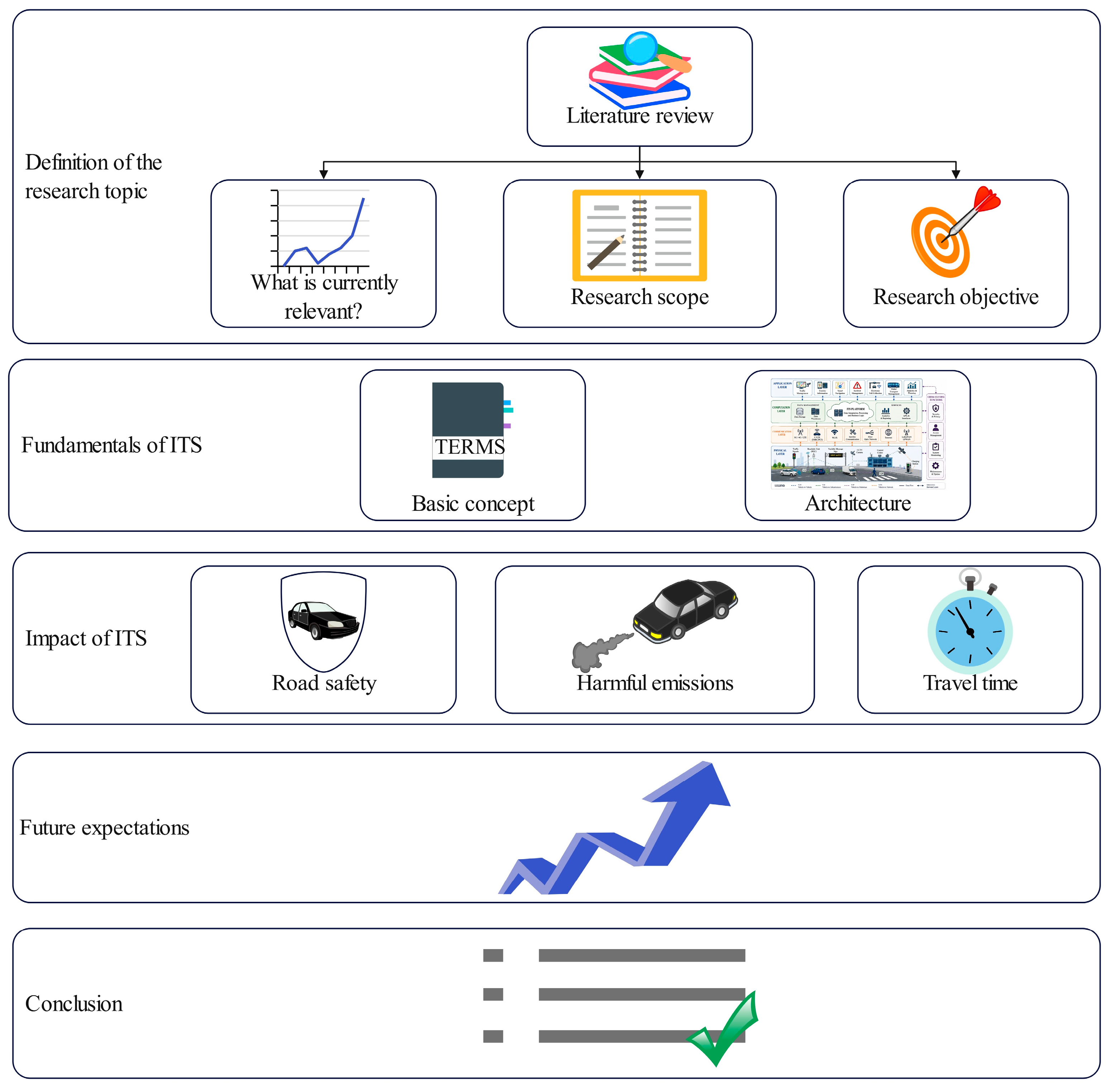
1.3. Outline and Objectives of the Review Paper
2. Research Methodology
3. Fundamentals and Architecture of Intelligent Transport Systems
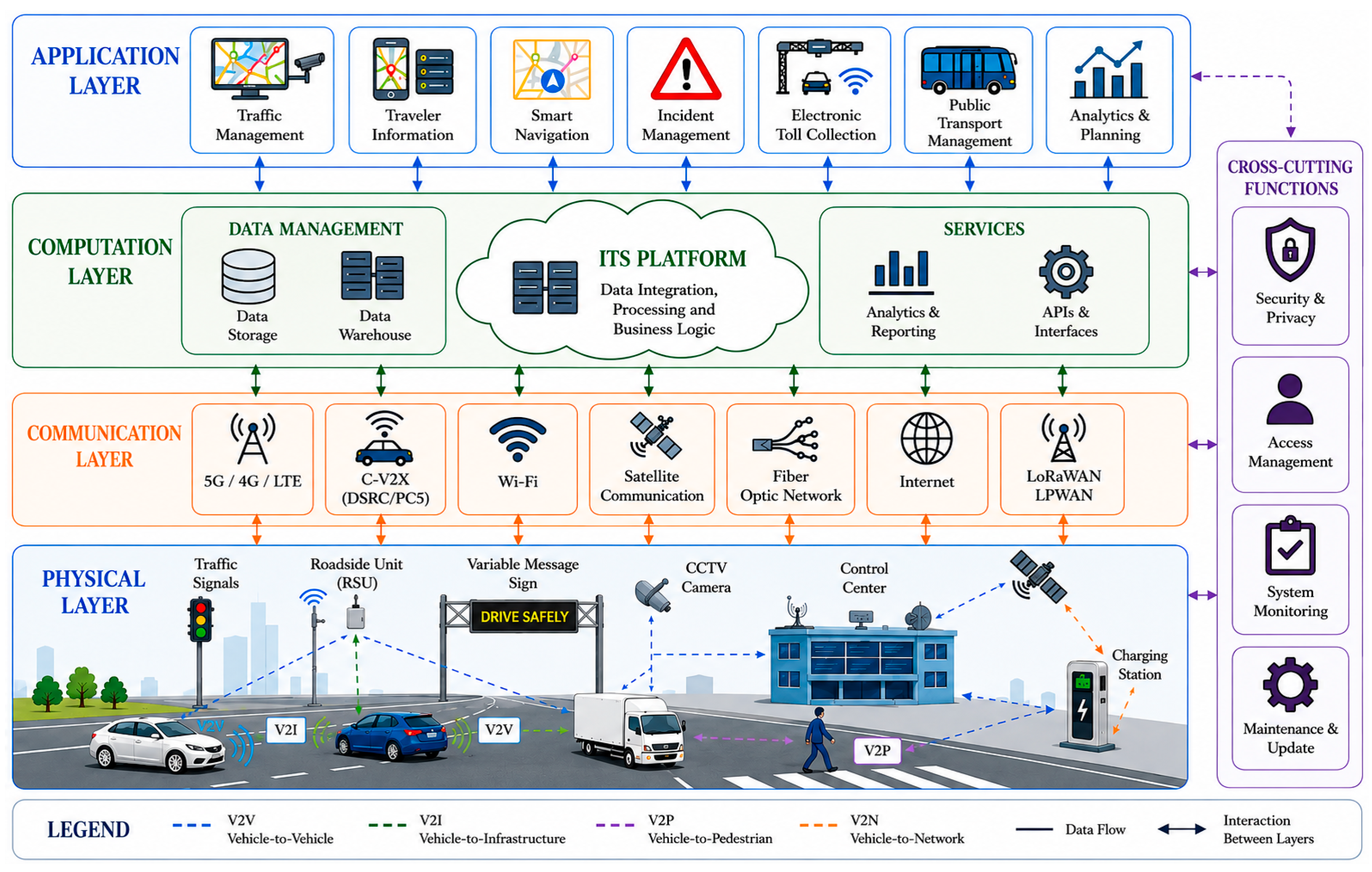
3.1. The ITS Architecture
- First layer—physical layer;
- Second layer—communication layer;
- Third layer—computation layer;
- Fourth layer—application layer.
3.2. Physical Layer
- Inductive loop detectors—sensors embedded in the road pavement and used for vehicle counting and speed measurement [47].
- Closed-circuit television (CCTV)—systems that serve as a source of spatial and temporal traffic data [48].
- LiDAR (Light Detection and Ranging) and radar—highly accurate systems for vehicle detection and classification. LiDAR generates a point cloud representing the detected vehicle and, together with radar, enables accurate determination of vehicle position, even under poor visibility conditions [49,50].
3.3. Communication and Computation Layer
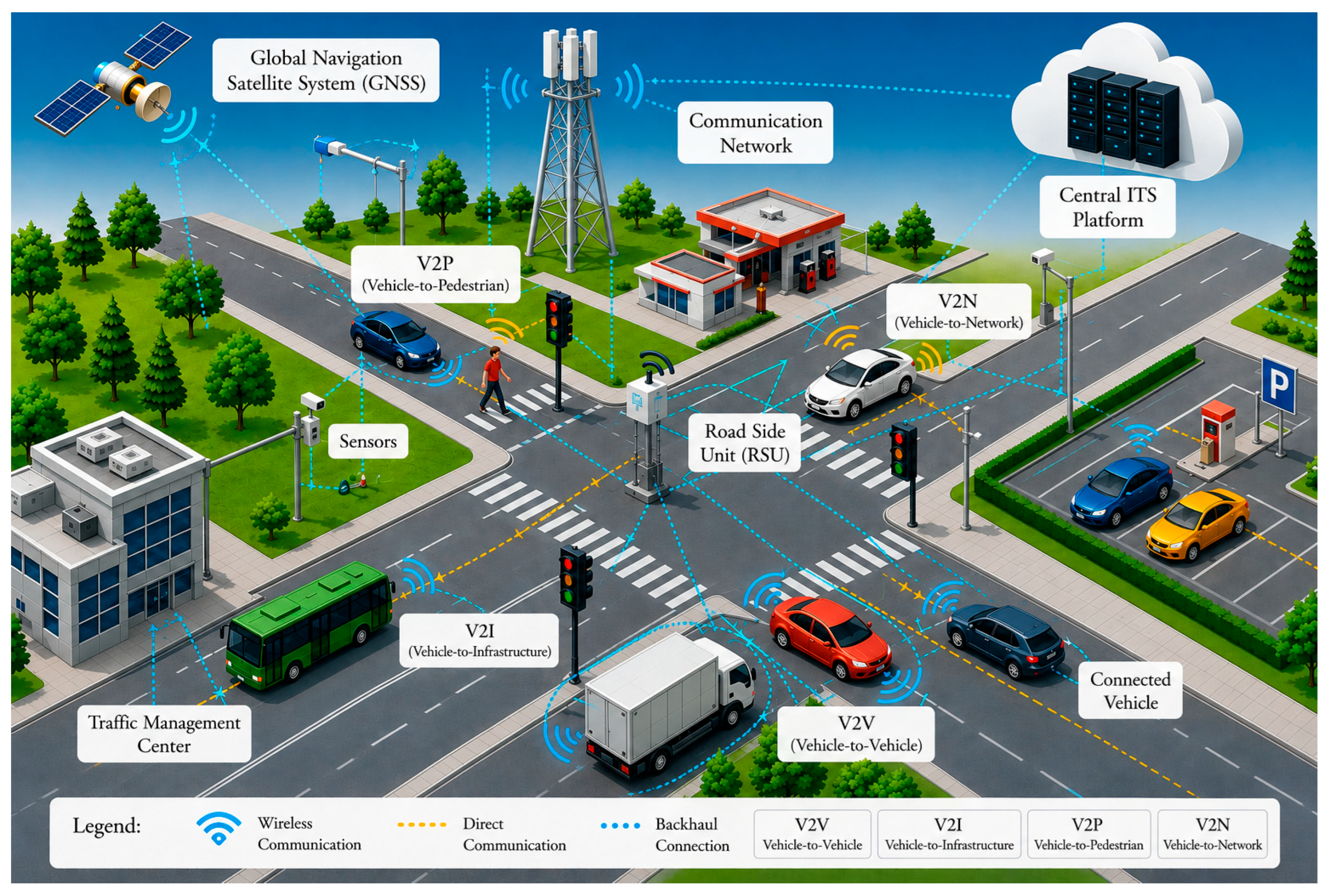
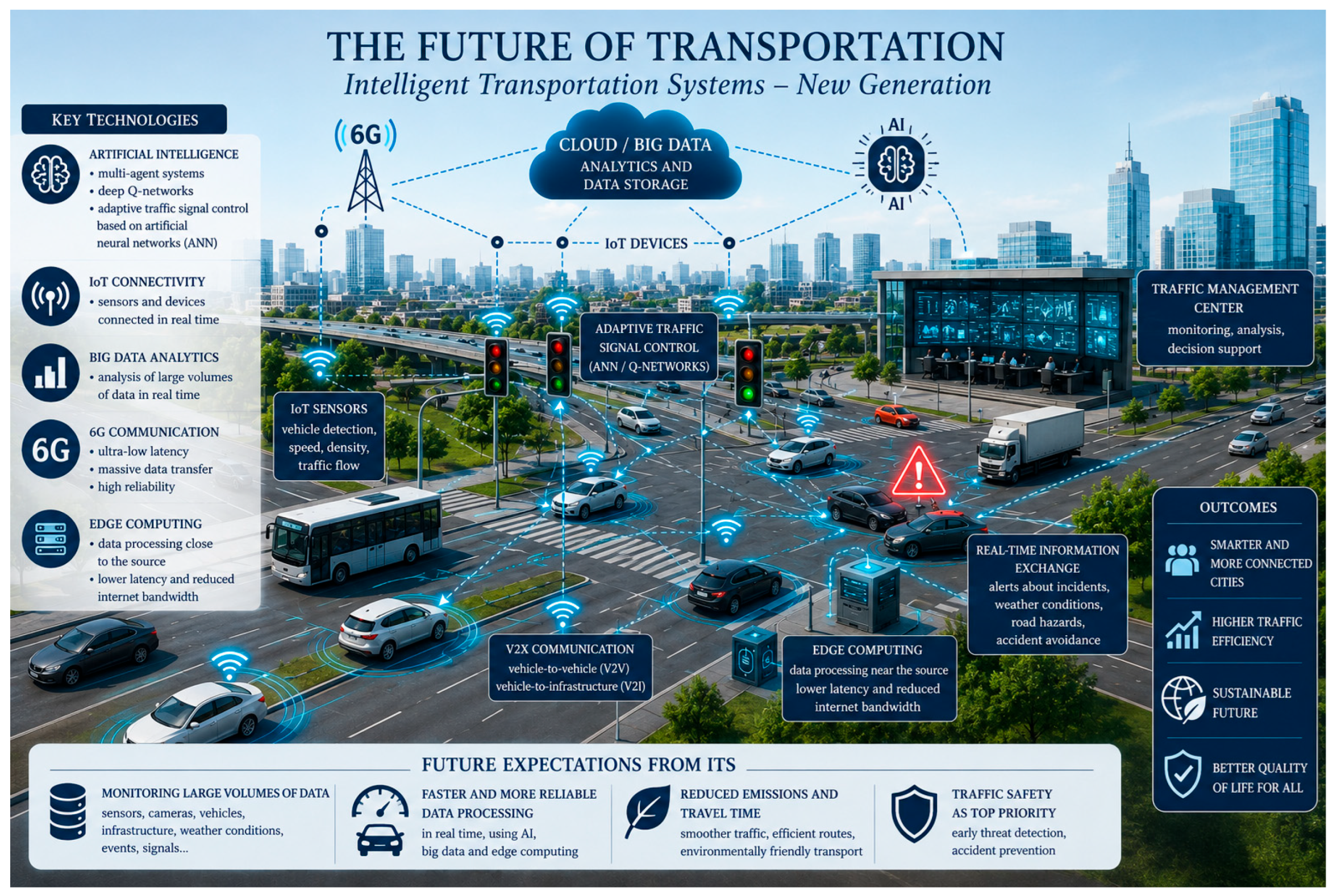
- Vehicle-to-Everything (V2X)—represents communication within a dynamic traffic environment, where the final letter indicates the entity with which the vehicle communicates. These communication models include [55,56,57]:
- ○
- V2V (Vehicle-to-Vehicle) communication model—operates through wireless communication, enabling vehicles to exchange information about accidents and traffic congestion. Vehicles can also transmit information about their current speed and position, allowing them to respond more rapidly than a human driver [58].
- ○
- V2I (Vehicle-to-Infrastructure) communication model—enables bidirectional wireless data exchange between vehicles and elements of the road infrastructure. This system integrates data from both traffic flows and various infrastructure components, including optical sensors, traffic light signalization, smart street lighting, speed limit monitoring systems, and weather stations [59].
- ○
- V2N (Vehicle-to-Network) communication model—relies on cellular networks and dedicated short-range communication. In this model, the vehicle functions similarly to a mobile device, receiving information such as notifications about traffic accidents [60].
- ○
- V2P (Vehicle-to-Pedestrian) communication model—establishes communication between vehicles and vulnerable road users, such as pedestrians and motorcyclists, with the aim of detecting, warning about, and preventing potential collisions. Data are exchanged in real time between smart devices used by vulnerable road users and sensors installed on vehicles [61].
- ○
- 5G and 6G—these represent two key technologies from which significant advances are expected, namely fifth-generation broadband cellular networks (5G) and sixth-generation broadband cellular networks (6G) [62]. 5G enables connectivity anytime and anywhere [63]. The introduction of 5G has substantially increased mobile data transmission speeds and reduced latency, while 6G is expected to enable near-instantaneous data transmission, exceptionally high reliability, and the seamless integration of the physical and virtual worlds [64].
- Edge computing—based on local data processing [65] which is performed precisely where improvements in response time and bandwidth efficiency are required [66]. This approach enables real-time data analysis, which is particularly important in transportation, rather than transmitting data to a central processing facility for subsequent analysis [67].
- Cloud computing and big data analytics—cloud computing enables remote servers to store and process data [68]. These systems process data that are not time-sensitive [66], and use them for macro-level traffic optimization [69]. They can also be used to analyze historical traffic events. Such processing and learning from traffic-related events require substantial computational resources [70].
3.4. Application Layer
4. Impact of Intelligent Transport Systems on Key ASPECTS of Transportation
4.1. Enhancing Road Safety
4.2. Emission Reduction
4.3. Traveling Time Reduction
4.4. Theoretical Traffic Management from the Perspective of Safety, Energy Efficiency, and Environmental Quality
5. Future Expectations for Intelligent Transport Systems
6. Conclusions
- ITS enable a transition from traditional to dynamic and predictive traffic management based on the continuous collection, transmission, and processing of real-time data.
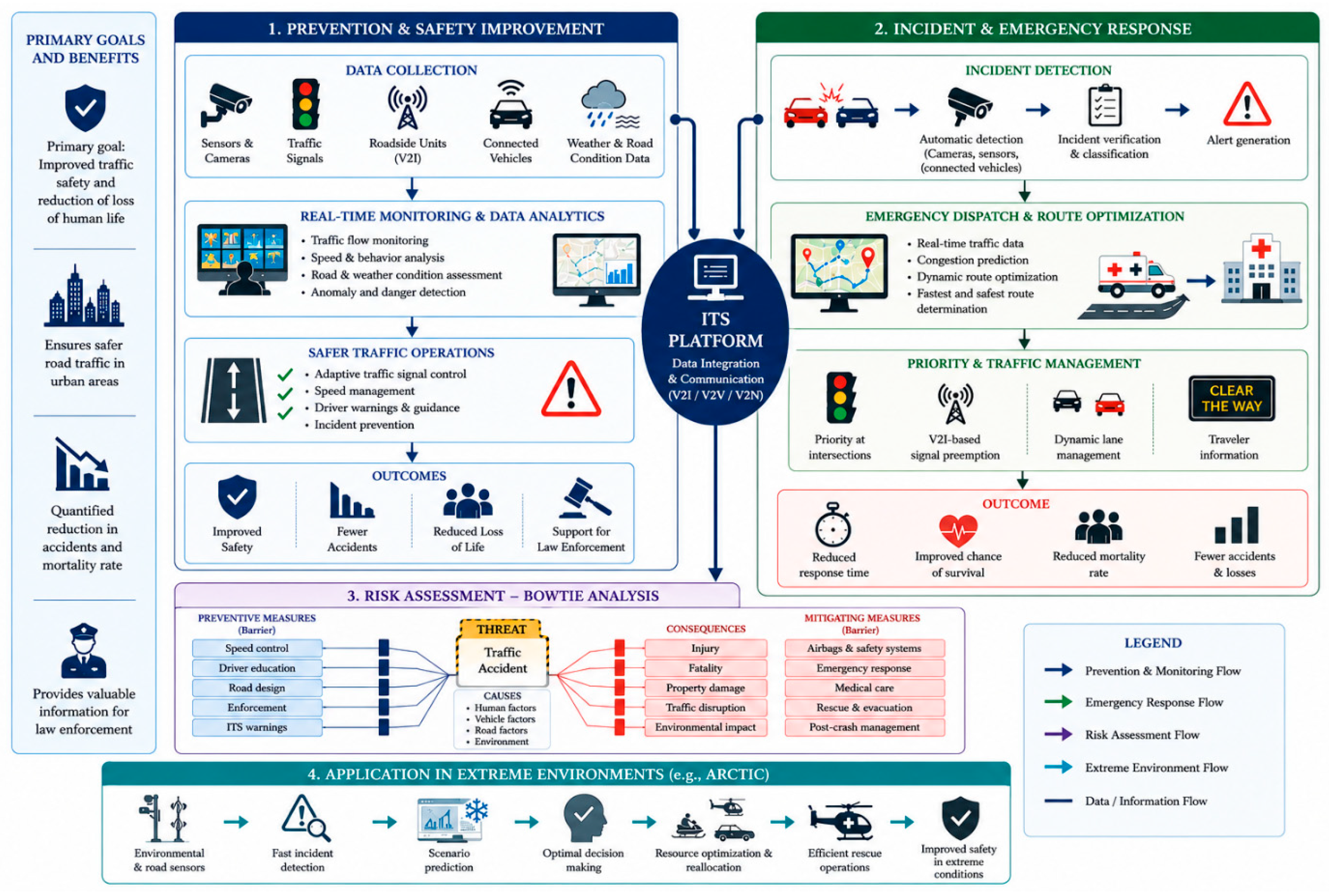
- The application of ITS contributes to improved road safety through the early detection of hazardous situations, risk prediction, intelligent traffic flow management, and more efficient responses to road traffic accidents.
- ITS can contribute to reducing energy consumption and harmful combustion emissions through traffic flow optimization, dynamic routing, congestion reduction, and smoother driving patterns. At the same time, route optimization can also incorporate traffic noise levels as an additional criterion.
- Travel time reduction can be achieved through dynamic assessment of the traffic network, prediction of its future state, and adaptation of routes and traffic signal control to current conditions. This approach is particularly important for the management of emergency vehicles, where route optimization and traffic signal prioritization can contribute to faster emergency response.
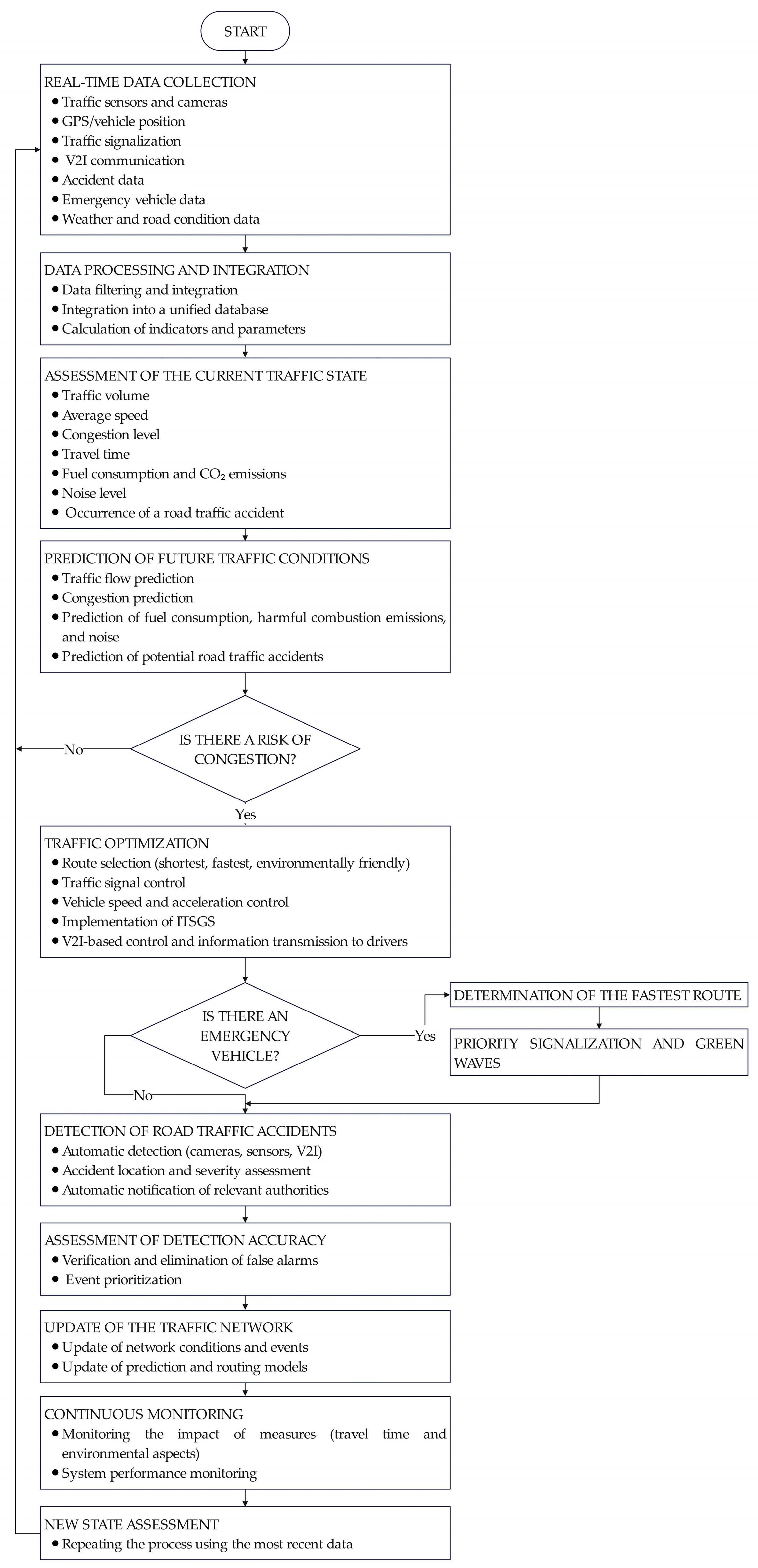
- The most significant contribution of this study is the integration of the aforementioned aspects into a unified conceptual traffic management algorithm. The proposed algorithm combines data collection and processing, traffic state assessment and prediction, route optimization, emissions and noise management, and road safety enhancement. Its closed feedback loop enables continuous monitoring of the effects of implemented measures and their adaptation to changing conditions within the traffic network.
Author Contributions
Funding
Data Availability Statement
Acknowledgments
Conflicts of Interest
Abbreviations
| ITS | Intelligent Transport Systems |
| V2X | Vehicle-to-Everything |
| IoT | Internet of Things |
| AI | Artificial intelligence |
| CO2 | Carbon dioxide |
| NOx | Nitrogen oxides |
| PM | Particulate matter |
| HC | Hydrocarbons |
| CO | Carbon monoxide |
| VOC | Volatile organic compounds |
| PAH | Polycyclic aromatic hydrocarbons |
| ICT | Information and communication technology |
| 5G | Fifth-generation |
| 6G | Sixth-generation |
| CCTV | Closed-circuit television |
| LiDAR | Light Detection and Ranging |
| FCD | Floating Car Data |
| V2V | Vehicle-to-Vehicle |
| V2I | Vehicle-to-Infrastructure |
| V2N | Vehicle-to-Network |
| V2P | Vehicle-to-Pedestrian |
| ITSGS | Intelligent Transportation Speed Guidance Systems |
| IATCMS | Intelligent Adaptive Traffic Control and Management System |
References
- European Commission. The Importance of the Private Car. Available online: https://road-safety.transport.ec.europa.eu/eu-road-safety-policy/priorities/safe-road-use/elderly-drivers/older-drivers/safety-versus-mobility-and-quality-life/importance-private-car_en (accessed on 15 July 2026).
- Complexity Science*Hub. Over Half of Global Commutes Are by Car, Says Study. Available online: https://csh.ac.at/news/over-half-of-global-commutes-are-by-car-says-study/ (accessed on 15 July 2026).
- ACEA. Motorisation Rates in the EU, by Country and Vehicle Type. Available online: https://www.acea.auto/figure/motorisation-rates-in-the-eu-by-country-and-vehicle-type/ (accessed on 15 July 2026).
- World Health Organization. Road Traffic Injuries. Available online: https://www.who.int/news-room/fact-sheets/detail/road-traffic-injuries (accessed on 15 July 2026).
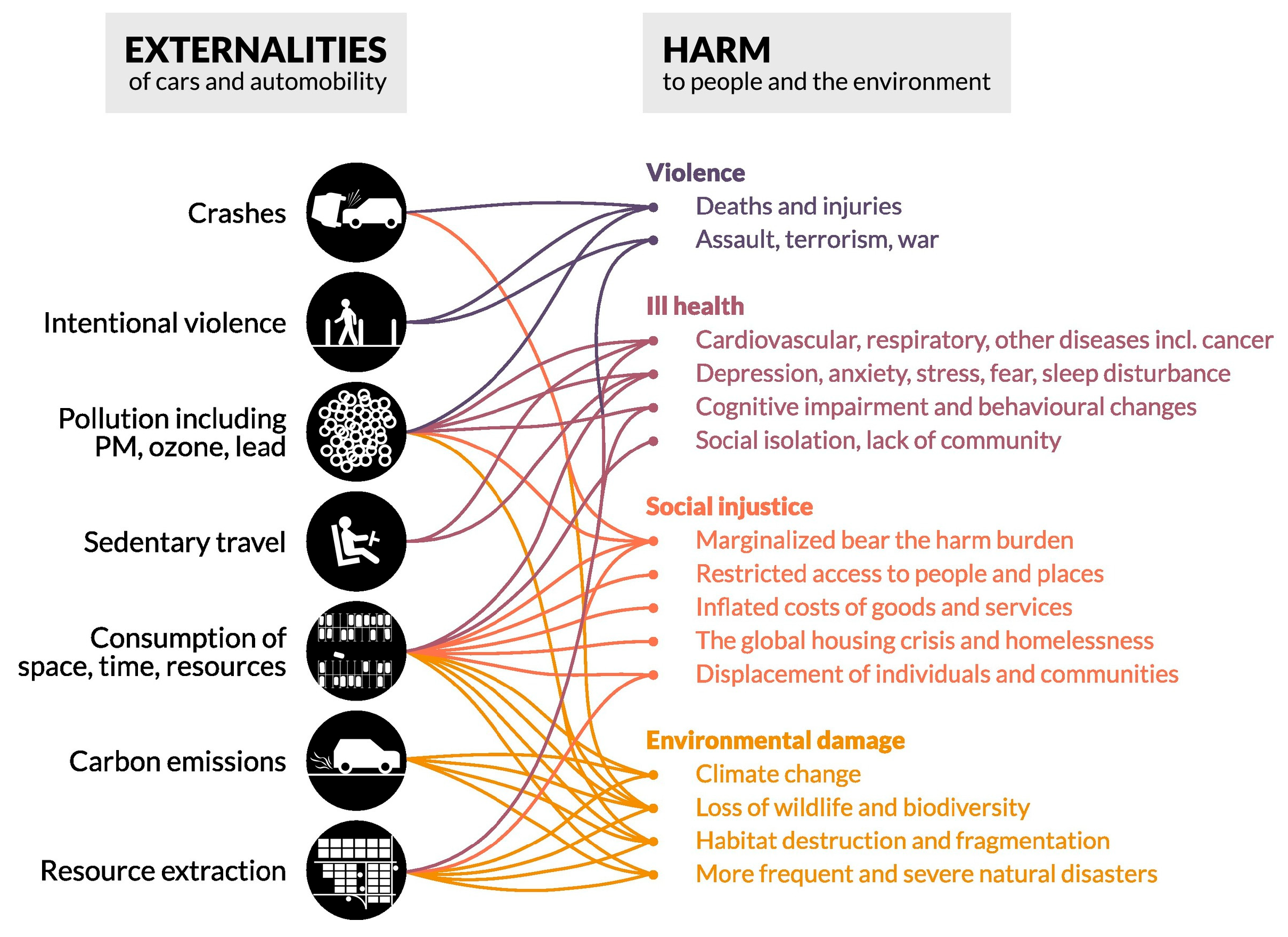
- Miner, P.; Smith, B.M.; Jani, A.; McNeill, G.; Gathorne-Hardy, A. Car harm: A global review of automobility’s harm to people and the environment. J. Transp. Geogr. 2024, 115, 103817. [Google Scholar] [CrossRef] [Scilit]
- Skrynetska, I.; Ciepał, R.; Kandziora-Ciupa, M.; Barczyk, G.; Nadgórska-Socha, A. Ecophysiological Responses to Environmental Pollution of Selected Plant Species in an Industrial Urban Area. Int. J. Environ. Res. 2018, 12, 255–267. [Google Scholar] [CrossRef] [Scilit]
- Oyelade, A.O.; Maku, O.E.; Oladimeji, O. The Effect of CO2 Emissions on Quality of Life in Anglophone Countries in West Africa. Afr. J. Econ. Rev. 2022, 10, 27–41. [Google Scholar]
- Kęska, A. The Actual Toxicity of Engine Exhaust Gases Emitted from Vehicles: The Development and Perspectives of Biological and Chemical Measurement Methods. ACS Omega 2023, 8, 24718–24726. [Google Scholar] [CrossRef] [Scilit] [PubMed]
- Ayetor, G.; Mbonigaba, I.; Ampofo, J.; Sunnu, A. Investigating the state of road vehicle emissions in Africa: A case study of Ghana and Rwanda. Transp. Res. Interdiscip. Perspect. 2021, 11, 100409. [Google Scholar] [CrossRef] [Scilit]
- State of Global Air. State of Global Air Report 2025. Available online: https://www.stateofglobalair.org/sites/default/files/documents/2025-10/soga-2025-report.pdf (accessed on 15 July 2026).
- Hänninen, O.; Lehtomäki, H.; Korhonen, A.; Kokkola, T.; Hartikainen, A.; Sippula, O.; Haverinen-Shaughnessy, U.; Leviäkangas, P.; Rumrich, I.K. Health risks related to air pollution by transport categories and vehicle types: Comparison by mortality indicators. Environ. Int. 2025, 202, 109657. [Google Scholar] [CrossRef] [Scilit] [PubMed]
- Saini, D.; Mishra, N.; Lataye, D.H. Variation of ambient air pollutants concentration over Lucknow city, trajectories and dispersion analysis using HYSPLIT4.0. Sādhanā 2022, 47, 231. [Google Scholar] [CrossRef] [Scilit]
- Muthu, M.; Gopal, J.; Kim, D.-H.; Sivanesan, I. Reviewing the Impact of Vehicular Pollution on Road-Side Plants—Future Perspectives. Sustainability 2021, 13, 5114. [Google Scholar] [CrossRef] [Scilit]
- Uka, U.N.; Belford, E.J.D.; Hogarh, J.N. Roadside air pollution in a tropical city: Physiological and biochemical response from trees. Bull. Natl. Res. Cent. 2019, 43, 90. [Google Scholar] [CrossRef] [Scilit]
- Munam, B.; Muhammad, S.; Tayyab, M.; Hanif, H.K.; Majeed, M.; Nawaz, H.; Khan, M.J.T.; Faisal, S.; Hasnain, M.; Malik, S.M.; et al. Physiochemical screening of road avenue plants in better landscape management of highly polluted urbanized city (Lahore), Pakistan. PeerJ 2025, 13, e20121. [Google Scholar] [CrossRef] [Scilit] [PubMed]
- Sass, V.; Kravitz-Wirtz, N.; Karceski, S.M.; Hajat, A.; Crowder, K.; Takeuchi, D. The effects of air pollution on individual psychological distress. Health Place. 2017, 48, 72–79. [Google Scholar] [CrossRef] [Scilit] [PubMed]
- Lapin, K.; Konrad, H.; Leeb, C.; Oettel, J. Species on the Move: Migration, Range Shifts, and Dispersal of Species. In Ecological Connectivity of Forest Ecosystems; Lapin, K., Oettel, J., Braun, M., Konrad, H., Eds.; Springer: Cham, Switzerland, 2025; pp. 23–38. [Google Scholar]
- Corlett, R.T. The ecology of plant extinctions. Trends Ecol. Evol. 2025, 40, 286–295. [Google Scholar] [CrossRef] [Scilit] [PubMed]
- Berdugo, M.; Delgado-Baquerizo, M.; Soliveres, S.; Hernández-Clemente, R.; Zhao, Y.; Gaitán, J.J.; Gross, N.; Saiz, H.; Maire, V.; Lehmann, A.; et al. Global ecosystem thresholds driven by aridity. Science 2020, 367, 787–790. [Google Scholar] [CrossRef] [Scilit] [PubMed]
- Fu, L.; Huang, J.; Zhang, G.; Han, D.; Ding, L.; Wei, Y.; Liu, X.; Li, C.; Yu, H. Abrupt loss of species richness caused by ecosystem transition. Sci. Bull. 2025, 70, 1523–1532. [Google Scholar] [CrossRef] [Scilit] [PubMed]
- Lima, S.L.; Blackwell, B.F.; DeVault, T.L.; Fernández-Juricic, E. Animal reactions to oncoming vehicles: A conceptual review. Biol. Rev. 2014, 90, 60–76. [Google Scholar] [CrossRef] [Scilit] [PubMed]
- Balčiauskas, L.; Kučas, A.; Balčiauskienė, L. A Review of Wildlife–Vehicle Collisions: A Multidisciplinary Path to Sustainable Transportation and Wildlife Protection. Sustainability 2025, 17, 4644. [Google Scholar] [CrossRef] [Scilit]
- Abei, F.; Mirou, B.; Aghaeiboorkheili, M. Traffic congestion—The problem affecting the flow of traffic in cities. Brit. J. Comput. Netw. Inf. Technol. 2025, 8, 163–173. [Google Scholar] [CrossRef] [Scilit]
- Zhang, K.; Batterman, S. Air pollution and health risks due to vehicle traffic. Sci. Total Environ. 2013, 450, 307–316. [Google Scholar] [CrossRef] [Scilit] [PubMed]
- Nitoiu, C.; Cofaru, C.; Popescu, M. Influence of road and traffic conditions on emissions and fuel consumption of light vehicles in a real urban driving cycle. Environ. Sci. Pollut. Res. 2025, 32, 15050–15065. [Google Scholar] [CrossRef] [Scilit] [PubMed]
- Speck, J. Understand Induced Demand. In Walkable City Rules; Speck, J., Ed.; Island Press: Washington, DC, USA, 2018; pp. 64–65. [Google Scholar]
- Lu, J.; Li, B.; Li, H.; Al-Barakani, A. Expansion of city scale, traffic modes, traffic congestion, and air pollution. Cities 2021, 108, 102974. [Google Scholar] [CrossRef] [Scilit]
- Hymel, K. Does traffic congestion reduce employment growth? J. Urban Econ. 2009, 65, 127–135. [Google Scholar] [CrossRef] [Scilit]
- Huang, G.; Wang, H. Impact of the transit metropolis pilot policy on traffic congestion: Evidence from China. Transp. Polic. 2026, 186, 104234. [Google Scholar] [CrossRef] [Scilit]
- Bakare, B.; Motuba, D.; Szmerekovsky, J. Do corporate social responsibility ratings have any effect on traffic congestion? Transp. Res. A Policy Pract. 2022, 165, 98–119. [Google Scholar] [CrossRef] [Scilit]
- Chahal, A.; Gulia, P.; Gill, N.S.; Priyadarshini, I. A Hybrid Univariate Traffic Congestion Prediction Model for IoT-Enabled Smart City. Information 2023, 14, 268. [Google Scholar] [CrossRef] [Scilit]
- Anupriya; Bansal, P.; Graham, D.J. Congestion in cities: Can road capacity expansions provide a solution? Transp. Res. A Policy Pract. 2023, 174, 103726. [Google Scholar] [CrossRef] [Scilit]
- Samalna, D.A.; Ngossaha, J.M.; Abba Ari, A.A.; Kolyang. Cyber-physical urban mobility systems. Int. J. Softw. Innov. 2023, 11, 504–511. [Google Scholar] [CrossRef] [Scilit]
- Algherbal, A.; Ratrout, N.T. Smart cities and intelligent transportation systems: Integration of autonomous vehicles and their impact on congestion and safety. Transp. Res. Procedia. 2025, 84, 504–511. [Google Scholar] [CrossRef] [Scilit]
- Aarti; Gowroju, S.; Ansarullah, S.I. A comprehensive review of developments and challenges in the 6G internet of things. Discov. Netw. 2025, 1, 13. [Google Scholar] [CrossRef] [Scilit]
- Biswas, A.; Wang, H.-C. Autonomous vehicles enabled by the integration of IoT, edge intelligence, 5G, and blockchain. Sensors 2023, 23, 1963. [Google Scholar] [CrossRef] [Scilit] [PubMed]
- Marta, K. Expectations for the use of Intelligent Transport Systems applications in the management of freight transport enterprises. Procedia Comput. Sci. 2021, 192, 2318–2329. [Google Scholar] [CrossRef] [Scilit]
- Khalid, T.; Khan, A.N.; Ali, M.; Adeel, A.; ur Rehman Khan, A.; Shuja, J. A fog-based security framework for intelligent traffic light control system. Multimed. Tools Appl. 2018, 78, 24595–24615. [Google Scholar] [CrossRef] [Scilit]
- Antl, M.; Pietriková, E.; Poor, P. Intelligent urban traffic management systems—Takeways from Martin City. In Proceedings of the 2024 IEEE 17th International Scientific Conference on Informatics (Informatics), Poprad, Slovakia, 13–15 November 2024. [Google Scholar]
- Adeniran, A.O.; Adeniran, A.A.; Ogieva, M.O.; Ogwuche, G. Adoption of Intelligent Transport Systems (ITS) in urban transportation planning. Discov. Glob. Soc. 2026, 4, 13. [Google Scholar] [CrossRef] [Scilit]
- Hamida, B.; Noura, H.; Znaidi, W. Security of Cooperative Intelligent Transport Systems: Standards, Threats Analysis and Cryptographic Countermeasures. Electronics 2015, 4, 380–423. [Google Scholar] [CrossRef] [Scilit]
- Sanguesa, J.A.; Barrachina, J.; Fogue, M.; Garrido, P.; Martinez, F.J.; Cano, J.-C.; Calafate, C.T.; Manzoni, P. Sensing traffic density combining V2V and V2I wireless communications. Sensors 2015, 15, 31794–31810. [Google Scholar] [CrossRef] [Scilit] [PubMed]
- Petracca, M.; Pagano, P.; Pelliccia, R.; Ghibaudi, M.; Salvadori, C.; Nastasi, C. On-board unit hardware and software design for vehicular ad-hoc networks. In Roadside Networks for Vehicular Communications: Architectures, Applications and Test Fields; Idea Group: Hershey, PA, USA, 2015; pp. 1–19. [Google Scholar]
- Xu, H.; Liang, Y.; Xie, R.; Kong, Y. The deep learning evolution in wireless physical layer communications: Applications, challenges, and evolutionary directions. Sensors 2026, 26, 3609. [Google Scholar] [CrossRef] [Scilit] [PubMed]
- Hmissi, F.; Ouni, S. A Survey on application layer protocols for IoT networks. Int. J. Adv. Telecommun. 2024, 15, 11–22. [Google Scholar]
- Holmgren, J.; Fredriksson, H.; Dahl, M. Traffic data collection using active mobile and stationary devices. Procedia Comput. Sci. 2020, 177, 49–56. [Google Scholar] [CrossRef] [Scilit]
- Lamas-Seco, J.J.; Castro, P.M.; Dapena, A.; Vazquez-Araujo, F.J. SiDIVS: Simple detection of inductive vehicle signatures with a multiplex resonant sensor. Sensors 2016, 16, 1309. [Google Scholar] [CrossRef] [Scilit] [PubMed]
- Chen, W.-C.; Deng, M.-J.; Liu, P.-Y.; Lai, C.-C.; Lin, Y.-H. A framework for real-time vehicle counting and velocity estimation using deep learning. Sustain. Comput. Inform. Syst. 2023, 40, 100927. [Google Scholar] [CrossRef] [Scilit]
- Shan, J.; Toth, C.K. Topographic Laser Ranging and Scanning Principles and Processing, 2nd ed.; CRC Press: Boca Raton, FL, USA, 2018. [Google Scholar]
- Takhtkeshha, N.; Mandlburger, G.; Remondino, F.; Hyyppä, J. Multispectral Light Detection and Ranging Technology and Applications: A Review. Sensors 2024, 24, 1669. [Google Scholar] [CrossRef] [Scilit] [PubMed]
- Altintasi, O.; Tuydes-Yaman, H.; Tuncay, K. Detection of urban traffic patterns from Floating Car Data (FCD). Transp. Res. Procedia. 2017, 22, 382–391. [Google Scholar] [CrossRef] [Scilit]
- Budimir, D.; Jelušić, N.; Perić, M. Floating Car Data Technology. Pomorstvo 2019, 33, 22–32. [Google Scholar] [CrossRef] [Scilit]
- Liu, P.; Yuan, X.; Zhang, C.; Song, Y.; Liu, C.; Li, Z. Real-Time Photometric Calibrated Monocular Direct Visual SLAM. Sensors 2019, 19, 3604. [Google Scholar] [CrossRef] [Scilit] [PubMed]
- Arena, F.; Pau, G. An overview of vehicular communications. Future Internet 2019, 11, 27. [Google Scholar] [CrossRef] [Scilit]
- Špitálová, Z. Vehicle-to-everything communication. Electr. Eng. Transp. 2022, 25, C24–C35. [Google Scholar] [CrossRef] [Scilit]
- Tahir, M.N.; Leviäkangas, P.; Katz, M. Connected vehicles: V2V and V2I road weather and traffic communication using cellular technologies. Sensors 2022, 22, 1142. [Google Scholar] [CrossRef] [Scilit] [PubMed]
- Gordón, P.E.; Olivera, V.M.; Corona, A.S. Vehicle-to-Vehicle Secure Communication Protocol Based on Digital Vehicle Identification Number. Sensors 2025, 25, 5954. [Google Scholar] [CrossRef] [Scilit] [PubMed]
- Zorkany, M.E.; Yasser, A.; Galal, A.I. Vehicle To Vehicle “V2V” communication: Scope, importance, challenges, research directions and future. Open Transp. J. 2020, 14, 86–98. [Google Scholar] [CrossRef] [Scilit]
- Rahman, M.A. Vehicle-To-Infrastructure (V2I) communication and traffic incident reduction: An empirical study across U.S. highway networks. J. Sustain. Dev. Polic. 2025, 4, 38–81. [Google Scholar] [CrossRef] [Scilit]
- Sandesh, R.S.; Santhosh, K. Revolutionizing vehicle communication: A comprehensive exploration of technologies for enhanced road safety and autonomous vehicles. Alex. Eng. J. 2025, 129, 976–997. [Google Scholar] [CrossRef] [Scilit]
- Petrov, T.; Sleiman, W.; Beigi, P.; Počta, P.; Buzna, Ľ.; Hamdar, S. Simulation of Vehicle-to-Pedestrian Communication for Development of Novel C-ITS Services for Vulnerable Road Users. Transp. Res. Procedia. 2026, 93, 674–679. [Google Scholar] [CrossRef] [Scilit]
- Oinas-Kukkonen, H.; Karppinen, P.; Kekkonen, M. 5G and 6G broadband cellular network technologies as enablers of new avenues for behavioral influence with examples from reduced rural-urban digital divide. Urban Sci. 2021, 5, 60. [Google Scholar] [CrossRef] [Scilit]
- Breskovic, D. X-haul solutions for 5G/6G networks: Overview of requirements and technologies. Comput. Netw. 2026, 274, 111796. [Google Scholar] [CrossRef] [Scilit]
- Taherdoost, H. A comparative analysis of 6G and 5G technologies for metaverse connectivity dynamics. Discov. Netw. 2026, 2, 2. [Google Scholar] [CrossRef] [Scilit]
- Tamariz-Flores, E.I.; Torrealba-Meléndez, R.; Muñoz-Pacheco, J.M.; López-López, M.; Arriaga-Arriaga, C.A. Intelligent edge computing architecture: Low-latency transmission in an intelligent transport system for IoT applications. IoT 2026, 7, 47. [Google Scholar] [CrossRef] [Scilit]
- Pushpa, J.; Kalyani, S. Using fog computing/edge computing to leverage Digital Twin. In Advances in Computers; Raj, P., Evangeline, P., Eds.; Elsevier: Amsterdam, The Netherlands, 2020; Volume 117, pp. 51–77. [Google Scholar]
- Saini, K.; Raj, P. (Eds.) Edge platforms, frameworks and applications. In Advances in Computers; Elsevier: Amsterdam, The Netherlands, 2022; Volume 127, pp. 237–258. [Google Scholar]
- Ahmed, A.H.; Zanotti Fragonara, L. Adaptive intelligent traffic control systems for improving traffic quality and congestion in smart cities. Int. J. Qual. Res. 2021, 15, 139–154. [Google Scholar] [CrossRef] [Scilit]
- Mohandu, A.; Kubendiran, M. Survey on big data techniques in intelligent transportation system (ITS). Mater. Today Proc. 2021, 47, 8–17. [Google Scholar] [CrossRef] [Scilit]
- AL-Jumaili, H.A.; Muniyandi, R.C.; Hasan, M.K.; Paw, J.K.S.; Singh, M.J. Big data analytics using cloud computing based frameworks for power management systems: Status, constraints, and future recommendations. Sensors 2023, 23, 2952. [Google Scholar] [CrossRef] [Scilit] [PubMed]
- Javed, A.; Hamida, E.B.; Znaidi, W. Security in intelligent transport systems for smart cities: From theory to practice. Sensors 2016, 16, 879. [Google Scholar] [CrossRef] [Scilit] [PubMed]
- Petrescu, I.; Niculae, E.; Vulturescu, V.; Dimitrescu, A.; Ungureanu, L.M. Transport and application layer protocols for iot: Comprehensive review. Technologies 2025, 13, 583. [Google Scholar] [CrossRef] [Scilit]
- Cherry, M.; Shalli, R.; Norbert, H. A misbehavior detection framework for cooperative intelligent transport systems. ISA Trans. 2023, 132, 52–60. [Google Scholar] [CrossRef] [Scilit] [PubMed]
- Xing, L.; Li, B.; Deng, K.; Gao, J.; Wu, H.; Ma, H.; Zhang, X. Advancing intelligent transportation through digital twin: Challenges, models, and future prospects. AD Hoc Netw. 2026, 181, 104077. [Google Scholar] [CrossRef] [Scilit]
- Malygin, I.; Komashinskiy, V.; Korolev, O. Cognitive technologies for providing road traffic safety in intelligent transport systems. Transp. Res. Procedia 2018, 36, 487–492. [Google Scholar] [CrossRef] [Scilit]
- Alqarni, Z.A.; Qasim, H.M.; Alsuwian, T.; Amin, A.A.; Rehman, S.U.; Haris, M. Advanced internet of things (IoT)-based intelligent heavy transport vehicles (HTV) monitoring system to enhance passenger safety. Recent Adv. Electr. Electron. Eng. 2026, 19, E23520965368197. [Google Scholar] [CrossRef] [Scilit]
- Ehlers, U.C.; Ryeng, E.O.; McCormack, E.; Khan, F.; Ehlers, S. Assessing the safety effects of cooperative intelligent transport systems: A bowtie analysis approach. Accid. Anal. Prev. 2017, 99, 125–141. [Google Scholar] [CrossRef] [Scilit] [PubMed]
- Sharma, A.; Shabaz, M. SLA-trust-energy aware path computation for critical services in Blockchain-enabled intelligent transport system. Comput. Commun. 2022, 196, 109–116. [Google Scholar] [CrossRef] [Scilit]
- Rudskoy, A.; Ilin, I.; Prokhorov, A. Digital Twins in the Intelligent Transport Systems. Transp. Res. Procedia. 2021, 54, 927–935. [Google Scholar] [CrossRef] [Scilit]
- Alexander, M.; Ekaterina, B. Functional model of an intelligent decision support system for responding to transport emergencies in the Arctic zone. Transp. Res. Procedia. 2021, 57, 363–369. [Google Scholar] [CrossRef] [Scilit]
- Wang, X.; Ning, Z.; Wang, L. Offloading in Internet of vehicles: A fog-enabled real-time traffic management system. IEEE Trans. Ind. Inform. 2018, 14, 1568–4578. [Google Scholar] [CrossRef] [Scilit]
- Lytras, M.D.; Visvizi, A.; Sarirete, A. Clustering Smart City Services: Perceptions, Expectations, Responses. Sustainability 2019, 11, 1669. [Google Scholar] [CrossRef] [Scilit]
- Khodaparastan, M.; Mohamed, A.A.; Brandauer, W. Recuperation of regenerative braking energy in electric rail transit systems. IEEE Trans. Intell. Transp. Syst. 2019, 20, 2831–2847. [Google Scholar] [CrossRef] [Scilit]
- Lv, Z.; Shang, W. Impacts of intelligent transportation systems on energy conservation and emission reduction of transport systems: A comprehensive review. Green Technol. Sustain. 2022, 1, 100002. [Google Scholar] [CrossRef] [Scilit]
- Bi, S.; Liang, B.; Li, J.; Yan, Z.; Appolloni, A. Impact of green fiscal policy on collaborative management of energy conservation and emission reduction. Sustain. Energy Technol. Assess. 2025, 83, 104587. [Google Scholar] [CrossRef] [Scilit]
- Pell, A.; Nyamadzawo, P.; Schauer, O. Intelligent transportation system for traffic and road infrastructure-related data. Int. J. Adv. Logist. 2016, 5, 19–29. [Google Scholar] [CrossRef] [Scilit]
- Chen, Y.; Ardila-Gomez, A.; Frame, G. Achieving energy savings by intelligent transportation systems investments in the context of smart cities. Transp. Res. Part D Transp. Environ. 2017, 54, 381–396. [Google Scholar] [CrossRef] [Scilit]
- Peng, T.; Yang, X.; Xu, Z.; Liang, Y. Constructing an environmental friendly low-carbon-emission intelligent transportation system based on big data and machine learning methods. Sustainability 2020, 12, 8118. [Google Scholar] [CrossRef] [Scilit]
- Mohsen, B.M.; Mohsen, M. Reducing emissions through ai-driven multimodal transport optimization in IoT-connected environments. Int. J. Energy Res. 2025, 2025, 2399288. [Google Scholar] [CrossRef] [Scilit]
- Ouallane, A.A.; Bakali, A.; Bahnasse, A.; Broumi, S.; Talea, M. Fusion of engineering insights and emerging trends: Intelligent urban traffic management system. Inf. Fusion. 2022, 88, 218–248. [Google Scholar] [CrossRef] [Scilit]
- Nsour, K.S.; Iskandarani, M.Z. Impact of transferring light busses to BRT route on traffic congestion, mobility, and safety at Sweileh intersection in Amman. J. Appl. Eng. Sci. 2025, 23, 165–179. [Google Scholar] [CrossRef] [Scilit]
- Jia, Z.; Yin, J.; Cao, Z.; Wei, N.; Jiang, Z.; Zhang, Y.; Wu, L.; Zhang, Q.; Mao, H. Sustainable transportation emission reduction through intelligent transportation systems: Mitigation drivers, and temporal trends. Environ. Impact Assess. Rev. 2025, 112, 107767. [Google Scholar] [CrossRef] [Scilit]
- Koukounaris, A.I.; Stephanedes, Y.J. Connected Intelligent Transportation System Model to Minimize Societal Cost of Travel in Urban Networks. Sustainability 2023, 15, 15383. [Google Scholar] [CrossRef] [Scilit]
- Prasad, R.; Yadav, H.; Kumar, D.; Pandey, S.; Yadav, A. Smart Traffic Monitoring and Controlling. J. Emerg. Technol. Innov. Res. 2021, 8, f744–f748. [Google Scholar] [CrossRef] [Scilit]
- Lupi, M.; Boero, M.; Conte, D.; Rappis, L.N.; Vannucci, M.; Farina, A. An ITS system for reducing congestion and noise pollution due to vehicles to/from port terminals. Sustainability 2022, 14, 14579. [Google Scholar] [CrossRef] [Scilit]
- Mansour, A.I.; Aljamil, H.A. Investigating the effect of traffic flow on pollution, noise for urban road network. In Proceedings of the 2nd International Conference of Al-Esraa University College for Engineering Sciences (ICAUC_ES 2021), Baghdad, Iraq, 3–4 November 2021. [Google Scholar]
- Shaygan, M.; Meese, C.; Li, W.; Zhao, X.G.; Nejad, M. Traffic prediction using artificial intelligence: Review of recent advances and emerging opportunities. Transp. Res. C Emerg. Technol. 2022, 145, 103921. [Google Scholar] [CrossRef] [Scilit]
- Rajagopal, M.; Sivasakthivel, R.; Anitha, G.; Loganathan, K.; Rao, K.S.; Abbas, M.; Kalathil, S. A hybrid Lorentzian graph neural diffusion framework for predicting traffic flow in intelligent transportation systems. Appl. Soft Comput. 2026, 203, 116002. [Google Scholar] [CrossRef] [Scilit]
- Elassy, M.; Al-Hattab, M.; Takruri, M.; Badawi, S. Intelligent transportation systems for sustainable smart cities. Transp. Eng. 2024, 16, 100252. [Google Scholar] [CrossRef] [Scilit]
- Zhang, X. Review on traffic flow prediction method based on neural network. In Proceedings of the 2023 2nd International Conference on Artificial Intelligence and Autonomous Robot Systems (AIARS), Bristol, UK, 29–31 July 2023. [Google Scholar]
- Vankdoth, S.R.; Arock, M. Deep intelligent transportation system for travel time estimation on spatio-temporal data. Neural Comput. Appl. 2023, 35, 19117–19129. [Google Scholar] [CrossRef] [Scilit]
- Mrudula, S.T.; Meenakshi; Ritonga, M.; Sivakumar, S.; Jawarneh, M.; Sammy, F.; Keerthika, T.; Roy, B. Internet of things and optimized knn based intelligent transportation system for traffic flow prediction in smart cities. Meas. Sens. 2024, 35, 101297. [Google Scholar] [CrossRef] [Scilit]
- Li, X.; Li, Z.; Wang, Y. Intelligent traffic management with Mamba-ATSP: Optimizing signal control and path planning using multi-modal data fusion. Alex. Eng. J. 2026, 137, 414–423. [Google Scholar] [CrossRef] [Scilit]
- Dorofeev, A.; Kurganov, V.; Filippova, N.; Petrov, A.; Zakharov, D.; Iarkov, S. Improving Transportation Management Systems (TMSs) Based on the Concept of Digital Twins of an Organization. Appl. Sci. 2024, 14, 1330. [Google Scholar] [CrossRef] [Scilit]
- Alsheikhy, A.; Said, Y.F.; Shawly, T. A novel intelligent smart traffic system using a deep-learning architecture. Multimed. Tools Appl. 2024, 83, 37913–37926. [Google Scholar] [CrossRef] [Scilit]
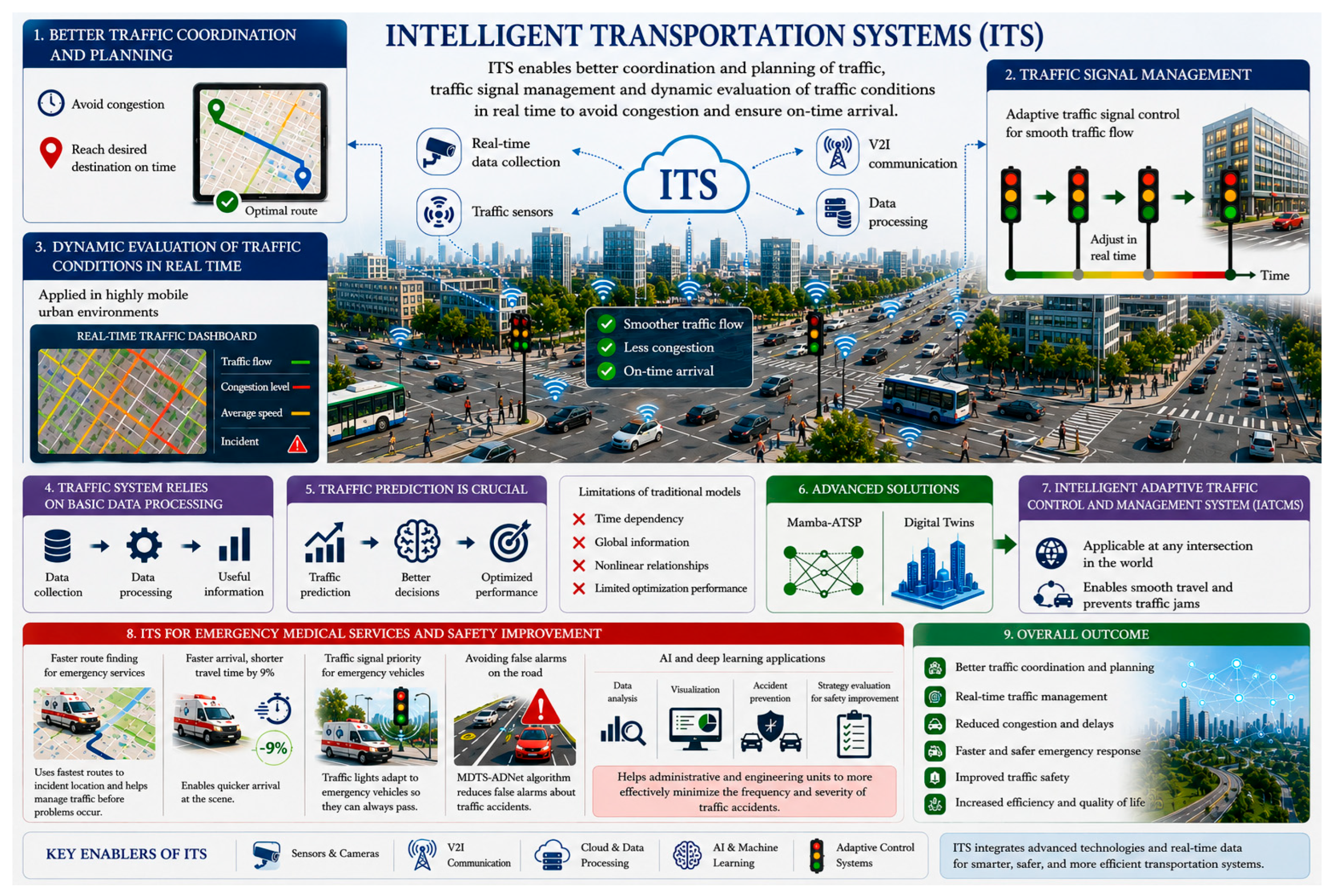
- Sharrab, Y.O.; Alshabatat, M.A.; Attar, H.H.; Irtahi, B.M.; Eljinini, M.A.H.; Khosravi, M.; Hafez, M.A. Enhanced intelligent transportation network systems for optimized emergency medical services management. Int. J. Intell. Netw. 2025, 6, 314–333. [Google Scholar] [CrossRef] [Scilit]
- Uribe-Chavert, P.; Posadas-Yagüe, J.-L.; Poza-Lujan, J.-L. Evaluating Traffic Control Parameters: From Efficiency to Sustainable Development. Smart Cities 2025, 8, 57. [Google Scholar] [CrossRef] [Scilit]
- Ahmad, A.; Al-Sumaiti, A.S.; Byon, Y.-J.; Alhosani, K. Multiple intelligent control strategies for travel-time reduction of connected emergency vehicles. IEEE Trans. Intell. Transp. Syst. 2025, 26, 337–353. [Google Scholar] [CrossRef] [Scilit]
- Qi, L.; Zhou, M.; Luan, W. A Two-level Traffic Light Control Strategy for Preventing Incident-Based Urban Traffic Congestion. IEEE Trans. Intell. Transp. Syst. 2018, 19, 13–24. [Google Scholar] [CrossRef] [Scilit]
- Liu, H.; Hu, X.; Sun, G.; Zhang, W.; Zhan, J.; Fang, H.; Li, Y.; Ma, W. Intelligent traffic accident detection system in complex dynamic scenarios based on the dual-stream spatiotemporal-fusion model. Eng. Appl. Artif. Intell. 2025, 162, 112675. [Google Scholar] [CrossRef] [Scilit]
- Lin, D.-J.; Chen, M.-Y.; Chiang, H.-S. Deep learning based intelligent traffic accident prediction systems. Encycl. Oper. Manag. 2026, 3, 463–480. [Google Scholar] [CrossRef] [Scilit]
- Deepika; Pandove, G. A comparison of ML models for predicting congestion in urban cities. Int. J. Intell. Transp. Syst. Res. 2024, 22, 171–188. [Google Scholar] [CrossRef] [Scilit]
- Dridi, M.; Mualla, Y.; Abbas-Turki, A. Intelligent Transportation System Technologies and Applications: Closing Editorial. Appl. Sci. 2025, 15, 11051. [Google Scholar] [CrossRef] [Scilit]
- Karabulut, M.A.; Shahen Shah, A.F.M.; Khan Pathan, A.-S.; Bradford, P.G. IoT-driven intelligent transportation system in the era of 6G and AI: A review. Comput. Mater. Contin. 2026, 88, 077625. [Google Scholar] [CrossRef] [Scilit]
- Jha, A.V.; Appasani, B.; Khan, M.S.; Zeadally, S.; Katib, I. 6G for intelligent transportation systems: Standards, technologies, and challenges. Telecommun. Syst. 2024, 86, 241–268. [Google Scholar] [CrossRef] [Scilit]
- Porambage, P.; Gür, G.; Moya Osorio, D.P.; Liyanage, M.; Gurtov, A.; Ylianttila, M. The roadmap to 6G security and privacy. IEEE Open J. Commun. Soc. 2021, 2, 1094–1122. [Google Scholar] [CrossRef] [Scilit]
- Afolalu, O.; Tsoeu, M.S. Artificial Intelligence as the Next Frontier in Cyber Defense: Opportunities and Risks. Electronics 2025, 14, 4853. [Google Scholar] [CrossRef] [Scilit]
- Hayat, K.; Abid, S.A.; Shah, N.; Tahir, T. A systematic review on task offloading and resource allocation for next-generation intelligent transportation systems: Methodologies, challenges, and future research directions. Comput. Netw. 2026, 287, 112529. [Google Scholar] [CrossRef] [Scilit]
- Maduranga, M.W.P.; Tilwari, V.; Rathnayake, R.M.M.R.; Sandamini, C. AI-enabled 6G internet of things: Opportunities, key technologies, challenges, and future directions. Telecom 2024, 5, 804–822. [Google Scholar] [CrossRef] [Scilit]
- Akbar, M.S.; Hussain, Z.; Ikram, M.; Sheng, Q.Z.; Mukhopadhyay, S.C. On challenges of sixth-generation (6G) wireless networks: A comprehensive survey of requirements, applications, and security issues. J. Netw. Comput. Appl. 2025, 233, 104040. [Google Scholar] [CrossRef] [Scilit]
- Ghasemi, A.; Keshavarzi, A.; Abdelmoniem, A.M.; Nejati, O.R.; Derikvand, T. Edge Intelligence for Intelligent Transport Systems: Approaches, challenges, and future directions. Expert Syst. Appl. 2025, 280, 127273. [Google Scholar] [CrossRef] [Scilit]



| References | Applied Technology/Methodology | Results |
|---|---|---|
| [73] | Machine learning | Improved road safety and reduced risk of loss of human life. |
| [74] | Digital twins | Improved traffic efficiency and road safety. |
| [75] | Combined application of cognitive technologies in transportation | Reduction in the number of road traffic accidents, mitigation of their consequences, saving human lives, and protecting human health. |
| [76] | Image processing, intelligent algorithms (such as FaceMesh Model (Mediapipe)), Canny Edge Detection, and MobileNet), and an 8 GB Raspberry Pi 4 model B | Providing valuable information to authorities for law enforcement purposes. |
| [77] | Bowtie analysis | Prevention of road traffic accidents or mitigation of their consequences. |
| [78] | Numerical algorithms | Identification of the fastest route for transporting road traffic accident victims to a hospital. |
| [79] | Digital twins | |
| [80] | IDEF0 methodology | Rapid response of rescue services in regions with extreme climatic conditions. |
| References | Research Area/Topic | Brief Summary |
|---|---|---|
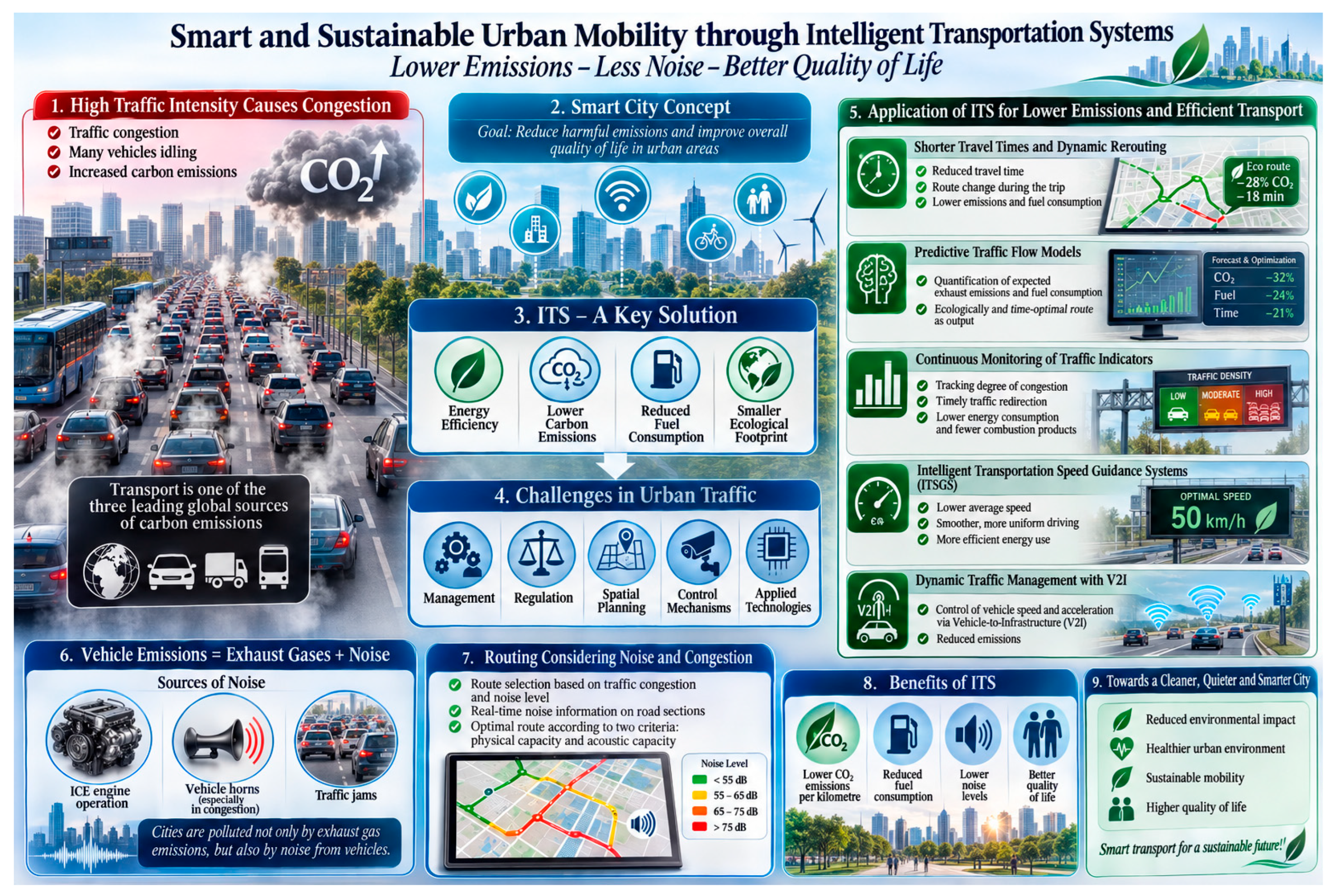
| [81] | Traffic congestion and emissions | High traffic intensity leads to congestion, vehicle idling, and increased carbon emissions. |
| [82] | Smart city requirements | Modern transportation systems must reduce harmful gas emissions and contribute to improving the quality of life in urban areas. |
| [83] | The role of transportation in emissions | Transportation represents one of the three leading global sources of carbon emissions, making improvements in transport energy efficiency highly important. |
| [84,85] | ITS as a solution | The implementation of intelligent transport systems (ITS) enables more efficient traffic management, reduced energy consumption, and a lower environmental footprint. |
| [86] | Urban transportation challenges | The highest energy consumption occurs in urban transportation, accompanied by challenges related to management, regulation, spatial planning, control, and technology implementation. |
| [87] | Route optimization | ITS can reduce emissions per kilometer traveled by shortening travel time and dynamically changing routes during a journey. |
| [88,89] | Predictive models | Advanced traffic flow prediction models can estimate exhaust emissions and fuel consumption and propose an environmentally and time-efficient route. |
| [90,91] | Real-time traffic monitoring | Continuous monitoring of congestion levels enables timely rerouting of vehicles to less congested road sections, thereby reducing fuel consumption and emissions. |
| [92] | ITSGS | ITSGS contributes to emission reduction by optimizing average speed and promoting smoother driving patterns. |
| [93] | V2I and dynamic traffic management | Dynamic traffic management and V2I communication enable the control of speed and acceleration of connected vehicles to reduce emissions. |
| [94] | Noise as a form of pollution | The impact of transportation is not limited to exhaust emissions; vehicles also represent a significant source of noise in urban areas. |
| [95] | Noise-aware routing | Modern routing systems can display not only traffic conditions but also noise levels along individual road sections in real time. |
| [96] | Sources of vehicle noise | Noise originates from engine operation as well as from the use of vehicle horns, particularly during traffic congestion. |
| [95] | Route selection criteria | The optimal route can be determined based on the physical capacity of the road and its acoustic capacity, i.e., noise level. |
| [88,89,90,91,92,93,94,95,96] | Integrated approach | By combining data on congestion, emissions, fuel consumption, and noise, it is possible to define an environmentally, time-, and acoustically optimal route. |
Disclaimer/Publisher’s Note: The statements, opinions and data contained in all publications are solely those of the individual author(s) and contributor(s) and not of MDPI and/or the editor(s). MDPI and/or the editor(s) disclaim responsibility for any injury to people or property resulting from any ideas, methods, instructions or products referred to in the content. |
© 2026 by the authors. Licensee MDPI, Basel, Switzerland. This article is an open access article distributed under the terms and conditions of the Creative Commons Attribution (CC BY) license.
Share and Cite
Stojanovic, N.; Grujic, I.; Petrovic Savic, S.; Stefanovic, M.; Djordjevic, A. The Impact of Intelligent Transport Systems on Safety, Emissions Reduction, and Travel Time: A Review. Future Internet 2026, 18, 478. https://doi.org/10.3390/fi18090478
Stojanovic N, Grujic I, Petrovic Savic S, Stefanovic M, Djordjevic A. The Impact of Intelligent Transport Systems on Safety, Emissions Reduction, and Travel Time: A Review. Future Internet. 2026; 18(9):478. https://doi.org/10.3390/fi18090478
Chicago/Turabian StyleStojanovic, Nadica, Ivan Grujic, Suzana Petrovic Savic, Miladin Stefanovic, and Aleksandar Djordjevic. 2026. "The Impact of Intelligent Transport Systems on Safety, Emissions Reduction, and Travel Time: A Review" Future Internet 18, no. 9: 478. https://doi.org/10.3390/fi18090478
APA StyleStojanovic, N., Grujic, I., Petrovic Savic, S., Stefanovic, M., & Djordjevic, A. (2026). The Impact of Intelligent Transport Systems on Safety, Emissions Reduction, and Travel Time: A Review. Future Internet, 18(9), 478. https://doi.org/10.3390/fi18090478