Systematic Review

Explainable and Human-Centered AIoT: A Systematic Review of Integration, Interaction, and Impact

by
Adolfo A. Jurado Rosas
1,*,
Marina Fernández Miranda
2,
Gladys L. Peña Pazos
3,
Elberth E. García Panta
1,
Carlos A. Ramos Reyes
3,
Milagros P. Córdova de Chang
2,
José H. Chang Valdiviezo
4,
Olga P. Gamarra Chirinos
3 and
Carlos E. Esquerre Aguirre
5
1
Faculty of Accounting and Financial Sciences, Universidad Nacional de Piura, Piura 20002, Peru
2
Faculty of Social Sciences and Education, School of Language and Literature, Universidad Nacional de Piura, Piura 20002, Peru
3
Academic Department of Humanities, Universidad Privada Antenor Orrego, Piura 20001, Peru
4
Faculty of Engineering and Mining, Universidad Nacional de Piura, Piura 20002, Peru
5
Faculty of Medicine, Universidad Privada Antenor Orrego, Piura 20001, Peru
*
Author to whom correspondence should be addressed.
Future Internet 2026, 18(6), 303; https://doi.org/10.3390/fi18060303
Submission received: 15 April 2026 / Revised: 23 May 2026 / Accepted: 27 May 2026 / Published: 4 June 2026
(This article belongs to the Special Issue Information Networks with Human-Centric LLMs)

Abstract

This study analyzes the transition of the Artificial Intelligence of Things (AIoT) toward a Human-Centered Artificial Intelligence (HCAI) approach. Following PRISMA 2020 guidelines, a Systematic Literature Review was conducted on 1 April 2026, retrieving literature from Scopus, Web of Science, SciELO, and Springer Nature Link. The inclusion criteria prioritized open-access, peer-reviewed English articles published between 2020 and 2025 that addressed AIoT architectures and explainability mechanisms. The screening procedure involved a dual independent review process, followed by a rigorous methodological quality assessment to minimize the risk of bias, culminating in a final sample of 40 studies from an initial pool of 971 records. The findings reveal a structural paradox: while intelligent systems achieve greater operational autonomy, legal and moral accountability remains inexorably bound to the human operator. Furthermore, 77.5% of the evaluated implementations employ superficial explainability, functioning merely as a psychological buffer to manage automation anxiety rather than providing a genuine interactive control mechanism. It is concluded that programming based on HCAI principles must shift from a post hoc feature to an inherent architectural requirement. Establishing explainability by design is imperative to guarantee an interactive audit capability that comprehensively safeguards operational integrity and preserves human agency, although the exclusive reliance on open-access literature limits visibility into proprietary commercial models.

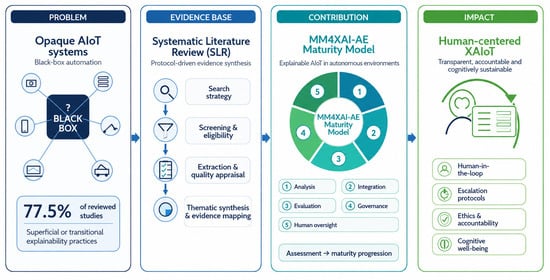
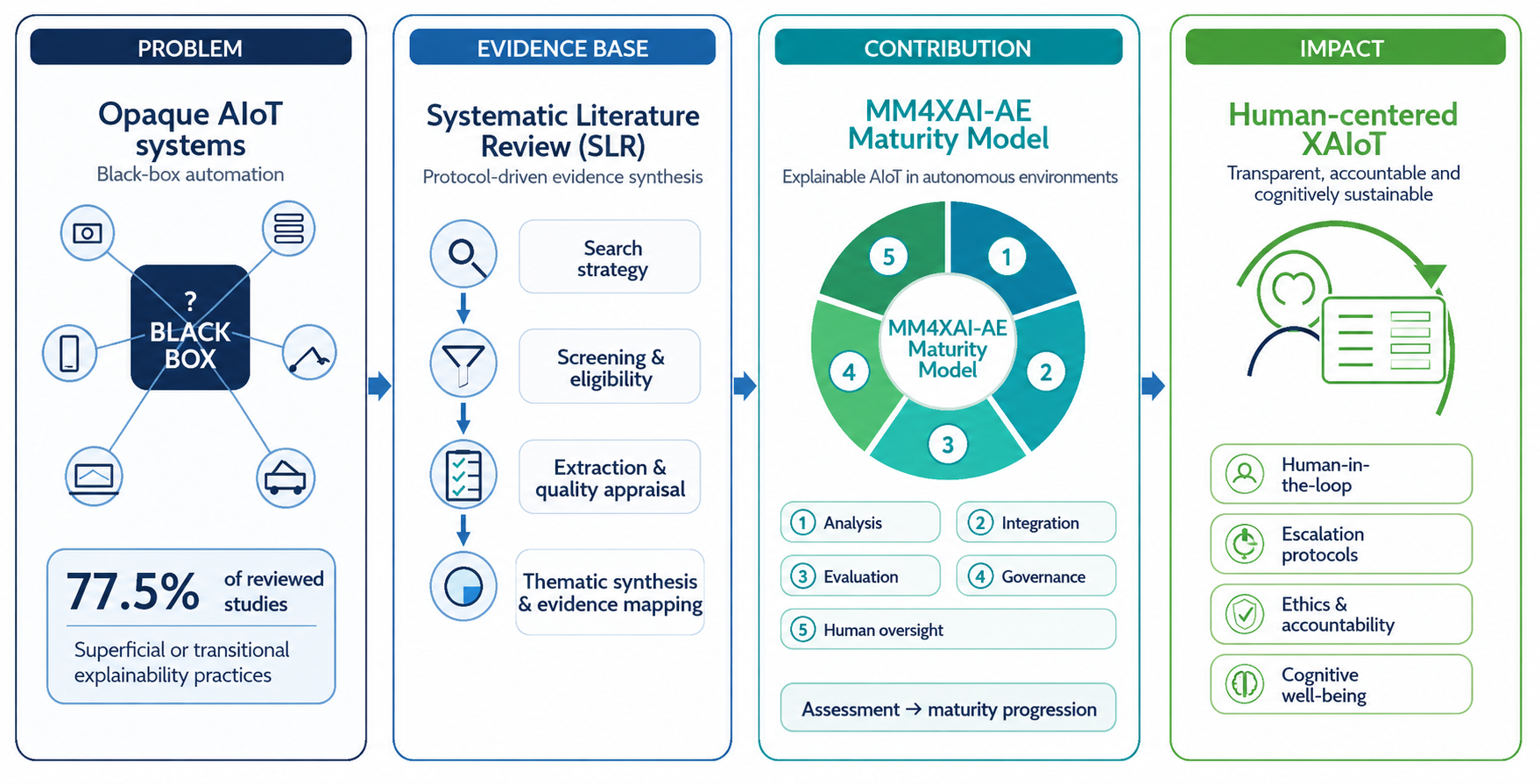
Graphical Abstract

1. Introduction

Due to its ability to bridge the physical and digital worlds, anticipate problems, and automate daily tasks, the combination of Artificial Intelligence and connected devices is now one of the strategic pillars of technological development. In fact, the implementation of connected devices in daily practice involves significant benefits, such as mitigating the impact of natural disasters in the field or increasing profitability in factories, among others [1,2]. Indeed, the natural evolution of technology has shifted from being a mere data-collection tool to becoming expert systems that evolve to assist and collaborate with humans [3]. This transition stems from the need to highlight automation in mission-critical environments, such as logistics ports and hospitals, where accuracy and support for human decision-making play a crucial role, among other factors [4,5].
However, there are significant barriers to the adoption of this technology, particularly in terms of public acceptance; concerns about data privacy, resistance to change, and fears of excessive surveillance often account for much of this resistance [6,7]. In turn, the very complexity of the algorithms—which are often presented as a black box that makes decisions without adhering to the principle of transparency—requires a thorough review of the process. Consequently, adverse effects such as cognitive strain, confusion, or extreme mistrust on the part of operators can arise [8,9]. In critical fields such as medicine or industry, blindly accepting the suggestions of an advanced device without clear justification is unacceptable, as it jeopardizes both the physical safety and legal liability of workers [10,11].
Despite the growing volume of Artificial Intelligence of Things (AIoT) literature, research remains heavily skewed toward operational metrics, such as processing speed or algorithmic optimization. There is a clear lack of studies synthesizing current technological developments with international regulatory trends, leaving a critical research gap: the absence of a strategic pathway to transition from opaque processing models to transparent, user-driven architectures [12,13]. This pattern is evidenced in Figure 1, where the co-citation network reveals a structural bifurcation that accurately reflects the research gap identified earlier.
The upper cluster (blue) consolidates the algorithmic foundations of Explainable Artificial Intelligence (XAI), based on fundamental methodological contributions: Ref. [14] introduced Local Interpretable Model-agnostic Explanations (LIME), ref. [15] formalized gradient-based visual interpretability (Grad-CAM), and [16] systematized the general taxonomic framework for XAI implementation. The internal density of this cluster reflects a mature technical corpus, widely cross-cited but largely autonomous within computational problem-solving. The lower cluster (red), by contrast, gravitates toward user-centered governance: [17] organized system-level taxonomies of transparency and trust, ref. [18], reframed interpretability as a dynamic process dependent on human feedback, and the [19] node—as the network’s sole non-academic reference—anchors everything to the end-users’ right to explanation. The limited connectivity between clusters, evidenced by the small number of edges linking the two communities, confirms that the technical development of XAI and human regulatory frameworks has evolved along largely parallel trajectories. No dominant node occupies the structural bridge between algorithmic interpretability and governance-oriented transparency, which constitutes precisely the gap that justifies the proposed explainability-by-design framework.
To address this deficiency, the novelty and added value of this review lie in establishing an Explainability-by-Design (XAI-by-design) framework to guide the ongoing paradigm shift in AIoT development. Transcending mere data recapitulation, this study demonstrates that embedding human-centered principles (HCAI) from the system’s core is now an imperative requirement under emerging global standards.
Based on these considerations, the study sets forth four objectives: first, to analyze trends in research publication by identifying the years, countries, and authors; second, to describe how artificial intelligence and devices are being combined in order to assess whether human well-being is being prioritized; third, to analyze how communication is structured in device-AI-human interactions, assessing whether these systems are able to explain their actions in a comprehensible and reliable manner; and, finally, to evaluate the actual effects that using these technologies has had on daily life, paying special attention to users’ privacy, security, and well-being.
Ultimately, this research establishes a socio-technical baseline to protect human agency. By aligning technological design with ethical governance, the findings provide researchers, developers, and policymakers with actionable guidelines to ensure future autonomous systems genuinely empower the human operator.

1.1. AIoT (Artificial Intelligence of Things)

AIoT is the functional integration of Artificial Intelligence and the Internet of Things, which increases the level of operational autonomy and facilitates data-driven decision-making processes. This integration stems from the complementary nature of two technological components: the infrastructure of connected devices and sensors, and computational algorithms [4].
Previously, sensors used in operational environments served exclusively to capture physical data for specific applications, such as recording environmental variables or monitoring equipment conditions [2]. By incorporating this technology, today’s devices develop capabilities for machine learning, data processing and categorization, and generating predictions about potential problems through computational procedures.
This technological combination enables systems to respond to users simultaneously, delivering instant results [20]. Current applications include: management of traffic light and vehicular traffic systems in smart cities, improvement of logistics processes at port terminals, and early diagnostic mechanisms in maintenance services [4,21].

1.2. Human-Centered Approach

Human-Centered Artificial Intelligence (HCAI) aims to have technology work alongside people rather than replace them [8,22]. Its purpose is to support experts with systems that are clear, interactive, and easy to monitor. Unlike closed-loop automation, this approach takes the user’s capabilities into account and avoids mentally overloading them, especially in complex situations [23,24]. Furthermore, it recognizes that a system’s effective operation depends not only on the algorithm but also on the work environment and how the person interacts with the technology. In short, this model aims to help the operator make better decisions through transparent, reliable, and understandable tools that foster security, trust, and greater acceptance of their use [25,26].

2. Materials and Methods

The research was based on a Systematic Literature Review (SLR), which followed the guidelines of the Preferred Reporting Items for Systematic Reviews and Meta-Analyses (PRISMA) 2020 (the complete PRISMA checklist is available in the Supplementary Materials), supported by a descriptive bibliometric analysis. The study protocol was retrospectively registered in the Open Science Framework (OSF) and is publicly available at: https://osf.io/8wgze. These methods enabled the identification and retrieval of relevant research articles on AIoT, its ability to explain decisions, and its direct impact on humans. This structured approach allowed for the mapping of publications, the organization of relevant information, and the objective addressing of the three objectives set forth in the study [27].
The information retrieval was executed on 1 April 2026, in four international databases: Scopus, Web of Science (WOS), SciELO, and Springer Nature Link. They were selected for their exhaustive coverage in technology and social sciences. The search strategy employed a query constructed using terms and keywords: (“AIoT” OR “Artificial Intelligence of Things” OR “Internet of Things” OR “Trustworthy” OR “AI-enabled IoT” OR “Edge AI”) AND (“Explainable” OR “Explainability” OR “XAI” OR “Interpretability”) AND (“Human-Centric” OR “Human-centered” OR “Human-in-the-loop” OR “Human-Machine Interaction”) AND (“Integration” OR “Interaction” OR “Impact” OR “Effect”). This general search yielded an initial total of 162 documents in Scopus, 56 in WOS, 373 in SciELO, and 380 in Springer Nature Link.
To ensure academic relevance and quality, eligibility criteria were established a priori and applied directly within each database platform prior to data export.
Inclusion criteria:
  • Peer-reviewed scientific articles with open access.
  • Published between 2020 and 2025.
  • Written in English.
  • Indexed under subject areas related to engineering, computer science, or artificial intelligence.
  • Studies addressing, explicitly or substantially, at least one of the three focal constructs: AIoT architectures, explainability mechanisms (XAI), and human-centric dimensions of intelligent systems.
Exclusion criteria:
  • Non-article formats (conference proceedings, book chapters, editorials, letters, and notes).
  • Studies focused exclusively on the technical optimization of hardware without evaluating human–machine interaction or user impact.
  • Studies that deploy AI algorithms purely for automated data collection without offering any interface for explainability or human supervision.
  • Duplicate records identified across databases.
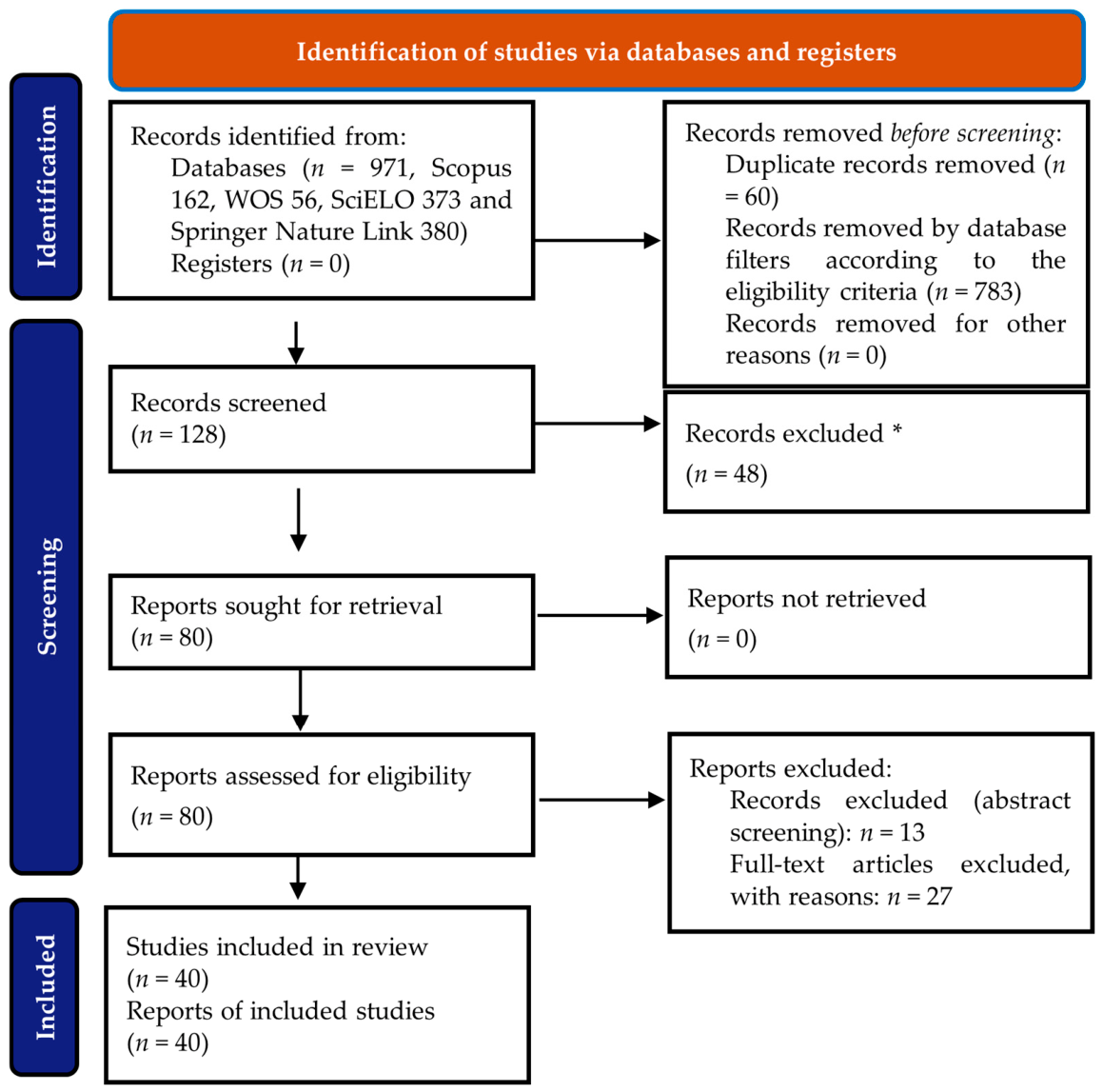
After applying these criteria systematically, 188 viable studies were identified across the four databases (45 from Scopus, 33 from WOS, 77 from SciELO, and 33 from Springer Nature Link), constituting the pool for subsequent screening. For the management and screening of the records, the Rayyan platform (Rayyan Systems Inc., Cambridge, MA, USA, https://www.rayyan.ai) was used for the detection of duplicates and the initial exclusion through keywords. Subsequently, Microsoft Excel (Office 365, Microsoft Corporation, Redmond, WA, USA) was used for the organization of metadata and Bibliometrix (version 4.1, K-Synth Srl, Naples, Italy, https://www.bibliometrix.org) for the co-citation network analysis. The selection process, based on the PRISMA 2020 guidelines, was carried out independently by two groups of two independent reviewer teams from among the authors, resolving discrepancies through consensus. Of the 188 records screened, 60 duplicate documents were removed, resulting in a sample of 128 unique studies (30 from Scopus, 21 from WOS, 77 from SciELO, and 0 from Springer, as their contributions were already covered in the other databases). Subsequently, a title screening was conducted to explicitly exclude studies that focused strictly on hardware optimization (e.g., energy efficiency, routing protocols, or latency) without addressing human–machine interaction, explainability mechanisms (XAI), or user impact. This precise application of the predefined exclusion criteria reduced the list to 80 documents. Finally, after a detailed reading and analysis of the abstracts, the 40 articles (14 from Scopus, 9 from WOS, and 17 from SciELO) were selected to form the definitive sample and the final dataset for analysis.
To ensure the traceability of bibliometric analysis and document management, the Bibliometrix software was used to process the networks, while Mendeley Reference Manager (version 2.103, Elsevier, London, UK, https://www.mendeley.com) was employed as the reference management tool. The co-citation network presented in Figure 1 does not aim to represent the entire AIoT field; rather, it focuses on a set of key references that were carefully selected. This network is derived exclusively from the final set of 40 articles.
To ensure methodological rigor, a quality assessment (QA) of the 40 final studies was conducted using the Mixed Methods Appraisal Tool (MMAT, 2018 version), selected given the heterogeneous nature of the AIoT research landscape, which ranges from qualitative case studies on human interaction to quantitative algorithmic evaluations and mixed-methods approaches. The team was divided into two groups, and each article was independently reviewed based on the five methodological quality criteria specific to its design. Discrepancies were resolved by consensus. All studies met at least 80% of the MMAT criteria, thus confirming a low risk of bias for the results of this review. The identification, selection, and inclusion process is presented in Figure 2. The flow diagram summarizes the stages through which the initial set of records was refined, encompassing database retrieval, duplicate removal, title and abstract screening, and final study selection. Collectively, the schema transparently illustrates how the review progressively narrowed the available evidence to yield a sample centered on research addressing AIoT architectures, explainability mechanisms, and user-oriented intelligent systems approaches.
From this final selection, the bibliometric and thematic analysis underpinning the results presented in the subsequent sections was conducted.

3. Results

This section presents the findings of the review, organized according to the research objectives. This structure allows for a synthesis of the evidence gathered and provides the empirical basis necessary for the critical analysis that will be conducted in the discussion.

3.1. Trends in Research: Identifying the Year, Country, and Authors with the Most Publications on Smart Devices (AIoT)

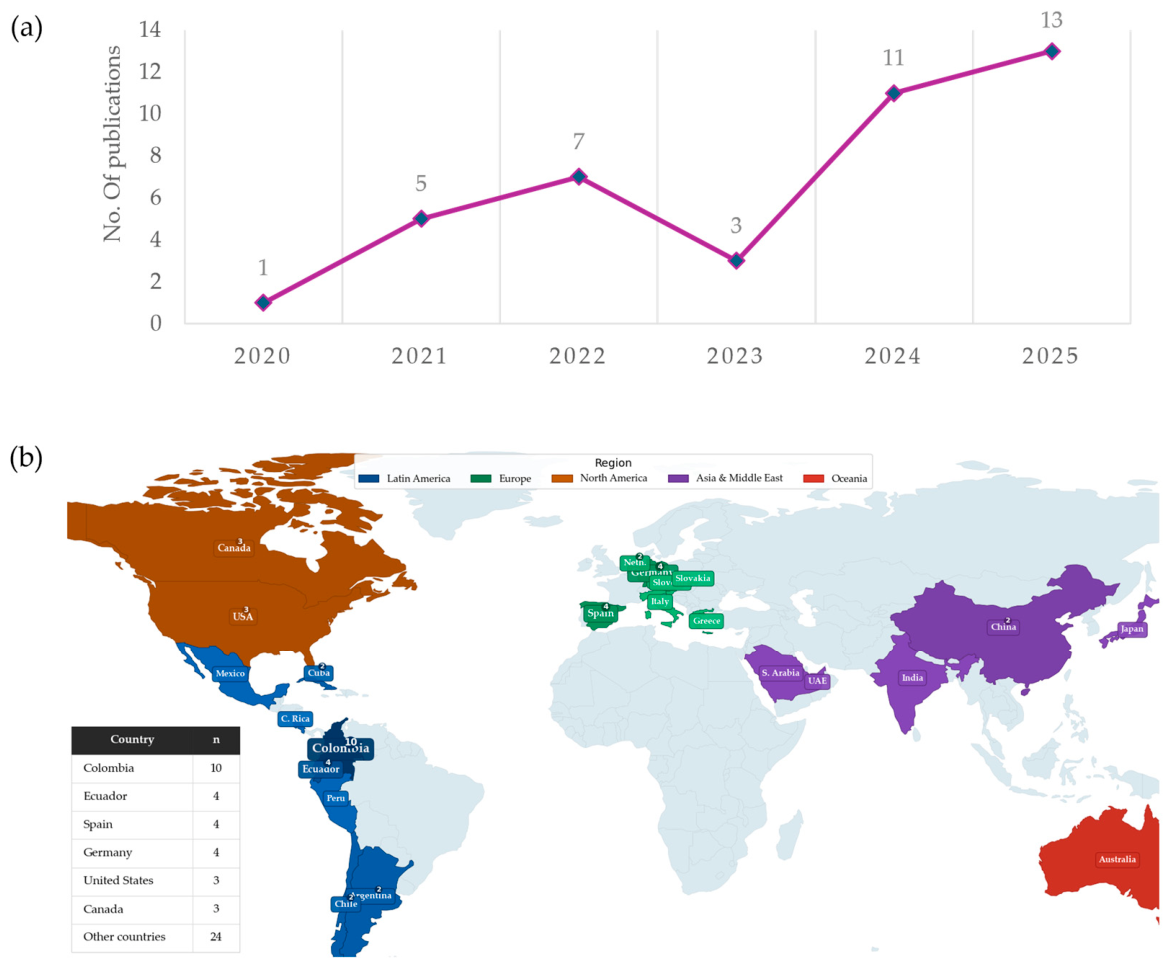
This section presents the bibliometric results obtained from the selected studies. Figure 3 illustrates the temporal evolution of publications and their geographic distribution.
As shown in Figure 3a, scientific output on AIoT exhibited a general growth trend between 2020 and 2025. The period began with a limited number of publications in 2020 (1 study), followed by a sustained increase over the next two years, reaching 5 publications in 2021 and 7 in 2022. However, 2023 saw a temporary decline to 3 publications. Output subsequently resumed an upward trajectory, reaching 11 publications in 2024 and peaking at 13 studies in 2025. Taken together, the findings reflect a progressive expansion of academic interest in this area over the period examined.
Regarding geographic distribution, Figure 3b reveals a higher concentration of publications in Latin America and Europe. Colombia leads the scientific production with 10 publications, followed by Ecuador, Spain, and Germany with 4 publications each. When analyzing by geographic proximity, Latin America shows significant regional engagement (including contributions from Cuba, Argentina, Peru, Costa Rica, Chile, and Mexico), as does Europe (with additions from the Netherlands, France, Austria, Italy, Slovakia, Slovenia, and Greece). North America (United States and Canada) maintains a steady output, while emerging contributions are also observed across Asia and the Middle East (China, India, Saudi Arabia, UAE, Japan) and Oceania (Australia). This distribution reflects a global interest in AIoT, with a marked leadership in the Ibero-American context.

3.2. Types of Artificial Intelligence and Connected Devices Currently Available, with a Focus on People’s Needs and Convenience

To systematically address the current landscape of smart devices, we present an original classification framework derived from a synthesis of the reviewed literature. Table 1 presents this classification based on three analytical dimensions: the primary type of artificial intelligence, the connected devices used, and the specific human needs that are prioritized.
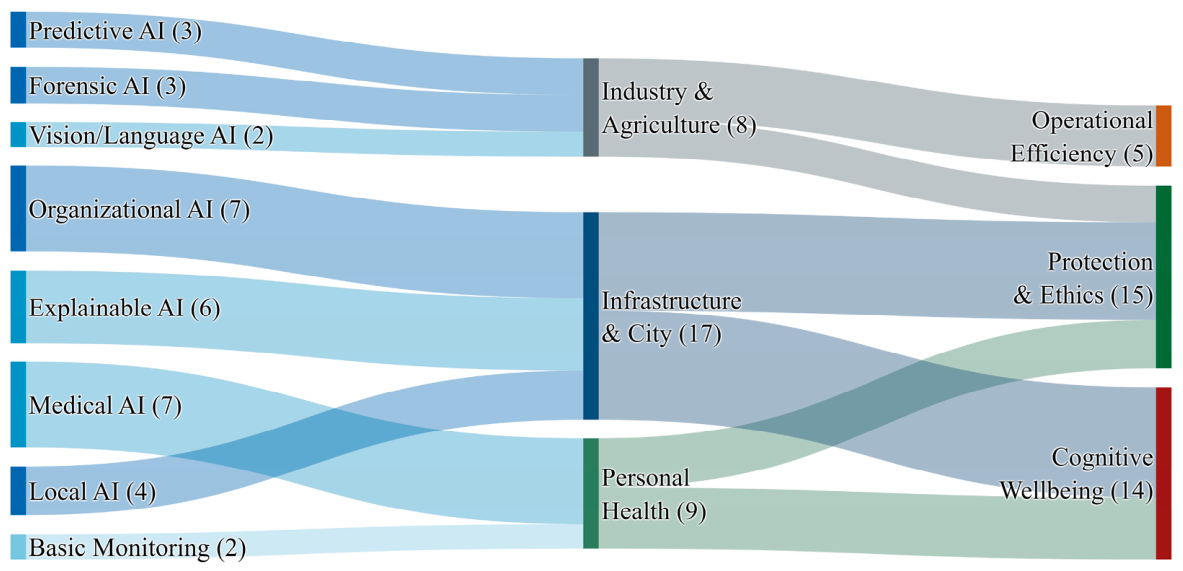
The table outlines eight types of artificial intelligence, their applications, and the human needs they prioritize. Two categories stand out as having the most research: medical AI and health assistants, which use hospital monitors to ensure patient care and privacy; and AI for organization and social work, applied in logistics and university networks to provide clear information and prevent mental fatigue. Next is explainable and fair AI, used in government systems to promote trust and justice. Then, local processing AI employs cameras and autonomous vehicles to ensure privacy and rapid responses. Also included are predictive AI, with sensors for peace of mind and cost savings, and AI with secure and forensic logging, for transparent investigations. Finally, there is vision and language AI, using robots for clear communication, and basic monitoring systems, with alarms and cell phones for greater convenience. Figure 4 presents these relationships by linking each type of artificial intelligence to its corresponding devices, application domains, and human-centered outcomes.
Looking at the center of the image, the infrastructure and city block stand out prominently. This is the largest intersection in the diagram and absorbs all the flow coming from organizational AI, explainable AI, and local AI. The other two central areas are personal health, composed almost entirely of medical AI; and industry and agriculture, which brings together smaller branches such as predictive, forensic, and vision/language AI.
Moving toward the far right, the graph clearly reveals the ultimate goals of all these technologies. The vast majority of connections lead to just two major priorities: protection and ethics, and cognitive well-being. These two final areas draw heavily from the infrastructure, city, and personal health blocks. In contrast, the band leading to operational efficiency is the thinnest, receiving the fewest connections from smaller segments of Industry, agriculture, and health.

3.3. Communication with These Smart Devices and How They Manage to Explain in Simple Terms Why They Make Certain Decisions

To systematically categorize how AIoT systems communicate their decisions to human operators, Table 2 presents a taxonomy of explainability levels and their direct impact on human control, derived from the reviewed literature.
The findings reveal an asymmetric and functionally polarized distribution. Most systems (57.5%) rely on unidirectional communication models, where information is transmitted from the system to the operator through visual alerts or text notifications, limiting opportunities for active human intervention. This type of interface neither requires nor expects a user response; its function is to inform, not to enable decision-making. At an intermediate level, post hoc systems (20.0%) provide explanations only after decisions have been executed, serving primarily as mechanisms for accountability and retrospective auditing rather than real-time operational control. Only 22.5% of studies document systems where explanations occur before execution, within an interactive cycle that allows the operator to modify, escalate, or reject an automated decision.

3.4. Technologies in People’s Daily Lives with Regard to User Safety and Well-Being

To evaluate the real-world socio-technical implications of these systems, Table 3 details the impact of AIoT technologies on users’ privacy, physical security, and cognitive well-being across various operational environments.
As detailed, mitigating the adverse effects of AIoT requires integrating technical solutions under new control frameworks. To address privacy concerns and operational risks, modern architectures are increasingly aligning with the EU AI Act and implementing mandatory escalation protocols. Furthermore, to protect cognitive well-being and clarify legal liability, frameworks such as the Maturity Model for Practical Explainability in Artificial Intelligence-Based Applications: Integrating Analysis and Evaluation Models (MM4XAI-AE) maturity models are being adopted. This, alongside the institutionalization of the AI Ethics Officer, ensures that human operators maintain effective control over automated processes.

4. Discussion

4.1. Maturity and Consistency in the Field

The literature shows that explainable, human-centered AIoT is rapidly transitioning from an emerging field to a mature one. Its greatest growth occurred between 2024 and 2025, supported by pre-existing theories and laws. A heterogeneous geographic distribution persists, with Colombia in the lead and significant participation from Spain, Ecuador, and Germany. This landscape reveals a dual reality. On the one hand, Latin America leads the application of these technologies to solve concrete problems, such as supporting smallholder farmers and improving business processes. On the other hand, many of these solutions still rely on theories and models created in Europe and the United States. Even so, the literature is not scattered: it is organized into two main strands, one focused on methods of explaining AI and the other on trust, governance, and the role of human intervention.
This theoretical maturity has enabled the “human-centered approach” to move beyond a mere conceptual promise and become a practical, structured, and measurable reality. HCAI is now a methodological requirement embodied in tools such as the MM4XAI-AE, which evaluates and guides the practical implementation of explainability in real-world applications across various sectors [38]. Likewise, in the clinical field, specific frameworks are being created that combine the technical precision of sensors with interactive interfaces to comply with strict European regulations such as the EU AI Act [5]. Even in policy-making, as in maritime education, multi-criteria mathematical methodologies are applied to integrate the perspectives and needs of human users [37].
In contrast to the usual dichotomy between well-being and efficiency, a clear shift is evident: human trust and control are no longer an optional “either/or,” but rather become an “and” that is considered a necessary condition for maximizing any system. In a critical context such as healthcare, the model must not only be accurate or clinically validated, but the specialist must also feel that, when using the “method,” they do not lose control to the machine [11]. Moreover, user trust depends on the system (machine) having the ability to explain its decisions in a way that reinforces that trust [9]. This also has social implications, as the perception of fairness and legitimacy (of the system) depends on the degree of clarity offered by the algorithm [34]. Thus, transparency and user well-being are essential elements for the safe and efficient adoption of the Internet of Things (IoT) [13].
Ultimately, this evolution demands that humanization go beyond a user-friendly interface and become an integral part of the algorithms’ design itself. While efforts were once focused on explaining “black-box” models using external solutions, the current trend is to build systems that are comprehensible from the outset, integrating interdisciplinary and cognitive-social knowledge into their design [9]. Along these lines, interpretable architectures based on symbolic reasoning are emerging [5]. Furthermore, in the Edge Artificial Intelligence (Edge AI) environment—defined as the integration directly at the edge of networks, close to where data is generated—hybrid models that combine deep learning with human rules are being actively promoted [13]. Thus, the goal is to achieve systems that are transparent and interactive from their very conception.

4.2. A Human-Centered Approach: Theory vs. Practice

This systematic review differs from previous studies on AIoT in one key respect: while studies such as [48,49] prioritize technical optimization—such as latency reduction, energy efficiency, and algorithmic accuracy—without considering the socio-technical dimension of the operator, the findings presented here challenge that reductionist view. Furthermore, in contrast to the widespread optimism of theoretical studies such as [50,51], which assume that explainable AI inherently increases user trust and safety, the present review challenges such widespread optimism.
This finding aligns with recent critical perspectives in the broader AI ethics literature, such as those by [52,53], who warned about automation bias and the false hope of superficial explanations in commercial algorithms. However, this review expands on those theoretical concerns by synthesizing quantitative evidence; specifically, it finds that 77.5% of the IoT AI implementations analyzed use explainability only superficially.
Conceptually, it establishes that user well-being and the perception of control are non-negotiable requirements that must take precedence over technical efficiency, serving as indispensable bridges for technology adoption [9,11,13]. As mentioned earlier, the MM4XAI-AE maturity model has been translated into concrete tools and multi-criteria methodologies that incorporate user needs [37,38]. However, when analyzing who actually makes the final decision, practice varies depending on the risk level of the domain. In critical areas such as healthcare or structural engineering, theory aligns with practice: AI acts solely as a support, and the professional retains full agency [11,12,37,43]. In contrast, in operational environments characterized by rapid responses or large volumes of data, such as physical security or intrusion detection using blockchain, efficiency takes precedence over the user’s cognitive well-being. In these cases, the machine makes the decisions, and the human serves as a regulatory supervisor or final auditor [24,36,42].
The technological discourse argues that humanization must go beyond the visual and be incorporated into the internal design of algorithms through systems that are understandable from the outset [5,9,13]. Upon examining whether this requirement is met in practice, it was found that explainability oscillates between two extremes. At the cutting edge of research, humanized design is indeed a reality that empowers the user, because it provides tools to follow the process, question results, and maintain control [13,23,43,44]. However, many commercial applications and government algorithms still employ XAI in a superficial manner. Instead of empowering users, these implementations use explanations solely to justify decisions already made by the machine, with the aim of reducing public mistrust or meeting visual transparency requirements, without providing true interactive auditability [10,34].
Finally, although the theoretical framework promotes the incorporation of cognitive-social knowledge to ensure interactive systems [38], practice shows that the vast majority of AIoT implementations fail to establish a true dialogue. The prevailing standard remains anchored in one-way visualization, translating complex mathematical logic into 3D models, heat maps, or static control panels [10,12,24,46]. The realization of human-centered discourse into real dialogue is currently an emerging frontier rather than the norm. Only the most advanced systems, which integrate natural language architectures and Human–Robot Team (HRT) principles, are managing to transcend the screen to achieve collaborative sensemaking [23,43]. It is in these areas where the user can adjust parameters in real time and receive step-by-step validation, demonstrating that true interdependence between human and machine is logistically possible, but still requires widespread adoption in the industry [23,43,44].

4.3. Explainability and Control

An analytical review of the literature reveals a profound paradox in the interaction between AIoT systems and users. While operational decision-making is increasingly delegated to machines in high-speed or high-data-volume environments [36,42], these studies conclusively state that responsibility for failure is never transferred to artificial intelligence. As humans are displaced from direct decision-making into a role of “regulatory supervisor” [24,42], explainability architectures are specifically designed to keep moral and legal responsibility anchored with the operator [11,24]. This need to maintain a human accountable party is so structural that it drives the industry to institutionalize roles of exhaustive oversight and mandatory escalation protocols before executing critical decisions [29].
This inescapable human responsibility explains why the “human-centered approach” in practice often veers toward psychology rather than technology. As demonstrated in the taxonomy of these systems (see Table 2), 77.5% (31 out of 40) of the AIoT implementations analyzed offer only superficial or transient explainability. Since humans must account for systems that often outpace them at processing speed, much of current XAI design is aimed at managing anxiety and mitigating the fear of losing control [11,24]. In this vein, it has been shown that, rather than truly empowering the user, the majority of one-way systems (57.5%) use explainability merely to justify algorithmic actions to the public or a supervisor [10,34,36]. Thus, data visualization (such as heat maps or attribution metrics) functions as a psychological buffer that makes the user feel the system is safe, acting as a treatment for the symptoms of public distrust [24,35,42,46].
However, in contrast to this superficial and merely corrective justification, the subset of studies demonstrating genuine explainability (22.5%) points the way toward true empowerment by addressing the underlying causes. To achieve this, for explainability to cease being a psychological crutch and become a genuine operational safeguard [4,29,43], systems must move beyond the stage of simple one-way visualization and achieve comprehensive interoperability. This is only possible when ethical and safety rules are integrated from the outset into software requirements and system design [29,33]. By combining sound reasoning with interfaces that enable a joint construction of meaning [23,43], humans regain the tools necessary to question and validate the machine in real time [23,43,44]. Upon reaching this level of interactive maturity, explainability ceases to be limited to justifying errors and becomes a preventive framework that comprehensively protects both the human operator and the critical process.

4.4. Well-Being, Efficiency, and Responsibility

When considering the convergence of artificial intelligence and connected devices (AIoT), it becomes clear that the intersection of well-being, efficiency, and accountability is the fundamental dilemma in effectively applying this technology. Within the body of literature that also informs this article, it is established as a theoretical premise that technical efficiency must necessarily be subordinate to trust and human control (cognitive well-being) [9,11,13]. However, when these methodological requirements intersect with operational practice, a profound paradox is revealed: the pursuit of efficiency represents merely an attitude toward managing psychological symptoms rather than structural empowerment.
To resolve this tension, the most up-to-date research argues that humanization must go beyond visible interfaces [5,9,13]. This involves incorporating ethical and safety constraints into the design of the software and algorithms [29,33,43]. Only then is it possible to move from simple visualization to real dialogue or to reject predictions in real time [23,43,44]. At this level, the system becomes a transparent tool that safeguards the critical process and reinforces human accountability. Under this palliative approach, the system addresses the symptoms of human mistrust [35,42] to make the user feel that they retain control, thereby preventing operational efficiency from being compromised by natural resistance to automation.
However, as mentioned earlier, this sense of control conflicts with the legal and ethical realities of AIoT. Even though the machine gains autonomy and processes data at high speed [36,42], responsibility for any error still falls on the human operator [11,24]. Thus, the person ceases to make direct decisions and assumes the role of supervisor or final auditor [24,42]. Therefore, to bear this burden, the most advanced theoretical models require the institutionalization of critical roles, such as the Ethical AI Officer, and the development of architectures that not only report but also mandate escalation and human intervention before executing high-risk decisions, as is the case in civil engineering or medicine [12,29,43].
To definitively resolve the tension between machine efficiency and human responsibility without compromising well-being, the most advanced research concludes that humanization must go beyond superficial interfaces [5,9,13]. Addressing the root causes of this vulnerability requires incorporating ethical and mathematical constraints from the very outset of software requirements gathering and at the core of the algorithm [29,33,43]. Only by moving from simple visualization to a “real dialogue,” where there is a joint construction of meaning [23,43], does the human obtain the traceability and cognitive tools necessary to validate, adjust, or reject predictions in real time. At this level of maturity, the system ceases to be a black box that merely justifies its efficiency and becomes a transparent tool that comprehensively safeguards the critical process and empowers the human decision-maker.
In conclusion, the reviewed literature demonstrates that, to resolve these issues, the enactment of legally binding legislation is required. Since legal and moral responsibility ultimately falls on the human operator, it is urgent to pass laws inspired by current policies—such as the EU AI Act, the European Data Act, or civil rights initiatives—that require assessing explainability by design [5]. Therefore, ethics in AIoT can no longer be merely a voluntary best practice; it must become clear mathematical rules and a real control model [29,38]. This requires that explainability be a mandatory requirement within standards to certify these tools [11]. Furthermore, the creation of new human oversight roles, such as the Ethical AI Officer, must be mandated by law [29]. In this way, the security of critical systems and the user’s decision-making power will be fully protected by mandatory legal compliance and not merely as a suggestion [32,38].
In summary, the discussion shows that moving toward a more transparent and people-centered AIoT is no longer a future option, but an ethical and practical necessity. The analysis leads to the conclusion that, although scientific studies provide a solid foundation and well-defined methods, their real-world application still faces obstacles in business models that prioritize system performance over the mental well-being of their users. The contradiction identified—where the machine acts with greater independence, yet the person continues to bear full legal responsibility—demands a profound change: explainability must no longer be viewed as a mere tool for building trust, but as a necessary technical requirement from the very start of the design process. Ultimately, the success of digital transformation in our region and around the world will depend on creating standards that ensure technology supports people and does not become an incomprehensible system that undermines their security and decision-making capacity.

4.5. Limitations of This Research

First, the search was exclusively limited to open-access scientific articles. While this ensures public reproducibility of the analyzed sources, it inherently excludes grey literature, industrial technical reports, and high-impact subscription-based journals. Consequently, the findings represent the academic consensus but may not fully capture the current state of the field, as proprietary commercial AIoT implementations and closed-source corporate practices regarding explainability may differ significantly from the open-access models reviewed here.
Second, although a regional leadership in publications from Colombia is observed, the predominant theoretical framework and models such as the EU AI Act continue to have a strong bias towards European and North American contexts. Finally, the qualitative nature of the explainability analysis implies a degree of subjective interpretation by the reviewers when categorizing the forms of human–machine interaction.

5. Conclusions

A review of the 40 studies showed that the transition from AIoT to a human-centered approach remains, in practice, largely theoretical. While technical advances have managed to reconcile operational efficiency with data privacy, the sector operates with a serious lack of accountability. As evidenced, more than 70% of the implementations in the reviewed studies are based on superficial explainability, confirming that XAI is used predominantly as a psychological buffer rather than as a genuine interactive control mechanism. Consequently, human operators are forced to assume legal responsibility for autonomous decisions made at high speed without possessing the necessary bidirectional authority to govern them safely.
To resolve this contradiction, ethics and transparency in AIoT can no longer be treated as voluntary communicative features; they must be imposed as fundamental architectural constraints. This imperative holds particular strategic importance for Latin America. While the region demonstrates an active commitment to AIoT research, it remains dependent on importing regulatory models such as the EU AI Act. The effective localization of these frameworks in economically vital but technologically lagging sectors, such as agriculture and traditional manufacturing, presents a unique development opportunity. Adopting HCAI-by-design principles allows the region to advance toward ethically aligned productive automation, while placing human workers at the center of the process and meeting an important ethical standard.
Finally, these conclusions should be interpreted within the framework of open-access academic literature. Future research should incorporate subscription-based industry reports to assess whether private commercial practices deviate from the academic models synthesized here. Ultimately, the unique contribution of this review lies in providing evidence that challenges the prevailing optimism surrounding current explainable AI models, laying the necessary socio-technical foundations to formally demand explainability-by-design in future regulatory standards and system development frameworks.

Supplementary Materials

The following supporting information can be downloaded at: https://www.mdpi.com/article/10.3390/fi18060303/s1.

Author Contributions

Conceptualization, A.A.J.R. and M.F.M.; methodology, A.A.J.R. and G.L.P.P.; software, E.E.G.P. and C.A.R.R.; validation, M.P.C.d.C., J.H.C.V. and O.P.G.C.; formal analysis, A.A.J.R., M.F.M. and G.L.P.P.; investigation, E.E.G.P., C.A.R.R., M.P.C.d.C. and J.H.C.V.; data curation, O.P.G.C. and C.E.E.A.; writing—original draft preparation, A.A.J.R. and M.F.M.; writing—review and editing, G.L.P.P., E.E.G.P., C.A.R.R., M.P.C.d.C., J.H.C.V., O.P.G.C. and C.E.E.A.; visualization, A.A.J.R. and E.E.G.P.; supervision, A.A.J.R. and C.E.E.A.; project administration, A.A.J.R. All authors have read and agreed to the published version of the manuscript.

Funding

This research received no external funding.

Data Availability Statement

All data generated or analyzed during this study are included in this published article.

Conflicts of Interest

The authors declare no conflicts of interest.

Abbreviations

The following abbreviations are used in this manuscript:
AIoTArtificial Intelligence of Things
Edge AIEdge Artificial Intelligence
EUEuropean Union
Grad-CAMGradient-based Visual Interpretability
HCAIHuman-Centered Artificial Intelligence
HRTHuman–Robot Team
IoTInternet of Things
LIMELocal Interpretable Model-agnostic Explanations
MM4XAI-AEMaturity Model for Practical Explainability in Artificial Intelligence-Based Applications: Integrating Analysis and Evaluation Models
MMATMixed Methods Appraisal Tool
XAIExplainable Artificial Intelligence

References

  1. Osimani, C.; Arevalo, J.A.; Ruiz Martinez, W. Caficultor digital: Tecnologías 4.0 para producción de café mediante modelos predictivos. Tecnura 2024, 28, 156–177. [Google Scholar] [CrossRef] [Scilit]
  2. Heredia, J.; Ayala, E. IoT and AI-Based Predictive Maintenance System Design for Express Auto Repair Shops. Rev. Técnica Energía 2025, 21, 81–86. [Google Scholar] [CrossRef] [Scilit]
  3. Bruckert, S.; Finzel, B.; Schmid, U. The Next Generation of Medical Decision Support: A Roadmap Toward Transparent Expert Companions. Front. Artif. Intell. 2020, 3, 507973. [Google Scholar] [CrossRef] [Scilit]
  4. Giraldo, J.D.; Castaño, T.; González, J.; López, V.; Velásquez, P.; Tamayo, J. Utilidad de las tecnologías de las industria 4.0 en los smart ports. Ing. Compet. 2024, 26, e-30212814. [Google Scholar] [CrossRef] [Scilit]
  5. Bouderhem, R. A Comprehensive Framework for Transparent and Explainable AI Sensors in Healthcare. Eng. Proc. 2024, 82, 49. [Google Scholar] [CrossRef] [Scilit]
  6. Vaca, C.; Valle, M. Current Status and Challenges of IoT Research in the Ecuadorian Healthcare Sector: A Systematic Literature Review. Enfoque UTE 2024, 15, 20–29. [Google Scholar] [CrossRef] [Scilit]
  7. Rico-Bautista, D.; Maestre-Góngora, G.P.; Guerrero, C.D.; Medina-Cárdenas, Y.; Areniz-Arévalo, Y.; Sanchez-Velasquez, M.C.; Barrientos-Avendaño, E. Universidad inteligente: Factores claves para la adopción de internet de las cosas y big data. RISTI—Rev. Iber. Sist. Tecnol. Inf. 2021, 2021, 63–79. [Google Scholar] [CrossRef] [Scilit]
  8. Madriz, C.E.; Sánchez, O.; Hernández-Granados, J.B. Influencia de la intervención humana en procesos modernos de manufactura: Un enfoque de simulación de procesos centrado en el factor humano. Rev. Tecnol. Marcha 2021, 35, 3–13. [Google Scholar] [CrossRef] [Scilit]
  9. Schoenherr, J.R.; Abbas, R.; Michael, K.; Rivas, P.; Anderson, T.D. Designing AI Using a Human-Centered Approach: Explainability and Accuracy Toward Trustworthiness. IEEE Trans. Technol. Soc. 2023, 4, 9–23. [Google Scholar] [CrossRef] [Scilit]
  10. Andres, A.; Martinez-Seras, A.; Laña, I.; Del Ser, J. On the black-box explainability of object detection models for safe and trustworthy industrial applications. Results Eng. 2024, 24, 103498. [Google Scholar] [CrossRef] [Scilit]
  11. Cinà, G.; Röber, T.E.; Goedhart, R.; Birbil, Ş.İ. Why we do need explainable AI for healthcare. Diagn. Progn. Res. 2025, 9, 24. [Google Scholar] [CrossRef] [Scilit]
  12. Yang, Z.; Zhang, R.; Zhang, L.; Liu, M.; Duan, X.; Yin, F.F. Uncovering the black box of medical image analysis algorithms: Recent advances in explainable artificial intelligence in medical image analysis. Chin. Sci. Bull. 2025, 70, 5675–5695. [Google Scholar] [CrossRef] [Scilit]
  13. Moss, J.; Gordon, J.; Duclos, W.; Liu, Y.; Wang, Q.; Wang, J. Explainable AI in IoT: A Survey of Challenges, Advancements, and Pathways to Trustworthy Automation. Electronics 2025, 14, 4622. [Google Scholar] [CrossRef] [Scilit]
  14. Ribeiro, M.T.; Singh, S.; Guestrin, C. ‘Why should i trust you?’ Explaining the predictions of any classifier. In Proceedings of the ACM SIGKDD International Conference on Knowledge Discovery and Data Mining; Association for Computing Machinery: New York, NY, USA, 2016; pp. 1135–1144. [Google Scholar] [CrossRef] [Scilit]
  15. Selvaraju, R.R.; Cogswell, M.; Das, A.; Vedantam, R.; Parikh, D.; Batra, D. Grad-CAM: Visual Explanations from Deep Networks via Gradient-Based Localization. In Proceedings of the IEEE International Conference on Computer Vision; Institute of Electrical and Electronics Engineers Inc.: New York, NY, USA, 2017; pp. 618–626. [Google Scholar] [CrossRef] [Scilit]
  16. Arrieta, A.B.; Díaz-Rodríguez, N.; Del Ser, J.; Bennetot, A.; Tabik, S.; Barbado, A.; García, S.; Gil-López, S.; Molina, D.; Benjamins, R.; et al. Explainable Artificial Intelligence (XAI): Concepts, taxonomies, opportunities and challenges toward responsible AI. Inf. Fusion 2020, 58, 82–115. [Google Scholar] [CrossRef] [Scilit]
  17. Wang, H.; Ren, Y.; Meng, Z. A farm management information system for semi-supervised path planning and autonomous vehicle control. Sustainability 2021, 13, 7497. [Google Scholar] [CrossRef] [Scilit]
  18. Kim, J.; Rohrbach, A.; Darrell, T.; Canny, J.; Akata, Z. Textual Explanations for Self-Driving Vehicles. arXiv 2018, arXiv:1807.11546. [Google Scholar] [CrossRef] [Scilit]
  19. Regulation (EU) 2023/2854 of the European Parliament and of the Council of 13 December 2023 on Harmonised Rules on Fair Access to and Use of Data (Data Act). Official Journal of the European Union. 2023. Available online: http://data.europa.eu/eli/reg/2023/2854/oj (accessed on 28 April 2026).
  20. Quiñonez-Cuenca, F.; Maza-Merchán, C.; Cuenca-Maldonado, N.; Quiñones-Cuenca, M.; Torres, R.; Sandoval, F.; Ludeña-González, P. Evaluación de AIoT en modelos computacionales en la nube y en el borde aplicado a la detección de mascarillas. Ingenius 2022, 2022, 32–47. [Google Scholar] [CrossRef] [Scilit]
  21. Colomé, A.; Calderon, C.; Delgado, T. Procedimiento para la implementación de la computación en la niebla en ciudades inteligentes. Ing. Electrónica Automática Comun. 2021, 42, 45–57. [Google Scholar]
  22. Holzinger, A.; Saranti, A.; Angerschmid, A.; Retzlaff, C.O.; Gronauer, A.; Pejakovic, V.; Medel-Jimenez, F.; Krexner, T.; Gollob, C.; Stampfer, K. Digital Transformation in Smart Farm and Forest Operations Needs Human-Centered AI: Challenges and Future Directions. Sensors 2022, 22, 3043. [Google Scholar] [CrossRef] [Scilit]
  23. Ang, K.C.S.; Sankaran, S.; Liu, D. Advancing sociotechnical systems theory: New principles for human-robot team design and development. Appl. Ergon. 2025, 129, 104604. [Google Scholar] [CrossRef] [Scilit] [PubMed]
  24. Alketbi, K.S.; Mehmood, A. A Comprehensive Survey of Explainable Artificial Intelligence Techniques for Malicious Insider Threat Detection. IEEE Access 2025, 13, 121772–121798. [Google Scholar] [CrossRef] [Scilit]
  25. Pavleska, T. Social interaction models for trust systems design. CCF Trans. Pervasive Comput. Interact. 2025, 7, 48–69. [Google Scholar] [CrossRef] [Scilit]
  26. Nguyen, H.T.T.; Nguyen, L.P.T.; Cao, H. XEdgeAI: A human-centered industrial inspection framework with data-centric Explainable Edge AI approach. Inf. Fusion 2025, 116, 102782. [Google Scholar] [CrossRef] [Scilit]
  27. Page, M.J.; McKenzie, J.E.; Bossuyt, P.M.; Boutron, I.; Hoffmann, T.C.; Mulrow, C.D.; Shamseer, L.; Tetzlaff, J.M.; Akl, E.A.; Brennan, S.E.; et al. The PRISMA 2020 statement: An updated guideline for reporting systematic reviews. Bmj 2021, 372, n71. [Google Scholar] [CrossRef] [Scilit]
  28. Velasco-Loera, F.; Alcaraz-Mejia, M.; Chavez-Hurtado, J.L. An Interpretable Hybrid Fault Prediction Framework Using XGBoost and a Probabilistic Graphical Model for Predictive Maintenance: A Case Study in Textile Manufacturing. Appl. Sci. 2025, 15, 10164. [Google Scholar] [CrossRef] [Scilit]
  29. Thurzo, A. Provable AI Ethics and Explainability in Medical and Educational AI Agents: Trustworthy Ethical Firewall. Electronics 2025, 14, 1294. [Google Scholar] [CrossRef] [Scilit]
  30. Song, B.; Zhang, C.; Sunny, S.; Kc, D.R.; Li, S.; Gurushanth, K.; Mendonca, P.; Mukhia, N.; Patrick, S.; Gurudath, S.; et al. Interpretable and Reliable Oral Cancer Classifier with Attention Mechanism and Expert Knowledge Embedding via Attention Map. Cancers 2023, 15, 1421. [Google Scholar] [CrossRef] [Scilit]
  31. Alvarez Mendoza, Y.; Londoño Gomez, T.J.; Leguizamón Páez, M.A. Risks and security solutions existing in the Internet of things (IoT) in relation to Big Data. Ing. Compet. 2020, 23, e9484. [Google Scholar] [CrossRef] [Scilit]
  32. Leon, M. Investing in AI Interpretability, Control, and Robustness. Algorithms 2026, 19, 136. [Google Scholar] [CrossRef] [Scilit]
  33. Hurtado, J.A.; Antonelli, L.; López, S.; Gómez, A.; Delle Ville, J.; Maltempo, G.; Zambrano, F.G.; Solis, A.; Camacho, M.C.; Solinas, M.; et al. Semiotics: An Approach to Model Security Scenarios for IoT-Based Agriculture Software. TecnoLógicas 2024, 27, e2923. [Google Scholar] [CrossRef] [Scilit]
  34. Aoki, N.; Tatsumi, T.; Naruse, G.; Maeda, K. Explainable AI for government: Does the type of explanation matter to the accuracy, fairness, and trustworthiness of an algorithmic decision as perceived by those who are affected? Gov. Inf. Q. 2024, 41, 101965. [Google Scholar] [CrossRef] [Scilit]
  35. Morris Molina, L.H.; Chávez Salazar, L.G.; Arias Vargas, J.L.; Lozano Mosquera, D.F.; Mejía Melo, D.H. Prototipo funcional para el mejoramiento del proceso productivo en MiPymes de manufactura y su aproximación a la Industria 4.0. Entre Cienc. Ing. 2022, 16, 70–80. [Google Scholar] [CrossRef] [Scilit]
  36. Castaño Gómez, M.; López Echeverry, A.M.; Villa Sánchez, P.A. Review of the use of IoT technologies and devices in physical security systems. Ing. Compet. 2022, 24, 16. [Google Scholar] [CrossRef] [Scilit]
  37. Karnavas, S.I.; Peteinatos, I.; Kyriazis, A.; Barbounaki, S.G. Using Fuzzy Multi-Criteria Decision-Making as a Human-Centered AI Approach to Adopting New Technologies in Maritime Education in Greece. Information 2025, 16, 283. [Google Scholar] [CrossRef] [Scilit]
  38. Muñoz-Ordóñez, J.; Cobos, C.; Vidal-Rojas, J.C.; Herrera, F. A Maturity Model for Practical Explainability in Artificial Intelligence-Based Applications: Integrating Analysis and Evaluation (MM4XAI-AE) Models. Int. J. Intell. Syst. 2025, 2025, 4934696. [Google Scholar] [CrossRef] [Scilit]
  39. Kaufhold, M.A. Exploring the evolving landscape of human-centred crisis informatics: Current challenges and future trends. i-com 2024, 23, 155–163. [Google Scholar] [CrossRef] [Scilit]
  40. Beatriz Parra de Gallo, H. Propuesta de una guía de actuación forense para entornos de internet de las cosas (IoT). Comput. Sist. 2022, 26, 441–460. [Google Scholar] [CrossRef] [Scilit]
  41. Bertoli, A.; Cervo, A.; Rosati, C.A.; Fantuzzi, C. Smart node networks orchestration: A new e2e approach for analysis and design for agile 4.0 implementation. Sensors 2021, 21, 1624. [Google Scholar] [CrossRef] [Scilit]
  42. Llanten Lucio, Y.I.; Amador Donado, S.; Márceles, K. Architecture of an intelligent cybersecurity Framework based on Blockchain technology for IioT. Ing. Compet. 2022, 24, 13. [Google Scholar] [CrossRef] [Scilit]
  43. Avila, C.; Ilbay, D.; Rivera, D. Human–AI Teaming in Structural Analysis: A Model Context Protocol Approach for Explainable and Accurate Generative AI. Buildings 2025, 15, 3190. [Google Scholar] [CrossRef] [Scilit]
  44. Centeio Jorge, C.; Jonker, C.M.; Tielman, M.L. Interdependence and trust analysis (ITA): A framework for human–machine team design. Behav. Inf. Technol. 2024. [Google Scholar] [CrossRef] [Scilit]
  45. Bustamante Garcia, S.; Castañeda, P.; Rodríguez, C. Challenges of information security managementin the industrial sector: A systematic review. Enfoque UTE 2025, 16, 9–18. [Google Scholar] [CrossRef] [Scilit]
  46. Ordóñez-Bolaños, O.-A.; Sierra-Martinez, L.-M.; Peluffo-Ordoñez, D.-H. IoT-ATL: Prototype of a Digital Twin to Simulate Educational Scenarios in the Art and Technology Laboratories at the Departmental Institute of Fine Arts in Cali, Colombia. Rev. Fac. Ing. 2023, 32, e15245. [Google Scholar] [CrossRef] [Scilit]
  47. Martínez-Manso, H.; Delgado-Fernández, T. Arquitectura básica de diseño de gemelos digitales para la construcción. Rev. Investig. Desarro. Innovación 2022, 12, 327–336. [Google Scholar] [CrossRef] [Scilit]
  48. Li, H.; Ota, K.; Dong, M. Learning IoT in Edge: Deep Learning for the Internet of Things with Edge Computing. IEEE Netw. 2018, 32, 96–101. [Google Scholar] [CrossRef] [Scilit]
  49. Sun, Y.; Peng, M.; Zhou, Y.; Huang, Y.; Mao, S. Application of Machine Learning in Wireless Networks: Key Techniques and Open Issues. IEEE Commun. Surv. Tutor. 2019, 21, 3072–3108. [Google Scholar] [CrossRef] [Scilit]
  50. Gunning, D.; Stefik, M.; Choi, J.; Miller, T.; Stumpf, S.; Yang, G.Z. XAI-Explainable artificial intelligence. Sci. Robot. 2019, 4, eaay7120. [Google Scholar] [CrossRef] [Scilit] [PubMed]
  51. Adadi, A.; Berrada, M. Peeking Inside the Black-Box: A Survey on Explainable Artificial Intelligence (XAI). IEEE Access 2018, 6, 52138–52160. [Google Scholar] [CrossRef] [Scilit]
  52. Bansal, G.; Wu, T.; Zhou, J. Does the whole exceed its parts? The efect of ai explanations on complementary team performance. In Conference on Human Factors in Computing Systems—Proceedings; Association for Computing Machinery: New York, NY, USA, 2021. [Google Scholar] [CrossRef] [Scilit]
  53. Ghassemi, M.; Oakden-Rayner, L. The false hope of current approaches to explainable artificial intelligence in health care. Viewp. Lancet Digit. Health 2021, 3, 745–750. [Google Scholar] [CrossRef] [Scilit]
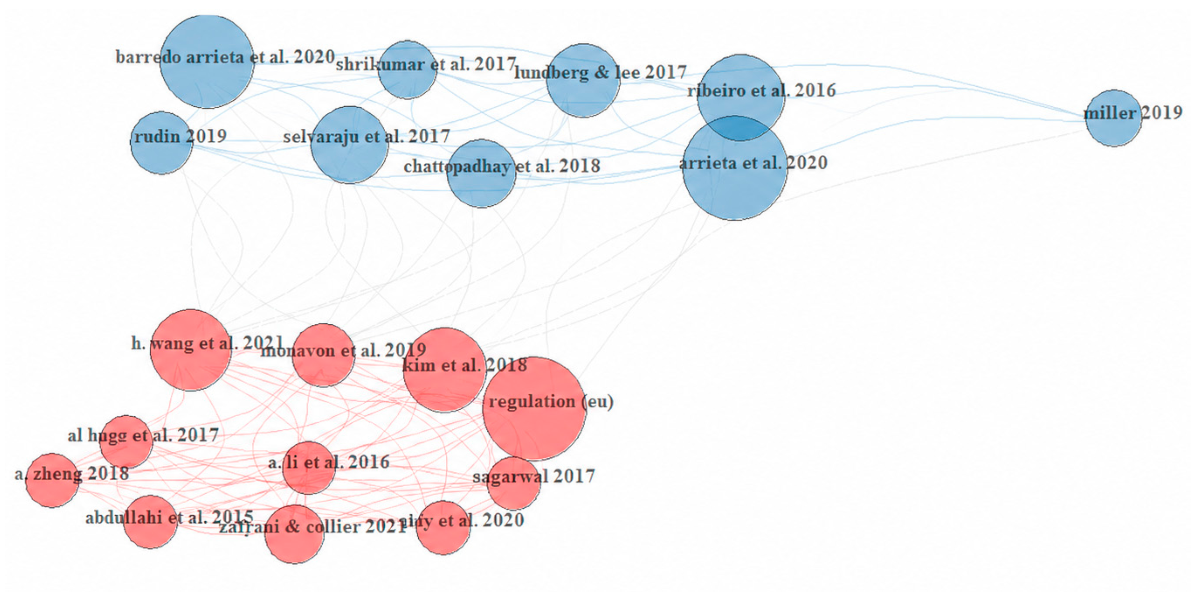
Figure 1. Co-citation network of key references informing the AIoT–XAI–HCAI research gap. Colors indicate distinct thematic communities: the upper cluster (blue) consolidates the algorithmic foundations of Explainable Artificial Intelligence (XAI), while the lower cluster (red) gravitates toward user-centered governance and regulation. Node sizes reflect citation frequency. References depicted in the network include selected key nodes such as: Ribeiro et al. [14], Selvaraju et al. [15], Barredo Arrieta et al. [16], H. Wang et al. [17], Kim et al. [18], Regulation (EU) [19].
Futureinternet 18 00303 g001
Figure 2. PRISMA Flow Diagram of Study Selection. * Records excluded during title screening due to irrelevance based on predefined inclusion/exclusion criteria.
Futureinternet 18 00303 g002
Figure 3. Bibliometric trends in AIoT research. (a) Number of publications per year from 2020 to 2025; (b) Geographical distribution of publications by region and country. Note: Software-generated abbreviations include: USA = United States, C. Rica = Costa Rica, Netn. = Netherlands, Slov. = Slovenia, S. Arabia = Saudi Arabia, and UAE = United Arab Emirates. Countries without numerical badges represent exactly one (1) publication.
Futureinternet 18 00303 g003
Figure 4. Sankey diagram linking AI types, connected-device domains, and human-centered outcomes. The numbers in parentheses represent the frequency of articles associated with each specific node. Colors are utilized strictly for visual distinction to differentiate the thematic categories and trace the flow of connections across the three stages.
Futureinternet 18 00303 g004
Table 1. Types of artificial intelligence and connected devices.
Types of Artificial IntelligenceConnected DevicesHuman Needs That Take PriorityArticles
Predictive AIAgricultural sensors, factory machinery, and measuring devices in textile and mechanical workshops.
  • Peace of mind
  • Savings
[1,2,28]
Medical AI and Healthcare AssistantsBody monitors, medical scanners, and hospital computers.
  • Care
  • Monitoring
  • Patient privacy
[6,11,12,29,30]
On-Premises AISecurity cameras, smart traffic lights, and autonomous vehicles.
  • Privacy
  • Immediate response to prevent accidents
[13,20,21,31]
Explainable and Fair AIGovernment computers, internet networks, and decision-making systems.
  • Trust
  • Justice
[9,24,32,33,34]
Vision and Language AIHigh-quality cameras for factories, robots, and industrial arms.
  • Safety
  • Clear communication
[10,26]
Basic Monitoring SystemsAffordable sensors for small businesses, alarms, and cell phones.
  • Comfort
  • Accessibility
[35,36]
AI for Social Work and Social ServicesPort cranes, ship systems, university networks, and city alerts.
  • Clear information
  • Avoid mental fatigue
[25,37,38,39]
AI with Secure and Forensic LoggingIndustrial nodes, crime scene sensors.
  • Transparency in información
  • Facilitates research
[40,41,42]
Table 2. Taxonomy of explainability levels and human control in AIoT.
Level of ExplainabilityDescription and Impact on Human ControlNumber of Articles (%)References
Genuine Explainability (Bidirectional/Co-creation)The system empowers the user through interactive dialogue, risk escalation protocols, and transparent reasoning (e.g., citing norms or ethical firewalls). The human operator retains active authority and can alter outcomes before execution.9 (22.5%)[3,5,9,11,22,23,29,43,44]
Transitional Explainability (Audit-focused/Post hoc)The system generates unalterable logs, forensic reports, or adapted justifications to prove fairness after a decision is made. It aids in accountability but does not offer real-time intervention to the operator.8 (20.0%)[24,25,32,34,37,38,40,42]
Superficial Explainability (One-way/Visual Alerts)The system acts as a black box that issues commands accompanied by simple visual cues (heat maps, SMS, dashboards). It serves as a psychological buffer for the human, who acts as a passive supervisor absorbing legal responsibility without real interactive control. 23 (57.5%)[1,2,4,6,7,8,10,12,13,20,21,26,28,30,31,33,35,36,39,41,45,46,47]
Table 3. The impact of technology on people’s privacy, security, and well-being.
Impact AreaEffects on People’s LivesUsage
Environments
Technology Solution (AIoT)Studies
Privacy- Fear of constant surveillance
- Theft of personal data
- Hospitals
- Universities
- Public spaces
To prevent information from traveling over the internet and being hacked, devices now process the data on the spot. This localized processing aligns with strict regulatory frameworks like the EU AI Act.[6,7,20]
Digital Security- Manipulation of information
- Visual illusions
- Corporate systems
- Industry
Technology maintains immutable records of all operations. It also provides accessible explanations for threat alerts to prevent users from being deceived by visual manipulations.[24,33,40,45]
Physical Security- Risk of accidents
- Damage caused by machine malfunctions
- Charging stations
- Engineering projects
It does not make decisions blindly and requires a human supervisor to approve the action through the implementation of mandatory escalation protocols.[4,29,36]
Mental Well-being- Mental exhaustion
- Frustration due to information overload
- Feeling of being replaced
- Hospitals
- Production lines
- Disaster zones
The system summarizes information and provides actionable advice, ensuring that human operators make the final decision. This approach fosters a sense of empowerment rather than replacement. The practical implementation of this human-centric approach is guided by frameworks like the MM4XAI-AE maturity model.[1,11,37,39,44]
Accountability and Ethics- Confusion regarding legal responsibility
- Risk of unethical automated decisions
- High-risk environments (Medicine, Civil Engineering)Systems integrate ethical firewalls and support the institutionalization of new human oversight roles, such as the Ethical AI Officer, to legally audit and validate the machine’s behavior.[12,22,31,36]
Disclaimer/Publisher’s Note: The statements, opinions and data contained in all publications are solely those of the individual author(s) and contributor(s) and not of MDPI and/or the editor(s). MDPI and/or the editor(s) disclaim responsibility for any injury to people or property resulting from any ideas, methods, instructions or products referred to in the content.