

Explainable and Human-Centered AIoT: A Systematic Review of Integration, Interaction, and Impact

Abstract
1. Introduction
1.1. AIoT (Artificial Intelligence of Things)
1.2. Human-Centered Approach
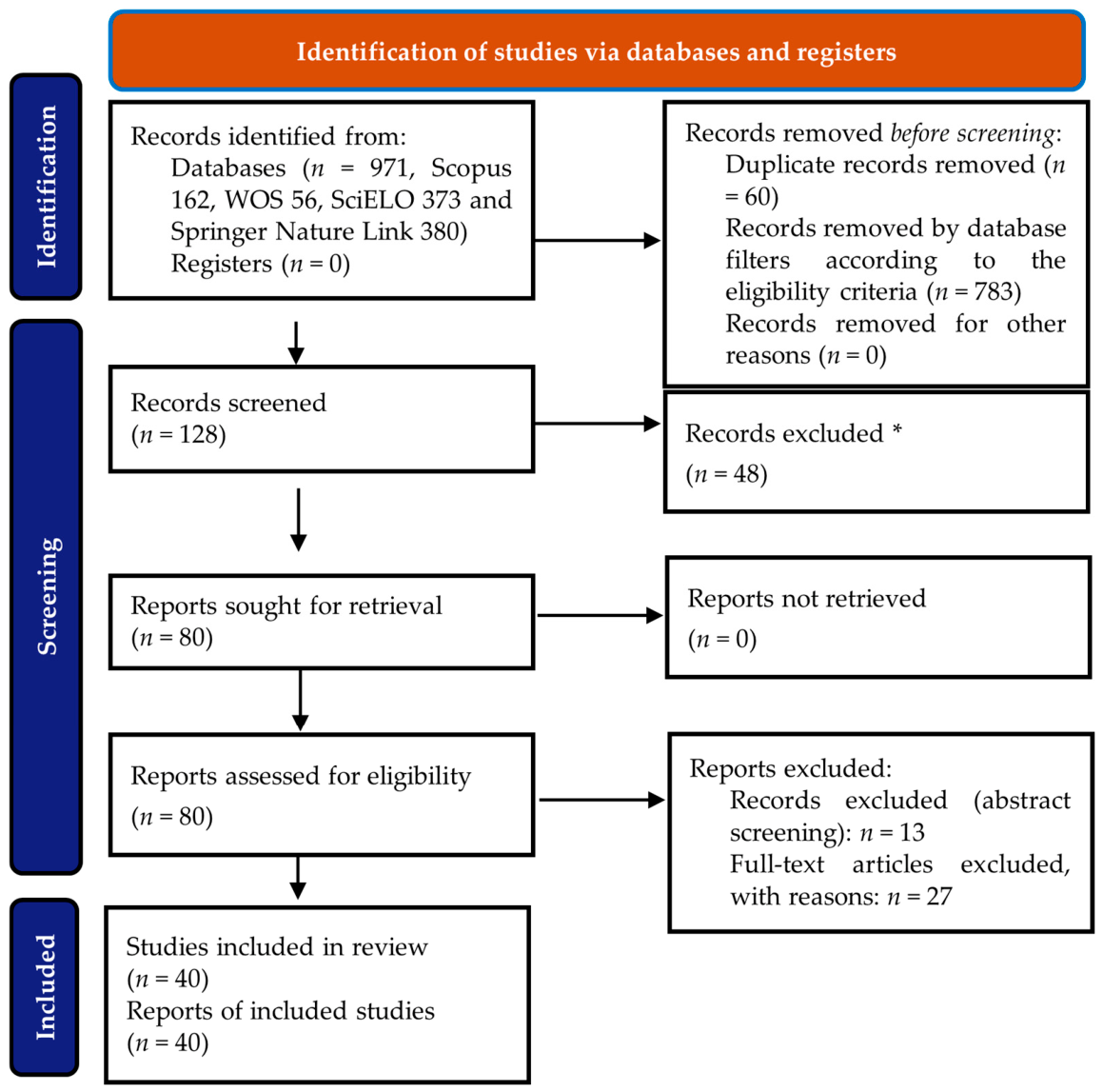
2. Materials and Methods
- Peer-reviewed scientific articles with open access.
- Published between 2020 and 2025.
- Written in English.
- Indexed under subject areas related to engineering, computer science, or artificial intelligence.
- Studies addressing, explicitly or substantially, at least one of the three focal constructs: AIoT architectures, explainability mechanisms (XAI), and human-centric dimensions of intelligent systems.
- Non-article formats (conference proceedings, book chapters, editorials, letters, and notes).
- Studies focused exclusively on the technical optimization of hardware without evaluating human–machine interaction or user impact.
- Studies that deploy AI algorithms purely for automated data collection without offering any interface for explainability or human supervision.
- Duplicate records identified across databases.
3. Results
3.1. Trends in Research: Identifying the Year, Country, and Authors with the Most Publications on Smart Devices (AIoT)
3.2. Types of Artificial Intelligence and Connected Devices Currently Available, with a Focus on People’s Needs and Convenience
3.3. Communication with These Smart Devices and How They Manage to Explain in Simple Terms Why They Make Certain Decisions
3.4. Technologies in People’s Daily Lives with Regard to User Safety and Well-Being
4. Discussion
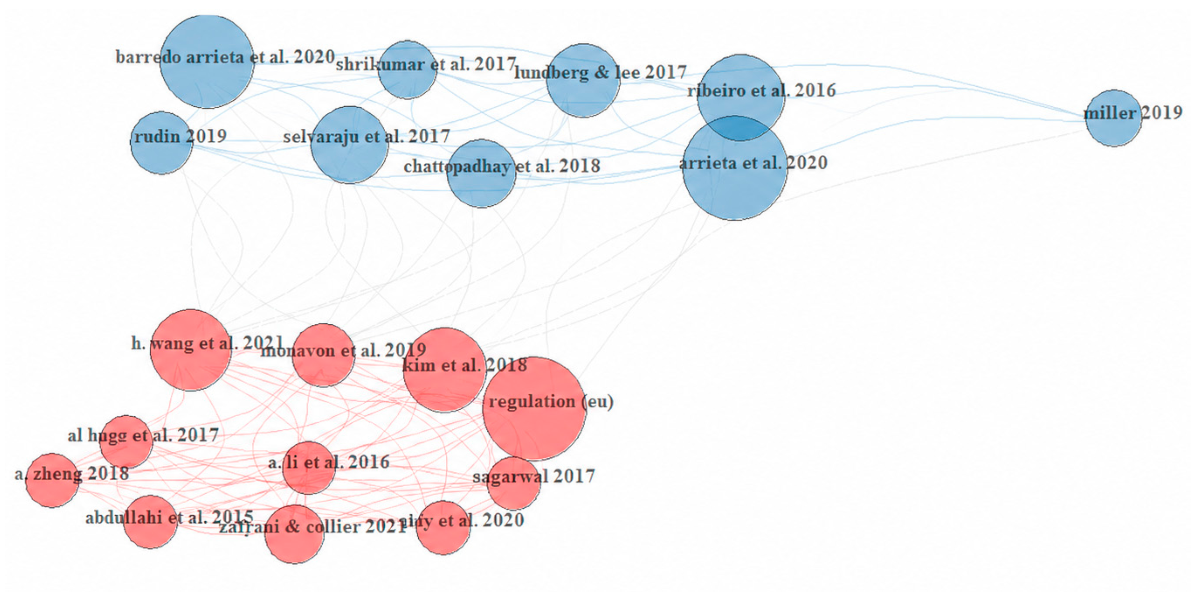
4.1. Maturity and Consistency in the Field
4.2. A Human-Centered Approach: Theory vs. Practice
4.3. Explainability and Control
4.4. Well-Being, Efficiency, and Responsibility
4.5. Limitations of This Research
5. Conclusions
Supplementary Materials
Author Contributions
Funding
Data Availability Statement
Conflicts of Interest
Abbreviations
| AIoT | Artificial Intelligence of Things |
| Edge AI | Edge Artificial Intelligence |
| EU | European Union |
| Grad-CAM | Gradient-based Visual Interpretability |
| HCAI | Human-Centered Artificial Intelligence |
| HRT | Human–Robot Team |
| IoT | Internet of Things |
| LIME | Local Interpretable Model-agnostic Explanations |
| MM4XAI-AE | Maturity Model for Practical Explainability in Artificial Intelligence-Based Applications: Integrating Analysis and Evaluation Models |
| MMAT | Mixed Methods Appraisal Tool |
| XAI | Explainable Artificial Intelligence |
References
- Osimani, C.; Arevalo, J.A.; Ruiz Martinez, W. Caficultor digital: Tecnologías 4.0 para producción de café mediante modelos predictivos. Tecnura 2024, 28, 156–177. [Google Scholar] [CrossRef] [Scilit]
- Heredia, J.; Ayala, E. IoT and AI-Based Predictive Maintenance System Design for Express Auto Repair Shops. Rev. Técnica Energía 2025, 21, 81–86. [Google Scholar] [CrossRef] [Scilit]
- Bruckert, S.; Finzel, B.; Schmid, U. The Next Generation of Medical Decision Support: A Roadmap Toward Transparent Expert Companions. Front. Artif. Intell. 2020, 3, 507973. [Google Scholar] [CrossRef] [Scilit]
- Giraldo, J.D.; Castaño, T.; González, J.; López, V.; Velásquez, P.; Tamayo, J. Utilidad de las tecnologías de las industria 4.0 en los smart ports. Ing. Compet. 2024, 26, e-30212814. [Google Scholar] [CrossRef] [Scilit]
- Bouderhem, R. A Comprehensive Framework for Transparent and Explainable AI Sensors in Healthcare. Eng. Proc. 2024, 82, 49. [Google Scholar] [CrossRef] [Scilit]
- Vaca, C.; Valle, M. Current Status and Challenges of IoT Research in the Ecuadorian Healthcare Sector: A Systematic Literature Review. Enfoque UTE 2024, 15, 20–29. [Google Scholar] [CrossRef] [Scilit]
- Rico-Bautista, D.; Maestre-Góngora, G.P.; Guerrero, C.D.; Medina-Cárdenas, Y.; Areniz-Arévalo, Y.; Sanchez-Velasquez, M.C.; Barrientos-Avendaño, E. Universidad inteligente: Factores claves para la adopción de internet de las cosas y big data. RISTI—Rev. Iber. Sist. Tecnol. Inf. 2021, 2021, 63–79. [Google Scholar] [CrossRef] [Scilit]
- Madriz, C.E.; Sánchez, O.; Hernández-Granados, J.B. Influencia de la intervención humana en procesos modernos de manufactura: Un enfoque de simulación de procesos centrado en el factor humano. Rev. Tecnol. Marcha 2021, 35, 3–13. [Google Scholar] [CrossRef] [Scilit]
- Schoenherr, J.R.; Abbas, R.; Michael, K.; Rivas, P.; Anderson, T.D. Designing AI Using a Human-Centered Approach: Explainability and Accuracy Toward Trustworthiness. IEEE Trans. Technol. Soc. 2023, 4, 9–23. [Google Scholar] [CrossRef] [Scilit]
- Andres, A.; Martinez-Seras, A.; Laña, I.; Del Ser, J. On the black-box explainability of object detection models for safe and trustworthy industrial applications. Results Eng. 2024, 24, 103498. [Google Scholar] [CrossRef] [Scilit]
- Cinà, G.; Röber, T.E.; Goedhart, R.; Birbil, Ş.İ. Why we do need explainable AI for healthcare. Diagn. Progn. Res. 2025, 9, 24. [Google Scholar] [CrossRef] [Scilit]
- Yang, Z.; Zhang, R.; Zhang, L.; Liu, M.; Duan, X.; Yin, F.F. Uncovering the black box of medical image analysis algorithms: Recent advances in explainable artificial intelligence in medical image analysis. Chin. Sci. Bull. 2025, 70, 5675–5695. [Google Scholar] [CrossRef] [Scilit]
- Moss, J.; Gordon, J.; Duclos, W.; Liu, Y.; Wang, Q.; Wang, J. Explainable AI in IoT: A Survey of Challenges, Advancements, and Pathways to Trustworthy Automation. Electronics 2025, 14, 4622. [Google Scholar] [CrossRef] [Scilit]
- Ribeiro, M.T.; Singh, S.; Guestrin, C. ‘Why should i trust you?’ Explaining the predictions of any classifier. In Proceedings of the ACM SIGKDD International Conference on Knowledge Discovery and Data Mining; Association for Computing Machinery: New York, NY, USA, 2016; pp. 1135–1144. [Google Scholar] [CrossRef] [Scilit]
- Selvaraju, R.R.; Cogswell, M.; Das, A.; Vedantam, R.; Parikh, D.; Batra, D. Grad-CAM: Visual Explanations from Deep Networks via Gradient-Based Localization. In Proceedings of the IEEE International Conference on Computer Vision; Institute of Electrical and Electronics Engineers Inc.: New York, NY, USA, 2017; pp. 618–626. [Google Scholar] [CrossRef] [Scilit]
- Arrieta, A.B.; Díaz-Rodríguez, N.; Del Ser, J.; Bennetot, A.; Tabik, S.; Barbado, A.; García, S.; Gil-López, S.; Molina, D.; Benjamins, R.; et al. Explainable Artificial Intelligence (XAI): Concepts, taxonomies, opportunities and challenges toward responsible AI. Inf. Fusion 2020, 58, 82–115. [Google Scholar] [CrossRef] [Scilit]
- Wang, H.; Ren, Y.; Meng, Z. A farm management information system for semi-supervised path planning and autonomous vehicle control. Sustainability 2021, 13, 7497. [Google Scholar] [CrossRef] [Scilit]
- Kim, J.; Rohrbach, A.; Darrell, T.; Canny, J.; Akata, Z. Textual Explanations for Self-Driving Vehicles. arXiv 2018, arXiv:1807.11546. [Google Scholar] [CrossRef] [Scilit]
- Regulation (EU) 2023/2854 of the European Parliament and of the Council of 13 December 2023 on Harmonised Rules on Fair Access to and Use of Data (Data Act). Official Journal of the European Union. 2023. Available online: http://data.europa.eu/eli/reg/2023/2854/oj (accessed on 28 April 2026).
- Quiñonez-Cuenca, F.; Maza-Merchán, C.; Cuenca-Maldonado, N.; Quiñones-Cuenca, M.; Torres, R.; Sandoval, F.; Ludeña-González, P. Evaluación de AIoT en modelos computacionales en la nube y en el borde aplicado a la detección de mascarillas. Ingenius 2022, 2022, 32–47. [Google Scholar] [CrossRef] [Scilit]
- Colomé, A.; Calderon, C.; Delgado, T. Procedimiento para la implementación de la computación en la niebla en ciudades inteligentes. Ing. Electrónica Automática Comun. 2021, 42, 45–57. [Google Scholar]
- Holzinger, A.; Saranti, A.; Angerschmid, A.; Retzlaff, C.O.; Gronauer, A.; Pejakovic, V.; Medel-Jimenez, F.; Krexner, T.; Gollob, C.; Stampfer, K. Digital Transformation in Smart Farm and Forest Operations Needs Human-Centered AI: Challenges and Future Directions. Sensors 2022, 22, 3043. [Google Scholar] [CrossRef] [Scilit]
- Ang, K.C.S.; Sankaran, S.; Liu, D. Advancing sociotechnical systems theory: New principles for human-robot team design and development. Appl. Ergon. 2025, 129, 104604. [Google Scholar] [CrossRef] [Scilit] [PubMed]
- Alketbi, K.S.; Mehmood, A. A Comprehensive Survey of Explainable Artificial Intelligence Techniques for Malicious Insider Threat Detection. IEEE Access 2025, 13, 121772–121798. [Google Scholar] [CrossRef] [Scilit]
- Pavleska, T. Social interaction models for trust systems design. CCF Trans. Pervasive Comput. Interact. 2025, 7, 48–69. [Google Scholar] [CrossRef] [Scilit]
- Nguyen, H.T.T.; Nguyen, L.P.T.; Cao, H. XEdgeAI: A human-centered industrial inspection framework with data-centric Explainable Edge AI approach. Inf. Fusion 2025, 116, 102782. [Google Scholar] [CrossRef] [Scilit]
- Page, M.J.; McKenzie, J.E.; Bossuyt, P.M.; Boutron, I.; Hoffmann, T.C.; Mulrow, C.D.; Shamseer, L.; Tetzlaff, J.M.; Akl, E.A.; Brennan, S.E.; et al. The PRISMA 2020 statement: An updated guideline for reporting systematic reviews. Bmj 2021, 372, n71. [Google Scholar] [CrossRef] [Scilit]
- Velasco-Loera, F.; Alcaraz-Mejia, M.; Chavez-Hurtado, J.L. An Interpretable Hybrid Fault Prediction Framework Using XGBoost and a Probabilistic Graphical Model for Predictive Maintenance: A Case Study in Textile Manufacturing. Appl. Sci. 2025, 15, 10164. [Google Scholar] [CrossRef] [Scilit]
- Thurzo, A. Provable AI Ethics and Explainability in Medical and Educational AI Agents: Trustworthy Ethical Firewall. Electronics 2025, 14, 1294. [Google Scholar] [CrossRef] [Scilit]
- Song, B.; Zhang, C.; Sunny, S.; Kc, D.R.; Li, S.; Gurushanth, K.; Mendonca, P.; Mukhia, N.; Patrick, S.; Gurudath, S.; et al. Interpretable and Reliable Oral Cancer Classifier with Attention Mechanism and Expert Knowledge Embedding via Attention Map. Cancers 2023, 15, 1421. [Google Scholar] [CrossRef] [Scilit]
- Alvarez Mendoza, Y.; Londoño Gomez, T.J.; Leguizamón Páez, M.A. Risks and security solutions existing in the Internet of things (IoT) in relation to Big Data. Ing. Compet. 2020, 23, e9484. [Google Scholar] [CrossRef] [Scilit]
- Leon, M. Investing in AI Interpretability, Control, and Robustness. Algorithms 2026, 19, 136. [Google Scholar] [CrossRef] [Scilit]
- Hurtado, J.A.; Antonelli, L.; López, S.; Gómez, A.; Delle Ville, J.; Maltempo, G.; Zambrano, F.G.; Solis, A.; Camacho, M.C.; Solinas, M.; et al. Semiotics: An Approach to Model Security Scenarios for IoT-Based Agriculture Software. TecnoLógicas 2024, 27, e2923. [Google Scholar] [CrossRef] [Scilit]
- Aoki, N.; Tatsumi, T.; Naruse, G.; Maeda, K. Explainable AI for government: Does the type of explanation matter to the accuracy, fairness, and trustworthiness of an algorithmic decision as perceived by those who are affected? Gov. Inf. Q. 2024, 41, 101965. [Google Scholar] [CrossRef] [Scilit]
- Morris Molina, L.H.; Chávez Salazar, L.G.; Arias Vargas, J.L.; Lozano Mosquera, D.F.; Mejía Melo, D.H. Prototipo funcional para el mejoramiento del proceso productivo en MiPymes de manufactura y su aproximación a la Industria 4.0. Entre Cienc. Ing. 2022, 16, 70–80. [Google Scholar] [CrossRef] [Scilit]
- Castaño Gómez, M.; López Echeverry, A.M.; Villa Sánchez, P.A. Review of the use of IoT technologies and devices in physical security systems. Ing. Compet. 2022, 24, 16. [Google Scholar] [CrossRef] [Scilit]
- Karnavas, S.I.; Peteinatos, I.; Kyriazis, A.; Barbounaki, S.G. Using Fuzzy Multi-Criteria Decision-Making as a Human-Centered AI Approach to Adopting New Technologies in Maritime Education in Greece. Information 2025, 16, 283. [Google Scholar] [CrossRef] [Scilit]
- Muñoz-Ordóñez, J.; Cobos, C.; Vidal-Rojas, J.C.; Herrera, F. A Maturity Model for Practical Explainability in Artificial Intelligence-Based Applications: Integrating Analysis and Evaluation (MM4XAI-AE) Models. Int. J. Intell. Syst. 2025, 2025, 4934696. [Google Scholar] [CrossRef] [Scilit]
- Kaufhold, M.A. Exploring the evolving landscape of human-centred crisis informatics: Current challenges and future trends. i-com 2024, 23, 155–163. [Google Scholar] [CrossRef] [Scilit]
- Beatriz Parra de Gallo, H. Propuesta de una guía de actuación forense para entornos de internet de las cosas (IoT). Comput. Sist. 2022, 26, 441–460. [Google Scholar] [CrossRef] [Scilit]
- Bertoli, A.; Cervo, A.; Rosati, C.A.; Fantuzzi, C. Smart node networks orchestration: A new e2e approach for analysis and design for agile 4.0 implementation. Sensors 2021, 21, 1624. [Google Scholar] [CrossRef] [Scilit]
- Llanten Lucio, Y.I.; Amador Donado, S.; Márceles, K. Architecture of an intelligent cybersecurity Framework based on Blockchain technology for IioT. Ing. Compet. 2022, 24, 13. [Google Scholar] [CrossRef] [Scilit]
- Avila, C.; Ilbay, D.; Rivera, D. Human–AI Teaming in Structural Analysis: A Model Context Protocol Approach for Explainable and Accurate Generative AI. Buildings 2025, 15, 3190. [Google Scholar] [CrossRef] [Scilit]
- Centeio Jorge, C.; Jonker, C.M.; Tielman, M.L. Interdependence and trust analysis (ITA): A framework for human–machine team design. Behav. Inf. Technol. 2024. [Google Scholar] [CrossRef] [Scilit]
- Bustamante Garcia, S.; Castañeda, P.; Rodríguez, C. Challenges of information security managementin the industrial sector: A systematic review. Enfoque UTE 2025, 16, 9–18. [Google Scholar] [CrossRef] [Scilit]
- Ordóñez-Bolaños, O.-A.; Sierra-Martinez, L.-M.; Peluffo-Ordoñez, D.-H. IoT-ATL: Prototype of a Digital Twin to Simulate Educational Scenarios in the Art and Technology Laboratories at the Departmental Institute of Fine Arts in Cali, Colombia. Rev. Fac. Ing. 2023, 32, e15245. [Google Scholar] [CrossRef] [Scilit]
- Martínez-Manso, H.; Delgado-Fernández, T. Arquitectura básica de diseño de gemelos digitales para la construcción. Rev. Investig. Desarro. Innovación 2022, 12, 327–336. [Google Scholar] [CrossRef] [Scilit]
- Li, H.; Ota, K.; Dong, M. Learning IoT in Edge: Deep Learning for the Internet of Things with Edge Computing. IEEE Netw. 2018, 32, 96–101. [Google Scholar] [CrossRef] [Scilit]
- Sun, Y.; Peng, M.; Zhou, Y.; Huang, Y.; Mao, S. Application of Machine Learning in Wireless Networks: Key Techniques and Open Issues. IEEE Commun. Surv. Tutor. 2019, 21, 3072–3108. [Google Scholar] [CrossRef] [Scilit]
- Gunning, D.; Stefik, M.; Choi, J.; Miller, T.; Stumpf, S.; Yang, G.Z. XAI-Explainable artificial intelligence. Sci. Robot. 2019, 4, eaay7120. [Google Scholar] [CrossRef] [Scilit] [PubMed]
- Adadi, A.; Berrada, M. Peeking Inside the Black-Box: A Survey on Explainable Artificial Intelligence (XAI). IEEE Access 2018, 6, 52138–52160. [Google Scholar] [CrossRef] [Scilit]
- Bansal, G.; Wu, T.; Zhou, J. Does the whole exceed its parts? The efect of ai explanations on complementary team performance. In Conference on Human Factors in Computing Systems—Proceedings; Association for Computing Machinery: New York, NY, USA, 2021. [Google Scholar] [CrossRef] [Scilit]
- Ghassemi, M.; Oakden-Rayner, L. The false hope of current approaches to explainable artificial intelligence in health care. Viewp. Lancet Digit. Health 2021, 3, 745–750. [Google Scholar] [CrossRef] [Scilit]



| Types of Artificial Intelligence | Connected Devices | Human Needs That Take Priority | Articles |
|---|---|---|---|
| Predictive AI | Agricultural sensors, factory machinery, and measuring devices in textile and mechanical workshops. |
| [1,2,28] |
| Medical AI and Healthcare Assistants | Body monitors, medical scanners, and hospital computers. |
| [6,11,12,29,30] |
| On-Premises AI | Security cameras, smart traffic lights, and autonomous vehicles. |
| [13,20,21,31] |
| Explainable and Fair AI | Government computers, internet networks, and decision-making systems. |
| [9,24,32,33,34] |
| Vision and Language AI | High-quality cameras for factories, robots, and industrial arms. |
| [10,26] |
| Basic Monitoring Systems | Affordable sensors for small businesses, alarms, and cell phones. |
| [35,36] |
| AI for Social Work and Social Services | Port cranes, ship systems, university networks, and city alerts. |
| [25,37,38,39] |
| AI with Secure and Forensic Logging | Industrial nodes, crime scene sensors. |
| [40,41,42] |
| Level of Explainability | Description and Impact on Human Control | Number of Articles (%) | References |
|---|---|---|---|
| Genuine Explainability (Bidirectional/Co-creation) | The system empowers the user through interactive dialogue, risk escalation protocols, and transparent reasoning (e.g., citing norms or ethical firewalls). The human operator retains active authority and can alter outcomes before execution. | 9 (22.5%) | [3,5,9,11,22,23,29,43,44] |
| Transitional Explainability (Audit-focused/Post hoc) | The system generates unalterable logs, forensic reports, or adapted justifications to prove fairness after a decision is made. It aids in accountability but does not offer real-time intervention to the operator. | 8 (20.0%) | [24,25,32,34,37,38,40,42] |
| Superficial Explainability (One-way/Visual Alerts) | The system acts as a black box that issues commands accompanied by simple visual cues (heat maps, SMS, dashboards). It serves as a psychological buffer for the human, who acts as a passive supervisor absorbing legal responsibility without real interactive control. | 23 (57.5%) | [1,2,4,6,7,8,10,12,13,20,21,26,28,30,31,33,35,36,39,41,45,46,47] |
| Impact Area | Effects on People’s Lives | Usage Environments | Technology Solution (AIoT) | Studies |
|---|---|---|---|---|
| Privacy | - Fear of constant surveillance - Theft of personal data | - Hospitals - Universities - Public spaces | To prevent information from traveling over the internet and being hacked, devices now process the data on the spot. This localized processing aligns with strict regulatory frameworks like the EU AI Act. | [6,7,20] |
| Digital Security | - Manipulation of information - Visual illusions | - Corporate systems - Industry | Technology maintains immutable records of all operations. It also provides accessible explanations for threat alerts to prevent users from being deceived by visual manipulations. | [24,33,40,45] |
| Physical Security | - Risk of accidents - Damage caused by machine malfunctions | - Charging stations - Engineering projects | It does not make decisions blindly and requires a human supervisor to approve the action through the implementation of mandatory escalation protocols. | [4,29,36] |
| Mental Well-being | - Mental exhaustion - Frustration due to information overload - Feeling of being replaced | - Hospitals - Production lines - Disaster zones | The system summarizes information and provides actionable advice, ensuring that human operators make the final decision. This approach fosters a sense of empowerment rather than replacement. The practical implementation of this human-centric approach is guided by frameworks like the MM4XAI-AE maturity model. | [1,11,37,39,44] |
| Accountability and Ethics | - Confusion regarding legal responsibility - Risk of unethical automated decisions | - High-risk environments (Medicine, Civil Engineering) | Systems integrate ethical firewalls and support the institutionalization of new human oversight roles, such as the Ethical AI Officer, to legally audit and validate the machine’s behavior. | [12,22,31,36] |
Disclaimer/Publisher’s Note: The statements, opinions and data contained in all publications are solely those of the individual author(s) and contributor(s) and not of MDPI and/or the editor(s). MDPI and/or the editor(s) disclaim responsibility for any injury to people or property resulting from any ideas, methods, instructions or products referred to in the content. |
© 2026 by the authors. Licensee MDPI, Basel, Switzerland. This article is an open access article distributed under the terms and conditions of the Creative Commons Attribution (CC BY) license.
Share and Cite
Jurado Rosas, A.A.; Fernández Miranda, M.; Peña Pazos, G.L.; García Panta, E.E.; Ramos Reyes, C.A.; Córdova de Chang, M.P.; Chang Valdiviezo, J.H.; Gamarra Chirinos, O.P.; Esquerre Aguirre, C.E. Explainable and Human-Centered AIoT: A Systematic Review of Integration, Interaction, and Impact. Future Internet 2026, 18, 303. https://doi.org/10.3390/fi18060303
Jurado Rosas AA, Fernández Miranda M, Peña Pazos GL, García Panta EE, Ramos Reyes CA, Córdova de Chang MP, Chang Valdiviezo JH, Gamarra Chirinos OP, Esquerre Aguirre CE. Explainable and Human-Centered AIoT: A Systematic Review of Integration, Interaction, and Impact. Future Internet. 2026; 18(6):303. https://doi.org/10.3390/fi18060303
Chicago/Turabian StyleJurado Rosas, Adolfo A., Marina Fernández Miranda, Gladys L. Peña Pazos, Elberth E. García Panta, Carlos A. Ramos Reyes, Milagros P. Córdova de Chang, José H. Chang Valdiviezo, Olga P. Gamarra Chirinos, and Carlos E. Esquerre Aguirre. 2026. "Explainable and Human-Centered AIoT: A Systematic Review of Integration, Interaction, and Impact" Future Internet 18, no. 6: 303. https://doi.org/10.3390/fi18060303
APA StyleJurado Rosas, A. A., Fernández Miranda, M., Peña Pazos, G. L., García Panta, E. E., Ramos Reyes, C. A., Córdova de Chang, M. P., Chang Valdiviezo, J. H., Gamarra Chirinos, O. P., & Esquerre Aguirre, C. E. (2026). Explainable and Human-Centered AIoT: A Systematic Review of Integration, Interaction, and Impact. Future Internet, 18(6), 303. https://doi.org/10.3390/fi18060303