
A State-Assisted Authentication and Key Agreement Scheme for Lightweight Multi-RSU Access in VANETs


Abstract
1. Introduction
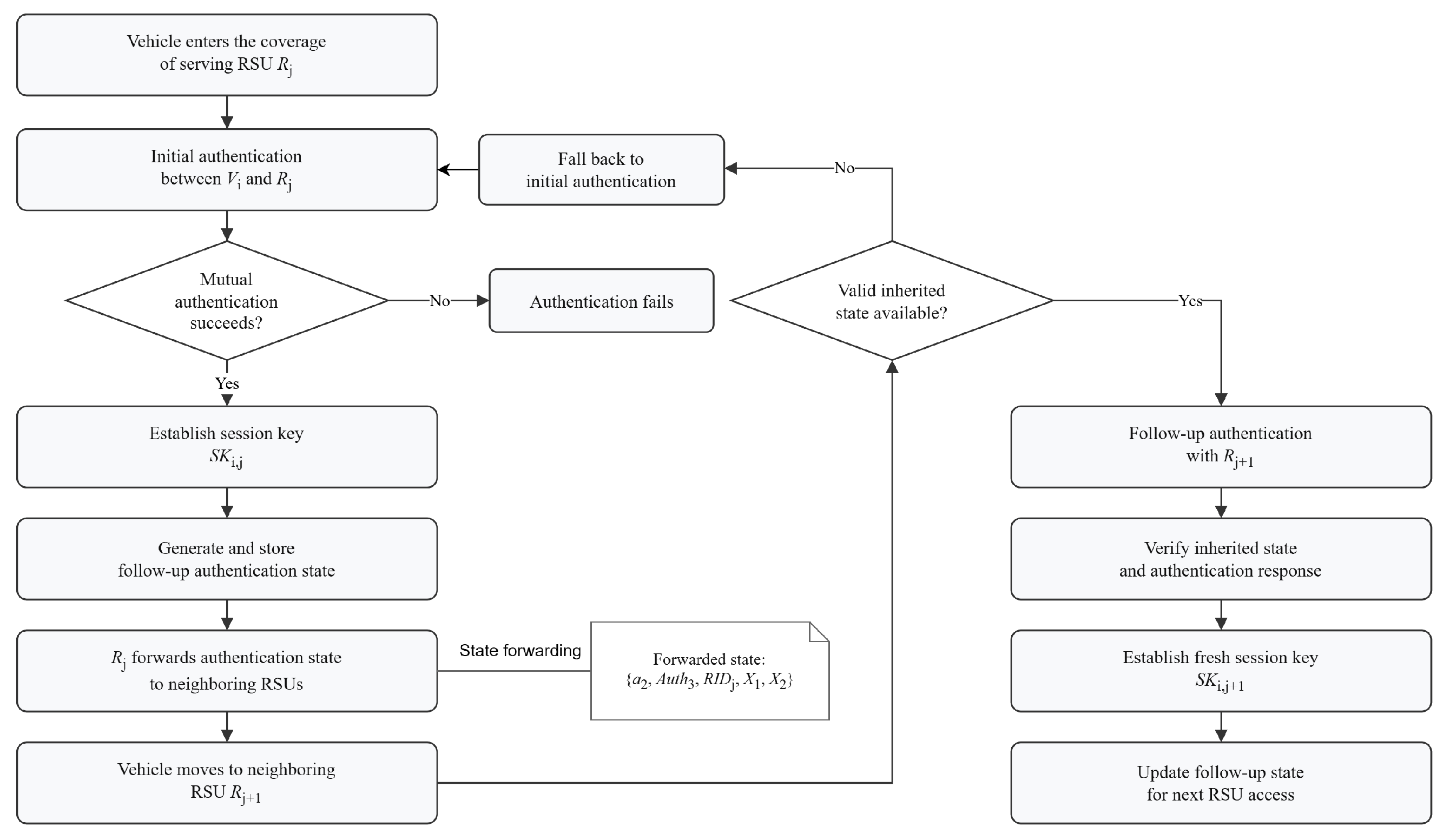
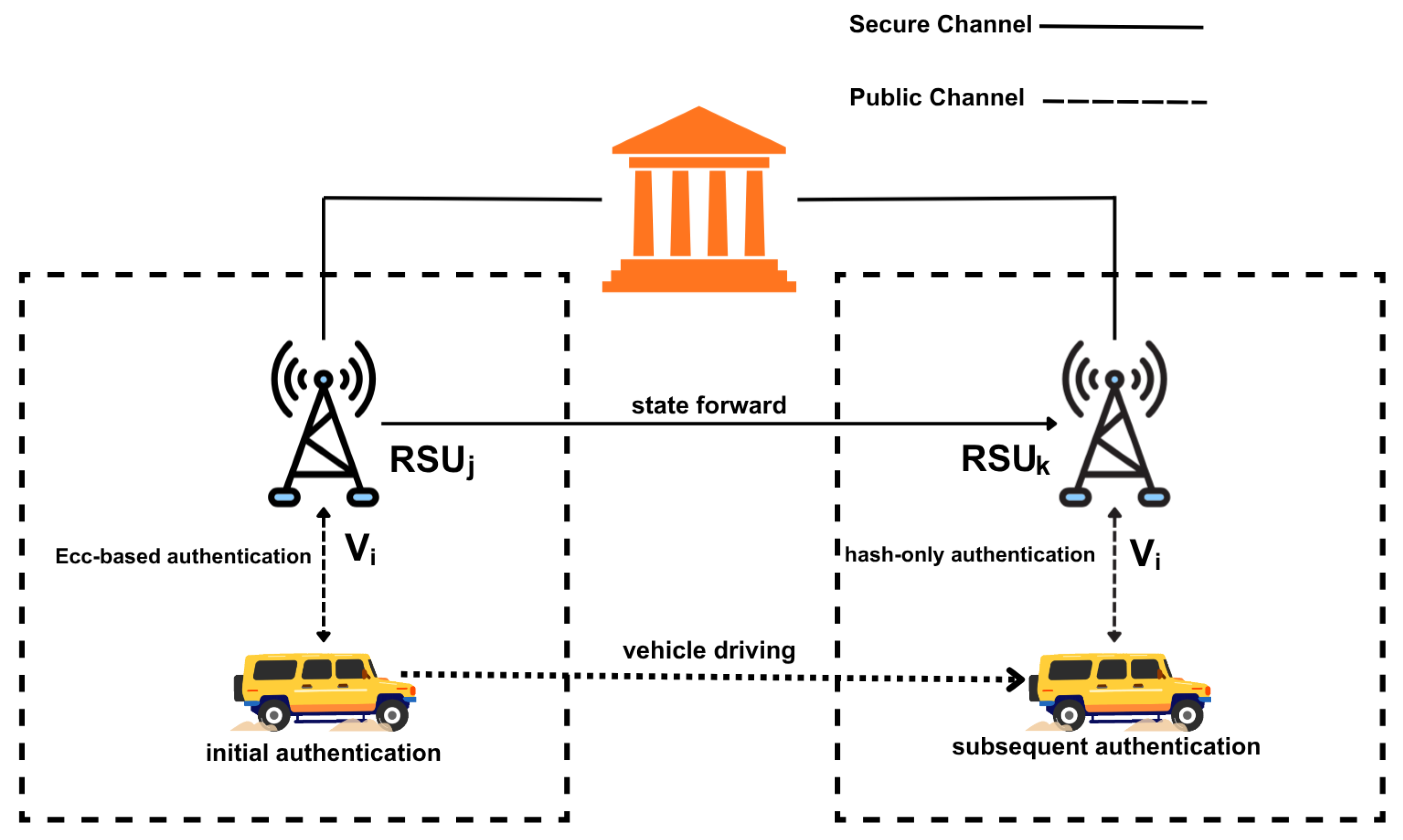
- We propose a state-assisted authentication framework for lightweight multi-RSU access in VANET environments. The framework decouples authentication into initial trust establishment and subsequent authentication, enabling secure continuous V2I access without requiring full authentication at every RSU.
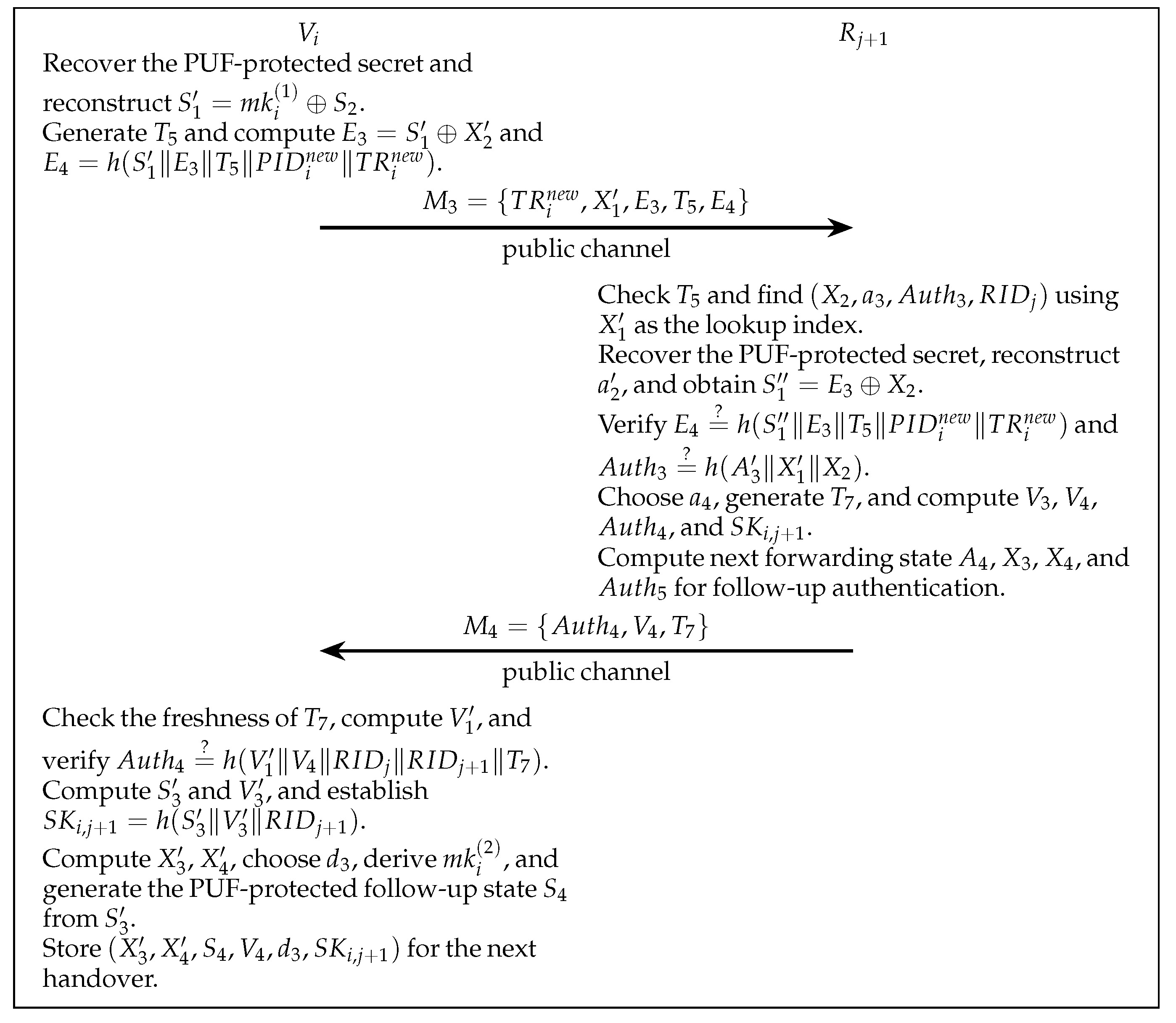
- We design an efficient RSU-assisted subsequent authentication mechanism. By using RSU-specific and session-bound authentication states forwarded through secure inter-RSU channels, a vehicle can complete follow-up authentication with a neighboring RSU using only lightweight hash and XOR operations while supporting anonymity, mutual authentication, and fresh session key establishment.
- We introduce PUF-based device-bound secret protection for both vehicles and RSUs. PUFs are used for local secret protection and stable secret recovery through fuzzy extraction, thereby improving the protection of device-side secrets.
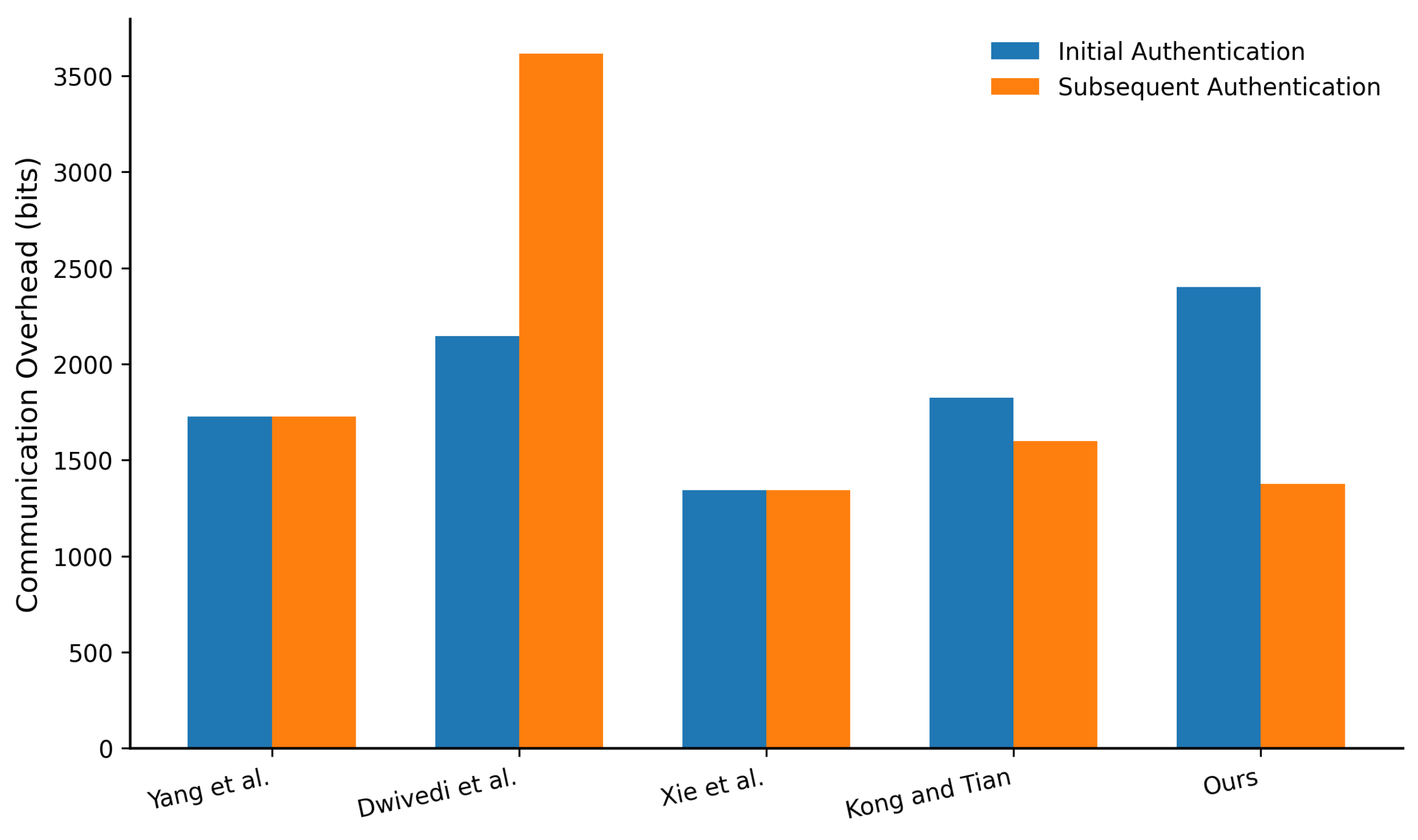
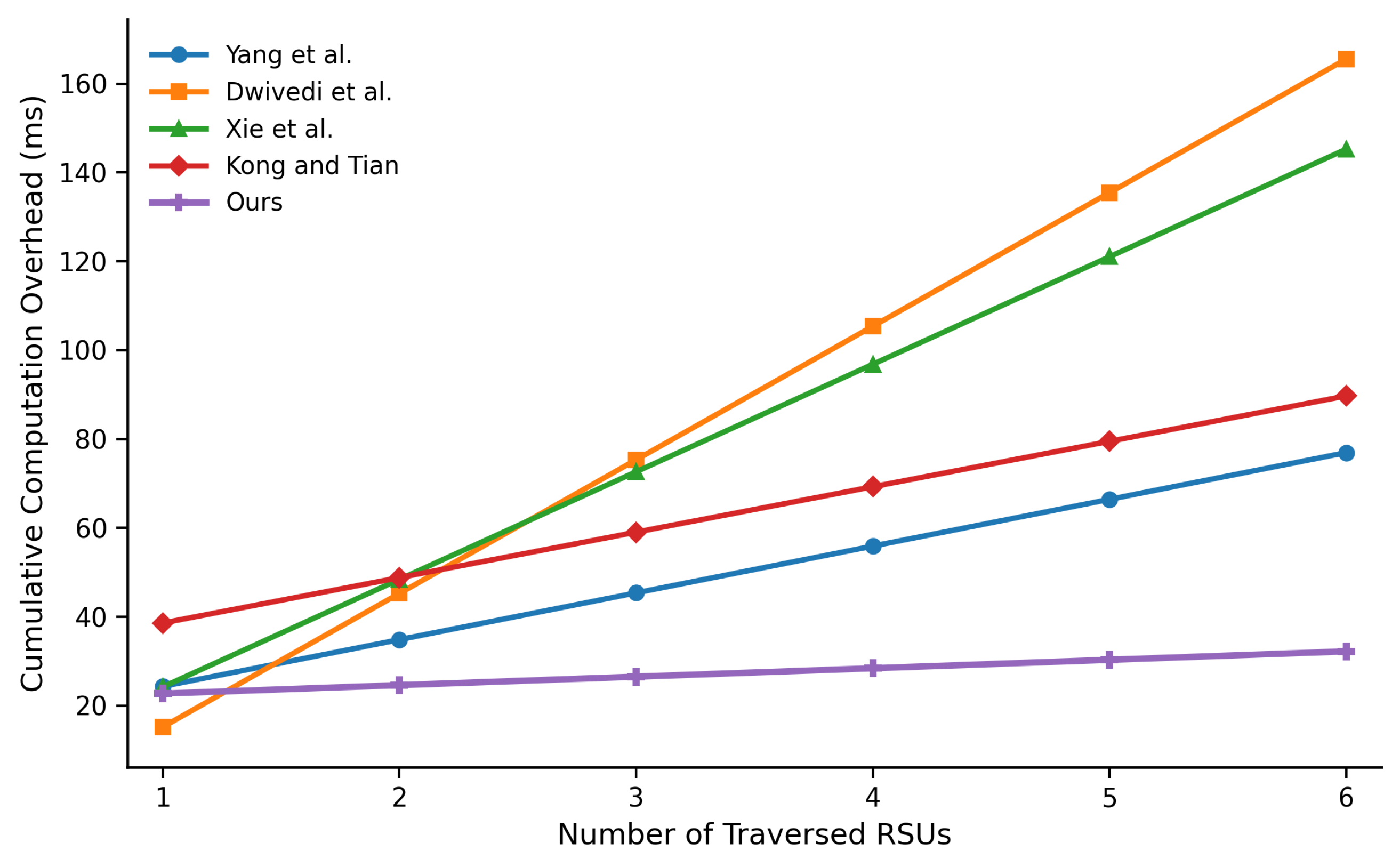
- We provide security analysis and performance evaluation for the proposed scheme. The results show that the proposed scheme achieves the required security properties and reduces the computational cost of the subsequent authentication phase by more than 90% while maintaining low communication overhead.
Related Work
2. System Model
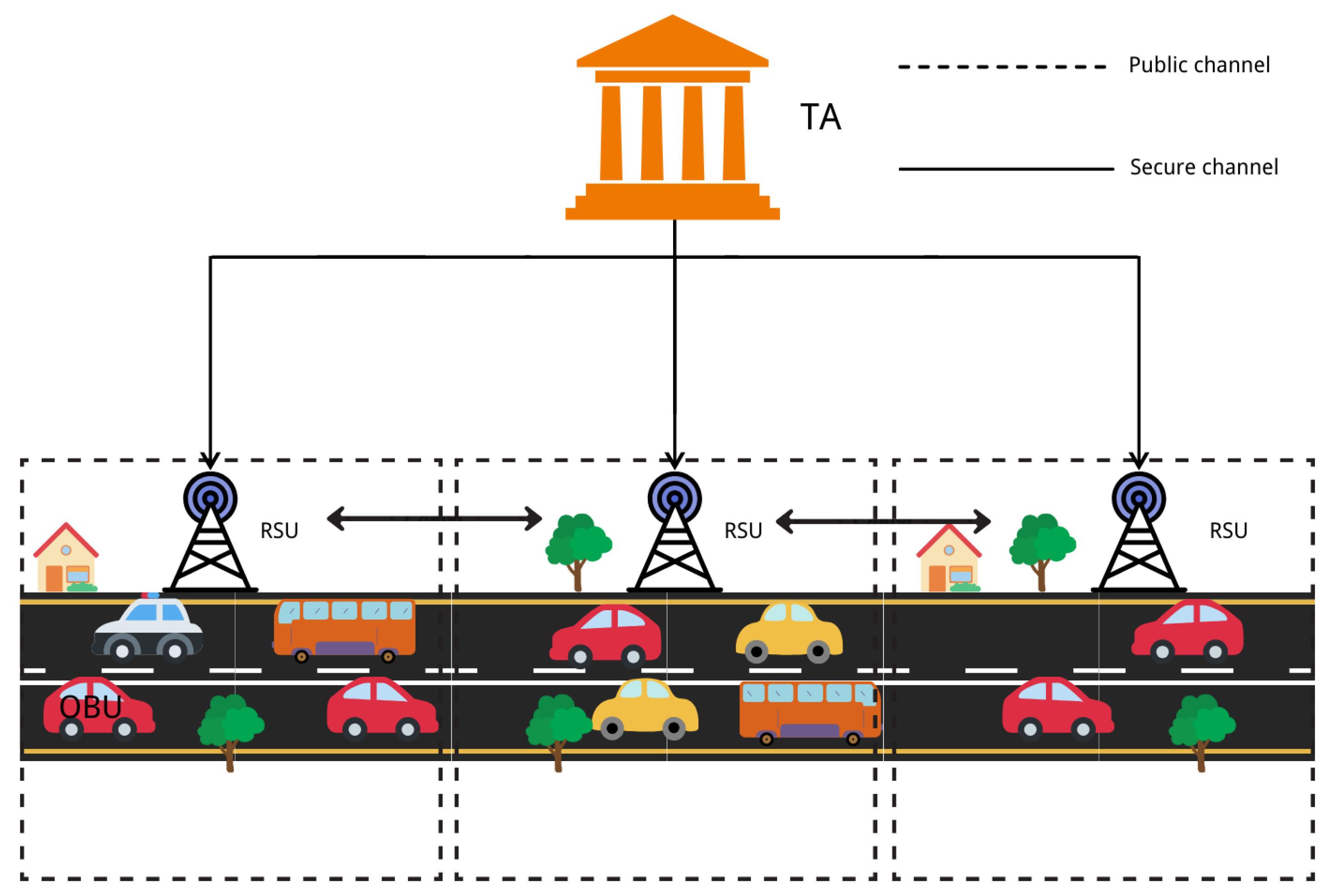
2.1. System Framework
2.2. Cryptographic and Hardware Assumptions
2.3. Adversary Threat Model
- The adversary can eavesdrop on, intercept, modify, replay, and delete messages transmitted over public channels.
- The adversary can obtain public system parameters and publicly available identity-related information of protocol participants.
- The adversary may attempt impersonation, replay, man-in-the-middle, and message tampering attacks by actively manipulating protocol messages.
- The adversary may physically capture an OBU or an RSU and launch side-channel or device-level attacks to extract software-stored information. For the PUF primitive, cloning the underlying PUF instance or accurately reproducing its challenge-response behavior is assumed to be infeasible within feasible resources. The helper data generated by the fuzzy extractor is also assumed not to reveal the reconstructed PUF-derived secret by itself. Under this assumption, capturing an RSU does not enable the adversary to clone its PUF-bound secret or reproduce valid PUF-derived values on another device.
3. The Proposed Scheme
3.1. System Initialization and Registration
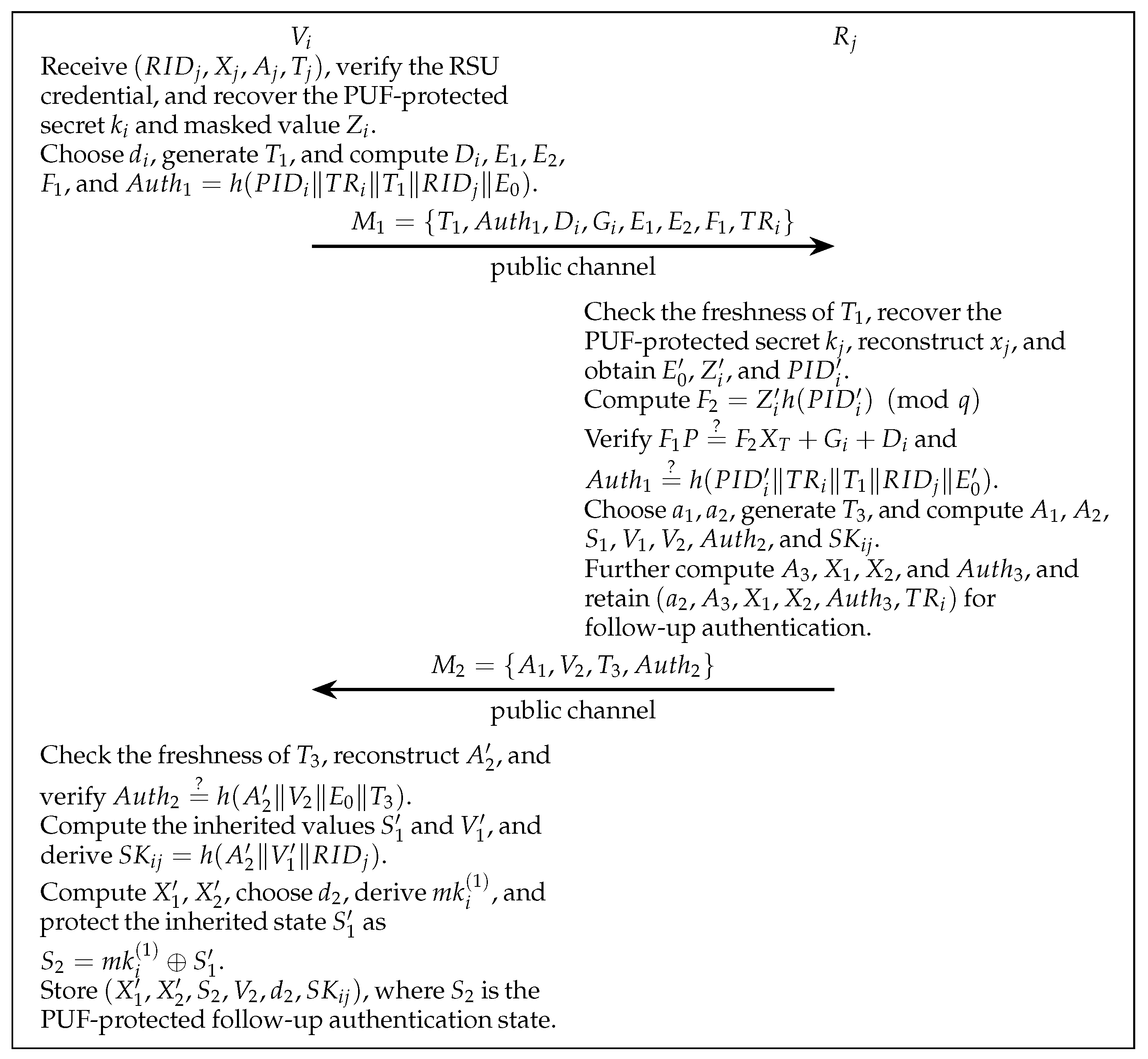
3.2. Initial Authentication and Key Agreement
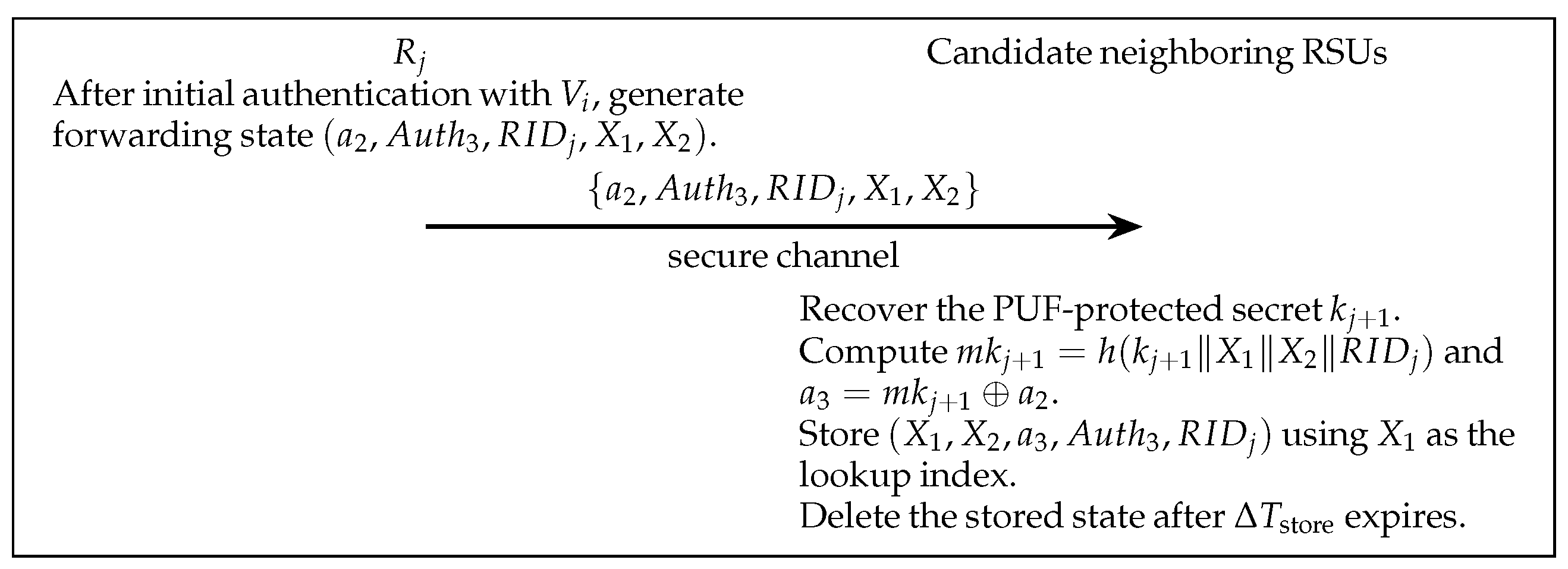
3.3. Subsequent Authentication
3.4. Vehicle Pseudonym Update, Traceability, and Revocation
4. Security Analysis
4.1. Formal Security Proof
4.2. Informal Security Analysis
4.3. Comparative Security Analysis
5. Performance Analysis
5.1. Computation Overhead Analysis
5.2. Communication Overhead Analysis
5.3. RSU-Side Coordination Overhead Analysis
5.4. Storage Overhead Analysis
6. Conclusions
Author Contributions
Funding
Data Availability Statement
Conflicts of Interest
Abbreviations
| VANET | Vehicular Ad Hoc Network |
| RSU | Roadside Unit |
| TA | Trusted Authority |
| OBU | On-Board Unit |
| ITS | Intelligent Transportation System |
| V2I | Vehicle-to-Infrastructure |
| ECC | Elliptic Curve Cryptography |
| PUF | Physically Unclonable Function |
References
- Mazhar, S.; Rakib, A.; Pan, L.; Jiang, F.; Anwar, A.; Doss, R.; Bryans, J. State-of-the-art Authentication and Verification Schemes in VANETs: A Survey. Veh. Commun. 2024, 49, 100804. [Google Scholar] [CrossRef]
- Manasrah, A.; Yaseen, Q.; Al-Aqrabi, H.; Liu, L. Identity-Based Authentication in VANETs: A Review. IEEE Trans. Intell. Transp. Syst. 2025, 26, 4260–4282. [Google Scholar] [CrossRef]
- Soujanya, B.K.; Azam, F. Ensuring Security and Privacy in VANET: A Comprehensive Survey of Authentication Approaches. J. Comput. Netw. Commun. 2024, 2024, 1818079. [Google Scholar] [CrossRef]
- Kumar, P.; Om, H. Multi-TA Model-Based Conditional Privacy-Preserving Authentication Protocol for Fog-Enabled VANET. Veh. Commun. 2024, 47, 100785. [Google Scholar] [CrossRef]
- Shahparian, J.; Shojafar, M.; Frascolla, V.; Conti, M.; Tafazolli, R. A Secure and Efficient Authentication and Key Agreement Protocol in Blockchain-Enabled VANETs. Comput. Electr. Eng. 2025, 122, 109947. [Google Scholar] [CrossRef]
- Chen, H.; Wang, W.; Duan, Y. A Dual Blockchain-Based Privacy-Preserving Authentication Scheme for Vehicular Ad Hoc Networks. Comput. Netw. 2025, 271, 111578. [Google Scholar] [CrossRef]
- Palaniswamy, B.; Camtepe, S.; Foo, E.; Simpson, L.; Baee, M.A.R.; Pieprzyk, J. Continuous Authentication for VANET. Veh. Commun. 2020, 25, 100255. [Google Scholar] [CrossRef]
- Gan, Y.; Xie, X.; Liu, Y. A Privacy-Preserving V2I Fast Authentication Scheme in VANETs. Electronics 2024, 13, 2369. [Google Scholar] [CrossRef]
- Liu, G.; Lu, H.; Wang, W.; Huang, H. An Efficient Authentication Scheme for Vehicular Networks Based on Merkle Tree. Comput. Netw. 2025, 269, 111429. [Google Scholar] [CrossRef]
- Lo, N.W.; Chuang, C.Y.; Huang, J.J.; Luo, Y.X. Authentication Protocol for Vehicular Networks Using Zero-Knowledge Proofs and Elliptic Curve Cryptography. ICT Express 2025, 11, 636–642. [Google Scholar] [CrossRef]
- Li, L.; Deng, H.; Zhai, Z.; Peng, S.L. Privacy-Preserving Authentication Based on PUF for VANETs. Future Internet 2024, 16, 326. [Google Scholar] [CrossRef]
- Feng, X.; Wang, Y.; Cui, K.; Wang, L. A Lightweight Dual Authentication Scheme for V2V Communication in 6G-Based VANETs. Digit. Commun. Netw. 2025, 11, 1225–1236. [Google Scholar] [CrossRef]
- Yuan, M.; Xiao, Y. PMAKA-IoV: A Physical Unclonable Function (PUF)-Based Multi-Factor Authentication and Key Agreement Protocol for Internet of Vehicles. Information 2025, 16, 404. [Google Scholar] [CrossRef]
- Sutradhar, K.; Pillai, B.G.; Amin, R.; Narayan, D.L. A Survey on Privacy-Preserving Authentication Protocols for Secure Vehicular Communication. Comput. Commun. 2024, 219, 1–18. [Google Scholar] [CrossRef]
- Lv, S.; Liu, Y. PLVA: Privacy-Preserving and Lightweight V2I Authentication Protocol. IEEE Trans. Intell. Transp. Syst. 2022, 23, 6633–6639. [Google Scholar] [CrossRef]
- Su, H.; Dong, S.; Wang, N.; Zhang, T. An Efficient Privacy-Preserving Authentication Scheme That Mitigates TA Dependency in VANETs. Veh. Commun. 2024, 45, 100727. [Google Scholar] [CrossRef]
- Shi, D.; Nie, X.; Xu, M.; Cheng, H.; Alam, M. A Secure and Efficient Lattice-Based Conditional Privacy-Preserving Authentication Protocol for the VANET. Veh. Commun. 2025, 55, 100958. [Google Scholar] [CrossRef]
- Zhao, J.; Guo, Y.; Liao, L.; Wang, D. A blockchain-based efficient traceability authentication scheme in VANET. Digit. Commun. Netw. 2025, 11, 1410–1420. [Google Scholar] [CrossRef]
- Xiong, L.; Li, Q.; Tang, L.; Li, F.; Yang, X. Blockchain-based conditional privacy-preserving authentication scheme using PUF for vehicular ad hoc networks. Future Gener. Comput. Syst. 2025, 163, 107530. [Google Scholar] [CrossRef]
- Umar, M.; Islam, S.H.; Mahmood, K.; Ahmed, S.; Ghaffar, Z.; Saleem, M.A. Provable Secure Identity-Based Anonymous and Privacy-Preserving Inter-Vehicular Authentication Protocol for VANETS Using PUF. IEEE Trans. Veh. Technol. 2021, 70, 11774–11783. [Google Scholar] [CrossRef]
- Koblitz, N. Elliptic Curve Cryptosystems. Math. Comput. 1987, 48, 203–209. [Google Scholar] [CrossRef]
- Pappu, R.; Recht, B.; Taylor, J.; Gershenfeld, N. Physical One-Way Functions. Science 2002, 297, 2026–2030. [Google Scholar] [CrossRef]
- Tuyls, P.; Batina, L. Strong Authentication with Physical Unclonable Functions. In Security, Privacy, and Trust in Modern Data Management; Springer: Berlin/Heidelberg, Germany, 2007; pp. 133–148. [Google Scholar] [CrossRef]
- Dodis, Y.; Ostrovsky, R.; Reyzin, L.; Smith, A. Fuzzy Extractors: How to Generate Strong Keys from Biometrics and Other Noisy Data. SIAM J. Comput. 2008, 38, 97–139. [Google Scholar] [CrossRef]
- Dolev, D.; Yao, A.C. On the Security of Public Key Protocols. IEEE Trans. Inf. Theory 1983, 29, 198–208. [Google Scholar] [CrossRef]
- Yang, Q.; Zhu, X.; Wang, X.; Fu, J.; Zheng, J.; Liu, Y. A Novel Authentication and Key Agreement Scheme for Internet of Vehicles. Future Gener. Comput. Syst. 2023, 145, 415–428. [Google Scholar] [CrossRef]
- Dwivedi, S.K.; Amin, R.; Vollala, S.; Khan, M.K. B-HAS: Blockchain-Assisted Efficient Handover Authentication and Secure Communication Protocol in VANETs. IEEE Trans. Netw. Sci. Eng. 2023, 10, 3491–3504. [Google Scholar] [CrossRef]
- Xie, Q.; Ding, Z.; Zheng, P. Provably Secure and Anonymous V2I and V2V Authentication Protocol for VANETs. IEEE Trans. Intell. Transp. Syst. 2023, 24, 7318–7327. [Google Scholar] [CrossRef]
- Kong, Y.; Tian, J. An ECC-Based Anonymous and Fast Handover Authentication Protocol for Internet of Vehicles. Appl. Sci. 2025, 15, 5894. [Google Scholar] [CrossRef]





| Scheme | Identity Privacy | Traceability | Multi-RSU Follow-Up | Session-Key Establishment | Hardware-Assisted Protection |
|---|---|---|---|---|---|
| Lv and Liu [15] | ✓ | ✕ | ✕ | ✓ | ✕ |
| Kumar and Om [4] | ✓ | ✓ | ✕ | ✓ | ✕ |
| Shahparian et al. [5] | ✓ | ✓ | ✕ | ✓ | ✕ |
| Palaniswamy et al. [7] | ✓ | ✓ | ✓ | ✓ | ✕ |
| Umar et al. [20] | ✓ | ✕ | ✕ | ✓ | ✓ |
| Yuan et al. [13] | ✓ | ✕ | ✕ | ✓ | ✓ |
| Our scheme | ✓ | ✓ | ✓ | ✓ | ✓ |
| Notation | Description |
|---|---|
| The i-th vehicle | |
| The current RSU and the subsequent RSU | |
| Identities of and | |
| Real identity of vehicle | |
| Anonymous pseudonym of | |
| P | Generator of the elliptic curve group |
| q | Large prime order of |
| TA private/public key pair | |
| Vehicle private/public key pair | |
| RSU private/public key pair | |
| Credentials issued by the TA to and | |
| PUF challenges for and | |
| Helper data generated by the fuzzy extractor | |
| – | Authentication tokens generated in different phases |
| Session keys established with and | |
| Timestamp threshold and state retention threshold | |
| One-way hash function | |
| ⊕ | Bitwise XOR operation |
| Category | Potential Threat | Mitigation | Residual Risk |
|---|---|---|---|
| Spoofing | Vehicle or RSU impersonation. | Mutual authentication, credential verification, hash-based authenticators, and PUF-protected secrets. | Relies on credential and PUF protection. |
| Tampering | Modification of V2I messages or forwarded states. | Session-dependent authenticators and inherited-state verification reject modified or inconsistent states. | Disruption may trigger fallback. |
| Repudiation | Misbehavior denial under anonymous identities. | TA-side tracing information supports conditional traceability and revocation. | Relies on tracing-anchor protection. |
| Information disclosure | Exposure of identity, session state, or local secrets. | Dynamic pseudonyms, hash-protected values, session keys, and PUF/fuzzy-extractor-based secret recovery. | Conditional on tracing-anchor and local-state protection. |
| Denial of Service | Excessive requests or stale state queries. | Timestamps, lightweight lookup, state expiration, and early rejection of invalid requests. | Requires deployment-level rate limiting. |
| Elevation of privilege | Unauthorized follow-up access or state reuse. | Follow-up authentication requires valid inherited states, protected secrets, and fresh session-dependent values. | Depends on PUF protection and state expiration. |
| Scheme | Conditional Unlinkability | Replay Resistance | Capture Resistance | Traceability/ Revocation | Conditional Forward Secrecy | Subsequent Authentication | PUF-Based Protection | Fault Tolerance |
|---|---|---|---|---|---|---|---|---|
| Yang et al. [26] | ✓ | ✕ | ✕ | ✕ | ✕ | ✓ | ✕ | ✕ |
| Dwivedi et al. [27] | ✓ | ✕ | ✓ | ✕ | ✓ | ✓ | ✕ | ✕ |
| Xie et al. [28] | ✓ | ✓ | ✓ | ✓ | ✓ | ✕ | ✓ | ✕ |
| Kong and Tian [29] | ✓ | ✓ | ✕ | ✓ | ✓ | ✓ | ✕ | ✕ |
| Ours | ✓ | ✓ | ✓ | ✓ | ✓ | ✓ | ✓ | ✓ |
Disclaimer/Publisher’s Note: The statements, opinions and data contained in all publications are solely those of the individual author(s) and contributor(s) and not of MDPI and/or the editor(s). MDPI and/or the editor(s) disclaim responsibility for any injury to people or property resulting from any ideas, methods, instructions or products referred to in the content. |
© 2026 by the authors. Licensee MDPI, Basel, Switzerland. This article is an open access article distributed under the terms and conditions of the Creative Commons Attribution (CC BY) license.
Share and Cite
Liu, Z.; Yao, N.; Bai, S.; Li, Q. A State-Assisted Authentication and Key Agreement Scheme for Lightweight Multi-RSU Access in VANETs. Future Internet 2026, 18, 292. https://doi.org/10.3390/fi18060292
Liu Z, Yao N, Bai S, Li Q. A State-Assisted Authentication and Key Agreement Scheme for Lightweight Multi-RSU Access in VANETs. Future Internet. 2026; 18(6):292. https://doi.org/10.3390/fi18060292
Chicago/Turabian StyleLiu, Zhengze, Nianmin Yao, Shengyuan Bai, and Qibin Li. 2026. "A State-Assisted Authentication and Key Agreement Scheme for Lightweight Multi-RSU Access in VANETs" Future Internet 18, no. 6: 292. https://doi.org/10.3390/fi18060292
APA StyleLiu, Z., Yao, N., Bai, S., & Li, Q. (2026). A State-Assisted Authentication and Key Agreement Scheme for Lightweight Multi-RSU Access in VANETs. Future Internet, 18(6), 292. https://doi.org/10.3390/fi18060292