1. Introduction
The construction industry remains one of the most hazardous occupational sectors worldwide, characterised by persistent exposure to extreme environmental and physiological stressors. Workers frequently operate under high ambient temperatures exceeding 40 °C, elevated noise levels above 85 dB, and sustained physical exertion that imposes significant cardiovascular strain. These combined conditions contribute to a disproportionate safety burden, accounting for nearly 20% of global occupational fatalities despite representing only 6% of the total workforce [
1]. The economic implications are equally severe, with preventable incidents generating approximately USD 11.5 billion annually in medical expenses and productivity losses in the United States alone [
2]. In response, heat-related illness has been formally recognised as a critical public health concern, prompting institutions such as the National Institute for Occupational Safety and Health (NIOSH) to establish exposure guidelines that emphasise early physiological monitoring and timely intervention [
3]. Within this context, AI-enabled wearable health technologies and preventive physiological risk detection at the network edge have emerged as key enablers of proactive occupational safety management [
4,
5].
Despite growing awareness and technological advancements, existing wearable safety solutions remain insufficient for the dynamic nature of construction environments. Current systems are limited by three fundamental challenges. First, a significant proportion of devices—estimated at nearly 80%—monitor only a single physiological parameter, thereby failing to capture multi-factorial risks such as concurrent heat stress and physical [
6,
7,
8,
9]. Second, reliance on cloud-based architectures introduces unavoidable network latency, which can delay critical intervention in time-sensitive scenarios [
10]. Third, adoption of wearable sensing devices in construction remains a practical challenge; survey evidence shows that construction labourers may hesitate to use biometric or location-tracking wearable devices, motivating less intrusive and user-centred designs [
11].
Recent advances suggest that ear-level biosensing, combined with edge computing, provides a compelling alternative. In-ear PPG sensors demonstrate 25–30% greater signal stability compared to wrist-based measurements due to reduced motion artefacts at the auricular site [
12]. The earbud form factor is unobtrusive, compatible with standard hearing protection, and well accepted by workers. Edge computing further enables on-device machine learning inference, reducing dependence on network connectivity and achieving near real-time response [
4]. While prior studies have demonstrated the feasibility of wearable heat-stress monitoring [
13] and multi-modal fatigue detection [
14,
15], an integrated system combining these capabilities into a unified platform remains absent from the literature.
To address this gap, this paper presents a unified ear-level intelligent safety system designed specifically for construction workers. The key contributions of this work are as follows:
A breadboard proof-of-concept prototype integrating PPG sensing (MAX30102), non-contact infrared thermometry (MLX90614), and a nine-axis inertial measurement unit (BNO055), designed for future ear-level miniaturisation;
A multi-output logistic regression model deployed directly on the Raspberry Pi Pico’s 2 MB flash memory, achieving local inference with sub-second latency (<0.5 s) without requiring cloud connectivity;
A controlled evaluation using the WESAD physiological dataset with clustering-derived proxy labels, achieving F1-scores exceeding 95% across all three classification targets and 97.80% average performance on an entirely held-out subject;
A Streamlit-based supervisor dashboard receiving inference outputs via USB serial and presenting worker status through map-based visualisation and time-stamped alert logs.
The remainder of this paper is organised as follows.
Section 2 reviews the technical background and related work.
Section 3 describes the system methodology.
Section 4 presents the experimental results.
Section 5 discusses findings and compares prior work.
Section 6 concludes the paper and outlines future directions.
2. Background and Related Work
2.1. Technical Background
2.1.1. Cardiovascular Signal Processing
Heart rate (HR) is derived by detecting peak-to-peak intervals in the photoplethysmographic pulse waveform. Heart rate variability (HRV), an established marker of autonomic nervous system activity and a sensitive indicator of physiological stress and fatigue, is quantified using standard time-domain metrics:
Frequency-domain analysis extracts power spectral density in the low-frequency (LF) and high-frequency (HF) bands to characterise sympathetic–vagal balance [
16]. Time-domain HRV features reliably discriminate physiological stress from cognitive load in wearable cardiac sensors [
17], and their fusion with accelerometer data substantially improves fatigue classification accuracy in free-living environments [
18].
2.1.2. Blood Oxygen Estimation
Oxygen saturation (SpO
2) is derived from the ratio of optical absorbance at two wavelengths according to the Beer–Lambert law:
where
A and
B are empirically determined calibration constants. The expressions above (Equations (3)–(5)) represent the theoretical basis for dual-wavelength PPG sensing; the current implementation focuses on PPG amplitude and motion features, with SpO
2 estimation reserved as future work.
2.1.3. Thermal Monitoring
Non-contact skin temperature measurement is governed by Stefan–Boltzmann radiation:
where
is skin emissivity and
is the calibrated sensor output [
19].
2.1.4. Activity Analysis
Worker movement intensity is captured from the 9-axis IMU through the scalar acceleration magnitude and quaternion-based orientation tracking:
These metrics support posture classification, fall detection, and exertion quantification [
20,
21,
22].
2.1.5. Composite Risk Indices
A Heat Stress Index (HSI) can be constructed to assess cumulative thermal strain:
where the weights
are tuned from empirical data or via regression [
23,
24]. Similarly, a multivariate Fatigue Index integrates movement history, autonomic imbalance, and ergonomic deviation:
Both composite indices are presented here as contextual references representing directions for future model extension; neither the HSI nor the FI was implemented or evaluated in the current system. The classifier described in
Section 3.5 uses individual sensor features extracted directly from the WESAD dataset [
25]. On-device deployment of such models is feasible through TinyML compression frameworks [
26,
27,
28], and careful feature engineering can maintain high accuracy within the tight memory budgets of embedded hardware [
29,
30].
2.2. Related Work
The feasibility of continuous ear-level biometric monitoring has been well established in the prior literature. Adams et al. [
31] demonstrated that in-ear PPG enables accurate and continuous heart rate measurement under realistic conditions, while Röddiger et al. [
32] provided a comprehensive taxonomy of earable sensing modalities spanning physiological, environmental, and contextual domains.
Building on these foundations, existing wearable safety solutions can be broadly categorised according to their system architecture and deployment strategy [
33].
2.2.1. Cloud-Connected Wearables
Commercial systems such as the viAct Smart Watch [
34] provide real-time monitoring and predictive safety alerts through cloud-based [
35,
36,
37]. However, reliance on remote processing introduces network-dependent latency and limits responsiveness in time-critical scenarios. CENTEGIX CrisisAlert [
38] offers rapid emergency response via a wearable panic-button with precise location tracking, yet it lacks physiological sensing capabilities and operates in a purely reactive manner.
2.2.2. Body-Worn and PPE-Integrated Systems
PyroGuardian [
39] exemplifies multi-sensor wearable systems for extreme environments, combining body temperature, heart rate, and GPS monitoring with long-range LoRa communication. While effective for remote supervision, processing is performed off-device and no predictive fatigue modelling is incorporated. SmartShoulder [
40] focuses on ergonomic design and haptic feedback but does not include cardiovascular or thermal sensing, nor machine learning-based physiological state classification. Personalised sensing frameworks [
41] and mechanical exoskeletons [
42] represent complementary occupational safety approaches that similarly lack integrated physiological classification.
2.2.3. Helmet-Based Systems
Smart helmet platforms [
43] enable detection of impacts, falls, and environmental conditions with real-time dashboard integration. Deep learning approaches have extended helmets to PPE compliance detection [
44] and EEG-based cognitive stress recognition at construction sites [
45]. Despite their utility in hazard detection, these systems do not capture cardiovascular signals or support fatigue modelling, and their dependence on cloud-based processing introduces latency unsuitable for rapid intervention.
2.2.4. Earable Research Platforms
OpenEarable 2.0 [
46] represents a state-of-the-art ear-level sensing platform integrating a rich suite of biosensors with support for edge inference. Earlier work demonstrated that in-ear EEG reliably detects drowsiness onset [
47], and wearable sensor systems have proven effective in rehabilitation monitoring [
48], confirming the cross-domain applicability of ear-level physiological sensing. OpenEarable provides a strong architectural foundation; however, it remains a general-purpose platform and has not been adapted for construction safety applications, occupational fatigue labelling, or integrated supervisory alerting pipelines.
Table 1 presents a systematic comparison of the proposed system against all reviewed platforms across seven key dimensions. Despite significant progress, existing solutions exhibit a clear gap: none simultaneously combine ear-level multi-sensor biosensing, fully on-device edge AI inference, and real-time safety alerting within a unified system. Addressing this gap is critical for enabling proactive, low-latency intervention in high-risk construction environments and motivates the proposed approach in this work.
3. Materials and Methods
3.1. System Overview
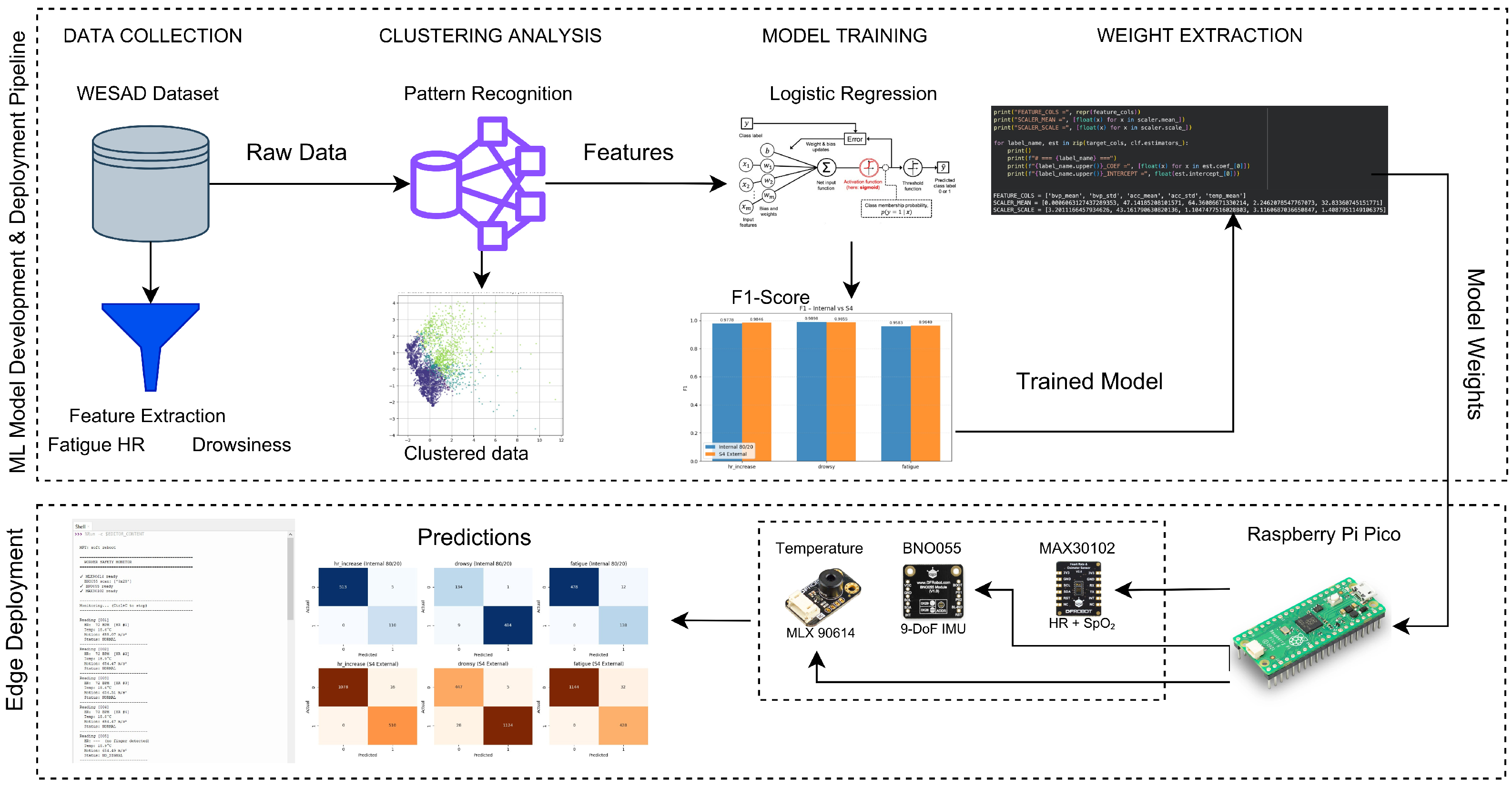
The system operates in two distinct phases. In the offline training phase, raw physiological recordings from the WESAD dataset are segmented into non-overlapping 5 s windows and five scalar features are extracted per window. K-means clustering is applied independently to each target state to generate binary proxy labels, and a multi-output logistic regression model is trained on the resulting labelled feature matrix. The learned weight matrix and bias vector are then exported as a Python literal and compiled into the Raspberry Pi Pico’s 2 MB flash memory alongside the MicroPython 1.23 inference firmware. In the online deployment phase, the Pico reads the MAX30102 (PPG; Analog Devices, Wilmington, MA, USA), MLX90614 (infrared temperature; Melexis Technologies NV, Ieper, Belgium), and BNO055 (9-axis IMU; Bosch Sensortec GmbH, Reutlingen, Germany) sensors via I
2C every 5 s, computes the same five-dimensional feature vector in real time, evaluates the logistic regression model through a fixed-point matrix multiplication, and applies a 0.5 decision threshold to each of the three binary outputs. Classification results are transmitted via USB serial to the Streamlit supervisor dashboard, which displays worker status, sensor trends, and time-stamped alerts.
Figure 1 illustrates both phases of this pipeline.
3.2. Hardware Design
3.2.1. Prototype Configuration
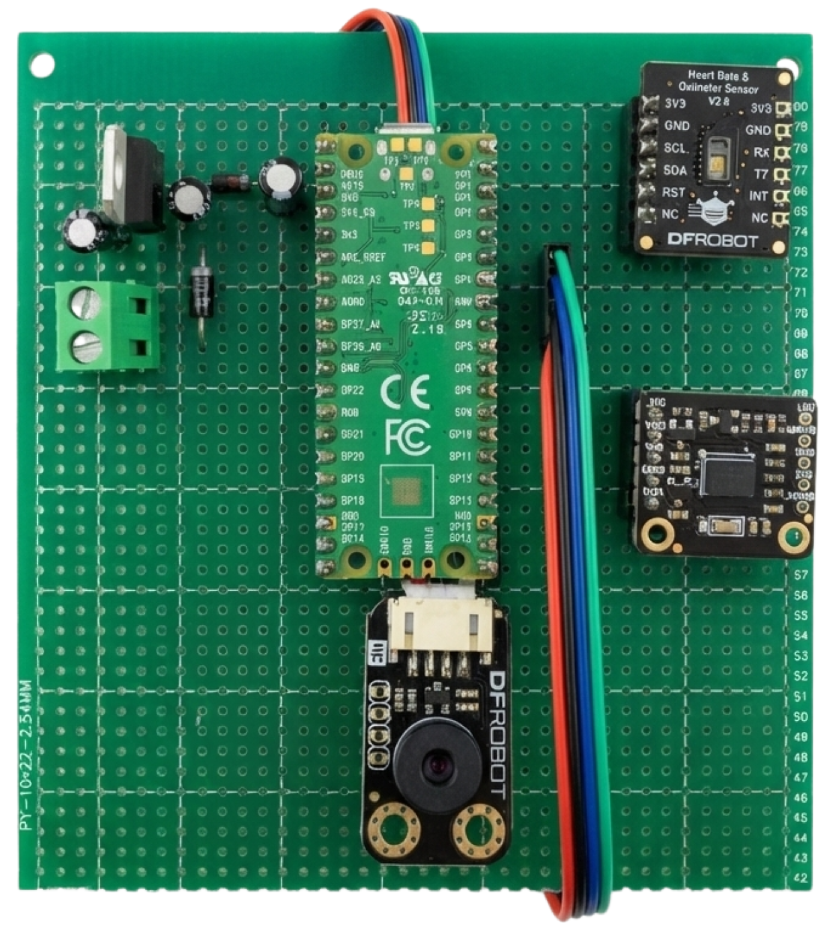
Figure 2 shows the breadboard prototype. The central component is a Raspberry Pi Pico microcontroller [
49] to which three sensors are connected via the I
2C bus: a MAX30102 for PPG-based cardiovascular monitoring, an MLX90614 for non-contact infrared thermometry, and a BNO055 nine-axis IMU for motion analysis. The prototype demonstrates the feasibility of the three-sensor fusion architecture in a breadboard form factor. It is important to emphasise that mechanical enclosure design, ear-fit validation, contact pressure optimisation, battery integration, environmental protection against sweat, dust, and vibration, and compatibility with personal protective equipment such as helmets and hearing protection were not evaluated in this work and remain essential hardware development tasks for future ear-level integration.
3.2.2. Sensor Specifications
Table 2 summarises the three sensing modules. The MAX30102 [
50] uses red and infrared LEDs to measure the photoplethysmographic waveform. The MLX90614 [
51] is a factory-calibrated non-contact infrared thermometer with a measurement accuracy of ±0.5 °C. The BNO055 [
52] integrates a triaxial accelerometer, gyroscope, and magnetometer with an onboard sensor fusion processor, providing orientation-corrected acceleration and angular velocity outputs without host-side computation.
3.2.3. Microcontroller
The Raspberry Pi Pico [
49] is built around the RP2040 dual-core ARM Cortex-M0+ processor running at up to 133 MHz. It provides 264 KB of SRAM for runtime computation and 2 MB of on-chip flash memory, which is sufficient to store the full logistic regression weight matrix alongside the MicroPython firmware. In the current prototype, communication with the supervisor dashboard is achieved over USB serial; wireless BLE/WiFi integration was not implemented and is planned for subsequent hardware revisions.
3.3. Software Environment
Table 3 lists the principal software tools used in this project. The machine learning training pipeline was implemented in Python 3.10 using Scikit-learn 1.3 [
53] for model training and K-means clustering, executed in Google Colab (Python 3.10 runtime) to leverage cloud-based GPU acceleration during development. Sensor firmware for the Pico was written in MicroPython 1.23 and deployed via Thonny IDE 1.4. The real-time supervisor interface was constructed using Streamlit 1.32, with Pandas 2.1, NumPy 1.26, and Matplotlib 3.8 supporting data handling and visualisation.
3.4. Dataset and Feature Engineering
3.4.1. WESAD Dataset
The Wearable Stress and Affect Detection (WESAD) dataset [
54] was selected as the training and evaluation corpus. WESAD is a widely used benchmark for physiological state detection, collected under controlled laboratory conditions from 15 subjects performing baseline, stress-inducing, and amusement tasks. It provides synchronised PPG, skin temperature, and triaxial acceleration recordings that directly correspond to the three sensor modalities of the proposed hardware. Subjects S2 and S3 were used for model training, and Subject S4 was withheld entirely as an external validation set to assess generalisation to unseen individuals.
3.4.2. Feature Extraction
Five scalar features are computed from each non-overlapping 5 s window of raw sensor data: bvp_mean (mean PPG waveform amplitude over the window), bvp_std (standard deviation of the PPG waveform, capturing short-window amplitude variability), acc_mean (mean acceleration magnitude, indicating overall activity level), acc_std (standard deviation of acceleration magnitude, capturing movement irregularity), and temp_mean (mean skin temperature over the window). It is important to note that bvp_mean and bvp_std are raw waveform amplitude descriptors and are not equivalent to clinically derived heart rate or heart rate variability metrics, which require peak detection, inter-beat interval computation, and artefact rejection algorithms that were not implemented in the current pipeline. This minimal five-dimensional feature vector was deliberately chosen to satisfy the 2 MB flash constraint of the deployment hardware while preserving physiological interpretability for safety supervisors.
Although WESAD provides synchronised PPG, skin temperature, and triaxial acceleration recordings that match the sensing modalities of the proposed hardware, it was collected under controlled laboratory conditions and does not reproduce the environmental stressors characteristic of construction sites, including sustained heat exposure exceeding 40 °C, heavy personal protective equipment, airborne dust and vibration, manual material handling, and construction-specific fatigue patterns. The proxy labels derived from K-means clustering capture statistical structure in the physiological feature space but have not been validated against expert-annotated occupational ground truth. Consequently, all performance results reported in this study should be interpreted as a controlled proof-of-concept evaluation, and field validation with domain-specific labelled data is an essential prerequisite for operational deployment.
3.5. Machine Learning Approach
3.5.1. Proxy Label Generation via Clustering
Because WESAD does not include annotations for the specific occupational states targeted in this work, K-means clustering was used as a physiologically motivated proxy labelling strategy. The rationale is that the three target conditions—elevated PPG variability, drowsiness, and fatigue—produce distinguishable signatures in the five-dimensional feature space. Elevated PPG variability is identified from windows with high bvp_std; drowsiness from windows combining low acc_std with suppressed bvp_std; and fatigue from windows that show elevated temp_mean accompanied by high acc_std. Three independent binary K-means assignments (one per state) are thus used as surrogate ground-truth labels for classifier training.
It is important to acknowledge that all performance metrics reported in
Section 4 reflect classifier agreement with these proxy labels, not clinically validated annotations. The results therefore demonstrate technical feasibility under controlled conditions and should not be interpreted as a guarantee of operational accuracy on real construction sites. Field validation with expert-annotated ground truth data is identified as an essential priority for future work.
3.5.2. Classifier Training
A multi-output logistic regression model was trained on subjects S2 and S3 with an 80/20 train–test split, using Scikit-learn’s built-in class-weight balancing to address label imbalance. The model produces three simultaneous binary outputs corresponding to the three physiological states. Logistic regression was selected over more expressive alternatives (e.g., gradient-boosted trees, neural networks) because its linear weight structure can be represented as a compact matrix multiplication executable within the memory and processing constraints of the RP2040. This choice also ensures that alert triggers are fully interpretable: a supervisor can understand, for example, that a fatigue alert was raised because body temperature and movement variability both crossed their learned thresholds.
3.5.3. On-Device Deployment
After training, the weight matrix and bias vector are serialised to a Python literal and written directly to the Pico’s flash memory alongside the inference firmware. At runtime, the device: (i) reads all three sensors over I2C; (ii) computes the five features from a 5 s buffer; (iii) evaluates the logistic regression via a fixed-point matrix multiplication; and (iv) applies a 0.5 decision threshold to each output. Classification results are transmitted to the dashboard over USB serial at each inference cycle.
3.6. Supervisor Dashboard
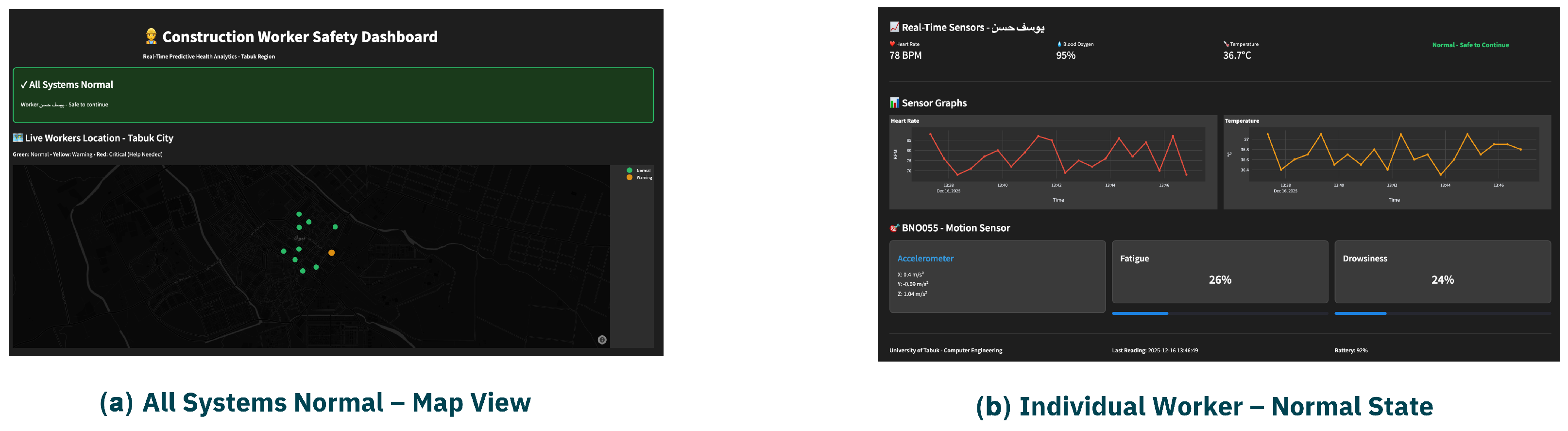
A real-time Streamlit dashboard was developed to present inference outputs to safety supervisors. In the current prototype, classification results are received via USB serial from the Raspberry Pi Pico; wireless communication via BLE or WiFi was not implemented and is identified as future work. The interface displays the current physiological status of each monitored worker (Normal or Critical), live sensor readings for PPG amplitude, temperature, and motion intensity, and time-stamped alert logs for triggered classifications. Worker positions are shown as manually assigned markers on a map of the Tabuk City construction area for visualisation purposes; no GPS, BLE-based, WiFi-based, or indoor localisation system was implemented or evaluated in this work, and formal localisation integration is planned as a future development priority.
Figure 3 and
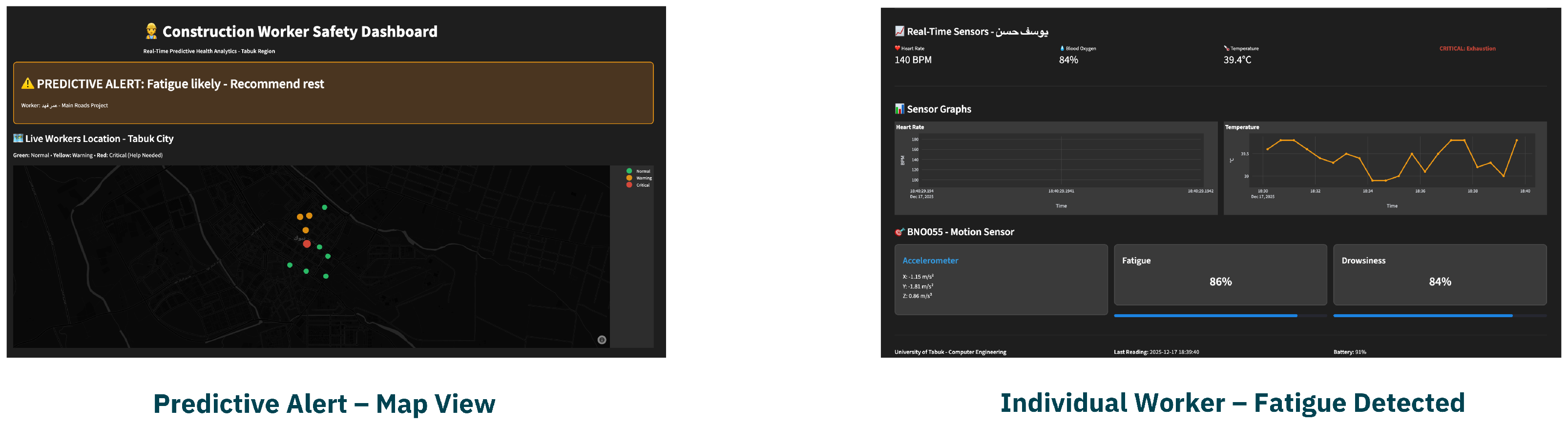
Figure 4 illustrate the normal and alert display states, respectively.
3.7. Evaluation Protocol
Model performance is evaluated using four standard metrics: accuracy (proportion of correct binary classifications), precision (positive predictive value), recall (sensitivity), and F1-score (harmonic mean of precision and recall), which is used as the primary comparative metric throughout. Confusion matrices are analysed for each physiological state separately to identify systematic misclassification patterns. Inference latency is measured at batch size 1—the operationally relevant setting for single-worker real-time monitoring—and compared with an XGBoost baseline to contextualise the deployment trade-off.
4. Results
4.1. Dataset Characteristics
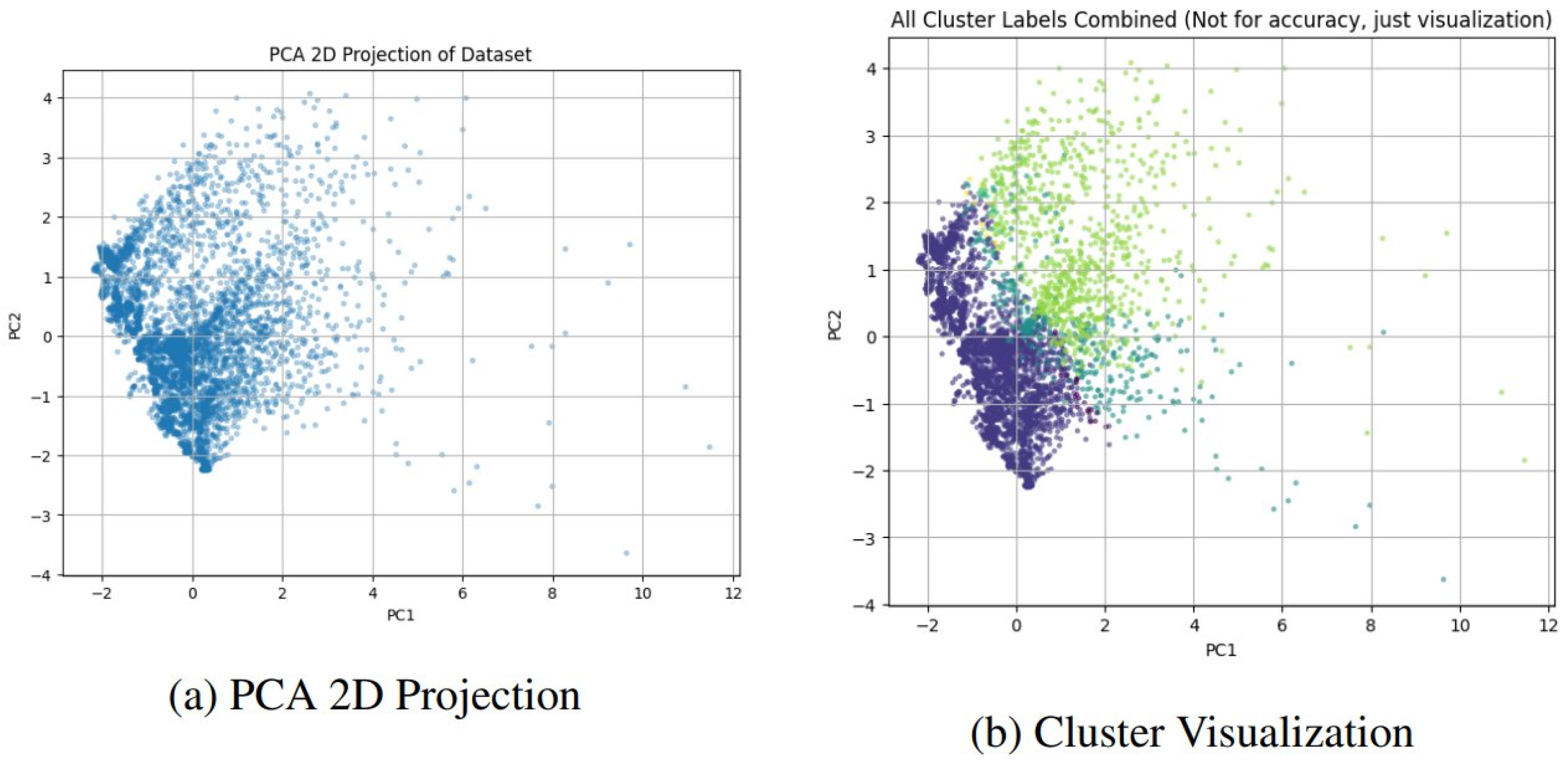
The combined feature dataset extracted from subjects S2, S3, and S4 comprises 4217 windows, each representing 5 s of synchronised physiological recordings. Principal Component Analysis (PCA) was used to project the five-dimensional feature space into two dimensions for visualisation;
Figure 5 shows the resulting scatter plot alongside the three K-means cluster assignments, confirming that the proxy labels occupy well-separated regions of the feature space and are therefore suitable as surrogate training targets.
4.2. Classification Performance
F1-Score Results
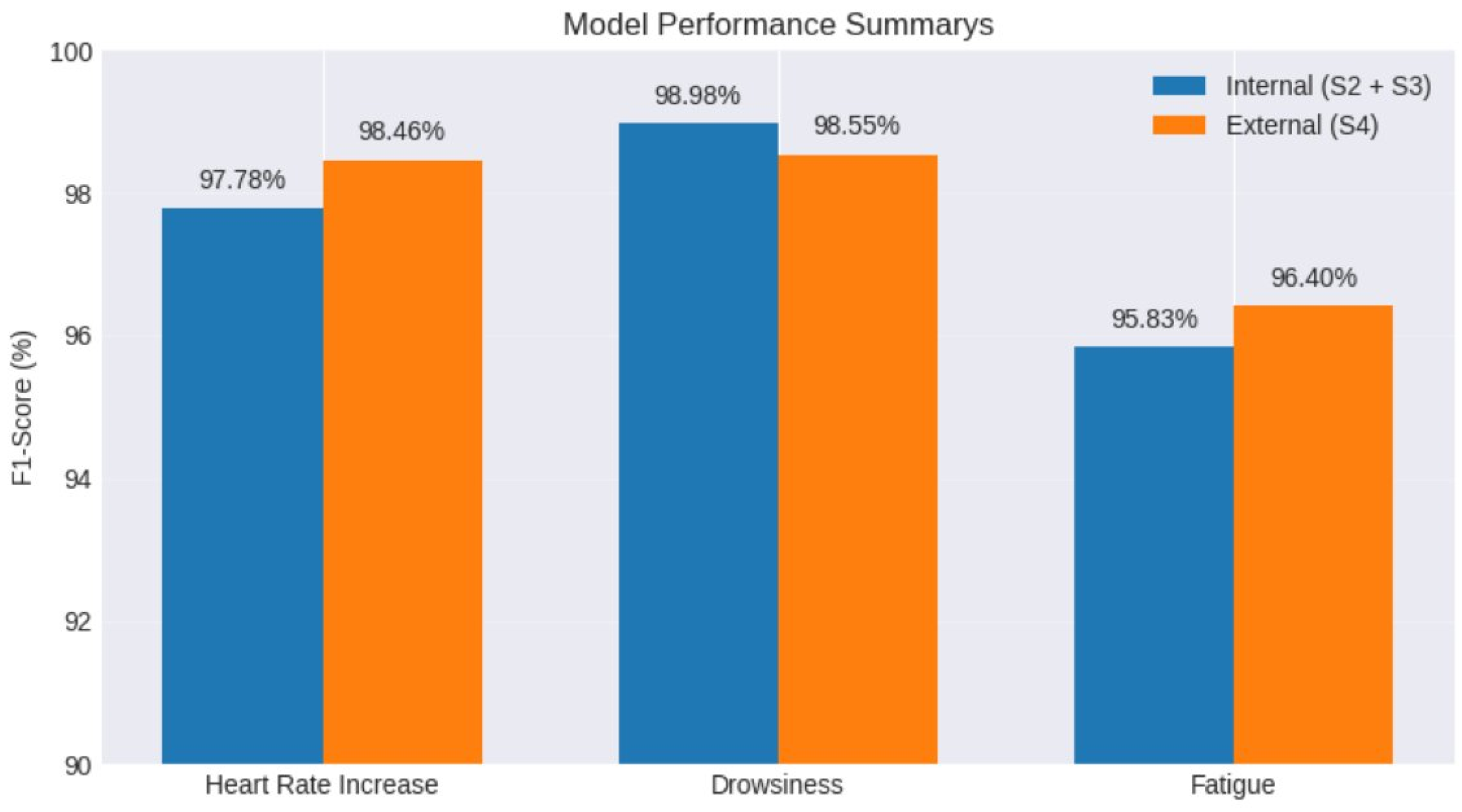
Figure 6 presents F1-scores for both the internal test split (S2 + S3) and the held-out external validation subject (S4). The classifier achieved strong performance across all three physiological states under both evaluation conditions, with every F1-score exceeding 95%—well above the 80% design target. Drowsiness detection yielded the highest scores (internal: 98.98%, external: 98.55%), while the average F1-score across all states reached 97.53% on the internal split and 97.80% on the external test, indicating that classification performance generalises to unseen individuals without degradation.
It bears repeating that these scores reflect agreement with K-means proxy labels generated from the same dataset rather than independently validated clinical annotations. They demonstrate that the classifier has successfully learned the statistical structure of the clustering-derived label space, which serves as a proof of technical feasibility. Achieving comparable performance against expert-annotated field data is a necessary subsequent step before clinical or operational deployment.
4.3. Confusion Matrix Analysis
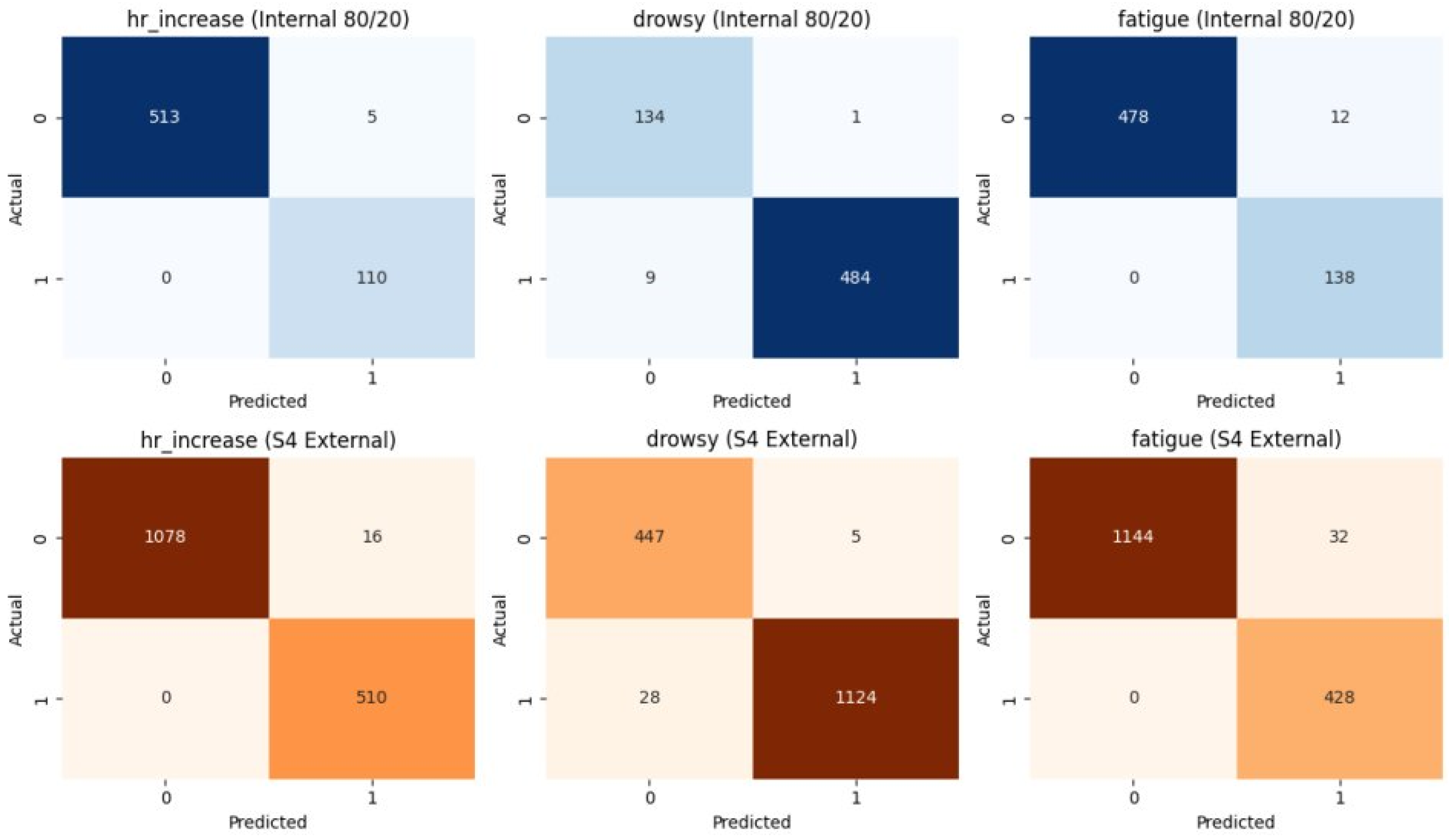
Figure 7 presents confusion matrices for internal and external testing across all three classification targets. In all cases, the dominant mass of predictions falls on the diagonal, confirming correct classification. Off-diagonal misclassification rates are consistently low, ranging from approximately 1% to 3%, and the pattern of errors is largely consistent between the internal and external test sets—indicating that the learned decision boundaries generalise reliably rather than overfitting to the training subjects.
4.4. Inference Latency
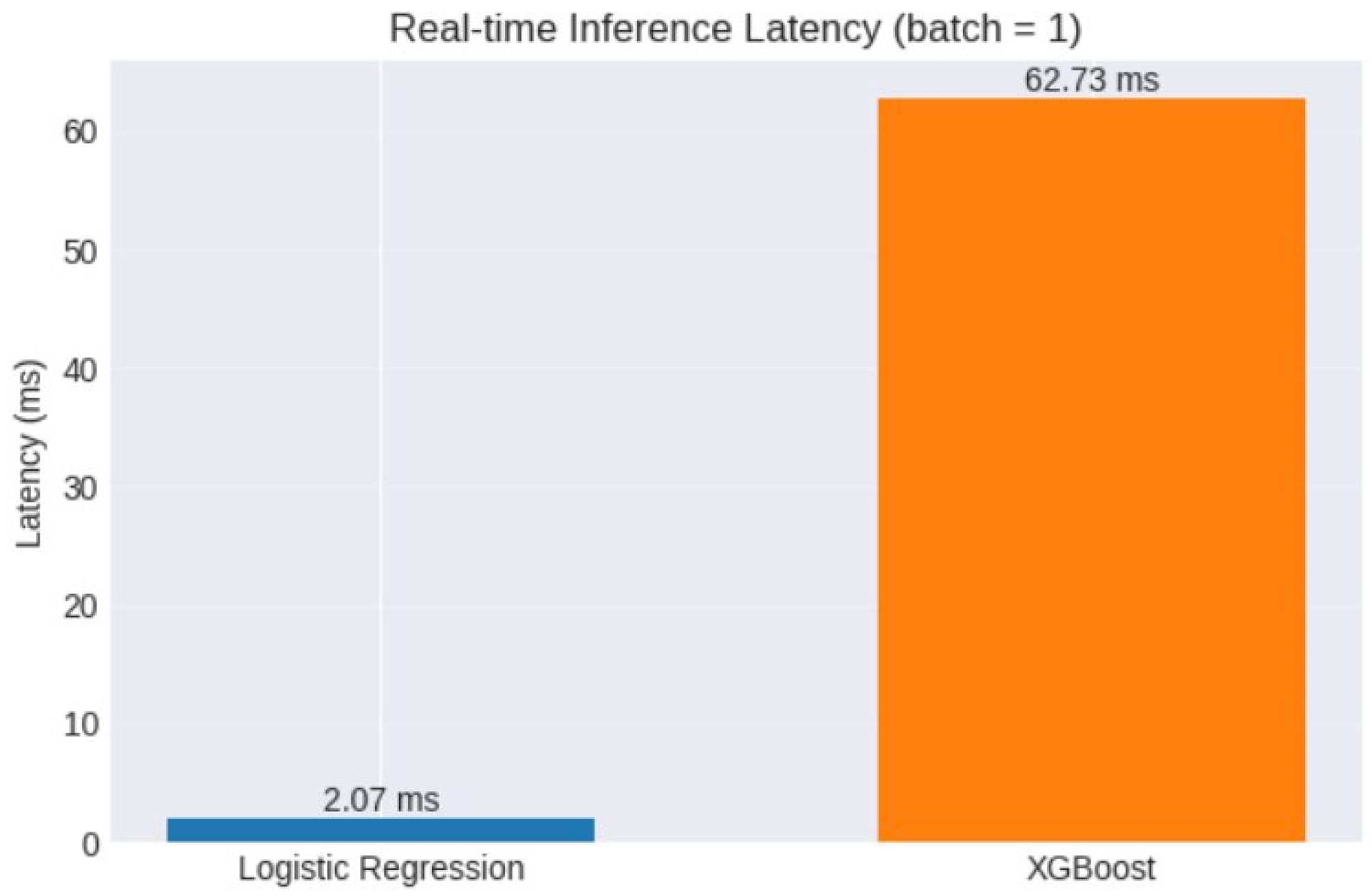
Figure 8 compares per-sample inference latency for logistic regression and XGBoost at batch size 1. Logistic regression completes inference in well under 0.5 s on the Raspberry Pi Pico, consistent with real-time monitoring requirements. XGBoost incurs substantially higher latency at small batch sizes owing to its sequential tree-traversal structure, rendering it impractical for deployment on resource-constrained embedded hardware. This result supports the selection of logistic regression as a well-suited model for this prototype, balancing deployment efficiency, interpretability, and memory constraints. However, this comparison is limited to inference latency at batch size 1; a comprehensive model-selection study comparing accuracy, flash memory footprint, SRAM usage, quantisation error, power consumption, and decision-threshold sensitivity across logistic regression, decision trees, quantised neural networks, and gradient-boosted ensembles remains an important direction for future work.
5. Discussion
5.1. Performance and Generalisation
The empirical results validate the core hypothesis of this work: that a compact, ear-level wearable prototype integrating three complementary sensor modalities and an on-device logistic regression classifier can achieve high-accuracy physiological state detection under controlled conditions. An average F1-score of 97.80% on a completely unseen test subject is particularly encouraging given the small training corpus of only two subjects and suggests that the feature-space structure of the proxy labels is physiologically consistent across individuals. The sub-second inference latency achieved on the Raspberry Pi Pico (<0.5 s) supports real-time alerting and substantially reduces dependence on cloud-based processing, a key limitation of existing alternatives [
10].
The choice of logistic regression merits further discussion. While ensemble methods or shallow neural networks could, in principle, capture non-linear interactions among the five features, they would require substantially more flash storage and multiply-accumulate operations per inference cycle—both severely constrained on the RP2040 (264 KB SRAM, no floating-point unit). Beyond hardware constraints, the linear weight structure provides inherent interpretability: a supervisor receiving an alert can understand, at the feature level, which combination of elevated temperature, PPG amplitude variability, and motion anomaly triggered the notification. In safety-critical operational contexts, this transparency is likely to support trust and adoption more effectively than a black-box classifier with marginally superior accuracy.
5.2. Prototype Validation and Design Rationale
The breadboard prototype successfully demonstrates the technical feasibility of the three-sensor fusion architecture. Ear-level PPG acquisition with the MAX30102 benefits from the substantially lower motion noise present at the auricular site compared with the wrist, a well-documented advantage confirmed by comparative PPG accuracy studies [
12,
55]. Non-contact infrared thermometry with the MLX90614 provides a minimally intrusive proxy for core body temperature, which has been validated as a reliable indicator of occupational thermal strain at peripheral measurement sites [
56]. The BNO055’s onboard sensor-fusion processor offloads quaternion computation from the RP2040, ensuring that the microcontroller’s limited CPU budget remains available for feature extraction and inference.
The ear-level form factor is informed by prior design guidelines for in-ear biosensors [
57] and the architectural choices demonstrated in the OpenEarable platform [
46]. By targeting a standard earbud enclosure in future miniaturisation, the system would be compatible with existing personal protective equipment requirements on construction sites, address the high abandonment rates associated with bulky body-worn devices [
33], and support the fundamental shift from reactive to predictive occupational safety monitoring that the literature identifies as the most urgent unmet need in the field [
5].
6. Conclusions
This paper presented the design, implementation, and controlled evaluation of an ear-level edge-AI wearable proof of concept for real-time physiological monitoring in construction safety. By fusing PPG, non-contact infrared thermometry, and nine-axis inertial sensing on a Raspberry Pi Pico microcontroller, and deploying a lightweight multi-output logistic regression classifier entirely on-device, the system achieves local inference at sub-second latency that substantially reduces dependence on cloud-based processing. Evaluated on the WESAD physiological dataset, the classifier reached an average F1-score of 97.53% on internal validation and 97.80% on a held-out test subject, demonstrating that strong agreement with clustering-derived proxy labels generalises across individuals even with a small training corpus. Confusion matrix analysis confirmed consistently low misclassification rates of 1–3%, and latency benchmarking established that logistic regression is well suited to the resource constraints of the RP2040 compared with alternative models such as XGBoost.
Several limitations are acknowledged. The evaluation involved only three WESAD subjects, which constrains the representativeness of the reported inter-subject generalisation results. All experiments were conducted under controlled laboratory conditions; the motion artefacts, temperature extremes, and environmental variability characteristic of real construction sites were not captured in the training data. Performance metrics reflect agreement with K-means proxy labels rather than independently validated clinical annotations, and field validation against expert-labelled ground truth is essential before any operational deployment. Continuous multi-sensor operation imposes battery constraints that have not yet been characterised over full working shifts, and the current USB-based communication channel limits deployment to tethered monitoring scenarios.
Addressing these limitations defines the roadmap for future development. Priority items include field validation studies with 30 or more subjects drawn from operational construction environments with expert-annotated physiological ground truth; PCB miniaturisation to produce a self-contained production-grade earbud enclosure; integration of BLE or WiFi for wireless dashboard communication and GPS-based geolocation; adaptive personalisation techniques to calibrate physiological thresholds to individual baselines; model compression and quantisation to extend battery life while maintaining classification accuracy; a comprehensive model-comparison study evaluating accuracy, memory footprint, and power consumption across alternative classifiers; and exploration of predictive time-series architectures capable of forecasting physiological deterioration before threshold crossing rather than classifying established states.
This work provides initial evidence that the convergence of ear-level multi-sensor biosensing and locally deployed machine learning represents a technically viable direction for next-generation construction safety monitoring. By substantially reducing dependence on cloud processing, targeting a minimally intrusive form factor, and supporting timely supervisor alerting, the proposed architecture addresses three of the most persistent barriers to wearable adoption in high-risk occupational settings. Realising the full potential of this approach will require field validation with expert-annotated data from operational construction environments, hardware miniaturisation into a self-contained earbud enclosure, and wireless communication integration.
Author Contributions
Conceptualization, N.A., B.A., A.A., T.A., and W.A.; methodology, N.A., B.A., A.A., T.A., and W.A.; software, B.A. and N.A.; validation, N.A., B.A., A.A., T.A., and W.A.; formal analysis, B.A. and N.A.; investigation, N.A., B.A., A.A., T.A., and W.A.; resources, A.J.A.; data curation, B.A. and N.A.; writing—original draft preparation, N.A., B.A., A.A., T.A., and W.A.; writing—review and editing, A.J.A.; visualization, B.A.; supervision, A.J.A.; project administration, A.J.A. All authors have read and agreed to the published version of the manuscript.
Funding
This research received no external funding.
Institutional Review Board Statement
Not applicable. This study used a publicly available dataset (WESAD) and did not involve direct interaction with human participants.
Informed Consent Statement
Not applicable.
Data Availability Statement
Acknowledgments
This paper is an extended and substantially expanded version of a poster presentation accepted at the 3rd GCC International Conference on Industrial Engineering and Operations Management (IEOM), University of Tabuk, Tabuk, Saudi Arabia, 2–4 February 2026 [
58]. The poster introduced the initial prototype concept; the present work provides the full system design, machine learning pipeline, experimental evaluation, and supervisor dashboard implementation.
Conflicts of Interest
The authors declare no conflicts of interest.
References
- International Labour Organization. Safety and Health in Construction; ILO Sectoral Report; International Labour Organization: Geneva, Switzerland, 2023; Available online: https://www.ilo.org/resource/safety-and-health-construction-0 (accessed on 1 January 2025).
- Center for Construction Research and Training (CPWR). The Construction Chart Book: The U.S. Construction Industry and Its Workers, 7th ed.; CPWR: Silver Spring, MD, USA, 2024; Available online: https://www.cpwr.com/research/data-center/the-construction-chart-book/ (accessed on 1 January 2025).
- National Institute for Occupational Safety and Health (NIOSH). Criteria for a Recommended Standard: Occupational Exposure to Heat and Hot Environments; DHHS (NIOSH) Publication No. 2016-106; NIOSH: Cincinnati, OH, USA, 2016. [CrossRef]
- Deng, S.; Zhao, H.; Fang, W.; Yin, J.; Dustdar, S.; Zomaya, A.Y. Edge intelligence: The confluence of edge computing and artificial intelligence. IEEE Internet Things J. 2020, 7, 7457–7469. [Google Scholar] [CrossRef]
- Shah, I.A.; Mishra, S. Artificial intelligence in advancing occupational health and safety: An encapsulation of developments. J. Occup. Health 2024, 66, uiad017. [Google Scholar] [CrossRef]
- Aroganam, G.; Manivannan, N.; Harrison, D. Review on wearable technology sensors used in consumer sport applications. Sensors 2019, 19, 1983. [Google Scholar] [CrossRef] [PubMed]
- Majumder, S.; Mondal, T.; Deen, M.J. Wearable sensors for remote health monitoring. Sensors 2017, 17, 130. [Google Scholar] [CrossRef]
- Orrù, M.; Lontri, A.; Sartori, C.; Mosa, M.; Maccagni, G.; Greco, A. Personalized stress detection using biosignals from wearables: A scoping review. Sensors 2024, 24, 3221. [Google Scholar] [CrossRef] [PubMed]
- Mukherjee, M.D.; Gupta, P.; Kumari, V.; Rana, I.; Jindal, D.; Sagar, N.; Singh, J.; Dhand, C. Wearable biosensors in modern healthcare: Emerging trends and practical applications. Talanta Open 2025, 12, 100486. [Google Scholar] [CrossRef]
- Shi, W.; Cao, J.; Zhang, Q.; Li, Y.; Xu, L. Edge computing: Vision and challenges. IEEE Internet Things J. 2016, 3, 637–646. [Google Scholar] [CrossRef]
- Fugate, H.; Alzraiee, H. Quantitative analysis of construction labor acceptance of wearable sensing devices to enhance workers’ safety. Results Eng. 2023, 17, 100841. [Google Scholar] [CrossRef]
- Ferlini, A.; Montanari, A.; Min, C.; Li, H.; Sassi, U.; Kawsar, F. In-ear PPG for vital signs. IEEE Pervasive Comput. 2022, 21, 65–74. [Google Scholar] [CrossRef]
- Yi, W.; Chan, A.P.C.; Wang, X.; Wang, J. Development of an early-warning system for site work in hot and humid environments: A case study in Hong Kong. Autom. Constr. 2016, 62, 101–113. [Google Scholar] [CrossRef]
- Aryal, A.; Ghahramani, A.; Becerik-Gerber, B. Monitoring fatigue in construction workers using physiological measurements. Autom. Constr. 2017, 82, 154–165. [Google Scholar] [CrossRef]
- Chen, H.; Mao, Y.; Xu, Y.; Wang, R. The impact of wearable devices on the construction safety of building workers: A systematic review. Sustainability 2023, 15, 11165. [Google Scholar] [CrossRef]
- Shaffer, F.; Ginsberg, J.P. An overview of heart rate variability metrics and norms. Front. Public Health 2017, 5, 258. [Google Scholar] [CrossRef] [PubMed]
- Setz, C.; Arnrich, B.; Schumm, J.; Marca, R.L.; Tröster, G.; Ehlert, U. Discriminating stress from cognitive load using a wearable EDA device. IEEE Trans. Inf. Technol. Biomed. 2010, 14, 410–417. [Google Scholar] [CrossRef]
- Gjoreski, M.; Gjoreski, H.; Luštrek, M.; Gams, M. Monitoring stress with a wrist device using context. J. Biomed. Inform. 2017, 73, 159–170. [Google Scholar] [CrossRef]
- Wang, Q.; Zhou, Y.; Ghassemi, P.; McBride, D.; Casamento, J.P.; Pfefer, T.J. Infrared thermography for measuring elevated body temperature: Clinical accuracy, calibration, and evaluation. Sensors 2022, 22, 215. [Google Scholar] [CrossRef]
- Ramanujam, E.; Perumal, T.; Padmavathi, S. Human activity recognition with smartphone and wearable sensors using deep learning techniques: A review. IEEE Sens. J. 2021, 21, 13029–13040. [Google Scholar] [CrossRef]
- Lara, O.D.; Labrador, M.A. A survey on human activity recognition using wearable sensors. IEEE Commun. Surv. Tutor. 2013, 15, 1192–1209. [Google Scholar] [CrossRef]
- Serpush, F.; Menhaj, M.B.; Masoumi, B.; Karasfi, B. Wearable sensor-based human activity recognition in the smart healthcare system. Comput. Intell. Neurosci. 2022, 2022, 1391906. [Google Scholar] [CrossRef]
- Buller, M.J.; Tharion, W.J.; Cheuvront, S.N.; Montain, S.J.; Kenefick, R.W.; Castellani, J.; Latzka, A.W.; Roberts, W.S.; Richter, M.; Jenkins, O.C.; et al. Estimation of human core temperature from sequential heart rate observations. Physiol. Meas. 2013, 34, 781–798. [Google Scholar] [CrossRef] [PubMed]
- Nybo, L.; Rasmussen, P.; Sawka, M.N. Performance in the heat—Physiological factors of importance for hyperthermia-induced fatigue. Compr. Physiol. 2014, 4, 657–689. [Google Scholar] [CrossRef]
- Moshawrab, M.; Adda, M.; Bouzouane, A.; Ibrahim, H.; Raad, A. Smart wearables for the detection of occupational physical fatigue: A literature review. Sensors 2022, 22, 7472. [Google Scholar] [CrossRef]
- Warden, P.; Situnayake, D. TinyML: Machine Learning with TensorFlow Lite on Arduino and Ultra-Low-Power Microcontrollers; O’Reilly Media: Sebastopol, CA, USA, 2020; Available online: https://www.oreilly.com/library/view/tinyml/9781492052036/ (accessed on 1 January 2025).
- Zhou, Z.; Chen, X.; Li, E.; Zeng, L.; Luo, K.; Zhang, J. Edge intelligence: Paving the last mile of artificial intelligence with edge computing. Proc. IEEE 2019, 107, 1738–1762. [Google Scholar] [CrossRef]
- Bourechak, A.; Zedadra, O.; Kouahla, M.N.; Guerrieri, A.; Seridi, H.; Fortino, G. At the confluence of artificial intelligence and edge computing in IoT-based applications: A review and new perspectives. Sensors 2023, 23, 1639. [Google Scholar] [CrossRef]
- Reiss, A.; Indlekofer, I.; Schmidt, P.; Laerhoven, K.V. Deep PPG: Large-scale heart rate estimation with convolutional neural networks. Sensors 2019, 19, 3079. [Google Scholar] [CrossRef] [PubMed]
- Pereira, C.V.F.; de Oliveira, E.M.; de Souza, A.D. Machine learning applied to edge computing and wearable devices for healthcare: Systematic mapping of the literature. Sensors 2024, 24, 6322. [Google Scholar] [CrossRef] [PubMed]
- Adams, T.; Wagner, S.; Baldinger, M.; Zellhuber, I.; Weber, M.; Nass, D.; Surges, R. Accurate detection of heart rate using in-ear photoplethysmography in a clinical setting. Front. Digit. Health 2022, 4, 909519. [Google Scholar] [CrossRef] [PubMed]
- Röddiger, T.; Clarke, C.; Breitling, P.; Schneegans, T.; Zhao, H.; Gellersen, H.; Beigl, M. Sensing with earables: A systematic literature review and taxonomy of phenomena. In Proceedings of the ACM on Interactive, Mobile, Wearable and Ubiquitous Technologies; Association for Computing Machinery: New York, NY, USA, 2022; Volume 6, pp. 1–57. [Google Scholar] [CrossRef]
- Jebelli, H.; Choi, B.; Lee, S. Application of Wearable Biosensors to Construction Sites. II: Assessing Workers’ Physical Demand. J. Constr. Eng. Manag. 2019, 145, 04019080. [Google Scholar] [CrossRef]
- viAct. IoT-Based AI Smart Watch for Workplace Safety; viAct Product Page: Hong Kong, China, 2024; Available online: https://www.viact.ai/iot/smart-watch (accessed on 1 January 2025).
- Elrifaee, M.; Zayed, T. Smart IoT-BIM framework with modified zonal safety analysis (ZSA) for real-time safety monitoring in construction. Autom. Constr. 2025, 178, 106431. [Google Scholar] [CrossRef]
- Cheng, T.; Teizer, J. Real-time resource location data collection and visualization technology for construction safety and activity monitoring applications. Autom. Constr. 2013, 34, 3–15. [Google Scholar] [CrossRef]
- Wang, M.; Chen, J.; Ma, J. Monitoring and evaluating the status and behaviour of construction workers using wearable sensing technologies. Autom. Constr. 2024, 165, 105555. [Google Scholar] [CrossRef]
- CENTEGIX. Public Safety Solutions for Rapid Incident Response; CENTEGIX Product Documentation: Atlanta, GA, USA, 2024; Available online: https://www.centegix.com/public-safety-solutions-for-safety-agencies/ (accessed on 1 January 2025).
- Kaplan, B.; Li, B. PyroGuardian: An IoT-Enabled System for Health and Location Monitoring in High-Risk Firefighting Environments. arXiv 2024, arXiv:2411.03654. Available online: https://arxiv.org/abs/2411.03654 (accessed on 1 January 2025).
- Elitac Wearables. SmartShoulder: A Smart Safety Vest for Service Engineers and Lone Workers; Elitac Wearables Project Portfolio: Utrecht, The Netherlands, 2024; Available online: https://elitacwearables.com/projects/smartshoulder-safety-vest-for-lone-workers/ (accessed on 1 January 2025).
- Nnaji, C.; Awolusi, I.; Park, J.; Albert, A. Wearable sensing devices: Towards the development of a personalized system for construction safety and health risk mitigation. Sensors 2021, 21, 682. [Google Scholar] [CrossRef] [PubMed]
- Toxiri, S.; Näf, M.B.; Lazzaroni, M.; Fernández, J.; Sposito, M.; Poliero, T.; Monica, L.; Anastasi, S.; Caldwell, D.G.; Ortiz, J. Back-support exoskeletons for occupational use: An overview of technological advances and trends. IISE Trans. Occup. Ergon. Hum. Factors 2019, 7, 237–249. [Google Scholar] [CrossRef]
- Knowit Connectivity. Smart Hard Hats for Safer Construction Sites; Knowit Case Study: Stockholm, Sweden, 2024; Available online: https://www.knowit.eu/cases/smart-hard-hats-for-safer-construction-sites/ (accessed on 1 January 2025).
- Nath, N.D.; Behzadan, R.; Paal, S.G. Deep learning for site safety: Real-time detection of personal protective equipment. Autom. Constr. 2020, 112, 103085. [Google Scholar] [CrossRef]
- Jebelli, H.; Hwang, S.; Lee, S. EEG-based workers’ stress recognition at construction sites. Autom. Constr. 2018, 93, 315–324. [Google Scholar] [CrossRef]
- Röddiger, T.; Küttner, M.; Lepold, P.; King, T.; Moschina, D.; Bagge, O.; Paradiso, J.A.; Clarke, C.; Beigl, M. OpenEarable 2.0: Open-Source Earphone Platform for Physiological Ear Sensing. In Proceedings of the ACM on Interactive, Mobile, Wearable and Ubiquitous Technologies; Association for Computing Machinery: New York, NY, USA, 2025; Volume 9, pp. 1–33. [Google Scholar] [CrossRef]
- Nakamura, T.; Alqurashi, Y.D.; Morrell, M.J.; Mandic, D.P. Automatic detection of drowsiness using in-ear EEG. In Proceedings of the IEEE International Joint Conference on Neural Networks (IJCNN), Rio de Janeiro, Brazil, 8–13 July 2018; pp. 1–6. [Google Scholar] [CrossRef]
- Patel, S.; Park, H.; Bonato, P.; Chan, L.; Rodgers, M. A review of wearable sensors and systems with application in rehabilitation. J. Neuroeng. Rehabil. 2012, 9, 21. [Google Scholar] [CrossRef]
- Raspberry Pi Foundation. RP2040 Microcontroller Datasheet; Raspberry Pi Foundation: Cambridge, UK, 2021; Available online: https://datasheets.raspberrypi.com/rp2040/rp2040-datasheet.pdf (accessed on 1 January 2025).
- Analog Devices (Formerly Maxim Integrated). MAX30102 High-Sensitivity Pulse Oximeter and Heart-Rate Sensor Datasheet; Rev. 1; Analog Devices: Wilmington, MA, USA, 2020; Available online: https://www.analog.com/en/products/max30102.html (accessed on 1 January 2025).
- Melexis Technologies NV. MLX90614 Infrared Thermometer Datasheet; Melexis: Ieper, Belgium, 2025; Available online: https://www.melexis.com/en/documents/documentation/datasheets/datasheet-mlx90614 (accessed on 1 January 2025).
- Bosch Sensortec GmbH. BNO055 Intelligent 9-Axis Absolute Orientation Sensor Datasheet; Rev. 1.4; Bosch Sensortec GmbH: Reutlingen, Germany, 2020; Available online: https://www.bosch-sensortec.com/products/smart-sensor-systems/bno055/ (accessed on 1 January 2025).
- Pedregosa, F.; Varoquaux, G.; Gramfort, A.; Michel, V.; Thirion, B.; Grisel, O.; Blondel, M.; Prettenhofer, P.; Weiss, R.; Dubourg, V.; et al. Scikit-learn: Machine learning in Python. J. Mach. Learn. Res. 2011, 12, 2825–2830. [Google Scholar]
- Schmidt, P.; Reiss, A.; Duerichen, R.; Marberger, C.; Laerhoven, K.V. Introducing WESAD, a multimodal dataset for wearable stress and affect detection. In Proceedings of the 20th ACM International Conference on Multimodal Interaction ACM ICMI, Boulder, CO, USA, 16–20 October 2018; pp. 400–408. [Google Scholar] [CrossRef]
- Bent, B.; Goldstein, B.A.; Kibbe, W.A.; Dunn, J.P. Investigating sources of inaccuracy in wearable optical heart rate sensors. npj Digit. Med. 2020, 3, 18. [Google Scholar] [CrossRef]
- Dolson, C.M.; Harlow, E.R.; Phelan, D.M.; Gabbett, T.J.; Gaal, B.; McMellen, C.; Geletka, B.J.; Calcei, J.G.; Voos, J.E.; Seshadri, D.R. Wearable sensor technology to predict core body temperature: A systematic review. Sensors 2022, 22, 7639. [Google Scholar] [CrossRef]
- Charlton, P.H.; Kyriacou, P.A.; Mant, J.; Marozas, V.; Chowienczyk, P.; Alastruey, J. Wearable photoplethysmography for cardiovascular monitoring. Proc. IEEE 2022, 110, 355–381. [Google Scholar] [CrossRef] [PubMed]
- Alshehri, B.; Aljhani, N.; Albalawi, A.; Abdulghani, W.; Alfawzan, T.; Alkhodair, A.J. Federated Edge AI Earables for Real-Time Physiological Monitoring and Predictive Safety Analytics in Construction Workforces. In Proceedings of the 3rd GCC International Conference on Industrial Engineering and Operations Management (IEOM 2026), University of Tabuk, Tabuk, Saudi Arabia, 2–4 February 2026. [Google Scholar]
Figure 1.
End-to-end system pipeline showing the offline training phase and online deployment phase. In the offline phase, WESAD physiological data are processed through feature extraction and K-means clustering to generate proxy labels, and a logistic regression model is trained. In the online phase, the trained model’s weight matrix is loaded into the Raspberry Pi Pico’s flash memory, sensor data are processed in real time, and classification results are transmitted via USB serial to the supervisor dashboard.
Figure 1.
End-to-end system pipeline showing the offline training phase and online deployment phase. In the offline phase, WESAD physiological data are processed through feature extraction and K-means clustering to generate proxy labels, and a logistic regression model is trained. In the online phase, the trained model’s weight matrix is loaded into the Raspberry Pi Pico’s flash memory, sensor data are processed in real time, and classification results are transmitted via USB serial to the supervisor dashboard.
Figure 2.
Breadboard proof of concept: Raspberry Pi Pico (centre) connected to the MAX30102 PPG sensor, MLX90614 infrared thermometer, and BNO055 nine-axis IMU via I2C at 400 kHz. This configuration validates the three-sensor fusion architecture; ear-level miniaturisation is future work.
Figure 2.
Breadboard proof of concept: Raspberry Pi Pico (centre) connected to the MAX30102 PPG sensor, MLX90614 infrared thermometer, and BNO055 nine-axis IMU via I2C at 400 kHz. This configuration validates the three-sensor fusion architecture; ear-level miniaturisation is future work.
Figure 3.
Supervisor dashboard in the normal operating state (green indicator). (a) Map view: orange dots represent manually assigned worker position markers on the Tabuk City construction area; the monitored worker is identified as Youssef Hassan; note that the dashboard interface includes an Arabic-language panel label meaning “Live Worker Locations—Tabuk City”. (b) Sensor data view: real-time readings for PPG amplitude, skin temperature, and motion intensity for worker Youssef Hassan are displayed alongside historical trend logs. Note: negative y-axis values (e.g., ) indicate deviations below the sensor baseline and are displayed using standard minus signs (−).
Figure 3.
Supervisor dashboard in the normal operating state (green indicator). (a) Map view: orange dots represent manually assigned worker position markers on the Tabuk City construction area; the monitored worker is identified as Youssef Hassan; note that the dashboard interface includes an Arabic-language panel label meaning “Live Worker Locations—Tabuk City”. (b) Sensor data view: real-time readings for PPG amplitude, skin temperature, and motion intensity for worker Youssef Hassan are displayed alongside historical trend logs. Note: negative y-axis values (e.g., ) indicate deviations below the sensor baseline and are displayed using standard minus signs (−).
Figure 4.
Supervisor dashboard in the predictive warning state (yellow/orange indicator). Elevated physiological readings have triggered a fatigue alert; the worker’s marker is highlighted on the site map to guide timely supervisory response.
Figure 4.
Supervisor dashboard in the predictive warning state (yellow/orange indicator). Elevated physiological readings have triggered a fatigue alert; the worker’s marker is highlighted on the site map to guide timely supervisory response.
Figure 5.
Dataset characterisation. (a) Two-dimensional PCA projection of all 4217 feature windows from subjects S2–S4, with each point representing one 5 s window. (b) K-means cluster assignments corresponding to elevated PPG variability (blue), drowsiness (green), and fatigue (purple), showing clear separation in the projected feature space.
Figure 5.
Dataset characterisation. (a) Two-dimensional PCA projection of all 4217 feature windows from subjects S2–S4, with each point representing one 5 s window. (b) K-means cluster assignments corresponding to elevated PPG variability (blue), drowsiness (green), and fatigue (purple), showing clear separation in the projected feature space.
Figure 6.
Per-class F1-scores for internal testing (subjects S2 + S3, 20% holdout) and external testing (subject S4, entirely unseen). All scores exceed 95% and external performance matches or surpasses internal performance in every category.
Figure 6.
Per-class F1-scores for internal testing (subjects S2 + S3, 20% holdout) and external testing (subject S4, entirely unseen). All scores exceed 95% and external performance matches or surpasses internal performance in every category.
Figure 7.
Confusion matrices for internal testing (S2 + S3, (top row)) and external testing (S4, (bottom row)) across elevated PPG variability (left), drowsiness (centre), and fatigue (right). Diagonal elements represent correct predictions; off-diagonal elements represent misclassifications.
Figure 7.
Confusion matrices for internal testing (S2 + S3, (top row)) and external testing (S4, (bottom row)) across elevated PPG variability (left), drowsiness (centre), and fatigue (right). Diagonal elements represent correct predictions; off-diagonal elements represent misclassifications.
Figure 8.
Inference latency comparison between logistic regression and XGBoost at batch size 1. Logistic regression sustains sub-0.5 s response suitable for real-time monitoring; XGBoost latency is impractical for on-device deployment on the RP2040.
Figure 8.
Inference latency comparison between logistic regression and XGBoost at batch size 1. Logistic regression sustains sub-0.5 s response suitable for real-time monitoring; XGBoost latency is impractical for on-device deployment on the RP2040.
Table 1.
Systematic comparison of the proposed system against the most relevant prior works.
† F1-scores reflect agreement with K-means proxy labels, not clinically validated ground truth; see
Section 3.5. HR = heart rate; IMU = inertial measurement unit; BLE = Bluetooth Low Energy; GPS = global positioning system.
Table 1.
Systematic comparison of the proposed system against the most relevant prior works.
† F1-scores reflect agreement with K-means proxy labels, not clinically validated ground truth; see
Section 3.5. HR = heart rate; IMU = inertial measurement unit; BLE = Bluetooth Low Energy; GPS = global positioning system.
| System/Study | Application Focus | Sensors | Key Strength | Processing/Latency | Form Factor | Critical Limitation |
|---|
| viAct Smart Watch [34] (2024) | AI-powered industrial IoT smartwatch for worker safety | HR, Motion, GPS | Seamless IoT integration; real-time health alerting via cloud | Cloud/>2 s | Wrist-worn | Server-side only; wrist motion artefacts; no on-device physiological classification |
| PyroGuardian [39] (2024) | IoT wearable for firefighter health and GPS tracking | Body Temp, HR, GPS | Long-range LoRa telemetry; multi-module body-worn design | LoRa/>3 s | Helmet + wrist strap | No on-device inference; no fatigue prediction; firefighting context only |
| Elitac SmartShoulder [40] (2024) | Smart safety vest with haptic alerting for lone workers | IMU, Haptics | High ergonomic quality; haptic-feedback warning | BLE/>2 s | Body-worn vest | No PPG or thermal sensing; no ML physiological classifier |
| CENTEGIX CrisisAlert [38] (2024) | Wearable panic-button for emergency dispatch | Push-button, GPS | Precise room-level location; sub-2 s direct notification | Private net/<2 s | Badge/wristband | Purely reactive; no physiological sensors; no predictive capability |
| Knowit Smart Hat [43] (2024) | Connected helmet for construction accident prevention | IMU, Temperature | Fall and impact detection; live supervisory dashboard | Cloud/>5 s | Helmet-mounted | No cardiovascular sensing; no fatigue model; cloud latency incompatible with emergencies |
| OpenEarable 2.0 [46] (2025) | Open-source earphone platform for physiological research | PPG (3), 9-axis IMU, Temp, Pressure, Mic | Richest sensor suite in an earbud; fully open hardware | BLE/<1 s | Earbud | General-purpose research tool; no occupational fatigue pipeline; no supervisor alerting |
| Proposed system (This work) (2026) | Edge-AI ear-level proof of concept for construction safety | PPG, IR Temp, 9-axis IMU | Multi-sensor fusion; 97.80% F1 †; sub-0.5 s on-device inference | On-device/<0.5 s | Ear-level (breadboard) | Controlled lab validation; 3 subjects; proxy labels require field validation |
Table 2.
Sensor module specifications.
Table 2.
Sensor module specifications.
| Sensor | Model | Manufacturer | Function |
|---|
| PPG/SpO2 | MAX30102 | Analog Devices, Wilmington, MA, USA | Photoplethysmography; heart rate and blood oxygen capability |
| Thermometer | MLX90614 | Melexis Technologies NV, Ieper, Belgium | Non-contact IR temperature (±0.5 °C) |
| 9-Axis IMU | BNO055 | Bosch Sensortec GmbH, Reutlingen, Germany | Fused acceleration, gyroscope, and magnetometer |
Table 3.
Principal software tools and their roles in the development pipeline.
Table 3.
Principal software tools and their roles in the development pipeline.
| Tool/Library | Role |
|---|
| Python 3.10 | Primary development language for training and firmware development |
| Google Colab (Python 3.10 runtime) | Notebook environment for model training and feature analysis |
| Thonny IDE 1.4 | Deployment environment for MicroPython firmware on Raspberry Pi Pico |
| MicroPython 1.23 | Firmware runtime used on the Raspberry Pi Pico |
| Scikit-learn 1.3 [53] | Logistic regression and K-means clustering |
| Pandas 2.1 | Data processing, windowing, and feature handling |
| NumPy 1.26 | Numerical computation and feature extraction |
| Matplotlib 3.8 | Visualisation of features, clusters, and results |
| Streamlit 1.32 | Real-time supervisor monitoring dashboard |
| Disclaimer/Publisher’s Note: The statements, opinions and data contained in all publications are solely those of the individual author(s) and contributor(s) and not of MDPI and/or the editor(s). MDPI and/or the editor(s) disclaim responsibility for any injury to people or property resulting from any ideas, methods, instructions or products referred to in the content. |