
A Hybrid ABAC–RpBAC Framework for Enhancing PoS Consensus Against Sybil Attacks

Abstract
1. Introduction
2. Related Work
2.1. Sybil Attacks and the Limits of Stake-Only Participation
2.2. Trust-Graph and Federated Sybil Defenses
2.3. Behavior Monitoring and Network/Protocol-Level Detection
2.4. Privacy-Preserving Uniqueness and Identity Verification
2.5. Reputation-Based and Hybrid Consensus Hardening
2.6. Access Control for Participation Governance (ABAC/RpBAC) and Remaining Gaps
3. Methodology
3.1. Study Design
3.2. Benchmark Dataset
3.3. The Experimental Design and Implementation Environment
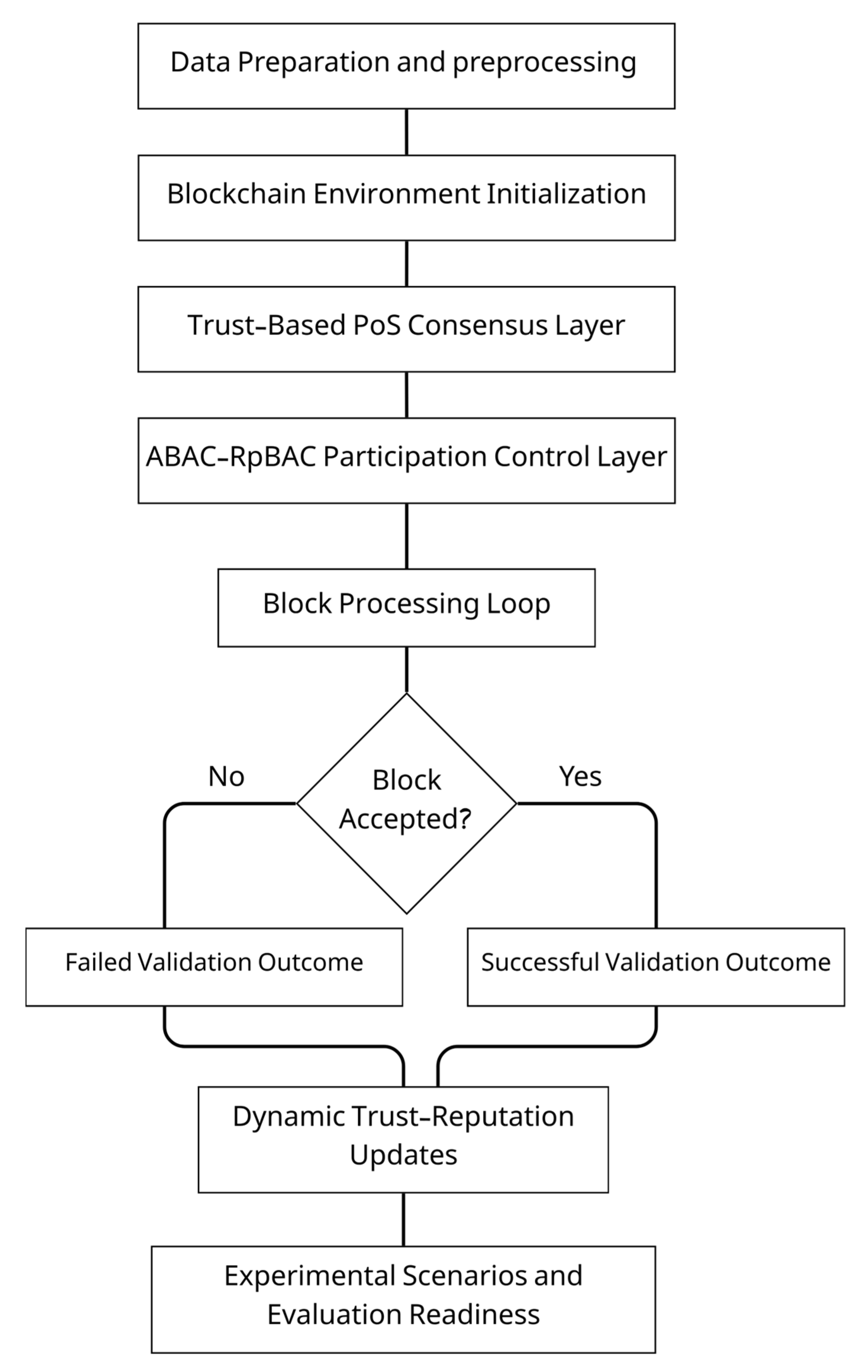
3.4. Framework Implementation Phases
- Phase 1. Data Preparation and Preprocessing:
- Phase 2. Initialization of Blockchain Environment:
- Phase 3. Trust-Based PoS Consensus Layer:
| Algorithm 1. Label-Free Validator Selection and Trust Update in the Proposed PoS-Based Framework |
| Input: Set of nodes N with trust scores T and validation outcomes O O denotes the observable validation outcome derived from protocol-level behavior. Output: Updated trust scores 1. Initialize nodes with operational attributes: trust score, validation history, and behavioral state. 2. For each validation round: Determine eligible nodes E based on: - current trust score - recent validation behavior - consistency of participation 3. Select validator i ∈ E with probability: 4. The selected validator performs block validation. 5. Observe validation outcome O: - successful validation - failed validation - inconsistent behavior - block anomaly (e.g., invalid parent hash, dropped block) 6. Update trust score: (O) 7. Repeat for subsequent rounds. 8. After simulation terminates: Use ground-truth labels only to compute evaluation metrics. Note: Ground-truth labels are not used in steps 2–6 and are excluded from the operational consensus workflow. |
- Phase 4. ABAC, RpBAC Participation Control Layer:
- Phase 5. Experimental Scenario and Evaluation of Readiness:
3.5. Evaluation Metrics
4. Results
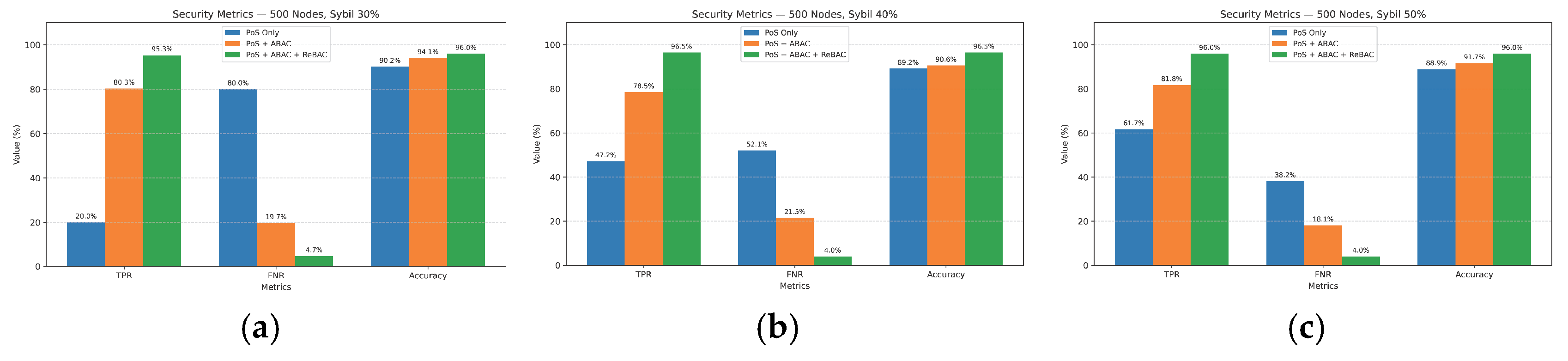
4.1. Comparative Evaluation Across Scenarios
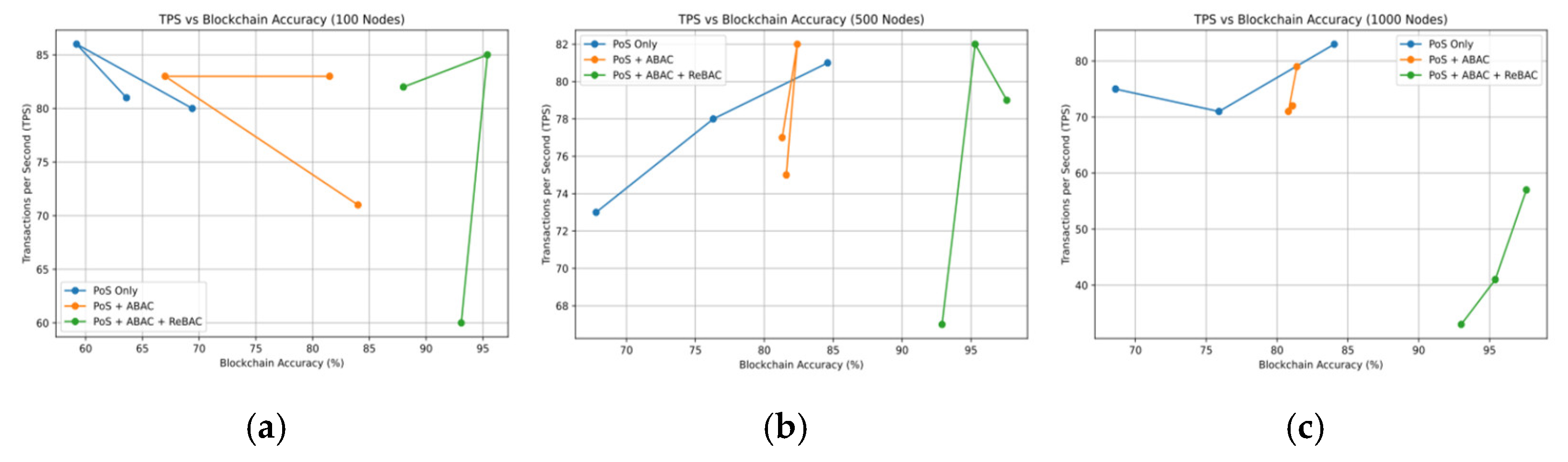
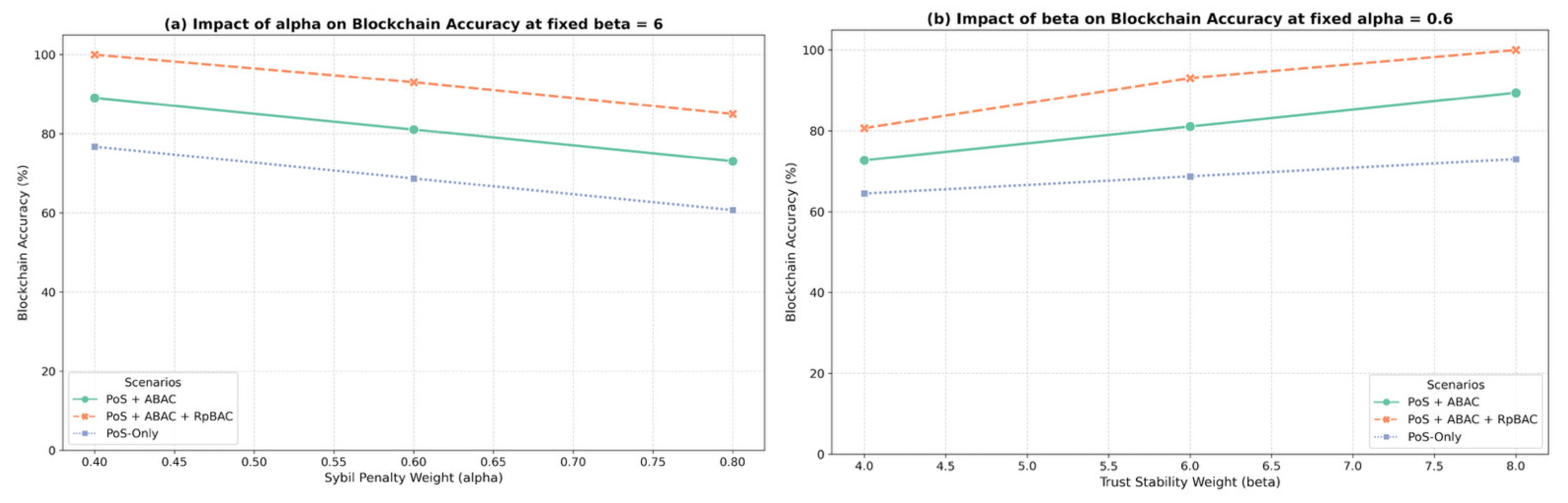
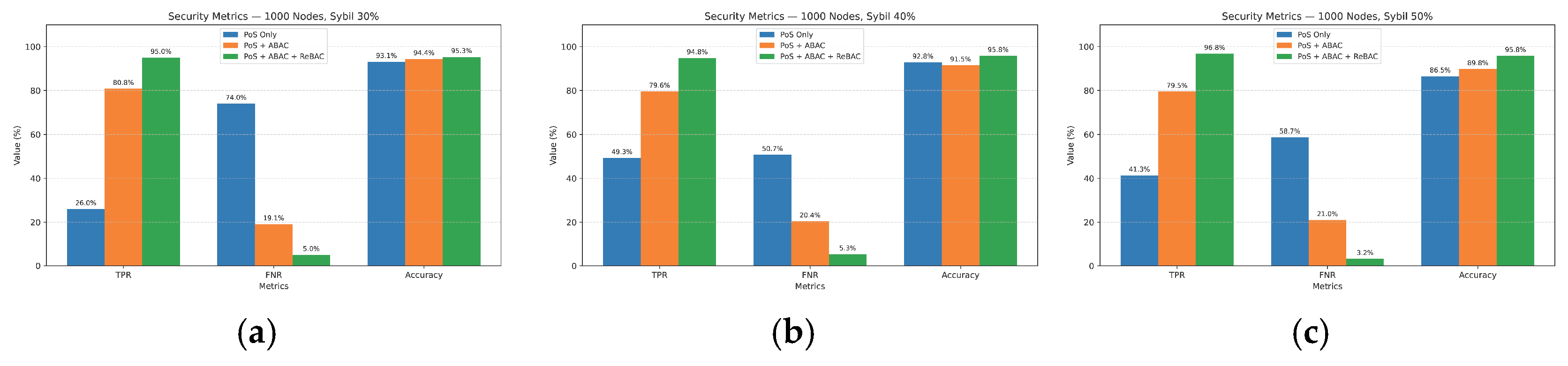
4.2. Visualization of Security–Performance Trends
4.3. Analysis of Security–Performance Trade-off
5. Discussion and Conclusions
Author Contributions
Funding
Data Availability Statement
Conflicts of Interest
Appendix A

| Scenario | Nodes | Blockchain Accuracy 30% | Blockchain Accuracy 40% | Blockchain Accuracy 50% |
|---|---|---|---|---|
| PoS-Only | 100 | 63.63 ± 0.21 | 59.16 ± 0.17 | 69.40 ± 0.10 |
| PoS-Only | 500 | 84.59 ± 0.10 | 76.29 ± 0.17 | 67.75 ± 0.24 |
| PoS-Only | 1000 | 83.97 ± 0.13 | 75.93 ± 0.21 | 68.74 ± 0.11 |
| PoS + ABAC | 100 | 81.52 ± 0.17 | 66.95 ± 0.20 | 83.99 ± 0.10 |
| PoS + ABAC | 500 | 81.36 ± 0.15 | 82.43 ± 0.12 | 81.62 ± 0.15 |
| PoS + ABAC | 1000 | 81.43 ± 0.13 | 80.89 ± 0.17 | 81.09 ± 0.13 |
| PoS + ABAC + RpBAC | 100 | 88.07 ± 0.10 | 95.41 ± 0.18 | 93.06 ± 0.19 |
| PoS + ABAC + RpBAC | 500 | 97.69 ± 0.13 | 95.22 ± 0.15 | 92.86 ± 0.14 |
| PoS + ABAC + RpBAC | 1000 | 97.54 ± 0.15 | 95.36 ± 0.15 | 93.05 ± 0.18 |
| Scenario | Nodes | F1-Score 30% | F1-Score 40% | F1-Score 50% |
|---|---|---|---|---|
| PoS-Only | 100 | 51.79 ± 0.55 | 82.61 ± 0.25 | 86.78 ± 0.19 |
| PoS-Only | 500 | 0.00 ± 0.00 | 77.80 ± 0.41 | 84.92 ± 0.32 |
| PoS-Only | 1000 | 0.00 ± 0.00 | 84.73 ± 0.42 | 75.41 ± 0.47 |
| PoS + ABAC | 100 | 46.78 ± 0.44 | 59.95 ± 0.47 | 77.79 ± 0.39 |
| PoS + ABAC | 500 | 89.00 ± 0.29 | 86.96 ± 0.35 | 90.73 ± 0.18 |
| PoS + ABAC | 1000 | 89.68 ± 0.26 | 88.25 ± 0.26 | 88.55 ± 0.23 |
| PoS + ABAC + RpBAC | 100 | 85.25 ± 0.24 | 92.65 ± 0.32 | 97.02 ± 0.23 |
| PoS + ABAC + RpBAC | 500 | 93.35 ± 0.24 | 95.69 ± 0.27 | 95.98 ± 0.25 |
| PoS + ABAC + RpBAC | 1000 | 92.33 ± 0.41 | 94.76 ± 0.26 | 95.86 ± 0.14 |

References
- Zheng, Z.; Xie, S.; Dai, H.-N.; Chen, X.; Wang, H. Blockchain challenges and opportunities: A survey. Int. J. Web Grid Serv. 2018, 14, 352–375. [Google Scholar] [CrossRef] [Scilit]
- Yli-Huumo, J.; Ko, D.; Choi, S.; Park, S.; Smolander, K. Where is current research on blockchain technology?—A systematic review. PLoS ONE 2016, 11, e0163477. [Google Scholar] [CrossRef] [Scilit] [PubMed]
- Abou Jaoude, J.; Saade, R.B. Blockchain applications—Usage in different domains. IEEE Access 2019, 7, 45360–45381. [Google Scholar] [CrossRef] [Scilit]
- Wang, W.; Hoang, D.; Hu, P.; Xiong, Z.; Niyato, D.; Wang, P.; Wen, Y.; Kim, D. A survey on consensus mechanisms and mining strategy management in blockchain networks. IEEE Access 2019, 7, 22328–22370. [Google Scholar] [CrossRef] [Scilit]
- Lashkari, B.; Musilek, P. A comprehensive review of blockchain consensus mechanisms. IEEE Access 2021, 9, 43620–43652. [Google Scholar] [CrossRef] [Scilit]
- Ethereum.org. Proof-of-Stake(PoS). Available online: https://ethereum.org/developers/docs/consensus-mechanisms/pos/ (accessed on 7 May 2025).
- Swathi, P.; Modi, C.; Patel, D. Preventing Sybil attack in blockchain using distributed behavior monitoring of miners. In Proceedings of the 2019 10th International Conference on Computing, Communication and Networking Technologies (ICCCNT), Kanpur, India, 6–8 July 2019. [Google Scholar]
- Biryukov, A.; Feher, D. ReCon: Sybil-resistant consensus from reputation. Pervasive Mob. Comput. 2020, 61, 101109. [Google Scholar] [CrossRef] [Scilit]
- Platt, M.; Platt, D.; McBurney, P. Sybil attack vulnerability trilemma. Int. J. Parallel Emerg. Distrib. Syst. 2024, 39, 446–460. [Google Scholar] [CrossRef] [Scilit]
- Platt, M.; McBurney, P. Sybil attacks on identity-augmented Proof-of-Stake. Comput. Netw. 2021, 199, 108424. [Google Scholar] [CrossRef]
- Rouhani, S.; Butterworth, R.; Culley, R.; Scrivens, N.; Deters, R. Distributed attribute-based access control system using permissioned blockchain. World Wide Web 2021, 24, 1617–1639. [Google Scholar] [CrossRef] [Scilit]
- Malik, S.; Shah, M.A. Access control using blockchain: A taxonomy and review. In Proceedings of the 2022 6th International Conference on Information System and Data Mining (ICISM 2022), Silicon Valley, CA, USA, 27–29 May 2022; Association for Computing Machinery: New Your, NY, USA, 2022; pp. 46–54. [Google Scholar]
- Sánchez, D.C. Zero-knowledge proof-of-identity: Sybil-resistant, anonymous authentication on permissionless blockchains and incentive compatible, strictly dominant cryptocurrencies. arXiv 2019, arXiv:1902.02224. [Google Scholar] [CrossRef] [Scilit]
- Otte, P.; de Vos, M.; Pouwelse, J. TrustChain: A Sybil-resistant scalable blockchain. Future Gener. Comput. Syst. 2020, 107, 770–780. [Google Scholar] [CrossRef] [Scilit]
- Siddiqui, S.; Srivastava, V.; Maheshwari, R.; Gujar, S. QuickSync: A quickly synchronizing PoS-based blockchain protocol. In Proceedings of the 2023 IEEE International Conference on Blockchain and Cryptocurrency (ICBC), Dubai, United Arab Emirates, 1–5 May 2023; pp. 1–2.
- Wang, Y.; Tan, M. Defense against Sybil attack in blockchain based on improved consensus algorithm. In Proceedings of the 2023 IEEE International Conference on Control, Electronics and Computer Technology (ICCECT), Jilin, China, 28–30 April 2023. [Google Scholar]
- Platt, M.; McBurney, P. Sybil in the haystack: A comprehensive review of blockchain consensus mechanisms in search of strong Sybil attack resistance. Algorithms 2023, 16, 34. [Google Scholar] [CrossRef] [Scilit]
- Douceur, J.R. The Sybil attack. In Peer-to-Peer Systems: First International Workshop, IPTPS 2002, Cambridge, MA, USA, 7–8 March 2002; Revised Papers; Springer: Berlin/Heidelberg, Germany, 2002. [Google Scholar]
- Neudecker, T.; Hartenstein, H. Network layer aspects of permissionless blockchains. IEEE Commun. Surv. Tutor. 2018, 21, 838–857. [Google Scholar] [CrossRef] [Scilit]
- Iqbal, M.; Matulevičius, R. Exploring Sybil and double-spending risks in blockchain systems. IEEE Access 2021, 9, 76153–76177. [Google Scholar] [CrossRef] [Scilit]
- Yu, H.; Kaminsky, M.; Gibbons, P.B.; Flaxman, A. SybilGuard: Defending against Sybil attacks via social networks. In Proceedings of the 2006 Conference on Applications, Technologies, Architectures, and Protocols for Computer Communications (SIGCOMM ’06), Pisa, Italy, 11–15 September 2006; Association for Computing Machinery: New York, NY, USA, 2006; pp. 267–278. [Google Scholar]
- Danezis, G.; Mittal, P. SybilInfer: Detecting Sybil nodes using social networks. In Proceedings of the Network and Distributed System Security Symposium (NDSS 2009), San Diego, CA, USA, 8–11 February 2009; Internet Socity: Reston, VA, USA, 2009. [Google Scholar]
- Sonnino, A.; Danezis, G. SybilQuorum: Open distributed ledgers through trust networks. arXiv 2019, arXiv:1906.12237. [Google Scholar] [CrossRef] [Scilit]
- Al-Qurishi, M.; Al-Rakhami, M.; Alamri, A.; Alrubaian, M.; Rahman, S.M.M.; Hossain, M.S. Sybil defense techniques in online social networks: A survey. IEEE Access 2017, 5, 1200–1219. [Google Scholar] [CrossRef] [Scilit]
- Winter, P.; Ensafi, R.; Loesing, K.; Feamster, N. Identifying and characterizing Sybils in the Tor network. In Proceedings of the 25th USENIX Security Symposium (USENIX Security 16), Austin, TX, USA, 10–12 August 2016; Available online: https://www.usenix.org/system/files/conference/usenixsecurity16/sec16_paper_winter.pdf (accessed on 7 May 2025).
- Bernabe, J.B.; Canovas, J.L.; Hernandez-Ramos, J.L.; Moreno, R.T.; Skarmeta, A. Privacy-preserving solutions for blockchain: Review and challenges. IEEE Access 2019, 7, 164908–164940. [Google Scholar] [CrossRef] [Scilit]
- Hardjono, T.; Pentland, A. Verifiable anonymous identities and access control in permissioned blockchains. arXiv 2019, arXiv:1903.04584. [Google Scholar] [CrossRef] [Scilit]
- Nasrulin, B.; Ishmaev, G.; Pouwelse, J. MeritRank: Sybil tolerant reputation for merit-based tokenomics. In Proceedings of the 2022 4th Conference on Blockchain Research & Applications for Innovative Networks and Services (BRAINS), Paris, France, 27–30 September 2022. [Google Scholar]
- Pass, R.; Shi, E. Hybrid consensus: Efficient consensus in the permissionless model. In Proceedings of the 31st International Symposium on Distributed Computing (DISC 2017), Vienna, Austris, 16–20 October 2017; Richa, A.W., Ed.; Leibniz International Proceedings in Informatics (LIPIcs); Schloss Dagstuhl–Leibniz-Zentrum für Informatik: Wadern, Germany, 2017; Volume 91, pp. 39:1–39:16. [Google Scholar]
- Duong, T.; Fan, L.; Katz, J.; Thai, P.; Zhou, H.-S. 2-hop blockchain: Combining proof-of-work and proof-of-stake securely. In Computer Security—ESORICS 2020; Springer: Cham, Switzerland, 2020. [Google Scholar]
- Umar, A.; Jamwal, P.K.; Kumar, D.; Gupta, N.; Gali, V.; Kumar, A. A sybil-resilient and privacy-aware blockchain architecture for dynamic demand response in decentralized microgrids. Sustain. Energy Technol. Assess. 2025, 82, 104540. [Google Scholar] [CrossRef] [Scilit]
- Friedman, A.; Hu, V.C. Presentation 9. Attribute assurance for attribute based access control. In Proceedings of the 2014 IT Professional Conference, Gaithersburg, MD, USA, 22–22 May 2014. [Google Scholar]
- Shammar, E.A.; Zahary, A.T.; Al-Shargabi, A.A. An attribute-based access control model for Internet of Things using Hyperledger Fabric blockchain. Wirel. Commun. Mob. Comput. 2022, 2022, 6926408. [Google Scholar] [CrossRef] [Scilit]
- Sun, S.; Du, R.; Chen, S.; Li, W. Blockchain-based IoT access control system: Towards security, lightweight, and cross-domain. IEEE Access 2021, 9, 36868–36878. [Google Scholar] [CrossRef] [Scilit]
- Shih, D.-H.; Wu, T.-W.; Shih, M.-H.; Chen, G.-W.; Yen, D.C. Hyperledger Fabric access control for industrial Internet of Things. Appl. Sci. 2022, 12, 3125. [Google Scholar] [CrossRef] [Scilit]
- Ding, Y.; Wu, Z.; Miao, Y.; Ding, M. SharAcc: Enhancing scalability and security in attribute-based access control with sharding-based blockchain and full decentralization. Comput. Netw. 2025, 257, 110992. [Google Scholar] [CrossRef] [Scilit]
- Javanmardi, S.; Scarpa, M.; Shojafar, M.; Distefano, S.; Merlino, G. Mutable blockchains in IoT-driven sustainable urban planning: Challenges, and analytical modeling. In Proceedings of the 2025 IEEE International Conference on Smart Computing (SMARTCOMP), Cork, Ireland, 16–19 June 2025; IEEE: New York, NY, USA, 2025; pp. 408–413. [Google Scholar]
- cryotoEthereum Dataset. cryotoEthereum: Preprocessed Ethereum Block Dataset. Available online: https://drive.google.com/file/d/18UffKfUvskS6d36IpPWRWilTRoBhTDjl/view (accessed on 28 February 2026).
- Google BigQuery. Ethereum Blockchain. Kaggle. Available online: https://www.kaggle.com/datasets/bigquery/ethereum-blockchain (accessed on 28 February 2026).



| Block Number | Hash | Parent Hash | SHA3-Uncles | Timestamp | Transaction-Count | Size |
|---|---|---|---|---|---|---|
| 900,000 | 0x388f34dd… | 0xdbfa2da5… | 0x1dcc4de8… | 12/03/2018|9:59:35 | 95 | 41,360 |
| 900,001 | 0x8992ef39… | 0x388f34dd… | 0x1dcc4de8… | 12/03/2018|11:11:01 | 119 | 34,751 |
| 900,002 | 0xd18199fd… | 0x8992ef39… | 0x1dcc4de8… | 12/03/2018|19:20:22 | 69 | 16,998 |
| 900,003 | 0x1304ee0b… | 0xd18199fd… | 0x1dcc4de8… | 12/03/2018|18:04:51 | 114 | 33,292 |
| 900,004 | 0xaa675351… | 0x1304ee0b… | 0x1dcc4de8… | 01/03/2019|11:04:51 | 142 | 24,413 |
| Parameters | Type | Description |
|---|---|---|
| Block characteristics | Controlled | Dataset-informed block properties were used consistently across experiments. |
| Consensus workflow | Controlled | The PoS-oriented workflow and its update logic were held constant across scenarios. |
| Simulation environment | Controlled | Transaction and block-processing settings were kept comparable across scenarios. |
| Network size | Experimental | Variations were performed using 100, 500, and 1000 nodes to assess scalability. |
| Sybil Node Ratio | Experimental | Variations were performed using 30%, 40%, and 50% to simulate different attack intensities. |
| Access Control configuration | Experimental | PoS-only, PoS + ABAC, and PoS + ABAC + RpBAC scenarios were compared. |
| Tool/Library | Purpose |
|---|---|
| Python 3.10 | Core implementation language for simulation and analysis. |
| Google Colab | Cloud-based development execution environment, accessed during 2025–2026. |
| Pandas 2.2.2 | Data preprocessing and structured dataset handling. |
| NumPy 2.0.2 | Numerical computation and probability-based calculation. |
| Matplotlib 3.10.0 | Visualization of performance and security metrics. |
| NetworkX 3.6.1 | Network modeling and structural analysis. |
| Hashlib | SHA-256-based hashing for transactions and blocks. |
| Random/NumPy.random (included in NumPy 2.0.2) | Controlled probabilistic selection and simulation variability. |
| Attribute | Description |
|---|---|
| Block Number | Unique identifier, indicating the position of the block in the simulation chain. |
| Parent Hash | Hash of the preceding block, used to preserve chain continuity. |
| Hash | SHA-256 cryptographic hash of the current block. |
| Transaction Count | Number of transactions included in the block. |
| Block Size | Size of the block in bytes. |
| Timestamp | Time associated with block creation in the benchmark dataset. |
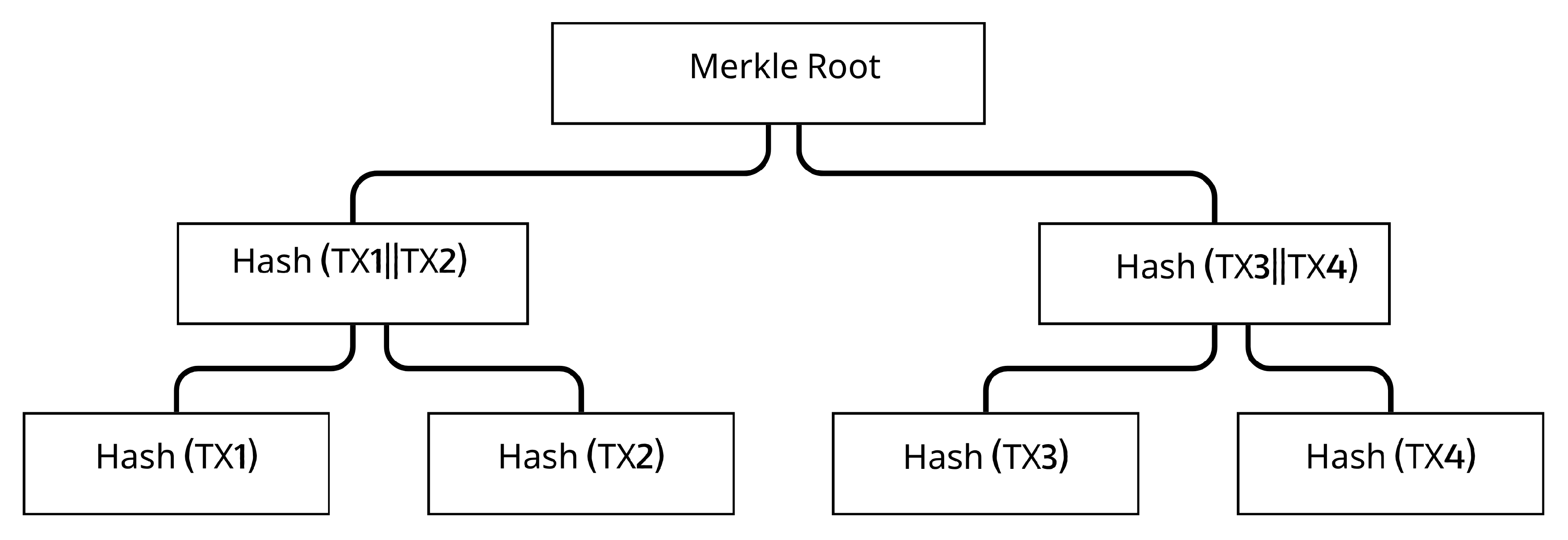
| Merkle Root | Cryptography roots derived from hashed block transaction. |
| Validator/Node ID | Identifier of the simulated node assigned to propose or validate the block. |
| Scenario | Nodes | TPR (%) | FNR (%) | Accuracy (%) | ||||||
|---|---|---|---|---|---|---|---|---|---|---|
| 30% | 40% | 50% | 30% | 40% | 50% | 30% | 40% | 50% | ||
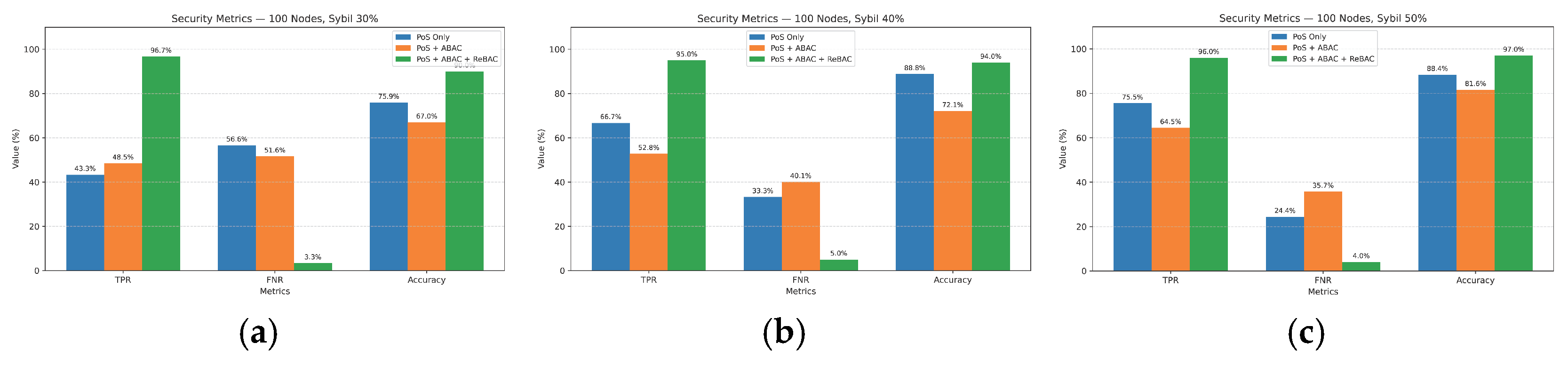
| PoS-Only | 100 | 43.21 ± 0.50 | 66.66 ± 0.29 | 75.66 ± 0.30 | 56.69 ± 0.50 | 33.34 ± 0.29 | 24.24 ± 0.30 | 75.86 ± 0.25 | 88.78 ± 0.14 | 88.48 ± 0.15 |
| 500 | 19.64 ± 0.35 | 47.23 ± 0.35 | 61.91 ± 0.41 | 80.36 ± 0.35 | 52.07 ± 0.35 | 37.99 ± 0.41 | 90.02 ± 0.17 | 89.22 ± 0.17 | 89.01 ± 0.20 | |
| 1000 | 25.81 ± 0.30 | 49.45 ± 0.36 | 41.34 ± 0.42 | 74.19 ± 0.30 | 50.55 ± 0.36 | 58.66 ± 0.42 | 93.01 ± 0.15 | 92.87 ± 0.18 | 86.52 ± 0.21 | |
| PoS + ABAC | 100 | 48.41 ± 0.49 | 52.49 ± 0.54 | 64.47 ± 0.53 | 51.69 ± 0.49 | 40.41 ± 0.54 | 35.73 ± 0.53 | 66.95 ± 0.25 | 71.95 ± 0.27 | 81.59 ± 0.27 |
| 500 | 80.20 ± 0.30 | 78.48 ± 0.47 | 81.70 ± 0.29 | 19.80 ± 0.30 | 21.52 ± 0.47 | 18.20 ± 0.29 | 94.05 ± 0.15 | 90.59 ± 0.23 | 91.65 ± 0.14 | |
| 1000 | 80.83 ± 0.27 | 79.64 ± 0.36 | 79.37 ± 0.37 | 19.07 ± 0.27 | 20.36 ± 0.36 | 21.13 ± 0.37 | 94.42 ± 0.14 | 91.52 ± 0.18 | 89.74 ± 0.19 | |
| PoS + ABAC + RpBAC | 100 | 96.64 ± 0.31 | 94.95 ± 0.50 | 96.10 ± 0.45 | 3.39 ± 0.31 | 5.05 ± 0.50 | 3.90 ± 0.45 | 89.97 ± 0.16 | 93.97 ± 0.25 | 97.05 ± 0.22 |
| 500 | 95.16 ± 0.29 | 96.55 ± 0.42 | 95.97 ± 0.47 | 4.84 ± 0.29 | 3.95 ± 0.42 | 4.03 ± 0.47 | 95.93 ± 0.15 | 96.53 ± 0.21 | 95.99 ± 0.24 | |
| 1000 | 94.94 ± 0.50 | 94.82 ± 0.41 | 96.83 ± 0.27 | 5.06 ± 0.50 | 5.28 ± 0.41 | 3.17 ± 0.27 | 95.27 ± 0.25 | 95.81 ± 0.21 | 95.82 ± 0.13 | |
| Scenario | Nodes | TPS (Tx/s) | Time Latency (ms) | ||||
|---|---|---|---|---|---|---|---|
| 30% | 40% | 50% | 30% | 40% | 50% | ||
| PoS-Only | 100 | 81.11 ± 0.83 | 85.85 ± 0.66 | 80.00 ± 0.42 | 77.89 ± 0.83 | 76.95 ± 0.66 | 82.00 ± 0.42 |
| 500 | 80.95 ± 0.42 | 77.96 ± 0.70 | 72.80 ± 0.94 | 76.05 ± 0.42 | 80.24 ± 0.70 | 78.70 ± 0.94 | |
| 1000 | 82.68 ± 0.53 | 71.10 ± 0.85 | 75.58 ± 0.43 | 79.62 ± 0.53 | 77.90 ± 0.85 | 77.72 ± 0.43 | |
| PoS + ABAC | 100 | 83.10 ± 0.67 | 82.78 ± 0.81 | 70.94 ± 0.40 | 89.40 ± 0.67 | 81.72 ± 0.81 | 78.26 ± 0.40 |
| 500 | 77.22 ± 0.61 | 82.12 ± 0.48 | 75.07 ± 0.59 | 89.78 ± 0.61 | 90.68 ± 0.48 | 89.63 ± 0.59 | |
| 1000 | 79.09 ± 0.53 | 71.35 ± 0.67 | 71.95 ± 0.50 | 90.61 ± 0.53 | 87.55 ± 0.67 | 90.05 ± 0.50 | |
| PoS + ABAC + RpBAC | 100 | 82.26 ± 0.39 | 85.05 ± 0.72 | 59.86 ± 0.75 | 99.04 ± 0.39 | 98.95 ± 0.72 | 89.64 ± 0.75 |
| 500 | 79.37 ± 0.50 | 81.68 ± 0.62 | 66.87 ± 0.55 | 97.03 ± 0.50 | 102.32 ± 0.62 | 103.13 ± 0.55 | |
| 1000 | 56.74 ± 0.58 | 40.85 ± 0.62 | 33.19 ± 0.73 | 101.26 ± 0.58 | 103.25 ± 0.62 | 104.81 ± 0.73 | |
| Study | Year | Strategy | Implementation Environment | Evaluation Scale | Security/Performance Evaluation | Reported Outcomes |
|---|---|---|---|---|---|---|
| Sonnino and Danezis [23] | 2019 | Trust graph hybrid | Open distributed ledger through trust networks/FBAS evaluation on social graphs | Real-world social graphs; exact node count not explicitly reported | Security only | Empirical Sybil-thwarting/trust-network security evaluation |
| Swathi et al. [7] | 2019 | Behavior monitoring | Blockchain test bed/distributed behavior monitoring of miners | 20–40 nodes | Both | 95% TPR; 87.8% Accuracy |
| Sánchez [13] | 2019 | Identity verification (zk-PoI) | Theoretical model using zk-SNARKs and TEEs | No explicit blockchain node-scale evaluation reported | Security/theoretical only | Theoretical Sybil-resistance and anonymous authentication claims |
| Biryukov and Feher [8] | 2020 | Reputation-based strategy | Proof-of-concept simulator/reputation consensus over BFT-style committees | Simulation with variable node count and committee size as inputs; typical committee size discussed as 100 | Security only | Strong Sybil resistance claimed 95% system robustness reported; compares favorably to maliciousness-detection methods |
| Otte et al. [14] | 2020 | Trust/reputation-based hybrid | P2P ledger/live-network experiment with TrustChain + NetFlow; additional throughput experiments | 917-node live-network experiment; plus throughput tests on mobile devices and PCs | Both | Formal Sybil-resistance argument for NetFlow and throughput higher than traditional blockchain architectures reported |
| Siddiqui et al. [15] | 2023 | Hybrid PoS design (BlockPower + PoS) | Mathematical/theoretical protocol analysis with security proofs and performance analysis | No explicit node-count evaluation reported in the uploaded text | Both | Sybil-resistant block-power function claimed; improved TPS and time to finality reported |
| Wang and Tan [16] | 2023 | Reputation + PBFT hybrid | Python-based blockchain simulation of improved PBFT with reputation weighting | 10 nodes | Both | Reduced attack success rate and increased attack cost reported; performance stated as not significantly decreased |
| Umar et al. (2025) [31] | 2025 | Hybrid PoS + dynamic reputation scoring | Decentralized microgrid/energy system (application-oriented study) | Up to 1000 nodes | Both | 99% Sybil-attack mitigation; consensus within 8 s for up to 1000 nodes; 12% peak-demand reduction; 83% load-shifting efficiency; 5.26% cost-savings improvement |
| This study | 2026 | ABAC + RpBAC with trust-based PoS | Python simulation in an Ethereum-like environment | 100, 500, and 1000 nodes | Both | Up to 96% TPR; 97% Accuracy; TPS and latency jointly evaluated, with acceptable performance at 100–500 nodes and more noticeable overhead at 1000 nodes under higher Sybil ratios |
Disclaimer/Publisher’s Note: The statements, opinions and data contained in all publications are solely those of the individual author(s) and contributor(s) and not of MDPI and/or the editor(s). MDPI and/or the editor(s) disclaim responsibility for any injury to people or property resulting from any ideas, methods, instructions or products referred to in the content. |
© 2026 by the authors. Licensee MDPI, Basel, Switzerland. This article is an open access article distributed under the terms and conditions of the Creative Commons Attribution (CC BY) license.
Share and Cite
Al Qurashi, M.; Al Qarni, I. A Hybrid ABAC–RpBAC Framework for Enhancing PoS Consensus Against Sybil Attacks. Future Internet 2026, 18, 276. https://doi.org/10.3390/fi18060276
Al Qurashi M, Al Qarni I. A Hybrid ABAC–RpBAC Framework for Enhancing PoS Consensus Against Sybil Attacks. Future Internet. 2026; 18(6):276. https://doi.org/10.3390/fi18060276
Chicago/Turabian StyleAl Qurashi, Mohammed, and Ibtihaj Al Qarni. 2026. "A Hybrid ABAC–RpBAC Framework for Enhancing PoS Consensus Against Sybil Attacks" Future Internet 18, no. 6: 276. https://doi.org/10.3390/fi18060276
APA StyleAl Qurashi, M., & Al Qarni, I. (2026). A Hybrid ABAC–RpBAC Framework for Enhancing PoS Consensus Against Sybil Attacks. Future Internet, 18(6), 276. https://doi.org/10.3390/fi18060276