1. Introduction
The automotive domain is being reshaped by the convergence of digitalization, connectivity, and artificial intelligence. In this context, Digital Twin (DT) technologies are increasingly used to support real-time monitoring, simulation, and optimization across vehicles, drivers, and road infrastructure [
1,
2,
3,
4]. A DT can be understood as a dynamic virtual representation of a physical entity, continuously updated through data collected from the physical world and used to support analysis, prediction, and decision-making [
5,
6,
7]. In the automotive field, this paradigm is gaining relevance not only for lifecycle management and predictive maintenance but also for connected and adaptive mobility services.
Within this context, Vehicle Digital Twins (VDTs) have been widely explored for monitoring vehicle health, optimizing performance, and supporting validation and maintenance processes [
5,
6]. As vehicles become increasingly connected, however, VDTs should not be viewed solely as isolated replicas of onboard systems. Rather, they are increasingly part of distributed mobility environments in which data exchange, communication latency, and coordination with external services influence the quality and timeliness of digital-twin-enabled decisions [
7,
8,
9,
10]. This makes communication and computing choices—including edge–cloud orchestration and vehicular connectivity—central to the design of effective automotive DT solutions.
The human dimension introduces an additional layer of complexity. The Driver Digital Twin (DrDT), as a domain-specific instance of the Human Digital Twin (HDT), aims to represent relevant cognitive, behavioral, and physiological aspects of the driver [
11]. By combining human-state estimation with vehicle context, DrDTs can support more adaptive driver assistance, personalized intervention strategies, and more informed control transitions in advanced driving scenarios. At the same time, the literature still shows heterogeneous definitions, modeling assumptions, and implementation strategies for DrDTs, which makes cross-study comparison difficult and limits methodological convergence [
12,
13].
A complementary perspective is provided by the Road Digital Twin (RDT), which extends the DT paradigm to road infrastructure and its operational context. Beyond physical road conditions, RDTs may include traffic flow, roadside units, traffic regulation and control elements, and broader environmental information relevant to connected mobility [
14]. In urban and mixed traffic scenarios, this context may also include interactions with pedestrians and other vulnerable road users [
15]. When considered together, VDTs, DrDTs, and RDTs point toward a connected automotive ecosystem in which vehicle state, driver state, and infrastructure context are jointly modeled and exchanged to support coordinated decision-making [
16,
17]. Achieving this integration, however, requires interoperable and distributed architectures that can cope with heterogeneous data sources, real-time constraints, and cross-domain semantic alignment [
18].
Against this background, this paper presents a critical review of Automotive Digital Twins (ADTs), focusing on Vehicle, Driver, and Road Digital Twins and on their role within connected mobility scenarios. By examining seventy-six studies published between 2008 and 2025, the paper analyzes how these DT domains are defined, modeled, evaluated, and connected in the literature. The review identifies recurring architectural patterns, communication and computing choices, and open issues related to interoperability, standardization, real-time coordination, and driver-aware adaptation. Building on this analysis, the paper outlines a unified conceptual framework for connected automotive DTs and discusses key directions for building scalable and safety-aware mobility services.
While recent broad surveys have examined DT technologies across the wider intelligent vehicle and transportation domain [
19], this paper focuses specifically on the VDT–DrDT–RDT triad and on their coordinated integration within connected mobility architectures, a perspective that remains underrepresented in the existing review literature. The main contributions of this paper are as follows:
A structured review of 76 studies on Vehicle, Driver, and Road Digital Twins;
A comparative synthesis of their architectural, communication, computing, interoperability, and safety-related dimensions;
The identification of three recurrent integration patterns among automotive DTs;
A unified conceptual framework translating the review gaps into design principles for connected and safety-aware ADT ecosystems.
The remainder is organized as follows. In
Section 2, we introduce the foundational concepts of VDTs, DrDTs, and RDTs, together with the enabling technologies that support them. In
Section 3, we describe the review methodology and the research questions guiding the analysis. In
Section 4, we discuss the main findings of the review. In
Section 5, we present the proposed unified conceptual framework for connected automotive digital twins. In
Section 6, we discuss the main threats to validity and limitations of the review. In
Section 7, we conclude the paper.
2. Background
The automotive domain involves multiple DTs, each capturing a different facet of the mobility ecosystem, namely the vehicle, the driver, and the road infrastructure. Understanding their respective roles, architectural foundations, and interaction requirements is essential for framing ADTs as interconnected rather than isolated systems. This section introduces the main characteristics of Vehicle, Driver, and Road Digital Twins, and then discusses the enabling technologies that support their real-time, distributed, and adaptive operation.
2.1. Vehicle Digital Twin
A VDT is a dynamic virtual representation of a physical vehicle, or of some of its components, continuously updated through data collected from onboard sensors, telematics, and connected services [
5,
20]. As emphasized in [
12], a VDT is not a static model, but an evolving digital counterpart that remains aligned with the physical vehicle through continuous data exchange. This property enables simulation, condition monitoring, predictive maintenance, and performance optimization across different operating conditions [
8].
From an architectural perspective, a VDT typically combines sensing, communication, data management, modeling, and application layers. The physical layer includes the vehicle sensing and control stack, such as Electronic Control Units (ECUs), onboard diagnostics, inertial sensors, cameras, radar, LiDAR, and component-specific monitoring sensors [
21]. These data are processed through a data management layer that may involve in-vehicle edge nodes for low-latency filtering and aggregation, as well as cloud resources for storage, historical analysis, and large-scale model execution [
8]. The modeling layer hosts the virtual representation itself, which may rely on simulation models, data-driven estimators, or hybrid approaches to estimate component degradation, predict failures, or evaluate system behavior under alternative conditions [
22].
In connected mobility scenarios, however, a VDT should not be interpreted solely as a replica of isolated onboard assets. As vehicles increasingly operate within communication-rich environments, VDTs also depend on interaction with external services and infrastructure, including roadside units, remote platforms, and vehicle-to-everything (V2X) communication substrates. Under these conditions, communication latency, synchronization quality, and distributed orchestration directly affect how useful the twin is for timely decision-making and coordinated adaptation. Therefore, VDTs are not only modeling artifacts but also distributed digital entities whose effectiveness depends on the quality and timeliness of communication with the surrounding ecosystem including, e.g., V2X connectivity, remote service platforms, and edge-cloud orchestration mechanisms [
17,
23].
2.2. Driver Digital Twin
The DrDT extends the DT paradigm to the human dimension of automotive systems, focusing on the driver as a dynamic and partially observable entity [
24]. More specifically, a DrDT can be described as a continuously updated virtual representation of relevant cognitive, behavioral, and physiological aspects of the driver [
24,
25,
26]. Compared with traditional driver monitoring systems, a DrDT aims to provide a richer, more persistent representation of the driver, potentially supporting not only instantaneous detection but also prediction, personalization, and driver-aware adaptation [
27].
A typical DrDT architecture relies on multimodal sensing and fusion. Its sensing and acquisition layer may include in-cabin cameras, wearable or seat-integrated physiological sensors, and vehicle-control signals such as steering inputs, pedal activity, or lane-keeping behavior [
25]. These data streams are usually processed close to the vehicle, where low-latency fusion and feature extraction support the estimation of driver-related variables such as fatigue, distraction, workload, stress, or intention. The resulting information is then used by a modeling layer that may combine machine learning methods, probabilistic reasoning, and behavioral abstractions to infer the driver’s state and support downstream applications [
28].
An important aspect of DrDTs is that they may capture both relatively stable and dynamic aspects of the driver. Stable aspects include preferences, driving style tendencies, or capability-related traits, whereas dynamic aspects include attention, arousal, workload, and short-term intention. This distinction matters because driver-aware assistance requires not only detecting the driver’s current condition but also adapting vehicle behavior and support strategies to the specific driver and context. In this sense, DrDTs are particularly relevant for personalized assistance, adaptive warnings, and supervision of control transitions in advanced driving scenarios [
13,
25,
26]. Recent work further reinforces this perspective by showing how distributed sensing and driver-adaptive HMIs can support situation awareness and personalized safety strategies in vulnerable-road-user and safety-critical urban scenarios [
29]. Complementary evidence also comes from research on intelligent driver state monitoring and adaptive HMI strategies, where multimodal interfaces are designed and assessed to support safer driving behavior under distraction and altered emotional states [
30]. At a more architectural level, recent work has also demonstrated how a cognitive digital twin framework can be used to improve driver compliance with road rules and proactively prevent accidents, by coupling cognitive state estimation with behavioral intervention logic [
31].
At the same time, the literature still exhibits heterogeneous definitions and design choices for DrDTs, with differences in sensing assumptions, state representation, and levels of personalization. The broader driver monitoring field reflects a similar fragmentation: the states to be monitored, the indicators used to characterize them, and the sensors employed vary substantially across studies, with no shared taxonomy or standardized representation [
32]. This heterogeneity makes comparison across DrDT studies difficult and limits methodological convergence, especially when DrDTs are expected to interact with vehicle and infrastructure twins in real time [
33].
This heterogeneity suggests that future DrDT research should move beyond generic labels such as “driver state” or “driver model” and make the internal structure of the driver twin more explicit. This issue is revisited in
Section 5.1, where the semantic-interoperability principle is used to outline a possible way forward based on a minimal, interface-oriented set of dimensions for more consistent DrDT representations.
2.3. Road Digital Twin
An RDT is a dynamic virtual representation of road infrastructure and its operational context, continuously updated through data collected from roadside sensors, connected vehicles, infrastructure services, and environmental sources [
34]. Unlike static road models, an RDT is expected to evolve continuously and support analysis, prediction, and decision-making through bidirectional interaction with the physical domain [
5]. In this sense, the RDT extends the DT paradigm from the vehicle and its subsystems to the broader driving environment.
The scope of an RDT should not be limited to pavement status or structural integrity. In connected mobility scenarios, the road twin may also include traffic flow conditions, roadside units, traffic signals, control policies [
35], weather conditions, work zones, incidents, and other contextual elements relevant to vehicular operation [
36,
37,
38]. In urban settings, this context may also involve intersections, pedestrian activity, vulnerable road users, and interactions with traffic management systems [
15,
39]. Accordingly, the RDT acts not only as an infrastructure model but also as a context model for coordinated mobility services.
From an architectural perspective, RDTs commonly adopt a layered organization comprising physical sensing, data management, modeling, and application layers. The physical layer may include IoT sensors, cameras, localization devices, and V2I communication systems that collect information about the road and surrounding environment [
14,
40]. The data management layer performs fusion, filtering, and storage, often combining edge resources for local responsiveness with cloud infrastructures for large-scale analytics [
41]. The modeling layer may include traffic simulation, predictive analytics, geometric or semantic environment representations, and AI-based estimators of degradation or congestion [
42]. On top of this, the application layer supports use cases such as predictive maintenance, traffic optimization, infrastructure management, and scenario analysis [
43].
Recent research underscores the growing relevance of RDTs within smart and connected mobility ecosystems. Current trends include AI-enhanced predictive maintenance, integration with urban traffic management, and distributed architectures for large-scale sensing and forecasting [
44,
45]. Together, these developments suggest that the RDT is progressively becoming a key element for integrating infrastructure awareness into broader automotive DT ecosystems. This trend extends beyond urban settings: recent work has explored RDT-based frameworks for interurban highway scenarios, including variable speed limit management and dynamic re-routing under live traffic conditions [
46].
2.4. Enabling Technologies and Approaches
A range of enabling technologies supports the implementation of VDTs, DrDTs, and RDTs. Rather than acting as isolated components, these technologies jointly determine how twins are sensed, updated, connected, and used within distributed mobility systems. In this review, the most recurrent enabling dimensions are sensing and IoT integration, communication and distributed orchestration, AI/ML, data management and interoperability, hierarchical computing, and cybersecurity and safety assurance.
Sensing and IoT integration provide the data foundation of automotive DTs. Vehicle-embedded sensors, roadside infrastructure, in-cabin devices, and wearable systems continuously generate information about vehicle dynamics, driver state, and environmental conditions. These streams are conveyed through connectivity mechanisms and application protocols such as MQTT and WebSockets, enabling continuous synchronization between physical and digital entities [
47,
48]. In this sense, IoT is not only a source of data but also the substrate that makes real-time DT updating possible.
Communication and distributed orchestration are central in connected automotive scenarios, where twins interact across vehicles, infrastructure, and remote services. V2X and V2I communication mechanisms, roadside units, and service orchestration platforms enable data exchange among distributed DT components and support coordinated decision-making beyond the boundaries of a single vehicle [
9,
16,
17]. This capability is particularly important when the usefulness of a twin depends not only on local sensing but also on timely access to contextual and cooperative information.
AI/ML techniques provide the analytical capabilities required to infer states, predict future conditions, and support adaptation. In the literature, they are used for tasks such as predictive maintenance, traffic forecasting, driver-state estimation, behavior prediction, and anomaly detection [
13,
49,
50]. Federated and distributed learning approaches have also been proposed to train models collaboratively while mitigating privacy and data-sharing constraints in connected vehicular settings [
51]. Despite these advantages, the growing use of AI/ML raises challenges related to interpretability, robustness, and trustworthy deployment in safety-relevant scenarios [
52].
Data management and interoperability are equally important because automotive DTs rely on heterogeneous, high-volume, and high-velocity data generated by different systems and stakeholders. Scalable storage and analytics infrastructures are needed to support historical analysis, online processing, and lifecycle-oriented decision support [
53]. At the same time, semantic interoperability is necessary to ensure that information exchanged among VDTs, DrDTs, and RDTs remains consistent and usable across heterogeneous platforms and domains [
18]. This becomes particularly relevant in multi-twin systems, where coordinated operation depends on shared meanings in addition to shared data.
Cloud/fog/edge computing provides the hierarchical execution environment required to balance low-latency operation with large-scale analytical capabilities [
54]. Edge resources, including in-vehicle devices and roadside units, are typically used for time-sensitive processing and local control support, while fog and cloud layers are used for large-scale model execution, historical analytics, and fleet-level or infrastructure-level optimization [
55,
56,
57]. This hierarchical organization is recurrent across the literature because automotive DTs often need both local responsiveness and broader system-level intelligence.
Cybersecurity and safety assurance are cross-cutting concerns in automotive DT systems. Since DTs rely on sensitive and operationally relevant data, they are exposed to risks such as spoofing, tampering, unauthorized access, and privacy leakage. The literature has therefore explored secure communication mechanisms, anomaly detection, intrusion prevention, and privacy-aware architectures for DT-enabled systems [
58,
59]. In parallel, the use of DTs in safety-relevant applications requires mechanisms for dependable monitoring, safe adaptation, and support for validation and testing under critical scenarios.
2.5. Digital Twin Applications in Automotive
Automotive DTs have been explored across a broad range of applications, reflecting the different roles of vehicle, driver, and infrastructure twins within connected mobility systems. Representative application areas include vehicle lifecycle management and predictive maintenance [
21,
60], driver monitoring and personalized assistance [
13,
17,
61], traffic optimization and smart infrastructure coordination [
14,
16,
62], and the development and validation of autonomous driving functions in simulated or hybrid environments [
28,
56,
63]. These applications show that automotive DTs are already used not only to mirror physical assets but also to support prediction, adaptation, coordination, and testing across multiple layers of the mobility ecosystem.
At the same time, these applications are often developed in a domain-specific manner, with limited integration across VDT, DrDT, and RDT perspectives. This fragmentation motivates the need for a more systematic understanding of how different DTs are defined, connected, and used in the literature, which is the focus of the following sections.
3. Methodology
We adopt a structured review methodology to examine the literature on automotive Digital Twins (DTs), with a specific focus on Vehicle, Driver, and Road Digital Twins (VDTs, DrDTs, and RDTs). The goal is to provide a rigorous and critical synthesis of the most relevant studies addressing the definitions, architectures, enabling technologies, and integration of these DT domains. The review process was organized into three main phases:
Planning and scope definition: we defined the objectives of the review, identified its thematic boundaries, and formulated the research questions guiding the analysis.
Literature search and screening: we searched for relevant studies on DTs in the automotive domain, with particular attention to VDTs, DrDTs, RDTs, and their enabling technologies, architectures, and integration mechanisms.
Synthesis and interpretation: we analyzed the selected studies to synthesize recurrent patterns, open challenges, and directions for unified automotive DT ecosystems.
3.1. Search Strategy
The search process was designed to identify technically relevant studies on DT concepts, architectures, and applications in the automotive domain. Particular attention was given to studies addressing VDTs, DrDTs, and RDTs, as well as to the communication, computing, and interoperability aspects required to support their coordinated operation in connected mobility scenarios. The search covered the period from 2008 to 2025, in order to capture both early conceptual work on DTs and more recent developments in connected, intelligent, and automotive-specific DT systems. The literature search relied on combinations of domain-specific terms, direct expressions, acronym-based variants, and Boolean queries. To improve coverage, the query set was expanded to include both core DT terms and adjacent expressions frequently used in connected mobility and driver modeling studies. The main search terms included:
Digital Twin; DT;
Automotive Digital Twin;
Vehicle Digital Twin; VDT;
Human Digital Twin;
Driver Digital Twin; DrDT;
Road Digital Twin; RDT;
Road Infrastructure Digital Twin; Traffic Digital Twin;
Digital Twin Architecture; Digital Twin Standards;
Real-time Data Management; Connected Mobility;
Cyber-Physical Systems; V2X; Vehicle-to-Everything;
ADAS; Autonomous Driving; Self-Driving Cars;
Driver State Estimation; Human Digital Twin Automotive.
To capture relevant combinations of concepts, we also used Boolean expressions:
“Human Digital Twin” OR “Driver Digital Twin”;
“Driver Digital Twin” OR “Driver State Estimation”;
“Road Digital Twin” OR “Road Infrastructure Digital Twin” OR “Traffic Digital Twin”;
“ADAS” OR “Autonomous Driving” OR “Self-Driving Cars”;
“Cyber-Physical Systems” OR “Connected Mobility”;
“V2X” OR “Vehicle-to-Everything”;
“Vehicle Digital Twin” AND “Driver Digital Twin” AND “Road Digital Twin”;
“Digital Twin” AND “Automotive”;
“Digital Twin” AND “IoT”;
“Digital Twin” AND “Standards”;
“Digital Twin” AND “V2X”;
“Digital Twin” AND “Connected Mobility”;
“Vehicle Digital Twin” AND “Driver Digital Twin”;
“Vehicle Digital Twin” AND “Road Digital Twin”.
The search was conducted across the following digital libraries and platforms:
- 1.
ACM Digital Library;
- 2.
Elsevier;
- 3.
Frontiers;
- 4.
IARIA;
- 5.
IEEE Xplore;
- 6.
IFAC-PapersOnLine;
- 7.
IET/Wiley;
- 8.
MDPI;
- 9.
NIST;
- 10.
Springer.
The review considered journal articles, conference papers, and a limited number of preprints when they addressed emerging topics relevant to the scope of the paper. Grey literature was excluded from the review corpus.
3.2. Selection Criteria and Study Coding
The primary inclusion criterion was the relevance of the study to DTs in the automotive domain. More specifically, selected studies had to address at least one of the following dimensions: (i) VDTs, DrDTs, or RDTs; (ii) enabling technologies or architectural solutions for automotive DTs; or (iii) applications involving connected, adaptive, or safety-relevant automotive scenarios. The selection process considered the following criteria:
Domain relevance: the study addresses DTs in the automotive or closely related mobility domain.
Technical relevance: the study presents architectural, computational, sensing, communication, or application-related aspects that are useful for the review.
Methodological transparency: the paper provides sufficient detail to understand the proposed system, model, or experimental setup.
Analytical usefulness: the study can support comparative analysis across DT types, enabling technologies, integration strategies, or evaluation settings.
We excluded documents that were out of scope, inaccessible in full text, duplicated across platforms, or provided insufficient technical detail to support comparative analysis.
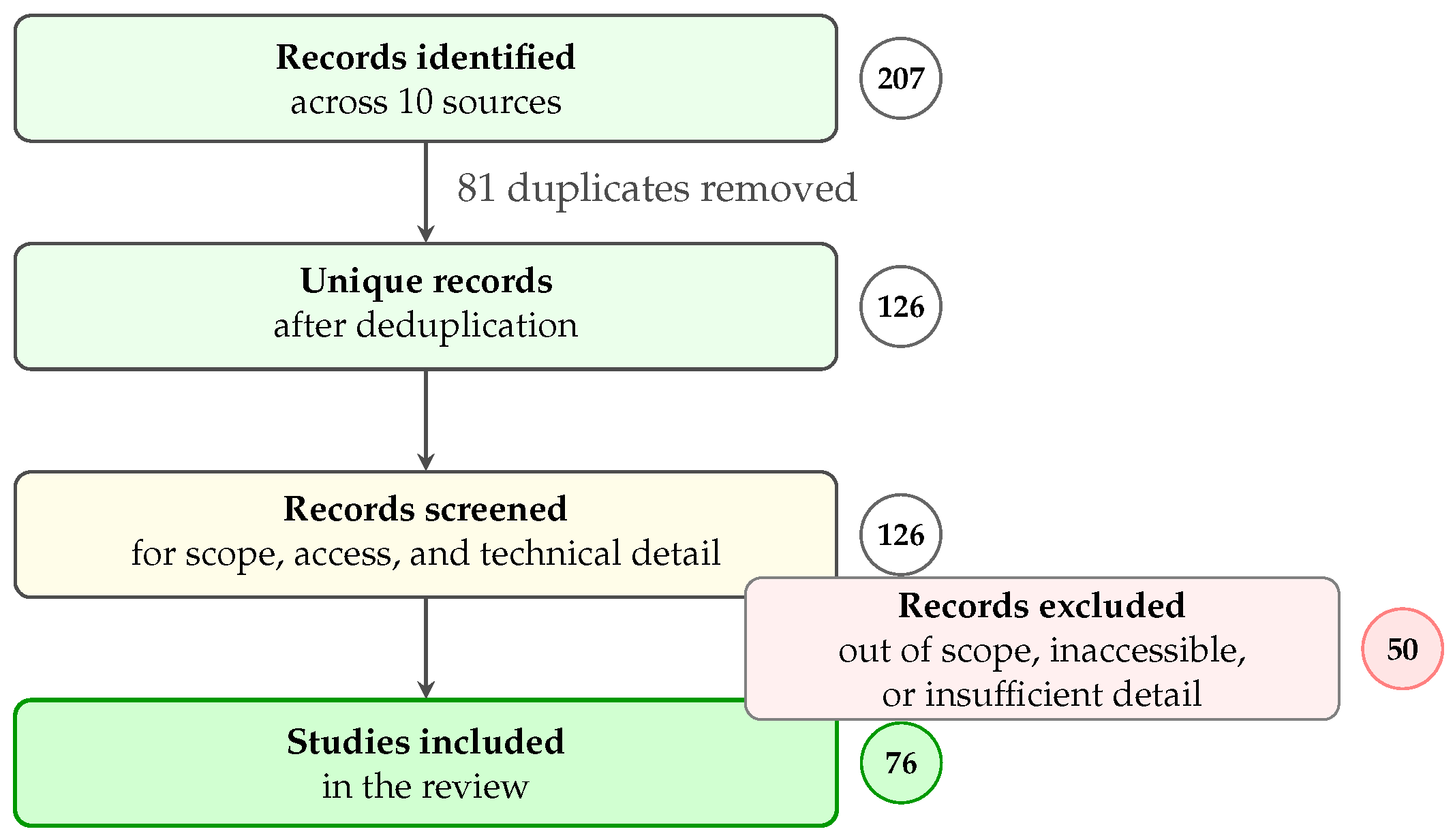
Figure 1 summarizes the resulting selection process.
After selection, each retained study was examined and coded using a common set of analytical dimensions, including:
DT type (VDT, DrDT, RDT, or integrated);
Main application focus;
Enabling technologies;
Communication and coordination mechanisms;
Computing paradigm (e.g., edge, cloud, hybrid);
Evaluation setting (e.g., conceptual, simulation-based, prototype-based, real-world);
Safety-related role or capability.
These dimensions inform the comparative synthesis in
Section 4 and are made explicit through the interaction-oriented comparison of Table 3.
As shown in
Table 1, the search yielded 207 records, of which 126 were retained as unique records after duplicate removal. After screening for scope, accessibility, and analytical relevance, 76 studies were selected for the review. These 76 studies constitute the core review corpus used for the comparative analyses presented in
Section 4 and
Section 5. Additional references are used to support background definitions, enabling technologies, standards, and broader contextual discussion but are not counted as part of the review corpus.
3.3. Research Questions
Existing studies have explored DT concepts, architectures, and applications in the automotive domain, often focusing on specific technical implementations or isolated use cases of VDTs, DrDTs, or RDTs [
22,
64,
65,
66]. However, less attention has been paid to how these DT domains are comparatively characterized, how they are integrated in connected mobility settings, and which safety-related capabilities emerge from their interaction.
Based on these gaps, this review is guided by the following research questions:
RQ1: What are the main structural components, functional roles, and enabling technologies of Vehicle, Driver, and Road Digital Twins?
RQ2: How are Vehicle, Driver, and Road Digital Twins integrated in the literature, and which communication, computing, and interoperability mechanisms support such integration?
RQ3: Which safety-related capabilities are enabled, strengthened, or limited by the integration of Vehicle, Driver, and Road Digital Twins in connected mobility scenarios?
4. Research Findings and Implications
This section presents the main findings of the review in relation to the research questions introduced in
Section 3. The analysis synthesizes recurrent architectural patterns, integration mechanisms, and safety-related implications that emerge across studies on VDTs, DrDTs, and RDTs. Unless otherwise stated, the comparative findings discussed here are grounded in the 76 studies included in the review corpus, while some additional references are used only to provide methodological, conceptual, or contextual support.
4.1. RQ1: What Are the Main Structural Components, Functional Roles, and Enabling Technologies of Vehicle, Driver, and Road Digital Twins?
Across the reviewed literature, VDTs, DrDTs, and RDTs not only show clear domain-specific differences but also share a recurring structure. Most contributions can be interpreted through a layered organization comprising: (i) a
physical and sensing layer, where data are acquired from vehicles, drivers, or infrastructure; (ii) a
data management and communication layer, where heterogeneous streams are filtered, fused, and exchanged; (iii) a
modeling layer, where the digital representation is maintained and updated; and (iv) an
application layer, where analytics, prediction, control, and decision support are delivered to upper-level services or users [
5,
8,
16,
17,
20,
21,
36,
67].
Although this layered logic is common across the three DT domains, the functional role of each twin differs. VDTs are mainly used to represent vehicle state, support predictive maintenance, monitor component health, and assist performance-aware or control-related functions [
22,
23,
60,
61]. DrDTs focus on driver-related variables such as attention, fatigue, cognitive workload, behavioral tendencies, or physiological state, and are mainly associated with personalization and driver-aware adaptation [
25,
27]. RDTs capture the broader operational context, including infrastructure conditions, traffic flow, roadside systems, and environmental factors, thereby providing contextual information for coordination, planning, and infrastructure-aware adaptation [
34,
37,
38,
39].
A first relevant observation is that the literature rarely treats DTs as fully independent entities: the underlying architecture often presupposes information exchange with adjacent domains. For example, VDTs depend on environmental and communication context, DrDTs benefit from vehicle and traffic state, and RDTs increasingly rely on data originating from connected vehicles and distributed sensing systems. Together, these observations suggest that the distinction between VDT, DrDT, and RDT is analytically useful, but operationally porous.
A second recurring finding concerns the enabling technologies underpinning these twins. Across the reviewed studies, six technological dimensions appear repeatedly: sensing and IoT integration, communication and distributed orchestration, AI/ML, data management and interoperability, hierarchical cloud–fog–edge computing, and cybersecurity and safety assurance. Their importance, however, is not uniform across DT types. VDT studies more frequently emphasize predictive analytics, lifecycle management, and edge/cloud execution; DrDT studies emphasize multimodal sensing, ML-based inference, and personalization; and RDT studies place stronger emphasis on infrastructure sensing, traffic modeling, large-scale coordination, and context integration.
The literature also shows that the modeling layer itself is heterogeneous, and this heterogeneity reflects genuinely different design choices across DT domains. In some studies, the twin is primarily simulation-driven, relying on engineering or traffic models; in others, it is mainly data-driven, using machine learning to estimate or predict system state; and in a growing number of cases, hybrid approaches combine physics-based, behavioral, and data-driven elements [
17,
68,
69]. These three paradigms appear with different prevalences depending on the domain. In VDTs, physics-based and hybrid models are common for vehicle dynamics and component degradation. In RDTs, simulation-driven models coexist with data-driven calibration and real-time prediction approaches [
44,
70]. In DrDTs, the picture is especially fragmented: some studies rely on physiological signal processing, others use end-to-end machine learning for behavioral recognition [
31,
32,
71], and a smaller group attempts to integrate cognitive priors with data-driven inference [
13,
24]. This heterogeneity is particularly consequential for DrDTs, where the choice of modeling paradigm has direct implications for interpretability [
52], generalization, and real-time deployability, and where no shared standard has yet emerged. Efforts to ground automotive DT architectures on standardized foundations, such as ISO 23247, are beginning to emerge [
72], but their adoption remains limited and fragmented across the three DT domains.
Taken together, these findings indicate that automotive DTs should not be understood only in terms of what they represent but also in terms of how they are updated, connected, and operationalized. The reviewed literature points to a shared architectural backbone and also to substantial variation in modeling assumptions, functional priorities, and enabling technology choices across VDTs, DrDTs, and RDTs.
4.2. RQ2: How Are Vehicle, Driver, and Road Digital Twins Integrated in
the Literature, and Which Communication, Computing, and Interoperability
Mechanisms Support Such Integration?
The literature has not yet converged on a single model to integrate VDTs, DrDTs, and RDTs. Instead, three recurrent integration patterns can be identified.
The first recurrent model is a
federated or explicitly interaction-oriented architecture, where multiple twins exchange state information through defined interfaces, coordination logic, or shared control loops [
16,
17,
68]. In this model, integration is an explicit architectural goal, and the DTs are treated as cooperating rather than isolated entities. Recent contributions reinforce this model: a surveillance-video-assisted federated DT framework for pedestrians and vehicles in-the-loop demonstrates real-time large-area traffic optimization through cooperative multi-agent DT exchange [
73], while a simulation-based V2X-enabled DT architecture for urban environments shows how cross-domain state sharing can support coordinated intersection management and conflict detection [
74]. This interaction-oriented architecture is particularly important because it moves beyond single-domain optimization and begins to address the problem of coordinated operation.
The second emerging pattern achieves integration primarily through
communication-mediated state exchange, even when a full DT-of-DTs architecture is not explicitly defined [
56,
75,
76,
77,
78,
79]. Here, the main contribution lies in coupling traffic, communication, or infrastructure models with vehicle-related information to enable shared situational awareness, simulation, or coordination. Notably, this pattern includes both field-implemented solutions, e.g., cloud-mediated cooperative maneuvers [
77], and laboratory-scale testbeds that couple physical and virtual spaces through a shared cloud unit [
78]. Studies implementing this pattern show that useful integration can emerge even without a fully formalized multi-twin framework, but it also reveals the fragility of solutions that depend heavily on middleware or simulator-specific coupling mechanisms.
Finally, many studies continue to follow a
domain-centered integration logic, where one twin type is dominant and the others are only partially represented or implicitly assumed. This is particularly common in VDT- and DrDT-oriented work, where environmental and infrastructural context is often treated as external input rather than as a first-class twin, as well as in RDT-oriented work where vehicle and driver state are similarly absent [
14,
24,
71,
80]. While these approaches can still be technically effective for specific use cases, they offer weaker support for system-wide coordination and more limited cross-domain adaptability.
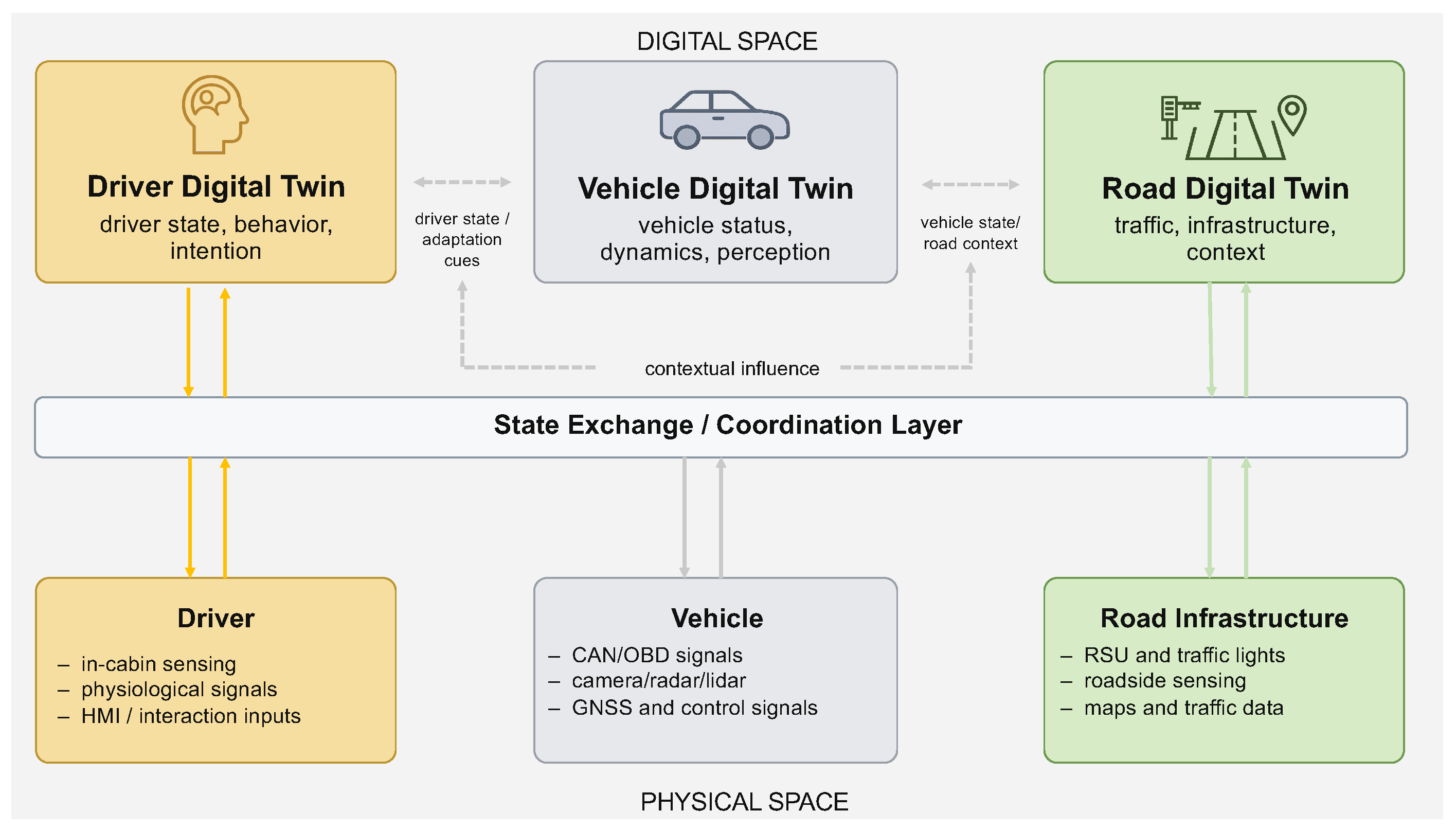
Figure 2 provides a visual synthesis derived from the literature of these recurrent interaction patterns, highlighting the common structural logic: vertical updating between physical entities and their digital counterparts, and horizontal exchange among DTs to support coordination, driver-aware adaptation, and safety-related functions.
To provide a broader empirical grounding for these findings,
Table 2 offers a comparative overview of representative studies, organized around seven analytical dimensions: DT type, main focus, integration pattern, communication substrate, computing model, evaluation setting, safety-related role and interoperability support. This overview makes the structural diversity of existing approaches visible, while systematically highlighting the gaps that emerge from the full corpus.
Table 3 complements this overview by zooming in on a subset of contributions from the perspective of DT-to-DT interaction specifically, detailing how architectural coupling, communication support, and coordination mechanisms are combined across connected mobility scenarios. To situate these automotive findings within a broader architectural context, the table also includes a set of studies from industrial and IIoT domains [
68,
81], which serve as reference patterns for DT-to-DT interaction mechanisms independently of the mobility domain.
The tables jointly reveal several structural findings. First, the majority of contributions in
Table 2 fall within the domain-centered pattern (P3), confirming that isolated DT designs remain the norm rather than the exception. Second, fully integrated configurations (P1) are concentrated in a small yet technically rich subset of studies, and typically rely on hierarchical edge–cloud computing combined with V2X or cellular communication, though exceptions exist (e.g., ref. [
62] operates at the cloud layer only). Third, the interaction-oriented comparison in
Table 3 reveals that even within the P1 and P2 groups, the simultaneous presence of: (i) explicit multi-twin interaction, (ii) traffic optimization through cross-twin coordination, (iii) V2X-enabled information exchange, and (iv) driver-aware customization remains uncommon, with only [
17,
62] satisfying all four conditions.
Communication mechanisms play a central role in all three integration patterns. The literature shows two partially overlapping paradigms. In one paradigm, V2X is treated explicitly as the operational substrate that enables state dissemination, coordination, and shared situational awareness across vehicles and infrastructure [
16,
17,
62,
68]. In the other paradigm, higher-layer middleware or distributed service frameworks abstract the communication substrate and expose interaction through APIs, brokers, or coupling interfaces and simulation-level connectors [
16,
75,
76,
78]. The first paradigm provides clearer visibility into how vehicular and infrastructural information propagates across the system, while the second offers greater modularity and portability at the software architecture level. Architecture-first approaches are gaining traction in this space: recent work on automotive DTs built on standardized software architectures emphasizes the importance of component decomposition, interface contracts, and deployment flexibility for scalable multi-twin systems [
72].
A similar distinction can be observed in computing choices. Many studies adopt hierarchical edge–cloud solutions, where low-latency processing is performed close to the vehicle or roadside infrastructure, while heavier analytics and coordination tasks are delegated to remote or cloud resources [
16,
17,
21,
54,
55,
57]. This pattern is especially relevant for multi-twin integration because different twins operate under different temporal constraints: some driver- and vehicle-related adaptations require immediate reaction, whereas traffic-level optimization and large-scale coordination can tolerate longer processing times [
9,
13,
14,
23,
24,
71,
80].
Interoperability remains a weaker point. Although several studies mention APIs, data exchange interfaces, semantic layers, or federation mechanisms, only a limited portion of the literature addresses semantic interoperability in a sufficiently explicit manner [
18]. This suggests that communication among twins is often technically possible but not yet supported by mature shared data models or interaction semantics. As a result, many current solutions appear integrable at the software level but not fully interoperable at the system-of-systems level [
33].
Overall, the review indicates that integration among VDTs, DrDTs, and RDTs is technically feasible and increasingly explored, but still fragmented. Existing work provides important building blocks for multi-twin coordination, yet the field lacks widely adopted patterns for semantic alignment, reusable interaction interfaces, and consistent distribution of roles across edge, vehicle, and infrastructure resources.
4.3. RQ3: Which Safety-Related Capabilities Are Enabled,
Strengthened, or Limited by the Integration of Vehicle, Driver,
and Road Digital Twins in Connected Mobility Scenarios?
The reviewed literature suggests that integrating VDTs, DrDTs, and RDTs can strengthen several safety-related capabilities, even though current evidence remains uneven and often application-specific. These capabilities can be grouped into five recurrent categories.
Cross-domain situational awareness is the most immediate benefit of integration. When vehicle state, driver state, and infrastructure context are jointly represented, the system can reason on a more complete and operationally relevant view of the driving situation [
16,
17,
35]. Compared with isolated DTs, integrated configurations are better positioned to capture interactions among human, vehicular, and environmental factors, which is particularly important in dynamic and safety-relevant mobility scenarios.
Earlier and more context-aware intervention is a second recurring capability. By combining driver-related indicators (e.g., fatigue, distraction, workload), vehicle behavior, and road context, integrated DT systems can support more timely warnings, adaptive assistance, or preventive control actions [
17,
29,
30,
68]. In this sense, the safety contribution of integration is not only greater observability, but also the possibility of tailoring responses to a richer operational context.
Driver-aware adaptation is another capability that emerges from the literature, especially when DrDTs are coupled with VDT-supported control or assistance mechanisms. Personalized warnings, adaptive assistance policies, and context-sensitive interface behavior can all benefit from combining driver modeling with vehicle and environmental information [
13,
17,
25,
27,
32]. However, the evidence here is still limited, and the field lacks common methods for quantifying the safety benefit of such personalization.
Safer validation and scenario exploration also appears as a significant contribution of integrated DT environments. Studies based on simulation, driver-in-the-loop platforms, or hybrid digital environments show that coordinated representations of vehicle dynamics, driver behavior, and road conditions can support safer testing of critical scenarios before real-world deployment [
28,
63,
68]. This is particularly relevant for advanced assistance functions and connected mobility services, where unsafe behaviors often emerge only from interactions across domains.
Distributed and scalable safety support is enabled when integration is combined with federated architectures or hierarchical computing. Edge–cloud coordination, distributed monitoring, and cross-domain data exchange can support safety-relevant functions at multiple scales, from in-vehicle reaction to infrastructure-level coordination [
16,
21]. This is further supported by recent work demonstrating a virtual-road DT framework specifically designed for mixed autonomous traffic safety analysis, which shows how joint vehicle and infrastructure digital representations enable scenario-level safety evaluation beyond what isolated models can achieve [
82]. This indicates that integration is not only a modeling issue but also an architectural condition for deploying safety-aware mobility services beyond isolated prototypes.
At the same time, the review highlights important limitations. First, most studies do not evaluate safety through common metrics or standardized assurance criteria. Safety is often discussed as a likely benefit or design objective, but is only rarely operationalized as a directly measured comparative dimension. This observation is consistent with broader findings in the autonomous driving literature, where proving safety against well-defined criteria remains an open problem even outside the DT context [
83,
84,
85,
86]. Second, the integration of the three DT domains remains partial in much of the literature, which makes it difficult to assess how much of the claimed safety value truly depends on cross-twin cooperation rather than on improvements within a single DT. Third, the weakest points of current solutions often concern real-time synchronization, interoperability, privacy-sensitive driver modeling, and the maturity of DrDT representations. These limitations directly affect the reliability and deployability of safety-relevant adaptation.
From a broader perspective, the literature therefore supports a cautious conclusion: the integration of VDTs, DrDTs, and RDTs does not yet provide validated evidence of universally improved safety, but it does enable a set of safety-related capabilities that isolated twins struggle to achieve alone. The most promising direction is not simply to connect more twins but to do so through architectures that make communication, timing, semantic consistency, and adaptation logic explicit and dependable. The implications of these findings are twofold. From a research perspective, there is a clear need for more consistent comparative evaluations, more explicit interoperability mechanisms, and more rigorous methods to assess the safety contribution of driver-aware and infrastructure-aware integration. From a system design perspective, the literature indicates that future automotive DT ecosystems should be conceived as distributed, interaction-oriented, and semantically coordinated systems, rather than as a loose aggregation of independent twins.
5. Toward a Unified Conceptual Framework for Connected and Safety-Aware Automotive Digital Twins
The findings discussed in
Section 4 suggest that research on Vehicle, Driver, and Road Digital Twins is progressing, but remains fragmented across definitions, architectural assumptions, interaction mechanisms, and evaluation practices. In particular, the literature reveals recurring difficulties in cross-domain interoperability, semantic alignment, real-time coordination, and explicit treatment of safety-related requirements in distributed settings. Similar observations have also been reported in broader reviews of digital twins for future networks and cyber-physical systems, where scalable, trustworthy, and heterogeneous DT integration remains an open challenge [
87].
Table 4 summarizes how the main gaps emerging from the review translate into architectural implications and motivate the principles of the unified conceptual framework presented in the following subsection.
Building on these findings, this section outlines a unified conceptual framework for connected and safety-aware Automotive Digital Twins (ADTs). The aim is not to claim a definitive or validated architecture, but to synthesize the main design principles that emerge from the literature and that appear necessary for coordinated operation across VDTs, DrDTs, and RDTs.
5.1. Foundational Principles
As illustrated in
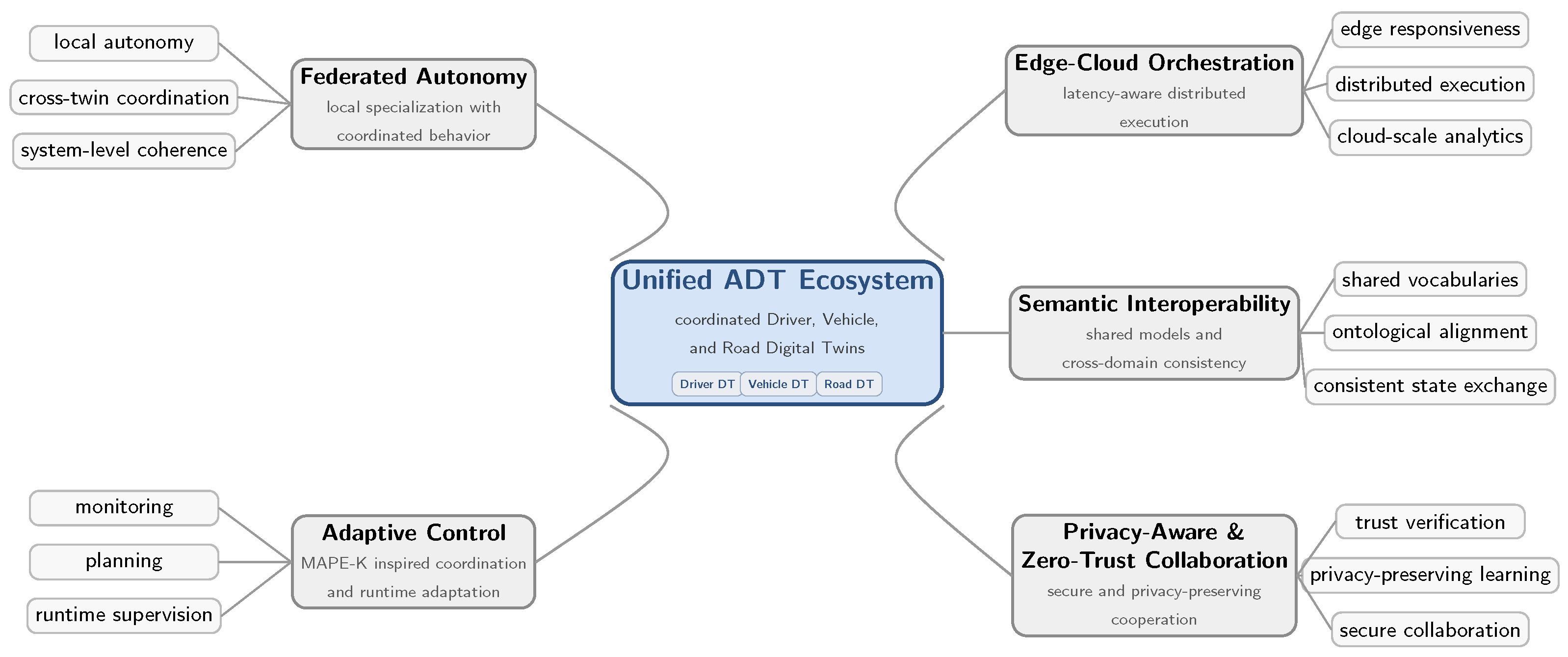
Figure 3, the proposed framework can be understood as a federated and interaction-oriented ecosystem in which VDTs, DrDTs, and RDTs remain locally specialized, yet exchange information and coordinate actions through shared architectural principles. Based on the patterns identified in
Section 4 and on the enabling dimensions discussed in
Section 2, five foundational principles emerge.
Federated autonomy with system-level coordination. The literature suggests that VDTs, DrDTs, and RDTs should preserve local autonomy to remain responsive to domain-specific constraints, while also participating in a broader coordination structure. In practice, this means that each twin should be able to operate and adapt locally, but without ignoring system-level conditions that may affect safety, consistency, or cooperative behavior. Rather than assuming a monolithic architecture, the framework therefore adopts a federated view, where coordinated operation emerges from explicit interaction mechanisms, shared policies, and cross-twin synchronization logic [
10,
16,
68]. In safety-relevant contexts, such coordination should be guided by domain standards and assurance-oriented design practices, including functional safety and SOTIF-inspired reasoning [
88,
89].
Hierarchical edge–cloud orchestration. A recurring pattern in the reviewed literature is the need to distribute computation according to temporal criticality. Low-latency functions, such as driver-state monitoring, immediate warnings, or local control adaptation, are better placed at the vehicle or roadside edge. In contrast, large-scale analytics, long-term learning, and fleet- or infrastructure-level optimization are more naturally delegated to fog or cloud layers [
16,
17,
21]. A unified ADT framework should therefore support hierarchical orchestration across edge, fog, and cloud resources, allowing different twins and services to execute where their latency, scalability, and coordination requirements can be most effectively balanced.
Semantic interoperability through shared models and ontologies. One of the clearest gaps identified in the literature concerns interoperability beyond simple data exchange. A connected ADT ecosystem requires not only interfaces for communication but also sufficiently aligned representations of driver state, vehicle state, road context, events, and adaptation logic. For this reason, semantic interoperability should be treated as a foundational principle rather than as a secondary implementation detail. The framework therefore assumes the use of shared vocabularies, ontological mappings, or common data models to reduce ambiguity and improve cross-domain consistency [
90]. For DrDTs in particular, this implies that driver-related states should be exposed through explicit semantic state descriptors, including the estimated value, confidence, freshness, provenance, sensing modality, and validity conditions. This allows driver-state information to be interpreted by vehicle and road twins without assuming that all systems share the same sensing pipeline or inference model. Existing efforts in vehicular data modeling, intelligent transport standards, and sensor ontologies provide useful reference points, even though no single standard currently covers the full VDT–DrDT–RDT integration space. A recent case study on engineering automotive digital twins over standardized architectures, explicitly referencing ISO 23247, provides a useful reference point for how shared structural conventions can reduce integration friction across heterogeneous DT components [
91].
Hierarchical adaptive control through MAPE-K-inspired loops. The review suggests that adaptive behavior in automotive DT ecosystems requires both local and cross-domain feedback loops. For this reason, a useful conceptual abstraction is provided by MAPE-K-like control loops, which can be instantiated at the twin level and coordinated at a higher level when multiple twins need to react jointly to changing conditions [
92,
93]. In this framework, local adaptation may involve updating driver-state estimates, vehicle control parameters, or infrastructure responses, while higher-level coordination may evaluate whether local decisions remain coherent with broader operational goals. Importantly, the purpose of this principle is not to prescribe a specific autonomic architecture, but to emphasize that adaptive DT ecosystems require explicit monitoring, reasoning, planning, and execution mechanisms, supported by a structured knowledge base.
Privacy-aware and zero-trust collaborative intelligence. Because ADTs rely on sensitive and operationally relevant data, especially in the case of DrDTs, privacy and security should be integrated into the framework as intrinsic design requirements. This includes secure identity and access management, constrained data sharing, and architectural assumptions that do not treat any interacting component as implicitly trusted. In this sense, zero-trust principles offer a useful reference model for structuring interactions among distributed twins and services [
58,
59,
94,
95,
96]. At the same time, collaborative intelligence should be supported in a privacy-aware manner, for example through federated learning or related techniques that allow collective model improvement without centralizing all raw driver-related data [
47,
51,
97]. The goal is not only security in the narrow sense but also sustainable trustworthiness in multi-actor automotive ecosystems.
The semantic-interoperability principle has specific implications for DrDTs, since driver-related states are often produced by heterogeneous sensing pipelines and inference models. A possible way forward is to make the internal structure of the driver twin more explicit, rather than relying on generic labels such as “driver state” or “driver model”. Based on the reviewed literature and on the integration needs identified in this paper, a minimal set of DrDT representation dimensions can be identified, as summarized in
Table 5. These dimensions do not prescribe a single implementation model, but provide an interface-oriented structure that can support comparison across studies and interaction with VDTs and RDTs.
Such a representation would allow DrDTs to expose driver-related information as structured semantic state descriptors rather than as isolated classification outputs. For example, an estimated fatigue or attentiveness state should be associated not only with a categorical or numerical value but also with confidence, freshness, provenance, sensing modality, and validity conditions. This is particularly important when DrDT outputs are used by VDTs, RDTs, or coordination layers to support safety-relevant adaptation. In this sense, the path toward more consistent DrDTs is not only a matter of improving driver-state estimation algorithms but also of defining interoperable state representations that can be exchanged, interpreted, and audited across connected automotive DT ecosystems.
Taken together, these principles do not define a single implementation blueprint; rather, they provide a conceptual structure for reasoning about how VDTs, DrDTs, and RDTs can be coordinated in connected mobility systems while preserving responsiveness, interoperability, and safety awareness.
5.2. Conceptual Architectural View
While
Figure 3 summarizes the guiding principles of a unified ADT ecosystem,
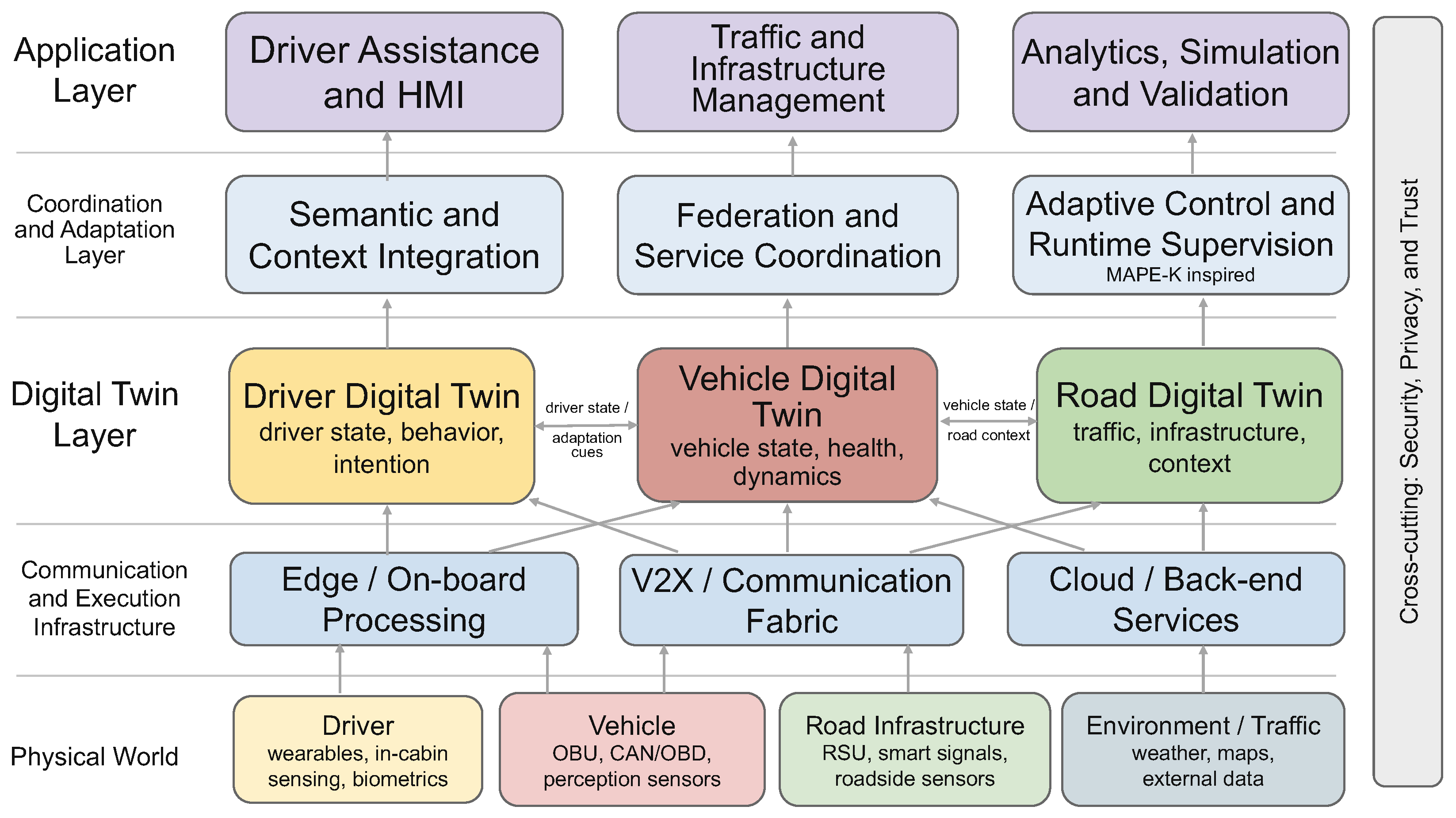
Figure 4 provides a complementary architectural interpretation of how these principles may be embodied in a layered and interaction-oriented design. The figure should not be read as a definitive reference architecture, but rather as a conceptual synthesis of recurrent structural elements emerging from the reviewed literature.
At the base of the architecture lies the physical world, where data originate from drivers, vehicles, road infrastructure, and broader environmental or traffic-related sources. This layer includes in-cabin and wearable sensing, onboard vehicle sensing and control signals, roadside infrastructure, smart traffic devices, and external contextual data such as weather or map-based information. Its role is to provide the raw and contextual observations required to keep the digital counterparts aligned with the evolving physical environment.
Above it, the communication and execution infrastructure captures the distributed processing and communication substrate that repeatedly emerges in the literature. In the figure, this layer is represented through edge or onboard processing resources, V2X communication fabric, and cloud or back-end services. Its role is twofold: to support low-latency local processing where required, and to enable state exchange and distributed execution across vehicles, infrastructure, and remote services. This layer is particularly important because the review has shown that integration among VDTs, DrDTs, and RDTs depends not only on modeling quality but also on the timeliness, continuity, and structure of cross-domain communication and computation.
The digital twin layer constitutes the conceptual center of the architecture. Here, Driver, Vehicle, and Road Digital Twins are maintained as distinct yet interacting entities. This separation remains useful because each twin preserves its own modeling assumptions, state representations, update mechanisms, and domain-specific objectives. At the same time, the horizontal links among these twins emphasize one of the main findings of the review, namely that the value of automotive DTs increases when driver, vehicle, and infrastructure-related information are coordinated rather than treated in isolation. In this view, the DrDT contributes driver state, behavioral interpretation, and adaptation cues; the VDT contributes vehicle state, health, and dynamics; and the RDT contributes traffic, infrastructure, and contextual awareness.
Above the twins, the coordination and adaptation layer represents the higher-level mechanisms required to transform multi-twin information into coherent system behavior. In the figure, this layer includes semantic and context integration, federation and service coordination, and adaptive control with runtime supervision. Together, these functions reflect a central conclusion of the review: a unified automotive DT ecosystem requires more than simple data exchange. It also requires explicit mechanisms for contextual interpretation, cross-domain coordination, and adaptation logic. The adaptive control block is represented as MAPE-K-inspired to indicate that monitoring, reasoning, planning, and execution may be organized through structured feedback loops, without implying a single mandatory implementation strategy.
At the top, the application layer represents the operational services that consume coordinated twin outputs. These include driver assistance and human–machine interaction, traffic and infrastructure management, and analytics, simulation, and validation services. This layer highlights that the purpose of a unified ADT ecosystem is not the twins themselves, but the connected and adaptive services that can be built on top of them when cross-domain information becomes available in a coordinated manner.
Finally,
Figure 4 makes explicit that
security, privacy, and trust should be treated as cross-cutting concerns rather than isolated add-ons. This choice is consistent with the broader framework proposed in this paper, where trustworthy data exchange, privacy-aware collaboration, and secure coordination are considered necessary conditions for scalable and safety-aware multi-twin ecosystems.
Overall,
Figure 4 helps bridge the gap between the abstract principles of
Figure 3 and a more operational architectural view. Its main contribution is to show that a unified ADT ecosystem requires not only multiple digital twins but also communication and execution infrastructure, explicit cross-twin interaction, higher-level coordination and adaptation mechanisms, and mobility services supported by cross-cutting trust, privacy, and security requirements.
5.3. Safety Assurance Considerations
If the framework is to support safety-relevant automotive services, safety assurance cannot be treated as an implicit consequence of integration. Instead, the literature suggests that assurance-related mechanisms should be embedded explicitly in the architecture, at both design time and runtime. In this perspective, three complementary directions appear particularly important.
The first direction is
contract-based and specification-driven coordination. Interactions among VDTs, DrDTs, and RDTs should be constrained by explicit assumptions, guarantees, and validity conditions describing what kind of information can be exchanged, with which confidence, and under which operational limits. In practice, this means that cross-twin adaptation should rely not only on the availability of information but also on explicit conditions regarding its trustworthiness, timeliness, and safe use. Contract-based reasoning, inspired by safety engineering practices and increasingly discussed in DT-related contexts, offers a promising basis for making these dependencies traceable and analyzable [
98].
The second direction is
runtime monitoring and anomaly-aware supervision. Because connected automotive DTs operate in dynamic and partially unpredictable environments, design-time reasoning alone is insufficient. A unified framework should therefore include runtime mechanisms able to detect deviations from expected behavior, inconsistencies among twin states, or communication failures that may compromise safe adaptation. These mechanisms may combine rule-based checks with data-driven anomaly detection, depending on the application context [
99]. Their role is not only to detect faults but also to identify early conditions under which local or cross-domain decisions should be revised, delayed, or blocked.
The third direction is
graceful degradation under partial failure or degraded coordination. The reviewed literature repeatedly shows that multi-twin integration depends on synchronization, communication quality, and availability of contextual data. A realistic architecture should therefore assume that some of these dependencies may temporarily fail. Under such conditions, the system should preserve essential safety-related functions while disabling or simplifying more advanced adaptation or optimization services. For instance, a vehicle-level controller may revert to conservative assistance policies when driver-state updates are stale, or infrastructure-level services may continue broadcasting alerts even when deeper personalization logic is unavailable. This principle is important because it shifts the framework from an idealized, integrated system to a more deployable, resilient one. Complementary to these runtime directions, recent work on scenario-based accelerated testing for SOTIF in autonomous driving highlights how systematically structured test scenarios—generated and executed within DT environments—can close the gap between design-time assumptions and real-world operational coverage [
100]. Similarly, virtual-road DT frameworks for mixed traffic safety analysis demonstrate that integrating vehicle and infrastructure twins within simulation-based safety pipelines can expose hazardous interaction patterns before physical deployment [
74].
Together, these directions suggest that safety assurance in unified automotive DT ecosystems should be approached as a continuum: from explicit design constraints to runtime supervision to fault-tolerant behavior under degraded operating conditions. This does not yet amount to validated evidence of safe deployment, but it provides a more concrete basis for structuring future research on dependable, connected, and driver-aware automotive DT systems.
5.4. Unified ADT in Action: Interaction Scenario
To make the coordinated operation of the three DTs more concrete, consider the following scenario grounded in the architectural principles of
Figure 3 and
Figure 4: an instrumented vehicle approaches a signalized urban intersection under conditions that trigger cross-domain DT interaction. This type of scenario, combining vehicle, driver, and infrastructure state in a safety-critical urban context, is representative of the integration challenges identified throughout the review and reflects the interaction topology captured in
Figure 4.
The purpose of this scenario is not to introduce new sensing, driver-monitoring, or ADAS components in isolation. Rather, it is to instantiate the proposed framework by showing how components that are typically studied separately can be coordinated through cross-twin state exchange, semantic alignment, contract-based reasoning, and runtime adaptation. The added value therefore lies in the system-level composition and in the explicit flow from physical observations to twin updates, coordinated interpretation, and safety-relevant action.
The same scenario can be interpreted in two complementary modes. In an online mode, the twins act as synchronized runtime representations supporting monitoring, warning, and conservative adaptation. In a simulation-in-the-loop mode, the same cross-twin state configuration can be replayed, perturbed, and evaluated before deployment to assess whether the coordination logic behaves safely under variations in driver state, vehicle speed, signal timing, pedestrian behavior, and communication quality. This dual interpretation is consistent with the use of DT environments for scenario-based safety testing and with virtual-road DT pipelines for identifying hazardous interaction patterns before physical deployment.
Physical layer inputs. At the physical layer, the driver’s in-cabin camera and physiological sensors detect elevated eye-blink frequency and reduced gaze stability, consistent with early-stage fatigue. Multimodal in-cabin sensing of this kind—combining cameras, physiological signals, and vehicle control inputs—constitutes the standard acquisition architecture for DrDTs described in the literature [
24,
25,
32]. Simultaneously, the vehicle’s onboard CAN/OBD and GNSS signals report a speed slightly above the posted limit and compute a projected stopping distance based on current vehicle dynamics [
21,
23]. Roadside infrastructure provides information indicating that the traffic signal ahead will turn red within a few seconds, while a pedestrian crossing event has been detected at the target intersection through roadside sensing and V2I communication [
15,
35,
39]. This combination of in-vehicle, V2X, and infrastructure sensing reflects the physical-layer configuration consistently described in RDT-oriented work [
14,
34].
Digital Twin layer. These inputs are independently maintained by the three twins at the Digital Twin layer. The DrDT updates its driver state estimate to reflect moderate fatigue and reduced attentiveness, following the persistent and continuously updated representation model discussed in [
24,
27,
71]. The VDT flags the mild speed overshoot and updates its dynamic state, consistent with the real-time monitoring and edge-based synchronization described in [
21,
23]. The RDT updates its intersection state model with the imminent red phase and pedestrian presence, extending the contextual infrastructure representation discussed in [
35,
39]. Crucially, none of these updates in isolation is sufficient to trigger a safety-relevant response; it is their combination that constitutes the hazard. For this scenario to support runtime adaptation, the coordination layer should not treat all twin states as equally valid. Each state update should be associated with freshness, confidence, and provenance metadata, and the safety contract should specify the maximum acceptable age of driver-, vehicle-, and infrastructure-related information. Time-critical processing, such as driver-state estimation, vehicle-state updates, and initial warning generation, is assumed to run at the in-vehicle or roadside edge, while cloud services are used only for non-time-critical analytics, logging, or offline refinement. If one of the required inputs is stale, unavailable, or inconsistent, the coordination layer should inhibit personalized adaptation and fall back to conservative local assistance or warning policies.
Coordination and Adaptation layer. At the Coordination and Adaptation layer, the Semantic and Context Integration module aligns the three state representations onto a shared situational model. Semantic alignment of heterogeneous twin states of this kind requires shared vocabularies and ontological mappings to avoid ambiguity across domains [
18,
90]. The Federation and Service Coordination module evaluates the composite state—fatigued driver, slightly fast vehicle, imminent red phase, pedestrian present—against a predefined safety contract: the combined condition exceeds the intervention threshold defined at design time. Contract-based reasoning of this kind, where cross-twin interactions are governed by explicit assumptions and validity conditions, is discussed as a key safety assurance mechanism in [
98] and is motivated by SOTIF-aligned reasoning about uncertain operational conditions [
89,
100].
The MAPE-K-inspired Adaptive Control block [
92,
93] then issues two coordinated outputs. First, the DrDT activates a graduated HMI intervention—an auditory cue followed by a visual deceleration prompt—whose intensity is scaled to the estimated driver attentiveness level. Fatigue-scaled and context-adaptive HMI strategies of this kind have been shown to improve driver response and situation awareness in safety-critical scenarios [
29,
30]. Second, the VDT adjusts the ADAS target speed to initiate a smooth deceleration profile compatible with safe stopping before the intersection line. The joint use of driver state and road context to parameterize such vehicle-level responses is a defining characteristic of the P1 integration pattern identified in the previous section, and is operationally demonstrated in [
17,
62]. The coupling of a cognitive driver state model with behavioral compliance logic in this kind of intervention loop has also been investigated in recent work on cognitive DrDTs for accident prevention [
31].
If the driver responds and decelerates appropriately within a defined time window, the intervention is logged and the twins revert to normal monitoring. If no response is detected, the Adaptive Control block escalates to a cooperative braking request, consistent with the graceful degradation principle described in the previous section. Throughout, the Privacy-Aware and Zero-Trust Collaboration layer ensures that the driver physiological data used by the DrDT are processed locally and are not transmitted to external services in raw form, following the federated and privacy-preserving architectures discussed in [
47,
51,
97] and the zero-trust interaction model advocated in [
94,
95,
96].
What cross-twin coordination adds. This scenario illustrates three safety-relevant outputs that would be difficult to support with the same contextual completeness through isolated DTs. First, the fatigue-scaled HMI intervention requires DrDT and VDT coupling: the vehicle’s speed state is needed to determine the urgency of the warning, while the driver’s attentiveness state is needed to calibrate its modality and intensity [
17,
29]. Second, the pedestrian-aware deceleration profile requires VDT and RDT coupling: the stopping distance computation depends on infrastructure-derived signal timing and pedestrian crossing data that are not locally available to the vehicle [
35,
39]. Third, the composite safety assessment that triggers escalation only when all three domains jointly exceed the threshold requires the full three-way coordination and the contract layer [
98], since the individual conditions—mild fatigue, minor speed excess, imminent red phase—would not individually reach the escalation criterion.
This composite reasoning structure is structurally consistent with the federated, pedestrians-and-vehicles-in-the-loop DT framework proposed in [
73], which provides a cooperative multi-agent DT exchange model for large-area real-time traffic optimization. The V2X-enabled urban intersection simulation of [
74] provides a comparable interaction model, showing how cross-domain coordination can reduce conflict rates relative to vehicle-only or infrastructure-only baselines. The resulting safety coverage also aligns with the mixed-traffic safety analysis framework of [
82], which indicates that joint vehicle–infrastructure virtual representations can expose hazardous interaction patterns that neither domain can detect alone.
6. Threats to Validity
As with any structured literature review, this study is subject to several threats to validity that should be considered when interpreting its findings. We addressed these threats through explicit search, screening, and synthesis choices, but they cannot be eliminated entirely.
A first threat concerns the validity of the search and coverage. Although the review spans ten major digital libraries and publisher platforms and covers the 2008–2025 period, relevant studies may still have been missed. This risk is particularly relevant in a fragmented field such as automotive digital twins, where similar concepts are sometimes described using different terms, adjacent labels, or domain-specific expressions rather than the exact categories of Vehicle, Driver, or Road Digital Twins. To mitigate this threat, the search strategy combined direct DT terminology with related expressions from connected mobility, driver modeling, V2X, and autonomous driving, and also included Boolean combinations intended to capture cross-domain studies. It should also be noted that broader surveys on DT for intelligent vehicles and transportation systems have recently appeared [
19], covering a wider scope that includes communication networks and ITS infrastructure beyond the VDT–DrDT–RDT focus of this paper. These serve as useful complementary references for readers seeking a more expansive view of the field.
Even so, the final corpus should be interpreted as a rigorously constructed but not necessarily exhaustive representation of the field.
A second threat relates to selection validity. The inclusion and exclusion of studies inevitably involve researcher judgment, especially when papers differ in technical depth, conceptual clarity, or relevance to related automotive DTs. This is particularly important in a literature base where some studies are highly architectural, others are application-driven, and others remain partially conceptual. To reduce arbitrariness, we applied explicit inclusion criteria based on domain relevance, technical relevance, methodological transparency, and analytical usefulness. We also excluded duplicates, inaccessible papers, and studies lacking sufficient technical detail to support comparative synthesis. Nevertheless, borderline cases remained possible, especially for papers that addressed only one DT domain while implicitly assuming the others.
A third threat concerns the validity of classification and coding. Several analytical dimensions used in the review—such as DT type, integration pattern, safety-related role, communication substrate, or interoperability support—required interpretive coding. In heterogeneous literature, these categories are not always explicitly stated by the original authors, and in some cases, they had to be inferred from the described architecture or evaluation setting. This may introduce classification bias, especially for studies that do not adopt a consistent DT vocabulary. We mitigated this risk by using a common coding scheme across the corpus and by grounding categories in recurrent structural features rather than in terminology alone. Even so, some categorizations remain interpretive abstractions rather than objectively fixed labels.
A fourth threat involves construct validity, particularly regarding the notion of safety. In the reviewed literature, safety is often treated as an expected benefit, design objective, or application motivation rather than as a directly measured outcome supported by standardized metrics. As a result, our synthesis of safety-related capabilities should not be interpreted as proof that integrated VDT–DrDT–RDT systems are universally safer than isolated approaches. Rather, the review identifies how the literature positions integration as enabling or strengthening capabilities such as situational awareness, driver-aware adaptation, and safer scenario exploration. To remain methodologically cautious, we explicitly distinguish between validated evidence and claimed or inferred safety contributions.
A fifth threat concerns external validity and generalizability. The reviewed studies differ substantially in scope, maturity, and evaluation setting, ranging from conceptual proposals and simulations to prototypes and limited real-world deployments. Consequently, the patterns identified in this paper should be interpreted as literature-level tendencies rather than universally established properties of all automotive digital twin systems. This limitation is especially relevant for Driver Digital Twins and integrated multi-twin systems, where empirical evidence remains comparatively limited, and definitions are still evolving.
A sixth threat relates to publication and reporting bias. Peer-reviewed studies are more likely to report successful architectures, promising applications, or positive performance indications than negative results, failed integrations, or safety limitations. Moreover, grey literature was excluded to preserve technical traceability and methodological transparency, but this choice may also omit industrial experiences or deployment lessons that are not represented in academic publications. The review therefore reflects the state of the documented scholarly literature rather than the full range of industrial practice.
Finally, a threat concerns the researcher’s interpretation during synthesis. Because this paper does not merely enumerate studies but develops a critical comparison and proposes a unified conceptual framework, the synthesis necessarily reflects interpretive decisions about which patterns are recurrent, which gaps are most significant, and which architectural principles deserve emphasis. We sought to make these decisions as transparent as possible by linking them to explicit research questions, common analytical dimensions, and cross-study comparisons. In addition, where the literature remained fragmented or inconclusive, we intentionally adopted cautious language and avoided claiming validated consensus where none clearly exists.
Overall, while these threats limit the review’s conclusiveness, the study was designed to support a careful, analytically transparent synthesis. The use of an explicit search strategy, defined screening criteria, structured coding dimensions, and a cautious distinction between demonstrated evidence and conceptual extrapolation helps strengthen the credibility of the findings, while also clarifying the boundaries within which they should be interpreted.
7. Conclusions
This paper presents a critical review of Digital Twin technologies in the automotive domain, with particular attention to Vehicle, Driver, and Road Digital Twins and to their role in connected mobility scenarios. By examining seventy-six studies published between 2008 and 2025, the review has highlighted both the progress made in the three DT domains and the persistent fragmentation that still characterizes their definitions, architectures, interaction mechanisms, and evaluation practices.
The analysis shows that, although VDTs, DrDTs, and RDTs are increasingly relevant to predictive maintenance, driver-aware assistance, traffic coordination, and scenario-based validation, their integration remains uneven and is only partially supported by mature interoperability mechanisms. In particular, the literature suggests that communication support, distributed orchestration, semantic alignment, and hierarchical edge-cloud execution are central enablers of multi-twin coordination, yet they are not consistently addressed across existing studies. Similarly, safety is widely recognized as a major motivation for integration but is still only rarely assessed through explicit metrics, common assurance criteria, or comparable evaluation methodologies.
On this basis, the paper has outlined a unified conceptual framework for connected and safety-aware automotive digital twins. Rather than defining a fixed implementation blueprint, the framework synthesizes the main architectural directions emerging from the literature, namely federated coordination, hierarchical orchestration, semantic interoperability, adaptive control, and privacy-aware collaboration. These design dimensions provide a conceptual basis for moving from isolated DT instances toward more coherent automotive DT ecosystems in which vehicle, driver, and infrastructure perspectives can be combined more systematically.
The review also points to several priorities for future research. These include the need for more explicit interoperability mechanisms across DT domains, more rigorous and comparable evaluation protocols for safety-related capabilities, more mature and standardized representations of driver-related states, and more dependable approaches to real-time coordination in distributed automotive environments. Addressing these issues will be essential if integrated DT ecosystems are to evolve from promising research prototypes into trustworthy and scalable mobility infrastructures.
In conclusion, the literature supports a cautious but clear perspective: the integration of VDTs, DrDTs, and RDTs is a promising direction for connected automotive systems, but its benefits should not be assumed a priori. Their effective contribution depends on how communication, computation, semantics, adaptation, and assurance are made explicit in the architecture. In this sense, the present review contributes both a critical synthesis of the field and a conceptual foundation for future work on connected, driver-aware, and safety-aware automotive digital twins.
Author Contributions
Conceptualization, Ö.K., L.B., A.M., R.P., C.-T.L., R.G. and G.P.; methodology, Ö.K., L.B., A.M., R.P., C.-T.L., R.G. and G.P.; validation, Ö.K., L.B., A.M., R.P., C.-T.L., R.G. and G.P.; investigation, Ö.K., L.B., A.M., R.P., C.-T.L., R.G. and G.P.; writing—original draft preparation, Ö.K., L.B., A.M., R.P., C.-T.L., R.G. and G.P.; writing—review and editing, Ö.K., L.B., A.M., R.P., C.-T.L., R.G. and G.P.; visualization, Ö.K., L.B., A.M., R.P., C.-T.L., R.G. and G.P. All authors have read and agreed to the published version of the manuscript.
Funding
This study was partially funded within the MOST-Sustainable Mobility National Research Center and received funding from the European Union Next-GenerationEU (PIANO NAZIONALE DI RIPRESA E RESILIENZA (PNRR)-MISSIONE 4 COMPONENTE 2, INVESTIMENTO 1.4-D.D. 1033 17/06/2022, CN00000023), and also from the European Union’s Horizon Europe research and innovation program Key Digital Technology (KDT) Joint Undertaking (JU) under grant agreement No. 101139769, DistriMuSe project-“Distributed Multi-Sensor Systems for Human Safety and Health”. The KDT JU received support from the European Union’s Horizon Europe research and innovation programme and the nations involved in the mentioned projects. The work reflects only the authors’ views; the European Commission is not responsible for any use that may be made of the information it contains.
Data Availability Statement
No new data were created or analyzed in this study. Data sharing is not applicable to this article.
Conflicts of Interest
The authors declare no conflicts of interest.
References
- Glaessgen, E.; Stargel, D. The digital twin paradigm for future NASA and U.S. air force vehicles. In Proceedings of the 53rd AIAA/ASME/ASCE/AHS/ASC Structures, Structural Dynamics and Materials Conference 20th AIAA/ASME/AHS Adaptive Structures Conference 14th AIAA, Honolulu, HI, USA, 23–26 April 2012. [Google Scholar]
- Tao, F.; Zhang, M.; Liu, Y.; Nee, A.Y. Digital twin driven prognostics and health management for complex equipment. Cirp Ann. 2018, 67, 169–172. [Google Scholar] [CrossRef]
- Grieves, M.; Vickers, J. Digital Twin: Mitigating Unpredictable, Undesirable Emergent Behavior in Complex Systems. In Transdisciplinary Perspectives on Complex Systems; Springer: Cham, Switzerland, 2017; pp. 85–113. [Google Scholar]
- Fuller, A.; Fan, Z.; Day, C.; Barlow, C. Digital Twin: Enabling Technologies, Challenges and Open Research. IEEE Access 2020, 8, 108952–108971. [Google Scholar] [CrossRef]
- Kritzinger, W.; Karner, M.; Traar, G.; Henjes, J.; Sihn, W. Digital Twin in manufacturing: A categorical literature review and classification. Ifac-PapersOnline 2018, 51, 1016–1022. [Google Scholar] [CrossRef]
- Schluse, M.; Atorf, L.; Rossmann, J. Experimentable digital twins for model-based systems engineering and simulation-based development. In Proceedings of the 2017 Annual IEEE International Systems Conference (syscon), Montreal, QC, Canada, 24–27 April 2017; pp. 1–8. [Google Scholar]
- Qi, Q.; Tao, F.; Hu, T.; Anwer, N.; Liu, A.; Wei, Y.; Wang, L.; Nee, A.Y. Enabling technologies and tools for digital twin. J. Manuf. Syst. 2021, 58, 3–21. [Google Scholar] [CrossRef]
- Rasheed, A.; San, O.; Kvamsdal, T. Digital twin: Values, challenges and enablers from a modeling perspective. IEEE Access 2020, 8, 21980–22012. [Google Scholar] [CrossRef]
- Hui, Y.; Ma, X.; Su, Z.; Cheng, N.; Yin, Z.; Luan, T.H.; Chen, Y. Collaboration as a Service: Digital-Twin-Enabled Collaborative and Distributed Autonomous Driving. IEEE Internet Things J. 2022, 9, 18607–18619. [Google Scholar] [CrossRef]
- Wu, K.; Li, P.; Cheng, Y.; Parker, S.T.; Ran, B.; Noyce, D.A.; Ye, X. A digital twin framework for physical-virtual integration in v2x-enabled connected vehicle corridors. IEEE Trans. Intell. Transp. Syst. 2025, 9, 14407–14420. [Google Scholar] [CrossRef]
- Wang, Q.; Jiao, W.; Wang, P.; Zhang, Y. Digital twin for human-robot interactive welding and welder behavior analysis. IEEE/CAA J. Autom. Sin. 2020, 8, 334–343. [Google Scholar] [CrossRef]
- Lu, Y.; Liu, C.; Kevin, I.; Wang, K.; Huang, H.; Xu, X. Digital Twin-driven smart manufacturing: Connotation, reference model, applications and research issues. Robot. Comput.-Integr. Manuf. 2020, 61, 101837. [Google Scholar] [CrossRef]
- Liao, X.; Zhao, X.; Wang, Z.; Zhao, Z.; Han, K.; Gupta, R.; Barth, M.J.; Wu, G. Driver digital twin for online prediction of personalized lane-change behavior. IEEE Internet Things J. 2023, 10, 13235–13246. [Google Scholar] [CrossRef]
- Kušić, K.; Schumann, R.; Ivanjko, E. A digital twin in transportation: Real-time synergy of traffic data streams and simulation for virtualizing motorway dynamics. Adv. Eng. Inform. 2023, 55, 101858. [Google Scholar] [CrossRef]
- Pauwels, A.; Pourmohammad-Zia, N.; Schulte, F. Safety and Sustainable Development of Automated Driving in Mixed-Traffic Urban Areas—Considering Vulnerable Road Users and Network Efficiency. Sustainability 2022, 14, 13486. [Google Scholar] [CrossRef]
- Calisesi, E.; Kaya, O.; Melis, A.; Girau, R. A Federated Architecture for Digital Twins in Automotive: An Integrated Solution for Vehicles, Drivers and Road Environments. In Proceedings of the 2024 International Conference on Information Technology for Social Good, New York, NY, USA, 4–6 September 2024; GoodIT ’24. pp. 181–187. [Google Scholar]
- Wang, Z.; Gupta, R.; Han, K.; Wang, H.; Ganlath, A.; Ammar, N.; Tiwari, P. Mobility Digital Twin: Concept, Architecture, Case Study, and Future Challenges. IEEE Internet Things J. 2022, 9, 17452–17467. [Google Scholar] [CrossRef]
- Karabulut, E.; Pileggi, S.F.; Groth, P.; Degeler, V. Ontologies in digital twins: A systematic literature review. Future Gener. Comput. Syst. 2024, 153, 442–456. [Google Scholar] [CrossRef]
- Gu, X.; Duan, W.; Zhang, G.; Hou, J.; Peng, L.; Wen, M.; Gao, F.; Chen, M.; Ho, P.H. Digital twin technology for intelligent vehicles and transportation systems: A survey on applications, challenges and future directions. IEEE Commun. Surv. Tutor. 2025, 28, 3235–3271. [Google Scholar] [CrossRef]
- Grieves, M. Digital Twin: Manufacturing Excellence through Virtual Factory Replication. J. Manuf. Sci. 2014. [Google Scholar]
- Campolo, C.; Genovese, G.; Molinaro, A.; Pizzimenti, B.; Ruggeri, G.; Zappalà, D.M. An Edge-Based Digital Twin Framework for Connected and Autonomous Vehicles: Design and Evaluation. IEEE Access 2024, 12, 46290–46303. [Google Scholar] [CrossRef]
- Smeets, J.; Öztürk, K.; Liebich, R. Digital twins for automotive development: Two wheelers application. Adv. Eng. Inform. 2023, 56, 101982. [Google Scholar] [CrossRef]
- Schwarz, C.; Wang, Z. The role of digital twins in connected and automated vehicles. IEEE Intell. Transp. Syst. Mag. 2022, 14, 41–51. [Google Scholar] [CrossRef]
- Hu, Z.; Lou, S.; Xing, Y.; Wang, X.; Cao, D.; Lv, C. Review and Perspectives on Driver Digital Twin and Its Enabling Technologies for Intelligent Vehicles. IEEE Trans. Intell. Veh. 2022, 7, 417–440. [Google Scholar] [CrossRef]
- Xing, Y.; Lv, C.; Cao, D.; Hang, P. Toward human-vehicle collaboration: Review and perspectives on human-centered collaborative automated driving. Transp. Res. Part C Emerg. Technol. 2021, 128, 103199. [Google Scholar] [CrossRef]
- Bhatti, G.; Mohan, H.; Singh, R.R. Towards the future of smart electric vehicles: Digital twin technology. Renew. Sustain. Energy Rev. 2021, 141, 110801. [Google Scholar] [CrossRef]
- Kashevnik, A.; Shchedrin, R.; Kaiser, C.; Stocker, A. Driver distraction detection methods: A literature review and framework. IEEE Access 2021, 9, 60063–60076. [Google Scholar] [CrossRef]
- Shah, S.; Dey, D.; Lovett, C.; Kapoor, A. Airsim: High-fidelity visual and physical simulation for autonomous vehicles. In Proceedings of the Field and Service Robotics: Results of the 11th International Conference, Zurich, Switzerland, 12–15 September 2018; Springer: Cham, Switzerland, 2018; pp. 621–635. [Google Scholar]
- Presta, R.; Tancredi, C.; De Simone, F.; Girau, R.; Monteleone, A.; Viero, F. Augmenting Driver Situation Awareness Through Distributed Sensing and Driver Adaptive Interfaces: A Research Framework. In HCI International 2025—Late Breaking Papers; Lecture Notes in Computer Science; Springer: Cham, Switzerland, 2026; Volume 16336, pp. 390–409. [Google Scholar] [CrossRef]
- Presta, R.; De Simone, F.; Tancredi, C.; Chiesa, S. Nudging the Safe Zone: Design and Assessment of HMI Strategies Based on Intelligent Driver State Monitoring Systems. In HCI in Mobility, Transport, and Automotive Systems; Lecture Notes in Computer Science; Springer: Cham, Switzerland, 2023; Volume 14048, pp. 166–185. [Google Scholar] [CrossRef]
- Gu, Y.; Li, S.; Qi, J.; Fu, B.; Tang, R.; Yang, L.; Tian, S.; Jiang, Z. A cognitive digital twin approach to improving driver compliance and accident prevention. Accid. Anal. Prev. 2025, 211, 107913. [Google Scholar] [CrossRef]
- Halin, A.; Verly, J.G.; Van Droogenbroeck, M. Survey and Synthesis of State of the Art in Driver Monitoring. Sensors 2021, 21, 5558. [Google Scholar] [CrossRef]
- Girau, R.; Anedda, M.; Presta, R.; Corpino, S.; Ruiu, P.; Fadda, M.; Lam, C.T.; Giusto, D. Definition and implementation of the Cloud Infrastructure for the integration of the Human Digital Twin in the Social Internet of Things. Comput. Netw. 2024, 251, 110632. [Google Scholar] [CrossRef]
- El Marai, O.; Taleb, T.; Song, J. Roads infrastructure digital twin: A step toward smarter cities realization. IEEE Netw. 2020, 35, 136–143. [Google Scholar] [CrossRef]
- Wang, Z.; Han, K.; Tiwari, P. Digital twin-assisted cooperative driving at non-signalized intersections. IEEE Trans. Intell. Veh. 2021, 7, 198–209. [Google Scholar] [CrossRef]
- Tao, F.; Zhang, H.; Liu, A.; Nee, A.Y.C. Digital Twin in Industry: State-of-the-Art. IEEE Trans. Ind. Inform. 2019, 15, 2405–2415. [Google Scholar] [CrossRef]
- Haverkamp, P.; Anantheswar, A.; May, M.; Wadlig, G.; Hildebrandt, J.; Thiessat, K.A.; Wollny, I.; Traverso, M.; Müller-Mall, S.; Kaliske, M.; et al. Digital Twin Road: Value and implications involving data and application. Discov. Appl. Sci. 2025, 7, 510. [Google Scholar] [CrossRef]
- Sierra, C.; Paul, S.; Rahman, A.; Kulkarni, A. Development of a cognitive digital twin for pavement infrastructure health monitoring. Infrastructures 2022, 7, 113. [Google Scholar] [CrossRef]
- Wang, Z.; Zheng, O.; Li, L.; Abdel-Aty, M.; Cruz-Neira, C.; Islam, Z. Towards next generation of pedestrian and connected vehicle in-the-loop research: A digital twin co-simulation framework. IEEE Trans. Intell. Veh. 2023, 8, 2674–2683. [Google Scholar] [CrossRef]
- Khajavi, S.H.; Motlagh, N.H.; Jaribion, A.; Werner, L.C.; Holmström, J. Digital twin: Vision, benefits, boundaries, and creation for buildings. IEEE Access 2019, 7, 147406–147419. [Google Scholar] [CrossRef]
- Alam, F.; Mehmood, R.; Katib, I.; Albogami, N.N.; Albeshri, A. Data fusion and IoT for smart ubiquitous environments: A survey. IEEE Access 2017, 5, 9533–9554. [Google Scholar] [CrossRef]
- Cuomo, S.; Di Cola, V.S.; Giampaolo, F.; Rozza, G.; Raissi, M.; Piccialli, F. Scientific machine learning through physics–informed neural networks: Where we are and what’s next. J. Sci. Comput. 2022, 92, 88. [Google Scholar] [CrossRef]
- Consilvio, A.; Hernández, J.S.; Chen, W.; Brilakis, I.; Bartoccini, L.; Di Gennaro, F.; van Welie, M. Towards a digital twin-based intelligent decision support for road maintenance. Transp. Res. Procedia 2023, 69, 791–798. [Google Scholar] [CrossRef]
- Weil, C.; Bibri, S.E.; Longchamp, R.; Golay, F.; Alahi, A. Urban digital twin challenges: A systematic review and perspectives for sustainable smart cities. Sustain. Cities Soc. 2023, 99, 104862. [Google Scholar] [CrossRef]
- Jiang, F.; Ma, L.; Broyd, T.; Chen, W.; Luo, H. Digital twin enabled sustainable urban road planning. Sustain. Cities Soc. 2022, 78, 103645. [Google Scholar] [CrossRef]
- Llagostera-Brugarola, E.; Corpas-Marco, E.; Victorio-Vergel, C.; Lopez-Aguilera, E.; Vázquez-Gallego, F.; Alonso-Zarate, J. A Digital Twin for intelligent transportation systems in interurban scenarios. Appl. Sci. 2025, 15, 7454. [Google Scholar] [CrossRef]
- Gupta, D.; Moni, S.S.; Tosun, A.S. Integration of digital twin and federated learning for securing vehicular internet of things. In Proceedings of the 2023 International Conference on Research in Adaptive and Convergent Systems, Gdansk, Poland, 6–10 August 2023; pp. 1–8. [Google Scholar]
- Raes, L.; Celikkol, B.; Schreer, O.; De Winter, J.; Baltazar, J.; McAleer, S.R.; Bertocci, D. Connected Services: IoT Data to Fuel Your Local Digital Twin. In Decide Better: Open and Interoperable Local Digital Twins; Springer Nature: Cham, Switzerland, 2025; pp. 169–202. [Google Scholar]
- Homaei, M.; Mogollón-Gutiérrez, Ó.; Sancho, J.C.; Ávila, M.; Caro, A. A review of digital twins and their application in cybersecurity based on artificial intelligence. Artif. Intell. Rev. 2024, 57, 201. [Google Scholar] [CrossRef]
- Kreuzer, T.; Papapetrou, P.; Zdravkovic, J. Artificial intelligence in digital twins—A systematic literature review. Data Knowl. Eng. 2024, 151, 102304. [Google Scholar] [CrossRef]
- Khan, L.U.; Mustafa, E.; Shuja, J.; Rehman, F.; Bilal, K.; Han, Z.; Hong, C.S. Federated learning for digital twin-based vehicular networks: Architecture and challenges. IEEE Wirel. Commun. 2023, 31, 156–162. [Google Scholar] [CrossRef]
- Barredo Arrieta, A.; Díaz-Rodríguez, N.; Del Ser, J.; Bennetot, A.; Tabik, S.; Barbado, A.; Garcia, S.; Gil-Lopez, S.; Molina, D.; Benjamins, R.; et al. Explainable Artificial Intelligence (XAI): Concepts, taxonomies, opportunities and challenges toward responsible AI. Inf. Fusion 2020, 58, 82–115. [Google Scholar] [CrossRef]
- Zaharia, M.; Xin, R.; Wendell, P.; Das, T.; Armbrust, M.; Dave, A.; Meng, X.; Rosen, J.; Venkataraman, S.; Franklin, M.; et al. Apache spark: A unified engine for big data processing. Commun. ACM 2016, 59, 56–65. [Google Scholar] [CrossRef]
- Pushpa, J.; Kalyani, S. Using fog computing/edge computing to leverage Digital Twin. In Advances in Computers; Elsevier: Amsterdam, The Netherlands, 2020; Volume 117, pp. 51–77. [Google Scholar]
- Dai, Y.; Zhang, Y. Adaptive digital twin for vehicular edge computing and networks. J. Commun. Inf. Netw. 2022, 7, 48–59. [Google Scholar] [CrossRef]
- Tihanyi, V.; Rövid, A.; Remeli, V.; Vincze, Z.; Csontho, M.; Pethő, Z.; Szalai, M.; Varga, B.; Khalil, A.; Szalay, Z. Towards Cooperative Perception Services for ITS: Digital Twin in the Automotive Edge Cloud. Energies 2021, 14, 5930. [Google Scholar] [CrossRef]
- Shi, X.; Zhao, L.; Lin, N.; Xu, L.; Hawbani, A.; Bi, Y. Constructing future vehicle digital twins with insights from cloud-edge collaboration. In Proceedings of the 2023 IEEE Intl Conf on Parallel & Distributed Processing with Applications, Big Data & Cloud Computing, Sustainable Computing & Communications, Social Computing & Networking (ISPA/BDCloud/SocialCom/SustainCom), Wuhan, China, 21–24 December 2023; pp. 110–117. [Google Scholar]
- Almeaibed, S.; Al-Rubaye, S.; Tsourdos, A.; Avdelidis, N.P. Digital twin analysis to promote safety and security in autonomous vehicles. IEEE Commun. Stand. Mag. 2021, 5, 40–46. [Google Scholar] [CrossRef]
- Vallet, F. The gdpr and its application in connected vehicles—compliance and good practices. In Electronic Components and Systems for Automotive Applications: Proceedings of the 5th CESA Automotive Electronics Congress, Paris, 2018; Springer: Cham, Switzerland, 2019; pp. 245–254. [Google Scholar]
- Alamin, K.S.S.; Chen, Y.; Macii, E.; Poncino, M.; Vinco, S. A Machine Learning-based Digital Twin for Electric Vehicle Battery Modeling. In Proceedings of the IEEE International Conference on Omni-Layer Intelligent Systems, COINS 2022, Barcelona, Spain, 1–3 August 2022; pp. 1–6. [Google Scholar] [CrossRef]
- Kumar, S.A.; Madhumathi, R.; Chelliah, P.R.; Tao, L.; Wang, S. A novel digital twin-centric approach for driver intention prediction and traffic congestion avoidance. J. Reliab. Intell. Environ. 2018, 4, 199–209. [Google Scholar] [CrossRef]
- Wang, Z.; Han, K.; Tiwari, P. Augmented Reality-Based Advanced Driver-Assistance System for Connected Vehicles. In Proceedings of the 2020 IEEE International Conference on Systems, Man, and Cybernetics (SMC), Toronto, ON, Canada, 11–14 October 2020; pp. 752–759. [Google Scholar]
- Ju, S.; van Vliet, P.; Arenz, O.; Peters, J. Digital Twin of a Driver-in-the-Loop Race Car Simulation With Contextual Reinforcement Learning. IEEE Robot. Autom. Lett. 2023, 8, 4107–4114. [Google Scholar] [CrossRef]
- Mendi, A.F. A Digital Twin Case Study on Automotive Production Line. Sensors 2022, 22, 6963. [Google Scholar] [CrossRef] [PubMed]
- Son, Y.H.; Park, K.; Lee, D.; Jeon, S.; Noh, S.D. Digital twin–based cyber-physical system for automotive body production lines. Int. J. Adv. Manuf. Technol. 2021, 115, 1–20. [Google Scholar] [CrossRef]
- Biesinger, F.; Kraß, B.; Weyrich, M. A survey on the necessity for a digital twin of production in the automotive industry. In Proceedings of the 2019 23rd International Conference on Mechatronics Technology (ICMT), Salerno, Italy, 23–26 October 2019; pp. 1–8. [Google Scholar]
- Schluse, M.; Rossmann, J. From simulation to experimentable digital twins: Simulation-based development and operation of complex technical systems. In Proceedings of the 2016 IEEE International Symposium on Systems Engineering (ISSE), Edinburgh, UK, 3–5 October 2016; pp. 1–6. [Google Scholar]
- Tao, F.; Sun, X.; Cheng, J.; Zhu, Y.; Liu, W.; Wang, Y.; Xu, H.; Hu, T.; Liu, X.; Liu, T.; et al. makeTwin: A reference architecture for digital twin software platform. Chin. J. Aeronaut. 2023, 37, 1–18. [Google Scholar] [CrossRef]
- Thelen, A.; Zhang, X.; Fink, O.; Lu, Y.; Ghosh, S.; Youn, B.D.; Todd, M.D.; Mahadevan, S.; Hu, C.; Hu, Z. A comprehensive review of digital twin—Part 1: Modeling and twinning enabling technologies. Struct. Multidiscip. Optim. 2022, 65, 354. [Google Scholar] [CrossRef]
- Ge, C.; Qin, S. Digital twin intelligent transportation system (DT-ITS)—A systematic review. IET Intell. Transp. Syst. 2024, 18, 2325–2358. [Google Scholar] [CrossRef]
- Ma, Y.; Du, R.; Abdelraouf, A.; Han, K.; Gupta, R.; Wang, Z. Driver Digital Twin for Online Recognition of Distracted Driving Behaviors. IEEE Trans. Intell. Veh. 2024, 9, 3168–3180. [Google Scholar] [CrossRef]
- Bhatt, H.; Vaidhyanathan, K.; Biju, R.; Gangadharan, D.; Trestian, R.; Shah, P. Architecting digital twins for intelligent transportation systems. In Proceedings of the 2025 IEEE 22nd International Conference on Software Architecture Companion (ICSA-C), Odense, Denmark, 31 March–4 April 2025; pp. 215–223. [Google Scholar]
- Li, X.; Wei, J.; Wang, H.; Dong, L.; Chen, R.; Yi, C.; Cai, J.; Niyato, D.; Shen, X. Towards intelligent transportation with pedestrians and vehicles in-the-loop: A surveillance video-assisted federated digital twin framework. IEEE Netw. 2025, 39, 305–315. [Google Scholar] [CrossRef]
- Iturbe-Olleta, N.; Iqbal, H.; Perez, J.; Al-Kaff, A.; Garcia, F. Simulation-Based Framework of V2X-Enabled Digital Twin Application for Urban Environments. In Proceedings of the 2025 IEEE International Conference on Vehicular Electronics and Safety (ICVES), Coventry, UK, 27–28 October 2025; pp. 161–168. [Google Scholar]
- Krajzewicz, D.; Erdmann, J.; Behrisch, M.; Bieker-Walz, L. Recent Development and Applications of SUMO—Simulation of Urban MObility. Int. J. Adv. Syst. Meas. 2012, 5, 128–138. [Google Scholar]
- Krajzewicz, D.; Bieker, L.; Härri, J.; Blokpoel, R. Simulation of V2X Applications with the iTETRIS System. Procedia-Soc. Behav. Sci. 2012, 48, 1482–1492. [Google Scholar] [CrossRef]
- Liao, X.; Wang, Z.; Zhao, X.; Han, K.; Tiwari, P.; Barth, M.J.; Wu, G. Cooperative Ramp Merging Design and Field Implementation: A Digital Twin Approach Based on Vehicle-to-Cloud Communication. IEEE Trans. Intell. Transp. Syst. 2022, 23, 4490–4500. [Google Scholar] [CrossRef]
- Dong, J.; Xu, Q.; Wang, J.; Yang, C.; Cai, M.; Chen, C.; Liu, J.; Wang, J.; Li, K. Mixed Cloud Control Testbed: Validating Vehicle-Road-Cloud Integration via Mixed Digital Twin. IEEE Trans. Intell. Veh. 2023, 8, 2723–2736. [Google Scholar] [CrossRef]
- Tan, X.; Meng, Q.; Wang, M.; Zheng, Q.; Wu, J.; Yang, J. Digital Twin-Based Cloud-Native Vehicular Networks Architecture for Intelligent Driving. IEEE Netw. 2024, 38, 69–76. [Google Scholar] [CrossRef]
- Xu, H.; Berres, A.; Yoginath, S.B.; Sorensen, H.; Nugent, P.J.; Severino, J.; Tennille, S.A.; Moore, A.; Jones, W.; Sanyal, J. Smart Mobility in the Cloud: Enabling Real-Time Situational Awareness and Cyber-Physical Control Through a Digital Twin for Traffic. IEEE Trans. Intell. Transp. Syst. 2023, 24, 3145–3156. [Google Scholar] [CrossRef]
- Kherbache, M.; Maimour, M.; Rondeau, E. Digital Twin Network for the IIoT using Eclipse Ditto and Hono. IFAC-PapersOnLine 2022, 55, 37–42. [Google Scholar] [CrossRef]
- Zhang, H.; Yue, X.; Tian, K.; Li, S.; Wu, K.; Li, Z.; Lord, D.; Zhou, Y. Virtual Roads, Smarter Safety: A Digital Twin Framework for Mixed Autonomous Traffic Safety Analysis. IEEE Internet Things J. 2026, 13, 6045–6058. [Google Scholar] [CrossRef]
- Riedmaier, S.; Ponn, T.; Ludwig, D.; Schick, B.; Diermeyer, F. Survey on scenario-based safety assessment of automated vehicles. IEEE Access 2020, 8, 87456–87477. [Google Scholar] [CrossRef]
- Wang, H.; Shao, W.; Sun, C.; Yang, K.; Cao, D.; Li, J. A survey on an emerging safety challenge for autonomous vehicles: Safety of the intended functionality. Engineering 2024, 33, 17–34. [Google Scholar] [CrossRef]
- Sun, J.; Zhang, H.; Zhou, H.; Yu, R.; Tian, Y. Scenario-based test automation for highly automated vehicles: A review and paving the way for systematic safety assurance. IEEE Trans. Intell. Transp. Syst. 2021, 23, 14088–14103. [Google Scholar] [CrossRef]
- Khan, F.; Falco, M.; Anwar, H.; Pfahl, D. Safety testing of automated driving systems: A literature review. IEEE Access 2023, 11, 120049–120072. [Google Scholar] [CrossRef]
- Hakiri, A.; Gokhale, A.; Yahia, S.B.; Mellouli, N. A comprehensive survey on digital twin for future networks and emerging Internet of Things industry. Comput. Netw. 2024, 244, 110350. [Google Scholar] [CrossRef]
- ISO 26262; Road Vehicles—Functional Safety. International Organization for Standardization: Geneva, Switzerland, 2018.
- ISO/PAS 21448; Road Vehicles—Safety of the Intended Functionality (SOTIF). International Organization for Standardization: Geneva, Switzerland, 2019.
- Klauß, M.; Friedel, S.; Krüger, J.; Häuptle, T. Ontology-Driven and Integrated Automotive Systems Engineering. In 21. Internationales Stuttgarter Symposium: Automobil-und Motorentechnik; Springer: Wiesbaden, Germany, 2021; pp. 446–456. [Google Scholar]
- Ramdhan, S.; Trandinh, W.; David, I.; Pantelic, V.; Lawford, M. Engineering Automotive Digital Twins on Standardized Architectures: A Case Study. In Proceedings of the 2025 ACM/IEEE 28th International Conference on Model Driven Engineering Languages and Systems Companion (MODELS-C), Montreal, QC, Canada, 5–10 October 2025; pp. 174–180. [Google Scholar]
- Kephart, J.O.; Chess, D.M. The vision of autonomic computing. Computer 2003, 36, 41–50. [Google Scholar] [CrossRef]
- Iglesia, D.G.D.L.; Weyns, D. MAPE-K formal templates to rigorously design behaviors for self-adaptive systems. ACM Trans. Auton. Adapt. Syst. (TAAS) 2015, 10, 1–31. [Google Scholar] [CrossRef]
- Stafford, V. Zero trust architecture. NIST Spec. Publ. 2020, 800, 800-207. [Google Scholar] [CrossRef]
- Khan, I.A.; Keshk, M.; Hussain, Y.; Pi, D.; Li, B.; Kousar, T.; Ali, B.S. A context-aware zero trust-based hybrid approach to IoT-based self-driving vehicles security. Ad. Hoc Netw. 2025, 167, 103694. [Google Scholar] [CrossRef]
- Anderson, J.; Huang, Q.; Cheng, L.; Hu, H. A zero-trust architecture for connected and autonomous vehicles. IEEE Internet Comput. 2023, 27, 7–14. [Google Scholar] [CrossRef]
- Li, Y.; Tao, X.; Zhang, X.; Liu, J.; Xu, J. Privacy-preserved federated learning for autonomous driving. IEEE Trans. Intell. Transp. Syst. 2021, 23, 8423–8434. [Google Scholar] [CrossRef]
- Naeem, M.; Seceleanu, C. Contract-based verification of digital twins. In Proceedings of the International Conference on Engineering of Complex Computer Systems, Hangzhou, China, 2–4 July 2025; Springer: Cham, Switzerland, 2025; pp. 338–357. [Google Scholar]
- Calvo-Bascones, P.; Voisin, A.; Do, P.; Sanz-Bobi, M.A. A collaborative network of digital twins for anomaly detection applications of complex systems. Snitch Digital Twin concept. Comput. Ind. 2023, 144, 103767. [Google Scholar] [CrossRef]
- Tang, L.; Wang, R.; Liu, Z.; Liang, Y.; Niu, Y.; Zhu, W.; Duan, Z. Scenario-based accelerated testing for sotif in autonomous driving: A review. IEEE Internet Things J. 2024, 12, 1453–1470. [Google Scholar] [CrossRef]
| Disclaimer/Publisher’s Note: The statements, opinions and data contained in all publications are solely those of the individual author(s) and contributor(s) and not of MDPI and/or the editor(s). MDPI and/or the editor(s) disclaim responsibility for any injury to people or property resulting from any ideas, methods, instructions or products referred to in the content. |





 ,
,