


Abstract
Wireless sensor networks (WSNs) are fundamental to the Internet of Things (IoT) and are widely used in environmental, industrial, and healthcare applications. However, their operational lifetime is constrained by the limited energy resources of sensor nodes. The Low-Energy Adaptive Clustering Hierarchy (LEACH) protocol reduces energy consumption through clustering but suffers from random cluster head (CH) selection, leading to uneven energy usage and reduced stability. This study introduces a hybrid optimization approach, LEACH-CSA, which integrates the Crow Search Algorithm (CSA) with LEACH to enhance CH selection and positioning. The proposed method employs CSA’s intelligent search behavior to minimize intra-cluster distances and balance energy consumption across nodes. MATLAB simulations with 100 sensor nodes in a 100 × 100 m2 area demonstrate that LEACH-CSA significantly reduces energy consumption and extends network lifetime compared with LEACH and its variants. Furthermore, CSA parameters were optimized using a progressive randomized tuning strategy with 1000, 2000, and 4000 candidate configurations. A comparative evaluation against LEACH-based GA, PSO, GWO, and WOA demonstrated that LEACH-CSA consistently improved the FND metric under different node density and area-scaling scenarios.
1. Introduction
Internet of Things (IoT) and artificial intelligence have been integrated across numerous disciplines [1,2,3,4] and a wide range of fields and industries such as healthcare [5,6,7,8,9,10], finance [11,12,13], transportation [14,15,16,17] and structural health monitoring [18]. One of the earliest models of IoT is wireless sensor networks (WSNs). WSNs consist of distributed autonomous sensors that monitor physical or environmental conditions. Energy efficiency is a critical factor in WSNs since sensor nodes are battery-powered, and replacing or recharging batteries is often impractical [19,20,21].
Many factors impact wireless node energy consumption, such as the size and frequency of data packets transmitted. Larger data packets demand more energy for both transmitter and receiver, mainly because the radio transceiver must remain in an active state for an extended duration to process the increased data volume [22]. In addition to communication-related factors, network architecture and protocol design play a decisive role in determining overall energy efficiency. Cluster-based routing approaches, particularly those involving cluster head selection, are widely adopted to reduce communication overhead; however, inefficient CH selection can result in uneven energy distribution and premature node failure [23].
Another significant factor influencing energy dissipation in WSNs is the transmission distance between communicating entities. The energy required for radio transmission is fundamentally proportional to a power of the distance, typically ranging from the square to a higher power, between the transmitting and receiving nodes [24]. Consequently, as the distance between a sensor node and its designated receiver (e.g., a cluster head (CH) or the base station) increases, a higher transmission power is required, leading directly to a higher energy consumption. This inverse relationship between transmission distance and energy efficiency highlights the critical importance of minimizing communication ranges through (1) topology and (2) routing design.
Firstly, the network topology of a wireless sensor network dictates the communication pathways and the overall efficiency of data dissemination. Common topological configurations include star, mesh, and cluster-tree structures, each offering distinct trade-offs between complexity and performance [25]. In a star topology, all sensor nodes communicate directly with a central base station, which simplifies the routing process but introduces a single point of failure and limits the network’s scalability [26]. Conversely, mesh topologies allow for multi-hop communication between any two nodes, providing high resilience and extensive coverage at the cost of increased control overhead and complex routing requirements [27]. The selection of an appropriate topology is a critical factor in optimizing the energy efficiency and operational lifetime of WSNs. Research indicates that hierarchical topologies, such as the cluster-tree or clustered structures, are particularly effective in balancing the energy load across the network by organizing nodes into manageable groups [27,28]. In these configurations, cluster heads are responsible for data aggregation and long-range transmission, which significantly reduces the number of direct transmissions to the base station and mitigates the impact of the “hot spot” problem. Furthermore, advanced topology control mechanisms can dynamically adjust the network structure in response to node failures or environmental changes, ensuring sustained connectivity while minimizing redundant energy expenditure [29]. Beyond energy efficiency, the network topology influences the reliability and latency of data transmission, while the choice of topology directly impacts the end-to-end delay and the packet delivery ratio [30]. For instance, while mesh topologies offer multiple redundant paths that enhance reliability, the increased number of hops can lead to higher latency compared to more direct star- or tree-based structures. Consequently, modern WSN designs often incorporate topology-aware routing protocols that prioritize paths based on real-time assessments of link quality and node availability to meet specific Quality of Service (QoS) requirements [31].
Secondly, from the point of view of routing algorithms, WSNs can be classified into two categories: path discovery routing algorithms and hierarchical structure algorithms. Path discovery routing algorithms in wireless sensor networks focus on establishing efficient communication routes between sensor nodes and the sink while minimizing energy consumption and maintaining reliable data delivery. These algorithms are generally classified into proactive, reactive, and hybrid approaches. Proactive routing protocols maintain continuous routing information through periodic updates, which reduces latency but introduces significant control overhead and energy consumption. In contrast, reactive routing protocols establish routes only when required, thereby reducing unnecessary communication overhead at the cost of increased latency during route discovery. Hybrid approaches combine both strategies by maintaining partial routing information while dynamically discovering routes when needed, achieving a balance between efficiency and responsiveness [32]. Advanced path discovery algorithms integrate multipath routing and intelligent optimization techniques. Multipath routing improves fault tolerance by maintaining alternative communication paths, reducing the impact of node failures and network disruptions. Moreover, recent developments leverage metaheuristic optimization and machine learning approaches to enable real-time, data-driven routing decisions. These intelligent systems can predict network conditions, optimize routing paths dynamically, and improve energy efficiency and scalability. As WSN applications continue to expand in complexity and scale, such adaptive and intelligent routing strategies are becoming essential for achieving robust, energy-efficient, and sustainable network operation [33].
As for hierarchical structure algorithms in wireless sensor networks, the routing design improves energy efficiency and scalability by organizing nodes into structured layers, typically through clustering mechanisms. In such approaches, sensor nodes are grouped into clusters, with each cluster managed by a selected cluster head. The cluster head is responsible for aggregating data from member nodes and forwarding it to the base station, thereby reducing redundant transmissions and minimizing communication overhead.
One of the most prominent hierarchical protocols is LEACH (Low-Energy Adaptive Clustering Hierarchy), which introduces randomized rotation of cluster heads to balance energy consumption among nodes, this hierarchical organization significantly enhances network lifetime by limiting long-distance transmissions to a smaller subset of nodes while enabling efficient local communication within clusters [34,35,36]. LEACH organizes nodes into clusters and selects a cluster head for each cluster, reducing communication overhead. However, LEACH’s probabilistic CH selection can lead to suboptimal energy consumption; thus, many extensions of LEACH have been proposed, such as LEAH with a fixed number of CHs (LEACH-F), centralized LEACH where CHs are selected by the main station (LEACH-C) [36], and LEACH with mobile sensor nodes (LEACH-M) [37]. LEACH-F introduces a deterministic clustering approach where clusters are formed once and remain unchanged throughout network operation, thereby eliminating the overhead associated with repeated cluster formation. While this approach reduces control overhead and improves stability, it lacks adaptability to dynamic energy variations among nodes, which may lead to uneven energy depletion over time. On the other hand, LEACH-C employs a base station to select CHs based on global network information, including node energy levels and positions. This centralized decision-making significantly improves cluster distribution and energy balancing; however, it introduces additional communication overhead and dependency on the base station, which may not be feasible in all deployment scenarios. Meanwhile, LEACH-M extends the LEACH protocol by incorporating mobility, either in sensor nodes or the sink, to enhance network flexibility and energy efficiency. Mobility allows for the dynamic adaptation of cluster structures and reduces the communication distance between CHs and the sink, thereby lowering transmission energy consumption. However, this approach introduces additional complexity in maintaining network topology and ensuring reliable data transmission. Overall, while LEACH-F focuses on stability, LEACH-C emphasizes optimal cluster formation through centralized control, and LEACH-M enhances flexibility through mobility; each variant presents a trade-off between energy efficiency, complexity, and scalability.
In general, ordinary hierarchical structure algorithms often fail to address critical inefficiencies such as redundant transmissions, uneven energy dissipation, and suboptimal cluster head selection, leading to premature network degradation. However, merging hierarchical structure algorithms and metaheuristic techniques such as Particle Swarm Optimization (PSO) and Genetic Algorithms (GA) has demonstrated significant improvements in structure algorithms by dynamically optimizing clustering and routing decisions based on residual energy, node distribution, and communication costs, thereby enhancing network longevity and load balancing [38,39,40]. Recent advancements further integrate machine learning (ML) and intelligent optimization paradigms to enable predictive, adaptive, and context-aware routing in WSNs. Reinforcement learning and data-driven models facilitate real-time decision-making by anticipating node failures, traffic patterns, and energy depletion trends, thus improving routing resilience and efficiency. Newly emerging frameworks in wireless sensor networks include security-aware routing through trust management and hybrid optimization methods to mitigate vulnerabilities such as Sybil and black hole attacks without compromising energy efficiency. Collectively, these innovations signify a paradigm shift toward autonomous, secure, and energy-aware WSN routing systems capable of sustaining large-scale and mission-critical deployments [41,42,43].
In this paper the Crow Search Algorithm (CSA) was proposed to optimize LEACH and prolong the network lifetime. CSA is a nature-inspired optimization algorithm that mimics the intelligent behavior of crows searching for food [44,45]. CSA can be used to optimize the positions of CHs in WSNs, balancing energy consumption across nodes. This research combines LEACH with CSA to optimize CH selection and positioning for energy-efficient routing in WSNs.
CSA effectively explores and exploits solution spaces to find optimal solutions across various applications, including engineering, Artificial Neural Networks (ANNs), and machine learning [46,47]. The algorithm’s adaptability and simplicity make it a popular choice for solving complex optimization problems. In recent years, researchers have further enhanced CSA by integrating it with other optimization methods, leading to improved performance and convergence rates. These hybrid approaches often combine the strengths of CSA with techniques such as Genetic Algorithms or Particle Swarm Optimization, resulting in more robust solutions that can tackle multi-objective problems effectively. As the demand for efficient optimization techniques continues to grow, the exploration of CSA’s capabilities is likely to expand; here CSA is an extension of LEACH to optimize cluster head selection and positioning, aiming to minimize energy consumption and prolong the network lifetime.
The novelty of this research lies in achieving an adaptive and energy-balanced cluster head. Unlike traditional LEACH-based extensions that rely on probabilistic or static CH assignment (e.g., LEACH-F, LEACH-C), the proposed LEACH-CSA employs a dynamic metaheuristic optimization process that continuously updates CH positions based on both node energy levels and inter-node distances. This hybridization enables a more equitable energy distribution across clusters and significantly prolongs the stability period of the network. Furthermore, the application of CSA in WSN clustering demonstrates superior exploration and exploitation balance compared to common algorithms such as Particle Swarm Optimization or Genetic Algorithms. The proposed model therefore contributes a new optimization-driven framework for clustering that enhances energy efficiency, scalability, and network lifetime.
2. Method
2.1. Low-Energy Adaptive Clustering Hierarchy (LEACH)
The main idea of LEACH is to organize sensor nodes into clusters with one sensor node acting as a CH. All cluster members transmit their data to their CHs, while CHs perform data aggregation and send the data to the sink [34]. Thus, nodes that act as CHs consume more energy than cluster members and to avoid draining these sensor nodes’ energy LEACH implements random rotation of the CH role among the sensor nodes. The operation of LEACH is divided into rounds. Each round consists of two periods: the setup period and steady period. During the setup period, nodes organized into clusters and at steady period nodes transmit data to the CHs and to the sink.
A: Cluster Formation and CH selection:
At any given time, sensor nodes can elect themself as CHs, and nodes join the CH that requires minimum communication energy. Sensor nodes select random values between 0 and 1, and if a sensor node (n) value is less than threshold T(n) as Equation (1), then the node becomes a CH. P represent the desired percentage of CHs from the total number of nodes, r is the current round, and G is the set of nodes that have not been CHs during previous rounds. Each node that is elected as a CH will send an advertisement message to the rest of the network nodes. Each node becomes a CH once every rounds, and after rounds all nodes once again will be eligible to become CHs.
B: Steady period
CHs create a transmission schedule for nodes and broadcast back to them. Once a node has data to transmit, it sends it during its allocated time. When CHs receive all transmitted data from nodes, they compose the data into a single packet and send this packet to the sink. The steady period is complete once all data is received by the sink, and the new round begins.
2.2. LEACH-CSA Algorithm
Metaheuristic algorithms are optimization techniques that efficiently explore complex solution spaces to find near-optimal solutions, with various types including Genetic Algorithms, Particle Swarm Optimization, and firefly algorithms [47]. One of the applications of metaheuristic algorithms, such as Genetic Algorithm, Particle Swarm Optimization, and Cuckoo Search Algorithm, is optimizing feature selection in classification tasks [48,49,50,51]. The Crow Search Algorithm is a metaheuristic optimizer based on the intelligence behavior of crows [52]. CSA simulates crow behavior when storing excess food and retrieving it when needed. CSA also provides an optimal or near-optimal solution for nondeterministic polynomial problems. In crow flocks, crows use hiding places in their environment to store excess food, and they also follow each other to gain better access to hidden or stored food. From an optimization point of view, the crows are searchers, the hiding places are solutions to the problem with different feasibilities, and the quality of the food stored at a hiding position is an objective or a fitness function. The principles of CSA are listed as follows:
- Crows live in a flock (population).
- Crows memorize positions of their hiding places (solutions).
- Crows follow each other to thieve (search algorithm).
- Crows protect their caches from being pilfered (probability of solution).
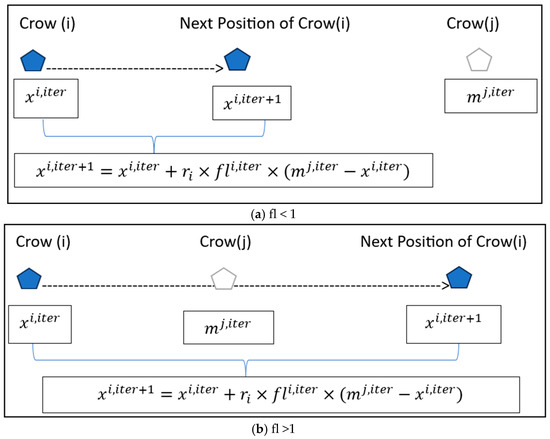
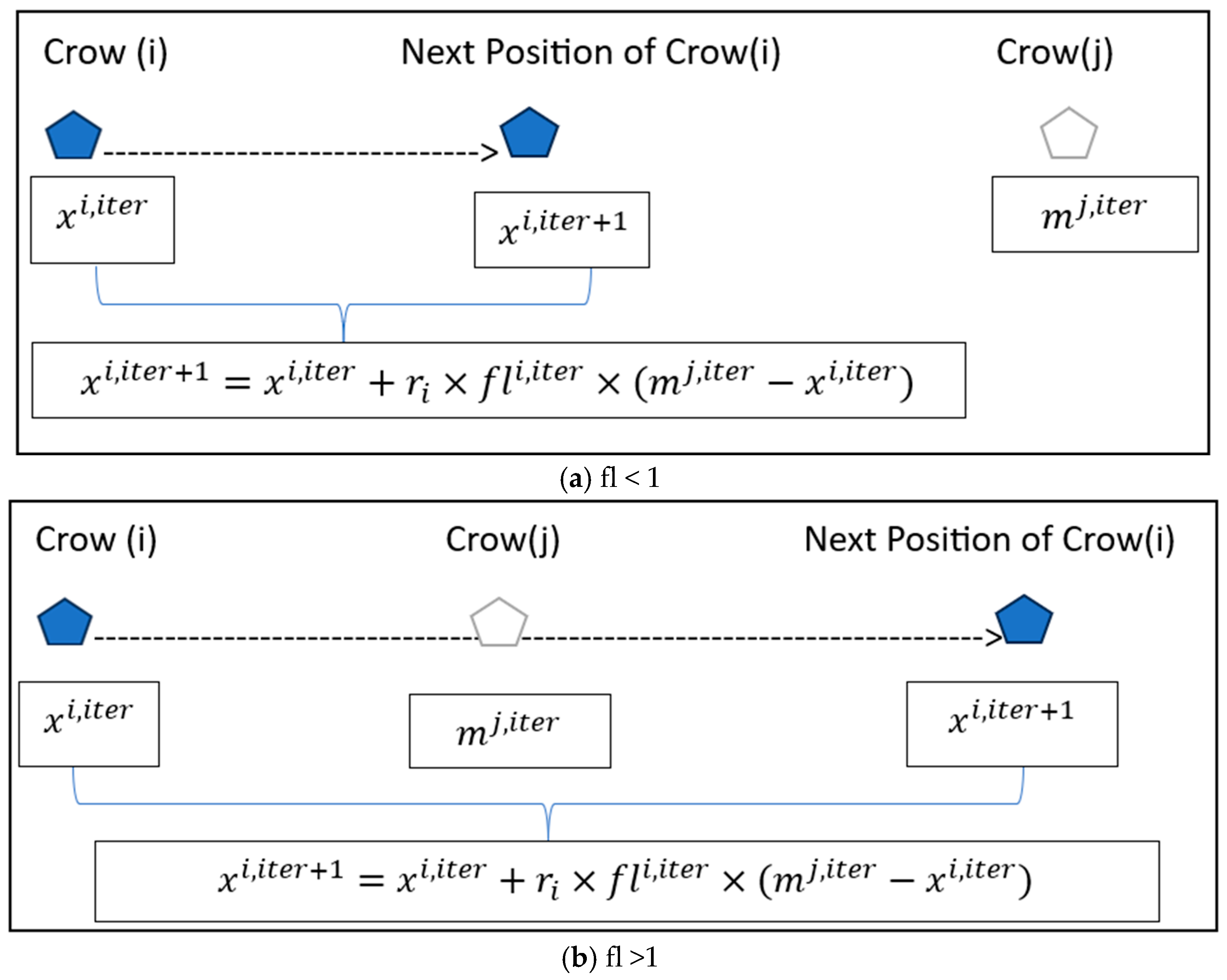
Mathematically, it is assumed that the environment has d-dimensions, the population is N, the position of a crow (i) in the environment at time (iter) is represented by a vector Xi,iter = [, , , …, ], iter has a predefined maximum number and hiding places are memorized by crows, for example the hiding place of a crow (j) is represented by . Assuming that crow (j) wants to visit its hiding place and crow (i) decides to follow crow (j), in this case the position of crow (i) can be obtained using Equation (2). Here represents a random number between 0 and 1, and represents the flight length of the crow which is a value either less than 1 to maintain local search where the next crow position is between and as in Figure 1a, or greater than 1 for global search and the next crow position might exceed as in Figure 1b.
Figure 1.
fl value effect on next position of crow [52].
The LEACH-CSA algorithm is a hybrid approach that combines the LEACH protocol with the Crow Search Algorithm. During the initialization phase, LEACH is used to select the initial centroid positions, which correspond to candidate sensor nodes acting as cluster heads. These selected nodes are encoded into the memory vector with a probability value of 1 and the rest set to 0. The fitness of these nodes is then evaluated and assigned as the initial fitness of the memory locations. Subsequently, a population of crow vectors is initialized with random values in the range [0, 1], where each element represents a sensor node in the network. The length of each crow vector is equal to the number of currently active (alive) nodes in the network.
During the flight phase, Equation (2) is applied to update the position of each crow. Following this, the fitness function defined in Equation (3) is evaluated. The fitness function defined in Equation (3) is evaluated to assess the suitability of node as a potential cluster head. The objective of this fitness function is to jointly consider both communication efficiency and energy sustainability. where represents the Euclidean distance between node (acting as a candidate CH) and the member nodes within its cluster, and denotes the total number of nodes associated with that cluster. The first term, , corresponds to the average intra-cluster distance, which reflects the communication cost between the cluster head and its member nodes. Minimizing this term promotes the selection of CHs that are centrally located within their clusters, thereby reducing transmission energy consumption. The second term, , represents the normalized energy factor, where is the initial energy of node at deployment, and is its residual energy during network operation. This ratio penalizes nodes with low remaining energy, ensuring that nodes with higher residual energy are more likely to be selected as cluster heads. Overall, the fitness function is designed as a minimization objective, where lower fitness values indicate more suitable candidates for cluster head selection. By combining both distance and energy considerations, the proposed formulation achieves a balanced trade-off between communication efficiency and network lifetime. Once node determines that its updated position yields a better (i.e., lower) fitness value than its previously stored memory , the memory is updated accordingly, as defined in Equation (4). Figure A1 illustrates the overall programming flowchart of the proposed LEACH-CSA algorithm, detailing the interaction between the initialization, flight, fitness evaluation, and memory update phases. The flight and memory update procedures are iteratively repeated for a predefined number of iterations to ensure adequate exploration and convergence of the search process. Upon completion of the optimization phase, the crow (solution vector) with the lowest fitness value is selected, and its corresponding node indices are identified as the optimal set of cluster heads.
2.3. Energy Model
The study by [36] provided an energy simulation model that is made of two energy consumption parts, an electric part ( that consists of the transmit energy consumption and data aggregation, and a second part that represents the power amplification at the transmitter () as in Equation (5). In the energy model the channel attenuation is represented by a two-ray mode or freespace model, depending on the distance (d) between the transmitter and the receiver nodes. If d is greater than the crossover distance () the two-ray transmission model is considered () as in Equation (6) where the attenuation is increased to ; otherwise the freespace transmission model is considered () as in Equation (7). At the receiving part, only electronic parts consumption is considered as in Equation (8). () is the physical criteria of the antennas and the transmission wavelength, Table 1 shows the energy model parameters that are required to determine () and the energy consumption of a sensor node during a single transmission. hr and ht are the receiver and transmitter antenna heights respectively, λ is wavelength, and P in all equations represents the packet length in bits.
Table 1.
Wireless sensor node parameters.
3. Results and Discussion
3.1. LEACH-CSA Tuning Parameters
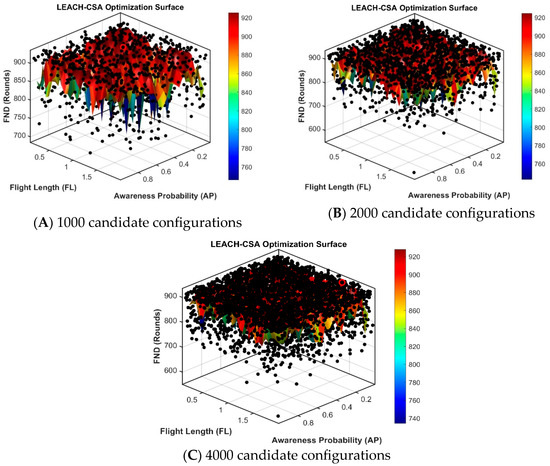
The LEACH-CSA algorithm parameters were systematically tuned to identify the optimal configuration for maximizing network lifetime and clustering efficiency in wireless sensor networks. The tuning process focused on the primary CSA control parameters, including the awareness probability (AP), flight length (FL), population size, and maximum number of iterations. The parameter ranges were selected based on commonly adopted values in the CSA-related literature and preliminary experimental observations to ensure sufficient exploration capability and optimization stability. Initially, a randomized exploration strategy was employed to generate multiple candidate parameter combinations within predefined ranges. Specifically, the awareness probability was sampled within the interval [0, 1], the flight length within [0.1, 2], the population size (POP) within [5,30], and the maximum iteration (ITER) count within [5,30]. Each generated candidate represented a unique LEACH-CSA parameter configuration. Randomized sampling was adopted to provide broad coverage of the optimization search space and avoid premature bias toward specific parameter regions.
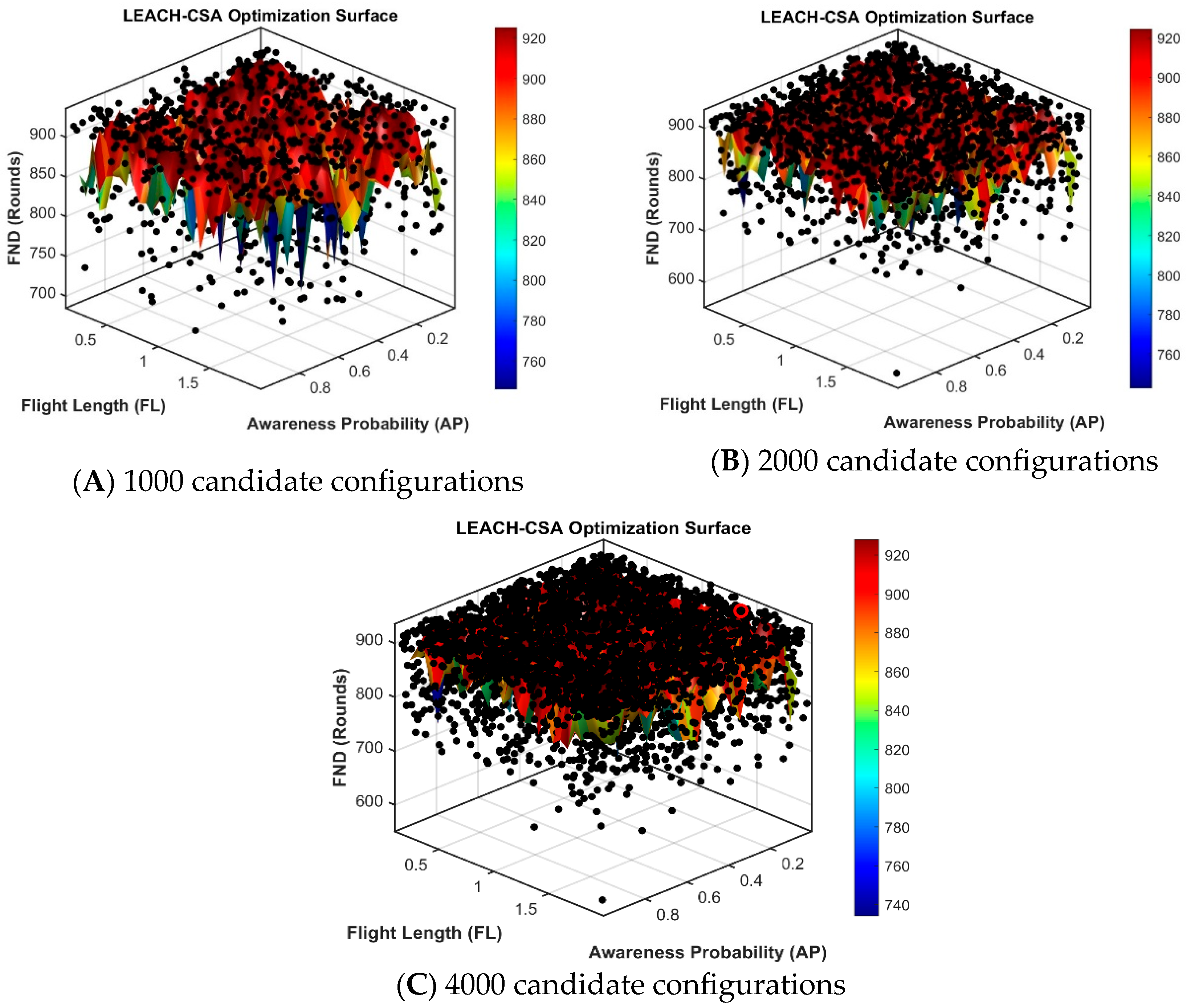
To investigate convergence behavior and determine an adequate exploration size, the tuning process was progressively conducted using increasing candidate pool sizes of 1000, 2000, and finally 4000 candidate configurations. The obtained results demonstrated that increasing the number of candidate configurations beyond 2000 produced only marginal improvements in the FND metric, indicating stabilization of the optimization process and convergence toward near-optimal parameter regions. Consequently, 4000 candidate configurations were selected to ensure sufficient search space exploration while maintaining computational efficiency. During the exploration phase, each candidate configuration was evaluated using two independent simulation runs, and the average First Node Death (FND) value was computed to reduce stochastic variability while maintaining computational efficiency. The FND metric was selected because it reflects the network stability period and energy efficiency in wireless sensor networks. Statistical analysis of the exploration-phase results produced an average FND value of (881.38 ± 1.48) rounds at a 95% confidence level, indicating that the expected mean FND performance lies within the interval [879.90, 882.86] rounds with 95% confidence. The confidence interval was computed using the standard error of the mean based on the evaluated candidate configurations.
Figure 2A–C illustrate the optimization surfaces obtained during the LEACH-CSA tuning process using 1000, 2000, and 4000 candidate configurations, respectively. The three-dimensional response surfaces visualize the relationship between (AP), (FL), and the FND metric. Figure 2A exhibits a relatively sparse optimization landscape with noticeable fluctuations and discontinuities in the surface structure. Although several high-performing parameter regions are visible, the optimization surface still contains irregular valleys and localized variations, indicating incomplete exploration of the search space. As the number of evaluated candidate configurations increased to 2000 in Figure 2B, the optimization surface became smoother and more stable. The high-FND regions expanded across a wider range of AP and FL values, suggesting improved identification of near-optimal parameter combinations. The smoother surface behavior indicates improved exploration of the optimization search space and a more stable approximation of the LEACH-CSA parameter landscape.
Figure 2.
LEACH-CSA optimization surface illustrating the relationship between AP, FL, and FND.
Figure 2C presents the final optimization surface generated using 4000 candidate configurations. Compared with Figure 2A,B, the surface exhibits a more stable structure near the highest FND values, demonstrating convergence toward robust parameter regions associated with improved network lifetime performance. The majority of the high-performing solutions were concentrated within moderate AP values and moderate-to-high FL values, indicating that balanced exploration and exploitation behavior contributes to improved cluster head selection and network stability. The numerical results obtained from the 4000-candidate optimization process in Table 2 further support the observations shown in Figure 2C. The highest FND value achieved was 936 rounds, obtained under multiple parameter combinations. Specifically, the configurations (AP = 0.4442, FL = 1.0029, POP = 14, ITER = 23) and (AP = 0.0928, FL = 1.5281, POP = 25, ITER = 18) both achieved the maximum FND value of 936 rounds. This behavior indicates that the FND performance depends on the combined interaction between AP, FL, POP, and ITER rather than on a single dominant parameter.
Table 2.
Best LEACH-CSA parameter configurations and corresponding FND performance.
The obtained results additionally indicate that awareness probability (AP) has a moderate influence on FND performance, since high-performing configurations were observed across a relatively wide AP range. In contrast, flight length (FL) appeared to exhibit a relatively stronger effect on network lifetime, where moderate-to-high FL values generally produced improved FND performance. Furthermore, moderate-to-large population sizes and moderate iteration counts enhanced optimization stability and convergence performance by improving search diversity and solution refinement capability. Overall, the relatively small variation in the obtained FND values demonstrates that the proposed LEACH-CSA framework maintains a stable performance across multiple parameter configurations. The characteristics observed in the final optimization surface confirm that several parameter combinations can achieve similar network lifetime performances, demonstrating the robustness and stability of the proposed LEACH-CSA optimization framework.
3.2. LEACH-CSA vs. Metaheuristic Algorithms
The proposed LEACH-CSA framework was benchmarked against LEACH-based metaheuristic approaches including Genetic Algorithm (GA) [53], Particle Swarm Optimization (PSO) [54], Grey Wolf Optimization (GWO) [55], and Whale Optimization Algorithm (WOA) [56]. It is assumed that all optimization and computational processes of the evaluated metaheuristic algorithms are performed at the sink node, and a unified experimental setup was adopted for all evaluated algorithms, where the conventional LEACH protocol initially generates the cluster head candidates, while the metaheuristic algorithms optimize the cluster head selection process. For simplicity throughout the analysis, the terms GA, PSO, GWO, and WOA implicitly refer to LEACH-GA, LEACH-PSO, LEACH-GWO, and LEACH-WOA, respectively.
3.3. Node Density Variation Analysis
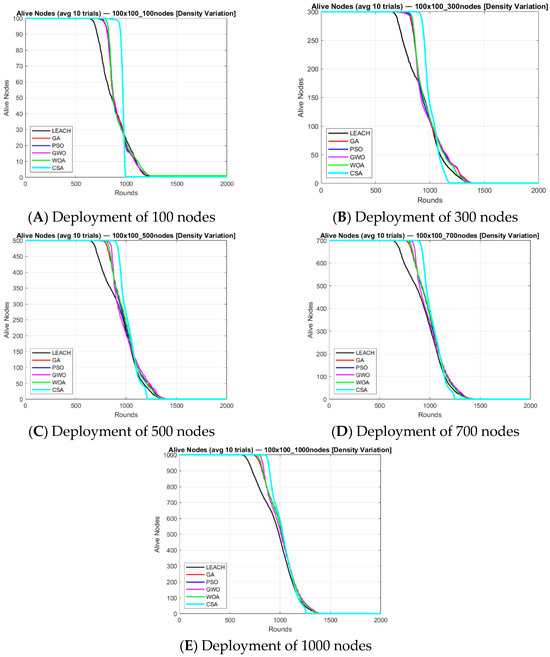
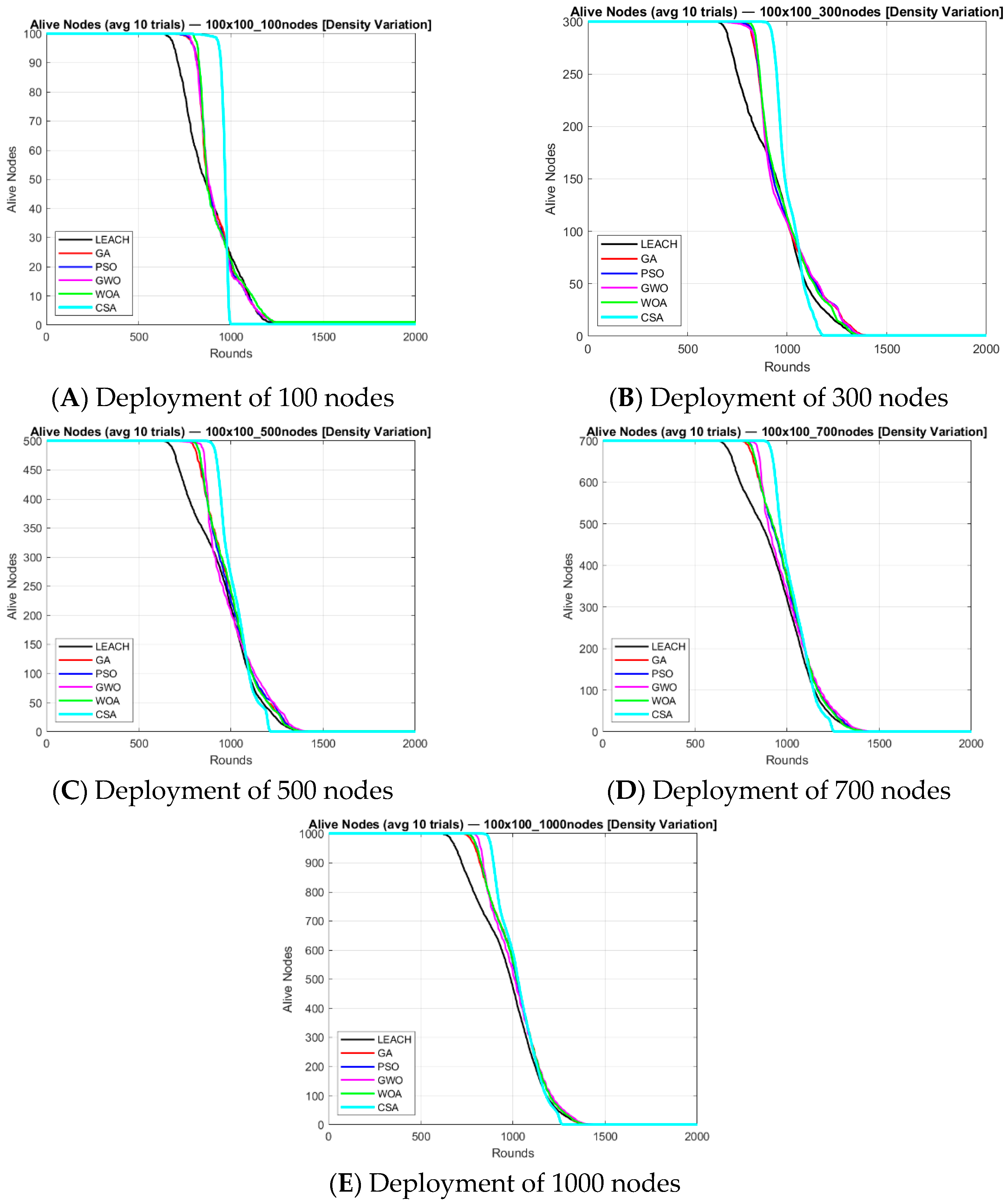
Table 3 and Figure 3A–E present the alive node performance under different node density scenarios using 100, 300, 500, 700, and 1000 deployed sensor nodes within a fixed deployment area of 100 × 100 m2. The results represent the average performance over 10 independent simulation runs. The results show that all metaheuristic-based approaches, including GA, PSO, GWO, WOA, and CSA, achieved improved network stability compared with conventional LEACH across all density levels. Conventional LEACH consistently exhibited the earliest degradation in alive node count due to less efficient cluster head selection and energy balancing. Among the optimization-based approaches, the CSA-based framework generally maintained the latest First Node Death (FND) and the longest stability period, particularly under moderate- and high-density scenarios. PSO, GWO, and WOA also demonstrated competitive performances with smoother energy depletion behavior compared with LEACH, while GA achieved a moderate improvement in network lifetime.
Table 3.
Node density performance evaluation of LEACH-based clustering protocols.
Figure 3.
Node density scalability analysis of LEACH and LEACH-based metaheuristic protocols.
As node density increased, the alive node curves shifted toward later rounds, indicating improved network stability and reduced communication distances among sensor nodes. However, under very-high-density conditions, the performance gap between the optimization-based protocols became smaller due to increased communication overhead and cluster management complexity. Overall, the obtained results confirm that the proposed LEACH-CSA framework maintains a stable and scalable performance across varying deployment densities while outperforming conventional LEACH and remaining competitive with other metaheuristic-based clustering approaches.
3.4. Area-Scaling Analysis
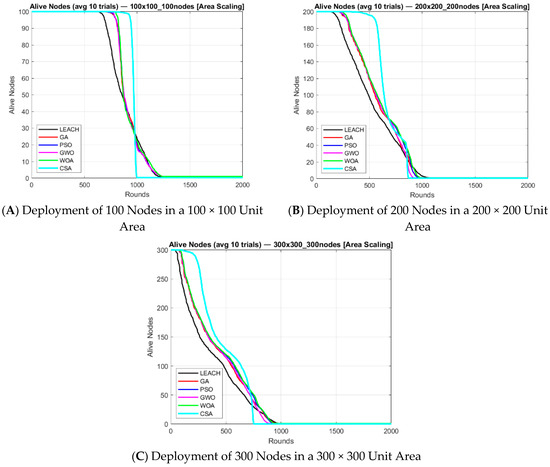
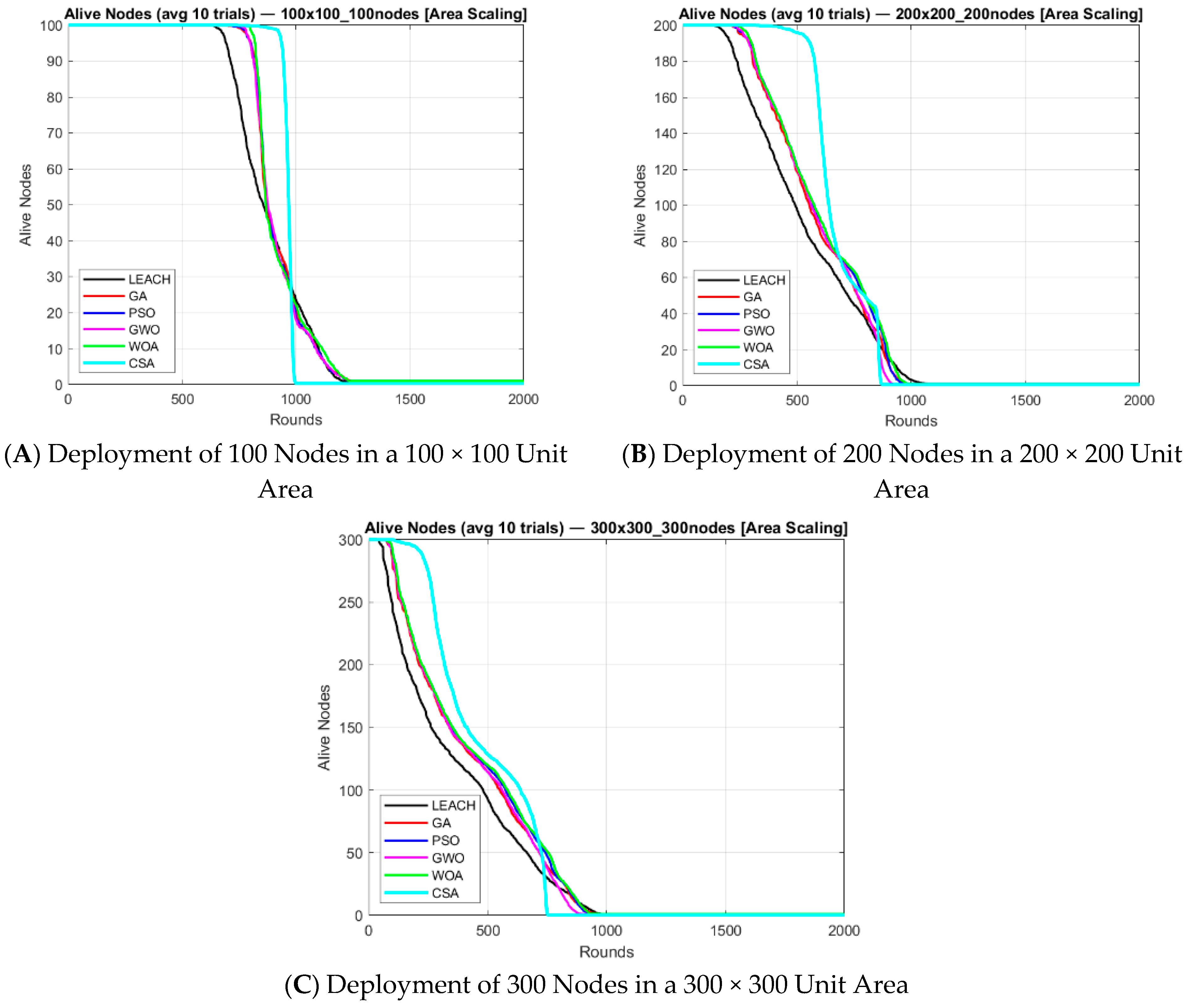
Table 4 and Figure 4A–C present the performance comparison of LEACH, GA, PSO, GWO, WOA, and the proposed LEACH-CSA framework under different area-scaling scenarios using the FND, HND, and LND metrics. The results demonstrate that LEACH-CSA consistently achieved the highest FND and HND performance across all deployment scenarios, indicating improved network stability and more efficient energy balancing compared with the remaining approaches. In the 100 × 100 deployment scenario shown in Figure 4A, LEACH-CSA achieved the highest FND value of 854 rounds compared with 656 rounds for conventional LEACH. Similar behavior was observed in Figure 4B for the 200 × 200 deployment scenario, where LEACH-CSA maintained a superior stability performance with an FND value of 398 rounds compared with 167 rounds for LEACH. Under the larger 300 × 300 deployment area shown in Figure 4C, the FND values decreased significantly for all protocols due to increased communication distances and reduced connectivity efficiency. Nevertheless, LEACH-CSA continued to outperform the remaining optimization-based approaches with an FND value of 111 rounds.
Table 4.
Area-scaling performance evaluation of metaheuristic-based clustering protocols.
Figure 4.
Area-scaling analysis of LEACH-based clustering protocols.
The alive node curves in Figure 4A–C further confirm that LEACH-CSA delays the onset of node depletion and maintains a larger number of alive nodes during the stability period compared with LEACH, GA, PSO, GWO, and WOA. Although LEACH-CSA produced lower LND values in some scenarios, this behavior indicates that the proposed optimization strategy prioritizes prolonging the stability period and delaying early node death rather than extending the final depletion phase of the network. Overall, the results demonstrate that increasing the deployment area negatively affects network lifetime for all protocols due to higher transmission energy consumption. However, the proposed LEACH-CSA framework consistently maintained a superior stability performance and scalability under different area-scaling conditions.
3.5. LEACH-CSA vs. Classical Algorithms
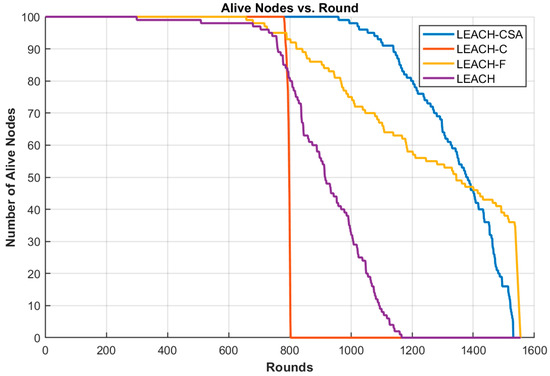
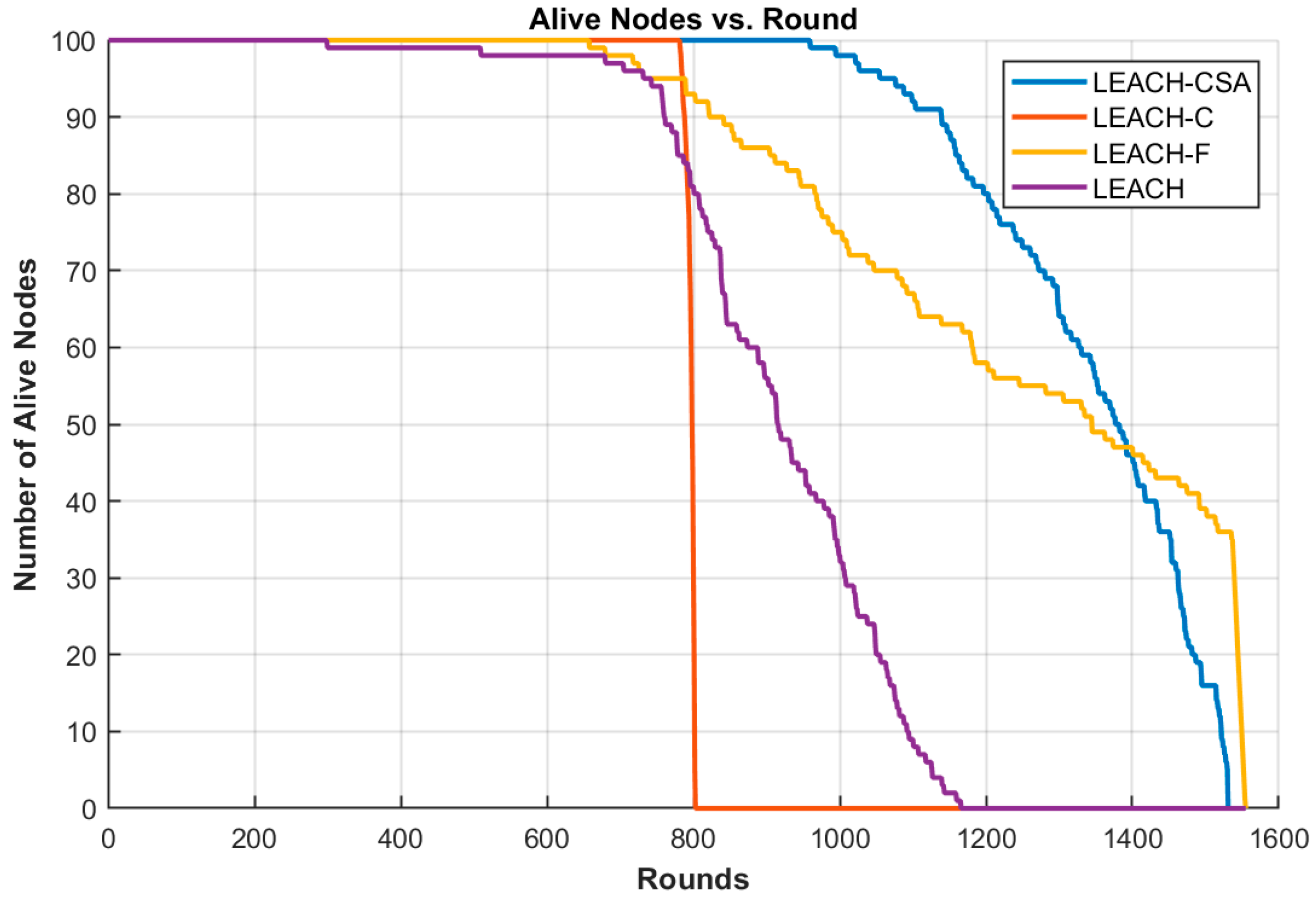
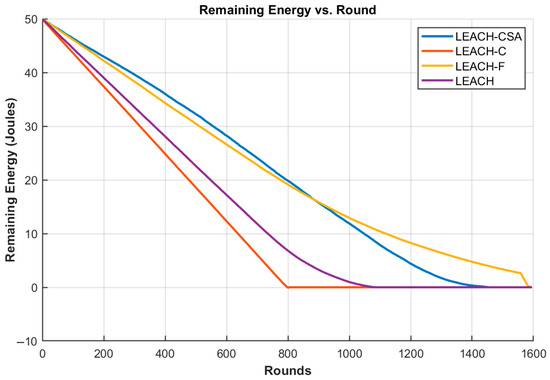
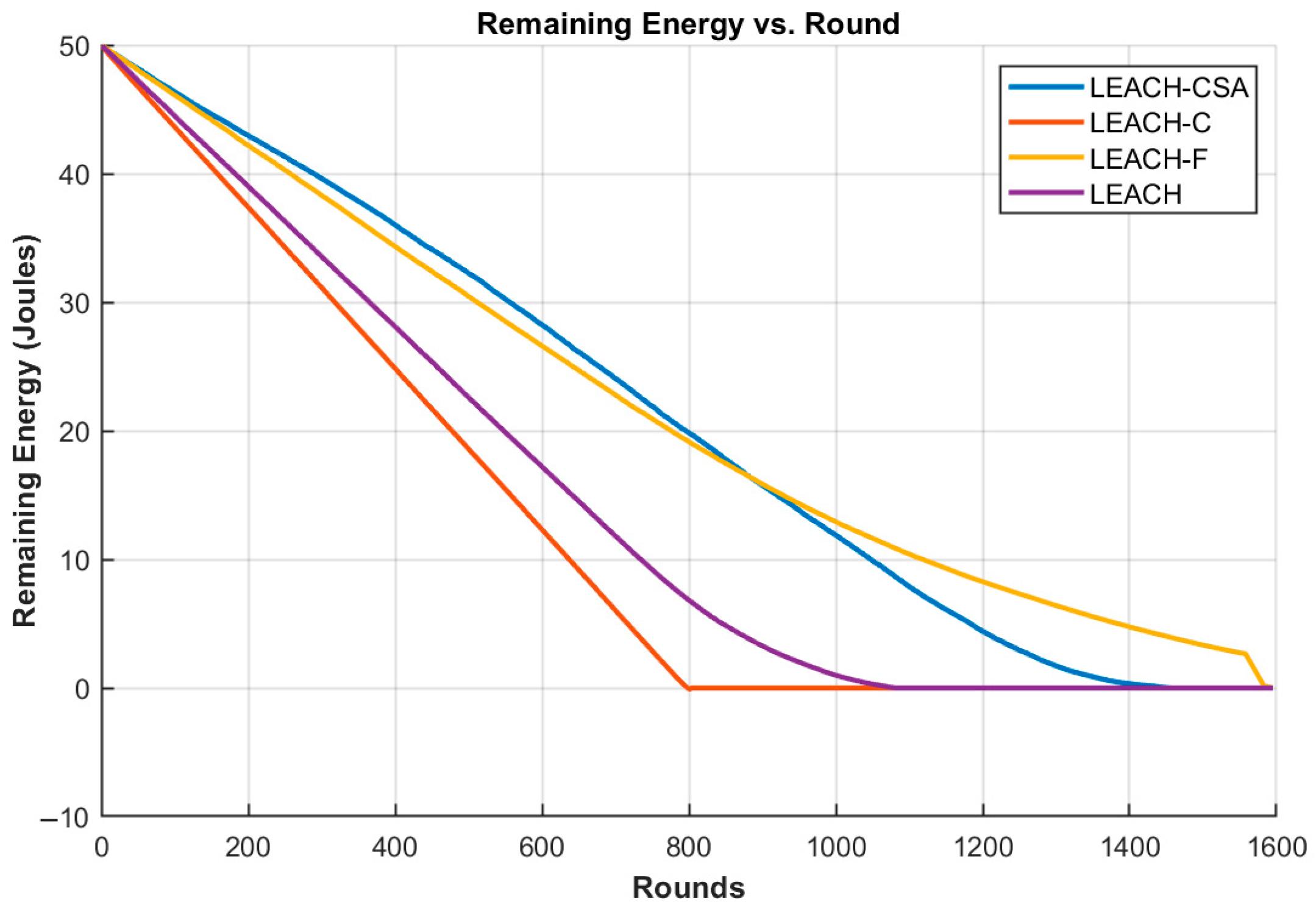
The proposed hybrid LEACH-CSA approach was simulated in MATLAB with 100 sensor nodes randomly deployed in a 100 × 100 area. The energy consumption per round and the number of alive nodes were tracked over 2000 rounds. Figure 5 and Figure 6 provide a comprehensive evaluation of the four clustering protocols, LEACH, LEACH-C, LEACH-F, and LEACH-CSA, across the three phases of wireless sensor network lifetime, FND, HND, and LND. In Figure 5, which depicts the number of alive nodes versus iteration, the stability period (from network initialization to FND) is clearly longest for LEACH-CSA, indicating a superior initial energy distribution and more effective cluster head selection. In contrast, LEACH-C exhibits the earliest node death, suggesting that its centralized clustering mechanism imposes uneven energy burdens on specific nodes. During the transitional phase between FND and HND, LEACH-C experiences a steep decline in the number of alive nodes, reflecting rapid energy depletion and poor load balancing, while LEACH shows a moderately improved but still relatively sharp degradation. LEACH-F and LEACH-CSA, however, demonstrate a more gradual reduction in node population, highlighting their ability to distribute communication and processing energy more evenly across the network. In the final phase (HND to LND), LEACH-CSA sustains node survivability for the longest duration, followed closely by LEACH-F, whereas both LEACH and LEACH-C terminate significantly earlier, confirming their inferior lifetime performance.
Figure 5.
The number of alive nodes from the start of network simulation until the last alive node.
Figure 6.
Total energy consumed of all networks from the beginning of the simulation until the last node is alive.
These behaviors are further corroborated by Figure 6, which illustrates total residual energy over time. LEACH-C exhibits the fastest energy consumption rate, reaching near depletion shortly after the FND point, thereby explaining its premature network collapse. LEACH performs slightly better but still shows a relatively rapid energy decline. In contrast, LEACH-F and particularly LEACH-CSA display a more controlled and gradual energy dissipation pattern, maintaining residual energy over a longer sequence of iterations. This indicates that these protocols achieve more balanced energy utilization among sensor nodes, effectively mitigating the formation of energy holes and preventing early exhaustion of critical nodes. Overall, the combined analysis of both figures demonstrates that LEACH-CSA achieves the best trade-off between stability period, energy efficiency, and network lifetime, followed by LEACH-F, while LEACH provides a baseline performance and LEACH-C suffers from significant inefficiencies due to its centralized clustering approach.
4. Conclusions
This paper presented a hybrid clustering algorithm, LEACH-CSA, which integrates the Crow Search Algorithm (CSA) with the traditional Low-Energy Adaptive Clustering Hierarchy (LEACH) protocol to enhance energy efficiency and network longevity in wireless sensor networks (WSNs). The proposed method leverages the global search capability of CSA to optimize cluster head (CH) selection and placement, thereby reducing intra-cluster communication distances and balancing energy consumption across nodes. The simulation results demonstrated that LEACH-CSA consistently outperformed conventional LEACH as well as LEACH-based GA, PSO, GWO, and WOA approaches in terms of network stability and energy efficiency. The proposed framework achieved improved FND and HND performances under different node density and area-scaling scenarios, indicating enhanced scalability, energy balancing, and network lifetime.
Overall, the findings confirm that combining metaheuristic optimization with hierarchical routing protocols can significantly improve the stability and sustainability of WSNs. Future work will focus on extending the LEACH-CSA framework to multi-sink or mobile node environments, incorporating adaptive parameter tuning within the CSA to reduce computational overhead, and validating performance through real-world WSN testbeds or IoT-based deployments.
Author Contributions
Conceptualization, A.R.; methodology, A.R., M.H., Z.I., M.M., A.A. and M.N.; software, A.R.; validation, A.R. and M.H.; formal analysis, A.R.; investigation, A.R.; resources, M.H., Z.I., M.M., A.A. and M.N.; data curation, A.R.; writing—original draft preparation, A.R.; writing—review and editing, M.H., Z.I., M.M., A.A. and M.N.; visualization, A.R.; supervision, M.H., Z.I. and M.N.; project administration, M.H. and Z.I.; funding acquisition, Z.I. All authors have read and agreed to the published version of the manuscript.
Funding
This research received no external funding.
Data Availability Statement
The data presented in this study are available from the corresponding author upon request.
Conflicts of Interest
The authors declare no conflicts of interest.
Appendix A. Computer Program
Appendix A.1. Introduction
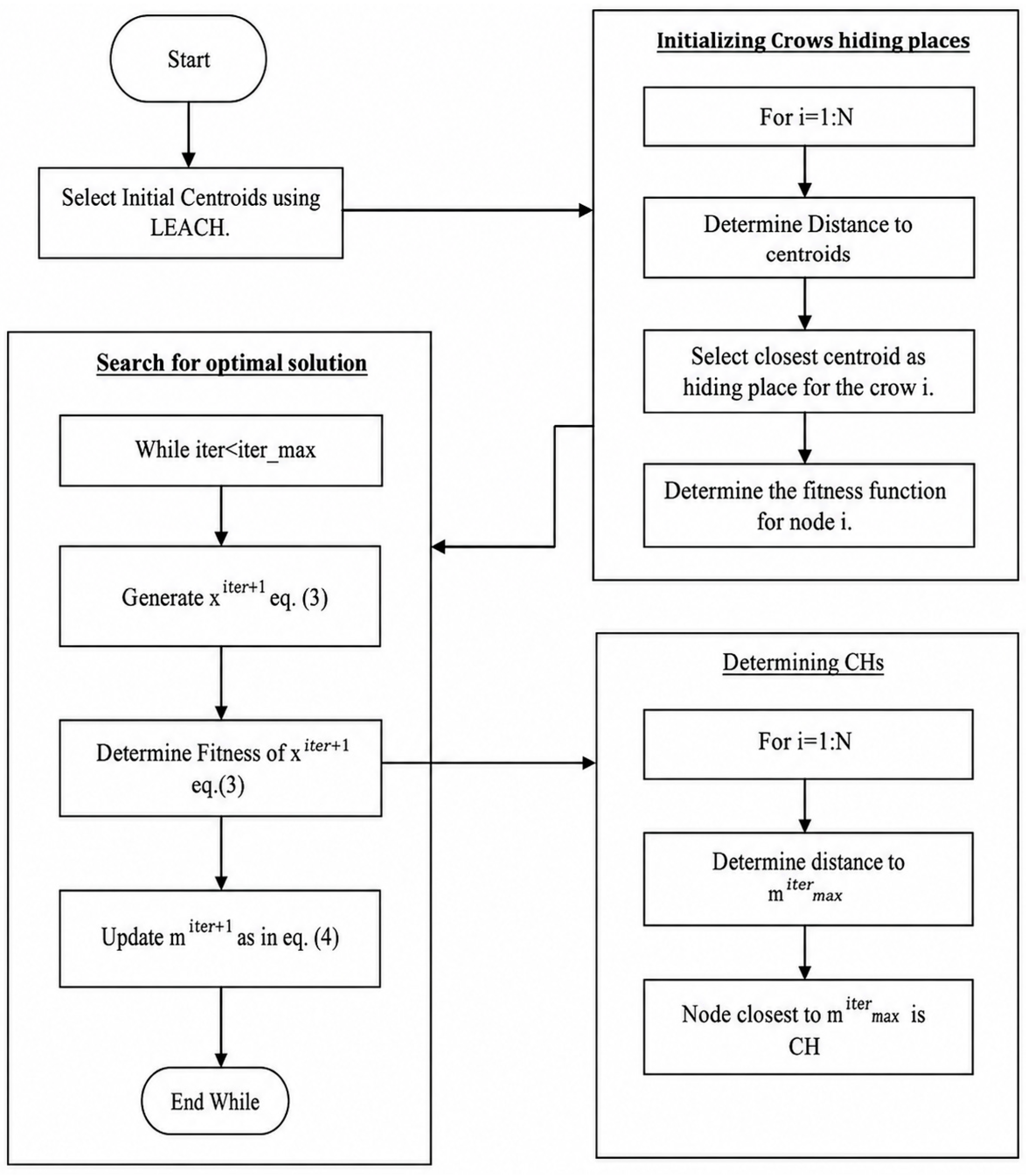
Section 2 presents a programming flow chart of LEACH-CSA. The working flow chart consists of 4 main parts; the initial centroids selection using original LEACH algorithm, then selecting initial crows and forming initial clusters to determine nodes fitness, after that exploring the network space to find optimal solution, and finally structuring the clusters.
Appendix A.2. Program Structure and Description of Subroutines
The simulation was implemented in MATLAB R202As. as mentioned earlier, the implementation consists of 4 blocks as shown in Figure A1, where each block is implemented as process or multiple sub-processes. Furthermore, after completing the simulation of these parts the consumed energy is determined and recorded. The simulation is repeated until the remaining energy of all nodes is depleted.
Figure A1.
Flowchart of the Crow-LEACH algorithm for forming clusters and optimizing selection.
References
- Miller, T.; Durlik, I.; Kostecka, E.; Kozlovska, P.; Łobodzińska, A.; Sokołowska, S.; Nowy, A. Integrating Artificial Intelligence Agents with the Internet of Things for Enhanced Environmental Monitoring: Applications in Water Quality and Climate Data. Electronics 2025, 14, 696. [Google Scholar] [CrossRef] [Scilit]
- Jahmani, K.; Mohammad, S.I.; Mohammad, A.A.S.; Vasudevan, A.; Al-Momani, A.M.; Almomani, H.M.; Masadeh, M.; Mohammad, R.I. The Internet of Things Adoption Landscape: Insights from a Comprehensive Bib-liometric Review. In Artificial Intelligence, Sustainable Technologies, and Business Innovation: Opportunities and Challenges of Digital Transformation; Springer: Berlin/Heidelberg, Germany, 2025; pp. 47–58. [Google Scholar] [CrossRef] [Scilit]
- Alakkari, K.; Ali, B. Artificial Intelligence of Things: A Review. Babylon. J. Internet Things 2025, 2025, 113–120. [Google Scholar] [CrossRef] [Scilit]
- Sial, Q.A.; Safder, U.; Iqbal, S.; Ali, R.B. Advancement in Supercapacitors for IoT Applications by Using Machine Learning: Current Trends and Future Technology. Sustainability 2024, 16, 1516. [Google Scholar] [CrossRef] [Scilit]
- Helwan, A.; Azar, D.; Ma’aitah, M.K.S. Conventional and deep learning methods in heart rate estimation from RGB face videos. Physiol. Meas. 2024, 45, 02TR01. [Google Scholar] [CrossRef] [Scilit]
- Helwan, A.; Ma’aitah, M.K.S. Machine learning in automated chest radiographs classification. In International Conference on Theory and Applications of Fuzzy Systems and Soft Computing; Springer International Publishing: Cham, Switzerland, 2020; pp. 810–816. [Google Scholar]
- Bhat, V.S.; Kakunje, A. Artificial Intelligence in Health Care. Arch. Med. Health Sci. 2024, 12, 1–2. [Google Scholar] [CrossRef] [Scilit]
- Ma’aitah, M.K.S.; Helwan, A.; Radwan, A. Urinary Bladder Acute Inflammations and Nephritis of the Renal Pelvis: Diagnosis Using Fine-Tuned Large Language Models. J. Pers. Med. 2025, 15, 45. [Google Scholar] [CrossRef] [Scilit]
- Ma’aitah, M.K.S.; Helwan, A.; Radwan, A.; Mohammad Salem Manasreh, A.; Alshareef, E.A. Multimodal model for knee osteoarthritis KL grading from plain radiograph. J. X-Ray Sci. Technol. 2025, 33, 608–620. [Google Scholar] [CrossRef] [Scilit] [PubMed]
- Selvaraj, S.; Sundaravaradhan, S. Challenges and Opportunities in IoT Healthcare Systems: A Systematic Review; Springer Nature: New York, NY, USA, 2020. [Google Scholar] [CrossRef] [Scilit]
- Polireddi, N.S.A. An effective role of artificial intelligence and machine learning in banking sec-tor. Meas. Sens. 2024, 33, 101135. [Google Scholar] [CrossRef] [Scilit]
- Douglas, D.D. The Transformative Impact of AI in Finance and Banking. J. Investig. Bank. Financ. 2024, 2, 1–8. [Google Scholar] [CrossRef] [Scilit]
- Menekay, M.; Ma’aitah, M.K.S. Applying expert system for bank credit authorization using fuzzy tools. In Proceedings of the 9th International Conference on Education Technology and Computers; Association for Computing Machinery: New York, NY, USA, 2017; pp. 258–261. [Google Scholar]
- Zhang, L.; Innab, N.; Shuhidan, S.M.; Pan, Y.; Zhang, Y.; Som, H.M.; Alasbali, N. Artificial intelligence-driven internet of things-based green supply chain for carbon reduction in sustainable manufacturing. J. Environ. Manag. 2025, 389, 126170. [Google Scholar] [CrossRef] [Scilit]
- Liu, P. Analysis of the Application of Artificial Intelligence in Transportation. J. World Archit. 2024, 8, 78–83. [Google Scholar] [CrossRef] [Scilit]
- Abiyev, R.H.; Ma’aitah, M.; Sonyel, B. Fuzzy logic traffic lights control (FLTLC). In Proceedings of the 9th International Conference on Education Technology and Computers; Association for Computing Machinery: New York, NY, USA, 2017; pp. 233–238. [Google Scholar]
- Jami Pour, M.; Hosseinzadeh, M.; Moradi, M. IoT-based entrepreneurial opportunities in smart transportation: A multidimensional framework. Int. J. Entrep. Behav. Res. 2024, 30, 450–481. [Google Scholar] [CrossRef] [Scilit]
- Bono, F.M.; Polinelli, A.; Radicioni, L.; Benedetti, L.; Castelli-Dezza, F.; Cinquemani, S.; Belloli, M. Wireless Accelerometer Architecture for Bridge SHM: From Sensor Design to System Deployment. Future Internet 2025, 17, 29. [Google Scholar] [CrossRef] [Scilit]
- Singh, P.; Vir, R. Enhanced energy-aware routing protocol with mobile sink optimization for wireless sensor networks. Comput. Netw. 2025, 261, 111100. [Google Scholar] [CrossRef] [Scilit]
- Mushtaq, M.U.; Venter, H.; Singh, A.; Owais, M. Advances in Energy Harvesting for Sustainable Wireless Sensor Networks: Challenges and Opportunities. Hardware 2025, 3, 1. [Google Scholar] [CrossRef] [Scilit]
- Radwan, A.; Kamarudin, N.H.; Solihin, M.I.; Leong, H.; Hoong, J.M.V. A Survey on Energy efficient Clustering Algorithms for Wireless Sensor Networks. Solid State Technol. 2020, 63, 1046–1060. [Google Scholar]
- Hussein, M.K. Impact of various data packet sizes on the performance of WSN-based clusters: Study. In 2021 5th International Symposium on Multidisciplinary Studies and Innovative Technologies (ISMSIT); IEEE: New York, NY, USA, 2021; pp. 424–428. [Google Scholar] [CrossRef] [Scilit]
- Lan, Y.; Kan, M.; Cao, B.; Rao, C.; Zhou, M.; Zhou, P. Optimized energy efficient clustering in WSNs through modified zebra optimization. Sci. Rep. 2025, 15, 37366. [Google Scholar] [CrossRef] [Scilit]
- Lee, J.-G.; Chim, S.; Park, H.-H. Energy-Efficient Cluster-Head Selection for Wireless Sensor Networks Using Sampling-Based Spider Monkey Optimization. Sensors 2019, 19, 5281. [Google Scholar] [CrossRef] [Scilit]
- Buratti, C.; Conti, A.; Dardari, D.; Verdone, R. An Overview on Wireless Sensor Networks Tech-nology and Evolution. Sensors 2009, 9, 6869–6896. [Google Scholar] [CrossRef] [Scilit]
- Ompal, O.; Mishra, V.M.; Kumar, A. Zigbee Internode Communication and FPGA Synthesis Using Mesh, Star and Cluster Tree Topological Chip. Wirel. Pers. Commun. 2021, 119, 1321–1339. [Google Scholar] [CrossRef] [Scilit]
- Pan, J.; Hou, Y.T.; Cai, L.; Shi, Y.; Shen, S.X. Topology control for wireless sensor networks. In Proceedings of the 9th Annual International Conference on Mobile Computing and Networking; ACM: New York, NY, USA, 2003; pp. 286–299. [Google Scholar] [CrossRef] [Scilit]
- Dutta, M.K. Comparative Study Between Star and Mesh Topology for the Application in All-Optical WDM Network. In Progress in Computing, Analytics and Networking; Springer: Singapore, 2020; pp. 255–263. [Google Scholar] [CrossRef] [Scilit]
- Dey, I.; Marchetti, N. Optimized Topology Control for IoT Networks using Graph-based Locali-zation. arXiv 2024, arXiv:2410.03204. Available online: http://arxiv.org/abs/2410.03204 (accessed on 8 April 2026).
- Shakhov, V.; Migov, D. On the Reliability of Wireless Sensor Networks with Multiple Sinks. Sensors 2024, 24, 5468. [Google Scholar] [CrossRef] [Scilit]
- Dai, Y.; Ji, J.; Qiu, Y. A dual-hop topology-aware routing protocol for underwater optical wire-less sensor networks. Opt. Switch. Netw. 2022, 45, 100682. [Google Scholar] [CrossRef] [Scilit]
- Akkaya, K.; Younis, M. A survey on routing protocols for wireless sensor networks. Ad Hoc Netw. 2005, 3, 325–349. [Google Scholar] [CrossRef] [Scilit]
- Ganesan, D.; Govindan, R.; Shenker, S.; Estrin, D. Highly-resilient, energy-efficient multipath routing in wireless sensor networks. ACM SIGMOBILE Mob. Comput. Commun. Rev. 2001, 5, 11–25. [Google Scholar] [CrossRef] [Scilit]
- Arumugam, G.S.; Ponnuchamy, T. EE-LEACH: Development of energy-efficient LEACH Proto-col for data gathering in WSN. EURASIP J. Wirel. Commun. Netw. 2015, 2015, 76. [Google Scholar] [CrossRef] [Scilit]
- Heinzelman, W.R.; Chandrakasan, A.; Balakrishnan, H. Energy-efficient communication proto-col for wireless microsensor networks. In Proceedings of the Hawaii International Conference on System Sciences; IEEE: New York, NY, USA, 2000; Volume 2, p. 223. [Google Scholar] [CrossRef] [Scilit]
- Heinzelman, W.B.; Chandrakasan, A.P.; Balakrishnan, H. An application-specific protocol ar-chitecture for wireless microsensor networks. IEEE Trans. Wirel. Commun. 2002, 1, 660–670. [Google Scholar] [CrossRef] [Scilit]
- Kim, D.S.; Chung, Y.J. Self-organization routing protocol supporting mobile nodes for wireless sensor network. In First International Multi-Symposiums on Computer and Computational Sciences; IMSCCS’06; IEEE: New York, NY, USA, 2006; Volume 2, pp. 622–626. [Google Scholar] [CrossRef] [Scilit]
- Xiao, X.; Huang, H.; Wang, W. Underwater Wireless Sensor Networks: An Energy-Efficient Clustering Routing Protocol Based on Data Fusion and Genetic Algorithms. Appl. Sci. 2020, 11, 312. [Google Scholar] [CrossRef] [Scilit]
- Gupta, S.K.; Jana, P.K. Energy Efficient Clustering and Routing Algorithms for Wireless Sen-sor Networks: GA Based Approach. Wirel. Pers. Commun. 2015, 83, 2403–2423. [Google Scholar] [CrossRef] [Scilit]
- Adumbabu, I.; Selvakumar, K. Energy Efficient Routing and Dynamic Cluster Head Selection Using Enhanced Optimization Algorithms for Wireless Sensor Networks. Energies 2022, 15, 8016. [Google Scholar] [CrossRef] [Scilit]
- Al-Mahdi, H.; Elshrkawey, M.; Saad, S.; Abdelaziz, S. An Intelligent Energy-Efficient Data Rout-ing Scheme for Wireless Sensor Networks Utilizing Mobile Sink. Wirel. Commun. Mob. Comput. 2024, 2024, 7384537. [Google Scholar] [CrossRef] [Scilit]
- Ding, Q.; Zhu, R.; Liu, H.; Ma, M. An Overview of Machine Learning-Based Energy-Efficient Routing Algorithms in Wireless Sensor Networks. Electronics 2021, 10, 1539. [Google Scholar] [CrossRef] [Scilit]
- Radwan, A.; Abdellatif, N.; Radwan, E.; Akhozahieh, M. Fitness function X-means for prolong-ing wireless sensor networks lifetime. Int. J. Electr. Comput. Eng. 2023, 13, 465–472. [Google Scholar] [CrossRef] [Scilit]
- Badawy, T.R.; Ziedan, N.I. Optimized Intelligent Localization Through Mathematical Model-ing and Crow Search Algorithms. Sensors 2025, 25, 4804. [Google Scholar] [CrossRef] [Scilit]
- Zhang, X.; Huang, C.; Gui, W. A multi-strategy improved crow search algorithm for multi-level thresholding image segmentation. Sci. Rep. 2025, 15, 20033. [Google Scholar] [CrossRef] [Scilit]
- Amrouche, A.; Boubchir, L.; Yahiaoui, S. Metaheuristic-driven neural architecture search for deep learning-based side-channel analysis. Cyber Secur. Appl. 2026, 4, 100125. [Google Scholar] [CrossRef] [Scilit]
- Zamani, H.; Nadimi-Shahraki, M.H. An evolutionary crow search algorithm equipped with in-teractive memory mechanism to optimize artificial neural network for disease diagnosis. Biomed. Signal Process. Control 2024, 90, 105879. [Google Scholar] [CrossRef] [Scilit]
- Shanmugapriya, M.; Manivannan, K.K. Compare the performance of meta-heuristics algorithm: A review. In Metaheuristics Algorithm and Optimization of Engineering and Complex Systems; IGI Global: New York, NY, USA, 2024; Volume 4, pp. 242–253. [Google Scholar] [CrossRef] [Scilit]
- Makhadmeh, S.N.; Awadallah, M.A.; Kassaymeh, S.; Al-Betar, M.A.; Sanjalawe, Y.; Kouka, S.; Al-Redhaei, A. Recent advances in Multi-objective Cuckoo Search Algorithm, its variants and applications. Arch. Comput. Methods Eng. 2025, 32, 3213–3240. [Google Scholar] [CrossRef] [Scilit]
- Sadeghian, Z.; Akbari, E.; Nematzadeh, H.; Motameni, H. A review of feature selection methods based on meta-heuristic algorithms. J. Exp. Theor. Artif. Intell. 2025, 37, 1–51. [Google Scholar] [CrossRef] [Scilit]
- Nurwinto, C.; Kurniawan, T.B.; Sutabri, T.; Kunang, Y.N. Enhancing Classification Algorithms with Metaheuristic Technique. J. Data Sci. 2024, 2024. [Google Scholar] [CrossRef] [Scilit]
- Askarzadeh, A. A novel metaheuristic method for solving constrained engineering optimization problems: Crow search algorithm. Comput. Struct. 2016, 169, 1–12. [Google Scholar] [CrossRef] [Scilit]
- Holland, J.H. Genetic Algorithms. Sci. Am. 1992, 267, 66–73. [Google Scholar] [CrossRef] [Scilit]
- Kennedy, J.; Eberhart, R. Particle Swarm Optimization. In Proceedings of ICNN’95-International Conference on Neural Networks; IEEE: New York, NY, USA, 1995; pp. 1942–1948. [Google Scholar] [CrossRef] [Scilit]
- Mirjalili, S.; Mirjalili, S.M.; Lewis, A. Grey Wolf Optimizer. Adv. Eng. Softw. 2014, 69, 46–61. [Google Scholar] [CrossRef] [Scilit]
- Mirjalili, S.; Lewis, A. The Whale Optimization Algorithm. Adv. Eng. Softw. 2014, 95, 46–61. [Google Scholar] [CrossRef] [Scilit]

Disclaimer/Publisher’s Note: The statements, opinions and data contained in all publications are solely those of the individual author(s) and contributor(s) and not of MDPI and/or the editor(s). MDPI and/or the editor(s) disclaim responsibility for any injury to people or property resulting from any ideas, methods, instructions or products referred to in the content. |
© 2026 by the authors. Licensee MDPI, Basel, Switzerland. This article is an open access article distributed under the terms and conditions of the Creative Commons Attribution (CC BY) license.