
Cybersecurity of Cyber-Physical Systems in the Quantum Era: A Systematic Literature Review-Based Approach



Abstract
1. Introduction
1.1. Contribution and Scope
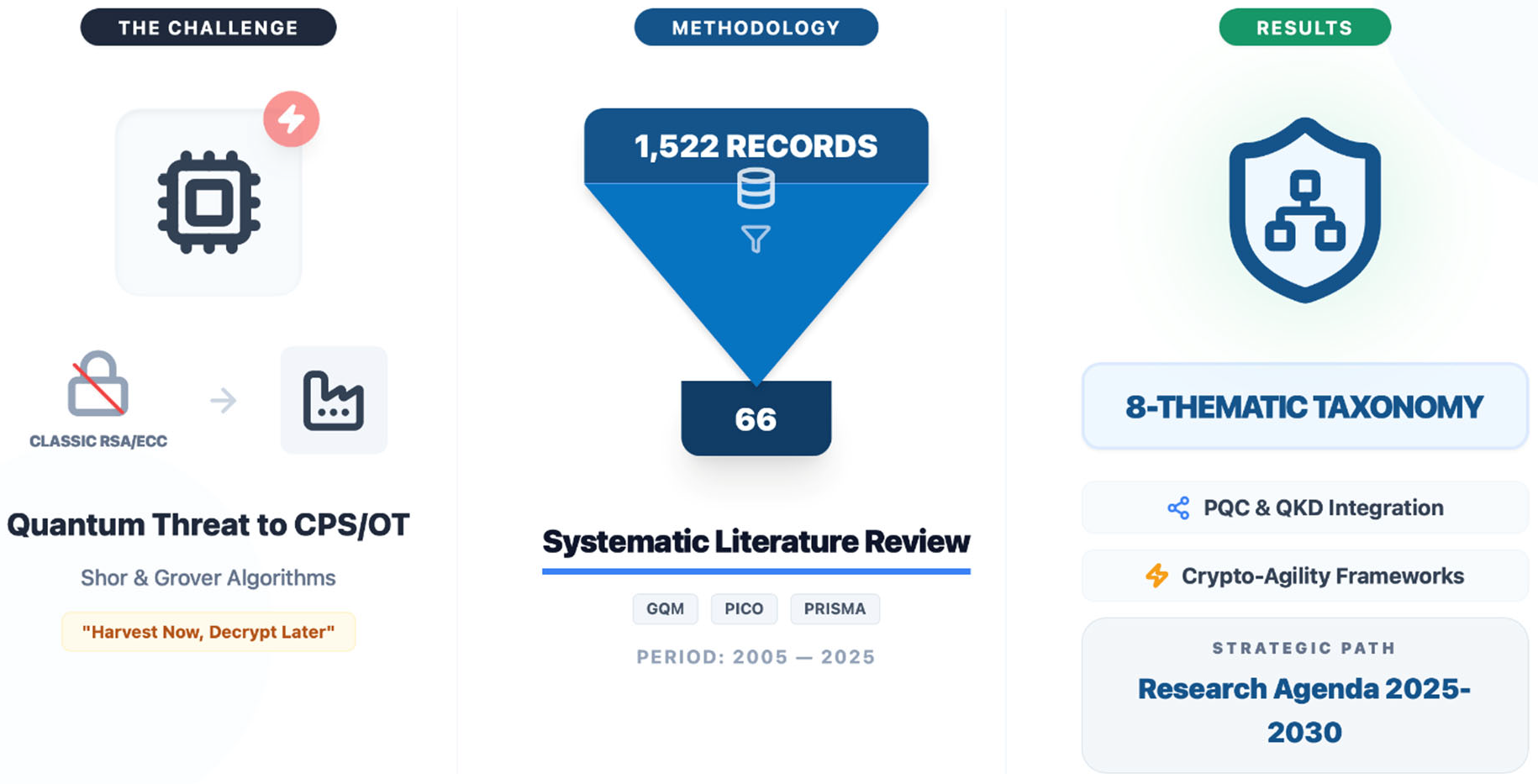
- Synthesizing evidence on how quantum computing disrupts CPS/OT ecosystems, with emphasis on structural vulnerabilities in long-lived operational assets.
- Deriving an eight-topic classification that organizes the fragmented literature (e.g., PQC in OT protocols, QKD links, quantum-aware IDS, and governance readiness).
- Mapping recurring gaps (e.g., limited PQC validation under OT constraints, scarcity of real-world datasets, and missing quantum-readiness metrics) into a targeted research agenda.
1.2. Paper Structure
2. Related Work
2.1. Foundational Trends and Emerging Threats (SG1)
2.2. Operational Security and Resilience Management (SG2)
2.3. Methodological Contributions and Experimental Validation (SG3)
2.4. Strategic Justification (SG4)
2.5. Comparative Analysis
3. Materials and Methods
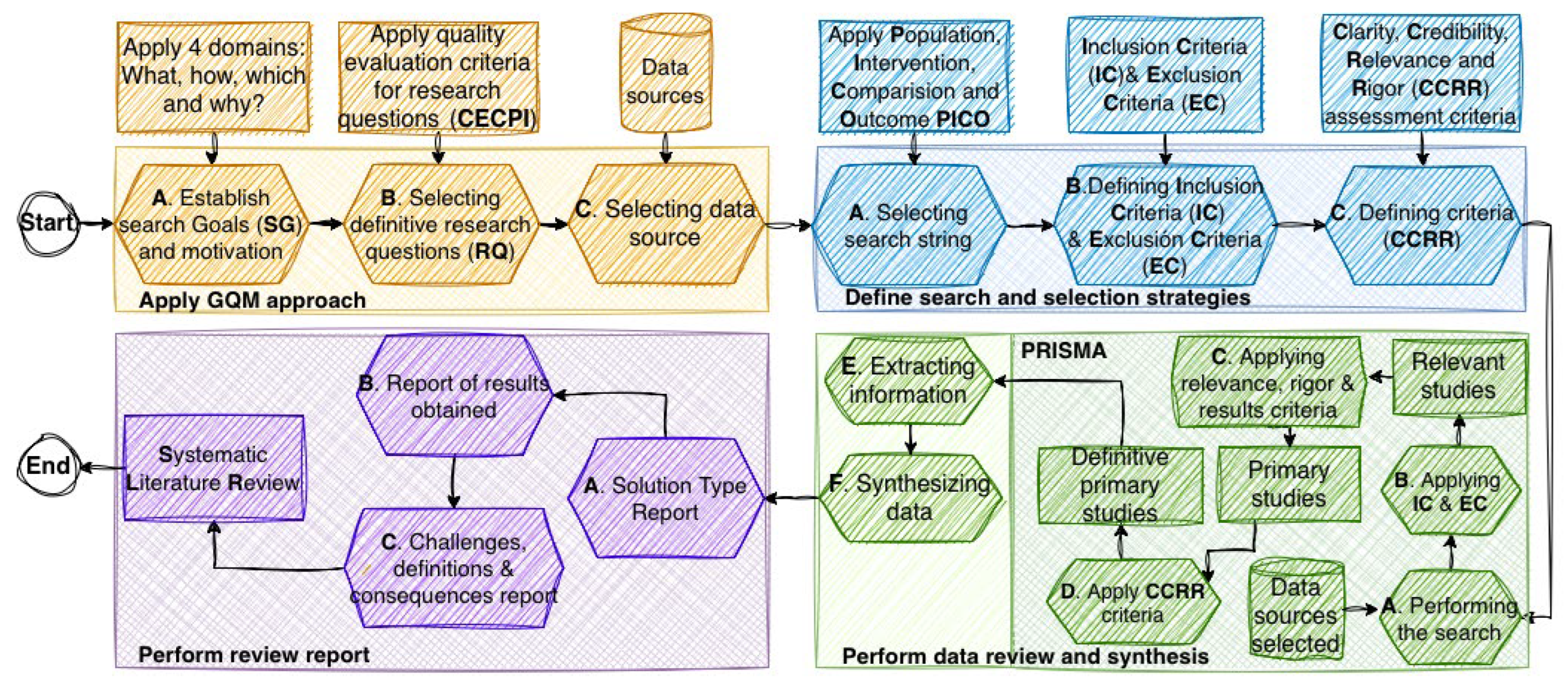
3.1. Stage 1: Apply Goal-Question-Metric (GQM) Approach
- SG1 (Knowledge): Identify emerging threats and the impact of quantum computing on CPS/OT.
- SG2 (Scope): Analyze management practices and resilience strategies.
- SG3 (Management): Examine testbeds, simulation frameworks, and experimental validation.
- SG4 (Use): Justify the research domain and identify gaps.
3.2. Stage 2: Search and Selection Strategy (PICO & PRISMA)
3.3. Stage 3: Data Review, Synthesis, and Quality Assessment
3.4. Stage 4: Reporting and Evidence Synthesis
- Familiarization with the data: This involved deep reading of the selected articles and reviewing technical extraction notes to identify recurring patterns.
- Generating initial codes: Using a structured extraction matrix (developed in Microsoft Excel), key technical concepts, performance metrics, and research gaps were systematically coded from each study.
- Searching for themes: The initial codes were grouped into preliminary categories based on commonalities in vulnerabilities, mitigation technologies, and application contexts (e.g., smart grids and PQC latency).
- Reviewing potential themes: The categories were validated against the entire dataset to ensure they accurately represented the evidence and that no critical findings were overlooked.
- Defining and naming themes: This phase resulted in the consolidation of the 8 final themes that structure the results of this study (as presented in Table 6).
- Report production: The themes were finally mapped onto the Technology-Organization-Environment (TOE) framework to provide the high-level strategic synthesis discussed in Section 5.
4. Results: Synthesis and Characterization of Finding
4.1. Study Quality Assessment (CCRR)
4.2. Evidence Mapping by Research Question
4.3. Synthesis of Findings
4.4. Temporal and Sectoral Trends
5. Discussion
5.1. The Technological Dimension: Balancing Quantum Security and Real-Time Constraints
5.2. The Organizational Dimension: The Roadmap to Quantum Readiness
5.3. The Environmental Dimension: Regulatory Pressure and Sectoral Specificity
5.4. Threats to Validity
- Biases in research questions: The formulation of research questions (RQs) can inherently limit the scope of the review if they are too narrow or biased toward a specific technology or outcome. To mitigate this, the RQs were defined iteratively and reviewed to ensure they were broad enough to cover the SLR landscape but specific enough to provide actionable insights. We aligned the questions with the PICO criteria to ensure neutrality and completeness.
- Biases in the search string: A poorly constructed search string is a major threat to internal validity, potentially leading to the exclusion of relevant studies (low recall) or an unmanageable amount of noise (low precision). This risk was minimized by:
- Conducting pilot searches to refine the keywords and synonyms.
- Include terms related to both “cyber-physical” and “cyber physical system” to account for terminological differences between communities.
- Adapting the logical operators (AND/OR) specifically for the syntax of each data source (IEEE Xplore, Scopus, Web of Science, ScienceDirect, SpringerLink, ACM Digital Library, and Google Scholar) to avoid syntax errors that could omit results.
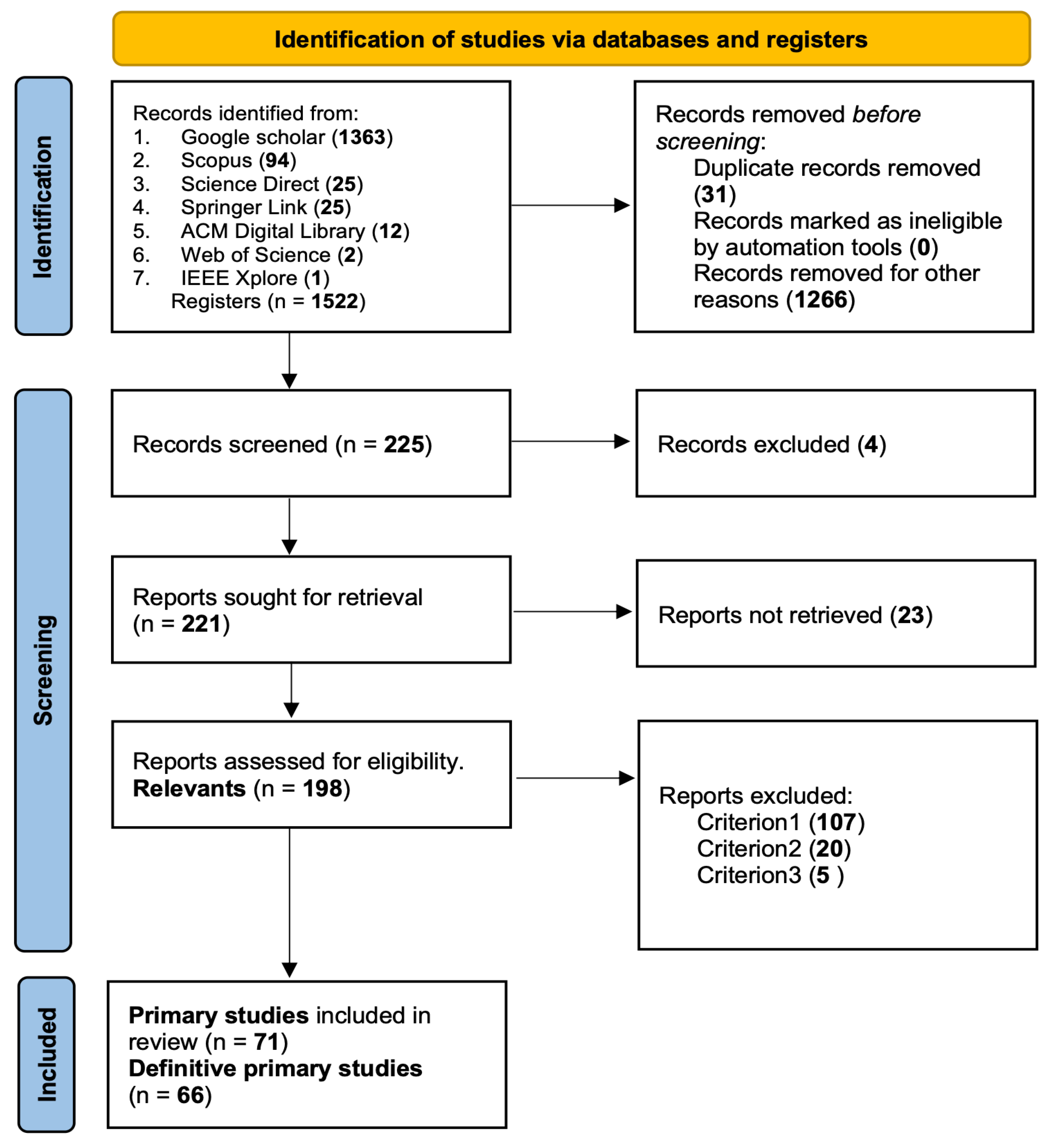
- Biases in study selection: Selection bias occurs when the decision to include or exclude a study is influenced by the researcher’s subjectivity. To mitigate this, we defined strict and explicit inclusion and exclusion criteria prior to the search. After applying the inclusion and exclusion criteria, the selection process was carried out using three criteria (Criterion 1: studies were eliminated based on an assessment of thematic relevance, methodological rigor, results, and conclusions to select the most important ones. Criterion 2: studies were eliminated based on an assessment of clarity, credibility, relevance, and rigor; and finally, Criterion 3: studies were eliminated based on an assessment of the answers to the final research questions).
- Biases in data extraction: There is a risk of inaccuracy or subjectivity when extracting complex information from the primary studies, specifically when classifying qualitative data. To mitigate this, a standardized data extraction form was designed in Excel to guide the process. During the extraction phase, ambiguous cases were discussed among the authors until a consensus was reached. This ensured that the classification of studies was consistent throughout the review.
- Publication Bias: The search was limited to English-language studies, potentially overlooking relevant developments in national-level CI research (from non-English-speaking nations active in quantum research).
5.5. Explaining Persistent Gaps Through a TOE Lens
6. Conclusions and Future Research Agenda
6.1. Conclusions
6.2. Future Research Agenda
- Hardware-Efficient PQC for Edge Devices: Research must focus on optimizing lattice-based or isogeny-based algorithms specifically for low-power microcontrollers and industrial IoT devices, minimizing the “computational debt” without compromising security.
- Quantum-Safe Real-Time Frameworks: There is an urgent need to develop hybrid security architectures that can authenticate time-critical substation communications (IEC 61850) within sub-10 ms windows, possibly through hardware acceleration or pre-computation of signatures.
- Cross-Sectoral Migration Playbooks: Future work should transition from theoretical models to practical “Migration Playbooks.” These should include step-by-step risk estimation methodologies (following Yesina et al., [8]) tailored to specific critical infrastructure sectors.
- AI-Driven Cryptographic Agility: Integrating machine learning to automate the detection of vulnerable classical primitives and facilitate the modular replacement of algorithms in software-defined industrial networks.
Author Contributions
Funding
Data Availability Statement
Acknowledgments
Conflicts of Interest
Abbreviations
| AES | Advanced Encryption Standard |
| AI/ML | Artificial Intelligence/Machine Learning |
| C2M2 | Cybersecurity Capability Maturity Model |
| CI | Critical Infrastructure |
| CPDs | Cyber-Physical Devices |
| CPSs | Cyber-Physical Systems |
| CRYSTALS | CRYptographic SuiTe for Algebraic LatticeS |
| CV-QKD | Continuous-Variable Quantum Key Distribution |
| DERs | Distributed Energy Resources |
| DV-QKD | Discrete-Variable Quantum Key Distribution |
| DNP3 | Distributed Network Protocol version 3 |
| EC | Exclusion Criteria |
| ECC | Elliptic Curve Cryptography |
| GOOSE | Generic Object-Oriented Substation Event |
| GQM | Goal Question Metric |
| HNDL | Harvest Now, Decrypt Later |
| IC | Inclusion Criteria |
| ICSs | Industrial Control Systems |
| IDS | Intrusion Detection System |
| IEC | International Electrotechnical Commission |
| IIoTs | Industrial Internet of Things |
| IoMTs | Internet of Medical Things |
| IoTs | Internet of Things |
| ML-KEM | Module-Lattice-based Key-Encapsulation Mechanism |
| NIST CSF | National Institute of Standards and Technology Cybersecurity Framework |
| OT | Operational Technology |
| PICO | Population, Intervention, Comparison and Outcome |
| PLC | Programmable Logic Controller |
| PQC | Post-Quantum Cryptography |
| PRISMA | Preferred Reporting Items for Systematic Reviews and Meta-Analyses |
| QKD | Quantum Key Distribution |
| QTM | Quantum Threat Modeling |
| RQ | Research Question |
| RSA | Rivest, Shamir & Adleman Encryption Algorithm |
| RTU | Remote Terminal Unit |
| SCADA | Supervisory Control And Data Acquisition |
| SG | Search Goal |
| SLR | Systematic Literature Review |
| SVs | Sampled Values |
| ZTAs | Zero Trust Architectures |
References
- Karnouskos, S. Stuxnet Worm Impact on Industrial Cyber-Physical System Security. In Proceedings of the IECON 2011—37th Annual Conference of the IEEE Industrial Electronics Society, Melbourne, VIC, Australia, 7–10 November 2011; IEEE: Piscataway, NJ, USA, 2011; pp. 4490–4494. [Google Scholar] [CrossRef]
- Mitchell, R.; Chen, I.-R. A Survey of Intrusion Detection Techniques for Cyber-Physical Systems. ACM Comput. Surv. 2014, 46, 1–29. [Google Scholar] [CrossRef]
- Giraldo, J.; Urbina, D.; Cárdenas, A.; Valente, J.; Faisal, M.; Ruths, J.; Tippenhauer, N.O.; Sandberg, H.; Candell, R. A Survey of Physics-Based Attack Detection in Cyber-Physical Systems. ACM Comput. Surv. 2018, 51, 1–36. [Google Scholar] [CrossRef]
- Mosca, M. Cybersecurity in an Era with Quantum Computers: Will We Be Ready? IEEE Secur. Priv. 2018, 16, 38–41. [Google Scholar] [CrossRef]
- Bernstein, D.J.; Lange, T.; Schwabe, P. Post-Quantum Cryptography: State of the Art. IEEE Secur. Priv. 2015, 13, 22–27. [Google Scholar] [CrossRef]
- Taylor, M.G. An Introduction to Quantum Threat Modeling. Commun. ACM 2023, 66, 38–46. [Google Scholar] [CrossRef]
- Pirandola, S.; Andersen, U.L.; Banchi, L.; Berta, M.; Bunandar, D.; Colbeck, R.; Englund, D.; Gehring, T.; Lupo, C.; Ottaviani, C.; et al. Advances in quantum cryptography. Adv. Opt. Photonics 2020, 12, 1012. [Google Scholar] [CrossRef]
- Yesina, M.V.; Ostrianska, Y.V.; Gorbenko, I.D. Status report on the third round of the NIST post-quantum cryptography standardization process. Radiotekhnika 2022, 3, 75–86. [Google Scholar] [CrossRef]
- Lo, H.-K.; Curty, M.; Tamaki, K. Secure Quantum Key Distribution. Nat. Photonics 2014, 8, 595–604. [Google Scholar] [CrossRef]
- Mo, Y.; Kim, T.H.J.; Brancik, K.; Dickinson, D.; Lee, H.; Perrig, A.; Sinopoli, B. Cyber–Physical Security of a Smart Grid Infrastructure. Proc. IEEE 2012, 100, 195–209. [Google Scholar] [CrossRef]
- Chung, C.-C.; Pai, C.-C.; Ching, F.-S.; Wang, C.; Chen, L.-J. When Post-Quantum Cryptography Meets the Internet of Things: An Empirical Study. In Proceedings of the 20th Annual International Conference on Mobile Systems, Applications and Services (MobiSys ’22); Association for Computing Machinery: New York, NY, USA, 2022; pp. 525–526. [Google Scholar] [CrossRef]
- Rose, S.; Borchert, O.; Mitchell, S.; Connelly, S. Zero Trust Architecture; NIST: Gaithersburg, MD, USA, 2020. [Google Scholar] [CrossRef]
- IEC 62443-1-1:2018; Security for Industrial Automation and Control Systems—Part 1-1: Terminology, Concepts and Models. International Electrotechnical Commission: Geneva, Switzerland, 2018.
- Jiang, Y.; Jeusfeld, M.A.; Mosaad, M.; Oo, N. Enterprise architecture modeling for cybersecurity analysis in critical infrastructures—A systematic literature review. Int. J. Crit. Infrastruct. Prot. 2024, 46, 100700. [Google Scholar] [CrossRef]
- Donado, S.A.; Calvache, C.J.P.; Mazo, R. Stage 1. Apply Goal Question Metric Approach to Target Questions; Zenodo: Geneva, Switzerland, 2025. [Google Scholar] [CrossRef]
- Cook, A.; Nicholson, A.; Janicke, H.; Maglaras, L.; Smith, R. Attribution of Cyber Attacks on Industrial Control Systems. EAI Endorsed Trans. Ind. Netw. Intell. Syst. 2016, 3, 151158. [Google Scholar] [CrossRef]
- Homay, A.; Chrysoulas, C.; El Boudani, B.; de Sousa, M.; Wollschlaeger, M. A security and authentication layer for SCADA/DCS applications. Microprocess. Microsyst. 2021, 87, 103479. [Google Scholar] [CrossRef]
- Mohammad, A. Development of the concept of electronic government construction in the conditions of synergetic threats. Technol. Audit. Prod. Reserves 2020, 3, 42–46. [Google Scholar] [CrossRef]
- Alshowkan, M.; Evans, P.G.; Starke, M.; Earl, D.; Peters, N.A. Authentication of smart grid communications using quantum key distribution. Sci. Rep. 2022, 12, 12731. [Google Scholar] [CrossRef]
- Poustourli, A. Research in Security Standardisation [Έρευνα στην Τυποποίηση και τα Πρότυπα Aσφάλειας]. In Proceedings of SafeEvros 2016: New Technologies at the Service of Civil Protection, Alexandroupolis, Greece, 22–25 June 2016; Democritus University of Thrace: Komotini, Greece, 2017; pp. 30–32. ISBN 978-960-89345-7-3. [Google Scholar]
- Shahzad, A.; Musa, S.; Aborujilah, A.; Irfan, M. The security survey and anaylsis on supervisory control and data acquisition communication. J. Comput. Sci. 2014, 10, 2006–2019. [Google Scholar] [CrossRef]
- Sundararajan, A.; Chavan, A.; Saleem, D.; Sarwat, A. A Survey of Protocol-Level Challenges and Solutions for Distributed Energy Resource Cyber-Physical Security. Energies 2018, 11, 2360. [Google Scholar] [CrossRef]
- Tomlinson, A.; Parkin, S.; Shaikh, S.A. Drivers and barriers for secure hardware adoption across ecosystem stakeholders. J. Cybersecur. 2022, 8, tyac009. [Google Scholar] [CrossRef]
- Yang, W.; Peisong, Y.; Qianchuan, Z. Industry Trusted Network Communication Based on Quantum Encryption. In Proceedings of the 2019 Chinese Control Conference (CCC), Guangzhou, China, 27–30 July 2019; IEEE: Piscataway, NJ, USA, 2019; pp. 7016–7022. [Google Scholar] [CrossRef]
- Saha, S.S.; Rahman, S.; Ahmed, M.U.; Aditya, S.K. Ensuring Cybersecure Telemetry and Telecommand in Small Satellites: Recent Trends and Empirical Propositions. IEEE Aerosp. Electron. Syst. Mag. 2019, 34, 34–49. [Google Scholar] [CrossRef]
- Mamun, A.A.; Abrar, A.; Rahman, M.; Salek, M.S.; Chowdhury, M. Enhancing Transportation Cyber-Physical Systems Security: A Shift to Post-Quantum Cryptography. arXiv 2024, arXiv:2411.13023. [Google Scholar] [CrossRef]
- Khan, M.A.; Javaid, S.; Mohsan, S.A.H.; Tanveer, M.; Ullah, I. Future-proofing security for UAVs with post-quantum cryptography: A review. IEEE Open J. Commun. Soc. 2024, 5, 6849–6871. [Google Scholar] [CrossRef]
- Pöyhönen, J. Cyber Security of an Electric Power System in Critical Infrastructure. In Cyber Security. Computational Methods in Applied Sciences; Springer: Cham, Switzerland, 2022; pp. 217–239. [Google Scholar] [CrossRef]
- Kumar, P.; Lin, Y.; Bai, G.; Paverd, A.; Dong, J.S.; Martin, A. Smart Grid Metering Networks: A Survey on Security, Privacy and Open Research Issues. IEEE Commun. Surv. Tutor. 2019, 21, 2886–2927. [Google Scholar] [CrossRef]
- Hussain, S.; Meraj, M.; Abughalwa, M.; Shikfa, A. Smart Grid Cybersecurity: Standards and Technical Countermeasures. In Proceedings of the 2018 International Conference on Computer and Applications (ICCA), Beirut, Lebanon, 25–26 August 2018; IEEE: Piscataway, NJ, USA, 2018; pp. 136–140. [Google Scholar] [CrossRef]
- Alguliyev, R.; Imamverdiyev, Y.; Sukhostat, L. Cyber-physical systems and their security issues. Comput. Ind. 2018, 100, 212–223. [Google Scholar] [CrossRef]
- Yaacoub, J.P.A.J.-P.A.; Salman, O.; Noura, H.N.H.N.; Kaaniche, N.; Chehab, A.; Malli, M. Cyber-physical systems security: Limitations, issues and future trends. Microprocess. Microsyst. 2020, 77, 103201. [Google Scholar] [CrossRef] [PubMed]
- Jasiūnas, J.; Lund, P.D.; Mikkola, J. Energy system resilience—A review. Renew. Sustain. Energy Rev. 2021, 150, 111476. [Google Scholar] [CrossRef]
- Khoei, T.T.; Slimane, H.O.; Kaabouch, N. A Comprehensive Survey on the Cyber-Security of Smart Grids: Cyber-Attacks, Detection, Countermeasure Techniques, and Future Directions. arXiv 2022, arXiv:2207.07738. [Google Scholar] [CrossRef]
- Tedeschi, P.; Sciancalepore, S.; Di Pietro, R. Satellite-based communications security: A survey of threats, solutions, and research challenges. Comput. Netw. 2022, 216, 109246. [Google Scholar] [CrossRef]
- Thomasian, N.M.; Adashi, E.Y. Cybersecurity in the Internet of Medical Things. Health Policy Technol. 2021, 10, 100549. [Google Scholar] [CrossRef]
- Choi, M.K.; Yeun, C.Y.; Seong, P.H. A Novel Monitoring System for the Data Integrity of Reactor Protection System Using Blockchain Technology. IEEE Access 2020, 8, 118732–118740. [Google Scholar] [CrossRef]
- Alimi, O.A.; Ouahada, K.; Abu-Mahfouz, A.M.; Rimer, S.; Alimi, K.O.A. A Review of Research Works on Supervised Learning Algorithms for SCADA Intrusion Detection and Classification. Sustainability 2021, 13, 9597. [Google Scholar] [CrossRef]
- Kong, P.-Y. A Review of Quantum Key Distribution Protocols in the Perspective of Smart Grid Communication Security. IEEE Syst. J. 2022, 16, 41–54. [Google Scholar] [CrossRef]
- Syafrizal, M.; Selamat, S.R.; Zakaria, N.A. Analysis of Cybersecurity Standard and Framework Components. Int. J. Commun. Netw. Inf. Secur. 2022, 12, 417–432. [Google Scholar] [CrossRef]
- Maynard, P.; McLaughlin, K. Towards Understanding Man-on-the-Side Attacks (MotS) in SCADA Networks. In Proceedings of the 17th International Joint Conference on e-Business and Telecommunications, Paris, France, 8–10 July 2020; SCITEPRESS-Science and Technology Publications: Setúbal, Portugal, 2020; pp. 287–294. [Google Scholar] [CrossRef]
- Rajeh, W. An Integrated Authentication Scheme for Supervisory Control and Data Acquisition System Based on Quantum Key Distribution. In Proceedings of the 2022 2nd International Conference on Computing and Information Technology (ICCIT), Tabuk, Saudi Arabia, 25–27 January 2022; IEEE: Piscataway, NJ, USA, 2022; pp. 374–378. [Google Scholar] [CrossRef]
- Wang, W.; Harrou, F.; Bouyeddou, B.; Senouci, S.-M.; Sun, Y. Cyber-attacks detection in industrial systems using artificial intelligence-driven methods. Int. J. Crit. Infrastruct. Prot. 2022, 38, 100542. [Google Scholar] [CrossRef]
- Xu, W.; Tao, Y.; Yang, C.; Chen, H. MSICST: Multiple-Scenario Industrial Control System Testbed for Security Research. Comput. Mater. Contin. 2019, 60, 691–705. [Google Scholar] [CrossRef]
- Tao, Y.; Xu, W.; Li, H.; Ji, S. Experience and Lessons in Building an ICS Security Testbed. In Proceedings of the 2019 1st International Conference on Industrial Artificial Intelligence (IAI), Shenyang, China, 23–27 July 2019; IEEE: Piscataway, NJ, USA, 2019; pp. 1–6. [Google Scholar] [CrossRef]
- Lee, C.C.; Tan, T.G.; Sharma, V.; Zhou, J. Quantum Computing Threat Modelling on a Generic CPS Setup. In Applied Cryptography and Network Security Workshops; 12809 LNCS; Zhou, J., Ahmed, C.M., Batina, L., Chattopadhyay, S., Eds.; Springer Nature: Cham, Switzerland, 2021; pp. 171–190. [Google Scholar] [CrossRef]
- Saeed, S.; Gull, H.; Aldossary, M.M.; Altamimi, A.F.; Alshahrani, M.S.; Saqib, M.; Iqbal, S.Z.; Almuhaideb, A.M. Digital Transformation in Energy Sector: Cybersecurity Challenges and Implications. Information 2024, 15, 764. [Google Scholar] [CrossRef]
- Yigit, Y.; Ferrag, M.A.; Ghanem, M.C.; Sarker, I.H.; Maglaras, L.A.; Chrysoulas, C.; Moradpoor, N.; Tihanyi, N.; Janicke, H. Generative ai and llms for critical infrastructure protection: Evaluation benchmarks, agentic ai, challenges, and opportunities. Sensors 2025, 25, 1666. [Google Scholar] [CrossRef] [PubMed]
- AlEnezi, A. Risk Assessment in OT Environments: Safeguarding Kuwait’s Critical Infrastructure. researchgate.net. Available online: https://www.researchgate.net/profile/Ali-Alenezi-4/publication/383870626_Risk_Assessment_in_OT_Environments_Safeguarding_Kuwait’s_Critical_Infrastructure/links/66debdfef84dd1716cde0a95/Risk-Assessment-in-OT-Environments-Safeguarding-Kuwaits-Critical-Infra (accessed on 17 January 2026).
- Singh, N.; Buyya, R.; Kim, H. Securing cloud-based internet of things: Challenges and mitigations. Sensors 2024, 25, 79. [Google Scholar] [CrossRef]
- Chen, D.; Peng, Y.; Wang, H. Development of a Testbed for Process Control System Cybersecurity Research. In Proceedings of the 3rd International Conference on Electric and Electronics, Hong Kong, China, 24–25 December 2013; pp. 158–161. [Google Scholar] [CrossRef]
- Hussain; Mohamed, A.; Razali, S. A Review on Cybersecurity: Challenges & Emerging Threats. In Proceedings of the 3rd International Conference on Networking, Information Systems & Security, Marrakech, Morocco, 31 March–2 April 2020; ACM: New York, NY, USA, 2020. [Google Scholar] [CrossRef]
- Negi, R.; Shukla, S.K. Building India’s First Cyber-Security Test-Bed for CI. In Cyber Security in India: Education, Research and Training; Shukla, S.K., Agrawal, M., Eds.; Chapter 1; Springer: Singapore, 2020; pp. 1–15. [Google Scholar] [CrossRef]
- Mukhopadhyay, D. Hardware Security in India: The Journey so Far. In Cyber Security in India: Education, Research and Training; Shukla, S.K., Agrawal, M., Eds.; Chapter 8; Springer: Singapore, 2020; pp. 71–96. [Google Scholar] [CrossRef]
- Sahin, M.E.; Tawalbeh, L.; Muheidat, F. The Security Concerns On Cyber-Physical Systems And Potential Risks Analysis Using Machine Learning. Procedia Comput. Sci. 2022, 201, 527–534. [Google Scholar] [CrossRef]
- Yang, M.; Qu, Y.; Ranbaduge, T.; Thapa, C.; Sultan, N.H.; Ding, M.; Suzuki, H.; Ni, W.; Abuadbba, S.; Smith, D.; et al. From 5g to 6g: A survey on security, privacy, and standardization pathways. ACM Comput. Surv. 2026, 58, 1–38. [Google Scholar] [CrossRef]
- Wehner, S.; Elkouss, D.; Hanson, R. Quantum Internet: A Vision for the Road Ahead. Science 2018, 362, eaam9288. [Google Scholar] [CrossRef]
- Sikiru, A.; Kora, A.D.; Ezin, E.C.; Imoize, A.L.; Li, C.T. Hybridization of Learning Techniques and Quantum Mechanism for IIoT Security: Applications, Challenges, and Prospects. Electronics 2024, 13, 4153. [Google Scholar] [CrossRef]
- NIST. Module-Lattice-Based Key-Encapsulation Mechanism Standard; NIST: Gaithersburg, MD, USA, 2024. [CrossRef]
- Gonzalez-Granadillo, G.; Dubus, S.; Motzek, A.; Garcia-Alfaro, J.; Alvarez, E.; Merialdo, M.; Papillon, S.; Debar, H. Dynamic risk management response system to handle cyber threats. Future Gener. Comput. Syst. 2018, 83, 535–552. [Google Scholar] [CrossRef]
- Evans, P.G.; Alshowkan, M.; Earl, D.; Mulkey, D.D.; Newell, R.; Peterson, G.; Safi, C.; Tripp, J.L.; Peters, N.A. Trusted Node QKD at an Electrical Utility. IEEE Access 2021, 9, 105220–105229. [Google Scholar] [CrossRef]
- Paul, S.; Niethammer, M. On the importance of cryptographic agility for industrial automation. at-Automatisierungstechnik 2019, 67, 402–416. [Google Scholar] [CrossRef]
- Tan, T.G.; Szalachowski, P.; Zhou, J. Challenges of post-quantum digital signing in real-world applications: A survey. Int. J. Inf. Secur. 2022, 21, 937–952. [Google Scholar] [CrossRef]
- Tuinema, B.W.; Torres, J.L.R.; Stefanov, A.I.; Gonzalez-Longatt, F.M.; van der Meijden, M.A.M.M. Cyber-physical system modeling for assessment and enhancement of power grid cyber security, resilience, and reliability. In Probabilistic Reliability Analysis of Power Systems; Springer: Cham, Switzerland, 2020. [Google Scholar] [CrossRef]
- Sharkov, G. Assessing the Maturity of National Cybersecurity and Resilience. Connect. Q. J. 2020, 19, 5–24. [Google Scholar] [CrossRef]
- Gholami, M.M.; Kassaee, M.; Arabsorkhi, A. A Novel Maturity Model for MSSP Assessment. Int. J. Inf. Commun. Technol. Res. 2019, 11, 57–70. [Google Scholar]
- Khou, S.; Mailloux, L.O.; Pecarina, J.M.; Mcevilley, M. A Customizable Framework for Prioritizing Systems Security Engineering Processes, Activities, and Tasks. IEEE Access 2017, 5, 12878–12894. [Google Scholar] [CrossRef]
- Syed, N.F.; Shah, S.W.; Shaghaghi, A.; Anwar, A.; Baig, Z.; Doss, R. Zero Trust Architecture (ZTA): A Comprehensive Survey. IEEE Access 2022, 10, 57143–57179. [Google Scholar] [CrossRef]
- Ahmadi, N. A Comprehensive Cybersecurity Framework For Afghanistan’s Cyberspace. Int. J. Eng. Appl. Sci. Technol. 2021, 6, 213–230. [Google Scholar] [CrossRef]
- Donado, S.A.; Calvache, C.J.P.; Mazo, R. Stage 3. Perform Data Review and Synthesis; Zenodo: Geneva, Switzerland, 2025. [Google Scholar] [CrossRef]
- Kitchenham, B.; Charters, S. Guidelines for Performing Systematic Literature Reviews in Software Engineering; Keele University: Keele, UK; Durham University: Durham, UK, 2007. [Google Scholar]
- Page, M.J.; McKenzie, J.E.; Bossuyt, P.M.; Boutron, I.; Hoffmann, T.C.; Mulrow, C.D.; Shamseer, L.; Tetzlaff, J.M.; Akl, E.A.; Brennan, S.E.; et al. The PRISMA 2020 statement: An updated guideline for reporting systematic reviews. BMJ 2021, 372, n71. [Google Scholar] [CrossRef]
- Donado, S.A.; Calvache, C.J.P.; Mazo, R. Stage 2. Define Search and Selection Strategies; Zenodo: Geneva, Switzerland, 2025. [Google Scholar] [CrossRef]
- Donado, S.A.; Calvache, C.J.P.; Mazo, R. Stage 4. Perform Review Report; Zenodo: Geneva, Switzerland, 2025. [Google Scholar] [CrossRef]
- Basili, V.; Trendowicz, A.; Kowalczyk, M.; Heidrich, J.; Seaman, C.; Münch, J.; Rombach, D. Aligning Organizations Through Measurement. In The Fraunhofer IESE Series on Software and Systems Engineering; Springer International Publishing: Cham, Switzerland, 2014. [Google Scholar] [CrossRef]
- Donado, S.A.; Calvache, C.J.P.; Mazo, R. Quality Criteria for Evaluating Research Questions in Systematic Literature Reviews; Zenodo: Geneva, Switzerland, 2025. [Google Scholar] [CrossRef]
- Braun, V.; Clarke, V. Using thematic analysis in psychology. Qual. Res. Psychol. 2006, 3, 77–101. [Google Scholar] [CrossRef]
- Yigit, Y.; Ferrag, M.A.; Sarker, I.H.; Maglaras, L.A.; Chrysoulas, C.; Moradpoor, N.; Janicke, H. Critical infrastructure protection: Generative AI, challenges, and opportunities. arXiv 2024, arXiv:2405.04874. [Google Scholar] [CrossRef]
- Wang, J.; Feng, T. OTS-Based SCADA Control Command Sequential Logic Authentication Scheme; Faversham House Group Ltd.: East Grinstead, UK, 2021; Available online: http://www.converter-magazine.info/index.php/converter/article/view/584 (accessed on 17 January 2026).
- Sun, N.; Li, C.-T.; Chan, H.; Le, B.D.; Islam, Z.; Zhang, L.Y.; Islam, R.; Armstrong, W. Defining Security Requirements With the Common Criteria: Applications, Adoptions, and Challenges. IEEE Access 2022, 10, 44756–44777. [Google Scholar] [CrossRef]
- Haney, M. Leveraging Cyber-Physical System Honeypots to Enhance Threat Intelligence. In IFIP Advances in Information and Communication Technology (570 IFIP); Springer International Publishing: Cham, Switzerland, 2019; pp. 209–233. [Google Scholar] [CrossRef]
- Shmatko, O.; Balakireva, S.; Vlasov, A.; Zagorodna, N.; Korol, O.; Milov, O.; Petrov, O.; Pohasii, S.; Rzayev, K.; Khvostenko, V. Development of methodological foundations for designing a classifier of threats to cyberphysical systems. East.-Eur. J. Enterp. Technol. 2020, 3, 6–19. [Google Scholar] [CrossRef]
- Simonov, M.; Bertone, F.; Goga, K.; Terzo, O. Cyber Kill Chain Defender for Smart Meters. Complex Intell. Softw. Intensive Syst. 2019, 993, 386–397. [Google Scholar] [CrossRef]
- Zhou, I.; Makhdoom, I.; Shariati, N.; Raza, M.A.; Keshavarz, R.; Lipman, J.; Abolhasan, M.; Jamalipour, A. Internet of Things 2.0: Concepts, Applications, and Future Directions. IEEE Access 2021, 9, 70961–71012. [Google Scholar] [CrossRef]
- Tornatzky, L.G.; Fleischer, M. The Processes of Technological Innovation; Lexington Books: Lexington, MA, USA, 1990. [Google Scholar]
- Islam, S.N.; Baig, Z.; Zeadally, S. Physical Layer Security for the Smart Grid: Vulnerabilities, Threats, and Countermeasures. IEEE Trans. Industr. Inform. 2019, 15, 6522–6530. [Google Scholar] [CrossRef]
- Hemminghaus, C.; Bauer, J.; Wolsing, K. SIGMAR: Ensuring Integrity and Authenticity of Maritime Systems using Digital Signatures. In Proceedings of the 2021 International Symposium on Networks, Computers and Communications (ISNCC), Dubai, United Arab Emirates, 31 October–2 November 2021; IEEE: Piscataway, NJ, USA, 2021; pp. 1–6. [Google Scholar] [CrossRef]
- Sandeepa, C.; Siniarski, B.; Kourtellis, N.; Wang, S.; Liyanage, M. A Survey on Privacy for B5G/6G: New Privacy Goals, Challenges, and Research Directions. arXiv 2022, arXiv:2203.04264. [Google Scholar] [CrossRef]
- Vaidyan, V.M.; Tyagi, A. Towards Quantum Artificial Intelligence Electromagnetic Prediction Models for Ladder Logic Bombs and Faults in Programmable Logic Controllers. In Proceedings of the 2022 International Conference on Electronic Systems and Intelligent Computing, ICESIC 2022, Chennai, India, 22–23 April 2022; IEEE: Piscataway, NJ, USA, 2022; pp. 1–6. [Google Scholar] [CrossRef]
- Pipyros, K.; Mitrou, L.; Gritzalis, D. Evaluating the Effects of Cyber-Attacks on Critical Infrastructures in the Context of Tallinn Manual; Information Security & Critical Infracture Protection (INFOSEC): Athens, Greece, 2017; p. 5. Available online: https://www.infosec.aueb.gr/Publications/NATO-NMIOTC-2017-Cyber_attacks_Tallinn_manual.pdf (accessed on 17 January 2026).
- Parvin, S.; Hussain, F.K.; Hussain, O.K.; Thein, T.; Park, J.S. Multi-cyber framework for availability enhancement of cyber physical systems. Computing 2013, 95, 927–948. [Google Scholar] [CrossRef]
- Sharma, M.; Elmiligi, H.; Gebali, F. Network Security and Privacy Evaluation Scheme for Cyber Physical Systems (CPS). In Handbook of Big Data Privacy; Springer International Publishing: Cham, Switzerland, 2020; pp. 191–217. [Google Scholar] [CrossRef]


| Search Goals | Keywords | Domain Question | Research Question (RQ) |
|---|---|---|---|
| SG1 (Foundational trends and emerging threads) | Knowledge | What knowledge has been expressed in the field of research? | RQ1: What cybersecurity techniques will be compromised with the advent of the quantum era in CPD? |
| RQ2: What kind of CPD will be compromised by cybersecurity threats in the quantum era? | |||
| RQ3: How vulnerable will CPD cybersecurity be in the quantum era? | |||
| SG2 (Operational Security and Resilience Management) | Scope | What is the scope of research expressed? | RQ4: Under what conditions are the threats of the quantum era real risks for CPD? |
| RQ5: What are the most effective strategies for protecting CPD against network attacks in the quantum era? | |||
| RQ6: What characteristics should be considered when developing cybersecurity solutions for CPD in the quantum era? | |||
| SG3 (Methodological Contributions and Experimental Validation) | Management | How to characterize cybersecurity management in the research domain? | RQ7: How to manage the cybersecurity of CPD used in critical infrastructure in the quantum era? |
| SG4 (Strategic Justification) | Use | Why use the research domain? | RQ8: Why is critical infrastructure seeing compromised CPD cybersecurity in the quantum era? |
| Reference | Methodology | Scope/Focus | Sector/Domain | Quantum/Related Technique | Key Differences & Alignment with This SLR |
|---|---|---|---|---|---|
| Karnouskos (2011) [1] | Case analysis | Stuxnet/ICS security | ICS/OT | None | Historical context. Complementary to: [16,41,45,60,61] |
| Mitchell & Chen (2014) [2] | Survey | IDS in CPS | CPS | None | Classical IDS. Extended by: [22,29,31,33,34,38,43,44,55] |
| Giraldo et al. (2018) [3] | Deep survey | Physics-based detection | Industrial CPS | None (pre-quantum) | Classical baseline. Extended by: [22,31,41,44,51] |
| Mosca (2018) [4] | Strategic analysis | Global quantum risk | General | PQC (strategic) | Macro-level view. Aligned with: [16,17,18,19,24,26,27,46] |
| Bernstein et al. (2015) [5] | Technical review | PQC State of the Art | Cryptography | PQC algorithms | Theoretical focus. Aligned with: [19,26,27,39,42,62,63] |
| Taylor (2023) [6] | Framework | Threat modeling | Quantum security | QTM | Theoretical model. Applied in: [27,46,48] |
| Pirandola et al. (2020) [7] | Extensive review | Advanced quantum crypto | Quantum security | CV/DV-QKD | Theoretical focus. Applied in: [19,24,25,39,46,61] |
| Lo et al. (2014) [9] | Review | QKD protocols | Telecom | QKD | Theoretical QKD. Applied in: [19,24,25,27,39,42,61] |
| Mo et al. (2017) [10] | Survey | Smart grid security | Energy | None | Lacks quantum aspect. Extended by: [22,28,29,30,33,34,35,64] |
| Chung et al. (2022) [11] | Benchmarking | PQC on IoT | IoT/Embedded | PQC performance | Performance baseline. Validated by: [36,43,44,50,56,58] |
| NIST SP 800-207 (2020) [12] | Framework | Zero trust architecture. | General | None | Governance model. Adapted in: [40,49,54,65,66,67,68] |
| Jiang (2024) [14] | Systematic review | CI * cybersecurity | CI * | None | High-level CI review. Extended by: All Primary Studies [69,70] |
| Wehner et al. (2018) [57] | Scientific perspective | Quantum Internet vision | Quantum networks | Entanglement, repeaters | Macro-level vision. Applied in: [19,24,25,27,39,61] |
| NIST FIPS 203 (2024) [59] | Standard | Lattice-based KEM | General | PQC (ML-KEM) | Standardization. Adoption in: [19,26,27,39,42,62,63] |
| Population | Intervention | Comparison | Outcome |
|---|---|---|---|
| (CPS/OT) * | Cyber-attacks | Not applicable | Effectiveness of cybersecurity measures. |
| Resilience. | |||
| Quantum computing | Quantum applications to enhance or threaten cybersecurity. |
| Criteria | Description |
|---|---|
| IC1 | Studies that have been peer-reviewed and published in journals, congresses, and proceedings addressing the main topic of cybersecurity of cyber-physical devices in critical infrastructures in the advent of the quantum era. |
| IC2 | Studies within the period 2005–2025. |
| Criteria | Description |
|---|---|
| EC1 | Duplicate studies (considering only the most complete and recent that can be evidenced). |
| EC2 | Studies that do not address the cybersecurity of cyber-physical devices in critical infrastructures in the advent of the quantum era or do so in a superficial manner. |
| EC3 | Studies that are reports, theses, books, or book chapters. |
| EC4 | Studies in languages other than English. |
| EC5 | Studies whose content is not accessible. |
| Theme ID | Research Theme | Key Evidence & Findings | Representative Studies | Critical Gap Detected |
|---|---|---|---|---|
| T1 | Quantum Information Security | Quantum algorithms (Shor/Grover) render current RSA/ECC obsolete. Risk of “Harvest Now, Decrypt Later” for long-term CI data. | [16,17,19,23,24,25,39,42] | Lack of specific “Quantum Risk Assessment” tools for operational technology (OT) environments. |
| T2 | Cyber-Physical Systems & OT | CPS/OT are vulnerable due to long lifecycles (20+ years) and limited hardware resources (CPU/RAM) for heavy PQC signatures. | [16,17,28,29,30,31,32,35,45,51] | Most PQC studies ignore jitter requirements in industrial control loops. |
| T3 | Critical Infrastructure (CI) | Focus on high-availability sectors: energy, water, and maritime. Ransomware combined with quantum threats is a growing concern. | [17,22,33,34,41,42,49,60,78,79,80] | Absence of unified intersectoral resilience frameworks for the quantum transition at a national level. |
| T4 | ML & Intrusion Detection | AI/ML acts as a compensatory security layer. Generative AI and LLMs are being explored for automated vulnerability patching. | [29,38,43,48,51,55,58,78,81,82] | Computational debt”: Edge devices cannot run ML models and PQC primitives simultaneously. |
| T5 | Smart Grids & Energy | Protection of GOOSE and SV protocols. PQC integration in smart meters and DER is a priority for grid stability. | [22,29,30,34,35,47,64,83] | PQC packet overhead exceeds the 3 ms–10 ms window required to prevent cascading failures. |
| T6 | IIoT & Edge Security | Migration toward “Quantum-ready” edge computing. High interest in secure quantum tunnels for industrial 5G/6G networks. | [25,35,36,50,56,58,83,84] | Non-existence of official certification systems for quantum-secure IIoT devices. |
| T7 | Governance & Models | The NIST process is the primary reference [8]. Emergence of “Quantum Readiness” maturity models for organizations. | [18,20,40,49,54,65,66,67,68,78] | Frameworks remain theoretical; there is a lack of practical “Migration Playbooks” for legacy technology environments. |
| T8 | PQC & Crypto-Agility | Preference for lattice-based algorithms (ML-KEM/Kyber). Emphasis on modular architectures to enable rapid algorithm changes. | [18,26,27,62,63] | Industrial controllers have “hard-coded” primitives, making “Agility” impossible without hardware replacement. |
| Research Question (RQ) | Core Focus (Description from Protocol) | Supporting Studies (Count) |
|---|---|---|
| RQ1: Compromised Techniques | Identify cybersecurity techniques compromised by the advent of the quantum era in CPD. | 49 |
| RQ2: Compromised CPD | Identify the types of Cyber-Physical Devices (CPD) compromised by quantum threats. | 48 |
| RQ3: Vulnerability Level | Assess the degree of vulnerability in CPD cybersecurity during the quantum era. | 51 |
| RQ4: Risk Conditions | Determine the conditions under which quantum threats become real risks for CPD. | 51 |
| RQ5: Protection Strategies | Identify the most effective strategies for protecting CPD against network attacks. | 58 |
| RQ6: Solution Characteristics | Define essential characteristics for developing quantum-resilient cybersecurity solutions. | 62 |
| RQ7: Cybersecurity Management | Establish how to manage the cybersecurity of CPD used in critical infrastructure. | 61 |
| RQ8: Strategic Justification | Analyze why critical infrastructure faces compromised cybersecurity in the quantum era. | 58 |
Disclaimer/Publisher’s Note: The statements, opinions and data contained in all publications are solely those of the individual author(s) and contributor(s) and not of MDPI and/or the editor(s). MDPI and/or the editor(s) disclaim responsibility for any injury to people or property resulting from any ideas, methods, instructions or products referred to in the content. |
© 2026 by the authors. Licensee MDPI, Basel, Switzerland. This article is an open access article distributed under the terms and conditions of the Creative Commons Attribution (CC BY) license.
Share and Cite
Amador, S.; Pardo, C.; Mazo, R. Cybersecurity of Cyber-Physical Systems in the Quantum Era: A Systematic Literature Review-Based Approach. Future Internet 2026, 18, 125. https://doi.org/10.3390/fi18030125
Amador S, Pardo C, Mazo R. Cybersecurity of Cyber-Physical Systems in the Quantum Era: A Systematic Literature Review-Based Approach. Future Internet. 2026; 18(3):125. https://doi.org/10.3390/fi18030125
Chicago/Turabian StyleAmador, Siler, César Pardo, and Raúl Mazo. 2026. "Cybersecurity of Cyber-Physical Systems in the Quantum Era: A Systematic Literature Review-Based Approach" Future Internet 18, no. 3: 125. https://doi.org/10.3390/fi18030125
APA StyleAmador, S., Pardo, C., & Mazo, R. (2026). Cybersecurity of Cyber-Physical Systems in the Quantum Era: A Systematic Literature Review-Based Approach. Future Internet, 18(3), 125. https://doi.org/10.3390/fi18030125