
Computation Offloading in Space–Air–Ground Integrated Networks for Diverse Task Requirements with Integrated Reliability Mechanisms


Abstract
1. Introduction
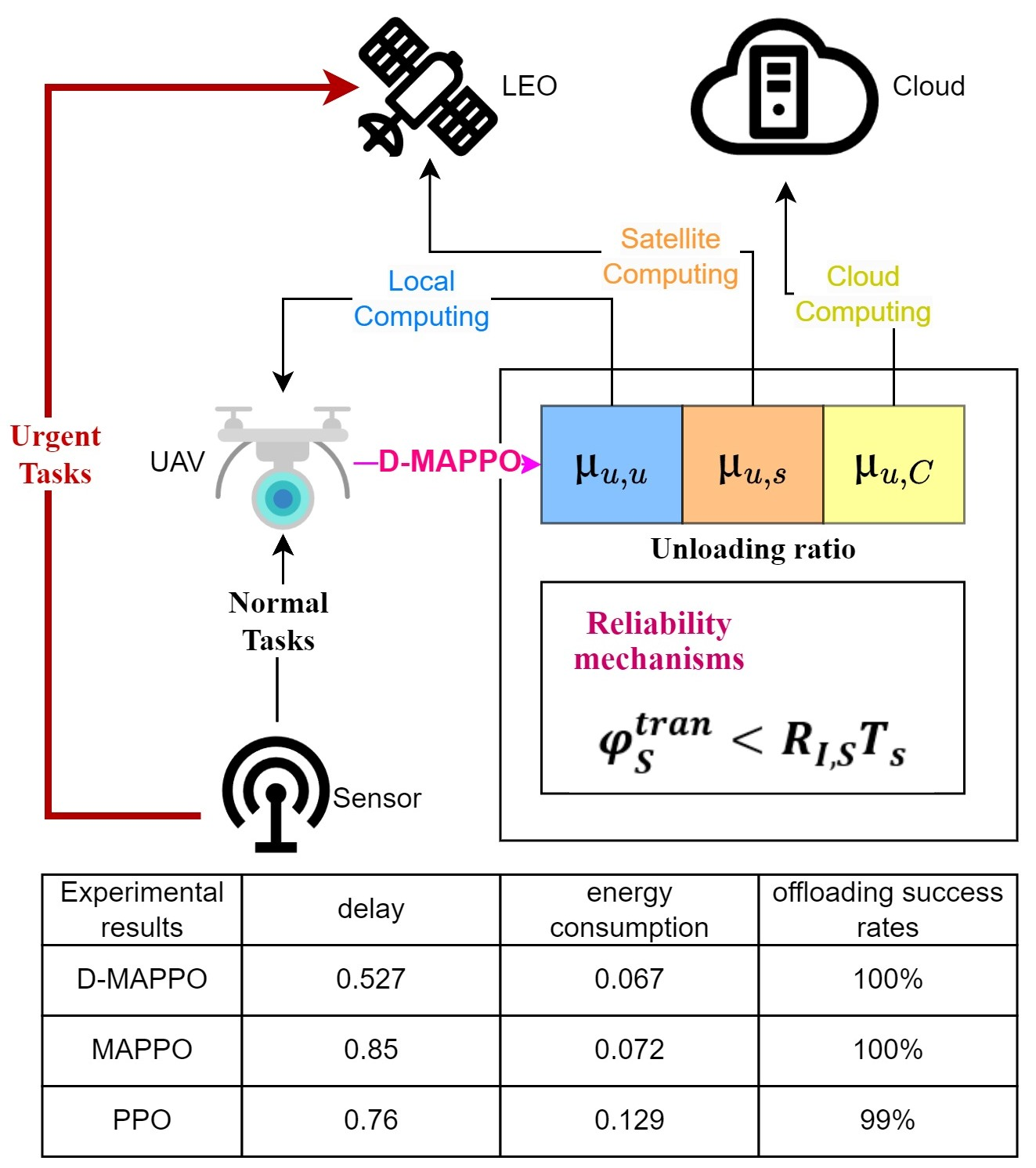
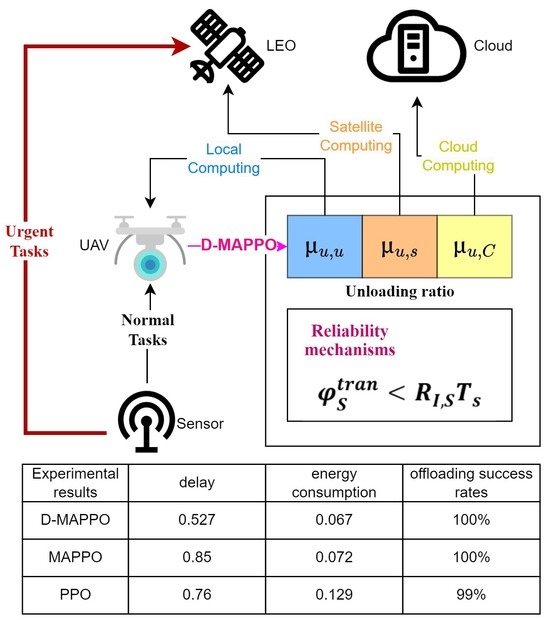
- A SAGIN suitable for remote areas is proposed. Considering the unique application requirements of remote regions, computational tasks are classified into normal and urgent tasks to address diverse demands under different scenarios.
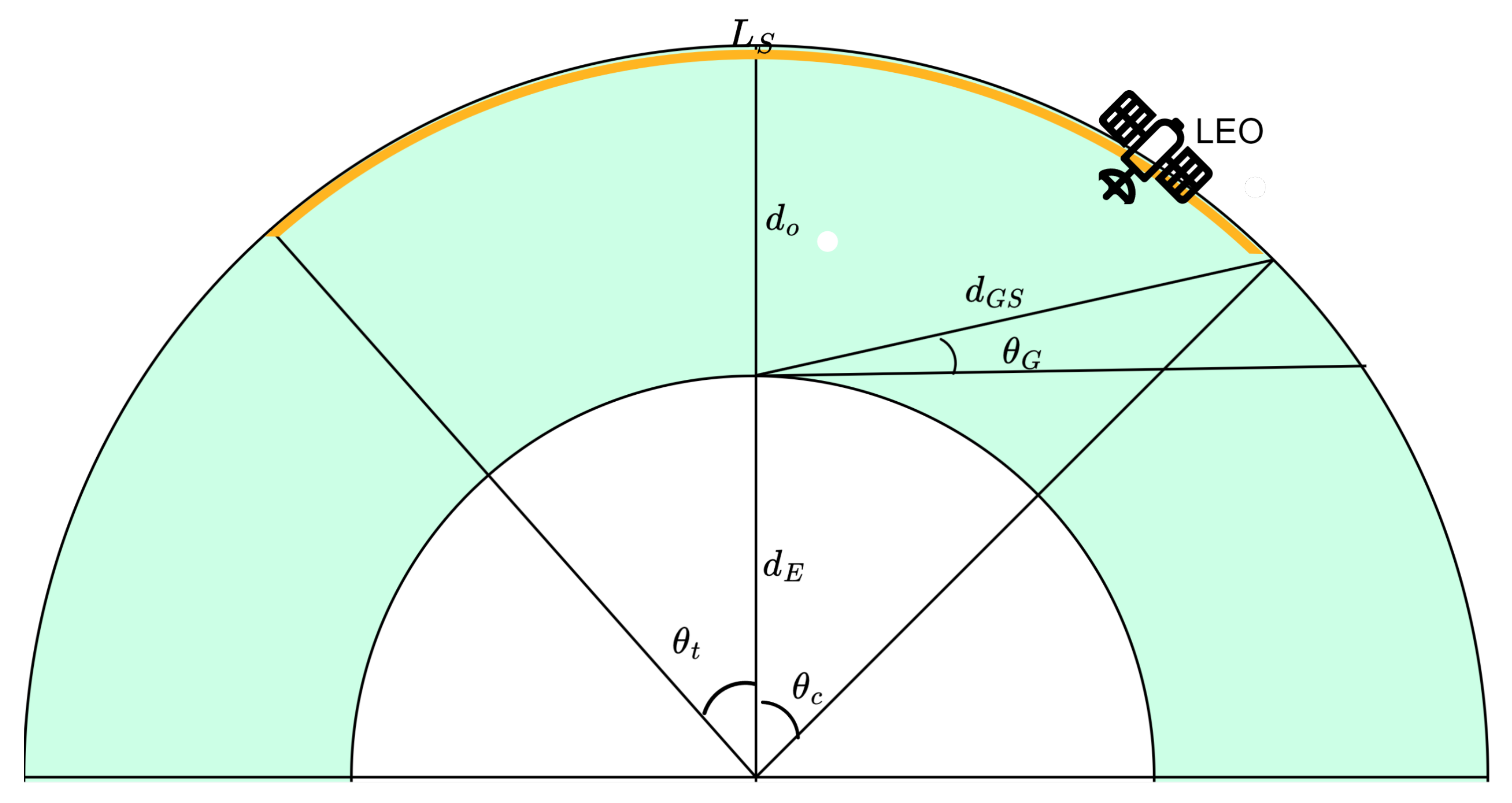
- To address the limited satellite coverage time and improve communication quality, a reliability mechanism for task offloading from ground sensors and UAVs to satellites is proposed. In addition, the communication process, satellite coverage duration, and overall network cost are modeled within the proposed framework.
- Based on the distinct characteristics of urgent and normal tasks, a computation offloading problem is formulated to jointly optimize network energy consumption and latency. The optimization problem is modeled as a Markov Decision Process (MDP). Considering the multidimensional offloading decision space and specific constraints, a Dirichlet-based Multi-Agent Proximal Policy Optimization (D-MAPPO) algorithm is proposed to enable the learning of optimal task offloading strategies.
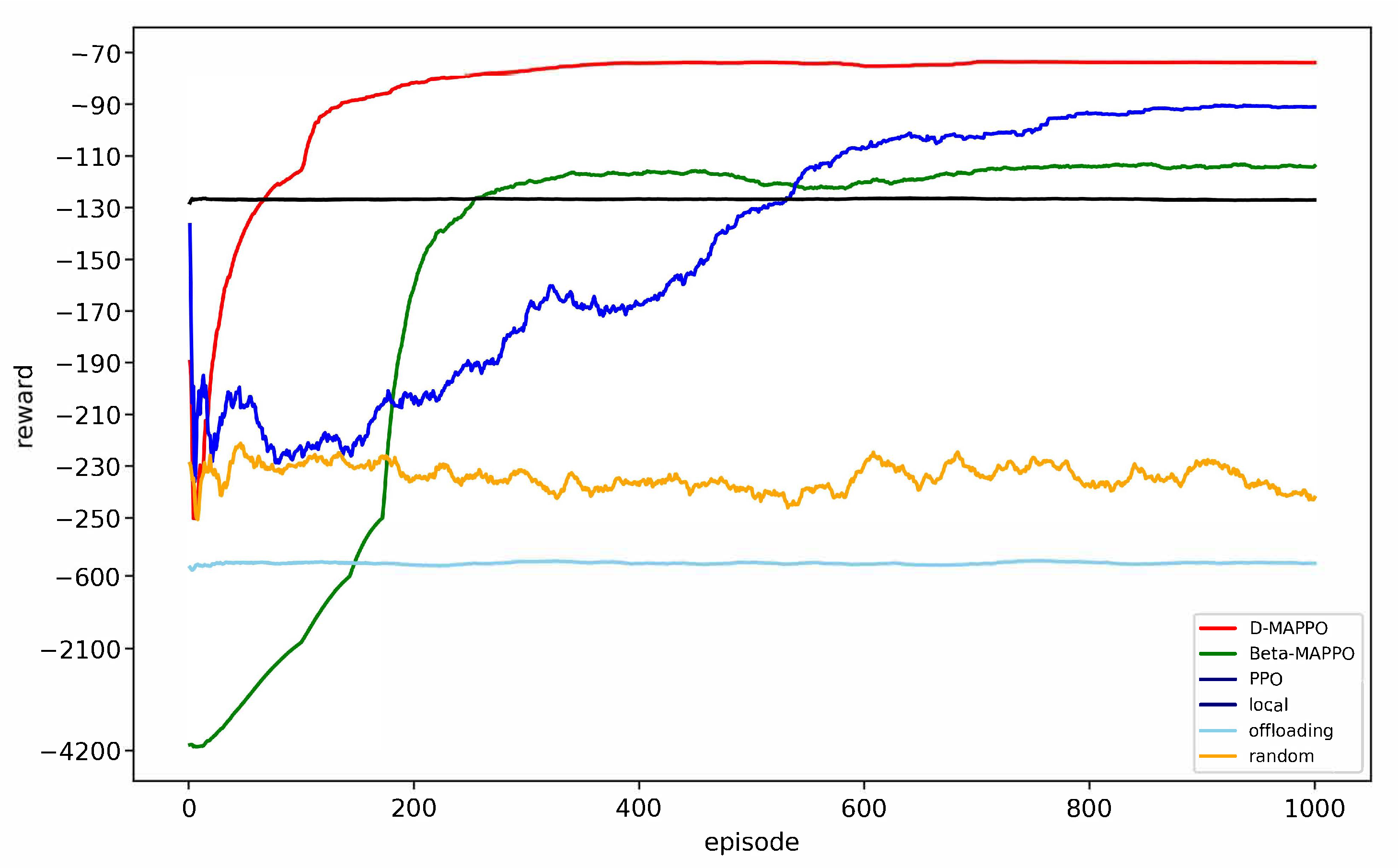
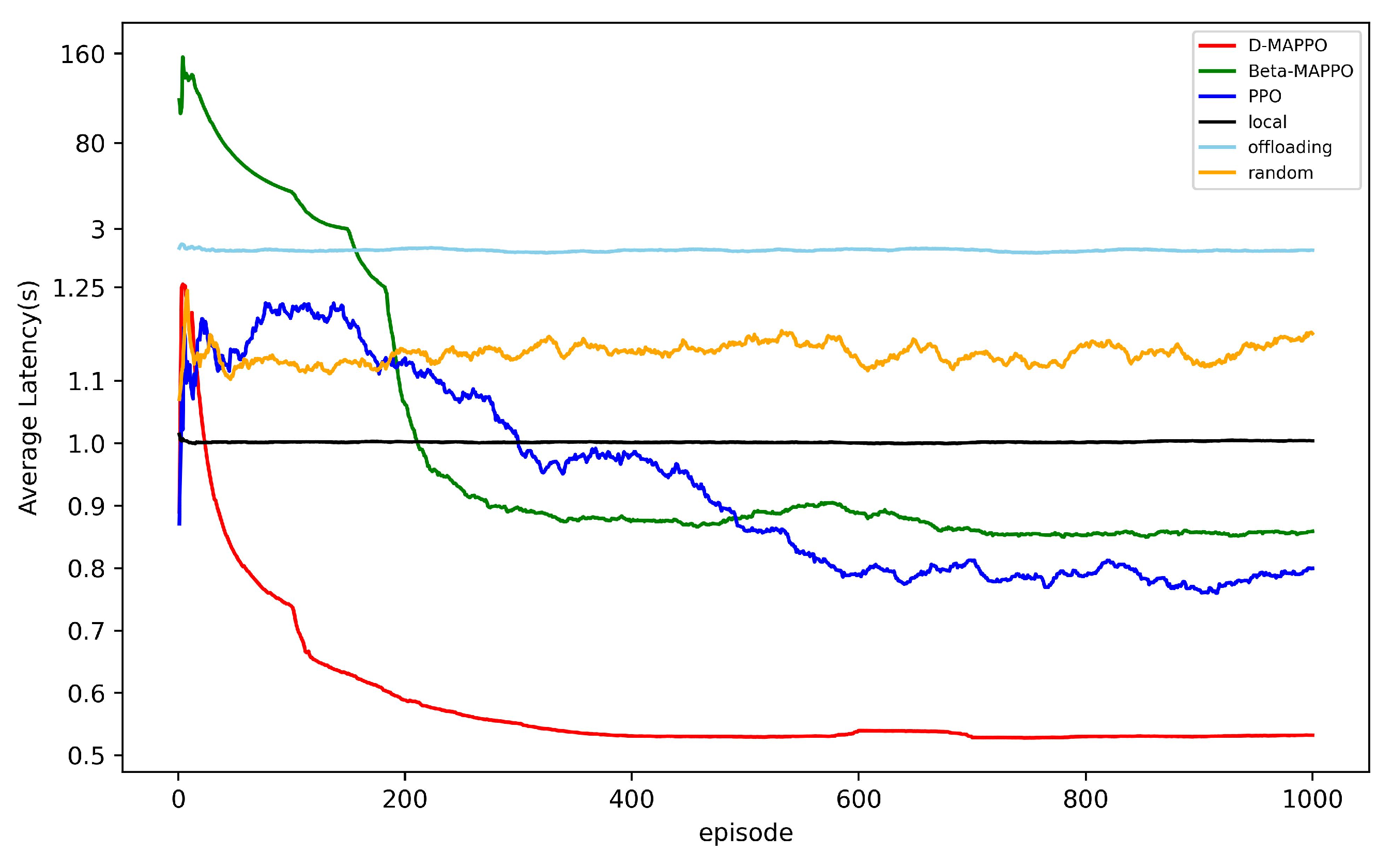
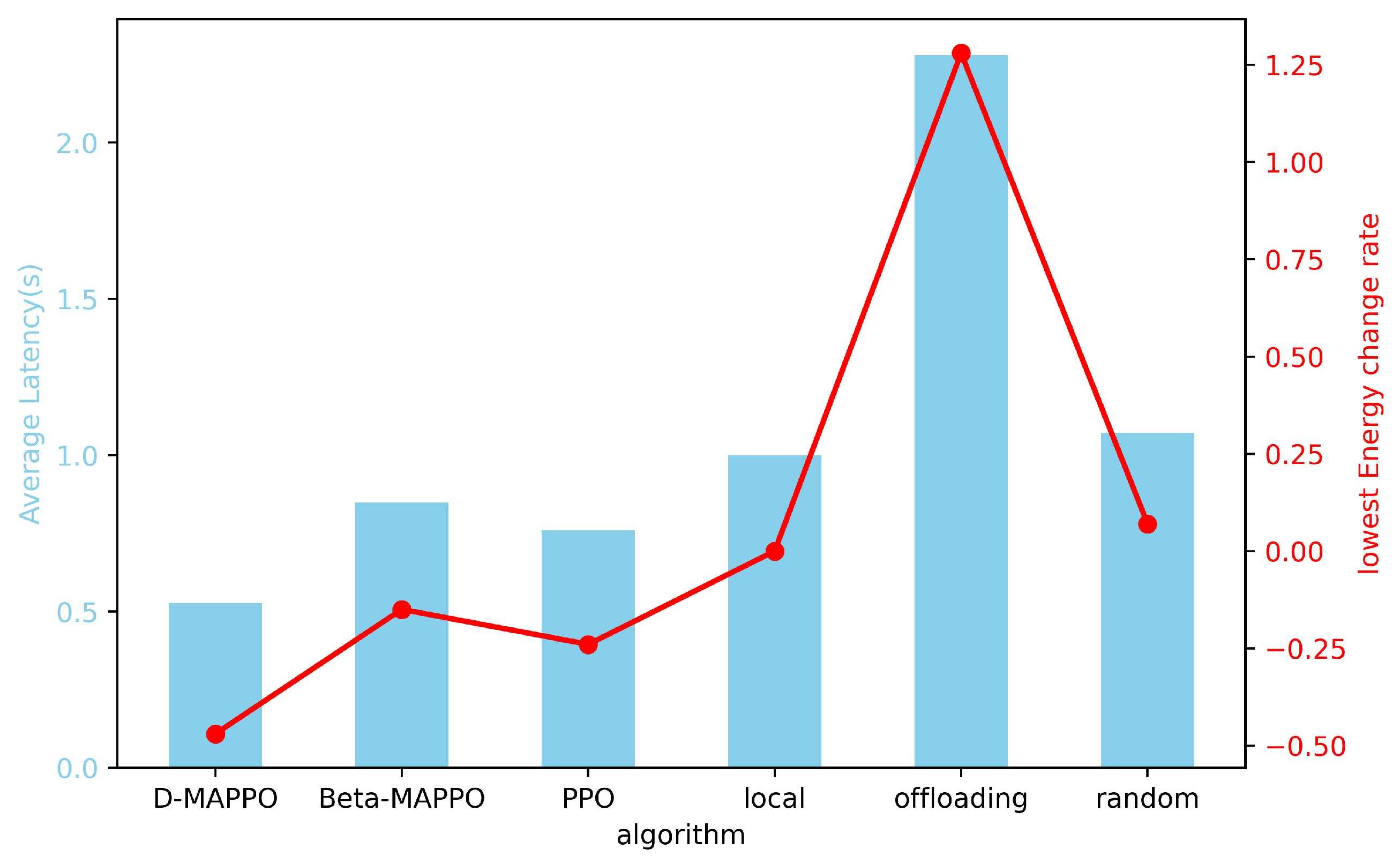
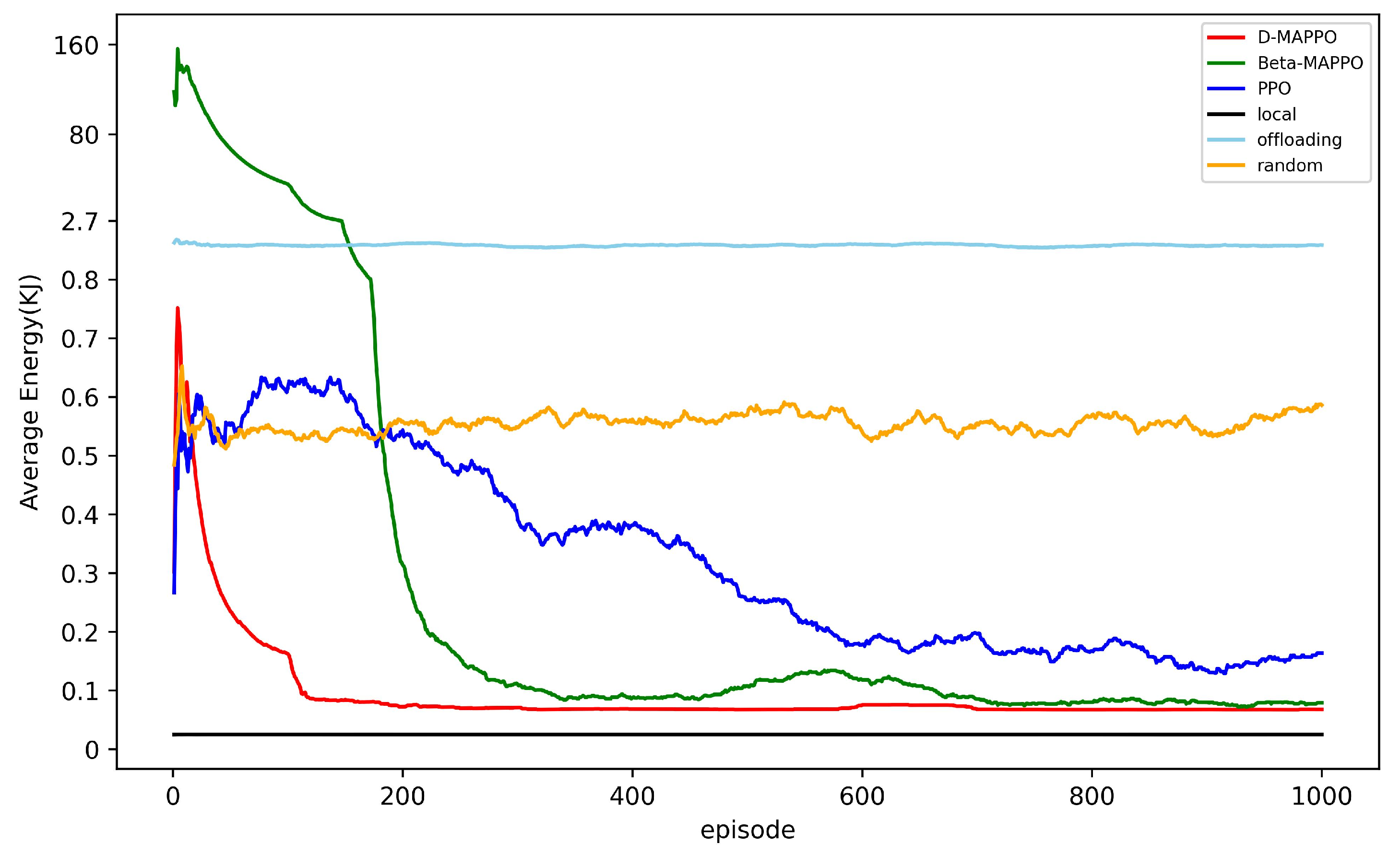
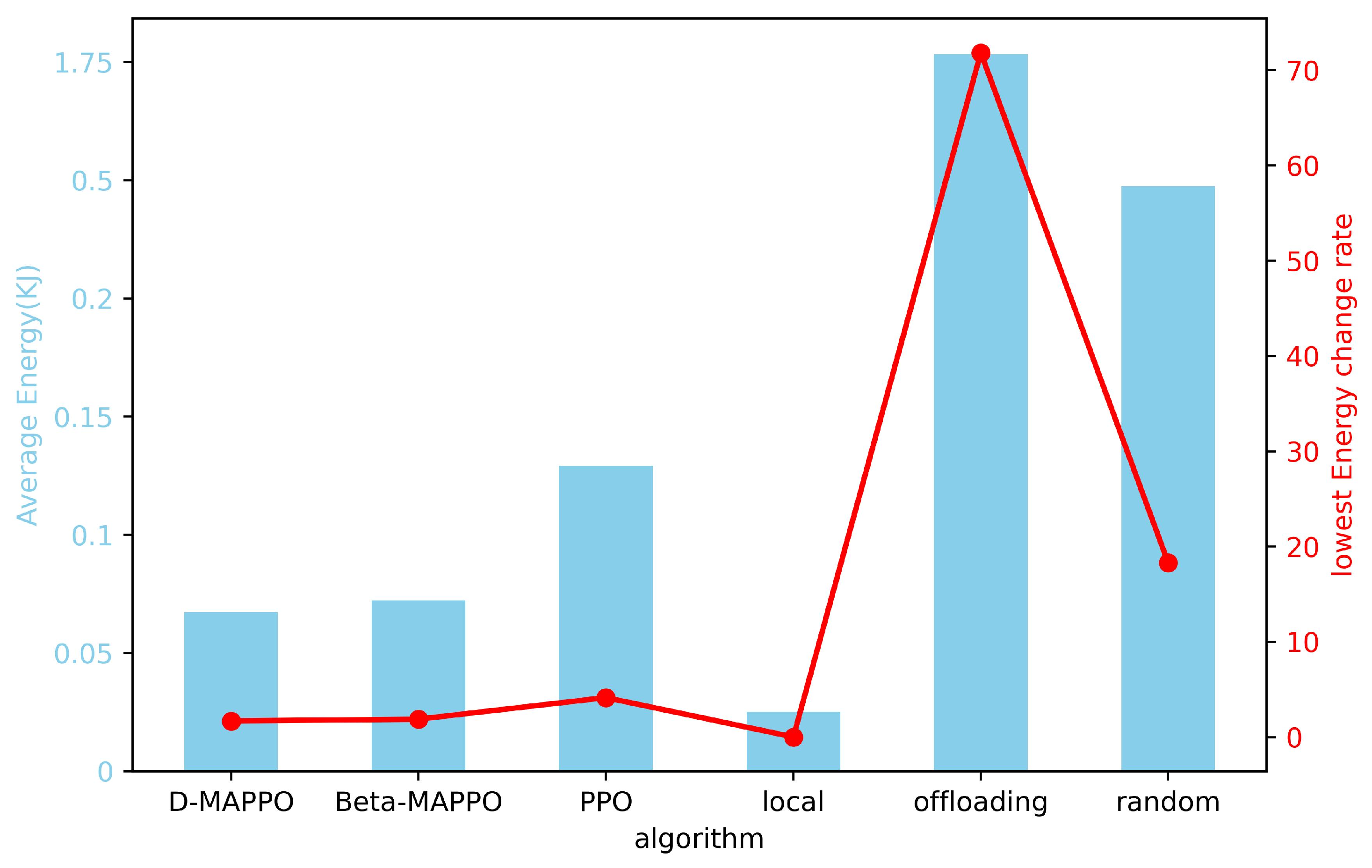
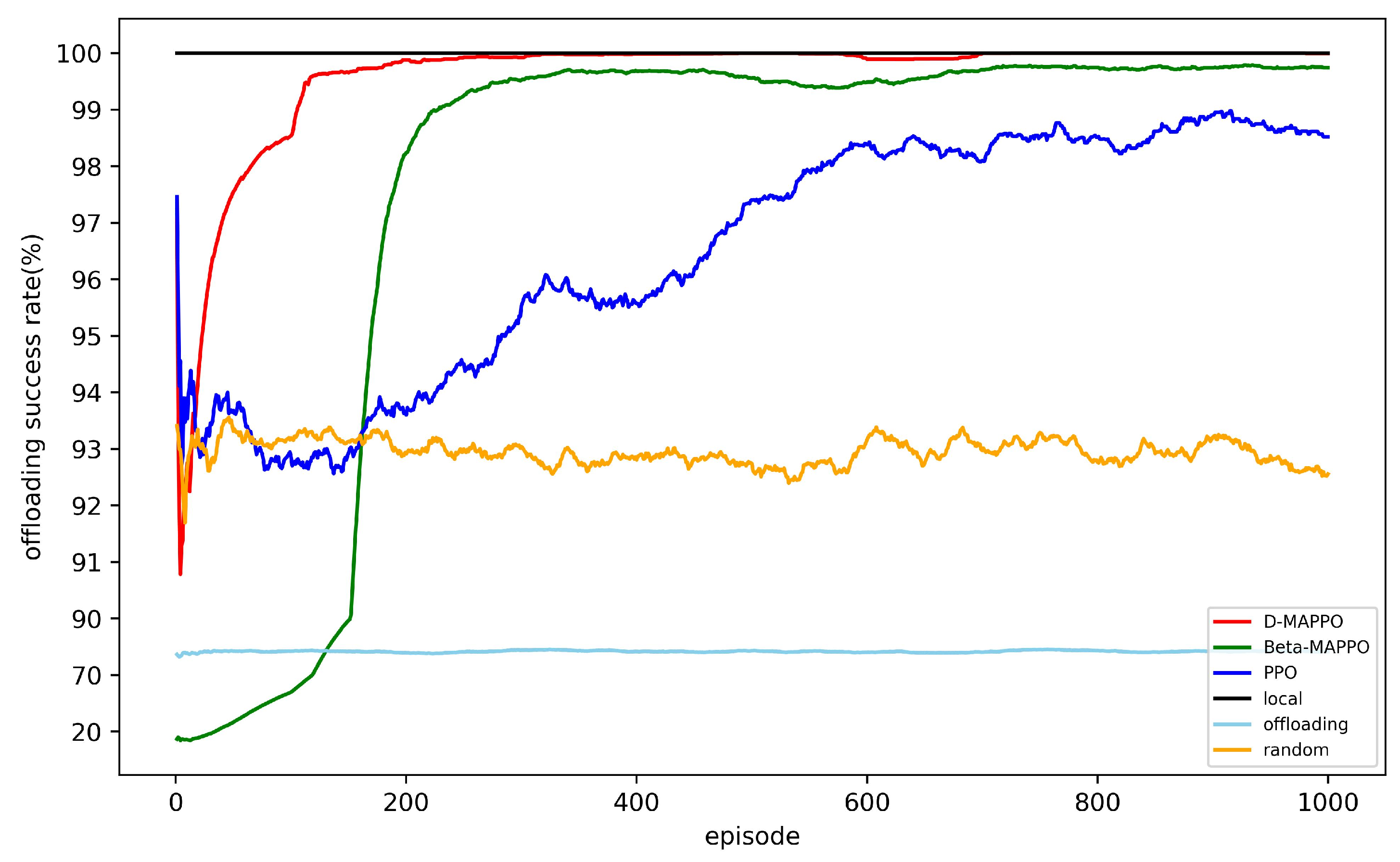
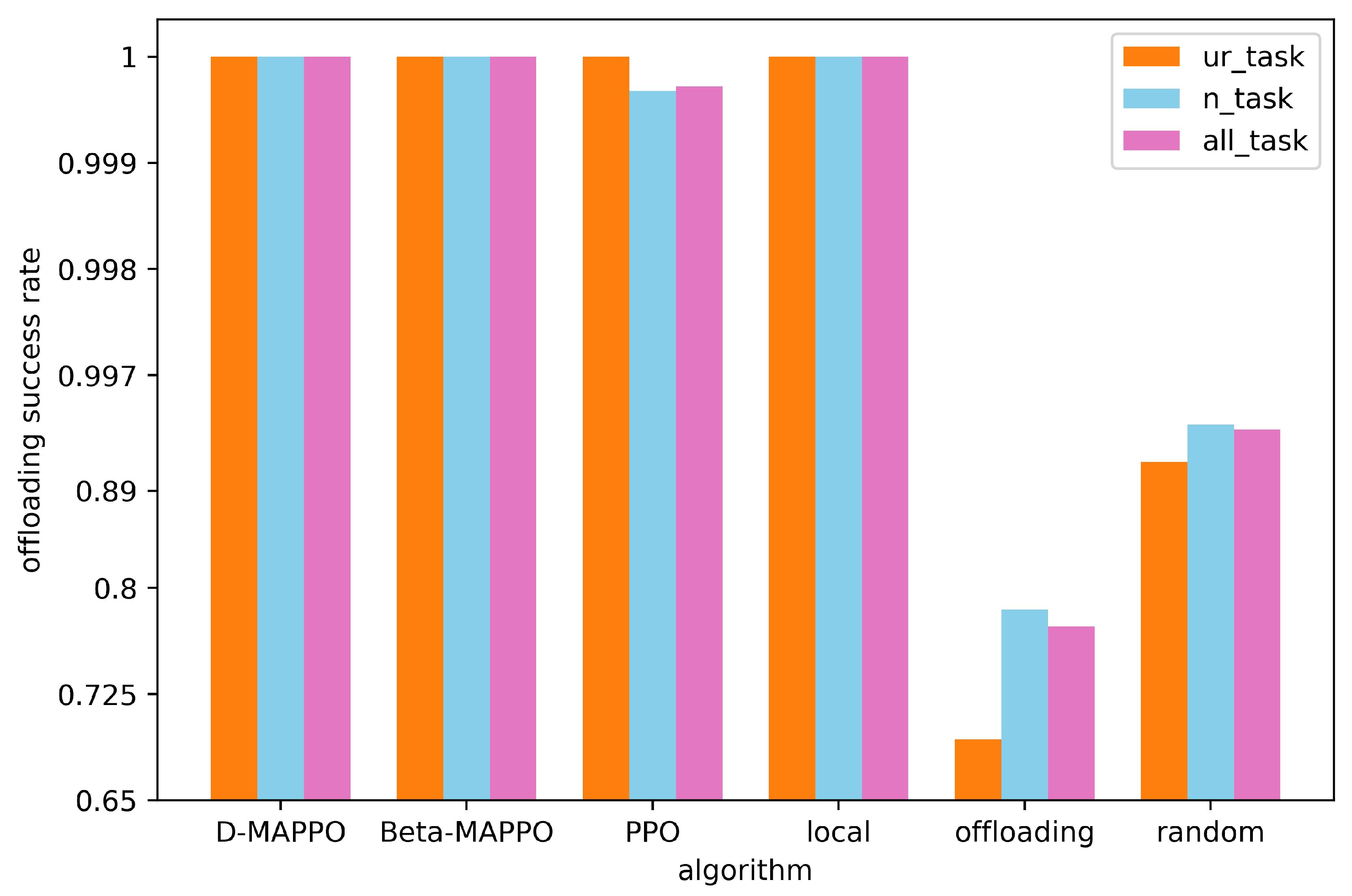
- Extensive simulation results demonstrate that the D-MAPPO algorithm achieves faster and more stable convergence. Moreover, it consistently outperforms benchmark methods—including Beta-MAPPO, PPO, Local, Offloading, and Random—in terms of latency reduction, energy efficiency, and offloading success rate.
2. Related Work
2.1. Task Offloading in SAGIN
2.2. Optimization Algorithms
3. System Model
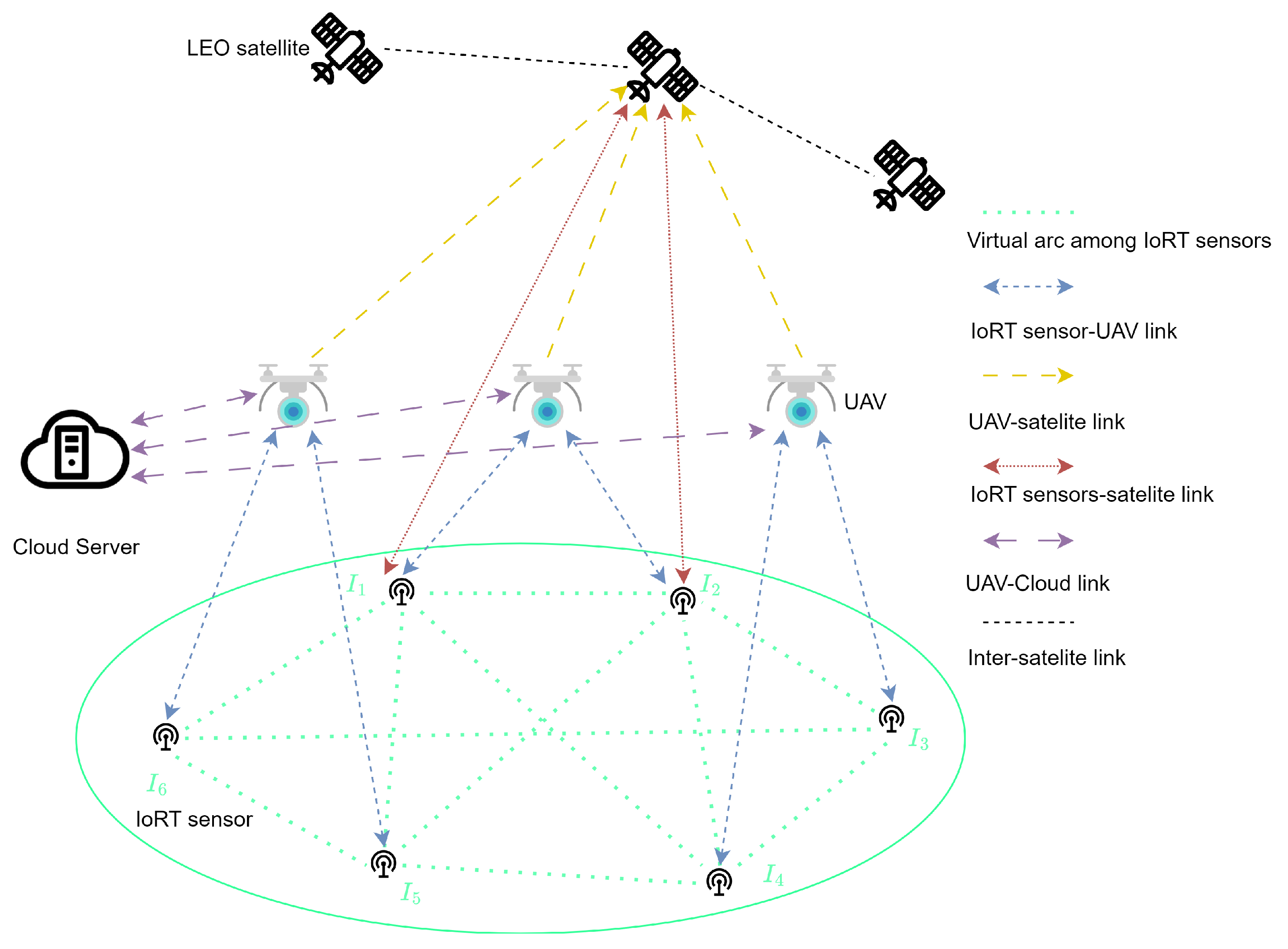
3.1. Network Architecture
3.2. Task Model
- (1)
- Urgent Tasks: Tasks triggered by emergency events such as wildfires, earthquakes, or other sudden incidents are defined as urgent tasks. Among all tasks, urgent tasks represent a small proportion but must be processed with the highest priority. When there are too many tasks to unload, priority should be given to unloading the completion rate of urgent tasks.
- (2)
- Normal Tasks: Most computational tasks generated by ground sensors are classified as normal tasks. Hence, optimizing normal tasks is the central focus of computation offloading in the system. Given that normal tasks are generally delay-tolerant, a joint optimization of energy consumption and latency is desirable.
3.3. Communication Model
- (1)
- Communication Between UAVs and Ground Sensors: According to [33], the air-to-ground communication channel depends on the UAV’s altitude, the elevation angle, and the propagation environment [34]. As described in [35], the average path loss for the air-to-ground channel can be expressed as follows:where denotes the probability of a line-of-sight (LoS) link between the UAV and the ground devices(GDs); h is the UAV altitude and r is the horizontal distance to the sensor; and are the additional losses associated with LoS and non-LoS (NLoS) conditions [36]. is the carrier frequency, and ccc is the speed of light. According to [37], the values in remote areas are .We assume that the communication link between the sensor and the UAV operates in the C-band spectrum. The maximum transmission rate for the ground sensor and the UAV is given bywhere and are the bandwidths of the ground sensor and the UAV, respectively. It is worth noting that device bandwidths are not fixed and may vary dynamically [38]. and represent the transmit power of the sensor and the UAV, respectively, while denotes Gaussian noise power.
- (2)
- Communication Between UAVs and the Cloud Server: The cloud server is also deployed on the ground, so its communication model with UAVs is similar to that between UAVs and sensors. The main difference is that the cloud server not only receives task data but also sends the processed results back to the UAV, which then delivers them to GD. Therefore, the maximum transmission rate between the UAV and the cloud server is given bywhere is the bandwidth of the cloud server, and is its transmit power.
- (3)
- Communication between UAV and ground sensors and satellites: The communication links between UAV and satellites are mainly based on clear line-of-sight (LoS) links, supplemented by a small number of NLoS links. We model the communication channel between UAV and GD and satellites as a Rician channel [39,40]; therefore, the channel gains of LoS and NLoS are integrated, so the channel coefficients between UAV and ground sensors and satellites , where F is the Rician factor, denotes the distance attenuation factor, and and denote the LoS and NLoS channel gains between satellites and communication devices, respectively. Finally, the maximum transmission rates and from UAVs and ground sensors to the satellite, as well as the satellite’s maximum transmission rate , can be determined as follows:where is the available bandwidth of the satellite, is the fixed antenna gain. denotes the transmit power of the satellite, and is the spectral density of the additional white Gaussian noise (AWGN).
3.4. Satellite Coverage Model
3.5. Computational Model
- (1)
- UAV computation: Each UAV collects tasks offloaded from multiple sensors. However, since UAVs have limited computational resources, offloading a portion of tasks is necessary. Let denote the total number of normal tasks generated by sensor iii; thus, the total number of tasks collected by UAV u is . The transmission time for UAV u to collect all tasks is given bywhere is the transmission overhead factor [42]. The total transmission energy consumption for UAV u to collect all normal tasks is as follows:According to the above equations, the number of tasks computed locally by UAV u can be represented as , the total local computational latency of UAV u iswhere and represent the data size and computational complexity of the x-th task, respectively. denotes the computational capability of UAV u. The total local computational energy consumption of UAV u is:where is the energy coefficient and depends on the CPU structure of the UAV u. When the calculation is complete, the UAV u sends the resultant data back to the sensor with a return time ofwhere denotes the total data volume of the UAV u result data. The energy consumption of the UAV u return data is as follows:
- (2)
- Cloud server computation: The cloud server processes tasks offloaded from multiple UAVs. Since the cloud server’s computational resources are limited, the total number of tasks received by the cloud server is . The transmission time and the energy consumption for the cloud server to receive UAV-offloaded tasks are denoted as and , respectively:The computational latency and computational energy consumption of the cloud server arewhere is the computational capability of the cloud server. The cloud server needs to return the computation result of the task to the UAV, and the return delay and the energy consumption of the cloud server will be
- (3)
- Satellite computation: The satellite not only has to deal with the tasks offloaded by the UAV locally, but also has to deal with the urgent tasks uploaded by the sensors. When satellites receive offloaded tasks, urgent tasks are prioritized to ensure timely processing. The total number of normal tasks received by satellite s is , where represents the total number of urgent tasks generated by sensor iii. The transmission time and energy consumption for satellite s to receive both urgent and normal tasks are represented by and , respectively.The computation delay and energy consumption of satellite s for processing urgent and normal tasks are denoted as and , respectively:where represents the computational capability of satellite s. The satellite directly returns the computation results to the sensors, and the backhaul delay and energy consumption of satellite s are expressed as and , respectively:where denotes the amount of result data returned by satellite s.
3.6. Reliability Mechanisms
4. Problem Analysis
5. D-MAPPO Algorithm Design
5.1. MDP Design
- (1)
- State Space: The state space defines all possible states of the environment and serves to describe the current condition of the system, thereby providing a basis for the agent’s decision-making. In the context of the computation offloading problem, the state space should adequately represent the availability of computational resources and the execution status of tasks, enabling the agent to select an appropriate offloading strategy accordingly. In this study, each UAV is modeled as an individual agent. The state of each agent at time slot t is defined as follows:where is the computational resource of the cloud server, is the bandwidth resource of the cloud server, and is the number of tasks that the cloud server can handle. is the computational resource of the satellite s, is the bandwidth resource of the satellite s, and is the coverage angle of the satellites, ; note that there are multiple satellites in the network frame in the paper, and the status records the status of all satellites. is the computational resource of UAV u and is the bandwidth resource of UAV u. is the number of common tasks, is the number of urgent tasks, is the computational complexity of the tasks, and is the task size of a single task.
- (2)
- Action Space: the action set defines the actions that an intelligent can perform in each state. In the computational offloading problem, the action determines the allocation ratio of tasks on different computational nodes. So, in this paper, the unloading ratio is taken as the action set, i.e., the action of each intelligent body in the time slot t, where the unloading ratio in the action set has to satisfy the constraint in the problem .
- (3)
- State Transition: State transition describes the process by which the system evolves from one state to another after an action is taken. In the computation offloading problem, state transitions depend on how offloading decisions affect resource availability and task status. In this study, state transitions are influenced by the following factors: Changes in the available computational resources of each device after task execution. The arrival of new tasks follows the completion of previous ones. The state transition process can be described by the probability model , which captures the impact of offloading decisions on the future state of the system.
- (4)
- Reward Function: The reward function evaluates the quality of offloading decisions and serves as the foundation for policy optimization in reinforcement learning. The objective of this study is to ensure a high completion rate for urgent task offloading while improving the completion rate of normal tasks and minimizing their energy consumption and delay. Accordingly, the reward function is defined as follows:Among them, k is the weight coefficient between energy consumption and delay, which can be adjusted according to different user requirements, indicates the penalty coefficient, which is penalized for every uninstalled task, and the total penalty will be reduced with the improvement of task uninstallation success rate, indicates the number of uninstalled tasks in common tasks, and indicates the number of uninstalled tasks in urgent tasks. In this paper, we set .
- (5)
- Policy: denoted by , is a static mapping from a state to an action . In other words, when the system is in state , it selects the corresponding action as prescribed by the policy.
5.2. Dirichlet Probability Distribution and Representation of Offloading Decisions
5.3. MAPPO Algorithm Design
- (1)
- Network Structure Design: Both the Actor and Critic networks adopt three fully connected layers with tanh activation functions to enhance nonlinearity and expressive capacity. The Actor network includes an additional fully connected layer to output the Dirichlet distribution parameters, providing a probabilistic representation for continuous action selection. The Critic network outputs a scalar value representing the state value. Both networks are trained using the Adam optimizer.
- (2)
- Advantage Estimation: Advantage estimation measures how much better a specific action is compared to the average. It is a critical component of MAPPO, helping reduce variance and improve learning efficiency. MAPPO employs Generalized Advantage Estimation (GAE), defined as follows:where is the Temporal Difference (TD) error, is the immediate reward after UAV action at time slot t, is the Critic’s estimated value of state , denotes Critic parameters, is the discount factor, and controls the bias–variance trade-off.
- (3)
- Policy Update: The log-probability of the Dirichlet policy is given bywhere denotes the current policy. The PPO clipping loss is defined as follows:where is the probability ratio used to control the update step size, represents the previous policy, and limits update magnitude to prevent gradient explosion. is a hyperparameter. Incorporating Dirichlet entropy regularization enhances exploration, and the Actor loss is defined as follows:where is the entropy coefficient encouraging exploration, and denotes the entropy of the Dirichlet distribution.
- (4)
- Value Function Update: The Critic network is optimized using the mean squared error (MSE) loss:where is the immediate discounted return serving as the target for value function learning.
- (5)
- Joint Parameter Optimization: The total loss function is expressed aswhere is the weighting coefficient for the value loss. The Actor and Critic parameters are updated separately using the Adam optimizer.
| Algorithm 1 Multi-Agent Proximal Policy Optimization (MAPPO) |
|
6. Experiment Analysis
6.1. Parameter Settings
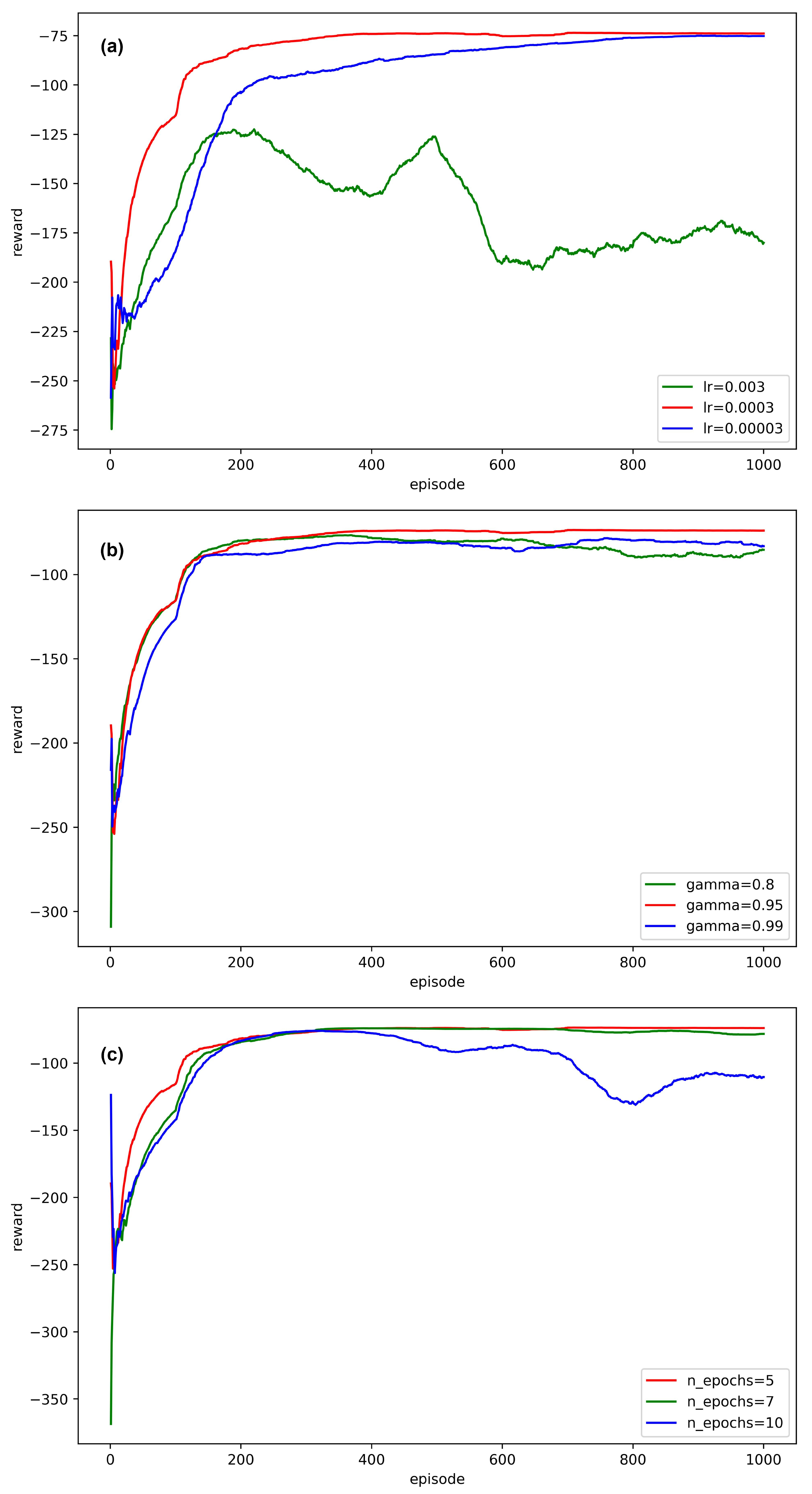
6.2. D-MAPPO Algorithm Convergence
6.3. Comparison of Reward Values Among Different Algorithms
6.4. Delay Optimization Comparison
6.5. Energy Consumption Optimization Comparison
6.6. Optimization Comparison of Task Offloading Success Rate
7. Conclusions
Author Contributions
Funding
Data Availability Statement
Conflicts of Interest
Abbreviations
| 6G | Sixth-Generation |
| SAGIN | Space–Air–Ground Integrated Network |
| IoT | Internet of Things |
| MDP | Markov Decision Process |
| MAPPO | Multi-Agent Proximal Policy Optimization |
| UAVs | Unmanned Aerial Vehicles |
| LEO | Low Earth Orbit |
| MEO | Medium Earth Orbit |
| GEO | Geostationary Earth Orbit |
| MEC | Mobile Edge Computing |
| QoS | Overall Quality of Service |
| DRL | Deep Reinforcement Learning |
| JDACO | Joint Data Aggregation and Computation Offloading |
| DQN | Deep Q Network |
| PPO | Proximal Policy Optimization |
| MARL | Multi-Agent Reinforcement Learning |
| MADDPG | Multi-Agent Deep Deterministic Policy Gradient |
| PSO | Particle Swarm Optimization |
| GA | Genetic Algorithm |
| LoS | Line-of-Sight |
| NLoS | Non-LoS |
| AWGN | Additional White Gaussian Noise |
| UE | User Equipment |
| RL | Reinforcement Learning |
| CMDP | Constrained Markov Decision Process |
| CTDE | Centralized Training and Decentralized Execution |
| SMAC | StarCraft Multi-Agent Challenge |
| POEs | Partially Observable Environments |
| GRUs | Gated Recurrent Units |
| GAE | Generalized Advantage Estimation |
| TD Error | Temporal Difference Error |
| MSE Loss | Mean Square Error |
References
- Saad, W.; Bennis, M.; Chen, M. A Vision of 6G Wireless Systems: Applications, Trends, Technologies, and Open Research Problems. IEEE Netw. 2020, 34, 134–142. [Google Scholar] [CrossRef]
- Zhang, Z.; Xiao, Y.; Ma, Z.; Xiao, M.; Fan, P. 6G wireless networks: Vision, requirements, architecture, and key technologies. IEEE Veh. Technol. Mag. 2019, 14, 28–41. [Google Scholar] [CrossRef]
- Kodheli, O.; Maturo, N.; Chatzinotas, S.; Andrenacci, S.; Zimmer, F. NB-IoT via LEO Satellites: An Efficient Resource Allocation Strategy for Uplink Data Transmission. IEEE Internet Things J. 2022, 9, 5094–5107. [Google Scholar] [CrossRef]
- Li, B.; Fei, Z.; Chu, Z.; Zhou, F.; Wong, K.K.; Xiao, P. Robust Chance-Constrained Secure Transmission for Cognitive Satellite–Terrestrial Networks. IEEE Trans. Veh. Technol. 2018, 67, 4208–4219. [Google Scholar] [CrossRef]
- Xie, R.; Tang, Q.; Wang, Q.; Liu, X.; Yu, F.R.; Huang, T. Satellite-Terrestrial Integrated Edge Computing Networks: Architecture, Challenges, and Open Issues. IEEE Netw. 2020, 34, 224–231. [Google Scholar] [CrossRef]
- Jia, Z.; Sheng, M.; Li, J.; Han, Z. Toward Data Collection and Transmission in 6G Space–Air–Ground Integrated Networks: Cooperative HAP and LEO Satellite Schemes. IEEE Internet Things J. 2022, 9, 10516–10528. [Google Scholar] [CrossRef]
- Liu, Z.; Weng, J.; Guo, J.; Ma, J.; Huang, F.; Sun, H. PPTM: A Privacy-Preserving Trust Management Scheme for Emergency Message Dissemination in Space–Air–Ground-Integrated Vehicular Networks. IEEE Internet Things J. 2022, 9, 5943–5956. [Google Scholar] [CrossRef]
- Pachler, N.; del Portillo, I.; Crawley, E.F.; Cameron, B.G. An Updated Comparison of Four Low Earth Orbit Satellite Constellation Systems to Provide Global Broadband. In Proceedings of the 2021 IEEE International Conference on Communications Workshops (ICC Workshops), Montreal, QC, Canada, 14–23 June 2021; pp. 1–7. [Google Scholar] [CrossRef]
- Li, J.; Lu, H.; Xue, K.; Zhang, Y. Temporal Netgrid Model-Based Dynamic Routing in Large-Scale Small Satellite Networks. IEEE Trans. Veh. Technol. 2019, 68, 6009–6021. [Google Scholar] [CrossRef]
- Di, B.; Zhang, H.; Song, L.; Li, Y.; Li, G.Y. Ultra-Dense LEO: Integrating Terrestrial-Satellite Networks Into 5G and Beyond for Data Offloading. IEEE Trans. Wirel. Commun. 2019, 18, 47–62. [Google Scholar] [CrossRef]
- You, X.; Wang, C.-X.; Huang, J.; Gao, X.; Zhang, Z.; Wang, M.; Huang, Y.; Zhang, C.; Jiang, Y.; Wang, J.; et al. Towards 6G wireless communication networks: Vision, enabling technologies, and new paradigm shifts. Sci. China Inf. Sci. 2020, 64, 110301. [Google Scholar] [CrossRef]
- Giordani, M.; Zorzi, M. Non-Terrestrial Networks in the 6G Era: Challenges and Opportunities. IEEE Netw. 2021, 35, 244–251. [Google Scholar] [CrossRef]
- Chen, S.; Sun, S.; Kang, S. System integration of terrestrial mobile communication and satellite communication—The trends, challenges and key technologies in B5G and 6G. China Commun. 2020, 17, 156–171. [Google Scholar] [CrossRef]
- Zhu, X.; Jiang, C. Integrated Satellite-Terrestrial Networks Toward 6G: Architectures, Applications, and Challenges. IEEE Internet Things J. 2022, 9, 437–461. [Google Scholar] [CrossRef]
- Tran, T.X.; Hajisami, A.; Pandey, P.; Pompili, D. Collaborative Mobile Edge Computing in 5G Networks: New Paradigms, Scenarios, and Challenges. IEEE Commun. Mag. 2017, 55, 54–61. [Google Scholar] [CrossRef]
- Li, Z.; Wang, Y.; Liu, M.; Sun, R.; Chen, Y.; Yuan, J. Energy Efficient Resource Allocation for UAV-Assisted Space-Air-Ground Internet of Remote Things Networks. IEEE Access 2019, 12, 145348–145362. [Google Scholar] [CrossRef]
- Zhou, H.; Wang, Z.; Zheng, H.; He, S.; Dong, M. Cost Minimization-Oriented Computation Offloading and Service Caching in Mobile Cloud-Edge Computing: An A3C-Based Approach. IEEE Trans. Netw. Sci. Eng. 2023, 10, 1326–1338. [Google Scholar] [CrossRef]
- Li, K.; Wang, X.; He, Q.; Ni, Q.; Yang, M.; Dustdar, S. Computation Offloading for Tasks With Bound Constraints in Multiaccess Edge Computing. IEEE Internet Things J. 2023, 10, 15526–15536. [Google Scholar] [CrossRef]
- Dai, X.; Xiao, Z.; Jiang, H.; Lui, J.C.S. UAV-Assisted Task Offloading in Vehicular Edge Computing Networks. IEEE Trans. Mob. Comput. 2024, 23, 2520–2534. [Google Scholar] [CrossRef]
- Subburaj, B.; Jayachandran, U.M.; Arumugham, V.; Suthanthira Amalraj, M.J.A. A Self-Adaptive Trajectory Optimization Algorithm Using Fuzzy Logic for Mobile Edge Computing System Assisted by Unmanned Aerial Vehicle. Drones 2023, 7, 266. [Google Scholar] [CrossRef]
- Fengjun, S.; Guo, J. An Energy-efficient Task Offloading Model based on Trust Mechanism and Multi-agent Reinforcement Learning. Res. Sq. 2024, 1, 1–19. [Google Scholar] [CrossRef]
- Jia, Z.; Sheng, M.; Li, J.; Niyato, D.; Han, Z. LEO-Satellite-Assisted UAV: Joint Trajectory and Data Collection for Internet of Remote Things in 6G Aerial Access Networks. IEEE Internet Things J. 2021, 8, 9814–9826. [Google Scholar] [CrossRef]
- Gao, Y.; Ye, Z.; Yu, H. Cost-Efficient Computation Offloading in SAGIN: A Deep Reinforcement Learning and Perception-Aided Approach. IEEE J. Sel. Areas Commun. 2024, 42, 3462–3476. [Google Scholar] [CrossRef]
- Liu, Y.; Jiang, L.; Qi, Q.; Xie, S. Energy-Efficient Space–Air–Ground Integrated Edge Computing for Internet of Remote Things: A Federated DRL Approach. IEEE Internet Things J. 2023, 10, 4845–4856. [Google Scholar] [CrossRef]
- Xie, J.; Jia, Q.; Chen, Y.; Wang, W. Computation Offloading and Resource Allocation in Satellite-Terrestrial Integrated Networks: A Deep Reinforcement Learning Approach. IEEE Access 2024, 12, 97184–97195. [Google Scholar] [CrossRef]
- Sadiki, A.; Bentahar, J.; Dssouli, R.; En-Nouaary, A.; Otrok, H. Deep reinforcement learning for the computation offloading in MIMO-based Edge Computing. Ad Hoc Netw. 2023, 141, 103080. [Google Scholar] [CrossRef]
- Xu, Y.; Deng, F.; Zhang, J. UDCO-SAGiMEC: Joint UAV Deployment and Computation Offloading for Space–Air–Ground Integrated Mobile Edge Computing. Mathematics 2023, 11, 4014. [Google Scholar] [CrossRef]
- Raivi, A.M.; Moh, S. JDACO: Joint Data Aggregation and Computation Offloading in UAV-Enabled Internet of Things for Post-Disaster Scenarios. IEEE Internet Things J. 2024, 11, 16529–16544. [Google Scholar] [CrossRef]
- Zhou, C.; Wu, W.; He, H.; Yang, P.; Lyu, F.; Cheng, N. Deep Reinforcement Learning for Delay-Oriented IoT Task Scheduling in Space-Air-Ground Integrated Network. IEEE Trans. Wirel. Commun. 2020, 20, 911–925. [Google Scholar] [CrossRef]
- Chen, Z.; Zhou, H.; Du, S.; Liu, J.; Zhang, L.; Liu, Q. Reinforcement Learning-Based Resource Allocation and Energy Efficiency Optimization for a Space–Air–Ground-Integrated Network. Electronics 2024, 13, 1792. [Google Scholar] [CrossRef]
- Chen, C.; Zhao, M. Orbital collaborative learning in 6G space-air-ground integrated networks. Neurocomputing 2022, 497, 94–109. [Google Scholar] [CrossRef]
- Dao, P.N.; Duc, H.A.N. Reinforcement-learning-based control framework for leader-following cascade formation of multiple perturbed surface vehicles. Syst. Control Lett. 2025, 200, 106077. [Google Scholar] [CrossRef]
- Chen, Y.; Ai, B.; Niu, Y.; Zhang, H.; Han, Z. Energy-constrained computation offloading in space-air-ground integrated networks using distributionally robust optimization. IEEE Trans. Veh. Technol. 2021, 70, 12113–12125. [Google Scholar] [CrossRef]
- Chandrasekharan, S.; Gomez, K.; Al-Hourani, A.; Kandeepan, S.; Rasheed, T.; Goratti, L. Designing and implementing future aerial communication networks. IEEE Commun. Mag. 2016, 54, 26–34. [Google Scholar] [CrossRef]
- Seid, A.M.; Boateng, G.O.; Mareri, B.; Sun, G.; Jiang, W. Multi-Agent DRL for Task Offloading and Resource Allocation in Multi-UAV Ena-bled IoT Edge Network. IEEE Trans. Netw. Serv. Manag. 2021, 18, 4531–4547. [Google Scholar] [CrossRef]
- Al-Hourani, A.; Kandeepan, S.; Lardner, S. Optimal LAP Altitude for Maximum Coverage. IEEE Wirel. Commun. Lett. 2014, 3, 569–572. [Google Scholar] [CrossRef]
- Cheng, N.; Lyu, F.; Quan, W.; Zhou, C.; He, H.; Shi, W.; Shen, X. Space/Aerial-Assisted Computing Offloading for IoT Applications: A Learning-Based Approach. IEEE J. Sel. Areas Commun. 2019, 37, 1117–1129. [Google Scholar] [CrossRef]
- Chakour, I.; Daoui, C.; Baslam, M.; Sainz-De-Abajo, B.; Garcia-Zapirain, B. Strategic Bandwidth Allocation for QoS in IoT Gateway: Predicting Future Needs Based on IoT Device Habits. IEEE Access 2024, 12, 6590–6603. [Google Scholar] [CrossRef]
- Abdi, A.; Lau, W.C.; Alouini, M.S.; Kaveh, M. A new simple model for land mobile satellite channels: First- and second-order statistics. IEEE Trans. Wirel. Commun. 2003, 2, 519–528. [Google Scholar] [CrossRef]
- Di, B.; Song, L.; Li, Y.; Poor, H.V. Ultra-Dense LEO: Integration of Satellite Access Networks into 5G and Beyond. IEEE Wirel. Commun. 2019, 26, 62–69. [Google Scholar] [CrossRef]
- Huang, C.; Chen, G.; Xiao, P.; Xiao, Y.; Han, Z.; Chambers, J.A. Joint Offloading and Resource Allocation for Hybrid Cloud and Edge Computing in SAGINs: A Decision Assisted Hybrid Action Space Deep Reinforcement Learning Approach. IEEE J. Sel. Areas Commun. 2024, 42, 1029–1043. [Google Scholar] [CrossRef]
- Ding, C.; Wang, J.B.; Zhang, H.; Lin, M.; Li, G.Y. Joint Optimization of Transmission and Computation Resources for Satellite and High Altitude Platform Assisted Edge Computing. IEEE Trans. Wirel. Commun. 2022, 21, 1362–1377. [Google Scholar] [CrossRef]
- He, H.; Shan, H.; Huang, A.; Ye, Q.; Zhuang, W. Edge-Aided Computing and Transmission Scheduling for LTE-U-Enabled IoT. IEEE Trans. Wirel. Commun. 2020, 19, 7881–7896. [Google Scholar] [CrossRef]
- Yu, C.; Velu, A.; Vinitsky, E.; Gao, J.; Wang, Y.; Bayen, A.; Wu, Y. The Surprising Effectiveness of PPO in Cooperative Multi-Agent Games. In Proceedings of the Advances in Neural Information Processing Systems, New Orleans, LA, USA, 28 November–9 December 2022; Curran Associates, Inc.: Red Hook, NY, USA, 2022; Volume 35, pp. 24611–24624. [Google Scholar]
- Song, F.; Xing, H.; Wang, X.; Luo, S.; Dai, P.; Xiao, Z. Evolutionary Multi-Objective Reinforcement Learning Based Trajectory Control and Task Offloading in UAV-Assisted Mobile Edge Computing. IEEE Trans. Mob. Comput. 2023, 22, 7387–7405. [Google Scholar] [CrossRef]
- Zhou, C.; Wu, W.; He, H.; Yang, P.; Lyu, F.; Cheng, N. Delay-Aware IoT Task Scheduling in Space-Air-Ground Integrated Network. In Proceedings of the 2019 IEEE Global Communications Conference (GLOBECOM), Waikoloa, HI, USA, 9–13 December 2019; pp. 1–6. [Google Scholar] [CrossRef]
- Ebadi, F.; Shah-Mansouri, V. Online and Utility-Power Efficient Task Scheduling in Homogeneous Fog Networks. Technical report. arXiv 2024, arXiv:2409.18675. [Google Scholar] [CrossRef]
- Li, B.; Liu, W.; Xie, W.; Zhang, N.; Zhang, Y. Adaptive Digital Twin for UAV-Assisted Integrated Sensing, Communication, and Computation Networks. IEEE Trans. Green Commun. Netw. 2023, 7, 1996–2009. [Google Scholar] [CrossRef]
- Lan, W.; Chen, K.; Cao, J.; Li, Y.; Li, N.; Chen, Q. Security-Sensitive Task Offloading in Integrated Satellite-Terrestrial Networks. IEEE Trans. Mob. Comput. 2025, 24, 2220–2233. [Google Scholar] [CrossRef]



| Notation | Description | Notation | Description |
|---|---|---|---|
| Sets of sensors, UAVs, and satellites | Spectral density of added white Gaussian noise (AWGN) | ||
| Numbers of sensors, UAVs, and satellites | Communication between ground | ||
| C | Cloud server | Earth’s radius | |
| G | Ground equipment (including ground sensors, UAVs, and cloud servers) | Satellite orbit altitude | |
| M | Set of tasks | Distance between GD and satellite | |
| m | Number of tasks | Coverage angle of low Earth orbit (LEO) satellites | |
| Data amount of a task | Coverage arc length of the satellite | ||
| Complexity of a task | Coverage time of the satellite | ||
| n | Normal task | Satellite speed | |
| Urgent task | Proportion of local computation done by UAV u | ||
| Average path loss of the air-to-ground channel | Proportion of task offloaded to the cloud server by UAV u | ||
| Line-of-sight (LOS) between ground equipment and UAV | Proportion of task offloaded to the satellite by UAV u | ||
| r | Horizontal distance between UAV and ground equipment | Energy coefficient | |
| h | Flight altitude of the UAV | Total number of normal tasks generated by sensor i | |
| , | Additional losses in LOS and non-LOS links based on free-space path loss | Total number of urgent tasks generated by sensor i | |
| Carrier frequency | ,, | Total number of normal tasks received by UAV u, cloud server, and satellite s | |
| c | Speed of light | ,, | Computational capacities of UAV u, cloud server, and satellite s |
| Maximum transmission rates of ground sensors, UAVs, satellites, and cloud servers | Transmission delays for task collection by UAV u, cloud server, and satellite s | ||
| Bandwidth of ground sensors, UAVs, satellites, and cloud servers | Transmission energy consumption for task collection by UAV u, cloud server, and satellite s | ||
| Transmission powers of ground sensors, UAVs, satellites, and cloud servers | Computation delays for UAV u, cloud server, and satellite s | ||
| Gaussian noise power | Computation energy consumption for UAV u, cloud server, and satellite s | ||
| Channel coefficient | Backhaul delays for UAV u, cloud server, and satellite s | ||
| F | Rician factor | Backhaul energy consumption for UAV u, cloud server, and satellite s | |
| Distance attenuation factor | b | Overhead coefficient | |
| LOS and non-LOS channel gains between satellites and communication devices | Total time for transmitting tasks to the satellite | ||
| Maximum transmission rates of ground sensors and UAVs to satellites | Total data transmitted to the satellite | ||
| Fixed antenna gain |
| Parameter | Value | Parameter | Value |
|---|---|---|---|
| ≈ | |||
| ≈ | |||
| ≈ | ≈ | ||
| ≈ | ≈ |
| Parameter | Value | Parameter | Value |
|---|---|---|---|
| Number of agents | 5 | Actor network dim | (128, 128, 64, 5) |
| entropy coefficient | 0.01 | Critic network dim | (128, 128, 64, 1) |
| Clipping parameter | 0.2 | Discount factor | 0.95 |
| GAE parameter | 0.95 | batch size | 128 |
| rollout length | 75 | number of training epochs per update | 128 |
Disclaimer/Publisher’s Note: The statements, opinions and data contained in all publications are solely those of the individual author(s) and contributor(s) and not of MDPI and/or the editor(s). MDPI and/or the editor(s) disclaim responsibility for any injury to people or property resulting from any ideas, methods, instructions or products referred to in the content. |
© 2025 by the authors. Licensee MDPI, Basel, Switzerland. This article is an open access article distributed under the terms and conditions of the Creative Commons Attribution (CC BY) license (https://creativecommons.org/licenses/by/4.0/).
Share and Cite
Chen, Y.; Tong, Y. Computation Offloading in Space–Air–Ground Integrated Networks for Diverse Task Requirements with Integrated Reliability Mechanisms. Future Internet 2025, 17, 542. https://doi.org/10.3390/fi17120542
Chen Y, Tong Y. Computation Offloading in Space–Air–Ground Integrated Networks for Diverse Task Requirements with Integrated Reliability Mechanisms. Future Internet. 2025; 17(12):542. https://doi.org/10.3390/fi17120542
Chicago/Turabian StyleChen, Yitian, and Yinghua Tong. 2025. "Computation Offloading in Space–Air–Ground Integrated Networks for Diverse Task Requirements with Integrated Reliability Mechanisms" Future Internet 17, no. 12: 542. https://doi.org/10.3390/fi17120542
APA StyleChen, Y., & Tong, Y. (2025). Computation Offloading in Space–Air–Ground Integrated Networks for Diverse Task Requirements with Integrated Reliability Mechanisms. Future Internet, 17(12), 542. https://doi.org/10.3390/fi17120542