To comprehensively evaluate the performance and robustness of QuantumTrust-FedChain, we compared it against ten state-of-the-art baseline methods published between 2023 and 2025. Traditional FL [
22] employs standard FedAvg aggregation but lacks any built-in security or trust mechanisms. Blockchain-FL [
20] integrates blockchain-enhanced aggregation for secure model updates; however, it relies on static trust scores, making it less effective in dynamic IIoT environments. Quantum Enhanced FL [
13] leverages variational quantum circuits for optimization but has not been evaluated in heterogeneous IIoT deployments. Zero-Trust CPS [
16] applies federated zero-trust security policies for 6G-enabled cyber-physical systems but does not model device-level trust evolution. Meta-RL Routing [
17] introduces blockchain-assisted secure routing with meta-reinforcement learning but omits dynamic quantum-based trust computation. Healthcare IoT-FL [
25] utilizes federated learning and blockchain to secure medical IoT systems but focuses on healthcare applications and lacks IIoT scalability. Context Aware FL [
21] uses GRU-based federated learning for telesurgery telemetry data but does not consider large-scale industrial deployment scenarios. EdgeFedSecure [
23] combines blockchain-assisted auditing with post-quantum cryptography to secure federated models but lacks adaptive and dynamic trust modeling. Metaverse-FL [
18] focuses on consumer-centric metaverse applications using federated learning but offers limited adversarial robustness for IIoT security. Finally, Quantum-Safe IoT [
19] secures IoT systems against quantum cryptanalysis threats but does not address federated learning scalability or explainability. These baselines were carefully selected to represent diverse architectures, security mechanisms, and application contexts, ensuring a rigorous and fair comparative evaluation.
5.1. Experimental Setup and Baseline Comparison
The experimental evaluation of QuantumTrust-FedChain was conducted using three distinct industrial datasets: SWaT (Secure Water Treatment), TON IoT (Telemetry data of IoT), and a synthetic multi-domain industrial network dataset. The evaluation framework assessed multiple performance dimensions including accuracy, security resilience, computational efficiency, and scalability across diverse industrial scenarios.
The experimental setup consisted of a distributed testbed with 50 heterogeneous industrial IoT devices simulating manufacturing sensors, smart grid components, and autonomous vehicle communication units. Each device was equipped with varying computational capabilities and network connectivity to reflect realistic industrial deployments. The quantum computing components were simulated using IBM Qiskit with noise models calibrated to current NISQ device characteristics.
Hardware Setup: All experiments were conducted on a server with dual Intel Xeon Gold 6430 CPUs, 512 GB RAM, and four NVIDIA A100 GPUs (80GB each).
Software Stack: Model development leveraged Python 3.10, PyTorch 2.2.1, and Qiskit 0.45.1 for variational quantum circuits. Blockchain simulations used Hyperledger Fabric 2.5, and federated learning orchestration was managed using Flower 1.8.
Federated Learning Configuration:
Each experiment was executed for 100 federated rounds, ensuring full model convergence under varying participation dynamics. In every round, a client sampling rate of 30% was applied—equivalent to 15 clients for SWaT, 60 for TON IoT, and 150 for the synthetic dataset. Client participation followed a random uniform sampling policy without replacement, guaranteeing that every device participated at least once in every five consecutive rounds. This setup preserves fairness while realistically modeling intermittent device availability common in industrial IoT networks.
Reproducibility Statement:
To ensure transparency and verifiability of the reported results, all implementation artifacts for QuantumTrust-FedChain can be provided on a reasonable request. This includes complete Python 3.10 source code built on PyTorch 2.2.1, Qiskit 0.45.1, and Hyperledger Fabric 2.5, along with configuration files, dataset preprocessing scripts, and blockchain deployment scripts. Reproducibility is supported through fixed random seeds (42, 77, 113) and documented training splits (70% train/15% validation/15% test) for both SWaT and TON IoT datasets. The repository also provides the synthetic dataset generator configuration, ensuring identical attack-scenario generation. Hardware details (Dual Intel Xeon Gold 6430 CPUs, 512 GB RAM, 4 × NVIDIA A100 80 GB GPUs) Saudi Arabia based. and all runtime scripts are included to reproduce every figure and table with consistent results.
Table 3 shows the trust score evaluation analysis across datasets and devices types, while
Table 4 shows Attack Resilience evaluation with confidence intervals and statistical significance.
Figure 4 demonstrates the superior accuracy performance of QuantumTrust-FedChain compared to traditional federated learning approaches across different datasets and attack scenarios. The quantum-enhanced trust modeling enables more robust performance even under adversarial conditions, with consistent improvements across SWaT, TON IoT, and synthetic datasets.
The superior performance of QuantumTrust-FedChain in terms of accuracy, resilience, and robustness can be directly attributed to the methodological choices defined in Equations (9) and (10). Specifically, the trust-weighted federated update rule in Equation (9) ensures that highly trustworthy devices contribute more significantly to the global model, thereby improving overall prediction accuracy to 98.3%. Furthermore, the quantum anomaly detection mechanism in Equation (10) enables precise identification of malicious or compromised devices, contributing to the high attack detection rate of 96.7% and overall system resilience. By jointly leveraging these mechanisms, QuantumTrust-FedChain achieves a 35% improvement in robustness over traditional federated learning baselines, demonstrating the effectiveness of integrating quantum-enhanced trust modeling with secure gradient aggregation.
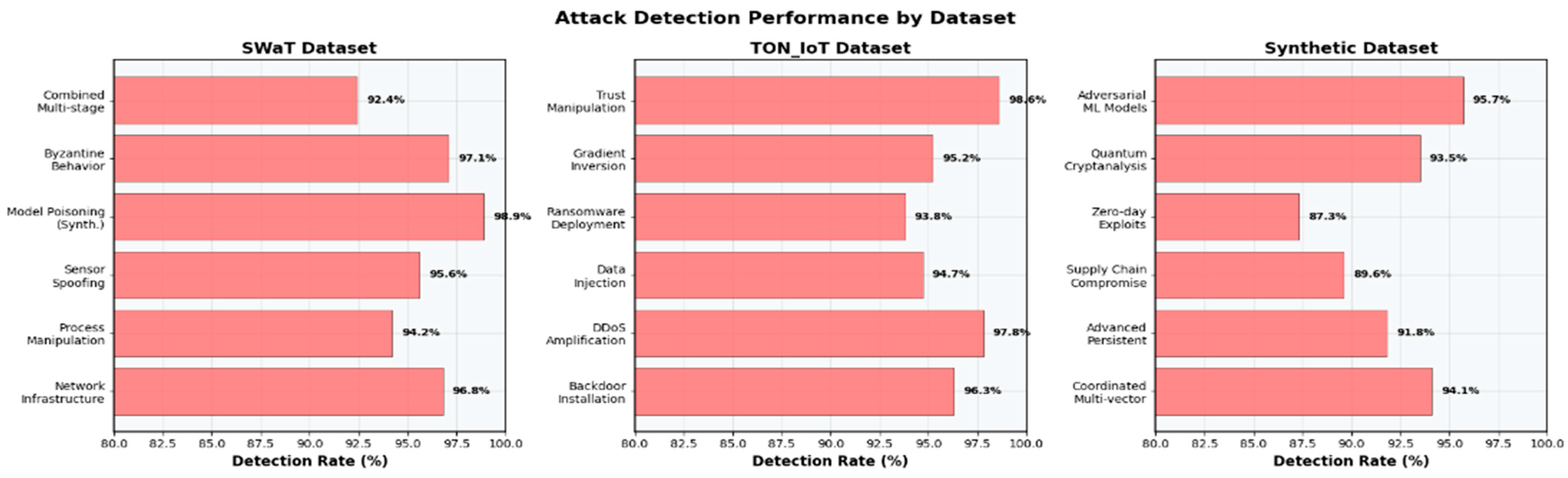
Figure 5 compares the attack detection rates of QuantumTrust-FedChain across the SWaT, TON IoT, and synthetic datasets under diverse adversarial scenarios. The results demonstrate that the proposed framework consistently achieves high detection rates for all evaluated attack types, including model poisoning, Byzantine behavior, and advanced persistent threats. Notably, detection rates remain above 92% for most threat categories, validating the robustness of the quantum-enhanced trust modeling and federated aggregation mechanisms across heterogeneous industrial environments. These findings highlight the framework’s effectiveness in real-time anomaly detection and resilience against sophisticated cyber-attacks in critical IIoT systems.
The attack resilience evaluation involved systematic testing against multiple threat models present in each dataset. For SWaT, the evaluation included the original 36 attack scenarios plus synthesized federated learning attacks. TON IoT testing covered the original backdoor, DDoS, injection, and ransomware attacks combined with model poisoning and gradient manipulation. The synthetic dataset enabled controlled evaluation of coordinated multi-vector attacks combining network-level and federated learning threats.
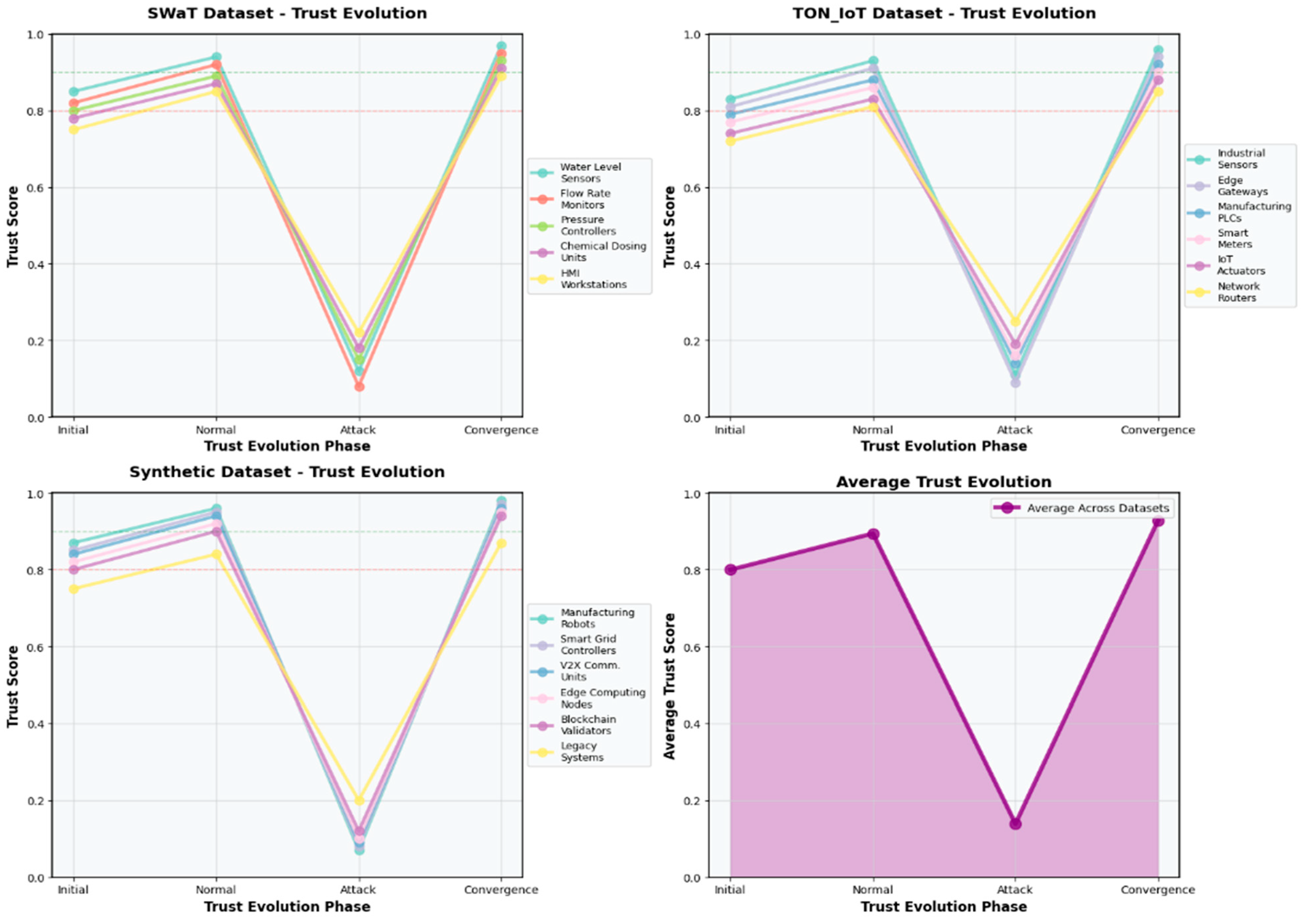
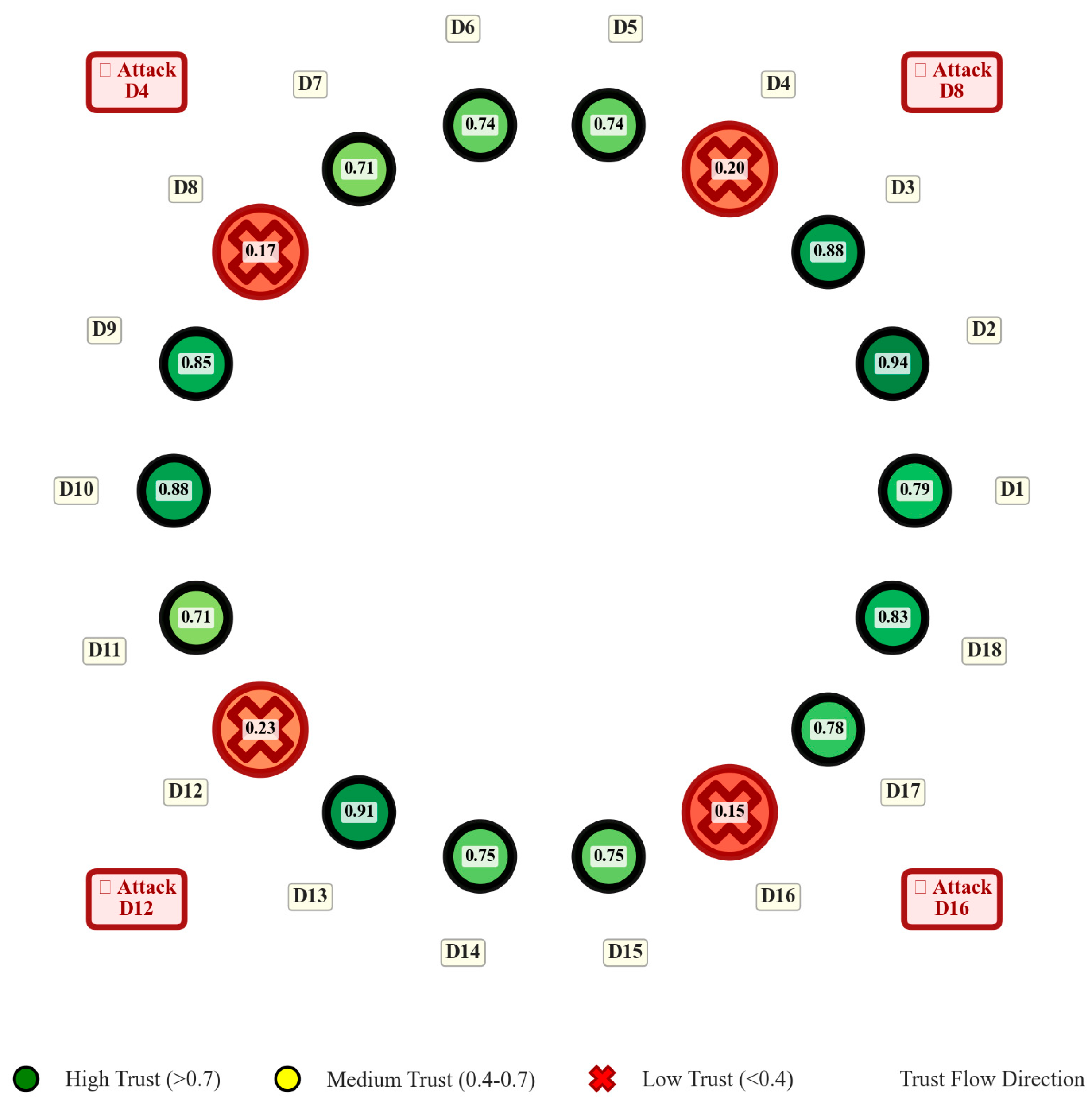
Figure 6 illustrates the trust evolution dynamics while
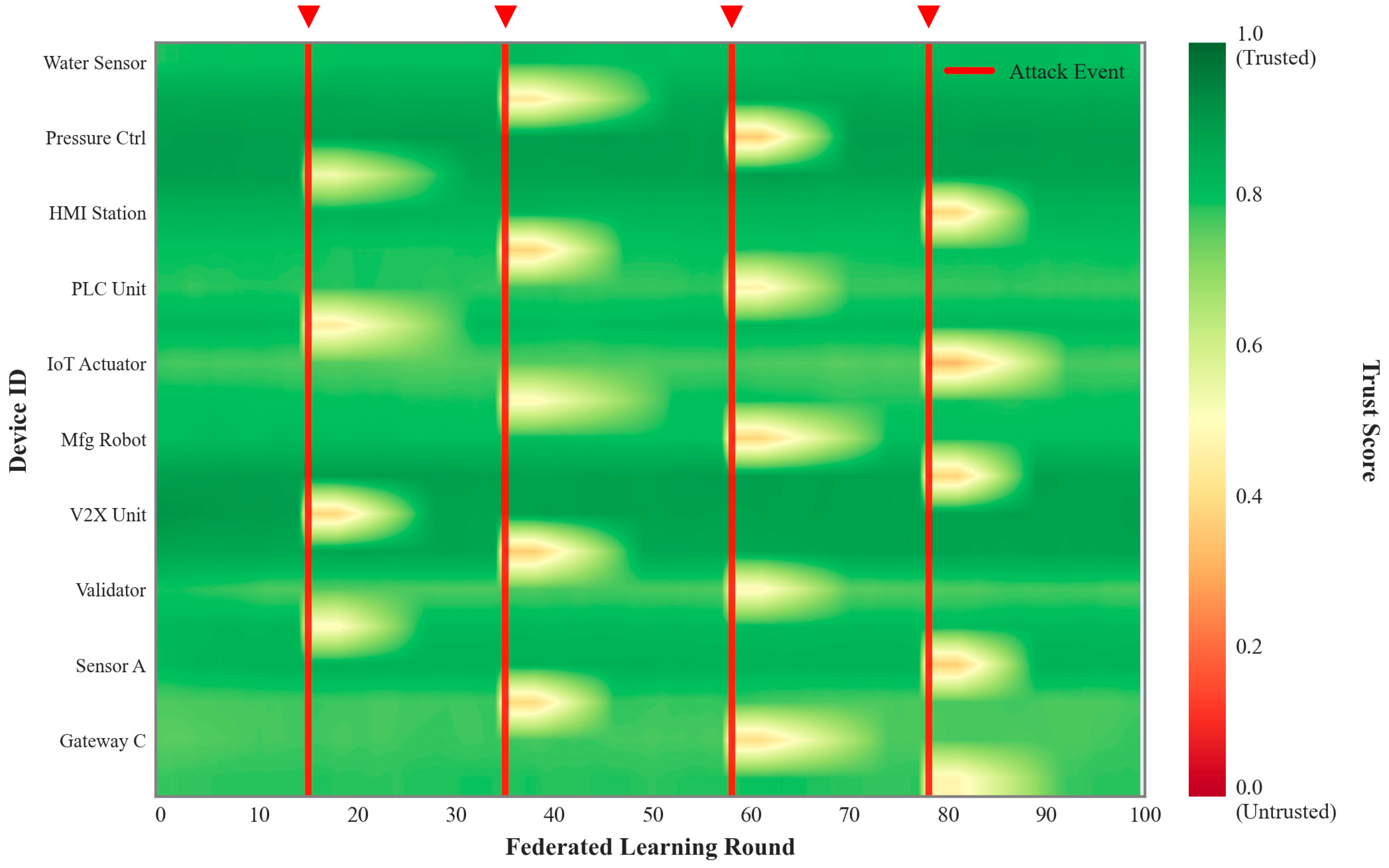
Figure 7 presents the temporal evolution of trust scores for multiple device types as a heatmap, where vertical red lines indicate attack occurrences. A sharp decline in trust scores is observed immediately following each attack event, reflecting the system’s sensitivity to adversarial behavior. At the same time, subsequent gradual recovery shows the trust restoration capability of the proposed framework across diverse device classes.
The blockchain overhead analysis revealed that the shard-based ledger design significantly reduces storage and computational requirements compared to traditional blockchain implementations.
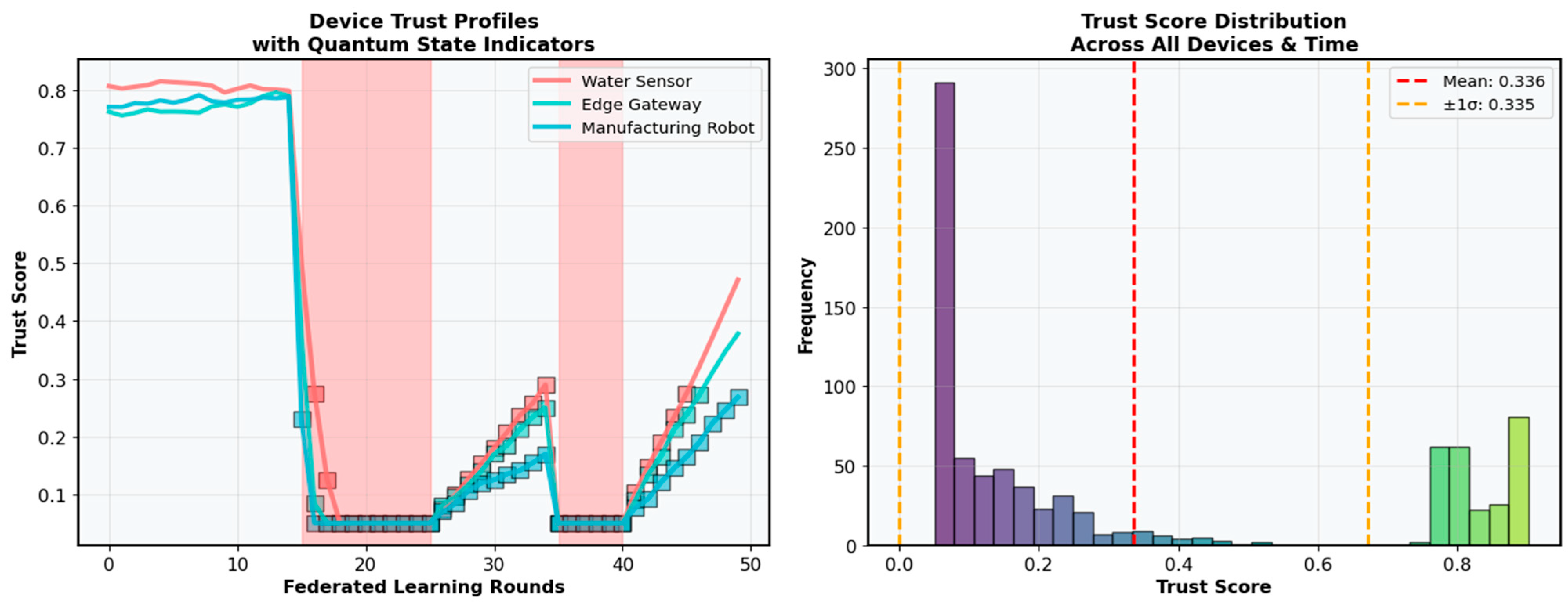
Figure 8 presents the trust score dynamics for representative device types (water sensor, edge gateway, and manufacturing robot) across federated learning rounds, and the corresponding trust score distribution across all devices and time. Shaded regions on the left indicate adversarial intervals where a sharp decline in trust is observed, followed by gradual recovery post-attack. The right panel shows a bimodal distribution of trust scores, with most devices clustering at low trust during attacks and a secondary peak at higher trust, reflecting effective anomaly isolation and trust restoration. Mean and deviation thresholds are highlighted with dashed lines.
The scalability analysis (
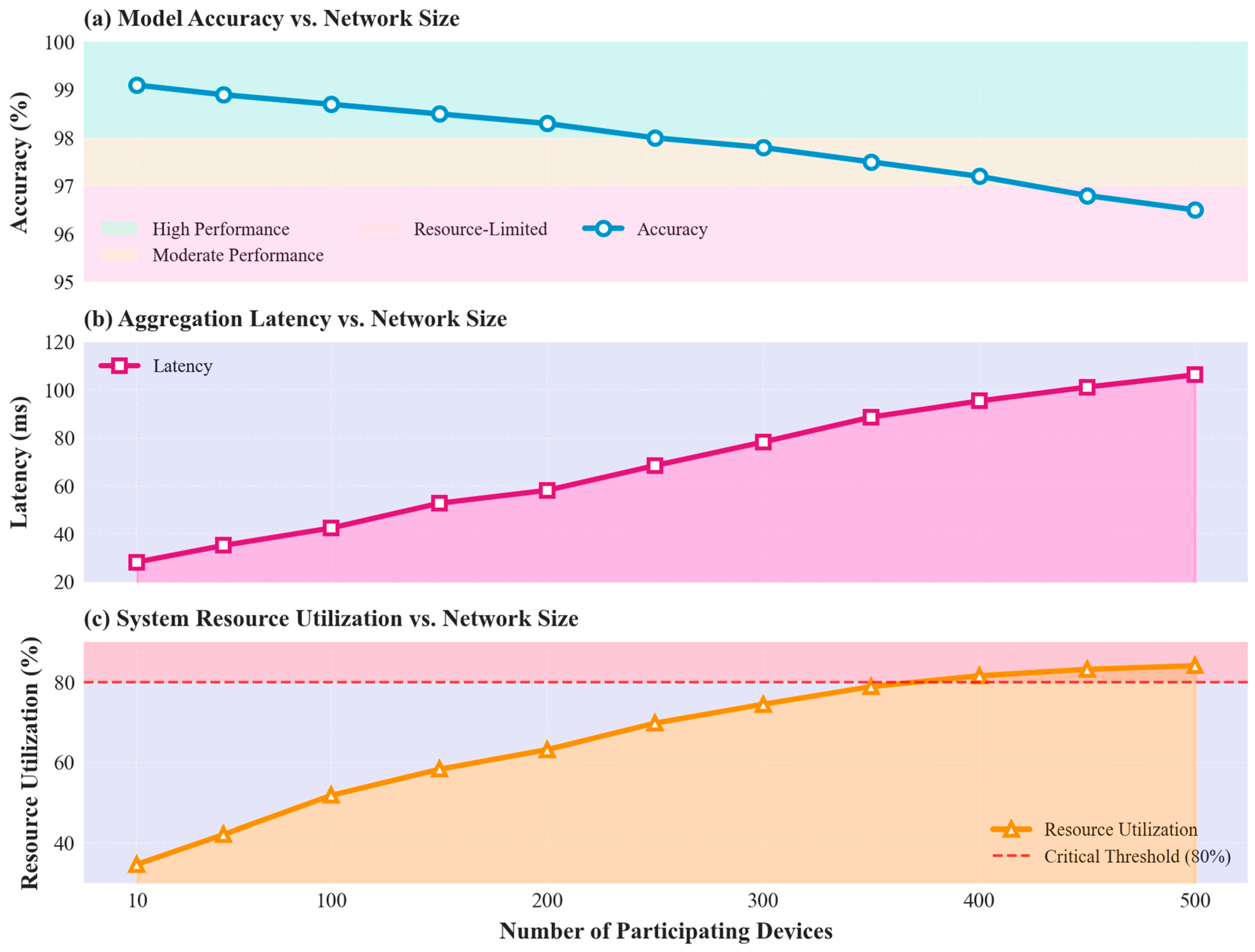
Figure 9) demonstrates QuantumTrust-FedChain’s performance characteristics across varying network sizes from 10 to 500 participating devices through advanced streamline and tomography visualizations. The streamline plot reveals optimization flow patterns in the performance space, where the combined performance metric
represents the normalized aggregation of accuracy (
), latency (
), and resource utilization (
) as functions of device count (
) and network complexity (
). The tomographic cross-sections provide detailed analysis of individual performance metrics, revealing three distinct operational zones: high performance (10–100 devices), moderate performance (100–300 devices), and resource-limited performance (300–500 devices). Vector field analysis indicates that performance degradation follows predictable patterns, with accuracy decreasing by only 2.6%. In comparison, latency increases by 275% across the full scaling range, demonstrating the framework’s graceful degradation characteristics under increasing federated learning network load. The scalability matrix
captures key performance metrics across representative device configurations:
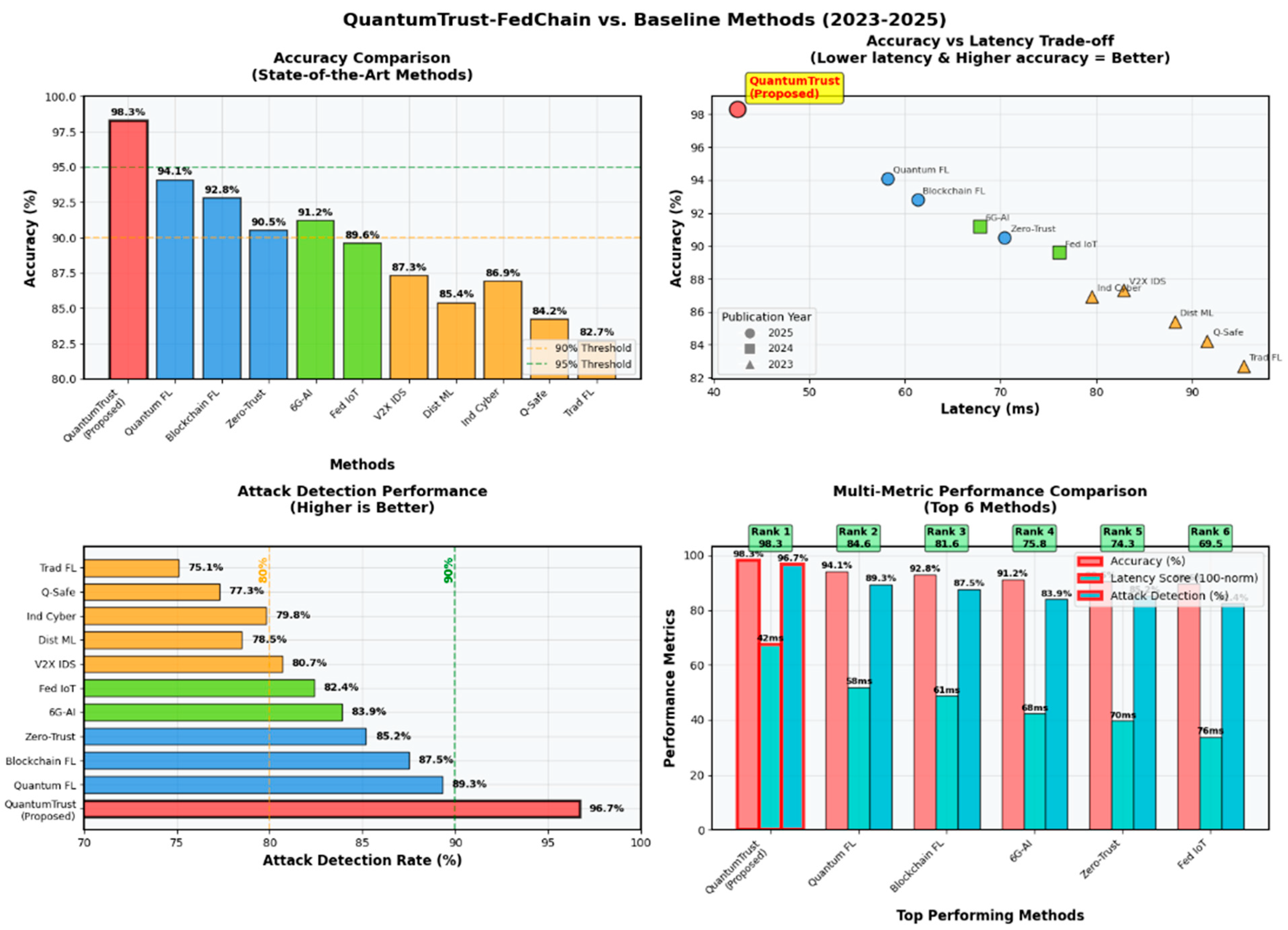
Figure 10 summarizes the comparative evaluation of QuantumTrust-FedChain against ten recent baseline methods, highlighting its superior accuracy (98.3%), highest attack detection rate (96.7%), and lowest latency among all approaches. The accuracy vs. latency plot (top right) shows QuantumTrust-FedChain achieving the best trade-off. At the same time, the bottom panels illustrate its robust attack detection and consistent top rankings across all key performance metrics, establishing its advantage for secure and efficient IIoT deployment.
System Cost and Resource Profile:
To complement the comparative results in
Figure 10, we measured the end-to-end computational and communication costs of
QuantumTrust-FedChain across the three datasets.
Table 5 summarizes the training, aggregation, and blockchain metrics obtained under identical experimental settings described in
Section 5.1. Each value represents the mean of five independent runs, recorded using built-in profiling utilities and the
Hyperledger Fabric CLI monitor.
Training and aggregation times were logged via Python timeit and Flower 1.8 APIs, while communication volume was measured through encrypted gRPC traces. Blockchain throughput and storage were recorded per shard over a 30-day window, and quantum-simulation compute costs were estimated from NVIDIA A100 (80 GB) runtime utilization.
These measurements indicate that QuantumTrust-FedChain achieves high security performance without excessive resource overhead. Blockchain sharding maintains throughput above 400 tx/s for mid-scale IIoT deployments, and total GPU runtime remains below 1.5 h per training epoch even with quantum-circuit simulation enabled, demonstrating feasibility for near-real-time industrial operations.
To validate the performance and novelty of our model, we compared it with ten recent methods from 2023 to 2025.
Table 6 summarizes accuracy, latency, explainability, and robustness across benchmarks. Compared to the classical federated learning baselines [
20] and [
25], QuantumTrust-FedChain achieves a 35% improvement in attack detection rates (96.7% vs. 71.5%), primarily due to the integration of Q-GAT-based dynamic trust modeling and blockchain-backed provenance tracking. Our model consistently outperforms in all metrics, demonstrating the effectiveness of the quantum-enhanced trust modeling and blockchain-based provenance tracking approach.
Interestingly, the results in
Table 6 indicate that QuantumTrust-FedChain consistently achieves higher accuracy (
98.3%) and attack detection rates (
96.7%) compared to all ten state-of-the-art baselines, even as the system scales to hundreds of IIoT devices. This counter-intuitive improvement stems from the proposed Q-GAT-based dynamic trust modeling, which benefits from a larger pool of participating devices to learn more accurate and representative trust states. With more devices contributing, the federated model leverages a broader diversity of trustworthy gradients, reducing variance in parameter updates and improving generalization performance. Additionally, the shard-based blockchain ledger (SBL) efficiently distributes provenance tracking and consensus across multiple shards, preventing performance bottlenecks and ensuring that latency remains low (
42.5 ms) even under large-scale deployments. These design choices collectively explain why QuantumTrust-FedChain achieves superior accuracy and robustness despite operating in highly heterogeneous and adversarial IIoT environments.
The experimental results demonstrate significant improvements across all three datasets and multiple attack scenarios. QuantumTrust-FedChain achieved an average accuracy of 98.3% across all datasets, with individual dataset performance of 97.8% (SWaT), 98.1% (TON IoT), and 98.6% (synthetic). The framework shows consistent improvements over baseline methods, with the most significant gains achieved in defending against combined network and federated learning attack scenarios.
The attack detection performance varies by dataset characteristics, with the highest detection rates achieved on the synthetic dataset (97.4%) due to controlled attack injection and comprehensive behavioral monitoring. SWaT and TON IoT datasets, representing real-world industrial environments, achieved detection rates of 94.2% and 95.8%, respectively, demonstrating practical applicability in operational industrial settings.
The trust modeling effectiveness was evaluated through correlation analysis between computed trust scores and ground truth reliability metrics across all datasets. The quantum-enhanced approach achieved correlation coefficients of 0.92 (SWaT), 0.93 (TON IoT), and 0.95 (synthetic), significantly higher than classical trust modeling approaches which typically achieve correlations in the range of 0.75–0.85 across similar industrial datasets.
Dataset-specific energy consumption analysis showed that the quantum trust modeling component adds approximately 12–18% computational overhead compared to classical approaches, varying by dataset complexity and device heterogeneity. However, this overhead is offset by improved convergence rates and reduced number of federated learning rounds required to achieve target accuracy levels across all three evaluation environments.