1. Introduction
Diabetes mellitus represents a rapidly escalating global health crisis, with projections indicating that the number of affected adults will surge from approximately 589 million to 853 million by 2050 [
1]. For patients with type 1 diabetes and many with advanced type 2 diabetes, insulin therapy remains the cornerstone of management [
2]. However, the standard regimen of multiple daily subcutaneous (SC) injections is inherently painful, inconvenient, and places a significant burden on patient adherence and quality of life [
2,
3]. More critically, manual dosing via SC injection cannot effectively mimic the physiological, pulsatile insulin secretion of a healthy pancreas, frequently leading to dangerous fluctuations in blood glucose levels [
2,
3]. The resulting glycemic variability often precipitates both chronic hyperglycemic complications and, most acutely, severe hypoglycemia—a life-threatening condition that remains the primary barrier to safe and effective insulin intensification [
2,
4]. This clinical reality underscores a sustained and urgent demand for safer, more patient-friendly, and physiologically responsive insulin delivery strategies.
A paradigm shift toward mimicking pancreatic function is offered by glucose-responsive (GR) insulin delivery systems, often referred to as “smart insulin” [
5]. These closed-loop platforms are designed to autonomously adjust insulin release in real time based on ambient glucose concentrations, thereby mitigating the severe glycemic swings associated with manual dosing [
5,
6,
7]. Clinical evidence strongly supports this approach, demonstrating that closed-loop systems significantly improve the time spent in the target glucose range while substantially reducing the risk of hypoglycemia [
7]. Early and widely explored GR strategies have primarily relied on enzyme-based mechanisms, such as those utilizing glucose oxidase (GOx) [
8,
9,
10]. While effective for glucose sensing, GOx-based systems generate hydrogen peroxide H
2O
2—a cytotoxic byproduct—and suffer from inherent limitations, including enzyme denaturation, loss of activity, and sensitivity to pH changes, which severely restrict their long-term durability and clinical translatability [
4,
8,
9,
10].
To overcome the instability and biosafety concerns of enzyme-based systems, research has shifted toward developing robust, enzyme-free alternatives. One prominent approach involves the use of phenylboronic acid (PBA) derivatives, which can form reversible covalent bonds with diol-containing molecules like glucose [
11,
12,
13]. However, the clinical translation of PBA-based systems is often hindered by the need for complex chemical modifications to achieve glucose sensitivity at physiological pH [
12,
14], as well as potential concerns regarding the cytotoxicity of boronic acid derivatives at high concentrations [
14,
15]. Therefore, a critical knowledge gap exists for a simple, highly biocompatible, and stable enzyme-free GR system that can be easily scaled for clinical application.
Meanwhile, microneedle (MN) arrays have emerged as a transformative and patient-friendly platform for transdermal drug delivery [
5,
16,
17]. These micron-scale structures painlessly breach the outermost skin barrier, the stratum corneum, to create transient microchannels that dramatically enhance drug permeability while remaining minimally invasive. Among various formats, dissolving microneedles (DMNs) are particularly promising [
3,
7,
9,
10,
18,
19]. Fabricated from biocompatible and biodegradable polymers, DMNs completely dissolve in the skin after application, releasing their payload without generating sharp medical waste [
6,
20]. Poly(vinyl alcohol) (PVA) is an ideal polymer for DMNs due to its excellent water-solubility, biocompatibility, and robust film-forming capacity, allowing for the fabrication of needles with reproducible geometry and high skin-penetration efficiency [
3,
10,
21,
22,
23].
To address the aforementioned limitations of existing GR systems, we report the development of a novel, enzyme-free, glucose-responsive insulin delivery system integrated into a dissolving PVA-based microneedle patch [
12,
24]. Our system leverages the simple and highly biocompatible borate–diol chemistry through the dynamic crosslinking of PVA and Dextran with borax [
12,
24]. This approach exploits the reversible borate–diol ester bonding, which is sensitive to glucose via a pH-independent competitive binding mechanism [
12,
24]. The strategic incorporation of Dextran, a polysaccharide rich in cis-diol groups, serves to amplify this glucose-responsive behavior by increasing the crosslink density and hydrogel swelling capacity, thereby promoting rapid, on-demand insulin release during hyperglycemic events [
10,
14,
24].
While borate–diol chemistry is an established mechanism for glucose-responsive materials, its translation into robust transdermal devices has been hampered by difficulties in achieving sufficient mechanical strength for reliable skin penetration while simultaneously preserving tunable, rapid glucose-responsive release kinetics [
25]. We hypothesize that these competing requirements can be met through a systematic, multi-step optimization process. By sequentially gating formulation variables (polymer ratio, total solids, insulin load, and crosslinking time) against a priori performance criteria (e.g., fracture strength ≥ 1.0 N, flux ratio R
0–6h ≥ 1.5×), we can identify a PVA/Dextran/borax formulation that is both mechanically robust and highly responsive [
26,
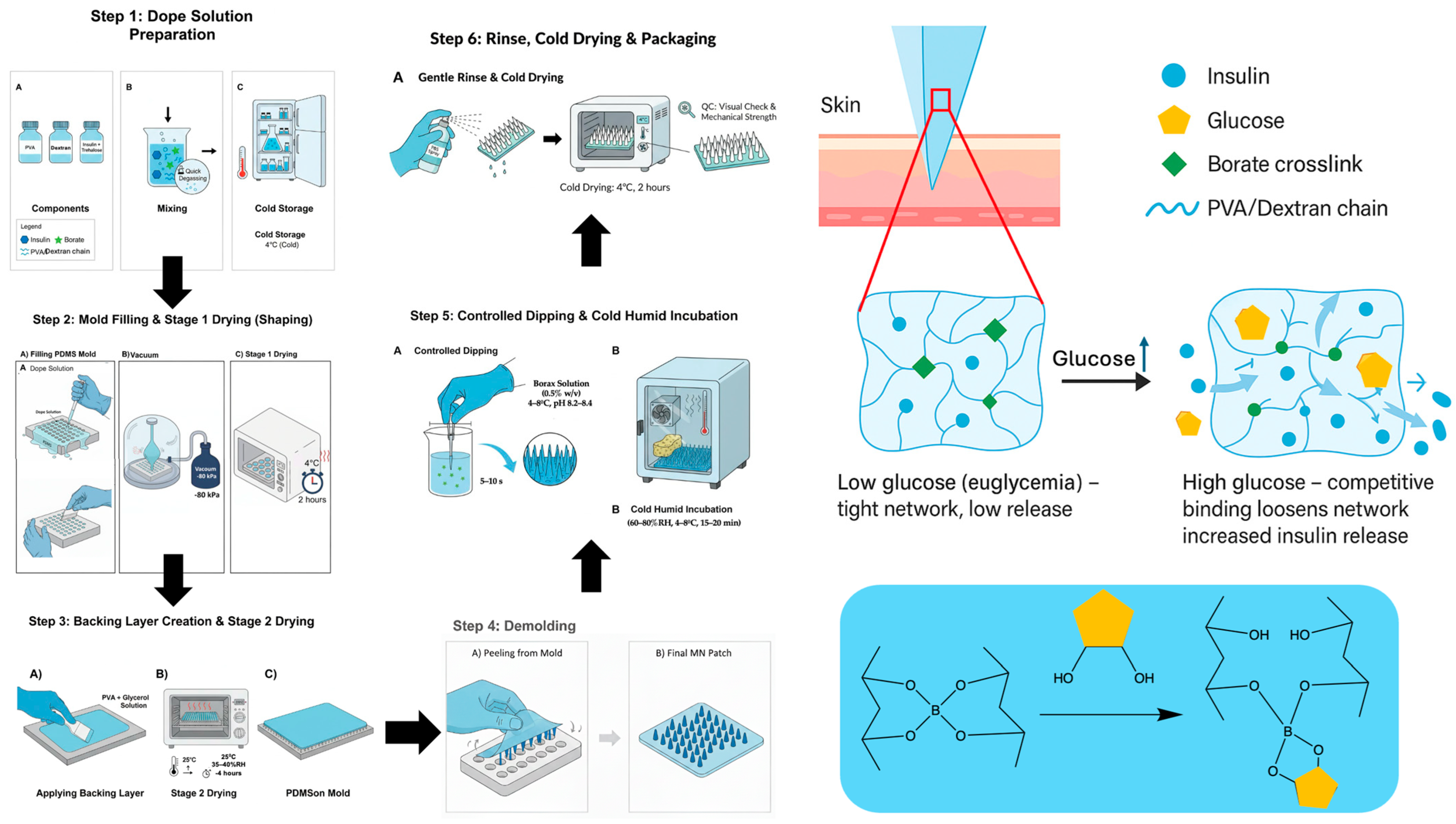
27]. Herein, we present the comprehensive in vitro and in vivo evaluation of this optimized microneedle patch, demonstrating its (i) sufficient mechanical strength for reliable skin penetration; (ii) rapid skin barrier recovery and excellent biosafety; (iii) tunable, enzyme-free glucose-responsive insulin-release kinetics in vitro; and (iv) superior efficacy in maintaining stable and safe glycemic control in vivo in a type 1 diabetic mouse model, critically mitigating the risk of the hypoglycemic nadir common with SC injections. This simple and scalable platform represents a significant step toward safer, patient-friendly, and autonomous diabetes therapy. An overview of the device concept and fabrication workflow is shown in
Figure 1.
2. Materials and Methods
2.1. Materials
Poly(vinyl alcohol) (PVA, 98–99% hydrolyzed, Mw 85–124 kDa) and dextran (40–70 kDa) were obtained from Sigma-Aldrich (St. Louis, MO, USA). Sodium tetraborate decahydrate (borax, ≥99.5%) and trehalose dihydrate (≥99%) were from Sigma- Aldrich as well. Zinc-stabilized (research grade) recombinant human insulin was purchased from Sigma- Aldrich and stored at 2–8 °C per the manufacturer’s instructions. Phosphate-buffered saline (PBS, pH 7.4), Dulbecco’s PBS, DMEM high glucose, fetal bovine serum (FBS), and penicillin–streptomycin were from Thermo Fisher Scientific (Waltham, MA, USA). Glycerol (USP/Ph.Eur.) was from Merck KGaA (Darmstadt, Germany). D-glucose (cell culture and analytical grade), and Eosin Y were from Sigma- Aldrich (St. Louis, MO, USA).
Polydimethylsiloxane (PDMS) base and curing agent (Sylgard™ 184) were obtained from Dow (Midland, MI, USA) and used to cast negative molds. Parafilm M® was from Bemis Company (Neenah, WI, USA). Semi-occlusive medical adhesive film (Tegaderm™, 3M Company, Saint Paul, MN, USA) used for patch fixation was from 3M (St. Paul, MN, USA). Sterile syringe filters (0.22 µm, PVDF or PES) and low-protein-binding microcentrifuge tubes were from MilliporeSigma (Burlington, MA, USA). Black, clear-bottom 96-well plates for spectrophotometric assays were from Corning (Corning, NY, USA).
For plasma insulin quantification, a human insulin ELISA (Mercodia AB, Uppsala, Sweden) was used. Calibrators were prepared in ng·mL−1 and fitted with a 4-parameter logistic (4PL, 1/y2). The validated analytical range used for this study was 0.30–10 ng·mL−1 (LLOQ 0.30 ng·mL−1; estimated LoD 0.10 ng·mL−1). All plates included duplicate standards/QCs; runs required R2 ≥ 0.99, QC recovery 80–120% (≤20% at LLOQ). For confirming negligible endogenous secretion in STZ mice when required, a mouse C-peptide ELISA (Crystal Chem, Elk Grove Village, IL, USA; calibrator range 0–10 ng·mL−1) was employed. Dextrose 50% (w/v) solution for IVGTT was from B. Braun (Melsungen, Germany). Isoflurane for brief anesthesia during patch application and blood sampling was from Baxter (Deerfield, IL, USA).
Boron leaching was quantified using TraceCERT® boron ICP-MS standards (Sigma-Aldrich) prepared in ultrapure nitric acid for trace analysis (Merck KGaA). Working calibration ranges of 0–100 µg·L−1 were freshly prepared in acidified matrix as specified in the corresponding method section. All solutions contacting insulin were prepared with endotoxin-free water, filtered through 0.22 µm membranes, and handled aseptically in a Class II biosafety cabinet. Unless otherwise stated, reagents were of anal ytical grade or higher and used as received.
2.2. Methods
2.2.1. Fabrication of PVA/Dextran/Borax/Insulin Microneedle Arrays
Mold Design and Replication
Microneedle (MN) array layouts (square matrix, conical frustums; nominal base 400 µm; height 900 µm) were drafted in vector software and laser-engraved into PMMA plates to generate negative masters. Engraving was performed using a laser system (manufactured in Guangzhou, China; Phan Long Laser–monitored in Hanoi, Vietnam) operated at 20% laser intensity and 600 mm·s
−1 for the selected pattern settings (speed range explored: 500–1400 mm·s
−1; power range explored: 10–100%). PDMS working molds (Sylgard™ 184, 10:1 base/curing agent,
w/
w) were prepared by mixing, vacuum degassing for 30 min, casting onto the PMMA master, and curing at room temperature for 24 h. After curing, molds were peeled, inspected for defects, cleaned with 70% ethanol, and stored dust-free prior to replica molding [
28]. Mold filling used vacuum cycles (−60 to −90 kPa, 2–3 cycles × 60–120 s) to ensure void-free cavities. Prior to use, PDMS molds were cleaned (70% ethanol), air-dried in a clean hood, and UV-irradiated to ensure surface cleanliness. Where reverse replication was required, a thin metallic (Ag) sputter was briefly applied to the PMMA surface to improve feature fidelity; production runs used untreated PDMS molds.
Microneedle Fabrication Workflow (Schematic in Figure 1)
In this study, PDB-MN denotes poly(vinyl alcohol)/Dextran/borax microneedle patches; sI-MN refers to insulin-loaded PDB-MN.
Step 1—Dope preparation (no borax): a cold aqueous PVA/dextran blend was prepared at 18–22% w/w total solids with PVA/Dextran = 90:10 (w/w) and trehalose 2% w/v; recombinant human insulin (5 mg·mL−1) was gently incorporated under cold conditions with minimal aeration. No borax was included in the dope to avoid premature gelation and to preserve tip fidelity.
Step 2—Mold filling and Stage-1 cold-drying: 70 µL per 15 mm disk of dope was dispensed onto PDMS-negative molds (working array 14 × 14; nominal needle height 900 µm, base 400 µm) and driven into the cavities by vacuum −60 to −90 kPa (2–3 cycles × 60–120 s) until void-free; the surface was then leveled with a doctor blade. Immediately after filling, molds were placed in a closed chamber at 4 °C for 2 h to stabilize needle shape while maintaining insulin integrity.
Step 3—Backing layer and Stage-2 drying: a backing layer (PVA 15% w/w + glycerol 0.5% w/w) was cast to cover the mold and arrays were dried to completion at 25 °C for 3–4 h (RH 35–40%) in a closed desiccator to mass-constant (±1 mg per patch over 30 min).
Step 4—Demolding and trimming: arrays were released from the molds and trimmed to the required format (e.g., 15 mm disks or mouse-scaled mini-patches), avoiding deformation of the needle field.
Step 5—post-dip borax and cold–humid incubation: Entire patches (needles + backing) were immersed once in chilled sodium tetraborate 0.5% w/v (pH 8.2–8.4, 4–8 °C) for 5–10 s, then incubated at 4–8 °C and 60–80% RH for 15–20 min to complete reversible boronate–diol crosslinking.
Step 6—Finishing and storage: a fine PBS mist (3–5 s) was applied to normalize surface ionic strength and remove loosely bound borate, followed by cold-drying at 4 °C for 2 h. Patches were sealed with desiccant in foil pouches and stored at 2–8 °C; prior to in vivo use, they were equilibrated sealed at room temperature for 15–20 min and then opened and applied. All steps were conducted at ≤30 °C under clean, low-airflow conditions.
Design of Optimization Experiments
To identify a single, manufacturable recipe that meets all pre-specified performance gates, we executed a four-step, sequential optimization with explicit factor levels, standardized readouts, and decision rules. Unless otherwise stated, each condition was produced in ≥3 independent batches (“patch-level” replicates), mechanical testing sampled ≥10 needles per patch, and release assays were run in technical triplicate per batch. For single-needle testing, needles were selected using stratified sampling across the array (center and peripheral zones) to capture potential spatial heterogeneity from casting/drying. This sampling density was chosen as a practical compromise between throughput and representativeness and is supported by the low defect rate (<5%) and high mechanical reproducibility observed across independent arrays. Test order was randomized where feasible and data processing was blinded to factor levels. Primary acceptance thresholds were defined a priori (
Table 1): mean fracture strength ≥ 1.0 N·needle
−1 (borderline acceptable ≥ 0.8 N·needle
−1), glucose-responsiveness ratio R
0–6h ≥ 1.5×, encapsulation efficiency (EE) ≥ 70–80%, insulin loss during borax dip ≤ 5% of nominal load, and boron leaching < 10 µg·patch
−1·24 h
−1. Glucose-responsiveness was computed from cumulative insulin-release profiles in PBS (pH 7.4, 37 °C) containing either 100 or 400 mg·dL
−1 D-glucose: a linear slope (flux, µg·h
−1) was fit over 0–6 h for each glucose level, and R
0–6h was defined as flux(400)/flux(100).
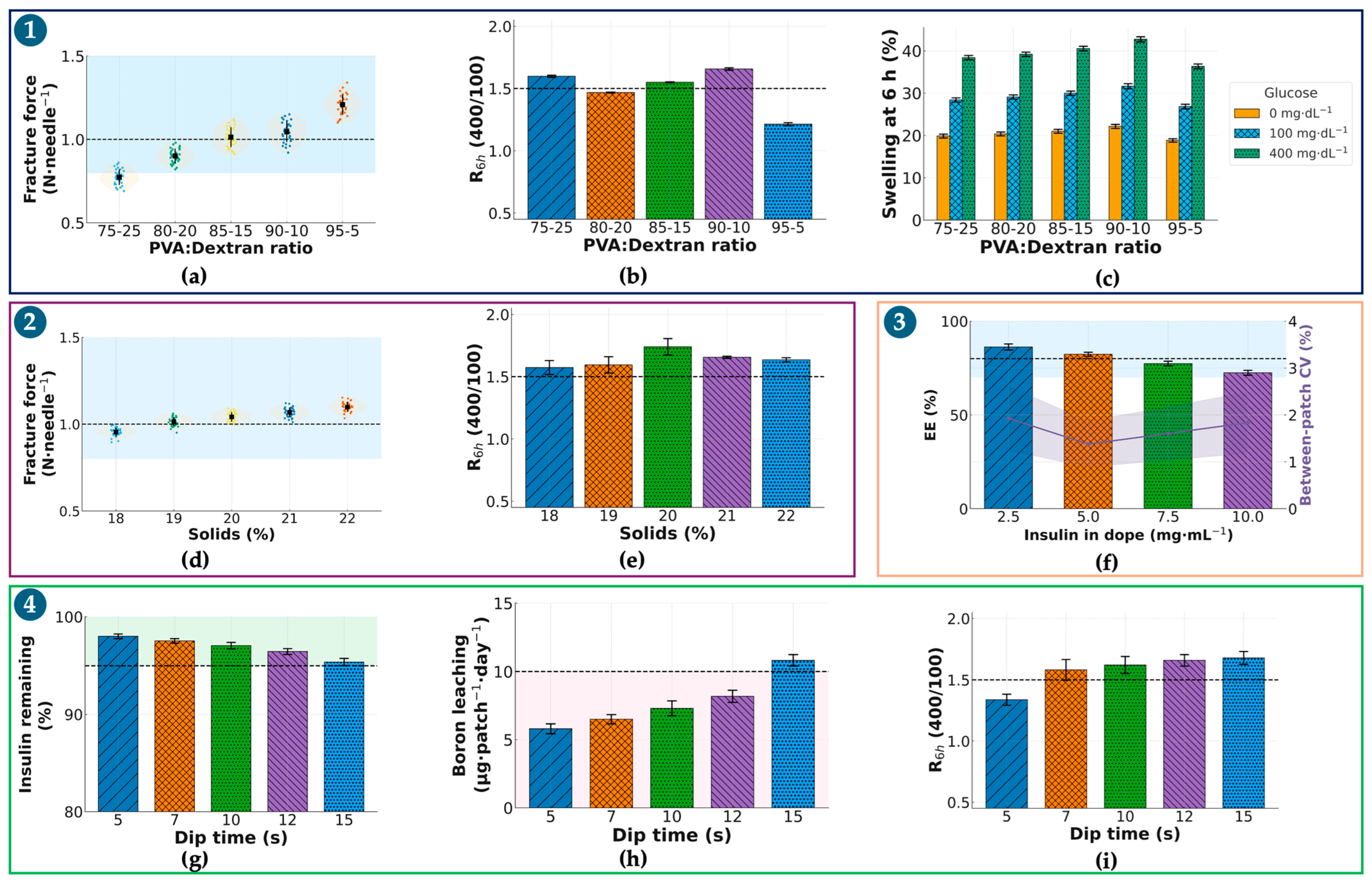
Step 1—Select PVA/dextran ratio at fixed solids and post-dip configuration. We screened PVA/dextran mass ratios of 95:5, 90:10, 85:15, 80:20, and 75:25 (w/w) at a fixed total solids of 20% (w/w). To avoid confounding composition with crosslinking intensity, all candidates received the same post-dip activation: a single brief immersion in chilled, mildly alkaline borax (0.5% w/v sodium tetraborate, pH 8.2–8.4, 4–8 °C). Primary readouts were (i) per-needle fracture strength measured on a texture analyzer using a flat platen and controlled approach speed until catastrophic failure (10 needles per patch; ≥3 patches per ratio), and (ii) glucose-responsiveness R0–6h derived from ELISA-based quantification of insulin release at 100 vs. 400 mg·dL−1 glucose. A supportive readout—swelling at 6 h (%) in 0/100/400 mg·dL−1—was recorded to guard-band mechanical integrity. The decision rule was to select the lowest-variance ratio whose patch-level mean fracture was ≥1.0 N·needle−1 and R0–6h was ≥1.5×; ties were broken by larger R0–6h and lower swelling at 0 mg·dL−1.
Step 2—Select total solids at the Step-1 ratio. With the Step-1 ratio fixed, we varied total solids across 18, 19, 20, 21, and 22% (w/w), keeping the borax bath and immersion identical to Step-1. The same readouts (fracture and R0–6h) were collected, with optional 6 h swelling as a manufacturability check (molding/demolding defects, tip fidelity). The decision rule was to select the lowest-variance solids level that maintained fracture ≥ 1.0 N·needle−1 and maximized R0–6h, provided arrays molded and released cleanly from the PDMS without defects.
Step 3—Select insulin concentration in the dope at the chosen ratio/solids. Nominal insulin concentrations of 2.5, 5.0, 7.5, and 10.0 mg·mL
−1 were prepared under cold, sterile handling. Entire patches were solvent-extracted in PBS (pH 7.4, 37 °C) with gentle agitation until complete dissolution; clarified extracts (centrifugation/0.22 µm) were quantified by sandwich ELISA against a multi-point insulin calibration. Readouts were encapsulation efficiency (EE, %) and drug loading (IU·patch
−1). The decision rule was to select the concentration that achieved the target IU·patch
−1 with EE within the acceptance band (
Table 1) and an acceptable between-patch coefficient of variation; ties were resolved by higher EE and lower CV.
Step 4—Confirm borax immersion time at fixed composition. At the Step-1/2/3 composition, we evaluated post-dip immersion times of 5, 7, 10, 12, and 15 s in the same chilled borax bath. Primary readouts were (i) insulin loss to the bath (%) measured by ELISA after immediate neutralization and ≥1:20 dilution into ELISA sample diluent; spike-recovery in borax matrix confirmed 80–120%, and (ii) boron leaching after 24 h incubation in PBS at 37 °C (µg·patch−1·24 h−1), quantified by ICP-MS with calibration/QA checks. A brief guard-check of R0–6h verified that responsiveness was preserved. The decision rule was to adopt the shortest immersion time that simultaneously kept insulin loss ≤ 5% and boron leaching < 10 µg·patch−1·day−1 while maintaining R0–6h ≥ 1.5×; conditions breaching the boron limit (e.g., 15 s) were pre-specified for exclusion.
Applying this gated, sequential design converged on a single composition/processing recipe that satisfied all acceptance thresholds with favorable variance. It is crucial to differentiate this “gated, sequential” selection process from a formal Design of Experiments (DoE) optimization. This workflow was designed to efficiently identify a single compliant formulation that meets all a priori acceptance thresholds (
Table 1), not necessarily to map the entire design space or find a global mathematical optimum. For example, the selection of 7 s in Step 4 was based on it being the minimum effective time that satisfied all safety and efficacy gates (R
0–6h ≥ 1.5×, Boron < 10 µg·patch
−1), although 10 s also demonstrated compliance. This pragmatic approach balances performance with manufacturability and was deemed sufficient for this proof-of-concept validation.
2.2.2. Optical Microscopy for Array Geometry and Morphology
Microneedle (MN) arrays were imaged using a calibrated optical microscope (stereo/bright-field). Prior to measurements, the imaging scale was verified with a stage micrometer at each magnification used. Single-needle height, base diameter, and tip radius were measured from micrographs in ImageJ 1.54 software(NIH). For each experimental condition, the number of needles and arrays analyzed is specified in the corresponding figure legends. Geometric defect rate (% malformed needles per patch) and effective needle count (needles conforming to design specifications per patch diameter) were calculated to describe manufacturing quality.
2.2.3. Insulin Loading, Content Uniformity and Patch Stability
For patch content and content uniformity, entire patches were dissolved in PBS (pH 7.4, 37 °C) or the ELISA sample diluent recommended by the manufacturer, with gentle vortexing and brief sonication as needed to ensure complete dissolution. Solutions were clarified by low-speed centrifugation and, when required, by 0.22 µm filtration. Human insulin concentration was determined using a validated sandwich ELISA. Calibration curves (≥5 standards) were fitted with a four-parameter logistic (4PL, 1/y
2) model with run acceptance R
2 ≥ 0.99; calibrator/QC back-calculation within ±15% (±20% at LLOQ). Assay validation in patch-extract matrices and in mouse plasma is summarized in
Supplementary Tables S1 and S2, respectively. Patch content (IU/patch) was obtained from ELISA-derived mass using the conversion 1 IU = 0.0347 mg human insulin before normalization.
For storage stability, patches were stored at 2–8 °C with/without desiccant and at room temperature (RT) with/without desiccant for predefined intervals. At each timepoint, patch insulin content was quantified by ELISA as described above and expressed relative to the initial value to track immunoreactive insulin retention over time.
To functionally confirm that immunoreactive insulin quantified in patch extracts remained bioactive after storage, a subset of freshly prepared and stored sI-MN patches was directly tested in STZ-diabetic mice following the in vivo protocols in
Section 2.2.9.
Encapsulation efficiency (EE, %) was calculated as follows:
Theoretical insulin mass was computed from the dope insulin concentration and the dispensed dope volume per patch (70 µL per 15 mm disk). Drug loading is reported as the absolute insulin content (IU·patch
−1), whereas EE captures process retention relative to the theoretical load (i.e., losses during molding/drying/post-dip).
2.2.4. Mechanical Testing (Array-Scale and Single-Needle Fracture)
Array Force–Displacement. The bulk mechanical properties of the arrays were evaluated using a texture analyzer (TA.XTplus, Stable Micro Systems, Godalming, UK) with a 5 kg load cell. A 2 mm diameter cylindrical probe compressed the array at a constant rate of 0.5 mm·s−1. The resulting force–displacement data were normalized by the probe area to generate a stress–strain curve (N·cm−2), from which yield and fracture points were identified.
Single-Needle Fracture Force. The fracture force of individual needles was measured by micro-compression using the same texture analyzer setup. The array was fixed onto a rigid stage, and the probe was lowered at 0.5 mm·s
−1 to compress a single needle until the point of fracture, defined as the peak force (N) recorded [
29]. Sample sizes (needles per patch and patches per group) are indicated with the results. Mechanical outcomes are reported as mean ± SD; where applicable, reproducibility metrics (e.g., coefficient of variation or intraclass correlation) are provided.
2.2.5. Insertion, Depth Profiling, and Local Barrier Function
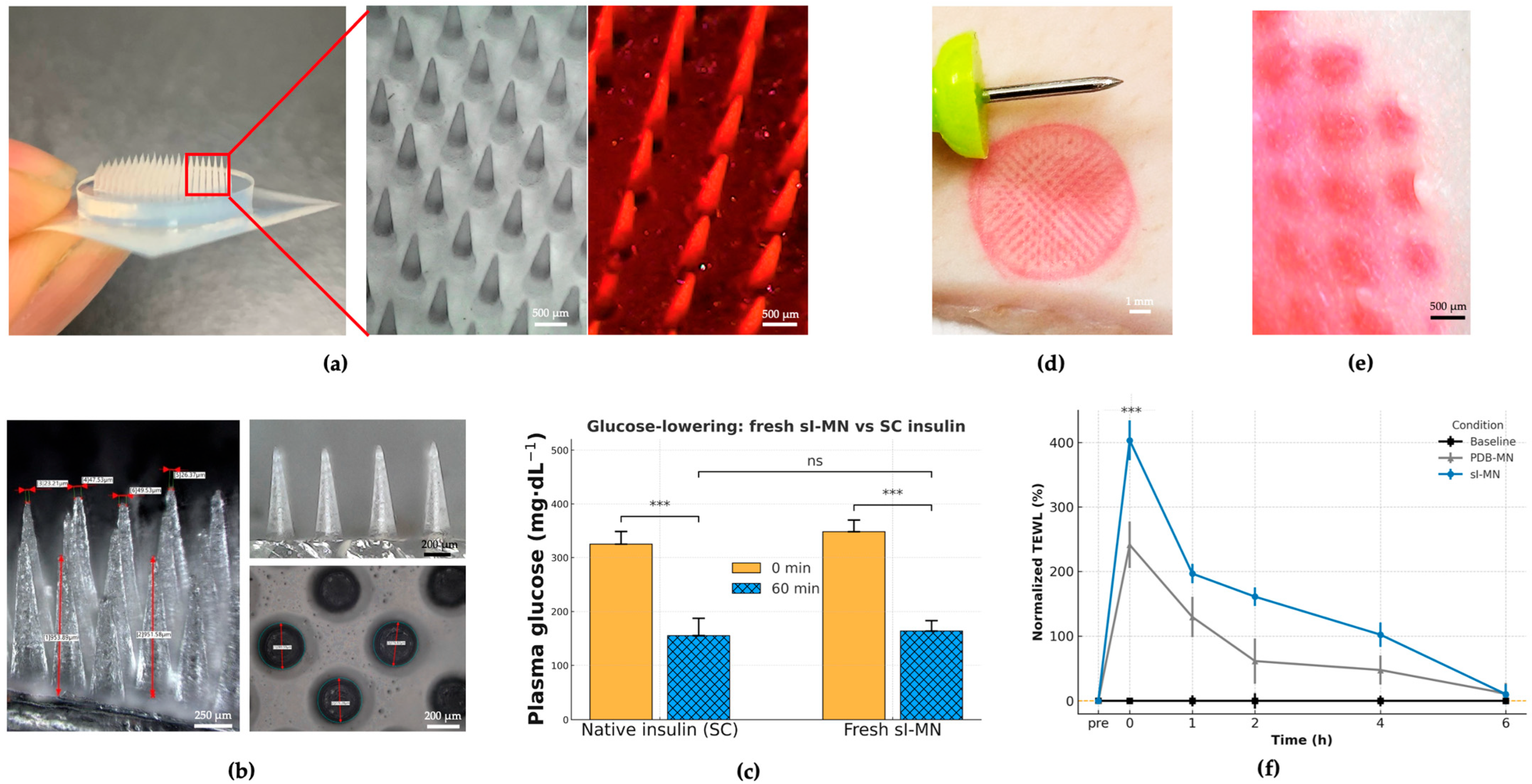
Insertion (ex vivo, porcine skin). Arrays designed for insertion verification were fabricated with eosin Y incorporated in the needle tips. After application to excised porcine skin under standardized thumb pressure for a fixed dwell time, patches were removed and the skin surface was immediately examined by optical microscopy.
Transepidermal Water Loss (TEWL). Skin barrier disruption and recovery were quantified using an open-chamber tewameter (Tewameter
® TM 300, Courage + Khazaka electronic GmbH, Cologne, Germany). Measurements were taken at pre-, 0, 1, 2, 4, 6, 12, and 24 h post-removal; values were normalized to pre-application baseline. All TEWL measurements were conducted in a controlled room (20–25 °C; 40–60% RH). Animals were acclimatized for 15–30 min at rest with the dorsal site exposed immediately before each read. The acclimatization duration was selected in accordance with established guidance for TEWL measurements [
33,
34]. Three consecutive readings per site were recorded with the probe held perpendicular to skin; the median value was used for analysis. For each timepoint, n = 5 independent skin sites were measured (three technical readings per site averaged). The following groups were assessed: Baseline (no patch), blank PDB-MN, and insulin-loaded sI-MN.
2.2.6. In Vitro Swelling and Glucose-Responsive Release
Swelling kinetics. Microneedle tips were incubated in PBS (pH 7.4, 37 °C) containing glucose at normoglycemic (100 mg·dL
−1), hyperglycemic (400 mg·dL
−1), or glucose-free (0 mg·dL
−1) concentrations. At timepoints from 0 to 24 h, samples were weighed to determine water uptake. The percentage swelling was calculated as follows:
Cumulative release and on–off cycling. Insulin release was assessed in static/Franz diffusion setups maintained under sink conditions in PBS (pH 7.4) at 37 °C with glucose at 0, 100, or 400 mg·dL−1. Samples were collected over 0–24 h with medium replacement. For reversibility tests, donor media were alternated between 100 and 400 mg·dL−1 glucose at fixed intervals (30–60 min) for three cycles. Insulin concentrations in all receiver samples were determined by ELISA (4-PL fit; appropriate dilution into ELISA diluent; spike-recovery 80–120% verified in the receiver matrix). Initial release flux (0–6 h) was estimated from the slope of cumulative amount vs. time over the 0–6 h window, normalized by the effective release area. The flux ratio R0–6h was defined as Flux(400 mg·dL−1)/Flux(100 mg·dL−1). The response time, T90, was defined as the time to reach 90% of the new steady-state release rate after a glucose switch.
2.2.7. Boron Leaching
Patches were incubated 24 h at 37 °C in PBS; supernatant was analyzed by ICP-MS (Agilent 7700, Agilent Technologies, Inc., Santa Clara, CA, USA). Calibration employed TraceCERT
® boron standards (0–100 µg·L
−1) in acidified matrix, with procedural blanks and matrix-matched QCs in each run; calibration R
2 ≥ 0.99 and QC recovery 80–120% were required. Analytical method validation is provided in
Supplementary Table S3. Boron release was reported as µg patch
−1 day
−1, with a predefined acceptance threshold of <10 µg patch
−1 day
−1.
2.2.8. Animals, Diabetes Induction, Randomization and Blinding
Male C57BL/6J mice, 56–70 days old (8–10 weeks) and weighing 23–28 g at allocation, were housed under standard conditions with ad libitum access to food and water. Type 1 diabetes was induced by intraperitoneal streptozotocin (55 mg kg
−1 daily for 5 days). Mice with fasting plasma glucose (FPG) > 300 mg·dL
−1 were considered diabetic and enrolled. Individual induction outcomes are summarized in
Supplementary Table S4. Animals were randomized to groups with allocation concealment; outcome assessors were blinded to treatment. All procedures were approved by the Institutional Animal Care and Use Committee (IACUC; protocol ILES-IACUC-2025-002, approved 11 July 2025) and complied with ARRIVE guidelines. Animals were housed at 22 ± 2 °C, 45–65% RH under a 12 h light/12 h dark cycle with environmental enrichment (nesting material), standard chow and water ad libitum. For blood sampling and patch application, brief isoflurane anesthesia was used (Materials). Humane endpoints: >20% body-weight loss from baseline, persistent FPG > 600 mg·dL
−1 despite treatment, or any severe distress prompted euthanasia per IACUC policy.
2.2.9. In Vivo Studies: Baseline Efficacy, GTTs, Feeding, and PK
Treatments and Dosing. Treatments included sI-MN mini-patches (Ø 3–5 mm, delivering 0.05–0.20 IU), blank PDB-MN patches (poly(vinyl alcohol)/Dextran/borax microneedle patches without insulin), a dose-matched SC insulin injection, and a PBS sham control. Patches were applied to a shaved dorsal skin site and secured with a semi-occlusive film. The nominal dose for mouse studies (0.05–0.20 IU) was delivered using “mini-patches” (Ø 3–5 mm) punched from larger, fully characterized patches (Ø 15 mm). The nominal dose was calculated based on this area ratio:
This calculation carries the critical, unverified assumption of perfect intra-patch homogeneity (i.e., that drug content is uniform across the entire patch surface, with no “edge effects” from drying or molding). As only inter-patch uniformity was validated (
Figure S1), all subsequent pharmacokinetic and pharmacodynamic data based on this nominal dose must be interpreted with this limitation in mind.
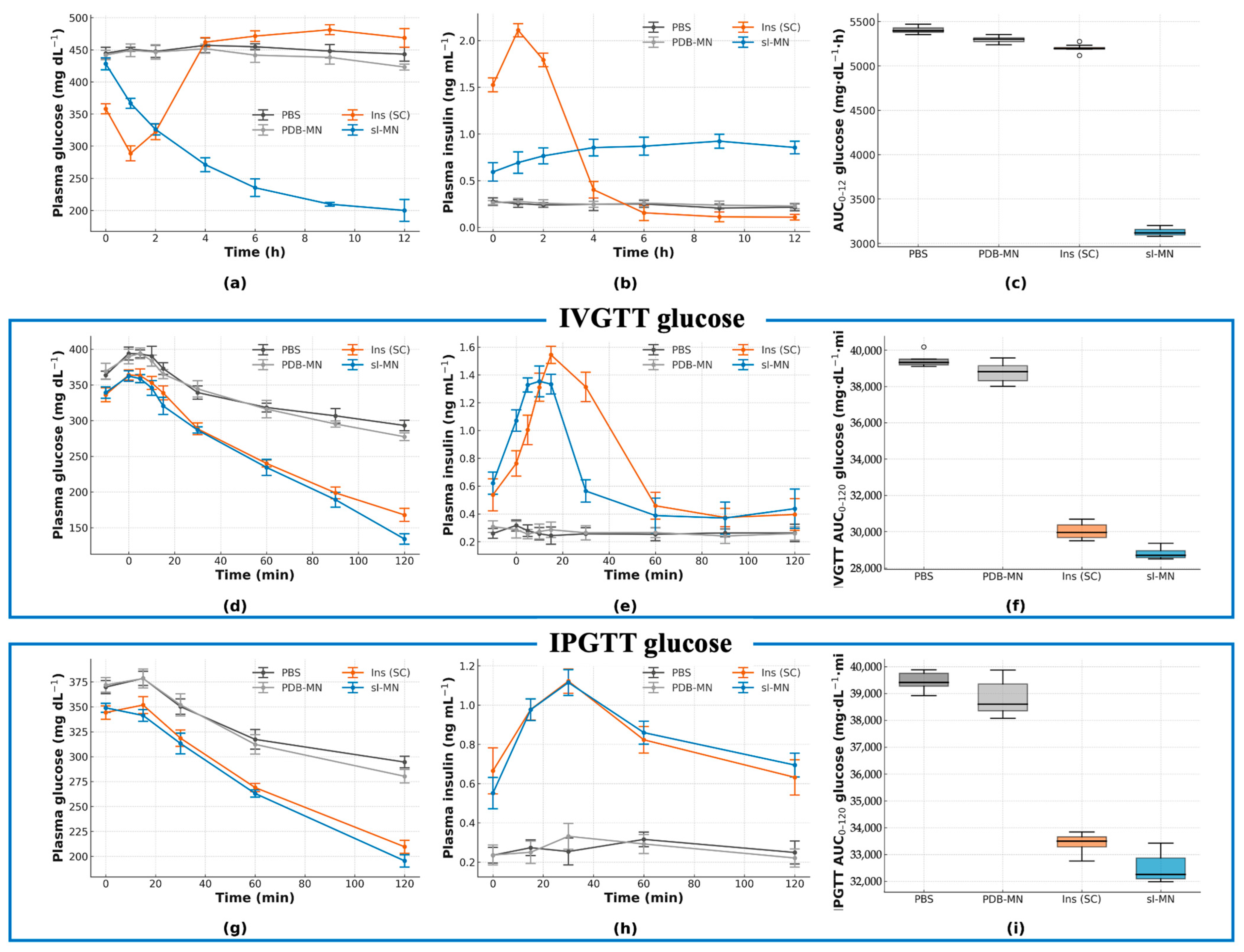
Baseline Efficacy (0–12/24 h). Plasma glucose levels (PGLs) were monitored for 12–24 h using a glucometer. Plasma insulin was quantified by ELISA at selected timepoints. The area under the curve (AUC0–12/24) was calculated to assess overall glycemic control.
IVGTT. An intravenous glucose-tolerance test (IVGTT) was performed 2–4 h post-application by administering an IV bolus of dextrose (0.7 g·kg−1). PGL and plasma insulin were monitored for 0–60 min post-bolus.
IPGTT. An intraperitoneal glucose-tolerance test (IPGTT) was performed 4 h post-application by administering an IP bolus of glucose (1.5 g·kg−1). PGL and plasma insulin were monitored for 0–120 min, and the AUC0–120 was calculated.
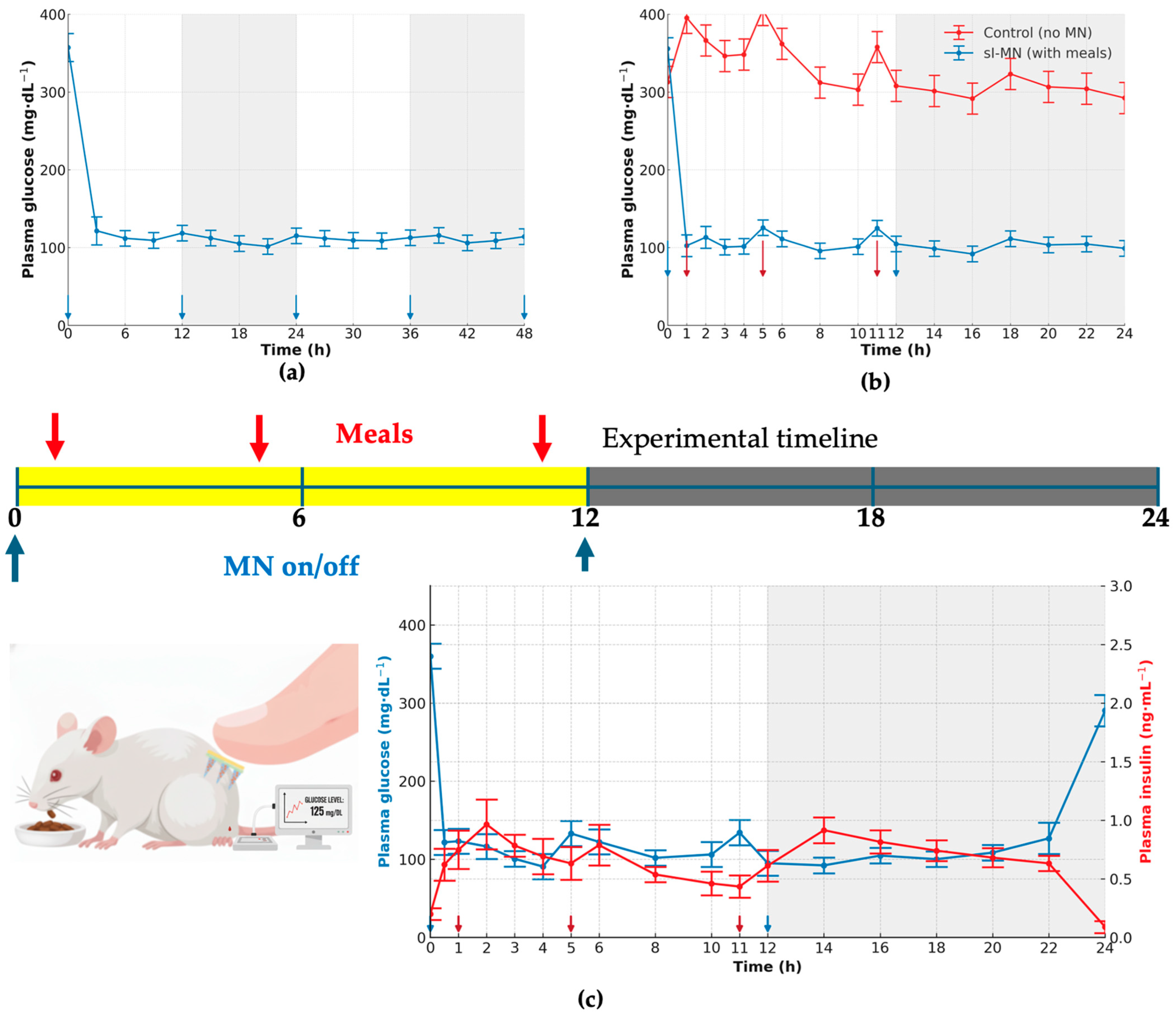
Feeding Tests. Postprandial glucose control was assessed over 24 h with standardized meals provided during the day (at 1, 5, and 11 h), followed by a nocturnal fast. A separate 48 h study was conducted without meals, with patches changed every 12 h (q12h) to evaluate long-term control. PGL time-courses and dual-axis glucose–insulin traces were generated.
Pharmacokinetics. Serial blood samples were collected following sI-MN application or SC insulin dosing. Plasma insulin concentrations were quantified by ELISA (4-PL; appropriate plasma dilution; internal QCs and spike-recovery within 80–120%). Noncompartmental analysis (NCA) yielded Cmax, tmax, and AUC over the reported interval, and terminal half-life (t1/2). The terminal rate constant (λ_z) was estimated by log-linear regression of the terminal phase (≥3 points), with t1/2 = ln(2)/λ_z. AUCs were calculated by the linear-up/linear-down trapezoidal rule.
2.2.10. Statistical Analysis
All analyses were performed using GraphPad Prism v9.0. Replicates were defined as technical or biological, with n per group specified for each experiment. Data were checked for normality (Shapiro–Wilk test) and homogeneity of variance (Levene’s test). Comparisons were made using one- or two-way ANOVA (with repeated measures where applicable), followed by post hoc tests (Tukey/Šidák) or by two-tailed Student’s t-test. A p-value < 0.05 was considered statistically significant. Data are presented as mean ± SD unless otherwise stated.
4. Discussion
This study details the successful design, optimization, and validation of an enzyme-free, glucose-responsive microneedle (MN) patch for autonomous insulin delivery. The platform represents a critical step toward safer and more patient-centric diabetes management, directly addressing the limitations of conventional therapies [
4,
9].
The most significant preclinical finding from this work is the platform’s ability to maintain near-normoglycemia for approximately 8 h in a type 1 diabetic mouse model (
Figure 5 and
Figure 6). Critically, the patch avoids the acute hypoglycemic nadir and subsequent rebound hyperglycemia commonly observed with conventional subcutaneous (SC) injections (
Figure 5a). This outcome directly addresses the primary barrier to intensive glycemic control in diabetes management [
19,
35,
37], a key benefit also demonstrated by electronic closed-loop systems [
38,
39,
40].
The pursuit of “smart insulin” systems has historically been dominated by two approaches [
7]. Enzyme-based platforms, typically using Glucose Oxidase (GOx), suffer from significant biosafety and stability issues [
8,
9]. The enzymatic reaction, while sensitive, generates cytotoxic hydrogen peroxide H
2O
2 as a byproduct, posing a risk of inflammation and tissue damage upon repeated application [
9,
10]. Phenylboronic acid (PBA) systems, while enzyme-free, are often constrained by a high pK
a (often > 8.0) [
12,
24]. This makes them poorly responsive at physiological pH (7.4), necessitating complex, multi-step chemical modifications to lower the pK
a and achieve sensitivity [
13].
Our platform circumvents both challenges. It is enzyme-free, negating concerns of H
2O
2 toxicity, and it utilizes a simple borate–diol chemistry that is natively and highly responsive at physiological pH without requiring complex polymer synthesis. The strategic incorporation of Dextran was essential to this mechanism; while PVA provides the necessary mechanical backbone, Dextran is rich in cis-diol groups and acts to amplify glucose-responsive behavior by increasing the density of competitive binding sites (
Figure 2b) [
27]. Importantly, the PVA/dextran ratio creates a trade-off between mechanical stiffness and glucose-responsiveness: increasing the PVA fraction enhances chain entanglement/crystallite formation and thus supports higher fracture force, whereas higher Dextran content increases hydrophilicity and can soften the matrix by reducing PVA crystallinity. Accordingly, an intermediate Dextran level can preserve mechanical integrity while still providing sufficient cis-diol density for competitive boronate exchange. This framework also explains why the 95:5 formulation, despite strong mechanics, exhibited the lowest R
0–6h: fewer cis-diol motifs reduce the population of reversible boronate–diol linkages available for glucose-competitive exchange, leading to a smaller glucose-induced change in network permeability (mesh size/effective diffusivity). The fabrication process itself, often a challenge for dissolving MNs [
10], was designed to protect insulin integrity. By employing a rapid, post-fabrication dip in a chilled (4–8 °C) borax solution (
Figure 1, Step 5), we successfully crosslinked the matrix. This brief, cold exposure (optimized to 7 s) was proven to minimize insulin loss (≤5%) and prevent the alkaline-induced degradation that can compromise the protein during other processing methods (
Table 1).
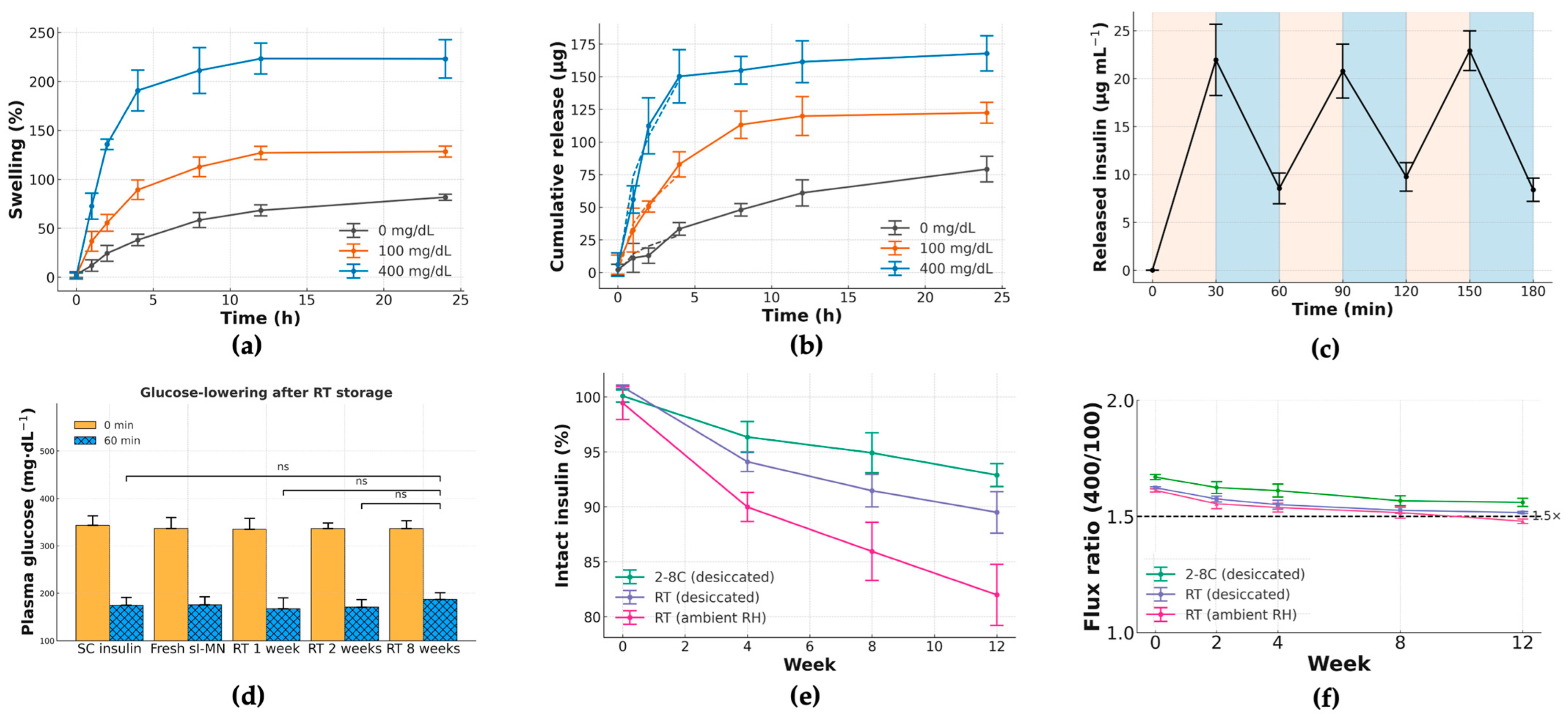
The in vitro performance confirmed this mechanism. Both hydrogel swelling (
Figure 4a) and cumulative insulin release (
Figure 4b) were directly proportional to glucose concentration, consistent with competitive glucose binding displacing polymer–diol crosslinks [
2]. The system’s rapid reversibility, shown in on–off cycling tests (
Figure 4c), is the key “off-switch” that actively prevents hypoglycemia.
The platform’s safety profile is strong. The constituent polymers, PVA and Dextran, are widely recognized for their biocompatibility [
17,
18]. Consistent with ISO 10993-5 [
25], extract cytotoxicity remained ≥70% viability across 25–100% extracts (
Supplementary Table S5 and serum biochemistry (AST, ALT, urea, creatinine) in treated mice fell within C57BL/6J reference ranges (
Supplementary Table S6, indicating no detectable local or systemic toxicity. Further, our assessments confirmed high cell viability (>95%), transient skin barrier disruption that recovered fully (
Figure 3f), and undetectable plasma boron levels. Insulin stability post-fabrication was confirmed via ELISA spike-recovery (95–102%), with no evidence of degradation under storage at 2–8 °C. While acute toxicity is low, future long-term (e.g., 28-day) repeated-dose dermal toxicity studies are necessary to rule out localized boron accumulation [
14].
These in vitro characteristics translated effectively to in vivo performance. The pharmacokinetic data (
Table 2) support the observed pharmacodynamic stability: the sI-MN patch yielded a lower C
max (38.0 vs. 50.0 ng·mL
−1) and delayed t
max (3.0 vs. 1.0 h) compared to the SC bolus. Intriguingly, the relative bioavailability F
rel was 126.5%. We hypothesize that this enhanced pharmacological efficiency is due to the delivery mechanism. An SC bolus creates a high-concentration depot, promoting insulin aggregation (e.g., hexamer formation) and local degradation [
15], whereas the sI-MN delivers insulin slowly across a large surface area, likely maintaining a higher fraction of active, monomeric insulin [
7,
41].
Translational viability also requires proven product stability. Our functional stability studies demonstrated that the sI-MN patches are robust. When stored under refrigerated conditions (2–8 °C) with a desiccant, the patches retained both their insulin content and, critically, their full functional glucose-responsiveness (R
0–6h ≥ 1.5×) for at least 12 weeks (
Figure 4e,f). Stored patches also retained their acute in vivo bioactivity, producing a glucose-lowering effect in mice comparable to fresh controls (
Figure 4d).
When benchmarked against other glucose-responsive microneedle platforms (
Table 3), the strategic advantage of our system becomes clear. Leading platforms have demonstrated impressive in vivo durations, achieving glycemic control for 24–48 h in both mice and large-animal minipig models. However, these systems rely on the complex, multi-step PBA-polymer synthesis discussed earlier [
24,
42]. Other advanced systems either rely on GOx, such as hypoxia-sensitive vesicles, with their inherent stability and H
2O
2 concerns, or require complex fabrication, like the osmotic pump-inspired structure [
11,
43,
44,
45].
The platform’s reliance on commercially available biocompatible polymers (PVA, Dextran) is a clear advantage (
Table 3). However, the claim of “profound simplicity” must be nuanced. The “single-step post-dip activation” (
Figure 1, Step 5), which is critical to the final formulation’s performance, requires precise, sub-10 s control of immersion time in a chilled, humidified environment (
Figure 2g–i). This process exchanges a polymer synthesis CMC bottleneck for a manufacturing process CMC bottleneck. Scaling this precision-dip step from a lab bench (manual dip) to a GMP-compliant, high-throughput, roll-to-roll manufacturing line presents a substantial engineering hurdle that is not trivial and remains unaddressed in this work. This work presents a pragmatic trade-off: sacrificing, for now, maximum duration for a platform that is fundamentally more manufacturable and scalable.
Despite these promising results, significant translational hurdles remain. The 8 h duration of action, while stable (
Figure 5a and
Figure 6a), is a primary translational barrier. This duration is far too short for a 24 h basal therapy and its slow-release profile is kinetically inappropriate for a prandial (mealtime) system, which requires rapid onset and offset. This limitation would necessitate an impractical three-patch-per-day regimen, offering no clear usability advantage over conventional injection protocols. Furthermore, dose scaling for human use (from 0.2 IU for mice to a 20–40 IU basal human dose) is a non-trivial challenge. This >100-fold increase in dose would likely require a patch with an unacceptably large surface area or entirely new fabrication strategies to increase drug loading density without compromising mechanical integrity (
Figure 2f). In addition, we did not quantify residual insulin remaining in the spent patches after in vivo wear in the current study. Therefore, the delivered fraction was inferred indirectly from pharmacodynamic and pharmacokinetic responses rather than by mass balance. Quantifying residual insulin in used patches (e.g., ELISA extraction of spent arrays) will be included in future work to enable delivered-dose accounting and to further support dose personalization. Dose personalization can be implemented discretely by selecting patch area/needle count (mini-patches) and/or insulin concentration in the dope. However, the present system is glucose-responsive but passive (does not sense glucose quantitatively in real time), so individualized titration would require an external decision rule (e.g., CGM-informed selection of patch size/wear time) rather than closed-loop dosing in the strict engineering sense. Finally, validation in large-animal models (e.g., minipigs), whose skin physiology is more analogous to humans, is an essential next step [
6]. Comprehensive biocompatibility and stability testing according to regulatory guidelines [
28] will be required, but this work provides a credible pathway toward a safer, patient-friendly “smart insulin patch”.
5. Conclusions
In this study, we have successfully developed and validated an enzyme-free, glucose-responsive microneedle (MN) patch based on a PVA/Dextran hydrogel dynamically crosslinked with borax. A systematic optimization process yielded a formulation with robust mechanical properties for reliable skin penetration and a precisely tuned borate–diol network that enables rapid, reversible, and concentration-dependent insulin release at physiological pH.
The optimized sI-MN patch demonstrated an excellent safety profile, characterized by high biocompatibility, transient and fully recoverable skin barrier disruption, and negligible local or systemic toxicity. Most importantly, in vivo studies in a type 1 diabetic mouse model confirmed the platform’s therapeutic efficacy. The patch provided stable glycemic control for approximately 8 h and effectively responded to glycemic challenges, critically avoiding the sharp hypoglycemic nadir and subsequent rebound hyperglycemia associated with conventional subcutaneous insulin injections.
In summary, we have applied a systematic optimization process to develop a mechanically robust, glucose-responsive PVA/Dextran/borax MN patch. The optimized patch provided stable, sustained insulin release for approximately 8 h in diabetic mice, successfully demonstrating a transformed pharmacokinetic profile compared to a bolus SC insulin injection and mitigating the associated hypoglycemic nadir. While this proof-of-concept is promising, the platform’s significant translational limitations—namely the impractical 8 h duration and the unresolved challenge of dose scaling for human use—must be overcome in future iterations. This work thus represents a foundational step in optimizing borate–diol systems, rather than a finalized solution, for autonomous diabetes therapy.





 ,
,