Advances in Drug Delivery Science for Diacerein: Strategies to Enhance Solubility, Bioavailability, and Pharmacokinetic Performance


 , and
, and
Abstract
1. Introduction
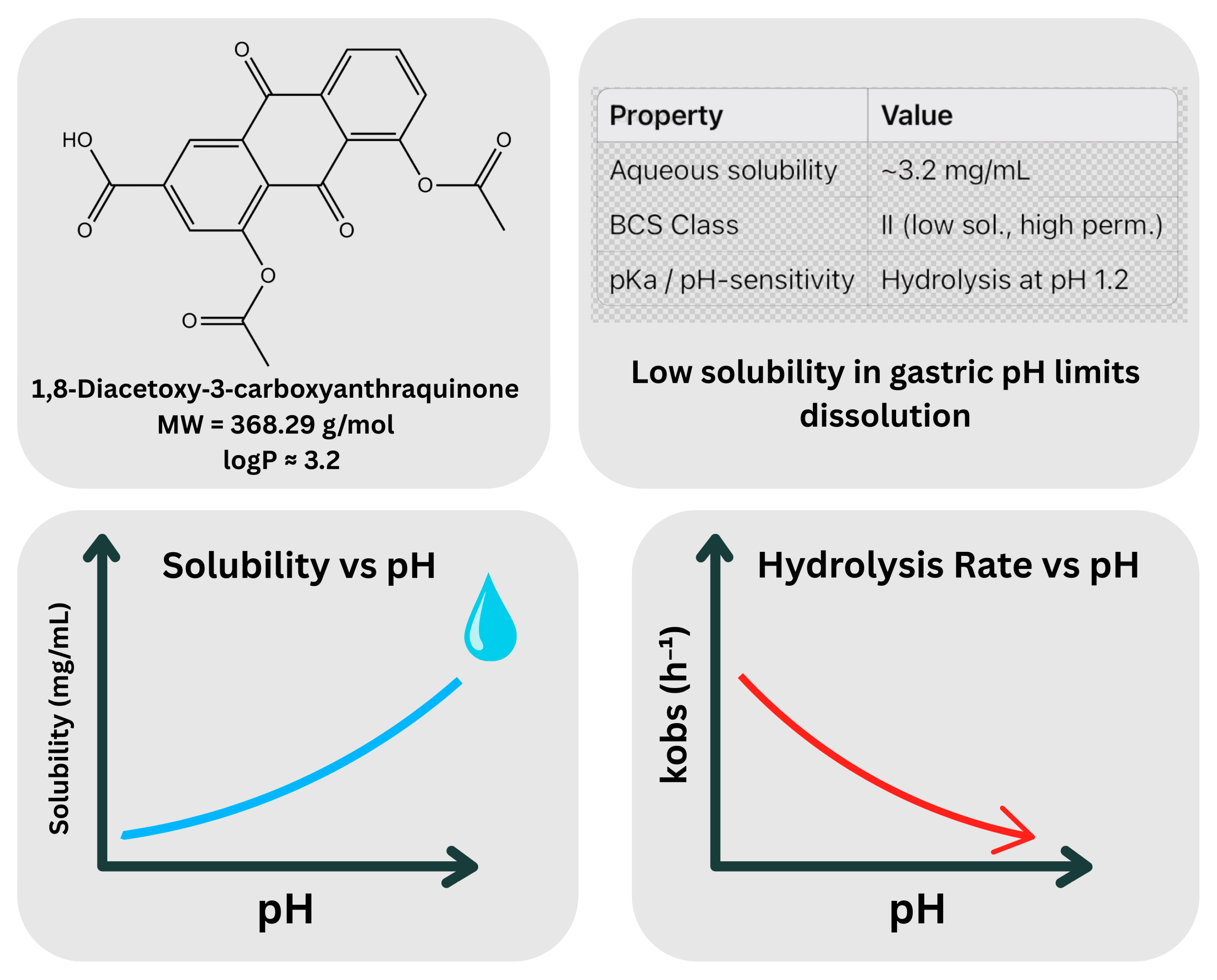
2. Absorption of Diacerein: Role of Physicochemical Properties
3. Factors Limiting the Bioavailability and Stability of DCN
4. Enhancing Bioavailability of DCN: Physical to Nanocarrier-Based Approaches

| Category | Technique | Mechanism/Description | Advantages | Limitations | Ref. |
|---|---|---|---|---|---|
| Physical Modification Approaches | Micronization | Reducing the particle size of Diacerein API to increase surface area and improve wetting; micronized DCN shows significantly faster dissolution compared with unmicronized DCN. | Enhances dissolution rate; improves capsule performance; reduces variability in drug release | Does not substantially change intrinsic solubility; may require careful control of flow properties | [65,66,67,84] |
| Nanonization | Reduction in DCN into nanoscale particles via nano-carrier engineering (e.g., lecithin–gold hybrid nanocarriers) to increase surface area and dissolution kinetics. | Enhances saturation solubility and improves oral bioavailability | Requires stabilizers; risk of aggregation and complexity in formulation | [85] | |
| Solid dispersion/Amorphization | Diacerein dispersed in hydrophilic polymers (e.g., PVP K30; PEG; Soluplus) via kneading or solvent evaporation, leading to reduced crystallinity and partial/complete amorphization. | Markedly improves dissolution rate, enhances solubility, increases oral bioavailability (up to 2–3 fold). | Potential physical instability due to amorphous transitions; polymer ratio-dependent performance. | [20,40,86] | |
| Chemical Modification Approaches | Prodrug (Mutual/Co-drug) | Covalent conjugation of Diacerein with antioxidant molecules (e.g., thymol) to mask the acidic group, improve lipophilicity, reduce gastric irritation, and enhance oral absorption. | Improved lipophilicity, enhanced absorption, reduced ulcerogenicity, controlled release, improved anti-arthritic activity. | Requires enzymatic cleavage; additional synthesis steps; stability profiling needed. | [87] |
| Physicochemical Modifications | Co-crystals | Formation of new crystalline phases with coformers (e.g., urea, tartaric acid, isonicotinamide, nicotinamide, theophylline, β-resorcylic acid) resulting in modified lattice structure and improved molecular interactions | Significantly enhances aqueous solubility, intrinsic dissolution rate, and biopharmaceutical performance; improves tabletability and physicomechanical properties | Requires selection of suitable coformers; solid-state characterization is essential; potential stability concerns depending on coformer | [74,88,89] |
| Cyclodextrin Complexation | Formation of 1:1 inclusion complexes of Diacerein with β-CD or HP-β-CD via kneading, co-evaporation, or freeze-drying; DCN molecules become partially or fully entrapped inside the hydrophobic CD cavity, increasing amorphousness and reducing hydrolysis rate | Markedly improves aqueous solubility, dissolution rate, and apparent bioavailability; stabilizes DCN by decreasing hydrolysis rate; enhances tabletability and enables fast-disintegrating formulations | Limited drug loading; decreased complexation efficiency at higher CD concentrations; CD amounts may increase bulk of dosage form | [4,90,91] | |
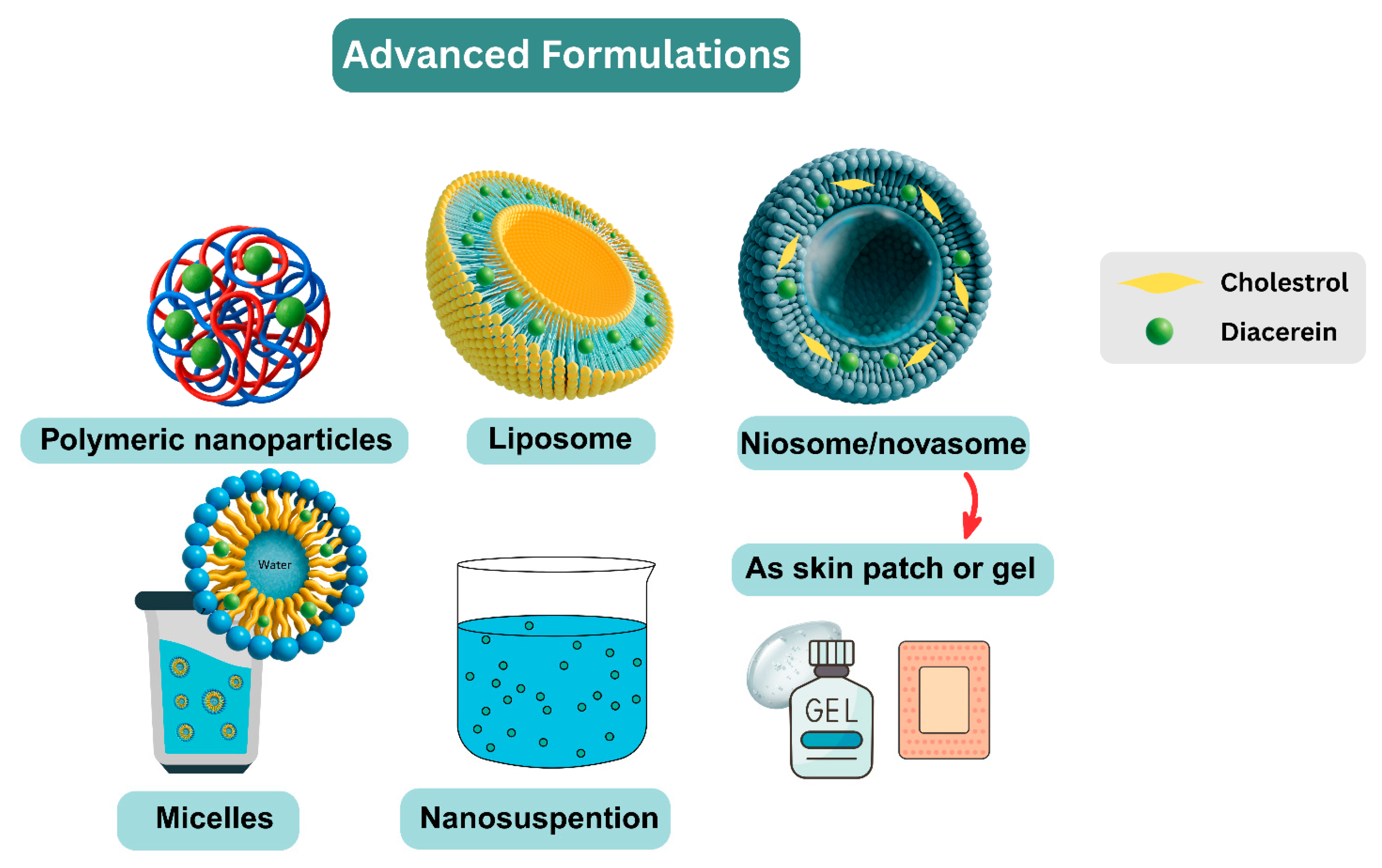
| Advanced Formulations | SMEDDS/SNEDDS (Self-micro/nano-emulsifying lipid-based systems) | Spontaneous formation of micro/nano-sized emulsions upon aqueous dilution, enhancing solubilization and dissolution of Diacerein. | Significantly increases solubility, dissolution rate, and oral bioavailability. | High surfactant load may cause GI irritation; limited drug loading capacity. | [92,93] |
| Nanosuspensions | Submicron crystalline particles of diacerein prepared by precipitation, high-shear homogenization, or media milling, stabilized with polymers/surfactants to prevent aggregation | Significant increase in saturation solubility, rapid dissolution, improved permeability, higher oral bioavailability, and potential reduction in diarrheal side effects (especially with chitosan-coated nanocrystals) | Requires stabilizers; risk of aggregation; possible Ostwald ripening; lyophilization needed for stability | [49,94] | |
| Polymeric Nanoparticles | Diacerein encapsulated in biodegradable polymers (e.g., chitosan–chondroitin sulfate, PLGA) forming nano-sized carriers that enable sustained release, improved stability, and enhanced tissue penetration | Sustained release up to several days; reduced gastrointestinal side effects; improved anti-inflammatory effect; targeted intra-articular or transdermal delivery | Complex preparation process; need for optimization of polymer ratios; potential variability in entrapment efficiency | [95,96] | |
| Lipid-based Systems | Lipid nanoparticles such as solid lipid nanoparticles (SLNs) and nanostructured lipid carriers (NLCs) use solid or mixed lipid matrices to incorporate Diacerein, enhancing solubilization, promoting lymphatic uptake, and enabling sustained topical or oral delivery. | Improve bioavailability (2.7–3.7-fold), reduce gastrointestinal side effects, provide sustained and controlled release, improve topical permeation, and protect the drug in amorphous or molecularly dispersed form. | Potential drug leakage during storage, stability concerns, scale-up complexity, need for optimized lipid/surfactant ratios. | [15,97,98] |
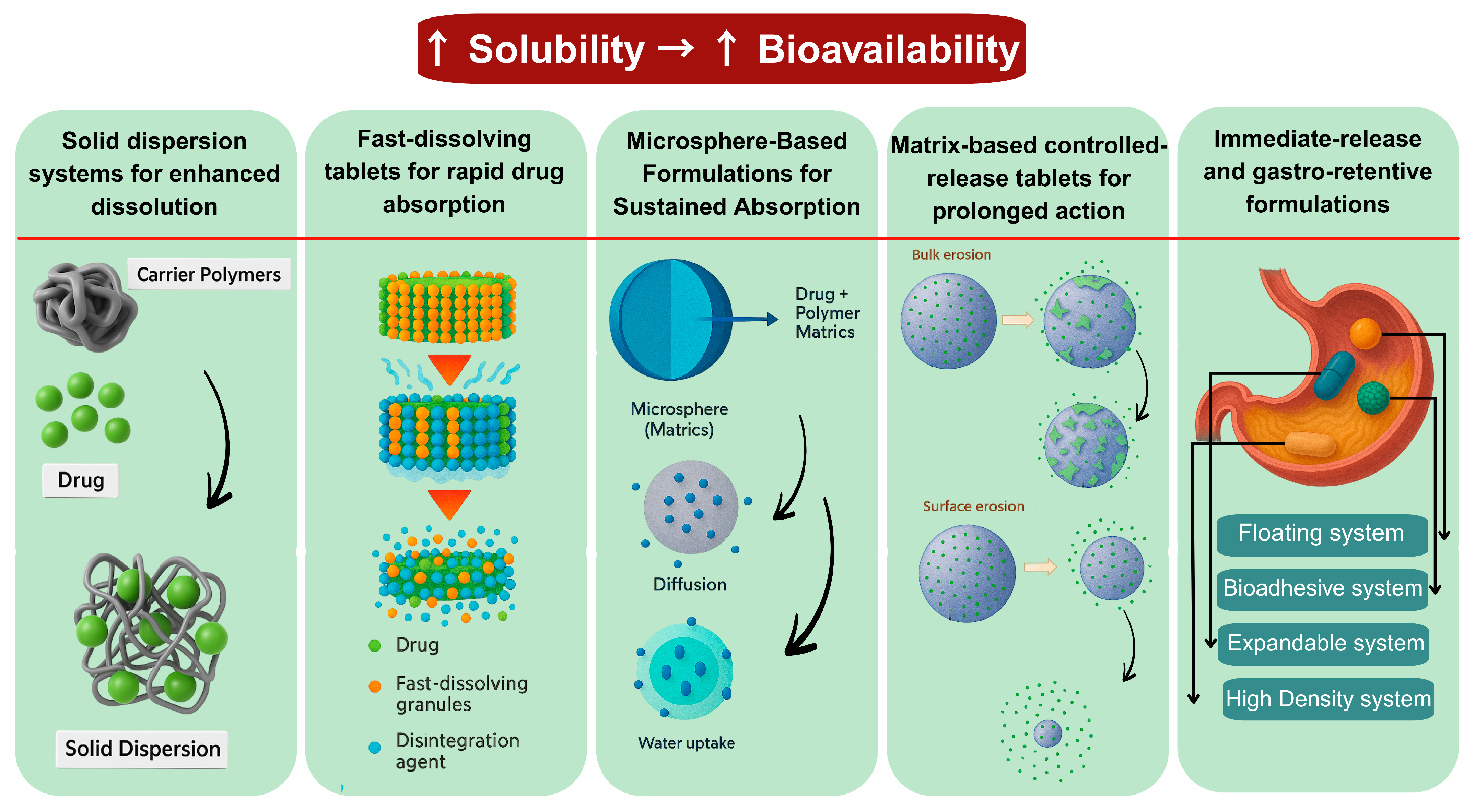
4.1. Physical Strategies to Improve DCN Solubility
4.1.1. Solid Dispersion System for Enhanced Dissolution
4.1.2. Fast-Dissolving Tablets for Rapid Drug Absorption
4.1.3. Immediate-Release and Gastro-Retentive Formulations
4.1.4. Matrix-Based Controlled-Release Tablets for Prolonged Action
4.1.5. Microsphere-Based Formulations for Sustained Absorption
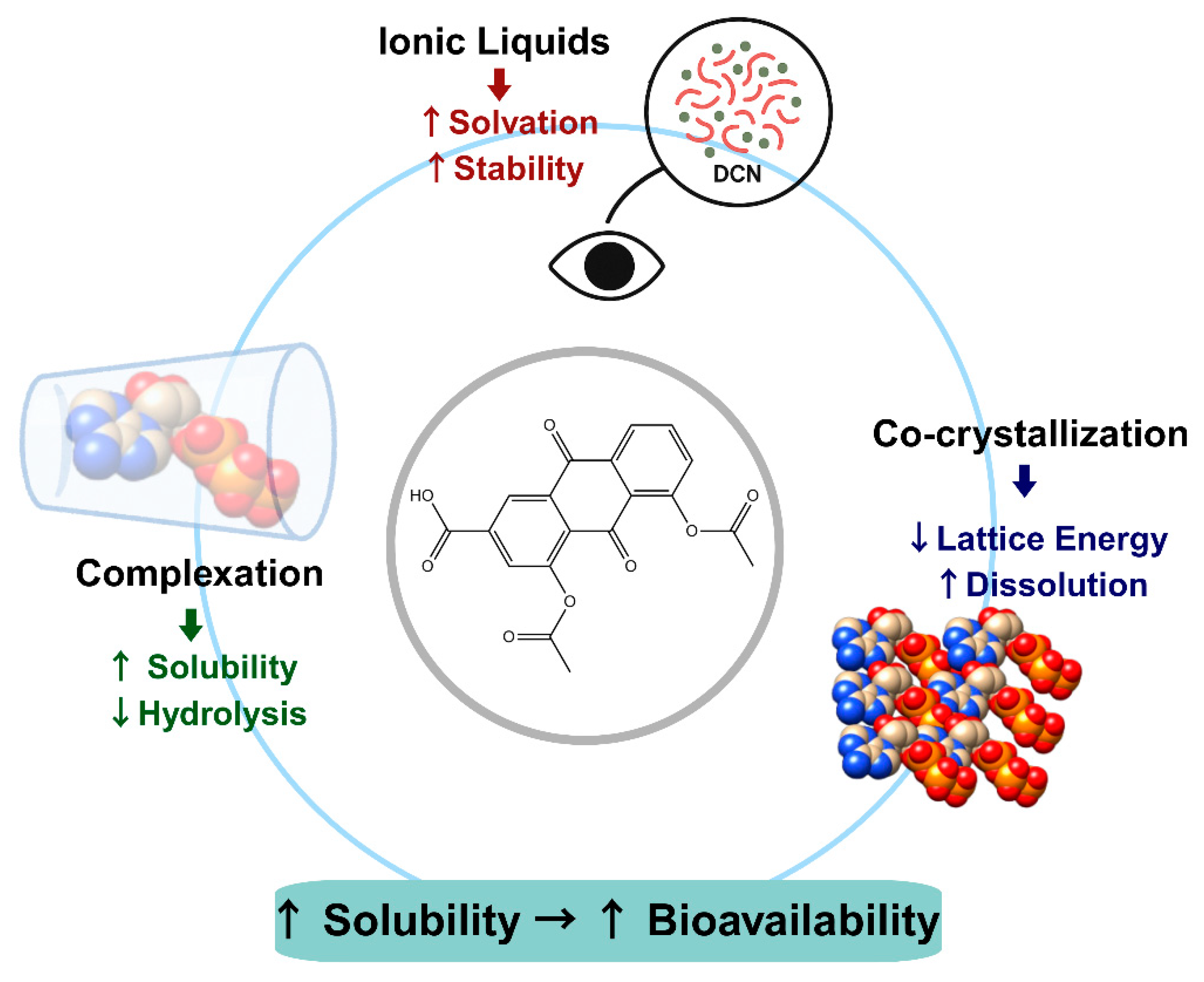
4.2. Physicochemical Strategies for Enhancing DCN Solubility
4.2.1. Cyclodextrin Inclusion Complexation for Enhanced Solubility and Stability
4.2.2. Co-Crystal and Eutectic Formation for Enhanced Bioavailability
4.2.3. Ionic Liquids for Stability and Ocular Drug Delivery
4.3. Advanced Formulations by Route of Administration
4.3.1. Vesicular Systems (Topical, Transdermal, Intra-Articular)
Niosomal Formulations
Other Types of Vesicular Systems
4.3.2. Emulsion and Gel-Based Systems (Topical/Transdermal)
4.3.3. Lipid-Based Nanoformulations (Topical & Intra-Articular)
4.3.4. Injectable and Targeted Delivery Systems
4.3.5. Oral Nano-Formulations of DCN
Nanosuspensions
Self-Nanoemulsifying Drug Delivery Systems
pH-Responsive Hydrogels and Polymeric Microspheres
| Technique | Target Compound | Disease Treated | Solubility Enhancement | Bioavailability Increase | Dissolution/Release Profile | Ref. |
|---|---|---|---|---|---|---|
| Nanosuspension (F12-SDS) | DCN | Osteoarthritis | 2.23-fold increase | 131.4% increase vs. commercial DCN | 1.26 min (complete dissolution) | [51] |
| Chitosan-Coated Nanosuspensions | DCN | Osteoarthritis | Increased mucoadhesion | 172.1% increase vs. conventional DCN | Sustained release | [49] |
| SNEDDS | Rhein (DCN Metabolite) | Osteoarthritis | Yes | Enhanced systemic absorption | Complete release in 30 min | [48] |
| Linseed Polysaccharide Hydrogel | DCN | Osteoarthritis | pH-responsive swelling | Sustained drug absorption | Controlled release in intestinal pH | [61] |
| pH-Responsive Polymeric Hydrogels | DCN | Osteoarthritis | Yes | Controlled swelling | Extended release in pH 7.4 | [142] |
| Ionotropic Gelation Microspheres | DCN | Osteoarthritis | Yes | Controlled drug entrapment | Slow drug diffusion | [143] |
| Microsphere-Based SR Formulation | DCN | Arthritis | Not Reported | Reduced peak plasma fluctuations | Improved joint function | [144] |
4.3.6. Dissolving Microneedles for Percutaneous Drug Delivery
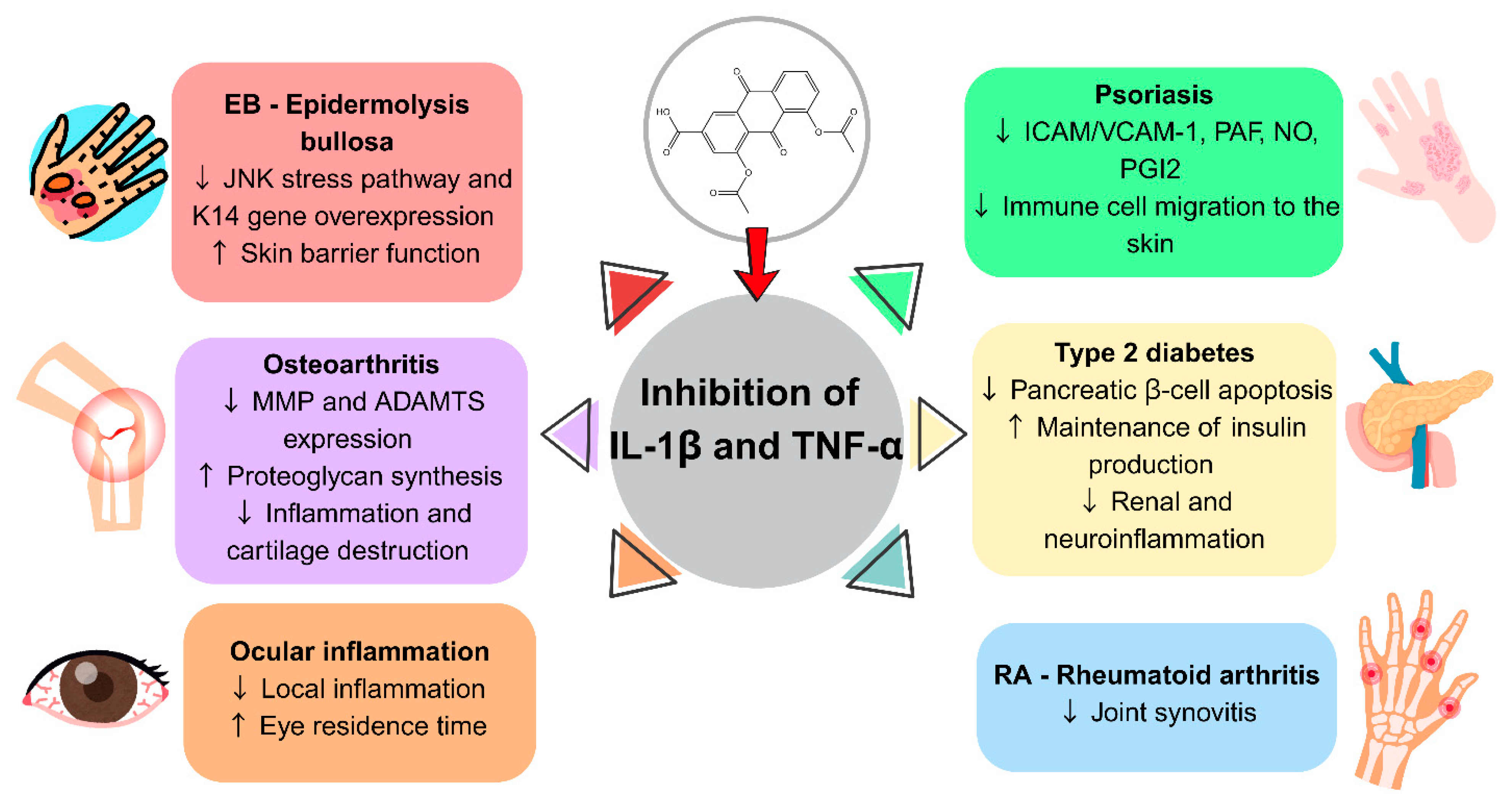
4.4. Enhancing DCN’s Therapeutic Effects Through Synergistic Strategies
5. Clinical Potential of DCN in Novel Carriers and Formulations
6. Discussion
6.1. Regulatory and Clinical Translation Challenges
6.2. Comparative Performance of Diacerein Formulation Strategies
7. Future Directions and Conclusions
Funding
Data Availability Statement
Acknowledgments
Conflicts of Interest
Abbreviations
References
- Moghddam, S.R.M.; Ahad, A.; Aqil, M.; Imam, S.S.; Sultana, Y. Formulation and optimization of niosomes for topical diacerein delivery using 3-factor, 3-level Box-Behnken design for the management of psoriasis. Mater. Sci. Eng. C 2016, 69, 789–797. [Google Scholar] [CrossRef]
- Sharma, N.K.; Mishra, K. Exploration of diacerein as a neuroprotective adjuvant to Adenium obesum: An in-vivo study. J. Ayurveda Integr. Med. 2023, 14, 100761. [Google Scholar] [CrossRef]
- Mohamed, M.I.; Al-Mahallawi, A.M.; Awadalla, S.M. Development and optimization of osmotically controlled drug delivery system for poorly aqueous soluble diacerein to improve its bioavailability. Drug Dev. Ind. Pharm. 2020, 46, 814–825. [Google Scholar] [CrossRef] [PubMed]
- Batt, D.K.; Garala, K.C. Preparation and evaluation of inclusion complexes of diacerein with β-cyclodextrin and hydroxypropyl β-cyclodextrin. J. Incl. Phenom. Macrocycl. Chem. 2013, 77, 471–481. [Google Scholar] [CrossRef]
- Wally, V.; Hovnanian, A.; Ly, J.; Buckova, H.; Brunner, V.; Lettner, T.; Ablinger, M.; Felder, T.K.; Hofbauer, P.; Wolkersdorfer, M. Diacerein orphan drug development for epidermolysis bullosa simplex: A phase 2/3 randomized, placebo-controlled, double-blind clinical trial. J. Am. Acad. Dermatol. 2018, 78, 892–901.e897. [Google Scholar] [CrossRef] [PubMed]
- Patil, S.B.; Shete, D.K.; Narade, S.B.; Surve, S.S.; Khan, Z.K.; Bhise, S.B.; Pore, Y.V. Improvement in the dissolution profile of diacerein using a surfactant-based solid dispersion technique. Drug Discov. Ther. 2010, 4, 435–441. [Google Scholar] [PubMed]
- Petralito, S.; Zanardi, I.; Spera, R.; Memoli, A.; Travagli, V. Spectroscopic characterization of both aqueous and solid-state diacerhein/hydroxypropyl-β-cyclodextrin inclusion complexes. Spectrochim. Acta Part A Mol. Biomol. Spectrosc. 2014, 127, 355–360. [Google Scholar] [CrossRef]
- Eladawy, N.O.; Morsi, N.M.; Shamma, R.N. Diacerein-loaded hyaluosomes as a dual-function platform for osteoarthritis management via intra-articular injection: In vitro characterization and in vivo assessment in a rat model. Pharmaceutics 2021, 13, 765. [Google Scholar] [CrossRef]
- Martorell, M.; Castro, N.; Victoriano, M.; Capó, X.; Tejada, S.; Vitalini, S.; Pezzani, R.; Sureda, A. An update of anthraquinone derivatives emodin, diacerein, and catenarin in diabetes. Evid.-Based Complement. Altern. Med. 2021, 2021, 3313419. [Google Scholar] [CrossRef]
- Martel-Pelletier, J.; Pelletier, J.-P. Effects of diacerein at the molecular level in the osteoarthritis disease process. Ther. Adv. Musculoskelet. Dis. 2010, 2, 95–104. [Google Scholar] [CrossRef]
- Balabanova, R.M. Use of diacerein for the treatment of large joint osteoarthritis (A review of literature and the author’s own experience). Mod. Rheumatol. J. 2015, 9, 30–32. [Google Scholar] [CrossRef][Green Version]
- Fidelix, T.S.; Macedo, C.R.; Maxwell, L.J.; Trevisani, V.F.M. Diacerein for osteoarthritis. Cochrane Database Syst. Rev. 2014, 2014, CD005117. [Google Scholar] [CrossRef]
- Pavelka, K.; Bruyere, O.; Cooper, C.; Kanis, J.A.; Leeb, B.F.; Maheu, E.; Martel-Pelletier, J.; Monfort, J.; Pelletier, J.-P.; Rizzoli, R. Diacerein: Benefits, risks and place in the management of osteoarthritis. An opinion-based report from the ESCEO. Drugs Aging 2016, 33, 75–85. [Google Scholar] [CrossRef]
- Kongtharvonskul, J.; Anothaisintawee, T.; McEvoy, M.; Attia, J.; Woratanarat, P.; Thakkinstian, A. Efficacy and safety of glucosamine, diacerein, and NSAIDs in osteoarthritis knee: A systematic review and network meta-analysis. Eur. J. Med. Res. 2015, 20, 24. [Google Scholar] [CrossRef]
- Maitra, S.; Das, S.K.; Sinha, D.; Mukherjee, M.; Kumari, L.; Roy, T. Recent Advancements and Future Perspectives in Diacerein Delivery Systems for Rheumatoid Arthritis: Novel Strategies and Emerging Technologies. Palest. Med. Pharm. J. 2025; in press. [Google Scholar] [CrossRef]
- Honvo, G.; Reginster, J.-Y.; Rabenda, V.; Geerinck, A.; Mkinsi, O.; Charles, A.; Rizzoli, R.; Cooper, C.; Avouac, B.; Bruyère, O. Safety of symptomatic slow-acting drugs for osteoarthritis: Outcomes of a systematic review and meta-analysis. Drugs Aging 2019, 36, 65–99. [Google Scholar] [CrossRef] [PubMed]
- Roy, T.; Chakraborty, P.; Chowdhury, R.R.; Chatterjee, T.K. Possible Beneficial Role of Novel Anti-Osteoarthritic Drug Diacerein in Rheumatoid Arthritis. Res. J. Pharm. Technol. 2022, 15, 2715–2720. [Google Scholar] [CrossRef]
- Wang, F.; Shi, W.-X.; Chen, J.; He, K.; Fang, W. Clinical therapeutic effects of combined diacerein and glucosamine in the treatment of osteoarthritis: A protocol for systematic review and meta-analysis. Medicine 2021, 100, e27583. [Google Scholar] [CrossRef]
- Kumar, K.K.; Sasikanth, K.; Sabareesh, M.; Neerugattu, D. Formulation and evaluation of diacerein cream. Asian J. Pharm. Clin. Res. 2011, 4, 93–98. [Google Scholar]
- Patil, S.B.; Shete, T.K.; Narade, S.B.; Surve, S.S.; Khan, Z.K.; Bhokare, K.K.; Pore, Y.V. Physicochemical characterization and improved in vitro dissolution performance of diacerein solid dispersions with PVP K30. Lat. Am. J. Pharm. 2011, 30, 61–67. [Google Scholar]
- Nishal, S.; Jhawat, V.; Phaugat, P.; Dutt, R. DoE Based Formulation Development and Characterization of Topical Nanoemulgel of Diacerein: In-Vitro Release and Permeation Studies. BioNanoScience 2022, 12, 472–485. [Google Scholar] [CrossRef]
- Chaudhari, B.P.; Daniel, K. A validated ultra performance liquid chromatography method for simultaneous estimation of diacerein and aceclofenac in bulk and pharmaceutical formulation. Res. J. Pharm. Technol. 2022, 15, 1467–1471. [Google Scholar] [CrossRef]
- Pawbake, G.R.; Shirolkar, S.V. Formulation, development and evaluation of nanostructured lipid carrier (NLC) based gel for topical delivery of diacerein. Syst. Rev. Pharm. 2020, 11, 794–802. [Google Scholar]
- Shah, H.; Madni, A.; Rahim, M.A.; Jan, N.; Khan, A.; Khan, S.; Jabar, A.; Ali, A. Fabrication, in vitro and ex vivo evaluation of proliposomes and liposomal derived gel for enhanced solubility and permeability of diacerein. PLoS ONE 2021, 16, e0258141. [Google Scholar] [CrossRef] [PubMed]
- Kazi, T.M.; Dandagi, P.M. A New Stability-Indicating RP-HPLC Method for Simultaneous Quantification of Diacerein and Aceclofenac in Novel Nanoemulgel Formulation and Commercial Tablet Dosage Form in the Presence of their Major Degradation Products Using DoE Approach. J. Chromatogr. Sci. 2023, 61, 918–929. [Google Scholar] [CrossRef] [PubMed]
- Almezgagi, M.; Zhang, Y.; Hezam, K.; Shamsan, E.; Gamah, M.; Al-shaebi, F.; Abbas, A.B.; Shoaib, M.; Saif, B.; Han, Y.; et al. Diacerein: Recent insight into pharmacological activities and molecular pathways. Biomed. Pharmacother. 2020, 131, 110594. [Google Scholar] [CrossRef]
- ClinicalTrials.gov. Diacerein. Available online: https://clinicaltrials.gov/search?cond=Diacerein (accessed on 12 November 2025).
- Rehman, M.; Madni, A.; Ihsan, A.; Khan, W.S.; Khan, M.I.; Mahmood, M.A.; Ashfaq, M.; Bajwa, S.Z.; Shakir, I. Solid and liquid lipid-based binary solid lipid nanoparticles of diacerein: In vitro evaluation of sustained release, simultaneous loading of gold nanoparticles, and potential thermoresponsive behavior. Int. J. Nanomed. 2015, 2805–2814. [Google Scholar] [CrossRef]
- Gao, D.; Wu, J.-S.; Lu, W.-S.; Chen, S.; Kuo, P.-C.; Chen, C.-M. Pharmaceutical Compositions Containing Diacerein. EP 2349289 B1. 13 July 2016. Available online: https://patents.google.com/patent/EP2349289B1/en (accessed on 20 November 2025).
- Alegría, A.; Irarrázaval, S. Is diacerein an alternative for the treatment of osteoarthritis? Medwave 2017, 17, e7041. [Google Scholar] [CrossRef]
- Liang, Y.; Duan, M.; Yi, W.; Zhang, T.; Wang, Y.; Wu, Z.; Tang, H. Ion-pair compounds of diacerein for enhancing skin permeability in vitro: The compatibility–permeability relationship of counter ion and diacerein. Drug Deliv. 2022, 29, 499–505. [Google Scholar] [CrossRef]
- Panova, E.; Jones, G. Benefit–risk assessment of diacerein in the treatment of osteoarthritis. Drug Saf. 2015, 38, 245–252. [Google Scholar] [CrossRef]
- Nicolas, P.; Tod, M.; Padoin, C.; Petitjean, O. Clinical pharmacokinetics of diacerein. Clin. Pharmacokinet. 1998, 35, 347–359. [Google Scholar] [CrossRef]
- Zhang, Q.; Zhou, J.; Wang, Y.; Chen, D. The effect and safety of diacerein in patients with type 2 diabetes mellitus: A systematic review and meta-analysis. Am. J. Clin. Exp. Immunol. 2017, 6, 97. [Google Scholar]
- Irarrázaval, S.; Mejias, A.A.; Soto, G.B.; Rada, G. Diacerein and arthrosis treatment. Medwave 2018, 18, e7202. [Google Scholar] [CrossRef]
- Kaur, D.; Kaur, J.; Kamal, S.S. Diacerein, its beneficial impact on chondrocytes and notable new clinical applications. Braz. J. Pharm. Sci. 2019, 54, e17534. [Google Scholar] [CrossRef]
- Fu, Y.; Yang, L.; Liu, L.; Kong, L.; Sun, H.; Sun, Y.; Yin, F.; Yan, G.; Wang, X. Rhein: An Updated Review Concerning Its Biological Activity, Pharmacokinetics, Structure Optimization, and Future Pharmaceutical Applications. Pharmaceuticals 2024, 17, 1665. [Google Scholar] [CrossRef] [PubMed]
- Jain, A.; Mishra, S.K.; Vuddanda, P.R.; Singh, S.K.; Singh, R.; Singh, S. Targeting of diacerein loaded lipid nanoparticles to intra-articular cartilage using chondroitin sulfate as homing carrier for treatment of osteoarthritis in rats. Nanomed. Nanotechnol. Biol. Med. 2014, 10, e1031–e1040. [Google Scholar] [CrossRef] [PubMed]
- Fouad, S.A.; Malaak, F.A.; El-Nabarawi, M.A.; Abu Zeid, K. Development of orally disintegrating tablets containing solid dispersion of a poorly soluble drug for enhanced dissolution: In-vitro optimization/in-vivo evaluation. PLoS ONE 2020, 15, e0244646. [Google Scholar] [CrossRef] [PubMed]
- Fouad, S.A.; Malaak, F.A.; El-Nabarawi, M.A.; Abu Zeid, K.; Ghoneim, A.M. Preparation of solid dispersion systems for enhanced dissolution of poorly water soluble diacerein: In-vitro evaluation, optimization and physiologically based pharmacokinetic modeling. PLoS ONE 2021, 16, e0245482. [Google Scholar] [CrossRef]
- Khan, M.I.; Madni, A.; Peltonen, L. Development and in-vitro characterization of sorbitan monolaurate and poloxamer 184 based niosomes for oral delivery of diacerein. Eur. J. Pharm. Sci. 2016, 95, 88–95. [Google Scholar] [CrossRef]
- Khan, M.I.; Madni, A.; Hirvonen, J.; Peltonen, L. Ultrasonic processing technique as a green preparation approach for diacerein-loaded niosomes. AAPS PharmSciTech 2017, 18, 1554–1563. [Google Scholar] [CrossRef]
- Liu, Y.; Liang, Y.; Yuhong, J.; Xin, P.; Han, J.L.; Du, Y.; Yu, X.; Zhu, R.; Zhang, M.; Chen, W.; et al. Advances in Nanotechnology for Enhancing the Solubility and Bioavailability of Poorly Soluble Drugs. Drug Des. Dev. Ther. 2024, 2024, 1469–1495. [Google Scholar] [CrossRef]
- Mudie, D.M.; Amidon, G.L.; Amidon, G.E. Physiological parameters for oral delivery and in vitro testing. Mol. Pharm. 2010, 7, 1388–1405. [Google Scholar] [CrossRef]
- Savolainen, M.; Kogermann, K.; Heinz, A.; Aaltonen, J.; Peltonen, L.; Strachan, C.; Yliruusi, J. Better understanding of dissolution behaviour of amorphous drugs by in situ solid-state analysis using Raman spectroscopy. Eur. J. Pharm. Biopharm. 2009, 71, 71–79. [Google Scholar] [CrossRef] [PubMed]
- Kumari, L.; Choudhari, Y.; Patel, P.; Gupta, G.D.; Singh, D.; Rosenholm, J.M.; Bansal, K.K.; Kurmi, B.D. Advancement in Solubilization Approaches: A Step towards Bioavailability Enhancement of Poorly Soluble Drugs. Life 2023, 13, 1099. [Google Scholar] [CrossRef]
- Brahmachari, B.; Chatterjee, S.; Ghosh, A. Efficacy and safety of diacerein in early knee osteoarthritis: A randomized placebo-controlled trial. Clin. Rheumatol. 2009, 28, 1193–1198. [Google Scholar] [CrossRef]
- More, S.M.; Rashid, M.A.; Kharwade, R.S.; Taha, M.; Alhamhoom, Y.; Elhassan, G.O.; Gangane, P.; Asar, T.O.; Pise, A.; Kaleem, M.; et al. Development of Solid Self-Nanoemulsifying Drug Delivery System of Rhein to Improve Biopharmaceutical Performance: Physiochemical Characterization, and Pharmacokinetic Evaluation. Int. J. Nanomed. 2025, 2025, 267–291. [Google Scholar] [CrossRef] [PubMed]
- Allam, A.N.; Hamdallah, S.I.; Abdallah, O.Y. Chitosan-coated diacerein nanosuspensions as a platform for enhancing bioavailability and lowering side effects: Preparation, characterization, and ex vivo/in vivo evaluation. Int. J. Nanomed. 2017, 2017, 4733–4745. [Google Scholar] [CrossRef]
- Zaki, R.; Ali, A.; El-Menshawe, S.; Bary, A.A. Formulation and in vitro evalution of diacerein loaded niosomes. Int. J. Pharm. Pharm. Sci. 2014, 6, 515–521. [Google Scholar]
- Elsayed, I.; Abdelbary, A.A.; Elshafeey, A.H. Nanosizing of a poorly soluble drug: Technique optimization, factorial analysis, and pharmacokinetic study in healthy human volunteers. Int. J. Nanomed. 2014, 9, 2943–2953. [Google Scholar] [CrossRef]
- Gómez-Gaete, C.; Retamal, M.; Chávez, C.; Bustos, P.; Godoy, R.; Torres-Vergara, P. Development, characterization and in vitro evaluation of biodegradable rhein-loaded microparticles for treatment of osteoarthritis. Eur. J. Pharm. Sci. 2017, 96, 390–397. [Google Scholar] [CrossRef]
- Khan, M.I.; Madni, A.; Ahmad, S.; Khan, A.; Rehmanand, M.; Mahmood, M.A. ATR-FTIR Based Pre and Post Formulation Compatibility Studies for the Design of Niosomal Drug Delivery System Containing Nonionic Amphiphiles and Chondroprotective Drug. J. Chem. Soc. Pak. 2015, 37, 527–534. [Google Scholar]
- Aziz, D.E.; Abdelbary, A.A.; Elassasy, A.I. Investigating superiority of novel bilosomes over niosomes in the transdermal delivery of diacerein: In vitro characterization, ex vivo permeation and in vivo skin deposition study. J. Liposome Res. 2019, 29, 73–85. [Google Scholar] [CrossRef]
- Chattopadhyay, H.; Auddy, B.; Sur, T.; Gupta, M.; Datta, S. Transdermal co-delivery of glucosamine sulfate and diacerein for the induction of chondroprotection in experimental osteoarthritis. Drug Deliv. Transl. Res. 2020, 10, 1327–1340. [Google Scholar] [CrossRef]
- Kesharwani, D.; Paul, S.D.; Paliwal, R.; Satapathy, T. Exploring potential of diacerin nanogel for topical application in arthritis: Formulation development, QbD based optimization and pre-clinical evaluation. Colloids Surf. B Biointerfaces 2023, 223, 113160. [Google Scholar] [CrossRef]
- Fareed, N.Y.; Kassab, H.J. Effect of formulation variables on the properties of a new vesicular system of an anthraquinone derivative. J. Adv. Pharm. Educ. Res. 2023, 13, 25–29. [Google Scholar] [CrossRef]
- Shabbir, M.; Barkat, K.; Ashraf, M.U.; Nagra, U.; Shah, S.N.H. Assessment of formulation variables of poor water soluble diacerein for its improved loading and anti-inflammatory activity. Drug Deliv. Transl. Res. 2023, 13, 1780–1798. [Google Scholar] [CrossRef] [PubMed]
- Ali, N.A.; Morsi, N.M.; Badr-Eldin, S.M.; Shamma, R.N. Diacerein-loaded surface modified iron oxide microparticles (SMIOMPs): An emerging magnetic system for management of osteoarthritis via intra-articular injection. Front. Bioeng. Biotechnol. 2024, 12, 1439085. [Google Scholar] [CrossRef]
- El-Say, K.M.; Abd-Allah, F.I.; Lila, A.E.; Hassan, A.E.-S.A.; Kassem, A.E.A. Diacerein niosomal gel for topical delivery: Development, in vitro and in vivo assessment. J. Liposome Res. 2016, 26, 57–68. [Google Scholar] [CrossRef]
- Haseeb, M.T.; Hussain, M.A.; Bashir, S.; Ashraf, M.U.; Ahmad, N. Evaluation of superabsorbent linseed-polysaccharides as a novel stimuli-responsive oral sustained release drug delivery system. Drug Dev. Ind. Pharm. 2017, 43, 409–420. [Google Scholar] [CrossRef]
- Grassiri, B.; Mezzetta, A.; Maisetta, G.; Migone, C.; Fabiano, A.; Esin, S.; Guazzelli, L.; Zambito, Y.; Batoni, G.; Piras, A.M. Betaine-and l-carnitine-based ionic liquids as solubilising and stabilising agents for the formulation of antimicrobial eye drops containing diacerein. Int. J. Mol. Sci. 2023, 24, 2714. [Google Scholar] [CrossRef] [PubMed]
- Mirunalini, R.; Chandrasekaran, M.; Manimekalai, K. Efficacy of chondroitin sulfate with glucosamine versus diacerein in grade ii and iii osteoarthritis knee: A randomized comparative study. Asian J. Pharm. Clin. Res. 2015, 8, 42–44. [Google Scholar]
- El-Kafrawy, D.S.; El-Shoubashy, O.H.; Issa, A.E.; Beltagy, Y.A. Sustainable multi-analyte HPTLC estimation of meloxicam, diclofenac and diacerein along with its major degradation product and official impurity; rhein: Comprehensive greenness and whiteness evaluation. Microchem. J. 2023, 193, 109098. [Google Scholar] [CrossRef]
- Khadka, P.; Ro, J.; Kim, H.; Kim, I.; Kim, J.T.; Kim, H.; Cho, J.M.; Yun, G.; Lee, J. Pharmaceutical particle technologies: An approach to improve drug solubility, dissolution and bioavailability. Asian J. Pharm. Sci. 2014, 9, 304–316. [Google Scholar] [CrossRef]
- Bhat, M.R. Bionanocomposites: Technique towards enhancement of solubility, drug release and bioavailability. J. Med. Pharm. Innov. 2015, 2, 6–18. [Google Scholar]
- Onkar, K.; Vishal, D.; Kiran, Z.; Ravindra, K. Review on Different Methods of Solubility Enhancement of Bcs Class II Drugs. Int. J. Pharm. Sci. 2024, 2, 65–77. [Google Scholar]
- Alshora, D.H.; Ibrahim, M.A.; Alanazi, F.K. Nanotechnology from particle size reduction to enhancing aqueous solubility. In Surface Chemistry of Nanobiomaterials; Elsevier: Amsterdam, The Netherlands, 2016; pp. 163–191. [Google Scholar]
- Patrekar, P.; Patil, C. Solubility enhancement and evaluation of diacerein using cyclodextrin as hydrophilic carriers. J. Pharm. Res. 2009, 2, 923–926. [Google Scholar]
- Abd Elkarim, R.A.; El-Shenawy, A.A.; Abdelhafez, W.A.; Osman, S.K. Novel nanosized Diacerein proliposomes for oral delivery: Development and in vitro/in vivo evaluation. J. Appl. Pharm. Sci. 2022, 12, 131–146. [Google Scholar] [CrossRef]
- Shah, P.; Goodyear, B.; Michniak-Kohn, B.B. A review: Enhancement of solubility and oral bioavailability of poorly soluble drugs. Adv. Pharm. J. 2017, 2, 161–173. [Google Scholar]
- Bhalani, D.V.; Nutan, B.; Kumar, A.; Singh Chandel, A.K. Bioavailability enhancement techniques for poorly aqueous soluble drugs and therapeutics. Biomedicines 2022, 10, 2055. [Google Scholar] [CrossRef]
- Kumar, S.; Bhargava, D.; Thakkar, A.; Arora, S. Drug carrier systems for solubility enhancement of BCS class II drugs: A critical review. Crit. Rev. Ther. Drug Carr. Syst. 2013, 30, 217–256. [Google Scholar] [CrossRef] [PubMed]
- Patel, R.D.; Raval, M.K. Formulation of diacerein cocrystal using β-resorcylic acid for improvement of physicomechanical and biopharmaceutical properties. Org. Process Res. Dev. 2020, 25, 384–394. [Google Scholar] [CrossRef]
- Ogden, J.; Parry-Billings, M. Nanotechnology approaches to solving the problems of poorly water-soluble drugs. Drug Discov. 2005, 6, 71–76. [Google Scholar]
- Aziz, D.E.; Abdelbary, A.A.; Elassasy, A.I. Fabrication of novel elastosomes for boosting the transdermal delivery of diacerein: Statistical optimization, ex-vivo permeation, in-vivo skin deposition and pharmacokinetic assessment compared to oral formulation. Drug Deliv. 2018, 25, 815–826. [Google Scholar] [CrossRef] [PubMed]
- Tamanna, S. Nanotechnology: A novel approach for treatment of skin disorder. J. Drug Deliv. Ther. 2021, 11, 271–277. [Google Scholar] [CrossRef]
- Landriscina, A.; Rosen, J.; Friedman, A.J. Nanotechnology, inflammation and the skin barrier: Innovative approaches for skin health and cosmesis. Cosmetics 2015, 2, 177–186. [Google Scholar] [CrossRef]
- Wei, J.; Mu, J.; Tang, Y.; Qin, D.; Duan, J.; Wu, A. Next-generation nanomaterials: Advancing ocular anti-inflammatory drug therapy. J. Nanobiotechnol. 2023, 21, 282. [Google Scholar] [CrossRef]
- Lv, Z.; Li, S.; Zeng, G.; Yao, K.; Han, H. Recent progress of nanomedicine in managing dry eye disease. Adv. Ophthalmol. Pract. Res. 2024, 4, 23–31. [Google Scholar] [CrossRef]
- Piovesan, F.; Tres, G.S.; Moreira, L.B.; Andrades, M.E.; Lisboa, H.K.; Fuchs, S.C. Effect of diacerein on renal function and inflammatory cytokines in participants with type 2 diabetes mellitus and chronic kidney disease: A randomized controlled trial. PLoS ONE 2017, 12, e0186554. [Google Scholar] [CrossRef]
- Chen, Y.; Wang, X.; Tao, S.; Wang, Q.; Ma, P.-Q.; Li, Z.-B.; Wu, Y.-L.; Li, D.-W. Research advances in smart responsive-hydrogel dressings with potential clinical diabetic wound healing properties. Mil. Med. Res. 2023, 10, 37. [Google Scholar] [CrossRef]
- Liu, Y.; Li, C.; Feng, Z.; Han, B.; Yu, D.-G.; Wang, K. Advances in the preparation of nanofiber dressings by electrospinning for promoting diabetic wound healing. Biomolecules 2022, 12, 1727. [Google Scholar] [CrossRef]
- Singh, R.; Pimple, S.; Maurya, P.; Joshi, A.; Swami, A. Formulation Development and Evaluation OF Diacerein HARD Gelatin Capsules. Int. J. Pharm. Res. Dev. 2014, 6, 19–25. [Google Scholar]
- Javed, I.; Hussain, S.Z.; Shahzad, A.; Khan, J.M.; ur-Rehman, H.; Rehman, M.; Usman, F.; Razi, M.T.; Shah, M.R.; Hussain, I. Lecithin-gold hybrid nanocarriers as efficient and pH selective vehicles for oral delivery of diacerein—In-vitro and in-vivo study. Colloids Surf. B Biointerfaces 2016, 141, 1–9. [Google Scholar] [CrossRef] [PubMed]
- Aggarwal, A.K.; Singh, S. Physicochemical characterization and dissolution study of solid dispersions of diacerein with polyethylene glycol 6000. Drug Dev. Ind. Pharm. 2011, 37, 1181–1191. [Google Scholar] [CrossRef]
- Dhaneshwar, S.; Patel, V.; Patil, D.; Meena, G. Studies on synthesis, stability, release and pharmacodynamic profile of a novel diacerein-thymol prodrug. Bioorg. Med. Chem. Lett. 2013, 23, 55–61. [Google Scholar] [CrossRef] [PubMed]
- Thenge, R.R.; Patond, V.; Adhao, V.S.; Ajmire, P.V.; Barde, L.N.; Mahajan, N.M.; Tekade, N.P. Preparation and Characterization of Co-Crystals of Diacerein. Indones. J. Pharm. 2017, 28, 34. [Google Scholar] [CrossRef]
- Tomar, S.; Chakraborti, S.; Jindal, A.; Grewal, M.K.; Chadha, R. Cocrystals of diacerein: Towards the development of improved biopharmaceutical parameters. Int. J. Pharm. 2020, 574, 118942. [Google Scholar] [CrossRef] [PubMed]
- Petralito, S.; Zanardi, I.; Memoli, A.; Annesini, M.C.; Travagli, V. Cyclodextrin/diacerein inclusion complex: A tool for therapeutic drug delivery. Chem. Eng. Trans. 2011, 24, 967–972. [Google Scholar]
- chand Gupta, K.; Singhvi, I. Formulation, Characterization and Optimization of Mouth Dissolving Tablets of Diacerein: Β-Cyclodextrin Solid Dispersion. Asian J. Pharm. Res. Dev. 2015, 3, 1–16. [Google Scholar]
- Tamboli, J.A.; Mohite, S.K. Development of solid self-microemulsifying drug delivery system of diacerein for enhanced dissolution rate. Asian J. Pharm. Clin. Res. 2019, 12, 315–319. [Google Scholar] [CrossRef]
- Naseef, M.A.; Ibrahim, H.K.; Nour, S.A.E.-K. Solid form of lipid-based self-nanoemulsifying drug delivery systems for minimization of diacerein adverse effects: Development and bioequivalence evaluation in albino rabbits. AAPS PharmSciTech 2018, 19, 3097–3109. [Google Scholar] [CrossRef]
- Parekh, K.K.; Paun, J.S.; Soniwala, M.M. Formulation and evaluation of nanosuspension to improve solubility and dissolution of diacerein. Int. J. Pharm. Sci. Res. 2017, 8, 1643. [Google Scholar]
- Siddiqui, B.; Rehman, A.u.; Ahmed, N. Development and In Vitro Characterization of Diacerein Loaded Chitosan–Chondroitin Sulfate Nanoemulgel for Osteoarthritis. Mater. Proc. 2021, 4, 47. [Google Scholar]
- Jung, J.H.; Kim, S.E.; Kim, H.J.; Park, K.; Song, G.G.; Choi, S.J. A comparative pilot study of oral diacerein and locally treated diacerein-loaded nanoparticles in a model of osteoarthritis. Int. J. Pharm. 2020, 581, 119249. [Google Scholar] [CrossRef]
- Jain, A.; Singh, S.K.; Singh, Y.; Singh, S. Development of lipid nanoparticles of diacerein, an antiosteoarthritic drug for enhancement in bioavailability and reduction in its side effects. J. Biomed. Nanotechnol. 2013, 9, 891–900. [Google Scholar] [CrossRef]
- Kesharwani, D.; Das Paul, S.; Paliwal, R.; Satapathy, T. Development, QbD based optimization and in vitro characterization of Diacerein loaded nanostructured lipid carriers for topical applications. J. Radiat. Res. Appl. Sci. 2023, 16, 100565. [Google Scholar] [CrossRef]
- Kadam, S.; Shinkar, D.; Saudagar, R. Review on solubility enhancement techniques. IJPBS 2013, 3, 462–475. [Google Scholar]
- Prashant, S.; Prashant, S.; Narkhede, M.; Nehete, J. Solubility enhancement of diacerein by mannitol solid dispersons. Int. J. Pharm. Pharma. Sci. 2011, 3, 261–264. [Google Scholar]
- Soliman, M.A.N.; Ibrahim, H.K.; Nour, S.A.E.-K. Diacerein solid dispersion loaded tablets for minimization of drug adverse effects: Statistical design, formulation, in vitro, and in vivo evaluation. Pharm. Dev. Technol. 2021, 26, 302–315. [Google Scholar] [CrossRef]
- Hasan, A.; Abd Elghany, M.; Sabry, S. Design and characterization of intra-oral fast dissolving tablets containing diacerein-solid dispersion. J. Appl. Pharm. Sci. 2020, 10, 044–053. [Google Scholar]
- Mandawgade, S.D.; Kulkarni, S.; Pal, A.; Srivastava, S.; Padhi, B.K.; Raghuvanshi, R.S. Development and pharmacokinetic evaluation of new oral formulations of diacerein. Curr. Drug Deliv. 2016, 13, 83–89. [Google Scholar] [CrossRef]
- Kabir, E.R.; Syeara, N.; Khan, T.T.S. Formulation design and optimization of sustained release tablet dosage form of Diacerein. Eur. Polym. J. 2023, 189, 111982. [Google Scholar] [CrossRef]
- Mukhopadhyaya, S.; Chatterjee, N.; Chatterjee, T.K. Evaluation of Diacerein Microsphere Manufactured by Fluid Bed Bottom Spray Coating Technique as Sustained Release Drug Delivery Form. Indian Drugs 2022, 59, 28–36. [Google Scholar] [CrossRef]
- Patel, R.D.; Raval, M.K.; Pethani, T.M. Application of a validated RP-HPLC method in solubility and dissolution testing for simultaneous estimation of Diacerein and its active metabolite Rhein in presence of Coformers in the eutectic tablet formulation. J. Chromatogr. Sci. 2021, 59, 697–705. [Google Scholar] [CrossRef]
- Patel, R.D.; Raval, M.K.; Pethani, T.M.; Waghela, B.N.; Shukla, R.H.; Buch, P.R.; Vadalia, J.M.; Sharma, T.P.; Airao, V.A. RP-HPLC method development, validation and pharmacokinetic applicability in preclinical evaluation of rhein treated with novel diacerein eutectics. Biomed. Chromatogr. 2022, 36, e5465. [Google Scholar] [CrossRef]
- Davis, M.E.; Brewster, M.E. Cyclodextrin-based pharmaceutics: Past, present and future. Nat. Rev. Drug Discov. 2004, 3, 1023–1035. [Google Scholar] [CrossRef]
- Maski, N.; Kumaran, A.; Girhepunje, K.; Ghode, P.; Randive, S.; Pal, R. Studies on the preparation, characterization and solubility of β-cyclodextrin-diacerein inclusion complexes. Int. J. Pharm. Pharm. Sci. 2009, 1, 121–135. [Google Scholar]
- Hamedi, A.; Anceschi, A.; Patrucco, A.; Hasanzadeh, M. A γ-cyclodextrin-based metal–organic framework (γ-CD-MOF): A review of recent advances for drug delivery application. J. Drug Target. 2022, 30, 381–393. [Google Scholar] [CrossRef] [PubMed]
- Shaban, S.M.; Kang, J.; Kim, D.-H. Surfactants: Recent advances and their applications. Compos. Commun. 2020, 22, 100537. [Google Scholar] [CrossRef]
- Gibaldi, M.; Feldman, S. Mechanisms of surfactant effects on drug absorption. J. Pharm. Sci. 1970, 59, 579–589. [Google Scholar] [CrossRef] [PubMed]
- Chen, Y.L.; Chen, S.; Frank, C.; Israelachvili, J. Molecular mechanisms and kinetics during the self-assembly of surfactant layers. J. Colloid Interface Sci. 1992, 153, 244–265. [Google Scholar] [CrossRef]
- Albassam, N.Y.; Kassab, H.J. Diacerein loaded novasome for transdermal delivery: Prepartion, in-vitro characterization and factors affecting formulation. Iraqi J. Pharm. Sci. 2023, 32, 214–224. [Google Scholar] [CrossRef]
- Bodnár, K.; Fehér, P.; Ujhelyi, Z.; Bácskay, I.; Józsa, L. Recent approaches for the topical treatment of psoriasis using nanoparticles. Pharmaceutics 2024, 16, 449. [Google Scholar] [CrossRef]
- Fadaei, M.S.; Fadaei, M.R.; Kheirieh, A.E.; Rahmanian-Devin, P.; Dabbaghi, M.M.; Tavallaei, K.N.; Shafaghi, A.; Hatami, H.; Rahimi, V.B.; Nokhodchi, A. Niosome as a promising tool for increasing the effectiveness of anti-inflammatory compounds. EXCLI J. 2024, 23, 212. [Google Scholar]
- Aziz, D.E.; Abdelbary, A.A.; Elassasy, A.I. Implementing central composite design for developing transdermal diacerein-loaded niosomes: Ex vivo permeation and in vivo deposition. Curr. Drug Deliv. 2018, 15, 1330–1342. [Google Scholar] [CrossRef]
- Khan, M.I.; Madni, A.; Ahmad, S.; Mahmood, M.A.; Rehman, M.; Ashfaq, M. Formulation design and characterization of a non-ionic surfactant based vesicular system for the sustained delivery of a new chondroprotective agent. Braz. J. Pharm. Sci. 2015, 51, 607–615. [Google Scholar] [CrossRef]
- Nayak, D.; Rathnanand, M.; Tippavajhala, V.K. Unlocking the potential of bilosomes and modified bilosomes: A comprehensive journey into advanced drug delivery trends. AAPS PharmSciTech 2023, 24, 238. [Google Scholar] [CrossRef] [PubMed]
- illastria Rosalina, A.; Sagita, E.; Iskandarsyah, I. Novasome: Combining ufasome and niosome for excellent vesicular drug delivery system. Sci. Pharm. 2023, 2, 26–36. [Google Scholar]
- Sarolia, J.; Baldha, R.; Chakraborthy, G.; Rathod, S. The effect of edge activator on the evolution and application of a nonionic surfactant: The elastic vesicular system. J. Surfactants Deterg. 2023, 26, 747–759. [Google Scholar] [CrossRef]
- Lal, D.K.; Kumar, B.; Saeedan, A.S.; Ansari, M.N. An overview of nanoemulgels for bioavailability enhancement in inflammatory conditions via topical delivery. Pharmaceutics 2023, 15, 1187. [Google Scholar] [CrossRef]
- Sinha, A.; Garg, U.; Nagaich, U.; Chaudhary, A.; Pandey, M.; Jain, N. Emulgels: A promising topical drug delivery system for arthritis management and care. Pharm. Dev. Technol. 2024, 29, 25–39. [Google Scholar] [CrossRef] [PubMed]
- Gupta, J.; Sharma, G. Nanogel: A versatile drug delivery system for the treatment of various diseases and their future perspective. Drug Deliv. Transl. Res. 2025, 15, 455–482. [Google Scholar] [CrossRef] [PubMed]
- PAWBAKE, G.R.; SHIROLKAR, S.V. Formulation and evaluation of diacerein microemulgel topical drug delivery. Int. J. Pharm. Res. 2020, 12. [Google Scholar] [CrossRef]
- Al-Remawi, M.; Elsayed, A.; Saleem, A.a.; Saleem, M. Development of solid lipid nanoparticles of diacerein in a stable oral liquid dosage form using a central composite design. J. Dispers. Sci. Technol. 2024, 45, 1880–1893. [Google Scholar] [CrossRef]
- Singh, N.; Kushwaha, P.; Ahmad, U.; Abdullah, M. Proliposomes: An approach for the development of stable liposome. Ars Pharm. 2019, 60, 231–240. [Google Scholar] [CrossRef]
- Dhiman, N.; Sarvaiya, J.; Mohindroo, P. A drift on liposomes to proliposomes: Recent advances and promising approaches. J. Liposome Res. 2022, 32, 317–331. [Google Scholar] [CrossRef]
- Daeihamed, M.; Dadashzadeh, S.; Haeri, A.; Faghih Akhlaghi, M. Potential of liposomes for enhancement of oral drug absorption. Curr. Drug Deliv. 2017, 14, 289–303. [Google Scholar] [CrossRef]
- Jain, S.; Jain, N.; Bhadra, D.; Tiwary, A.; Jain, N. Transdermal delivery of an analgesic agent using elastic liposomes: Preparation, characterization and performance evaluation. Curr. Drug Deliv. 2005, 2, 223–233. [Google Scholar] [CrossRef] [PubMed]
- Huang, H.; Lou, Z.; Zheng, S.; Wu, J.; Yao, Q.; Chen, R.; Kou, L.; Chen, D. Intra-articular drug delivery systems for osteoarthritis therapy: Shifting from sustained release to enhancing penetration into cartilage. Drug Deliv. 2022, 29, 767–791. [Google Scholar] [CrossRef]
- Kang, M.L.; Im, G.-I. Drug delivery systems for intra-articular treatment of osteoarthritis. Expert Opin. Drug Deliv. 2014, 11, 269–282. [Google Scholar] [CrossRef] [PubMed]
- Ho, M.J.; Kim, S.R.; Choi, Y.W.; Kang, M.J. Recent advances in intra-articular drug delivery systems to extend drug retention in joint. J. Pharm. Investig. 2019, 49, 9–15. [Google Scholar] [CrossRef]
- Abhinav, M.; Neha, J.; Anne, G.; Bharti, V. Role of novel drug delivery systems in bioavailability enhancement: At a glance. Int. J. Drug Deliv. Technol. 2016, 6, 7–26. [Google Scholar] [CrossRef][Green Version]
- Yadollahi, R.; Vasilev, K.; Simovic, S. Nanosuspension technologies for delivery of poorly soluble drugs. J. Nanomater. 2015, 2015, 216375. [Google Scholar] [CrossRef]
- Balata, G.F.; Essa, E.A.; Shamardl, H.A.; Zaidan, S.H.; Abourehab, M.A. Self-emulsifying drug delivery systems as a tool to improve solubility and bioavailability of resveratrol. Drug Des. Dev. Ther. 2016, 2016, 117–128. [Google Scholar] [CrossRef] [PubMed]
- Singh, B.; Bandopadhyay, S.; Kapil, R.; Singh, R.; Katare, O.P. Self-emulsifying drug delivery systems (SEDDS): Formulation development, characterization, and applications. Crit. Rev. Ther. Drug Carr. Syst. 2009, 26, 427–521. [Google Scholar] [CrossRef]
- Bhupinder, M.; Roy, G.; Bajwa, B.; Sandeep, K. Self emulsified drug delivery system for the enhancement of oral bioavailability of poorly water soluble drugs. Int. J. Adv. Pharm. Biol. Chem. 2013, 2, 427–436. [Google Scholar]
- Fazal, T.; Murtaza, B.N.; Shah, M.; Iqbal, S.; Rehman, M.-U.; Jaber, F.; Dera, A.A.; Awwad, N.S.; Ibrahium, H.A. Recent developments in natural biopolymer based drug delivery systems. RSC Adv. 2023, 13, 23087–23121. [Google Scholar] [CrossRef]
- Van de Velde, K.; Kiekens, P. Biopolymers: Overview of several properties and consequences on their applications. Polym. Test. 2002, 21, 433–442. [Google Scholar] [CrossRef]
- Bansal, M.; Gupta, D.K.; Sachdeva, M. Formulation and Characterization of Expandable Tablet of Diacerein using Swellable Polymers. J. Drug Deliv. Ther. 2022, 12, 156–169. [Google Scholar] [CrossRef]
- Danish, Z.; Hussain, R.M.A.; Ijaz, H.; Mughal, S.; Saeed, H.; Aslam, I.; Qureshi, J.; Razaque, G.; Imran, M.; Khan, A. Formulation, optimization and in vitro evaluation of sustained release oral hydrogels of diacerein to treat arthritis. Pak. J. Pharm. Sci. 2023, 36, 39–49. [Google Scholar]
- Roy, T.; Chatterjee, T. Formulation and evaluation of microspheres of anti-inflammatory drug diacerein prepared by ionotropic gelation method. Palest. Med. Pharm. J. 2022, 8, 81–89. [Google Scholar] [CrossRef]
- Roy, T.; Chatterjee, T.K. Beneficial roles of sustained release formulations of diacerein microspheres in comparison to free diacerein incomplete Freund’s adjuvant (CFA) induced arthritis model in rat. Palest. Med. Pharm. J. 2023, 8, 20. [Google Scholar] [CrossRef]
- Wu, C.; Yu, Q.; Huang, C.; Li, F.; Zhang, L.; Zhu, D. Microneedles as transdermal drug delivery system for enhancing skin disease treatment. Acta Pharm. Sin. B 2024, 14, 5161–5180. [Google Scholar] [CrossRef]
- Priya, S.; Tomar, Y.; Desai, V.M.; Singhvi, G. Enhanced skin drug delivery using dissolving microneedles: A potential approach for the management of skin disorders. Expert Opin. Drug Deliv. 2023, 20, 721–738. [Google Scholar] [CrossRef] [PubMed]
- Shabbir, M.; Barkat, K.; Ashraf, M.U.; Nagra, U. Development of a novel self-dissolving microneedle-assisted percutaneous delivery system of diacerein through solid dispersion gel: Solubility enhancement, proof of anti-inflammatory activity and safety. Curr. Drug Deliv. 2023, 20, 1351–1367. [Google Scholar] [CrossRef]
- Singh, S.; Awasthi, R. Topical transferosomal gel of berberine HCl and diacerein reduced TNF-α and IL-17A levels and reduced epidermal thickness in imiquimod-induced psoriatic BALB/c mice. J. Drug Deliv. Sci. Technol. 2025, 106, 106731. [Google Scholar] [CrossRef]
- Singh, S.; Awasthi, R. Berberine HCl and diacerein loaded dual delivery transferosomes: Formulation and optimization using Box-Behnken design. ADMET DMPK 2024, 12, 553–580. [Google Scholar] [CrossRef]
- El-Refaie, W.M.; Ghazy, M.S.; Ateyya, F.A.; Sheta, E.; Shafek, M.Y.; Ibrahim, M.S.; Ismail, M.M.; Gowayed, M.A. Rhein methotrexate-decorated solid lipid nanoparticles altering adjuvant arthritis progression through endoplasmic reticulum stress-mediated apoptosis. Inflammopharmacology 2023, 31, 3127–3142. [Google Scholar] [CrossRef]
- Kongtharvonskul, J.; Woratanarat, P.; McEvoy, M.; Attia, J.; Wongsak, S.; Kawinwonggowit, V.; Thakkinstian, A. Efficacy of glucosamine plus diacerein versus monotherapy of glucosamine: A double-blind, parallel randomized clinical trial. Arthritis Res. Ther. 2016, 18, 233. [Google Scholar] [CrossRef]
- Treewipanon, N.; Kasetsuwan, N.; Reinprayoon, U.; Satitpitakul, V.; Uthaithammarat, L.; Tanpowpong, T. Efficacy of Interleukin-1β Inhibitor on Dry Eye Disease in Patients with Degenerative Arthritis. Clin. Ophthalmol. 2023, 17, 2967–2974. [Google Scholar] [CrossRef] [PubMed]
- European Medicines Agency. Annual Report 2014; EMA: London, UK, 2015. [Google Scholar]
- Nanotechnology Guidance Documents. Available online: https://www.fda.gov/science-research/nanotechnology-programs-fda/nanotechnology-guidance-documents (accessed on 23 March 2018).
- Simões, M.F.; Silva, G.; Pinto, A.C.; Fonseca, M.; Silva, N.E.; Pinto, R.M.; Simões, S. Artificial neural networks applied to quality-by-design: From formulation development to clinical outcome. Eur. J. Pharm. Biopharm. 2020, 152, 282–295. [Google Scholar] [CrossRef] [PubMed]
- Hidayat, A.F.; Wardhana, Y.W.; Suwendar, S.; Mohammed, A.F.A.; Mahmoud, S.A.; Elamin, K.M.; Wathoni, N. A Review on QbD-Driven Optimization of Lipid Nanoparticles for Oral Drug Delivery: From Framework to Formulation. Int. J. Nanomed. 2025, 2025, 8611–8651. [Google Scholar] [CrossRef]
- Koletti, A.E.; Tsarouchi, E.; Kapourani, A.; Kontogiannopoulos, K.N.; Assimopoulou, A.N.; Barmpalexis, P. Gelatin nanoparticles for NSAID systemic administration: Quality by design and artificial neural networks implementation. Int. J. Pharm. 2020, 578, 119118. [Google Scholar] [CrossRef]
- Singh, A.; Nishad, R. A Review Analysis of Drug Delivery System Using Artificial Intelligence. Biomed. Inform. Smart Healthc. 2025, 1, 52–66. [Google Scholar]
- Chou, W.-C.; Lin, Z. Machine learning and artificial intelligence in physiologically based pharmacokinetic modeling. Toxicol. Sci. 2023, 191, 1–14. [Google Scholar] [CrossRef] [PubMed]
- Bao, Z.; Bufton, J.; Hickman, R.J.; Aspuru-Guzik, A.; Bannigan, P.; Allen, C. Revolutionizing drug formulation development: The increasing impact of machine learning. Adv. Drug Deliv. Rev. 2023, 202, 115108. [Google Scholar] [CrossRef] [PubMed]
- Vidal-Henriquez, E.; Holder, T.; Lee, N.F.; Pompe, C.; Teese, M.G. Machine learning driven acceleration of biopharmaceutical formulation development using Excipient Prediction Software (ExPreSo). Comput. Struct. Biotechnol. J. 2025, 27, 4517–4525. [Google Scholar] [CrossRef]


| Formulation Technique | Disease Treated | Delivery Route | Solubility Enhancement | Bioavailability Improvement | Drug Release Profile | Ref. |
|---|---|---|---|---|---|---|
| Solid Dispersion (PEG, PVP, Pluronic® F127, Mannitol, PVP K30) | Osteoarthritis | Oral | 8.6–10.83-fold increase | 2.66–4.04-fold AUC increase | Immediate release | [3,6,20,40,100,101] |
| Fast-Dissolving Tablets (FDTs) | Osteoarthritis | Oral | Yes | Faster dissolution | Immediate release | [39,101,102] |
| Immediate-Release (IR) Formulation | Osteoarthritis | Oral | 90% release in 1 h | 1.7-fold AUC increase | Rapid absorption | [103] |
| Gastro-Retentive (GR) Formulation | Osteoarthritis | Oral | 96% release in 2 h | 1.2-fold AUC increase | Prolonged gastric retention | [103] |
| Matrix-Based SR Tablets | Osteoarthritis | Oral | Controlled | Extended half-life | Sustained release (8–24 h) | [3,104] |
| Fluid Bed Coated Microspheres | Osteoarthritis | Oral | Yes | Prolonged Tmax | Controlled release | [105] |
| Strategy | Disease Treated | Delivery Route | Solubility Enhancement | Bioavailability Improvement | Key Advantages | Ref. |
|---|---|---|---|---|---|---|
| Cyclodextrin Complex (HPβCD, Freeze-Drying) | Osteoarthritis | Oral (FDT) | 100% dissolution in 5 min | 50% hydrolysis reduction | Enhances solubility, improves patient compliance | [7] |
| Cyclodextrin Inclusion Complex (HP-β-CD) | Osteoarthritis | Oral | 4.36 mg/mL solubility | 99.95% drug release in 60 min | Enhanced dispersibility, improved stability | [4] |
| Co-Crystal & Eutectic Formation (DHA, FMA) | Osteoarthritis | Oral | Increased solubility | Faster dissolution in citrate buffer | Reduced GI side effects, improved oral absorption | [106] |
| Eutectic System | Osteoarthritis | Oral | Yes | Improved absorption | Alters crystallinity, enhances dissolution | [107] |
| Co-Crystallization with β-Resorcylic Acid | Osteoarthritis | Oral (Cocrystal Tablet) | Yes | 3.2-fold AUC increase | Improves tabletability, increases bioavailability | [74] |
| Ionic Liquid-Based Formulations (Bet6, Carn6) | Osteoarthritis, Ocular Inflammation | Oral, Topical | Stabilized formulation | Extended ocular retention, slowed hydrolysis | Antimicrobial activity, enhanced permeability | [62] |
| Formulation Type | Delivery Route | Entrapment Efficiency | Particle Size (nm/µm) | Drug Release Profile | Ref. |
|---|---|---|---|---|---|
| Niosomal Gel (Psoriasis) | Topical | 83.02% | 477.8 nm | Higuchi-model, sustained release | [1] |
| Niosomal Gel (Osteoarthritis) | Topical | 9.52–58.43% | 7.33–23.72 µm | Controlled release (8 h) | [60] |
| Niosomes for Transdermal Therapy | Transdermal | 95.63% | 436.65 nm | Enhanced penetration & retention | [117] |
| TFH-Based Niosomes for Oral Therapy | Oral | 74.09% | 0.5–2.6 µm | 93.24% release in 60 min | [50] |
| Reverse-Phase Evaporation Niosomes | Oral | 79.8% | 0.608–1.010 µm | Sustained release (T50% = 10 h), zero-order kinetics | [118] |
| TFH-Based Niosomes (Controlled Release) | Oral | 90.5% | 350–1000 nm | Gradual drug release prevents rapid metabolism | [41] |
| Ultrasonic Processing (UP) Niosomes | Oral | 82.6% | 154–405 nm | Faster dissolution, improved absorption | [42] |
| Stability-Enhanced Niosomes | Oral/Transdermal | Not reported | Not reported | Prolonged retention, degradation-resistant | [53] |
| Bilosomes | Transdermal | 100.00% | 301.65 nm | Enhanced permeability and prolonged retention | [54] |
| Novasomes (Span 60, Cholesterol, Stearic Acid) | Transdermal | 69.415% | 275.2 ± 2.68 nm | Improved transdermal absorption and bioavailability | [114] |
| Novasomes (Optimized Ratio 1:4, Span 60) | Transdermal | High | Not reported | Enhanced permeability, reduced systemic toxicity | [57] |
| Elastosomes (Edge Activators: Brij, Cremophor) | Transdermal | 96.25% | 506.35 nm | 19-fold higher transdermal flux, sustained release | [76] |
| Hyaluosomes (HA-Based Liposomes) | Intra-Articular | 90.7% | 310 nm | Sustained release (48% over 48 h), reduced TNF-α & IL-1β | [8] |
| Formulation Type | Delivery Route | Entrapment Efficiency | Particle Size (nm) | Drug Release Profile | Ref. |
|---|---|---|---|---|---|
| Nanoemulgel (Carbopol 940, Kolliphor EL, Transcutol-P) | Transdermal | >90% | 10.7 nm | Sustained drug release, improved absorption | [25] |
| Nanoemulgel (Oleic Acid, Tween 80, Propylene Glycol) | Topical | Not reported | 104.3 nm | 93.61% release over 24 h, prolonged action | [21] |
| Microemulgel (Capmul MCM C8, Labrasol, Ethanol) | Topical | Not reported | Not reported | 95% drug release in 8 h, stable formulation | [125] |
| Nanogel (Carbopol 940, Eudragit RSPO) | Topical | 83.51% | 190.3 nm | 90.13% drug release over 24 h | [56] |
| Formulation Type | Delivery Route | Entrapment Efficiency | Particle Size (nm) | Drug Release Profile | Ref. |
|---|---|---|---|---|---|
| NLC-Based Gel | Topical | Not reported | Not reported | Sustained release over 24 h | [23] |
| SLN-Based Liquid Formulation (Cetyl Alcohol, Tween 80®) | Oral | Not reported | Not reported | 6-month stability, reduced diarrhea | [126] |
| Proliposome & Liposomal Gel (Carbopol-934, Lecithin–Cholesterol) | Oral/Transdermal | Not applicable | 385.1–762.8 nm | Sustained drug release, improved permeability | [24] |
| Proliposomes (Controlled-Release Tablets, Eudragit RS100, Ethyl Cellulose) | Oral | 91.13% | Not reported | Sustained drug release (46.7% over 12 h) | [70] |
| Formulation Type | Delivery Route | Entrapment Efficiency | Particle Size (µm/nm) | Drug Release Profile | Ref. |
|---|---|---|---|---|---|
| PLGA Microparticles | Intra-Articular | 63.8% | 4.23 ± 0.87 µm | Biphasic: 45% in 24 h, sustained over 30 days | [52] |
| Surface-Modified Iron Oxide Microparticles | Intra-Articular | 85.25% | 1.54 µm | Prolonged drug retention, targeted delivery, reduced TNF-α & IL-1β | [59] |
| Chondroitin Sulfate-Modified SLNs (ChS-DC-SLN) | Intra-Articular | 93.8% | 396 ± 2.7 nm | Sustained release up to 16 h, 2.8-fold higher bioavailability | [38] |
| Technique | Target Compound | Disease Treated | Delivery Route | Bioavailability Improvement | Release Profile | Key Benefits | Ref. |
|---|---|---|---|---|---|---|---|
| Dissolving Microneedles | DCN | Inflammatory Disorders | Percutaneous | Enhanced transdermal penetration | 74.39% release in 24 h | Non-invasive delivery, improved local absorption | [58] |
| Microneedle-Assisted Solid Dispersion | DCN | Osteoarthritis | Percutaneous | 2.43-fold increase in absorption | 98% release in 24 h | Rapid dissolution, enhanced skin permeability | [147] |
| Technique | Target Condition | Delivery Route | Solubility Enhancement | Bioavailability Improvement | Therapeutic Effect | Ref. |
|---|---|---|---|---|---|---|
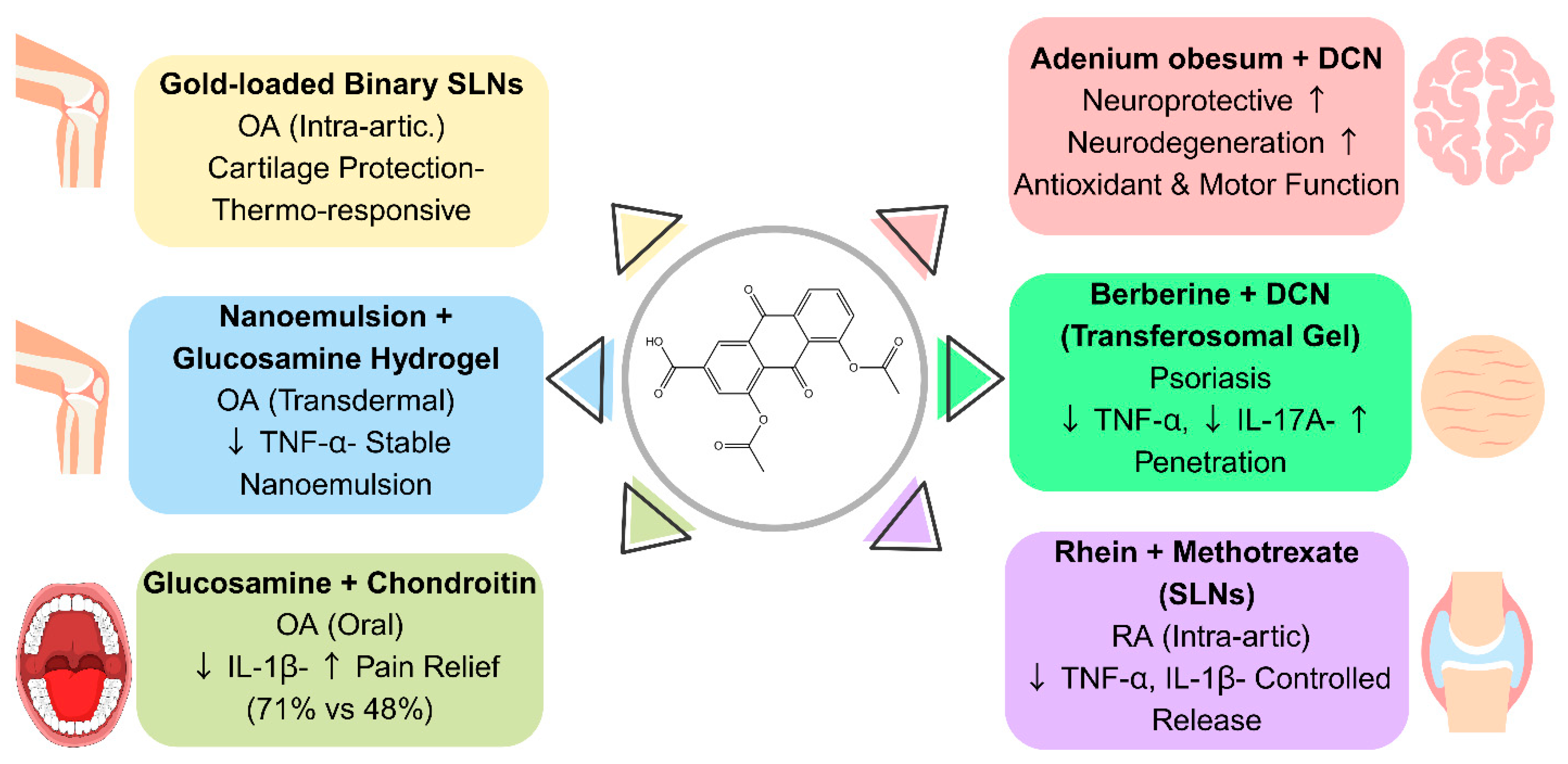
| Carrier-Based (A. obesum Co-administration) | Parkinson’s Disease, Depression | Oral | Not Applicable | Improved neuroprotection | Enhanced behavioral and antioxidant responses | [2] |
| Transferosomal Gel (DCN + Berberine HCl) | Psoriasis | Topical | Not Applicable | Improved spreadability & drug retention | Reduced epidermal thickness, TNF-α & IL-17A suppression | [148] |
| Dual Transferosomes (DCN + Berberine HCl) | Psoriasis | Topical | Not Applicable | 91.23% entrapment efficiency | Enhanced skin penetration, 24-h sustained drug release | [149] |
| SLNs (Rhein + Methotrexate) | Rheumatoid Arthritis | Oral | Sustained release (~48% over 24 h) | Increased joint targeting | Reduced TNF-α, IL-1β, and inflammation | [150] |
| Binary SLNs (Thermoresponsive) | Osteoarthritis | Oral & Intra-Articular | Sustained release over 72 h | Enhanced joint retention | Reduced TNF-α & IL-1β | [28] |
| Nanoemulsion-Loaded Hydrogel | Osteoarthritis | Transdermal | Yes | Stable nanoemulsion formulation | Reduced inflammatory biomarkers | [55] |
| Chondroitin & Glucosamine Combination | Osteoarthritis | Oral | No | Not applicable | 71.01% pain reduction vs. 48.09% with DCN | [63] |
| Number | NCT Number | Study Title | Conditions | Interventions | Phases |
|---|---|---|---|---|---|
| 1 | NCT01906801 | Clinical Efficacy of Glucosamine Plus Diacerein Versus Mono-therapy of Glucosamine | Osteoarthritis|Glucosamine|Diacerein | DRUG: Glucosamine sulfate|DRUG: Diacerein|DRUG: Placebo (for Diacerein) | PHASE4 |
| 2 | NCT04351100 | Efficacy of Diacerein on Ocular Surface Disease in Degenerative Arthritis Patients | Ocular Surface Disease|Osteoarthritis|Diacerein | DRUG: Diacerein | |
| 3 | NCT00685542 | Effect of Diacerein on Hand Osteoarthritis | Osteoarthritis | DRUG: diacerein|DRUG: placebo | PHASE4 |
| 4 | NCT03472287 | To Evaluate the Pharmacokinetics of Diacerein and Rhein After Maximum Use in Patients With Epidermolysis Bullosa (EB) | Epidermolysis Bullosa (EB)|Epidermolysis Bullosa Simplex|Dystrophic Epidermolysis Bullosa|Junctional Epidermolysis Bullosa | DRUG: Diacerein 1% Ointment | PHASE1 |
| 5 | NCT01298882 | Diacerein on Insulin Secretion in Diabetes | Type 2 Diabetes Mellitus|Overweight|Obesity | DRUG: Diacerein|OTHER: Placebo | PHASE2 |
| 6 | NCT00445276 | Symptomatic Efficacy of Diacerein in Knee Osteoarthritis | Knee Osteoarthritis | DRUG: Diacerein | PHASE4 |
| 7 | NCT04917679 | Eltrombopag Plus Diacerein vs. Eltrombopag in Adult ITP | Thrombocytopenia | DRUG: Eltrombopag plus diacerein|DRUG: Eltrombopag | PHASE2 |
| 8 | NCT05226754 | Study Design of the Diacerein in Patients With COVID-19 | COVID-19 | DRUG: Diacerein|DRUG: placebo capsules | PHASE2 |
| 9 | NCT00451360 | Chondromodulating Effect of Diacerein in Osteoarthritis of the Hip | Hip Osteoarthritis | DRUG: diacerein | PHASE3 |
| 10 | NCT00440661 | Exploration of the Synovial Fluid Inflammation Mediators Under Diacerhein in Knee Osteoarthritis | Osteoarthritis | DRUG: Diacerhein | PHASE4 |
| 11 | NCT07199933 | Diacerein in the Treatment of Metabolic Dysfunction-Associated Steatotic Liver Disease | MAFLD | DRUG: Diacerein 50 mg Capsule|DRUG: Placebo 50 mg | NA |
| 12 | NCT06308068 | Bioequivalence Study of Diacerein 50 mg Capsule in Healthy Thai Volunteers | Healthy Volunteer | DRUG: Diacerein 50 mg Capsule | PHASE1 |
| 13 | NCT02060552 | Immune Molecular and Inflammatory Cytokines Dysfunction Analysis in Gout Patients With Different Urate Levels | Primary Gout | DRUG: Diacerein|DRUG: Colchicine|DRUG: Febuxostat | PHASE4 |
| 14 | NCT04318041 | Evaluation of the Structural Modification Effect of Diacerein (Artrodar®) in Knee Osteoarthritic Patients | Knee Osteoarthritis | DRUG: Artrodar|DRUG: Placebos | PHASE3 |
| 15 | NCT02242149 | Efficacy Study of Diacerein on Glycemic Control and Liver Fat in Type 2 Diabetes Subjects | Diabetes Mellitus, Type 2|Non-alcoholic Fatty Liver Disease | DRUG: Diacerein|DRUG: Placebo | PHASE3 |
| 16 | NCT03472547 | A Study of Sensitizing Potential of Diacerein 1% Ointment in Healthy Subjects | Healthy | DRUG: diacerein 1% ointment | PHASE1 |
| 17 | NCT03472534 | A 21 Day Irritation Study in Healthy Volunteers With Diacerein 1% Ointment | Healthy | DRUG: diacerein 1% ointment | PHASE1 |
| 18 | NCT01120015 | Diacerein as Adjuvant to Diclofenac Sodium in Indian Patients of Osteoarthritis (OA) Knee | Osteoarthritis|Osteoarthritis, Knee | DRUG: diacerein | PHASE4 |
| 19 | NCT02688400 | Effect of Diacerein vs. Celecoxib on Symptoms and Structural Changes in Symptomatic Knee Osteoarthritis | Osteoarthritis|Osteoarthritis, Knee | DRUG: Diacerein|DRUG: Celecoxib|DRUG: Placebo | PHASE3 |
| 20 | NCT02177643 | Effect of Diacerein in the Metabolic Control of Patients With DM Type 2 and Secondary Failure to Metformin | Diabetes-Related Complications|Diabetes Mellitus, Type 2|Insulin Resistance | DRUG: Diacerein|DRUG: Placebo | PHASE2 |
| 21 | NCT03754634 | A Prospective, Open, Multicenter Clinical Trial of Eltrombopag Combined With Diacerein in Eltrombopag-Inefficient or Relapsed ITP | Thrombocytopenia | DRUG: Eltrombopag and Diacerein | PHASE2 |
| 22 | NCT03154333 | Safety and Efficacy of Diacerein 1% Ointment for Subjects With Epidermolysis Bullosa Simplex (EBS) | Epidermolysis Bullosa Simplex | DRUG: diacerein 1% ointment|DRUG: A placebo ointment | PHASE2 |
| 23 | NCT03208309 | Effect of Diacerein in the Metabolic Control of Patients With DM Type 2 and Secondary Failure to Metformin | Complications of Diabetes Mellitus|Diabetes Mellitus|Diabetes Mellitus, Type 2 | DRUG: Diacerein|DRUG: Placebo | PHASE2 |
| 24 | NCT03473184 | A 4-Day Study to Evaluate the Photoxicity of Diacerein 1% Topical Ointment in Healthy Volunteers | Healthy | DRUG: Diacerein 1% ointment | PHASE1 |
| 25 | NCT03473197 | A 6-Week Study to Evaluate the Photoallergic Potential of Diacerein 1% Ointment in Healthy Volunteers | Healthy | DRUG: Diacerein 1% ointment | PHASE1 |
| 26 | NCT03404479 | Trial to Evaluate Efficacy and Safety of Combination of Diacerein and Celecoxib Administered in Patients With Knee OA | Knee Osteoarthritis | DRUG: Diacerein|DRUG: Celecoxib | PHASE4 |
| 27 | NCT03389308 | Long-term Open-label Study Evaluating Safety of Diacerein 1% Ointment Topical Formulation in Subjects With Epidermolysis Bullosa Simplex | Epidermolysis Bullosa|Epidermolysis Bullosa Simplex | DRUG: diacerein 1% ointment | PHASE2 |
| 28 | NCT06912035 | Efficacy of Diacerein Supplementation on Interleukin-1Î2, Hs-CRP, TNF-α Levels and Glycemic Control in Uncontrolled Type 2 Diabetes Mellitus Patients at Dr. Mohammad Hoesin General Hospital Palembang | Uncontrolled Diabetes|Diabetes Mellitus Type 2 | DRUG: Diacerein 50 mg Capsule|DRUG: Placebo | PHASE2|PHASE3 |
| 29 | NCT01264211 | Safety and Efficacy of the Combination of Diacerein 100 mg Daily and MTX Versus MTX Alone in the Treatment of Early Rheumatoid Arthritis (RA) | Rheumatoid Arthritis | DRUG: Diacerein|DRUG: Placebo | PHASE2 |
| 30 | NCT06073132 | An International, Multicenter, Randomized, Double-Blind, Parallel Group, Vehicle-Controlled, Phase 2/3 Study With Open-Label Extension Evaluating the Efficacy and Safety of Diacerein 1% Ointment for the Treatment of Generalized Epidermolysis Bullosa Simplex (EBS) | Generalized Epidermolysis Bullosa Simplex | DRUG: AC-203|DRUG: Vehicle | PHASE2|PHASE3 |
| Formulation Type | Delivery Vehicle/System | Physicochemical/Encapsulation Improvement | Therapeutic/PK Outcomes | Mechanistic Correlation | Ref. | |
|---|---|---|---|---|---|---|
| Physical strategies | Osmotically controlled oral system (ternary SD + asymmetric osmotic pump) | Ternary SD (Pluronic F127 + Solutol HS15 + PEG 35K) compressed into Opadry® CA–coated asymmetric osmotic pump tablets | Solubility ↑ to 70.2 µg/mL; dissolution 79.28% at 60 min; intrinsic dissolution rate ↑; zero-order 24-h release | Bioavailability ↑ ~2.8-fold in vivo (AUC 28.84 vs. 10.39 ng·h/mL) | Amorphization + surfactant-enhanced wetting ↑ absorption; osmotic pump ensures constant release → improved systemic exposure | [3] |
| Solid dispersion–loaded oral tablets | Pluronic® F68 solid dispersion (1:3 drug:carrier) prepared via rotavap and compressed into tablets | Solubility ↑ to 187.6 µg/mL (vs. 22.5 µg/mL); dissolution efficiency ↑ 4.04-fold; dissolution rate ↑ 6.6-fold; 100% release in 2 min; tablet dissolution rate ↑ 12.5-fold vs. marketed | Bioavailability ↑ 2.66-fold vs. marketed product | Amorphization + surfactant-enhanced wetting ↑ solubility and dissolution → rapid absorption; optimized SD matrix prevents crystallinity → higher systemic exposure | [101] | |
| Solid dispersion system (hydrophilic polymer-based) | Solvent-evaporated SD using hydrophilic polymers optimized via I-Optimal design | Dissolution efficiency ↑ 10.83-fold (15 min) and ↑ 3.42-fold (60 min); MDT ↓ 6-fold; complete amorphization confirmed by DSC/XRD/SEM | Relative bioavailability ↑ 229% (adults) and 262% (geriatrics) vs. plain DCN (PBPK predicted) | Amorphization + polymer-enhanced wettability → faster dissolution → higher simulated plasma exposure; PBPK correlation indicates improved oral bio-performance across populations | [40] | |
| Orally disintegrating tablets (ODTs) containing optimized solid dispersion | ODTs formulated with co-processed excipients (Prosolv® ODT, Pharmaburst® 500, F-melt®) loaded with optimized DCN SD | Dissolution efficiency ↑ 1.50-fold (10 min) and ↑ 1.12-fold (30 min); MDT ↓ 2-fold vs. Diacerein® capsules; rapid wetting/disintegration | Significant ↑ in anti-inflammatory response (higher edema inhibition, p < 0.0465); faster onset at 0.5 h vs. Diacerein® capsules | Rapid oral cavity dissolution → reduced DCN reaching colon → less rhein formation; improved solubility + fast disintegration → enhanced absorption & early therapeutic effect | [39] | |
| Physicochemical strategies | Cyclodextrin inclusion complexes (β-CD and HP-β-CD) | Kneaded 1:1 inclusion complexes of DCN with β-CD and HP-β-CD; HP-β-CD used for fast-disintegrating tablets | Increased aqueous solubility; improved dissolution rate in pH 6.8 buffer; enhanced amorphousness confirmed by DSC/XRD/FTIR; stable host–guest complex formation | Improved in vitro release vs. pure drug and comparable to marketed formulation; expected ↓ colonic DCN → ↓ rhein-associated diarrhea | Cyclodextrin cavity entraps DCN → reduced crystallinity + enhanced wettability → faster dissolution → reduced unabsorbed fraction reaching colon → mitigation of GI adverse effects | [4] |
| Cyclodextrin inclusion complex (HP-β-CD) | 1:1 DCN/HP-β-CD complexes prepared via physical mixture, kneading, co-evaporation, and freeze-drying; evaluated in aqueous and solid state | Improved solubility and dissolution in simulated intestinal fluid; enhanced amorphousness confirmed by DSC/FTIR; binding constants validated via spectroscopic, UV, and HPLC methods; stabilized molecular interaction with CD cavity | No in vivo PK reported; complexation shown to modify hydrolysis kinetics of DCN → potential stabilization against premature degradation | HP-β-CD encapsulation improves drug–carrier binding, reduces crystallinity, and modulates DCN hydrolysis → improved dissolution behavior and more predictable release compared to free drug | [7] | |
| Pharmaceutical cocrystal (DIA–β-resorcylic acid) | DIA:RA cocrystal (optimized at 1:3 molar ratio) prepared via antisolvent crystallization | Improved solubility, faster dissolution, enhanced packability/compressibility/compactibility, improved stability; novel solid phase confirmed by DSC, PXRD, FT-IR, SEM | Bioavailability ↑ 3.2-fold compared with pure DIA | Cocrystal formation modifies lattice energy and hydrogen-bonding network → enhanced solubility, improved mechanical properties, and faster dissolution → increased systemic exposure | [74] | |
| Eutectic-based diacerein formulations (PK evaluation study) | Novel DIA eutectics administered orally; rhein quantified using validated RP-HPLC bioanalytical method | Not directly investigated; study supports accurate PK assessment of DIA eutectics via validated quantification of rhein | PK profiling enabled: linearity r2 > 0.9988; validated FDA-compliant method allowed comparison of rhein exposure between pure DIA and eutectic formulations | Reliable bioanalytical quantification of rhein allows mechanistic understanding of how eutectic formulations may alter DIA absorption, metabolism, and systemic exposure | [107] | |
| Advanced Formulations | Niosomes (ultrasonic-processed) | UP-prepared niosomes using Span 20, Pluronic L64, or mixed surfactant systems; compared with thin-film hydration (TFH) | Smaller vesicle size; more monodisperse (lower PDI); feasible entrapment; significantly faster drug release vs. pure drug and vs. TFH-niosomes | Faster release profile indicates improved dissolution and potential for enhanced bioavailability; no in vivo data reported | Reduced vesicle size + increased surface area from ultrasonic processing → accelerated drug release; improved wettability/dispersion enhances dissolution behavior of poorly soluble DCN | [42] |
| Transdermal niosomes (CCD-optimized) | Niosomes prepared by thin-film hydration and optimized via central composite design; elastic vesicles developed for comparative permeation | Entrapment efficiency 95.63%; particle size 436.7 nm; PDI 0.47; zeta potential −38.8 mV; optimized lipid/surfactant system enhances vesicle stability and loading | Ex vivo: markedly enhanced skin permeation and retention vs. drug suspension; in vivo: significantly higher skin deposition (improved local availability) | Vesicular encapsulation + elastic vesicle properties enhance SC penetration; high entrapment + stable vesicle charge improves deposition, enabling efficient transdermal delivery and avoiding oral GI side effects | [117] | |
| Sustained-release niosomes (REV technique) | Niosomes prepared via reverse-phase evaporation using sorbitan monostearate:cholesterol ratios (5:5 to 9:1); optimized F3 (7:3) | Vesicle size 0.608–1.01 µm; PDI 0.409–0.781; entrapment 79.8% (F3); sustained release with T50% up to 10 h; zero-order kinetics (R2 = 0.9834); non-Fickian diffusion (n = 0.90) | Sustained release indicates extended drug availability at absorption site; improved dissolution performance vs. pure DCN; enhances potential oral absorption | Surfactant–cholesterol bilayers improve entrapment and modulate membrane rigidity → prolonged release; controlled diffusion reduces burst effect → more consistent systemic exposure and improved bioavailability | [118] | |
| Elastic bilosomes (bile salt-modified niosomes) | Bilosomes prepared by thin-film hydration with bile salts as edge activators; optimized via full factorial (B6 formulation) | Vesicle size ~301.7 nm; 100% entrapment; enhanced deformability and bilayer flexibility enabling superior penetration; improved stability vs. niosomes | Ex vivo: significantly increased permeation vs. niosomes and drug suspension. In vivo: markedly higher skin retention; histopathology confirmed dermal safety | Bile-salt-induced membrane elasticity enhances deformability → easier stratum corneum traversal; ultra-flexible vesicles increase flux + depot formation → higher local drug levels and improved therapeutic availability | [54] | |
| Novasomes (fatty acid-modified non-ionic vesicles) | Novasomes prepared by thin-film hydration, optimized by varying surfactant:cholesterol ratio, sonication type/time, and fatty acid level | Optimized formula (F6): vesicle size 275.2 nm, EE% 69.4%, PDI 0.309; stable vesicle architecture confirmed by FTIR and TEM | No in vivo PK reported; optimized vesicle size and EE% indicate potential for enhanced transdermal delivery and reduced GI exposure | Fatty-acid–enhanced bilayer fluidity + optimized surfactant/cholesterol balance → stable nanosized vesicles with higher loading → improved dermal penetration vs. free drug | [114] | |
| Elastosomes (edge-activator-based elastic vesicles) | Elastosomes optimized via 41·21 factorial design using different edge activators; optimal E1 formulation selected by desirability function | EE% 96.25%, PS 506 nm, PDI 0.46, ZP –38.6 mV, deformability index 12.7 g; high flexibility and stability vs. conventional vesicles | Ex vivo: significantly superior permeation + retention vs. drug suspension. In vivo: high skin deposition and confirmed dermal safety; PK: comparable systemic absorption to oral suspension; strong Level C IVIVC between release and in vivo performance | Edge activators increase bilayer elasticity → enhanced SC crossing + deeper skin deposition; high deformability + high EE% create a transdermal reservoir → improved local availability while avoiding GI exposure and oral side effects | [76] | |
| Hyaluosomes (HA-based gel-core vesicles for intra-articular injection) | Hyaluronic-acid gel-core vesicles optimized via full factorial design for intra-articular delivery | High entrapment efficiency 90.7%; small vesicle size ~310 nm; spherical morphology with HA core confirmed by TEM; stable zeta potential | In vivo (OA rat model): marked reduction in cartilage damage and inflammation; significant decrease in plasma TNF-α and IL-1β vs. untreated group; superior joint protection and local anti-inflammatory effect | HA-core vesicles enhance joint residence time and synovial adhesion → sustained DCN release within joint cavity; high EE% and nanosize improve drug availability at site of inflammation → leading to strong reduction in inflammatory cytokines and cartilage deterioration | [8] | |
| Solid Lipid Nanoparticles (SLNs)—Oral Liquid Form | Cetyl alcohol (2%) as lipid matrix; Tween 80 (0.9%) surfactant; citric acid (0.05%) for pH adjustment; structured liquid vehicle | QbD-based optimization; enhanced chemical stability of DCN in aqueous medium; protection from hydrolysis; stable for 6 months at 40 °C/75% RH; formation of uniform SLNs suitable for oral suspension (50 mg/5 mL) | Significant reduction in diarrheal side effects (p < 0.0001); protection of DCN from degradation; improved tolerability and safety | Entrapment within SLNs protects DCN from aqueous instability → reduces formation of rhein in colon → markedly lowers GI adverse effects; stabilization of drug within lipid matrix supports long-term storage | [126] | |
| Proliposomes (PLS)—Oral Controlled-Release | Film deposition method; positively charged stearylamine-containing PLS (PLS-F16); sorbitol-based PLS compressed into Eudragit RS100/Ethyl cellulose CR tablets | High EE 91.13% ± 2.25%; nano-size 128.12 ± 17.90 nm; delayed release (46.7% at 12 h); amorphization of DCN (FTIR, DSC, PXRD); improved physical stability vs. liposomes | CR tablet PT-F10 showed markedly enhanced PK: Cmax = 7455 ± 262.7 ng/mL, AUC0–24 = 913,013.7 ± 553.48 ng·h/mL, Tmax = 8 h; significantly better than marketed DCN capsules | High EE and amorphous state improved dissolution and absorption; positive charge enhanced membrane interaction; controlled-release matrix minimized colonic DCN → reduced rhein exposure and improved systemic bioavailability | [70] | |
| Nanostructured Lipid Carrier (NLC) Gel—Topical | DCN-loaded NLC dispersed in gel base; designed for enhanced cutaneous penetration and prolonged topical delivery | Improved rheology and spreadability; stable nano-dispersion; controlled release with extended delivery up to 24 h; optimized pH and skin compatibility; improved nanoparticle proliferation and stability | Pharmacodynamic studies confirmed faster onset and prolonged anti-inflammatory action (up to 24 h); skin irritation tests showed good dermal tolerability | Enhanced drug solubilization within lipid matrix improved penetration; nanoparticle–gel hybrid increased skin retention and sustained release, enabling prolonged analgesic/anti-inflammatory effect vs. conventional topicals | [23] | |
| Solid Lipid Nanoparticles (SLN) with Targeting Ligand | Chondroitin sulfate-modified DCN-loaded SLN (ChS-DC-SLN) for intra-articular targeting | Particle size 396 ± 2.7 nm; extended release up to 16 h; 2.8-fold increase in bioavailability versus plain drug; improved stability and site-specific retention | Histopathology showed improved preservation of cartilage structure; significantly higher rhein concentration at target site: 7.8 ± 1.23 µg/mL vs. 2.9 ± 0.45 µg/mL (drug dispersion); enhanced therapeutic response in OA rat model | Chondroitin sulfate acts as a homing ligand to articular cartilage → improves intra-articular accumulation; SLN matrix enhances solubility, protects DCN from degradation, and prolongs residence time → collectively increases anti-osteoarthritic efficacy | [38] | |
| Topical nanoemulgel (NE–Carbopol hydrogel) | Box–Behnken–optimized nanoemulsion (oleic acid 8–12%, Tween 80 10–15%, PG 15–25%) incorporated into Carbopol 934P gel | Particle size 104.3 nm; loading efficiency 18.5%; uniform drug content; 24-h release 93.6% (Higuchi, non-Fickian); good spreadability and pH stability | High in vitro permeability: cumulative permeation 12.73 μg/cm2 at 24 h; flux 0.574 μg/cm2/h; superior release and penetration vs. plain DCN | Small droplet size + oleic acid (penetration enhancer) disrupt SC lipids → increased skin permeation; hydrophilic gel network maintains sustained drug release → enhanced local therapeutic availability | [21] | |
| Stability-indicating analytical method (RP-HPLC) supporting nanoemulgel formulation | RP-HPLC assay developed via DoE (fractional factorial + CCD) for simultaneous quantification of DCN, ACE, and degradation products (rhein, DLS) in nanoemulgel and tablets | Validated method under ICH conditions (heat, acid/alkali, oxidative, photolytic, humidity, hydrolysis stress); high linearity (R2 > 0.999), accuracy 98–102%; allows reliable characterization and stability assessment of DCN nanoemulgel | Facilitates accurate quantification of DCN within novel nanoemulgel formulations; supports stability profiling and ensures dosage consistency (no direct in vivo data) | Robust analytical validation ensures precise measurement of DCN in advanced formulations → enables PK evaluation, stability assessment, and correlation of formulation performance with drug degradation behavior | [25] | |
| Microemulgel | Oil phase: Capmul MCM C8; Surfactant: Labrasol; Co-surfactant: Ethanol; Microemulsion incorporated into carbomer-based gel | Central Composite Design (27 runs); optimized batch F2 showed high drug solubilization capacity, thermodynamic stability, acceptable transmittance, and minimal drug–excipient interaction | In vitro diffusion showed 95% drug release within 8 h; enhanced permeation and controlled release compared to conventional topical forms | Microemulsion droplets significantly increase DCN solubilization → incorporation into gel matrix ensures controlled permeation across skin while avoiding oral GI side effects | [125] | |
| Microparticulate & Magnetically Responsive Delivery System | Surface-modified iron oxide microparticles (SMIOMPs) coated with chitosan for intra-articular injection | High entrapment 85.25%; particle size 1.54 µm; chitosan-coated spherical morphology; sustained drug release; stability preserved after gamma sterilization; no undesirable interactions per DSC/FTIR | Significant reduction in TNF-α, IL-1β, and knee joint diameter in arthritic rats; superior anti-inflammatory and cartilage-protective effects compared to untreated animals; improved local drug retention | Chitosan surface modification ↑ mucoadhesion + magnetic microparticles ↑ localization → enhanced intra-articular residence; sustained release moderates inflammatory mediators → improved cartilage preservation | [59] | |
| Stimuli-responsive polymeric hydrogel system | Rhamnogalacturonan-based linseed polysaccharide hydrogel (LSH) tablets | pH-responsive swelling/deswelling: swelling ↑ at pH 7.4; deswelling at pH 1.2; sustained release behavior; <10% release in gastric pH; SEM showed elongated porous channels; non-Fickian diffusion mechanism | Provides controlled & sustained oral release of DCN with strong gastric protection; minimizes drug hydrolysis in acidic media → potential reduction in diarrhea; enhances release consistency at intestinal pH | pH-triggered swelling at intestinal pH → enhanced diffusion; deswelling in acidic stomach → protects DCN from hydrolysis and prevents premature rhein formation; hydrogel matrix modulates diffusion kinetics | [61] | |
| Self-Nanoemulsifying Drug Delivery System (Solid-SNEDDS) | Rhein-loaded SNEDDS (Tween 80 + PEG 400 + Eucalyptus oil), converted into solid RS-SNEDDS | Droplet size 129 nm; zeta potential −24.6 mV; very high encapsulation (98.86%); high % transmittance (94.8%); complete amorphization confirmed by DSC/XRD; 24-h extended release (99%); smooth spherical nano-globules (FESEM) | ~4-fold ↑ Cmax and ~5-fold ↑ AUC vs. free rhein; markedly enhanced oral bioavailability; significantly improved brain penetration (Cmax 2.9 µg/mL; AUC0–t 18.18 µg·h/mL) | Nanoemulsification ↓ crystallinity → ↑ solubility & dissolution; high surface area nano-droplets → enhanced lymphatic uptake; PEG/Tween system improves membrane permeability; extended-release matrix improves systemic exposure | [48] | |
| Mucoadhesive Oral Nanosuspension | Chitosan-coated diacerein nanosuspension (CS-DNS) prepared by sonoprecipitation | Reduced particle size; improved PDI; chitosan coating → strong positive ZP; enhanced dissolution; increased mucoadhesion; lower rhein/DCN intraluminal ratio; crystallinity retained (SEM, XRD, DSC) | Cmax ↑ to 0.74 µg/mL, delayed Tmax (3.6 h), 172% relative bioavailability vs. suspension; significantly reduced diarrheal side effect due to lower colonic rhein formation | Nanosizing ↑ surface area → improved dissolution; chitosan coat ↑ mucoadhesion → prolonged intestinal residence; controlled release ↓ colonic hydrolysis to rhein → reduces diarrhea; improved permeation in non-everted intestine explains PK improvement | [49] | |
| Stimuli-responsive sustained-release hydrogel | Acrylic acid/KPS/MBA cross-linked hydrogel (pH-responsive oral matrix) | pH-triggered swelling (high in pH 7.4; minimal in pH 1.2); SEM shows porous morphology; FTIR confirms crosslinking; zero-order sustained release; ↑ crosslinker → ↓ release rate (optimized M3 formulation) | Strong gastric protection; sustained intestinal release; M3 formulation showed controlled drug release ideal for chronic arthritis therapy; avoids burst release and may reduce local GI irritation | pH-sensitive swelling in basic media → promotes intestinal targeting; tighter crosslinking regulates diffusion → sustained release; acidic deswelling protects DCN from degradation and reduces conversion to rhein → potentially lowers diarrhea | [142] | |
| Polymeric microspheres (ionotropic gelation) | Alginate–chitosan microspheres crosslinked with CaCl2 | Particle size 106–542 µm; ↑ chitosan → ↑ entrapment efficiency; ↑ alginate/CaCl2 → ↑ size; SEM: spherical & rough-surfaced microspheres; sustained release in pH 6.8; B3 (1:3 alginate:chitosan) showed slowest release | Sustained intestinal release ideal for reducing GI conversion of DCN to rhein; potential reduction in diarrhea; optimized B3 suitable for further preclinical evaluation | Ionotropic gelation → dense crosslinked matrix; higher chitosan levels ↓ hydration/porosity → prolonged release; alginate/chitosan polyelectrolyte complex regulates diffusion and protects DCN from rapid hydrolysis | [143] | |
| Sustained-release polymeric microspheres (in vivo efficacy evaluation) | Oral alginate–chitosan microspheres (optimized ionotropic gelation system) | Sustained-release profile confirmed in earlier formulation paper; controlled intestinal release; slower transit & prolonged retention | In CFA-induced arthritis: reduced paw edema, improved gait score, lower arthritic index, reduced joint stiffness, radiographic improvement; therapeutic effect comparable to free diacerein API and glucosamine; charcoal meal test showed slower GI transit → reduced diarrhea | Sustained release → reduced colonic conversion of DCN to rhein → lower diarrheal side effect; prolonged systemic exposure → improved anti-inflammatory response (IL-1β pathway), matching efficacy of standard treatments | [144] | |
| Microneedle-assisted percutaneous system | Self-dissolving microneedles + CMC-based gel containing PEG4000 solid dispersion of diacerein | PEG400 & PEG4000 solid dispersion → markedly ↑ solubility & amorphization (confirmed by XRD); microneedles dissolved in 5 min; uniform needle morphology; microchannel formation validated; ↑ MN loading (390 µg/array); optimized gel enabled 98% permeation | 2.43-fold ↑ permeation, 74.39% ex vivo permeation via MN-array; 15.75% skin deposition; significantly improved anti-inflammatory activity in paw-edema model; reduced diarrheal episodes vs. oral marketed formulation; stable under accelerated conditions | Solid dispersion ↓ crystallinity → ↑ solubility; dissolving MNs bypass stratum corneum → enhanced percutaneous flux; microchannels + CMC gel create sustained depot; reduced GI exposure ↓ colonic hydrolysis → ↓ diarrhea | [147] | |
| Non-formulation pharmacological adjuvant study | Co-administration of diacerein (100 mg/kg) with methanolic Adenium obesum extract | No formulation modification; systemic administration of pure DCN | Significant neuroprotective effect in Parkinsonism & depression models: improved motor coordination (rotarod), reduced depressive behavior (forced swim), improved exploratory behavior (hole-board); histopathology showed neuroprotection; antioxidant markers improved (↑ GSH, SOD, CAT; ↓ LPO) | DCN’s IL-1β inhibitory and anti-inflammatory properties may synergize with phytochemicals of A. obesum; reduction in neuroinflammation supports rationale for using DCN as a broad-spectrum anti-inflammatory candidate in advanced formulations | [2] | |
| Transdermal hydrogel–nanoemulsion co-delivery system | Xanthan hydrogel containing nanoemulsion-loaded diacerein + glucosamine sulfate | Nanoemulsion with globule size 81.95 nm; PDI 0.285; ZP +39.3 mV → high stability; thixotropic rheology; uniform morphology (CryoSEM/TEM); controlled non-Fickian release; stable under ICH conditions; good skin biocompatibility | Significant reduction in TNF-α, CRP, HMGB1, MCP-1; strong chondroprotection in OA rat model; reduced inflammation & cartilage degradation; controlled permeation across skin | Small droplet size ↑ penetration; xanthan matrix sustains release; synergy of glucosamine (chondroprotective) + DCN (IL-1β inhibitor) → amplified anti-inflammatory & cartilage-protective effect; positive ZP enhances stability & interaction with skin | [55] | |
| Topical transferosomal hydrogel (dual-drug system) | 1% hyaluronic acid gel containing transferosomes co-loaded with berberine HCl + diacerein | Homogeneous gel, pH 5.4 ± 0.4; pseudoplastic rheology; spreadability 9.8 g·cm/s; sustained 24 h release (DCN: 88.44%, BBR: 81.56%); improved lipid vesicle penetration & residence | Significant reduction in erythema, scaling, and epidermal thickness; reduced acanthosis in histology; marked decrease in TNF-α and IL-17A levels in psoriatic mice; improved local therapeutic effect | Transferosomes enhance deep dermal penetration; HA gel increases hydration & skin residence; combination of berberine (anti-inflammatory/anti-proliferative) with diacerein (IL-1β inhibitor) provides synergistic suppression of psoriatic cytokines & keratinocyte hyperproliferation | [148] | |
| Dual-drug transferosomal nanocarriers (optimized via Box–Behnken design) | Film-hydration transferosomes containing berberine HCl + diacerein; sodium deoxycholate as edge activator | Particle size 110.90 ± 2.8 nm; PDI 0.296; ζ = −13.3 mV; high EE% (BBR 89.50 ± 1.5%, DCN 91.23 ± 1.8%); deformability index 2.44; 24 h sustained release (BBR 82.09%, DCN 85.02%); antioxidant activity 38.36%; stable at 4 °C and 25 ± 2 °C/60 ± 5% RH for 3 months | Enhanced transdermal flux (BBR 0.0224 μg cm−2 h−1; DCN 0.0462 μg cm−2 h−1); Raman mapping confirmed dermal penetration; no irritation in BALB/c mice | Sodium–deoxycholate-based transferosomes improve membrane elasticity and deep skin permeation; co-delivery of two cytokine-modulating agents supports multi-pathway suppression of psoriatic inflammation (TNF-α, IL-12, IL-23) | [149] | |
| Dual-drug targeted solid lipid nanoparticles (SLNs) containing Rhein + Methotrexate | Solid lipid nanoparticles decorated with RH and MTX for targeted RA delivery | Nanosized particles; high negative zeta potential → high stability (exact size not stated numerically but reported as “suitable nanosized range”); good physicochemical attributes | Significant improvement in inflammatory and arthritic markers in vivo; improved joint histology and ultrastructure; reduced disease progression in adjuvant arthritis model | SLNs altered endoplasmic-reticulum-stress (ERS)–mediated apoptosis—suggesting mechanistic modulation of RA pathways; improved delivery enhances anti-inflammatory efficacy of RH despite low inherent bioavailability | [150] | |
Disclaimer/Publisher’s Note: The statements, opinions and data contained in all publications are solely those of the individual author(s) and contributor(s) and not of MDPI and/or the editor(s). MDPI and/or the editor(s) disclaim responsibility for any injury to people or property resulting from any ideas, methods, instructions or products referred to in the content. |
© 2025 by the authors. Licensee MDPI, Basel, Switzerland. This article is an open access article distributed under the terms and conditions of the Creative Commons Attribution (CC BY) license (https://creativecommons.org/licenses/by/4.0/).
Share and Cite
Naseri, M.; Ghobakhlou, S.; Heidarizade, N.; Akbari, M.E.; Lotfabadi, A.; Sadegh Malvajerd, S.; Izadi, Z.; Maleki, H. Advances in Drug Delivery Science for Diacerein: Strategies to Enhance Solubility, Bioavailability, and Pharmacokinetic Performance. Pharmaceutics 2025, 17, 1539. https://doi.org/10.3390/pharmaceutics17121539
Naseri M, Ghobakhlou S, Heidarizade N, Akbari ME, Lotfabadi A, Sadegh Malvajerd S, Izadi Z, Maleki H. Advances in Drug Delivery Science for Diacerein: Strategies to Enhance Solubility, Bioavailability, and Pharmacokinetic Performance. Pharmaceutics. 2025; 17(12):1539. https://doi.org/10.3390/pharmaceutics17121539
Chicago/Turabian StyleNaseri, Maryam, Sajjad Ghobakhlou, Niloofar Heidarizade, Mohammad Emad Akbari, Alireza Lotfabadi, Soroor Sadegh Malvajerd, Zhila Izadi, and Hassan Maleki. 2025. "Advances in Drug Delivery Science for Diacerein: Strategies to Enhance Solubility, Bioavailability, and Pharmacokinetic Performance" Pharmaceutics 17, no. 12: 1539. https://doi.org/10.3390/pharmaceutics17121539
APA StyleNaseri, M., Ghobakhlou, S., Heidarizade, N., Akbari, M. E., Lotfabadi, A., Sadegh Malvajerd, S., Izadi, Z., & Maleki, H. (2025). Advances in Drug Delivery Science for Diacerein: Strategies to Enhance Solubility, Bioavailability, and Pharmacokinetic Performance. Pharmaceutics, 17(12), 1539. https://doi.org/10.3390/pharmaceutics17121539