Practical Pharmacokinetic–Pharmacodynamic Models in Oncology


Abstract
1. Introduction
2. PK Models to Describe and Predict Drug Exposure
3. Disease Progression Models to Recapitulate Natural Tumor Growth
4. PD Models for PK-PD Modeling of Anticancer Monotherapy
4.1. Indirect Response Models

| Model | Mathematical Equation | References |
|---|---|---|
| IDR | ||
| Inhibition of Kin | [75,87] | |
| —the tumor mass at time t R—Biomarker γ—Hill coefficient —the zero-order formation rate constant (h−1) —the first-order degradation rate constant (h−1) —the first-order tumor growth rate constant (h−1) —the first-order tumor loss rate constant (h−1) TG50—the tumor mass that inhibits 50% of the tumor growth rate | ||
| Stimulation of Kout | - | - |
| Signal distribution | [82] | |
—the tumor mass at time t —the net tumor growth constant —the maximal cell kill rate —the half maximal effective concentration —the cell kill rate constants in different transit compartments —the plasma concentration of drug —the transit time the total tumor mass at time t | ||
| Cell distribution | ||
| Simeoni | [20] | |
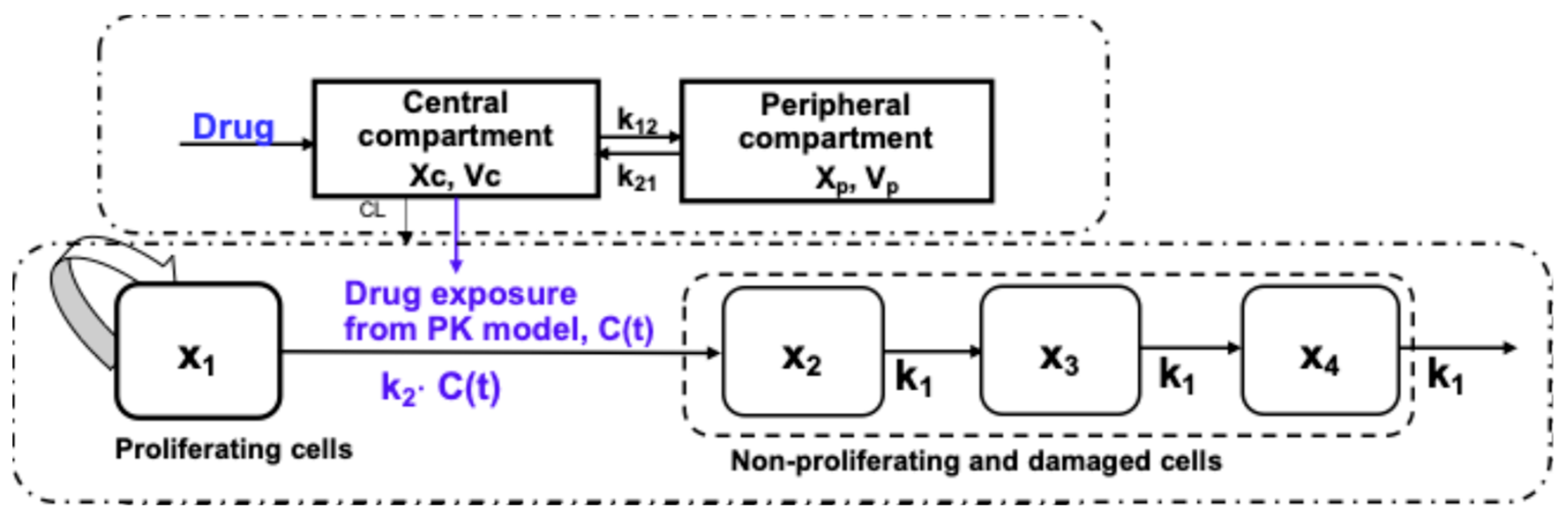
k1—the transient rate constant k2—the potency of the drug λ0—the exponential rate of tumor growth λ1—the linear rate of tumor growth —the shape parameter controls the nonlinearity and smoothness of the tumor growth function x1—the mass of the proliferating cells x2, x3, x4—the mass of the non-proliferating cells at different damage stages —the total tumor mass at time t —the plasma concentration of the drug at time t | ||
| Koch | [34] | |
| (All other equations remain the same as Simeoni’s) | ||
| Tumor burden | [94] | |
—the volume of dividing cells at time t the volume of damaged cells at different stages at time t —the total tumor volume at time t —the net tumor growth constant k1—the transient rate constant —the maximal effect —the half maximal effective concentration —the plasma concentration of drug at time t | ||
| Immune checkpoint inhibition | [95] | |
| —the overall portion of inhibited effector memory T cell and effector T cells; | ||
| —the number of cancer cells; | ||
| —the concentration of free PD-1 inhibitor in blood | ||
| —the number of T cells in the th differentiation compartment that have undergone divisions |
4.2. Signal Distribution Models
4.3. Cell Distribution Models
4.4. Other PD Models for Integrated PK-PD Modeling of Anticancer Drugs
5. Advanced PD Models for PK-PD Modeling of Combination Therapy and the Determination of Combination Effects
5.1. Koch Model
5.2. Terranova Model
5.3. Choi-Yu Model
6. Conclusions and Perspectives
Author Contributions
Funding
Data Availability Statement
Conflicts of Interest
Abbreviations
| AUC | area under the curve |
| CAR-T | Chimeric Antigen Receptor T cell therapy |
| CDM | cell distribution model |
| CL | clearance |
| Cmax | the maximum drug concentration |
| cMet | c-mesenchymal–epithelial transition factor |
| CI | combination index |
| EC50 | half-maximal effective concentration |
| EGFR | Epidermal Growth Factor Receptor |
| FDA | Food and Drug Administration |
| FLT3 | Feline McDonough Sarcoma-like tyrosine kinase 3 |
| Gli1 | glioma-associated oncogene 1 |
| HER2 | human epidermal growth factor receptor 2 |
| IDR | indirect response |
| IC50 | half-maximal inhibitory concentration |
| ka | absorption rate constant |
| ke | elimination rate constant |
| kg | a tumor growth function |
| Kin | the first-order tumor growth rate constant |
| Kout | the first-order tumor loss rate constant |
| mAb | monoclonal antibody |
| MIDD | model-informed drug development |
| NCA | non-compartmental analysis |
| NSCLC | non-small cell lung cancer |
| PBPK | physiologically based pharmacokinetic |
| PD | pharmacodynamics |
| PD-L1 | programmed death-ligand 1 |
| PK | pharmacokinetics |
| QSP | quantitative systems pharmacology |
| SDM | signal distribution model |
| Smo | Smoothened |
| t1/2 | half-life |
| TG50 | the tumor size that inhibits 50% of the growth rate |
| TGI | tumor growth inhibition |
| TKI, | tyrosine kinase inhibitor |
| Tmax | time to maximum concentration |
| TSC | tumor-static concentration |
| TV | tumor volume |
| Vd | Volume of Distribution |
References
- Scott, E.C.; Baines, A.C.; Gong, Y.; Moore, R., Jr.; Pamuk, G.E.; Saber, H.; Subedee, A.; Thompson, M.D.; Xiao, W.; Pazdur, R.; et al. Trends in the approval of cancer therapies by the FDA in the twenty-first century. Nat. Rev. Drug Discov. 2023, 22, 625–640. [Google Scholar] [CrossRef]
- Ribeiro, T.B.; Ribeiro, A.; Rodrigues, L.O.; Harada, G.; Nobre, M.R.C. U.S. Food and Drug Administration anticancer drug approval trends from 2016 to 2018 for lung, colorectal, breast, and prostate cancer. Int. J. Technol. Assess. Health Care 2020, 36, 20–28. [Google Scholar] [CrossRef] [PubMed]
- Mould, D.R.; Walz, A.C.; Lave, T.; Gibbs, J.P.; Frame, B. Developing Exposure/Response Models for Anticancer Drug Treatment: Special Considerations. CPT Pharmacomet. Syst. Pharmacol. 2015, 4, e00016. [Google Scholar] [CrossRef]
- DiMasi, J.A.; Feldman, L.; Seckler, A.; Wilson, A. Trends in risks associated with new drug development: Success rates for investigational drugs. Clin. Pharmacol. Ther. 2010, 87, 272–277. [Google Scholar] [CrossRef]
- Kurzrock, R.; Kantarjian, H.M.; Kesselheim, A.S.; Sigal, E.V. New drug approvals in oncology. Nat. Rev. Clin. Oncol. 2020, 17, 140–146. [Google Scholar] [CrossRef]
- Derendorf, H.; Meibohm, B. Modeling of pharmacokinetic/pharmacodynamic (PK/PD) relationships: Concepts and perspectives. Pharm. Res. 1999, 16, 176–185. [Google Scholar] [CrossRef]
- Derendorf, H.; Lesko, L.J.; Chaikin, P.; Colburn, W.A.; Lee, P.; Miller, R.; Powell, R.; Rhodes, G.; Stanski, D.; Venitz, J. Pharmacokinetic/pharmacodynamic modeling in drug research and development. J. Clin. Pharmacol. 2000, 40, 1399–1418. [Google Scholar] [CrossRef] [PubMed]
- Danhof, M.; de Lange, E.C.; Della Pasqua, O.E.; Ploeger, B.A.; Voskuyl, R.A. Mechanism-based pharmacokinetic-pharmacodynamic (PK-PD) modeling in translational drug research. Trends Pharmacol. Sci. 2008, 29, 186–191. [Google Scholar] [CrossRef]
- Meibohm, B.; Derendorf, H. Basic concepts of pharmacokinetic/pharmacodynamic (PK/PD) modelling. Int. J. Clin. Pharmacol. Ther. 1997, 35, 401–413. [Google Scholar]
- Gong, Z.; Chen, R.; Ye, L.; Ma, G.; Xian, Y.; Kulkarni, K. Editorial: Pharmacokinetic-pharmacodynamic model of drugs and their pharmacokinetic differences between normal and disease states. Front. Pharmacol. 2024, 15, 1451176. [Google Scholar] [CrossRef]
- Byrn, S.R. Accelerated Development of Pharmaceuticals Past, Present, and Future. Pharm. Res. 2024, 41, 1547–1555. [Google Scholar] [CrossRef]
- Mager, D.E.; Wyska, E.; Jusko, W.J. Diversity of mechanism-based pharmacodynamic models. Drug Metab. Dispos. 2003, 31, 510–518. [Google Scholar] [CrossRef] [PubMed]
- Jusko, W.J. Moving from basic toward systems pharmacodynamic models. J. Pharm. Sci. 2013, 102, 2930–2940. [Google Scholar] [CrossRef] [PubMed]
- Ait-Oudhia, S.; Mager, D.E. Array of translational systems pharmacodynamic models of anti-cancer drugs. J. Pharmacokinet. Pharmacodyn. 2016, 43, 549–565. [Google Scholar] [CrossRef]
- Garralda, E.; Dienstmann, R.; Tabernero, J. Pharmacokinetic/Pharmacodynamic Modeling for Drug Development in Oncology. Am. Soc. Clin. Oncol. Educ. Book 2017, 37, 210–215. [Google Scholar] [CrossRef]
- Bruno, R.; Bottino, D.; de Alwis, D.P.; Fojo, A.T.; Guedj, J.; Liu, C.; Swanson, K.R.; Zheng, J.; Zheng, Y.; Jin, J.Y. Progress and Opportunities to Advance Clinical Cancer Therapeutics Using Tumor Dynamic Models. Clin. Cancer Res. 2020, 26, 1787–1795. [Google Scholar] [CrossRef]
- Gao, W.; Liu, J.; Shtylla, B.; Venkatakrishnan, K.; Yin, D.; Shah, M.; Nicholas, T.; Cao, Y. Realizing the promise of Project Optimus: Challenges and emerging opportunities for dose optimization in oncology drug development. CPT Pharmacomet. Syst. Pharmacol. 2024, 13, 691–709. [Google Scholar] [CrossRef]
- Rahman, A.; Shah, M.; Shord, S.S. Dosage Optimization: A Regulatory Perspective for Developing Oncology Drugs. Clin. Pharmacol. Ther. 2024, 116, 577–591. [Google Scholar] [CrossRef] [PubMed]
- Laird, A.K. Dynamics of Tumor Growth. Br. J. Cancer 1964, 13, 490–502. [Google Scholar] [CrossRef]
- Simeoni, M.; Magni, P.; Cammia, C.; De Nicolao, G.; Croci, V.; Pesenti, E.; Germani, M.; Poggesi, I.; Rocchetti, M. Predictive pharmacokinetic-pharmacodynamic modeling of tumor growth kinetics in xenograft models after administration of anticancer agents. Cancer Res. 2004, 64, 1094–1101. [Google Scholar] [CrossRef]
- Li, J.; Jameson, M.B.; Baguley, B.C.; Pili, R.; Baker, S.D. Population pharmacokinetic-pharmacodynamic model of the vascular-disrupting agent 5,6-dimethylxanthenone-4-acetic acid in cancer patients. Clin. Cancer Res. 2008, 14, 2102–2110. [Google Scholar] [CrossRef]
- Rocchetti, M.; Del Bene, F.; Germani, M.; Fiorentini, F.; Poggesi, I.; Pesenti, E.; Magni, P.; De Nicolao, G. Testing additivity of anticancer agents in pre-clinical studies: A PK/PD modelling approach. Eur. J. Cancer 2009, 45, 3336–3346. [Google Scholar] [CrossRef] [PubMed]
- Diekstra, M.H.; Fritsch, A.; Kanefendt, F.; Swen, J.J.; Moes, D.; Sorgel, F.; Kinzig, M.; Stelzer, C.; Schindele, D.; Gauler, T.; et al. Population Modeling Integrating Pharmacokinetics, Pharmacodynamics, Pharmacogenetics, and Clinical Outcome in Patients with Sunitinib-Treated Cancer. CPT Pharmacomet. Syst. Pharmacol. 2017, 6, 604–613. [Google Scholar] [CrossRef]
- Cho, Y.K.; Irby, D.J.; Li, J.; Sborov, D.W.; Mould, D.R.; Badawi, M.; Dauki, A.; Lamprecht, M.; Rosko, A.E.; Fernandez, S.; et al. Pharmacokinetic-Pharmacodynamic Model of Neutropenia in Patients with Myeloma Receiving High-Dose Melphalan for Autologous Stem Cell Transplant. CPT Pharmacomet. Syst. Pharmacol. 2018, 7, 748–758. [Google Scholar] [CrossRef]
- Iida, H.; Fujikawa, R.; Kozaki, R.; Harada, R.; Hosokawa, Y.; Ogawara, K.I.; Ohno, T. Pharmacokinetic-Pharmacodynamic-Efficacy Modeling of ONO-7579, a Novel Pan-Tropomyosin Receptor Kinase Inhibitor, in a Murine Xenograft Tumor Model. J. Pharmacol. Exp. Ther. 2020, 373, 361–369. [Google Scholar] [CrossRef] [PubMed]
- Vaghi, C.; Rodallec, A.; Fanciullino, R.; Ciccolini, J.; Mochel, J.P.; Mastri, M.; Poignard, C.; Ebos, J.M.L.; Benzekry, S. Population modeling of tumor growth curves and the reduced Gompertz model improve prediction of the age of experimental tumors. PLoS Comput. Biol. 2020, 16, e1007178. [Google Scholar] [CrossRef]
- Webster, R.M. Combination therapies in oncology. Nat. Rev. Drug Discov. 2016, 15, 81–82. [Google Scholar] [CrossRef]
- Chaft, J.E.; Rimner, A.; Weder, W.; Azzoli, C.G.; Kris, M.G.; Cascone, T. Evolution of systemic therapy for stages I-III non-metastatic non-small-cell lung cancer. Nat. Rev. Clin. Oncol. 2021, 18, 547–557. [Google Scholar] [CrossRef] [PubMed]
- Gordan, J.D.; Keenan, B.P.; Lim, H.C.; Yarchoan, M.; Kelley, R.K. New Opportunities to Individualize Frontline Therapy in Advanced Stages of Hepatocellular Carcinoma. Drugs 2023, 83, 1091–1109. [Google Scholar] [CrossRef]
- Barrera, N.P.; Morales, B.; Torres, S.; Villalon, M. Principles: Mechanisms and modeling of synergism in cellular responses. Trends Pharmacol. Sci. 2005, 26, 526–532. [Google Scholar] [CrossRef]
- Greco, W.R.; Bravo, G.; Parsons, J.C. The search for synergy: A critical review from a response surface perspective. Pharmacol. Rev. 1995, 47, 331–385. [Google Scholar] [CrossRef] [PubMed]
- Carrara, L.; Lavezzi, S.M.; Borella, E.; De Nicolao, G.; Magni, P.; Poggesi, I. Current mathematical models for cancer drug discovery. Expert Opin. Drug Discov. 2017, 12, 785–799. [Google Scholar] [CrossRef]
- Choi, Y.H.; Zhang, C.; Liu, Z.; Tu, M.J.; Yu, A.X.; Yu, A.M. A Novel Integrated Pharmacokinetic-Pharmacodynamic Model to Evaluate Combination Therapy and Determine In Vivo Synergism. J. Pharmacol. Exp. Ther. 2021, 377, 305–315. [Google Scholar] [CrossRef]
- Koch, G.; Walz, A.; Lahu, G.; Schropp, J. Modeling of tumor growth and anticancer effects of combination therapy. J. Pharmacokinet. Pharmacodyn. 2009, 36, 179–197. [Google Scholar] [CrossRef]
- Terranova, N.; Germani, M.; Del Bene, F.; Magni, P. A predictive pharmacokinetic-pharmacodynamic model of tumor growth kinetics in xenograft mice after administration of anticancer agents given in combination. Cancer Chemother. Pharmacol. 2013, 72, 471–482. [Google Scholar] [CrossRef]
- Pawaskar, D.K.; Straubinger, R.M.; Fetterly, G.J.; Hylander, B.H.; Repasky, E.A.; Ma, W.W.; Jusko, W.J. Synergistic interactions between sorafenib and everolimus in pancreatic cancer xenografts in mice. Cancer Chemother. Pharmacol. 2013, 71, 1231–1240. [Google Scholar] [CrossRef] [PubMed]
- Chen, W.; Chen, R.; Li, J.; Fu, Y.; Yang, L.; Su, H.; Yao, Y.; Li, L.; Zhou, T.; Lu, W. Pharmacokinetic/Pharmacodynamic Modeling of Schedule-Dependent Interaction between Docetaxel and Cabozantinib in Human Prostate Cancer Xenograft Models. J. Pharmacol. Exp. Ther. 2018, 364, 13–25. [Google Scholar] [CrossRef]
- Doshi, S.; Wang, H.; Chow, V. Establishing PK Equivalence Between Adalimumab and ABP 501 in the Presence of Antidrug Antibodies Using Population PK Modeling. Clin. Ther. 2022, 44, 111–122. [Google Scholar] [CrossRef] [PubMed]
- Lin, W.; Chen, Y.; Unadkat, J.D.; Zhang, X.; Wu, D.; Heimbach, T. Applications, Challenges, and Outlook for PBPK Modeling and Simulation: A Regulatory, Industrial and Academic Perspective. Pharm. Res. 2022, 39, 1701–1731. [Google Scholar] [CrossRef]
- Gabrielsson, J.; Weiner, D. Non-compartmental analysis. Methods Mol. Biol. 2012, 929, 377–389. [Google Scholar] [CrossRef]
- Osipova, N.; Budko, A.; Maksimenko, O.; Shipulo, E.; Vanchugova, L.; Chen, W.; Gelperina, S.; Wacker, M.G. Comparison of Compartmental and Non-Compartmental Analysis to Detect Biopharmaceutical Similarity of Intravenous Nanomaterial-Based Rifabutin Formulations. Pharmaceutics 2023, 15, 1258. [Google Scholar] [CrossRef] [PubMed]
- Kotila, O.A.; Ajayi, D.T.; Masimirembwa, C.; Thelingwani, R.; Odetunde, A.; Falusi, A.G.; Babalola, C.P. Non-compartmental and population pharmacokinetic analysis of dapsone in healthy NIGERIANS: A pilot study. Br. J. Clin. Pharmacol. 2023, 89, 3454–3459. [Google Scholar] [CrossRef]
- Hughes, J.H.; Upton, R.N.; Reuter, S.E.; Phelps, M.A.; Foster, D.J.R. Optimising time samples for determining area under the curve of pharmacokinetic data using non-compartmental analysis. J. Pharm. Pharmacol. 2019, 71, 1635–1644. [Google Scholar] [CrossRef] [PubMed]
- Park, J.S.; Kim, J.R. Non-compartmental data analysis using SimBiology and MATLAB. Transl. Clin. Pharmacol. 2019, 27, 89–91. [Google Scholar] [CrossRef] [PubMed][Green Version]
- Marques, L.; Costa, B.; Pereira, M.; Silva, A.; Santos, J.; Saldanha, L.; Silva, I.; Magalhaes, P.; Schmidt, S.; Vale, N. Advancing Precision Medicine: A Review of Innovative In Silico Approaches for Drug Development, Clinical Pharmacology and Personalized Healthcare. Pharmaceutics 2024, 16, 332. [Google Scholar] [CrossRef]
- Rescigno, A. Compartmental analysis and its manifold applications to pharmacokinetics. AAPS J. 2010, 12, 61–72. [Google Scholar] [CrossRef][Green Version]
- Bassingthwaighte, J.B.; Butterworth, E.; Jardine, B.; Raymond, G.M. Compartmental modeling in the analysis of biological systems. Methods Mol. Biol. 2012, 929, 391–438. [Google Scholar] [CrossRef]
- Gomeni, R.; Bressolle-Gomeni, F. Deconvolution Analysis by Non-linear Regression Using a Convolution-Based Model: Comparison of Nonparametric and Parametric Approaches. AAPS J. 2019, 22, 9. [Google Scholar] [CrossRef]
- Willmann, S.; Edginton, A.N.; Kleine-Besten, M.; Jantratid, E.; Thelen, K.; Dressman, J.B. Whole-body physiologically based pharmacokinetic population modelling of oral drug administration: Inter-individual variability of cimetidine absorption. J. Pharm. Pharmacol. 2009, 61, 891–899. [Google Scholar] [CrossRef]
- Sager, J.E.; Yu, J.; Ragueneau-Majlessi, I.; Isoherranen, N. Physiologically Based Pharmacokinetic (PBPK) Modeling and Simulation Approaches: A Systematic Review of Published Models, Applications, and Model Verification. Drug Metab. Dispos. 2015, 43, 1823–1837. [Google Scholar] [CrossRef]
- Arav, Y. Advances in Modeling Approaches for Oral Drug Delivery: Artificial Intelligence, Physiologically-Based Pharmacokinetics, and First-Principles Models. Pharmaceutics 2024, 16, 978. [Google Scholar] [CrossRef]
- El-Khateeb, E.; Burkhill, S.; Murby, S.; Amirat, H.; Rostami-Hodjegan, A.; Ahmad, A. Physiological-based pharmacokinetic modeling trends in pharmaceutical drug development over the last 20-years; in-depth analysis of applications, organizations, and platforms. Biopharm. Drug Dispos. 2021, 42, 107–117. [Google Scholar] [CrossRef]
- Kumar, M.; Lanke, S.; Yadav, A.; Ette, M.; Mager, D.E.; Shah, D.K. Inter-Antibody Variability in the Clinical Pharmacokinetics of Monoclonal Antibodies Characterized Using Population Physiologically Based Pharmacokinetic Modeling. Antibodies 2024, 13, 54. [Google Scholar] [CrossRef]
- Hu, S.; D’Argenio, D.Z. Predicting monoclonal antibody pharmacokinetics following subcutaneous administration via whole-body physiologically-based modeling. J. Pharmacokinet. Pharmacodyn. 2020, 47, 385–409. [Google Scholar] [CrossRef]
- An, L.; De Bruyn, T.; Pang, J.; Ubhayakar, S.; Salphati, L.; Zhang, X.; Liu, L.; Li, R.; Chan, B.; Dey, A.; et al. Early Stage Preclinical Formulation Strategies to Alter the Pharmacokinetic Profile of Two Small Molecule Therapeutics. Pharmaceuticals 2024, 17, 179. [Google Scholar] [CrossRef]
- Ruiz-Garcia, A.; Tan, W.; Li, J.; Haughey, M.; Masters, J.; Hibma, J.; Lin, S. Pharmacokinetic Models to Characterize the Absorption Phase and the Influence of a Proton Pump Inhibitor on the Overall Exposure of Dacomitinib. Pharmaceutics 2020, 12, 330. [Google Scholar] [CrossRef] [PubMed]
- Ahamadi, M.; Freshwater, T.; Prohn, M.; Li, C.H.; de Alwis, D.P.; de Greef, R.; Elassaiss-Schaap, J.; Kondic, A.; Stone, J.A. Model-Based Characterization of the Pharmacokinetics of Pembrolizumab: A Humanized Anti-PD-1 Monoclonal Antibody in Advanced Solid Tumors. CPT Pharmacomet. Syst. Pharmacol. 2017, 6, 49–57. [Google Scholar] [CrossRef] [PubMed]
- Low, J.L.; Huang, Y.; Sooi, K.; Ang, Y.; Chan, Z.Y.; Spencer, K.; Jeyasekharan, A.D.; Sundar, R.; Goh, B.C.; Soo, R.; et al. Low-dose pembrolizumab in the treatment of advanced non-small cell lung cancer. Int. J. Cancer 2021, 149, 169–176. [Google Scholar] [CrossRef] [PubMed]
- Miolo, G.; Buonadonna, A.; Lombardi, D.; Scalone, S.; Lauretta, A.; Della Puppa, L.; Corona, G. Trabectedin may be a valuable treatment option for elderly patients with metastatic soft tissue sarcomas. Front. Oncol. 2024, 14, 1437732. [Google Scholar] [CrossRef]
- Mondal, S.; Roy, V.; Meshram, G.G.; Khanna, A.; Velpandian, T.; Garg, S. Pharmacokinetics-pharmacodynamics of first-line antitubercular drugs: A comparative study in tuberculosis patients with and without concomitant diabetes mellitus. Eur. J. Clin. Pharmacol. 2024, 80, 1945–1958. [Google Scholar] [CrossRef]
- van der Gaag, S.; Jordens, T.; Yaqub, M.; Grijseels, R.; van Valkengoed, D.W.; de Langen, E.N.; van den Broek, R.; Thijssen, V.; de Langen, A.J.; Kouwenhoven, M.C.M.; et al. Physiologically Based Pharmacokinetic Model of Tyrosine Kinase Inhibitors to Predict Target Site Penetration, with PET-Guided Verification. CPT Pharmacomet. Syst. Pharmacol. 2025, 14, 918–928. [Google Scholar] [CrossRef]
- Hart, D.; Shochat, E.; Agur, Z. The growth law of primary breast cancer as inferred from mammography screening trials data. Br. J. Cancer 1998, 78, 382–387. [Google Scholar] [CrossRef] [PubMed]
- Bernard, A.; Kimko, H.; Mital, D.; Poggesi, I. Mathematical modeling of tumor growth and tumor growth inhibition in oncology drug development. Expert Opin. Drug Metab. Toxicol. 2012, 8, 1057–1069. [Google Scholar] [CrossRef] [PubMed]
- Gerlee, P. The model muddle: In search of tumor growth laws. Cancer Res. 2013, 73, 2407–2411. [Google Scholar] [CrossRef] [PubMed]
- Heesterman, B.L.; Bokhorst, J.M.; de Pont, L.M.H.; Verbist, B.M.; Bayley, J.P.; van der Mey, A.G.L.; Corssmit, E.P.M.; Hes, F.J.; van Benthem, P.P.G.; Jansen, J.C. Mathematical Models for Tumor Growth and the Reduction of Overtreatment. J. Neurol. Surg. B Skull Base 2019, 80, 72–78. [Google Scholar] [CrossRef]
- Schrek, R. A Comparison of the Growth Curves of Malignant and Normal (Embryonic and Postembryonic) Tissues of the Rat. Am. J. Pathol. 1936, 12, 525–530. [Google Scholar]
- Skipper, H.E.; Schabel, F.M., Jr.; Mellett, L.B.; Montgomery, J.A.; Wilkoff, L.J.; Lloyd, H.H.; Brockman, R.W. Implications of biochemical, cytokinetic, pharmacologic, and toxicologic relationships in the design of optimal therapeutic schedules. Cancer Chemother. Rep. 1970, 54, 431–450. [Google Scholar]
- Dethlefsen, L.A.; Prewitt, J.M.; Mendelsohn, M.L. Analysis of tumor growth curves. J. Natl. Cancer Inst. 1968, 40, 389–405. [Google Scholar] [CrossRef]
- Lalonde, R.L.; Kowalski, K.G.; Hutmacher, M.M.; Ewy, W.; Nichols, D.J.; Milligan, P.A.; Corrigan, B.W.; Lockwood, P.A.; Marshall, S.A.; Benincosa, L.J.; et al. Model-based drug development. Clin. Pharmacol. Ther. 2007, 82, 21–32. [Google Scholar] [CrossRef]
- Baserga, R.; Kisieleski, W.E.; Halvorsen, K. A study on the establishment and growth of tumor metastases with tritiated thymidine. Cancer Res. 1960, 20, 910–917. [Google Scholar]
- Zhang, L.; Pfister, M.; Meibohm, B. Concepts and challenges in quantitative pharmacology and model-based drug development. AAPS J. 2008, 10, 552–559. [Google Scholar] [CrossRef]
- Mendelsohn, M.L. Chronic infusion of tritiated thymidine into mice with tumors. Science 1962, 135, 213–215. [Google Scholar] [CrossRef] [PubMed]
- Nucci, G.; Gomeni, R.; Poggesi, I. Model-based approaches to increase efficiency of drug development in schizophrenia: A can’t miss opportunity. Expert Opin. Drug Discov. 2009, 4, 837–856. [Google Scholar] [CrossRef] [PubMed]
- von Bertalanffy, L. Untersuchungen Über die Gesetzlichkeit des Wachstums. In Wilhelm Roux’ Archiv für Entwicklungsmechanik der Organismen; Springer: Berlin/Heidelberg, Germany, 1934; Volume 131, pp. 613–652. Available online: https://link.springer.com/article/10.1007/BF00650112 (accessed on 13 June 2025).
- Yamazaki, S.; Skaptason, J.; Romero, D.; Lee, J.H.; Zou, H.Y.; Christensen, J.G.; Koup, J.R.; Smith, B.J.; Koudriakova, T. Pharmacokinetic-pharmacodynamic modeling of biomarker response and tumor growth inhibition to an orally available cMet kinase inhibitor in human tumor xenograft mouse models. Drug Metab. Dispos. 2008, 36, 1267–1274. [Google Scholar] [CrossRef] [PubMed]
- Talkington, A.; Durrett, R. Estimating Tumor Growth Rates In Vivo. Bull. Math. Biol. 2015, 77, 1934–1954. [Google Scholar] [CrossRef]
- Kirkwood, T.B. Deciphering death: A commentary on Gompertz (1825) ‘On the nature of the function expressive of the law of human mortality, and on a new mode of determining the value of life contingencies’. Philos. Trans. R. Soc. Lond. B Biol. Sci. 2015, 370, 20140379. [Google Scholar] [CrossRef]
- Gompertz, B. On the nature of the function expressive of the law of human mortality, and on a new mode of determining the value of life contingencies. Philos. Trans. R. Soc. 1825, 115, 513–585. [Google Scholar]
- Verhulst, P.-F. Notice on the law that a population follows in its growth. Corr. Math. Phys. 1838, 10, 113–121. [Google Scholar]
- Benzekry, S.; Lamont, C.; Beheshti, A.; Tracz, A.; Ebos, J.M.; Hlatky, L.; Hahnfeldt, P. Classical mathematical models for description and prediction of experimental tumor growth. PLoS Comput. Biol. 2014, 10, e1003800. [Google Scholar] [CrossRef]
- Vaidya, V.G.; Alexandro, F.J., Jr. Evaluation of some mathematical models for tumor growth. Int. J. Biomed. Comput. 1982, 13, 19–36. [Google Scholar] [CrossRef]
- Lobo, E.D.; Balthasar, J.P. Pharmacodynamic modeling of chemotherapeutic effects: Application of a transit compartment model to characterize methotrexate effects in vitro. AAPS PharmSci 2002, 4, E42. [Google Scholar] [CrossRef]
- Kogame, A.; Tagawa, Y.; Shibata, S.; Tojo, H.; Miyamoto, M.; Tohyama, K.; Kondo, T.; Prakash, S.; Shyu, W.C.; Asahi, S. Pharmacokinetic and pharmacodynamic modeling of hedgehog inhibitor TAK-441 for the inhibition of Gli1 messenger RNA expression and antitumor efficacy in xenografted tumor model mice. Drug Metab. Dispos. 2013, 41, 727–734. [Google Scholar] [CrossRef] [PubMed]
- Bueno, L.; de Alwis, D.P.; Pitou, C.; Yingling, J.; Lahn, M.; Glatt, S.; Troconiz, I.F. Semi-mechanistic modelling of the tumour growth inhibitory effects of LY2157299, a new type I receptor TGF-beta kinase antagonist, in mice. Eur. J. Cancer 2008, 44, 142–150. [Google Scholar] [CrossRef] [PubMed]
- Norton, L.; Simon, R. Tumor size, sensitivity to therapy, and design of treatment schedules. Cancer Treat. Rep. 1977, 61, 1307–1317. [Google Scholar]
- Michor, F.; Hughes, T.P.; Iwasa, Y.; Branford, S.; Shah, N.P.; Sawyers, C.L.; Nowak, M.A. Dynamics of chronic myeloid leukaemia. Nature 2005, 435, 1267–1270. [Google Scholar] [CrossRef] [PubMed]
- Dayneka, N.L.; Garg, V.; Jusko, W.J. Comparison of four basic models of indirect pharmacodynamic responses. J. Pharmacokinet. Biopharm. 1993, 21, 457–478. [Google Scholar] [CrossRef]
- Derendorf, H.; Mollmann, H.; Krieg, M.; Tunn, S.; Mollmann, C.; Barth, J.; Rothig, H.J. Pharmacodynamics of methylprednisolone phosphate after single intravenous administration to healthy volunteers. Pharm. Res. 1991, 8, 263–268. [Google Scholar] [CrossRef]
- Gupta, S.K.; Ritchie, J.C.; Ellinwood, E.H.; Wiedemann, K.; Holsboer, F. Modeling the pharmacokinetics and pharmacodynamics of dexamethasone in depressed patients. Eur. J. Clin. Pharmacol. 1992, 43, 51–55. [Google Scholar] [CrossRef]
- Lin, J.H. Pharmacokinetic and pharmacodynamic properties of histamine H2-receptor antagonists. Relationship between intrinsic potency and effective plasma concentrations. Clin. Pharmacokinet. 1991, 20, 218–236. [Google Scholar] [CrossRef]
- Ganda, O.P.; Kahn, C.B.; Soeldner, J.S.; Gleason, R.E. Dynamics of tolbutamide, glucose, and insulin interrelationships following varying doses of intravenous tolbutamide in normal subjects. Diabetes 1975, 24, 354–367. [Google Scholar] [CrossRef]
- Belz, G.G.; Kirch, W.; Kleinbloesem, C.H. Angiotensin-converting enzyme inhibitors. Relationship between pharmacodynamics and pharmacokinetics. Clin. Pharmacokinet. 1988, 15, 295–318. [Google Scholar] [CrossRef] [PubMed]
- Averbuch, M.; Weintraub, M.; Liao, J.C.; Brazzell, R.K.; Dobbs, R.E. Red blood cell sorbitol lowering effects and tolerance of single doses of AL 1576 (HOE 843) in diabetic patients. J. Clin. Pharmacol. 1988, 28, 757–761. [Google Scholar] [CrossRef]
- Jumbe, N.L.; Xin, Y.; Leipold, D.D.; Crocker, L.; Dugger, D.; Mai, E.; Sliwkowski, M.X.; Fielder, P.J.; Tibbitts, J. Modeling the efficacy of trastuzumab-DM1, an antibody drug conjugate, in mice. J. Pharmacokinet. Pharmacodyn. 2010, 37, 221–242. [Google Scholar] [CrossRef] [PubMed]
- Perlstein, D.; Shlagman, O.; Kogan, Y.; Halevi-Tobias, K.; Yakobson, A.; Lazarev, I.; Agur, Z. Personal response to immune checkpoint inhibitors of patients with advanced melanoma explained by a computational model of cellular immunity, tumor growth, and drug. PLoS ONE 2019, 14, e0226869. [Google Scholar] [CrossRef]
- Salphati, L.; Wong, H.; Belvin, M.; Bradford, D.; Edgar, K.A.; Prior, W.W.; Sampath, D.; Wallin, J.J. Pharmacokinetic-pharmacodynamic modeling of tumor growth inhibition and biomarker modulation by the novel phosphatidylinositol 3-kinase inhibitor GDC-0941. Drug Metab. Dispos. 2010, 38, 1436–1442. [Google Scholar] [CrossRef]
- Yamazaki, S.; Vicini, P.; Shen, Z.; Zou, H.Y.; Lee, J.; Li, Q.; Christensen, J.G.; Smith, B.J.; Shetty, B. Pharmacokinetic/pharmacodynamic modeling of crizotinib for anaplastic lymphoma kinase inhibition and antitumor efficacy in human tumor xenograft mouse models. J. Pharmacol. Exp. Ther. 2012, 340, 549–557. [Google Scholar] [CrossRef]
- Yamazaki, S.; Nguyen, L.; Vekich, S.; Shen, Z.; Yin, M.J.; Mehta, P.P.; Kung, P.P.; Vicini, P. Pharmacokinetic-pharmacodynamic modeling of biomarker response and tumor growth inhibition to an orally available heat shock protein 90 inhibitor in a human tumor xenograft mouse model. J. Pharmacol. Exp. Ther. 2011, 338, 964–973. [Google Scholar] [CrossRef] [PubMed]
- Yang, J.; Mager, D.E.; Straubinger, R.M. Comparison of two pharmacodynamic transduction models for the analysis of tumor therapeutic responses in model systems. AAPS J. 2010, 12, 1–10. [Google Scholar] [CrossRef]
- Higgins, B.; Glenn, K.; Walz, A.; Tovar, C.; Filipovic, Z.; Hussain, S.; Lee, E.; Kolinsky, K.; Tannu, S.; Adames, V.; et al. Preclinical optimization of MDM2 antagonist scheduling for cancer treatment by using a model-based approach. Clin. Cancer Res. 2014, 20, 3742–3752. [Google Scholar] [CrossRef]
- Wilson, S.; Tod, M.; Ouerdani, A.; Emde, A.; Yarden, Y.; Adda Berkane, A.; Kassour, S.; Wei, M.X.; Freyer, G.; You, B.; et al. Modeling and predicting optimal treatment scheduling between the antiangiogenic drug sunitinib and irinotecan in preclinical settings. CPT Pharmacomet. Syst. Pharmacol. 2015, 4, 720–727. [Google Scholar] [CrossRef]
- Rocchetti, M.; Simeoni, M.; Pesenti, E.; De Nicolao, G.; Poggesi, I. Predicting the active doses in humans from animal studies: A novel approach in oncology. Eur. J. Cancer 2007, 43, 1862–1868. [Google Scholar] [CrossRef] [PubMed]
- Imbs, D.C.; El Cheikh, R.; Boyer, A.; Ciccolini, J.; Mascaux, C.; Lacarelle, B.; Barlesi, F.; Barbolosi, D.; Benzekry, S. Revisiting Bevacizumab + Cytotoxics Scheduling Using Mathematical Modeling: Proof of Concept Study in Experimental Non-Small Cell Lung Carcinoma. CPT Pharmacomet. Syst. Pharmacol. 2018, 7, 42–50. [Google Scholar] [CrossRef] [PubMed]
- Zhang, Y.; Hsu, C.P.; Lu, J.F.; Kuchimanchi, M.; Sun, Y.N.; Ma, J.; Xu, G.; Zhang, Y.; Xu, Y.; Weidner, M.; et al. FLT3 and CDK4/6 inhibitors: Signaling mechanisms and tumor burden in subcutaneous and orthotopic mouse models of acute myeloid leukemia. J. Pharmacokinet. Pharmacodyn. 2014, 41, 675–691. [Google Scholar] [CrossRef] [PubMed]
- Witkowski, J.; Polak, S.; Rogulski, Z.; Pawelec, D. In Vitro/In Vivo Translation of Synergistic Combination of MDM2 and MEK Inhibitors in Melanoma Using PBPK/PD Modelling: Part II. Int. J. Mol. Sci. 2022, 23, 11939. [Google Scholar] [CrossRef]
- Krop, I.E.; Beeram, M.; Modi, S.; Jones, S.F.; Holden, S.N.; Yu, W.; Girish, S.; Tibbitts, J.; Yi, J.H.; Sliwkowski, M.X.; et al. Phase I study of trastuzumab-DM1, an HER2 antibody-drug conjugate, given every 3 weeks to patients with HER2-positive metastatic breast cancer. J. Clin. Oncol. 2010, 28, 2698–2704. [Google Scholar] [CrossRef]
- Beeram, M.; Krop, I.E.; Burris, H.A.; Girish, S.R.; Yu, W.; Lu, M.W.; Holden, S.N.; Modi, S. A phase 1 study of weekly dosing of trastuzumab emtansine (T-DM1) in patients with advanced human epidermal growth factor 2-positive breast cancer. Cancer 2012, 118, 5733–5740. [Google Scholar] [CrossRef]
- Scheuher, B.; Ghusinga, K.R.; McGirr, K.; Nowak, M.; Panday, S.; Apgar, J.; Subramanian, K.; Betts, A. Towards a platform quantitative systems pharmacology (QSP) model for preclinical to clinical translation of antibody drug conjugates (ADCs). J. Pharmacokinet. Pharmacodyn. 2024, 51, 429–447. [Google Scholar] [CrossRef]
- Haddish-Berhane, N.; Shah, D.K.; Ma, D.; Leal, M.; Gerber, H.P.; Sapra, P.; Barton, H.A.; Betts, A.M. On translation of antibody drug conjugates efficacy from mouse experimental tumors to the clinic: A PK/PD approach. J. Pharmacokinet. Pharmacodyn. 2013, 40, 557–571. [Google Scholar] [CrossRef]
- Li, Q.; Wang, L.; Zhang, J.; Zhao, G.; Liu, Z.; Ma, X.; Jiang, J. Translation of the efficacy of antibody-drug conjugates from preclinical to clinical using a semimechanistic PK/PD model: A case study with RC88. Clin. Transl. Sci. 2023, 16, 1232–1242. [Google Scholar] [CrossRef]
- Park, H.J.; Kim, K.W.; Pyo, J.; Suh, C.H.; Yoon, S.; Hatabu, H.; Nishino, M. Incidence of Pseudoprogression during Immune Checkpoint Inhibitor Therapy for Solid Tumors: A Systematic Review and Meta-Analysis. Radiology 2020, 297, 87–96. [Google Scholar] [CrossRef]
- McCune, J.S. Rapid Advances in Immunotherapy to Treat Cancer. Clin. Pharmacol. Ther. 2018, 103, 540–544. [Google Scholar] [CrossRef]
- Syed, M.; Cagely, M.; Dogra, P.; Hollmer, L.; Butner, J.D.; Cristini, V.; Koay, E.J. Immune-checkpoint inhibitor therapy response evaluation using oncophysics-based mathematical models. Wiley Interdiscip. Rev. Nanomed. Nanobiotechnol. 2023, 15, e1855. [Google Scholar] [CrossRef]
- de Miguel, M.; Calvo, E. Clinical Challenges of Immune Checkpoint Inhibitors. Cancer Cell 2020, 38, 326–333. [Google Scholar] [CrossRef]
- Hardiansyah, D.; Ng, C.M. Quantitative Systems Pharmacology Model of Chimeric Antigen Receptor T-Cell Therapy. Clin. Transl. Sci. 2019, 12, 343–349. [Google Scholar] [CrossRef]
- Santurio, D.S.; Barros, L.R.C.; Glauche, I.; Fassoni, A.C. Mathematical modeling unveils the timeline of CAR-T cell therapy and macrophage-mediated cytokine release syndrome. PLoS Comput. Biol. 2025, 21, e1012908. [Google Scholar] [CrossRef]
- Hosseini, I.; Gadkar, K.; Stefanich, E.; Li, C.C.; Sun, L.L.; Chu, Y.W.; Ramanujan, S. Mitigating the risk of cytokine release syndrome in a Phase I trial of CD20/CD3 bispecific antibody mosunetuzumab in NHL: Impact of translational system modeling. NPJ Syst. Biol. Appl. 2020, 6, 28. [Google Scholar] [CrossRef] [PubMed]
- Lefevre, A.; Parra-Guillen, Z.P.; Troconiz, I.F.; Boetsch, C.; Frances, N. Mechanistic PKPD modeling to describe cytokine release associated with CD3 T-cell engager therapies. Front. Immunol. 2024, 15, 1463915. [Google Scholar] [CrossRef] [PubMed]
- Dunn, A.; van der Graaf, P.H. Model-Informed Drug Development: Bang for the Buck? Clin. Pharmacol. Ther. 2025, 118, 283–287. [Google Scholar] [CrossRef] [PubMed]
- Lesko, L.J.; van der Graaf, P.H. Reflections on Model-Informed Drug Development. Clin. Pharmacol. Ther. 2024, 116, 267–270. [Google Scholar] [CrossRef]
- Madabushi, R.; Seo, P.; Zhao, L.; Tegenge, M.; Zhu, H. Review: Role of Model-Informed Drug Development Approaches in the Lifecycle of Drug Development and Regulatory Decision-Making. Pharm. Res. 2022, 39, 1669–1680. [Google Scholar] [CrossRef]
- Sahasrabudhe, V.; Nicholas, T.; Nucci, G.; Musante, C.J.; Corrigan, B. Impact of Model-Informed Drug Development on Drug Development Cycle Times and Clinical Trial Cost. Clin. Pharmacol. Ther. 2025, 118, 378–385. [Google Scholar] [CrossRef]
- Bloomingdale, P.; Bumbaca-Yadav, D.; Sugam, J.; Grauer, S.; Smith, B.; Antonenko, S.; Judo, M.; Azadi, G.; Yee, K.L. PBPK-PD modeling for the preclinical development and clinical translation of tau antibodies for Alzheimer’s disease. Front. Pharmacol. 2022, 13, 867457. [Google Scholar] [CrossRef] [PubMed]
- Loisios-Konstantinidis, I.; Cristofoletti, R.; Jamei, M.; Turner, D.; Dressman, J. Physiologically Based Pharmacokinetic/Pharmacodynamic Modeling to Predict the Impact of CYP2C9 Genetic Polymorphisms, Co-Medication and Formulation on the Pharmacokinetics and Pharmacodynamics of Flurbiprofen. Pharmaceutics 2020, 12, 1049. [Google Scholar] [CrossRef]
- Moj, D.; Britz, H.; Burhenne, J.; Stewart, C.F.; Egerer, G.; Haefeli, W.E.; Lehr, T. A physiologically based pharmacokinetic and pharmacodynamic (PBPK/PD) model of the histone deacetylase (HDAC) inhibitor vorinostat for pediatric and adult patients and its application for dose specification. Cancer Chemother. Pharmacol. 2017, 80, 1013–1026. [Google Scholar] [CrossRef]
- Aghamiri, S.S.; Amin, R.; Helikar, T. Recent applications of quantitative systems pharmacology and machine learning models across diseases. J. Pharmacokinet. Pharmacodyn. 2022, 49, 19–37. [Google Scholar] [CrossRef]
- Androulakis, I.P. Quantitative Systems Pharmacology: A Framework for Context. Curr. Pharmacol. Rep. 2016, 2, 152–160. [Google Scholar] [CrossRef] [PubMed]
- Bradshaw, E.L.; Spilker, M.E.; Zang, R.; Bansal, L.; He, H.; Jones, R.D.O.; Le, K.; Penney, M.; Schuck, E.; Topp, B.; et al. Applications of Quantitative Systems Pharmacology in Model-Informed Drug Discovery: Perspective on Impact and Opportunities. CPT Pharmacomet. Syst. Pharmacol. 2019, 8, 777–791. [Google Scholar] [CrossRef]
- Verma, M.; Gall, L.; Biasetti, J.; Di Veroli, G.Y.; Pichardo-Almarza, C.; Gibbs, M.A.; Kimko, H. Quantitative systems modeling approaches towards model-informed drug development: Perspective through case studies. Front. Syst. Biol. 2023, 2, 1063308. [Google Scholar] [CrossRef]
- Pichardo-Almarza, C.; Diaz-Zuccarini, V. From PK/PD to QSP: Understanding the Dynamic Effect of Cholesterol-Lowering Drugs on Atherosclerosis Progression and Stratified Medicine. Curr. Pharm. Des. 2016, 22, 6903–6910. [Google Scholar] [CrossRef]
- Musante, C.J.; Ramanujan, S.; Schmidt, B.J.; Ghobrial, O.G.; Lu, J.; Heatherington, A.C. Quantitative Systems Pharmacology: A Case for Disease Models. Clin. Pharmacol. Ther. 2017, 101, 24–27. [Google Scholar] [CrossRef] [PubMed]
- Abouir, K.; Samer, C.F.; Gloor, Y.; Desmeules, J.A.; Daali, Y. Reviewing Data Integrated for PBPK Model Development to Predict Metabolic Drug-Drug Interactions: Shifting Perspectives and Emerging Trends. Front. Pharmacol. 2021, 12, 708299. [Google Scholar] [CrossRef]
- Cucurull-Sanchez, L. An industry perspective on current QSP trends in drug development. J. Pharmacokinet. Pharmacodyn. 2024, 51, 511–520. [Google Scholar] [CrossRef]
- Helmlinger, G.; Sokolov, V.; Peskov, K.; Hallow, K.M.; Kosinsky, Y.; Voronova, V.; Chu, L.; Yakovleva, T.; Azarov, I.; Kaschek, D.; et al. Quantitative Systems Pharmacology: An Exemplar Model-Building Workflow with Applications in Cardiovascular, Metabolic, and Oncology Drug Development. CPT Pharmacomet. Syst. Pharmacol. 2019, 8, 380–395. [Google Scholar] [CrossRef]
- van den Maagdenberg, H.W.; de Mol van Otterloo, J.; van Hasselt, J.G.C.; van der Graaf, P.H.; van Westen, G.J.P. Integrating Pharmacokinetics and Quantitative Systems Pharmacology Approaches in Generative Drug Design. J. Chem. Inf. Model. 2025, 65, 4783–4796. [Google Scholar] [CrossRef]
- Yuan, Y.; Zhou, X.; Ren, Y.; Zhou, S.; Wang, L.; Ji, S.; Hua, M.; Li, L.; Lu, W.; Zhou, T. Semi-Mechanism-Based Pharmacokinetic/Pharmacodynamic Model for the Combination Use of Dexamethasone and Gemcitabine in Breast Cancer. J. Pharm. Sci. 2015, 104, 4399–4408. [Google Scholar] [CrossRef]
- Li, J.Y.; Ren, Y.P.; Yuan, Y.; Ji, S.M.; Zhou, S.P.; Wang, L.J.; Mou, Z.Z.; Li, L.; Lu, W.; Zhou, T.Y. Preclinical PK/PD model for combined administration of erlotinib and sunitinib in the treatment of A549 human NSCLC xenograft mice. Acta Pharmacol. Sin. 2016, 37, 930–940. [Google Scholar] [CrossRef]
- Nanavati, C.; Mager, D.E. Sequential Exposure of Bortezomib and Vorinostat is Synergistic in Multiple Myeloma Cells. Pharm. Res. 2017, 34, 668–679. [Google Scholar] [CrossRef] [PubMed]
- Chakraborty, A.; Jusko, W.J. Pharmacodynamic interaction of recombinant human interleukin-10 and prednisolone using in vitro whole blood lymphocyte proliferation. J. Pharm. Sci. 2002, 91, 1334–1342. [Google Scholar] [CrossRef] [PubMed]
- Zhu, X.; Trueman, S.; Straubinger, R.M.; Jusko, W.J. Physiologically-based pharmacokinetic and pharmacodynamic models for gemcitabine and birinapant in pancreatic cancer xenografts. J. Pharmacokinet. Pharmacodyn. 2018, 45, 733–746. [Google Scholar] [CrossRef]
- Zhu, X.; Straubinger, R.M.; Jusko, W.J. Mechanism-based mathematical modeling of combined gemcitabine and birinapant in pancreatic cancer cells. J. Pharmacokinet. Pharmacodyn. 2015, 42, 477–496. [Google Scholar] [CrossRef] [PubMed]
- Chou, T.C. Theoretical basis, experimental design, and computerized simulation of synergism and antagonism in drug combination studies. Pharmacol. Rev. 2006, 58, 621–681. [Google Scholar] [CrossRef]
- Tallarida, R.J. An overview of drug combination analysis with isobolograms. J. Pharmacol. Exp. Ther. 2006, 319, 1–7. [Google Scholar] [CrossRef]
- Loewe, S. The problem of synergism and antagonism of combined drugs. Arzneimittelforschung 1953, 3, 285–290. [Google Scholar]
- Jiang, X.L.; Shen, H.W.; Mager, D.E.; Schmidt, S.; Yu, A.M. Development of a mechanism-based pharmacokinetic/pharmacodynamic model to characterize the thermoregulatory effects of serotonergic drugs in mice. Acta Pharm. Sin. B 2016, 6, 492–503. [Google Scholar] [CrossRef]
- Jiang, X.L.; Shen, H.W.; Yu, A.M. Potentiation of 5-methoxy-N,N-dimethyltryptamine-induced hyperthermia by harmaline and the involvement of activation of 5-HT1A and 5-HT2A receptors. Neuropharmacology 2015, 89, 342–351. [Google Scholar] [CrossRef] [PubMed]
- Yi, W.; Tu, M.J.; Liu, Z.; Zhang, C.; Batra, N.; Yu, A.X.; Yu, A.M. Bioengineered miR-328-3p modulates GLUT1-mediated glucose uptake and metabolism to exert synergistic antiproliferative effects with chemotherapeutics. Acta Pharm. Sin. B 2020, 10, 159–170. [Google Scholar] [CrossRef] [PubMed]
- Jilek, J.L.; Tu, M.J.; Zhang, C.; Yu, A.M. Pharmacokinetic and Pharmacodynamic Factors Contribute to Synergism between Let-7c-5p and 5-Fluorouracil in Inhibiting Hepatocellular Carcinoma Cell Viability. Drug Metab. Dispos. 2020, 48, 1257–1263. [Google Scholar] [CrossRef]
- Zhao, Y.; Tu, M.J.; Yu, Y.F.; Wang, W.P.; Chen, Q.X.; Qiu, J.X.; Yu, A.X.; Yu, A.M. Combination therapy with bioengineered miR-34a prodrug and doxorubicin synergistically suppresses osteosarcoma growth. Biochem. Pharmacol. 2015, 98, 602–613. [Google Scholar] [CrossRef]
- Traber, G.M.; Tu, M.J.; Guan, S.; Batra, N.; Yu, A.M. Bioengineered miR-7-5p modulates non-small cell lung cancer cell metabolism to improve therapy. Mol. Pharmacol. 2025, 107, 100006. [Google Scholar] [CrossRef]
- Jian, C.; Tu, M.J.; Ho, P.Y.; Duan, Z.; Zhang, Q.; Qiu, J.X.; DeVere White, R.W.; Wun, T.; Lara, P.N.; Lam, K.S.; et al. Co-targeting of DNA, RNA, and protein molecules provides optimal outcomes for treating osteosarcoma and pulmonary metastasis in spontaneous and experimental metastasis mouse models. Oncotarget 2017, 8, 30742–30755. [Google Scholar] [CrossRef] [PubMed]
- Abou-Alfa, G.K.; Johnson, P.; Knox, J.J.; Capanu, M.; Davidenko, I.; Lacava, J.; Leung, T.; Gansukh, B.; Saltz, L.B. Doxorubicin plus sorafenib vs doxorubicin alone in patients with advanced hepatocellular carcinoma: A randomized trial. JAMA 2010, 304, 2154–2160. [Google Scholar] [CrossRef]
- Abou-Alfa, G.K.; Shi, Q.; Knox, J.J.; Kaubisch, A.; Niedzwiecki, D.; Posey, J.; Tan, B.R., Jr.; Kavan, P.; Goel, R.; Lammers, P.E.; et al. Assessment of Treatment with Sorafenib Plus Doxorubicin vs Sorafenib Alone in Patients with Advanced Hepatocellular Carcinoma: Phase 3 CALGB 80802 Randomized Clinical Trial. JAMA Oncol 2019, 5, 1582–1588. [Google Scholar] [CrossRef]
- Balevic, S.J.; Cohen-Wolkowiez, M. Innovative Study Designs Optimizing Clinical Pharmacology Research in Infants and Children. J. Clin. Pharmacol. 2018, 58 (Suppl. 10), S58–S72. [Google Scholar] [CrossRef] [PubMed]
- Jamal-Hanjani, M.; Quezada, S.A.; Larkin, J.; Swanton, C. Translational implications of tumor heterogeneity. Clin. Cancer Res. 2015, 21, 1258–1266. [Google Scholar] [CrossRef]
- Yates, J.W.T.; Byrne, H.; Chapman, S.C.; Chen, T.; Cucurull-Sanchez, L.; Delgado-SanMartin, J.; Di Veroli, G.; Dovedi, S.J.; Dunlop, C.; Jena, R.; et al. Opportunities for Quantitative Translational Modeling in Oncology. Clin. Pharmacol. Ther. 2020, 108, 447–457. [Google Scholar] [CrossRef] [PubMed]
- Lee, J.W.; Figeys, D.; Vasilescu, J. Biomarker assay translation from discovery to clinical studies in cancer drug development: Quantification of emerging protein biomarkers. Adv. Cancer Res. 2007, 96, 269–298. [Google Scholar] [CrossRef] [PubMed]
- Ruiz-Garcia, A.; Baverel, P.; Bottino, D.; Dolton, M.; Feng, Y.; Gonzalez-Garcia, I.; Kim, J.; Robey, S.; Singh, I.; Turner, D.; et al. A comprehensive regulatory and industry review of modeling and simulation practices in oncology clinical drug development. J. Pharmacokinet. Pharmacodyn. 2023, 50, 147–172. [Google Scholar] [CrossRef]
- Krishna, R.; Mitra, A.; Zierhut, M.L.; East, L.; Durairaj, C. State-of-the-Art on Model-Informed Drug Development Approaches for Pediatric Rare Diseases. CPT Pharmacomet. Syst. Pharmacol. 2025; Epub ahead of printing. [Google Scholar] [CrossRef]


| Model | Mathematical Equation | Representative Curve | References |
|---|---|---|---|
| Exponential | Y(t)—the tumor mass at time t λ0—the exponential rate of growth |  | [62,63,64,65,66,67] |
| Gompertz | ××)) Y0—the tumor mass at time zero Y(t)—the tumor mass at time t α—the growth constant β—the natural loss constant |  | [19,63,65,68,69] |
| Logistic | ×× Y(t)—the tumor mass at time t α—the growth constant β—the natural loss constant |  | [63,64,65,70,71] |
| Bertalanffy | ×× (t) Y(t)—the tumor mass at time t α—the growth constant β—the natural loss constant |  | [63,64,65,72,73,74] |
| Simeoni | Y(t)—the tumor mass at time t λ0—the exponential rate of tumor growth λ1—the linear rate of tumor growth —the shape parameter controls the nonlinearity and smoothness of the tumor growth function |  | [20] |
| Yamazaki | Y(t)—the tumor mass at time t Kin—the first-order tumor growth rate constant TG50—the tumor mass that inhibits 50% of the growth rate Kout—the first-order tumor loss rate constant |  | [75] |
| Koch | Y(t)—the tumor mass at time t λ0—the exponential rate of tumor growth λ1—the linear rate of tumor growth |  | [34] |
| Model | Combination Factors | Equation | References |
|---|---|---|---|
| Koch | Interaction factor | [34] | |
—the transient rate constant after combination treatment —the potency of the drug A or B λ0—the exponential rate of tumor growth λ1—the linear rate of tumor growth x1—the mass of proliferating cells x2, x3, x4 —the mass of non-proliferating cells at different damage states —the tumor mass at time t —the plasma concentration of drug at time t | |||
| Terranova | Interaction term Interaction parameter γ | [35] | |
—the transient rate constant after drug A or B treatment —the potency of the drug A or B λ0—the exponential rate of tumor growth λ1—the linear rate of tumor growth —the mass of the proliferating cells —the mass of non-proliferating cells at different damage states —the drug effect of A or B at stage ij —the interaction parameter —the tumor mass at time t —the plasma concentration of drug at time t | |||
| Choi-Yu | Contribution (or combination) factors | [33] | |
| (All other equations remain the same as Koch’s) |
Disclaimer/Publisher’s Note: The statements, opinions and data contained in all publications are solely those of the individual author(s) and contributor(s) and not of MDPI and/or the editor(s). MDPI and/or the editor(s) disclaim responsibility for any injury to people or property resulting from any ideas, methods, instructions or products referred to in the content. |
© 2025 by the authors. Licensee MDPI, Basel, Switzerland. This article is an open access article distributed under the terms and conditions of the Creative Commons Attribution (CC BY) license (https://creativecommons.org/licenses/by/4.0/).
Share and Cite
Guan, S.; Tu, M.-J.; Yu, A.-M. Practical Pharmacokinetic–Pharmacodynamic Models in Oncology. Pharmaceutics 2025, 17, 1452. https://doi.org/10.3390/pharmaceutics17111452
Guan S, Tu M-J, Yu A-M. Practical Pharmacokinetic–Pharmacodynamic Models in Oncology. Pharmaceutics. 2025; 17(11):1452. https://doi.org/10.3390/pharmaceutics17111452
Chicago/Turabian StyleGuan, Su, Mei-Juan Tu, and Ai-Ming Yu. 2025. "Practical Pharmacokinetic–Pharmacodynamic Models in Oncology" Pharmaceutics 17, no. 11: 1452. https://doi.org/10.3390/pharmaceutics17111452
APA StyleGuan, S., Tu, M.-J., & Yu, A.-M. (2025). Practical Pharmacokinetic–Pharmacodynamic Models in Oncology. Pharmaceutics, 17(11), 1452. https://doi.org/10.3390/pharmaceutics17111452