Review

Type I Interferon Induction and Exhaustion during Viral Infection: Plasmacytoid Dendritic Cells and Emerging COVID-19 Findings
Division of Biological Sciences, University of California, San Diego, CA 92093, USA
*
Author to whom correspondence should be addressed.
Viruses 2021, 13(9), 1839; https://doi.org/10.3390/v13091839
Submission received: 27 June 2021 / Revised: 1 September 2021 / Accepted: 1 September 2021 / Published: 15 September 2021
(This article belongs to the Special Issue In Memory of Stefan Kunz)

Abstract

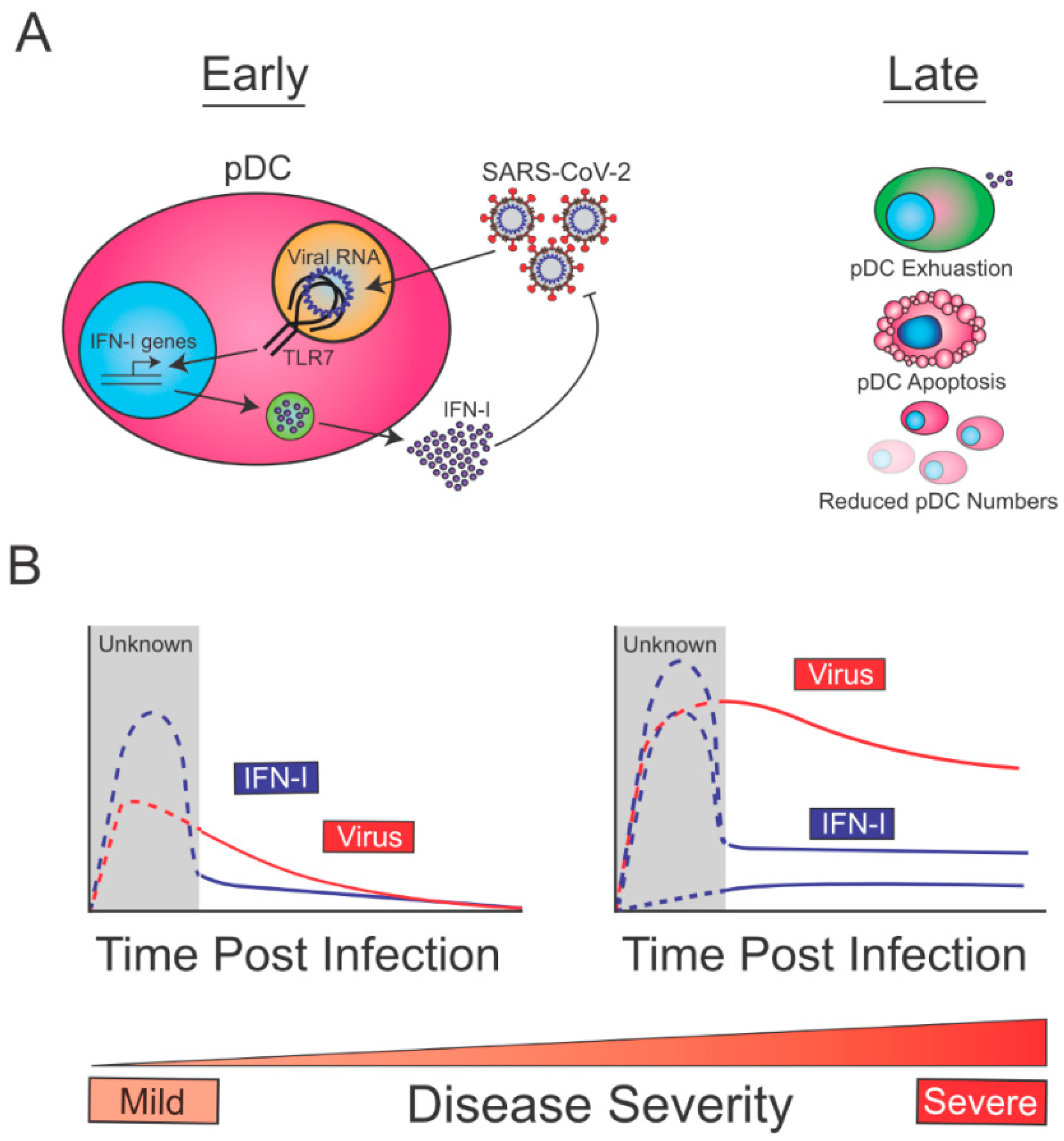
Type I Interferons (IFN-I) are a family of potent antiviral cytokines that act through the direct restriction of viral replication and by enhancing antiviral immunity. However, these powerful cytokines are a caged lion, as excessive and sustained IFN-I production can drive immunopathology during infection, and aberrant IFN-I production is a feature of several types of autoimmunity. As specialized producers of IFN-I plasmacytoid (p), dendritic cells (DCs) can secrete superb quantities and a wide breadth of IFN-I isoforms immediately after infection or stimulation, and are the focus of this review. Notably, a few days after viral infection pDCs tune down their capacity for IFN-I production, producing less cytokines in response to both the ongoing infection and unrelated secondary stimulations. This process, hereby referred to as “pDC exhaustion”, favors viral persistence and associates with reduced innate responses and increased susceptibility to secondary opportunistic infections. On the other hand, pDC exhaustion may be a compromise to avoid IFN-I driven immunopathology. In this review we reflect on the mechanisms that initially induce IFN-I and subsequently silence their production by pDCs during a viral infection. While these processes have been long studied across numerous viral infection models, the 2019 coronavirus disease (COVID-19) pandemic has brought their discussion back to the fore, and so we also discuss emerging results related to pDC-IFN-I production in the context of COVID-19.
Keywords: IFN-I; plasmacytoid dendritic cells; viral infection; LCMV; influenza; HIV-1; HCV; HBV; COVID-19; SARS-CoV-2 IFN-I; plasmacytoid dendritic cells; viral infection; LCMV; influenza; HIV-1; HCV; HBV; COVID-19; SARS-CoV-2