The PA Subunit of the Influenza Virus Polymerase Complex Affects Replication and Airborne Transmission of the H9N2 Subtype Avian Influenza Virus

Abstract
1. Introduction
2. Materials and Methods
2.1. Virus Strains, Cells, and Animals
2.2. Construction of Plasmids and Rescue of the Reassortant
2.3. Replication Ability of Viruses in the Lung Tissues of SPF Chickens
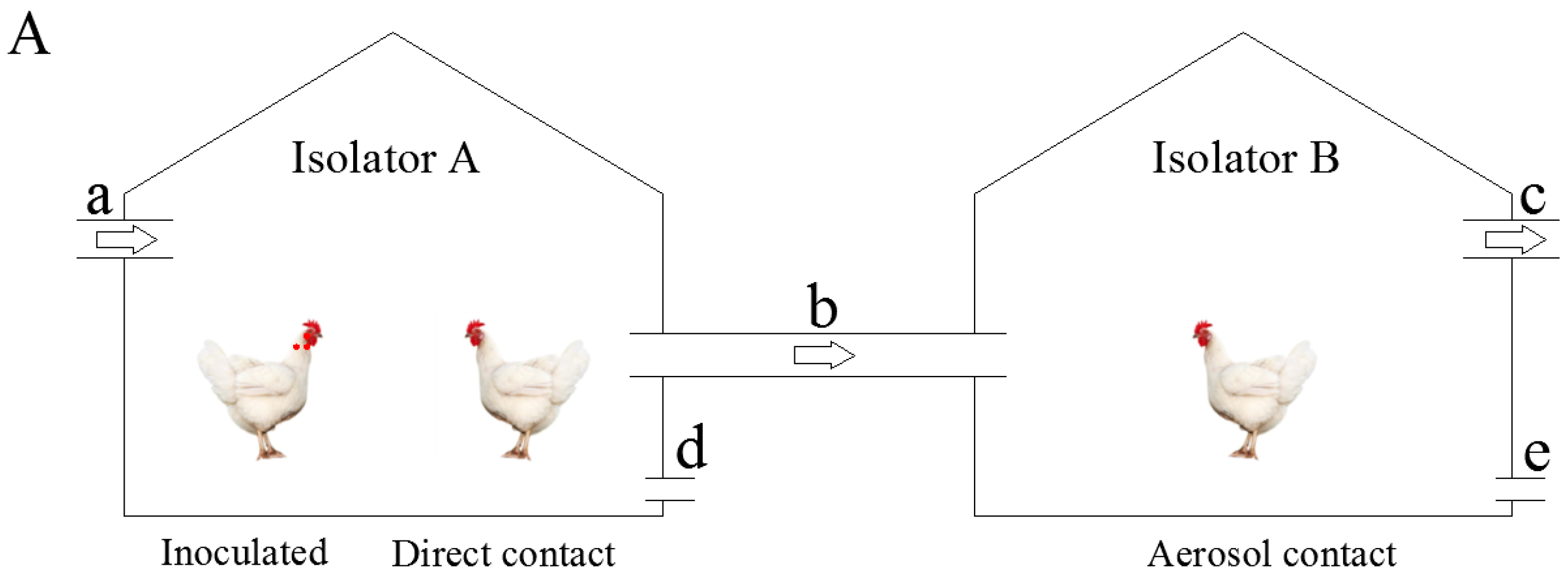
2.4. Viral Transmission among SPF Chickens
2.5. Replication Ability of the Viruses in Guinea Pigs
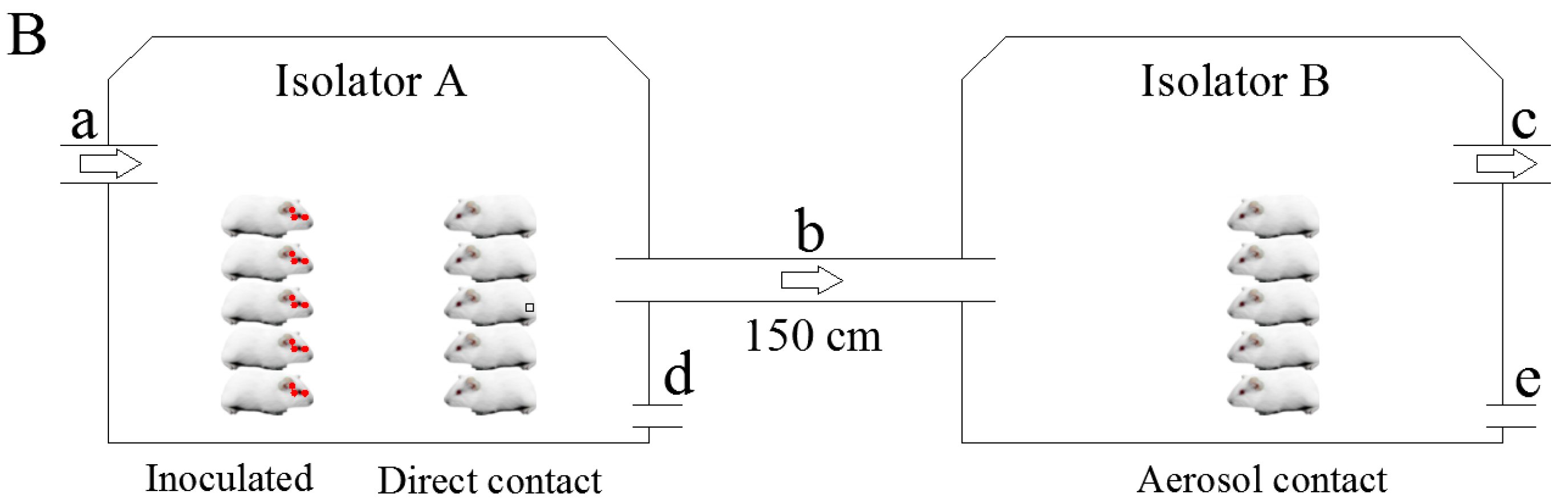
2.6. Transmission of Viruses among Guinea Pigs
2.7. Statistical Analysis
3. Results
3.1. HA Test and EID50 Determination
3.2. Replication Ability of Viruses in the Lung Tissues of SPF Chickens
3.3. Transmission of Viruses among SPF Chickens
3.3.1. Oropharyngeal and Cloacal Cotton Swab Tests in SPF Chickens
3.3.2. Antibody Levels in SPF Chickens
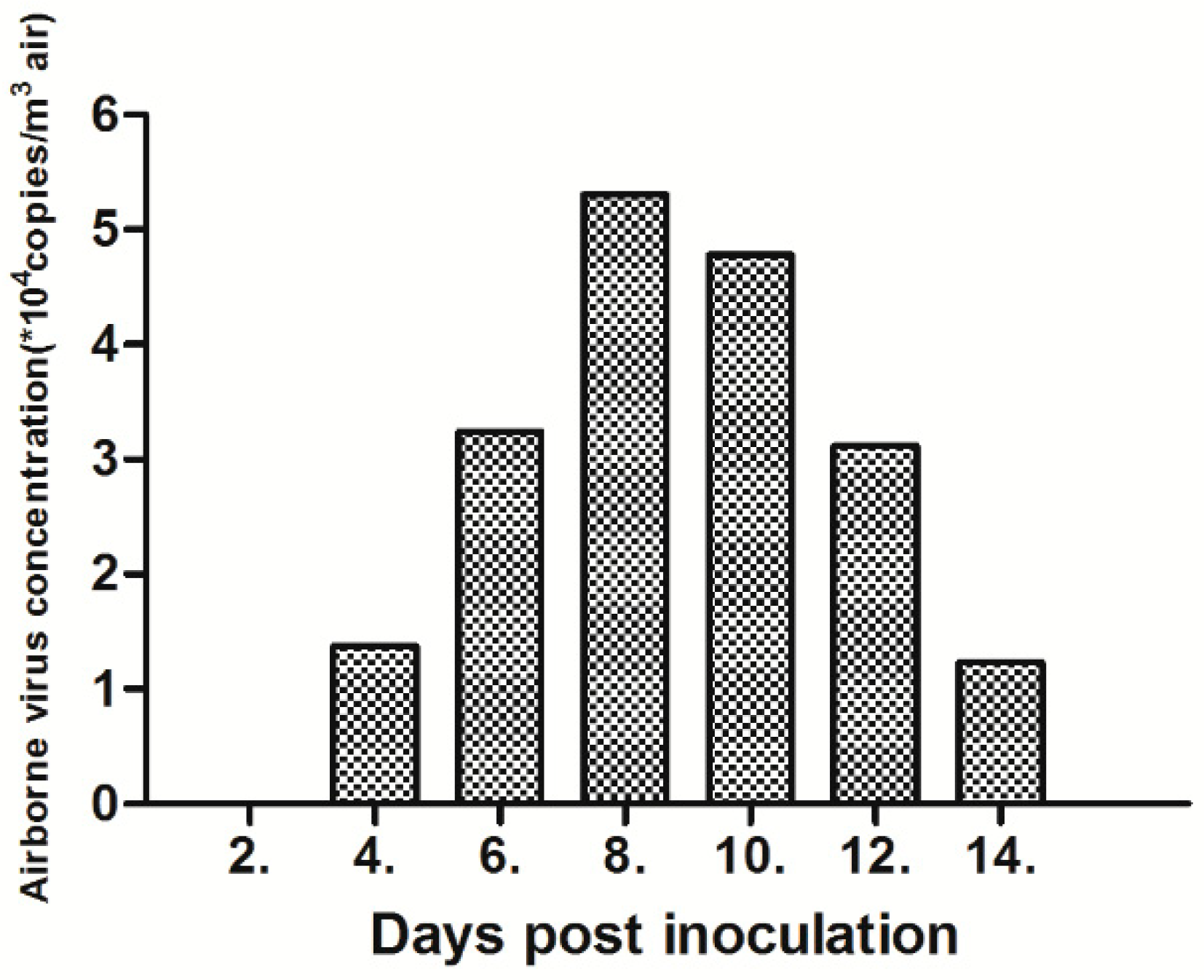
3.3.3. Aerosol of the SD01 and rSD01-PA in the Isolators of SPF Chickens
3.4. Replication Ability of the Viruses in Guinea Pigs
3.5. Transmission of rSD01-PA among Guinea Pigs
3.5.1. Detection of rSD01-PA in Guinea Pig Nasal Washes
3.5.2. Detection of AIV Antibody Levels in Guinea Pigs
4. Discussion
Author Contributions
Funding
Conflicts of Interest
References
- Bouvier, N.M.; Palese, P. The biology of influenza viruses. Vaccine 2008, 26 (Suppl. 4), D49–D53. [Google Scholar] [CrossRef] [Scilit] [PubMed]
- Wanitchang, A.; Jengarn, J.; Jongkaewwattana, A. The N terminus of PA polymerase of swine-origin influenza virus H1N1 determines its compatibility with PB2 and PB1 subunits through a strain-specific amino acid serine 186. Virus Res. 2011, 155, 325–333. [Google Scholar] [CrossRef] [Scilit] [PubMed]
- White, S.K.; Ma, W.; Mcdaniel, C.J.; Gray, G.C.; Lednicky, J.A. Serologic evidence of exposure to influenza D virus among persons with occupational contact with cattle. J. Clin. Virol. 2016, 81, 31–33. [Google Scholar] [CrossRef] [Scilit] [PubMed]
- Hause, B.M.; Mariette, D.; Collin, E.A.; Ran, Z.; Liu, R.; Sheng, Z.; Anibal, A.; Bryan, K.; Suvobrata, C.; Hoppe, A.D. Isolation of a Novel Swine Influenza Virus from Oklahoma in 2011 Which Is Distantly Related to Human Influenza C Viruses. PLoS Pathog. 2013, 9, e1003176. [Google Scholar] [CrossRef] [Scilit] [PubMed]
- Mozdzanowska, K.; Furchner, M.; Zharikova, D.; Feng, J.Q.; Gerhard, W. Roles of CD4+ T-Cell-Independent and -Dependent Antibody Responses in the Control of Influenza Virus Infection: Evidence for Noncognate CD4+ T-Cell Activities That Enhance the Therapeutic Activity of Antiviral Antibodies. J. Virol. 2005, 79, 5943–5951. [Google Scholar] [CrossRef] [Scilit] [PubMed]
- Wan, H.; Sorrell, E.M.; Song, H.; Hossain, M.J.; Ramirez-Nieto, G.; Monne, I.; Stevens, J.; Cattoli, G.; Capua, I.; Chen, L.M. Replication and Transmission of H9N2 Influenza Viruses in Ferrets: Evaluation of Pandemic Potential. PLoS ONE 2008, 3, e2923. [Google Scholar] [CrossRef] [Scilit] [PubMed]
- Gelder, C.M.; Welsh, K.I.; Faith, A.; Lamb, J.R.; Askonas, B.A. Human CD4+ T-cell repertoire of responses to influenza A virus hemagglutinin after recent natural infection. J. Virol. 1995, 69, 7497–7506. [Google Scholar]
- Lv, J.; Wei, L.; Yang, Y.; Wang, B.; Liang, W.; Gao, Y.; Xia, X.; Gao, L.; Cai, Y.; Hou, P. Amino acid substitutions in the neuraminidase protein of an H9N2 avian influenza virus affect its airborne transmission in chickens. Vet. Res. 2015, 46, 44. [Google Scholar] [CrossRef] [Scilit]
- Haghighat-Jahromi, M.; Asasi, K.; Nili, H.; Dadras, H.; Shooshtari, A.H. Coinfection of avian influenza virus (H9N2 subtype) with infectious bronchitis live vaccine. Arch. Virol. 2008, 153, 651–655. [Google Scholar] [CrossRef] [Scilit]
- Bano, S.; Naeem, K.; Malik, S.A. Evaluation of Pathogenic Potential of Avian Influenza Virus Serotype H9N2 in Chickens. Avian Dis. 2003, 47, 817–822. [Google Scholar] [CrossRef] [Scilit]
- Perry, C.G.; Afb, K.; Petrie, J.R. Natural cases and an experimental study of H9N2 avian influenza in commercial broiler chickens of Iran. Avian Pathol. 2002, 31, 247–252. [Google Scholar]
- Homme, P.J.; Easterday, B.C. Avian Influenza Virus Infections. I. Characteristics of Influenza A/Turkey/Wisconsin/1966 Virus. Avian Dis. 1970, 14, 66–74. [Google Scholar] [CrossRef] [Scilit] [PubMed]
- Greenbaum, B.D.; Li, O.T.; Poon, L.L.; Levine, A.J.; Rabadan, R. Viral reassortment as an information exchange between viral segments. Proc. Natl. Acad. Sci. USA 2012, 109, 3341–3346. [Google Scholar] [CrossRef] [Scilit] [PubMed]
- Sun, Y.; Qin, K.; Wang, J.; Pu, J.; Tang, Q.; Hu, Y.; Bi, Y.; Zhao, X.; Yang, H.; Shu, Y. High genetic compatibility and increased pathogenicity of reassortants derived from avian H9N2 and pandemic H1N1/2009 influenza viruses. Proc. Natl. Acad. Sci. USA 2011, 108, 4164–4169. [Google Scholar] [CrossRef] [Scilit] [PubMed]
- Neumann, G.; Noda, T.; Kawaoka, Y. Emergence and pandemic potential of swine-origin H1N1 influenza virus. Nature 2009, 459, 931–939. [Google Scholar] [CrossRef] [Scilit]
- Scholtissek, C.; Rohde, W.; Von, H.V.; Rott, R. On the origin of the human influenza virus subtypes H2N2 and H3N2. Virology 1978, 87, 13–20. [Google Scholar] [CrossRef] [Scilit]
- Lin, Y.P.; Shaw, M.; Gregory, V.; Cameron, K.; Lim, W.; Klimov, A.; Subbarao, K.; Guan, Y.; Krauss, S.; Shortridge, K. Avian-to-human transmission of H9N2 subtype influenza A viruses: Relationship between H9N2 and H5N1 human isolates. Proc. Natl. Acad. Sci. USA 2000, 97, 9654–9658. [Google Scholar] [CrossRef] [Scilit]
- Yu, X.; Jin, T.; Cui, Y.; Pu, X.; Li, J.; Xu, J.; Liu, G.; Jia, H.; Liu, D.; Song, S. Influenza H7N9 and H9N2 viruses: Coexistence in poultry linked to human H7N9 infection and genome characteristics. J. Virol. 2014, 88, 3423–3431. [Google Scholar] [CrossRef] [Scilit]
- Kandeil, A.; Elshesheny, R.; Maatouq, A.M.; Moatasim, Y.; Shehata, M.M.; Bagato, O.; Rubrum, A.; Shanmuganatham, K.; Webby, R.J.; Ali, M.A. Genetic and antigenic evolution of H9N2 avian influenza viruses circulating in Egypt between 2011 and 2013. Arch. Virol. 2014, 159, 2861–2876. [Google Scholar] [CrossRef] [Scilit]
- Novel Swine-Origin Influenza A (H1N1) Virus Investigation Team. Emergence of a novel swine-origin influenza A (H1N1) virus in humans. N. Engl. J. Med. 2009, 360, 2605–2615. [Google Scholar] [CrossRef] [Scilit]
- Peiris, J.S.; Poon, L.L.; Guan, Y. Emergence of a novel swine-origin influenza A virus (S-OIV) H1N1 virus in humans. J. Clin. Virol. 2009, 45, 169–173. [Google Scholar] [CrossRef] [Scilit] [PubMed]
- Vijaykrishna, D.; Poon, L.L.M.; Ma, S.K.; Li, O.T.W.; Cheung, C.L.; Smith, G.J.D.; Peiris, J.S.M.; Guan, Y. Reassortment of Pandemic H1N1/2009 Influenza A Virus in Swine. Science 2010, 328, 1529. [Google Scholar] [CrossRef] [Scilit] [PubMed]
- Sun, Y.; Xu, Q.; Shen, Y.; Liu, L.; Wei, K.; Sun, H.; Pu, J.; Chang, K.C.; Liu, J. Naturally occurring mutations in the PA gene are key contributors to increased virulence of pandemic H1N1/09 influenza virus in mice. J. Virol. 2014, 88, 4600–4604. [Google Scholar] [CrossRef] [Scilit] [PubMed]
- Brachman, P.S.; Ehrlich, R.; Eichenwald, H.F.; Gabelli, V.J.; Kethley, T.W.; Madin, S.H.; Maltman, J.R.; Middlebrook, G.; Morton, J.D.; Silver, I.H. Standard Sampler for Assay of Airborne Microorganisms. Science 1964, 144, 1295. [Google Scholar]
- Lin, X.; Willeke, K.; Ulevicius, V.; Grinshpun, S.A. Effect of Sampling Time on the Collection Efficiency of All-Glass Impingers. Am. Ind. Hyg. Assoc. J. 1997, 58, 480–488. [Google Scholar] [CrossRef]
- Yao, M.; Zhang, X.; Gao, J.; Chai, T.; Miao, Z.; Ma, W.; Qin, M.; Li, Q.; Li, X.; Liu, J. The occurrence and transmission characteristics of airborne H9N2 avian influenza virus. Berl. Munch. Tierarztl. Wochenschr. 2011, 124, 136–141. [Google Scholar] [PubMed]
- Lindh, E.; Ekkommonen, C.; Väänänen, V.M.; Vaheri, A.; Vapalahti, O.; Huovilainen, A. Molecular epidemiology of H9N2 influenza viruses in Northern Europe. Vet. Microbiol. 2014, 172, 548–554. [Google Scholar] [CrossRef] [Scilit] [PubMed]
- Matrosovich, M.N.; Krauss, S.; Webster, R.G. H9N2 Influenza A Viruses from Poultry in Asia Have Human Virus-like Receptor Specificity. Virology 2001, 281, 156–162. [Google Scholar] [CrossRef] [Scilit] [PubMed]
- Kawaoka, Y.; Naeve, C.W.; Webster, R.G.; Kawaoka, Y.; Naeve, C.W.; Webster, R.G. Is virulence of H5N2 influenza viruses in chicken associated with loss of carbohydrate from the hemagglutinin? Virology 1985, 139, 303–316. [Google Scholar] [CrossRef] [Scilit]
- Scholtissek, C. Pigs as ‘Mixing Vessels’ for the Creation of New Pandemic Influenza A Viruses. Med. Princ. Pract. 1990, 2, 65–71. [Google Scholar] [CrossRef] [Scilit]
- Scholtissek, C.; Naylor, E. Fish farming and influenza pandemics. Nature 1988, 331, 215. [Google Scholar] [CrossRef] [Scilit] [PubMed]
- Kimble, J.B.; Sorrell, E.; Shao, H.; Martin, P.L.; Perez, D.R. Compatibility of H9N2 avian influenza surface genes and 2009 pandemic H1N1 internal genes for transmission in the ferret model. Proc. Natl. Acad. Sci. USA 2011, 108, 12084–12088. [Google Scholar] [CrossRef] [Scilit] [PubMed]
- Zhong, L.; Wang, X.; Li, Q.; Liu, D.; Chen, H.; Zhao, M.; Gu, X.; He, L.; Liu, X.; Gu, M. Molecular mechanism of the airborne transmissibility of H9N2 avian influenza A viruses in chickens. J. Virol. 2014, 88, 9568–9578. [Google Scholar] [CrossRef] [Scilit] [PubMed]
- Ruigrok, R.W.; Crepin, T.; Hart, D.J.; Cusack, S. Towards an atomic resolution understanding of the influenza virus replication machinery. Curr. Opin. Struct. Biol. 2010, 20, 104–113. [Google Scholar] [CrossRef] [Scilit] [PubMed]
- Gabriel, G.; Dauber, B.; Wolff, T.; Planz, O.; Klenk, H.D.; Stech, J. The viral polymerase mediates adaptation of an avian influenza virus to a mammalian host. Proc. Natl. Acad. Sci. USA 2005, 102, 18590–18595. [Google Scholar] [CrossRef] [Scilit] [PubMed]
- Li, Z.; Chen, H.; Jiao, P.; Deng, G.; Tian, G.; Li, Y.; Hoffmann, E.; Webster, R.G.; Matsuoka, Y.; Yu, K. Molecular Basis of Replication of Duck H5N1 Influenza Viruses in a Mammalian Mouse Model. J. Virol. 2005, 79, 12058–12064. [Google Scholar] [CrossRef] [Scilit] [PubMed]
- Steel, J.; Lowen, A.C.; Mubareka, S.; Palese, P. Transmission of Influenza Virus in a Mammalian Host Is Increased by PB2 Amino Acids 627K or 627E/701N. PLoS Pathog. 2009, 5, e1000252. [Google Scholar] [CrossRef] [Scilit]
- Naffakh, N.; Tomoiu, A.; Rameix-Welti, M.-A.; van der Werf, S. Host restriction of avian influenza viruses at the level of the ribonucleoproteins. Annu. Rev. Microbiol. 2008, 62, 403–424. [Google Scholar] [CrossRef] [Scilit]
- Dias, A.; Bouvier, D.; Crépin, T.; Mccarthy, A.A.; Hart, D.J.; Baudin, F.; Cusack, S.; Ruigrok, R.W. The cap-snatching endonuclease of influenza virus polymerase resides in the PA subunit. Nature 2009, 458, 914–918. [Google Scholar] [CrossRef] [Scilit]
- Perales, B.; Sanzezquerro, J.J.; Gastaminza, P.; Ortega, J.; Santarén, J.F.; Ortín, J.; Nieto, A. The Replication Activity of Influenza Virus Polymerase Is Linked to the Capacity of the PA Subunit To Induce Proteolysis. J. Virol. 2000, 74, 1307–1312. [Google Scholar] [CrossRef] [Scilit]
- Huarte, M.; Falcón, A.; Nakaya, Y.; Ortín, J.; García-Sastre, A.; Nieto, A. Threonine 157 of influenza virus PA polymerase subunit modulates RNA replication in infectious viruses. J. Virol. 2003, 77, 6007–6013. [Google Scholar] [CrossRef] [Scilit] [PubMed]
- Maier, H.J.; Kashiwagi, T.; Hara, K.; Brownlee, G.G. Differential role of the influenza A virus polymerase PA subunit for vRNA and cRNA promoter binding. Virology 2008, 370, 194–204. [Google Scholar] [CrossRef] [Scilit] [PubMed]
- Nieto, A.; De la Luna, S.; Bárcena, J.; Portela, A.; Ortín, J. Complex structure of the nuclear translocation signal of influenza virus polymerase PA subunit. J. Gen. Virol. 1994, 75 Pt 1, 29–36. [Google Scholar] [CrossRef] [Scilit]
- Lakdawala, S.S.; Jayaraman, A.; Halpin, R.A.; Lamirande, E.W.; Shih, A.R.; Stockwell, T.B.; Lin, X.; Simenauer, A.; Hanson, C.T.; Vogel, L. The soft palate is an important site of adaptation for transmissible influenza viruses. Nature 2015, 526, 122–125. [Google Scholar] [CrossRef] [Scilit] [PubMed]
- Gao, Y.; Zhang, Y.; Shinya, K.; Deng, G.; Jiang, Y.; Li, Z.; Guan, Y.; Tian, G.; Li, Y.; Shi, J. Identification of amino acids in HA and PB2 critical for the transmission of H5N1 avian influenza viruses in a mammalian host. PLoS Pathog. 2009, 5, e1000709. [Google Scholar] [CrossRef] [Scilit] [PubMed]


| Virus | HA(log2 ± SD) | lgEID50/mL ± SD |
|---|---|---|
| SD01 a | 8.5 ± 0.13 | 9.31 ± 0.27 |
| rSD01-PA b | 7.3 ± 0.34 | 8.27 ± 0.20 |
| Virus | Dose (EID50) a | Lethality | Virus Titers in Lung b (lgEID50/g(SD)) | Seroconversion d (Positive/Total) |
|---|---|---|---|---|
| SD01 | 106 | None | 4.29 ± 0.41(3/3) c | 2/2 c |
| 107 | None | 5.31 ± 0.15(3/3) | 2/2 | |
| 108 | None | 6.14 ± 0.22(3/3) | 2/2 | |
| rSD01-PA | 106 | None | 4.17 ± 0.38(3/3) | 2/2 |
| 107 | None | 5.06 ± 0.19(3/3) | 2/2 | |
| 108 | None | 5.94 ± 0.31(3/3) | 2/2 |
| dpi | SD01 | rSD01-PA | ||||
|---|---|---|---|---|---|---|
| Inoculated | Direct-Contact | Aerosol-Contact | Inoculated | Direct-Contact | Aerosol-Contact | |
| 2 | 6/10 | 1/10 | 0/10 | 2/10 | 0/10 | 0/10 |
| 4 | 9/10 | 3/10 | 0/10 | 5/10 | 0/10 | 0/10 |
| 6 | 10/10 | 7/10 | 3/10 | 10/10 | 5/10 | 0/10 |
| 8 | 10/10 | 10/10 | 7/10 | 9/10 | 7/10 | 0/10 |
| 10 | 8/10 | 7/10 | 7/10 | 2/10 | 4/10 | 0/10 |
| 12 | 4/10 | 5/10 | 5/10 | 3/10 | 2/10 | 0/10 |
| 14 | 0/10 | 0/10 | 0/10 | 0/10 | 0/10 | 0/10 |
| dpi | SD01 | rSD01-PA | ||||
|---|---|---|---|---|---|---|
| Inoculated a | Direct-Contact | Aerosol-Contact | Inoculated | Direct-Contact | Aerosol-Contact | |
| 7 | 4.66 ± 1.31 | 2.86 ± 1.52 | 0 | 4.73 ± 0.49 | 0 * | 0 |
| 14 | 6.92 ± 1.03 | 4.59 ± 0.77 | 4.35 ± 1.27 | 5.57 ± 1.27 | 3.24 ± 1.18 * | 0 * |
| 21 | 7.75 ± 0.81 | 6.32 ± 1.61 | 5.93 ± 1.30 | 7.88 ± 1.01 | 5.33 ± 0.89 | 0 * |
| Average Virus Titers a lgTCID50/g ± SD | Seroconversion (Positive/Total) | |||||
|---|---|---|---|---|---|---|
| Strain | Brain | Trachea | Nasal Turbinate | Lung | Kidney | |
| SD01 | 0 b (0/3) c | 0 (0/3) | 0 (0/3) | 0 (0/3) | 0 (0/3) | 0/2 |
| rSD01-PA | 0 (0/3) | 3.76 ± 0.64 * (2/3) | 4.32 ± 0.48 (3/3) | 0 (0/3) | 0 (0/3) | 2/2 |
| dpi | Inoculated a | Direct-Contact | Aerosol-Contact |
|---|---|---|---|
| 2 | 0/5 | 0/5 | 0/5 |
| 4 | 3/5 | 2/5 | 0/5 |
| 6 | 5/5 | 5/5 | 0/5 |
| 8 | 4/5 | 3/5 | 0/5 |
| 10 | 4/5 | 3/5 | 0/5 |
| 12 | 3/5 | 3/5 | 0/5 |
| 14 | 0/5 | 0/5 | 0/5 |
| dpi | Inoculated | Direct-Contact | Aerosol-Contact |
|---|---|---|---|
| 7 | 5.25 ± 1.7 | 0 | 0 |
| 14 | 6.03 ± 0.35 | 5.32 ± 0.40 | 0 |
| 21 | 8.35 ± 1.24 | 7.28 ± 0.73 | 0 |
© 2019 by the authors. Licensee MDPI, Basel, Switzerland. This article is an open access article distributed under the terms and conditions of the Creative Commons Attribution (CC BY) license (http://creativecommons.org/licenses/by/4.0/).
Share and Cite
Hao, M.; Han, S.; Meng, D.; Li, R.; Lin, J.; Wang, M.; Zhou, T.; Chai, T. The PA Subunit of the Influenza Virus Polymerase Complex Affects Replication and Airborne Transmission of the H9N2 Subtype Avian Influenza Virus. Viruses 2019, 11, 40. https://doi.org/10.3390/v11010040
Hao M, Han S, Meng D, Li R, Lin J, Wang M, Zhou T, Chai T. The PA Subunit of the Influenza Virus Polymerase Complex Affects Replication and Airborne Transmission of the H9N2 Subtype Avian Influenza Virus. Viruses. 2019; 11(1):40. https://doi.org/10.3390/v11010040
Chicago/Turabian StyleHao, Mengchan, Shaojie Han, Dan Meng, Rong Li, Jing Lin, Meng Wang, Tong Zhou, and Tongjie Chai. 2019. "The PA Subunit of the Influenza Virus Polymerase Complex Affects Replication and Airborne Transmission of the H9N2 Subtype Avian Influenza Virus" Viruses 11, no. 1: 40. https://doi.org/10.3390/v11010040
APA StyleHao, M., Han, S., Meng, D., Li, R., Lin, J., Wang, M., Zhou, T., & Chai, T. (2019). The PA Subunit of the Influenza Virus Polymerase Complex Affects Replication and Airborne Transmission of the H9N2 Subtype Avian Influenza Virus. Viruses, 11(1), 40. https://doi.org/10.3390/v11010040