Review

miRNAs in Insects Infected by Animal and Plant Viruses

by
Verna Monsanto-Hearne
and
Karyn N. Johnson
*
School of Biological Sciences, The University of Queensland, Brisbane 4072, Australia
*
Author to whom correspondence should be addressed.
Viruses 2018, 10(7), 354; https://doi.org/10.3390/v10070354
Submission received: 24 April 2018 / Revised: 29 June 2018 / Accepted: 29 June 2018 / Published: 3 July 2018
(This article belongs to the Special Issue Antiviral Defense in Invertebrates)

Abstract

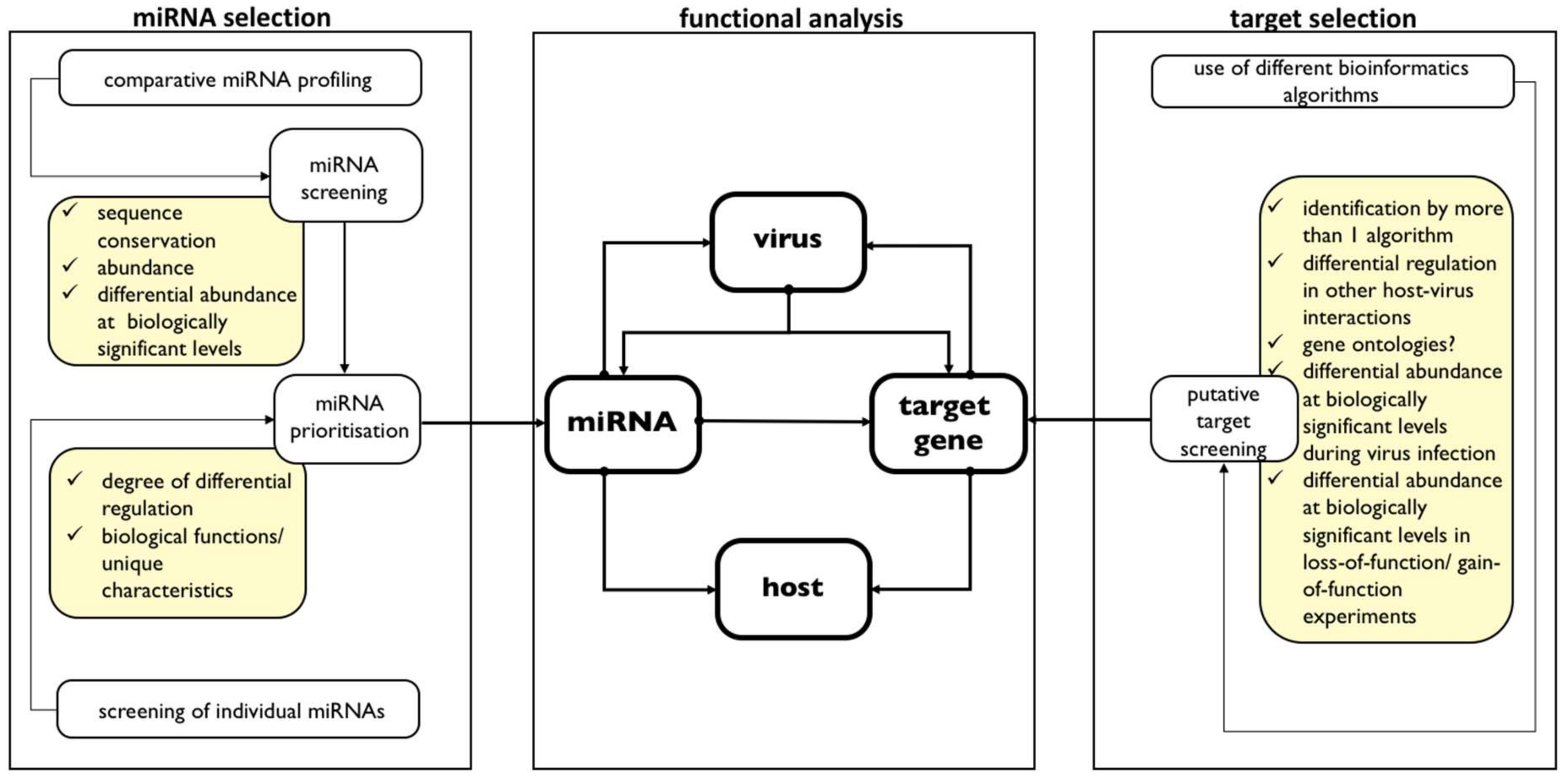
Viruses vectored by insects cause severe medical and agricultural burdens. The process of virus infection of insects regulates and is regulated by a complex interplay of biomolecules including the small, non-coding microRNAs (miRNAs). Considered an anomaly upon its discovery only around 25 years ago, miRNAs as a class have challenged the molecular central dogma which essentially typifies RNAs as just intermediaries in the flow of information from DNA to protein. miRNAs are now known to be common modulators or fine-tuners of gene expression. While recent years has seen an increased emphasis on understanding the role of miRNAs in host-virus associations, existing literature on the interaction between insects and their arthropod-borne viruses (arboviruses) is largely restricted to miRNA abundance profiling. Here we analyse the commonalities and contrasts between miRNA abundance profiles with different host-arbovirus combinations and outline a suggested pipeline and criteria for functional analysis of the contribution of miRNAs to the insect vector-virus interaction. Finally, we discuss the potential use of the model organism, Drosophila melanogaster, in complementing research on the role of miRNAs in insect vector-virus interaction.
Keywords: miRNA; insect virus; arbovirus; plant virus; host-virus interaction miRNA; insect virus; arbovirus; plant virus; host-virus interaction