Article

Water-Holding Characteristics of Forestry Residues for Urban Bare Soil Mulching

1
School of Environmental and Life Sciences, Nanning Normal University, Nanning 530001, China
2
University Engineering Research Center of “Satellite +” Space AI Intelligent Governance of Natural Resources in Guangxi, Nanning 530001, China
3
School of Geography Science and Planning, Nanning Normal University, Nanning 530001, China
4
School of Chemistry and Materials, Nanning Normal University, Nanning 530001, China
5
School of Natural Resources and Surveying, Nanning Normal University, Nanning 530001, China
6
Guangxi Jingpeng Technology Co., Ltd., Nanning 530200, China
*
Author to whom correspondence should be addressed.
These authors contributed equally to this work.
Forests 2026, 17(8), 866; https://doi.org/10.3390/f17080866
Submission received: 29 June 2026 / Revised: 17 July 2026 / Accepted: 23 July 2026 / Published: 24 July 2026
(This article belongs to the Special Issue Ecological Functions of Urban Green Spaces)

Abstract

Objective: Forestry management produces abundant residues including wood chips, fallen leaves and bark. Reusing them as urban organic mulches improves soil quality, mitigates soil erosion and optimizes urban green space ecology. This study analyzed the water-holding characteristics of four typical forestry residues to guide urban mulch selection. Methods: Soaking lab tests were conducted on pine bark (PB), oak leaves (OLs), pine needles (PNs), and fir wood chips (FWCs) to monitor dynamic variations in water-holding capacity and absorption rate over soaking time, with data fitted by mathematical models. Results: All forestry residues exhibited considerable water-holding capacity, with OLs showing the highest water-retention performance (175.67 t/ha, 145.42%), effective interception capacity (119.83 t/ha) and interception rate (99.19%) among all tested materials, followed by FWCs. The water-holding capacity increased rapidly and then leveled off with prolonged soaking time, and this trend conformed to a logarithmic equation, expressed as Q = a·ln(t) + b. Water absorption peaked at 15 min before declining slowly until equilibrium, and this dynamic process was well fitted by a power function, expressed as V = k·tn. Conclusions: Given their superior water-holding characteristics, OLs and FWCs are highly recommended as preferred organic mulches for urban soil applications.

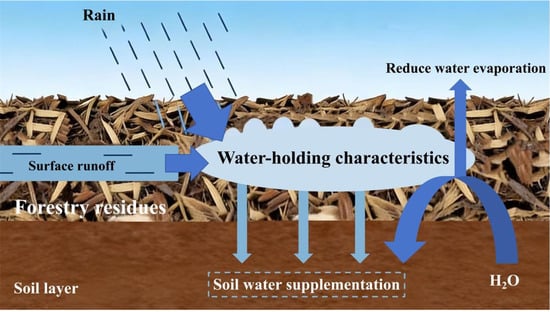
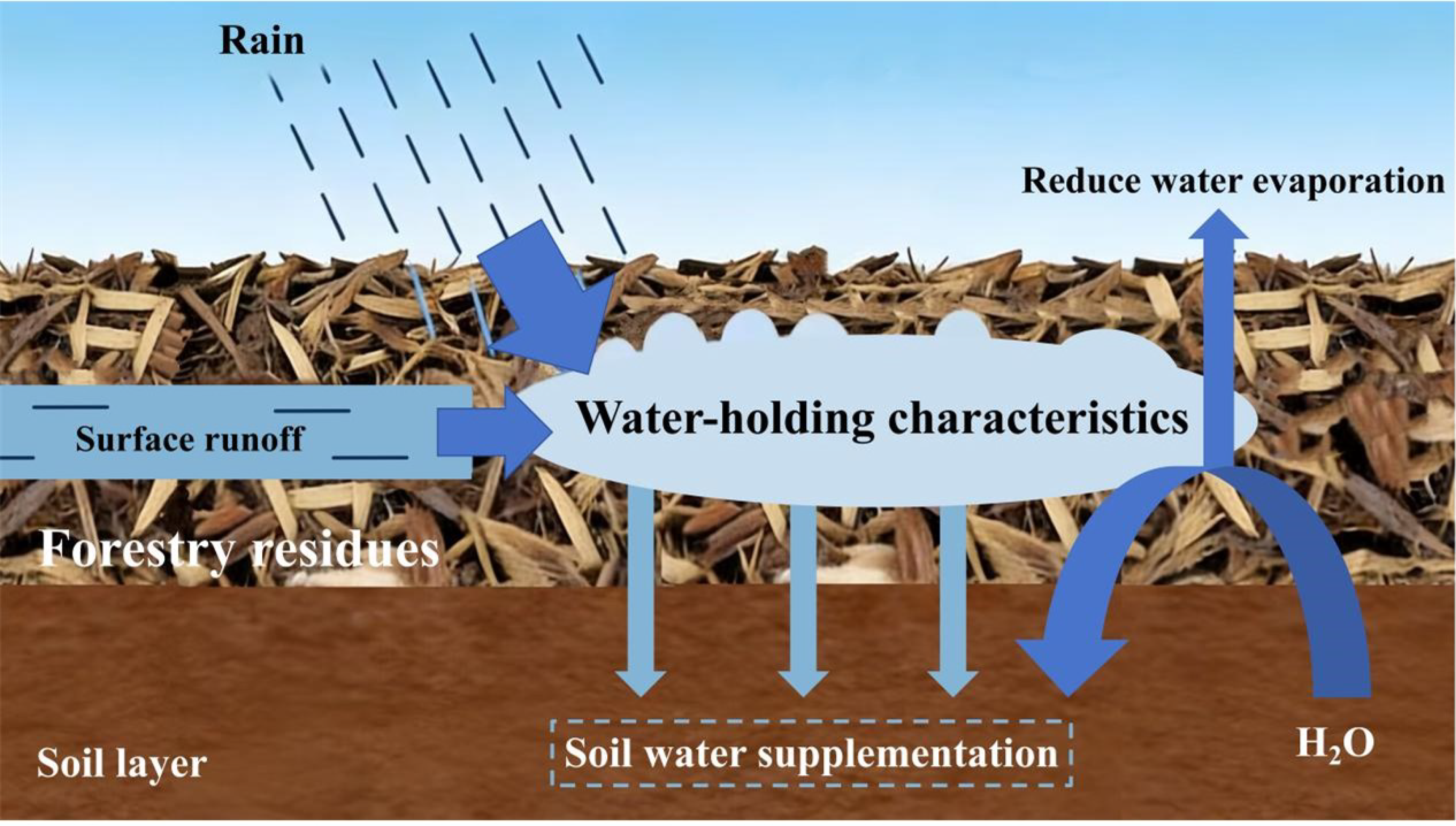
Graphical Abstract

1. Introduction

Against the backdrop of rapid urbanization in many parts of the world [1], the development and quality improvement of urban greening systems have attracted increasing research and public attention. With the continuous expansion of urban green space coverage and the diversification of greening layout modes, the daily management and conservation of urban green ecosystems have grown increasingly complicated, which drives a steady increase in financial expenditure on maintenance. During the construction and renovation of urban green infrastructure, including urban forests, urban parks, and roadside green belts, extensive soil surfaces are frequently disturbed and exposed, resulting in persistent bare soil areas in urban landscapes. The widespread existence of bare soil in urban environments poses multiple ecological problems: it aggravates surface soil erosion, reduces soil moisture content and soil water-holding capacity, and induces severe urban dust pollution, which jointly degrade the overall ecological quality of urban green spaces [2,3,4].
Forestry residues refer to renewable organic by-products generated during routine forest cultivation, logging, and wood processing procedures, mainly including tree branches, fallen leaves, bark, sawdust, and other forest-derived organic materials. On a global scale, approximately 0.23 × 10⁹ tons of forestry residues are produced annually, with East Asia recording the highest yield, followed by South America and North America [5]. Despite the huge annual output of forestry residues, their resource utilization efficiency remains low worldwide. At present, the mainstream disposal methods for surplus forestry residues primarily include biofuel combustion, direct incineration, and landfill stacking. These traditional disposal approaches not only cause serious secondary pollution to soil environments and atmospheric ecosystems but also result in the massive waste of valuable organic forest resources. To date, only a small fraction of forestry residues have been effectively recycled and applied in soil improvement and industrial production fields [6,7]. In this context, reusing forestry residues as organic mulch to cover urban bare soil provides a sustainable and eco-friendly disposal pathway. This innovative utilization mode can effectively solve two prominent environmental problems simultaneously: it mitigates soil erosion of exposed urban bare soil and avoids environmental pollution caused by improper residue disposal, while realizing the high-value resource recycling of waste forestry organic materials [8].
Organic mulching has been widely recognized as a beneficial and sustainable soil improvement technology for optimizing soil quality and stabilizing ecosystem functions in urban green areas. A large number of previous studies have confirmed the positive effects of forestry residues on the ecological restoration of urban bare soil. As an effective surface covering material, forestry residues can form a protective layer on the soil surface, which buffers the destructive impact of raindrops on topsoil, reduces soil surface evaporation, and consequently alleviates soil erosion and improves the soil water-retention capacity [9]. Relevant studies have verified that straw-based organic mulch can effectively reduce runoff shear stress, thereby significantly decreasing the probability of soil erosion [10]. This theoretical basis was further supplemented through simulated rainfall experiments, proving that forestry residue-derived organic mulch possesses excellent water absorption and water-retention performance. The mulch layer can stabilize the soil surface structure, inhibit surface runoff generation, and ultimately achieve efficient soil erosion control [11]. Beyond hydrological regulation functions, forestry residue mulching also exerts positive effects on soil biological properties. The incorporation of forestry residues into urban soil can activate soil microbial metabolic activity, optimize the community structure of beneficial microorganisms in urban forest ecosystems, and accelerate the cycling processes of soil carbon and nitrogen elements. It was found that organic mulching treatment significantly improved rhizosphere soil enzyme activity, increased the accumulation of soil microbial carbon and nitrogen, and further promoted the turnover and cycling of soil carbon and nitrogen pools [12]. Consistently, it has been reported that herbaceous and wood biochar derived from agricultural and forestry residues can significantly enhance carbon sequestration, pollutant removal, and soil health in green infrastructure systems [13]. In addition, the ecological regulation effects of organic mulching exhibit obvious spatial heterogeneity under different environmental conditions and habitat backgrounds. Field experiments on the Loess Plateau demonstrated that straw organic mulching could effectively alleviate soil temperature fluctuations, sustain soil moisture retention, and thereby significantly improve regional crop yield and ecological stability [14].
Although existing studies have confirmed the multiple ecological benefits of organic mulching, systematic comparative analysis on the water-holding and hydrological regulation performance of different types of forestry residues remains insufficient. This knowledge gap not only restricts the targeted application and popularization of residue mulch in urban green space management but also highlights the necessity of experimental investigations into the hydrological characteristics of forestry residues. Given that water-holding capacity is governed by morphological and physicochemical properties [15,16], we hypothesized that the four common residue types—wood chips, bark, broadleaf litter, and coniferous needle litter—would exhibit significant differences in their hydrological responses, owing to their contrasting structural complexity. Therefore, this study selected these four types of forestry residues to systematically investigate their water-holding characteristics and hydrological performance differences, with the objective of clarifying their varying regulation characteristics when used as mulches for urban bare soil remediation. By comparing the water-holding performance of the four forestry residues, this study aims to identify the most effective materials and thereby recommend optimal organic mulches for urban bare soil application. The research results are expected to supplement the research system of water conservation function evaluation for urban soil ecosystems, enrich the theoretical basis for the resource utilization of forestry waste residues, and provide practical data support and scientific references for the formulation of targeted urban forest restoration, green space maintenance, and ecological management measures.

2. Materials and Methods

2.1. Research Objects

This study was carried out in 2025 at the University Engineering Research Center of “Satellite +” Space AI Intelligent Governance of Natural Resources in Guangxi, Nanning Normal University, China. For the experiments, four typical forestry residues—pine bark (PB), oak leaves (OLs), pine needles (PNs), and fir wood chips (FWCs)—were selected as organic mulch materials to systematically compare their water-holding performance (Figure 1). Pine (Pinus massoniana Lamb.), oak (Quercus palustris Münchh.), and fir trees (Abies fabri (Mast.) Craib) are widely cultivated across China, and substantial volumes of residues are produced during the processes of seedling cultivation, pruning, and wood processing. These residual materials are highly representative and can well characterize the main types of forestry residues in China. Furthermore, oak leaves and pine needles were specifically chosen to represent residues from broad-leaved and coniferous tree species, respectively, enabling a comprehensive comparative analysis of the hydrological properties of different forest residue types.

2.2. Data Collection

This study adopted a single-factor completely randomized experimental design with four types of forestry residues as experimental treatments, and each treatment was set with three replicates to ensure experimental repeatability and data reliability. The forestry residues were prepared as organic mulches for application and evenly laid on the surface of urban soil in the experiment. All residue samples were trimmed to a uniform size of 20 cm × 20 cm × 5 cm, placed in numbered nylon mesh bags, and weighed to record their initial fresh mass. Each mesh bag was clearly labeled with the corresponding residue type and replicate number for subsequent identification.

2.3. Laboratory Analyses

In this study, laboratory immersion experiments were conducted to determine the water-holding capacities of forestry residue samples. This experimental methodology has been widely applied in previous studies on the water-holding characteristics of forest litter [17]. All fresh samples were weighed using a high-precision electronic balance (Wuyi Zhuheng Electronics Co., Ltd., Jinhua, China). Subsequently, the samples were placed in labeled envelope bags and dried in a constant-temperature oven at 105 °C until a constant weight was obtained (Shanghai Aixi Aijie Instrument Co., Ltd., Shanghai, China). The stable dry weight was recorded to calculate the natural moisture content of the forestry residues.
For the water-holding characteristic tests conducted at room temperature (approximately 25 °C), the fully dried residue samples were sealed in nylon bags with a mesh size of 0.1 mm and completely immersed in purified water. The samples were taken out at predetermined time intervals of 0.25, 0.5, 1, 2, 4, 6, 8, 10, 12, and 24 h. After natural drainage until no further water dripping occurred, the samples were weighed to obtain their wet weight values. The measured weight data were adopted to calculate multiple hydrological indices, including the maximum water-holding capacity, maximum water-holding amount, effective water-retention rate, effective water-retention amount, dynamic water-holding capacity, and water absorption rate. The relevant calculation formulas are presented as follows [18,19]:
R 0 = m 1 m 0 m 0 × 100 %
Q = m 24 m 0 / m 0
S n t = m n t m n 1 t m 0 / t
W m = m 24 m 0
R m = m 24 m 0 m 0 × 100 %
R s v = 0.85 × R m R 0
W s v = R s v × m 0
v = m n t m 0 t
where m 1 represents the fresh weight of the forestry residues; m 0 represents the weight of the residues after oven drying; m 24 , m n t , and m n 1 t denote the weight of residues soaked for 24 h, n hours, and (n − 1) h, respectively (all measured in grams); R 0 , R m , and R s v indicate the mean moisture content, maximum water-holding rate, and effective water-retention rate, respectively (all measured as percentages); W m and W s v refer to the mean maximum water-holding capacity and effective water-retention amount, respectively (all measured as t/ha); Q is the mass water absorption ratio of the forestry residues (measured as t/t); t denotes the soaking time of forestry residues (measured in h); S n t represents the mass water absorption rate of the forestry residues; v is the water absorption rate of forestry residues after soaking for t hours (both the S n t and v values are measured as t/h).

2.4. Data Analysis

All statistical analyses were performed using IBM SPSS Statistics 23 and OriginPro 2024 SR1 software. One-way analysis of variance (ANOVA) with Duncan’s multiple range test was employed to examine significant differences in the average moisture content and mass water absorption ratio among different forestry residue types. Nonlinear regression analysis was applied to fit the dynamic curves of the water-holding process and water absorption rate, and the corresponding fitting coefficients of determination (R2) and correlation significance were obtained. A significance level of p < 0.05 was adopted for all statistical tests.

3. Results

3.1. Water Absorption Capacity

The average moisture content differed significantly among the four types of forestry residues (p < 0.05) (Table 1). The average moisture content ranged from 6.82% ± 1.29% to 26.94% ± 1.64%, following the order of PNs > OLs > PB > FWCs. Among all residue types, FWCs exhibited the lowest average moisture content (6.82% ± 1.29%), whereas PNs showed the highest value (26.94% ± 1.64%). No significant difference was observed between the average moisture content of PNs (26.94% ± 1.64%) and OLs (24.41% ± 4.32%). The moisture content of PNs was approximately four times that of FWCs and 1.4 times that of PB. In addition, a significant difference existed in average moisture content between PB (18.81% ± 3.16%) and FWCs (6.82% ± 1.29%) (p < 0.05), with the moisture content of PB being nearly three times higher than that of FWCs.
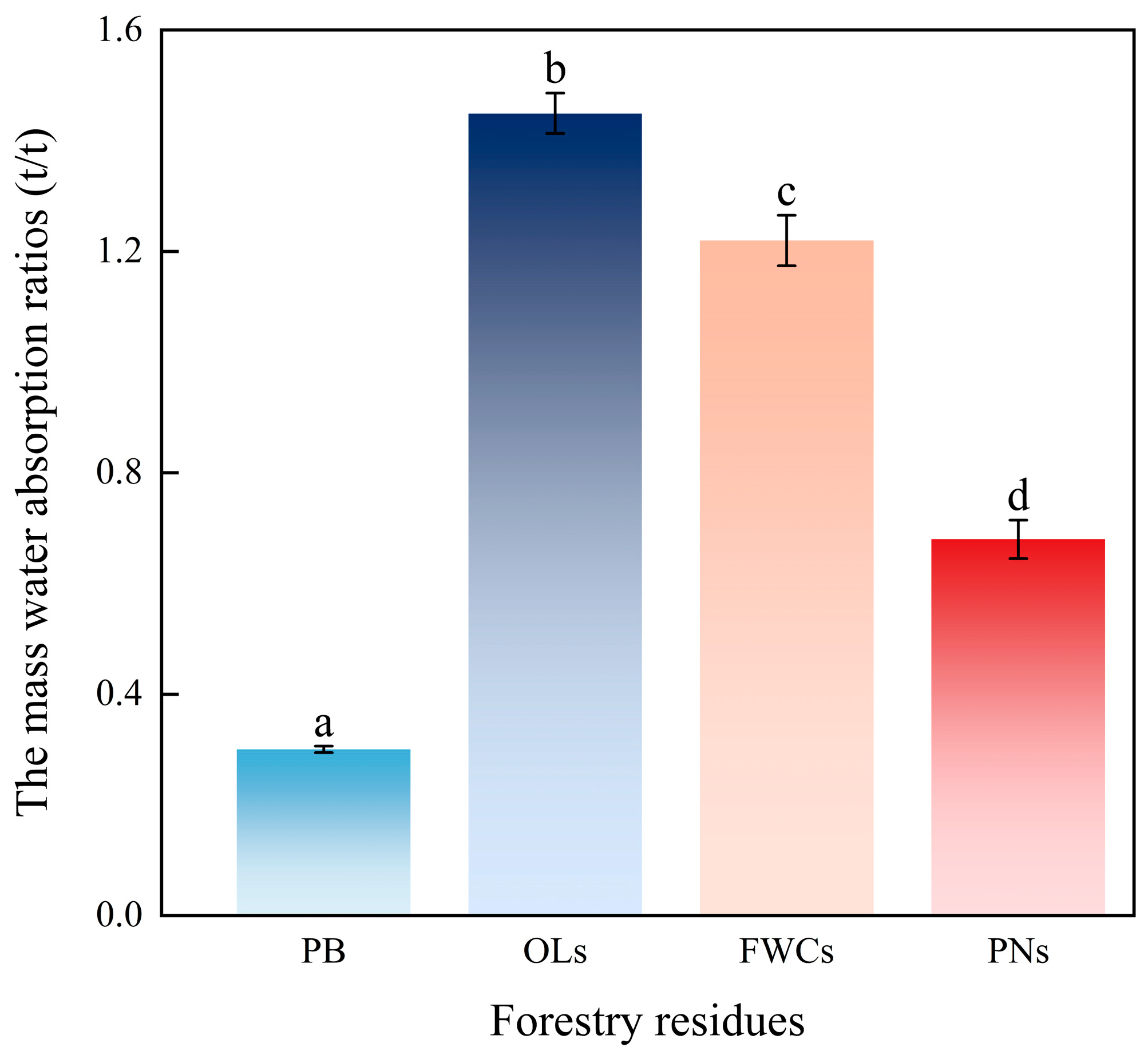
As shown in Figure 2, the mass water absorption ratio differed significantly among the four types of forestry residues (p < 0.05). The values of the mass water absorption ratio ranged from 0.3 ± 0.006 t/t to 1.45 ± 0.037 t/t, and the overall ranking was OLs (1.45 ± 0.037 t/t) > FWCs (1.22 ± 0.046 t/t) > PNs (0.68 ± 0.035 t/t) > PB (0.3 ± 0.006 t/t). All four forestry residues exhibited distinct fluctuating characteristics in their mass water absorption ratios throughout the test. OLs presented the highest mass water absorption ratio, which was 4.8 times that of PB and 2.13 times that of PNs. In contrast, PB had the lowest mass water absorption ratio, and significant differences were detected between PB and the other three residue types (p < 0.05).
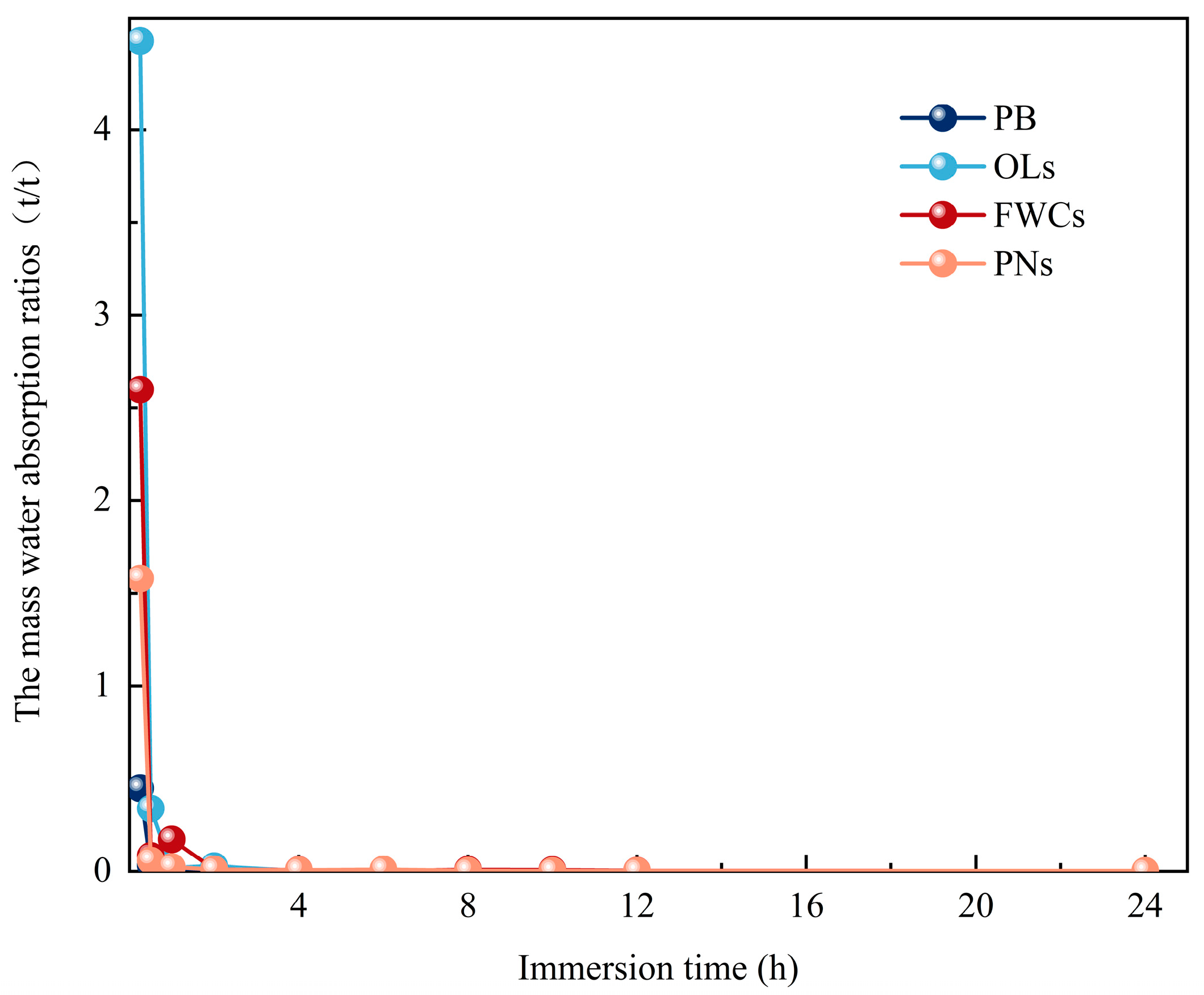
The mass water absorption rates of the four types of forestry residues exhibit similar trends (Figure 3): all four types of forest residues achieved their maximum mass water absorption rates within the first 0.25 h of soaking. The absorption rates decreased rapidly during the period of 0.25–1 h after immersion. A slight but statistically insignificant increase in water absorption rates was observed from 1 h to 10 h of soaking, and all forest residues reached water absorption saturation after 10 h of immersion. At the soaking duration of 0.25 h, OLs exhibited the highest mass water absorption rate, which was significantly greater than that of the other three residue types. Specifically, the mass water absorption rate of OLs was approximately 10-fold that of PB, threefold that of PNs, and twofold that of FWCs. Among all tested residues, the water-absorption process for different forestry residues decreased in the order OLs > FWCs > PNs > PB; PB showed the lowest mass water absorption rate.

3.2. Maximum Water-Holding Capacity

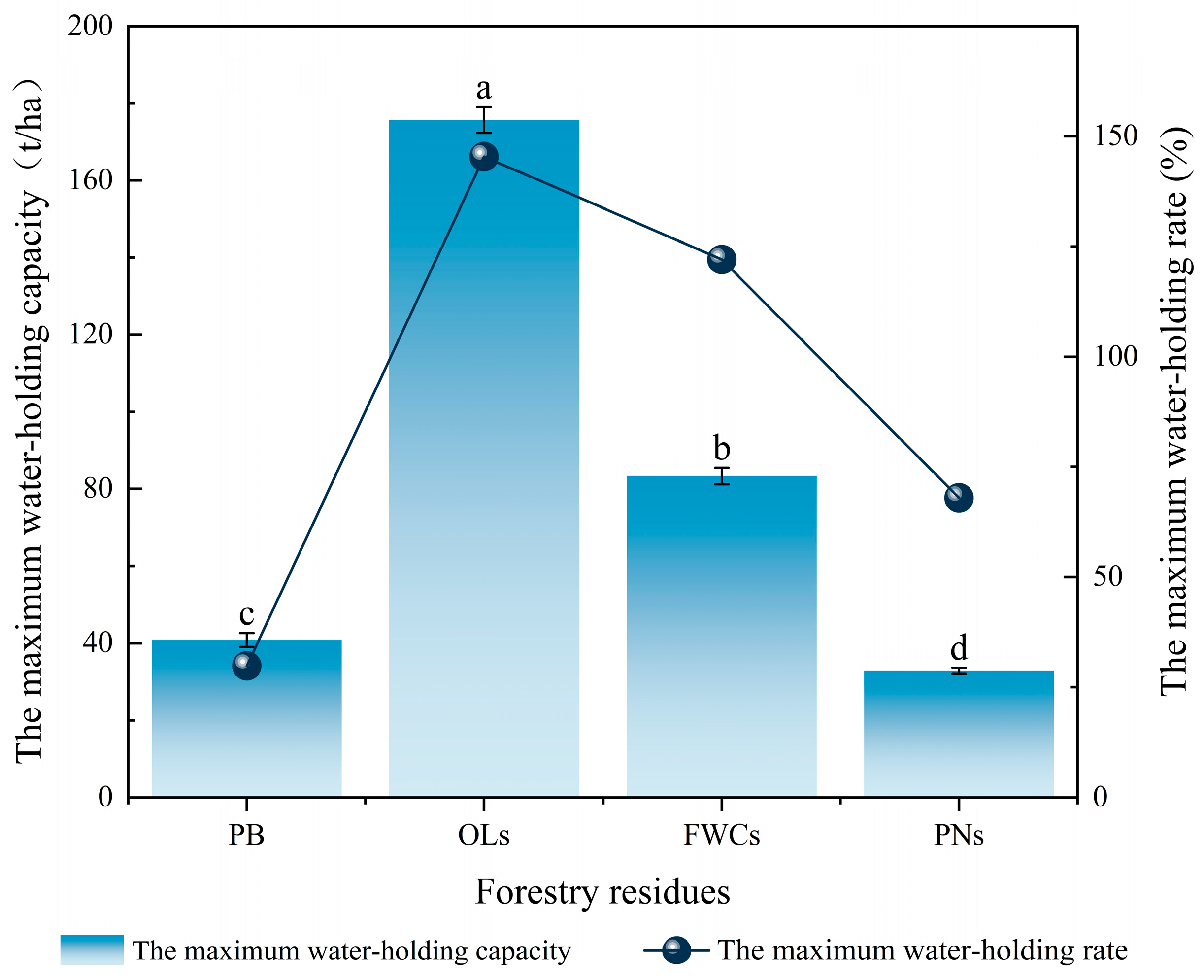
The maximum water-holding capacity of the four types of forestry residues ranged from 32.83 ± 0.76 to 175.67 ± 3.39 t/ha, with the corresponding maximum water-holding rate varying between 29.87% ± 0.74% and 145.42% ± 4.52% (Figure 4, Table 2). The maximum water-holding capacity was ranked as OLs (175.67 ± 3.39 t/ha) > FWCs (83.33 ± 2.16 t/ha) > PB (40.83 ± 1.77 t/ha) > PNs (32.83 ± 0.76 t/ha), while the maximum water-holding rate followed a different order: OLs (145.42% ± 4.52%) > FWCs (122.03% ± 5.58%) > PNs (68.00% ± 3.50%) > PB (29.87% ± 0.74%). Significant differences in both maximum water-holding capacity and maximum water-holding rate were detected among the four forestry residue types (p < 0.05). Specifically, OLs exhibited significantly higher values for both water-holding indices than the other three residue types. Quantitatively, the maximum water-holding capacity of OLs was twice that of FWCs, approximately four times that of PB, and five times that of PNs. Additionally, FWCs had a maximum water-holding capacity 1-fold and 1.5-fold higher than that of PB and PNs, respectively.

3.3. Temporal Changes in Water-Holding Characteristics

3.3.1. Water-Holding Capacity

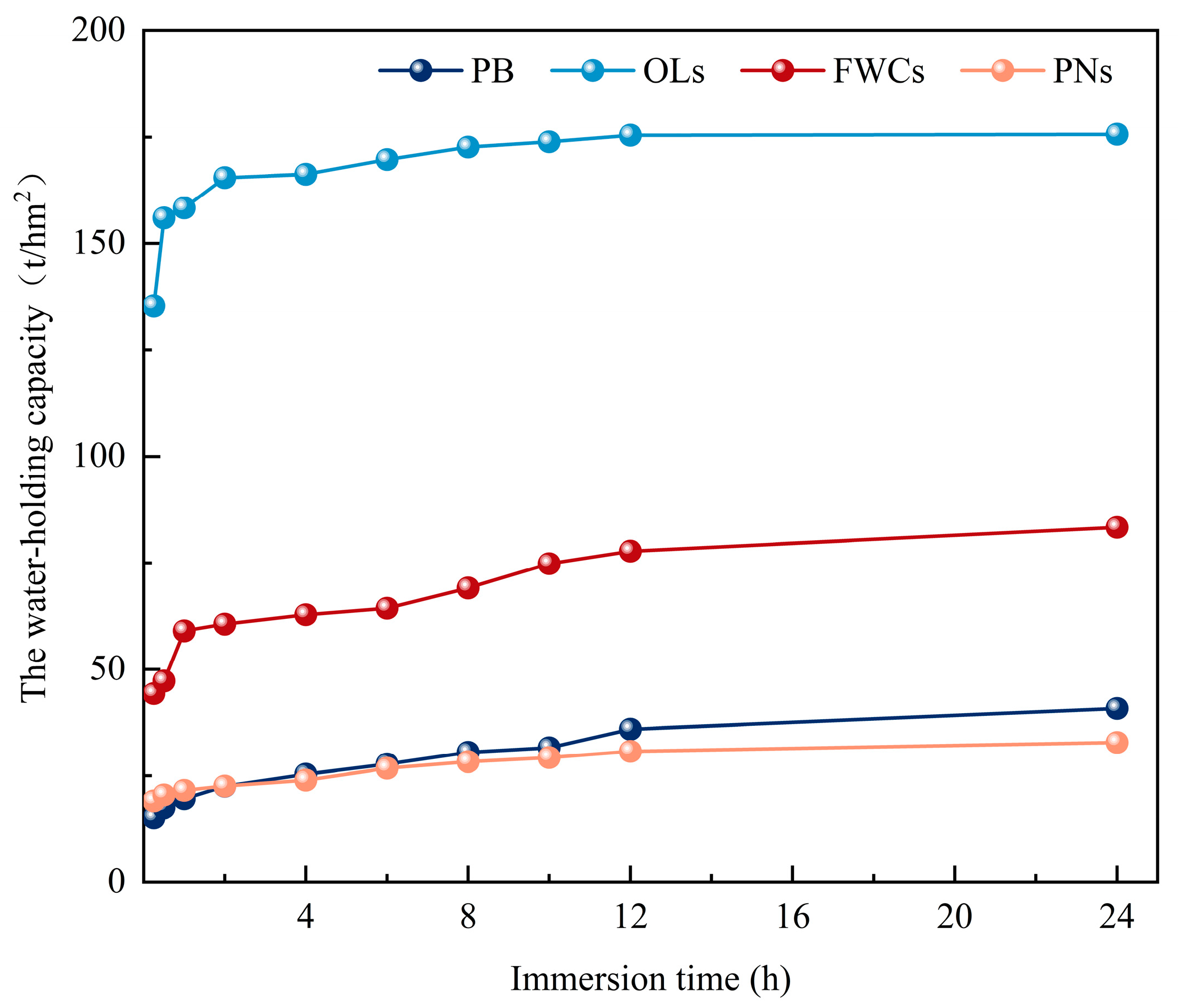
The relationship between the water-holding capacity of forestry residues and immersion time is illustrated in Figure 5. All four types of forestry residues exhibited consistent dynamic trends in water-holding capacity with prolonged immersion time. The water-holding capacity increased sharply within the initial 0.25 h of immersion and continued to rise steadily from 0.25 h to 8 h. Subsequently, the growth rate of water-holding capacity gradually decreased from 8 h to 24 h, and the water absorption process eventually reached a saturated state. Fitting analysis revealed a significant logarithmic correlation between the water-holding capacity of the four forestry residues and immersion time, which conformed to the equation Q = a·ln(t) + b, with all coefficients of determination, R2, being greater than 0.88 (Table 3), suggesting a good fit [20]. In the formula, Q represents the water-holding capacity of forestry residues (t/ha), t denotes the immersion time (h), a is the fitting coefficient, and b is the constant term of the equation.

3.3.2. Water Absorption Rate

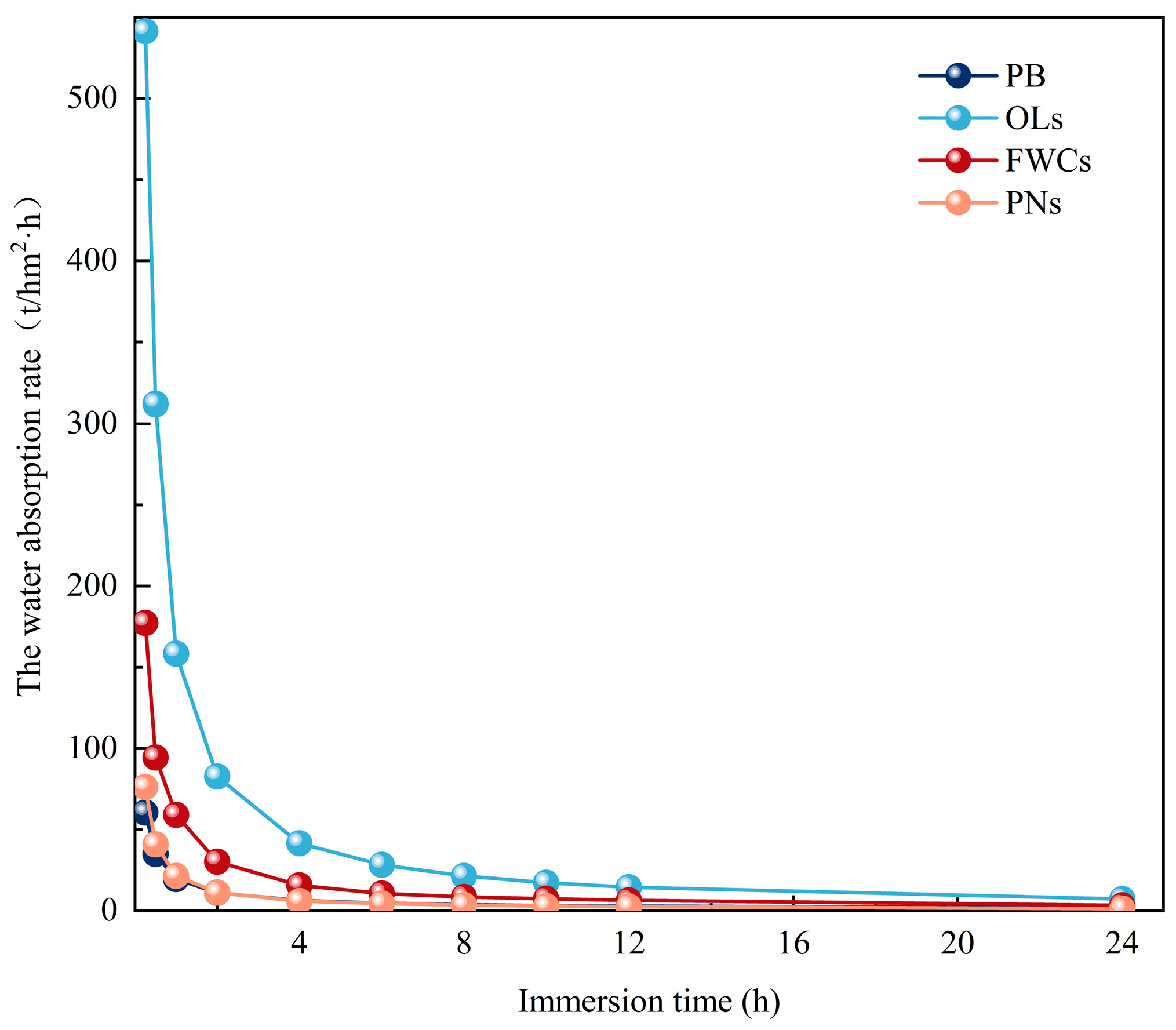
As presented in Figure 6, the water absorption rates of the four forestry residues exhibited essentially identical temporal variations. The water absorption rate declined rapidly within the first 2 h of immersion, followed by a moderate decreasing trend from 2 h to 8 h. The absorption rate gradually stabilized and approached an equilibrium state during the immersion period of 8 h to 24 h. Fitting analysis demonstrated a robust power-function correlation between the water absorption rate and immersion time, expressed as V = k·tn, with all coefficients of determination, R2, exceeding 0.99 (Table 3), indicating excellent goodness of fit. In this formula, V is the water absorption rate of forestry residues (t/h), t refers to immersion time (h), k represents the fitting coefficient, and n denotes the exponent of the power function.

3.4. Water-Holding Characteristics

The four types of forestry residues exhibited similar variation patterns in effective water-retention capacity (Table 2). Their effective water-retention capacity and effective water-retention rate ranged from 9.05 ± 4.77 to 119.83 ± 5.90 t/ha and 6.58% ± 3.51% to 99.19% ± 5.85%, respectively. The effective water-retention rate of OLs was 1.02 times that of FWCs, approximately 3.21 times that of PNs, and 15.07 times that of PB. In addition, the effective water-retention capacity of OLs was 0.81-, 7.05-, and 12.24-fold greater than that of FWCs, PNs and PB, respectively. Furthermore, there exist significant differences in both effective water-retention capacity and effective water-retention rate among various types of forestry residues (p < 0.05). The ranking of both effective water-retention capacity and rate was consistent across the four residues, following the order: OLs (119.83 ± 5.90 t/ha, 99.19% ± 5.85%) > FWCs (66.16 ± 2.80 t/ha, 96.90% ± 6.25%) > PNs (14.88 ± 1.80 t/ha, 30.86% ± 4.58%) > PB (6.58 ± 3.51 t/ha, 9.05 ± 4.77%). This ranking was identical to that of the maximum water-holding rate for different forestry residues.

4. Discussion

4.1. Water Absorption Capacity

According to the measurement results, all four types of forestry residues possess water absorption capacity. This phenomenon is mainly attributed to the chemical composition of woody plant cell walls, which are predominantly composed of cellulose, hemicellulose, and lignin. These three components constitute the primary chemical framework of forestry residues and fundamentally govern their hydrophilicity [21,22]. Cellulose and hemicellulose contain abundant hydroxyl groups that readily form hydrogen bonds with water molecules, while lignin, a cross-linked phenolic polymer, is intrinsically hydrophobic [23,24]. Accordingly, residues with higher cellulose-to-lignin ratios typically demonstrate superior water absorption capacities. Among the four tested forestry residues, OLs exhibit the highest gravimetric water absorption rate, demonstrating superior water absorption capacity, followed by FWCs. In comparison, PB shows the lowest gravimetric water absorption rate, corresponding to a relatively inferior water absorption performance relative to the other three residues. The differential water absorption capacities observed among different forestry residues in this study are consistent with those in a previous study [25], which confirmed significant variations in moisture uptake behavior across different wood species. The excellent water absorption performance of OLs and FWCs may stem from their advantageous cellulose/hemicellulose-to-lignin ratios [26,27]. By contrast, PB may have a relatively high lignin proportion, which could explain its weaker water absorption capacity relative to OLs and FWCs.

4.2. Water-Holding Capacity

It has been documented that the water-holding capacity of litter is closely related to its decomposition degree, where a higher decomposition degree corresponds to stronger water-holding performance [28,29]. In this study, OLs and FWCs exhibited higher water-holding capacities than PB and PNs, which can be primarily explained by their higher decomposition degrees. The inherent porous capillary structure of wood enables water retention in cell lumens and intercellular spaces via capillary action [30]. OLs and FWCs have loose, porous internal structures that facilitate capillary water retention. In contrast, PB has a smooth surface as well as a hard and thick texture, and PNs feature an elongated and rigid structure. These morphological characteristics cause most water to drain through the gaps between PB and PN particles during water infiltration, ultimately leading to their inferior water-holding capacities. Furthermore, the present results verified that broadleaf litter possesses a greater water-holding capacity than coniferous litter, which is in good agreement with previous research conclusions [16,31]. The superior maximum water-holding capacity of FWCs over PB is mainly attributed to the thinner texture of FWCs. Moreover, PB has a harder texture and larger particle size than FWCs, which reduces its contact area with water and further weakens its water-retention performance.
The water-holding capacity of forestry residues increased logarithmically with soaking time (Figure 5), while their water absorption rate decreased following a power function trend with the extension of soaking duration (Figure 6). These two functional fitting models are consistent with previous findings [32,33]. The initial low moisture content of forestry residues creates a large water potential gradient between the residues and free water. Driven by this gradient, forestry residues absorb water rapidly at the initial soaking stage with a high water uptake rate. As soaking time increases, the water absorption amount gradually approaches the maximum water absorption limit of the residues, leading to a saturated state. After saturation, the water absorption potential of the residues declines, and the water absorption rate decreases continuously. This dynamic variation pattern is consistent with the results of a previous study [34]. Within the first hour of soaking, the water-holding capacity of all forestry residues increased rapidly, with oak leaves showing the most prominent variation. This indicates that oak leaves can effectively intercept precipitation during short-duration heavy rainfall events, thereby alleviating soil erosion.

4.3. Water-Retention Capacity

Effective water-retention capacity comprehensively considers topographic conditions and the inherent moisture content of forestry residues, providing a more accurate characterization of the actual rainfall interception performance of forestry residues [29,35,36]. In the present study, all four types of forestry residues exhibited distinct effective water-retention capacities. This discrepancy is mainly attributed to the relatively loose internal structure of OLs and FWCs, which confers superior water absorption and retention capabilities. In contrast, PB features a thick texture and a smooth surface, which hinders water infiltration. Meanwhile, PNs present an elongated morphological structure. When surface water flows through PB and PNs, the majority of runoff directly drains through internal gaps or slides off their smooth surfaces, resulting in inferior water-retention performance. Additionally, PNs have a limited water-contact area, further causing substantial water loss through gap drainage and thus poor water-retention capacity. Furthermore, this study demonstrated that leaf litter exhibits stronger rainfall interception capacity than bark materials.
The water-holding characteristics of forestry residues are not merely material properties; they also play a positive role in urban landscape management. Mulches with high water-holding and effective retention capacities can reduce surface runoff, mitigate soil erosion, and decrease irrigation frequency in urban green spaces, thereby enhancing the ecological functionality and sustainability of urban landscapes [20,37]. In the present study, OLs and FWCs exhibited the best overall water-holding performance among the four tested residues. From a practical standpoint, these two materials are therefore recommended as priority choices for mulching urban bare soil. Their widespread availability and high annual production volumes make them low-cost and readily accessible organic resources. Using them as mulch offers a dual benefit, as it enables the efficient recycling of forestry by-products while simultaneously improving soil moisture regulation and potentially reducing soil erosion on exposed urban lands. These findings provide a scientific basis for selecting forestry residue mulches in urban greening projects, offering a practical strategy to enhance urban soil hydrological functions while simultaneously recycling forestry waste materials. However, it should be acknowledged that these findings are derived from laboratory immersion experiments and may not fully capture the complex hydrological processes under actual urban conditions. Therefore, future field studies are necessary to verify the practical effectiveness of forestry residues when applied as mulch on real urban bare soil.

5. Conclusions

All four tested forestry residues presented measurable water absorption and retention capacities with consistent performance trends. The maximum water-holding capacities followed the order of OLs > FWCs > PB > PNs, while the maximum water-holding rates ranked as OLs > FWCs > PNs > PB. Similarly, the effective water-retention capacity and rate shared the same trend: OLs > FWCs > PNs > PB.
Statistical analysis revealed that the water-holding capacity of the four residues had a significant logarithmic correlation with soaking time, while the water absorption rate exhibited a significant exponential correlation with soaking time. In conclusion, OLs exhibited optimal water-retention performance, followed by FWCs, whereas PB showed the weakest water-retention capacity among the four materials.
Considering the comprehensive performance of water absorption rate, maximum water-holding capacity, and effective water-retention ability, OLs and FWCs are highly recommended as preferred organic mulches for urban soil applications. Given their superior water-holding properties, these two forestry residues may contribute to reducing surface runoff and mitigating urban soil erosion during short-duration and high-intensity rainfall. Moreover, they may gradually release the absorbed water into the soil over time, thereby effectively replenishing soil moisture and contributing to improving urban soil water regulation capacity.

Author Contributions

Conceptualization: B.Q. and X.M.; methodology: B.Q., P.Y. and B.L.; software: B.Q., X.M. and Y.Z.; validation: L.W. and Y.J.; formal analysis: B.Q., Y.W. and B.L.; investigation: X.M. and W.Z.; resources: Y.Z. and G.H.; data curation: B.Q., X.M. and X.W.; writing—original draft preparation: B.Q. and X.M.; writing—review and editing: B.Q., P.Y. and B.L.; visualization: Y.Z. and Y.J.; supervision: Y.W. and L.W.; project administration: Y.Z. and B.L.; funding acquisition: B.Q. and B.L. All authors have read and agreed to the published version of the manuscript.

Funding

This research was supported by the Guangxi Natural Science Foundation (2025GXNSFBA069372) and the National Natural Science Foundation of China (52469003).

Data Availability Statement

The original contributions presented in this study are included in the article. Further inquiries can be directed to the corresponding author.

Conflicts of Interest

Author Baopeng Lu was employed by Guangxi Jingpeng Technology Co., Ltd. The remaining authors declare that the research was conducted in the absence of any commercial or financial relationships that could be construed as potential conflicts of interest.

References

  1. Derdouri, A.; Murayama, Y.; Morimoto, T.; Wang, R.; Aghasi, N.H.M. Urban green space in transition: A cross-continental perspective from eight Global North and South cities. Landsc. Urban Plan. 2025, 253, 105220. [Google Scholar] [CrossRef] [Scilit]
  2. Zhao, J.; Du, D.; Chen, L.; Liang, X.; Chen, H.; Jin, Y. HA-Net for bare soil extraction using optical remote sensing images. Remote Sens. 2024, 16, 3088. [Google Scholar] [CrossRef] [Scilit]
  3. Nguyen, C.T.; Chidthaisong, A.; Kieu Diem, P.; Huo, L.Z. A modified bare soil index to identify bare land features during agricultural fallow-period in southeast Asia using Landsat 8. Land 2021, 10, 231. [Google Scholar] [CrossRef] [Scilit]
  4. Qu, B.; Li, S.; Sun, X.; Yun, B.; Zhang, H.; Wang, X.; Xiong, K. Effects of different mulching materials on reducing soil dust from bare soil. Pol. J. Environ. Stud. 2018, 28, 303–310. [Google Scholar] [CrossRef] [Scilit]
  5. Weldesemayat Sileshi, G.; Barrios, E.; Lehmann, J.; Tubiello, F.N. An organic matter database (OMD): Consolidating global residue data from agriculture, fisheries, forestry and related industries. Earth Syst. Sci. Data 2025, 17, 369–391. [Google Scholar] [CrossRef] [Scilit]
  6. Tian, J.; Yu, F.; Guo, Z.; Yan, Y.; Xie, Y.; Ma, Z.; Li, Q.; Fousseni, F.; Liu, W. Forest residues contribute significantly to climate change in China. Resour. Conserv. Recycl. 2023, 198, 107157. [Google Scholar] [CrossRef] [Scilit]
  7. Shakeel, U.; Zeng, Y.; Khan, M.R.; Song, J. Valorization of waste lignocellulosic biomass for soil amendment: A critical assessment and strategic framework. J. Bioresour. Bioprod. 2026, 11, 100230. [Google Scholar] [CrossRef] [Scilit]
  8. Qu, B.; Liu, Y.; Sun, X.; Li, S.; Wang, X.; Xiong, K.; Yun, B.; Zhang, H. Effect of various mulches on soil physico—Chemical properties and tree growth (Sophora japonica) in urban tree pits. PLoS ONE 2019, 14, e0210777. [Google Scholar] [CrossRef] [Scilit] [PubMed]
  9. Wang, B.; Niu, J.; Berndtsson, R.; Zhang, L.; Chen, X.; Li, X.; Zhu, Z. Efficient organic mulch thickness for soil and water conservation in urban areas. Sci. Rep. 2021, 11, 6259. [Google Scholar] [CrossRef] [Scilit] [PubMed]
  10. Keesstra, S.D.; Rodrigo-Comino, J.; Novara, A.; Giménez-Morera, A.; Pulido, M.; Di Prima, S.; Cerdà, A. Straw mulch as a sustainable solution to decrease runoff and erosion in glyphosate-treated clementine plantations in Eastern Spain. An assessment using rainfall simulation experiments. Catena 2019, 174, 95–103. [Google Scholar] [CrossRef] [Scilit]
  11. Lopes, I.; de Lima, J.L.; Montenegro, A.A.; Carvalho, A.A.D. Assessment of Water Retention and Absorption of Organic Mulch Under Simulated Rainfall for Soil and Water Conservation. Soil Syst. 2025, 9, 4. [Google Scholar] [CrossRef] [Scilit]
  12. Sun, X.; Ye, Y.; Liao, J.; Soromotin, A.V.; Smirnov, P.V.; Kuzyakov, Y. Organic mulching increases microbial activity in urban Forest soil. Forests 2022, 13, 1352. [Google Scholar] [CrossRef] [Scilit]
  13. Zhu, Y.; Rui, S.; Zhang, K.; Shen, X.; Sun, X.; Wang, J.; Zhang, L.; Guan, Y. Improving green infrastructure: Enhancing multidimensional benefits from a soil health perspective. J. Environ. Manag. 2025, 391, 126549. [Google Scholar] [CrossRef] [Scilit]
  14. Jun, F.; Yu, G.; Quanjiu, W.; Malhi, S.S.; Yangyang, L. Mulching effects on water storage in soil and its depletion by alfalfa in the Loess Plateau of northwestern China. Agric. Water Manag. 2014, 138, 10–16. [Google Scholar] [CrossRef] [Scilit]
  15. Qureshi, S.S.; Xu, J.; Vancov, T.; Chen, C. From waste to treasure trove: High-value cellulose-rich materials with exceptional water retention properties in soil. Environ. Res. 2025, 289, 122974. [Google Scholar] [PubMed]
  16. Feng, Y.; Zhao, Y.; Zhang, D.; Zhang, B.; Fan, X.; Han, Z.; Zhao, L. Response of water retention characteristics in litters based on the leaf type. Hydrol. Res. 2025, 56, 297–304. [Google Scholar] [CrossRef] [Scilit]
  17. Hu, G.; Huo, C.; Hu, C.; Zhong, C.; Chen, S.; Xu, C.; Zhang, Z. Elevational patterns of hydrological properties of forest litter layers in Daming Mountain, southern China. Glob. Ecol. Conserv. 2025, 58, e03510. [Google Scholar] [CrossRef] [Scilit]
  18. Zhou, Q.; Keith, D.M.; Zhou, X.; Cai, M.; Cui, X.; Wei, X.; Luo, Y. Comparing the water-holding characteristics of broadleaved, coniferous, and mixed forest litter layers in a Karst Region. Mt. Res. Dev. 2018, 38, 220–229. [Google Scholar] [CrossRef] [Scilit]
  19. Li, Y.; Li, B.; Zhang, X.; Chen, J.J.; Zhan, F.D.; Guo, X.H.; Zu, Y.Q. Differential water and soil conservation capacity and associated processes in four forest ecosystems in Dianchi Watershed, Yunnan Province, China. J. Soil Water Conserv. 2015, 70, 198–206. [Google Scholar] [CrossRef] [Scilit]
  20. Zhang, P.; Xiao, M.; Zhang, Z.; Dai, Y.; Liu, G.; Senge, M. Hydrological characteristics of different organic materials mulches. Sci. Rep. 2023, 13, 771. [Google Scholar] [CrossRef] [Scilit] [PubMed]
  21. Guo, A.; Sun, Z.; Feng, H.; Shang, H.; Sathitsuksanoh, N. State-of-the-art review on the use of lignocellulosic biomass in cementitious materials. Sustain. Struct. 2023, 3, 000023. [Google Scholar]
  22. Thybring, E.E.; Fredriksson, M. Wood modification as a tool to understand moisture in wood. Forests 2021, 12, 372. [Google Scholar] [CrossRef] [Scilit]
  23. Khodayari, A.; Thielemans, W.; Hirn, U.; Van Vuure, A.W.; Seveno, D. Cellulose-hemicellulose interactions-a nanoscale view. Carbohydr. Polym. 2021, 270, 118364. [Google Scholar] [CrossRef] [Scilit] [PubMed]
  24. Kamande, S.W.; Kariuki, S.W.; Murithi, G. Impact of lignin on water absorption and thickness swelling of particleboard: A comprehensive review. Adv. Mater. Sci. Eng. 2026, 2026, 9065314. [Google Scholar] [CrossRef] [Scilit]
  25. Mercy, O.B.; Comfort, A.A.; Michael, A.I.; Sesan, A.K. Histology and Water Absorption Properties of Different Wood Species. RRJ Bot. Sci. 2023, 12, 001. [Google Scholar]
  26. Fernando, D.; Kowalczyk, M.; Guindos, P.; Auer, M.; Daniel, G. Electron tomography unravels new insights into fiber cell wall nanostructure; exploring 3D macromolecular biopolymeric nano-architecture of spruce fiber secondary walls. Sci. Rep. 2023, 13, 2350. [Google Scholar] [CrossRef] [Scilit] [PubMed]
  27. Arab, L.; Seegmueller, S.; Kreuzwieser, J.; Eiblmeier, M.; Dannenmann, M.; Rennenberg, H. Significance of current weather conditions for foliar traits of old-growth sessile oak (Quercus petraea Liebl) trees. Trees 2022, 36, 777–791. [Google Scholar]
  28. Ilek, A.; Błońska, E.; Miszewski, K.; Kasztelan, A.; Zborowska, M. Investigating water storage dynamics in the litter layer: The impact of mixing and decay of pine needles and oak leaves. Forests 2024, 15, 350. [Google Scholar] [CrossRef] [Scilit]
  29. Lima, J.A.; Tonello, K.C. Rainfall partitioning in Amazon forest: Implications of reduced impact logging on litter water conservation. Hydrology 2023, 10, 97. [Google Scholar] [CrossRef] [Scilit]
  30. Fredriksson, M. On wood–water interactions in the over-hygroscopic moisture range—Mechanisms, methods, and influence of wood modification. Forests 2019, 10, 779. [Google Scholar] [CrossRef] [Scilit]
  31. Li, X.; Xiao, Q.; Niu, J.; Dymond, S.; McPherson, E.G.; van Doorn, N.; Yu, X.; Xie, B.; Zhang, K.; Li, J. Rainfall interception by tree crown and leaf litter: An interactive process. Hydrol. Process. 2017, 31, 3533–3542. [Google Scholar] [CrossRef] [Scilit]
  32. Shi, R.; Li, B.; Liu, S.; Wang, S. Water holding characteristics of litters from different ecological public welfare forest types. In 2nd International Conference on Green Materials and Environmental Engineering; Atlantis Press: Dordrecht, The Netherlands, 2015; pp. 55–59. [Google Scholar]
  33. Gun, S.; Hou, M.; Qu, L. Stock and hydrological characteristics of four limestone secondary forest litters in subtropical China. Pak. J. Bot. 2023, 55, 595–604. [Google Scholar]
  34. Bai, Y.; Zhou, Y.; Du, J.; Zhang, X.; Di, N. Effects of a broadleaf-oriented transformation of coniferous plantations on the hydrological characteristics of litter layers in subtropical China. Glob. Ecol. Conserv. 2021, 25, e01400. [Google Scholar] [CrossRef] [Scilit]
  35. Castagnolli, L.; Boggiani, F.S.; Lima, J.A.D.; Lima, M.T.; Tonello, K.C. Hydrological properties of litter in different vegetation types: Implications for ecosystem functioning. Hydrology 2023, 10, 165. [Google Scholar] [CrossRef] [Scilit]
  36. Tu, Z.; Chen, S.; Chen, Z.; Ruan, D.; Zhang, W.; Han, Y.; Han, L.; Wang, K.; Huang, Y.; Chen, J. Hydrological properties of soil and litter layers of four forest types restored in the gully erosion area of latosol in south China. Forests 2023, 14, 360. [Google Scholar] [CrossRef] [Scilit]
  37. Iqbal, R.; Raza, M.A.S.; Valipour, M.; Saleem, M.F.; Zaheer, M.S.; Ahmad, S.; Toleikiene, M.; Haider, I.; Aslam, M.U.; Nazar, M.A. Potential agricultural and environmental benefits of mulches—A review. Bull. Natl. Res. Cent. 2020, 44, 75. [Google Scholar] [CrossRef] [Scilit]
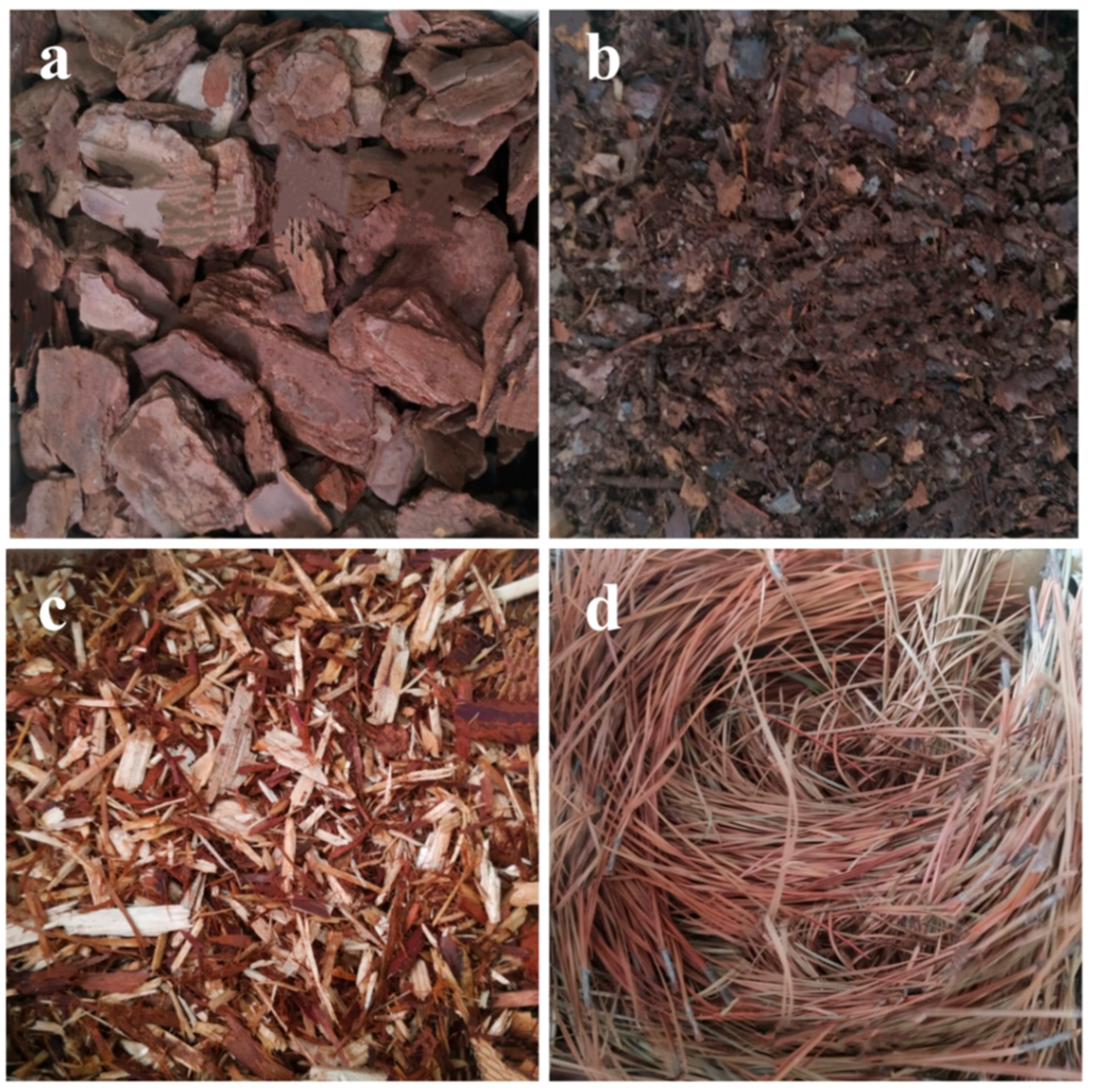
Figure 1. Four types of forestry residues as organic mulches: (a) pine bark (PB); (b) oak leaves (OLs); (c) fir wood chips (FWCs); (d) pine needles (PNs).
Forests 17 00866 g001
Figure 2. Mass water absorption ratios of four types of forestry residues. Different lowercase letters indicate significant differences among the four forestry residue types (p < 0.05).
Forests 17 00866 g002
Figure 3. Mass water absorption rates of four forestry residues over 24 h of immersion.
Forests 17 00866 g003
Figure 4. Maximum water-holding capacities and maximum water-holding rates of four types of forestry residues. Different lowercase letters indicate significant differences among the four forestry residue types (p < 0.05).
Forests 17 00866 g004
Figure 5. Water-holding capacities of four forestry residues over 24 h of immersion.
Forests 17 00866 g005
Figure 6. Water absorption rates of four forestry residues over 24 h of immersion.
Forests 17 00866 g006
Table 1. Average moisture content of four types of forestry residues (means ± standard error, n = 3).
VariablePBOLsFWCsPNs
Average moisture content (%)18.81 ± 3.16 b24.41 ± 4.32 a6.82 ± 1.29 c26.94 ± 1.64 a
Notes: Different lowercase letters indicate significant differences among the four forestry residue types (p < 0.05).
Table 2. Water-holding characteristics of four types of forestry residues (means ± standard error, n = 3).
TypesMaximum Water-Holding Capacity/t/haMaximum Water-Holding Rate/%Effective Water-Retention Rate/%Effective Water-Retention Capacity/t/ha
PB40.83 ± 1.77 c29.87 ± 0.74 d6.58 ± 3.51 d9.05 ± 4.77 d
OLs175.67 ± 3.39 a145.42 ± 4.52 a99.19 ± 5.85 a119.83 ± 5.90 a
FWCs83.33 ± 2.16 b122.03 ± 5.58 b96.90 ± 6.25 b66.16 ± 2.80 b
PNs32.83 ± 0.76 d68.00 ± 3.50 c30.86 ± 4.58 c14.88 ± 1.80 c
Notes: Different lowercase letters within the same column in the above table indicate significant differences in each parameter among various types of forestry residues (p < 0.05).
Table 3. The fitting equations for water-holding capacity and water absorption rate with respect to soaking time.
TypesWater-Holding CapacityWater Absorption Rate
PBQ = 5.34 ln t + 20.31, R 2 = 0.93V = 19.80· t 0.79 , R 2 = 0.999
OLsQ = 7.81 ln t + 155.63, R 2 = 0.88V = 155.08· t 0.95 , R 2 = 0.999
FWCsQ = 8.17 ln t + 54.68, R 2 = 0.94V = 53.95· t 0.87 , R 2 = 0.999
PNsQ = 3.04 ln t + 21.96, R 2 = 0.93V = 21.793· t 0.88 , R 2 = 0.999
Disclaimer/Publisher’s Note: The statements, opinions and data contained in all publications are solely those of the individual author(s) and contributor(s) and not of MDPI and/or the editor(s). MDPI and/or the editor(s) disclaim responsibility for any injury to people or property resulting from any ideas, methods, instructions or products referred to in the content.