A Decade of Research on Medium-Density Fiberboard: A Bibliometric Analysis of Physical and Mechanical Properties

 , ,
, ,  , , , , and
Abstract
1. Introduction
- What are the publication and citation trends in research on the physical and mechanical properties of MDF over the study period?
- Which documents and journals are the most influential in this research area?
- What major thematic groupings emerge from keyword co-occurrence analysis and thematic mapping?
- How have these themes evolved over time?
- What research gaps and future directions can be identified from the integrated bibliometric findings?
2. Literature Review
2.1. Recent Development
2.2. Previous Review Papers on MDF
3. Data and Methodology
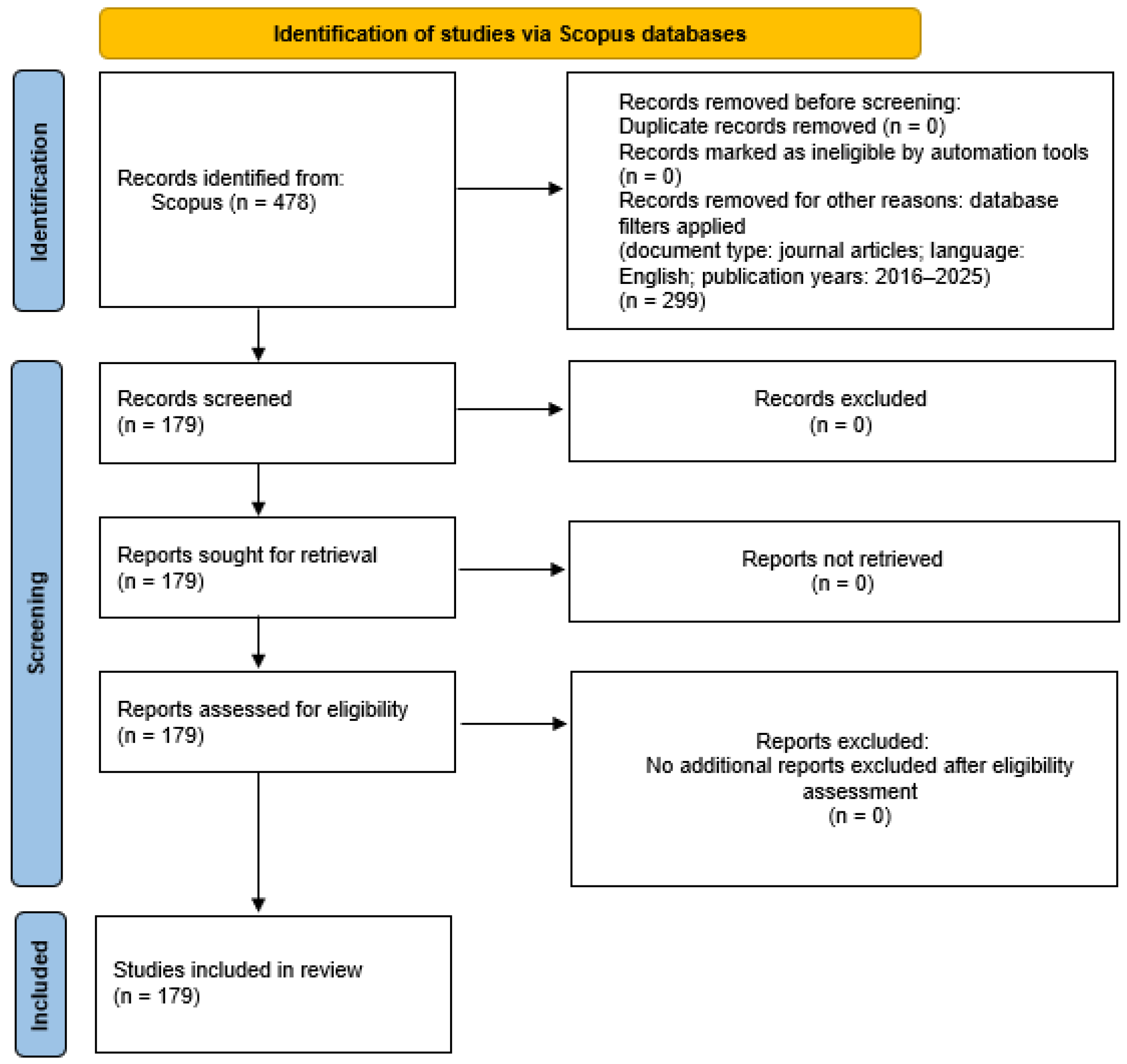
3.1. Search Strategy and Data Collection
3.2. Bibliometric Tools and Analytical Procedure
4. Results
4.1. Citation Metrics and Publication Trends
4.2. Source and Journal Analysis
4.3. Highly Cited Articles
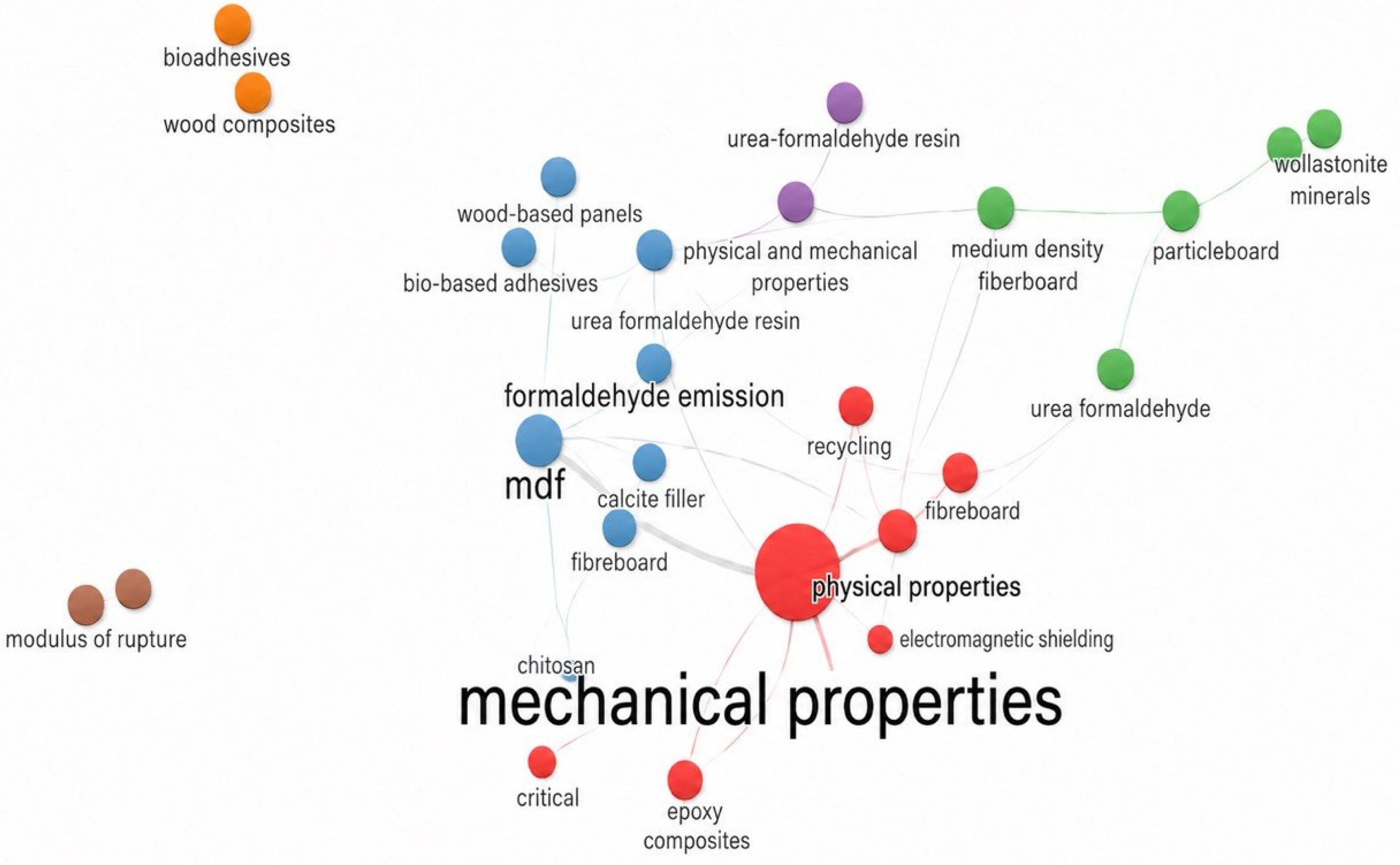
4.4. Keyword Co-Occurrence Network Analysis
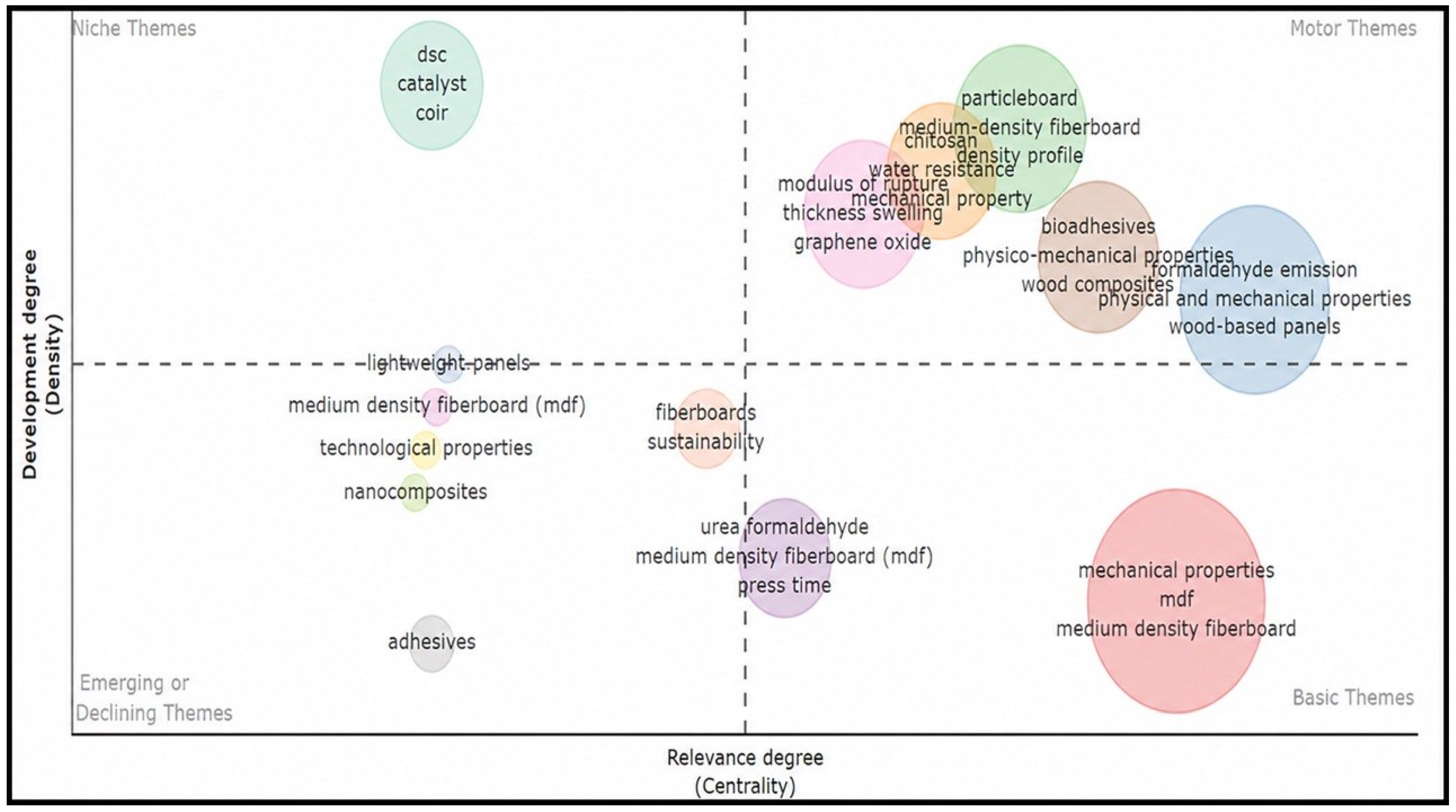
4.5. Thematic Map
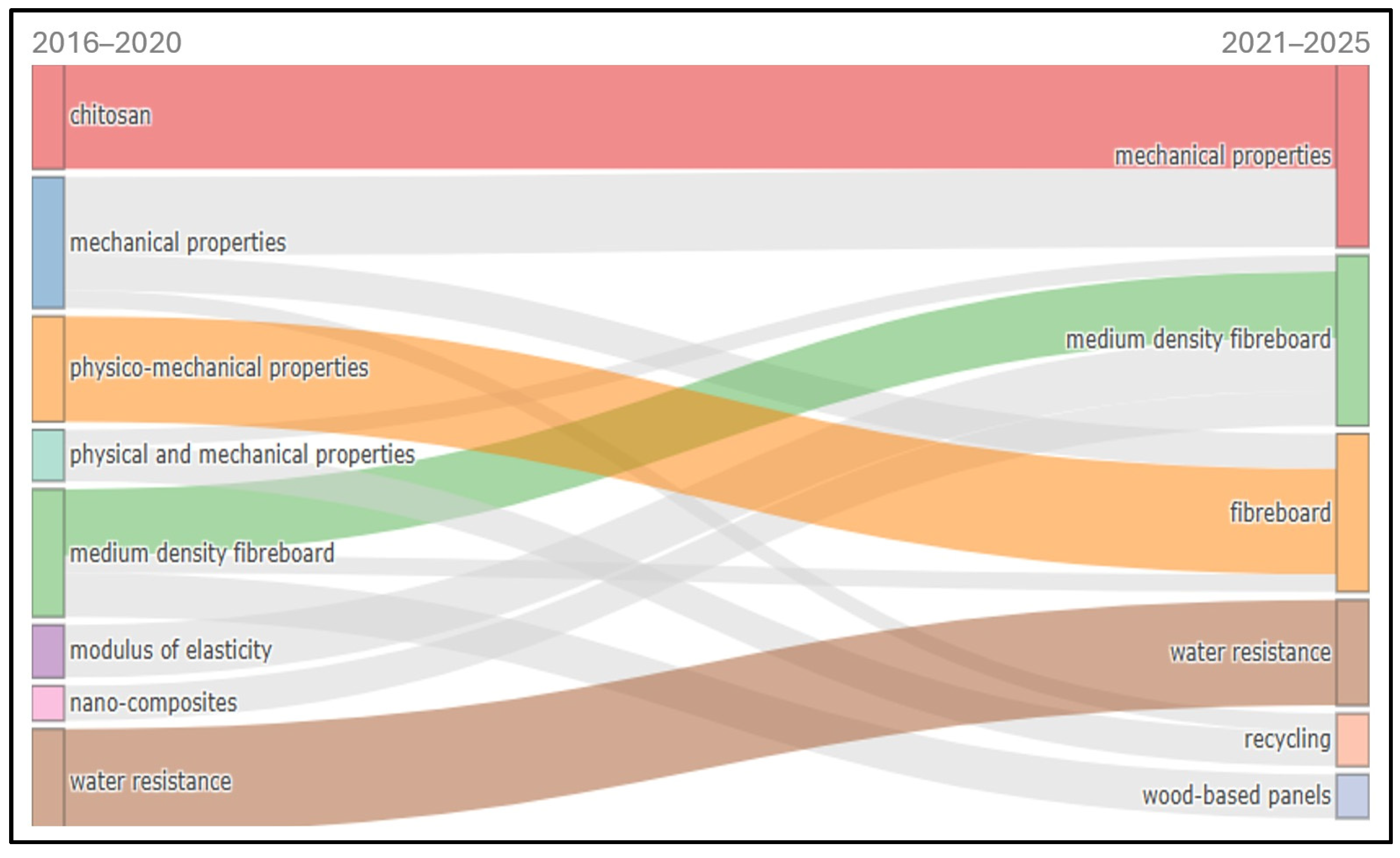
4.6. Thematic Evolution
5. Discussion
6. Conclusions
Author Contributions
Funding
Data Availability Statement
Acknowledgments
Conflicts of Interest
Appendix A

| No. | Authors | Title | Authors’ Keywords |
|---|---|---|---|
| 1 | [1] | Effects of Surface Lamination Process Parameters on Medium Density Fiberboard (MDF) Properties | Bending; Fiberboard; Gloss; Impregnated; Lamination; MOE; Press time; Scratch; Urea formaldehyde |
| 2 | [2] | Urea impregnated multiwalled carbon nanotubes; a formaldehyde scavenger for urea formaldehyde adhesives and medium density fiberboards bonded with them | graphene and fullerenes; mechanical properties; microscopy; nanotubes; swelling; viscosity and viscoelasticity |
| 3 | [3] | Effects of nano-clay on physical and mechanical properties of medium—Density fiberboards made from wood and chicken—Feather fibers and two types of resins; [Utjecaj nanogline na fizička i mehanička svojstva ploča vlaknatica srednje gustoće izrađenih od drva, vlakana pilećeg perja i dviju vrsta smola] | Clay nanofibers; Feather fibers; Mineral materials; Nano-composites; Wood fiber |
| 4 | [4] | Modified graphene as potential additive for urea formaldehyde (UF) resin in medium density fiberboard (MDF) manufacturing | Ethylenediamine; Formaldehyde emission; Graphene oxide; Medium density fiberboard(MDF); Urea formaldehyde resin |
| 5 | [5] | Effects of Nanoclay Modification with Aminopropyltriethoxysilane (APTES) on the Performance of Urea–formaldehyde Resin Adhesives | 3-Aminopropyltriethoxysilane; Formaldehyde emission; MDF; Nanoclay; Urea formaldehyde resin |
| 6 | [6] | The effects of urea-formaldehyde resin and paraffin contents on fluid flow (air and water) and physico-mechanical properties of medium-density fibreboards | medium-density fibreboard (MDF); permeability; urea-formaldehyde resin (UF-resin); wood fibre; Wood-based panels |
| 7 | [7] | The Impact of Hydrolysis Regime on the Physical and Mechanical Characteristics of Medium-Density Fiberboards Manufactured from Recycled Wood Fibers | formaldehyde content; medium-density fibreboards; physical and mechanical properties; recycling; thermal hydrolysis |
| 8 | [8] | A dialdehyde starch-based adhesive for medium-density fiberboards | Bio-based adhesives; MDF; Microfibrillated cellulose; Starch oxidation; Wood-based panels |
| 9 | [9] | The effect of post-heat treatment in MDF panels | Dimensional stability; MDF panels; Physical and mechanical properties; Post-heat treatment; Temperature and time of heat treatment |
| 10 | [10] | Impact of bio-based phase change materials on the thermal inertia of panels made from medium-density fiberboard (MDF) residues | Fiberboard; Medium density fiberboard residues; Phase change material; Thermal inertia; Thermal storage |
| 11 | [15] | Reducing free formaldehyde emission, improvement of thickness swelling and increasing storage stability of novel medium density fiberboard by urea-formaldehyde adhesive modified by phenol derivatives | Formaldehyde scavenger; Medium density fiberboard (MDF); Phenolic compounds; Thickness swelling; Urea formaldehyde adhesive |
| 12 | [18] | Revealing the impacts of recycled urea–formaldehyde wastes on the physical–mechanical properties of MDF | - |
| 13 | [28] | Characterization of new composite material based on date palm leaflets and expanded polystyrene wastes | Date palm waste; Expanded polystyrene waste; Leaflets-Polystyrene Composite; Mechanical properties; Recycling; Thermal conductivity |
| 14 | [29] | Preparation and properties of a chitosan-lignin wood adhesive | A. Adhesives for wood; Ammonium lignosulfonate; C. Infrared spectroscopy; C. Thermal analysis; Chitosan; D. Mechanical properties of adhesives |
| 15 | [30] | Application of surface chemical functionalized cellulose nanocrystals to improve the performance of UF adhesives used in wood based composites—MDF type | APTES; CNC; Formaldehyde emission; Mechanical properties; Urea formaldehyde |
| 16 | [31] | Effect of sodium lignosulfonate on bonding strength and chemical structure of a lignosulfonate/chitosan-glutaraldehyde medium-density fiberboard adhesive | Chitosan; Lignosulfonate; MDF; Mechanical property; Sodium lignosulfonate; Water resistance |
| 17 | [32] | Binderless all-cellulose fibreboard from microfibrillated lignocellulosic natural fibres | A. Cellulose; B. Mechanical properties; E. Compression moulding; Microfibrillation |
| 18 | [33] | Addition of cellulose nanofibers extracted from rice straw to urea formaldehyde resin; effect on the adhesive characteristics and medium density fiberboard properties | Cellulose nanofibers; Particleboard; Rice straw; Urea formaldehyde |
| 19 | [34] | Effect of graphene oxide nanoparticles on the physical and mechanical properties of medium density fiberboard | Graphene oxide; Internal bond; MDF; Modulus of elasticity; Modulus of rupture; Thickness swelling; Urea–formaldehyde resin; Water absorption |
| 20 | [35] | Eco-friendly fiberboard panels from recycled fibers bonded with calcium lignosulfonate | Bioadhesives; Calcium lignosulfonate; Fiberboards; Recycled fibers; Wood-based panels; Zero-formaldehyde emission |
| 21 | [36] | Utilization of construction and demolition waste for particleboard production | Board pressing; Urea formaldehyde resin; Wood particles |
| 22 | [37] | Effects of recycled fiber content on the properties of medium density fiberboard | - |
| 23 | [38] | Synthesis of graphene oxide (GO) and reduced graphene oxide (rGO) and their application as nano-fillers to improve the physical and mechanical properties of medium density fiberboard | graphene oxide (GO); medium density fiberboard; nanocomposites; nanofabrication; reduced graphene oxide (rGO) |
| 24 | [39] | The Combined Effects of Alkali Treatment and Ammonium Bicarbonate Addition on Selected Properties of MDF Panels | Alkali treatment; Ammonium bicarbonate; Fire resistance; Mechanical properties; Medium density fiberboard; Physical properties |
| 25 | [40] | Influence of glutaraldehyde on the performance of a lignosulfonate/chitosan-based medium density fiberboard adhesive | adhesives; biopolymers and renewable polymers; cellulose and other wood products; spectroscopy; thermogravimetric analysis (TGA) |
| 26 | [41] | Engineering the properties of eco-friendly medium density fibreboards bonded with lignosulfonate adhesive; [Dizajniranje svojstava ekološki prihvatljivih ploča vlaknatica srednje gustoće proizvedenih uporabom lignosulfonatnog ljepila] | Bio-based adhesives; Eco-friendly MDF; Lignosulfonate; Physical and mechanical properties; Wood-based panels |
| 27 | [42] | Supplementation of natural tannins as an alternative to formaldehyde in urea and melamine formaldehyde resins used in mdf production | Formaldehyde emission; Mdf; Mf; Tannin; Uf |
| 28 | [43] | Effect of Lignin Modification of Recycled and Fresh Wood Fibers on Physical, Mechanical, and Thermal Properties of Fiberboard | fiberboard; formaldehyde emission; kraft lignin; mechanical properties; thickness swelling; urea-formaldehyde resin |
| 29 | [44] | Advancing Sustainable Building Materials: Reducing Formaldehyde Emissions in Medium Density Fiber Boards with Lignin Nanoparticles | formaldehyde emission; formaldehyde scavenger; lignin nanoparticles; medium density fiberboard; urea formaldehyde resin |
| 30 | [45] | Eco-friendly fiberboards with low formaldehyde content and enhanced mechanical properties produced with activated soybean protein isolate modified urea-formaldehyde resin | Medium-density fiberboard; Soybean protein isolate; Urea; Urea-formaldehyde resin |
| 31 | [46] | Valorization of Recovered Mine Timber as a Secondary Feedstock for Medium-Density Fiberboard Manufacturing | cascade utilization; circular bioeconomy; medium-density fiberboard; mining timber; recovered wood; waste valorization |
| 32 | [47] | Effects of utilizing olive pits and waste melamine-impregnated paper in particleboard manufacturing on board properties; [Yongalevha üretiminde zeytin çekirdeği ve atık melamin emdirilmiş kağıt kullanımının levha özellikleri üzerine etkilerinin belirlenmesi] | MIP waste; Olive pit; Particleboard; Physical properties |
| 33 | [48] | Wood-like boards obtained from the recycling of rigid and flexible multilayer food packaging | boards manufacturing; mechanical properties; multilayer packaging; physical properties; recycling |
| 34 | [49] | Manufacturing and utilization of novel sustainable composites using pulled wool fibers waste from leather tanneries: Mechanical, physical, and dynamic characterization | damping capacity; flexural strength; pulled wool fibers; recycling; thermal conductivity |
| 35 | [50] | Mechanical and water-resistant properties of rice straw fiberboard bonded with chemically-modified soy protein adhesive | - |
| 36 | [51] | The impact of altering the molar ratio on formaldehyde content and the physical and mechanical properties of MDF panels | quality standards; technological properties; urea-formaldehyde ratio; Wood-based panels |
| 37 | [52] | Effect of medium-density fiberboard sawdust content on the dynamic and mechanical properties of epoxy-based composite | epoxy; mechanical properties; medium-density fiberboard; vibration |
| 38 | [53] | Properties of Un-Torrefied and Torrefied Poplar Plywood (PW) and Medium-Density Fiberboard (MDF) | medium-density fiberboard; modulus of rupture; roughness; water absorption |
| 39 | [54] | How nano-wollastonite can change the fundamental properties of a wood fibre and rice straw composites? | - |
| 40 | [55] | Reinforcement of fiberboard containing lingo-cellulose nanofiber made from wood fibers | Cellulose nanofiber; Fiberboard; Ligno-cellulose nanofiber; Wet pulverize; Wood-based materials |
| 41 | [56] | Statistical Methods in the Analysis of the Effect of Carbonisate on the Hardness of Epoxy-Resin-Based Composites | carbonisate; hardness; pyrolysis; recycling; statistical analysis |
| 42 | [57] | Application of mineral filler in medium density fiberboard (MDF) and its effect on material properties as a function of particle size | Dimensional stability; Liquid permeability; Mechanical properties; Medium density fiberboard (MDF); Mineral filler; Particle size; Urea formaldehyde |
| 43 | [58] | Mechanical and energy absorption properties of the composite XX-type lattice sandwich structure | Energy absorption property; Mechanical property; Sandwich structure; XX-type |
| 44 | [59] | Effects of factors on direct screw withdrawal resistance in medium density fiberboard and particleboard | Adhesives; Density; Medium density fiberboard; Particleboard; Screw; Water treatment |
| 45 | [60] | Investigation of the fire, thermal, and mechanical properties of zinc borate and synergic fire retardants on composites produced with PP-MDF wastes | Fiber wastes; Fire retardant; Thermal properties; Zinc borate |
| 46 | [61] | Properties of MDF manufactured with mixtures of wood from paricá plantations and wood waste from native Amazonian species; [Propriedades de painéis MDF fabricados com misturas de madeira de plantações de paricá e resíduos de madeira de espécies nativas da Amazônia] | Industrial wood processing; Schizolobium amazonicum; tropical wood species; wood-based panels |
| 47 | [62] | Effect of accelerated aging treatment on a surface property and dynamic mechanical properties of commercial wood-based panels | Accelerated aging treatment; Dynamic modulus of elasticity; Medium density fiberboard; Particleboard; Surface roughness |
| 48 | [63] | Influence of Mercerization on the Physical and Mechanical Properties of Polymeric Composites Reinforced with Amazonian Fiber | Castor oil; Leopoldinia piassaba fibers; Mercerization; Polymeric composites; Screw withdraw strength |
| 49 | [64] | Properties of medium-density fibreboards bonded with dextrin-based wood adhesive | Crosslinker; Dextrin adhesive; Glyoxal; Mechanical properties; Pmdi; Thickness swelling |
| 50 | [65] | Text Mining of Wood Science Research Published in Korean and Japanese Journals | co-occurrence network analysis; Journal of the Korean Wood Science and Technology; Journal of Wood Science; research information; term frequency-inverse document frequency (TF-IDF); text mining; word frequency analysis |
| 51 | [66] | Mechanical and physical screw withdrawal properties behavior of agglomerated panels reinforced with coir and pejibaye fibers | Coir; Mechanical properties; natural fibers; pejibaye; screw withdrawal |
| 52 | [67] | Formaldehyde emission from PVC–wood composites containing MDF sanding dust | - |
| 53 | [68] | Bending properties of wood I-joist made with Pinus (pinus sp.) and curupixá (Micropholis venulosa) flanges | Bending beam properties; Modulus of elasticity; Modulus of rupture; Structural adhesive; Wood engineered products |
| 54 | [69] | Development of wood composites from recycled fibres bonded with magnesium lignosulfonate | Bioadhesives; Magnesium lignosulfonate; Waste fibres; Wood composites |
| 55 | [70] | Thermal Analysis and Cone Calorimeter Study of Engineered Wood with an Emphasis on Fire Modelling | Cone calorimetry; Density profile; Engineered wood; Kinetic parameters; Thermogravimetric analysis |
| 56 | [71] | New insight into the use of latent catalysts for the synthesis of urea formaldehyde adhesives and the mechanical properties of medium density fiberboards bonded with them | 13C NMR; Ammonium salt; Catalyst; DSC; Mechanical properties; Synthesis and processing; Urea-formaldehyde |
| 57 | [72] | Effect of Pumice Powder on Mechanical, Thermal, and Water Absorption Properties of Fiberboard Composites | Composites; Epoxy; MDF; Mechanical properties; Pumice powder |
| 58 | [73] | Computational Design of Laser-Cut Bending-Active Structures | Active bending; Computational fabrication; Inverse design; Laser-cutting; Metamaterial |
| 59 | [74] | Degradation of medium density fibreboard and particleboard mechanical performance after exposed to different environmental condition | Medium density fibreboard; Melamine urea formaldehyde; Particleboard; Urea formaldehyde |
| 60 | [75] | Thermal behavior of insulation fiberboards made from MDF and paper wastes; [Toplinska svojstva izolacijskih vlaknatica izrađenih od otpadnog MDF-a i papira] | Insulation fiberboards; MDF wastes; Recycling; Thermal stability; Waste paper |
| 61 | [76] | Sustainable WPC Production: A Novel Method Using Recycled High-Density Polyethylene and Wood Veneer | compression molding; lightweight panels; manufacture; recycled plastic; wood plastic composite; wood veneer |
| 62 | [77] | The Study of Mechanical Properties of Sandwich Composites with a Hybrid Resin Matrix Based on Dammar, a Core of Chopped Corn Cobs and Natural Fabric Faces. Applications in the Furniture Industry | chopped corn cobs; Hybrid resin; mechanical properties; natural fabrics; sandwich composite materials |
| 63 | [78] | Mechanical and thermal behavior of hybrid composite medium density fiberboard reinforced with phenol formaldehyde | Basalt; Coir; DSC; Flammability; Medium density fiberboard; TGA |
| 64 | [79] | The Effect of Foamed Urea-Formaldehyde Adhesive on Physical and Mechanical Properties of Medium Density Fiberboards (MDF); [Utjecaj upjenjenog urea-formaldehidnog ljepila na fizička i mehanička svojstva srednje guste ploče vlaknatice (MDF)] | foamed urea-formaldehyde adhesive; foaming agent; medium-density fiberboard; physical and mechanical properties |
| 65 | [80] | Automated Shape Correction for Wood Composites in Continuous Pressing | continuous hot pressing; cyber granular; event-triggered control; forests resources; plate shape deviation correction; wood-based fiber composites |
| 66 | [81] | Manufacturing and characterization of innovative lightweight wooden furniture from polystyrene core wood sandwich panels | Engineered wood panels; Lightweight; Polystyrene core; Smart furniture; Wood-based sandwich structures |
| 67 | [82] | Effect of Calcite Addition on Technical Properties and Reduction of Formaldehyde Emissions of Medium Density Fiberboard | Calcite filler; Fibreboard; Formaldehyde emission; MDF; Technical properties |
| 68 | [83] | Investigating water transport in MDF and OSB using a gantry-based X-ray CT scanning system | - |
| 69 | [84] | Experimental Analysis of Connections Made with Wood-Based Panels and Brackets Under Cyclic Loading | bracket; Cyclic loading; ductility; impairment of strength; MDF; particleboard; viscous damping |
| 70 | [85] | Structural application of eco-friendly composites from recycled wood fibres bonded with magnesium lignosulfonate | Bending strength capacity; Bioadhesives; Corner joints; Magnesium lignosulfonate; Recycled fibres; Wood composites |
| 71 | [86] | Finite Element Analysis of Structural Strength in Flattened Bamboo Sheet Furniture | bamboo furniture; finite element analysis; flattened bamboo sheet; structural strength |
| 72 | [87] | Simulation analysis of the circular sawing process of medium density fiberboard (MDF) based on the Johnson–Cook model | - |
| 73 | [88] | Influence of Pressing Pressure on the Mechanical Properties of Durio zibethinus (Durian) Fiberboard | Automotive industry; Durian; Fiberboard; Husk; Urea formaldehyde |
| 74 | [89] | Enhancement of strength and water resistance of macro-defect free (MDF) gypsum modified by pregelatinized starch and hydrogen silicone oil | Compressive strength; Hydrogen silicone oil; Macro-defect-free; Pregelatinized starch; Water resistance |
| 75 | [90] | Eco-Design of Thermopressing through Induction of 100% Coriander-Based Fiberboards: Optimization of Molding Conditions | climate change; fiberboards; induction; mechanical properties; plant-based fibers; thermopressing |
| 76 | [91] | Bio-inspired layered nanolignocellulose/graphene-oxide composite with high mechanical strength due to borate cross-linking | Borate cross-linking; Graphene oxide; Lignocellulose; Physico-mechanical properties |
| 77 | [92] | Utilizing de-inked paper sludge for sustainable production of medium-density fiberboard: A comprehensive study | de-inked paper sludge; fiber-matrix interactions; recycling paper waste; sustainable materials; waste-to-resource conversion |
| 78 | [93] | Dependence of Polyurethane Content on Physical and Mechanical Properties of Wood Fiber/Palm Kernel Shell Composites | MDF; mechanical properties; palm kernel shell; polyurethane adhesive; wood fiber |
| 79 | [94] | Virtual characterization of MDF fiber network | - |
| 80 | [95] | Medium Density Fiberboard (MDF) with Efficient Electromagnetic Shielding: Preparation and Evaluation | Carbon fiber; Electromagnetic shielding; Fiberboard; Mechanical properties; Physical properties |
| 81 | [96] | Effects of adding nano-wollastonite, date palm prunings and two types of resins on the physical and mechanical properties of medium-density fibreboard (MDF) made from wood fibres | Minerals; Nanomaterials; Natural fibres; Palm leaves; Particleboard; Thermal conductivity coefficient ollastonite; Wood-composite |
| 82 | [97] | Enhancing water resistance of medium density fibreboards via periodate oxidation of thermomechanical fibres | - |
| 83 | [98] | Evaluation of UF resin content in MDF boards after hot-pressing by Kjeldahl method | - |
| 84 | [99] | Effect of alumina nano-particles on physical and mechanical properties of medium density fiberboard | Composites; Mechanical properties; Nano-composites; Process optimization; Tensile and compressive loads |
| 85 | [100] | Combining the pineapple leaf fibre (PALF) and industrial ramie fibre to the epoxy matrix for high-strength light weight medium-density fibreboards | Absorption studies; Mechanical properties; Pineapple leaf fibres; Ramie fibres; Taguchi optimization |
| 86 | [101] | Sorbitol glycidyl ether Epoxy/Brewer’s spent grain biocomposite for fiberboard applications | Agro-waste; Bio-based material; Brewer’s spent grain; Fiberboards; Sustainability |
| 87 | [102] | Developing polylactic acid (PLA)-based medium-density fiberboard: investigating three key manufacturing factors and their impact on physical and mechanical properties | - |
| 88 | [103] | Fabrication of structurally graded material (pure PLA/WFPC): Mechanical and microscopic aspects | FFF; mechanical integrity; microscopic morphologies; PLA; SGM wall; WFPC |
| 89 | [104] | Properties of particleboards made from mixture of oversized fibers from MDF waste process and wood particles of Norway spruce (Picea abies) | density profile; Oversized fibers; particleboard; physical and mechanical properties; wood particles |
| 90 | [105] | Failure analysis of a continuous press component in MDF production plant | Brittle fracture; Failure analysis; Heat treatment; Intergranular fracture |
| 91 | [106] | Use of secondary fibres from recycling processes of fibreboard manufacturing and post-consumer waste in medium density fibreboard | - |
| 92 | [107] | Evaluation of whey protein for modifying urea-formaldehyde in medium-density fiberboard (MDF) production | EWP; panel products; physical and mechanical properties; Whey protein |
| 93 | [108] | Reaction of door constructions made of cellular wood material to fire | Cellular wood material; Door elements; Fire resistance; Reaction to fire |
| 94 | [109] | Physical and Mechanical Properties of Fiberboard Made of MDF Residues and Phase Change Materials | fiberboard; MDF residues; phase change materials; physical-mechanical properties; thermal energy storage |
| 95 | [110] | Mechanical and Formaldehyde-related Properties of Medium Density Fiberboard with Zeolite Additive | Formaldehyde emission; MDF; Mechanical properties; Physical properties; Zeolite |
| 96 | [111] | Effects of heat treatment on some properties of MDF (medium-density fiberboard) | Fiberboard; formaldehyde emission; heat treatment; physical and mechanical properties |
| 97 | [112] | Canola Meal as Raw Material for the Development of Bio-Adhesive for Medium Density Fiberboards (MDFs) and Particleboards Production | bio-adhesive; canola meal; MDF; particleboard; protein; renewable resources; wood-based panels |
| 98 | [113] | Synthesis mechanism of an environment-friendly sodium lignosulfonate/chitosan medium-density fiberboard adhesive and response of bonding performance to synthesis mechanism | Bonding performance; Chemical structure; Chitosan; Crystalline structure; MDF adhesive; Sodium lignosulfonate; Synthesis mechanism; Thermal stability |
| 99 | [114] | Application of multi-directional forged titanium for prosthetic crown fabrication by cad/cam | CAD/CAM; Digital data; Fitness test; Glossiness; MDF titanium |
| 100 | [115] | Production of high-performance low density fibreboard from co-refined rubberwood-kenaf core fibres | Kenaf core; Light density fibreboard; Mechanical; Physical; Rubberwood |
| 101 | [116] | Hybrid coir medium density fibreboard made of coir and basalt fiber using urea-formaldehyde resin | Basalt fiber; Coir fiber; Modulus of elasticity; Modulus of rupture |
| 102 | [117] | Formaldehyde-free environmentally friendly lignocellulosic composites made from poplar and lignin obtained from paper mills | Black liquor; Composite; High performance; Lignin |
| 103 | [118] | Influence of needle-punching treatment and pressure on selected properties of medium density fiberboard made of bamboo (Dendrocalamus strictus Roxb. Nees) | Bamboo fibers; hot-pressing pressure; medium density fiberboard; needle-punching treatment; panel properties |
| 104 | [119] | Influence of press factor and additional thermal treatment on technology for production of eco-friendly MDF based on lignosulfonate adhesives | Additional thermal treatment; Eco-friendly MDF; Lignosulfonate adhesives; Press factor |
| 105 | [120] | Mechanical and Physical Properties of Green Biocomposite Based on Medium Density Fiberboard Sanding Powder/Polyethylene/Nanoclay | Biocomposite; Extrusion; Green; MDF sanding-powder; Mechanical properties; Nanomaterials |
| 106 | [121] | Relating MOE decrease and mass loss due to fungal decay in plywood and MDF using resonalyser and X-ray CT scanning | Fungal decay; MDF; Plywood; Resonalyser; X-ray CT scanning |
| 107 | [122] | Deformation Characteristics of Fiberboard Due to the Localized Heating | casting mold; Fiberboard; surface property; thermal deformation |
| 108 | [123] | Effects of Refining Parameters on the Properties of Oil Palm Frond (OPF) Fiber for Medium Density Fibreboard (MDF) | acidic fibre; Buffering capacity; fibrillation; medium density fibreboard (MDF) |
| 109 | [124] | Manufacturing of Composite Panels from Date Palm Leaflet and Expanded Polystyrene Wastes Using Hot Compression Moulding Process | Biocomposite panels; biowaste; date palm leaflets; expanded polystyrene; hot compression moulding process; mechanical properties; waste utilization |
| 110 | [125] | Potential of the crude glycerol and citric acid mixture as a binder in medium-density fiberboard manufacturing | - |
| 111 | [126] | Recovering fibres from fibreboards for wood polymer composites production | Cascade use; fibreboard; MDF; mechanical properties; physical properties; recycling; thermo-hydrolytic disintegration; wood polymer composite |
| 112 | [127] | Utilization of recycled material sources for wood-polypropylene composites: Effect on internal composite structure, particle characteristics and physico-mechanical properties | Cascade utilization; Fibre/particle characterisation; Physico-mechanical properties; Raw materials; Recycling and reuse; Wood polymer composites; X-ray micro-computed tomography imaging |
| 113 | [128] | Structural Optimization of Sustainable Lightweight Hemp Shive-Fiber Panels | carbon-negative materials; eco-friendly composites; hemp fibers; hemp shives; lightweight panels; moisture resistance; structural optimization; sustainable furniture materials; wood substitute |
| 114 | [129] | Adsorption of nanowollastonite on cellulose surface: Effects on physical and mechanical properties of medium-density fiberboard (MDF); [Adsorção de nano wollastonita na superfície de celulose: Efeitos nas propriedades físicas e mecânicas de placas de fibra de madeira de média densidade (MDF] | Adsorption; Binding energy; Cellulose fiber; Nanocomposites; Nanowollastonite |
| 115 | [130] | Sound insulation and mechanical properties of wood damping composites | Composite panels; Dynamic mechanical properties; Rubber; Sound insulation performance; Wood materials |
| 116 | [131] | Recycling wood waste from construction and demolition to produce particleboards | Mechanical properties; Physical properties; Urea-formaldehyde; Wood panels; Wood residue |
| 117 | [132] | Preparation and characterization of high-strength and water resistant lignocelluloses based composites bonded by branched polyethylenimine (PEI) | Cross-linking; High strength; Lignocelluloses based composites; Polyethylenimine; Schiff’s base addition reaction; Water resistance |
| 118 | [133] | The effect on panel properties of incorporation of reject paper fibre into MDF panels | MDF; Mechanical properties; Recycled paper waste; Trace metals |
| 119 | [134] | Sustainable panels design based on modified cassava starch bioadhesives and wood processing byproducts | Bioadhesives; Mechanical properties and water affinity; Polycarboxylic acids; Rheological behaviour; Structural and morphological analysis; Sustainable panels |
| 120 | [135] | Bio-Based Tannin Foams: Comparing Their Physical and Thermal Response to Polyurethane Foams in Lightweight Sandwich Panels | biomass; fire resistance; MDF panel; natural polymer; tannic extract |
| 121 | [136] | A novel approach in wood waste utilization for manufacturing of catalyst-free polyurethane-wood composites (PU-WC) | Polyurethane; Waste management; Wood; Wood-plastic composite |
| 122 | [137] | Circular Economy of Medium Density Fiberboard (MDF) and Medium Density Particleboard (MDP): Challenges and Advances in Sustainability and Production Processes; [Economia Circular de Painéis de Fibra de Densidade Média (MDF) e Painéis de Partículas de Média Densidade (MDP): Desafios e Avanços em Sustentabilidade e Processos Produtivos] | life cycle; medium density fiberboard; medium density particleboard; reuse |
| 123 | [138] | Engineering composites made fromwood and chicken feather bonded with uf resin fortified with wollastonite: A novel approach | Cell-wall polymers; Chicken feather; Composite panels; Engineering materials; Natural materials; Thermal conductivity coefficient; Wollastonite; Wood |
| 124 | [139] | Formaldehyde adsorption capacity of chitosan derivatives as bio-adsorbents for wood-based panels | Chitosan nanoparticles; Formaldehyde emission; Formaldehyde scavengers; Grafted chitosan; Medium density fiberboard; Wood-based panels |
| 125 | [140] | Waste rose flower and lavender straw biomass—an innovative lignocellulose feedstock for mycelium bio-materials development using newly isolated Ganoderma resinaceum ga1m | Apparent density; Compressive resistance; Ganoderma resinaceum; Hexane extracted rose flowers; Mycelium bio-composites; Steam distilled lavender straw; Water absorbance |
| 126 | [141] | Technological properties and fire performance of medium density fibreboard (MDF) treated with selected polyphosphate-based fire retardants | fire performance; Medium density fibreboard (MDF); polyphosphate-based retardants; smoke suppressants |
| 127 | [142] | Medium-density fibreboards bonded with phenol-formaldehyde resin and calcium lignosulfonate as an eco-friendly additive | bio-adhesives; calcium lignosulfonate; formaldehyde emission; lignosulfonate-PF resin; Medium-density fibreboard (MDF); phenol-formaldehyde resin (PF resin) |
| 128 | [143] | Sustainable composite panels from non-metallic waste printed circuit boards and automotive plastics | Automotive plastics; Non-metallic; Sustainable composite panel; Waste printed circuit boards |
| 129 | [144] | Fiber level catalyst-free oxidative carboxylation enhances physical properties of wood polymer composites | adhesive; carboxylation; lignocellulose; wood composites; wood modification |
| 130 | [145] | Mechanical and physical properties of medium density fibreboard with calcite additive | Calcite filler; Fiberboard; MDF; Mechanical properties; Physical properties |
| 131 | [146] | Characterization of blockboard and battenboard sandwich panels from date palm waste trunks | Battenboard; Blockboard; Date palm waste; Insulating material; Lightweight sandwich panel |
| 132 | [147] | Photoactive glazed polymer-cement composite | Glazing; Photocatalysis; Polymer-cement composite; TiO2; Waste water |
| 133 | [148] | Effect of chitosan-epoxy ratio in bio-based adhesive on physical and mechanical properties of medium density fiberboards from mixed hardwood fibers | Chitosan; Dimensional stability; Epoxy; Gel time; Mechanical properties |
| 134 | [149] | Effect of panel moisture content on internal bond strength and thickness swelling of medium density fiberboard | Commercial MDF; Physico-mechanical properties; Storage conditions; Wood-based panels |
| 135 | [150] | Effect of different acids during the synthesis of urea-formaldehyde adhesives and the mechanical properties of medium-density fiberboards bonded with them | addition polymerization; adhesives; applications; catalysts; synthesis and processing techniques |
| 136 | [151] | Mechanical Properties of Mycelium Based MDF | MDF; mechanical properties; Mycelium composites; physical properties; white-rot fungi |
| 137 | [152] | Improved durability of lignocellulose-polypropylene composites manufactured using twin-screw extrusion | A. Biocomposite; A. Thermoplastic resin; B. Environmental degradation; E. Extrusion |
| 138 | [153] | Plastic deformation assessment of sawdust-rPET composites under bending load | Bending properties; Mechanical properties; Polymer composite; Sawdust; Waste PET |
| 139 | [154] | VOC and carbonyl compound emissions of a fiberboard resulting from a coriander biorefinery: comparison with two commercial wood-based building materials | Chipboard; Coriander; Formaldehyde; MDF; Self-bonded fiberboards; VOC emissions |
| 140 | [155] | Preparation and characterisation of electromagnetic shielding medium-density fiberboard using Iron oxide nanoparticles | electromagnetic shielding; Fe3O4 nanoparticles; Fiberboard; mechanical properties; physical properties |
| 141 | [156] | Properties of commercial fiberboard from Sesbania aculeate and Tamarix aphylla | fiberboard; moisture content; Sesbania aculeate; Tamarix aphylla |
| 142 | [157] | Influence of fiber ratios and resin contents on the properties of medium density fiberboard made from rubberwood and Leucaena | Fiber ratio; Leucaena; Medium density fiberboard; Resin content; Rubberwood |
| 143 | [158] | Manufacture of medium density fiberboard (MDF) panels from agribased lignocellulosic biomass | Lignocellulosic biomass; MDF; Physical and mechanical properties |
| 144 | [159] | Approaching Self-Bonded Medium Density Fiberboards Made by Mixing Steam Exploded Arundo donax L. and Wood Fibers: A Comparison with pMDI-Bonded Fiberboards on the Primary Properties of the Boards | Arundo donaxL; medium density fiberboards; pMDI; self-bonding; steam explosion; wood fibers |
| 145 | [160] | Mechanical and thermal properties of polystyrene and medium density fiberboard composites | Pollution; Sustainability; Waste valuation |
| 146 | [161] | Investigation of mechanical properties and elucidation of factors affecting wood-based structural panels under embedment stress with a circular dowel i: analysis of the influence of various conditions on the embedment properties | Bearing; Edge distance; Embedment; End distance; Hardboard (HB); Medium density fiberboard (MDF); Oriented strand board (OSB); Particleboard (PB); Pilot hole; Plywood (PW); Standardized multiple regression analysis (SMRA); Wood-based structural panel |
| 147 | [162] | Bonding of recycled fibres with ureaformaldehyde resins | Formaldehyde release; Medium-density fibreboards; Physical and mechanical properties; Polymeric diphenylmethane diisocyanates; Recycled fibres; Urea-formaldehyde resin |
| 148 | [163] | Effect of iron oxide nanoparticles on the physical properties of medium density fiberboard | Curing temperature; DSC; EDS; Natural fiber composite; Physical properties; SEM; TGA; XRD |
| 149 | [164] | Physical properties of wastes from furniture industry for energy purposes | Chipboards; Fibreboards; Furniture industry; Wastes |
| 150 | [165] | “Investigating the synergistic effects of pulverized fly ash, calcium stearate and hydroxyl propyl methyl cellulose on macro-defect-free (MDF) cement performance” | Calcium stearate; Macro-defect-free (MDF) cement; Mechanical strength; Pulverized fly ash; Water resistance |
| 151 | [166] | Characterization of MDF produced with bolaina (Guazuma crinita Mart.) wood residues from plantation; [Caracterización de MDF producidos con residuos de madera de bolaina (Guazuma crinita Mart.) proveniente de una plantación] | chemi-mechanical pulp; chemical characterization; emulsion polymer isocyanate; fiber morphology; refiner mechanical pulp; technological properties |
| 152 | [167] | Preparation and Properties of Medium-Density Fiberboards Bonded with Vanillin Crosslinked Chitosan | adhesive; chitosan; MDF; mechanical strength; vanillin |
| 153 | [168] | Effect of zeolite as filler in medium density fiberboards bonded with urea formaldehyde and melamine formaldehyde resins | Amino resins; Mechanical properties; Medium density fiberboard; Thermal analysis; Water resistance; Zeolite |
| 154 | [169] | Static and dynamic thermal characterization of timber frame/wheat (Triticum aestivum) chaffthermal insulation panel for sustainable building construction | Agricultural waste; Dynamic; Hot box; Steady-state; Sustainable; Thermal insulation; Thermal transmittance; Wheat chaff |
| 155 | [170] | Effects of nano-wollastonite on physical and mechanical properties of medium-density fiberboard | Composite board; Fiber/matrix bond; Medium-density fiberboard; Minerals; Nanoscience; Thermal properties; Wollastonite |
| 156 | [171] | Oil Palm Empty Fruit Bunches (EFB): Influence of Alkali and Acid Treatment on the Mechanical Properties of Medium Density Fibreboard (MDF) | Acetic Acid; Bending Strength; Empty Fruit Bunches (EFB); Internal Bonding; Sodium Hydroxide (NaOH) |
| 157 | [172] | Effect of mineral materials content as filler in medium density fiberboard | Dolomite; LOI; Perlite; Sepiolite |
| 158 | [173] | Fabrication of functional hybrid carbon fiber-reinforced plastics with imparted surface concentrated electrical conductivity via multi-drop filling | Carbon fiber-reinforced plastics; Electrical conductivity; Liquid composite molding; Multi-drop filling |
| 159 | [174] | Medium density fibreboard production by hot pressing without adhesive using Triarrhena sacchariflora residue bio-pretreated by white-rot fungus Coriolus versicolor | fermentation; fibreboard; fungi; optimization; waste |
| 160 | [175] | Prediction of mechanical performance of acetylated mdf at different humid conditions | Acetylation; Finite element analysis; Internal bonding strength; Regression; Stiffness; Strength; Thickness swelling; Wood fiber |
| 161 | [176] | Surface characterization, mechanical and abrasion resistance of nanocellulose-reinforced wood panels | abrasion; cellulose nanocrystals; MDF; mechanical properties; roughness; wood composites |
| 162 | [177] | Effect of blending L-lysine-modified montmorillonite into urea-formaldehyde resin on formaldehyde emission and physicomechanical properties of medium density fiberboard | - |
| 163 | [178] | Characterization of MDF reinforced with Al2O3 Nano particles considering physical, mechanical and quasi-static properties | finite element modeling; mechanical properties; Medium density Fiberboard; Nano-Al2O3 powder; physical properties; quasi-static properties |
| 164 | [179] | The influence of mechanical pulping treatment on the physical properties of wood fibre plastic composites | Composite properties; Fibre modification; Mechanical pulp refining; Pilot-scale; SEM; Wood fibre plastic composites |
| 165 | [180] | Reduced use of urea-formaldehyde resin and press time due to the use of melamine resin-impregnated paper waste in MDF | Medium density fiberboard (MDF); Melamine resin-impregnated paper waste; Physical and mechanical properties; Press time; Urea-formaldehyde resin |
| 166 | [181] | Influence of Pressing Schedule and Adhesive Content on the Rheological Behavior of Wood Fiber-Furnish Mats | Adhesive content; Density profile; Mat-furnish; Medium-density fiberboard; Modelling; Pressing schedule; Rheology |
| 167 | [182] | Physical and mechanical properties of composites made from bamboo and woody wastes in Taiwan | Bamboo residues; Dimensional stability; Mechanical properties; Non-destructive testing; Physical properties; Wood wastes |
| 168 | [183] | Light medium-density fibreboards (MDFs): does acetylation improve the physico-mechanical properties? | - |
| 169 | [184] | Investigation of the interrelations between defibration conditions, fiber size and medium-density fiberboard (MDF) properties | - |
| 170 | [185] | Direct reuse at industrial level of ion-exchange resin regeneration wastewater in MDF manufacturing | - |
| 171 | [186] | Use of hornbeam, pine and MDF waste in wood-polymer composites as construction elements | Hornbeam; Medium density fiberboard; Pine; Recycling; Wood waste; Wood-polymer composites |
| 172 | [187] | Synthesis of lignin-based polyacid catalyst and its utilization to improve water resistance of urea-formaldehyde resins | Adhesive; Catalyst; Lignin; Urea-formaldehyde resin |
| 173 | [188] | Use of multi-hollow polyester particles as optical brighteners to dry-process fibreboard (MDF) | colorimetric analysis; Fibreboard; multi-hollow polyester particles; optical brighteners; physico-mechanical properties |
| 174 | [189] | Mechanical properties of the wood-based x-type lattice sandwich structure | Failure modes; Lattice sandwich structure; Mechanical properties; Wood composite; X-type |
| 175 | [190] | Sound Insulation Performance of Wooden Damping Composites; [木质阻尼复合材料的隔声性能] | Damping performance; Multi-layer composite; Rubber materials; Sound insulation performance; Wooden materials |
| 176 | [191] | Effects of wollastonite on the properties of medium-density fiberboard (mdf) made from wood fibers and camel-thorn | Camel-thorn weed; Minerals; Nano-materials; Particleboard; Thermal conductivity coefficient; Wollastonite; Wood-composite |
| 177 | [192] | Influence of polyurethane resin on the mechanical properties of wood fibre and wood Fibre/Palm kernel shell composite boards | Composite; Mechanical properties; Palm kernel shell; Polyurethane adhesive; Wood fibre |
| 178 | [193] | Preparation and characterisation of waste poultry feathers composite fibreboards | Composites; Construction material; Fibreboard; Poultry feathers; Wood residues |
| 179 | [194] | Effect of panel density and resin content on properties of medium density fiberboard | Medium density fiberboard; Panel density; Properties; Resin content |
References
- Özlüsoylu, İ.; İstek, A. Effects of surface lamination process parameters on medium density fiberboard (MDF) properties. BioResources 2022, 18, 767–777. [Google Scholar] [CrossRef]
- Mazaheri, M.; Moghimi, H.; Taheri, R.A. Urea impregnated multiwalled carbon nanotubes; a formaldehyde scavenger for urea formaldehyde adhesives and medium density fiberboards bonded with them. J. Appl. Polym. Sci. 2022, 139, 51445. [Google Scholar] [CrossRef]
- Omrani, P.; Taghiyari, H.R.; Zolghadr, M. Effects of Nano-Clay on Physical and Mechanical Properties of Medium-Density Fiberboards Made from Wood and Chicken-Feather Fibers and Two Types of Resins. Drv. Ind. 2018, 69, 329–337. [Google Scholar] [CrossRef]
- Jazayeri, R.; Najafi, S.K.; Younesi, H. Modified graphene as potential additive for urea formaldehyde (UF) resin in medium density fiberboard (MDF) manufacturing. Int. J. Adhes. Adhes. 2023, 126, 103448. [Google Scholar] [CrossRef]
- Khorramabadi, L.A.; Behrooz, R.; Kazemi, S. Effects of nanoclay modification with aminopropyltriethoxysilane (APTES) on the performance of urea–formaldehyde resin adhesives. BioResources 2023, 18, 5417–5434. [Google Scholar] [CrossRef]
- Taghiyari, H.R.; Antov, P.; Nadali, E.; Lee, S.H.; Samkhaniani, G.; Kokorska, M. The effects of urea-formaldehyde resin and paraffin contents on fluid flow (air and water) and physico-mechanical properties of medium-density fibreboards. Wood Mater. Sci. Eng. 2023, 18, 2001–2012. [Google Scholar] [CrossRef]
- Savov, V.; Antov, P.; Panchev, C.; Lubis, M.A.R.; Taghiyari, H.R.; Lee, S.H.; Krišťák, Ľ.; Todorova, M. The Impact of Hydrolysis Regime on the Physical and Mechanical Characteristics of Medium-Density Fiberboards Manufactured from Recycled Wood Fibers. Fibers 2023, 11, 103. [Google Scholar] [CrossRef]
- Neitzel, N.; Hosseinpourpia, R.; Adamopoulos, S. A dialdehyde starch-based adhesive for medium-density fiberboards. BioResources 2023, 18, 2155–2171. [Google Scholar] [CrossRef]
- Oliveira, S.L.; Freire, T.P.; Mendes, L.M.; Mendes, R.F. The Effect of Post-Heat Treatment in MDF Panels. Mater. Res. 2017, 20, 183–190. [Google Scholar] [CrossRef]
- Rodríguez, G.E.; Bustos Ávila, C.; Cloutier, A. Impact of bio-based phase change materials on the thermal inertia of panels made from medium-density fiberboard (MDF) residues. Constr. Build. Mater. 2025, 494, 143434. [Google Scholar] [CrossRef]
- Davim, J.P.; Campos Rubio, J.; Abrão, A.M. Delamination assessment after drilling medium-density fibreboard (MDF) by digital image analysis. Holzforschung 2007, 61, 294–300. [Google Scholar] [CrossRef]
- Pugazhenthi, N.; Anand, P. A Review on Mechanical Properties of Medium Density Fiberboard Prepared from Different Fiber Materials. In Proceedings of ICDMC 2019; Yang, L.-J., Haq, A.N., Nagarajan, L., Eds.; Springer: Singapore, 2020; pp. 321–333. [Google Scholar] [CrossRef]
- Abdul Khalil, H.P.S.; Firdaus, M.Y.N.; Jawaid, M.; Anis, M.; Ridzuan, R.; Mohamed, A.R. Development and material properties of new hybrid medium density fibreboard from empty fruit bunch and rubberwood. Mater. Des. 2010, 31, 4229–4236. [Google Scholar] [CrossRef]
- Saffian, H.A.; Harun, J.; Tahir, P.M.; Khalina, A. Feasibility of Manufacturing a Medium Density Fibreboard Made of 4-Year Old Rubber Tree RRIM 2020 Clone. Key Eng. Mater. 2011, 471, 839–844. [Google Scholar] [CrossRef]
- Selakjani, P.P.; Dorieh, A.; Pizzi, A.; Shahavi, M.H.; Hasankhah, A.; Shekarsaraee, S.; Ashouri, M.; Movahed, S.G.; Abatari, M.N. Reducing Free Formaldehyde Emission, Improvement of Thickness Swelling and Increasing Storage Stability of Novel Medium Density Fiberboard by Urea-Formaldehyde Adhesive Modified by Phenol Derivatives. Int. J. Adhes. Adhes. 2021, 111, 102962. [Google Scholar] [CrossRef]
- Hong, M.-K.; Lubis, M.A.R.; Park, B.-D.; Sohn, C.H.; Roh, J. Effects of surface laminate type and recycled fiber content on properties of three-layer medium density fiberboard. Wood Mater. Sci. Eng. 2020, 15, 163–171. [Google Scholar] [CrossRef]
- Savov, V.; Antov, P.; Dudeva, V.; Panchev, C. Properties of Medium-Density Fiberboards with Different Contents of Recycled Fibers and Urea–Formaldehyde Resin. Fibers 2025, 13, 40. [Google Scholar] [CrossRef]
- Khonakdar Dazmiri, M.; Valizadeh Kiamahalleh, M.; Valizadeh Kiamahalleh, M.; Mansouri, H.R.; Moazami, V. Revealing the impacts of recycled urea–formaldehyde wastes on the physical–mechanical properties of MDF. Eur. J. Wood Wood Prod. 2019, 77, 293–299. [Google Scholar] [CrossRef]
- Askari, F.; Abdulkhani, A.; Azadfallah, M.; Hamzeh, Y.; Ashori, A. Development and characterization of furfural-based bio-resins from lignocellulosic waste for eco-friendly wood resins. Int. J. Adhes. Adhes. 2025, 140, 104014. [Google Scholar] [CrossRef]
- Lu, L.; Wang, Y.; Li, T.; Wang, S.; Yang, S.; Qing, Y.; Li, X.; Wu, Y.; Liu, M. Calcium carbonate modified urea–formaldehyde resin adhesive for strength enhanced medium density fiberboard production. RSC Adv. 2021, 11, 25010–25017. [Google Scholar] [CrossRef]
- Gonçalves, C.; Paiva, N.T.; Ferra, J.M.; Martins, J.; Magalhães, F.D.; Carvalho, L.H. Utilization and characterization of amino resins for the production of wood-based panels with emphasis on particleboards (PB) and medium density fibreboards (MDF): A review. Holzforschung 2018, 72, 653–671. [Google Scholar] [CrossRef]
- Antov, P.; Savov, V. Possibilities for Manufacturing Eco-Friendly Medium Density Fibreboards from Recycled Fibres—A Review. In Proceedings of the 30th International Conference on Wood Science and Technology (ICWST 2019): Implementation of Wood Science in the Woodworking Sector, Zagreb, Croatia, 12–13 December 2019; pp. 18–24. [Google Scholar]
- Khorshidi, F.H.; Saadatabadi, A.R.; Pizzi, A.; Fatriasari, W. Selecting a Suitable Synthesis of Industrial Hot Melt Nanostructured Polyurethane Adhesives for the Enhanced Bonding of MDF and PVC Veneers—A Review. J. Sylva Lestari 2025, 13, 355–379. [Google Scholar] [CrossRef]
- Awang, R.; Abdul Wahab, N.; Ibrahim, Z.; Abdul Aziz, A. Medium Density Fibreboard (MDF) from Oil Palm Fibre: A Review. Malays. J. Anal. Sci. 2023, 27, 626–640. [Google Scholar]
- Page, M.J.; McKenzie, J.E.; Bossuyt, P.M.; Boutron, I.; Hoffmann, T.C.; Mulrow, C.D.; Shamseer, L.; Tetzlaff, J.M.; Akl, E.A.; Brennan, S.E.; et al. The PRISMA 2020 statement: An updated guideline for reporting systematic reviews. BMJ 2021, 372, n71. [Google Scholar] [CrossRef]
- Ahmi, A. biblioMagika®. 2024. Available online: https://bibliomagika.com/ (accessed on 14 February 2026).
- Aria, M.; Cuccurullo, C. Bibliometrix: An R-tool for comprehensive science mapping analysis. J. Informetr. 2017, 11, 959–975. [Google Scholar] [CrossRef]
- Masri, T.; Ounis, H.; Sedira, L.; Kaci, A.; Benchabane, A. Characterization of new composite material based on date palm leaflets and expanded polystyrene wastes. Constr. Build. Mater. 2018, 164, 410–418. [Google Scholar] [CrossRef]
- Ji, X.; Guo, M. Preparation and properties of a chitosan-lignin wood adhesive. Int. J. Adhes. Adhes. 2018, 82, 8–13. [Google Scholar] [CrossRef]
- Khanjanzadeh, H.; Behrooz, R.; Bahramifar, N.; Pinkl, S.; Gindl-Altmutter, W. Application of surface chemical functionalized cellulose nanocrystals to improve the performance of UF adhesives used in wood based composites—MDF type. Carbohydr. Polym. 2019, 206, 11–20. [Google Scholar] [CrossRef]
- Liu, C.; Yuan, B.; Guo, M.; Yang, Q.; Nguyen, T.T.; Ji, X. Effect of sodium lignosulfonate on bonding strength and chemical structure of a lignosulfonate/chitosan-glutaraldehyde medium-density fiberboard adhesive. Adv. Compos. Hybrid Mater. 2021, 4, 1176–1184. [Google Scholar] [CrossRef]
- Arévalo, R.; Peijs, T. Binderless all-cellulose fibreboard from microfibrillated lignocellulosic natural fibres. Compos. Part A Appl. Sci. Manuf. 2016, 83, 38–46. [Google Scholar] [CrossRef]
- Moslemi, A.; Zolfagharlou Koohi, M.; Behzad, T.; Pizzi, A. Addition of cellulose nanofibers extracted from rice straw to urea formaldehyde resin; effect on the adhesive characteristics and medium density fiberboard properties. Int. J. Adhes. Adhes. 2020, 99, 102582. [Google Scholar] [CrossRef]
- Gul, W.; Alrobei, H. Effect of Graphene Oxide Nanoparticles on the Physical and Mechanical Properties of Medium Density Fiberboard. Polymers 2021, 13, 1818. [Google Scholar] [CrossRef]
- Antov, P.; Krišt’ák, L.; Réh, R.; Savov, V.; Papadopoulos, A.N. Eco-Friendly Fiberboard Panels from Recycled Fibers Bonded with Calcium Lignosulfonate. Polymers 2021, 13, 639. [Google Scholar] [CrossRef]
- Azambuja, R.R.; de Castro, V.G.; Trianoski, R.; Iwakiri, S. Recycling wood waste from construction and demolition to produce particleboards. Maderas Ciencia Tecnologia 2018, 20, 681–690. [Google Scholar] [CrossRef]
- Lubis, M.A.R.; Hong, M.-K.; Park, B.-D.; Lee, S.-M. Effects of recycled fiber content on the properties of medium density fiberboard. Eur. J. Wood Wood Prod. 2018, 76, 1515–1526. [Google Scholar] [CrossRef]
- Gul, W.; Akbar Shah, S.R.; Khan, A.; Ahmad, N.; Ahmed, S.; Ain, N.; Mehmood, A.; Salah, B.; Ullah, S.S.; Khan, R. Synthesis of graphene oxide (GO) and reduced graphene oxide (rGO) and their application as nano-fillers to improve the physical and mechanical properties of medium density fiberboard. Front. Mater. 2023, 10, 1206918. [Google Scholar] [CrossRef]
- Ustaömer, D. The combined effects of alkali treatment and ammonium bicarbonate addition on selected properties of MDF panels. BioResources 2020, 15, 9143–9154. [Google Scholar] [CrossRef]
- Ji, X.; Dong, Y.; Yuan, B.; Li, B.; Guo, M. Influence of glutaraldehyde on the performance of a lignosulfonate/chitosan-based medium density fiberboard adhesive. J. Appl. Polym. Sci. 2018, 135, 45870. [Google Scholar] [CrossRef]
- Savov, V.; Antov, P. Engineering the Properties of Eco-Friendly Medium Density Fibreboards Bonded with Lignosulfonate Adhesive. Drv. Ind. 2020, 71, 157–162. [Google Scholar] [CrossRef]
- Sepahvand, S.; Doosthosseini, K.; Pirayesh, H.; Karamdoost Maryan, B. Supplementation of Natural Tannins as an Alternative to Formaldehyde in Urea and Melamine Formaldehyde Resins used in MDF Production. Drv. Ind. 2018, 69, 215–221. [Google Scholar] [CrossRef]
- Gürsoy, S.; Ayrilmis, N. Effect of Lignin Modification of Recycled and Fresh Wood Fibers on Physical, Mechanical, and Thermal Properties of Fiberboard. Forests 2023, 14, 2007. [Google Scholar] [CrossRef]
- Dorieh, A.; Pahlavan, F.; Hájková, K.; Hýsek, Š.; Farajollah Pour, M.; Fini, E.H. Advancing Sustainable Building Materials: Reducing Formaldehyde Emissions in Medium Density Fiber Boards with Lignin Nanoparticles. Adv. Sustain. Syst. 2024, 8, 2400102. [Google Scholar] [CrossRef]
- Li, J.; Ren, F.; Liu, X.; Chen, G.; Li, X.; Qing, Y.; Wu, Y.; Liu, M. Eco-friendly fiberboards with low formaldehyde content and enhanced mechanical properties produced with activated soybean protein isolate modified urea-formaldehyde resin. Eur. Polym. J. 2024, 210, 113002. [Google Scholar] [CrossRef]
- Dudeva, V.; Savov, V.; Antov, P.; Aleksandrov, Y. Valorization of Recovered Mine Timber as a Secondary Feedstock for Medium-Density Fiberboard Manufacturing. Materials 2025, 18, 5030. [Google Scholar] [CrossRef]
- Başboğa, İ.H.; Budak, S.; Karatağ, E.; Memiş, D. Effects of utilizing olive pits and waste melamine-impregnated paper in particleboard manufacturing on board properties. Mobilya Ahşap Malz. Araştır. Derg. 2024, 7, 266–280. [Google Scholar] [CrossRef]
- Morales, F.; Costantino, M.A.; Rodriguez, E.S.; Pettarin, V. Wood-like boards obtained from the recycling of rigid and flexible multilayer food packaging. Polym. Compos. 2025, 46, 7446–7454. [Google Scholar] [CrossRef]
- Nassef, M.; Elbasyoni, A.M.; Badr, A.A.; Alnahrawy, A.; Hassanin, A.H. Manufacturing and utilization of novel sustainable composites using pulled wool fibers waste from leather tanneries: Mechanical, physical, and dynamic characterization. J. Ind. Text. 2022, 51, 5708S–5727S. [Google Scholar] [CrossRef]
- Zhang, W.; Sun, H.; Zhu, C.; Wan, K.; Zhang, Y.; Fang, Z.; Ai, Z. Mechanical and water-resistant properties of rice straw fiberboard bonded with chemically-modified soy protein adhesive. RSC Adv. 2018, 8, 15188–15195. [Google Scholar] [CrossRef]
- Corrêa, C.A.; Cunha, A.B.D.; Rios, P.D.; Teixeira, M.Z.; Liz, G.C. The impact of altering the molar ratio on formaldehyde content and the physical and mechanical properties of MDF panels. J. Adhes. Sci. Technol. 2025, 39, 226–243. [Google Scholar] [CrossRef]
- Fayzulla, B.J. Effect of medium-density fiberboard sawdust content on the dynamic and mechanical properties of epoxy-based composite. J. Mech. Behav. Mater. 2025, 34, 20250060. [Google Scholar] [CrossRef]
- Spîrchez, C.; Lunguleasa, A.; Popescu, C.-M.; Avram, A.; Ionescu, C.S. Properties of Un-Torrefied and Torrefied Poplar Plywood (PW) and Medium-Density Fiberboard (MDF). Appl. Sci. 2023, 13, 11950. [Google Scholar] [CrossRef]
- Tichi, A.H.; Bari, E.; Nicholas, D.D. How nano-wollastonite can change the fundamental properties of a wood fibre and rice straw composites? IET Nanobiotechnology 2018, 12, 1027–1030. [Google Scholar] [CrossRef]
- Kojima, Y.; Kawabata, A.; Kobori, H.; Suzuki, S.; Ito, H.; Makise, R.; Okamoto, M. Reinforcement of fiberboard containing lingo-cellulose nanofiber made from wood fibers. J. Wood Sci. 2016, 62, 518–525. [Google Scholar] [CrossRef]
- Wieczorska, A.; Drewing, S. Statistical Methods in the Analysis of the Effect of Carbonisate on the Hardness of Epoxy-Resin-Based Composites. Materials 2024, 17, 5916. [Google Scholar] [CrossRef]
- Ozyhar, T. Application of mineral filler in medium density fiberboard (MDF) and its effect on material properties as a function of particle size. Wood Res. 2021, 66, 891–899. [Google Scholar] [CrossRef]
- Zheng, T.; Li, S.; Wang, G.; Hu, Y.; Zhao, C. Mechanical and energy absorption properties of the composite XX-type lattice sandwich structure. Eur. J. Mech. A/Solids 2022, 91, 104410. [Google Scholar] [CrossRef]
- Yorur, H.; Birinci, E.; Gunay, M.N.; Tor, O. Effects of factors on direct screw withdrawal resistance in medium density fiberboard and particleboard. Maderas Cienc. Tecnol. 2020, 22, 375–384. [Google Scholar] [CrossRef]
- Altuntas, E.; Narlioglu, N.; Alma, M.H. Investigation of the fire, thermal, and mechanical properties of zinc borate and synergic fire retardants on composites produced with PP-MDF wastes. BioResources 2017, 12, 6971–6983. [Google Scholar] [CrossRef]
- Ribeiro, V.C.N.; Bortoletto Júnior, G. Properties of MDF manufactured with mixtures of wood from paricá plantations and wood waste from native Amazonian species; [Propriedades de painéis MDF fabricados com misturas de madeira de plantações de paricá e resíduos de madeira de espécies nativas da Amazônia]. Acta Amaz. 2024, 54, e54mt23040. [Google Scholar] [CrossRef]
- Saad, S.; Kobori, H.; Kojima, Y.; Suzuki, S. Effect of accelerated aging treatment on a surface property and dynamic mechanical properties of commercial wood-based panels. J. Wood Sci. 2017, 63, 496–505. [Google Scholar] [CrossRef]
- Giacon, V.M.; Rebelo, V.S.M.; dos Santos, G.M.; Sanches, E.A.; Fiorelli, J.; dos Santos Costella, Â.M.; de Melo, G.M.M.; Brito, L.M.A.F. Influence of Mercerization on the Physical and Mechanical Properties of Polymeric Composites Reinforced with Amazonian Fiber. Fibers Polym. 2021, 22, 1950–1956. [Google Scholar] [CrossRef]
- Hosseinpourpia, R.; Adamopoulos, S.; Mai, C.; Taghiyari, H.R. Properties of medium-density fibreboards bonded with dextrin-based wood adhesive. Wood Res. 2019, 64, 185–194. [Google Scholar]
- Jang, E.-S. Text Mining of Wood Science Research Published in Korean and Japanese Journals. J. Korean Wood Sci. Technol. 2023, 51, 458–469. [Google Scholar] [CrossRef]
- Pereira, A.A.C.; d’Almeida, J.R.M. Mechanical and physical screw withdrawal properties behavior of agglomerated panels reinforced with coir and pejibaye fibers. Wood Mater. Sci. Eng. 2018, 13, 286–295. [Google Scholar] [CrossRef]
- Ansari Chaharsoughi, M.; Kazemi Najafi, S.; Behrooz, R. Formaldehyde emission from PVC–wood composites containing MDF sanding dust. J. Vinyl Addit. Technol. 2019, 25, 159–164. [Google Scholar] [CrossRef]
- Shiba, G.K.; Del Menezzi, C.H.S.; De Melo, R.R.; Souza, M.R. Bending properties of wood I-joist made with Pinus (pinus sp.) and curupixá (Micropholis venulosa) flanges. J. Trop. For. Sci. 2018, 30, 312–319. [Google Scholar] [CrossRef]
- Antov, P.; Mantanis, G.I.; Savov, V. Development of wood composites from recycled fibres bonded with magnesium lignosulfonate. Forests 2020, 11, 613. [Google Scholar] [CrossRef]
- Ira, J.; Hasalová, L.; Šálek, V.; Jahoda, M.; Vystrčil, V. Thermal Analysis and Cone Calorimeter Study of Engineered Wood with an Emphasis on Fire Modelling. Fire Technol. 2020, 56, 1099–1132. [Google Scholar] [CrossRef]
- Dorieh, A.; Mahmoodi, N.O.; Mamaghani, M.; Pizzi, A.; Mohammadi Zeydi, M.; moslemi, A. New insight into the use of latent catalysts for the synthesis of urea formaldehyde adhesives and the mechanical properties of medium density fiberboards bonded with them. Eur. Polym. J. 2019, 112, 195–205. [Google Scholar] [CrossRef]
- Koyuncu, M.; Ulay, G.; Şeker, U. Effect of Pumice Powder on Mechanical, Thermal, and Water Absorption Properties of Fiberboard Composites. Fibres Text. East. Eur. 2023, 31, 30–36. [Google Scholar] [CrossRef]
- Rodriguez, E.; Bonneau, G.-P.; Hahmann, S.; Skouras, M. Computational Design of Laser-Cut Bending-Active Structures. Comput. Aided Des. 2022, 151, 103335. [Google Scholar] [CrossRef]
- Al Edrus, S.S.O.; Md Tahir, P.; Guan, C.T.; Hua, L.S.; Ab Halip, J.; Ilyas, R.A.; Sapuan, S.M. Degradation of medium density fibreboard and particleboard mechanical performance after exposed to different environmental condition. Int. J. Recent Technol. Eng. 2019, 8, 528–532. [Google Scholar] [CrossRef]
- Moezzipour, B.; Moezzipour, A. Thermal behavior of insulation fiberboards made from MDF and paper wastes; [Toplinska svojstva izolacijskih vlaknatica izrađenih od otpadnog MDF-a i papira]. Drv. Ind. 2021, 72, 245–254. [Google Scholar] [CrossRef]
- Canto-Borges, L.C.; Cruz, J.C.; Nahuat-Sansores, J.R.; Domínguez-Lepe, J.A.; Gurrola, M.P. Sustainable WPC Production: A Novel Method Using Recycled High-Density Polyethylene and Wood Veneer. Recycling 2024, 9, 1. [Google Scholar] [CrossRef]
- Stanescu, M.M.; Bolcu, D.; Miritoiu, C.M.; Ciuca, I.; Bolcu, A.; Radoi, I.A. The Study of Mechanical Properties of Sandwich Composites with a Hybrid Resin Matrix Based on Dammar, a Core of Chopped Corn Cobs and Natural Fabric Faces. Applications in the Furniture Industry. Mater. Plast. 2024, 61, 83–92. [Google Scholar] [CrossRef]
- Pugazhenthi, N.; Anand, P. Mechanical and thermal behavior of hybrid composite medium density fiberboard reinforced with phenol formaldehyde. Heliyon 2021, 7, e08597. [Google Scholar] [CrossRef]
- Özlüsoylu, İ.; İstek, A.; Ergün, M.E.; Aydemir, D. The Effect of Foamed Urea-Formaldehyde Adhesive on Physical and Mechanical Properties of Medium Density Fiberboards (MDF); [Utjecaj upjenjenog urea-formaldehidnog ljepila na fizička i mehanička svojstva srednje guste ploče vlaknatice (MDF)]. Drv. Ind. 2024, 75, 385–393. [Google Scholar] [CrossRef]
- Lv, Y.; Liu, Y.; Li, X.; Lu, L.; Malik, A. Automated Shape Correction for Wood Composites in Continuous Pressing. Forests 2024, 15, 1118. [Google Scholar] [CrossRef]
- Kelleci, O.; Köksal, S.E.; Sözen, E.; Kayahan, K.; Aydemir, D. Manufacturing and characterization of innovative lightweight wooden furniture from polystyrene core wood sandwich panels. Sci. Rep. 2025, 15, 33960. [Google Scholar] [CrossRef]
- Camlibel, O. Effect of Calcite Addition on Technical Properties and Reduction of Formaldehyde Emissions of Medium Density Fiberboard. BioResources 2021, 16, 3718–3733. [Google Scholar] [CrossRef]
- Li, W.; Van den Bulcke, J.; De Schryver, T.; Van Acker, J. Investigating water transport in MDF and OSB using a gantry-based X-ray CT scanning system. Wood Sci. Technol. 2016, 50, 1197–1211. [Google Scholar] [CrossRef]
- Mousavi, S.M.; Najafi, S.K.; Elyasi, M. Experimental Analysis of Connections Made with Wood-Based Panels and Brackets Under Cyclic Loading. Sigma J. Eng. Nat. Sci. 2019, 10, 1–9. [Google Scholar]
- Antov, P.; Jivkov, V.; Savov, V.; Simeonova, R.; Yavorov, N. Structural application of eco-friendly composites from recycled wood fibres bonded with magnesium lignosulfonate. Appl. Sci. 2020, 10, 7526. [Google Scholar] [CrossRef]
- Wu, C.; Li, Y.; Chen, R.; Song, S.; Liu, Y.; Liu, H. Finite Element Analysis of Structural Strength in Flattened Bamboo Sheet Furniture. Forests 2025, 16, 1857. [Google Scholar] [CrossRef]
- Yu, M.; Wang, B.; Ji, P.; Li, B.; Zhang, L.; Zhang, Q. Simulation analysis of the circular sawing process of medium density fiberboard (MDF) based on the Johnson–Cook model. Eur. J. Wood Wood Prod. 2024, 82, 447–459. [Google Scholar] [CrossRef]
- Aguilar, J.C.S.; Lawagon, C.P. Influence of Pressing Pressure on the Mechanical Properties of Durio zibethinus (Durian) Fiberboard. Nihon Enerugi Gakkaishi/J. Jpn. Inst. Energy 2022, 101, 251–257. [Google Scholar] [CrossRef]
- Xu, Q.; Wang, J.; Wang, Y.; Lu, B.; Zhu, Z.; Zhu, H.; Gu, L. Enhancement of strength and water resistance of macro-defect free (MDF) gypsum modified by pregelatinized starch and hydrogen silicone oil. J. Build. Eng. 2024, 87, 109008. [Google Scholar] [CrossRef]
- Guaygua-Amaguaña, P.; Vaca-Medina, G.; Vialle, C.; Sablayrolles, C.; Evon, P. Eco-Design of Thermopressing through Induction of 100% Coriander-Based Fiberboards: Optimization of Molding Conditions. Materials 2024, 17, 4852. [Google Scholar] [CrossRef]
- Chen, Y.; Dang, B.; Jin, C.; Chen, B.; Sun, Q.; Nie, Y. Bio-inspired layered nanolignocellulose/graphene-oxide composite with high mechanical strength due to borate cross-linking. Ind. Crops Prod. 2018, 118, 65–72. [Google Scholar] [CrossRef]
- Ashori, A.; Mahmoudi Najafi, S.H.; Heydari, V.; Besharatifar, K.; Sharifi Taskouh, H.; Maghsoodi, D. Utilizing de-inked paper sludge for sustainable production of medium-density fiberboard: A comprehensive study. Polym. Compos. 2024, 45, 6359–6373. [Google Scholar] [CrossRef]
- Primus, W.C.; Zamri, F.A.; Hanif, S.H.M.; Sinin, A.E.; Shaari, A.H.; Omar, L.; Ahmed, O.H. Dependence of Polyurethane Content on Physical and Mechanical Properties of Wood Fiber/Palm Kernel Shell Composites. Wood Res. 2023, 68, 83–95. [Google Scholar] [CrossRef]
- Sliseris, J.; Andrä, H.; Kabel, M.; Dix, B.; Plinke, B. Virtual characterization of MDF fiber network. Eur. J. Wood Wood Prod. 2017, 75, 397–407. [Google Scholar] [CrossRef]
- Pourjafar, M.; Behrooz, R.; Nayyeri, V.; Shalbafan, A. Medium Density Fiberboard (MDF) with Efficient Electromagnetic Shielding: Preparation and Evaluation. BioResources 2022, 17, 1518–1532. [Google Scholar] [CrossRef]
- Taghiyari, H.R.; Ghamsari, F.A.; Salimifard, E. Effects of adding nano-wollastonite, date palm prunings and two types of resins on the physical and mechanical properties of medium-density fibreboard (MDF) made from wood fibres. Bois For. Trop. 2018, 335, 49–57. [Google Scholar] [CrossRef]
- García-Garrido, J.; Martinez-Filgueira, D.; Barrio, A.; Eceiza, A.; Saralegi, A.; Tejado-Etayo, Á. Enhancing water resistance of medium density fibreboards via periodate oxidation of thermomechanical fibres. Eur. J. Wood Wood Prod. 2025, 83, 171. [Google Scholar] [CrossRef]
- Taheri, F.; Enayati, A.A.; Pizzi, A.; Lemonon, J.; Layeghi, M. Evaluation of UF resin content in MDF boards after hot-pressing by Kjeldahl method. Eur. J. Wood Wood Prod. 2016, 74, 237–242. [Google Scholar] [CrossRef]
- Alabduljabbar, H.; Alyousef, R.; Gul, W.; Akbar Shah, S.R.; Khan, A.; Khan, R.; Alaskar, A. Effect of alumina nano-particles on physical and mechanical properties of medium density fiberboard. Materials 2020, 13, 4207. [Google Scholar] [CrossRef]
- Arivendan, A.; KR, S.; Chen, X.; Zhang, Y.-F.; Gao, W.; Syamani, F.A.; Thangiah, W.J.J. Combining the pineapple leaf fibre (PALF) and industrial ramie fibre to the epoxy matrix for high-strength light weight medium-density fibreboards. Biomass Convers. Biorefinery 2025, 15, 4717–4731. [Google Scholar] [CrossRef]
- Aguillón, B.; Cabrera, D.; Lazo, M.; Adrián, E.; Carrasco, M.; Medina-Perilla, J.; Vera-Villalobos, J.; Rigail-Cedeño, A. Sorbitol glycidyl ether Epoxy/Brewer’s spent grain biocomposite for fiberboard applications. Case Stud. Chem. Environ. Eng. 2024, 9, 100705. [Google Scholar] [CrossRef]
- Bencsik, B.; Denes, L.; Kollar, M.; Szabo, T. Developing polylactic acid (PLA)-based medium-density fiberboard: Investigating three key manufacturing factors and their impact on physical and mechanical properties. Eur. J. Wood Wood Prod. 2024, 82, 2029–2045. [Google Scholar] [CrossRef]
- Veeman, D.; Subramaniyan, M.K.; Vellaisamy, M.; Kannan, S. Fabrication of structurally graded material (pure PLA/WFPC): Mechanical and microscopic aspects. Proc. Inst. Mech. Eng. Part E J. Process Mech. Eng. 2025, 239, 1207–1216. [Google Scholar] [CrossRef]
- Bekhta, P.; Ráheľ, J.; Pipíška, T.; Nociar, M.; Leiter, L.M.; Rousek, R. Properties of particleboards made from mixture of oversized fibers from MDF waste process and wood particles of Norway spruce (Picea abies). Wood Mater. Sci. Eng. 2025, 20, 571–579. [Google Scholar] [CrossRef]
- Lanzutti, A.; Andreatta, F.; Raffaelli, A.; Magnan, M.; Zuliani, L.; Fantoni, M.; Fedrizzi, L. Failure analysis of a continuous press component in MDF production plant. Eng. Fail. Anal. 2017, 82, 493–500. [Google Scholar] [CrossRef]
- Xu, C.; van Blokland, J.; Mota, I.F.; Alao, P.; Daniel, G.; Adamopoulos, S. Use of secondary fibres from recycling processes of fibreboard manufacturing and post-consumer waste in medium density fibreboard. Eur. J. Wood Wood Prod. 2025, 83, 170. [Google Scholar] [CrossRef]
- Çelik, U.; Ateş, S.; Olgun, Ç. Evaluation of whey protein for modifying urea-formaldehyde in medium-density fiberboard (MDF) production. Wood Mater. Sci. Eng. 2025, 20, 1304–1313. [Google Scholar] [CrossRef]
- Spulle, U.; Bukšāns, E.; Iejavs, J.; Roziņš, R. Reaction of door constructions made of cellular wood material to fire. Drewno 2016, 59, 171–179. [Google Scholar] [CrossRef]
- Rodríguez, G.E.; Bustos Ávila, C.; Cloutier, A. Physical and Mechanical Properties of Fiberboard Made of MDF Residues and Phase Change Materials. Forests 2024, 15, 802. [Google Scholar] [CrossRef]
- Camlibel, O. Mechanical and Formaldehyde-related Properties of Medium Density Fiberboard with Zeolite Additive. BioResources 2020, 15, 7918–7932. [Google Scholar] [CrossRef]
- Ates, S.; Kara, H.R.; Olgun, C.; Ozkan, O.E. Effects of heat treatment on some properties of MDF (medium-density fiberboard). Wood Mater. Sci. Eng. 2017, 12, 158–164. [Google Scholar] [CrossRef]
- Tene Tayo, J.L.; Bettelhäuser, R.J.; Euring, M. Canola Meal as Raw Material for the Development of Bio-Adhesive for Medium Density Fiberboards (MDFs) and Particleboards Production. Polymers 2022, 14, 3554. [Google Scholar] [CrossRef]
- Ji, X.; Guo, M.; Zhu, L.; Du, W.; Wang, H. Synthesis mechanism of an environment-friendly sodium lignosulfonate/chitosan medium-density fiberboard adhesive and response of bonding performance to synthesis mechanism. Materials 2020, 13, 5697. [Google Scholar] [CrossRef]
- Anzai, M.; Kumasaka, T.; Inoue, E.; Seimiya, K.; Kawanishi, N.; Hayakawa, T.; Ohkubo, C.; Miura, H.; Hoshi, N.; Kimoto, K. Application of multi-directional forged titanium for prosthetic crown fabrication by cad/cam. Dent. Mater. J. 2021, 40, 1049–1054. [Google Scholar] [CrossRef]
- Saharudin, M.H.; Md-Tahir, P.; Anwar, U.M.K.; Abdul-Halip, J.; Lee, S.H. Production of high-performance low density fibreboard from co-refined rubberwood-kenaf core fibres. J. Trop. For. Sci. 2020, 32, 17–24. [Google Scholar] [CrossRef]
- Pugazhenthi, N.; Anand, P. Hybrid coir medium density fibreboard made of coir and basalt fiber using urea-formaldehyde resin. Int. J. Eng. Trends Technol. 2020, 68, 22–25. [Google Scholar] [CrossRef]
- Zhong, Y.; Ren, Y.; Yang, Y.; Huo, H.; Zhang, L.; Zhang, J.; Yue, K.; Zhang, Z. Formaldehyde-free environmentally friendly lignocellulosic composites made from poplar and lignin obtained from paper mills. Ind. Crops Prod. 2024, 208, 117907. [Google Scholar] [CrossRef]
- Sihag, K.; Yadav, S.M.; Lubis, M.A.R.; Poonia, P.K.; Negi, A.; Khali, D.P. Influence of needle-punching treatment and pressure on selected properties of medium density fiberboard made of bamboo (Dendrocalamus strictus Roxb. Nees). Wood Mater. Sci. Eng. 2022, 17, 712–719. [Google Scholar] [CrossRef]
- Savov, V.; Valchev, I.; Yavorov, N.; Sabev, K. Influence of press factor and additional thermal treatment on technology for production of eco-friendly MDF based on lignosulfonate adhesives. Bulg. Chem. Commun. 2020, 52, 48–52. [Google Scholar] [CrossRef]
- Madhoushi, M.; Shahrebabak, A.B. Mechanical and Physical Properties of Green Biocomposite Based on Medium Density Fiberboard Sanding Powder/Polyethylene/Nanoclay. J. Polym. Environ. 2017, 25, 221–228. [Google Scholar] [CrossRef]
- Li, W.; Van den Bulcke, J.; De Windt, I.; Defoirdt, N.; Dhaene, J.; Dierick, M.; Sol, H.; Van Acker, J. Relating MOE decrease and mass loss due to fungal decay in plywood and MDF using resonalyser and X-ray CT scanning. Int. Biodeterior. Biodegrad. 2016, 110, 113–120. [Google Scholar] [CrossRef]
- Gemma, M.; Sakamoto, S.; Kobayashi, D. Deformation Characteristics of Fiberboard due to the Localized Heating. Wood Res. 2025, 70, 502–514. [Google Scholar] [CrossRef]
- Ibrahim, Z.; Alias, A.H.; Ramli, R.; Wahab, N.A.; Ahmad, M.; Osman, S.; Sheng, E.L. Effects of Refining Parameters on the Properties of Oil Palm Frond (OPF) Fiber for Medium Density Fibreboard (MDF). J. Adv. Res. Fluid Mech. Therm. Sci. 2021, 87, 64–77. [Google Scholar] [CrossRef]
- Malti, A.; Masri, T.; Yagoub, M.; Mahbubul, I.M.; Ghazali, A.; Benchabane, A. Manufacturing of Composite Panels from Date Palm Leaflet and Expanded Polystyrene Wastes Using Hot Compression Moulding Process. Rev. Compos. Mater. Av. 2023, 33, 153–164. [Google Scholar] [CrossRef]
- Segovia, F.; Blanchet, P.; Essoua, G.G.E. Potential of the crude glycerol and citric acid mixture as a binder in medium-density fiberboard manufacturing. Eur. J. Wood Wood Prod. 2021, 79, 1141–1151. [Google Scholar] [CrossRef]
- Bütün, F.Y.; Mayer, A.K.; Ostendorf, K.; Gröne, O.-E.Z.; Krause, K.C.; Schöpper, C.; Mertens, O.; Krause, A.; Mai, C. Recovering fibres from fibreboards for wood polymer composites production. Int. Wood Prod. J. 2018, 9, 42–49. [Google Scholar] [CrossRef]
- Krause, K.C.; Sauerbier, P.; Koddenberg, T.; Krause, A. Utilization of recycled material sources for wood-polypropylene composites: Effect on internal composite structure, particle characteristics and physico-mechanical properties. Fibers 2018, 6, 86. [Google Scholar] [CrossRef]
- Savov, V.; Antov, P.; Dudeva, V.; Ivanov, G. Structural Optimization of Sustainable Lightweight Hemp Shive-Fiber Panels. Forests 2025, 16, 1541. [Google Scholar] [CrossRef]
- Taghiyari, H.R.; Majidi, R.; Jahangiri, A. Adsorption of nanowollastonite on cellulose surface: Effects on physical and mechanical properties of medium-density fiberboard (MDF); [Adsorção de nano wollastonita na superfície de celulose: Efeitos nas propriedades físicas e mecânicas de placas de fibra de madeira de média densidade (MDF)]. Cerne 2016, 22, 215–222. [Google Scholar] [CrossRef]
- Liu, M.; Peng, L.; Fan, Z.; Wang, D. Sound insulation and mechanical properties of wood damping composites. Wood Res. 2019, 64, 743–758. [Google Scholar]
- Azambuja, R.R.; de Castro, V.G.; Trianoski, R.; Iwakiri, S. Utilization of construction and demolition waste for particleboard production. J. Build. Eng. 2018, 20, 488–492. [Google Scholar] [CrossRef]
- Yan, Y.; Wang, Y.; Wu, J.; Wang, Z.; Shen, X.; Sun, Q.; Jin, C. Preparation and characterization of high-strength and water resistant lignocelluloses based composites bonded by branched polyethylenimine (PEI). Int. J. Biol. Macromol. 2019, 141, 369–377. [Google Scholar] [CrossRef]
- Curling, S.F.; Stefanowski, B.K.; Laflin, N.; Davies, G.; Ormondroyd, G.A. The effect on panel properties of incorporation of reject paper fibre into MDF panels. Int. Wood Prod. J. 2016, 7, 165–170. [Google Scholar] [CrossRef]
- Monroy, Y.; Rivero, S.; García, M.A. Sustainable panels design based on modified cassava starch bioadhesives and wood processing byproducts. Ind. Crops Prod. 2019, 137, 171–179. [Google Scholar] [CrossRef]
- Rodrigues, M.B.B.; Côrrea, R.; De Cademartori, P.H.G.; Ribeiro, A.C.R.; Coldebella, R.; Delucis, R.A.; Lunkes, N.; Missio, A.L. Bio-Based Tannin Foams: Comparing Their Physical and Thermal Response to Polyurethane Foams in Lightweight Sandwich Panels. Compounds 2024, 4, 1–16. [Google Scholar] [CrossRef]
- Olszewski, A.; Kosmela, P.; Piszczyk, Ł. A novel approach in wood waste utilization for manufacturing of catalyst-free polyurethane-wood composites (PU-WC). Sustain. Mater. Technol. 2023, 36, e00619. [Google Scholar] [CrossRef]
- Garcia Gonçalves, G.; Dias, L.D. Circular Economy of Medium Density Fiberboard (MDF) and Medium Density Particleboard (MDP): Challenges and Advances in Sustainability and Production Processes; [Economia Circular de Painéis de Fibra de Densidade Média (MDF) e Painéis de Partículas de Média Densidade (MDP): Desafios e Avanços em Sustentabilidade e Processos Produtivos]. Fronteiras 2025, 14, 154–160. [Google Scholar] [CrossRef]
- Taghiyari, H.R.; Majidi, R.; Esmailpour, A.; Samadi, Y.S.; Jahangiri, A.; Papadopoulos, A.N. Engineering composites made fromwood and chicken feather bonded with uf resin fortified with wollastonite: A novel approach. Polymers 2020, 12, 857. [Google Scholar] [CrossRef]
- Shalbafan, A.; Hassannejad, H.; Rahmaninia, M. Formaldehyde adsorption capacity of chitosan derivatives as bio-adsorbents for wood-based panels. Int. J. Adhes. Adhes. 2020, 102, 102669. [Google Scholar] [CrossRef]
- Angelova, G.; Brazkova, M.; Stefanova, P.; Blazheva, D.; Vladev, V.; Petkova, N.; Slavov, A.; Denev, P.; Karashanova, D.; Zaharieva, R.; et al. Waste rose flower and lavender straw biomass—An innovative lignocellulose feedstock for mycelium bio-materials development using newly isolated Ganoderma resinaceum ga1m. J. Fungi 2021, 7, 866. [Google Scholar] [CrossRef]
- Mantanis, G.I.; Martinka, J.; Lykidis, C.; Ševčík, L. Technological properties and fire performance of medium density fibreboard (MDF) treated with selected polyphosphate-based fire retardants. Wood Mater. Sci. Eng. 2020, 15, 303–311. [Google Scholar] [CrossRef]
- Antov, P.; Savov, V.; Mantanis, G.I.; Neykov, N. Medium-density fibreboards bonded with phenol-formaldehyde resin and calcium lignosulfonate as an eco-friendly additive. Wood Mater. Sci. Eng. 2021, 16, 42–48. [Google Scholar] [CrossRef]
- Rajagopal, R.R.; Rajarao, R.; Cholake, S.T.; Sahajwalla, V. Sustainable composite panels from non-metallic waste printed circuit boards and automotive plastics. J. Clean. Prod. 2017, 144, 470–481. [Google Scholar] [CrossRef]
- Turhan, E.A.; Yarıcı, T.; Dizman, B.; Binay, N.; Bengu, B.; Erkey, C.; Senses, E. Fiber level catalyst-free oxidative carboxylation enhances physical properties of wood polymer composites. Polym. Compos. 2025, 46, 11358–11372. [Google Scholar] [CrossRef]
- Camlibel, O.; Akgul, M. Mechanical and physical properties of medium density fibreboard with calcite additive. Wood Res. 2020, 65, 231–244. [Google Scholar] [CrossRef]
- Haseli, M.; Layeghi, M.; Zarea Hosseinabadi, H. Characterization of blockboard and battenboard sandwich panels from date palm waste trunks. Meas. J. Int. Meas. Confed. 2018, 124, 329–337. [Google Scholar] [CrossRef]
- Baltes, L.; Patachia, S.; Tierean, M.; Ekincioglu, O.; Ozkul, H.M. Photoactive glazed polymer-cement composite. Appl. Surf. Sci. 2018, 438, 84–95. [Google Scholar] [CrossRef]
- Ashori, A.; Kuzmin, A. Effect of chitosan-epoxy ratio in bio-based adhesive on physical and mechanical properties of medium density fiberboards from mixed hardwood fibers. Sci. Rep. 2024, 14, 5057. [Google Scholar] [CrossRef]
- Magalhães, R.; Nogueira, B.; Costa, S.; Paiva, N.; Ferra, J.M.; Magalhães, F.D.; Martins, J.; Carvalho, L.H. Effect of panel moisture content on internal bond strength and thickness swelling of medium density fiberboard. Polymers 2021, 13, 114. [Google Scholar] [CrossRef]
- Dorieh, A.; Mahmoodi, N.O.; Mamaghani, M.; Pizzi, A.; Mohammadi Zeydi, M. Effect of different acids during the synthesis of urea-formaldehyde adhesives and the mechanical properties of medium-density fiberboards bonded with them. J. Appl. Polym. Sci. 2019, 136, 47256. [Google Scholar] [CrossRef]
- Gezer, E.D.; Gümüşkaya, E.; Uçar, E.; Ustaömer, D. Mechanical properties of mycelium based MDF. Sigma J. Eng. Nat. Sci. 2020, 11, 135–140. [Google Scholar]
- Koivuranta, E.; Hietala, M.; Ämmälä, A.; Oksman, K.; Illikainen, M. Improved durability of lignocellulose-polypropylene composites manufactured using twin-screw extrusion. Compos. Part A Appl. Sci. Manuf. 2017, 101, 265–272. [Google Scholar] [CrossRef]
- Hosseini, S.B.; Gaff, M.; Smardzewski, J. Plastic deformation assessment of sawdust-rPET composites under bending load. Compos. Part C Open Access 2024, 15, 100538. [Google Scholar] [CrossRef]
- Simon, V.; Uitterhaegen, E.; Robillard, A.; Ballas, S.; Véronèse, T.; Vilarem, G.; Merah, O.; Talou, T.; Evon, P. VOC and carbonyl compound emissions of a fiberboard resulting from a coriander biorefinery: Comparison with two commercial wood-based building materials. Environ. Sci. Pollut. Res. 2020, 27, 16121–16133. [Google Scholar] [CrossRef]
- Pourjafar, M.; Behrooz, R.; Shalbafan, A.; Nayyeri, V. Preparation and characterisation of electromagnetic shielding medium-density fiberboard using Iron oxide nanoparticles. Wood Mater. Sci. Eng. 2023, 18, 1360–1371. [Google Scholar] [CrossRef]
- Rahman, W.M.N.W.A.; Kamal, W.S.W.; Yunus, N.Y.M.; Ayoab, S.; Sarmin, S.N. Properties of commercial fiberboard from Sesbania aculeate and Tamarix aphylla. Songklanakarin J. Sci. Technol. 2022, 44, 296. [Google Scholar]
- Abdul Rahman, W.M.N.W.; Sarmin, S.N.; Yunus, N.Y.M. Influence of fiber ratios and resin contents on the properties of medium density fiberboard made from rubberwood and Leucaena. Int. J. Recent Technol. Eng. 2019, 8, 3167–3170. [Google Scholar]
- Akgül, M.; Uner, B.; Çamlibel, O.; Ayata, U. Manufacture of medium density fiberboard (MDF) panels from agribased lignocellulosic biomass. Wood Res. 2017, 62, 615–624. [Google Scholar]
- Vitrone, F.; Brinker, S.; Ramos, D.; Ferrando, F.; Salvadó, J.; Mai, C. Approaching Self-Bonded Medium Density Fiberboards Made by Mixing Steam Exploded Arundo donax L. and Wood Fibers: A Comparison with pMDI-Bonded Fiberboards on the Primary Properties of the Boards. Materials 2023, 16, 4343. [Google Scholar] [CrossRef]
- Kreutz, J.C.; de Souza, P.R.; Benetti, V.P.; dos Reis Freitas, A.; Bittencourt, P.R.S.; Gaffo, L. Mechanical and thermal properties of polystyrene and medium density fiberboard composites. Polimeros 2021, 31, e2021013. [Google Scholar] [CrossRef]
- Sudo, R.; Aoki, K.; Inayama, M. Investigation of mechanical properties and elucidation of factors affecting wood-based structural panels under embedment stress with a circular dowel i: Analysis of the influence of various conditions on the embedment properties. J. Wood Sci. 2023, 69, 18. [Google Scholar] [CrossRef]
- Roffael, E.; Behn, C.; Schneider, T.; Krug, D. Bonding of recycled fibres with ureaformaldehyde resins. Int. Wood Prod. J. 2016, 7, 36–45. [Google Scholar] [CrossRef]
- Gul, W.; Alrobei, H.; Shah, S.R.A.; Khan, A. Effect of iron oxide nanoparticles on the physical properties of medium density fiberboard. Polymers 2020, 12, 2911. [Google Scholar] [CrossRef]
- Dąbrowska-Salwin, M.; Raczkowska, D.; Świętochowski, A. Physical properties of wastes from furniture industry for energy purposes. Agron. Res. 2017, 15, 388–394. [Google Scholar]
- Tomar, P.; Lakhani, R.; Chhibber, V.K. Investigating the synergistic effects of pulverized fly ash, calcium stearate and hydroxyl propyl methyl cellulose on macro-defect-free (MDF) cement performance. J. Indian Chem. Soc. 2025, 102, 101735. [Google Scholar] [CrossRef]
- Rodriguez, J.A.C.; Mora, H.E.G.; Oscanoa, A.J.C. Characterization of MDF produced with bolaina (Guazuma crinita Mart.) wood residues from plantation; [Caracterización de MDF producidos con residuos de madera de bolaina (Guazuma crinita Mart.) proveniente de una plantación]. Madera Bosques 2022, 28, e2832433. [Google Scholar] [CrossRef]
- Cao, Y.; Qin, C.; Zhao, Z.; Wang, Z.; Jin, C. Preparation and Properties of Medium-Density Fiberboards Bonded with Vanillin Crosslinked Chitosan. Polymers 2023, 15, 2509. [Google Scholar] [CrossRef]
- Çavdar, A.D. Effect of zeolite as filler in medium density fiberboards bonded with urea formaldehyde and melamine formaldehyde resins. J. Build. Eng. 2020, 27, 101000. [Google Scholar] [CrossRef]
- Pavelek, M.; Prajer, M.; Trgala, K. Static and dynamic thermal characterization of timber frame/wheat (Triticum aestivum) chaffthermal insulation panel for sustainable building construction. Sustainability 2018, 10, 2363. [Google Scholar] [CrossRef]
- Taghiyari, H.R.; Nouri, P. Effects of nano-wollastonite on physical and mechanical properties of medium-density fiberboard. Maderas Cienc. Tecnol. 2016, 17, 833–842. [Google Scholar] [CrossRef]
- Ibrahim, Z.; Ahmad, M.; Aziz, A.A.; Ramli, R.; Wahab, N.A.; Alias, A.H.; Osman, S.; Sheng, E.L. Oil Palm Empty Fruit Bunches (EFB): Influence of Alkali and Acid Treatment on the Mechanical Properties of Medium Density Fibreboard (MDF). J. Adv. Res. Fluid Mech. Therm. Sci. 2020, 79, 44–53. [Google Scholar] [CrossRef]
- Özdemir, F. Effect of mineral materials content as filler in medium density fiberboard. BioResources 2019, 14, 2277–2286. [Google Scholar] [CrossRef]
- Kang, S.I.; Kim, M.G.; Seong, D.G. Fabrication of functional hybrid carbon fiber-reinforced plastics with imparted surface concentrated electrical conductivity via multi-drop filling. Korea Aust. Rheol. J. 2024, 36, 231–241. [Google Scholar] [CrossRef]
- Wu, J.G.; Zhang, X.; Liu, J.; Xiong, M.; Lu, X.Y.; Fan, H.D.; Wang, X.F. Medium density fibreboard production by hot pressing without adhesive using Triarrhena sacchariflora residue bio-pretreated by white-rot fungus Coriolus versicolor. J. Appl. Microbiol. 2016, 121, 415–421. [Google Scholar] [CrossRef]
- Ahmed, S.A.; Adamopoulos, S.; Li, J.; Kovacikova, J. Prediction of mechanical performance of acetylated mdf at different humid conditions. Appl. Sci. 2020, 10, 8712. [Google Scholar] [CrossRef]
- Morais Júnior, R.R.; Cardoso, G.V.; Ferreira, E.S.; Costa, H.L. Surface characterization, mechanical and abrasion resistance of nanocellulose-reinforced wood panels. Surf. Topogr. Metrol. Prop. 2020, 8, 025011. [Google Scholar] [CrossRef]
- Khorramabadi, L.A.; Behrooz, R.; Najafi, S.K. Effect of blending L-lysine-modified montmorillonite into urea-formaldehyde resin on formaldehyde emission and physicomechanical properties of medium density fiberboard. Eur. J. Wood Wood Prod. 2024, 82, 1393–1405. [Google Scholar] [CrossRef]
- Karkoodi, S.; Liaghat, G.; Hosseinabadi, H.Z.; Ahmadi, H. Characterization of MDF reinforced with Al2O3 Nano particles considering physical, mechanical and quasi-static properties. Wood Mater. Sci. Eng. 2021, 16, 380–390. [Google Scholar] [CrossRef]
- Dickson, A.; Thumm, A.; Murton, K.; Sandquist, D. The influence of mechanical pulping treatment on the physical properties of wood fibre plastic composites. BioResources 2020, 15, 5532–5545. [Google Scholar] [CrossRef]
- Ramezanian Sani, F.; Enayati, A.A. Reduced use of urea-formaldehyde resin and press time due to the use of melamine resin-impregnated paper waste in MDF. J. Indian Acad. Wood Sci. 2020, 17, 100–105. [Google Scholar] [CrossRef]
- Shalbafan, A.; Thoemen, H. Influence of Pressing Schedule and Adhesive Content on the Rheological Behavior of Wood Fiber-Furnish Mats. Materials 2022, 15, 1413. [Google Scholar] [CrossRef]
- Chung, M.J.; Wang, S.Y. Physical and mechanical properties of composites made from bamboo and woody wastes in Taiwan. J. Wood Sci. 2019, 65, 57. [Google Scholar] [CrossRef]
- Mai, C.; Direske, M.; Varel, D.; Weber, A. Light medium-density fibreboards (MDFs): Does acetylation improve the physico-mechanical properties? Eur. J. Wood Wood Prod. 2017, 75, 739–745. [Google Scholar] [CrossRef]
- Benthien, J.T.; Heldner, S.; Ohlmeyer, M. Investigation of the interrelations between defibration conditions, fiber size and medium-density fiberboard (MDF) properties. Eur. J. Wood Wood Prod. 2017, 75, 215–232. [Google Scholar] [CrossRef]
- Valizadeh Kiamahalleh, M.; Khonakdar Dazmiri, M.; Valizadeh Kiamahalleh, M.; Pizzi, A. Direct reuse at industrial level of ion-exchange resin regeneration wastewater in MDF manufacturing. Eur. J. Wood Wood Prod. 2020, 78, 523–531. [Google Scholar] [CrossRef]
- Yilmaz Atay, H.; Türkmen, M. Use of hornbeam, pine and MDF waste in wood-polymer composites as construction elements. J. Indian Acad. Wood Sci. 2022, 19, 110–120. [Google Scholar] [CrossRef]
- Gao, S.; Liu, Y.; Wang, C.; Chu, F.; Xu, F.; Zhang, D. Synthesis of lignin-based polyacid catalyst and its utilization to improve water resistance of urea-formaldehyde resins. Polymers 2020, 12, 175. [Google Scholar] [CrossRef]
- Monteiro, S.; Bento, C.; Gouveia, A.; Magalhães, F.D.; Martins, J.; Carvalho, L. Use of multi-hollow polyester particles as optical brighteners to dry-process fibreboard (MDF). Int. Wood Prod. J. 2025, 16, 295–300. [Google Scholar] [CrossRef]
- Zheng, T.; Cheng, Y.; Li, S.; Zhang, Y.; Hu, Y. Mechanical properties of the wood-based x-type lattice sandwich structure. BioResources 2020, 15, 1927–1944. [Google Scholar] [CrossRef]
- Liu, M.; Peng, L.; Fu, F.; Song, B.; Wang, D. Sound Insulation Performance of Wooden Damping Composites; [木质阻尼复合材料的隔声性能]. Linye Kexue/Sci. Silvae Sin. 2018, 54, 101–108. [Google Scholar] [CrossRef]
- Taghiyari, H.R.; Mohammad-Panah, B.; Morrell, J.J. Effects of wollastonite on the properties of medium-density fiberboard (mdf) made from wood fibers and camel-thorn. Maderas Cienc. Tecnol. 2016, 18, 157–166. [Google Scholar] [CrossRef]
- Primus, W.C.; Zamri, F.A.; Shaari, A.H.; Sinin, A.E. Influence of polyurethane resin on the mechanical properties of wood fibre and wood Fibre/Palm kernel shell composite boards. Malays. For. 2020, 83, 423–434. [Google Scholar]
- Šafarič, R.; Zemljič, L.F.; Novak, M.; Dugonik, B.; Bratina, B.; Gubeljak, N.; Bolka, S.; Strnad, S. Preparation and characterisation of waste poultry feathers composite fibreboards. Materials 2020, 13, 4964. [Google Scholar] [CrossRef]
- Hong, M.-K.; Lubis, M.A.R.; Park, B.-D. Effect of panel density and resin content on properties of medium density fiberboard. J. Korean Wood Sci. Technol. 2017, 45, 444–455. [Google Scholar] [CrossRef]


| Authors | Objective of the Study | Attributes Examined | Main Findings/Contributions |
|---|---|---|---|
| [23] | To review synthesis methods for industrial hot-melt nanostructured polyurethane adhesives (HMPUAs) to enhance bonding between MDF and PVC veneers. |
| The prepolymer method is most efficient. Nanoparticle additives significantly improve adhesive properties. Achieving consistent performance and durability under varied conditions remained a key challenge. |
| [24] | To review the potential of oil palm fiber as an alternative raw material for MDF production, addressing the supply limitations of rubberwood. |
| The chemical structure and size of oil palm fiber had a strong influence on the properties of boards. Fiber compatibility can be enhanced by chemical modification, and the mechanical properties of the resultant MDF are increased. |
| [22] | To review and analyze research on recycling lignocellulosic fibers (from post-consumer MDF and paper waste) for the production of eco-friendly MDF. |
| Post-consumer MDF fiber can be recycled, and this lowers the use of virgin wood. Diverse recycling techniques differ in productivity and price, and offer prospects of more sustainable panel manufacturing. |
| [21] | To review the utilization and characterization of amino resins (UF, MUF) for producing PB and MDF, with emphasis on optimization and low formaldehyde emission. |
| Described the importance of the critical association between resin formulation, pressing conditions and ultimate panel performance. Highlighted ways of fulfilling good mechanical properties and reducing formaldehyde emissions. |
| Scopus | TITLE-ABS-KEY ((“medium density fibreboard” OR “medium-density fibreboard” OR MDF) AND (wood OR timber OR lignocellulosic OR “wood-based” OR panel OR composite) AND (“physical properties” OR “mechanical properties”) AND NOT (forging OR metallurgy OR “metal forming” OR “model description file” OR electronics OR “median frequency”)) Search and export date: 14 February 2026 |
| Main Information | Data |
|---|---|
| Publication Years | 2016–2025 |
| Total Publications | 179 |
| Number of Contributing Authors | 789 |
| Number of Cited Papers | 170 |
| Total Citations | 2830 |
| Citation per Paper | 15.81 |
| Citation per Cited Paper | 16.65 |
| Citation per Year | 314.44 |
| Citation per Author | 3.59 |
| Author per Paper | 4.41 |
| Citation sum within h-Core | 2530 |
| h-index | 30 |
| g-index | 43 |
| m-index | 2.727 |
| Year | TP | NCA | NCP | TC | C/P | C/CP | h | g | m |
|---|---|---|---|---|---|---|---|---|---|
| 2016 | 12 | 54 | 12 | 246 | 20.50 | 20.50 | 8 | 12 | 0.727 |
| 2017 | 14 | 55 | 12 | 254 | 18.14 | 21.17 | 9 | 14 | 0.900 |
| 2018 | 20 | 85 | 20 | 566 | 28.30 | 28.30 | 12 | 20 | 1.333 |
| 2019 | 14 | 58 | 10 | 325 | 23.21 | 32.50 | 9 | 14 | 1.125 |
| 2020 | 31 | 130 | 29 | 619 | 19.97 | 21.34 | 16 | 24 | 2.286 |
| 2021 | 17 | 90 | 17 | 452 | 26.59 | 26.59 | 10 | 17 | 1.667 |
| 2022 | 12 | 44 | 11 | 98 | 8.17 | 8.91 | 6 | 9 | 1.200 |
| 2023 | 18 | 80 | 18 | 147 | 8.17 | 8.17 | 7 | 11 | 1.750 |
| 2024 | 22 | 108 | 22 | 107 | 4.86 | 4.86 | 8 | 9 | 2.667 |
| 2025 | 19 | 85 | 19 | 16 | 0.84 | 0.84 | 3 | 3 | 1.500 |
| Total | 179 | 789 | 170 | 2830 | 15.81 | 16.65 | 30 | 43 | 2.727 |
| Source Title | TP | NCA | NCP | TC | C/P | C/CP | h | g | m |
|---|---|---|---|---|---|---|---|---|---|
| European Journal of Wood and Wood Products | 13 | 58 | 13 | 162 | 12.46 | 12.46 | 7 | 12 | 0.636 |
| BioResources | 11 | 28 | 11 | 88 | 8.00 | 8.00 | 6 | 9 | 0.600 |
| Wood Material Science and Engineering | 10 | 43 | 10 | 122 | 12.20 | 12.20 | 5 | 10 | 0.500 |
| Materials | 8 | 39 | 8 | 95 | 11.88 | 11.88 | 4 | 8 | 0.571 |
| Polymers | 8 | 39 | 8 | 275 | 34.38 | 34.38 | 7 | 8 | 1.000 |
| Wood Research | 7 | 25 | 4 | 80 | 11.43 | 20.00 | 4 | 7 | 0.400 |
| Forests | 6 | 23 | 6 | 64 | 10.67 | 10.67 | 3 | 6 | 0.429 |
| International Journal of Adhesion and Adhesives | 5 | 21 | 5 | 242 | 48.40 | 48.40 | 5 | 5 | 0.556 |
| Drvna Industrija | 5 | 15 | 5 | 54 | 10.80 | 10.80 | 3 | 5 | 0.333 |
| Maderas: Ciencia y Tecnologia | 4 | 13 | 4 | 124 | 31.00 | 31.00 | 4 | 4 | 0.364 |
| International Wood Products Journal | 4 | 24 | 4 | 36 | 9.00 | 9.00 | 3 | 4 | 0.273 |
| Journal of Wood Science | 4 | 16 | 4 | 51 | 12.75 | 12.75 | 3 | 4 | 0.273 |
| Journal of Applied Polymer Science | 3 | 13 | 3 | 48 | 16.00 | 16.00 | 3 | 3 | 0.333 |
| Industrial Crops and Products | 3 | 17 | 3 | 78 | 26.00 | 26.00 | 3 | 3 | 0.333 |
| Journal of Building Engineering | 3 | 12 | 3 | 71 | 23.67 | 23.67 | 3 | 3 | 0.333 |
| Polymer Composites | 3 | 17 | 3 | 6 | 2.00 | 2.00 | 1 | 2 | 0.333 |
| Applied Sciences (Switzerland) | 3 | 14 | 3 | 46 | 15.33 | 15.33 | 3 | 3 | 0.429 |
| Journal of Tropical Forest Science | 2 | 9 | 2 | 4 | 2.00 | 2.00 | 2 | 2 | 0.222 |
| Journal of Advanced Research in Fluid Mechanics and Thermal Sciences | 2 | 15 | 2 | 15 | 7.50 | 7.50 | 2 | 2 | 0.286 |
| European Polymer Journal | 2 | 14 | 2 | 53 | 26.50 | 26.50 | 2 | 2 | 0.250 |
| No. | Author(s) | Title | Source Title | TC | C/Y |
|---|---|---|---|---|---|
| 1 | [28] | Characterization of a new composite material based on date palm leaflets and expanded polystyrene wastes | Construction and Building Materials | 115 | 12.78 |
| 2 | [29] | Preparation and properties of a chitosan-lignin wood adhesive | International Journal of Adhesion and Adhesives | 97 | 10.78 |
| 3 | [30] | Application of surface chemical functionalized cellulose nanocrystals to improve the performance of UF adhesives used in wood-based composites—MDF type | Carbohydrate Polymers | 90 | 11.25 |
| 4 | [31] | Effect of sodium lignosulfonate on bonding strength and chemical structure of a lignosulfonate/chitosan-glutaraldehyde medium-density fiberboard adhesive | Advanced Composites and Hybrid Materials | 83 | 13.83 |
| 5 | [32] | Binderless all-cellulose fiberboard from microfibrillated lignocellulosic natural fibers | Composites Part A: Applied Science and Manufacturing | 75 | 6.82 |
| 6 | [33] | Addition of cellulose nanofibers extracted from rice straw to urea formaldehyde resin; effect on the adhesive characteristics and medium-density fiberboard properties | International Journal of Adhesion and Adhesives | 71 | 10.14 |
| 7 | [34] | Effect of graphene oxide nanoparticles on the physical and mechanical properties of medium-density fiberboard | Polymers | 63 | 10.50 |
| 8 | [35] | Eco-friendly fiberboard panels from recycled fibers bonded with calcium lignosulfonate | Polymers | 60 | 10.00 |
| 9 | [36] | Recycling wood waste from construction and demolition to produce particleboards | Maderas: Ciencia y Tecnologia | 59 | 6.56 |
| 10 | [37] | Effects of recycled fiber content on the properties of medium-density fiberboard | European Journal of Wood and Wood Products | 52 | 5.78 |
Disclaimer/Publisher’s Note: The statements, opinions and data contained in all publications are solely those of the individual author(s) and contributor(s) and not of MDPI and/or the editor(s). MDPI and/or the editor(s) disclaim responsibility for any injury to people or property resulting from any ideas, methods, instructions or products referred to in the content. |
© 2026 by the authors. Licensee MDPI, Basel, Switzerland. This article is an open access article distributed under the terms and conditions of the Creative Commons Attribution (CC BY) license.
Share and Cite
Jainudin, N.A.; Ismaili, G.; Redzuan, F.A.; Jobli, A.F.; Openg, I.; Matarul, J.; Hashim, M.Z.; Kalu, M.; Wasli, M.E.; Ismaili, Z.; et al. A Decade of Research on Medium-Density Fiberboard: A Bibliometric Analysis of Physical and Mechanical Properties. Forests 2026, 17, 552. https://doi.org/10.3390/f17050552
Jainudin NA, Ismaili G, Redzuan FA, Jobli AF, Openg I, Matarul J, Hashim MZ, Kalu M, Wasli ME, Ismaili Z, et al. A Decade of Research on Medium-Density Fiberboard: A Bibliometric Analysis of Physical and Mechanical Properties. Forests. 2026; 17(5):552. https://doi.org/10.3390/f17050552
Chicago/Turabian StyleJainudin, Noor Azland, Gaddafi Ismaili, Faisal Amsyar Redzuan, Ahmad Fadzil Jobli, Iskanda Openg, Jamil Matarul, Mohamad Zain Hashim, Meekiong Kalu, Mohd Effendi Wasli, Zurina Ismaili, and et al. 2026. "A Decade of Research on Medium-Density Fiberboard: A Bibliometric Analysis of Physical and Mechanical Properties" Forests 17, no. 5: 552. https://doi.org/10.3390/f17050552
APA StyleJainudin, N. A., Ismaili, G., Redzuan, F. A., Jobli, A. F., Openg, I., Matarul, J., Hashim, M. Z., Kalu, M., Wasli, M. E., Ismaili, Z., Rizalman, A. N., Yahya, N. S., & Mustapha, M. A. (2026). A Decade of Research on Medium-Density Fiberboard: A Bibliometric Analysis of Physical and Mechanical Properties. Forests, 17(5), 552. https://doi.org/10.3390/f17050552