Meteorological Conditions and Site Productivity Modulate Genetic Controls over Radial Increment, but Not the Sensitivity of Hemiboreal Scots Pine
 ,
,  , , , ,
  and
and
Abstract
1. Introduction
2. Material and Methods
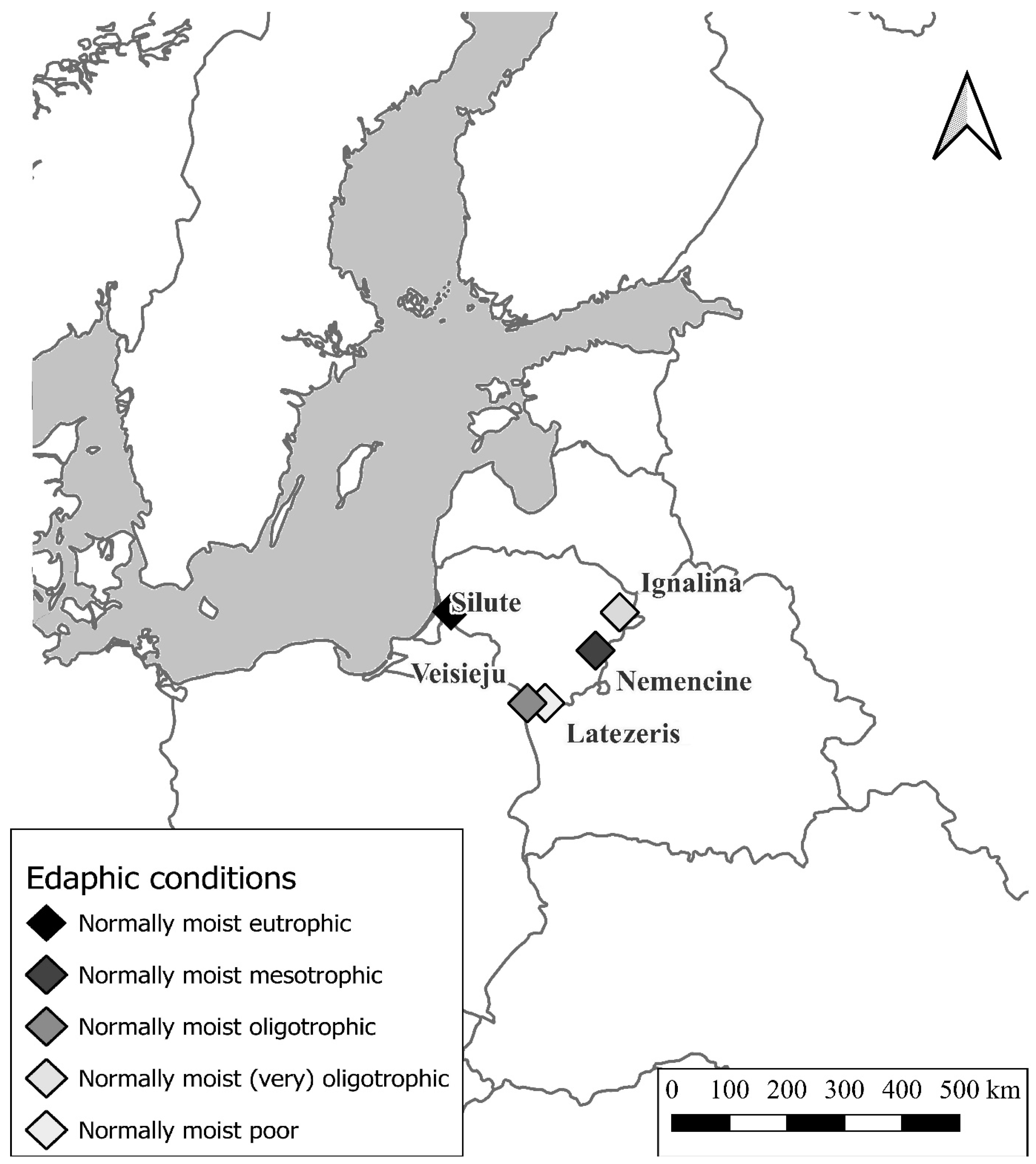
2.1. Trials and Genotypes
2.2. Sampling and Measurements
2.3. Data Analysis
3. Results
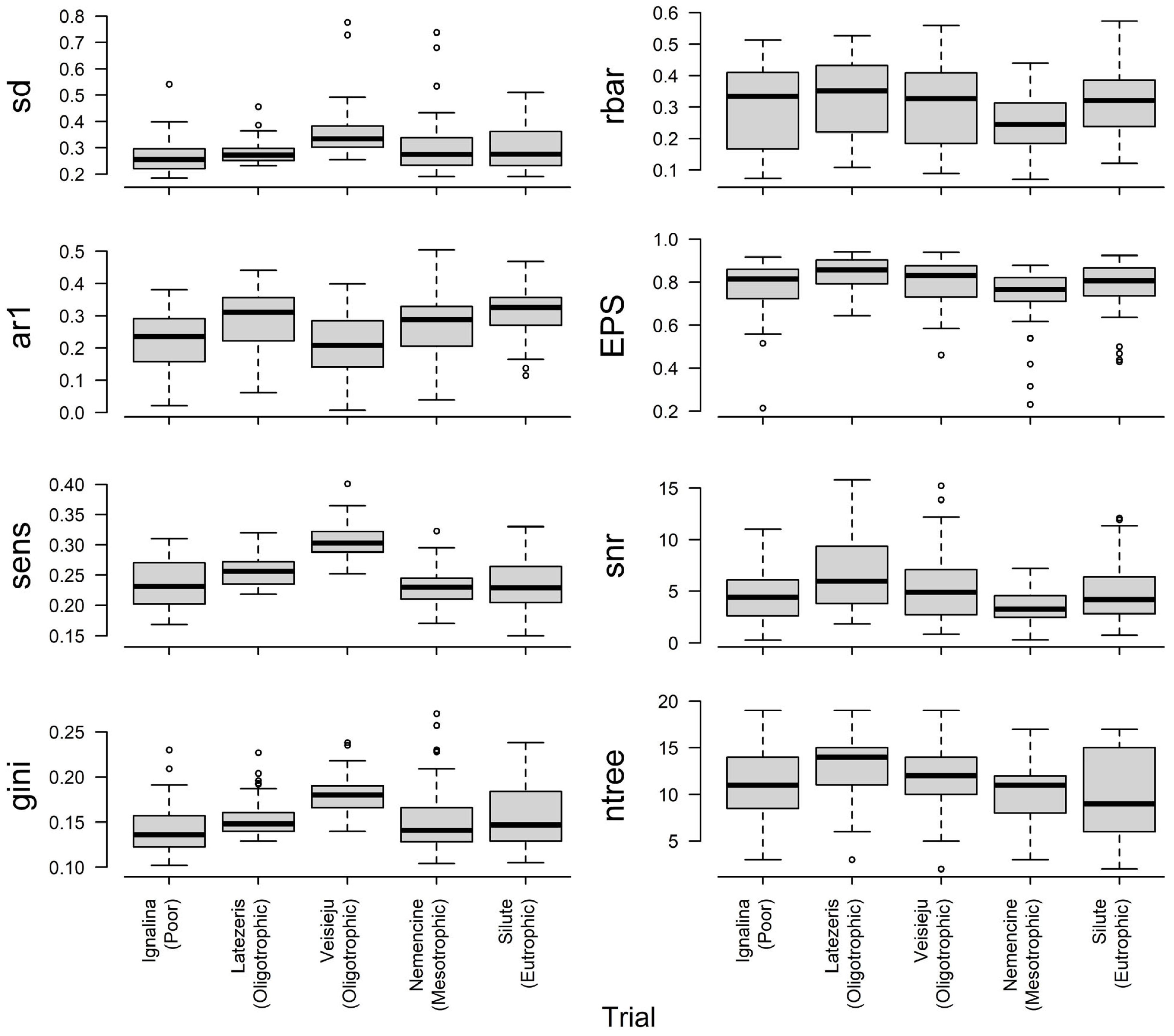
3.1. Statistics of the Dataset
3.2. Interannual Variability and Weather-Growth Relationships
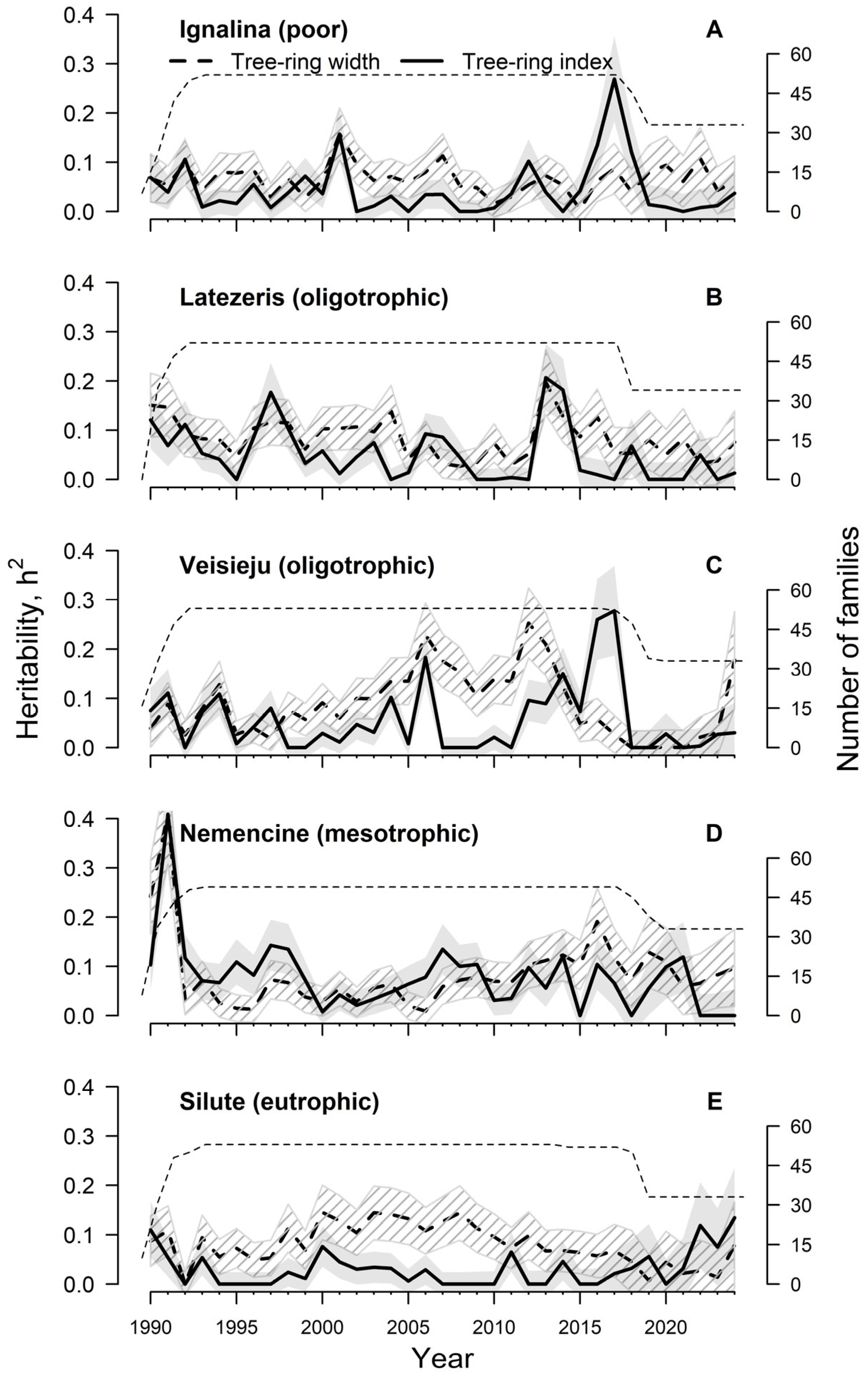
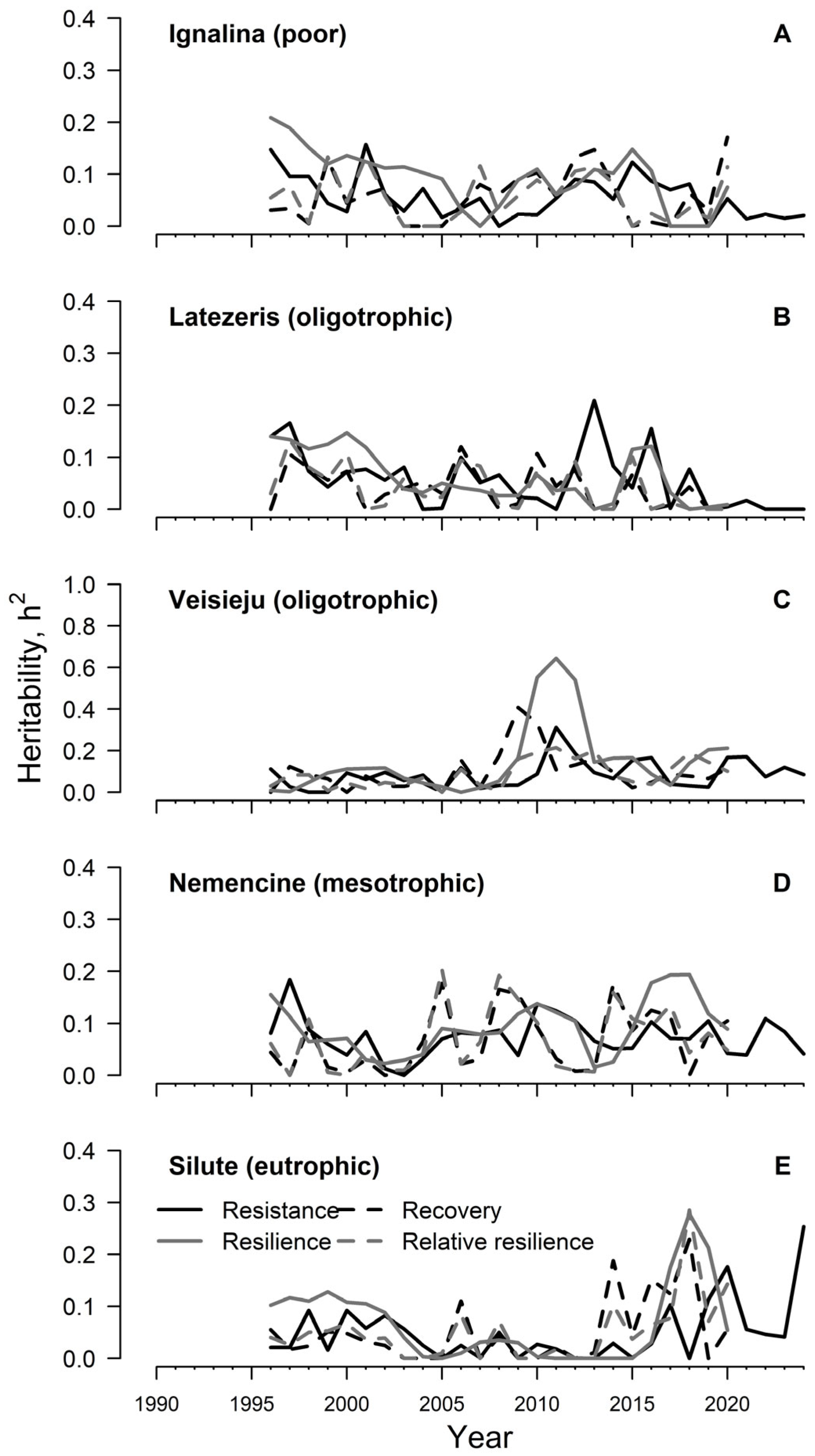
3.3. Genetic Control of Growth, Resilience, and Sensitivity Traits
4. Discussion
4.1. Informativity of Increment
4.2. Sensitivity and Climatic Drivers of Increment
4.3. Genetic Control of Climate Sensiitive Functional Traits
4.4. Limitations
5. Conclusions
Supplementary Materials
Author Contributions
Funding
Data Availability Statement
Acknowledgments
Conflicts of Interest
References
- Vinceti, B.; Manica, M.; Lauridsen, N.; Verkerk, P.J.; Lindner, M.; Fady, B. Managing forest genetic resources as a strategy to adapt forests to climate change: Perceptions of European forest owners and managers. Eur. J. For. Res. 2020, 139, 1107–1119. [Google Scholar] [CrossRef]
- Fady, B.; Cottrell, J.; Ackzell, L.; Alía, R.; Muys, B.; Prada, A.; González-Martínez, S.C. Forests and global change: What can genetics contribute to the major forest management and policy challenges of the twenty-first century? Reg. Environ. Change 2016, 16, 927–939. [Google Scholar] [CrossRef]
- Brizga, J.; Räty, T. Production, consumption and trade-based forest land and resource footprints in the Nordic and Baltic countries. For. Policy Econ. 2024, 161, 103166. [Google Scholar] [CrossRef]
- Rytter, L.; Ingerslev, M.; Kilpeläinen, A.; Torssonen, P.; Lazdina, D.; Löf, M.; Madsen, P.; Muiste, P.; Stener, L.-G. Increased forest biomass production in the Nordic and Baltic countries–a review on current and future opportunities. Silva Fenn. 2016, 50, 1660. [Google Scholar] [CrossRef]
- Buras, A.; Menzel, A. Projecting tree species composition changes of European forests for 2061- 2090 under RCP 4.5 and RCP 8.5 Scenarios. Front. Plant Sci. 2019, 9, 1986. [Google Scholar] [CrossRef] [PubMed]
- Ray, D.; Berlin, M.; Alia, R.; Sanchez, L.; Hynynen, J.; González-Martinez, S.; Bastien, C. Transformative changes in tree breeding for resilient forest restoration. Front. For. Glob. Change 2022, 5, 1005761. [Google Scholar] [CrossRef]
- Jansson, G.; Hansen, J.K.; Haapanen, M.; Kvaalen, H.; Steffenrem, A. The genetic and economic gains from forest tree breeding programmes in Scandinavia and Finland. Scand. J. For. Res. 2017, 32, 273–286. [Google Scholar] [CrossRef]
- Kauppi, P.E.; Stål, G.; Arnesson-Ceder, L.; Sramek, I.H.; Hoen, H.F.; Svensson, A.; Wernick, I.K.; Högberg, P.; Lundmark, T.; Nordin, A. Managing existing forests can mitigate climate change. For. Ecol. Manag. 2022, 513, 120186. [Google Scholar] [CrossRef]
- Horl, J.; Keller, K.; Yousefpour, R. Reviewing the performance of adaptive forest management strategies with robustness analysis. For. Policy Econ. 2020, 119, 102289. [Google Scholar] [CrossRef]
- Sousa-Silva, R.; Verbist, B.; Lomba, Â.; Valent, P.; Suškevičs, M.; Picard, O.; Hoogstra-Klein, M.A.; Cosofret, V.-C.; Bouriaud, L.; Ponette, Q.; et al. Adapting forest management to climate change in Europe: Linking perceptions to adaptive responses. For. Policy Econ. 2018, 90, 22–30. [Google Scholar] [CrossRef]
- Cortes, A.J.; Restrepo-Montoya, M.; Bedoya-Canas, L.E. Modern strategies to assess and breed forest tree adaptation to changing climate. Front. Plant Sci. 2020, 11, 583323. [Google Scholar] [CrossRef] [PubMed]
- Laverdiere, J.P.; Lenz, P.; Nadeau, S.; Depardieu, C.; Isabel, N.; Perron, M.; Beaulieu, J.; Bousquet, J. Breeding for adaptation to climate change: Genomic selection for drought response in a white spruce multi-site polycross test. Evol. Appl. 2022, 15, 383–402. [Google Scholar] [CrossRef] [PubMed]
- Li, Y.; Suontama, M.; Burdon, R.D.; Dungey, H.S. Genotype by environment interactions in forest tree breeding: Review of methodology and perspectives on research and application. Tree Genet. Genomes 2017, 13, 60. [Google Scholar] [CrossRef]
- Ansarifar, J.; Akhavizadegan, F.; Wang, L. Performance prediction of crosses in plant breeding through genotype by environment interactions. Sci. Rep. 2020, 10, 11533. [Google Scholar] [CrossRef] [PubMed]
- de la Mata, R.; Zas, R.; Bustingorri, G.; Sampedro, L.; Rust, M.; Hernandez-Serrano, A.; Sala, A. Drivers of population differentiation in phenotypic plasticity in a temperate conifer: A 27-year study. Evol. Appl. 2022, 15, 1945–1962. [Google Scholar] [CrossRef] [PubMed]
- Chmura, D.J.; Barzdajn, W.; Kowalkowski, W.; Guzicka, M.; Rożkowski, R. Analysis of genotype-by-environment interaction in a multisite progeny test with Scots pine for supporting selection decisions. Eur. J. For. Res. 2021, 140, 1457–1467. [Google Scholar] [CrossRef]
- Moran, E.; Lauder, J.; Musser, C.; Stathos, A.; Shu, M. The genetics of drought tolerance in conifers. New Phytol. 2017, 216, 1034–1048. [Google Scholar] [CrossRef] [PubMed]
- Poupon, V.; Gezan, S.A.; Schueler, S.; Lstibůrek, M. Genotype × environment interaction and climate sensitivity in growth and wood density of European larch. For. Ecol. Manag. 2023, 545, 121259. [Google Scholar] [CrossRef]
- Berauer, B.J.; Steppuhn, A.; Schweiger, A.H. The multidimensionality of plant drought stress: The relative importance of edaphic and atmospheric drought. Plant Cell Environ. 2024, 47, 3528–3540. [Google Scholar] [CrossRef] [PubMed]
- Mikalajunas, M.; Pretzsch, H.; Mozgeris, G.; Linkevičius, E.; Augustaitiene, I.; Augustaitis, A. Scots pine’s capacity to adapt to climate change in hemi-boreal forests in relation to dominating tree increment and site condition. iForest-Biogeosci. For. 2021, 14, 473. [Google Scholar] [CrossRef]
- Rubilar, R.; Hubbard, R.; Emhart, V.; Mardones, O.; Quiroga, J.J.; Medina, A.; Valenzuela, H.; Espinoza, J.; Burgos, Y.; Bozo, D. Climate and water availability impacts on early growth and growth efficiency of Eucalyptus genotypes: The importance of G×E interactions. For. Ecol. Manag. 2020, 458, 117763. [Google Scholar] [CrossRef]
- Rehschuh, R.; Mette, T.; Menzel, A.; Buras, A. Soil properties affect the drought susceptibility of Norway spruce. Dendrochronologia 2017, 45, 81–89. [Google Scholar] [CrossRef]
- Callahan, R.P.; Riebe, C.S.; Sklar, L.S.; Pasquet, S.; Ferrier, K.L.; Hahm, W.J.; Taylor, N.J.; Grana, D.; Flinchum, B.A.; Hayes, J.L.; et al. Forest vulnerability to drought controlled by bedrock composition. Nat. Geosci. 2022, 15, 714–719. [Google Scholar] [CrossRef]
- Mausolf, K.; Wilm, P.; Härdtle, W.; Jansen, K.; Schuldt, B.; Sturm, K.; von Oheimb, G.; Hertel, D.; Leuschner, C.; Fichtner, A. Higher drought sensitivity of radial growth of European beech in managed than in unmanaged forests. Sci. Total Environ. 2018, 642, 1201–1208. [Google Scholar] [CrossRef] [PubMed]
- Basnet, S.; Burger, A.; Homolová, Z.; Märker, F.; Trouillier, M.; Wilmking, M. Effect of bedrock, tree size and time on growth and climate sensitivity of Norway spruce in the High Tatras. Eur. J. For. Res. 2024, 143, 1835–1851. [Google Scholar] [CrossRef]
- Zavyalov, K.; Ivanova, N.; Potapenko, A.; Ayan, S. Influence of soil fertility on the ability of Scots pine (Pinus sylvestris L.) to adapt to technogenic pollution. Cerne 2020, 25, 326–331. [Google Scholar] [CrossRef]
- Rousi, M.; Possen, B.J.; Ruotsalainen, S.; Silfver, T.; Mikola, J. Temperature and soil fertility as regulators of tree line Scots pine growth and survival—Implications for the acclimation capacity of northern populations. Glob. Change Biol. 2018, 24, 545–559. [Google Scholar] [CrossRef] [PubMed]
- Stolz, J.; van der Maaten, E.; Kalanke, H.; Martin, J.; Wilmking, M.; van der Maaten-Theunissen, M. Increasing climate sensitivity of beech and pine is not mediated by adaptation and soil characteristics along a precipitation gradient in northeastern Germany. Dendrochronologia 2021, 67, 125834. [Google Scholar] [CrossRef]
- Burdon, R.D.; Klapste, J. Alternative selection methods and explicit or implied economic-worth functions for different traits in tree breeding. Tree Genet. Genomes 2019, 15, 79. [Google Scholar] [CrossRef]
- Oddou-Muratorio, S.; Davi, H.; Lefèvre, F. Integrating evolutionary, demographic and ecophysiological processes to predict the adaptive dynamics of forest tree populations under global change. Tree Genet. Genomes 2020, 16, 67. [Google Scholar] [CrossRef]
- Breed, M.F.; Harrison, P.A.; Bischoff, A.; Durruty, P.; Gellie, N.J.C.; Gonzales, E.K.; Havens, K.; Karmann, M.; Kilkenny, F.F.; Krauss, S.L.; et al. Priority actions to improve provenance decision-making. BioScience 2018, 68, 510–516. [Google Scholar] [CrossRef]
- Chaudhary, R.; Estravis Barcala, M.; Fundova, I.; Funda, T.; Chen, Z.Q.; Wu, H.X. Breeding for climate adaptation: Genetic variation and genomic selection for drought response in Scots pine. BMC Genom. 2026, 27, 416. [Google Scholar] [CrossRef] [PubMed]
- Klisz, M.; Chakraborty, D.; Cvjetković, B.; Grabner, M.; Lintunen, A.; Mayer, K.; George, J.-P.; Rossi, S. Functional Traits of Boreal Species and Adaptation to Local Conditions. In Boreal Forests in the Face of Climate Change; Girona, M.M., Morin, H., Gauthier, S., Bergeron, Y., Eds.; Advances in Global Change Research; Springer: Cham, Switzerland, 2023; Volume 74. [Google Scholar] [CrossRef]
- Pennacchi, J.; Lira, J.; Rodrigues, M.; Garcia, F.H.S.; Mendonça, A.; Barbosa, J.P. A systemic approach to the quantification of the phenotypic plasticity of plant physiological traits: The multivariate plasticity index. J. Exp. Bot. 2021, 72, 1864–1878. [Google Scholar] [CrossRef] [PubMed]
- Heer, K.; Behringer, D.; Piermattei, A.; Bässler, C.; Brandl, R.; Fady, B.; Jehl, H.; Liepelt, S.; Lorch, S.; Piotti, A.; et al. Linking dendroecology and association genetics in natural populations: Stress responses archived in tree rings associate with SNP genotypes in silver fir (Abies alba Mill.). Mol. Ecol. 2018, 27, 1428–1438. [Google Scholar] [CrossRef] [PubMed]
- Housset, J.M.; Nadeau, S.; Isabel, N.; Depardieu, C.; Duchesne, I.; Lenz, P.; Girardin, M.P. Tree rings provide a new class of phenotypes for genetic associations that foster insights into adaptation of conifers to climate change. New Phytol. 2018, 218, 630–645. [Google Scholar] [CrossRef] [PubMed]
- Wilmking, M.; van der Maaten-Theunissen, M.; van der Maaten, E.; Scharnweber, T.; Buras, A.; Biermann, C.; Gurskaya, M.; Hallinger, M.; Lange, J.; Shetti, R.; et al. Global assessment of relationships between climate and tree growth. Glob. Change Biol. 2020, 26, 3212–3220. [Google Scholar] [CrossRef] [PubMed]
- Babst, F.; Bouriaud, O.; Poulter, B.; Trouet, V.; Girardin, M.P.; Frank, D.C. Twentieth century redistribution in climatic drivers of global tree growth. Sci. Adv. 2019, 5, eaat4313. [Google Scholar] [CrossRef] [PubMed]
- Xu, K.; Wang, X.; Liang, P.; An, H.; Sun, H.; Han, W.; Li, Q. Tree-ring widths are good proxies of annual variation in forest productivity in temperate forests. Sci. Rep. 2017, 7, 1945. [Google Scholar] [CrossRef] [PubMed]
- Mäkinen, H.; Jyske, T.; Nöjd, P. Dynamics of diameter and height increment of Norway spruce and Scots pine in southern Finland. Ann. For. Sci. 2018, 75, 28. [Google Scholar] [CrossRef]
- Rossi, S.; Cairo, E.; Krause, C.; Deslauriers, A. Growth and basic wood properties of black spruce along an alti-latitudinal gradient in Quebec, Canada. Ann. For. Sci. 2015, 72, 77–87. [Google Scholar] [CrossRef]
- Matisons, R.; Elferts, D.; Krišāns, O.; Schneck, V.; Gärtner, H.; Bast, A.; Wojda, T.; Kowalczyk, J.; Jansons, Ā. Non-linear regional weather-growth relationships indicate limited adaptability of the eastern Baltic Scots pine. For. Ecol. Manag. 2021, 479, 118600. [Google Scholar] [CrossRef]
- Cuny, H.E.; Fonti, P.; Rathgeber, C.B.K.; Von Arx, G.; Peters, R.L.; Frank, D.C. Couplings in cell differentiation kinetics mitigate air temperature influence on conifer wood anatomy. Plant Cell Environ. 2019, 4, 1222–1232. [Google Scholar] [CrossRef] [PubMed]
- Isaac-Renton, M.; Montwe, D.; Hamann, A.; Spiecker, H.; Cherubini, P.; Treydte, K. Northern forest tree populations are physiologically maladapted to drought. Nat. Commun. 2018, 9, 5254. [Google Scholar] [CrossRef] [PubMed]
- Schwarz, J.; Skiadaresis, G.; Kohler, M.; Kunz, J.; Schnabel, F.; Vitali, V.; Bauhus, J. Quantifying growth responses of trees to drought—A critique of commonly used resilience indices and recommendations for future studies. Curr. For. Rep. 2020, 6, 185–200. [Google Scholar] [CrossRef]
- Jetschke, G.; van der Maaten, E.; van der Maaten-Theunissen, M. Towards the extremes: A critical analysis of pointer year detection methods. Dendrochronologia 2019, 53, 55–62. [Google Scholar] [CrossRef]
- Sullivan, P.F.; Pattison, R.R.; Brownlee, A.H.; Cahoon, S.M.; Hollingsworth, T.N. Effect of tree-ring detrending method on apparent growth trends of black and white spruce in interior Alaska. Environ. Res. Lett. 2016, 11, 114007. [Google Scholar] [CrossRef]
- Peters, R.L.; Groenendijk, P.; Vlam, M.; Zuidema, P.A. Detecting long-term growth trends using tree rings: A critical evaluation of methods. Glob. Change Biol. 2015, 21, 2040–2054. [Google Scholar] [CrossRef] [PubMed]
- Falconer, D.S.; Mackay, T.F.C. Introduction to Quantitative Genetics, 4th ed.; Longmans Green: Harlow, UK, 1996; p. 635. [Google Scholar]
- Šņepsts, G.; Donis, J.; Adamovičs, A.; Jansons, A.; Putniņš, R.; Razma, Ģ.; Zvirbulis, U.; Zariņš, J.; Matisons, R.; Jansons, J. Forest statistics from the National Forest Inventory in Latvia for 2004–2025. Balt. For. 2026, 32, id829. [Google Scholar] [CrossRef]
- Routa, J.; Kilpeläinen, A.; Ikonen, V.P.; Asikainen, A.; Venäläinen, A.; Peltola, H. Effects of intensified silviculture on timber production and its economic profitability in boreal Norway spruce and Scots pine stands under changing climatic conditions. For. Int. J. For. Res. 2019, 92, 648–658. [Google Scholar] [CrossRef]
- del Castillo, E.M.; Torbenson, M.C.; Reinig, F.; Tejedor, E.; de Luis, M.; Esper, J. Contrasting future growth of Norway spruce and Scots pine forests under warming climate. Glob. Change Biol. 2024, 30, e17580. [Google Scholar] [CrossRef] [PubMed]
- Wegener, M.; van der Maaten-Theunissen, M.; Schneck, V.; van der Maaten, E. Provenance without effect? Climate–growth relationships and drought tolerance in a Scots pine (Pinus sylvestris L.) provenance trial in northeastern Germany. For. Ecol. Manag. 2026, 614, 123822. [Google Scholar] [CrossRef]
- Harvey, J.; Smiljanić, M.; Scharnweber, T.; Buras, A.; Cedro, A.; Cruz-García, R.; Drobyshev, I.; Janecka, K.; Jansons, Ā.; Kaczka, R.; et al. Tree growth influenced by warming winter climate and summer moisture availability in northern temperate forests. Glob. Change Biol. 2020, 26, 2505–2518. [Google Scholar] [CrossRef] [PubMed]
- Matisons, R.; Schneck, V.; Jansone, D.; Bāders, E.; Dubra, S.; Zeltiņš, P.; Jansons, Ā. South-eastern Baltic provenances of Scots pine show heritable weather-growth relationships. Forests 2021, 12, 1101. [Google Scholar] [CrossRef]
- Stoncelis, A.; Juškauskaitė, A.; Baliuckas, V. Wood properties of nine Pinus sylvestris open-pollinated families originating from different Lithuanian populations. Acta Biol. Univ. Daugavp. 2017, 17, 237–241. [Google Scholar]
- Kavaliauskas, D.; Danusevičius, D.; Baliuckas, V. New insight into genetic structure and diversity of Scots pine (Pinus sylvestris L.) populations in Lithuania based on nuclear, chloroplast and mitochondrial DNA markers. Forests 2022, 13, 1179. [Google Scholar] [CrossRef]
- Danusevičius, D.; Rajora, O.P.; Kavaliauskas, D.; Baliuckas, V.; Augustaitis, A. Stronger genetic differentiation among within-population genetic groups than among populations in Scots pine provides new insights into within-population genetic structuring. Sci. Rep. 2024, 14, 2713. [Google Scholar] [CrossRef] [PubMed]
- Kottek, M.; Grieser, J.; Beck, C.; Rudolf, B.; Rubel, F. World Map of the Köppen-Geiger climate classification updated. Meteorol. Z. 2006, 15, 259–263. [Google Scholar] [CrossRef] [PubMed]
- Harris, I.; Osborn, T.J.; Jones, P.; Lister, D. Version 4 of the CRU TS monthly high-resolution gridded multivariate climate dataset. Sci. Data 2020, 7, 109. [Google Scholar] [CrossRef] [PubMed]
- Meier, H.E.M.; Kniebusch, M.; Dieterich, C.; Gröger, M.; Zorita, E.; Elmgren, R.; Myrberg, K.; Ahola, M.P.; Bartosova, A.; Bonsdorff, E.; et al. Climate change in the Baltic Sea region: A summary. Earth Syst. Dyn. 2022, 13, 457–593. [Google Scholar] [CrossRef]
- Allen, C.D.; Breshears, D.D.; McDowell, N.G. On underestimation of global vulnerability to tree mortality and forest die-off from hotter drought in the Anthropocene. Ecosphere 2015, 6, 1–55. [Google Scholar] [CrossRef]
- Bunn, A.G. Statistical and visual crossdating in R using the dplR library. Dendrochronologia 2010, 28, 251–258. [Google Scholar] [CrossRef]
- Klesse, S. Critical note on the application of the “two-third” spline. Dendrochronologia 2021, 65, 125786. [Google Scholar] [CrossRef]
- Wigley, T.M.; Briffa, K.R.; Jones, P.D. On the average value of correlated time series, with applications in dendroclimatology and hydrometeorology. J. Appl. Meteorol. Climatol. 1984, 23, 201–213. [Google Scholar] [CrossRef] [PubMed]
- Zang, C.; Biondi, F. Treeclim: An R package for the numerical calibration of proxy-climate relationships. Ecography 2015, 38, 431–436. [Google Scholar] [CrossRef]
- Vicente-Serrano, S.M.; Begueria, S.; Lopez-Moreno, J.I. A multiscalar drought index sensitive to global warming: The standardized precipitation evapotranspiration index. J. Clim. 2010, 23, 1696–1718. [Google Scholar] [CrossRef]
- Lloret, F.; Keeling, E.G.; Sala, A. Components of tree resilience: Effects of successive low-growth episodes in old ponderosa pine forests. Oikos 2011, 120, 1909–1920. [Google Scholar] [CrossRef]
- Dickerson, G.E. Techniques for research in quantitative animal genetics. In Techniques and Procedures in Animal Science Research; American Society of Animal Science: Albany, NY, USA, 1969; pp. 36–79. [Google Scholar]
- R Core Team. R: A Language and Environment for Statistical Computing; R Foundation for Statistical Computing: Vienna, Austria, 2025; Available online: https://www.R-project.org/ (accessed on 25 November 2025).
- Bates, D.; Mächler, M.; Bolker, B.; Walker, S. Fitting linear mixed-effects models using lme4. J. Stat. Softw. 2015, 67, 1–48. [Google Scholar] [CrossRef]
- Grossnickle, S.C.; El-Kassaby, Y.A. Bareroot versus container stocktypes: A performance comparison. New For. 2016, 47, 1–51. [Google Scholar] [CrossRef]
- Stoncelis, A. Dependence of Wood Properties of the Main Forest Tree Species on Environment and Genotype. Doctoral Dissertation, Aleksandro Stulginskis University, Lithuanian Research Centre for Agriculture and Forestry, Kaunas, Lithuania, 2019. [Google Scholar]
- Yermokhin, M.V. Dendrochronological zoning of Scots pine in Belarus. Proc. Natl. Acad. Sci. Belarus Biol. Ser. 2020, 65, 441–453. [Google Scholar] [CrossRef]
- Mozgeris, G.; Brukas, V.; Pivoriūnas, N.; Činga, G.; Makrickienė, E.; Byčenkienė, S.; Marozas, V.; Mikalajūnas, M.; Dudoitis, V.; Ulevičius, V.; et al. Spatial pattern of climate change effects on Lithuanian forestry. Forests 2019, 10, 809. [Google Scholar] [CrossRef]
- Linkevičius, E.; Kliučius, A.; Šidlauskas, G.; Augustaitis, A. Variability in growth patterns and tree-ring formation of East European Scots Pine (Pinus sylvestris L.) provenances to changing climatic conditions in Lithuania. Forests 2022, 13, 743. [Google Scholar] [CrossRef]
- Trouillier, M.; van der Maaten-Theunissen, M.; Scharnweber, T.; Würth, D.; Burger, A.; Schnittler, M.; Wilmking, M. Size matters—A comparison of three methods to assess age-and size-dependent climate sensitivity of trees. Trees 2019, 33, 183–192. [Google Scholar] [CrossRef]
- Hacket-Pain, A.J.; Friend, A.D.; Lageard, J.G.; Thomas, P.A. The influence of masting phenomenon on growth–climate relationships in trees: Explaining the influence of previous summers’ climate on ring width. Tree Physiol. 2015, 35, 319–330. [Google Scholar] [CrossRef] [PubMed]
- Tierney, G.L.; Fahey, T.J.; Groffman, P.M.; Hardy, J.P.; Fitzhugh, R.D.; Driscoll, C.T. Soil freezing alters fine root dynamics in a northern hardwood forest. Biogeochemistry 2001, 56, 175–190. [Google Scholar] [CrossRef]
- Wang, T.; O’Neill, G.A.; Aitken, S.N. Integrating environmental and genetic effects to predict responses of tree populations to climate. Ecol. Appl. 2010, 20, 153–163. [Google Scholar] [CrossRef] [PubMed]
- Matisons, R.; Krišāns, O.; Jansone, D.; Jansons, Ā.; Zeltiņš, P. The genetic and environmental variance of radial increment in Scots pine of south-eastern Baltic provenances in response to weather extremes. Balt. For. 2024, 30, id719. [Google Scholar] [CrossRef]
- Hacket-Pain, A.; Ascoli, D.; Berretti, R.; Mencuccini, M.; Motta, R.; Nola, P.; Piussi, P.; Ruffinatto, F.; Vacchiano, G. Temperature and masting control Norway spruce growth, but with high individual tree variability. For. Ecol. Manag. 2019, 438, 142–150. [Google Scholar] [CrossRef]
- Kremer, A.; Chen, J.; Lascoux, M. ‘Chimes of resilience’: What makes forest trees genetically resilient? New Phytol. 2025, 246, 1934–1951. [Google Scholar] [CrossRef] [PubMed]





| SD | AR1 | SENS | GINI | r-bar | EPS | SNR | |
|---|---|---|---|---|---|---|---|
| Population | 1.4 | 1.6 | 2.0 | 2.4 * | 0.8 | 0.2 | 1.3 |
| Trial | 1.2 | 11.8 *** | 74.9 *** | 14.1 *** | 9.2 *** | 3.6 ** | 7.8 *** |
| Replication | 0.2 | 1.2 | 0.2 | 0.3 | 5.0 * | 180.3 *** | 146.3 *** |
| Tree rings per tree | 10.1 ** | 41.3 *** | 88.6 *** | 41.9 *** | 218.7 *** | 186.6 *** | 213.3 *** |
| Population by trial interaction | 0.5 | 1.2 | 1.5 | 1.4 | 1.0 | 1.0 | 1.2 |
| R2 | 0.078 | 0.318 | 0.67 | 0.417 | 0.577 | 0.523 | 0.569 |
Disclaimer/Publisher’s Note: The statements, opinions and data contained in all publications are solely those of the individual author(s) and contributor(s) and not of MDPI and/or the editor(s). MDPI and/or the editor(s) disclaim responsibility for any injury to people or property resulting from any ideas, methods, instructions or products referred to in the content. |
© 2026 by the authors. Licensee MDPI, Basel, Switzerland. This article is an open access article distributed under the terms and conditions of the Creative Commons Attribution (CC BY) license.
Share and Cite
Rieksts-Riekstiņš, R.; Elferts, D.; Matisons, R.; Zeltiņš, P.; Jansone, D.; Jaunslaviete, I.; Jansons, Ā.; Stoncelis, A.; Juškauskaitė, A.; Baliuckas, V. Meteorological Conditions and Site Productivity Modulate Genetic Controls over Radial Increment, but Not the Sensitivity of Hemiboreal Scots Pine. Forests 2026, 17, 806. https://doi.org/10.3390/f17070806
Rieksts-Riekstiņš R, Elferts D, Matisons R, Zeltiņš P, Jansone D, Jaunslaviete I, Jansons Ā, Stoncelis A, Juškauskaitė A, Baliuckas V. Meteorological Conditions and Site Productivity Modulate Genetic Controls over Radial Increment, but Not the Sensitivity of Hemiboreal Scots Pine. Forests. 2026; 17(7):806. https://doi.org/10.3390/f17070806
Chicago/Turabian StyleRieksts-Riekstiņš, Raitis, Didzis Elferts, Roberts Matisons, Pauls Zeltiņš, Diāna Jansone, Ieva Jaunslaviete, Āris Jansons, Adomas Stoncelis, Aušra Juškauskaitė, and Virgilijus Baliuckas. 2026. "Meteorological Conditions and Site Productivity Modulate Genetic Controls over Radial Increment, but Not the Sensitivity of Hemiboreal Scots Pine" Forests 17, no. 7: 806. https://doi.org/10.3390/f17070806
APA StyleRieksts-Riekstiņš, R., Elferts, D., Matisons, R., Zeltiņš, P., Jansone, D., Jaunslaviete, I., Jansons, Ā., Stoncelis, A., Juškauskaitė, A., & Baliuckas, V. (2026). Meteorological Conditions and Site Productivity Modulate Genetic Controls over Radial Increment, but Not the Sensitivity of Hemiboreal Scots Pine. Forests, 17(7), 806. https://doi.org/10.3390/f17070806