1. Introduction
Forest food provisioning is an important but unevenly measured component of forest use. Forests provide timber, edible products and a broad range of regulating and cultural ecosystem services. Within the broader group of non-wood forest products (NWFPs), forest foods include mushrooms, berries, nuts, culinary plants and game, while the wider NWFP category also encompasses medicinal plants and other biological products derived from forests, other wooded land and trees outside forests. Forest foods contribute to household consumption, informal exchange, recreation, cultural practices and local economies [
1,
2,
3].
In Europe, forest foods play a significant role, yet their contribution is often challenging to quantify through conventional economic statistics. A considerable portion of collection and consumption takes place outside formal markets through self-provisioning, gifting, local exchange or small-scale direct sales. Formal retail turnover therefore provides only a partial view of the significance of forest foods. European research has shown that mushrooms, berries and other NWFPs can be socially and economically significant even where their market visibility is limited or fragmented [
4,
5]. This underscores the need for approaches that integrate physical quantities, household behaviour, value-chain organisation and trade statistics.
Forest foods can be understood at the intersection of three complementary perspectives: provisioning ecosystem services, household self-provisioning and food-system value chains. The ecosystem-services perspective frames mushrooms, forest fruits and game meat as forest-related provisioning contributions, while the self-provisioning perspective explains why their socio-economic significance is often realised through household collection, preservation, gifting and informal circulation rather than through formal markets alone. The value-chain and food-system perspective then clarifies how these products move, or fail to move, from biological availability or primary supply into standardised, safe and consumer-ready forms. Some products are collected by households for immediate consumption or preserved for future use, while others require stabilised product forms, processing, quality assurance, hygiene control or specialised distribution before they can enter formal food markets [
2,
6,
7]. NWFP value chains consequently differ according to product type, region, ownership structure, processing requirements and market organisation [
8]. This product-specific diversity is crucial for understanding supply, trade and consumption patterns. Category-specific analysis is therefore appropriate because the transition from biological availability in forests, or from hunted game to household use or market sale follows distinct acquisition and distribution mechanisms. Accordingly, mushrooms, forest fruits and game meat are compared here as forest-food categories with different dominant routes into household provisioning and formal market access.
Czechia provides a suitable case for examining these distinctions because public forest access, rich foraging traditions, regulated hunting and a retail food system coexist within one national context. Mushrooms, forest fruits and game meat represent three major forest-food categories examined in this study, yet they enter households and markets through different acquisition and distribution channels. This combination provides a valuable perspective for understanding the socio-economic significance of forest foods beyond their presence in formal retail environments [
1,
9]. The Czech legal framework helps to explain the different acquisition and market pathways analysed in this study. Under Act No. 289/1995 Coll., the Forest Act [
10], individuals may enter forests and collect forest fruits for their own needs, but they must not damage the forest, disturb the forest environment or enter restricted, fenced or signposted areas. This right supports household self-provisioning, including mushroom and forest-fruit collection, but it does not provide an unrestricted basis for commercial harvesting by enterprises. Commercial use requires an appropriate legal basis, typically agreement with the forest owner or another authorised holder, and compliance with food-law requirements when products are placed on the market. Additional restrictions may apply in protected areas and for protected species under Act No. 114/1992 Coll., on Nature and Landscape Protection [
11]. Once wild mushrooms are marketed, Czech food legislation regulates their quality, permitted species, storage and transport conditions, especially under Act No. 110/1997 Coll., on Foodstuffs [
12], and Decree No. 397/2021 Coll. [
13]. Game meat follows a separate and more regulated pathway because hunting, handling and trade are subject to Act No. 449/2001 Coll., on Hunting [
14], Act No. 166/1999 Coll., on Veterinary Care [
15], and EU hygiene rules for food of animal origin, especially Regulation (EC) No. 853/2004;Laying down specific hygiene rules for food of animal origin. [
16]. These legal distinctions reinforce the analytical separation between household collection, retail purchase and regulated game-meat value chains.
Previous Czech and Central European research has documented substantial household engagement with mushroom and forest-fruit collection and has shown that NWFPs relate to forest visitation, recreation and household use [
3,
4,
9,
17,
18,
19,
20]. This Czech evidence also links NWFP use to the forest-based bioeconomy, public preferences for non-wood forest products and long-term monitoring of forest visits, mushroom picking and forest-fruit collection [
17,
18,
19]. Research on game meat has mainly addressed consumer attitudes, market barriers, safety requirements and value-chain organisation [
6,
7,
21]. At the European level, NWFP research has further emphasised that household collection, informal circulation, processing, marketing and institutional arrangements form interconnected parts of product-specific value chains and broader NWFP valorisation systems [
5,
8,
22,
23]. Taken together, this literature provides strong evidence on individual components of forest-food systems, including household collection, public preferences, consumer barriers, food-safety requirements and NWFP value-chain organisation. A more integrated product-specific comparison remains useful for understanding how the main forest-food categories within one national setting differ in their routes from forest-based supply to household use, market acquisition and value creation.
This article addresses this gap by comparing mushrooms, forest fruits and game meat as product-specific forest-food provisioning systems in Czechia. The primary aim is to characterise their acquisition mechanisms, market visibility, and value-chain positions and to provide a 2024 reference-year comparison of their category-specific physical estimates and stage-specific indicative values. The main contribution of the study is therefore the integration of household acquisition behaviour, market access, value-chain organisation and indicative economic significance within one comparative empirical framework, rather than treating forest foods as a single aggregate NWFP category.
The analysis is guided by four research questions:
RQ1. What acquisition mechanisms, levels of market visibility and value-chain positions characterise mushrooms, forest fruits and game meat within the Czech non-wood forest product system?
RQ2. What patterns of household collection and market purchase characterise mushrooms and forest fruits, and how are these patterns associated with reported quantities, forest visitation and settlement size?
RQ3. What consumption frequencies, procurement channels, perceived barriers and value-chain requirements characterise game meat as a market-oriented forest-food category?
RQ4. What are the category-specific reference-year physical estimates and stage-specific indicative economic values of mushrooms, forest fruits and game meat in Czechia in the 2024 reference year?
2. Materials and Methods
The design combines four evidence sources: (i) pooled nationally representative survey data for mushrooms and forest fruits from 2021 to 2025; (ii) a 2022 survey extension focused on game-meat consumption, procurement channels, purchase forms and barriers to more frequent use; (iii) qualitative interviews with actors in the Czech game-meat value chain; and (iv) official hunting statistics, carcass-weight coefficients and game-in-hide procurement prices used to estimate game-meat supply volume and primary procurement value. These sources were used for different but complementary analytical purposes: the pooled survey data were used to analyse household acquisition and household-reported quantities of mushrooms and forest fruits; the 2022 survey extension provided respondent-level evidence on game-meat consumption, procurement channels and barriers; the qualitative interviews supported contextual interpretation of the Czech game-meat value chain; and official hunting statistics and procurement prices were used for the game-meat volume and primary-procurement estimate. The comparison is therefore product-based and multi-source, reflecting the distinct provisioning and market characteristics of each forest-food category and the stage-specific character of the indicative values. Accordingly, the evidence streams are comparable at the level of provisioning logic, acquisition route, and value-chain position, but not as identical measurements of final consumer-market turnover.
2.1. Product Categories and Analytical Scope
Mushrooms were analysed as a single pooled category because respondents commonly use local, informal and regionally variable mushroom names. The pooled approach supports measurement consistency in a nationwide survey and captures mushroom collection and purchase as a general forest-food behaviour.
Forest fruits were treated as an aggregated category composed of the main forest-fruit species covered by the survey programme: blueberries, raspberries, blackberries, cranberries and elderberries. These species represent the decisive part of the observed forest-fruit category in terms of practical use, reported volume and economic relevance. Product-level results are reported where they strengthen interpretation, especially for collected quantities and purchase forms.
Game meat was analysed as the third key forest-food category. For consumption analysis, the 2022 survey extension covered wild boar, red deer, roe deer, fallow deer, mouflon, game birds and hare. For the estimation of game-meat volume and primary procurement value, the analysis focused on the principal ungulate species: wild boar, red deer, roe deer, fallow deer, mouflon and sika deer. These species account for the decisive share of game-meat volume and value in Czech hunting statistics.
2.2. Quantitative Survey Data for Mushrooms and Forest Fruits
The analysis of mushrooms and forest fruits used a pooled dataset of 5025 adult respondents surveyed in Czechia between 2021 and 2025. The survey forms part of a long-term national survey programme on forest visitation and non-wood forest products that has been conducted annually since 1994 and has been used in previous Czech NWFP studies [
9,
19,
20]. The standard questionnaire includes socio-demographic characteristics, forest visitation, respondent knowledge of current prices for mushrooms and forest fruits, and reported quantities of mushrooms and forest fruits collected and purchased by the respondent’s household.
The survey was administered as a nationally representative omnibus survey using Computer-Assisted Personal Interviewing (CAPI). Respondents were selected through quota sampling based on gender, age, education, municipality size and region of residence. The respondent was the reporting unit for socio-demographic characteristics, forest visitation and price knowledge. Collected and purchased quantities of mushrooms and forest fruits referred to the respondent’s household. This distinction is important because behavioural associations were analysed using respondent-level predictors, whereas national provisioning estimates used household-level quantity variables scaled to the total number of households in Czechia.
The anonymised analytical files available for the present study contained completed interviews and quota variables but did not include gross contact numbers or refusal counts. A conventional response rate could therefore not be calculated from the supplied research files. The analysis used the quota-controlled analytical datasets provided for the study; no additional post-stratification weights were applied by the authors.
Binary indicators were created for collection and purchase. Collection was defined as a positive reported annual household quantity collected for the respective product category. Purchase was defined as a positive reported annual household quantity purchased in fresh/chilled or frozen form. Dried products were recorded inconsistently across the survey waves; the purchase analysis therefore covers fresh/chilled and frozen forms. Physical quantities were calculated from respondent-reported household data. Monetary values for mushrooms and forest fruits were based on indicative prices derived from respondent price knowledge and interpreted as replacement-value proxies for household collection, not as observed sales revenue.
Because quantity distributions were strongly right-skewed, medians, interquartile ranges (IQRs) and graphical distribution summaries were reported alongside participation indicators. Product-level boxplots were restricted to active collecting households, while purchase shares were calculated for the full respondent sample. The five survey waves were combined to characterise structural differences between household collection and market purchase using complete acquisition records. They were not used to estimate annual trends, because year-to-year variation in mushroom and forest-fruit availability may reflect weather conditions, seasonal abundance and other year-specific factors.
2.3. Game-Meat Survey Data and Value-Chain Evidence
Game meat was incorporated through a separate 2022 survey extension with 1000 respondents drawn from the same adult resident population. This extension was added to the same long-term omnibus survey framework used for forest visitation and non-wood forest products. The module recorded species-specific consumption frequencies, purchase forms, acquisition sources and barriers to more frequent consumption. Overall game-meat consumption was derived from the highest reported consumption frequency across species and classified into three groups: no consumption, occasional consumption, defined as one or two times per year, and repeated consumption.
The survey findings were supplemented by qualitative interviews with key stakeholders in the Czech game-meat value chain, conducted by the research team between 2023 and 2024. For the present article, only the Czech interview component was used. Interview participants were selected purposefully and comprised five forest landowners or users and seven processors. The selection reflected the actors’ direct involvement in game-meat production, processing or marketing and their ability to describe operational constraints in the Czech value chain.
The interviews were semi-structured and were conducted face-to-face or by video call, depending on participant availability. Each interview lasted approximately 90–120 min. The interview records were summarised or transcribed and analysed using thematic coding. The semi-structured interview guide covered procurement, carcass handling, processing capacity, hygiene and veterinary requirements, product forms, storage and logistics, pricing, retail access, direct-sale channels, consumer barriers and perceived development opportunities.
In the first step, the records were reviewed to identify recurrent stakeholder perspectives and operational constraints within the Czech game-meat value chain. In the second step, these themes were grouped into broader categories related to supply constraints, processing and hygiene requirements, distribution channels, pricing and consumer-facing barriers. The credibility of the interpretation was strengthened by comparing themes across stakeholder types and by retaining only themes that were repeated across interviews. The qualitative material provided evidence for the contextual interpretation of value-chain dynamics and market challenges, while population-level estimates were derived from the quantitative survey data.
2.4. Estimation of Game-Meat Volume and Primary Procurement Value
Game-meat volume was estimated from official hunting statistics [
24], unlike mushrooms and forest fruits, for which quantities and values were derived directly from respondent-reported survey data. The number of harvested animals was converted into gross carcass-weight equivalents using species-specific rounded coefficients derived from published carcass-weight data for European game species. The coefficients were as follows: roe deer 15 kg, red deer 75 kg, fallow deer 30 kg, mouflon 25 kg, wild boar 50 kg and sika deer 40 kg per harvested individual [
25,
26,
27,
28,
29].
These estimates represent gross carcass-weight equivalents. Retail-ready boneless meat constitutes a subsequent processing stage. The estimates indicate that the primary provisioning supply volume is generated through hunting. Primary procurement value was calculated by multiplying the estimated carcass-weight volumes by relevant game-in-hide procurement prices. Values originally expressed in Czech crowns were converted to euros using the average 2024 exchange rate: EUR 1 = CZK 25.
The resulting game-meat value should be interpreted as an indicative primary procurement value. Final consumer turnover is generated at subsequent stages through skinning, cutting, deboning, trimming, processing, packaging, storage, veterinary control, logistics, management of losses, and retail or gastronomy margins.
The 2024 reference-year comparison harmonised the available evidence by aligning household counts, 2024 hunting statistics and 2024 procurement-price information. For mushrooms and forest fruits, pooled household quantity estimates from 2021 to 2025 were used as structural household-level estimates and scaled to the number of households in 2024. For game meat, the reference-year estimate used 2024 hunting data and 2024 procurement prices. The resulting values are therefore stage-specific indicative estimates: household collection replacement value for mushrooms and forest fruits, and primary procurement value for game meat. They should not be interpreted as directly equivalent final consumer turnover measures. Nor should physical quantities be treated as directly equivalent units of provisioning value across mushrooms, forest fruits and game meat.
The comparative 2024 estimates focus on domestically collected mushrooms and forest fruits and domestically hunted game meat entering the primary procurement stage. Import and export flows, total retail turnover and processed-product volumes, including trade flows of frozen products, were outside the empirical scope because harmonised product-specific trade data were not available for all three categories. Reported household purchases of fresh/chilled and frozen mushrooms and forest fruits were used to characterise acquisition patterns, but they were not used to estimate total domestic market volume or international trade.
2.5. Statistical Analysis
Descriptive statistics were used as the primary analytical approach because the study focuses on product-specific patterns of forest-food acquisition, consumption and value-chain organisation. Counts and percentages describe collection, purchase, consumption frequency, procurement channels and reported barriers. For quantity variables, medians and interquartile ranges (IQRs; 25th–75th percentiles) were reported because the distributions were strongly right-skewed.Statistical analyses were performed using R software (version 4.5.2; R Core Team, R Foundation for Statistical Computing, Vienna, Austria) [
30].
Analyses were based on complete valid responses for the variables used in each table or model. Missing values were excluded from the relevant calculation and are reported where they affect table totals. Extreme positive quantity values were not mechanically removed, because highly active collecting households are substantively meaningful in NWFP research. Their influence on interpretation was addressed by reporting medians, IQRs and graphical distribution summaries alongside aggregate estimates.
For mushrooms and forest fruits, the main binary outcome variables were any collection and any purchase. Associations between collection and purchase within the same aggregated product category were examined using odds ratios (ORs), following standard procedures for categorical data analysis [
31]. ORs above 1 indicate higher odds of purchase among collectors, ORs below 1 indicate lower odds and ORs close to 1 indicate practical independence between the two behaviours. Statistical significance was assessed using
p-values where available, while interpretation focused primarily on the direction and substantive size of the association.
Relationships between forest visitation, settlement size and acquisition behaviour were assessed using chi-square tests complemented by Cramer’s V as an effect-size measure for categorical associations [
31]. Forest visitation and settlement size were treated as categorical contextual variables, while acquisition behaviour was represented by binary indicators of any collection and any purchase. For settlement size, product-specific collection and purchase indicators were reported across predefined settlement-size categories in order to distinguish mushroom collection, forest-fruit collection and combined acquisition patterns. The interpretation was descriptive and association-oriented, with emphasis on reported household acquisition patterns rather than individual collection intensity, because reported quantities referred to households. Statistical interpretation focused on the direction, magnitude and substantive relevance of the observed differences, not on statistical significance alone.
For game meat, descriptive statistics, chi-square tests and Cramer’s V were used to evaluate differences in consumption across socio-demographic groups. The quantitative survey data provided the basis for estimating reported consumption, while the qualitative evidence supported the interpretation of supply organisation, market barriers and the institutional conditions under which game meat can become a safe, standardised and consumer-ready food product.
The analyses characterise observed associations between forest visitation, settlement size and reported household acquisition of mushrooms and forest fruits, together with selected socio-demographic differences in game-meat consumption. Given the multi-source design and the different measurement structures of mushrooms, forest fruits and game meat, a unified model across all forest-food categories was not estimated. Instead, the analysis compares the categories at the level of provisioning mechanism, acquisition route, market visibility and value-chain stage. This approach preserves methodological consistency within each product category while maintaining explicit caution about direct numerical comparability across different data sources and valuation stages.
3. Results
The results are organised into five parts. First, we describe the acquisition structure of mushrooms and forest fruits based on reported household collection and purchase. Second, we examine how these acquisition modes relate to forest visitation and settlement size. Third, game meat is analysed separately as a forest-food category reflecting its specific procurement and processing context. Fourth, we compare the 2024 reference-year estimates of category-specific physical volume and stage-specific indicative value across the three product categories. Finally, we synthesise the product-specific provisioning logic. Throughout this section, collection, purchase, consumption, provisioning and market visibility are treated as related but distinct concepts.
3.1. Acquisition Structure and Collection–Purchase Relationships
Table 1 reports collection and purchase shares for mushrooms, forest fruits and the combined mushroom-or-forest-fruit category in the pooled 2021–2025 dataset (N = 5025). Both product groups were widely acquired by Czech households, but through different acquisition patterns. Mushrooms were primarily associated with household self-provisioning: 70.4% of respondents reported collecting mushrooms, whereas 16.8% reported purchasing them in fresh/chilled form and 6.3% in frozen form. These purchase forms are not additive because some respondents may have used more than one purchase form. Forest fruits showed a more market-integrated profile. Although 55.9% of respondents reported collecting forest fruits, fresh/chilled purchases were reported slightly more often (56.3%), and frozen purchases were also substantially more frequent than for mushrooms (29.1%).
When collection and all available purchase forms are considered together, 76.7% of respondents reported acquiring mushrooms and 82.0% reported acquiring forest fruits. Across both product groups, 92.0% of respondents reported at least one form of acquisition. These results show that forest foods are widely present in Czech household acquisition practices, while also demonstrating that mushrooms and forest fruits occupy different positions between self-provisioning and market-based procurement.
The relationship between collection and purchase was assessed to determine whether self-provisioning and market procurement operated as substitute, independent or complementary acquisition modes. For each product category, the reference group consisted of respondents who did not report collection in that category. The odds ratio, therefore, compares the odds of purchasing the product among respondents who report collection with the odds of purchasing it among respondents who do not report collection.
For mushrooms, the odds ratio was close to unity (OR = 0.92), indicating practical independence between collection and purchase. Respondents reporting mushroom collection therefore had almost the same odds of purchasing mushrooms as respondents not reporting mushroom collection. This supports the interpretation of mushrooms as a predominantly household-collected category, with purchase representing a separate and relatively limited acquisition route.
For forest fruits, the odds ratio was higher (OR = 1.39), indicating that respondents reporting forest-fruit collection had higher odds of purchasing forest fruits than respondents not reporting forest-fruit collection. This pattern suggests complementarity: households engaged in forest-fruit collection often also used market procurement, particularly through fresh/chilled or frozen product forms.
Table 2 summarises the collection–purchase relationships within the aggregated mushroom and forest-fruit categories.
Overall, the relationship between collection and purchase varied across forest-food categories. Mushroom acquisition remained mainly collection-based, whereas forest fruits showed a hybrid household–market pattern in which seasonal self-provisioning and purchase frequently coexisted.
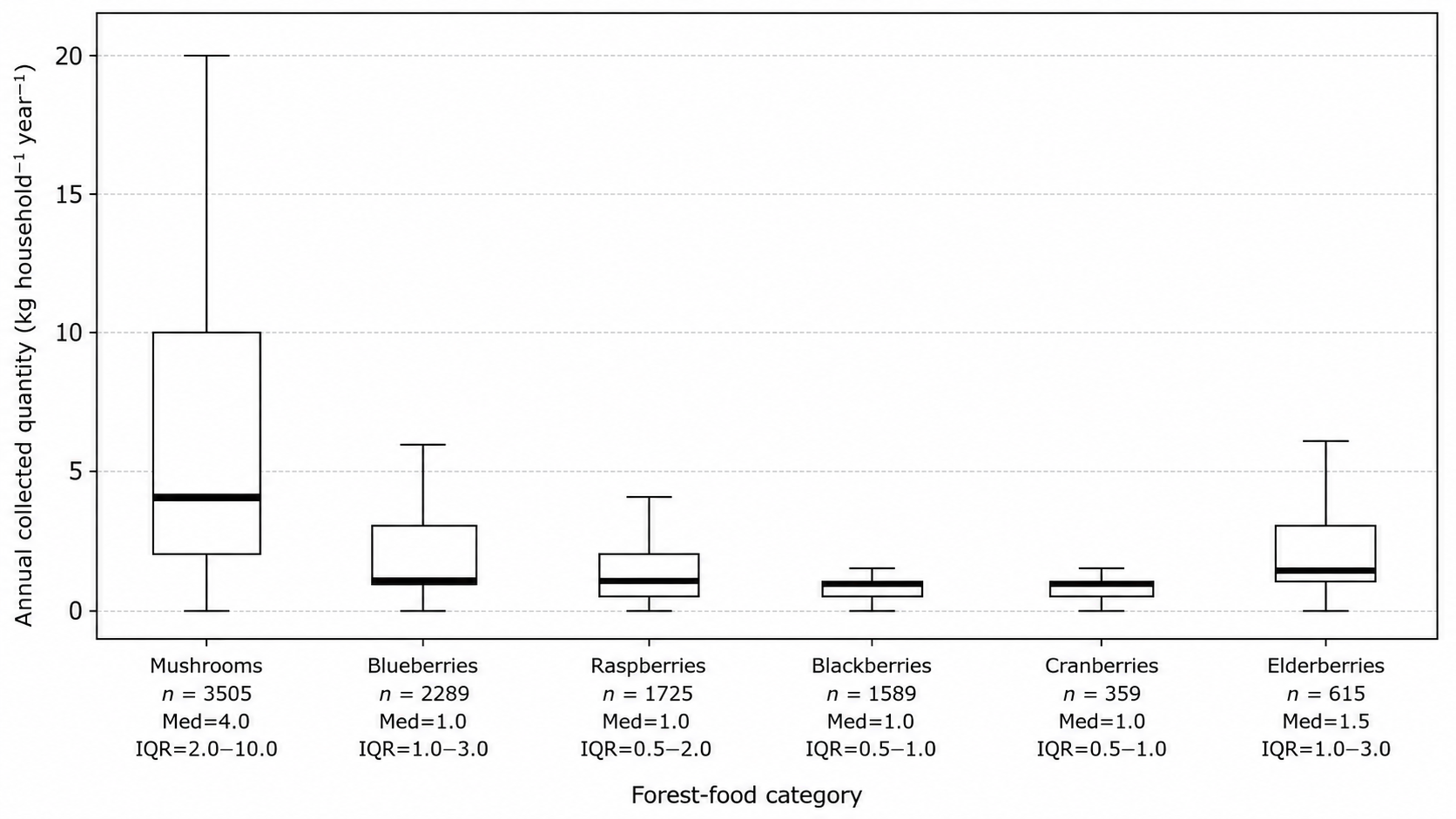
Figure 1 characterises the intensity and variability of household collection among households with a positive reported collected quantity by comparing the distribution of reported annual household quantities for mushrooms and individual forest fruits. This product-level perspective complements the participation indicators by linking reported collection with the scale of household self-provisioning. The conventional boxplot whisker range summarises the central distribution of collected quantities and facilitates comparison across products with right-skewed distributions.
The boxes represent the interquartile range (IQR; 25th–75th percentile), the horizontal line within each box indicates the median, and the whiskers represent the non-outlier range. The figure focuses on households reporting a positive collected quantity for the respective product.
The distribution confirms the distinctive position of mushrooms. Households reporting mushroom collection recorded higher and more variable annual household quantities than households reporting collection of most forest fruits, with a median of 4.0 kg/year and an interquartile range of 2.0–10.0 kg/year. Mushrooms therefore represented the strongest household self-provisioning profile among the analysed products. Forest fruits were generally collected in smaller quantities. Blueberries and elderberries showed broader quantity ranges, whereas raspberries, blackberries and cranberries were more concentrated at lower annual household quantities. These product-level differences support the use of an aggregated forest-fruit category for the comparative analysis, while retaining product-level detail where it strengthens interpretation.
3.2. Forest Visitation and Settlement Size
Table 3 shows that forest visitation was the strongest observed correlate of reported household collection. Interpretation of the two lowest visitation categories should take account of both the measurement structure of the collection indicator and the diversity of locations in which forest foods may be gathered. The binary indicator of any collection records every positive reported household quantity, including incidental collection of individual mushrooms or small quantities of berries. In addition, respondents may gather forest foods at forest edges, in sparse woodland, wooded parks or other semi-wooded landscape elements that they perceive as distinct from a forest visit.
These factors help explain why 22.8% of respondents reporting no forest visits recorded household collection of at least one analysed forest food, and why the proportion reporting household collection reached 77.9% among respondents visiting forests only 1–4 times per year. The lowest visitation categories therefore capture both marginal opportunistic collection and occasional gathering in a wider range of wooded and semi-wooded environments. A positive household collection record in these categories may represent limited contact with forest foods, while regular household self-provisioning is more characteristic of higher visitation categories.
At higher visitation levels, the proportion of respondents reporting household collection increased more gradually, reaching 87.8% among those visiting forests several times per week. The association between visitation and household collection was therefore strong but non-linear: the largest difference occurred between respondents reporting no forest visits and occasional visitors, while further increases in visitation frequency were associated with smaller incremental gains in collection participation.
Purchase varied less across forest-visitation categories than household collection. The association between visitation and any household collection was strong (Cramer’s V = 0.47, p < 0.001), whereas the association between visitation and purchase was weaker (Cramer’s V = 0.10, p < 0.001). This contrast supports the interpretation that forest visitation is primarily linked to household self-provisioning, while purchase more strongly reflects household demand, retail availability and product preferences.
Settlement size provided a secondary contextual pattern in forest-food acquisition. Because reported quantities referred to households, settlement size is interpreted here as a household-context variable linked to access conditions, retail availability, and local collection opportunities, rather than as an individual-level determinant of collection intensity.
Table 4 shows that the settlement-size pattern was clearer for mushrooms than for forest fruits. Household mushroom collection decreased from 75.9% in settlements with fewer than 5000 inhabitants to 64.5% in settlements with 90,000 or more inhabitants, a difference of 11.4 percentage points (χ
2(4) = 56.91,
p < 0.001, Cramer’s V = 0.106). A similar but slightly weaker pattern was observed for the combined category of collecting mushrooms or forest fruits, which decreased from 82.4% to 73.6% across the same settlement-size contrast (χ
2(4) = 40.88,
p < 0.001, Cramer’s V = 0.090). This indicates that the decline in overall collection across larger settlements was driven mainly by mushrooms.
By contrast, the collection of forest fruits alone showed only minor variation across settlement-size categories. The share was 57.1% in the smallest settlements and 53.8% in settlements with 90,000 or more inhabitants, and the association was not statistically significant (χ2(4) = 4.90, p = 0.298, Cramer’s V = 0.031). Larger settlement size therefore appears to reduce mushroom collection more clearly than forest-fruit collection.
The purchase showed the opposite direction. The share of respondents reporting purchase of mushrooms or forest fruits increased from 64.3% in the smallest settlements to 73.4% in the largest settlements, a difference of 9.1 percentage points (χ2(4) = 38.08, p < 0.001, Cramer’s V = 0.087). Purchase of forest fruits increased from 61.0% to 69.5% (χ2(4) = 33.67, p < 0.001, Cramer’s V = 0.082), while mushroom purchase increased from a lower baseline, from 17.8% to 24.2% (χ2(4) = 24.88, p < 0.001, Cramer’s V = 0.070).
Settlement size identified a modest but consistent differentiation in acquisition patterns. Smaller settlements were more strongly associated with household mushroom collection, whereas larger urban settings showed higher levels of purchase-based acquisition. This pattern suggests that settlement size captures differences in local access conditions, household provisioning practices and retail availability. Although the effect sizes were small, the direction of the results was consistent for the main indicators of mushroom collection and purchase.
3.3. Game Meat as a Regulated Forest-Food Supply Chain
Table 5 provides a separate empirical basis for assessing game-meat consumption and procurement in the 2022 survey extension. This module measured respondent-reported consumption frequency, procurement sources, and perceived barriers to more frequent use. It did not measure household-level quantities of game meat or the total volume of game meat consumed. Across 1000 respondents, 40.3% reported at least some consumption of game meat: 28.5% consumed it once or twice per year, and 11.8% consumed it repeatedly, while 59.7% reported no consumption.
Reported consumption was concentrated mainly in wild ungulates. Wild boar was the most frequently consumed category (30.4% at least occasionally), followed by roe deer (25.7%) and red deer (20.1%). Procurement was strongly social and local. Friends, acquaintances, hunters or self-hunting were reported as a source by 33.2% of all respondents, corresponding to most respondents who consumed game meat. Formal retail channels were much less frequent: 8.9% of respondents reported fresh game meat from shops and 5.2% reported frozen game meat from shops. These results indicate that game meat is not primarily accessed through routine retail purchase, but through a combination of social networks, direct links to hunting and selected formal channels.
Barriers to more frequent use point to both cultural-practice and formal-market constraints. The dominant barrier was the positioning of game meat as a festive or occasional food, reported by 67.6% of respondents. Taste, preparation difficulty, price and uncertainty about where to buy were also frequent barriers. These barriers describe constraints to more frequent use rather than mutually exclusive reasons for complete non-consumption, because respondents could report more than one barrier. Socio-demographic patterns further distinguished game meat from mushrooms and forest fruits: men reported any game-meat consumption more often than women (46.9% versus 33.9%; p < 0.001; Cramer’s V = 0.13), while age and settlement-size differences were statistically significant but modest.
The qualitative interviews with five Czech forest landowners or users and seven processors provided additional context for interpreting these survey findings. Recurrent stakeholder perspectives focused on processing capacity, efficient logistics, the development of retail and direct-sale channels, and the availability of standardised consumer-ready products. Participants also identified opportunities for higher-value cuts and processed products, supported by direct sales and online communication. These findings show that the market position of game meat is shaped not only by the physical availability of hunted game, but also by the capacity to process, standardise and distribute safe, accessible and convenient products.
Taken together, the survey and interview evidence characterise game meat as a forest-food category with a different provisioning logic from mushrooms and forest fruits. Its household access is less dependent on self-provisioning through forest visitation and more dependent on hunting rights, local social networks, regulated carcass handling, processing infrastructure and trusted distribution channels. This regulated supply-chain position explains why game meat can represent a substantial physical resource while remaining less visible in routine retail acquisition.
3.4. Category-Specific 2024 Physical Volume Estimates and Indicative Values of the Three Forest-Food Categories
The 2024 reference-year comparison provides a category-specific quantitative benchmark for mushrooms, forest fruits and game meat in Czechia.
The physical estimates describe different product states: household-collected mushrooms and forest fruits, and gross carcass-weight equivalents for game meat at the primary procurement stage. They are therefore not interpreted as directly additive or equivalent measures of provisioning importance. Instead, they provide product-specific information on the scale of each supply pathway. Cross-category interpretation is based mainly on stage-specific indicative economic value and on the provisioning logic through which each product enters household use or formal markets.
Table 6 presents the estimated 2024 game-meat gross carcass-weight equivalent and indicative primary procurement value for the main ungulate species.
The estimated game-meat supply volume for the main ungulate species reached 17,044.5 tonnes of gross carcass-weight equivalent in 2024, with an indicative primary procurement value of EUR 33.57 million. This identifies game meat as a sizeable primary supply within the regulated hunting-based value chain; however, its physical mass should not be interpreted as directly equivalent to the collected weight of mushrooms or forest fruits.
The potential value created along the game-meat supply chain can be illustrated by wild-boar meat. The primary procurement price used in this study was EUR 1.52/kg, whereas selected consumer-ready wild-boar products in a Czech processor’s direct-sale price list reached approximately EUR 8/kg for stew meat, EUR 14/kg for boneless haunch/leg and EUR 17/kg for boneless loin/saddle. These prices are approximately five to eleven times higher than the primary procurement price. A further retail example illustrates the upper range of consumer-ready pricing: cleaned wild-boar tenderloin was listed by a Czech retailer at approximately EUR 34/kg, corresponding to approximately 23 times the primary procurement price. These price spreads reflect the costs associated with cutting, trimming losses, hygiene control, cooling, packaging, storage, labour, product selection, VAT and logistics, together with processing, retail or direct-sale margins. They also illustrate the downstream value creation that occurs between game-in-hide procurement and consumer-ready product forms [
35,
36].
The household-collected volumes of mushrooms and forest fruits were estimated from the reported average quantity per household and scaled to the total number of households in Czechia. The calculation uses 4,572,922 households, based on Czech Statistical Office household statistics applied in the 2024 reference-year update [
37]. The estimates provide an indicative order-of-magnitude assessment of household collection volumes and values, while also showing product-level components of the forest-fruit categories (
Table 7).
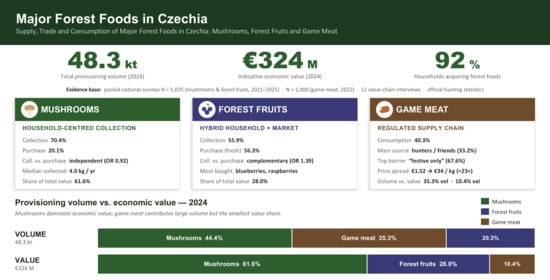
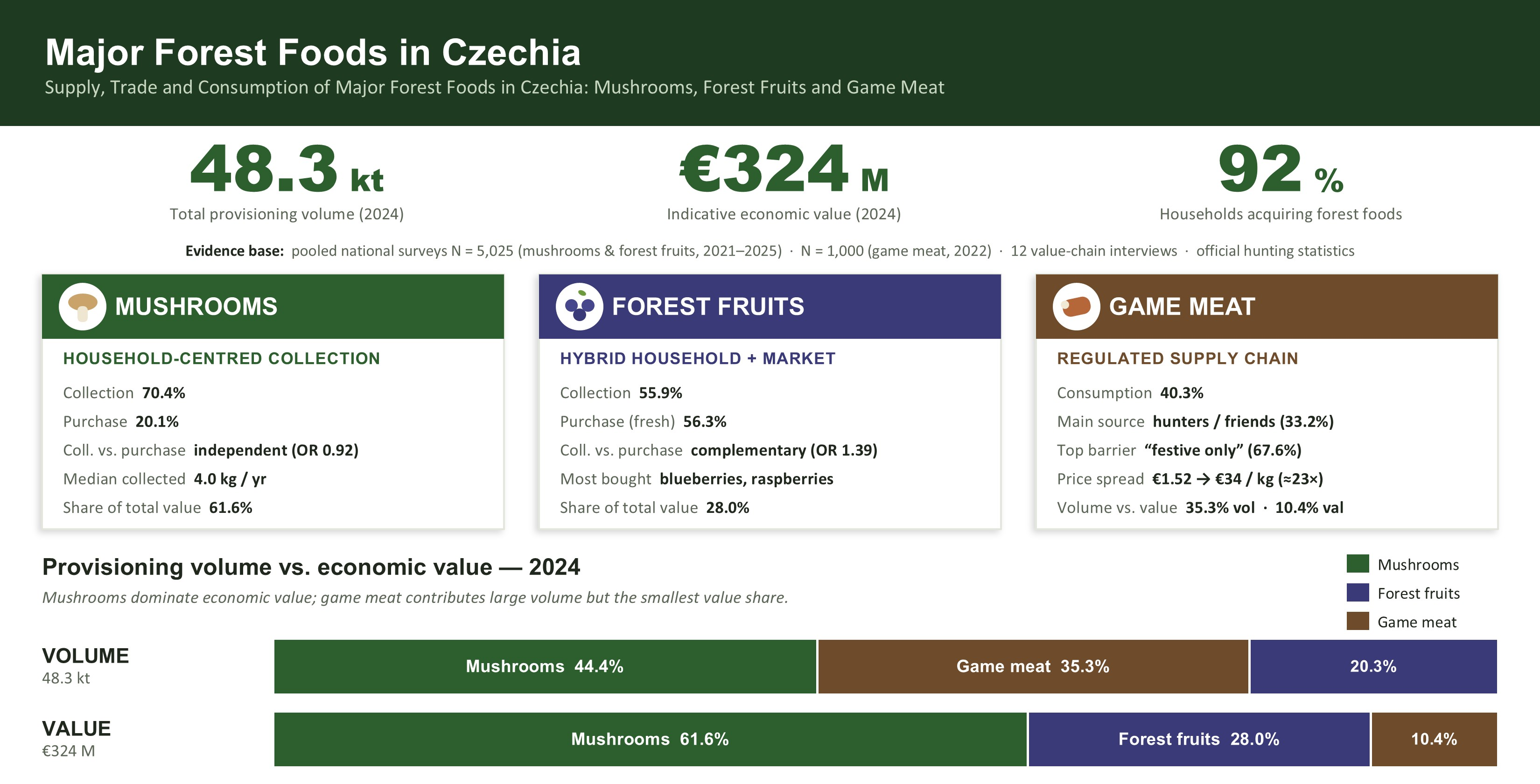
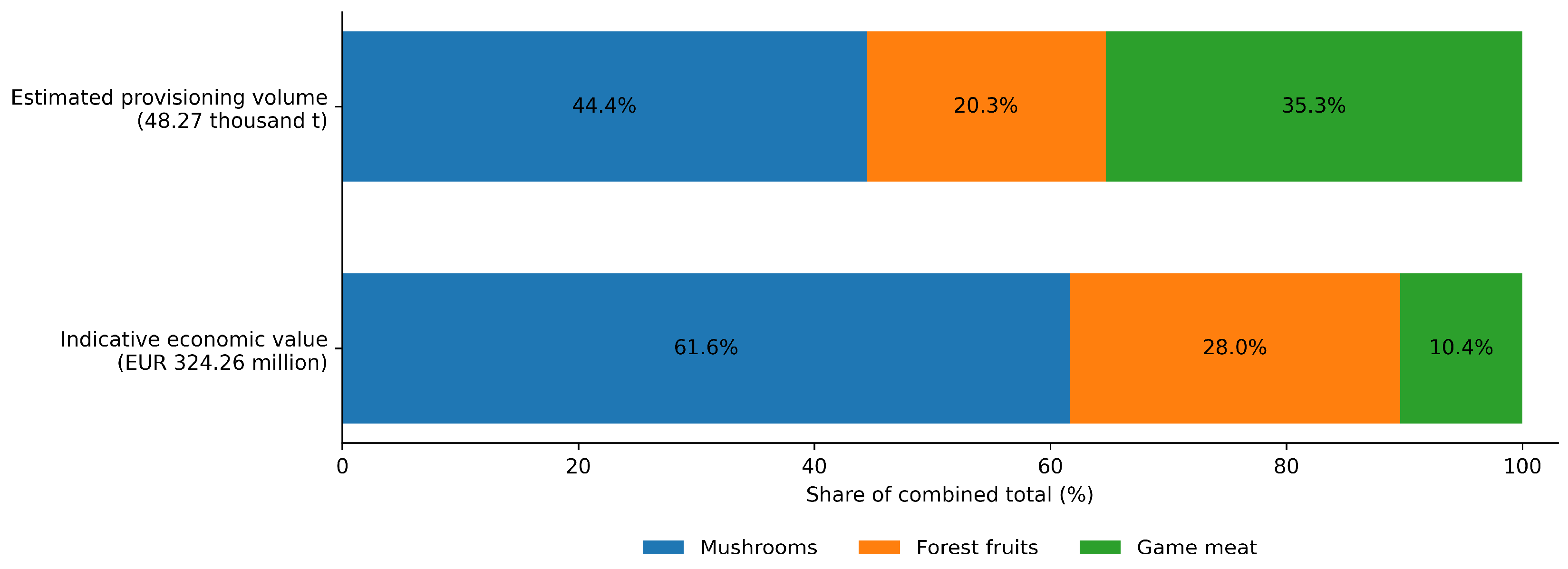
Figure 2 compares the stage-specific indicative economic values of mushrooms, forest fruits and game meat in the 2024 reference year. The sum of stage-specific indicative values was EUR 324.3 million, with mushrooms representing 61.6%, forest fruits 28.0% and game meat 10.4%.
The comparison shows that stage-specific indicative economic value provides a comparative perspective on the three categories. Game meat’s indicative value reflected gross carcass-weight equivalents and primary procurement prices. The values for mushrooms and forest fruits were estimated using indicative product prices applied to household-collected quantities. The comparison therefore captures differences in the value-chain stage at which each category is measured.
3.5. Synthesis of Product-Specific Provisioning Logic
The results show that mushrooms, forest fruits and game meat form three distinct forest-food provisioning systems rather than a single homogeneous NWFP market. Mushrooms are primarily linked to public forest access, reported household collection and direct household use. Forest fruits combine household collection with stronger purchase-based acquisition, particularly through fresh/chilled and frozen forms. Game meat differs from both plant-based categories because its transition into food depends on regulated hunting, carcass handling, hygiene control, cooling, cutting, processing and trusted distribution.
Table 8 translates these empirical findings into a comparative provisioning logic. Mushrooms are primarily linked to public forest access and household foraging, forest fruits combine household collection with stronger purchase-based access, and game meat differs from both plant-based categories because its transition into food depends on regulated hunting, carcass handling, hygiene control, cooling, cutting and processing. The resulting product-specific differentiation is consistent with European NWFP research emphasising market organisation and value creation as category-specific processes rather than uniform characteristics of NWFPs as a whole [
5,
8,
22].
This synthesis clarifies how the three categories differ in the route from forest-based biological availability or hunted game to household use and market visibility. Formal retail presence captures only one dimension of forest-food importance. Mushrooms are important mainly through household absorption of seasonal forest supply, forest fruits through a hybrid household–market pattern and game meat through the conversion of hunted game into safe, trusted and consumer-ready food.
4. Discussion
4.1. Integrative Synthesis of the Empirical Findings
The empirical findings answer the four research questions and show that mushrooms, forest fruits and game meat represent three distinct forest-food provisioning systems. The main contribution of the study is the product-specific comparison that connects household self-provisioning, market-mediated acquisition, value-chain organisation and stage-specific indicative valuation within one national case. This approach is particularly relevant for forest foods because their socio-economic importance is expressed through several channels: household collection, informal circulation, retail purchase, processing requirements and value creation at different stages of the supply chain [
2,
5,
8,
22]. The reference-year estimates anchor this comparison in physical volume and indicative value, while the product-specific interpretation explains why these values need to be read together with acquisition route and value-chain stage.
For RQ1, the three categories occupied different positions within the Czech forest-food system. Mushrooms were primarily a household-centred collection category, forest fruits combined household collection with market purchase, and game meat represented a regulated hunting-based supply chain requiring handling, hygiene control, cooling, cutting, processing and trusted distribution. This confirms that forest-food provisioning is best interpreted through product-specific pathways rather than as a single aggregated NWFP category.
For RQ2, mushrooms and forest fruits differed in the balance between household collection and market purchase. Mushrooms were clearly collection-oriented, whereas forest fruits showed stronger market participation and greater compatibility with fresh/chilled and frozen purchase forms (
Table 1 and
Table 2). The relationship between collection and purchase also differed: mushroom collection and purchase were practically independent, while forest-fruit collection and purchase were complementary. Forest visitation was strongly associated with reported household collection and showed a weaker association with purchase (
Table 3). Settlement-size patterns further indicated a modest but consistent differentiation in acquisition mode: mushroom collection was more frequent in smaller settlements, whereas purchase-based acquisition was more frequent in larger urban settings (
Table 4). Collection of forest fruits was comparatively stable across settlement-size categories. These patterns are consistent with Czech evidence that forest visits and foraging remain socially important, while also showing that market-mediated acquisition forms a distinct component of forest-food use, particularly in larger urban contexts [
9,
17,
18,
19].
For RQ3, game meat occupied a regulated and socially mediated supply-chain position. The 2022 survey extension showed occasional consumption for a sizeable group of respondents, strong reliance on friends, acquaintances, hunters or self-hunting, and barriers linked to festive-food positioning, taste, preparation difficulty, price and uncertainty about where to buy the product (
Table 5). The qualitative interviews complemented these survey results by identifying processing capacity, efficient logistics, retail and direct-sale channels, product standardisation and consumer-ready formats as recurrent value-chain priorities. These findings indicate that game-meat development is supported by coordinated processing, traceability, preparation guidance and credible consumer communication.
For RQ4, the 2024 reference-year comparison showed that category-specific physical estimates were reported together with EUR 324.3 million in stage-specific indicative value (
Table 6 and
Table 7;
Figure 2). Mushrooms dominated the indicative value, forest fruits occupied an intermediate position, and game meat was valued at the primary procurement stage. The comparison therefore contributes an integrated benchmark, but its interpretation depends on recognising the value-chain stage at which each category is measured.
4.2. Product-Specific Provisioning Systems and Value-Chain Implications
The results support a differentiated interpretation of Czech forest foods. Mushrooms, forest fruits and game meat belong to the broader NWFP framework, but they differ in dominant provisioning logic, market compatibility and institutional requirements. This distinction is consistent with European research showing that NWFP value chains vary according to product type, regional context, ownership structure and market organisation [
5,
8,
22]. It also extends existing Czech evidence on mushroom and forest-fruit collection by placing household self-provisioning, market purchase and regulated animal-product supply within one comparative framework [
9,
17,
18,
19,
20].
Viewed through the ecosystem-services perspective, the three categories all represent forest-food provisioning, but the results show that their socio-economic importance is realised through different social, institutional and market pathways. For mushrooms, the main pathway is household self-provisioning supported by public forest access and cultural foraging practices. For forest fruits, provisioning is divided between household collection and market-compatible product forms. For game meat, biological availability is converted into food through regulated hunting, veterinary control, processing and trusted distribution. The self-provisioning and value-chain perspectives therefore help explain why forest-food categories differ in market visibility, valuation stage and practical development options.
Mushrooms represent the clearest example of household-centred provisioning. Household collection is widespread, purchase is comparatively limited, and the two acquisition modes are practically independent. Their importance is therefore expressed mainly through direct household use, preservation, gifting and informal exchange. This finding supports the view that formal retail visibility captures only part of forest-food importance, especially for products strongly embedded in recreational foraging and household self-provisioning.
Forest fruits occupy a more hybrid position. Household collection and purchase frequently coexist, and fresh/chilled, frozen and preserved forms facilitate their integration into retail channels. This makes forest fruits more compatible with standardised product forms than mushrooms, while retaining a clear link with household collection and seasonal availability. Quality assurance and source-area authenticity become increasingly relevant as these products move into standardised market forms [
38].
Game meat represents the most institutionally mediated category. Its transition into food requires regulated hunting, carcass handling, hygiene control, cooling, inspection, cutting, traceability and trusted distribution. These requirements support food safety and market credibility and shape the conditions under which game meat can enter gastronomy, direct-sale channels and retail markets [
6,
7,
21]. The survey barriers indicate that consumer access is shaped not only by availability, but also by product familiarity, preparation knowledge, trusted purchase points and convenient product formats.
The category-specific differences have practical implications for monitoring because each category becomes visible at a different point in the provisioning system. Mushroom monitoring is most informative when it captures household collection, quantity concentration, preservation and informal distribution. Forest-fruit monitoring should cover the interface between household collection and purchase, including stabilised product forms. Game-meat monitoring needs to link carcass-weight volume, primary procurement value, processing capacity, distribution channels and consumer-ready formats. Such differentiation improves the visibility of both marketed and self-consumed NWFPs and supports a more accurate interpretation of their socio-economic importance [
5,
22].
Value-chain development should likewise reflect the characteristics of each category. Mushrooms are primarily associated with household use, preservation and seasonal availability. Forest fruits are more compatible with stabilised, traceable and standardised product forms. Game-meat development is supported by coordinated processing, product standardisation, convenient cuts, preparation guidance, gastronomy, retail participation and credible consumer communication. The survey findings indicate that these measures respond directly to barriers related to festive-food positioning, taste, preparation difficulty, price and uncertainty about where to buy the product.
4.3. Central European Transferability
The Czech results provide a country-specific empirical basis for distinguishing three forest-food provisioning systems: household-centred collection, hybrid household–market provisioning and regulated animal-product supply chains. This analytical framework can be applied in neighbouring countries to examine how legal conditions, cultural practices, processing capacity and market organisation shape the position of individual forest-food categories. The framework separates the dominant acquisition mechanism from the level of formal-market integration and from the processing requirements associated with each category. It therefore enables structured comparison while retaining the specific institutional and cultural characteristics of individual countries. The relative importance of each provisioning system should be assessed separately in each national context.
Slovakia provides the closest comparative setting. Forest berries and mushrooms retain important commercial, recreational and social roles, and their valuation has been examined in relation to rural quality of life and household collection [
4]. The framework applied in this study could therefore be extended to Slovakia by distinguishing direct household use from local-market participation and by assessing game meat separately as a regulated supply chain with specific processing and distribution requirements. A Czech–Slovak comparison could identify similarities in household collection traditions and differences in the organisation of formal-market channels. It could also clarify how regional conditions and processing capacities influence the transition from household provisioning to commercial distribution.
Poland represents a related but distinct configuration. Research has documented the presence of wild plants and mushrooms in open-air markets in south-eastern Poland and a strong mushroom-gathering culture in Mazovia [
39,
40]. Polish research has also examined consumer preferences for game meat and the conditions influencing its wider use [
41]. Poland is therefore a relevant setting for analysing interactions between household collection, culturally embedded local markets and formal food channels. Open-air markets provide an intermediate distribution form between direct household use and standardised retail participation. The Polish case can thus help to explain how culturally established collection practices support both informal exchange and visible local commercialisation.
Austria illustrates a further variant. Research on wild plants has identified direct marketing, local processing and the positioning of wild products as regional speciality goods linked with tourism and cultural identity [
42]. This demonstrates how NWFP value creation can develop through regional and niche-oriented channels alongside larger retail markets. Austrian evidence also shows that product differentiation can strengthen the economic and symbolic value of wild products within regional food systems. Direct-sale channels and local processing may therefore provide relevant models for value-chain development in categories where large-scale retail integration remains selective.
Germany offers an additional context for applying the product-specific framework, particularly for examining how regulated game-meat supply chains connect hunting, food-safety requirements and formal-market distribution [
43,
44]. A structured comparison with Czechia could assess the role of retail availability, direct sales and quality assurance in shaping consumer access. Comparable evidence on household collection of mushrooms and forest fruits would further support category-level analysis. Across Central Europe, the analytical framework is transferable at the level of provisioning logic, while empirical estimates should be developed separately for each country and product category.
Although this article uses forest-food provisioning as its primary analytical entry point, the results should not be read as reducing mushrooms, forest fruits and game meat to provisioning ecosystem services alone. In particular, mushroom and forest-fruit collection are closely embedded in forest visitation, recreation, household traditions, gifting and informal circulation. Their observed quantities and acquisition patterns may therefore reflect both food provisioning and cultural ecosystem-service dimensions, including recreation, place attachment, intergenerational knowledge and the social meaning of foraging. This reinforces the need for a product-specific interpretation: mushrooms and forest fruits are partly provisioning outputs and partly culturally embedded household practices, whereas game meat is more strongly shaped by regulated hunting, carcass handling, processing and trusted distribution.
4.4. Limitations
The mushroom and forest-fruit data are based on respondent-reported household quantities and may reflect recall effects, rounding and year-specific variation in seasonal availability. Quantity distributions were strongly right-skewed, with a relatively small group of households accounting for a substantial share of reported volume. Aggregate estimates were therefore interpreted together with medians, interquartile ranges and graphical summaries.
The respondent was the reporting unit for socio-demographic characteristics, forest visitation and price knowledge, whereas collected and purchased quantities referred to the household. Behavioural associations should therefore be interpreted as respondent-level characteristics linked to reported household acquisition, not as individual-level measures of collection intensity. The results are most robust for identifying acquisition patterns and differences between product categories.
The evidence streams differ across the three forest-food categories. Mushrooms and forest fruits are based mainly on household survey quantities, while game-meat volume is estimated from hunting statistics and supplemented by survey and interview evidence. This design supports product-specific interpretation, but numerical comparisons across categories require caution because the monetary estimates refer to different value-chain stages: indicative household collection values for mushrooms and forest fruits, and primary procurement value based on gross carcass-weight equivalents for game meat. The game-meat estimate further depends on rounded species-specific carcass-weight coefficients and 2024 game-in-hide procurement prices; it therefore provides an indicative primary-procurement benchmark rather than a precise estimate of edible meat volume or final market value.
The qualitative interviews provide contextual evidence on processing, logistics, distribution and market development within the Czech game-meat sector. They support interpretation of value-chain conditions, but they are not intended to provide population-level estimates. Future research should further integrate comparable retail, processing, import and export data and examine how legal and sanitary requirements shape commercial harvesting, processing and trade across forest-food categories.
A further limitation concerns the interpretation of physical quantities. The study reports product-specific physical estimates, but these should not be interpreted as equivalent units of provisioning value across categories. Mushrooms, forest fruits and game meat differ in edible fraction, water content, nutrient composition, processing stage, storability and cultural meaning. A nutritional-equivalence approach, such as energy, protein or micronutrient contribution, could provide an additional basis for future comparison, but such an analysis would require harmonised species-level composition data and edible-yield coefficients that were not available for all categories in the present study.
5. Conclusions
This article examined the supply, trade and consumption of three major forest-food categories in Czechia: mushrooms, forest fruits and game meat. Its main contribution is the product-specific comparison of these categories using a comparative analytical framework that links acquisition mechanisms, market visibility, value-chain position, category-specific physical estimates and stage-specific indicative value. The results show that the socio-economic importance of forest foods is interpreted more accurately when aggregate NWFP indicators and retail visibility are complemented by information on household acquisition, market access and value-chain organisation.
The findings identify three distinct but interconnected provisioning systems. Mushrooms are primarily embedded in household-centred foraging and seasonal self-provisioning. Forest fruits combine household collection with market-compatible fresh/chilled, frozen and preserved product forms. Game meat represents a regulated animal-product supply chain in which hunted game is transformed into safe, trusted and consumer-ready food through carcass handling, cooling, inspection, cutting, processing and distribution. In the 2024 reference year, the sum of stage-specific indicative economic values reached EUR 324.3 million. Mushrooms dominated the indicative value, forest fruits occupied an intermediate position, and game meat was valued at the primary procurement stage.
The practical implication is that forest foods should not be monitored, regulated or developed as a single uniform NWFP market. Each category requires different information and different policy or market responses. For mushrooms, the key issue is the scale and social importance of household self-provisioning, including preservation, gifting and informal circulation. For forest fruits, attention should focus on the interface between household collection and market-compatible product forms, particularly fresh/chilled, frozen and processed products. For game meat, the main issues are processing capacity, hygiene control, trusted distribution, consumer-ready cuts and the ability to convert primary game supply into accessible food products.
For forest managers and decision-makers, the results underline the need to distinguish public access for household collection from commercial harvesting and formal food-market participation. Household self-provisioning remains an important social and cultural function of forests, while commercial use requires clear legal conditions, product quality control and appropriate cooperation with forest owners or authorised users. For market participants, the findings point to category-specific development opportunities: preservation and seasonal household use for mushrooms; traceable and standardised products for forest fruits; and coordinated processing, convenient product formats, culinary guidance and trust-building communication for game meat.
Future research should improve the measurement of household self-provisioning, especially where reported quantities refer to households rather than individual collectors. Further work should also develop comparable valuation stages for different forest-food categories, examine the legal conditions for commercial harvesting alongside household collection rights, and integrate import, export, processing and retail data into the analysis of forest-food markets. Applying the same product-specific approach in neighbouring Central European countries would support comparison of how legal conditions, cultural practices, processing capacity and market organisation shape the socio-economic importance of forest foods.