Review

Discoveries of Most Ancient Wooden Objects (MAWOs) Suggest That Early Hominins Were Skilled Wood Workers: A Brief Review of Prominent Case Studies

1
Scion (New Zealand Forest Research Institute), Rotorua 3046, New Zealand
2
School of Biological Sciences, University of Auckland, Auckland 1442, New Zealand
3
Department of Wood Science and Engineering, Chonnam National University, Gwangju 61186, Republic of Korea
*
Author to whom correspondence should be addressed.
Forests 2026, 17(7), 795; https://doi.org/10.3390/f17070795
Submission received: 25 May 2026 / Revised: 24 June 2026 / Accepted: 30 June 2026 / Published: 4 July 2026
(This article belongs to the Special Issue Wood as Cultural Heritage Material: 2nd Edition)

Abstract

The discoveries of most ancient wooden objects (MAWOs) (defined here as older than 200,000 years) have shed light on human evolution, particularly the cognitive ability and advanced woodworking skills of early hominins that enabled them to meticulously construct wooden objects for shelter and wooden tools for specific applications, such as hunting and digging for underground plant products for food. These discoveries give us insight into the complex behaviour and technological development of early human ancestors, who migrated to various parts of the world, adapting to local environments and taking advantage of available resources for food and shelter. This review focuses on five MAWOs unearthed in different parts of the world and dating from 300,000 to 780,000 years ago, representing examples of early hominins’ use of wood to ingeniously construct objects for specific purposes. Background information on wood composition and structure, and the diagnostic features of wood cell wall degradation by erosion bacteria is included, as these bacteria are the main microorganisms that degrade the cell wall of ancient wooden objects buried in waterlogged, anoxic environments, such as the 300,000-year-old Schöningen spears, which, although remarkably well preserved, had been surface-degraded by erosion bacteria.

1. Introduction

While the discoveries of buried and waterlogged ancient wooden objects aged hundreds and thousands of years have informed us of the remarkable ingenuity and skills of modern humans in the complex designing and highly skilled engineering of wooden constructions, the unearthing of most ancient wooden objects (MAWOs) (aged hundreds of thousands of years) has provided irrefutable evidence of the advanced knowledge of our early ancestors (hominins) also in selecting fit-for-purpose wood species and the precision crafting of wooden structures for use in their everyday life (e.g., shelter, hunting). Salient examples, in the order of their age, include: the 780,000-year-old polished planks from Israel [1], the 476,000-year-old interlocking logs from Zambia [2], the 430,000-year-old wooden tools from Greece [3], 300,000 to 400,000-year-old spears (throwing sticks) from Germany [4,5,6] (age recently revised by Hutson et al. 2025 [7] to around 200,000 years old), and the 300,000-year-old digging tools from China [8]. Collectively, these discoveries provide evidence that the cognitive faculty of early human ancestors was sufficiently developed for thinking and planning their work as a whole and in formulating strategies to utilise available natural resources from their surroundings, such as wood from trees, to build their shelters and ingeniously construct sophisticated tools for hunting meat and digging for underground edible plant products. Additionally, a compelling impression is that they were not just hunter-gatherers but lived in communities, worked collaboratively, and communicated effectively to develop technological skills to build shelters for the community and obtain their food using the right tools and techniques they themselves developed, facilitated by their cognitive abilities. There is a general consensus [9,10] that the lack of oxygen in waterlogged burial environments is a major factor in the long-term preservation of precious ancient wooden objects, including those constructed by early human ancestors. In relation to the findings in Israel [1], further reporting in scientific research journals on the polished ancient wooden plank discovered in Israel, beyond the initial publication in J. Hum. Evol., will strengthen the claim that the polished plank is indeed the oldest known wooden object prepared by early hominins from wood.
While wood is a versatile natural material with many important uses, from building construction to the generation of biofuels and novelty chemicals, in nature it is degraded by several factors, including biological, chemical and physical ones [11], the most damaging being white rot and brown rot wood decay fungi, which have been intensively studied over many years, and we have learned much about their growth characteristics, physiology, biochemistry and enzymology [12,13,14,15,16,17]. Wood can also be degraded by soft-rot fungi and bacteria (named erosion and tunnelling bacteria) [12,13,18,19], although these organisms cannot degrade wood as rapidly or efficiently as white and brown rot fungi. However, they are adapted to degrading wood under extreme conditions, such as water-saturated and waterlogged environments, and wood rich in toxic extractives and preservatives [20,21], which do not suit the growth and activities of white and brown rot fungi. While wood degradation is a vital process for carbon cycling in nature, the biodeterioration of wood products in service can result in enormous economic losses, and protective measures must be taken to extend their service life.
Fortunately, when the wood becomes buried and waterlogged, it can survive for millennia primarily because such conditions promote the exclusion of oxygen, leading to anoxic or near-anaerobic environments [10,22,23,24], which discourage the presence of the most devastating wood-degrading microorganisms, white and brown rot fungi. However, certain microorganisms can still degrade wood cell walls depending on the severity of oxygen depletion. When the wood experiences conditions that allow the presence of adequate oxygen, it can be attacked by soft-rot fungi, and tunnelling and erosion bacteria [10,25,26,27,28], but under anoxic or near-anaerobic conditions, such as those present in mud, swamps, and ocean sediments promoting the waterlogging of wood tissues, wood is predominantly and even exclusively attacked by erosion bacteria [9,29,30,31,32]. Although erosion bacteria are adapted to utilising wood cell wall polymers under extreme oxygen-limiting conditions, cell wall degradation is extremely slow, often being restricted to surface tissue layers, allowing effective conservation to be undertaken [33]. It is therefore not surprising that thousands of years old precious ancient artefacts have been discovered and continue to be unearthed, with the most intensive studies undertaken on sunken wooden ships [10,34], which enrich us with information on past human history, civilisation, technological skills and trade, as well as climatic conditions. This is because concerted efforts have been made globally in developing the most effective conservation technologies based on the knowledge gained from the extensive characterisation of recovered waterlogged wooden objects before and after their stabilisation, employing sophisticated methods, including analytical techniques that are non-invasive and can provide information from molecular to macro levels. Advances in the characterisation and conservation of waterlogged ancient wooden objects constructed by modern humans are not within the scope of this review, and readers are directed to pertinent reviews [11,33,35,36,37].
Early human ancestors had no knowledge of wood structure, but they recognised the importance of wood in their survival. Although wooden objects from the Palaeolithic period have not by and large survived well, we are fortunate that in recent times well-preserved wooden objects have been discovered in various regions of the world that predate human history. These ancient objects inform us about the amazing knowledge and skills of our early ancestors that enabled them to utilise forest resources available to them to collaboratively and ingeniously construct devices for their shelter, hunting animals and digging into the ground for plant products as food. Apparently, their cognitive faculty was developed to a level that enabled them to select fit-for-purpose logs and tree branches for engineering shelters, weapons and tools [2,3,4,8].
This review focuses on these very ancient (hundreds of thousands of years old) wooden devices as prominent case studies. Because electron microscopic examination of the wood tissues of the spears provided evidence of slight degradation of the cell wall in the outermost tissue layers by erosion bacteria [38], the review will begin with a brief account of wood structure and composition and the micromorphological pattern of bacterial erosion, a predominant type of microbial attack found in many other waterlogged archaeological wooden objects [10]. The information presented can serve as an important base for recognising whether this type of bacterial attack is also present in yet-to-be-discovered buried wood from the Palaeolithic period. Readers are directed to important published reviews for detailed information on wood structure and composition [39,40,41,42,43,44,45,46,47] and the type(s) of micromorphological patterns of fungal and bacterial attacks on wooden structures in natural environments and also reported for buried and waterlogged archaeological woods [9,10,12,13,18,19,22,23,24,25,26,27,28,31,32,34,48,49].
Over the last several decades, studies of buried and waterlogged wooden structures have demonstrated that the wood is well-preserved despite thousands of years of burial [10]. This is mainly because under the anoxic conditions of the burial environment, white and brown rot fungi, which devour wood rapidly, are absent or inactive [24], as they require the presence of oxygen for their growth and activity. Among wood decay microorganisms, erosion bacteria are the most tolerant to anoxic or near-anaerobic conditions [30], occurring, for example, in deep burial environments, and have been widely reported to attack and degrade the cell walls of buried, waterlogged woods [9,10,26,29,31,32,50,51,52]. However, under such conditions, cell wall degradation by erosion bacteria is extremely slow, which can account for the very long life of wooden objects experiencing deep burial and waterlogging, the most fitting example being the Schöningen spears, which were degraded by erosion bacteria only in the outermost tissue layers after 300,000–400,000 years of burial [38], resulting in the almost perfect preservation of the spears. Tunnelling bacteria and soft-rot fungi, which require oxygen, have also been reported to be present in waterlogged woods if the burial is shallow or in intertidal zones where oxygen can be available [19,25,26,28,48,53,54,55], and in wooden products placed in service in terrestrial environments where the moisture present exceeds the level white and brown rot fungi can tolerate, or in wood products pre-treated with toxic preservatives to high retentions [18,21,26].
There are quite a few examples of well-preserved archaeological wooden structures aged 10,000 to 50,000 years old that are man-made objects or are untouched, a fitting example being New Zealand’s 50,000-year-old buried, remarkably well-preserved kauri forests popularly known as Swamp Kauri, as the trees were buried in a swamp. They are a treasure for New Zealand and the Maori people because of their historical, cultural and scientific value [56]. However, examples of ancient wooden objects aged 200,000 years and older, described in this review as most ancient wooden objects (MAWOs) are very few, perhaps because anoxic burial conditions have to be very stable (free from any disturbance) over such long periods. Nevertheless, discoveries of MAWOs have transformed the long-held view that our early ancestors were nomads migrating from place to place for their survival, in favour of the acceptance that early hominins possessed an advanced cognitive ability, with highly developed woodworking knowledge and skill, which enabled them to engineer products from wood targeted for efficient cooperative group hunting, to identify and dig out plant-based food resources from under the forest floor and build shelters for living and operating as a community. For this review, five major MAWOs are selected to demonstrate the ability of early hominins to think clearly and plan their operations. Apparently, they had the knowledge to utilise appropriate natural resources available and the technological skills for designing and constructing fit-to-purpose tools and other useful products from wood. The discoveries of MAWOs in various parts of the world, including Africa, Germany, Greece, Israel and China, inform us that early human ancestors migrated out of Africa to different parts of the world and developed woodworking technologies in parallel, reflected in the range of products they engineered from wood suitable for their survival.
Because knowledge of wood composition and structure is important for understanding the design and performance of wood products, many books and reviews serve as rich reference sources [24,39,46,57,58,59,60], and we provide here concise information for readers’ convenience, allowing them to access relevant information from a single source. Also, we summarise the information on the micromorphological characteristics of bacterial erosion of the wood cell wall, which can facilitate the diagnosis of this unique form of microbial attack, reported to be widely present in waterlogged archaeological wooden structures buried in anaerobic environments [9,10,34]. Although soft-rot fungi and tunnelling bacteria have also been reported to be present in waterlogged woods, they are infrequent and are present mainly when wood is exposed to oxygenated environments, and readers are directed to pertinent reviews for their diagnostic decay patterns [12,19]. Knowing that the extremely well-preserved spears displayed a bacterial erosion-type attack, albeit only in the surface tissue layers [38], confirmation would be desirable for other present and future MAWOs.

2. Wood Composition and Structure

Wood types, tissue types, the ultra- and nano-organisation of the cell wall, chemical composition, and the amount and distribution of cell wall polymers are all wood-related factors that influence the type and speed of microbial deterioration of wooden objects subjected to burial and waterlogging conditions. Therefore, a knowledge of these aspects is vitally important for evaluating the nature and extent of microstructural, ultrastructural and chemical changes that have occurred over prolonged periods in ancient waterlogged wooden constructions, including MAWOs.

2.1. Composition

Wood derives its desirable properties, such as strength and stability, from its cell wall polymers and their organisation within the cell wall. However, wood-degrading fungi and bacteria have evolved enzymatic and non-enzymatic machineries to access the cell wall, transforming the complex polymers into simpler molecules that they can utilise for their nutrition. These microorganisms vary in their ability to break down the polymers and the habitats they are adapted to for optimal functioning. The white rot and brown rot fungi, which function best in terrestrial environments, are voracious feeders on wood and can degrade wood rapidly in nature. Fortunately, these fungi are excluded from anoxic burial environments, from which the majority of ancient wooden artefacts have been uncovered [34], with MAWOs being the most salient examples of artefacts surviving in near-perfect condition after hundreds of thousands of years of burial. Only certain specialist bacteria, namely erosion bacteria, can function and attack wood in the extreme oxygen-depleted environments, but the speed of cell wall degradation by erosion bacteria under such conditions is extremely slow, which accounts for the long survival of waterlogged wooden artefacts.
Wood consists of three main structural polymers, cellulose, hemicellulose, and lignin, which are organised to form the complex fabric of the cell wall, responsible for the high performance of wood. In normal wood, these polymers are present in the following proportions: cellulose 40%–50%; hemicellulose 20%–30%; lignin 20%–35%, with notable differences between softwoods (conifers) and hardwoods (deciduous trees). Softwoods contain a higher amount of lignin (25%–35%) and a lower amount of hemicellulose (15%–25%) (mainly glucomannan). In comparison, hardwoods contain a higher amount of hemicellulose (glucuronoxylans) (20%–30%) and a lower amount of lignin (18%–25%). The cellulose content is similar. Chemical interactions between cellulose (cellulosic microfibrils) and hemicellulose are basically in the form of hydrogen bonding, while hemicellulose and lignin form covalent bonds [61]. Although there is general consensus that lignin does not directly interact with cellulose, evidence is accumulating that lignin may also interact directly with cellulose [62]. These lignin–polysaccharide interactions are crucial for wood strength and stability. From the perspective of microbial decay of wood, lignin in the cell wall is the most recalcitrant polymer and has to be breached for microbial enzymes (enzymes are too large to penetrate into the fabric of lignocellulosic cell walls) to gain access to cellulose and hemicellulose, the main cell wall components microorganisms depend on for their nutrition. They accomplish this task by producing small agents (e.g., hydroxyl radicals—a non-enzymatic process) that can loosen the cell wall architecture.

2.2. Structure

Wood can be classified into two main categories: softwood and hardwood. Softwood refers to wood formed in conifer trees, whereas wood formed in deciduous trees is called hardwood. Both types develop from a lateral meristem called the cambium, but they differ in tissue types and the pattern of their distribution, best viewed in sections (discs) cut transversely through the stem. On the flat surface of the discs from the majority of softwoods, periodic rings can be detected visually, resulting from a distinct interface between larger, thin-walled springwood (earlywood) and smaller, thick-walled summerwood (latewood), developed within a year from the cambium. These rings are termed annual rings. While distinct in many softwoods, annual rings may not be readily detected in hardwoods.
As the stem diameter increases with the annual growth, the wood in the centre of the stem (heartwood) becomes filled with a wide range of antimicrobial agents [63,64,65], such as resins, tannins, oils, and waxes, the nature and amount of which vary with wood species, being particularly pronounced in tropical timbers. As many tropical trees are slow-growing, the heartwood continues to expand centrifugally, acquiring a large proportion of the tree girth, so much so that in some tropical trees, such as teak (Tectona grandis), acacia (Acacia mangium), and belian (Eusideroxylon zwageri), only a narrow band of peripheral wood (sapwood) remains functional in transporting water, minerals and other nutrients. Because of the extractives, heartwood usually appears darker than the sapwood and can often be readily distinguished from the latter in transversely cut faces of tree logs. Heartwood formation, a natural aging process, results from highly coordinated, genetically controlled events involving programmed cell death (PCD) [66]. Heartwood is vitally important in the life of trees, providing them with strength and stability, particularly for high-volume, long-lived trees. It also protects them from microbial invasion and thus not only prolongs the life of trees but, being naturally durable [67], serves as a prized timber in many applications requiring a long service life, reducing or eliminating the need for timber treatment with toxic chemicals that are harmful to human and animal health and the environment [68]. Understandably, strong and durable timbers, such as oak, cedar, and acacia, were preferred for ship construction in ancient times to protect against wood decay and withstand structural stress. From the perspective of the contributory factors for the long life of MAWOs, the presence of a wood type (such as heartwood or compression wood) resistant to degradation by erosion bacteria, the microorganisms able to function and degrade wood in anoxic environments, is likely to have played an important role, such as the presence of lignin-rich compression wood in the spears [38].
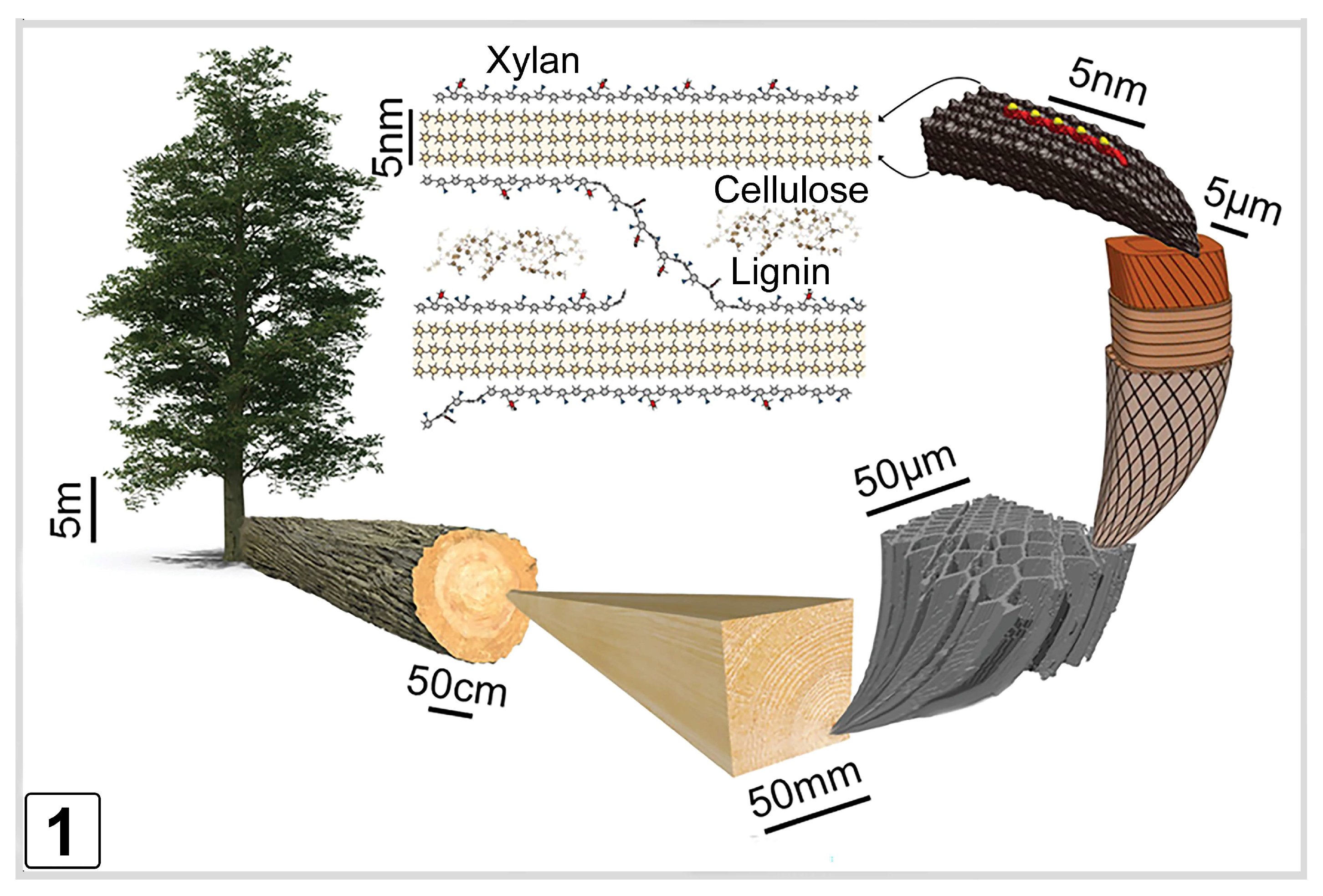
Wood is a hierarchical material in its natural design from the tissue to the molecular level (Figure 1), and this organisation is responsible for the strength and stability of trees.
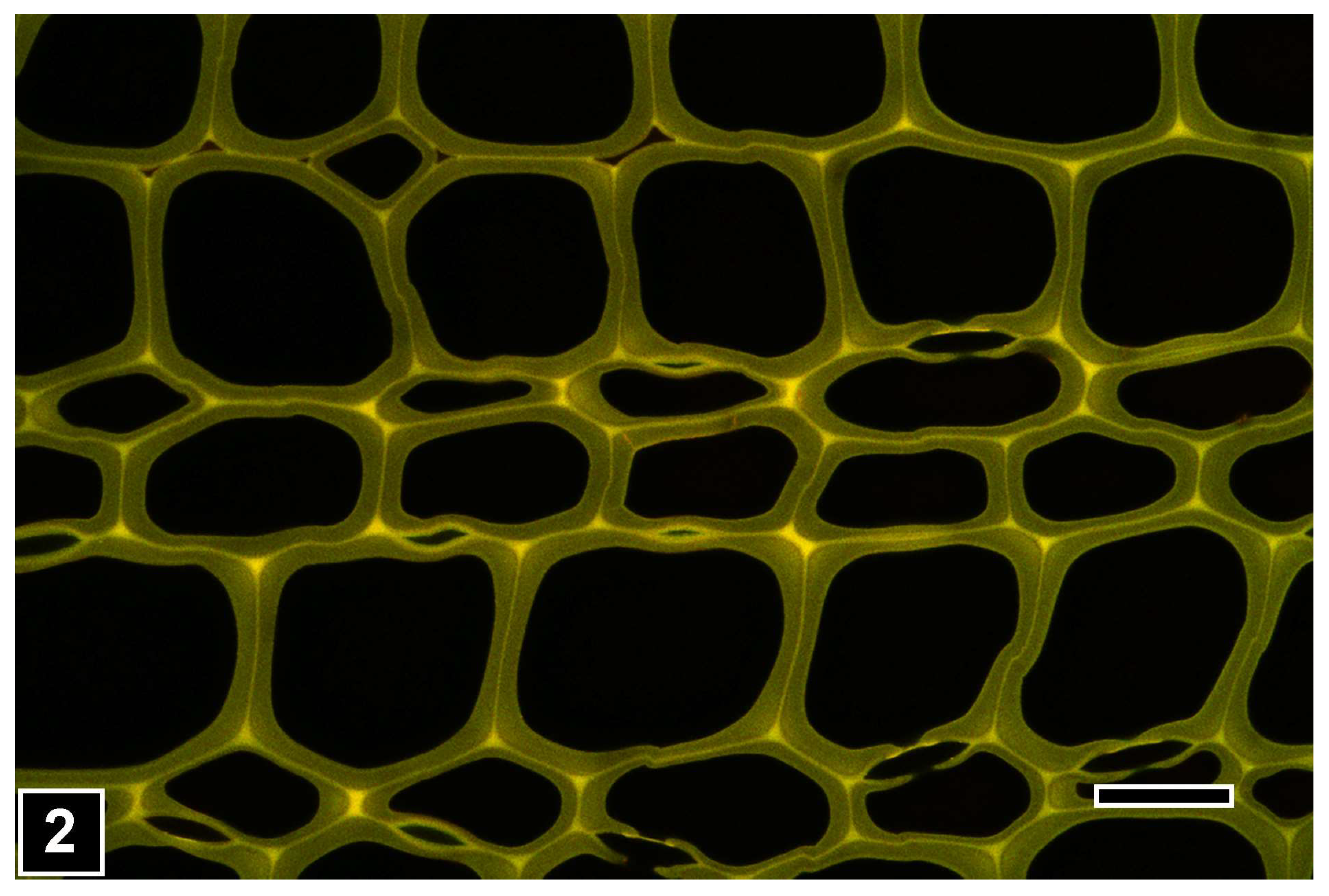
At the tissue level, there are key differences between softwoods and hardwoods in cell types, characteristic microscopic features, and the pattern of their distribution within the wood structure [46]. A close familiarity with their names and their microscopic features is important for identifying the wood type used in the construction of MAWOs. While a description of the wood identification features is outside the scope of this review, the names of cell types will help relate the micro- and ultrastructural features to the resistance of microorganisms reported to attack ancient waterlogged wooden constructions, including MAWOs. In the axial system (along the length), softwoods consist mainly of one type of cell referred to as tracheids (Figure 2), and thus softwoods are considered to be homogenous in construction. Tracheids transport water and minerals and also provide mechanical support to the stem and branches. In the radial system (radial direction), softwoods contain parenchyma cells, and some in addition also contain tracheids. Rays are connected to axial tracheids along their length, an organisation important for the stability and vital function of trees. The axial system of hardwoods consists of several types of cells, which perform specialised function(s) [69], and differ in their structure, length and diameter. They are: vessels, fibres and parenchyma.
Vessels are short, large-diameter elements that are the main water-transporting elements. Being thick-walled cells, fibres provide mechanical support. The majority of hardwoods also contain parenchyma in the axial system, which functions in the storage of important metabolites. Their number and distribution aid in identifying wood species. The radial system consists of parenchyma cells, which, being living, have important physiological functions in addition to storing important metabolic products, such as starch. The size of rays varies with the amount of parenchyma present. Some species, such as oak, develop massive rays that are visible to the unaided eye in sawn timbers. Hardwood rays also contribute significantly to the mechanical support of trees through radial reinforcement [70,71].
The axial and radial elements in both softwoods and hardwoods are organised in an interconnected, three-dimensional fashion that enables the wood to optimally perform in terms of strength and stability, as well as in its physiological functions. The transport of water and nutrients is facilitated by interconnecting valves (referred to as pits) shared by neighbouring elements [72,73], the most spectacular views of which can be seen in the images captured using a scanning electron microscope (SEM). Pits are partitioned by a distinctly porous membrane that, while preventing microbial invasion, readily facilitates the transport of water and nutrients. Unfortunately, being unlignified in the sapwood, the pit membranes are susceptible to degradation by wood-degrading microorganisms. These and the rays, which are also generally unlignified, form the initial pathways for invasion by wood-degrading microorganisms from the exposed faces of wood and wooden products, which are colonised by such microorganisms, facilitated by the biofilms they engineer for colonisation and adhesion [74,75]. The pit membranes generally become lignified in the heartwood and are impregnated with extractives, which is one of the most important factors determining the resistance of this type of wood to wood-degrading microorganisms.

2.2.1. Micro- and Ultrastructural Factors Impacting Microbial Degradation of Waterlogged Wooden Objects

Because erosion bacteria are the most predominant type of microorganisms that degrade wood exposed to waterlogging conditions (anoxic environments), including the Schöningen spears [38], this section will focus on micro- and ultrastructural features that deter wood degradation by these bacteria, enabling wooden constructions to survive for thousands and even hundreds of thousands of years under anoxic burial conditions, the excavation of which can inform us a great deal about past climatic conditions and human culture and activities.
Lignin is the cell wall polymer most resistant to wood degradation by erosion bacteria. Thus, the presence of lignin-rich structures in wood can in part explain r the longevity of waterlogged ancient wooden structures. For example, in some conifers, ray parenchyma cell walls are thickened and highly lignified [76]. While in standing trees, such ray parenchyma provides greater strength and stability compared to thin-walled ray parenchyma tissues, their resistance to erosion bacteria can contribute to a longer life for wood subjected to waterlogging conditions, as observed by Singh et al. (1996) [31] in ancient waterlogged Pinus sylvestris wood. Ray tracheid cell walls in some conifers are distinctly more highly lignified compared to axial tracheids [77] and have been found to be resistant to erosion bacteria in waterlogged ancient archaeological woods [31,55]. Other wood features relevant to the longevity of waterlogged wooden artefacts are warts and vestures. Warts, which are tiny cell wall protrusions consisting mainly of lignin and hemicelluloses, best viewed under an electron microscope, often occur as a part of a thin extractives-rich layer lining the innermost exposed face of the cell wall, and thus the layer is often referred to as the warty layer [78,79]. This warty layer persisted in ancient waterlogged wooden structures even when the underlying secondary cell wall was extensively degraded by erosion bacteria [31,79], pointing to its resistance to bacterial erosion. Vestures, which are lignin-rich, tiny outgrowths of the secondary cell wall projecting into the cell lumen, a prominent anatomical feature of hardwoods, are particularly common in vessel elements. Although not much is known about their relationship to erosion bacteria, they are resistant to tunnelling bacteria [80], which are more potent degraders of lignocellulosic cell walls compared to erosion bacteria. The highly lignified region of the pit border in softwoods, known as the initial pit border, is resistant to degradation by erosion bacteria [81].
The resistance of initial pit borders to erosion bacteria has also been demonstrated in ancient waterlogged archaeological woods [31,55]. While the presence of such lignin-rich structures can no doubt prolong the life of wood in anoxic buried environments, because wood degradation occurs at the cell wall level, a knowledge of the cell wall organisation is crucial for understanding the process of bacterial erosion and for diagnosing the presence of this type of bacterial attack in unearthed ancient wooden structures, including MAWOs. Much has been written on the ultrastructural organisation of wood cell walls [24,39,41,46,47,82,83,84,85,86,87]; we present a brief overview for readers’ convenience, enabling them to readily access pertinent information.

2.2.2. Wood Cell Wall Organisation at the Ultrastructural Scale

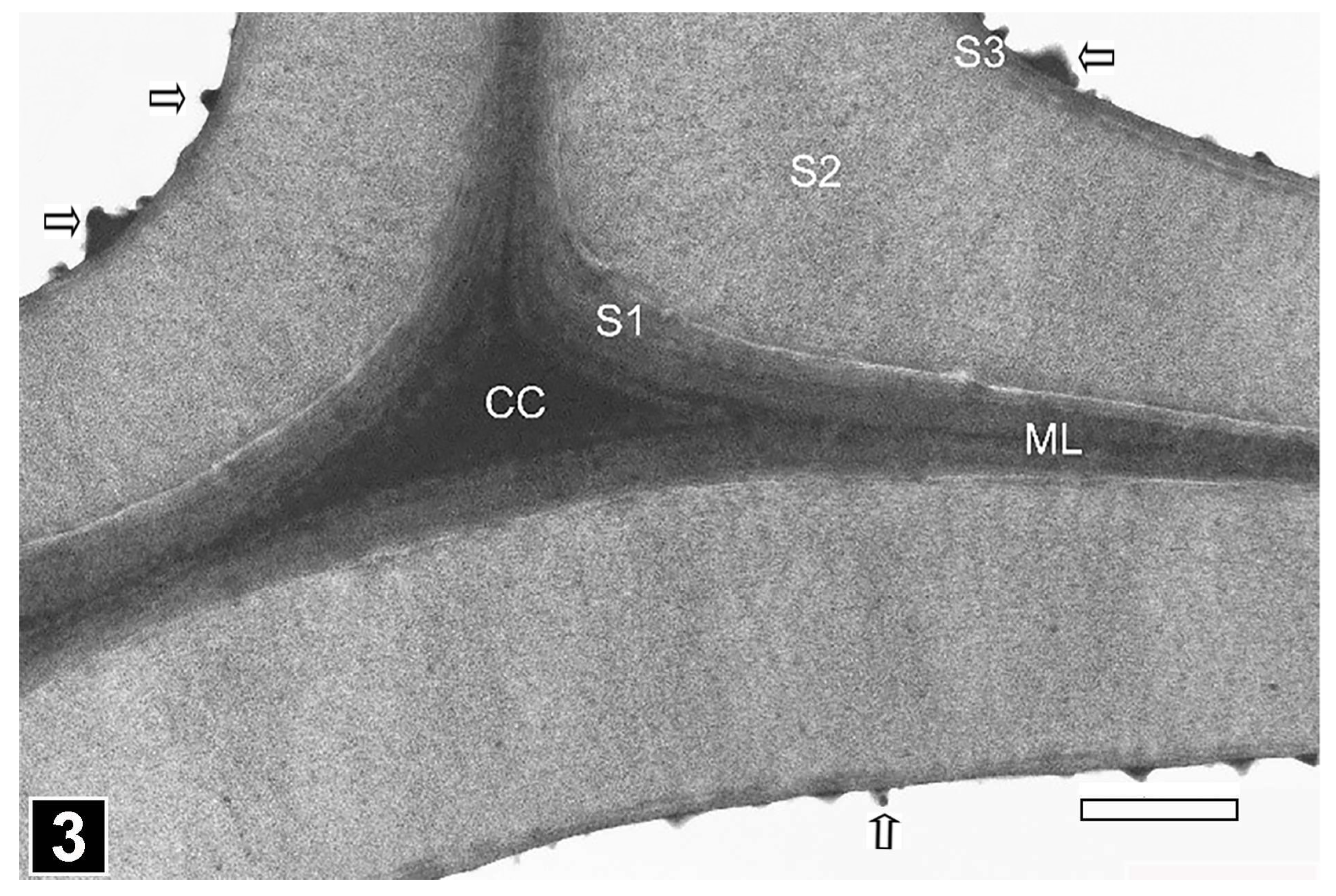
The structural organisation of the cell wall is best viewed under a transmission electron microscope (TEM). In suitably stained ultrathin sections, usually using potassium permanganate (KMnO4), which contrasts lignin [88,89,90], the lignocellulosic secondary cell wall appears as a three-layered structure (Figure 3), which optimises the strength and stability of wood tissues. Although this organisation appears more distinct in softwoods, it is also present in hardwoods. The birth of wood cells can be traced back to the lateral meristem, the cambium, which divides to produce xylem mother cells [46].
The mother cells go through a series of developmental processes, from cell expansion to programmed cell death (PCD) [91], leading to the establishment of cells (tracheids, vessels, fibres) that are specialised to provide water transport and mechanical support functions. However, ray parenchyma do not suffer from PCD and are thus living at maturity.
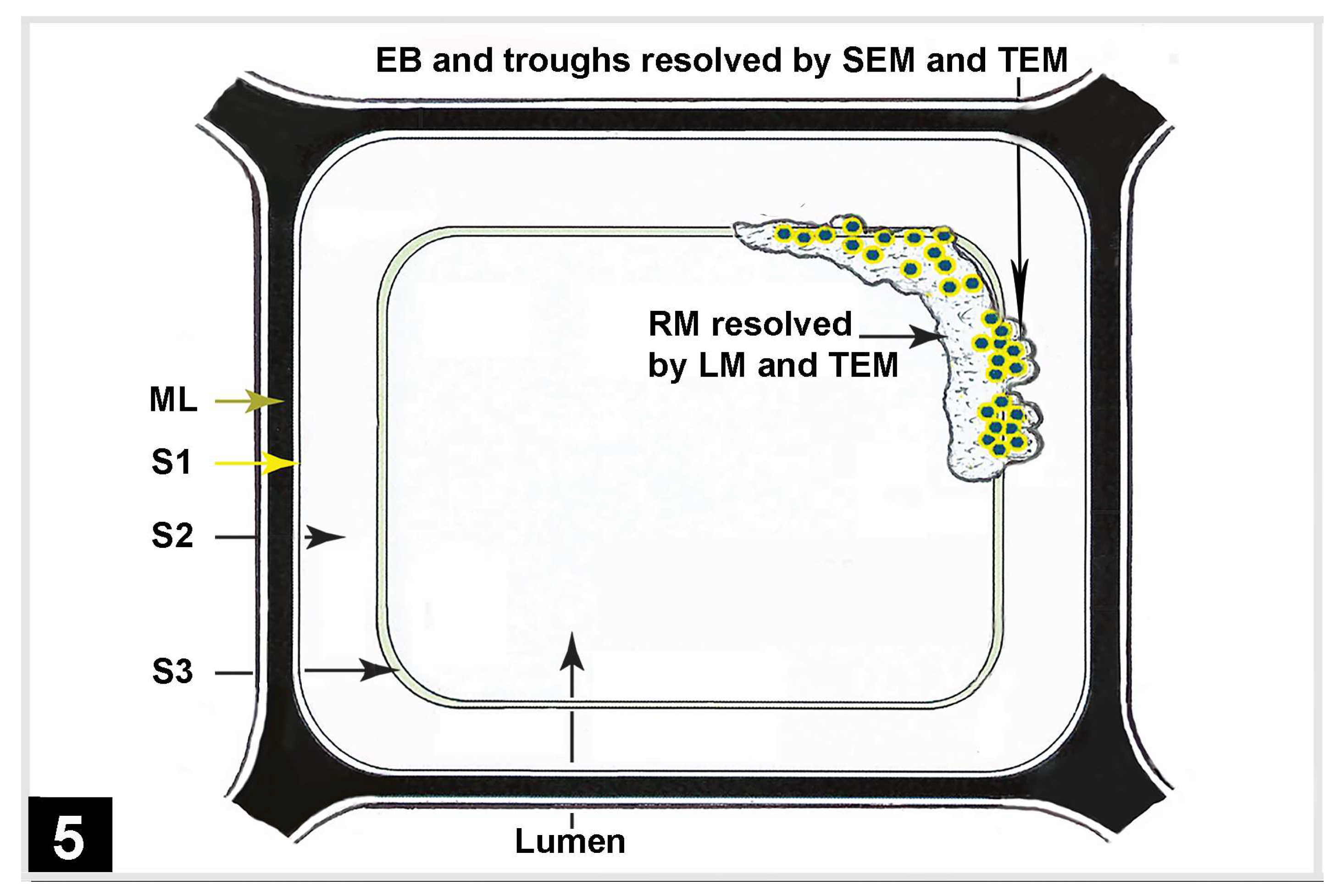
Expanding xylem mother cells consist of the middle lamella, which glues the neighbouring cells, and the primary cell wall. At the conclusion of expansion growth, the secondary cell wall begins to form sequentially through the deposition of cellulosic and hemicellulosic polysaccharides, followed by the incorporation of lignin precursors (monolignols) [40,92]. The end product is a layered cell wall, a composite structure (Figure 3). The three distinct layers are referred to as S1, S2, and S3; the S1 layer is the first to form, followed by the middle S2 layer and the innermost S3 layer, which encircles the cell lumen [46,93]. The deposition of cellulose and hemicellulose is a highly regulated and coordinated process [45,94], which enables the two components to be interconnected through chemical bonds, thereby establishing a precise cell wall architecture that influences the deposition and polymerisation of incoming monolignols. Defined bundles of cellulosic chains produce what is commonly referred to as microfibrils, which are best visible under electron and atomic force microscopes, enabling their orientation and arrangement in different cell wall layers to be examined [41]. Cellulose, hemicellulose, and lignin are chemically interlinked, forming a complex, three-dimensional network, which provides the desired strength and rigidity, optimising cell wall stability and mechanical performance. In the lignocellulosic cell wall complex, hemicellulose bridges cellulose and lignin by forming hydrogen bonds with cellulose microfibrils and covalent bonds with lignin.
A knowledge of the ultrastructural organisation of lignocellulosic cell walls is vitally important for understanding the manner of cell wall degradation by erosion bacteria, which can serve to diagnose the presence of this type of microbial attack in waterlogged wooden structures, including MAWOs. Cell wall layering, microfibril orientation across the cell wall, and lignin concentration and distribution are the most relevant aspects of the cell wall ultrastructure. The middle lamella, which consists mainly of pectic polysaccharides and functions as an adhesive between adjoining cells, is the first cell wall structure to develop. The primary cell wall forms from the deposition of cellulosic and hemicellulosic materials onto the middle lamella. The microfibrils in the primary wall are loosely organised and randomly arranged, enabling unrestricted cell expansion. At the conclusion of expansion, the cells develop a secondary wall, forming three successive layers, referred to as S1, S2 and S3, as mentioned above. The thick secondary wall is the richest source of nutrients for wood-degrading microorganisms, including erosion bacteria [10], particularly latewood cells, which in conifers develop massively thickened secondary walls, with the major contribution coming from the S2 layer. The three layers differ in the orientation of microfibrils, with the middle layer (S2), displaying an orientation nearly parallel to the longitudinal axis of the cell [41,95]. The microfibrils in the S1 and S3 layers are oriented perpendicular to those in the S2 layer [41,95]. Lignin deposition via monolignol insertion occurs when the cells begin to develop the secondary cell wall. Because of the greater nanoporosity of the middle lamella and the primary cell wall, these cell wall regions become more highly lignified than the secondary cell wall. Lignification of the cell wall initially occurs in the middle lamella, starting at sites where initiation factors are located [40,96], spreading to other regions of the middle lamella and across the secondary cell wall, terminating in the S3 layer. There are indications from TEM studies that the pattern of lignification may be under physical constraint, as lignin lamellae along the direction of microfibrils have been imaged [96], although lignin polymerisation is considered to occur randomly, facilitated by oxidative enzymes [97]. Because lignin is a highly recalcitrant cell wall polymer, it is a major factor regulating the speed and extent of cell wall degradation by erosion bacteria in waterlogged archaeological woods [10,24]. We will take up the aspects of the relationship of cell wall lignin to bacterial erosion again in the next section that deals with the bacterial erosion process. Because the nature of cell wall degradation by erosion bacteria produces a distinct microstructural (micromorphological) pattern that serves as a diagnostic signature for this type of microbial degradation of wood, a brief description of the pattern is warranted. Readers are directed to pertinent reviews for more detailed information [9,10,12,18,19,24,26,98].

3. Bacterial Erosion of Wood Cell Wall: Diagnostic Pattern

As stated earlier, in the absence of oxygen (anoxic environments), waterlogged woods are mainly attacked by erosion bacteria, which, among the wood-decay microorganisms, are the most tolerant to extreme oxygen-depleted environments. Also, because TEM observations of the spears (an important example of MAWOs) revealed only the presence of a bacterial erosion-type attack, albeit superficial, it is hoped that the information presented will serve as an important base for determining if other discovered or yet-to-be-unearthed MAWOs also display the presence of this type of microbial attack.

3.1. Strict Bacterial Alignment with Cellulosic Microfibrils Is Crucial for Cell Wall Degradation and Serves as a Diagnostic Feature

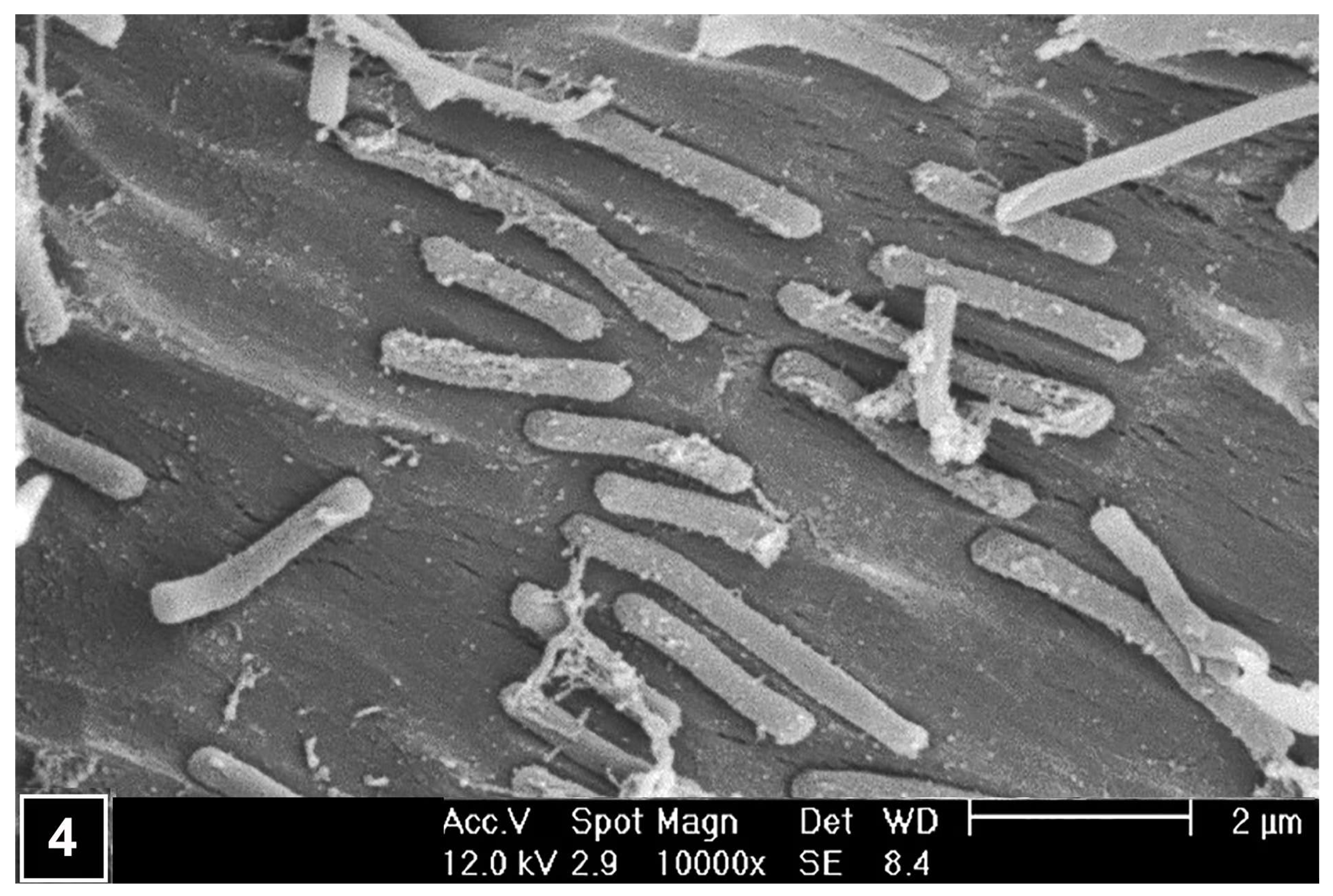
One of the most distinctive features of bacterial erosion is the strict bacterial alignment with cellulosic microfibrils after the initial entry into the S2 layer, a rich source of nutrients, by breaching the S3 layer exposed to erosion bacteria [30,98,99], SEM provides the most spectacular views of the relationship of erosion bacteria to the orientation of microfibrils. The long erosion channels (erosion troughs) developed during cell wall degradation are parallel to each other and to the microfibrils (Figure 4).
Light microscopic observations showing a stripy appearance of the cell wall under degradation can also serve as a diagnostic marker for bacterial erosion. It is assumed that this relationship of bacterial alignment with microfibrils facilitates the production/release of enzymes needed for cell wall degradation.

3.2. Erosion Trough, Middle Lamella, Cell Wall Residues, All Serve as Useful Diagnostic Features

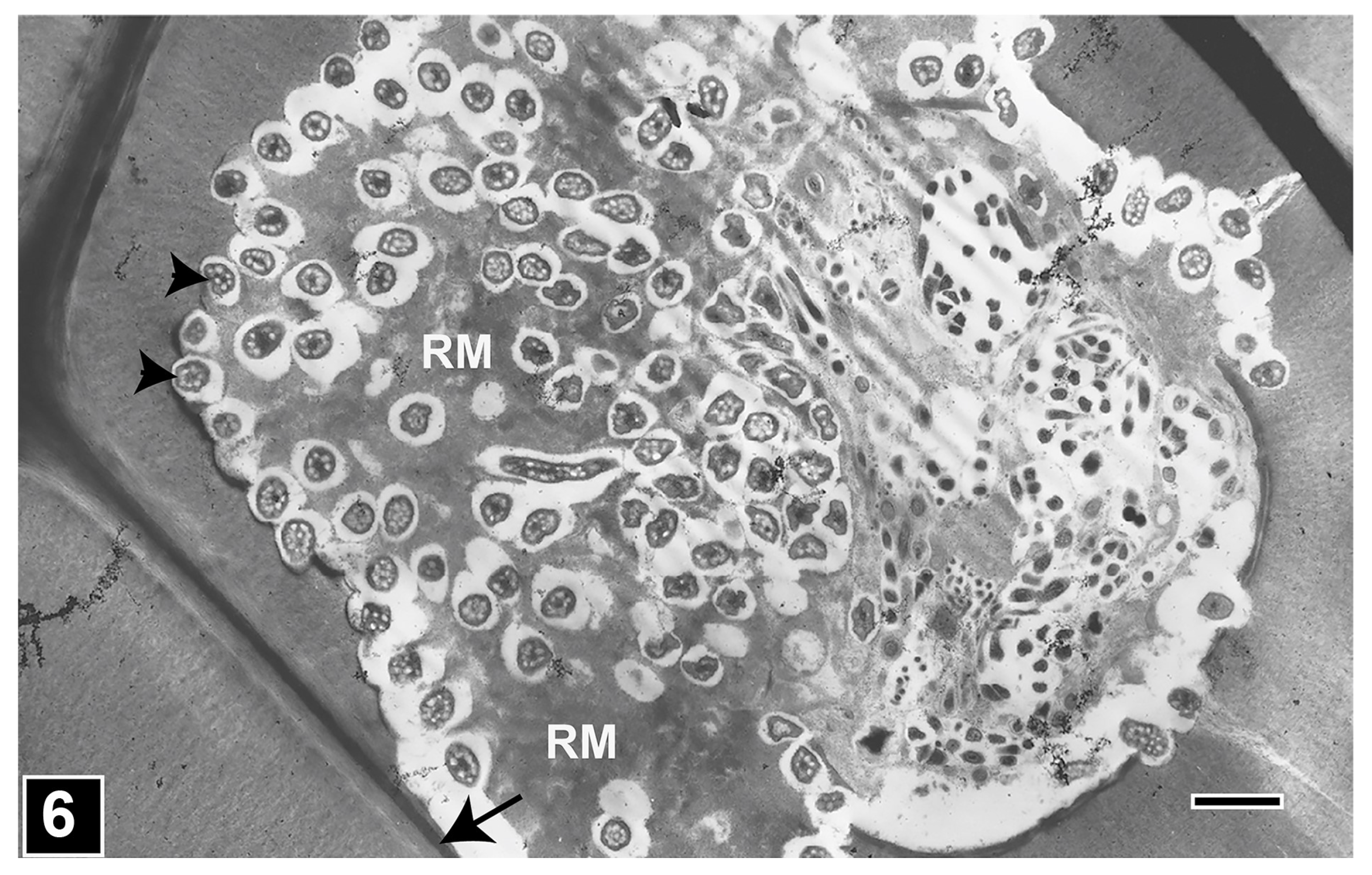
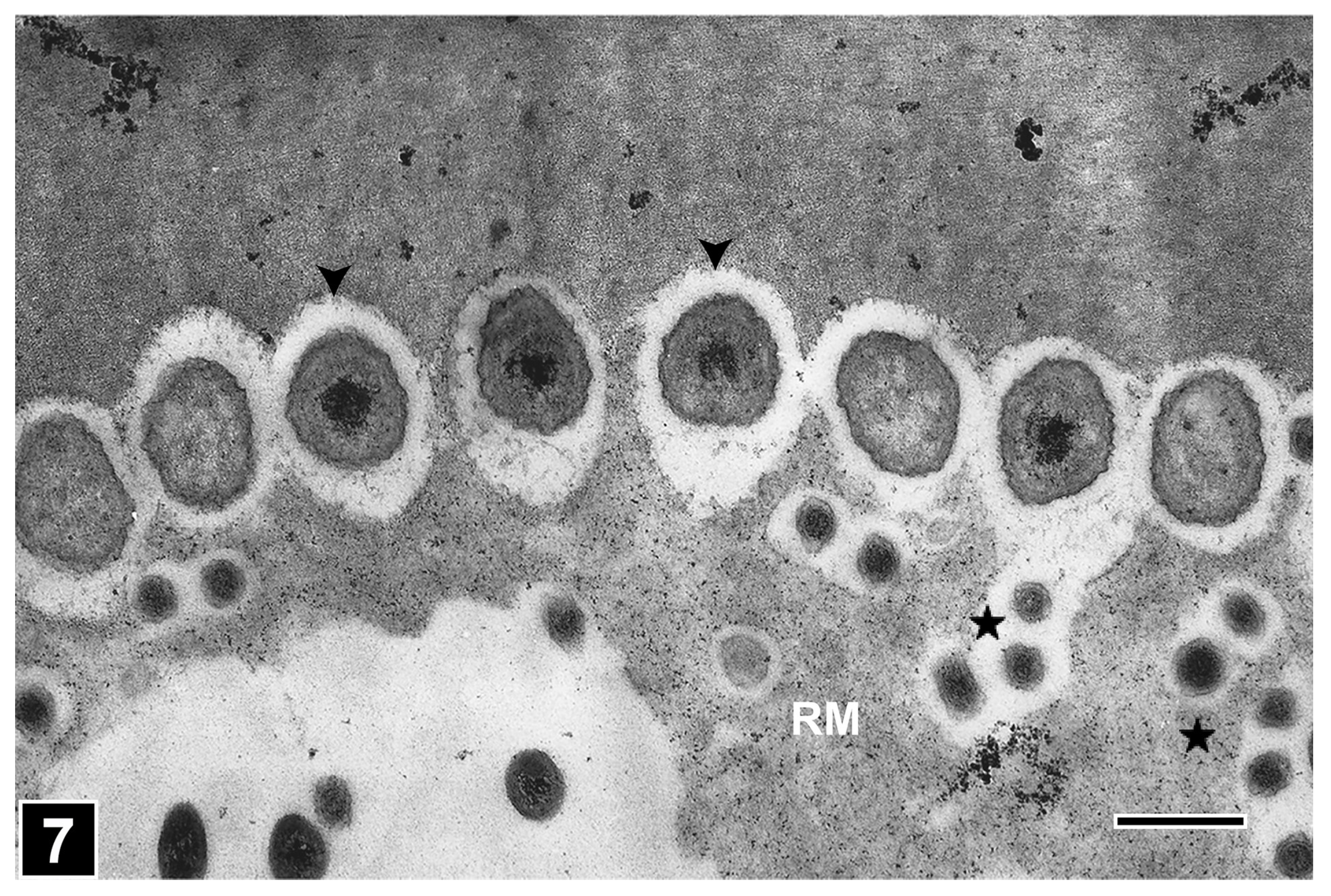
In TEM images of transversely cut sections, the erosion troughs appear as crescent-shaped notches in the exposed face of the secondary cell wall, with bacteria placed opposite to and in close contact with the trough (Figure 5, Figure 6 and Figure 7). The observed slight separation is likely a shrinkage artefact resulting during sample preparation, particularly at the dehydration stage. Nevertheless, the above-described feature is also a useful diagnostic marker and serves to confirm the information obtained using LM and SEM.
The secondary cell wall regions in heavily degraded tissues appear dark (black) under polarised light microscopy. The lignin-rich middle lamella–primary cell wall region (compound middle lamella) is resistant (Figure 6) and remains intact even in cells that have entirely lost the secondary cell wall.
This is one of the most important diagnostic features for distinguishing a bacterial erosion-type attack, which can also be confirmed by other microscopy methods, such as LM imaging of suitably stained sections for lignin and TEM of ultrathin sections stained with potassium permanganate (KMnO4), a lignin-contrasting stain [88,89,90].
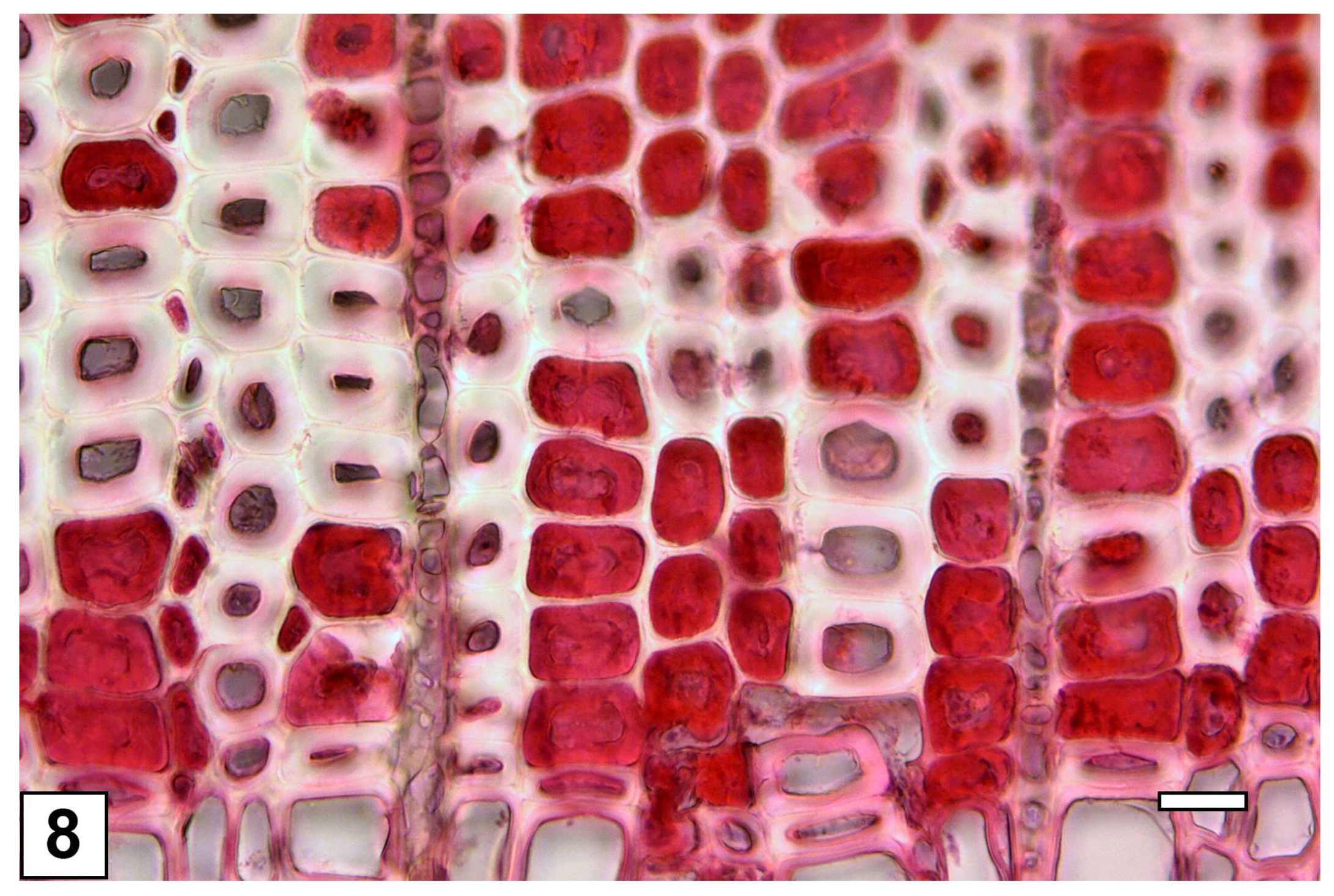
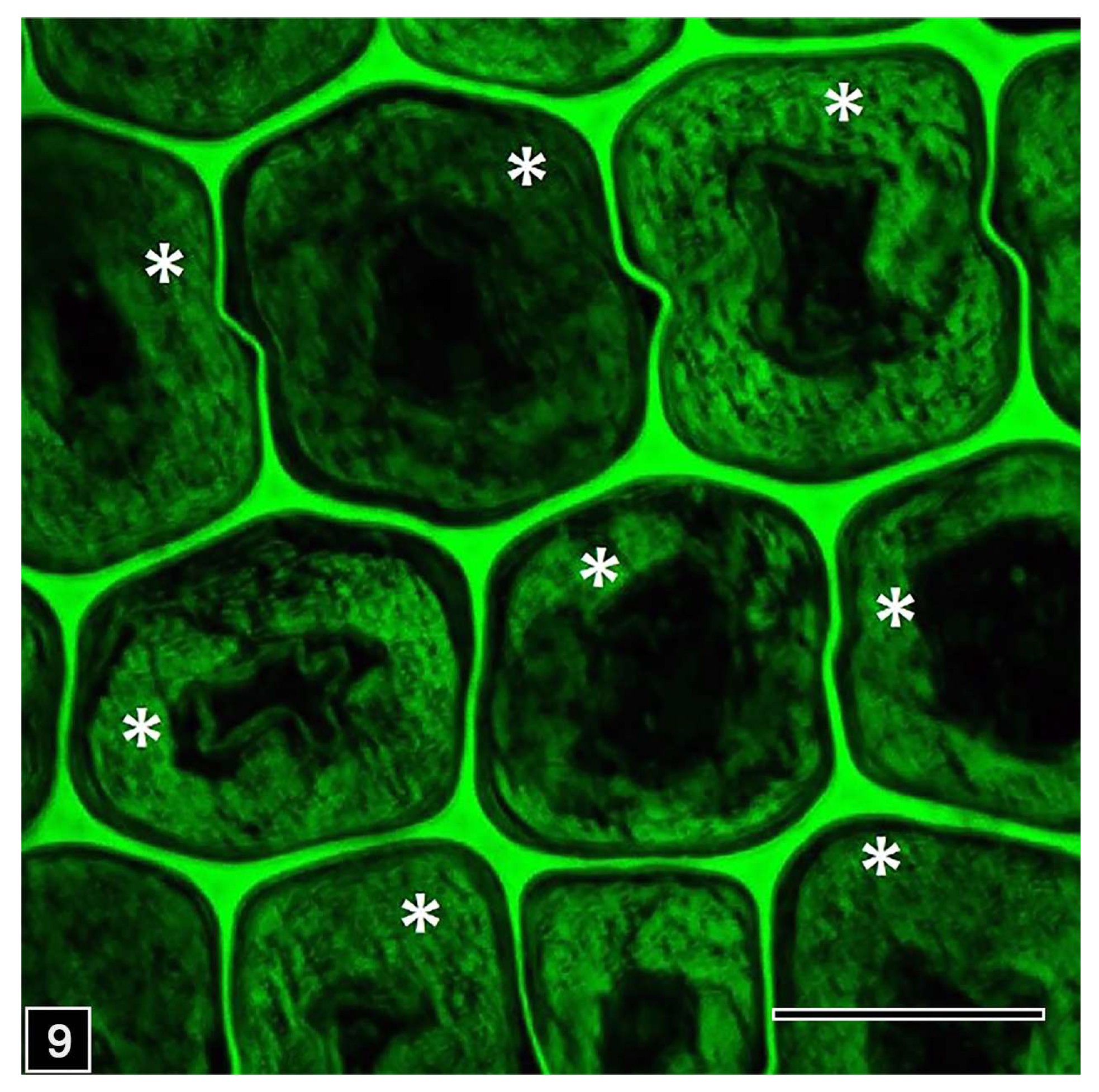
Lignin is highly resistant to erosion bacteria. Although erosion bacteria appear to have a limited ability to modify lignin, the lignocellulose matrix is sufficiently loosened by their action for their enzymes to access the polysaccharides, their primary substrate. Lignin-rich cell wall residues (commonly referred to as the residual material) remain in heavily degraded secondary cell wall regions. The residual material, which can serve as an important diagnostic signature, has been visualised using several techniques, and the lignin composition of this material has been confirmed using TEM of KMnO4-stained ultrathin sections (Figure 6 and Figure 7), light microscopy (Figure 8), confocal fluorescence microscopy (Figure 9), confocal Raman microscopy and UV microscopy [30,55,100,101,102,103,104,105,106].
Although initially TEM was used to image the residual material in greater detail [30], in many subsequent studies, LM in combination with suitable lignin-contrasting stains could be satisfactorily employed to detect the presence of the residual material [106] (Figure 8), enabling LM to be routinely employed to monitor large sample volumes within a relatively short time. However, in exceptional cases where cell wall degradation by erosion bacteria is restricted, such as in the mild compression wood cells in the spears [38], TEM would be required for confirmation.
From the perspective of the longevity of waterlogged archaeological woods, including MAWOs, lignin plays a pivotal role, as lignin-rich wood structures and cell wall regions display considerable resistance to erosion bacteria, and consequently, cell wall degradation in anoxic environments is extremely slow. There appears to be a relationship between lignin concentration and cell wall erosion, as erosion bacteria are unable to degrade cell wall regions where the lignin concentration exceeds a certain limit (threshold); salient examples being conifer middle lamellae and compression wood cell walls. The middle lamella of conifer tracheids appears to be completely resistant to bacterial erosion. In Pinus radiata, the lignin concentration in the cell corner middle lamella (CCML) has been estimated at 72%–92%, with an average of 81% [107]. Furthermore, the middle lamella in conifer tracheids also consists of the more recalcitrant guaiacyl lignin. Compression wood is a type of reaction wood [108,109,110], consisting of tracheids that differ from normal wood tracheids in structure and composition and occurs in a range of forms, from mild to severe [111,112]. The outer region of the tracheid wall is highly lignified [108,113,114], which makes it resistant to degradation by erosion bacteria, with the degradation progressing until the highly lignified cell wall regions are encountered, where it becomes highly restricted or altogether stops [25,82,114]. Because cell wall erosion progresses outward from the innermost cell wall, a considerable proportion of the compression wood cell wall remains intact. This is one of the main anatomical and compositional reasons why the Schöningen spears, which contained mild compression wood [38], were found in excellent condition even after hundreds of thousands of years of burial under anoxic conditions.

4. MAWOs: Case Studies

MAWOs are defined as wooden objects aged around 200,000 years (inclusive) and older. The out-of-Africa migration of hominins likely occurred in multiple waves over a long geological period, which means that the discovered hundreds of thousands of years old MAWOs were ingeniously constructed by prehistoric human ancestors for specific purposes, such as hunting and digging tools, reflecting the translation of their knowledge and skills, based on their well-developed cognitive faculty, into precise woodworking to create tools that they could effectively use for their survival. These objects also provide evidence of communal living and working together to achieve a target goal. The case studies have been selected as fitting examples of early humans’ engineering skills in constructing a variety of different useful products from wood. The review will begin with the discovery of the Schöningen spears, which have been most extensively investigated among MAWOs and for which complementary information about these objects is available from a range of sources and continues to emerge. The other four MAWOs are considered in the order of their estimated age from oldest to youngest. The technology used by the early hominins in most cases involved processes for the debarking of selected branches and stems and then shaping the objects. Both processes relied on the use of stone tools, judging by the presence of stone tool marks on the surface of the finished products.

4.1. Schöningen Spears

4.1.1. Background

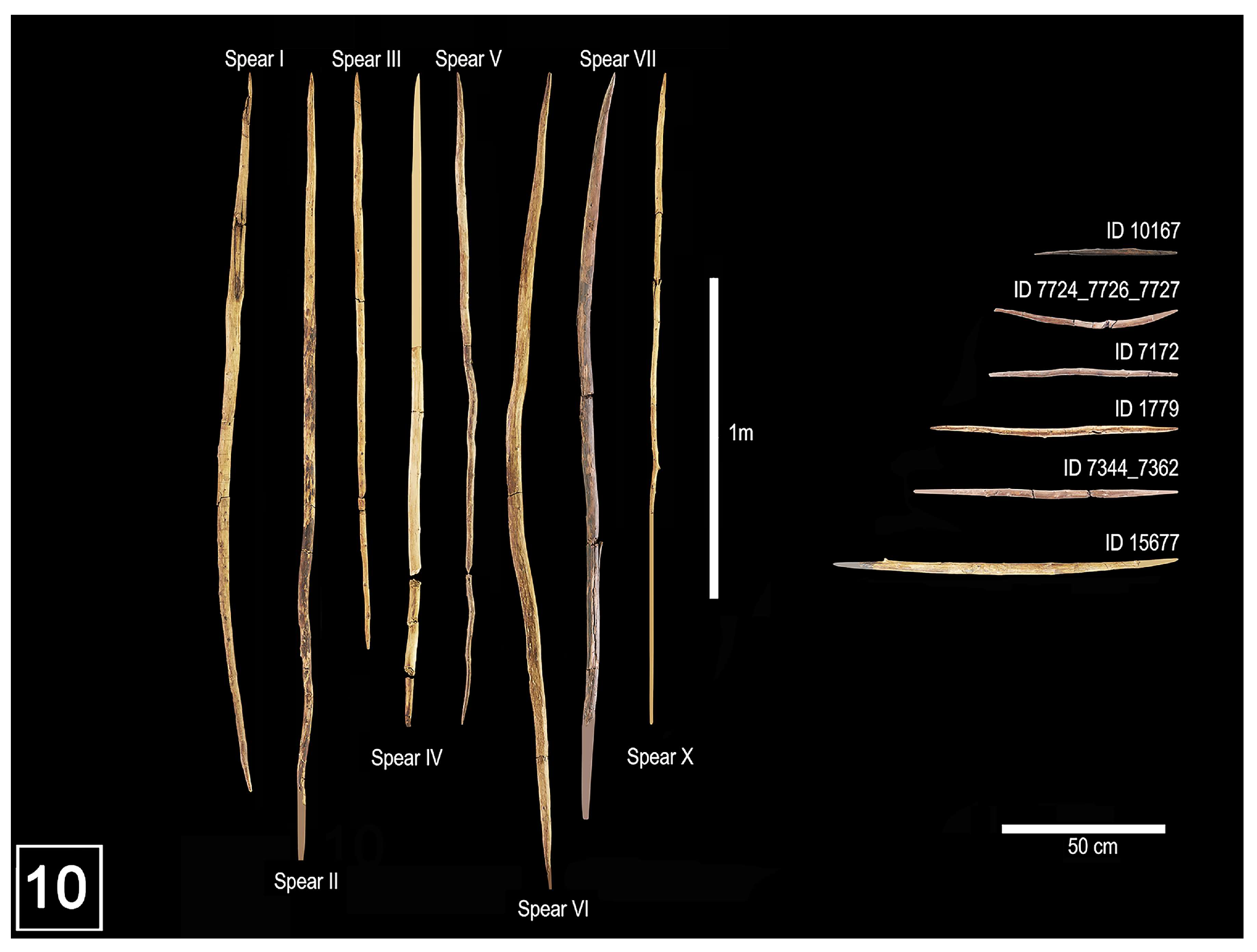
The initial discovery of the Schöningen spears, the earliest known, completely preserved wooden hunting weapons, was made by a group of archaeologists led by Helmut Thieme. During the excavations of 1994–2008 at a lakeshore site in the Schöningen region of Germany, commonly known as Schöningen’s Spear Horizon, several completely preserved wooden spears were unearthed (Figure 10). They were considered hunting spears because of their form, with at least one end sharply pointed, and the presence of butchered horse remains [4]. Dating of the weapons suggests that the spears were likely constructed by early hominins, such as Neanderthals, who lived in Europe as long ago as 400,000 years, a period of advanced technological and behavioural developments [115]. It has been suggested that they developed a complex functional society, living in communities and cooperatively hunting using weapons, such as the Schöningen spears, ingeniously constructed from suitable tree branches. Initially, the age of these spears was estimated to be around 400,000 years, but was subsequently revised down to 300,000 years.
However, according to a recent estimate based on the amino acid geochronology of fossils from the same site and deposits, the Schöningen spears are about 200,000 years old [7]. These authors suggest that the cooperative behaviour of Neanderthals greatly intensified during this period, meaning they closely communicated, sharing their knowledge and engineering skills to find fitting solutions to their community-based needs, and that included hunting cooperatively and developing suitable weapons for this purpose from wood, the most abundantly available natural resource. Milks [116], who undertook a comprehensive analysis of the Schöningen double-pointed throwing sticks using a combination of micro-CT scanning, three-dimensional microscopy and FTIR, is also of the opinion that Middle Pleistocene hominins had a good understanding of the material properties of wood, acquired a high level of woodworking skills, and engaged in communal hunting to maximise the outcome. There are also other examples of early Neanderthals’ use of wood in Europe for shelter, fire, and the construction of wooden tools [117]. However, because wood is highly prone to microbial deterioration in nature [10,118], examples of wooden structures engineered by early Neanderthals in Europe are very few.

4.1.2. Site and Burial Environment

The Schöningen spears, unearthed from organic sediments [5,119], deposited along a lakeshore setting [120,121], are considered to be the first examples of very ancient (200,000–400,000 years old) completely preserved wooden hunting weapons, meticulously constructed by early European settlers, likely Neanderthals. The burial environment was anaerobic because of the waterlogging of the sediments. According to earlier proposals, hominin hunting in the spear zone occurred on a dry shore, and the subsequent rapid accumulation of organic sediments preserved the buried spears and other artefacts. However, this view has been challenged, particularly by Stahlschmidt et al. [122], who presented evidence that the deposition occurred in a continuously submerged area of the former lake. Their claim is based on micromorphological analysis, combined with organic petrology and Fourier Transform Infrared Spectroscopy (FTIR). The spears found along the lakeshore lack cracks, which can occur from desiccation and weathering, suggesting that the weapons became embedded in wet sediments soon after being discarded and remained wet thereafter.

4.1.3. Construction and Characterisation of Spears

The shape and design of the spears suggest that early human ancestors had knowledge of wood properties, enabling them to select suitable wood species and to possess the woodworking skills to meticulously craft the spears and achieve optimal thrust for efficient throwing. The selection of slow-growing spruce (and, in some cases, pine and other types of wood) ensured that the spear wood was strong and durable. Furthermore, the tips were produced from the base of the trees for optimum density and weight, allowing for balanced throwing and hunting. The fitting length of complete spears (around 184–253 cm) and a reasonably small diameter (around 2-3-4.7 cm) [5] optimised the speed and thrust, enabling hunting to be carried out from a distance. It became evident from many characterisation studies that stone tools were used to remove branches and bark, as well as to scrape and carve spears to produce a smooth shaft and sharp, pointed tips [5]. The hominins who settled in Europe apparently recognised the importance of debarking spears before shaping them. This was an important step for several reasons: it minimised drag and improved the flight performance of the spears, facilitated the drying of the product and prevented insect and fungal attack during the construction of the tool. Significant surface cracks can develop if the wood is dried too rapidly, and the wooden constructions can also distort. The lack of such defects in the spears [116] suggests that the tools must have undergone slow drying. The wood species was identified using established botanical methods, and the age was determined by tree-ring analysis using micro-cuts and micro-CT scans [116], which suggested that the selected spruce trees were extremely slow-growing. The spear tips were shaped from the basal part of the stem, which, being the oldest part of the stem, was high in density and rich in heartwood extractives, factors responsible for increased strength, hardness and wood durability [63,65,123]. The remainder of the stem served to produce the shaft. This combination no doubt served well in the effective hunting of horses and other animals, both in terms of the penetrability of the spear tip into the target animal and the speed and accuracy of the spear flight. This reflects hominins’ awareness of the material properties of the raw material wood in making choices for targeted use, and their technical excellence in the design and manufacture of wood-based hunting weapons.
The age of the spears has been revised from the initial estimates of 300,000–400,000 years old [4] to a recent estimate of 200,000 years old [7], placing them within the Middle Palaeolithic period and linking them to Neanderthals rather than Homo heidelbergensis. Recent dating used amino acid geochronology (amino acid analysis of snail shells buried in the sediments of the layer of the earth where the spears were preserved), which means direct dating was possible. The initial dating of the Schöningen spears, based on their stratigraphic position within the known sedimentary sequence, placed them at 300,000 to 400,000 years old [4]. The layers of soil directly above and below the spears were correlated with known climate cycles, determining the relative age of the ‘Spear Horizon’ site.

4.1.4. Significance of the Discovery

The discovery of the Schöningen spears, cleverly designed and ingeniously crafted by early hominins, is of immense significance. These spears, regarded as the oldest hunting weapons, were fashioned from wooden trunks and branches and engineered to produce highly sharpened tips for hunting animals as large as horses from a distance. The thoughtful selection of tree branches, with accurate and efficient distant throwing in mind, in producing spear shafts and the choice of the hardest part of the wood structure (heartwood) for engineering spear tips for extreme sharpness, rigidity and durability, speak volumes for the high cognitive capacity and foresight of the hominin settlers in sophisticated planning and skilled woodworking in constructing these high-technology hunting weapons. The discovery also sheds light on human behaviour, including communication skills, organised community living, and group hunting. The discovery of the Schöningen spears challenges the commonly held view that early humans were hunter-gatherers, living a nomadic life. Quite the contrary, they had a highly organised social structure and were well equipped with the knowledge and skills to live in shelters and hunt and process animal products in interactive groups. Because of the immense value of the Schöningen site and its finds, local authorities are taking steps to nominate it for UNESCO World Heritage Site status.

4.1.5. While Schöningen Spears Were Excellently Preserved, Electron Microscopic Evidence Suggested the Presence of Bacterial Erosion in the Surface Tissue Layers

The realisation that while ancient wooden constructions survive well in anoxic, waterlogged burial environments, they often suffer from attack by a specialised type of bacteria (erosion bacteria) tolerant to anaerobic conditions [10], prompted Schmitt et al. [38] to undertake a high-resolution imaging study using TEM to find out if the spears had also been attacked by erosion bacteria. Knowledge of wood composition and structure, and a precise understanding of the micromorphological patterns produced during bacterial erosion of the wood cell wall, are important for diagnosing the presence of this type of microbial attack as ancient wooden objects are unearthed from anoxic burial environments. These aspects have been described in sufficient detail in the preceding sections to allow readers to readily access the information. Here, we briefly describe the TEM work done on the spears with a focus on relating the contribution of the unique cell wall features to the excellent preservation of the spears despite the presence of attack by erosion bacteria.
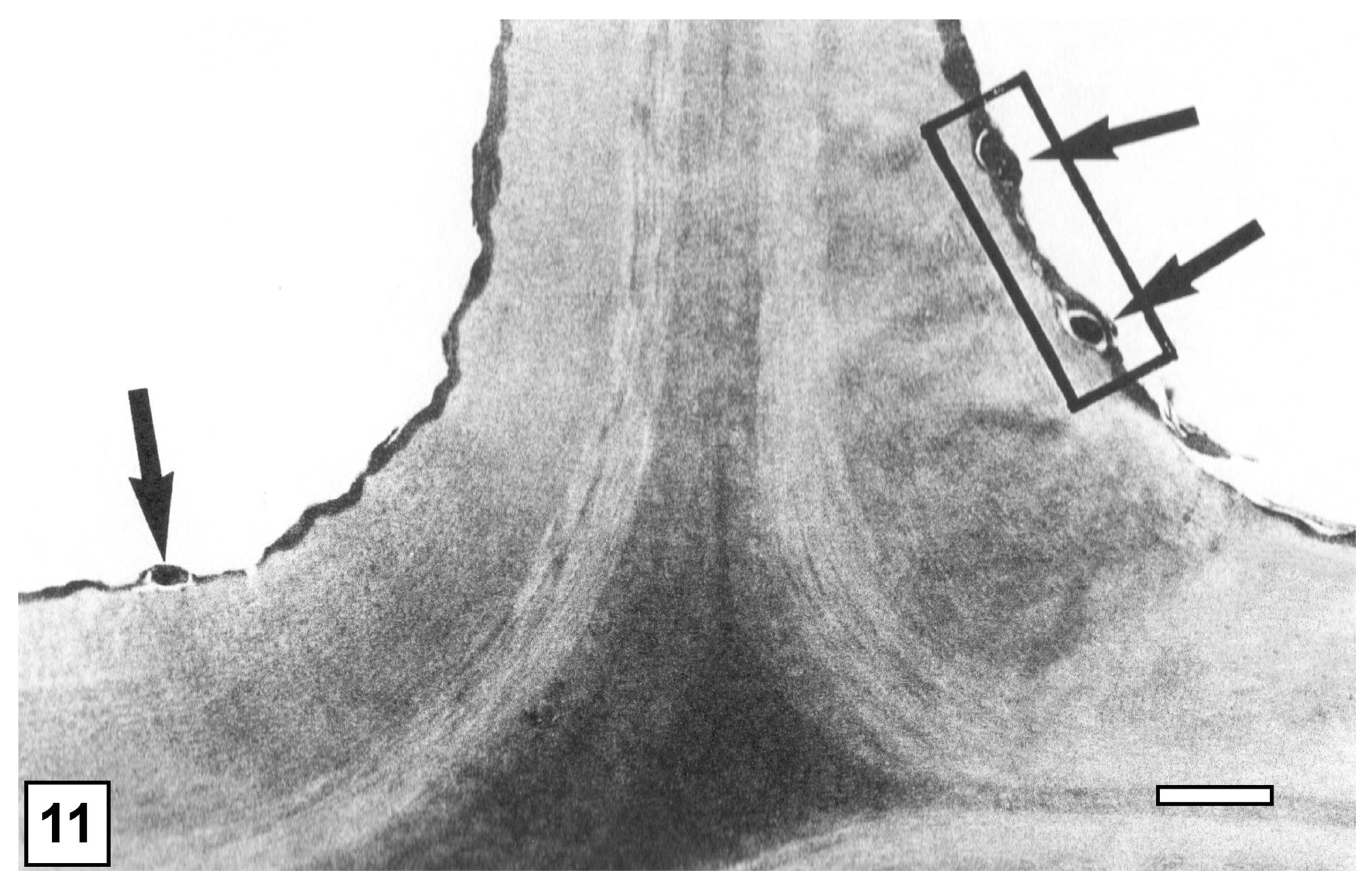
Although bacterial-erosion-type cell wall degradation can be diagnosed using light microscopy [24], which enables a rapid assessment of ancient waterlogged archaeological woods, in the work of Schmitt et al. [38] the use of TEM as a high-resolution imaging tool and its associated preparation techniques proved vitally important in precisely understanding the cell wall characteristics of spruce tracheids and in determining that the cell wall was degraded exclusively by erosion bacteria. This is because in addition to normal wood tissues, there was widespread presence of mild compression wood tissues, which superficially appear similar to normal wood cells except for the presence of a high concentration of lignin in the outer regions of the S2 layer, detectable only using specialised microscopy techniques. These include TEM imaging of ultrathin sections stained with lignin-contrasting stain KMnO4 [88,89,90,113,124], interference microscopy, fluorescence microscopy and UV microscopy [111,112,113,125]. Furthermore, TEM proved crucial in visualising erosion bacteria in contact with the cell wall undergoing erosion (Figure 11). The erosion bacteria were too small (likely having shrunk during the dehydration stage of sample preparation) to be detectable by light microscopy. Also, the residual material, a signature feature of bacterial-erosion-type cell wall degradation [30], lined the sound cell wall as a thin layer, which is not readily detectable by light microscopy.
The presence of mild compression wood in fast-growing conifer trees is more widespread than is generally recognised [109,110]. The spruce trees used for constructing the spears were slow-growing, which suggests that they may have been exposed to wind while producing the wood. By virtue of the greater lignification of the outer S2 [111,113], the cell wall of compression wood (including mild compression wood) is considerably more resistant to degradation by erosion bacteria than normal wood [28,82,126], as these bacteria can only slightly modify lignin in the complex cell wall polymer system to loosen the cell wall architecture, thereby facilitating the access of polysaccharide components to their enzymes. The resistance of the lignin-rich outer S2 wall of compression wood suggests that there may be a threshold for lignin concentration beyond which EB are unable to modify lignin. Because cell wall degradation by erosion bacteria progresses outwards, beginning with the innermost cell wall facing the cell lumen [9,30,99], the lignin-rich outer S2 wall in compression wood tracheids is unbreachable. This explains why the bacterial erosion of the cell wall was confined to the outermost tissue layers, and consequently, the bulk of the spear wood was extremely well preserved.

4.2. 780,000-Year-Old, Polished Wooden Planks Discovered in Israel

4.2.1. Background

A segment of a polished wooden plank, aged about 780,000 years, was discovered at the Gesher Benot Ya’aqov site in the northern Jordan Valley, Israel [1]. The object is regarded as the oldest wooden artefact engineered by early hominins. In addition to the plank, over 1400 other wooden objects were uncovered. The unique condition of the site, submerged by a paleo-Lake Hula, created a waterlogged, anoxic environment that preserved the unearthed wooden objects remarkably well. The burial must have been rapid enough to prevent attack on the excavated objects by aggressive wood decay microorganisms, such as white- and brown-rot fungi, which cause extensive damage to wood tissues within a relatively short time, as these organisms require oxygen for their activity [13,127]. However, although not investigated, it is possible that the surface tissues of the plank may have suffered from attack by erosion bacteria, the wood decay microorganisms most tolerant to anaerobic conditions [9,10,30], which have been reported to be frequently present in association with waterlogged wood [9,10,34,49,55]. Fortunately, wood cell wall degradation by erosion bacteria in anoxic environments is extremely slow and restricted to only the outermost tissue layers. It is therefore not surprising that even in the presence of attack by erosion bacteria, wooden objects have been found to be well preserved even after hundreds of thousands of years of burial in wet environments, the most salient example being the 300,000-year-old Schöningen spears that had been attacked by erosion bacteria [38].
Compared to other MAWOs, such as the 476,000-year-old interlocking logs in Zambia, the 430,000-year-old tools in Greece, the 300,000-year-old Schöningen spears in Germany, and the 300,000-year-old digging tools in China, the polished plank discovered in Israel still remains the earliest evidence of the oldest wooden object thoughtfully designed and cleverly engineered by early hominins. The ancient polished plank provides evidence of the advanced cognitive ability among the hominins settled in Middle East Asia nearly 800,000 years ago to plan and ingeniously construct wooden objects of advanced functionality.

4.2.2. Site and Burial Environment

The site of discovery of the 780,000-year-old polished wooden plank, among many other objects, was a lakeside (ancient Lake Hula) environment in the Jordan Rift Valley. The wood had been buried in waterlogged, anaerobic sediments, and the absence of oxygen prevented attack by highly destructive oxygen-requiring wood-decay microorganisms [13,16]. The early hominin population, possibly Homo heidelbergensis, occupying the site at the time had access to several common Mediterranean wood-producing tree species (e.g., willow, oak, olive).

4.2.3. Construction and Characterisation

The plank made from wood was about 20 cm long, with a flat, polished surface. The cutting of the plank at an angle and the polishing of the surface point to the shaping of the product for a specific use. Together with the polished plank, archaeologists uncovered several other objects, such as stone tools, suggestive of the use of abrasive stones during the shaping and smoothing of the wooden object. The wood used came from willow trees. Smoothening was likely undertaken for ease of handling and with a specific application in mind. Polishing also suggests that the plank was intentionally shaped for use as a part of a long-lasting structure, such as the interlocking logs found in Zambia [2].
The dating of the plank wood was based on a combination of techniques, such as the potassium–argon method to date the surrounding basal layers, magnetostratigraphy (magnetic reversal in the Earth’s history that occurred around 780,000–790,000 years ago), and biostratigraphy (based on extinct molluscs and other fauna).

4.2.4. Significance of the Discovery

The 780,000-year-old polished plank is by far the most ancient wooden structure engineered by early hominins, pushing back the timeline of complex woodworking technology by several hundred thousand years, judging by the dates of discovery of other MAWOs. Because wood is a perishable plant product and because so few wooden objects exceeding 150,000 years in age have been discovered, the polished plank provides physical evidence that early hominins not only relied on stone for making usable products, such as tools, but also exploited the wood resources available to them in the regions they settled and lived in. Perhaps ‘wood technology’ developed in parallel with ‘stone technology’, with wood serving as an invaluable natural material for developing useful products.
Shaping wood into a flat, polished plank would have required complex planning, with the foresight to design and engineer a product that would serve a specific purpose, testifying to the cognitive ability and woodworking skills of the hominin settlers in Israel in achieving advanced technological developments for producing specific products to suit their lifestyle. The use of a specific type of wood (willow) and the precise shaping of an object for intended application suggest that the hominins of that period were knowledgeable about wood properties and recognised the importance of wood from the forest trees present in their surroundings for their survival and well-being. It has been interpreted that the discovery emphasises the ability of early hominins, who migrated to the Middle East region and settled in Israel around 800,000 years ago, to carry out complex cognitive tasks, including the production of engineered products from wood for their use. The unique finding argues against the view that these distant human ancestors were not technologically advanced (unable to undertake complex planning and engineering specific products from wood) and were scavengers living a nomadic life.

4.3. 476,000-Year-Old Interlocking Logs in Zambia

4.3.1. Background

The discovery of two logs interlocked via a notch cut deliberately by early hominins to secure the joint at the archaeological site of Kalambo Falls in Zambia [2] is a fitting example of the use of the natural material, wood, for structural purposes dating back at least 476,000 years ago. Although these are not as sophisticated as the wooden objects such as the Schöningen spears, they represent the earliest example of a wooden structure built for purposes other than creating tools, and they demonstrate that these early hominins, who may have lived along the Kalambo River half a million years ago, had the foresight and woodworking skills to construct a structural device from an abundantly available natural resource, forest trees, that the hominin community could use for their needs. It has been proposed that the structure served as a platform or a walkway, perhaps for crossing over an obstacle, storing items like firewood, or providing a space for the community to sit, interact and share ideas that could strengthen their resolve to undertake activities collaboratively for the well-being of the community. It is also thought that this technologically unique interlocking construction design could have also served to construct shelters, much like modern-day log houses, for communal living. The structure predates modern humans and was probably built by Homo heidelbergensis, a close sister species to Homo sapiens and the Neanderthals, who lived 700,000–300,000 years ago.

4.3.2. Site and Burial Environment

Despite the fact that wood in nature decays rapidly due to microbial attack [118,128], the notched wooden logs were exceptionally well preserved after 476,000 years of burial. The logs had been buried in clay-rich, sandy sediments in a waterlogged environment on the Kalambo riverbanks in Zambia. The waterlogging of the sediments and of the wood cells (completely filled with water) created an anoxic burial environment, protecting the wood from decay by aerobic fungi and bacteria [24]. An exception could be erosion bacteria [9,10,34], but since the speed of cell wall degradation by these bacteria under anaerobic conditions is extremely slow [10], this accounts for the long survival of waterlogged wooden artefacts buried in oxygen-deprived environments, as discussed earlier for the Schöningen spears. There is no mention in the literature that microbiological analyses were conducted, or that the surface tissues of the logs were examined by microscopy to investigate any biological decay. One might thus assume that the excellent preservation of the logs is solely attributable to the rapid burial, caused perhaps by continuous flooding of the river, in waterlogged river sediments which presented an anoxic environment. Other contributing factors may have been a permanently high water table and the impregnation of the wood by minerals (predominantly silica) present in the sediments, as a partial mineralisation (silicification) of the log wood was demonstrated using Infrared Spectroscopy [2]. Experimental studies have shown that silica impregnation not only improves the physical properties of wood, such as hardness [129] but also protects wood from microbial decay [130,131]. The diffusion-led penetration of silica particles into the intermolecular nanopores of the wood cell walls and the subsequent coating of the cell wall structural polymers can help explain why silicified wood resists the microbial degradation of lignocellulosic cell walls.

4.3.3. Construction and Characterisation

The wooden logs were unearthed in 2019 at a Kalambo River site. Constructions were undertaken by shaping two logs from bush-willow to fit a smaller log into a larger log. A U-shaped notch was cut into mid region of the smaller log which was then placed perpendicularly to the larger log to secure tight fitting, likely to prepare a platform to serve as a walkway, or to store food and firewood to prevent wetting. Another possibility is that the construction was engineered to form a base for building a shelter for the community. Microscopic evidence in the form of distinct marks left behind during the construction suggests that different stone tools were used for cutting, scraping and carving.
Although fine burial sediments around the logs and high water level created an anoxic environment, preserving the logs exceedingly well, knowing that TEM examination of the 300,000-year-old Schöningen spears demonstrated the presence of bacterial erosion of surface tissues, it would be interesting to find out if the exterior of the logs had been attacked by erosion bacteria. Luminescence dating was used to estimate the age to around 476,000 years [2]. The technique called post-infrared stimulated luminescence involves measurement of the time mineral grains in the surrounding sand were last exposed to light prior to burial.

4.3.4. Significance of the Discovery

The period coincides with an environment conducive to forest cover. The habitat may have been suitable for habitation by early human ancestors along the riverbanks, providing ready access to stones and trees. The period predates Homo sapiens by at least 100,000 years, and it is assumed that the species that designed and engineered the wooden construction was Homo heidelbergensis. The discovery suggests that the species inhabiting Zambia and perhaps other regions of Africa half a million years ago had a far less nomadic life than is commonly assumed and possessed a cognitive capacity sufficiently developed to effectively utilise the natural resources available to them, allowing them to cooperatively plan as a community to engineer suitable wooden constructions for use in their daily lives.

4.4. 430,000-Year-Old Wooden Tools from Greece

4.4.1. Background

The 430,000-year-old objects, which appeared to be in a perfectly preserved state, may be the oldest handheld wooden tools found in Greece at an ancient lakeshore site (Marathousa 1) [3]. Also present at the site were stone flakes, animal bones with cut marks, and the remains of a straight-tusked elephant. Based on these findings, one can assume that hominins may have frequently visited this site to process carcasses near the water. The wooden tools were found buried very deep in waterlogged sediments, which created an anoxic environment unsuitable for highly destructive wood-decay microorganisms, such as white- and brown-rot fungi [12,13,127], thus preserving the ancient wooden artefacts in remarkably excellent condition. The visual and microscopic observations undertaken to characterise the internal wood structure and to determine the wood species proved useful also in distinguishing hominin modification of the wood from the damage caused by sediment pressure or animal disturbance. Two fragments provided solid evidence of the shaping (modification) of the wood to produce a functionally specific product.
One tool made from elder was assessed to be constructed as a digging stick, likely used for loosening the soil to extract underground plant-based food products, much like the function proposed for the handheld wooden tools discovered in China [8]. Compared to the wooden tools from Greece (430,000 years old) and China (300,000 years old), the hunting weapons unearthed in Germany (200,000–300,000 years old) were clearly younger. While the 430,000-year-old objects found in Greece may be the oldest, well-preserved handheld wooden tools, and the polished plank discovered in Israel may be the most ancient wooden object, we consider that, in comparison, the Schöningen spears unearthed in Germany are perhaps the most advanced, intricately engineered wooden product in terms of their design and functionality (aerodynamics and the extremely sharpened tips of the spears). Excavations in Greece were conducted between 2013 and 2019. According to anthropologist Bruce Hardy of Kenyon College in Ohio, the handheld tools from Greece were engineered either by Neanderthals or Homo heidelbergensis (source: Science News https://www.sciencenews.org/). The choice of wood for construction appears to be primarily based on easy access to the tree species growing in the local environment, such as willow, elder and poplar, which reflects behavioural adaptability and flexibility to the environment and the natural resources available to be exploited.

4.4.2. Site and Burial Environment

The team led by Annemieke Milks of the University of Reading discovered wooden tools, dated to be around 430,000 years old, buried in a lakeside setting at the Marathousa 1 site in Greece. These objects (a 2.5 feet long digging stick and a smaller piece) are regarded as the oldest handheld wooden tools, which were constructed from elder and willow by early hominins. The ancient wooden objects were found buried in waterlogged, anoxic lake sediments, presenting conditions unfavourable for the growth and activity of highly destructive wood-decay microorganisms, particularly white and brown rot fungi, which require oxygen and cannot survive in its absence [12,27,131]. This is the main reason why these wooden objects were found so well preserved, surviving hundreds of thousands of years of burial. The wooden tools must have been buried quickly enough to escape exposure to destructive white- and brown-rot fungi, remaining buried and surrounded by anoxic sediments until their unearthing. Similar burial conditions and environments have preserved other MAWOs, such as the 300,000-year-old Schöningen spears in Germany [4,6], the digging tools in China [8], the interlocking logs in Zambia [2] and the polished plank in Israel [1].
While not a priority for the discovery work reported [3], high-resolution microscopic imaging similar to that conducted for the Schöningen spears [38], which provided evidence of attack by erosion bacteria, is encouraged in any future studies. Erosion bacteria are extremely tolerant to anoxic conditions [9,10], but their speed of cell wall degradation is extremely slow, which in large part explains why the Schöningen spears were so well preserved.

4.4.3. Construction and Characterisation

The two main wooden objects were likely shaped for different purposes. The 81-cm-long stick, made from an alder branch, had a rounded end for handling. The other end showed signs of wear, fraying and splintering, suggesting its use for digging purposes, probably for exploring edible underground plant products (rhizomes and bulbs). ‘Live Science’ notes that it could have also been used for processing large carcasses, as the stick was found in the vicinity of butchered elephant remains. The second object was engineered from willow, perhaps for a specific purpose; however, its proposed function remains speculative. Visual and microscopic analyses provided evidence of surface markings and wear, and in addition revealed internal structures, suggesting that the wooden objects were deliberately shaped.
The age of the wooden tools was estimated by methods which could be applied to the surrounding material and not by conventional radiocarbon dating of wood, because carbon dating is ineffective for objects exceeding 50,000–60,000 years in age although techniques, such as accelerator mass spectrometry (AMS) somewhat extends this, but the method is still not suitable for dating MAWOs discussed Following methods were applied. 1. Optically Stimulated Luminescence (OSL): This method estimates when mineral grains in the burial sediment were last exposed to sunlight, thus assessing the time of burial of the tool. 2. Magnetostratigraphy: The method analyses shifts in earth’s magnetic field recorded in sediment layers, matching with global records of the Pleistocene period. 3. Biostratigraphy: Other artefacts, which were more precisely dated, and faunal remains of the burial region, were used for estimating the age of wooden tools. Microscopic identification of the wood species (alder, willow) proved useful also for climate-based dating of the site.

4.4.4. Significance of the Discovery

The 430,000-year-old wooden tools predate the use of handheld wooden tools by 30,000 years or so. The discovery suggests that early hominins not only used stone tools but also exploited plant-based products, such as wood from forest trees, to thoughtfully design and skilfully construct tools suitable for specific purposes, such as digging for underground plant products. This sheds light on their knowledge of edible plant products they could fetch by digging into the ground, as well as on their wood-technological capabilities. The discovery also leads us to believe that hominins of this period had greater reliance on plant-based products for making tools and for food than was previously recognised, and possessed the cognitive ability to excellently engineer handheld tools.

4.5. 300,000-Year-Old Wooden Tools from China

In the context of toolmaking in Asia, where bamboo is used in many applications, a comment on the possible use of bamboo by early hominins for making tools may not be out of place, although technically, bamboo is not a wood-producing plant. However, bamboos are fast-growing plants that reach maturity within 4 to 7 years [132,133]. The strength and stiffness properties of mature bamboo stems are comparable to wood [134], and bamboo has existed in China for millions of years. So, could bamboos have also been used by early hominins for shelter and toolmaking? The “Bamboo hypothesis” has been floated to suggest that bamboos may have been widely used in prehistoric China and other regions of Southeast Asia, judging by the ease with which bamboo can be used to make various objects, and also because there was a lack of stone tool innovation during the Pleistocene period in these regions. However, ancient bamboo tools of the Pleistocene period may not be preserved as well as wooden tools because of compositional and structural differences. The hemicellulose-to-lignin ratio is high, and the culms contain a large proportion of parenchyma tissue [135], which is rich in stored nutrients and attracts decay microorganisms. Although both fibres and parenchyma are lignified at maturity, chemical differences enable the cellulosic and hemicellulosic components in parenchyma to be more readily decomposed than fibres [136]. This can explain the shorter life of bamboo products compared to wood products, even in anoxic environments, particularly over the very long period (300,000 years) to which the wooden tools discovered in China were exposed. Limited studies of excavated ancient archaeological bamboo strips [137,138] provide evidence of extensive degradation of cell walls by microorganisms, with erosion bacteria identified as the most important degraders [137], and that parenchyma cells were more readily degraded than fibres [137]. As parenchyma forms the ground tissue in bamboo culms, more rapid degradation of parenchyma would mean that, in the absence of parenchyma, the structural integrity of the stem would be compromised in advance of extensive fibre degradation.

4.5.1. Background

The discovery of a total of 35 wooden tools (digging sticks and small, complete handheld pointed tools) at the early Palaeolithic site of Gantangqing, southwest China [8] suggests that these were digging tools (and not hunting tools like the Schöningen spears), developed and used for digging underground plant products (rhizomes, bulbs) as a food source. The handheld tools were pointed at one end and shaped into handles at the other, carved from a single piece of harvested wood. The Chinese tools are the oldest wooden tools (dated to 361–250 kyr) found in East Asia, which early hominins skilfully engineered for digging out underground plant products of edible value. Of the 35 tools excavated, the majority were crafted from pine. The findings are highly significant as they provide evidence of a high level of woodworking skill and craftsmanship among the early migrated settlers in East Asia. The unique design of the tools sheds light on the technological sophistication achieved by these early hominins in planning, designing and executing their work to produce exceptionally high-quality tools from purposely selected pieces of harvested wood. The discovery also sheds light on the distant migration and settlement of early hominins in Eastern Asia, likely well over 300,000 years ago, and suggests that these populations were capable of achieving technological advances for obtaining plant-based food products from underground while adapting to the local environment.

4.5.2. Site and Burial Environment

Since the first excavation in 1984, the Gantangqing site in China has been excavated three times (1989, 2014-2015, and 2018-2019). The 300,000-year-old digging tools were buried in organic-rich clay sediments in a lake-shore environment (Fuxian Lake). The burial environment was anaerobic, which protected the tools from destructive fungal feeders, such as white- and brown-rot fungi, which, with some exceptions [139], require oxygen for growth and activity. If not kept submerged until conservation, excavated waterlogged wooden objects are prone to attack by some of these fungi [140], making it difficult to achieve proper preservation of such wooden constructions. Although Liu et al. [8] did not investigate possible microbial attack on the excavated wooden tools, it is now widely accepted that erosion bacteria can degrade wood cell walls under extreme oxygen-limited conditions [10]. However, as stated earlier, cell wall degradation by erosion bacteria under anaerobic conditions is extremely slow and is confined to the surface tissue layers, as discovered in the case of the 300,000-year-old Schöningen spears [38]. Knowing that even the exceptionally well-preserved Schöningen spears were degraded, albeit only slightly in the surface tissue layers by erosion bacteria, we encourage the inclusion of the microbial aspect in future studies of these tools for a more complete scientific analysis.

4.5.3. Construction and Characterisation

The majority of the wooden tools discovered in China were made of pine, with some made of hardwoods. A knowledge of wood quality and durability acquired by the resident hominins may have been a key factor in the selection of specific types of wood. Another factor that may have played a role is the regional availability of tree species. The tools were functionally designed and crafted by intentionally modifying tips, shafts, and bases through scraping and polishing to produce digging tools for underground plant products, with pointed, sharp tips held in the basal part, which was crafted in a shape suitable for secure gripping. Microscopic analysis of surface marks produced during construction suggests that the raw substrate (such as branches) was scraped and smoothed [8] to produce tools with the desired functionality. It is likely that the resident hominins designed and made the tools for specific uses. The handheld tools were engineered to optimise digging, and the hook-shaped tools may have been used to cut underground tubers and rhizomes acquired. The advanced engineering of these tools reflects the technological sophistication and woodworking skills developed by the early hominins living in East Asia over 300,000 years ago. Their reliance on plant products for their livelihood, in contrast to that of meat-eating hominins of the same period, reflects their adaptability to a particular region of the globe. Chinese hominins would have known where and when certain edible plants were in abundance. They were probably knowledgeable about the seasonal distribution of edible plant products and would have taken communal trips to these regions for harvest.
Liu et al. [8] developed and used infrared-stimulated dating to determine the age of the minerals in the sediments from where the tools were unearthed. This technique was combined with electron spin resonance. The techniques placed the age between 361,000 and 250,000 years ago.

4.5.4. Significance of the Discovery

The 300,000-year-old wooden tools discovered in Southwest China represent an example of the earliest, best-preserved Palaeolithic wooden digging tools found in Eastern Asia. The discovery is highly significant, as it suggests that early hominin migrants to China possessed advanced woodworking skills, with a cognitive ability for planning and constructing wooden tools specifically engineered for extracting underground edible plant products as food (tubers, rhizomes, corms, bulbs). The presence of soil residues containing starch grains on the tips of some tools gave a strong hint that the tools were used mainly for digging underground plant products and suggested the reliance of early hominins in China on a plant-based diet. In comparison, early hominins in Germany specialised in mastering woodworking technological skills to engineer wooden spears for hunting purposes. Differences in climatic conditions and the availability of food sources (meat vs. plant products) may have been important factors. Around 300,000 years ago, the climatic conditions in China were tropical or subtropical, supporting accessibility to an abundance of plant products, and Europe must have been much colder, prompting a greater reliance of hominins on animals as a food source. The Chinese hominins must have discovered the regions along the lake shore rich in edible plants and made community trips for their harvest using handheld wooden tools specifically designed for digging purposes. Discoveries of purposefully engineered tools, weapons and other constructions from the early Palaeolithic period are rare. This is because wood is biodegradable and can only survive over a prolonged period if it is protected under conditions unsuitable for fast-degrading microorganisms, such as white and brown rot fungi [16].
The excellent preservation of wooden objects after thousands of years of exposure requires their rapid burial in a waterlogged, anoxic environment from which major wood-decay microorganisms are excluded [9,10,118]. In addition to the conditions of burial [141], burial depth is an important factor [142], as the availability of oxygen becomes increasingly restricted with increasing burial depth, thereby controlling oxygen-dependent wood-decay microorganisms. The discovery of specialised wooden, handheld digging tools in China challenges the commonly held view that early hominins living in East Asia during the Palaeolithic were not as technologically advanced as those in Western Eurasia and Africa, as indicated by the quality of stone tools made in these regions. These discoveries broaden our understanding that Palaeolithic hominins developed their technologies for making wooden tools independently, based on their knowledge of the local environment and the natural resources available to them for toolmaking and for exploiting animal- or plant-based products they had ready access to.

5. Conclusions

The review of the five different types of ancient wooden objects (MAWOs) presented strengthens the view that ancient hominins possessed the cognitive abilities to plan and execute the design and construction of a variety of wooden objects to meet their needs. Examples from three continents (Africa, Europe, Asia) suggest that woodworking knowledge and skills developed independently among ancient hominin populations as they migrated out of Africa and settled in different regions of the world as early as 800,000 years ago. These discoveries represent only a tiny fraction of the MAWOs yet to be unearthed. Given the age of the majority of MAWOs, the Middle Pleistocene must have been a critical period during which complex behavioural and technological developments among early human ancestors occurred, suggesting significant advances in human evolution. While, because of the recognised vulnerability of wood to microbial decay, opportunities for finding new MAWOs may be limited, it is important to undertake excavations on a much wider scale, involving unexplored regions of the world, with a focus on various locations within Africa where the chances of striking success are likely to be greater, and where wooden constructions may be even older than 800,000 years.
With regard to the relationship of MAWOs to understanding human evolution, particularly cognition, there is no question that the increasing brain size of hominins [143,144,145] played a vital role in enhancing social interactions, and thus in ‘brainstorming’ to collectively work to improve their knowledge of wood quality and woodworking skills to use suitable wood materials to generate products suited for specific purposes, such as for building community shelters and obtaining animal- and plant-based food using hunting spears and digging tools.

Author Contributions

A.P.S. conceptualised the review paper. Y.S.K. and R.R.C. contributed to designing the frame of the review paper. A.P.S. wrote the manuscript. Y.S.K. and R.R.C. contributed to enhancing the readability of the manuscript and the quality of the figures. A.P.S. and Y.S.K. revised the manuscript. All authors have read and agreed to the published version of the manuscript.

Funding

This research received no external funding.

Data Availability Statement

The original contributions presented in the study are included in the article; further inquiries can be directed to the corresponding author.

Conflicts of Interest

The authors declare no conflicts of interest.

References

  1. Belitzky, S.; Goren-Inbar, N.; Werker, E. A Middle Pleistocene wooden plank with man-made polish. J. Hum. Evol. 1991, 20, 349–353. [Google Scholar] [CrossRef]
  2. Barham, L.; Duller, G.A.T.; Candy, I.; Scott, C.; Cartwright, C.R.; Peterson, J.R.; Kabukou, C.; Chapot, M.S.; Melia, F.; Rots, V.; et al. Evidence for the earliest structural use of wood at least 476,000 years ago. Nature 2023, 622, 107–111. [Google Scholar] [CrossRef] [PubMed]
  3. Milks, A.A.; Ntinou, M.; Koutalis, S.; Michailidis, D.; Konidaris, G.; Giusti, D.; Thompson, N.; Tsartsidou, G.; Panagopoulou, E.; Tourloukis, V.; et al. Evidence for the earliest hominin use of wooden handheld tools found at Marathousa 1 (Greece). Proc. Natl. Acad. Sci. USA 2026, 123, e2515479123. [Google Scholar] [CrossRef] [PubMed]
  4. Thieme, H. Lower Palaeolithic hunting spears from Germany. Nature 1997, 385, 807–810. [Google Scholar] [CrossRef] [PubMed]
  5. Schoch, W.H.; Bigga, G.; Böhner, U.; Richter, P.; Terberger, T. New insights on the wooden weapons from the Paleolithic site of Schöningen. J. Hum. Evol. 2015, 89, 214–225. [Google Scholar] [CrossRef] [PubMed]
  6. Conrad, N.J.; Serangeli, J.; Bigga, G.; Rots, V.A. A 300,000 year-old throwing stick from Schöningen, northern Germany, documents the evolution of human hunting. Nat. Ecol. Evol. 2020, 4, 690–693. [Google Scholar]
  7. Hutson, J.M.; Bittmann, F.; Fischer, P.; Garcia-Moreno, A.; Gaudzinski-Windheuser, S.; Nelson, E.; Ortiz, J.E.; Penkman, K.E.H.; Perié, J.M.; Richter, D.; et al. Revised age for Schöningen hunting spears indicates intensification of Neanderthal cooperative behaviour around 200,000 years ago. Sci. Adv. 2025, 11, eardv0752. [Google Scholar]
  8. Liu, J.-H.; Run, Q.-J.; Ge, J.-Y.; Huang, Y.-J.; Zhang, X.-L.; Liu, J.; Li, S.-F.; Shen, H.; Wang, Y.; Slidham, T.A.; et al. 300,000-year-old wooden tools from Gantangqing, Southwest China. Science 2025, 389, 78–83. [Google Scholar] [CrossRef] [PubMed]
  9. Björdal, C.G. Waterlogged Archaeological Wood: Biodegradation and Its Implications for Conservation. Ph.D. Thesis, Swedish University of Agricultural Sciences, Uppsala, Sweden, 2000. [Google Scholar]
  10. Singh, A.P.; Kim, Y.S.; Chavan, R.R. Advances in understanding microbial deterioration of buried and waterlogged archaeological woods: A review. Forests 2022, 13, 394. [Google Scholar] [CrossRef]
  11. Zhang, L.; Guo, Y.; Yang, C. Degradation and protection of wooden cultural relics: A mini review. Coatings 2025, 15, 1454. [Google Scholar] [CrossRef]
  12. Daniel, G. Fungal and bacterial degradation: White rot, brown rot, soft rot and bacteria. In Deterioration and Protection of Sustainable Biomaterials; Schulz, T., Goodell, B., Nicholas, D.D., Eds.; ACS Symposium Series; American Chemical Society: Washington, DC, USA, 2014; pp. 23–56. [Google Scholar]
  13. Daniel, G. Fungal degradation of wood cell walls. In Secondary Xylem Biology: Origins, Functions, and Applications; Kim, Y.S., Funada, R., Singh, A.P., Eds.; Elsevier: London, UK, 2016; pp. 131–167. [Google Scholar]
  14. Goodell, B.; Winandy, J.E.; Morrell, J.J. Fungal degradation of wood: Emerging data, new insights and changing perceptions. Coatings 2020, 10, 1210. [Google Scholar] [CrossRef]
  15. Sugano, J.; Maina, N.; Willenius, J.; Hildén, K. Enhanced lignocellulolytic enzyme activities on hardwood and softwood during interspecific interactions of white- and brown-rot fungi. J. Fungi 2021, 7, 265. [Google Scholar] [CrossRef]
  16. Qi, J.; Li, F.; Jia, L.; Zhang, X.; Deng, S.; Luo, B.; Zhou, Y.; Fan, M.; Xia, Y. Fungal selectivity and biodegradation effects by white and brown rot fungi for wood biomass pretreatment. Polymers 2023, 15, 1957. [Google Scholar] [CrossRef] [PubMed]
  17. Li, Y.; Huang, C.; Mao, Y.; Zeng, W.; Zhao, X.; Zhu, Y.; Li, X. New insights for biomass utilization by brown rot and white rot fungi: The differing role of hemicellulose degradation in the incipient decay process. ACS Sustain. Chem. Eng. 2025, 13, 5157–5167. [Google Scholar] [CrossRef]
  18. Singh, A.P.; Butcher, J.A. Bacterial degradation of wood cell walls: A review of degradation patterns. J. Inst. Wood Sci. 1991, 12, 143–157. [Google Scholar]
  19. Singh, A.P.; Kim, Y.S.; Singh, T. Bacterial degradation of wood. In Secondary Xylem Biology: Origins, Functions, and Applications; Kim, Y.S., Funada, R., Singh, A.P., Eds.; Elsevier: London, UK, 2016; pp. 169–190. [Google Scholar]
  20. Singh, A.P.; Butcher, J.A. Degradation of CCA-treated Pinus radiata posts by erosion bacteria. J. Inst. Wood Sci. 1985, 10, 140–144. [Google Scholar]
  21. Singh, A.P.; Wakeling, R.N. Presence of widespread bacterial attacks in preservative-treated cooling tower timbers. N. Zealand J. For. Sci. 1997, 27, 79–85. [Google Scholar]
  22. Kim, Y.S.; Singh, A.P. Micromorphological characteristics of wood biodegradation in wet environments: A review. IAWA J. 2000, 21, 135–155. [Google Scholar] [CrossRef]
  23. Björdal, C.G. Microbial degradation of waterlogged archaeological wood. J. Cult. Herit. 2012, 13, S118–S122. [Google Scholar] [CrossRef]
  24. Singh, A.P.; Kim, J.S.; Möller, R.; Chavan, R.R.; Kim, Y.S. The pivotal role of microscopy in unravelling the nature of microbial deterioration of waterlogged wood: A review. Forests 2024, 15, 889. [Google Scholar] [CrossRef]
  25. Kim, Y.S.; Singh, A.P. Micromorphological characteristics of waterlogged archaeological woods attacked by marine microorganisms. In Recent Advances in Wood Anatomy; Donaldson, L.A., Singh, A.P., Butterfield, B.G., Whitehouse, L.J., Eds.; New Zealand Forest Research Institute: Rotorua, New Zealand, 1996; pp. 389–399. [Google Scholar]
  26. Blanchette, R.A. A review of microbial deterioration found in archaeological wood from different environments. Int. Biodeter. Biodegrad. 2000, 46, 189–204. [Google Scholar] [CrossRef]
  27. Singh, A.P. A review of microbial decay found in wooden objects of cultural heritage recovered from buried and waterlogged environments. J. Cult. Herit. 2012, 13, S16–S20. [Google Scholar] [CrossRef]
  28. Kim, Y.S.; Singh, A.P. Wood as cultural heritage material and its deterioration by biotic and abiotic agents. In Secondary Xylem Biology: Origins, Functions, and Applications; Kim, Y.S., Funada, R., Singh, A.P., Eds.; Elsevier: London, UK, 2016; pp. 233–257. [Google Scholar]
  29. Donaldson, L.A.; Singh, A.P. Ultrastructure of Terminalia wood from an ancient Polynesian canoe. IAWA Bull. 1990, 11, 195–202. [Google Scholar] [CrossRef]
  30. Singh, A.P.; Nilsson, T.; Daniel, G. Bacterial attack of Pinus sylvestris wood under near anaerobic conditions. J. Inst. Wood Sci. 1990, 11, 237–249. [Google Scholar]
  31. Singh, A.P.; Nilsson, T.; Daniel, G. Variable resistance of Pinus sylvestris wood components to attack by wood degrading bacteria. In Recent Advances in Wood Anatomy; Donaldson, L.A., Singh, A.P., Butterfield, B.G., Whitehouse, L.J., Eds.; New Zealand Forest Research Institute: Rotorua, New Zealand, 1996; pp. 408–416. [Google Scholar]
  32. Kim, M.S.; Yoon, Y.H.; Jeong, H.K.; Kim, J.S. Characterisation of microbial decay in the hull wood of the Yeongheungdo shipwreck. J. Conserv. Sci. 2025, 41, 398–409. [Google Scholar]
  33. Broda, M.; Hill, C.A.S. Conservation of waterlogged wood: Past, present and future perspectives. Forests 2021, 12, 1193. [Google Scholar] [CrossRef]
  34. Pournou, A. Biodegradation of Wooden Cultural Heritage: Origins and Decay Mechanisms in Aquatic and Terrestrial Ecosystems; Springer International Publishing: Berlin, Germany, 2020. [Google Scholar]
  35. High, K.E.; Penkman, K.E.H. A review of analytical methods for assessing preservation in waterlogged archaeological wood and their application in practice. Herit. Sci. 2020, 8, 83. [Google Scholar] [CrossRef]
  36. Stagno, V.; Mankinen, O.; Mailhiot, S.; Telkki, V.-V.; Capuani, S. Comprehensive characterisation of waterlogged archaeological wood by NMR relaxometry, diffusometry, micro-imaging and cryoporometry. Phys. Chem. Chem. Phys. 2024, 26, 27189. [Google Scholar] [PubMed]
  37. Stelzner, J.; Gwerder, D.; Rohmann, R.; Schuetz, P.; Muskala, W.; Wittkopper, M.; Schmidt-Ott, K.; Stelzner, I. Stabilisation of waterlogged archaeological wood: The analysis of structural and dimensional changes of different conservation methods using magnetic resonance imaging X-ray micro-computed tomography. Sci. Rep. 2025, 15, 33481. [Google Scholar]
  38. Schmitt, U.; Singh, A.P.; Thieme, H.; Friedrich, P. Electron microscopic characterisation of cell wall degradation of the 400,000-year-old wooden Schöningen spears. Holz Roh Werkst. 2005, 63, 118–122. [Google Scholar]
  39. Fengel, D.; Wegener, G. Wood: Chemistry, Ultrastructure, Reactions; Walter de Gruyter: Berlin, Germany, 1984. [Google Scholar]
  40. Donaldson, L.A. Lignification and lignin topochemistry—An ultrastructural view. Phytochemistry 2001, 57, 859–873. [Google Scholar] [PubMed]
  41. Donaldson, L.A. Wood cell wall ultrastructure: The key to understanding wood properties and behaviour. IAWA J. 2019, 40, 645–672. [Google Scholar] [CrossRef]
  42. Xu, F.; Zhong, X.C.; Sun, R.C.; Lu, Q. Anatomy, ultrastructure and lignin distribution in cell wall of Caragana korshinskii. Ind. Crops Prod. 2006, 24, 186–193. [Google Scholar] [CrossRef]
  43. Reza, M.; Kontturi, E.; Jaaskelainen, A.-S.; Vuorinen, T.; Ruokolainen, J. Transmission electron microscopy for wood and fibre analysis—A review. BioResources 2015, 10, 6230–6261. [Google Scholar] [CrossRef]
  44. Reza, M. Study of Norway Spruce Cell Wall Structure with Microscopy Tools. Ph.D. Thesis, Aalto University, Espoo, Finland, 2016. [Google Scholar]
  45. Meents, M.J.; Watanabe, Y.; Samuels, A.L. The cell biology of secondary cell wall biosynthesis. Ann. Bot. 2018, 121, 1107–1125. [Google Scholar] [CrossRef] [PubMed]
  46. Schmitt, U.; Singh, A.P.; Kim, Y.S. Wood as an ecological niche for microorganisms: Wood formation, structure, and cel wall composition. In Forest Microbiology: Tree Microbiome—Phillosphere, Endosphere and Rhizosphere; Asiegbu, F.O., Kovalchuk, A., Eds.; Elsevier: San Diego, CA, USA, 2021; pp. 17–34. [Google Scholar]
  47. Zhang, X.; Li, L.; Xu, F. Chemical characteristics of wood cell wall with an emphasis on ultrastructure: A mini-review. Forests 2022, 13, 439. [Google Scholar] [CrossRef]
  48. Kim, Y.S.; Singh, A.P.; Nilsson, T. Bacteria as important degraders in waterlogged archaeological woods. Holzforschung 1996, 50, 389–392. [Google Scholar] [CrossRef]
  49. Kim, J.S.; Kim, M.; Lim, J.W.; Cha, M.Y.; Lee, K.H.; Yoon, Y.H.; Kim, Y.S. Characterization of microbial decay and microbial communities in waterlogged archaeological Rosewood (Dalbergia Species). Forests 2023, 14, 1992. [Google Scholar] [CrossRef]
  50. Björdal, C.G.; Nilsson, T.; Daniel, G. Microbial decay of waterlogged archaeological wood found in Sweden. Int. Biodeter. Biodegrad. 1999, 43, 63–73. [Google Scholar] [CrossRef]
  51. Gao, M.; Zhang, Q.; Feng, X.; Chen, D.; Sun, J.; Cui, Y.; Xu, R. Microbial erosion assessment on waterlogged archaeological woods (WAWs) from a Chinese ancient shipwreck, Nanhai No.1. Herit Sci. 2018, 6, 53. [Google Scholar] [CrossRef]
  52. Pedersen, N.B.; Lucejko, J.J.; Modugno, F.; Björdal, C.G. Correlation between bacterial decay and chemical changes in waterlogged archaeological wood analysed by light microscopy and Py-GC/MS. Holzforschung 2021, 75, 635–645. [Google Scholar] [CrossRef]
  53. Singh, A.P.; Kim, Y.S.; Wi, S.G.; Lee, K.H.; Kim, I.J. Evidence of degradation of middle lamella in a waterlogged archaeological wood. Holzforschung 2003, 57, 115–119. [Google Scholar] [CrossRef]
  54. Björdal, C.G.; Dayton, P.K. First evidence of microbial wood degradation in the coastal waters of the Antarctic. Sci. Rep. 2020, 10, 12774. [Google Scholar] [CrossRef] [PubMed]
  55. Cha, M.Y.; Lee, K.H.; Kim, J.S.; Kim, Y.S. Variations in bacterial decay between cell types and between cell wall regions in waterlogged archaeological wood excavated in the intertidal zone. IAWA J. 2021, 42, 457–474. [Google Scholar] [CrossRef]
  56. Lorrey, A.M.; Boswijk, G.; Hogg, A.; Palmer, J.G.; Turney, C.S.M.; Fowler, A.M.; Ogden, J.; Woolley, J.-M. The scientific value and potential of New Zealand swamp kauri. Quat. Sci. Rev. 2018, 183, 124–139. [Google Scholar] [CrossRef]
  57. Ritter, G.J. Composition and structure of the cell wall of wood. Ind. Eng. Chem. 1929, 20, 941–945. [Google Scholar]
  58. Kollmann, F.F.P.; Côté, W.A. Principles of Wood Science and Technology; Springer Nature: New York, NY, USA, 1968. [Google Scholar]
  59. Lewin, M.; Golstein, I.S. Wood Structure and Composition; Marcel Dekker Inc.: New York, NY, USA, 1991. [Google Scholar]
  60. Esteban, L.G.; de Palacios, P.; Heinz, I.; Gasson, P.; Garcia-Iruela, A.; Garcia-Fernández, F. Softwood anatomy: A review. Forests 2023, 14, 323. [Google Scholar] [CrossRef]
  61. Niemz, P.; Mai, C.; Schmitt, U. Introduction to wood science. In Springer Handbook of Wood Science and Technology; Niemz, P., Teischinger, A., Eds.; Springer Nature: Heidelberg, Germany, 2023; pp. 25–40. [Google Scholar]
  62. Cui, S.; Xie, Y.; Wei, X.; Zhang, K.; Chen, X. Exploration of the chemical linkages between lignin and cellulose in poplar wood with 13C and Deuterium dual isotope tracer. Ind. Crops Prod. 2022, 187, 115452. [Google Scholar] [CrossRef]
  63. Hillis, W.E. Heartwood and Tree Exudates; Springer: Berlin, Germany, 1987. [Google Scholar]
  64. Magel, E. Biochemistry and physiology of heartwood formation. In Molecular and Cell Biology of Wood Formation; Savidge, R., Barnett, J., Napier, R., Eds.; BIOS Scientific Publications: Oxford, UK, 2000; 530 p. [Google Scholar]
  65. Taylor, A.M.; Gartner, B.L.; Morrell, J.J. Heartwood formation and natural durability: A review. Wood Fiber Sci. 2002, 34, 587–611. [Google Scholar]
  66. Fukuda, H. Xylogenesis: Initiation, progression, and cell death. Annu. Rev. Plant Physiol. Plant Mol. Biol. 1996, 47, 299–325. [Google Scholar] [CrossRef] [PubMed]
  67. Kirker, G.T.; Hassan, B.; Mankowski, M.E.; Eller, F.J. Critical review on the use of extractives of naturally durable woods as natural wood protectants. Insects 2024, 15, 69. [Google Scholar] [CrossRef] [PubMed]
  68. Hingston, J.A.; Collins, C.D.; Murphy, R.J.; Lester, J.N. Leaching of chromated copper arsenate wood preservatives: A review. En. Poll. 2001, 111, 53–66. [Google Scholar] [CrossRef]
  69. Esteban, L.G.; de Palacios, P.; Gasson, P.; Garcia-Iruela, A.; Garcia-Fernández, F.; Garcia-Esteban, L. Hardwoods: Anatomy and functionality of their elements—A short review. Forests 2024, 15, 1162. [Google Scholar] [CrossRef]
  70. Burgert, I.; Bernasconi, A.; Niklas, K.J.; Eckstein, D. The influence of rays on the transverse elastic anisotropy in green wood of deciduous trees. Holzforschung 2001, 55, 449–454. [Google Scholar] [CrossRef]
  71. Al-musawi, H.; Huber, C.; Ungerer, B.; Jakob, M.; Pramreiter, M.; Halbauer, P.; Painer, J.; Krenke, T.; Müller, U. The effect of rays on the mechanical behaviour of beech and birch at different moisture and temperature conditions perpendicular to the grain. Forests 2024, 15, 584. [Google Scholar] [CrossRef]
  72. Choat, B.; Cobb, A.R.; Jansen, S. Structure and function of bordered pits: New discoveries and impacts on whole plant hydraulic function. New Phytol. 2008, 177, 608–629. [Google Scholar] [PubMed]
  73. Kaack, L.; Altaner, C.M.; Carmesin, C.; Diaz, A.; Hollar, M.; Kranz, C.; Neusser, G.; Odstreil, M.; Schnk, H.J.; Schmidt, V.; et al. Function and three-dimensional structure of intervessel pit membranes in angiosperms. a review. IAWA J. 2019, 40, 673–702. [Google Scholar] [CrossRef]
  74. Costerton, J.W.; Lewandowski, Z.; Caldwell, D.E.; Korber, D.R.; Lappin-Scott, H.M. Microbial biofilms. Annu. Rev. Microbiol. 1995, 49, 711–745. [Google Scholar] [CrossRef] [PubMed]
  75. Cruciata, M.; Gaglio, R.; Scatassa, M.L.; Dala, G.; Cardmone, C.; Palmeri, M.; Moschetti, G.; Mantia, T.L.; Settanni, L. Formation and characterization of early bacterial biofilms on different wood topologies applied in dairy production. Appl. Environ. Microbiol. 2018, 84, e02107-17. [Google Scholar] [CrossRef] [PubMed]
  76. Zimmer, K.; Treu, K. Lignification and cell wall thickening of ray parenchyma cells in Scots pine sapwood. IAWA J. 2021, 42, 235–243. [Google Scholar] [CrossRef]
  77. Singh, A.P.; Schmitt, U.; Möller, R.; Dawson, B.S.W.; Koch, G. Ray tracheids in Pinus radiata are more highly resistant to soft rot as compared to axial tracheids: Relationship to lignin concentration. Wood Sci. Technol. 2006, 40, 16–25. [Google Scholar]
  78. Liese, W. Tertiary wall and warty layer in wood cells. J. Polym. Sci. Part C 1963, 2, 213–229. [Google Scholar] [CrossRef]
  79. Singh, A.P.; Kim, Y.S.; Chavan, R.R. Relationship of wood cell wall ultrastructure to bacterial degradation of wood. IAWA J. 2019, 40, 845–870. [Google Scholar] [CrossRef]
  80. Singh, A.P.; Nilsson, T.; Daniel, G. Ultrastructure of the attack of the wood of two high lignin tropical hardwood species, Homalium foetidum and Alstonia scholaris, by tunnelling bacteria. J. Inst. Wood Sci. 1987, 11, 26–42. [Google Scholar]
  81. Singh, A.P. Initial pit borders in Pinus radiata are resistant to degradation by soft rot fungi and erosion bacteria but not tunnelling bacteria. Holzforschung 1997, 51, 15–18. [Google Scholar]
  82. Harada, H. Ultrastructure and organisation of gymnosperm cell walls. In Cellular Ultrastructure of Woody Plants; Côté, W.A., Ed.; Syracuse University Press: Syracuse, NY, USA, 1965; pp. 215–233. [Google Scholar]
  83. Singh, A.P.; Daniel, G. The S2 layer in the tracheid walls of Picea abies wood: Inhomogeneity in lignin distribution and cell wall microstructure. Holzforschung 2001, 55, 373–378. [Google Scholar] [CrossRef]
  84. Fahlén, J. The Cell Wall Ultrastructure of Wood Fibres—Effects of the Chemical Pulp Fibre Line. Ph.D. Thesis, Royal Institute of Technology (KTH), Stockholm, Sweden, 2005. [Google Scholar]
  85. Ruel, K.; Chevalier-Billosta, V.; Guillemin, F.; Berrio-Sierra, J.; Joseleau, J.-P. The wood cell wall at the ultrastructural scale—Formation and topochemical organisation. Maderas Cienc. tecnol. 2006, 8, 107–116. [Google Scholar]
  86. Salmén, L.; Olsson, A.-M.; Stevanic, J.S.; Simonovic, J.; Radolic, K. Structural organisation of the wood polymers in the wood fibre structure. Bioresources 2012, 7, 521–532. [Google Scholar]
  87. Casdorff, K.; Keplinger, T.; Rüggeberg, M.; Burgert, I. A close-up of the wood cell wall ultrastructure and its mechanics at different cutting angles by atomic force microscopy. Planta 2018, 247, 1123–1132. [Google Scholar] [CrossRef] [PubMed]
  88. Hepler, P.K.; Fosket, D.E.; Newcomb, E.H. Lignification during secondary wall formation in Coleus: An electron microscopic study. Am. J. Bot. 1970, 57, 85–96. [Google Scholar] [CrossRef]
  89. Maurer, A.; Fengel, D.A. A process for improving the quality and lignin staining of ultrathin sections from wood tissue. Holzforschung 1990, 44, 453–460. [Google Scholar] [CrossRef]
  90. Fromm, J.; Rockell, B.; Lautner, S.; Windeisen, E.; Wanner, G. Lignin distribution in wood cell walls determined by TEM and backscattered SEM techniques. J. Struct. Biol. 2003, 143, 77–84. [Google Scholar] [CrossRef] [PubMed]
  91. Samuels, A.L.; Kaneda, M.; Rensing, K.H. The cell biology of wood formation; from cambial divisions to mature secondary xylem. Can. J. Bot. 2006, 84, 631–639. [Google Scholar] [CrossRef]
  92. Barros, J.; Sark, H.; Granlund, I.; Pesquet, E. The cell biology of lignification in higher plants. Ann. Bot. 2015, 115, 1053–1074. [Google Scholar] [CrossRef] [PubMed]
  93. Zhong, R.; Cui, D.; Zhong-Hua, Y. Secondary cell wall biosynthesis. New Phytol. 2019, 221, 1703–1723. [Google Scholar] [PubMed]
  94. Khodayari, A.; Thielemans, W.; Hirn, U.; Van Vuure, A.W.; Deveno, D. Cellulose-hemicellulose interactions—A nano scale view. Carbohydr. Polym. 2021, 270, 118364. [Google Scholar] [PubMed]
  95. Donaldson, L.A.; Xu, P. Microfibril orientation across the secondary cell wall of Radiata pine tracheids. Trees 2005, 19, 644–653. [Google Scholar] [CrossRef]
  96. Donaldson, L.A. Mechanical constraints on lignin deposition during lignification. Wood Sci. Technol. 1994, 28, 111–118. [Google Scholar] [CrossRef]
  97. Balk, M.; Sofia, P.; Neffe, A.T.; Tirelli, N. Lignin, the lignification process, and advanced, lignin-based materials. Int. J. Mol. Sci. 2023, 24, 11668. [Google Scholar] [CrossRef] [PubMed]
  98. Daniel, G.; Nilsson, T. Developments in the study of soft rot and bacterial decay. In Forest Products Biotechnology; Bruce, A., Palfreyman, J.W., Eds.; Taylor and Francis: London, UK, 1998; pp. 37–62. [Google Scholar]
  99. Daniel, G.; Nilsson, T. Ultrastructural Observations on Wood Degrading Erosion Bacteria; Document No. IRG/WP 1283; International Research Group on Wood Preservation: Stockholm, Sweden, 1986. [Google Scholar]
  100. Čufar, K.; Gričar, J.; Zupančič, M.; Koch, G.; Schmitt, U. Anatomy, cell wall structure and topochemistry of waterlogged archaeological wood aged 5,200 and 4,500 years. IAWA J. 2008, 29, 55–68. [Google Scholar] [CrossRef]
  101. Rehbein, M.; Koch, G.; Schmitt, U.; Huckfeldt, T. Topochemical and transmission electron microscopic studies of bacterial decay in pine (Pinus sylvestris L.) harbour foundation piles. Micron 2013, 44, 150–158. [Google Scholar] [CrossRef] [PubMed]
  102. Pedersen, N.B. Microscopic and Spectroscopic Characterisation of Waterlogged Archaeological Softwood from Anoxic Environments. Ph.D. Thesis, University of Copenhagen, Copenhagen, Denmark, 2015. [Google Scholar]
  103. Pedersen, N.B.; Schmitt, U.; Koch, G. Lignin distribution in waterlogged archaeological Picea abies (L.) Karst degraded by erosion bacteria. Holzforschung 2014, 68, 791–798. [Google Scholar] [CrossRef]
  104. Pedersen, N.B.; Gierlinger, N.; Thygensen, L.G. Bacterial and abiotic decay in waterlogged archaeological Picea abies (L.) Karst studied by confocal Raman imaging and ATR-FTIR spectroscopy. Holzforschung 2015, 69, 103–112. [Google Scholar]
  105. Mirra, M.; Pagella, G.; Lee, M.; Gard, W.; Ravenshorst, G.; van de Kuilen, J.-W. Characterisation of bacterial decay effects on wooden foundation piles across various historical periods. Constr. Build. Mater. 2024, 421, 135670. [Google Scholar] [CrossRef]
  106. Björdal, C.G.; Elam, J. Bacterial degradation of nine wooden foundation piles from Gothenburg historic city centre and correlation to wood quality, environment, and the time in service. Int. Biodeter. Biodegrad. 2021, 164, 105288. [Google Scholar]
  107. Donaldson, L.A. Within- and between-tree variation in lignin concentration in the tracheid cell walls of Pinus radiata. N. Zealand J. For. Sci. 1985, 15, 361–369. [Google Scholar]
  108. Timell, T.E. Compression Wood in Gymnosperms; Springer: Berlin, Germany, 1986. [Google Scholar]
  109. Donaldson, L.A.; Singh, A.P. Formation and structure of compression wood. In Cellular Aspects of Wood Formation; Fromm, J., Ed.; Springer: Berlin, Germany, 2013; pp. 225–256. [Google Scholar]
  110. Donaldson, L.A.; Singh, A.P. Reaction wood. In Secondary Xylem Biology: Origins, Functions, and Applications; Kim, Y.S., Funada, R., Singh, A.P., Eds.; Elsevier: London, UK, 2016; pp. 93–110. [Google Scholar]
  111. Donaldson, L.A.; Singh, A.P.; Yoshinaga, A.; Takabe, K. Lignin distribution in mild compression wood of Pinus radiata. Can. J. Bot. 1999, 77, 41–50. [Google Scholar] [CrossRef]
  112. Zhang, M.; Chavan, R.R.; Smith, B.G.; McArdle, B.H.; Harris, P.G. Tracheid cell wall structures and locations of !.4-β-D-galactans and 1,3-β-D-glucans in compression woods of radiata pine (Pinus radiata D. Don). BMC Plant Biol. 2016, 16, 194. [Google Scholar] [PubMed]
  113. Singh, A.P.; Donaldson, L.A. Utrastructure of tracheid cell walls in radiata pine (Pinus radiata) mild compression wood. Can. J. Bot. 1999, 77, 32–40. [Google Scholar]
  114. Singh, A.P. Ultrastructural features of compression wood cells in relation to bacterial decay in Pinus radiata. In Recent Advances in Wood Anatomy; Donaldson, L.A., Singh, A.P., Butterfield, B.G., Whitehouse, L.J., Eds.; New Zealand Forest Research Institute: Rotorua, New Zealand, 1996; pp. 400–407. [Google Scholar]
  115. Davis, R.; Ashton, N. Landscapes, environments and Societies: The development of culture in lower Palaeolithic Europe. J. Anthropol. Archaeol. 2019, 56, 101107. [Google Scholar] [CrossRef]
  116. Milks, A.A. A double-pointed wooden throwing stick from Schoningen, Germany: Results and new insights from a multianalytical study. PLoS ONE 2023, 18, e0287719. [Google Scholar] [CrossRef] [PubMed]
  117. Aranguren, B.; Revedin, A.; Amico, N.; Cavulli, F.; Giachi, G.; Grimaldi, S.; Macchioni, N.; Santaniello, F. Wooden tools and fire technology in the early Neanderthal site of Poggetti Vecchi (Italy). Proc. Natl. Acad. Sci. USA 2018, 115, 2054–2059. [Google Scholar] [CrossRef] [PubMed]
  118. Schrader, L.; Brischke, C.; Trautner, J.; Tebbe, C.C. Microbial decay of wooden structures: Actors, activities and means of protection. Appl. Microbiol. Biotechnol. 2025, 109, 59. [Google Scholar] [CrossRef] [PubMed]
  119. Böhner, U.; Serangali, J.; Richter, P. The Spear Horizon: First spatial analysis of the Schöningen site 13 II-4. J. Hum. Evol. 2015, 89, 202–213. [Google Scholar] [CrossRef] [PubMed]
  120. Urban, B.; Bigga, B. Environmental construction and biostratigraphy of late Middle Pleistocene lakeshore deposits at Schöningen. J. Hum. Evol. 2015, 89, 57–70. [Google Scholar] [PubMed]
  121. Urban, B.; Kasper, T.; Krahn, K.J.; van Kolfschoten, T.; Rech, B.; Holzheu, M.; Tucci, M.; Schwalb, A. Landscape dynamics and chronological refinement of the Middle Pleistocene Reinsdorf Sequence of schöningen, NW Germany. Quat. Res. 2023, 114, 148–177. [Google Scholar] [CrossRef]
  122. Stahlschmidt, M.; Miller, C.E.; Ligouis, B.; Goldberg, P.; Berna, F.; Urban, B.; Conrad, N.J. The deposition environments of Schöningen 13 II-4 and their archaeological implications. J. Hum. Evol. 2015, 9, 71–91. [Google Scholar] [CrossRef]
  123. Martin, J.A.; López, R. Biological deterioration and natural durability of wood in Europe. Forests 2023, 14, 283. [Google Scholar] [CrossRef]
  124. Bland, D.E.; Foster, R.C.; Logan, A.F. The mechanism of permanganate and osmium tetroxide fixation and the distribution of lignin in the cell wall of Pinus radiata. Holzforschung 1971, 25, 137–143. [Google Scholar] [CrossRef]
  125. Yumoto, M.; Ishida, S.; Fukazawa, K. Studies on the formation and structure of wood cells induced by artificial inclination in young trees of Picea glauca. IV. Gradation of the severity of compression wood tracheids. Res. Bull. Coll. Exp. For. Hokkaido Univ. 1983, 40, 409–454. [Google Scholar]
  126. Singh, A.P. The ultrastructure of the attack of Pinus radiata mild compression wood by erosion and tunnelling bacteria. Can. J. Bot. 1997, 75, 1095–1102. [Google Scholar] [CrossRef]
  127. Goodell, B.; Qian, Y.; Jellison, J. Fungal decay of wood: Soft rot-brown rot-white rot. In Development of Commercial Wood Preservatives; Schultz, T.P., Militz, H., Freeman, M.H., Goodell, B., Nicholas, D.D., Eds.; ACS Symposium Series; American Chemical Society: Washington, DC, USA, 2008; pp. 9–31. [Google Scholar]
  128. Zabel, R.A.; Morrell, J.J. Wood Microbiology: Decay and its Prevention; Elsevier: San Diego, CA, USA, 2020. [Google Scholar]
  129. Götze, J.; Möckel, R.; Langhof, N.; Hengst, M.; Klinger, M. Silicification of wood in the laboratory. Ceramics 2008, 52, 268–277. [Google Scholar]
  130. Pries, M.; Mai, C. Treatment of wood with silica sols against attack by wood decaying fungi and blue stain. Holzforschung 2013, 67, 697–705. [Google Scholar] [CrossRef]
  131. Liu, W.; Shi, G.; Li, X.; Quan, X.; Li, Y.; Yuan, Y. Well-preserved structure of silicified wood: A case study from Qitai silified forest, NW China and its silicification mechanism. Plants 2025, 14, 3468. [Google Scholar] [PubMed]
  132. Liese, W.; Kohl, M. (Eds.) Bamboo: The Plant and its Uses; Springer: Berlin/Heidelberg, Germany, 2015. [Google Scholar]
  133. Fei, B.; Gao, Z.; Wang, J.; Liu, Z. Biological, anatomical, and chemical characteristics of bamboo. In Secondary Xylem Biology: Origins, Functions, and Applications; Kim, Y.S., Funada, R., Singh, A.P., Eds.; Elsevier: London, UK, 2016; pp. 283–306. [Google Scholar]
  134. Sayyad, M.; Bachehhav, B.; Salunkhe, S.; Cepova, L.; Struzz, J.; Nasr, E.A.; Mola, K.M.S.G.E. Stiffness and Stability of bamboo stem—A optimal design perspective. Heliyon 2024, 10, e35403. [Google Scholar] [PubMed]
  135. Irawan, B.; Ihsan, M.; Permana, M.D.; Noviyanti, A.R. A review of bamboo: Characteristics, components, and its applications. J. Nat. Fibers 2025, 22, 2522928. [Google Scholar] [CrossRef]
  136. Ren, W.; Cao, M.; Zhou, Y.; Zhu, J.; Wang, H.; Yu, Y. Pore structure evolution of bamboo fiber and parenchyma cell wall during sequential chemical removal. Ind. Crop. Prod. 2023, 193, 116165. [Google Scholar]
  137. Cha, M.Y.; Lee, K.H.; Kim, Y.S. Micromorphological and chemical aspects of archaeological bamboos under long-term waterlogged condition. Int. Biodeter. Biodegrad. 2014, 86, 115–121. [Google Scholar] [CrossRef]
  138. Li, M.Y.; Fang, B.S.; Zhao, Y.; Tong, T.; Hou, X.-H.; Tong, H. Investigation into the deterioration process of archaeological bamboo strips of China from four different periods by chemical and anatomical analysis. Polym. Degrad. Stab. 2014, 109, 71–78. [Google Scholar] [CrossRef]
  139. Röllig, R.; Lebreton, A.; Grenga, L.; Cresswell, R.; Lett, S.; Tryfona, T.; Navarro, D.; Lambert, J.; Grisel, S.; Gimbert, I.; et al. Wood decay under anoxia by the brown-rot fungus Fomitopsis pinicola. Nat. Commun. 2025, 16, 7352. [Google Scholar] [CrossRef] [PubMed]
  140. Björdal, C.G.; Nilsson, T. Waterlogged archaeological wood—A substrate for white rot fungi during drainage of wetlands. Int. Biodeter. Biodegrad. 2002, 50, 17–23. [Google Scholar] [CrossRef]
  141. Lucejko, J.A.; Tamburini, D.; Zborowska, M.; Babiński, L.; Modugno, F.; Colombini, M.P. Oak wood degradation processes induced by the burial environment in the archaeological site of Biskupin (Poland). Herit. Sci. 2020, 8, 44. [Google Scholar] [CrossRef]
  142. Björdal, C.G.; Daniel, G.; Nilsson, T. Depth of burial, an important factor in controlling bacterial decay of waterlogged archaeological poles. Int. Biodeter. Biodegrad. 2000, 45, 15–26. [Google Scholar] [CrossRef]
  143. Gonzélez-Forero, M.; Gardner, A. Inference of ecological and social drivers of human brain-size evolution. Nature 2018, 557, 554–557. [Google Scholar] [CrossRef]
  144. Gingerich, P.D. Pattern and rate in the Plio-Pleistocene evolution of modern human brain size. Sci. Rep. 2022, 12, 11216. [Google Scholar] [CrossRef] [PubMed]
  145. Leder, D.; Lehmann, J.; Milks, A.; Koddenberg, T.; Sietz, M.; Vogel, M.; Böhner, U.; Terberger, T. The wooden artefacts from Schöningen’s Spear Horizon and their place in human evolution. Proc. Natl. Acad. Sci. USA 2024, 121, e2320484121. [Google Scholar] [CrossRef] [PubMed]
Figure 1. Diagrammatic representation of wood at different levels of organisation (logs to the molecular level). Scale bars: 5 m at tree level; 50 cm at log level; 50 mm at sawn timber level; 50 µm at wood tissue level; 5 µm at cell wall level; 5 nm at the level of cellulose microfibrils. Image courtesy of Professor Steve Eichhorn of the University of Bristol, UK.
Forests 17 00795 g001
Figure 2. Light micrograph of a section cut transversely through a piece of conifer (Pinus radiata) wood, consisting predominantly of tracheids. Scale bar = 25 µm. Image courtesy of Emeritus Scientist Dr. Lloyd Donaldson of Scion, New Zealand.
Forests 17 00795 g002
Figure 3. Silver fir tracheid cell walls imaged using TEM. The secondary cell wall is a three-layered structure. CC, cell corner; ML, middle lamella; S1, S2, S3, secondary wall layers. The arrows point to warts. Scale bar = 1 µm. Image courtesy of Professor Jong Sik Kim, Chonnam National University, South Korea, reproduced from Singh et al. [10].
Forests 17 00795 g003
Figure 4. SEM micrograph showing erosion bacteria (rod-shaped) associated with erosion troughs in the cell wall undergoing degradation. Micrograph courtesy of Professor Emerita Charlotte Björdal of the University of Gothenburg, Sweden, reproduced from Singh et al. [10].
Forests 17 00795 g004
Figure 5. Diagrammatic representation of wood cell wall degradation by erosion bacteria (EB) as observed in transversely cut sections. EB are associated with crescent-shaped erosion troughs. The degraded cell wall region appears sparsely granular, commonly referred to as residual material (RM). Image reproduced from Singh et al. [24].
Forests 17 00795 g005
Figure 6. TEM micrograph showing cell wall degradation by erosion bacteria (arrowheads), which are associated with erosion troughs (crescent-shaped notches in the cell wall). The secondary cell wall is degraded, whereas the middle lamella remains intact (arrow). The residual material (RM) represents leftover cell wall residues. Scale bar = 4 µm. Image reproduced from Singh et al. [19].
Forests 17 00795 g006
Figure 7. TEM micrograph (a high magnification view) showing the close spatial relationship of erosion bacteria with the cell wall undergoing erosion. Bacteria are positioned opposite crescent-shaped erosion troughs (arrowheads). The smaller dense bodies (stars) associated with the residual material (RM) are scavenging bacteria. Scale bar = 2 µm. Image reproduced from Singh et al. [24].
Forests 17 00795 g007
Figure 8. LM micrograph from a transversely cut section through ancient waterlogged wood degraded by erosion bacteria. The section was stained with Safranin O. The deep-red coloured material in heavily degraded cells represents residual material, an important diagnostic feature of cell wall degradation by erosion bacteria. Scale bar = 25 µm. Image courtesy of Professor Emerita Charlotte Björdal of the University of Gothenburg, Sweden.
Forests 17 00795 g008
Figure 9. Confocal laser scanning micrograph (CLSM) from a transversely cut section through ancient waterlogged wood degraded by erosion bacteria. The section was stained with acriflavin to enhance lignin fluorescence. Marked fluorescence of the residual material (asterisks) in heavily degraded cells indicates lignin composition of this material. Scale bar = 15 µm. Image courtesy of Professor Jong Sik Kim of Chonnam National University, South Korea, reproduced from Singh et al. [24].
Forests 17 00795 g009
Figure 10. Photograph of ancient Schöningen spears in a near-perfect condition. Image courtesy of Dr Dirk Leder, Department of Archaeology, Lower Saxony State Office for Cultural Heritage, Hannover, Germany.
Forests 17 00795 g010
Figure 11. TEM micrograph from a section cut transversely through a small piece of surface tissue of a Schöningen spear containing compression wood. The degradation of cell walls by erosion bacteria (arrows) is confined to the innermost part of the cell wall (boxed region), suggesting that compression wood tissue is resistant to erosion bacteria. Scale bar = 1 µm. Image reproduced from Schmitt et al. [38].
Forests 17 00795 g011
Disclaimer/Publisher’s Note: The statements, opinions and data contained in all publications are solely those of the individual author(s) and contributor(s) and not of MDPI and/or the editor(s). MDPI and/or the editor(s) disclaim responsibility for any injury to people or property resulting from any ideas, methods, instructions or products referred to in the content.