Simulating Impacts of Climate Change on Young-Aged Forest Succession and Carbon Dynamics


Abstract
1. Introduction
2. Materials and Methods
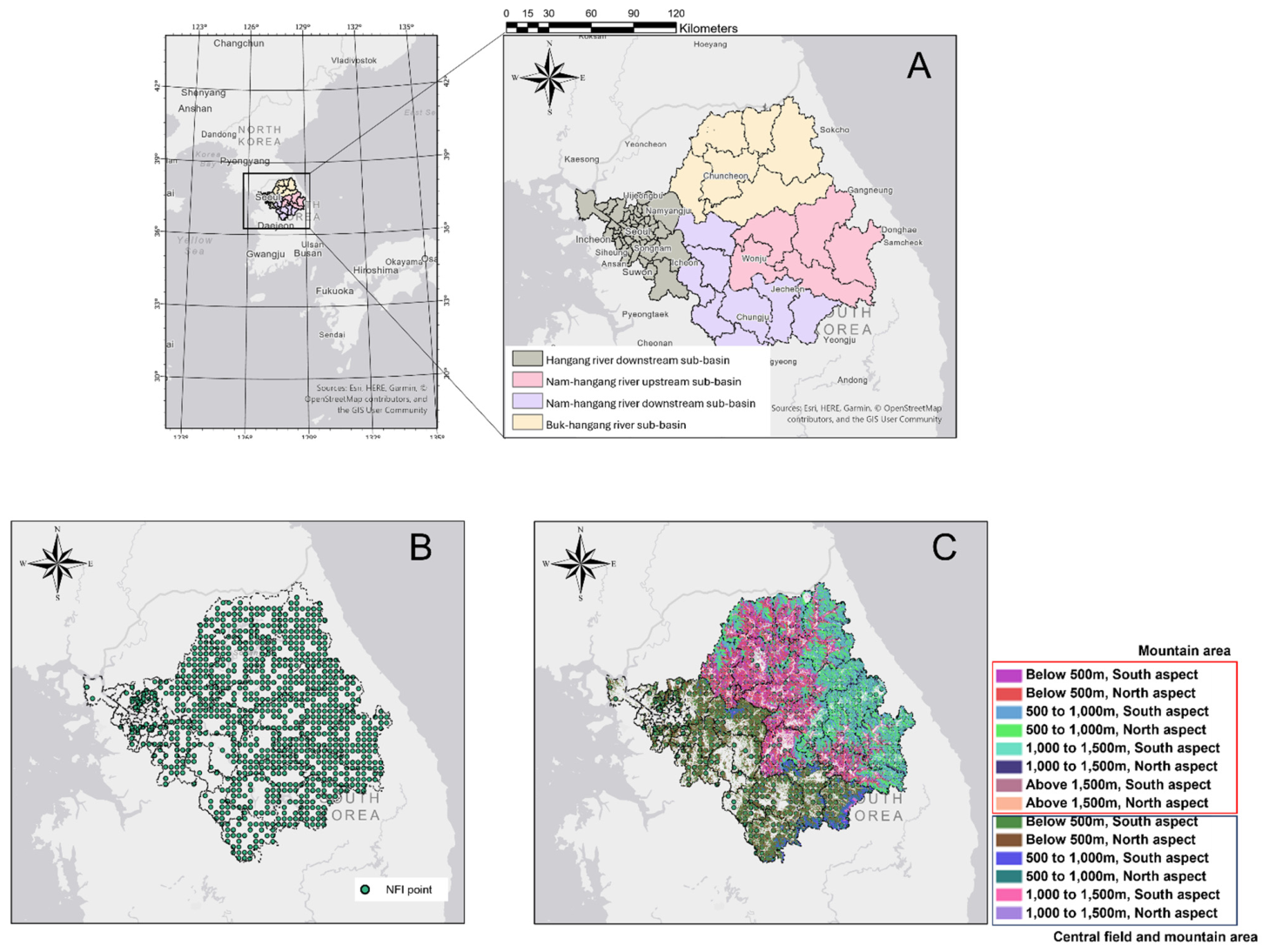
2.1. Background of the Study: Study Area, Species, and Environment
2.2. Model Description (LANDIS-II Biomass Succession Extension)
2.3. Parameterization and Verification
2.4. Model Initialization (Initial Community and Ecoregion)
2.5. Climate Scenario
2.6. Experimental Design and Analysis
3. Results
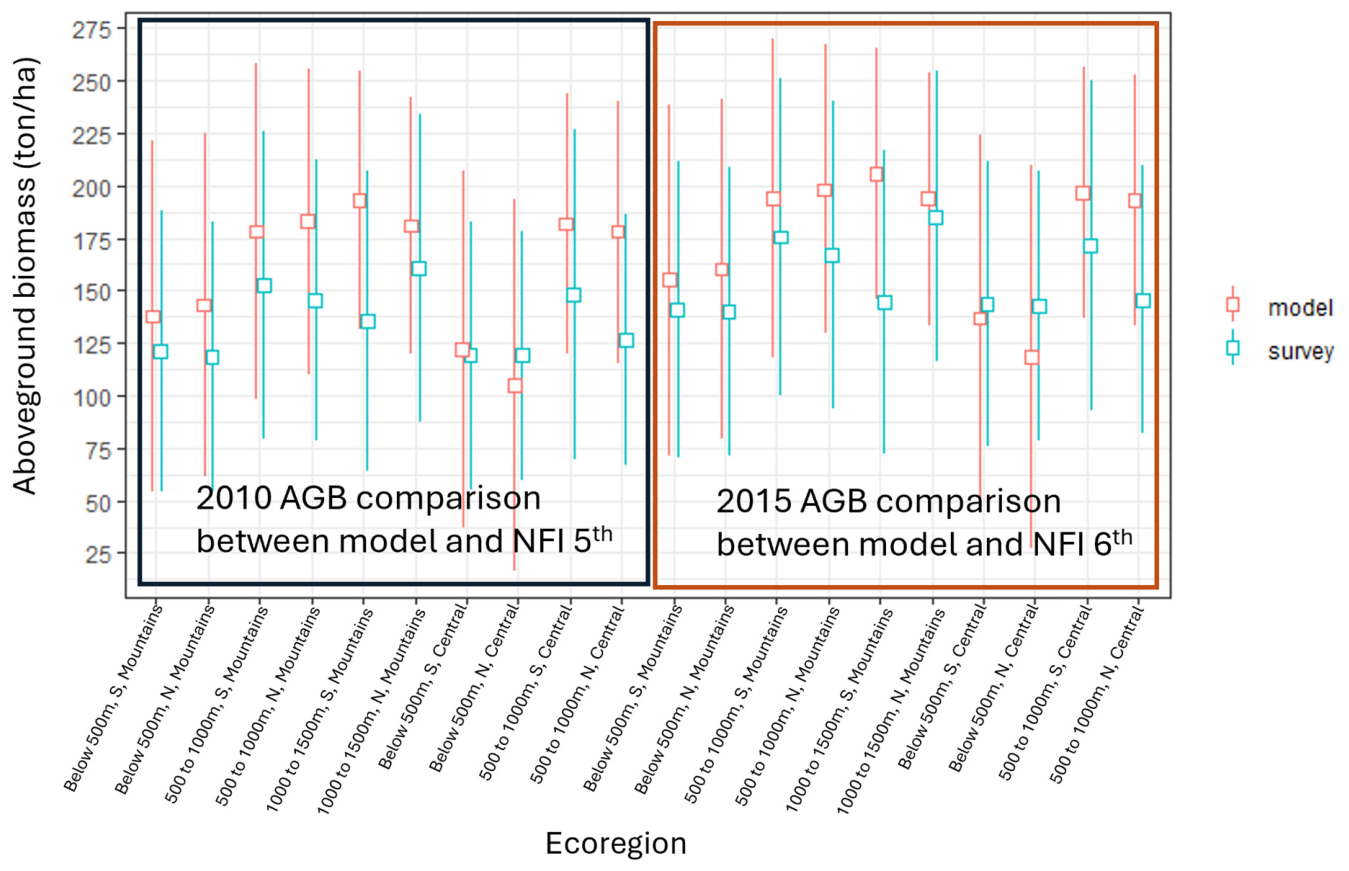
3.1. Model Verification
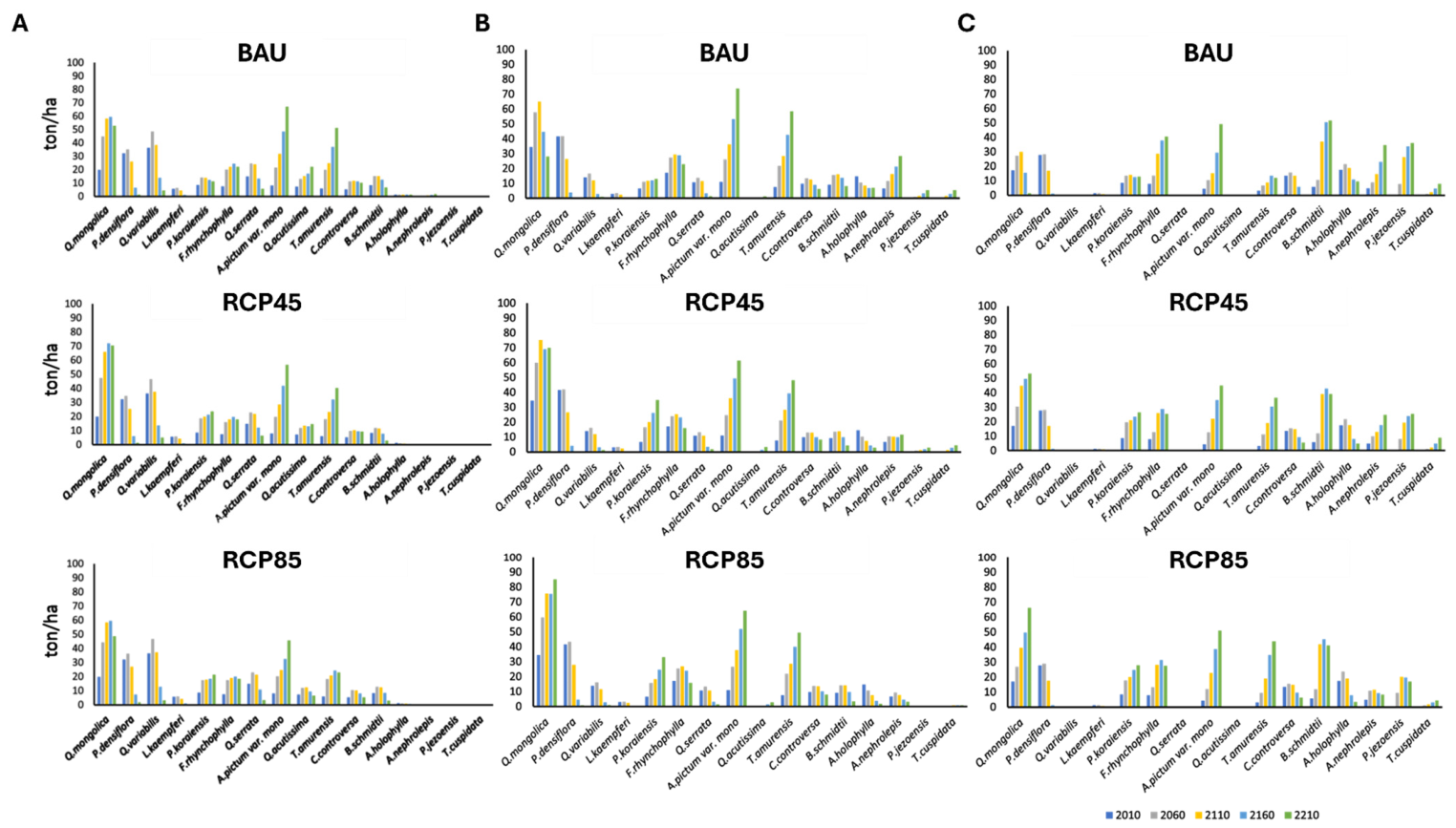
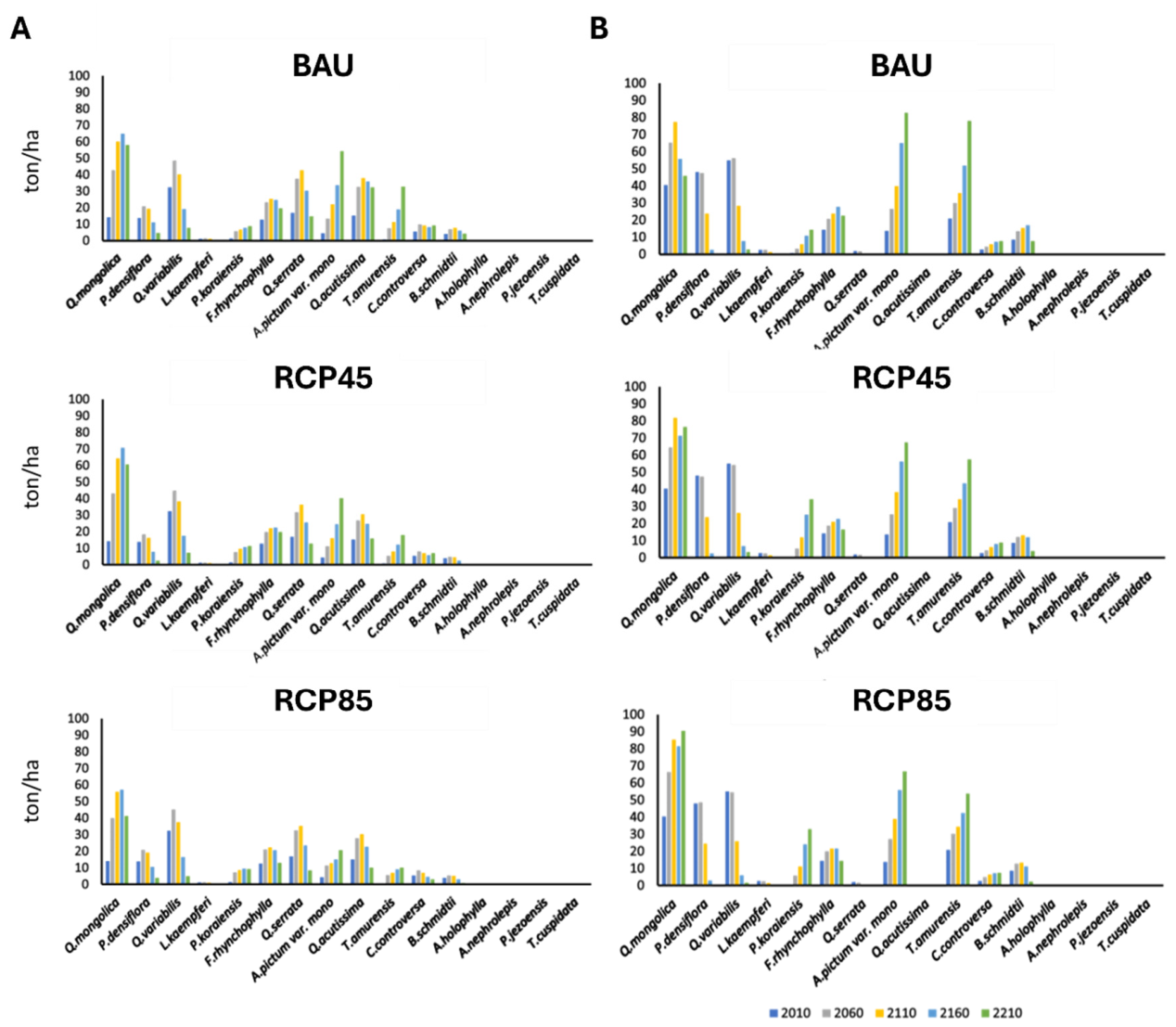
3.2. Changes in Forest Composition and Succession Under Climate Change
3.3. Carbon Dynamics
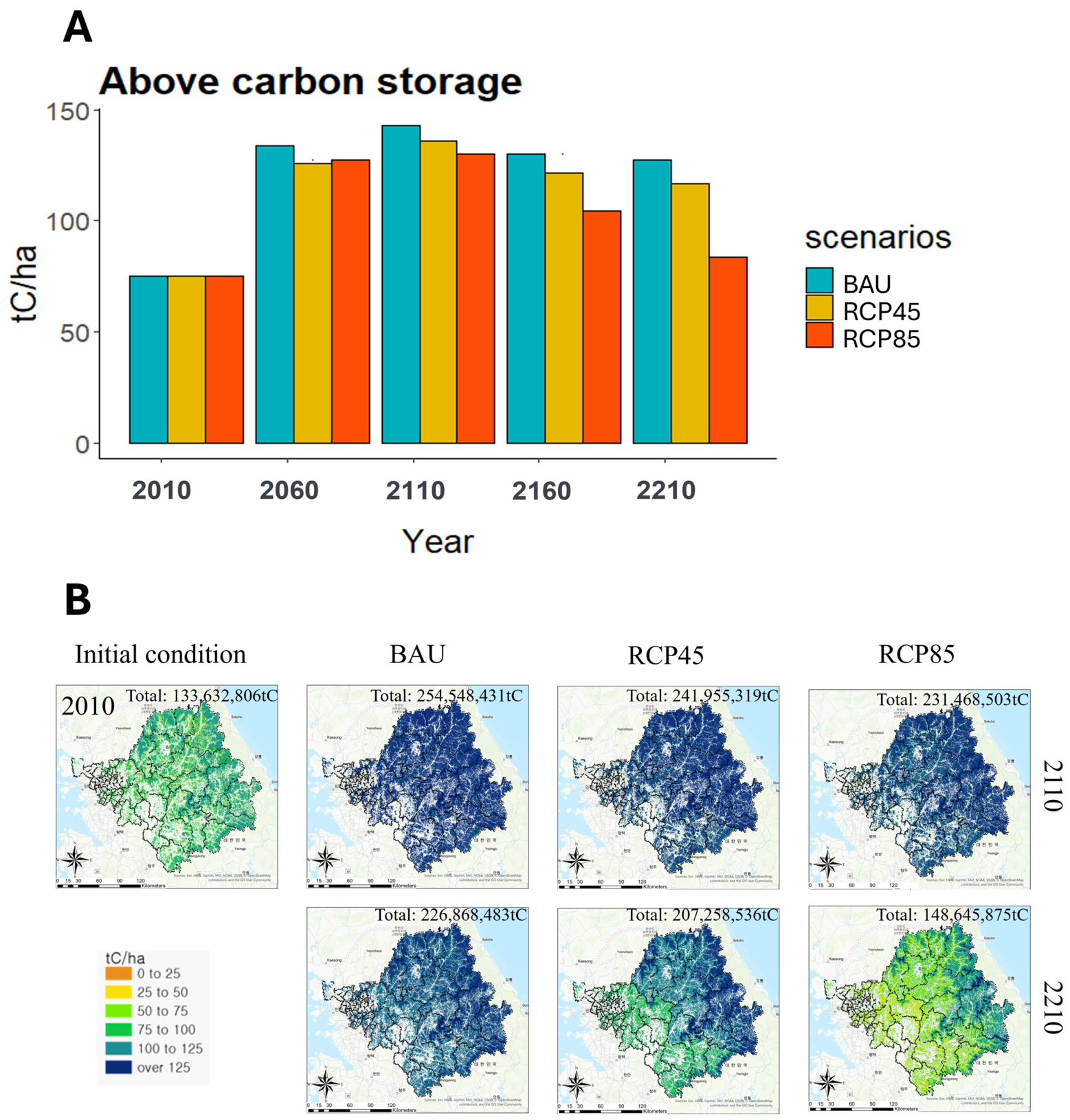
3.3.1. Carbon Storage
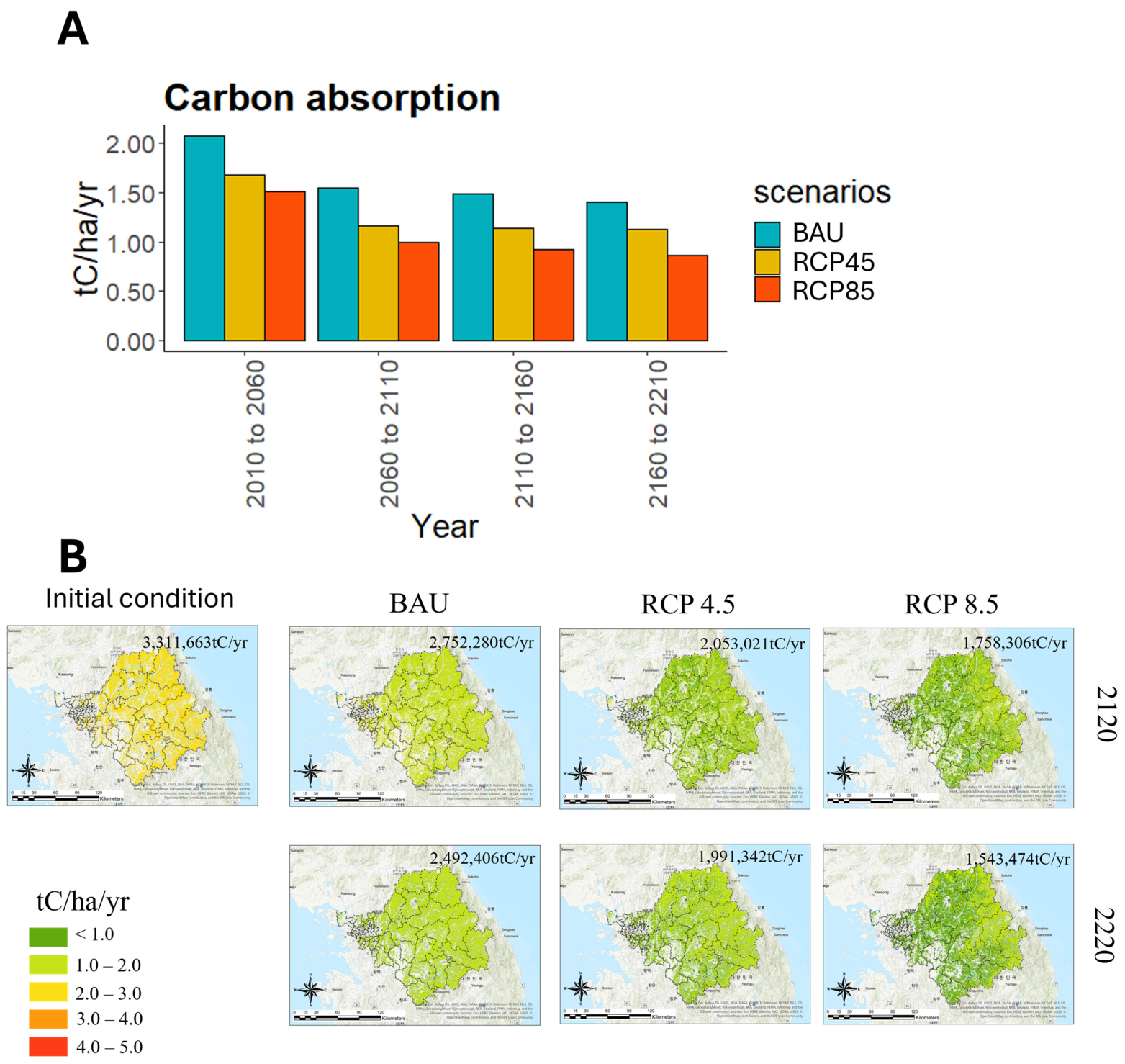
3.3.2. Carbon Absorption
4. Discussion
4.1. Species AGB Change in Young-Aged Forests
4.2. Carbon Vulnerability in Hangang River Basin
4.3. Uncertainties and Future Research
5. Conclusions
Supplementary Materials
Author Contributions
Funding
Data Availability Statement
Conflicts of Interest
References
- Jiang, L.; Bao, A.; Guo, H.; Ndayisaba, F. Vegetation dynamics and responses to climate change and human activities in Central Asia. Sci. Total Environ. 2017, 599, 967–980. [Google Scholar] [CrossRef] [PubMed]
- Hessburg, P.F.; Prichard, S.J.; Hagmann, R.K.; Povak, N.A.; Lake, F.K. Wildfire and climate change adaptation of western North American forests: A case for intentional management. Ecol. Appl. 2021, 31, e02432. [Google Scholar] [CrossRef] [PubMed]
- He, M.; Piao, S.; Huntingford, C.; Xu, H.; Wang, X.; Bastos, A.; Cui, J.; Gasser, T. Amplified warming from physiological responses to carbon dioxide reduces the potential of vegetation for climate change mitigation. Commun. Earth Environ. 2022, 3, 160. [Google Scholar] [CrossRef]
- Lasch, P.; Lindner, M.; Erhard, M.; Suckow, F.; Wenzel, A. Regional impact assessment on forest structure and functions under climate change—The Brandenburg case study. For. Ecol. Manag. 2002, 162, 73–86. [Google Scholar] [CrossRef]
- Iverson, L.R.; Prasad, A.M. Potential changes in tree species richness and forest community types following climate change. Ecosystems 2001, 4, 186–199. [Google Scholar] [CrossRef]
- Lee, S.J.; Ahn, Y.H. Change Prediction for Vegetation Structure, Species Diversity and Life-form of Evergreen Broad-leaved Forest by Climate Change in Gageo-Do Island, Korea. J. Environ. Sci. Int. 2013, 22, 979–997. [Google Scholar][Green Version]
- Lim, C.H.; Yoo, S.; Choi, Y.; Jeon, S.W.; Son, Y.; Lee, W.K. Assessing climate change impact on forest habitat suitability and diversity in the Korean Peninsula. Forests 2018, 9, 259. [Google Scholar] [CrossRef]
- Zhao, J.; Ma, J.; Hou, M.; Li, S. Spatial–temporal variations of carbon storage of the global forest ecosystem under future climate change. Mitig. Adapt. Strateg. Glob. Change 2020, 25, 603–620. [Google Scholar]
- Byun, J.Y.; Lee, W.K.; Choi, S.H.; Oh, S.H.; Yoo, S.J.; Kwon, T.S.; Sung, J.H.; Woo, J.W. Vulnerability assessment for forest ecosystem to climate change based on spatio-temporal information. Korean J. Remote Sens. 2012, 28, 159–169. [Google Scholar] [CrossRef]
- Cho, N.; Agossou, C.; Kim, E.; Lim, J.H.; Seo, J.W.; Kang, S. Machine-learning modeling on tree mortality and growth reduction of temperate forests with climatic and ecophysiological parameters. Ecol. Model. 2023, 483, 110456. [Google Scholar] [CrossRef]
- Anderson-Teixeira, K.J.; Miller, A.D.; Mohan, J.E.; Hudiburg, T.W.; Duval, B.D.; DeLucia, E.H. Altered dynamics of forest recovery under a changing climate. Glob. Change Biol. 2013, 19, 2001–2021. [Google Scholar] [CrossRef]
- Swift, K.; Ran, S. Successional responses to natural disturbance, forest management and climate change in British Columbia forests. J. Ecosyst. Manag. 2012, 13, 1. [Google Scholar] [CrossRef]
- Ko, D.W.; Sparrow, A.D.; Weisberg, P.J. Land-use legacy of historical tree harvesting for charcoal production in a semi-arid woodland. For. Ecol. Manag. 2011, 261, 1283–1292. [Google Scholar]
- IPCC. Climate Change 2023: Synthesis Report. Contribution of Working Groups I, II and III to the Sixth Assessment Report of the Intergovernmental Panel on Climate Change; IPCC: Geneva, Switzerland, 2023; pp. 35–115. [Google Scholar]
- Urban, D.L.; Harmon, M.E.; Halpern, C.B. Potential response of Pacific Northwestern forests to climatic change, effects of stand age and initial composition. Clim. Change 1993, 23, 247–266. [Google Scholar] [CrossRef]
- McMillan, A.M.; Winston, G.C.; Goulden, M.L. Age–dependent response of boreal forest to temperature and rainfall variability. Glob. Change Biol. 2008, 14, 1904–1916. [Google Scholar]
- Chen, H.Y.; Luo, Y.; Reich, P.B.; Searle, E.B.; Biswas, S.R. Climate change–associated trends in net biomass change are age dependent in western boreal forests of Canada. Ecol. Lett. 2016, 19, 1150–1158. [Google Scholar] [CrossRef] [PubMed]
- Kuuluvainen, T.; Gauthier, S. Young and old forest in the boreal: Critical stages of ecosystem dynamics and management under global change. For. Ecosyst. 2018, 5, 26. [Google Scholar] [CrossRef]
- Suazo-Ortuño, I.; Benítez-Malvido, J.; Marroquín-Páramo, J.; Soto, Y.; Siliceo, H.; Alvarado-Diaz, J. Resilience and vulnerability of herpetofaunal functional groups to natural and human disturbances in a tropical dry forest. For. Ecol. Manag. 2018, 426, 145–157. [Google Scholar] [CrossRef]
- Coop, J.D.; Parks, S.A.; Stevens-Rumann, C.S.; Crausbay, S.D.; Higuera, P.E.; Hurteau, M.D.; Tepley, A.; Whitman, E.; Assal, T.; Collins, B.M.; et al. Wildfire-driven forest conversion in western North American landscapes. BioScience 2020, 70, 659–673. [Google Scholar] [CrossRef] [PubMed]
- Bae, J.S.; Joo, R.W.; Kim, Y.S. Forest transition in South Korea: Reality, path and drivers. Land Use Policy 2012, 29, 198–207. [Google Scholar] [CrossRef]
- Korea Forest Service. Formulation and Implementation of Forest Master Plans I~III; Korea Forest Service: Seoul, Republic of Korea, 2013. [Google Scholar]
- Korea Forest Service. Formulation and Implementation of Forest Master Plans I~V; Korea Forest Service: Seoul, Republic of Korea, 2013. [Google Scholar]
- Pugh, T.A.; Lindeskog, M.; Smith, B.; Poulter, B.; Arneth, A.; Haverd, V.; Calle, L. Role of forest regrowth in global carbon sink dynamics. Proc. Natl. Acad. Sci. USA 2019, 116, 4382–4387. [Google Scholar] [CrossRef] [PubMed]
- Oh, J.S.; Shin, J.H.; Lim, J.H. Long-term ecological research programme in Forestry Research Institute, Korea. Korean J. Ecol. 2000, 23, 131–134. [Google Scholar]
- Yun, S.J.; Chun, J. Long-term ecological research on Korean forest ecosystems: The current status and challenges. Ecol. Res. 2018, 33, 1289–1302. [Google Scholar] [CrossRef]
- Nenzén, H.K.; Price, D.T.; Boulanger, Y.; Taylor, A.R.; Cyr, D.; Campbell, E. Projected climate change effects on Alberta’s boreal forests imply future challenges for oil sands reclamation. Restor. Ecol. 2020, 28, 39–50. [Google Scholar]
- Wu, Z.; Dai, E.; Ge, Q.; Xi, W.; Wang, X. Modelling the integrated effects of land use and climate change scenarios on forest ecosystem aboveground biomass, a case study in Taihe County of China. J. Geogr. Sci. 2017, 27, 205–222. [Google Scholar]
- Liu, J.; Zou, H.X.; Bachelot, B.; Dong, T.; Zhu, Z.; Liao, Y.; Plenković-Moraj, A.; Wu, Y. Predicting the responses of subalpine forest landscape dynamics to climate change on the eastern Tibetan Plateau. Glob. Change Biol. 2021, 27, 4352–4366. [Google Scholar] [CrossRef]
- Crookston, N.L.; Rehfeldt, G.E.; Dixon, G.E.; Weiskittel, A.R. Addressing climate change in the forest vegetation simulator to assess impacts on landscape forest dynamics. For. Ecol. Manag. 2010, 260, 1198–1211. [Google Scholar] [CrossRef]
- Scheller, R.M.; Domingo, J.B.; Sturtevant, B.R.; Williams, J.S.; Rudy, A.; Gustafson, E.J.; Mladenoff, D.J. Design, development, and application of LANDIS-II, a spatial landscape simulation model with flexible temporal and spatial resolution. Ecol. Model. 2007, 201, 409–419. [Google Scholar] [CrossRef]
- De Bruijn, A.; Gustafson, E.J.; Sturtevant, B.R.; Foster, J.R.; Miranda, B.R.; Lichti, N.I.; Jacobs, D.F. Toward more robust projections of forest landscape dynamics under novel environmental conditions: Embedding PnET within LANDIS-II. Ecol. Model. 2014, 287, 44–57. [Google Scholar] [CrossRef]
- Simons-Legaard, E.; Legaard, K.; Weiskittel, A. Predicting aboveground biomass with LANDIS-II: A global and temporal analysis of parameter sensitivity. Ecol. Model. 2015, 313, 325–332. [Google Scholar] [CrossRef]
- National Institute of Forest Science. The Forest Landscape and Ecosystem Management Territories; National Institute of Forest Science: Seoul, Republic of Korea, 2009. [Google Scholar]
- Xu, C.; Gertner, G.Z.; Scheller, R.M. Uncertainties in the response of a forest landscape to global climatic change. Glob. Change Biol. 2009, 15, 116–131. [Google Scholar] [CrossRef]
- Gustafson, E.J. When relationships estimated in the past cannot be used to predict the future: Using mechanistic models to predict landscape ecological dynamics in a changing world. Landsc. Ecol. 2013, 28, 1429–1437. [Google Scholar] [CrossRef]
- Scheller, R.M.; Mladenoff, D.J. A spatially interactive simulation of climate change, harvesting, wind, and tree species migration and projected changes to forest composition and biomass in northern Wisconsin, USA. Glob. Change Biol. 2005, 11, 307–321. [Google Scholar] [CrossRef]
- Scheller, R.M.; Mladenoff, D.J. A forest growth and biomass module for a landscape simulation model, LANDIS: Design, validation, and application. Ecol. Model. 2004, 180, 211–229. [Google Scholar] [CrossRef]
- Aber, J.D.; Federer, C.A. A generalized, lumped-parameter model of photosynthesis, evapotranspiration and net primary production in temperate and boreal forest ecosystems. Oecologia 1992, 92, 463–474. [Google Scholar] [CrossRef] [PubMed]
- Cho, W.; Lim, W.; Kim, E.S.; Lim, J.H.; Ko, D.W. Parameterization and application of a forest landscape model by using national forest inventory and long term ecological research data. Korean J. Agric. For. Meteorol. 2020, 22, 215–231. [Google Scholar]
- Lee, W.A.; Shin, J.W.; Choi, J.K.; Lee, W.K.; Lee, Y.J.; Kim, S.H.; Jung, D.J. Diameter growth analysis for major species using national forest resource inventory—In the Gangwon-Do forests. J. For. Sci. 2011, 27, 113–118. [Google Scholar] [CrossRef]
- National Institute of Forest Science. Development of Digital Climate Map of Korean Forest and Prediction of Forest Climate; National Institute of Forest Science: Seoul, Republic of Korea, 2013; pp. 1–133. [Google Scholar]
- Byun, J.G.; Lee, W.K.; Kim, M.; Kwak, D.A.; Kwak, H.; Park, T.; Byun, W.H.; Son, Y.; Choi, J.K.; Lee, Y.J.; et al. Radial growth response of Pinus densiflora and Quercus spp. to topographic and climatic factors in South Korea. J. Plant Ecol. 2013, 6, 380–392. [Google Scholar] [CrossRef]
- Cui, G.; Kwak, H.; Choi, S.; Kim, M.; Lim, C.H.; Lee, W.K.; Kim, J.S.; Chae, Y. Assessing vulnerability of forests to climate change in South Korea. J. For. Res. 2016, 27, 489–503. [Google Scholar]
- Hong, M.; Song, C.; Kim, M.; Kim, J.; Roh, M.; Ko, Y.; Cho, K.; Son, Y.; Jeon, S.; Kraxner, F.; et al. Modeling-based risks assessment and management of climate change in South Korean forests. Forests 2023, 14, 745. [Google Scholar] [CrossRef]
- Kim, D.J.; Han, N.Y.; Choi, M.N.; Jang, M.J.; Shin, M.S.; Seo, C.W.; Lee, D.H.; Kwon, Y.S. Assessment of climate change impact on landscape tree distribution and sustainability in South Korea using MaxEnt-based modeling. PLoS ONE 2025, 20, e0316393. [Google Scholar] [CrossRef] [PubMed]
- Choung, Y.; Lee, J.; Cho, S.; Noh, J. Review on the succession process of Pinus densiflora forests in South Korea: Progressive and disturbance-driven succession. J. Ecol. Environ. 2020, 44, 16. [Google Scholar] [CrossRef]
- Hong, Y.; Kim, E.; Lee, E.; Lee, S.; Cho, K.; Lee, Y.; Chung, S.; Jeong, H.; You, Y. Characteristics of vegetation succession on the Pinus thunbergii forests in warm temperate regions, Jeju Island, South Korea. J. Ecol. Environ. 2019, 43, 44. [Google Scholar] [CrossRef]
- Hwang, J.; Lee, E.; Jeong, S.; Kim, Y.; Yoo, Y.; Cha, S.; Jeon, S. Assessing the impact of urbanization and forest aging on carbon absorption in the Seoul metropolitan area of South Korea. Land Use Policy 2025, 152, 107504. [Google Scholar] [CrossRef]
- Kim, H.S.; Noulèkoun, F.; Noh, N.J.; Son, Y.W. Future projection of CO2 absorption and N2O emissions of the South Korean forests under climate change scenarios: Toward net-zero CO2 emissions by 2050 and beyond. Forests 2022, 13, 1076. [Google Scholar]
- Bodin, J.; Badeau, V.; Bruno, E.; Cluzeau, C.; Moisselin, J.M.; Walther, G.R.; Dupouey, J.L. Shifts of forest species along an elevational gradient in Southeast France: Climate change or stand maturation? J. Veg. Sci. 2013, 24, 269–283. [Google Scholar] [CrossRef]
- Ruiz–Labourdette, D.; Nogués–Bravo, D.; Ollero, H.S.; Schmitz, M.F.; Pineda, F.D. Forest composition in Mediterranean mountains is projected to shift along the entire elevational gradient under climate change. J. Biogeogr. 2012, 39, 162–176. [Google Scholar]
- Sarris, D.; Christodoulakis, D.; Körner, C. Impact of recent climatic change on growth of low elevation eastern Mediterranean forest trees. Clim. Change 2011, 106, 203–223. [Google Scholar]
- Guisan, A.; Theurillat, J.P. Assessing alpine plant vulnerability to climate change: A modeling perspective. Integr. Assess. 2000, 1, 307–320. [Google Scholar] [CrossRef]
- Mietkiewicz, N.; Kulakowski, D.; Rogan, J.; Bebi, P. Long–term change in sub–alpine forest cover, tree line and species composition in the Swiss Alps. J. Veg. Sci. 2017, 28, 951–964. [Google Scholar] [CrossRef]
- Maharjan, S.K.; Sterck, F.J.; Raes, N.; Zhao, Y.; Poorter, L. Climate change induced elevational range shifts of Himalayan tree species. Biotropica 2023, 55, 53–69. [Google Scholar]
- Maier, P.A.; Vandergast, A.G.; Ostoja, S.M.; Aguilar, A.; Bohonak, A.J. Landscape genetics of a sub-alpine toad: Climate change predicted to induce upward range shifts via asymmetrical migration corridors. Heredity 2022, 129, 257–272. [Google Scholar] [CrossRef] [PubMed]
- Haq, S.M.; Rashid, I.; Calixto, E.S.; Ali, A.; Kumar, M.; Srivastava, G.; Bussmann, R.W.; Khuroo, A.A. Unravelling patterns of forest carbon stock along a wide elevational gradient in the Himalaya: Implications for climate change mitigation. For. Ecol. Manag. 2022, 521, 120442. [Google Scholar] [CrossRef]
- Shin, S.; Kim, J.H.; Dang, J.H.; Seo, I.S.; Lee, B.Y. Elevational distribution ranges of vascular plant species in the Baekdudaegan mountain range, South Korea. J. Ecol. Environ. 2021, 45, 7. [Google Scholar] [CrossRef]
- Thom, D.; Seidl, R. Natural disturbance impacts on ecosystem services and biodiversity in temperate and boreal forests. Biol. Rev. 2016, 91, 760–781. [Google Scholar] [PubMed]
- Maxwell, C.; Scheller, R.M.; Long, J.W.; Manley, P. Forest management under uncertainty: The influence of management versus climate change and wildfire in the Lake Tahoe Basin, USA. Ecol. Soc. 2022, 27, 15. [Google Scholar] [CrossRef]
- Furniss, T.J.; Hessburg, P.F.; Povak, N.A.; Salter, R.B.; Wigmosta, M.S. Predicting future patterns, processes, and their interactions: Benchmark calibration and validation procedures for forest landscape models. Ecol. Model. 2022, 473, 110099. [Google Scholar] [CrossRef]
- Lucash, M.S.; Williams, N.G.; Srikrishnan, V.; Keller, K.; Scheller, R.M.; Hegelson, C.; Nicholas, R.E.; Smithwick, E.A.H. Balancing multiple forest management objectives under climate change in central Wisconsin, USA. Trees For. People 2023, 14, 100460. [Google Scholar] [CrossRef]
- Park, J.S.; Joo, S.J.; Lee, J.; Seo, D.; Kim, H.S.; Jeon, J.; Yun, C.W.; Lee, J.E.; Choi, S.W.; Lee, J.Y. Long-term ecological monitoring in South Korea: Progress and perspectives. J. Ecol. Environ. 2023, 47, 264–271. [Google Scholar] [CrossRef]
- Lee, K.; Cha, J.Y.; Lee, E.J.; Lee, S.C.; Son, S.; Kim, S.; Jin, X.; Choi, J.W.; Oh, N.H. Biogeochemical Properties of a Forest Stream Dissolved Organic Matter at Mt. Jeombong, a Korean Long-term Ecological Research (KLTER) Site. J. Korean Soc. Water Environ. 2025, 41, 54–69. [Google Scholar]
- Yun, S.J.; Kim, M.; Park, C.; Choi, W.I.; Lim, J.H.; Chun, J.H. Changes in stand structure and biomass increment in a warm temperate forest at a long-term ecological research site in Korea over 17 years. For. Sci. Technol. 2021, 17, 189–196. [Google Scholar] [CrossRef]


Disclaimer/Publisher’s Note: The statements, opinions and data contained in all publications are solely those of the individual author(s) and contributor(s) and not of MDPI and/or the editor(s). MDPI and/or the editor(s) disclaim responsibility for any injury to people or property resulting from any ideas, methods, instructions or products referred to in the content. |
© 2026 by the authors. Licensee MDPI, Basel, Switzerland. This article is an open access article distributed under the terms and conditions of the Creative Commons Attribution (CC BY) license.
Share and Cite
Cho, W.; Ko, D.W. Simulating Impacts of Climate Change on Young-Aged Forest Succession and Carbon Dynamics. Forests 2026, 17, 794. https://doi.org/10.3390/f17070794
Cho W, Ko DW. Simulating Impacts of Climate Change on Young-Aged Forest Succession and Carbon Dynamics. Forests. 2026; 17(7):794. https://doi.org/10.3390/f17070794
Chicago/Turabian StyleCho, Wonhee, and Dongwook W. Ko. 2026. "Simulating Impacts of Climate Change on Young-Aged Forest Succession and Carbon Dynamics" Forests 17, no. 7: 794. https://doi.org/10.3390/f17070794
APA StyleCho, W., & Ko, D. W. (2026). Simulating Impacts of Climate Change on Young-Aged Forest Succession and Carbon Dynamics. Forests, 17(7), 794. https://doi.org/10.3390/f17070794