Communication

From Wildfire Risk to Renewable Energy: A Sustainable Pathway to Valorize Fire-Prone Biomass for Bioenergy in Northern Canada

1
Natural Resources Canada, Canadian Forest Service, Northern Forestry Centre, 5320 122 St., Edmonton, AB T6H 3S5, Canada
2
Natural Resources Canada, CanmetENERGY, 1 Haanel Drive-Building 6, Ottawa, ON K1A 1M1, Canada
*
Author to whom correspondence should be addressed.
Forests 2026, 17(7), 748; https://doi.org/10.3390/f17070748 (registering DOI)
Submission received: 7 May 2026 / Revised: 18 June 2026 / Accepted: 22 June 2026 / Published: 27 June 2026

Abstract

Globally, wildfires are increasingly threatening forest ecosystems and human well-being, requiring proactive management strategies. Integrating wildfire mitigation with bioenergy production presents a dual opportunity to reduce fire risk while contributing to clean energy. This study builds upon previous work by incorporating updated annual heat load estimates from 32 off-grid communities in northern Canada to assess the amount of biomass at risk of wildfire that could be mobilized to meet local bioenergy needs. Our results reveal that energy consumption in the remote communities considered was previously significantly underestimated, with an average of 11,710 MWh per year, and a minimum and maximum of 1869 and 43,867 MWh per year, respectively. With the updated dataset, which includes both space heating and electricity energy usage, the average energy demand is approximately 300% higher than earlier estimates. Despite this substantial increase in energy consumption, the amount of biomass needed to meet local energy demand per year ranges from 352 to 8276 odt per year, representing only a small fraction (approximately 1.67% on average) of the total biomass identified as being at risk within a 10 km buffer. This corresponds to fuel treatment areas ranging from 4 to 222 hectares per year (around 51 ha on average), depending on the community. The results presented here, based on updated energy data, provide important insights into the operational feasibility of this approach. To be successful, implementation will require strong community leadership and collaboration with fire management agencies to design consistent and cost-effective fuel treatment strategies that are tailored to each community’s environmental conditions and energy needs.

1. Introduction

Wildfires are increasingly recognized as a global risk to human systems and ecosystems [1,2,3]. Wildfires are among the costliest natural hazards, with economic losses continuing to rise worldwide. From 2014 to 2023, wildfires resulted in an estimated USD 106 billion in economic losses [4]. As suppression costs increase, there is growing recognition of the need for more preventive and integrated wildfire management approaches [5].
The 2023 wildfire season was unprecedented in scale, particularly across boreal regions [6]. These areas experienced longer and more intense fire weather conditions, driven by prolonged droughts, higher temperatures, and the accumulation of combustible fuels. Canada was particularly affected, experiencing its most severe wildfire season on record, with more than 15 million ha burned and over 230,000 people evacuated [7,8]. This far exceeds historical averages and resulted in widespread impacts on ecosystems, air quality, infrastructure, and communities across multiple Canadian regions [7]. The increasing scale and intensity of fires exposed critical vulnerabilities in current wildfire management systems and highlighted the limits of suppression-based approaches.
Northern communities in Canada, many of which are home to Indigenous peoples, are disproportionately exposed to wildfire [9,10]. Indigenous peoples only make up 5% of the population in Canada, but 42% of wildfire evacuation events occurred in their communities [11]. Many remote communities in Canada, both Indigenous and non-Indigenous, lack up-to-date emergency planning, adequate infrastructure, and sufficient resources and capacity to respond effectively to wildfires. In addition, limited evacuation routes further increase their vulnerability to wildfire events. These constraints place significant pressure on local emergency response systems and economies, underscoring the critical need for proactive vegetation management to reduce fire risk in and around these communities.
Many of these communities are both exposed to increasing wildfire risk and classified as remote and off-grid [12]. According to the Remote Communities Energy Database (RCED), more than 200 communities in Canada are classified as remote and off-grid, with no connection to the North American electricity grid [13]. A large proportion (75%) rely on diesel-based systems for electricity and heating, reflecting persistent infrastructure and energy access challenges. Dependence on inefficient and aging diesel generators creates persistent energy insecurity, driven by limited infrastructure and reliance on imported fuels. As a result, many communities experience energy costs that are two to ten times higher than in southern regions, along with significant environmental impacts [13,14].
In this context, bioenergy has emerged as a promising pathway to support the energy transition in remote communities and replace diesel-based energy systems. Bioenergy systems, including biomass heating and combined heat and power (CHP), can utilize forest residues, sawmill byproducts, or other non-merchantable biomasses from fuel treatment as cost-effective feedstock [15,16,17]. Bioenergy currently represents approximately 5% of Canada’s total energy supply and 27% of its renewable energy portfolio [18]; however, biomass remains an abundant and underutilized resource with significant potential for commercial mobilization within sustainable forest management frameworks [19,20,21]. Despite the growing interest, the deployment of bioenergy in remote and off-grid communities remains limited, as biomass supply chains are complex due to geographic remoteness and infrastructure constraints [19,22,23]. As a result, many communities continue to rely on imported feedstocks from the south, which are sometimes transported over distances exceeding 3000 km [23]. This dependence on external supply chains, combined with the need for external technical expertise to operate bioenergy systems, constrains the full benefits of bioenergy and limits opportunities for community-led energy transitions [24,25].
These overlapping challenges underscore the importance of integrated solutions that address both wildfire risk reduction and energy security. In this study, we build upon previous work by incorporating updated estimates of annual heat load data from 32 off-grid communities in northern Canada to assess the amount of biomass that is at risk of wildfires that could be mobilized to meet local bioenergy needs. A previous study quantified biomass requirements using energy demand estimates derived from the Remote Communities Energy Database [12]. However, feedback from community stakeholders and experts indicated that portions of the database may no longer accurately reflect current energy consumption patterns. Therefore, this short communication incorporates updated community-level heat demand data to reassess the amount of biomass from wildfire risk reduction treatments required to meet local bioenergy demands. We argue that up-to-date and standardized energy data are critical for accurately evaluating local biomass needs and resource availability. Combined with efforts to build local capacity and expertise, they can help to unlock the full benefits of bioenergy systems.

2. Materials and Methods

2.1. Remote and Off-Grid Community Energy Data

Communities have been selected from the Remote Communities Energy Database (RCED) [13]. In this paper, we build upon and update the methodology developed by Mansuy et al. (2025) [12] by incorporating more recent and accurate data on energy consumption in remote and off-grid communities [26]. In the previous study [12], community annual energy demand (AED in MWh per year) was based on the RCED datasets from 2018, mostly based on population estimates, which are now outdated given the evolving energy context in northern and remote regions. The RCED datasets capture only electrical energy consumption data. In contrast, the study of Brown et al. (2024) [26] provides a refined approach by estimating the thermal energy demand based on building-level heat loads, which are then aggregated at the community scale (Table 1). This bottom-up methodology provides a more accurate and representative characterization of energy consumption patterns. As a result, the updated energy profiles include both heat and electricity needs at the community level while better reflecting current conditions and improving the robustness of the analysis. These improvements allow for a more reliable assessment of bioenergy potential in remote northern communities, supporting more operational and evidence-based decision making. From the previous study [12], we retained the same 32 communities previously identified as the most exposed to wildfire risk within the RCED (Table 1).

2.2. Biomass at Risk from Fire

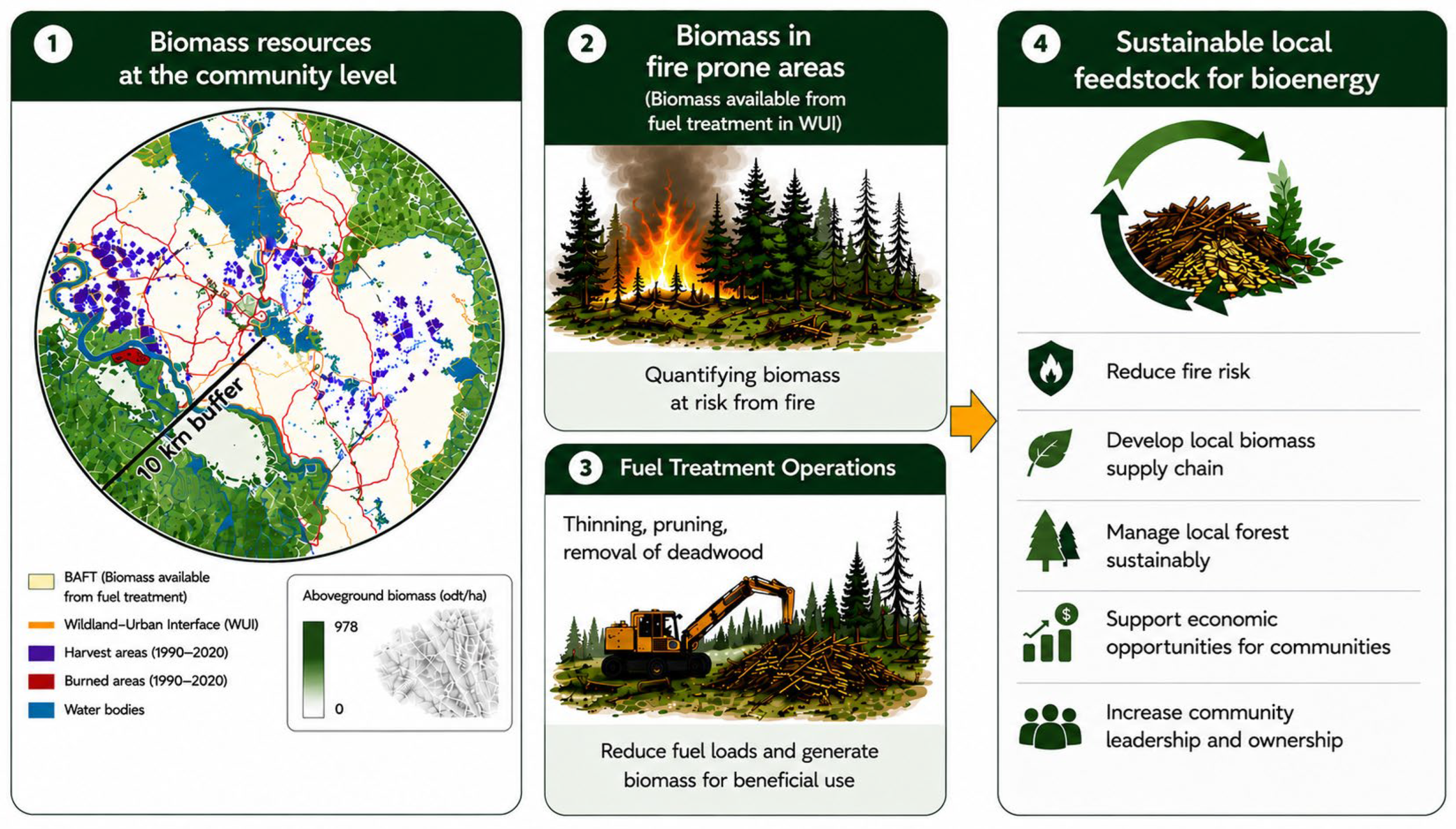
The amount of biomass that can serve as local feedstock is defined as the biomass at risk from fire and theoretically available for fuel treatment at the community level. The estimates were directly derived from previous analyses [12], and the methodology is briefly summarized here. The biomass available from fuel treatment (BAFT) was calculated using a national aboveground biomass dataset, expressed in oven-dry tons per hectare (odt ha−1) [27]. The dataset includes estimates of branches, foliage, bark, and stemwood from forest stands in 2020 at a spatial resolution of 30 m [27]. Biomass older than 30 years was used as an indicator of increased biomass accumulation and, consequently, elevated wildfire risk, which is consistent with findings from previous studies conducted in Canada [9]. To focus the assessment on the most fire-prone areas, biomass layers were spatially constrained to the wildland–human interface (WHI) using a national geospatial dataset [28] (Figure 1). The WHI layer is an aggregation of three anthropogenic interface types: the wildland–urban interface, the wildland–infrastructure interface, and the wildland–industrial interface. Each interface is defined by the intersection of human-built structures and wildland fuels, with a variable-width buffer extending up to a maximum distance of 2.4 km from human-built infrastructure, depending on the burning potential of the surrounding fuel type [28]. To focus on flammable vegetation, biomass classified as a non-fuel was masked and excluded from the analysis. In addition, biomass located within 30 m of water bodies was excluded by using a conservative riparian buffer that is commonly applied in Canada to minimize impacts on sensitive riparian ecosystems and water resources, as frequently recommended in the literature [29,30]. Finally, BAFT was estimated based on the spatial overlap of these datasets within a 10 km buffer surrounding each community, thereby focusing on the most accessible biomass resources for harvesting and transportation (Figure 1).

2.3. Converting Biomass to Bioenergy

Biomass requirements for bioenergy production were calculated based on the AED of each community (in Megawatt hours per year; MWh year−1). In this paper, we only consider a theoretical scenario in which raw biomass is estimated without further processing transformations. Because the biomass data from the national forest inventory [27] are already expressed in oven-dry tons (0% moisture content), we applied an energy conversion factor of 5.3 MWh per metric ton of dry woody biomass (with a calorific value of 19 MJ kg−1 at a 0% moisture content), as commonly reported in bioenergy standards [31]. The theoretical biomass requirement at the community level was calculated using the same methodological approach as in Mansuy et al. (2025) [12]:
T h e o r e t i c a l   b i o m a s s   n e e d   o d t / y r = A E D   M W h y r   5.3   ( M W h o d t )
The theoretical fuel treatment area (FTA) is defined as the annual forest area that must be treated (harvested or thinned) to supply the amount of woody biomass to meet the AED of a given community. It was calculated using the mean biomass density around the community as follows:
T h e o r e t i c a l   a r e a   t o   b e   t r e a t e d   a n n u a l l y   h a / y r = T h e o r e t i c a l   b i o m a s s   n e e d   o d t y r   M e a n   b i o m a s s   d e n s i t y   ( o d t h a )
The theoretical percentage of the FTA to be treated annually was calculated as follows:
T h e o r e t i c a l   p e r c e n t a g e   o f   F T A   n e e d e d   t o   m e e t   A E D   % = T h e o r e t i c a l   a r e a   t o   b e   t r e a t e d   a n n u a l l y   ( h a ) F T A   ( h a )   × 100

3. Results

The updated energy dataset with both heat and electricity needs reveals that energy consumption in the 32 remote communities ranges between 1869 and 43,867 Mwh per year, with an average of 11,710 Mwh per year (Table 1). The highest annual energy demand was observed in Sandy Lake, Ontario, which also corresponds to the largest community, with a population of approximately 2700 residents. According to the updated data, the average energy consumption across the communities considered is approximately 300% higher than earlier estimates, corresponding to nearly a threefold increase (Table 1), as expected, as the updated energy profiles include both thermal and electrical energy needs of the communities. However, this variation is not uniform across communities. In some cases, such as Aklavik in the Northwest Territories, energy consumption is up to 438% higher than previously estimated, while in other communities, the increase is more moderate, around 125%, like in Fort Hope, Ontario.
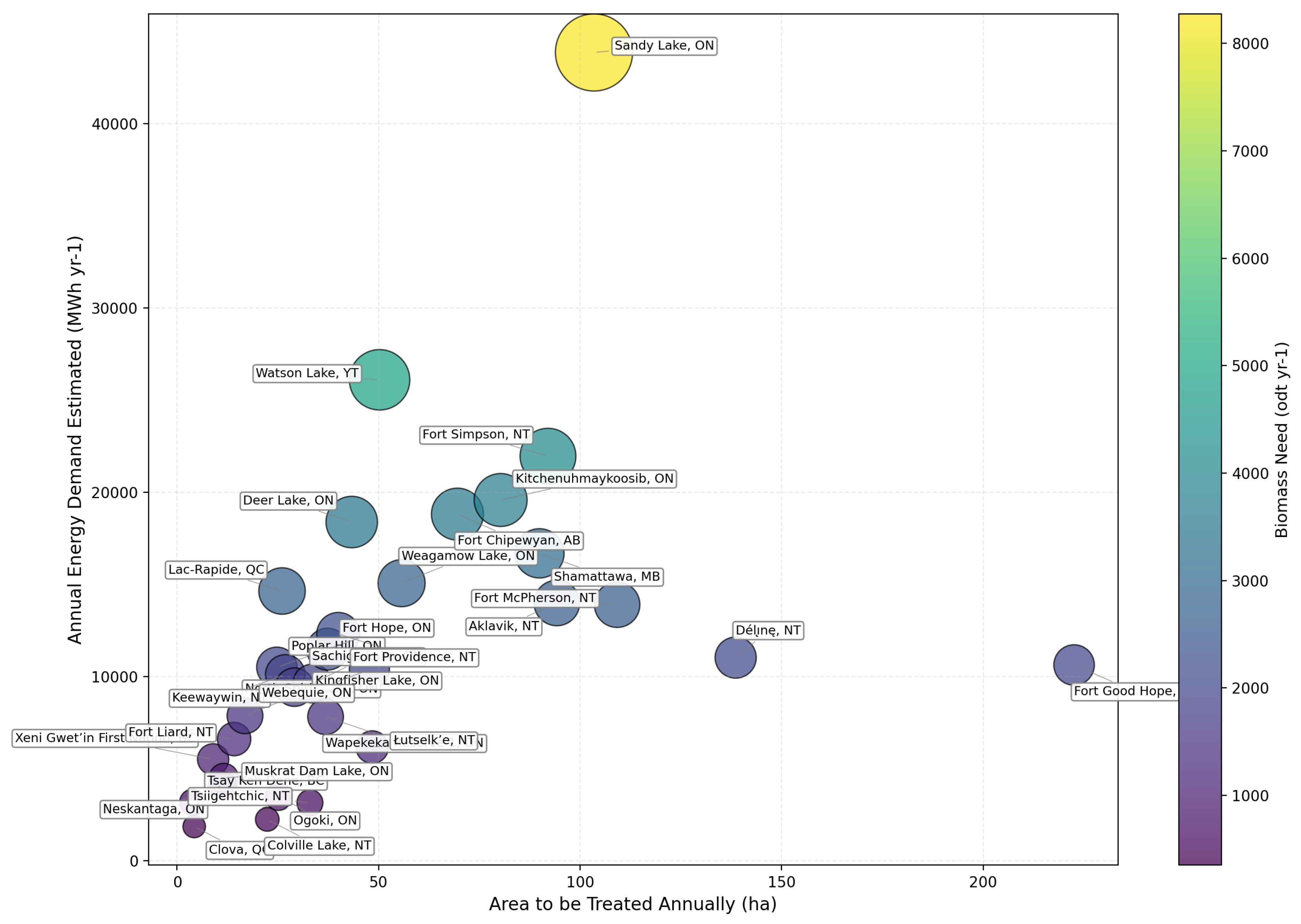
The higher energy demand estimated in this study has significant implications for bioenergy potential and biomass supply requirements. Under the same assumptions, the increased demand translates into a proportional rise in biomass needs (Figure 2). Specifically, biomass demand to replace fossil fuel needs ranges from a minimum of 352 oven-dry tons (odt) per year for the community of Clova (Quebec) to nearly 8300 odt per year for Sandy Lake (Ontario), with an average of 2200 odt per year across the communities considered. This amount of biomass represents approximately 0.16% of the total biomass identified as being at risk and available for fuel treatment, with estimates ranging from a minimum of 1.67% to a maximum of 5%, respectively.
On average, the required theoretical fuel treatment area based on the revised energy estimates is approximately 51 ha per year, with a maximum of 222 ha per year and a minimum of 3.8 ha per year (Table 1; Figure 2). In comparison, previous estimates solely based on electrical usage indicated an average requirement of 19 ha per year, ranging from 2 ha to 104 ha per year [12]. Overall, these updated treatment areas represent, on average, 1.82% of the total fuel treatment area (FTA), with values ranging from 0.03% to 18.65%.
Although the revised energy demand results in a substantial increase in biomass requirements, the findings indicate that biomass supply operations remain operationally feasible for most of the selected communities on an annual basis, given the significant availability of underutilized biomass in their surrounding areas. For most communities, the required fuel treatment area remains relatively limited, with less than 100 ha treated annually. The maximum value of 222 ha per year, observed for the community of Fort Good Hope in the Northwest Territories, appears to be an outlier relative to the other communities assessed (Figure 2).

4. Discussion

Our results highlight substantial discrepancies with earlier assessments of community energy data and underscore the importance of adopting a more holistic view of energy consumption requirements to accurately characterize energy profiles in remote communities. Energy data gaps have long been acknowledged as a major barrier to accelerating energy transitions in remote and rural communities [26,32]. Limited availability, outdated datasets, and a lack of high-resolution information constrain effective planning, investment, and the deployment of appropriate energy solutions [33]. More broadly, it is widely recognized that rural and remote communities in Canada face significant gaps across multiple sectors, which hinder socio-economic development and limit access to essential services, including healthcare [32]. Remote communities in northern Canada also face increased vulnerability to climate change due to a lack of harmonized and reliable data, which limits their ability to prepare for and respond effectively to climate-related risks [34]. Similar challenges have been widely documented in rural, remote, and Indigenous communities globally [35,36].
Despite the substantial revision in energy demand estimates and the resulting increase in biomass requirements, our results clearly demonstrate that significant biomass resources are available around these communities. Even the northernmost locations, such as Fort McPherson, which is located approximately 60 km north of the Arctic Circle, are surrounded by a large accumulation of unmanaged biomass [23]. Indeed, increasing fuel availability combined with rising summer air temperatures has spurred fire-prone conditions, resulting in more intense fires, more frequent fire events, and longer fire seasons across the Arctic [37]. This further highlights the need to manage the accumulation of biomass in these fire-prone areas. Our results confirm that the amount of biomass generated through fuel reduction treatments can be substantial and can be effectively valorized for bioenergy production [17], as has been demonstrated in southern Canada. For example, the volume of biomass available from fuel treatment has been estimated at approximately 2.5 million odt per year in British Columbia and 850,000 odt per year in Alberta [38]. Our findings are also consistent with international studies conducted in Mediterranean ecosystems, where biomass recovered from fuel management activities has been identified as a valuable feedstock for bioenergy production while simultaneously contributing to wildfire risk reduction and landscape resilience [39,40,41].
With wildfire suppression costs in Canada now exceeding CAD $1 billion annually at the national level [42], bioenergy can represent a strategic opportunity for aligning clean energy and wildfire risk reduction policies. Integrating bioenergy into policy frameworks can enable the cost-sharing of fuel treatment operations, whereby biomass removed for fire mitigation is valorized within energy systems. Such approaches have been demonstrated as effective means of utilizing low-value biomass, including deadwood and other woody material with limited commercial value, in fire-prone areas [43,44]. In addition to creating commercial value for this biomass, fuel treatment activities can reduce wildfire suppression costs and associated damage during fire events [45,46]. Indeed, investments in proactive fuel treatment can generate substantial economic returns. For example, every dollar invested in effective fuel management may generate up to three dollars in benefits through avoided firefighting costs, reduced infrastructure losses, and enhanced community protection [46].
With more than 200,000 people residing in remote and off-grid communities across Canada, many of whom are increasingly affected by energy insecurity and climate-related challenges, bioenergy represents a promising opportunity for delivering substantial socio-economic, environmental, and energy security benefits (Table 2). Since 2017, the Government of Canada has supported over 50 community-based bioenergy projects through its Clean Energy for Rural and Remote Communities program [47], highlighting the growing importance of integrating clean energy strategies with local forest and biomass management [22]. This is particularly critical as climate change exacerbates socio-economic vulnerabilities and increases exposure to climate-related risks in these communities. In this context, bioenergy systems integrated with wildfire fuel management offer a pathway to transform an environmental liability into a sustainable energy resource and resilience to climate. This integrated approach can contribute to several Sustainable Development Goals (SDGs) [48,49], including SDG 7 (Affordable and Clean Energy), SDG 13 (Climate Action), SDG 8 (Decent Work and Economic Growth), and SDG 11 (Sustainable Communities). In addition, bioenergy can help improve community resilience while also supporting local job creation, capacity building, and Indigenous leadership.

Limitations and Future Work

While the use of fire-prone biomass for bioenergy can offer significant benefits, it is essential to acknowledge several limitations and challenges that must be addressed to enable its large-scale deployment (Table 2). First, the analysis relies on a simplified representation of biomass availability and accessibility. Gross biomass estimates are based on average densities within a 10 km buffer and do not explicitly account for spatial heterogeneity, future disturbances, terrain constraints, road access, or operational and economic feasibility. Future work should therefore incorporate spatially explicit optimization approaches that account for processing facility locations and accessibility constraints, such as road networks, terrain slopes, and harvesting costs [50,51]. Such analyses would support the design of operationally feasible and cost-effective biomass supply chains while providing a more robust assessment of their economic viability and implementation potential. In addition, the real-world performance of bioenergy systems can vary significantly depending on the technology choice, maintenance, and the operational practices of each community, and should therefore be carefully considered.
Although biomass from fuel treatments may be economically and technically mobilized under favorable conditions [52], for example, a recent study in British Columbia demonstrated that biomass supply chain costs range from CAD $175 to $426 per odt [16], these assumptions remain uncertain in remote and off-grid communities, where infrastructure limitations and capacity constraints may significantly restrict deployment and increase costs. The economic and financial costs of fuel treatment, typically ranging between CAD $5000 and $20,000 per ha [52,53], also need to be assessed. Assuming a conservative average fuel treatment area of 50 hectares per year and treatment costs of approximately $10,000 per ha, the total annual cost would be about $500,000 per community, representing a substantial investment for many communities. However, the costs associated with biomass harvesting, processing, transportation, and infrastructure development can be difficult to absorb, particularly in remote communities where infrastructure, local capacity, and access to equipment are often limited. As a result, access to capital, equipment, and technical expertise remains essential for communities seeking to implement fuel treatment activities and develop local biomass supply chains. That said, provincial governments and the Government of Canada are increasingly aware of these challenges and have recently implemented several funding programs to support community-led wildfire risk reduction, fuel management, and clean energy initiatives in remote and Indigenous communities. For example, the Clean Energy for Rural and Remote Communities (CERRC) program provides funding for the development of bioenergy systems, ranging from feasibility studies and capacity building to equipment acquisition and project implementation [47]. Similarly, the Emergency Management Assistance Program (EMAP) FireSmart stream provides funding to First Nations communities to support wildfire adaptation, fuel treatment activities, emergency preparedness, and risk mitigation measures [54]. Additional support is also available through programs such as the Canada–Northwest Territories Agreement on Wildfire Resilience, which funds community-based wildfire risk reduction and resilience-building initiatives [55]. Nevertheless, ensuring that these funding programs are deployed effectively and aligned with community-identified priorities remains a significant challenge. Developing local capacity, including equipment, infrastructure, workforce skills, and technical expertise, is therefore essential to ensuring the long-term success and community ownership of these initiatives.
Finally, it is critical to consider community governance, social acceptability, and capacity-related factors, as these are central to successful implementation. The deployment of bioenergy systems in remote and Indigenous communities depends on meaningful local engagement and strong institutional support to design an effective local biomass supply chain that is adapted to community priorities and land-use objectives [56]. The success of bioenergy, like other renewable energy systems, is closely linked to Indigenous leadership and co-development approaches in energy transitions [57,58]. In addition, given the multidimensional nature of this approach, successful implementation will require strong community leadership and close collaboration among communities, fire management agencies, and energy providers. Such partnerships are essential to design coordinated, cost-effective fuel treatment strategies that are tailored to local environmental conditions, biomass availability, and community energy needs.

5. Conclusions

Integrating bioenergy development with proactive wildfire risk management represents a promising and sustainable pathway to enhance energy security, reduce GHG emissions, and strengthen climate resilience in remote and Indigenous communities. By leveraging locally available biomass, communities can address multiple challenges simultaneously, transforming wildfire risk into an opportunity for sustainable energy production and socio-economic development. However, realizing this potential will require improved data availability, cost–benefit analysis, targeted policy support, coordinated planning, and sustained investment in local capacity and infrastructure. Central to this transition is the meaningful engagement and leadership of communities, particularly Indigenous communities, to ensure that solutions are context-specific, culturally appropriate, and aligned with local priorities. Advancing such integrated approaches can contribute significantly to achieving multiple SDGs while supporting a resilient energy transition in northern and remote regions.

Author Contributions

Conceptualization and methodology, M.N.; formal analysis, M.N., M.S. and P.J.; data curation, M.S. and P.J.; writing—original draft preparation, M.N.; writing—review and editing, M.N., M.S. and P.J.; visualization, M.N.; funding acquisition, M.N. All authors have read and agreed to the published version of the manuscript.

Funding

This research was funded by the grant CFS-23-013 from the Office of Energy Research and Development (OERD), awarded to Nicolas Mansuy. The APC was funded by Natural Resources Canada.

Data Availability Statement

The data presented in this study are available upon request from the corresponding author.

Conflicts of Interest

The authors declare no conflicts of interest.

References

  1. Pandey, P.; Huidobro, G.; Lopes, L.F.; Ganteaume, A.; Ascoli, D.; Colaco, C.; Xanthopoulos, G.; Giannaros, T.M.; Gazzard, R.; Boustras, G.; et al. A global outlook on increasing wildfire risk: Current policy situation and future pathways. Trees For. People 2023, 14, 100431. [Google Scholar] [CrossRef]
  2. Jones, M.W.; Abatzoglou, J.T.; Veraverbeke, S.; Andela, N.; Lasslop, G.; Forkel, M.; Smith, A.J.P.; Burton, C.; Betts, R.A.; van der Werf, G.R.; et al. Global and regional trends and drivers of fire under climate change. Rev. Geophys. 2022, 60, e2020RG000726. [Google Scholar] [CrossRef]
  3. Clarke, H.; Nolan, R.H.; De Dios, V.R.; Bradstock, R.; Griebel, A.; Khanal, S.; Boer, M.M. Forest fire threatens global carbon sinks and population centres under rising atmospheric water demand. Nat. Commun. 2022, 13, 7161. [Google Scholar] [CrossRef] [PubMed]
  4. The United Nations Office for Disaster Risk Reduction (UNDRR). The Invisible Costs of Wildfire Disasters in 2025. 2026. Available online: https://www.undrr.org/news/invisible-costs-wildfire-disasters-2025 (accessed on 1 May 2026).
  5. Flannigan, M.D.; Krawchuk, M.A.; de Groot, W.J.; Wotton, B.M.; Gowman, L.M. Implications of changing climate for global wildland fire. Int. J. Wildland Fire 2009, 18, 483–507. [Google Scholar] [CrossRef]
  6. Kolden, C.A.; Abatzoglou, J.T.; Jones, M.W.; Jain, P. Wildfires in 2023. Nat. Rev. Earth Environ. 2024, 5, 238–240. [Google Scholar] [CrossRef]
  7. Jain, P.; Barber, Q.E.; Taylor, S.W.; Whitman, E.; Acuna, D.C.; Boulanger, Y.; Chavardès, R.D.; Chen, J.; Englefield, P.; Flannigan, M.; et al. Drivers and impacts of the record-breaking 2023 wildfire season in Canada. Nat. Commun. 2024, 15, 6764. [Google Scholar] [CrossRef] [PubMed]
  8. Boulanger, Y.; Arseneault, D.; Bélisle, A.C.; Bergeron, Y.; Boucher, J.; Boucher, Y.; Danneyrolles, V.; Erni, S.; Gachon, P.; Girardin, M.P.; et al. The 2023 wildfire season in Québec: An overview of extreme conditions, impacts, lessons learned and considerations for the future. Can. J. For. Res. 2025, 55, 1–21. [Google Scholar] [CrossRef]
  9. Parisien, M.A.; Barber, Q.E.; Hirsch, K.G.; Stockdale, C.A.; Erni, S.; Wang, X.; Arseneault, D.; Parks, S.A. Fire deficit increases wildfire risk for many communities in the Canadian boreal forest. Nat. Commun. 2020, 11, 2121. [Google Scholar] [CrossRef] [PubMed]
  10. Christianson, A. Social science research on Indigenous wildfire management in the 21st century and future research needs. Int. J. Wildland Fire 2015, 24, 190–200. [Google Scholar]
  11. McGee, T.K. Evacuating First Nations during wildfires in Canada. Fire Saf. J. 2021, 120, 103120. [Google Scholar] [CrossRef]
  12. Mansuy, N.; Buss, J.; Hirsch, K.; Guindon, L.; Robinne, F.N.; Boulanger, Y.; Lussier, M.; Regos, A.; Ayala, C.C.; Parisien, M.A. Integrating fire-smart fuels management with bioenergy benefits remote and Indigenous communities in Canada. Commun. Earth Environ. 2025, 6, 358. [Google Scholar] [CrossRef]
  13. Natural Resources Canada. Remote Communities Energy Database; NRCan: Ottawa, ON, Canada, 2022. [Google Scholar]
  14. Lovekin, D.; Heerema, D. The True Cost of Energy in Remote Communities: Understanding Diesel Electricity Generation Terms and Economics, 2nd ed.; Pembina Institute: Calgary, AB, Canada, 2019; Available online: https://www.pembina.org/pub/diesel-true-cost (accessed on 20 May 2026).
  15. Welling, H.H.; Shaw, T.J. Energy from Wood Biomass Combustion in Rural Alberta Applications; Government of Alberta: Edmonton, AB, Canada, 2007. [Google Scholar]
  16. Liu, Z.; Xie, S.H.; Mologni, O.; Lam, T.Y.; Ewen, S.; Barbeito, I.; Roeser, D. Wildfire fuel-reduction biomass for remote energy: Small-scale combined heat and power feasibility and strategic implications for British Columbia’s bioeconomy. J. Clean. Prod. 2026, 549, 147892. [Google Scholar] [CrossRef]
  17. Neary, D.G.; Zieroth, E.J. Forest bioenergy system to reduce the hazard of wildfires: White Mountains, Arizona. Biomass Bioenergy 2007, 31, 638–645. [Google Scholar] [CrossRef]
  18. Government of Canada. Bioenergy Systems; Natural Resources Canada: Ottawa, ON, Canada, 2026. [Google Scholar]
  19. Mansuy, N.; Paré, D.; Thiffault, E.; Bernier, P.Y.; Cyr, G.; Manka, F.; Lafleur, B.; Guindon, L. Estimating the spatial distribution and locating hotspots of forest biomass from harvest residues and fire-damaged stands in Canada’s managed forests. Biomass Bioenergy 2017, 97, 90–99. [Google Scholar] [CrossRef]
  20. Mansuy, N.; Thiffault, E.; Lemieux, S.; Manka, F.; Paré, D.; Lebel, L. Sustainable biomass supply chains from salvage logging of fire-killed stands: A case study for wood pellet production in eastern Canada. Appl. Energy 2015, 154, 62–73. [Google Scholar] [CrossRef]
  21. Menghwani, V.; Wheat, R.; Balicki, B.; Poelzer, G.; Noble, B.; Mansuy, N. Bioenergy for community energy security in Canada: Challenges in the business ecosystem. Energies 2023, 16, 1560. [Google Scholar] [CrossRef]
  22. Buss, J.; Mansuy, N.; Madrali, S. De-risking wood-based bioenergy development in remote and Indigenous communities in Canada. Energies 2021, 14, 2603. [Google Scholar] [CrossRef]
  23. Buss, J.; Mansuy, N.; Laganière, J.; Persson, D. Greenhouse gas mitigation potential of replacing diesel fuel with wood-based bioenergy in an Arctic Indigenous community: A pilot study in Fort McPherson, Canada. Biomass Bioenergy 2022, 159, 106367. [Google Scholar] [CrossRef]
  24. Bullock, R.C.; Zurba, M.; Parkins, J.R.; Skudra, M. Open for bioenergy business? Perspectives from Indigenous business leaders on biomass development potential in Canada. Energy Res. Soc. Sci. 2020, 64, 101446. [Google Scholar] [CrossRef]
  25. Zurba, M.; Bullock, R. Bioenergy development and the implications for the social wellbeing of Indigenous peoples in Canada. Ambio 2020, 49, 299–309. [Google Scholar] [PubMed]
  26. Brown, S.; Purdy, J.; Richardson, G.; Maynard, I.; Brideau, S.; Ferguson, A. Characterizing heating energy for residential and commercial buildings in Canada’s remote communities. In Proceedings of eSim 2024 13th Conference of IBPSA-Canada; IBPSA-Canada: Ottawa, ON, Canada, 2024. [Google Scholar]
  27. Guindon, L.; Manka, F.; Correia, D.L.; Villemaire, P.; Smiley, B.; Bernier, P.; Gauthier, S.; Beaudoin, A.; Boucher, J.; Boulanger, Y. A new approach for spatializing the Canadian National Forest Inventory (SCANFI) using Landsat dense time series. Can. J. For. Res. 2024, 54, 793–815. [Google Scholar] [CrossRef]
  28. Erni, S.; Johnston, L.M.; Boulanger, Y.; Manka, F.; Bernier, P.; Eddy, B.G.E.; Christianson, A.C.; Swystun, T.; Gauthier, S. Exposure of the Canadian wildland-human interface and population to wildland fire, under current and future climate conditions. Can. J. For. Res. 2021, 51, 1357–1367. [Google Scholar] [CrossRef]
  29. Mansuy, N.; Barrette, J.; Laganière, J.; Mabee, W.; Paré, D.; Gautam, S.; Thiffault, E.; Ghafghazi, S. Salvage harvesting for bioenergy in Canada: From sustainable and integrated supply chain to climate change mitigation. WIREs Energy Environ. 2018, 7, e298. [Google Scholar] [CrossRef]
  30. Lee, P.; Smyth, C.; Boutin, S. Quantitative review of riparian buffer width guidelines from Canada and the United States. J. Environ. Manag. 2004, 70, 165–180. [Google Scholar] [CrossRef]
  31. Forest Research. Typical Calorific Values of Fuels. Available online: https://www.forestresearch.gov.uk/tools-and-resources/fthr/biomass-energy-resources/reference-biomass/facts-figures/typical-calorific-values-of-fuels/ (accessed on 18 April 2026).
  32. Main, H.; Breen, S.; Collins, D.; Gaspard, V.; Lowery, B.; Minnes, S.; Reimer, B. State of Rural Canada III: Bridging Rural Data Gaps; Canadian Rural Revitalization Foundation: Brandon, MB, Canada, 2019. [Google Scholar]
  33. Rakshit, R.; Shahi, C.; Smith, M.A.; Cornwell, A. Bridging gaps in energy planning for First Nation communities. Strateg. Plan. Energy Environ. 2018, 37, 17–42. [Google Scholar]
  34. Swanson, D.; Murphy, D.; Temmer, J.; Scaletta, T. Advancing the Climate Resilience of Canadian Infrastructure; International Institute for Sustainable Development: Winnipeg, MB, Canada, 2021. [Google Scholar]
  35. Chirisa, I.; Nel, V. Resilience and climate change in rural areas: A review of infrastructure policies across global regions. Sustain. Resilient Infrastruct. 2022, 7, 380–390. [Google Scholar]
  36. Green, D.; Niall, S.; Morrison, J. Bridging the gap between theory and practice in climate change vulnerability assessments for remote Indigenous communities in northern Australia. Local Environ. 2012, 17, 295–315. [Google Scholar] [CrossRef]
  37. McCarty, J.L.; Aalto, J.; Paunu, V.-V.; Arnold, S.R.; Eckhardt, S.; Klimont, Z.; Fain, J.J.; Evangeliou, N.; Venäläinen, A.; Tchebakova, N.M.; et al. Reviews and syntheses: Arctic fire regimes and emissions in the 21st century. Biogeosciences 2021, 18, 5053–5083. [Google Scholar] [CrossRef]
  38. Volpé, S.; Roser, D. Improving the Efficiency of Forest Biomass Supply Chains in Canada; FPInnovations: Pointe-Claire, QC, Canada, 2014. [Google Scholar]
  39. Tubbesing, C.L.; Lara, J.D.; Battles, J.J.; Tittmann, P.W.; Kammen, D.M. Characterization of the woody biomass feedstock potential resulting from California’s drought. Sci. Rep. 2020, 10, 1096. [Google Scholar] [CrossRef] [PubMed]
  40. Regos, A.; Aquilué, N.; López, I.; Codina, M.; Retana, J.; Brotons, L. Synergies between forest biomass extraction for bioenergy and fire suppression in Mediterranean ecosystems: Insights from a storyline-and-simulation approach. Ecosystems 2016, 19, 786–802. [Google Scholar] [CrossRef]
  41. Bastos, T.; Leonel, J.; Leonor, T. Smart residual biomass supply chain: A digital tool to boost energy potential recovery and mitigate rural fire risk. Sustainability 2025, 17, 7863. [Google Scholar] [CrossRef]
  42. Hope, E.S.; McKenney, D.W.; Pedlar, J.H.; Stocks, B.J.; Gauthier, S. Wildfire suppression costs for Canada under a changing climate. PLoS ONE 2016, 11, e0157425. [Google Scholar] [CrossRef] [PubMed]
  43. Mansuy, N.; Barredo, J.I.; Migliavacca, M.; Pilli, R.; Leverkus, A.B.; Janouskova, K.; Mubareka, S. Reconciling the different uses and values of deadwood in the European Green Deal. One Earth 2024, 7, 1542–1558. [Google Scholar] [CrossRef]
  44. Barrette, J.; Durocher, C.; Mansuy, N.; Béland, M.; Thiffault, E. From Unloved Woods to Desirable Renewable Biofuels; BioFuelNet Canada: Kingston, ON, Canada, 2018. [Google Scholar]
  45. Sánchez, J.J.; Loomis, J.; González-Cabán, A.; Rideout, D.; Reich, R. Do fuel treatments in U.S. national forests reduce wildfire suppression costs and property damage? J. Nat. Resour. Policy Res. 2019, 9, 42–73. [Google Scholar] [CrossRef]
  46. Strabo, F.; Bryan, C.; Reimer, M.N. Wildfire damages and the cost-effective role of forest fuel treatments. Science 2026, 392, 629–635. [Google Scholar] [CrossRef] [PubMed]
  47. Government of Canada. Clean Energy for Rural and Remote Communities Program; Natural Resources Canada: Ottawa, ON, Canada, 2023; Available online: https://natural-resources.canada.ca/reducingdiesel (accessed on 1 June 2026).
  48. Blair, M.J.; Gagnon, B.; Klain, A.; Kulišić, B. Contribution of biomass supply chains for bioenergy to sustainable development goals. Land 2021, 10, 181. [Google Scholar] [CrossRef]
  49. Raman, R.; Sreenivasan, A.; Kulkarni, N.V.; Suresh, M.; Nedungadi, P. Analyzing the contributions of biofuels, biomass, and bioenergy to sustainable development goals. iScience 2025, 28, 112157. [Google Scholar] [CrossRef] [PubMed]
  50. Sacchelli, S.; Zambelli, P.; Zatelli, P.; Ciolli, M. A spatial decision support system for the optimization of forest biomass supply chains. Appl. Energy 2023, 323, 119643. [Google Scholar]
  51. Cambero, C.; Sowlati, T. Assessment and optimization of forest biomass supply chains from economic, social and environmental perspectives—A review of the literature. Renew. Sustain. Energy Rev. 2014, 36, 62–73. [Google Scholar] [CrossRef]
  52. Martin, K.J.; Jakes, P.J. Costs and effectiveness of fuel treatments in British Columbia’s forests. For. Policy Econ. 2012, 20, 88–97. [Google Scholar]
  53. Kreitler, J.; Thompson, M.P.; Vaillant, N.M.; Hawbaker, T.J. Cost-effective fuel treatment planning: A theoretical justification and case study. Int. J. Wildland Fire 2019, 29, 42–56. [Google Scholar] [CrossRef]
  54. Government of Canada. Indigenous Services Canada. Emergency Management FireSmart Program. 2026. Available online: https://www.sac-isc.gc.ca/eng/1643385529147/1643385549632 (accessed on 1 June 2026).
  55. Government of Canada. Natural Resources Canada. Canada and Northwest Territories Fund Community Resilience to Wildfires. 2026. Available online: https://www.canada.ca/en/natural-resources-canada/news/2025/01/canada-and-northwest-territories-fund-community-resilience-to-wildfires.html (accessed on 1 June 2026).
  56. Asante, S.; Islam, D.; Shah, T.; Dorion, D.; Noble, B.; Poelzer, G.; Calvert, K.; Jahns, R.; Farag, O. Community-appropriate bioenergy resource potential assessment in Pelican Narrows, Saskatchewan. Can. Geogr. Can. 2025, 69, e70018. [Google Scholar] [CrossRef]
  57. Krupa, J.; Galbraith, L.; Burch, S.; Arsenault, R. Canadian Indigenous renewable energy development: The role of community ownership and participation. Energy Policy 2019, 127, 149–159. [Google Scholar]
  58. Stefanelli, R.D.; Walker, C.; Kornelsen, D.; Lewis, D.; Martin, D. Renewable energy and energy autonomy: How Indigenous communities are shaping sustainable energy transitions. Energy Res. Soc. Sci. 2019, 49, 151–161. [Google Scholar]
Figure 1. Framework of the approach. Example of biomass spatialization for the community of Watson Lake in Yukon. The biomass available from fuel treatment (BAFT) is the gross biomass estimate that is at high risk from fire. This is defined as the accumulation of undisturbed aboveground biomass older than 30 years, located within the wildland–human interface (WHI) and constrained by a 10 km buffer around the community, excluding biomass located within 30 m of water bodies. The age of the biomass was determined by the time since the last disturbance, i.e., burned or harvested areas. We disclose that the design of the figure was enhanced by generative artificial intelligence (AI) tools (OpenAI GPT-5.5).
Forests 17 00748 g001
Figure 2. Community annual energy demand converted into biomass demand and the corresponding annual fuel treatment area required to sustain bioenergy production. Most communities exhibit relatively modest energy demands, generally below 20,000 MWh annually. As a result, gross biomass requirements remain below 4000 odt per year, which corresponds to fuel treatment areas of less than 100 hectares annually. Notably, two communities emerged as clear outliers in the analysis: Fort Good Hope (Northwest Territories) and Sandy Lake (Ontario).
Forests 17 00748 g002
Table 1. Profile of selected communities, including their revised annual energy demand and the biomass required to supply an equivalent level of bioenergy.
CommunityPopulation #Annual Energy Demand Estimated from Heat Load (MWh yr−1) *Differences from Previous Estimates (%) +Biomass
Need
(odt yr−1)
% of Biomass Need of Total BAFT Area to Be Treated
Annually (ha)
% of FTA to Meet AED
Aklavik, NT59013,985438%26380.93%9410.55%
Clova, QC1001869237%3520.01%40.03%
Colville Lake, NT1292254360%4250.07%220.78%
Délı̨nę, NT53311,020400%20790.29%1383.17%
Deer Lake, ON108318,377345%34670.07%430.79%
Fort Chipewyan, AB85318,805146%35480.09%690.98%
Fort Good Hope, NT51610,617386%20030.30%2223.31%
Fort Hope, ON154811,477125%21650.08%370.85%
Fort Liard, NT5006598290%12440.02%140.26%
Fort McPherson, NT70013,890402%26200.16%1091.82%
Fort Providence, NT69512,300394%2320.0.04%400.43%
Fort Simpson, NT120221,952292%41410.06%920.65%
Keewaywin, NT57710,102293%19060.05%260.57%
Kingfisher Lake, ON5359415346%17760.03%290.34%
Kitchenuhmaykoosib, ON115619,574306%36930.19%802.10%
Lac-Rapide, QC85414,633288%27610.04%260.47%
Łutselk’e, NT3036161337%11620.11%481.16%
Muskrat Dam Lake, ON2344491316%8470.01%110.15%
Neskantaga, ON2374075192%768.0.02%110.24%
North Spirit Lake, ON4407861298%1483.0.02%160.26%
Ogoki, ON3893468172%6540.06%250.72%
Poplar Hill, ON60110,495292%19800.07%240.79%
Sachigo Lake, ON5479611291%18130.10%331.08%
Sandy Lake, ON264143,867355%82760.23%1032.56%
Shamattawa, MB144316,678263%31461.67%8918.65%
Tsay Keh Dene, BC3523172150%5980.01%30.06%
Tsiigehtchic, NT1723145405%5930.04%320.47%
Wapekeka Reserve 1, ON4377812299%14730.06%360.63%
Watson Lake, YT79026,098175%49240.03%500.31%
Weagamow Lake, ON88015,059320%28410.08%550.94%
Webequie, ON79310,370338%19560.13%471.46%
Xeni Gwet’in First Nation, BC1975496458%10370.01%80.16%
# Population number estimated from the Census 2022. * Values estimated from Brown et al. (2024) [26]. + Values compared with the Remote Communities Energy Database, with the data from 2018 [13] used in Mansuy et al. 2025 [12]. Rounded to the nearest whole number. Fuel treatment areas (FTA) to meet annual energy demand (AED).
Table 2. Benefits and challenges of implementing a bioenergy system using local biomass in remote and off-grid communities in Canada.
DimensionBenefitsChallenges
Energy SecurityReduced dependence on diesel imports; increased local energy autonomy and sovereignty Consistent institutional support
EconomicCan be cost effective compared to a diesel-based system; local job creation; support for SMEs; economic diversificationHigh upfront capital costs; limited access to long-term financing.
Logistics and technicalShorter and potentially more resilient supply chains; proven technologies (e.g., biomass boilers, CHP systems)Complex biomass harvesting, seasonality, processing, storage, and transportation logistics in the northern context; harsh climate and dispersed communities further complicate project implementation and biomass supply chains; maintenance challenges in remote conditions
Social and Indigenous rights Supports Indigenous energy sovereignty and leadership; community empowermentNeed for local capacity, expertise, training, and long-term engagement. Ensure bioenergy is aligned with communities’ needs and priorities
EnvironmentalSupports community-based forest management; lower GHG emissions compared to diesel-based energy systems; improves air and soil quality with reduced oil spill risks; contributes to fire mitigation and climate resiliency Sustainability concerns, additional pressures on the ecosystem if biomass and forest are poorly managed; need to integrate bioenergy systems with traditional land-use practices, such as cultural burning and fuel management practices
Policy and GovernanceAlignment with affordable and clean energy (SDG7) and enhances climate resilience (SDG13); supports socio-economic development, particularly within remote and Indigenous communities (SDG11).Regulatory uncertainty; fragmented or insufficient policy support across Canadian jurisdictions. Lack of coordination and synergy between wildland fire agencies, energy departments, biomass providers, and the forest sector
Disclaimer/Publisher’s Note: The statements, opinions and data contained in all publications are solely those of the individual author(s) and contributor(s) and not of MDPI and/or the editor(s). MDPI and/or the editor(s) disclaim responsibility for any injury to people or property resulting from any ideas, methods, instructions or products referred to in the content.