You are currently viewing a new version of our website. To view the old version click .
Forests
  • Article
  • Open Access

16 December 2025

Extreme Climate Drivers and Their Interactions in Lightning-Ignited Fires: Insights from Machine Learning Models

,
,
,
,
,
,
and
1
Key Laboratory of Forest and Grassland Fire Risk Prevention, Ministry of Emergency Management, China Fire and Rescue Institute, Beijing 102202, China
2
College of Forestry, Beijing Forestry University, Beijing 100083, China
3
Department of Geography, The University of British Columbia, Vancouver, BC V6T 1Z4, Canada
*
Author to whom correspondence should be addressed.
This article belongs to the Special Issue Forest Fire Detection, Prevention and Management

Abstract

Lightning is the primary natural cause of wildfires in mid- to high-latitude forests, and it is increasing in frequency under climate change. Traditional fire danger forecasts, reliant on standard meteorological data, often fail to capture extreme events and future risk. To address this issue, we integrate extreme climate indices with meteorological, vegetation, soil, and topographic data, and apply four machine learning methods to build probabilistic models for lightning fire occurrence. The results show that incorporating extreme climate indices significantly improves model performance. Among the models, XGBoost achieved the highest accuracy (87.4%) and AUC (0.903), clearly outperforming traditional fire weather indices (accuracy 60%–71%). Model interpretation with SHapley Additive exPlanations (SHAP) further revealed the driving mechanisms and interaction effects of extreme factors. Extreme temperature and precipitation indices contributed nearly 60% to fire occurrence, with growing season length (GSL), minimum of daily maximum temperature (TXn), diurnal temperature range (DTR), and warm spell duration index (WSDI) identified as key drivers. In contrast, heavy precipitation indices exerted a suppressing effect. Compound hot and dry conditions amplified fuel aridity and markedly increased ignition probability. This interpretable framework improves short-term lightning fire prediction and offers quantitative support for risk warning and resource allocation in a warming climate.

1. Introduction

Globally, lightning is the leading natural cause of wildfires [1]. Forest fires caused by lightning release large amounts of carbon, nitrogen oxides, and other trace gases, which in turn affect the climate system [2]. With ongoing global warming, extreme climate events, including heatwaves, droughts, and heavy precipitation, have become increasingly frequent and intense [3]. These extremes prolong fire seasons and reduce fuel moisture, thereby elevating wildfire risk [4,5]. In mid- to high-latitude regions, lightning-ignited fires have become a critical driver of forest fire dynamics [6]. Studies indicate that about 77% of burned intact forests are caused by lightning, and a 1 °C increase in temperature may lead to an 11%–31% rise in lightning activity [7]. In boreal forests such as those in Canada, the proportion of burned area from lightning-ignited fires has continued to grow, surpassing that of human-caused fires [8,9]. Similar trends have been observed in northern China, where large latitudinal spans, diverse climate and vegetation types, and ongoing aridification have increased the importance of lightning-ignited fires in high-latitude and high-elevation regions [10,11]. Compound extremes of high temperature, drought, and declining humidity enhance fuel flammability and substantially increase the probability of lightning ignition [12]. Therefore, clarifying the key driving mechanisms of lightning-ignited fires, particularly the ignition processes under extreme climate conditions, and developing an operational early warning framework are of great scientific and practical importance for improving fire danger forecasting and informing prevention strategies.
In recent years, increasing attention to extreme climate events has led to increasing efforts to assess their potential impacts on wildfires. Studies have shown that lightning-ignited fires often occur during the driest season when fuel moisture is at its minimum [7]. High nighttime temperatures can further suppress fuel rewetting, leading to higher nighttime vapor pressure deficit, which prolongs fuel flammability and enhances nocturnal fire activity [13]. In addition, wet springs promote the growth of grasses and shrubs, which, once dried in summer, become highly flammable fuels that may elevate subsequent fire risk in some regions [14]. Although these studies provide important insights into the relationship between extreme climate events and wildfires, systematic quantification of the contributions of extreme factors and evaluation of their interactions in the context of lightning-ignited fires remain limited.
At the same time, machine learning techniques have been increasingly applied to wildfire prediction. Compared with traditional statistical models, machine learning can better capture nonlinear relationships and high-dimensional features, and has demonstrated notable advantages in ignition probability prediction, fire prone area identification, and fire danger index optimization [15,16]. Previous studies have shown that methods such as Random Forest (RF), Convolutional Neural Networks (CNNs), Gradient Boosted Trees (XGBoost), and Logistic Regression (LR) exhibit strong predictive capability in wildfire risk modeling. However, most models still rely primarily on conventional meteorological variables and vegetation parameters, with limited consideration of extreme climate events and their compound effects. This limitation reduces model performance under extreme scenarios and may lead to underestimation of fire danger in future climate change contexts. Therefore, there is a pressing need to develop an interpretable model that integrates extreme climate factors with fuel and environmental variables.
Based on this, our study focuses on China to construct and interpret a probabilistic model of lightning fire ignition. Specifically, we aim to achieve the following: (1) develop lightning fire prediction models using four mainstream machine learning methods (LR, CNNs, RF, and XGBoost), and evaluate the performance differences with and without extreme climate indices to assess their contribution to prediction accuracy; (2) apply interpretable modeling with SHAP to identify the key extreme climate indices driving lightning-ignited fires and to reveal their effects and threshold characteristics; (3) further explore the interactions among extreme factors and their compound amplification effects on lightning fire risk, uncovering mechanisms that single-factor models fail to capture and emphasizing the critical role of compound extremes in future fire risk management.

2. Materials and Methods

2.1. Study Area

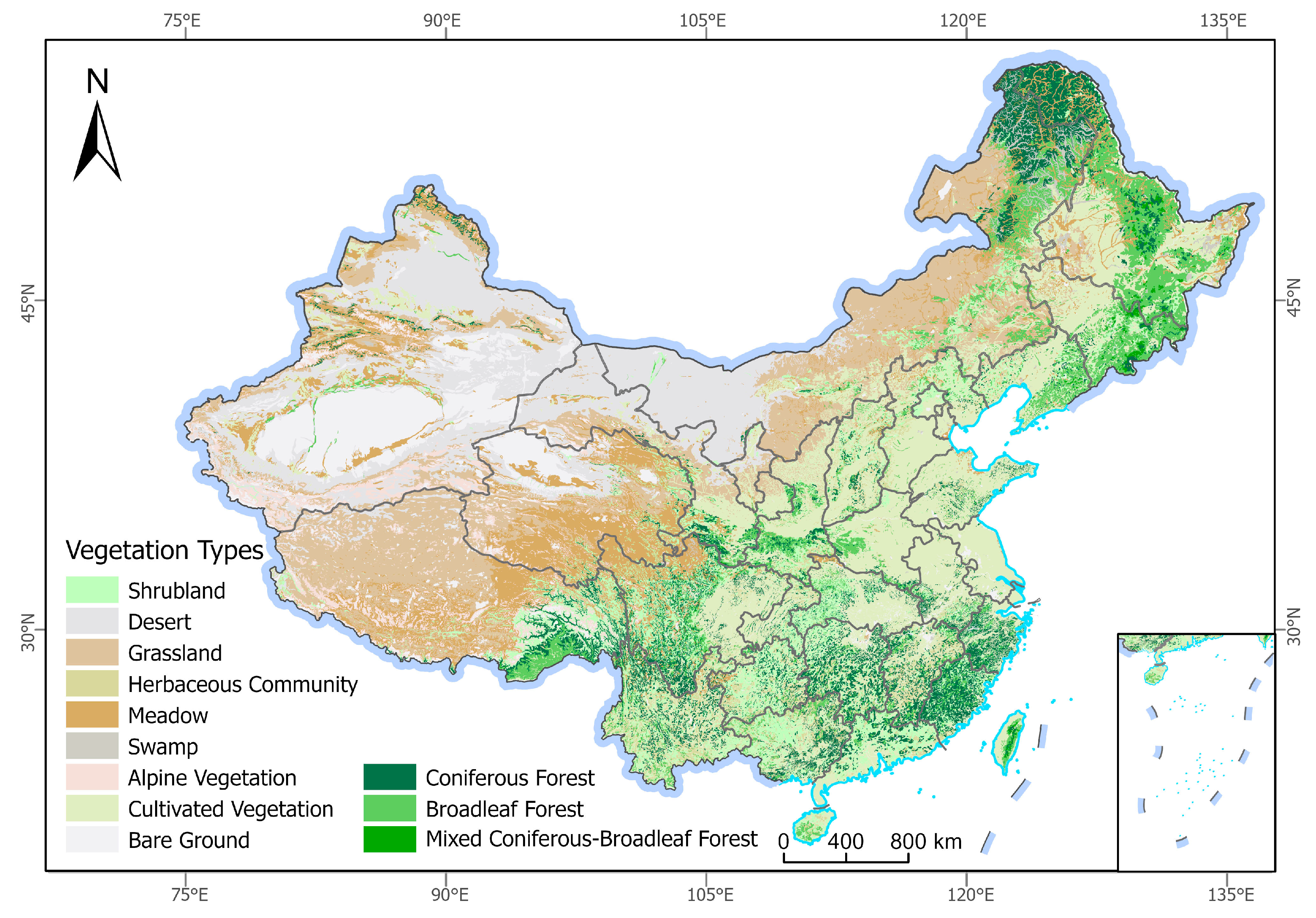
This study centers on China, characterized by its extensive landmass, highly varied terrain, and pronounced climatic and vegetation heterogeneity. Figure 1 shows that China’s forests are chiefly distributed across three major regions: the northeast, the south, and the southwest. These areas not only have high vegetation cover and rich biomass but also experience frequent summer thunderstorms, creating both climatic and fuel conditions for lightning-caused fires. According to wildfire statistics from the China Meteorological Administration and the National Forestry and Grassland Administration, lightning has become one of the major triggers of summer wildfires in some forested regions of China. This is particularly evident in lightning prone areas such as the Daxing’an Mountains in Heilongjiang [17]. Moreover, under the influence of global warming, extreme weather events such as heatwaves, droughts, and thunderstorms have shown a significant upward trend in China [18]. The China Climate Change Blue Book (2023) reports that over the past two decades, the annual number of hot days has increased markedly nationwide, while thunderstorm frequency and intensity have risen simultaneously in southern and southwestern regions, intensifying the potential risk of lightning-caused fires. Therefore, studying the relationship between extreme climate and lightning fires in this region is of great scientific significance.
Figure 1. Vegetation type distribution of the study area.

2.2. Data Sources

2.2.1. Lightning Fire Data

The wildfire data used in this study were obtained from the Global Wildfire Database [19], which provides daily wildfire perimeters in vector format. To focus on forest fires, we filtered the records using vegetation type data and retained only those occurring in forests (coniferous, broadleaf, and mixed forests). The vegetation dataset was provided by the National Cryosphere Desert Data Center (http://www.ncdc.ac.cn, accessed on 17 April 2025). To identify lightning-ignited fires, we used lightning data from the Earth Networks Total Lightning Detection Network (ENTLDN). This dataset records the time, geographic location, and duration of lightning events worldwide with high temporal resolution and location accuracy, which enables spatiotemporal matching and attribution analysis between lightning strikes and wildfire ignitions.
Based on these datasets, we extracted the ignition location and start date of each fire and matched them with ENTLDN lightning events. Because lightning ignitions often in-volve a smoldering phase before developing into visible flaming combustion, we adopted a 7 day lookback window following Shmuel et al. [20] to identify potential holdover fires. Given the spatial resolution of the meteorological data used in this study, we applied a 10 km matching radius, which represents the minimum effective scale for capturing the environmental conditions relevant to ignition. Under this framework, if lightning activity occurred within 10 km of the ignition point on the ignition day or within the preceding seven days, the fire was classified as a lightning-ignited fire. It should be noted that although this method effectively captures smoldering events, it involves a trade-off between identifying holdover fires (reducing false negatives) and avoiding misclassification (reducing false positives), thereby introducing some classification uncertainty. To mitigate this issue and exclude potential human caused fires (such as agricultural burning), we removed fire records that lasted only one day. In addition, we randomly selected an equal number of control samples from areas with frequent lightning activity but without fire occurrence, thereby constructing a balanced dataset for subsequent modeling and analysis.

2.2.2. Extreme Climate Data

This study followed the Expert Team on Climate Change Detection and Indices (ETCCDI) framework for extreme climate indices. We selected 16 extreme temperature indices and 10 extreme precipitation indices (Table S1) to comprehensively characterize changes in extreme events in terms of intensity, frequency, and duration. The indices were calculated based on the ERA5 -Land daily aggregated product (ECMWF/ERA5_LAND/DAILY_AGGR), which provides daily meteorological data at a 0.1° × 0.1° resolution since 1950. ERA5-Land data were extracted and processed using the Google Earth Engine (GEE) platform, and each index was computed following ETCCDI methodology. Percentile based indices (e.g., TX90p, TN10p, R95p, R99p) used thresholds derived from the 1981–2010 climate reference period. Absolute value indices (e.g., TXx, TNn, RX1day, RX5day) were directly calculated from the daily series. Duration based indices (e.g., WSDI, CDD, CWD) were obtained by identifying consecutive days that met the threshold criteria.

2.2.3. Meteorological, Vegetation, and Fire Weather Data

To more comprehensively analyze the environmental conditions of lightning-ignited fires, we incorporated multi source meteorological, vegetation, and biophysical variables. Meteorological data were obtained from the ERA5 reanalysis dataset and included daily mean temperature, relative humidity, precipitation, and wind speed. Vegetation and soil variables included high/low vegetation cover, soil moisture index, and skin reservoir content from ERA5. Normalized difference vegetation index (NDVI) was derived from the MODIS MOD13A2 product. Fire weather indices were represented using the seven standard indices of the Canadian Forest Service Fire Weather Index Rating System, which considers the combined effects of meteorological conditions and fuel moisture on fire spread. Terrain related variables, such as elevation, slope, and aspect, were extracted via the NASADEM_HGT/001 dataset accessed through the GEE platform.

2.2.4. Data Preprocessing

All variables used in this study are summarized in Table S1. To ensure spatial comparability across different datasets, all variables were resampled to a uniform resolution of 1 km. Given the resolution differences among the multi-source datasets, we adopted a consistent nearest-neighbor resampling strategy. This approach ensures spatial alignment while preserving the original physical values of the data, thereby avoiding the artificial smoothing or artifacts that may arise from interpolation based methods. All variables were then standardized in raster format for subsequent identification of key extreme climate factors and probabilistic modeling of lightning-ignited fire occurrence. To evaluate potential multicollinearity among the predictor variables, we calculated the variance inflation factor (VIF) for all input features (Table S2). Variables with VIF < 10 were retained, indicating that no severe multicollinearity issue was present in the dataset. We further assessed the correlation structure using the Spearman correlation matrix (Figure S1). The results show that most variables exhibit only weak correlations, while higher correlations mainly occur among some extreme climate indices. This type of structural correlation is common in climate indicators and reflects their shared underlying physical mechanisms. Given their clear physical relevance in representing different types of extreme events, these variables were retained to ensure a comprehensive representation of lightning-ignited fire driving mechanisms.

2.3. Model Construction

To evaluate the influence of extreme climate factors on lightning-ignited fires, this study applied a binary response modeling approach. Each grid cell on a given day was assigned a value of 1 if a lightning fire occurred (ignited grid) and 0 if no fire occurred (non-ignited grid). To compare predictive performance under different modeling approaches, four representative machine learning methods were selected: LR, RF, XGBoost, and CNN. LR served as a linear baseline model suitable for capturing linear relationships between variables and fire occurrence. RF and XGBoost are both decision tree based ensemble learning methods capable of modeling nonlinear effects and complex interactions among variables [21,22]. CNN, with its advantage in spatial pattern recognition, is well suited for capturing neighborhood information in gridded data [23].
By comparing these four models in parallel, we can examine the performance of linear, nonlinear, and deep learning methods in predicting lightning-ignited fires and assess the adaptability and robustness of different algorithms when extreme climate factors are included. During modeling, all samples were split into 70% training and 30% testing sets. To ensure reliable model evaluation and determine the optimal model configuration, we applied a 5-fold cross-validation strategy to the training dataset. We further combined this approach with grid search and used the mean AUC across validation folds as the primary criterion for selecting the best hyperparameter settings. In addition, due to a significant imbalance between ignited and non-ignited samples, we applied undersampling to the majority class to avoid model bias toward non-ignited grids [24]. After processing, the training and testing datasets contained an equal number of ignited and non-ignited samples (1572 each). The following sections briefly describe the four machine learning models used in this study.

2.3.1. Logistic Regression

LR is a typical binary response model that uses the logit function to describe the relationship between independent variables and the probability of an event [25]. In this study, LR was used as a baseline model to assess the linear influence of both environmental and extreme climate factors on the occurrence of lightning-ignited fires.

2.3.2. Random Forest

RF is an ensemble learning method based on multiple decision trees that can effectively handle nonlinear relationships and variable interactions [26]. It integrates multi source environmental and climate factors and has strong generalization ability, making it widely used in wildfire prediction studies [27]. RF reduces variance through bootstrap sampling and ensemble voting, making it less prone to overfitting compared to other machine learning methods.

2.3.3. XGBoost

XGBoost is an optimized extension of the traditional Gradient Boosting Decision Tree (GBDT). Its core idea is to iteratively reduce the overall prediction error by modeling the residuals of previous iterations. Unlike RF, where each tree is trained independently, XGBoost builds weak learners sequentially, with each tree correcting the errors of the previous one. The final prediction is obtained through a weighted combination of all trees [28,29]. XGBoost introduces L1 (Lasso) and L2 (Ridge) regularization terms in the loss function to control model complexity, reduce overfitting, and improve generalization. In addition, techniques such as histogram based binning, parallel computing, and pruning significantly enhance computational efficiency on large datasets. Previous studies have shown that XGBoost generally outperforms other machine learning methods in wildfire prediction [30]. Based on 5-fold cross-validation and grid search, the optimal hyperparameters for the XGBoost model were identified as follows: learning_rate, max_depth, n_estimators, subsample, and colsample_bytree were set to 0.1, 6, 400, 0.9, and 0.8, respectively. These parameter settings ensured strong model fitting capacity while improving robustness through subsampling and depth constraints.

2.3.4. Convolutional Neural Network

CNN is a deep learning method capable of effectively extracting spatially dependent features from gridded data [31]. By capturing local patterns through convolution operations and reducing dimensionality via pooling, CNNs offer significant advantages in modeling spatial correlations and translation invariance of environmental variables. In this study, we designed a CNN architecture to predict lightning-ignited fire occurrence using multisource raster inputs, including meteorological, vegetation, and other environmental factors. The optimal architecture determined through 5-fold cross-validation and grid search is summarized as follows:
(1)
Input Layer: A 9 × 9 patch was used as the input window to capture local environmental context surrounding each sampled grid cell.
(2)
Feature Extraction: The feature extraction module consisted of two convolutional blocks. The first and second convolutional layers contained 32 and 64 filters, respectively, each with a kernel size of 3 × 3 and zero padding to preserve feature map dimensions. Each convolutional layer was followed by a 2 × 2 max-pooling layer to reduce feature dimensionality and a dropout rate of 0.25 to prevent overfitting. All convolutional layers used the ReLU activation function.
(3)
Classification Layer: The extracted spatial features were flattened and passed through two fully connected layers with 64 and 32 neurons, both using ReLU activation. The output layer consisted of a single neuron with a Sigmoid activation function, producing the predicted probability of lightning-ignited fire for each input patch.
(4)
Model Training: The model was trained using the Adam optimizer with an initial learning rate of 0.001. To enhance robustness and reduce overfitting, a dropout rate of 0.5 was applied to the fully connected layers, and an early stopping strategy was employed during training [32,33].

2.4. Model Performance Evaluation

To assess how well each model predicts lightning-ignited fires, this study adopted three evaluation metrics: accuracy, the area under the ROC curve (AUC), and the confusion matrix [27]. Accuracy reflects the proportion of correct predictions and serves as a straightforward indicator of model performance. AUC represents the area under the ROC curve, indicating the model’s capacity to separate ignited from non-ignited grids across varying classification thresholds, values approaching 1 denote stronger discriminative power. The confusion matrix summarizes the classification outcomes for both categories and details the distribution of true positives (TP), true negatives (TN), false positives (FP), and false negatives (FN).
Our model retains the continuous probability of ignition generated from uncertainty estimation, which provides more utility for risk assessment compared with simple binary classification [34]. To visually validate model performance, predicted results were also compared with seven commonly used fire weather indices (FWI, FFMC, DMC, DC, ISI, BUI, fdsrte). In this study, a predicted ignition probability above 0.5 was considered “ignited.” For fire weather indices, which are continuous variables, the median value was used as the threshold: values above the median were classified as “ignited,” while values below were classified as “non-ignited.” This uniform binary classification approach allows direct comparison of the prediction accuracy and discriminative power of machine learning models and traditional fire weather indices under the same evaluation standard [15].

2.5. Identification of Key Extreme Climate Factors

To quantify the contributions of extreme climate factors and other variables such as weather and vegetation to lightning-ignited fire occurrence, XGBoost was used as the explanatory model, and SHAP was applied to measure variable importance and effect direction consistently. SHAP provides explanations at the individual sample level and can be aggregated to obtain global importance rankings, avoiding interpretation bias due to factor correlations. For a clearer understanding of the relative effects of different variable types, all features were first grouped into six categories (extreme climate, weather, vegetation, soil, terrain, population), and the group level SHAP contribution was calculated to assess the independent driving effect of extreme climate factors relative to other categories. Within this framework, the ranking of extreme climate factors was further analyzed. SHAP beeswarm plots were used to rank individual indicators by importance and to identify positive or negative effects [35]. To obtain a robust set of key variables, 100 repeated feature selection experiments were conducted. Variables were sequentially added according to importance, and model fit performance (R2) was compared to determine the optimal minimal subset. Finally, partial dependence plots were generated for the top ranked extreme climate indicators [36], illustrating the nonlinear responses and threshold characteristics of lightning ignition probability to changes in these indicators. This hierarchical analytical framework allows assessment of both the overall importance of extreme climate factors and the identification of specific indicators that act as primary risk amplifiers, while further explaining their nonlinear effect patterns and threshold features.

2.6. Interaction Among Extreme Climate Factors

Extreme climate factors rarely act in isolation on lightning-ignited fire occurrence; they often produce nonlinear synergistic effects through cumulative or modulating interactions. To systematically identify and quantify this nonlinear coupling mechanism, SHAP interaction values were applied within the XGBoost framework to evaluate pairwise interaction strengths among extreme climate factors [37], enabling the global screening of factor pairs with potentially significant synergistic effects. For factor pairs with high interaction strength, SHAP interaction dependence plots were generated to visualize how the SHAP contribution of one factor systematically varies with the values of another factor. This approach directly reveals nonlinear synergy or modulation effects among variables [38]. Through interaction analysis, this study not only quantifies the interaction strength among extreme climate factors but also elucidates risk mechanisms under typical compound scenarios, such as concurrent high-temperature and drought events, and distinguishes the differential roles of long-term background factors (e.g., GSL) versus short-term extreme events.

3. Results

3.1. Model Performance

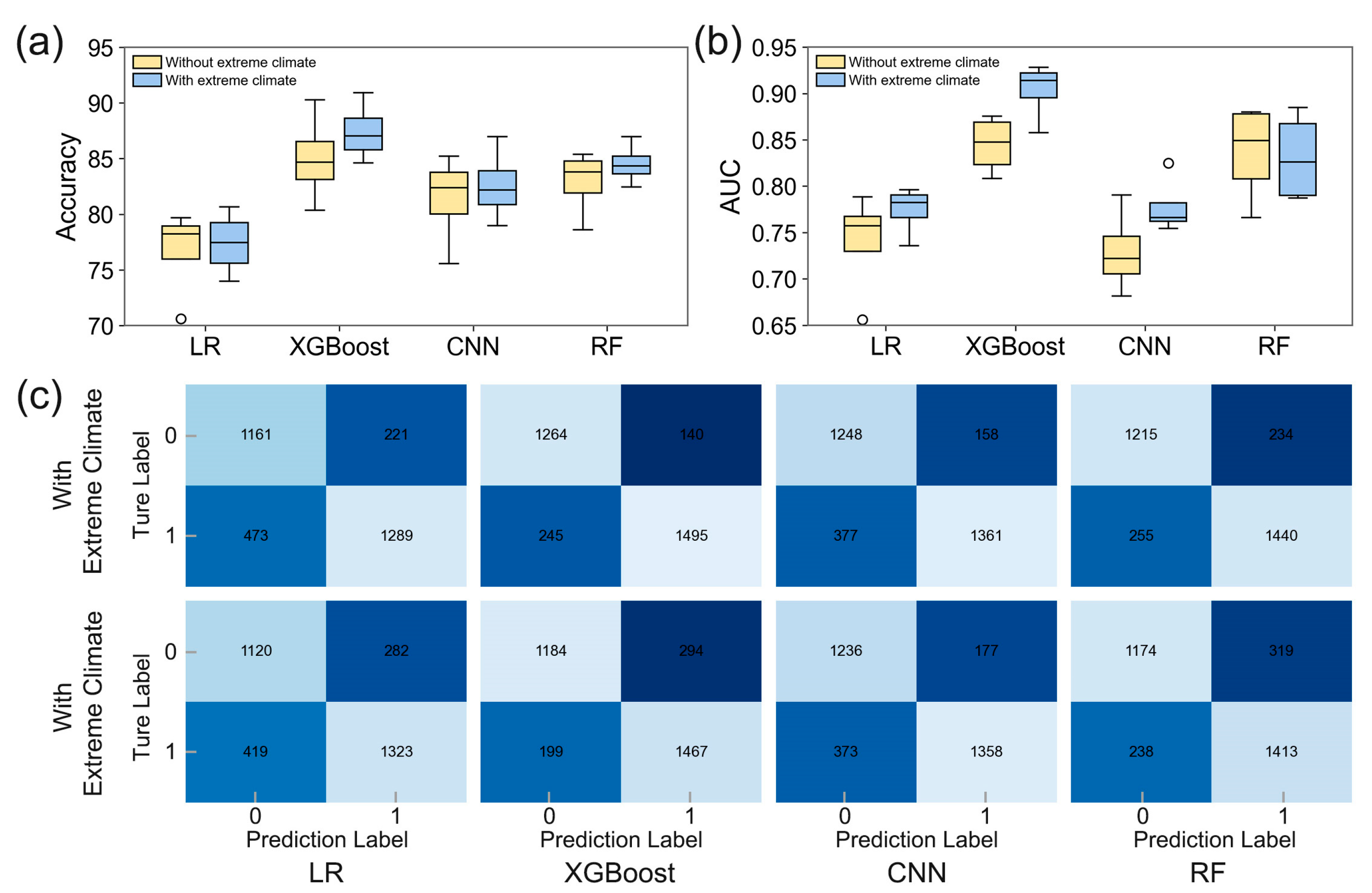
Four classifiers were used to construct and evaluate lightning-ignited fire prediction models. Results (Figure 2) show that XGBoost performed best overall. Within the feature set including extreme climate factors, its mean classification accuracy reached 87.4% with an AUC of 0.903. RF performed second best, while LR and CNN showed relatively lower overall performance. Further analysis revealed a strong positive correlation between AUC and classification accuracy, indicating that both metrics consistently reflect the model’s ability to distinguish grids with and without lightning-ignited fires. Model performance was also compared after removing extreme climate factors. The mean accuracy of the four models decreased from 83.0% to 81.5%, and the mean AUC dropped from 0.822 to 0.788. These results indicate that including extreme climate information can effectively enhance the overall discriminative power for lightning-ignited fires. Confusion matrix results (Figure 2c) show that, under the feature set including extreme factors, XGBoost achieved the highest TP and TN counts, with the fewest false predictions (FP and FN). Under the feature set excluding extreme factors, XGBoost still achieved the highest TP, while TN was slightly lower than that of CNN. Overall, XGBoost provides a more robust identification of lightning-ignited fires, and incorporating extreme climate factors further improves its comprehensive performance.
Figure 2. Comparison of model performance. Boxplots of models with and without extreme climate factors ((a): accuracy; (b): AUC) and confusion matrices (c).

3.2. Validation of Lightning-Fire Prediction

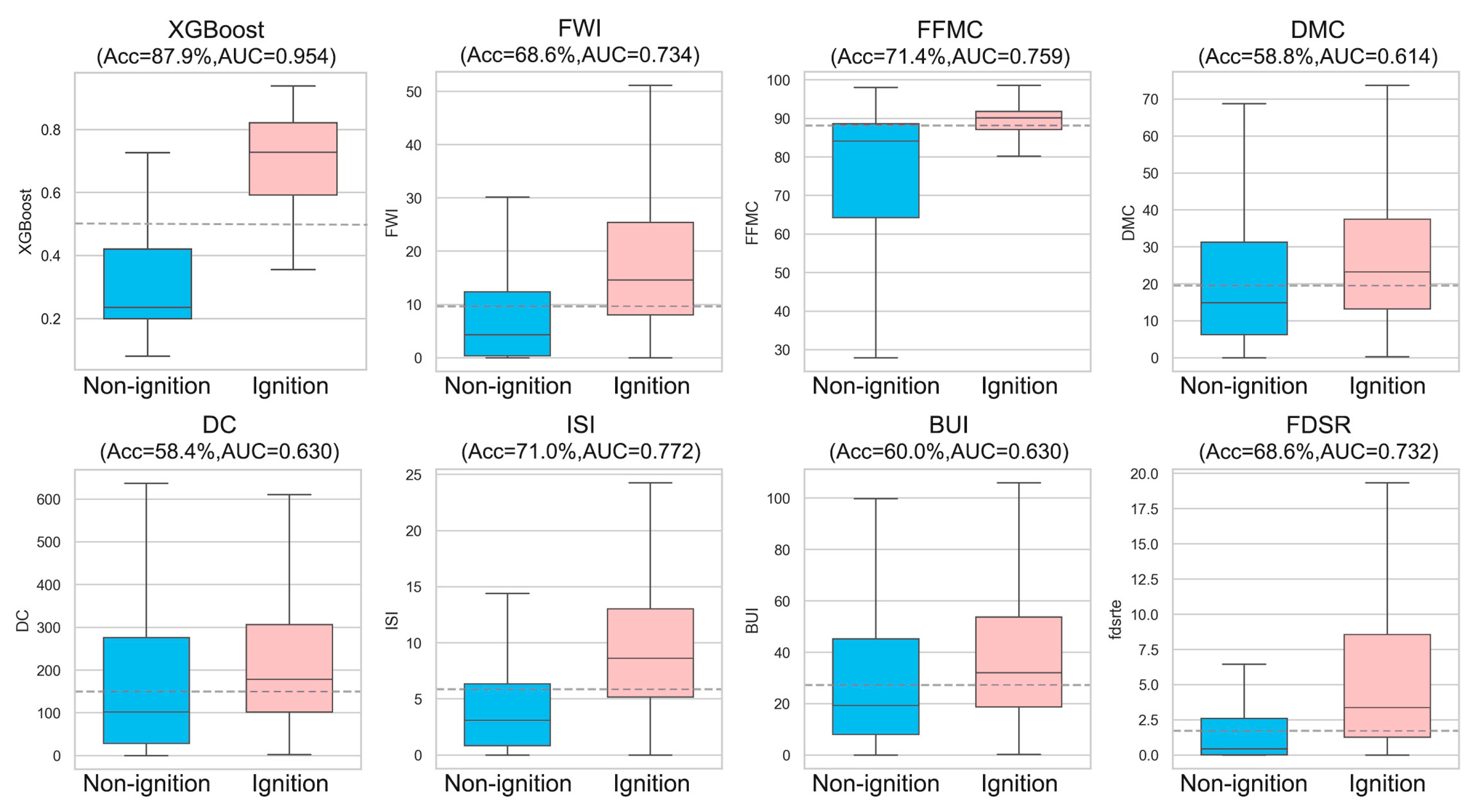
To provide a baseline comparison, we evaluated the classification accuracy of XGBoost against seven commonly used fire weather indices (Figure 3). Using the median of each index as the threshold, the accuracy of the fire weather indices ranged from 60% to 71.4%, whereas XGBoost achieved 87.9%. It is important to emphasize that the fire weather index system was developed for overall fire danger rating rather than for predicting lightning ignition probability. Therefore, its lower accuracy in our study mainly reflects differences in application context rather than a limitation of the indices themselves. In contrast, XGBoost integrates multisource environmental variables and extreme climate indices, allowing it to capture the nonlinear mechanisms related to lightning ignition more effectively. As a result, it shows a higher discriminative ability for this specific prediction task.
Figure 3. Comparison of XGBoost classification accuracy with common fire weather indices, where dashed lines indicate the median of each index.
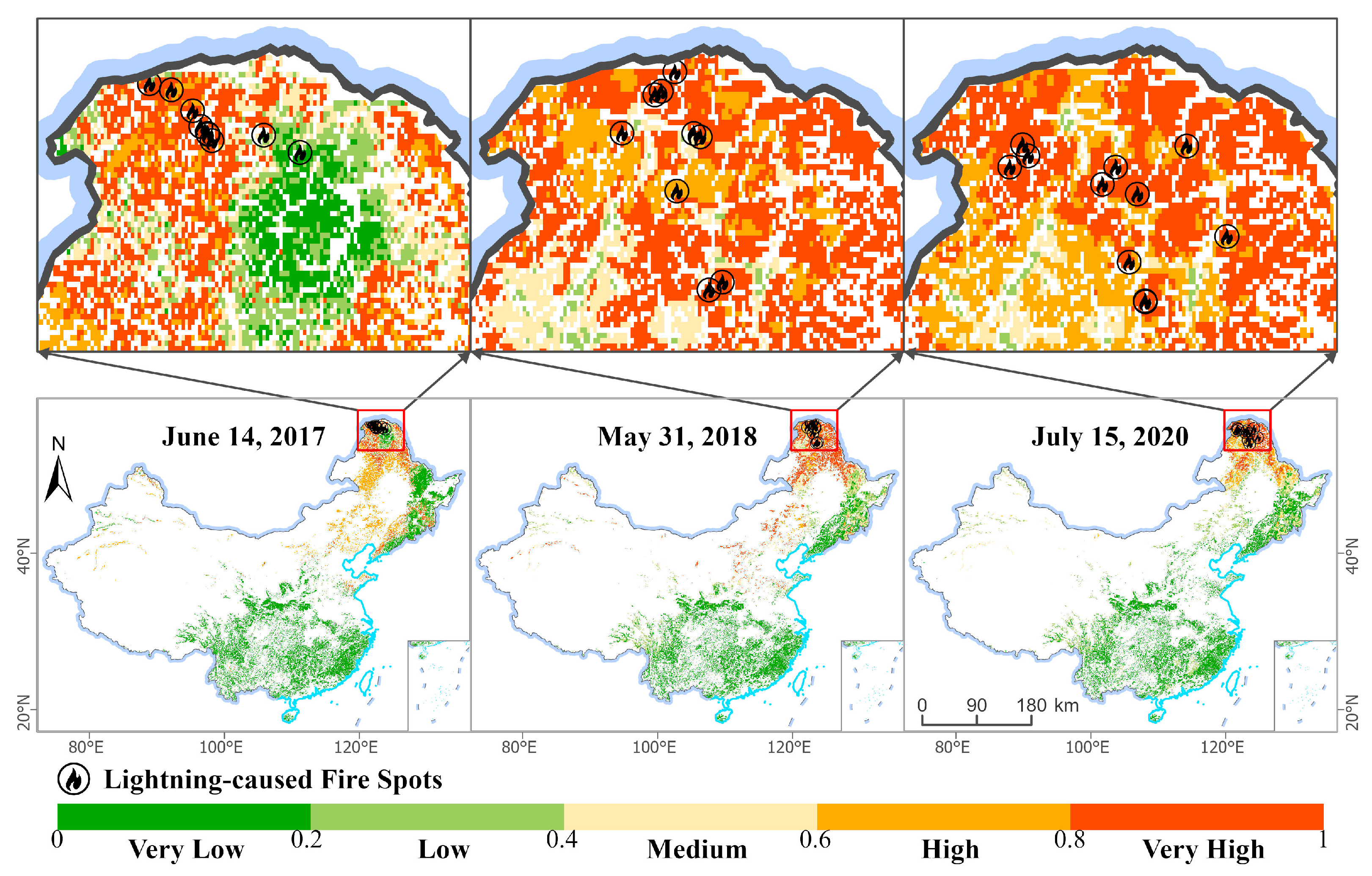
The top three dates with the highest number of lightning-ignited fires were selected to generate spatial risk maps (Figure 4). Among the 29 lightning-ignited fires recorded on these three days, 26 occurred in very high risk grids, one in a high risk grid, one in a medium risk grid, and only one in a low risk grid. This indicates that the constructed model effectively identifies high risk areas for lightning-ignited fires, with predictions highly consistent with observations. The peak months for lightning-ignited fire occurrence were mainly from May to July, and spatially concentrated in northeastern China, particularly the Daxing’an Mountains. This region, located at high latitudes with frequent thunderstorms, is dominated by coniferous forests with abundant and continuous fuel, providing typical conditions for lightning-ignited fires.
Figure 4. Spatial distribution of lightning-ignited fire risk. The fire risk is classified into five levels, including very low, low, medium, high, and very high, corresponding to ignition probability ranges of [0, 0.2], (0.2, 0.4], (0.4, 0.6], (0.6, 0.8], and (0.8, 1], respectively.

3.3. Identification of Key Extreme Climate Factors and Their Driving Effects

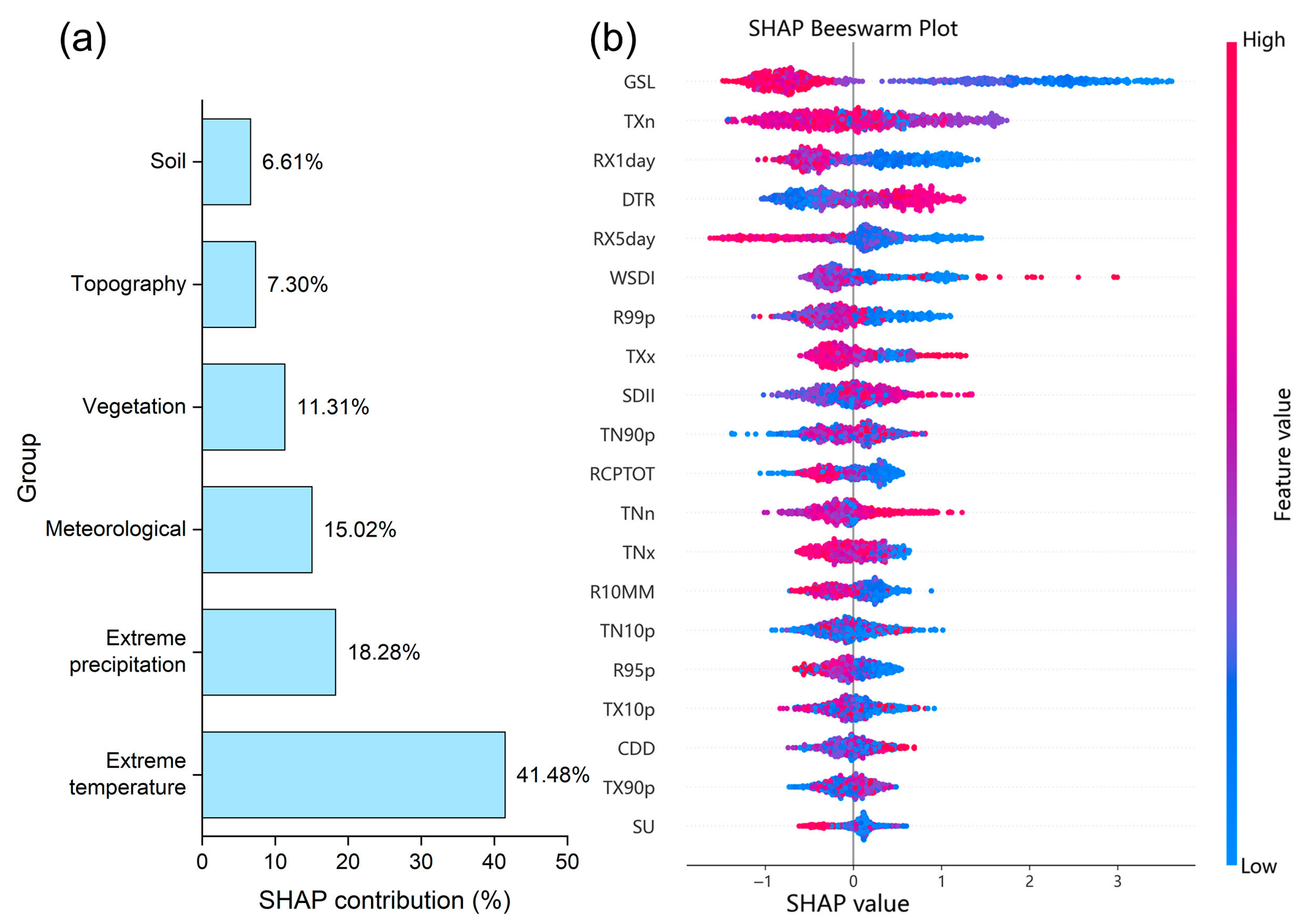
The grouped SHAP contribution results (Figure 5a) indicate that extreme climate factors exert a significant overall influence on lightning-ignited fire occurrence. Among the relative contributions of different types of explanatory variables, extreme temperature (41.5%) and extreme precipitation (18.3%) together account for nearly 60%, clearly exceeding the contributions of weather, vegetation, soil, and other factors. This highlights the critical role of temperature rise and precipitation anomalies in fire formation mechanisms. The SHAP beeswarm plot (Figure 5b) further reveals the relative importance and direction of specific extreme climate indicators. Among temperature related factors, GSL, TXn, DTR, and WSDI rank highest. These indicators collectively reflect extreme heat and temperature variability in the climate system, which can significantly increase the probability of lightning ignition by enhancing fuel drying and limiting nocturnal fuel wetting. In contrast, precipitation related indicators such as RX1day, RX5day, and R99p show negative effects. Heavy precipitation or abundant annual rainfall can alleviate fuel dryness and reduce lightning fire risk. Most other extreme climate indices have lower contributions in the global model, likely reflecting local or auxiliary influences rather than primary drivers of lightning ignition.
Figure 5. SHAP contribution ranking for lightning-ignited fires: (a) grouped contributions of all factors, (b) top 20 extreme climate factors.
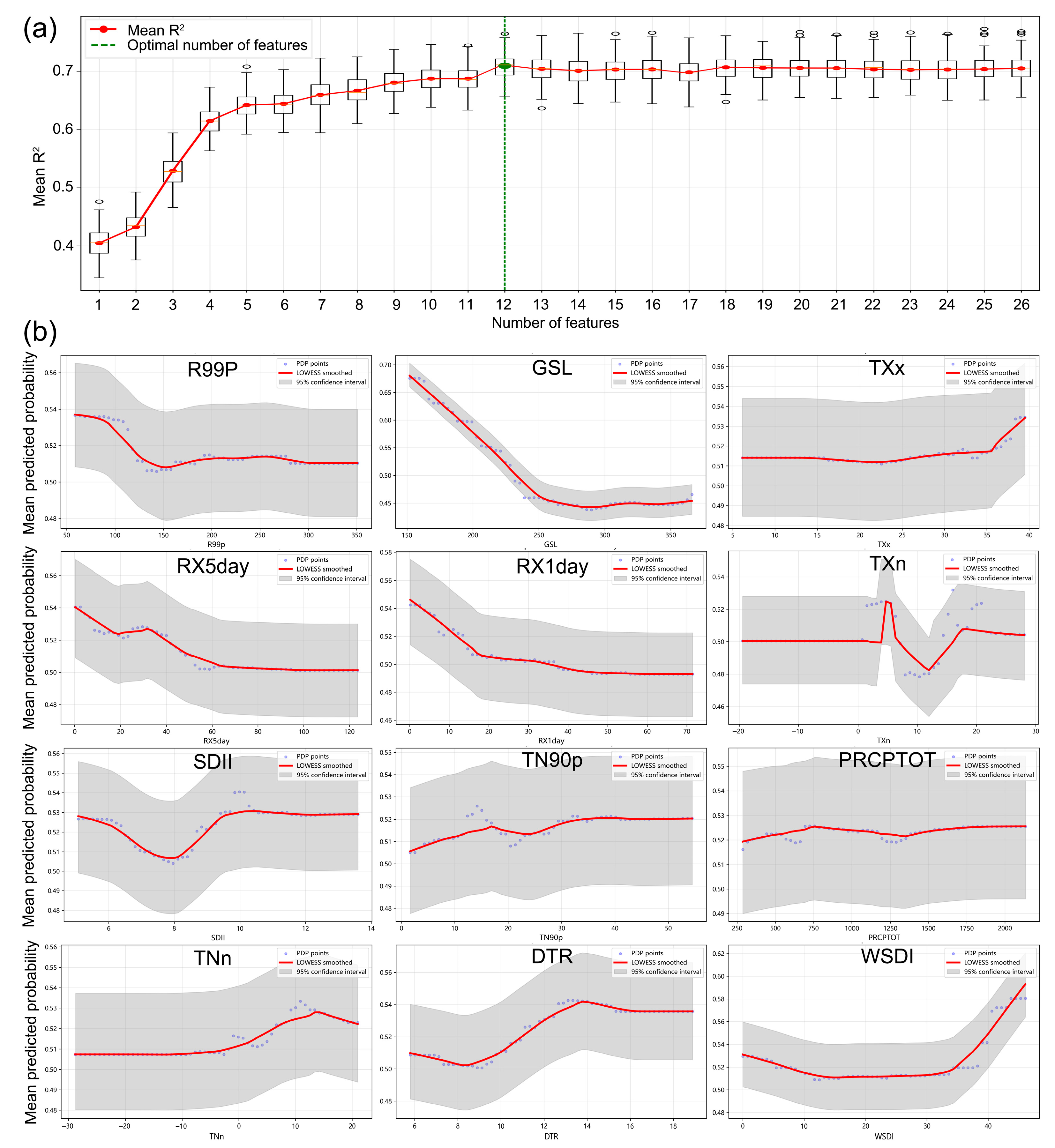
Feature selection experiments (100 repetitions) show that model performance is optimal when including the top 12 extreme climate factors (R2 = 0.71) (Figure 6a). Additional variables contribute little to performance improvement. Partial dependence plots of these key factors (Figure 6b) reveal the nonlinear relationships between extreme climate factors and the probability of lightning ignition. Most extreme temperature factors exhibit monotonic or S curve responses. GSL shows a strong negative correlation with ignition probability: shorter growing seasons correspond to higher fire risk, whereas when GSL exceeds approximately 260 days, ignition probability stabilizes at a relatively low level. Partial dependence results for DTR indicate that when daily temperature range is moderate (approximately 8 to 14 °C), fire probability increases, reflecting the combined effect of daytime drying and insufficient nocturnal wetting, which creates a moderately dry fuel layer highly susceptible to lightning ignition. Increases in WSDI substantially raise ignition probability, highlighting the key role of prolonged heatwaves in driving fire risk. For extreme precipitation factors, both RX1day and RX5day exhibit pronounced threshold behavior in their partial dependence relationships. When short duration or accumulated precipitation is below approximately 20 mm and 60 mm, respectively, the probability of lightning-ignited fire declines rapidly with increasing rainfall. Beyond these ranges, the curves flatten. This pattern reflects the suppressing effect associated with the rapid rise in surface soil moisture toward saturation. As soils approach saturation, they more readily absorb and dissipate the heat deposited by lightning and reduce the drying rate of the duff and litter layers, making surface fuels less capable of sustaining the smoldering phase required for ignition. As a result, once precipitation exceeds the threshold, the combined fuel–soil moisture effect reaches saturation, and additional rainfall provides little further reduction in ignition probability. This process explains the stable tail of the PDP curves.
Figure 6. Key extreme climate factors: (a) feature selection results, (b) partial dependence plots.

3.4. Interactions and Combined Effects of Extreme Climate Factors

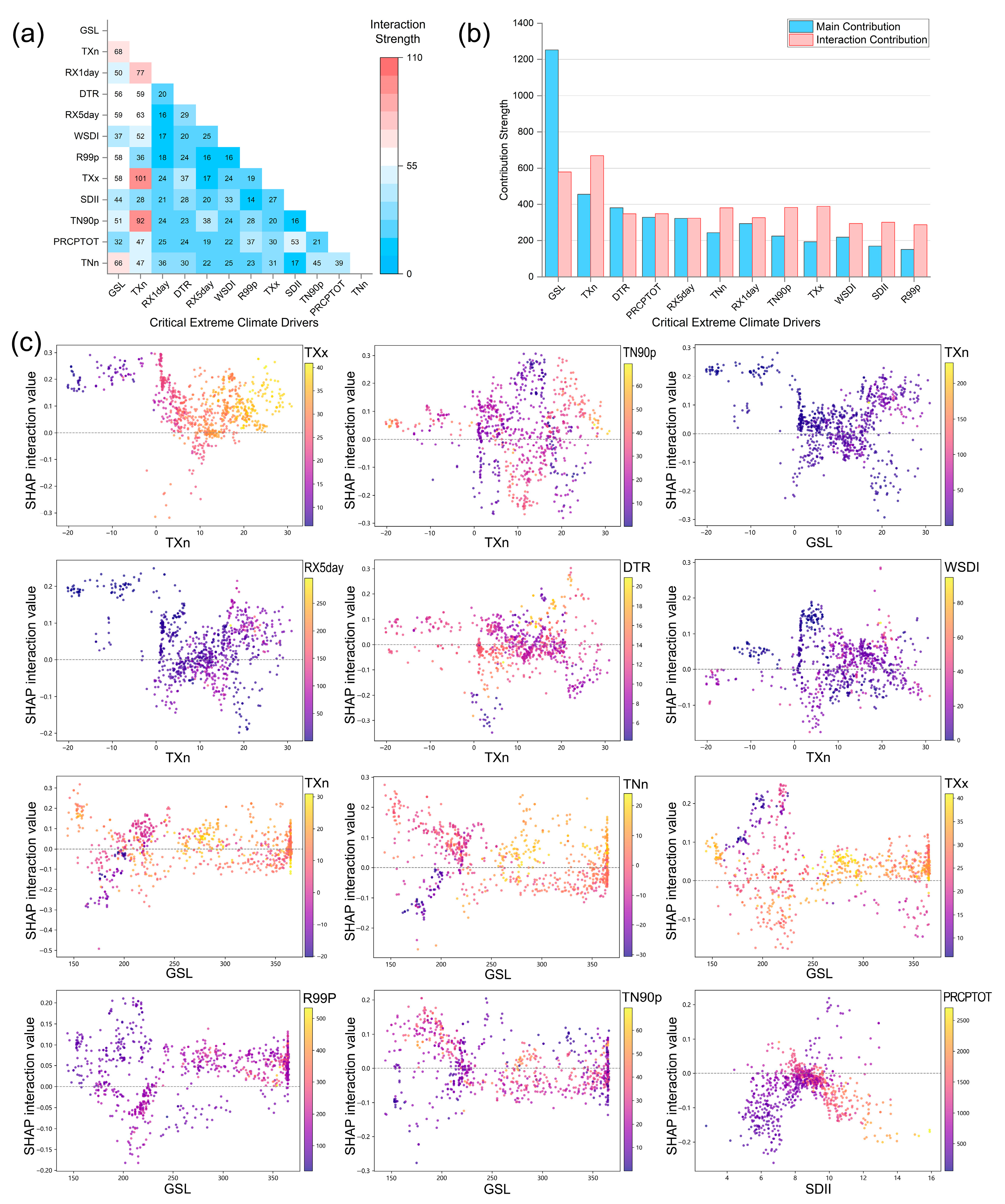
Interaction analysis (Figure 7) demonstrates that lightning-ignited fire risk is not determined by a single factor but by the combined effects of multiple extreme climate factors. Interactions among extreme temperature factors have the most pronounced influence (Figure 7a). Interactions between TXn and TXx as well as TN90p rank highest, indicating synergistic amplification between daytime and nighttime extreme heat. Specifically, summer heat extremes exacerbate fuel drying, while warm nights limit nocturnal wetting. Together, they maintain fuel in a highly flammable state, substantially increasing ignition probability.
Figure 7. Interactions among key extreme climate factors: (a) interaction strength, (b) comparison of main and interaction contributions, (c) SHAP interaction dependence plots.
Interactions between temperature and precipitation factors exhibit both synergistic amplification and mutual mitigation. When extreme temperatures are high (e.g., elevated TXn or prolonged WSDI) and extreme precipitation is low (e.g., low RX1day or RX5day), fuels remain dry for extended periods, sharply increasing lightning fire probability, representing a typical amplification effect of dry heat.” Notably, although GSL has the highest main effect contribution, its interaction contribution is relatively low (31.6%) (Figure 7b). GSL is strongly correlated with TXn and TNn, indicating that it primarily reflects long-term climate background, seasonal temperature, and vegetation growth characteristics, rather than directly interacting with short-term extreme events. Therefore, GSL sets the baseline fire susceptibility, while short-term temperature and precipitation extremes overlay this background to drive risk fluctuations.

4. Discussion

4.1. Improvement of Lightning Fire Prediction Performance by Extreme Climate Factors

Although numerous studies have indicated that lightning is one of the primary ignition sources for mid- to high-latitude forests globally [39], fire risk forecasting and assessment systems have long relied on traditional meteorological variables and fire danger indices [40]. These indices are effective in characterizing fire risk under average weather conditions but have limited capability in capturing extreme climate events, making it difficult to fully explain the triggering mechanisms of lightning fires. By explicitly incorporating multiple types of extreme climate factors into predictive models, this study significantly improved model performance, demonstrating the critical role of extreme climate in the ignition process.
The four machine learning classifiers in this study all showed higher discriminative power when extreme climate factors were included, with XGBoost achieving an accuracy of 87.4% and an AUC of 0.903, far exceeding the 60%–71% accuracy level of traditional fire weather indices. Other studies have shown that when live fuel moisture content falls below a critical flammability threshold, the probability of lightning-ignited fires is 1.8 times higher than when fuel moisture is higher; in shrublands, this risk ratio can reach 2.5 [41]. This indicates that extreme temperature and drought indicators better reflect fuel conditions and boundary conditions for ignition, thereby substantially enhancing the model’s ability to distinguish between “ignited” and “not ignited” scenarios. Further analysis of the confusion matrix also showed that including extreme factors not only improved overall accuracy but effectively reduced the number of false negatives and false positives, making predictions more robust. This reflects how extreme climate can amplify or modify the boundary conditions for fire occurrence. For example, extreme high temperatures and prolonged heatwaves (WSDI) significantly reduce fuel moisture, while extreme drought weakens the response of soil and vegetation to precipitation [42], making lightning more likely to ignite fires. In contrast, traditional fire danger indices primarily rely on daily weather conditions and often fail to capture abrupt effects during extreme events. Thus, incorporating extreme climate factors not only enriches the dimensionality of input variables but also enhances the representation of nonlinear and threshold effects.
From an application perspective, the improvement in model prediction performance by extreme climate factors is highly relevant for fire risk management and early warning. Under a warming climate, the frequency and intensity of extreme high temperatures and droughts are increasing [43,44], meaning that future fire ignition conditions will increasingly depend on the superposition of extreme events [5]. Traditional fire danger indices may underestimate this trend, whereas models based on extreme climate factors can more sensitively detect risk escalation. For instance, when the prediction system identifies simultaneous high values of heatwave and drought indicators, authorities can issue higher level fire danger warnings in advance, thereby optimizing the allocation of fire prevention resources.

4.2. Effects of Key Extreme Climate Factors on Lightning Fire Ignition

SHAP based interpretation results indicate that extreme temperature and precipitation factors play a dominant role in driving lightning fire occurrence. The mechanisms of extreme temperature factors (e.g., GSL, TXn, DTR, WSDI) mainly involve accelerating fuel drying, weakening nighttime fuel rehydration, and prolonging high-temperature stress, maintaining fuels in a highly flammable state. These processes collectively increase the probability of lightning ignition. This aligns with previous findings that heatwave events significantly increase fire susceptibility [5], and further highlights the regulatory role of GSL as a background factor in fire risk. In contrast, extreme precipitation factors exhibit a complex dual effect. Short-term intense rainfall events (e.g., RX1day, RX5day) generally reduce ignition probability because high intensity precipitation directly increases fuel moisture, thereby lowering the likelihood of lightning fire. However, at longer timescales, precipitation anomalies can indirectly elevate future fire risk by promoting vegetation growth and fuel accumulation [45]. This combination of immediate suppression and delayed amplification suggests that future fire risk assessments should consider not only the instantaneous effects of extreme factors but also their cumulative impacts on fuel patterns at seasonal or interannual scales. Partial dependence analyses further reveal nonlinear relationships between key factors and fire probability. For example, DTR increases fire risk within a moderate range, indicating that extreme climate does not follow a simple “the more extreme, the more dangerous” rule but has thresholds and optimal sensitivity intervals [46,47].
Non-climatic factors also influence ignition risk. Vegetation type and composition determine fuel structure and flammability [48]. Our results support this pattern, as high lightning-fire risk areas are mainly located in the coniferous forests of northeastern China (Figure 4), indicating that this ecosystem is more sensitive to compound dry- heat conditions. Mechanistically, coniferous forests contain resin rich fuels, and their litter is dominated by fine needles with short lag times and rapid drying rates. These properties make them highly responsive to atmospheric drying and high-temperature events [49,50]. In contrast, broadleaf forests in southern China typically have higher canopy closure and greater leaf water content, which help maintain a more humid understory microclimate. This microclimate can buffer short-term extreme heat and drought events, resulting in lower fire probabilities under similar climatic conditions. In addition, soil moisture, as an important proxy for fuel moisture, also affects lightning fire occurrence in some cases [51]. Although its contribution is lower than extreme climate factors, it plays a significant moderating role under drought or seasonal low precipitation conditions [52]. In contrast, terrain factors have limited contributions in this study and may only affect fuel drying locally by modifying microclimatic conditions [53], indicating a regional dependency of terrain effects. Overall, extreme temperature and precipitation are primary drivers of lightning fires, while vegetation and soil factors act under specific regional or local conditions. This highlights the need to place extreme climate factors at the core of future fire risk prediction and management frameworks, combined with other background environmental factors for more accurate assessment.

4.3. Effects of Interactions Among Extreme Climate Factors on Lightning Fire Ignition

Lightning fire occurrence is not driven by a single factor but results from interactions among multiple extreme climate factors. In this study, interactions among temperature factors and between temperature and precipitation factors significantly amplified lightning fire risk, highlighting the importance of compound extreme events. A single climate factor is often insufficient to trigger extreme fires, but multiple extremes can produce synergistic amplification effects. Mechanistically, interactions among temperature factors occur because extreme heat and warm nights together weaken nighttime fuel rehydration, keeping fuels at low moisture levels throughout diurnal cycles [54]. Similar phenomena have been observed in North America and Siberia, where heatwave and drought coupling creates strong cumulative fuel drying, greatly increasing fire risk [55]. Interactions between temperature and precipitation factors exhibit dual “amplifying” and “mitigating” effects. When high-temperature conditions coincide with low precipitation, fuels remain highly flammable under combined heat and drought stress, forming “dry heat compound” conditions that substantially elevate lightning fire ignition probability [14]. Conversely, extreme heat accompanied by heavy rainfall can restore fuel moisture in the short-term, partially mitigating fire risk [56]. Studies also suggest that extreme precipitation events are often associated with lightning activity [57], but strong rainfall usually offsets successful ignition [58]. This indicates that the effects of compound extreme events are not simple linear additions but are regulated by the coupling relationships of different factors. These findings provide a new perspective on understanding the multi driver mechanisms of fire ignition and help explain why fire risk can surge in certain years even when single meteorological indicators do not appear extreme.
From a fire risk prediction and emergency management perspective, these results emphasize a shift from single-factor to compound-factor early warning. Most current fire forecasting systems still rely on single indicators or average weather conditions, often underestimating the risk amplification caused by compound extremes. Fire management should transition from “single-factor-driven” to “compound-factor-coupled” monitoring, prioritizing the combined occurrence of extreme heat, warm nights, and drought. Incorporating the interactions of extreme factors into the fire prediction framework not only allows more precise identification of high risk periods and areas but also improves the scientific basis and sensitivity of warning levels. For example, when “heatwave + drought” or “high-temperature + warm night” conditions are detected simultaneously, warning systems should elevate fire danger levels promptly, providing forest management agencies with proactive guidance and optimized resource allocation.

4.4. Limitations and Future Prospects

This study integrated multisource datasets with machine learning techniques to develop a lightning-ignited fire probability model and to reveal the driving roles of key extreme climate indices. However, several limitations remain. First, although the identification of lightning-ignited fires considered the holdover characteristics and short duration fires were removed to reduce human caused interference, the use of a fixed spatiotemporal threshold may still increase the risk of misclassifying human caused fires as lightning-ignited ones in areas with intensive human activity. Second, although the random data splitting strategy enables the model to capture meteorological drivers, ignoring the spatial structure of geospatial data may introduce optimistic accuracy estimates and limit the assessment of the model’s transferability to unsampled regions. Future research could therefore focus on the following directions: (1) combining higher resolution lightning, fuel, and human activity data to develop more precise lightning fire identification algorithms and minimize classification bias; and (2) incorporating spatial or spatiotemporal block cross validation strategies to more comprehensively evaluate the model’s spatial generalization ability, thereby providing more reliable support for regional fire risk management.

5. Conclusions

This study introduced multiple types of extreme climate factors into lightning fire prediction models, constructing and comparing various machine learning models to systematically quantify the driving role of extreme climate in fire occurrence. Results indicate that incorporating extreme climate indicators significantly improves the discrimination of lightning fires, with XGBoost performing best (accuracy 87.4%, AUC 0.903), far exceeding traditional fire weather indices. Explainable analyses show that extreme temperature and precipitation factors contribute nearly 60% of the overall effect, making them core elements of lightning fire occurrence. Key indicators such as GSL, TXn, DTR, and WSDI significantly increase fuel drying and high-temperature stress, raising fire probability. Short-term intense precipitation events directly increase fuel moisture to suppress fires, whereas long-term precipitation anomalies may indirectly elevate subsequent fire risk by increasing fuel loads. Furthermore, interactions among multiple extreme factors generate compound amplification effects, with concurrent extreme heat and drought significantly reducing fuel rehydration and creating persistent dry heat conditions, greatly increasing the probability of lightning fire occurrence. Therefore, extreme climate not only serves as a critical ignition driver but also reshapes the fire risk environment through interactions. Incorporating these factors into prediction and management frameworks can help build a more scientific and dynamic fire warning system and provide key guidance for forest fire management under climate change.

Supplementary Materials

The following supporting information can be downloaded at: https://www.mdpi.com/article/10.3390/f16121861/s1, Figure S1: Spearman correlation heatmap of the input predictor variables; Table S1: Extreme climate, meteorological, vegetation, soil, and fire weather indices relevant to lightning-ignited fire occurrence; Table S2. Variance inflation factors (VIF) for the input predictor variables.

Author Contributions

Y.W. (Yu Wang) proposed the research concept, conducted data processing, and wrote the manuscript; Y.W. (Yingda Wu) contributed ideas and revisions; H.C., Y.L., M.L. and J.Z. jointly participated in research methodology design; X.Y. and Q.Y. were responsible for data acquisition; all authors participated in reviewing and revising the manuscript. All authors have read and agreed to the published version of the manuscript.

Funding

This research was funded by the National Key Research and Development Program of China [2023YFC3006804] and the Research Project on Key Technologies for Safety Risk Prevention in Photovoltaic Project Construction and Operation from Power China Renewable Energy Co., Ltd. [HZ202509-02].

Data Availability Statement

The raw data supporting the conclusions of this article will be made available by the authors on request.

Acknowledgments

We gratefully acknowledge the Global Wildfire Information System for providing the global wildfire perimeter data, and the National Cryosphere Desert Data Center for the vegetation type data, which were fundamental for identifying and filtering forest fire events. We sincerely acknowledge DiGangi et al. for providing the thunder hour data, which was jointly supplied by Earth Networks in collaboration with the World Wide Lightning Location Network (WWLLN) and is publicly available at: http://thunderhours.earthnetworks.com (accessed on 20 April 2025).

Conflicts of Interest

The authors declare no conflicts of interest.

References

  1. Pérez-Invernón, F.J.; Gordillo-Vázquez, F.J.; Huntrieser, H.; Jöckel, P. Variation of Lightning-Ignited Wildfire Patterns under Climate Change. Nat. Commun. 2023, 14, 739. [Google Scholar] [CrossRef] [PubMed]
  2. Huntrieser, H.; Lichtenstern, M.; Scheibe, M.; Aufmhoff, H.; Schlager, H.; Pucik, T.; Minikin, A.; Weinzierl, B.; Heimerl, K.; Pollack, I.B.; et al. Injection of Lightning-Produced NOx, Water Vapor, Wildfire Emissions, and Stratospheric Air to the UT/LS as Observed from DC3 Measurements. J. Geophys. Res. Atmos. 2016, 121, 6638–6668. [Google Scholar] [CrossRef]
  3. Clarke, B.; Otto, F.; Stuart-Smith, R.; Harrington, L. Extreme Weather Impacts of Climate Change: An Attribution Perspective. Environ. Res. Clim. 2022, 1, 012001. [Google Scholar] [CrossRef]
  4. Abram, N.J.; Henley, B.J.; Sen Gupta, A.; Lippmann, T.J.R.; Clarke, H.; Dowdy, A.J.; Sharples, J.J.; Nolan, R.H.; Zhang, T.; Wooster, M.J.; et al. Connections of Climate Change and Variability to Large and Extreme Forest Fires in Southeast Australia. Commun. Earth Environ. 2021, 2, 8. [Google Scholar] [CrossRef]
  5. Brown, P.T.; Hanley, H.; Mahesh, A.; Reed, C.; Strenfel, S.J.; Davis, S.J.; Kochanski, A.K.; Clements, C.B. Climate Warming Increases Extreme Daily Wildfire Growth Risk in California. Nature 2023, 621, 760–766. [Google Scholar] [CrossRef]
  6. Wang, W.; Wang, X.; Flannigan, M.D.; Guindon, L.; Swystun, T.; Castellanos-Acuna, D.; Wu, W.; Wang, G. Canadian Forests Are More Conducive to High-Severity Fires in Recent Decades. Science 2025, 387, 91–97. [Google Scholar] [CrossRef]
  7. Janssen, T.A.J.; Jones, M.W.; Finney, D.; van der Werf, G.R.; van Wees, D.; Xu, W.; Veraverbeke, S. Extratropical Forests Increasingly at Risk Due to Lightning Fires. Nat. Geosci. 2023, 16, 1136–1144. [Google Scholar] [CrossRef]
  8. Coogan, S.C.P.; Cai, X.; Jain, P.; Flannigan, M.D. Seasonality and Trends in Human- and Lightning-Caused Wildfires ≥ 2 Ha in Canada, 1959–2018. Int. J. Wildland Fire 2020, 29, 473–485. [Google Scholar] [CrossRef]
  9. Engle, B.; Bratoev, I.; Crowley, M.A.; Zhu, Y.; Senf, C. Distribution and Characteristics of Lightning-Ignited Wildfires in Boreal Forests—The BoLtFire Database. Earth Syst. Sci. Data 2025, 17, 2249–2276. [Google Scholar] [CrossRef]
  10. Zhou, Q.; Zhang, H.; Wu, Z. Effects of Forest Fire Prevention Policies on Probability and Drivers of Forest Fires in the Boreal Forests of China during Different Periods. Remote Sens. 2022, 14, 5724. [Google Scholar] [CrossRef]
  11. Zong, X.; Tian, X.; Liu, J. A Fire Regime Zoning System for China. Front. For. Glob. Change 2021, 4, 717499. [Google Scholar] [CrossRef]
  12. Xing, H.; Fang, K.; Yao, Q.; Zhou, F.; Ou, T.; Liu, J.; Zhou, S.; Jiang, S.; Chen, Y.; Bai, M.; et al. Impacts of Changes in Climate Extremes on Wildfire Occurrences in China. Ecol. Indic. 2023, 157, 111288. [Google Scholar] [CrossRef]
  13. Balch, J.K.; Abatzoglou, J.T.; Joseph, M.B.; Koontz, M.J.; Mahood, A.L.; McGlinchy, J.; Cattau, M.E.; Williams, A.P. Warming Weakens the Night-Time Barrier to Global Fire. Nature 2022, 602, 442–448. [Google Scholar] [CrossRef]
  14. Collins, L.; Clarke, H.; Clarke, M.F.; McColl Gausden, S.C.; Nolan, R.H.; Penman, T.; Bradstock, R. Warmer and Drier Conditions Have Increased the Potential for Large and Severe Fire Seasons across South-Eastern Australia. Glob. Ecol. Biogeogr. 2022, 31, 1933–1948. [Google Scholar] [CrossRef]
  15. Gao, C.; Shi, C.; Li, J.; Li, J.; Zhang, X.; Huang, X.; Shi, F.; Yang, J.; Bai, Y.; Liu, X. Lightning-Ignited Wildfire Prediction in the Boreal Forest of Northeast China. Glob. Planet. Change 2025, 253, 104948. [Google Scholar] [CrossRef]
  16. Wu, Z.; Wang, B.; Li, M.; Tian, Y.; Quan, Y.; Liu, J. Simulation of Forest Fire Spread Based on Artificial Intelligence. Ecol. Indic. 2022, 136, 108653. [Google Scholar] [CrossRef]
  17. Song, Y.; Xu, C.; Li, X.; Oppong, F. Lightning-Induced Wildfires: An Overview. Fire 2024, 7, 79. [Google Scholar] [CrossRef]
  18. Yin, Z.; Zhou, B.; Duan, M.; Chen, H.; Wang, H. Climate Extremes Become Increasingly Fierce in China. Innovation 2023, 4, 100406. [Google Scholar] [CrossRef] [PubMed]
  19. Artés Vivancos, T. Global Wildfire Database for GWIS (2021). Available online: https://doi.org/10.1594/PANGAEA.943975 (accessed on 20 April 2025).
  20. Shmuel, A.; Lazebnik, T.; Glickman, O.; Heifetz, E.; Price, C. Global Lightning-Ignited Wildfires Prediction and Climate Change Projections Based on Explainable Machine Learning Models. Sci. Rep. 2025, 15, 7898. [Google Scholar] [CrossRef]
  21. Sahin, E.K. Assessing the Predictive Capability of Ensemble Tree Methods for Landslide Susceptibility Mapping Using XGBoost, Gradient Boosting Machine, and Random Forest. SN Appl. Sci. 2020, 2, 1308. [Google Scholar] [CrossRef]
  22. Xu, K.; Pan, X.; Tansey, K.; Abdulla, A.; Guluzade, R.; Yang, Z.; He, M.; Zhu, C.; Yang, S.; Yang, Y. Wildfire Probability Assessment and Analysis Based on Multi-Source Data in Guangxi Province, China. Ecol. Indic. 2025, 179, 114148. [Google Scholar] [CrossRef]
  23. Maxwell, A.E.; Odom, W.E.; Shobe, C.M.; Doctor, D.H.; Bester, M.S.; Ore, T. Exploring the Influence of Input Feature Space on CNN-Based Geomorphic Feature Extraction From Digital Terrain Data. Earth Space Sci. 2023, 10, e2023EA002845. [Google Scholar] [CrossRef]
  24. Hwang, K.; Kang, W.; Jung, Y. Application of the Class-Balancing Strategies with Bootstrapping for Fitting Logistic Regression Models for Post-Fire Tree Mortality in South Korea. Environ. Ecol. Stat. 2023, 30, 575–598. [Google Scholar] [CrossRef]
  25. Marto, M.; Santos, S.; Vieira, A.; Bento-Gonçalves, A.; Alvelos, F. Estimating Wildfire Ignition Probabilities with Geographic Weighted Logistic Regression. J. Appl. Stat. 2025. [Google Scholar] [CrossRef]
  26. Shi, C.; Zhang, F. A Forest Fire Susceptibility Modeling Approach Based on Integration Machine Learning Algorithm. Forests 2023, 14, 1506. [Google Scholar] [CrossRef]
  27. Gao, C.; Lin, H.; Hu, H. Forest-Fire-Risk Prediction Based on Random Forest and Backpropagation Neural Network of Heihe Area in Heilongjiang Province, China. Forests 2023, 14, 170. [Google Scholar] [CrossRef]
  28. Just, A.C.; De Carli, M.M.; Shtein, A.; Dorman, M.; Lyapustin, A.; Kloog, I. Correcting Measurement Error in Satellite Aerosol Optical Depth with Machine Learning for Modeling PM2.5 in the Northeastern USA. Remote Sens. 2018, 10, 803. [Google Scholar] [CrossRef]
  29. Michael, Y.; Helman, D.; Glickman, O.; Gabay, D.; Brenner, S.; Lensky, I.M. Forecasting Fire Risk with Machine Learning and Dynamic Information Derived from Satellite Vegetation Index Time-Series. Sci. Total Environ. 2021, 764, 142844. [Google Scholar] [CrossRef]
  30. Stojić, A.; Stanić, N.; Vuković, G.; Stanišić, S.; Perišić, M.; Šoštarić, A.; Lazić, L. Explainable Extreme Gradient Boosting Tree-Based Prediction of Toluene, Ethylbenzene and Xylene Wet Deposition. Sci. Total Environ. 2019, 653, 140–147. [Google Scholar] [CrossRef] [PubMed]
  31. Eaturu, A.; Vadrevu, K.P. Evaluation of Machine Learning and Deep Learning Algorithms for Fire Prediction in Southeast Asia. Sci. Rep. 2025, 15, 18807. [Google Scholar] [CrossRef] [PubMed]
  32. Chen, L.; Han, B.; Wang, X.; Zhao, J.; Yang, W.; Yang, Z. Machine Learning Methods in Weather and Climate Applications: A Survey. Appl. Sci. 2023, 13, 12019. [Google Scholar] [CrossRef]
  33. Guo, Q.; He, Z.; Wang, Z. Monthly Climate Prediction Using Deep Convolutional Neural Network and Long Short-Term Memory. Sci. Rep. 2024, 14, 17748. [Google Scholar] [CrossRef] [PubMed]
  34. Di Giuseppe, F. The Value of Probabilistic Prediction for Lightning Ignited Fires. Geophys. Res. Lett. 2022, 49, e2022GL099669. [Google Scholar] [CrossRef]
  35. Feng, Y.; Sun, F.; Liu, F. SHAP-Powered Insights into Short-Term Drought Dynamics Disturbed by Diurnal Temperature Range across China. Agric. Water Manag. 2025, 316, 109579. [Google Scholar] [CrossRef]
  36. Li, Z. Extracting Spatial Effects from Machine Learning Model Using Local Interpretation Method: An Example of SHAP and XGBoost. Comput. Environ. Urban Syst. 2022, 96, 101845. [Google Scholar] [CrossRef]
  37. Zhang, B.; Abu Salem, F.K.; Hayes, M.J.; Smith, K.H.; Tadesse, T.; Wardlow, B.D. Explainable Machine Learning for the Prediction and Assessment of Complex Drought Impacts. Sci. Total Environ. 2023, 898, 165509. [Google Scholar] [CrossRef] [PubMed]
  38. Deng, Y.; Jiang, W.; Ling, Z.; Liu, L.; Sun, S. Revealing the Driving Factors of Urban Wetland Park Cooling Effects Using Random Forest Regression and SHAP Algorithm. Sustain. Cities Soc. 2025, 120, 106151. [Google Scholar] [CrossRef]
  39. Hessilt, T.D.; Abatzoglou, J.T.; Chen, Y.; Randerson, J.T.; Scholten, R.C.; van der Werf, G.; Veraverbeke, S. Future Increases in Lightning Ignition Efficiency and Wildfire Occurrence Expected from Drier Fuels in Boreal Forest Ecosystems of Western North America. Environ. Res. Lett. 2022, 17, 054008. [Google Scholar] [CrossRef]
  40. Parvar, Z.; Saeidi, S.; Mirkarimi, S. Integrating Meteorological and Geospatial Data for Forest Fire Risk Assessment. J. Environ. Manag. 2024, 358, 120925. [Google Scholar] [CrossRef]
  41. Rao, K.; Williams, A.P.; Diffenbaugh, N.S.; Yebra, M.; Bryant, C.; Konings, A.G. Dry Live Fuels Increase the Likelihood of Lightning-Caused Fires. Geophys. Res. Lett. 2023, 50, e2022GL100975. [Google Scholar] [CrossRef]
  42. Zhang, Y.; Hong, S.; Liu, D.; Piao, S. Susceptibility of Vegetation Low-Growth to Climate Extremes on Tibetan Plateau. Agric. For. Meteorol. 2023, 331, 109323. [Google Scholar] [CrossRef]
  43. Wang, J.; Yan, Z. Rapid Rises in the Magnitude and Risk of Extreme Regional Heat Wave Events in China. Weather Clim. Extrem. 2021, 34, 100379. [Google Scholar] [CrossRef]
  44. Yu, R.; Zhai, P. More Frequent and Widespread Persistent Compound Drought and Heat Event Observed in China. Sci. Rep. 2020, 10, 14576. [Google Scholar] [CrossRef]
  45. Hernández Ayala, J.J.; Mann, J.; Grosvenor, E. Antecedent Rainfall, Excessive Vegetation Growth and Its Relation to Wildfire Burned Areas in California. Earth Space Sci. 2021, 8, e2020EA001624. [Google Scholar] [CrossRef]
  46. Grotjahn, R. Weather Extremes That Affect Various Agricultural Commodities. In Extreme Events and Climate Change: A Multidisciplinary Approach; John Wiley & Sons: Hoboken, NJ, USA, 2021. [Google Scholar] [CrossRef]
  47. Harvey, J.A.; Tougeron, K.; Gols, R.; Heinen, R.; Abarca, M.; Abram, P.K.; Basset, Y.; Berg, M.; Boggs, C.; Brodeur, J.; et al. Scientists’ Warning on Climate Change and Insects. Ecol. Monogr. 2023, 93, e1553. [Google Scholar] [CrossRef]
  48. Ocampo-Zuleta, K.; Pausas, J.G.; Paula, S. FLAMITS: A Global Database of Plant Flammability Traits. Glob. Ecol. Biogeogr. 2024, 33, 412–425. [Google Scholar] [CrossRef]
  49. De Magalhães, R.Q.; Schwilk, D.W. Moisture Absorption and Drying Alter Nonadditive Litter Flammability in a Mixed Conifer Forest. J. Ecol. 2021, 109, 234–245. [Google Scholar] [CrossRef]
  50. Depicker, A.; De Baets, B.; Baetens, J.M. Wildfire Ignition Probability in Belgium. Nat. Hazards Earth Syst. Sci. 2020, 20, 363–376. [Google Scholar] [CrossRef]
  51. Lu, Y.; Wei, C. Evaluation of Microwave Soil Moisture Data for Monitoring Live Fuel Moisture Content (LFMC) over the Coterminous United States. Sci. Total Environ. 2021, 771, 145410. [Google Scholar] [CrossRef]
  52. Ellis, T.M.; Bowman, D.M.J.S.; Jain, P.; Flannigan, M.D.; Williamson, G.J. Global Increase in Wildfire Risk Due to Climate-driven Declines in Fuel Moisture. Glob. Change Biol. 2022, 28, 1544–1559. [Google Scholar] [CrossRef]
  53. Little, K.; Graham, L.J.; Flannigan, M.; Belcher, C.M.; Kettridge, N. Landscape Controls on Fuel Moisture Variability in Fire-Prone Heathland and Peatland Landscapes. Fire Ecol. 2024, 20, 14. [Google Scholar] [CrossRef]
  54. Jyoteeshkumar Reddy, P.; Sharples, J.J.; Lewis, S.C.; Perkins-Kirkpatrick, S.E. Modulating Influence of Drought on the Synergy between Heatwaves and Dead Fine Fuel Moisture Content of Bushfire Fuels in the Southeast Australian Region. Weather Clim. Extrem. 2021, 31, 100300. [Google Scholar] [CrossRef]
  55. Richardson, D.; Black, A.S.; Irving, D.; Matear, R.J.; Monselesan, D.P.; Risbey, J.S.; Squire, D.T.; Tozer, C.R. Global Increase in Wildfire Potential from Compound Fire Weather and Drought. npj Clim. Atmos. Sci. 2022, 5, 23. [Google Scholar] [CrossRef]
  56. Huang, Y.; Jin, Y.; Schwartz, M.W.; Thorne, J.H. Intensified Burn Severity in California’s Northern Coastal Mountains by Drier Climatic Condition. Environ. Res. Lett. 2020, 15, 104033. [Google Scholar] [CrossRef]
  57. Ren, Y.; Xu, W.; Fu, J.; Wei, H. On the Extreme Precipitation Events With and Without Lightning over Eastern and Southern China. JGR Atmos. 2025, 130, e2025JD043509. [Google Scholar] [CrossRef]
  58. Kalashnikov, D.A.; Abatzoglou, J.T.; Loikith, P.C.; Nauslar, N.J.; Bekris, Y.; Singh, D. Lightning-Ignited Wildfires in the Western United States: Ignition Precipitation and Associated Environmental Conditions. Geophys. Res. Lett. 2023, 50, e2023GL103785. [Google Scholar] [CrossRef]
Disclaimer/Publisher’s Note: The statements, opinions and data contained in all publications are solely those of the individual author(s) and contributor(s) and not of MDPI and/or the editor(s). MDPI and/or the editor(s) disclaim responsibility for any injury to people or property resulting from any ideas, methods, instructions or products referred to in the content.

Article Metrics

Citations

Article Access Statistics

Multiple requests from the same IP address are counted as one view.