Article

The Effect of Microplastics on Soil Microbial Activity, Biomass, and Microbial Community Structure in Three Types of Temperate Forest

Institute of Environmental Sciences, Faculty of Biology, Jagiellonian University, Gronostajowa 7, 30-387 Kraków, Poland
*
Author to whom correspondence should be addressed.
Forests 2026, 17(6), 686; https://doi.org/10.3390/f17060686 (registering DOI)
Submission received: 29 April 2026 / Revised: 2 June 2026 / Accepted: 4 June 2026 / Published: 9 June 2026
(This article belongs to the Special Issue The Role of Soil Fauna and Microbial Communities in Forests)

Abstract

Microplastic pollution is a problem of global concern, but its effects on forest soils are largely overlooked. This study is based on a laboratory experiment where the effects of soil-added polyethylene microplastic particles (MP-) of two sizes (60 μm and 140 μm) (Cospheric LLC, USA) were measured to examine their effects on three types of temperate forest: dry pine forest, beech-dominated forest, and ash-dominated riparian forest that differ greatly in several physicochemical and biological soil properties. The addition of MP- did not significantly alter the respiration rate of any of the forest soils studied (p = 0.6303), as shown by ANOVA. Soil microbial biomass, as measured by the phospholipid fatty acid (PLFA) method, decreased under 60 µm MP treatment but not under 140 µm MP treatment (p = 0.0094). MP- did affect microbial community structure, especially increasing the proportion of bacteria in the community under 60 µm MP treatment (p = 0.0023). MP- affected the PLFA pattern, as shown by PERMANOVA analysis along with NMDS ordination; the effect was similar in the three studied forest types. As shown by SIMPER analysis, there was a relative decrease in fatty acid 16:1ω7 and a simultaneous increase in 16:0 and 18:0 under both MP treatments. This may potentially serve as an indication of MP pollution in temperate forest soils. Our results suggest that forest soil bacteria, as a group, may benefit from MPs at the expense of fungi, which provides a new perspective on how soil microorganisms interact under globally common MP pollution.

1. Introduction

Thanks to their numerous applications, non-biodegradable synthetic polymers play a massive role in the modern world. However, they are also linked to a global problem involving a new type of persistent environmental pollutant, namely solid microplastic particles (MP), which are polymer particles smaller than 5 mm in diameter but bigger than 1 μm [1,2,3]. Contrary to popular belief, it is not the ocean but the soil that contains the largest quantity of MP, with levels 4–23 times higher than in the ocean [4,5]. The most frequently studied in terms of MP effects are agricultural, urban, and wetland soils [6]. The effects of MP pollution in forest soil are largely overlooked [7,8], even though forests represent the third most common type of land cover on Earth [9]. This highlights the urgent need to expand our knowledge of the impact of microplastics on forest soils. MP content in forest soils can be comparable to urban soils [10]. In temperate forests, MP concentrations were found to range between 120 and 13,300 particles per kg of dry soil, with a mean of 4440 ± 3690 p kg−1 [10]. However, given the growing production of synthetic polymers, we can expect increasing soil MP pollution, if only due to global-range airborne transport and continuing accumulation in the environment.
The decomposition of soil organic matter, together with biomass production, remains a process that drives the functioning of the Earth’s biosphere. Soil microorganisms are the foundation of terrestrial ecosystems, acting as essential decomposers and nutrient recyclers that drive energy flow, maintain soil structure, support plant growth, and ensure ecosystem stability and function, forming a critical feedback loop with vegetation and ultimately having widespread effects throughout the terrestrial food web [11]. Microplastics may alter soil microorganisms in a variety of ways, changing their viability, biomass, and community composition [12]. Direct effects may include microbial cell damage [13], whereas indirect effects include the modification of soil properties critical for microbial community functioning, such as soil structure, density, and water-holding capacity [14,15] or effects resulting from altered soil fauna and plants [16]. The effects of MP- can be very specific, such as increasing the retention time of antibiotics and antibiotic-resistant genes [17]. It was shown that different MP types (i.e., different in size, shape, or polymer type) exert varying effects on soil microorganisms [18,19,20]. Microplastic pollution results in shifts in the forest soil microbiome [21], which may have far-reaching consequences for terrestrial ecosystems.
The specific effects of MP on soils in different forest soils are less well understood [1,2,8]. Focusing on temperate forests, representing 15% of forest cover on the Earth [22], they vary greatly in water regimes, mineral fraction texture, pH, and plant and soil microbial diversity, including the abundance of particular groups of soil microorganisms; e.g., mycorrhizal fungi [23,24,25]. Because of such a wide range of characteristics, it is reasonable to expect that the impact of MPs on soil microorganisms may vary between forest types. In this study, we assessed the general and specific patterns of MP’s effects on soil microorganisms in three different types of temperate forests: dry pine forest, fertile beech forest, and riparian ash forest. The study included an assessment of the impact of MP on the activity (basal respiration rate), biomass, and community structure of soil microorganisms, as determined by phospholipid fatty acids (PLFA).
We expected that the effect of MP would generally be greater in soils with more diverse microbial communities—such as those found in beech forests and riparian ash forests—than in the dry soils of pine forests. Firstly, the pine forest soil community is dominated by fungi, which are known to be more resistant to environmental stressors than bacteria [26], although fungi are often more specialised and less adaptable than bacteria [27]. Secondly, highly diverse soils of deciduous forests tend to form rich biofilms on microplastic surfaces (the ‘microplastisphere’), which incline a much more noticeable shift in metabolic pathways and microbial enzyme activity in these soils [28]. High biodiversity generally boosts resilience; however, microplastics are not a typical form of soil contaminant, as their impact is expected to be largely indirect [28]. Furthermore, we hypothesised that the effect of MPs would be greater on the dominant microbial fraction of the community, that is, the fungal fraction in dry pine forests and the bacterial fraction in both deciduous forests. Since studies of PLFA profiles have shown that dry pine forests, beech forests, and riparian ash forests differ in the composition of their microbial communities [23,29], we decided to determine whether specific fatty acids could serve as indicators of the impact of microplastics on soil microorganisms in different forest types. Based also on earlier studies [16,30], we hypothesised that the effects of MP might depend on the size of microplastic particles used, with a greater effect from smaller MP particles.

2. Materials and Methods

2.1. Soil Sampling

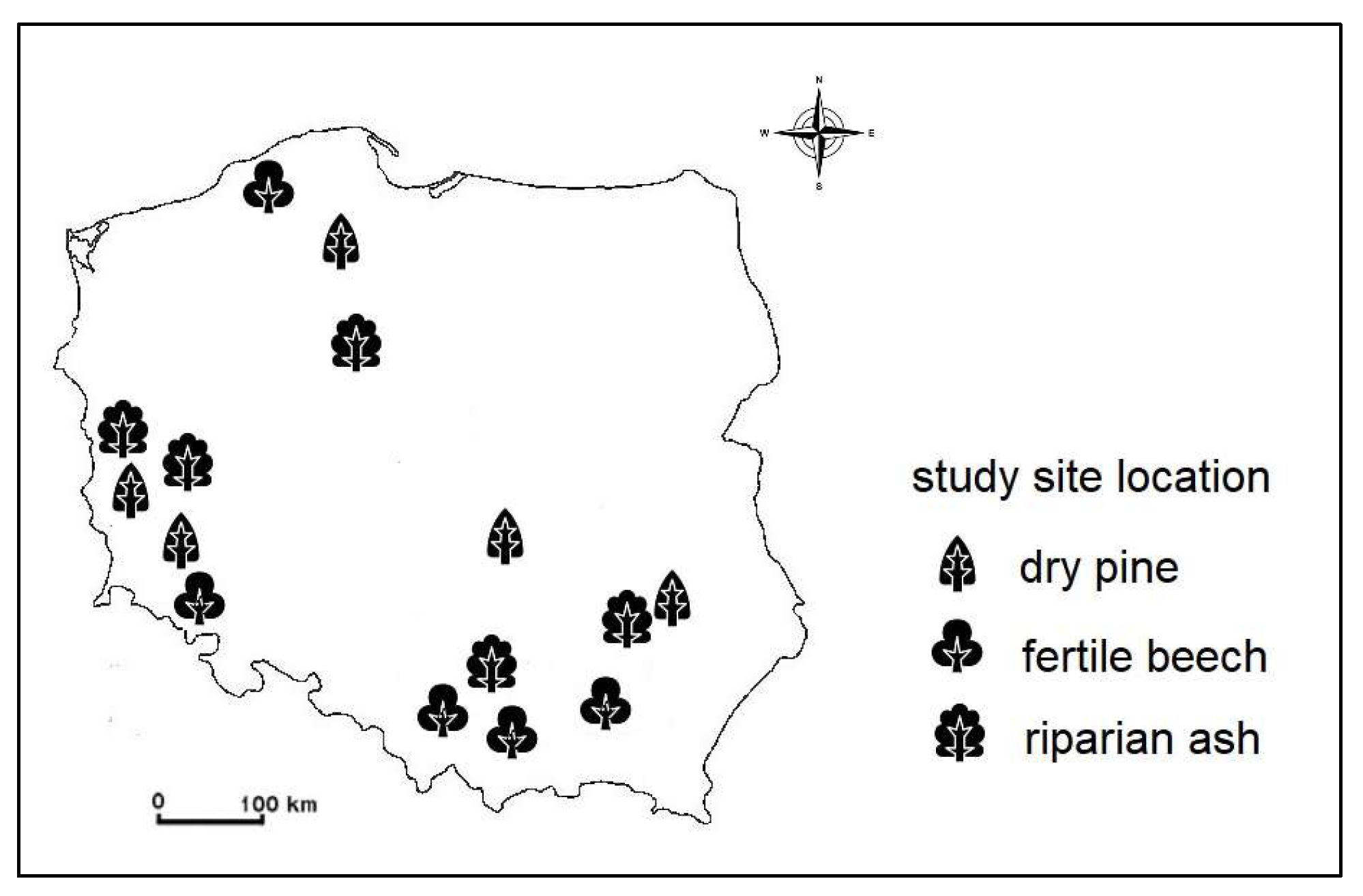
Soil samples were collected in July 2022 in three types of temperate forests: (1) dry pine forest (dry pine, DP)—Cladonio-Pinetum and Vaccinio-Pinetum, with a typical poor forest floor with Cladonia lichen; (2) fertile beech forest (fertile beech, FB)—Dentario glandulosae-Fagetum; and (3) riparian forest, with a domination of ash (riparian ash, RA)—Ficario-Ulmetum and Fraxino-Alnetum. Each forest type was represented by five independent stands, giving altogether 15 stands located in different regions of Poland (Figure 1).
The overall climate of Poland has a transitional—and highly variable—character between maritime and continental types. The distance between the two furthest points is, as the line of sight, 560 km. Detailed GPS positions of soil sampling points are given in Table 1. The study sites were situated beyond industrial areas, which was expected to result in low soil MP concentration. However, it cannot be ruled out that the collected soils contained a certain amount of MP, which is attributable, for example, to atmospheric MP deposition, and applies to soils worldwide [10].
Soil samples were taken from the soil A horizons in three types of forests studied on 100 m2 plots (10 m × 10 m), located in a greater representative forest patch. Five subsamples were collected from each plot using a spade (from the four corners and the center of the stand), resulting in a total of 15 mixed soil samples. The soil O horizon was present only in dry pine forests, so it was excluded from further analysis. Directly after sampling, the material was sieved in the field through a 2 mm mesh sieve to remove visible plant debris and stones and to homogenise it and transported to the laboratory at field moisture content.

2.2. Soil Physicochemical Analysis

The dry weight (DW) of the soil samples was determined by drying them at 105 °C for 24 h. Next, the organic matter content (OM) in dry weight was determined as the loss on ignition at 550 °C for 24 h. The water-holding capacity (WHC) was measured by a standard gravimetric method after soil soaking for 24 h in net-ended plastic pipes immersed in water. The maximal soil WHC was defined as the amount of water that a given soil can hold without leaking according to its dry mass (w:w). Soil pH was measured in water with a digital pH meter with a glass electrode (soil: water 1:10 w:w). The organic C and total N were analysed by dry combustion with an Elemental Analyser (Vario El III, Elementar Analysensysteme GmbHLangenselbold, Germany). Total content of P was extracted by wet digestion of 0.5 g of soil in 10 mL of a concentrated HNO3 and HClO4 (Sigma-Aldrich, Darmstadt, Germany) mixture (7:1 v/v), and the concentration of P in the digests was measured on a flow injection analyser (FIA compact, MLE, Radebeul, Germany). All soil physicochemical analyses were performed in three replications per soil sample and averaged.

2.3. Experimental Design

Polyethylene balls in two sizes (Cospheric LLC, Goleta, CA, USA) were used as microplastics (MPs) in the experiment. The product was made from pure polyethylene without any additives; the material density was 1 g per cm3. Three treatments involving MPs were applied to each soil: a control (C), 60 μm microplastics (SP, small particles), and 140 μm microplastics (BP, big particles). The experiment was conducted in 50 mL glass beakers. Due to differences in the volume density of the studied soils and the risk of uneven drying of the samples during incubation, the beakers were filled to the brim with each soil sample, and the MP dose was then calculated based on the dry weight of the soil in the beakers. Soil dry mass in beakers ranged from 45.9 g to 87.9 g. The MPs were added at a concentration of 0.8% of soil dry weight (w/w). This concentration has been shown in previous studies to affect a range of soil biological properties [16,31]. Each soil sample was mixed with MP balls of a given size in a separate, larger container and transferred to the experimental beakers. The control soil samples were also mixed first in a big container to ensure uniform treatment of all soil samples. A total of 45 beakers were prepared (15 soil samples × 3 experimental treatments). Soil samples were incubated at 20 °C at a constant moisture of 60% of the maximal WHC specific for each soil. Every three days, we replenished the water that had evaporated from the samples. To investigate the short- and long-term effects of MP on soil microorganisms, assessments were conducted three times: one day, one month, and two months after MP application. In total, 135 measurements of microbial responses were taken as part of the experiment. During each measurement, soil respiration rates were first measured, and then a soil subsample was collected from each mesocosm for PLFA analysis. In subsequent respiration rate measurements, a smaller soil sample weight was used. The sample weight reduction was included in the calculations.

2.4. The Soil Respiration Rate and Phospholipid Fatty Acids Analysis

The soil sample respiration rate was measured by CO2 trapping from each soil sample placed in an airtight jar with a beaker of 5 mL 0.2 M NaOH. Closed jars were incubated for ca 24 h (the incubation time was recorded to the nearest minute). Immediately after opening the jars, 2 mL of BaCl2 was added to the NaOH solution to prevent the NaOH from absorbing CO2 from the atmosphere. The excess sodium hydroxide was titrated using a digital Jencons burette with 0.1 M HCl (0.01 mL precision) in the presence of phenolphthalein as a solution pH (colour) indicator. Five empty jars (with only NaOH) were placed among the other samples as blanks. The soil respiration rate was expressed as mM CO2 kg dw−1 24 h−1.
Soil microbial biomass and community structure were determined by PLFA analysis as described by Frostegård et al. [32]. Briefly, total soil lipids were extracted from fresh soil, which were equivalents of 0.5 g DW soil, using a one-phase mixture consisting of chloroform, methanol, and citrate buffer (1:2:0.8, v:v:v). After the addition of chloroform and the buffer and overnight incubation, extracts were divided into two phases, and the lower lipid-containing phase was saved and dried under a stream of nitrogen and stored at −20 °C. The lipid material was fractionated on columns containing silica acid (Bond Elut Si-LRC, 100 mg/10 mL, Varian Inc., Palo Alto, CA, USA) into neutral lipids, glycolipids, and phospholipid-containing polar lipids. The phospholipid fraction was saved for preparation of fatty acid methyl esters. Methyl nonadecanoate (19:0) was used as an internal standard. The phospholipids were subjected to mild alkaline methanolysis, and the resulting fatty acid methyl esters were separated using gas chromatography (PerkinElmer, Waltham, MA, USA; Clarus 600 MS with SP-2560 capillary column) and quantified using qualitative fatty acid methyl ester mixes. All the chemicals used were HPLC purity (Sigma-Aldrich), detergent without phosphates was used for glass cleaning, and the extraction and methylation procedure was performed under a laminar flow chamber. The abundance of individual PLFAs was expressed as nanomoles of PLFA per gram of DW soil (nM PLFA g−1 dw). The sum of all 51 extracted PLFAs in each sample (PLFAtot) was used as an indicator for the soil microbial biomass. Fatty acid nomenclature was determined according to Frostegård et al. [33], and the classification of fatty acids to microbial groups was performed according to classical studies [34,35] and new reviews [36,37]. Fungal fatty acids were 16:1ω5c, 18:1ω9t, 18:1ω9c, 18:2ω6, 18:2ω6, and 18:3ω3. Bacterial fatty acids were i-C15:0, a-15:0, C15:0, i-16:0, 15:1, 16:0, 10Me16:0, i-17:0, 16:1ω9, 16:1ω7, 17:0, 10Me16:0, cy17:0, and cy19:0. The total number of fatty acids classified as being of fungal or bacterial origin accounted on average for 67% per soil sample. Then, proportions of bacterial and fungal fatty acids in total microbial biomass and bacteria-to-fungi ratios were calculated for each soil sample.

2.5. Statistical Analysis

Differences in soil physicochemical properties between three forest types were analysed using one-way ANOVA with Tukey’s test (p < 0.05). Normality of data distribution within groups was checked using the Shapiro–Wilk test.
Three-way ANOVA was used to test the effect of forest type, MP treatment, and experiment duration on soil respiration rate, microbial biomass, proportion of bacteria and fungi in total microbial biomass, and fungi to bacteria ratio (f-to-b ratio). Interactions between factors were tested and, if non-significant, were removed from the final model. Differences between groups were tested using Tukey’s test (p < 0.05).
The pattern of fatty acids was evaluated in multivariate analyses as the relative concentrations of all individual PLFAs. To test the effect of forest type and MP treatment and their interaction regarding fatty acid patterns, two-way PERMANOVAs were used for each of three measurement times separately. Separation of measurement times allowed for clearer visualisation of the differences between groups, which was performed using NDMS based on two dimensions of the Bray–Curtis distance metric. To identify the fatty acids that best indicate differences in the effects of different MP types, a SIMPER analysis was conducted separately for each measurement and forest type. The relative concentrations of the first three fatty acids, the most contributing to average dissimilarity between MP treatments, were compared between MP treatments using one-way ANOVA with Tukey’s test (p < 0.05). The use of just a few fatty acids was assumed to reduce the risk of a type 2 error.
The ANOVA analysis was performed with Statgraphics Centurion software (version 19.2.01.) (StatPoint, Herndon, VA, USA), and multivariate analysis was performed using PAST 2.17c software (Natural History Museum, University of Oslo, Norway).

3. Results

3.1. Soil Properties of Three Forest Types

The soils differed in all measured characteristics (Table 2). According to expectations, the lowest content of OM, C, N, and P was found in the dry pine forest soils compared to fertile beech and riparian ash soils (Table 2). Fertile beech and riparian ash forest soils were characterised by an enhanced soil pH compared to the dry pine forest soils (Table 2).

3.2. Soil Respiration Rate, Microbial Biomass, and Soil Bacteria and Fungi

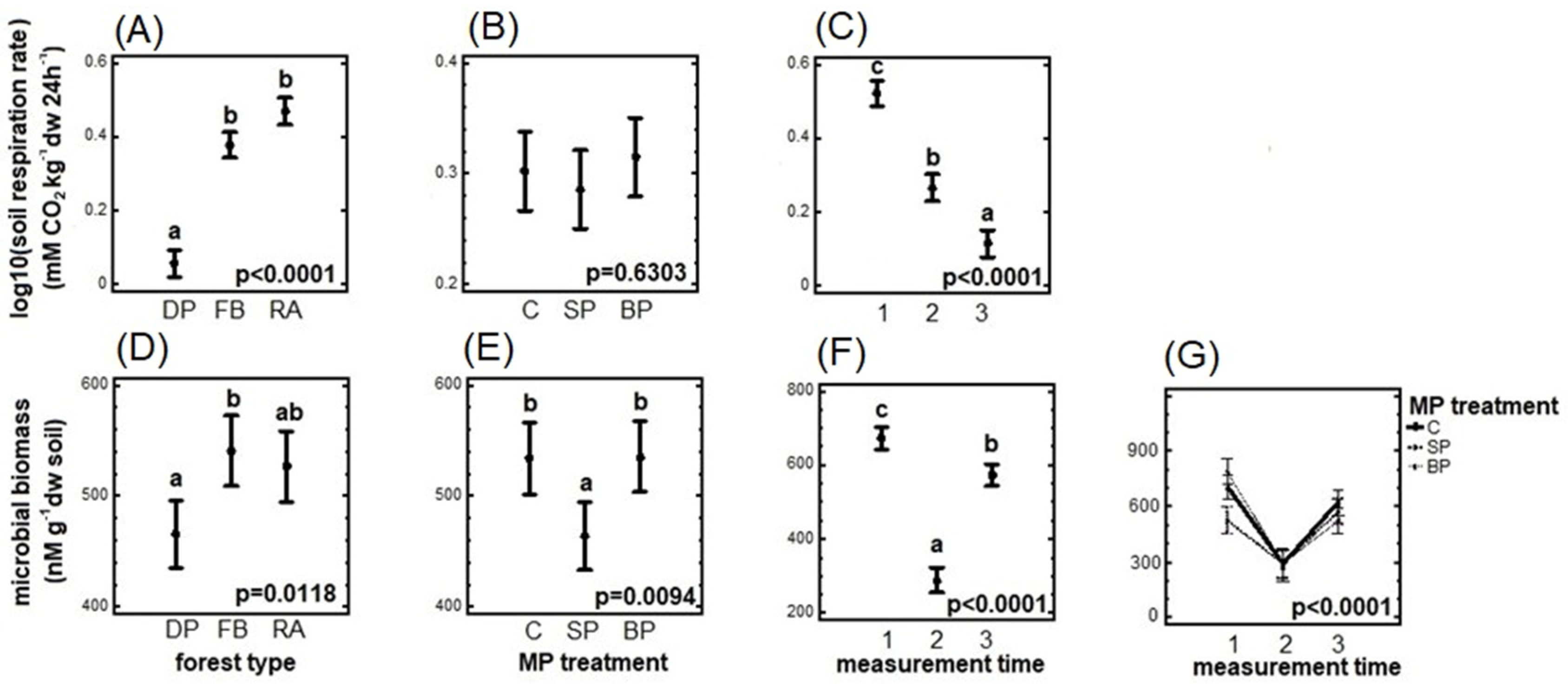
The soil respiration rate ranged from 0.49 to 6.79 mM CO2 kg dw−1 24 h−1. Soil respiration rate differed between forest types, being significantly lower in DP than in the other two forests (p < 0.0001) and decreased with measurement time (p < 0.0001), but it did not differ between MP treatments (p = 0.6303) (Figure 2A–C).
The soil microbial biomass (sum of all PLFAs) in individual soil samples ranged from 94.8 to 958.6 nM PLFA g−1 dw. Microbial biomass was the lowest in dry pine forest soil (p = 0.0118) (Figure 2D). MP treatment affected soil microbial biomass (p = 0.0094) and SP treatment resulted in declining microbial biomass, whereas there was no BP effect compared to the controls (Figure 2E). The biomass of microorganisms (p < 0.0001) varied over the course of the experiment and, unexpectedly, was lowest at the time of the second measurement (Figure 2F). There was also a significant interaction between MP treatment and measurement time in their joint effect on soil microbial biomass (p < 0.0001), indicating that at the first measuring time, the microbial biomass was especially low at SP treatment (Figure 2G).
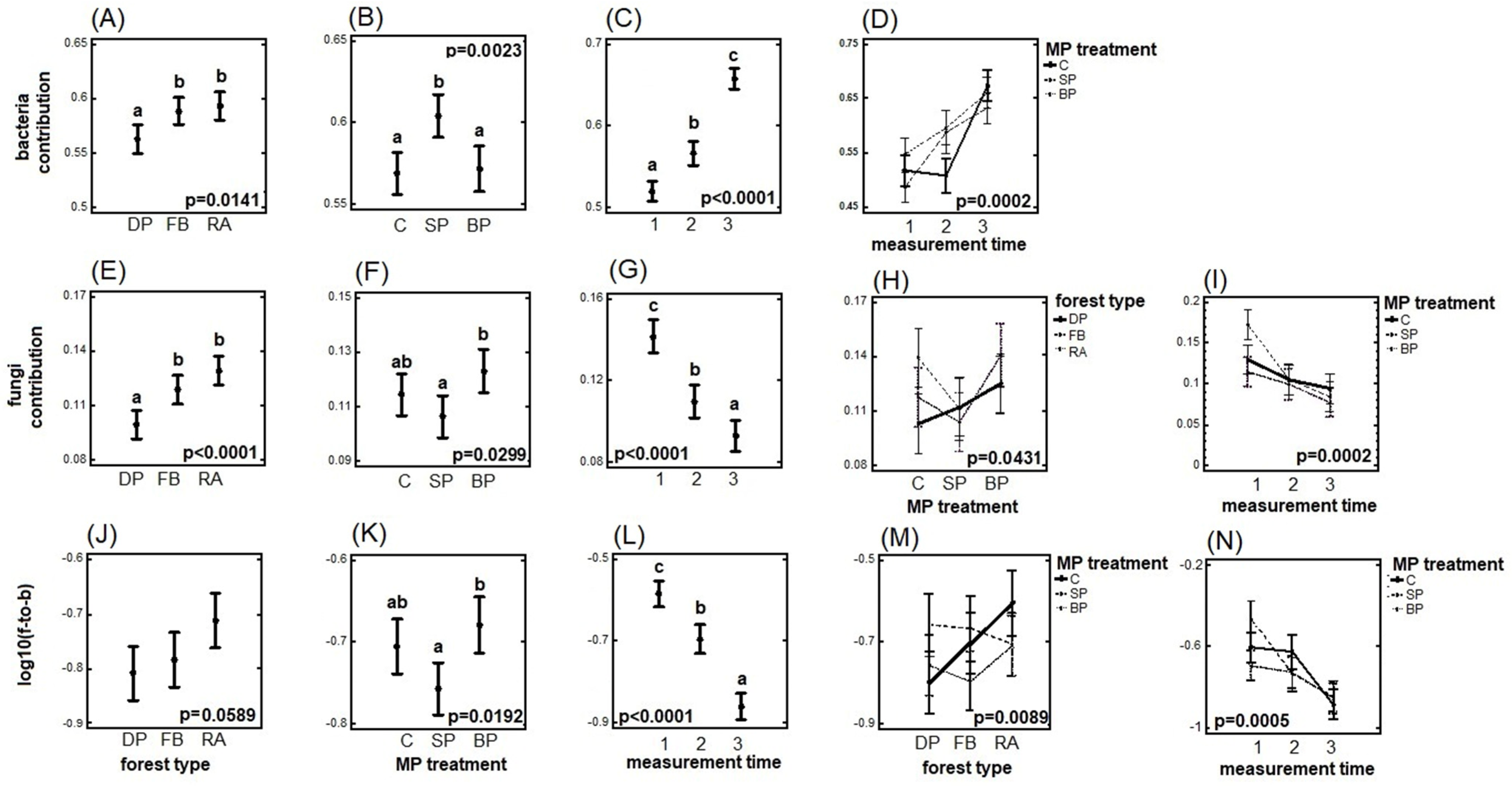
The contribution of bacteria in the microbial community, that is, a proportion of PLFAs attributed to bacteria, ranged from 0.39 to 0.72, with an average value of 0.57. The contribution of bacteria in the soil microbial community differed between forest types, being lower in DP than in the other two forest types (p = 0.0141), increased with SP treatment compared to control and BP treatments (p = 0.0023), and increased with measurement time (p < 0.0001) (Figure 3A–C). A significant interaction between MP treatment and experiment duration was found (p = 0.0002), indicating that bacterial contribution in the third measurement increased for MP treatments and also for the control treatment (Figure 3D).
The contribution of fungi in the microbial community ranged from 0.04 to 0.33, with an average value of 0.12. The contribution of fungi in the community differed between forest types (p < 0.0001); exhibited an effect due to MP treatment, where SP treatment showed the lowest value (p = 0.0290); and was also affected by measurement time (p < 0.0001) (Figure 3E–G). A significant interaction between forest type and MP treatment showed that at the control samples, the contribution of fungi was lower in the DP forest than in the other two forests (p = 0.0431) (Figure 3H). A significant interaction between MP treatment and measurement time showed that during the first measurement, the contribution of fungi was higher for BP treatment than in the other two groups (p = 0.0002) (Figure 3I).
The proportion of fungi to bacteria (f-to-b), combining trends in both these important microbial groups, ranged from 0.07 to 3.4, with an average value of 0.24. The f-to-b ratio did not differ between forest type (p = 0.0589) but did exhibit an effect from MP treatment, where SP treatment showed the lowest value (p = 0.0192), and also showed an effect from measurement time (p < 0.0001) (Figure 3J–L). A significant interaction between forest type and MP treatment showed that the f-to-b ratio in RA forest was higher in the control treatment than in the other two MP treatments (p = 0.0431) (Figure 3M). A significant interaction between MP treatment and measurement time showed that the f-to-b ratio in control treatment decreased slightly along the experiment’s duration for all MP treatments: the f-to-b ratio was especially high for BP treatment at the first measurement time and much lower for other MP treatments (p = 0.0005) (Figure 3N).

3.3. Soil Microbial Community Structure (PLFA Composition)

The number of fatty acids in individual soil samples ranged from 33 to 51, with an average value of 44.4 (±3.8). From all fatty acids, a few were especially abundant, that is, 16:0, 18:0, cy 17:0, 16:1n-7, and cy 19:0 (above 5% abundance).
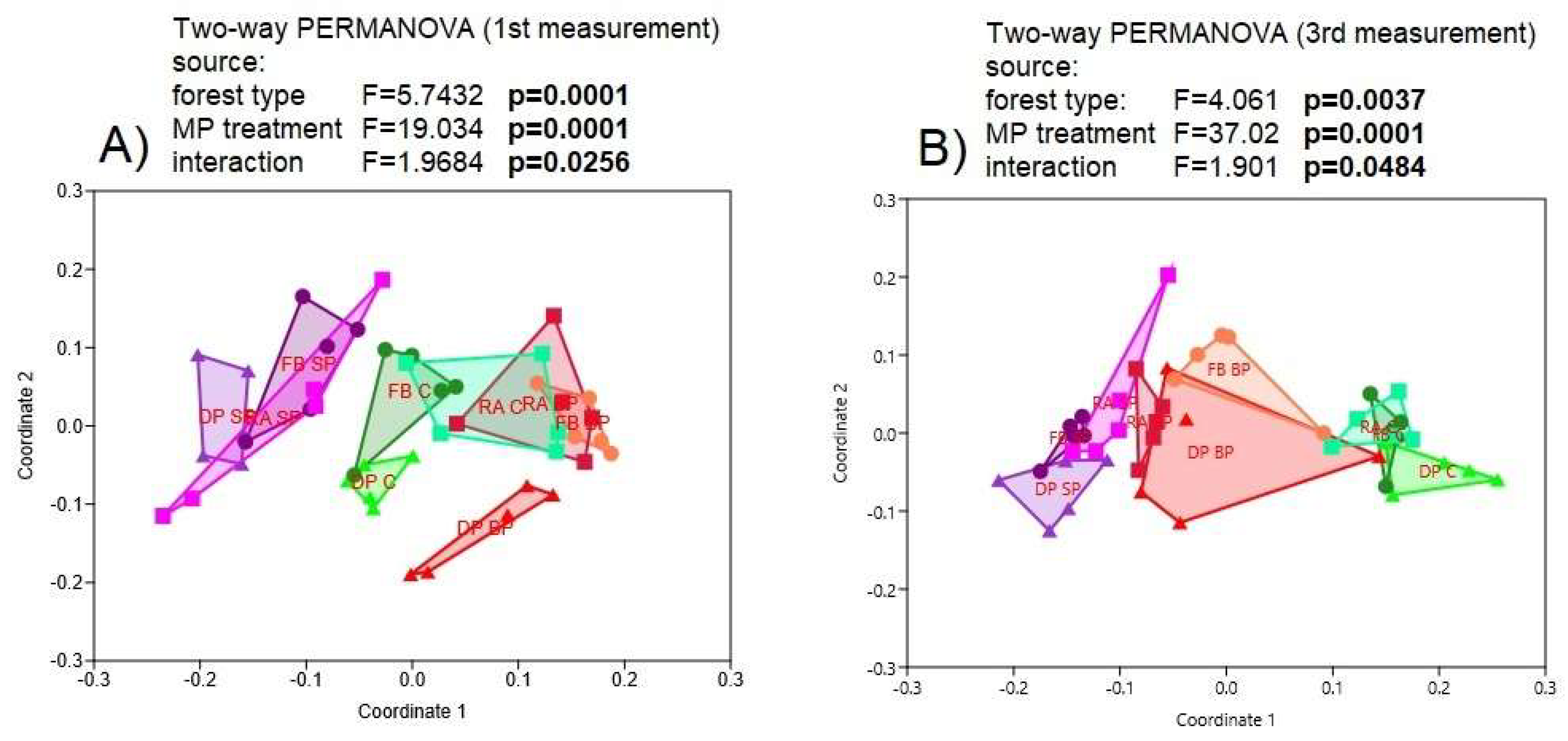
In the NDMS analysis, for each single dataset, the stress value was in the range from 0.1 to 0.15, representing a good fit for the data. Two-way PERMANOVA showed a significant effect from forest type and MP treatment on PLFA composition, but only for the first and third measurement times, and the PLFA pattern was visualised using NDMS ordination (Figure 4A,B). The MP effect for the second measurement was not significant and was not presented graphically. PERMANOVA for the second measurement time yielded a significant effect of forest type on PLFA composition (F = 2.2159, p = 0.0028), but no significant effect due to MP treatment (F = 0.1014, p = 0.414) or non-significant interaction (F = 0.7446, p = 0.8929).
SIMPER analysis was performed only for the first and third measurement times, and its results are presented in Table 3 and Table 4, respectively. Both tables present only the first three individual fatty acids for each forest type that most contribute to the average dissimilarity between MP treatments. For the first measuring time, their cumulative contribution ranged to 33% for DP forest and to 39% for FB and RA forests (Table 3). For each forest type, two fatty acids from these three were the same, namely 16:0 and cy 17:0, despite their position in average dissimilarity between MP treatment effects being different. It is worth noting that 16:0, the most abundant fatty acid, was present at the highest concentration in most of the soil samples tested (on average, accounting for 17.7% of the total fatty acid content). It was only absent in some soil samples from the second measurement time. In turn, fatty acid cy 17:0 was much less abundant (7.6% on average). Both these fatty acids are known as markers of the presence of soil bacteria. The 16:0 fatty acid is a marker for bacteria in general, while the cy 17:0 fatty acid indicates the presence of Gram-negative bacteria. In the first measurement, the concentration of 16:0 did not show a clear trend in the MP treatment, whereas in the SP treatment, a higher concentration of this acid was observed compared to the control group in the DP and RA forests, but not in the FB forest. In turn, cy 17:0 shows a consistent decrease during SP treatment compared to the controls for each forest type, and no change on insignificant increase during BP treatment compared to the controls. A similar pattern shows 18:1ω9t in FB and RA forests.
During the third measurement time, the cumulative contribution of the three fatty acids that most contributed ranged to 53% for DP forest, 49% for FB forest, and 47% for FB and RA forests (Table 4). The composition of the three fatty acids changed compared to the first measurement time, but fatty acid 16:0 was still present as one of the most abundant fatty acids, namely, the second most abundant for each type of forest. In the third measurement time, 16:0 showed a clear pattern for each forest type, as it increased in both SP and BP treatments compared to the controls. Under the influence of SP, the proportion of 16:0 acid almost doubled compared with the control group and to a slightly lesser but still significant extent under the influence of BP. The other most contributing fatty acids were 16:1ω7, 18:0, and cy 17:0. As cy 17:0 is known as a marker of bacterial presence, the other fatty acids have no clear classification. Fatty acid 18:0, along with 16:0, is one of the most prevalent saturated fatty acids in soil, contributing to the total PLFA profile used to assess the overall microbial community structure. Fatty acid 18:0 was present in all tested soil samples, and its average contribution was 11.3%. Fatty acid 16:1ω7 was the most contributing for each forest type and clearly decreased under both SP and BF treatments compared to the controls. Fatty acids 18:0 and cy 17:0 showed an opposite trend, as they increased under both SP and BP treatments compared to the controls.

4. Discussion

The results indicate that microbial activity in soils of different forest types, as measured by soil respiration rates, differed significantly, which was due to differences in the soil’s physicochemical and microbiological properties. Soil physicochemical properties are prevailing drivers of soil microbial abundance, activity, and community composition [38,39]. Higher bacterial contribution in microbial communities in both deciduous forest types compared to that in dry pine forest can be attributed especially to soil pH, as bacteria prefer less acidic soils than fungi [40]. The effect of forest type on soil microbial community was clearly visible during the experiment’s duration, as the PLFA pattern distinguished between forest type in each measurement time.
It is worth noting that laboratory experiments often reveal changes in the microbiological properties of soils resulting from the soil sampling procedure itself, which leads to alterations in soil structure and gas exchange, as well as the depletion of readily degradable carbon compounds in the soil [38,41]. We observed it as a decrease in soil respiration rate and a decrease in fungal contribution over time. However, changes in soil microbial biomass showed no consistent trend, as soil microbial biomass was the lowest during the second measurement time, that is, after a month of soil sample incubation, compared to the other two measurements. We observed an increase in bacterial contribution, which was accompanied by a corresponding decrease in the fungal contribution in the community. It should be emphasised that the proportion of bacteria and fungi within the microbial community, as measured by the proportion of their characteristic PLFAs, is rather arbitrary, as the composition of these PLFAs may vary depending on species, as well as cell size and condition, affecting the fatty acid content and composition in individual cells [42,43]. However, it remains a useful indicator of certain trends in the composition of the community as it is correlated with other soil microbial measures [36]. The biomass conversion factor can be applied to estimate bacterial and fungal biomass using PLFA, but there is a range of different conversion factors available without consensus among authors as to which is more appropriate, as noted by Willers et al. [36].
During soil laboratory incubation, continuing changes in microbial community structure can be expected, followed by changes in soil properties and microbial succession. This might make assessing long-term MP treatment effects on soil microorganisms a difficult task, even when changes are contrasted with control treatments. Furthermore, mycorrhizal fungi account for a significant proportion of forest soils. Once separated from their host plants, they can decline in number or biomass particularly rapidly. Fungal mycelium decomposes quickly, with significant mass loss (>50%) occurring within the first month of soil sample incubation [44].
In our experiment, the addition of MPs to soil did not affect the measured rate of soil respiration, which is consistent with the results of some studies [45,46]. On the other hand, a lot of reports indicate that polyethylene MPs increase the rate of soil respiration [19,47,48]. In their meta-analysis, Vainberg et al. [49] estimated that in 60% of scientific studies, the authors reported a positive effect of MP on soil respiration rates. Zhao et al. [50] found that the MP effect on soil respiration rate may depend on soil organic carbon content; therefore, a lack of clear MP effects can be expected in generally carbon-rich temperate forest soils, as used in our study. Also, an increase in soil respiration rate under MP treatment concerns mostly microplastic particles smaller than those used in our study, namely particles ranging in size from 0.5 to 50 μm. As particle size decreases, the surface-to-volume ratio is inversely proportional to the diameter. This results in an exponential increase in the surface area exposed to the environment, and, for the same mass of material, small particles contain a significantly greater number of individual particles, which greatly increases the likelihood of physical or biological interactions. Another possible reason for the lack of an effect of MPs on respiration rates in our study may be the high functional redundancy of soil microorganisms; this means that if certain species are inhibited by a stressor such as microplastics, other, more resilient taxa take over the role of maintaining large-scale processes, such as organic matter decomposition and basal respiration. MP surfaces constitute a new environment that may favour certain groups of microorganisms at the expense of others. These changes in community structure do not necessarily disrupt the overall rate of soil respiration, provided that the newly formed microbiome carries out carbon mineralisation at a rate comparable to that of the original community [51]. Also, in some soil systems, microplastics may alter microenvironments or leach dissolved organic carbon (DOC). If microbes utilise this additional carbon source, the resulting increase in activity can mask a decline in biomass, thereby stabilising overall respiration [28]. While overall respiration may look stable in the short term, this masks an underlying disruption in soil health. The shift may reflects a decline in microbial diversity, with stress-tolerant generalists replacing specialised, beneficial taxa required for long-term soil organic matter stabilisation [52]. Changes in PLFA composition with experiment duration may confirm this hypothesis.
Although MP did not affect soil respiration rates, we observed a significant effect of smaller microplastic particles on the soil microbial biomass. Changes in bacteria and fungi contribution and the fungi-to-bacteria ratio were also more pronounced for the SP treatment compared to the BP treatment. The application of the SP treatment increased the proportion of bacteria and decreased the proportion of fungi, suggesting that soil bacteria may benefit in some way at the expense of fungi. This may be due to bacterial–fungal competition for soil resources, whereby bacteria adapt and grow faster than fungi [53]. Given the changes in microbial communities caused by MPs observed in our experimental setup, it can be assumed that increasing soil contamination with microplastics may affect their essential functions in ecosystems, such as nutrient cycling [54].
We observed an MP effect on the PLFA pattern only at the first and third measurement times. There was no MP effect on the second measurement, which may result from enhanced variance in PLFA pattern in individual samples but may also indicate that MP effects on soil microorganisms may fluctuate over time. This observation is consistent with earlier reports [30,55]. Zhao et al. [30] showed that MP effects may be dynamic even in short-term experiments (up to 31 days of exposure). At the same time, it seems that the MP effect on the soil microbiome increases with time due to the cumulative changes taking place in the soil. This observation is consistent with some reports on long-term MP effects on soil microorganisms, which were conducted over several months [56]. The fatty acids that contributed most to the average dissimilarity between MP treatments were those with the highest abundance, despite the composition of these individual PLFAs varying between the first and third measurements. There were no dramatic differences between forest types in these individual PLFA compositions, which suggests that independent of forest type, the effect of MP treatment on different forest soils can be somewhat similar.
The late MP treatment effect, that is, after two months of experiment duration (third measurement), was especially visible for SP treatment. Under both MP treatments during the third measurement, fatty acid 16:1ω7 significantly decreased while 16:0 increased, compared to controls. The abundance of 16:1ω7 in MP treatments was several times lower than in controls. This relationship was less evident for 16:0, as the increase was less than double compared to the controls. The relative changes of these two bacterial fatty acids may therefore serve as general indicators of MP pollution in temperate forest soils, especially under prolonged exposition. Fatty acid 16:0 showed a similar trend, also under short-term exposition, but the effect was not so evident and was related mostly to SP treatment. Therefore, a relative decrease in 16:1ω7 and an increase in 16:0 might be expected to be common as a result of MP pollution, at least as a result of polyethylene MP soil contamination. It would be interesting to check if these same tendencies occur in the case of soil pollution by MPs created from other polymers or MPs of other sizes that were tested in the current study. However, the environment contains mixtures of particles of varying sizes and composed of different materials; therefore, any generalisations should be treated with caution.

5. Conclusions

MP pollution is a global problem; further research may reveal which microbial indices could act as universal indicators of microplastic pollution in forest soils instead of detailed analysis of MP concentration and composition, which is still challenging. We found that the relative decrease in fatty acid 16:1ω7 and simultaneous increase in 16:0 and 18:0 under MP treatments may potentially serve as an indication of MP pollution in temperate forest soils. Our results also suggest that forest soil bacteria, as a group, may benefit from MP at the expense of fungi, which may affect carbon sequestration and ecosystem functioning on a long time scale. However, it is of paramount importance to establish the link between changes in the structure and function of soil microorganisms resulting from exposure to microplastics, as the lack of MP effects on a particular measure of soil microorganisms parameter does not mean a lack of MP effects on soil health because of the risk of various compensatory effects, especially in carbon-rich temperate forest soils.

Author Contributions

Conceptualisation, B.K. and M.N.; methodology, B.K., M.C. and M.N.; software, B.K.; validation, B.K. and M.C.; formal analysis, B.K.; investigation, B.K., M.C. and M.N.; resources, M.N.; data curation, B.K.; writing—original draft preparation, B.K., M.C. and M.N.; writing—review and editing, B.K., M.C. and M.N.; visualisation, B.K.; supervision, B.K.; project administration, B.K. and M.N.; funding acquisition, M.N. All authors have read and agreed to the published version of the manuscript.

Funding

This work was supported by the Strategic Programme ‘Excellence Initiative—Research University’ (2020–2026) at the Jagiellonian University in Krakow (ID UJ, Priority Research Area BIOS, mini-grant support).

Data Availability Statement

The raw data supporting the conclusions of this article will be made available by the authors on request.

Acknowledgments

We acknowledge the support of Jagiellonian University in Kraków, Poland (N18/DBS/000003). We would like to thank the three anonymous reviewers for their constructive comments, which have significantly enhanced the scientific value of the manuscript.

Conflicts of Interest

The authors declare no conflicts of interest.

Abbreviations

The following abbreviations are used in this manuscript:
MPMicroplastic particles
PLFAPhospholipid Fatty Acid 
DPDry pine forest
FBFertile beech forest
RARiparian ash forest

References

  1. Zhu, F.; Zhu, C.; Wang, C.; Gu, C. Occurrence and ecological impacts of microplastics in soil systems: A review. Bull. Environ. Contam. Toxicol. 2019, 102, 741–749. [Google Scholar] [CrossRef] [PubMed]
  2. Yang, L.; Zhang, Y.; Kang, S.; Wang, Z.; Wu, C. Microplastics in soil: A review on methods, occurrence, sources, and potential risk. Sci. Total Environ. 2021, 780, 146546. [Google Scholar] [CrossRef] [PubMed]
  3. Yacoub, M.; Han, B. Terrestrial Microplastic Pollution: Occurrence, Fate, and Ecological Effects on Soil Systems. Microplastics 2026, 5, 67. [Google Scholar] [CrossRef]
  4. Horton, A.A.; Walton, A.; Spurgeon, D.J.; Lahive, E.; Svendsen, C. Microplastics in freshwater and terrestrial environments: Evaluating the current understanding to identify the knowledge gaps and future research priorities. Sci. Total Environ. 2017, 586, 127–141. [Google Scholar] [CrossRef]
  5. Fan, P.; Tan, W.; Yu, H. Effects of different concentrations and types of microplastics on bacteria and fungi in alkaline soil. Ecotoxicol. Environ. Saf. 2022, 229, 113045. [Google Scholar] [CrossRef]
  6. Helmberger, M.; Tiemann, L.; Grieshop, M. Towards an ecology of soil microplastics. Funct. Ecol. 2019, 34, 550–560. [Google Scholar] [CrossRef]
  7. Zeb, A.; Liu, W.; Shi, R.; Lian, Y.; Wang, Q.; Tang, J.; Lin, D. Evaluating the knowledge structure of micro- and nanoplastics in terrestrial environment through scientometric assessment. Appl. Soil Ecol. 2022, 177, 104507. [Google Scholar] [CrossRef]
  8. Weber, C.; Rillig, C.; Bigalke, M. Mind the gap: Forest soils as a hidden hub for global micro- and nanoplastic pollution. Microplastics Nanoplastics 2023, 3, 19. [Google Scholar] [CrossRef]
  9. Forest Area. Available online: https://ourworldindata.org/forest-area (accessed on 24 February 2026).
  10. Weber, C.; Bigalke, M. Forest soils accumulate microplastics through atmospheric deposition. Commun. Earth Environ. 2025, 6, 702. [Google Scholar] [CrossRef]
  11. Hanif, M.; Aijaz, N.; Azam, K.; Akhtar, M.; Laftah, W.; Babur, M. Impact of microplastics on soil (physical and chemical) properties, soil biological properties/soil biota, and response of plants to it: A review. Int. J. Environ. Sci. Technol. 2024, 21, 10277–10318. [Google Scholar] [CrossRef]
  12. Hale, R.; Seeley, M.; La Guardia, M.; Mai, L.; Zeng, E. A global perspective on microplastics. J. Geophys. Res. Ocean. 2020, 125, e2018JC014719. [Google Scholar] [CrossRef]
  13. Song, B.; Shang, S.; Cai, F.M.; Liu, Z.; Fang, J.; Li, N.; Adams, J.M.; Razavi, B.S. Microbial resistance in rhizosphere hotspots under biodegradable and conventional microplastic amendment: Community and functional sensitivity. Soil Biol. Biochem. 2023, 180, 108989. [Google Scholar] [CrossRef]
  14. Xu, B.; Liu, F.; Cryder, Z.; Huang, D.; Lu, Z.; He, Y. Microplastics in the soil environment: Occurrence, risks, interactions and fate—A review. Crit. Rev. Environ. Sci. Technol. 2020, 50, 2175–2222. [Google Scholar] [CrossRef]
  15. Li, K.; Xiu, X.; Hao, W. Microplastics in soils: Production, behavior process, impact on soil organisms, and related toxicity mechanisms. Chemosphere 2024, 350, 141060. [Google Scholar] [CrossRef]
  16. Klimek, B.; Grzyb, D.; Łukiewicz, B.; Niklińska, M. Microplastics increase soil respiration rate, decrease soil mesofauna feeding activity and change enchytraeid body length distribution in three contrasting soils. Appl. Soil Ecol. 2024, 201, 105463. [Google Scholar] [CrossRef]
  17. Hongjin, C.; Rahman, S.; Rehman, A.; Khan, A.; Khalid, M. Microplastics and antibiotic resistance genes as rising threats: Their interaction represents an urgent environmental concern. Curr. Res. Microb. Sci. 2025, 9, 100447. [Google Scholar] [CrossRef]
  18. Sun, Y.; Li, X.; Cao, N.; Duan, C.; Ding, C.; Huang, Y.; Wang, J. Biodegradable microplastics enhance soil microbial network complexity and ecological stochasticity. J. Hazard. Mater. 2022, 439, 129610. [Google Scholar] [CrossRef]
  19. Gao, B.; Gao, F.; Zhang, X.; Li, Y.; Yao, H. Effects of different sizes of microplastic particles on soil respiration, enzyme activities, microbial communities, and seed germination. Sci. Total Environ. 2024, 933, 173100. [Google Scholar] [CrossRef] [PubMed]
  20. Li, Q.; Wang, X.; Zhang, J.; Guo, X.; Li, Y.; Andom, O.; Li, Z. Microplastics alter microbial structure and assembly processes in different soil types: Driving effects of environmental factors. Environ. Res. 2025, 278, 121672. [Google Scholar] [CrossRef]
  21. Ng, E.L.; Lin, S.Y.; Dungan, A.M.; Colwell, J.M.; Ede, S.; Lwanga, E.H.; Meng, K.; Geissen, V.; Blackall, L.L.; Chen, D. Microplastic pollution alters forest soil microbiome. J. Hazard. Mater. 2021, 409, 124606. [Google Scholar] [CrossRef]
  22. FAO. Global Forest Resources Assessment 2020: Main Report; ISRIC and ISSS; FAO: Rome, Italy, 2020. [Google Scholar] [CrossRef]
  23. Chodak, M.; Klimek, B.; Niklinska, M. Composition and activity of soil microbial communities in different types of temperate forests. Biol. Fertil. Soils 2016, 52, 1093–1104. [Google Scholar] [CrossRef]
  24. Baldrian, P. Forest microbiome: Diversity, complexity and dynamics. FEMS Microbiol. Rev. 2017, 41, 109–130. [Google Scholar] [CrossRef] [PubMed]
  25. Labouyrie, M.; Ballabio, C.; Romero, F.; Panagos, P.; Jones, A.; Schmid, M. Patterns in soil microbial diversity across Europe. Nat. Commun. 2023, 14, 3311. [Google Scholar] [CrossRef] [PubMed]
  26. Stefanowicz, A.; Niklińska, M.; Laskowski, R. Metal affect soil bacterial and fungal functional diversity differently. Environ. Toxicol. Chem. 2008, 27, 591–598. [Google Scholar] [CrossRef]
  27. Kaisermann, A.; Maron, P.; Beaumelle, L.; Lata, J. Fungal communities are more sensitive indicators to non-extreme soil moisture variations than bacterial communities. Appl. Soil Ecol. 2015, 86, 158–164. [Google Scholar] [CrossRef]
  28. Wang, K.; Wang, F.; Yu, Y.; Yang, S.; Han, Y.; Yao, H. Microplastics and soil microbiomes. BMC Biol. 2025, 29, 273. [Google Scholar] [CrossRef]
  29. Stefanowicz, A.; Kapusta, P.; Stanek, M.; Rola, K.; Zubek, S. Herbaceous plant species support soil microbial performance in deciduous temperate forests. Sci. Total Environ. 2022, 810, 151313. [Google Scholar] [CrossRef]
  30. Zhao, T.; Lozano, Y.; Rillig, M. Microplastics Increase Soil pH and Decrease Microbial Activities as a Function of Microplastic Shape, Polymer Type, and Exposure Time. Front. Environ. Sci. 2021, 9, 675803. [Google Scholar] [CrossRef]
  31. Huo, Y.; Dijkstra, F.; Possell, M.; Dong, A.; Singh, B. Degradation of conventional, biodegradable and oxo-degradable microplastics in a soil using a d13C technique. Soil Res. 2023, 61, 755–765. [Google Scholar] [CrossRef]
  32. Frostegård, A.; Tunlid, A.; Bååth, E. Microbial biomass measured as total lipid phosphate in soils of different organic content. J. Microbiol. Methods 1991, 14, 151–163. [Google Scholar] [CrossRef]
  33. Frostegård, Å.; Tunlid, A.; Bååth, E. Phospholipid fatty acid composition, biomass, activity of microbial communities from two soil types experimentally exposed to different heavy metals. Appl. Environ. Microbiol. 1993, 59, 3605–3617. [Google Scholar] [CrossRef]
  34. Hill, G.; Mitkowski, N.; Aldrich-Wolfe, L.; Emele, L.; Jurkonie, D.; Ficke, A.; Maldonado-Ramirez, S.; Lynch, S.; Nelson, E. Methods for assessing the composition and diversity of soil microbial communities. Appl. Soil Ecol. 2000, 15, 25–36. [Google Scholar] [CrossRef]
  35. Waldrop, M.; Balser, T.; Firestone, M. Linking microbial community composition to function in a tropical soil. Soil Biol. Biochem. 2000, 32, 1837–1846. [Google Scholar] [CrossRef]
  36. Willers, C.; van Rensburg, P.J.; Claassens, S. Phospholipid fatty acid profiling of microbial communities–a review of interpretations and recent applications. J. Appl. Microbiol. 2015, 119, 1207–1218. [Google Scholar] [CrossRef]
  37. van Galen, L.G.; Smith, G.R.; Margenot, A.J.; Waldrop, M.P.; Crowther, T.W.; Peay, K.G.; Jackson, R.B.; Yu, K.; Abrahão, A.; Ahmed, T.A.; et al. A global database of soil microbial phospholipid fatty acids and enzyme activities. Sci. Data 2025, 12, 1568. [Google Scholar] [CrossRef]
  38. Hu, X.; Wang, J.; Lv, Y.; Liu, X.; Zhong, J.; Cui, X.; Zhang, M.; Ma, D.; Yan, X.; Zhu, X. Effects of Heavy Metals/Metalloids and Soil Properties on Microbial Communities in Farmland in the Vicinity of a Metals Smelter. Front. Microbiol. 2021, 12, 707786. [Google Scholar] [CrossRef]
  39. Yang, B.; Feng, W.; Zhou, W.; He, K.; Yang, Z. Association between Soil Physicochemical Properties and Bacterial Community Structure in Diverse Forest Ecosystems. Microorganisms 2024, 12, 728. [Google Scholar] [CrossRef]
  40. Rousk, J.; Brookes, P.; Bååth, E. Investigating the mechanisms for the opposing pH relationships of fungal and bacterial growth in soil. Soil Biol. Biochem. 2010, 42, 926–934. [Google Scholar] [CrossRef]
  41. Schroeder, J.; Kammann, L.; Helfrich, M.; Tebbe, C.; Poeplau, C. Impact of common sample pre-treatments on key soil microbial properties. Soil Biol. Biochem. 2021, 160, 108321. [Google Scholar] [CrossRef]
  42. Lindahl, V.; Frostegård, Å.; Bakken, L.; Bååth, E. Phospholipid fatty acid composition of size fractionated indigenous soil bacteria. Soil Biol. Biochem. 1997, 29, 1565–1569. [Google Scholar] [CrossRef]
  43. Camenzind, T.; Haslwimmer, H.; Rillig, M.; Ruess, L.; Finn, D.; Tebbe, C. Revisiting soil fungal biomarkers and conversion factors: Interspecific variability in phospholipid fatty acids, ergosterol and rDNA copy numbers. Soil Ecol. Lett. 2024, 6, 240243. [Google Scholar] [CrossRef]
  44. Ryan, M.; Schreiner, K.; Swenson, J.; Gagne, J.; Kennedy, P. Rapid changes in the chemical composition of degrading ectomycorrhizal fungal necromass. Fungal Ecol. 2020, 45, 100922. [Google Scholar] [CrossRef]
  45. Rauscher, A.; Meyer, N.; Jakobs, A.; Bartnick, R.; Lueders, T.; Lehndorff, E. Biodegradable microplastic increases CO2 emission and alters microbial biomass and bacterial community composition in different soil types. Appl. Soil Ecol. 2023, 182, 104714. [Google Scholar] [CrossRef]
  46. Xiang, Y.; Rillig, M.C.; Peñuelas, J.; Sardans, J.; Liu, Y.; Yao, B.; Li, Y. Global Responses of Soil Carbon Dynamics to Microplastic Exposure: A Data Synthesis of Laboratory Studies. Environ. Sci. Technol. 2024, 58, 5821–5831. [Google Scholar] [CrossRef]
  47. Shi, J.; Wang, J.; Lv, J.; Wang, Z.; Peng, Y.; Shang, J.; Wang, X. Microplastic additions alter soil organic matter stability and bacterial community under varying temperature in two contrasting soils. Sci. Total Environ. 2022, 838, 156471. [Google Scholar] [CrossRef] [PubMed]
  48. Zhang, Y.; Lia, X.; Xiao, M.; Feng, Z.; Yu, Y.; Yao, H. Effects of microplastics on soil carbon dioxide emissions and the microbial functional genes involved in organic carbon decomposition in agricultural soil. Sci. Total Environ. 2022, 806, 150714. [Google Scholar] [CrossRef] [PubMed]
  49. Vainberg, A.; Abakumov, E.; Nizamutdinov, T. Recent Insights into Microplastic Pollution and Its Effects on Soil Carbon: A Five-Year Ecosystem Review. Microplastics 2025, 4, 18. [Google Scholar] [CrossRef]
  50. Zhao, S.; Rillig, M.C.; Bing, H.; Cui, Q.; Qiu, T.; Cui, Y.; Penuelas, J.; Liu, B.; Bian, S.; Monikh, F.A.; et al. Microplastic pollution promotes soil respiration: A global-scale meta-analysis. Glob. Change Biol. 2024, 30, e17415. [Google Scholar] [CrossRef]
  51. Shah, T.; Ali, A.; Haider, G.; Asad, M.; Munsif, F. Microplastics alter soil enzyme activities and microbial community structure without negatively affecting plant growth in an agroecosystem. Chemosphere 2023, 322, 138188. [Google Scholar] [CrossRef]
  52. De Silva, S.; Kariyawasam Hetti Gamage, L.; Thapa, V.R. Impact of Drought on Soil Microbial Communities. Microorganisms 2025, 13, 1625. [Google Scholar] [CrossRef]
  53. Wang, C.; Kuzyakov, Y. Mechanisms and implications of bacterial–fungal competition for soil resources. ISME J. 2024, 18, wrae073. [Google Scholar] [CrossRef]
  54. Yan, F.; Hermansen, C.; Norgaard, T. Effects of microplastics on soil microbial diversity and community structure revealed by meta-analysis. Agric. Ecosyst. Environ. 2025, 390, 109720. [Google Scholar] [CrossRef]
  55. Speißer, B. Time matters: Why ecological effects of microplastics might change over time. J. Appl. Ecol. 2023, 61, 13–24. [Google Scholar] [CrossRef]
  56. Zhang, X.; Li, Y.; Lei, J.; Li, Z.; Tan, Q.; Xie, L.; Xiao, Y.; Liu, T.; Chen, X.; Wen, Y.; et al. Time-dependent effects of microplastics on soil bacteriome. J. Hazard. Mater. 2023, 447, 130762. [Google Scholar] [CrossRef] [PubMed]
Figure 1. Study site location in Poland. Different icons denote different forest types.
Forests 17 00686 g001
Figure 2. Soil respiration rate and soil microbial biomass in the experiment: (A) soil respiration rate in three types of forests, (B) soil respiration rate under MP treatment, (C) soil respiration rate along experiment duration, (D) soil microbial biomass in three types of forests, (E) soil microbial biomass under MP treatment, (F) soil microbial biomass along experiment duration, and (G) soil microbial biomass—interaction between MP treatment and measurement time. Three-way ANOVA test results are presented here; p values and significant differences between groups (small letters: a, b, c) are indicated. Central points indicate the sample means, and error bars indicate 95% Tukey honestly significant difference intervals.
Forests 17 00686 g002
Figure 3. Bacteria and fungi contribution in microbial community and their relative proportion changes in the experiment: (A) bacteria contribution in three types of forests, (B) bacteria contribution under MP treatment, (C) bacteria contribution along experiment duration, (D) bacteria contribution—interaction between MP treatment and measurement time, (E) fungi contribution in three types of forests, (F) fungi contribution under MP treatment, (G) fungi contribution along experiment duration, (H) fungi contribution—interaction between forest type and MP treatment, (I) fungi contribution—interaction between MP treatment and measurement time, (J) fungi-to bacteria ratio (f-to-b) in three types of forests, (K) fungi-to bacteria ratio (f-to-b) under MP treatment, (L) fungi-to bacteria ratio (f-to-b) along experiment duration, (M) fungi-to bacteria ratio (f-to-b)—interaction between forest type and MP treatment, and (N) fungi-to bacteria ratio (f-to-b)—interaction between MP treatment and measurement time. Three-way ANOVA test results are presented here; p values and significant differences between groups (small letters a, b, c) are indicated. Central points indicate the sample means, and error bars indicate 95% Tukey honestly significant difference intervals. The way in which the interactions are presented was chosen to improve clarity.
Forests 17 00686 g003
Figure 4. PLFA pattern according to forest type and MP treatment for (A) first measurement time and (B) third measurement time in the experiment. The MP effect for the second measurement was not significant and was not presented. Points denote single soil samples, and convex hulls combine separate experimental groups. Soil samples from different forest types and MP treatments were coded in different shapes and colours: green triangles: dry pine controls (DP C), purple triangles: dry pine small microplastic (DP SP), red triangles: dry pine big microplastic (DP BP); green wheels: fertile beech controls (FB C), purple wheels: fertile beech small microplastic (FB SP), red wheels: fertile beech big microplastic (FB BP); green squares: riparian ash controls (RA C), purple squares: riparian ash small microplastic (RA SP), red squares: riparian ash big microplastic (RA BP).
Forests 17 00686 g004
Table 1. GPS data on the geographical location of soil study sites for three types of temperate forests.
Forest TypeNearest
Locality
GPS Data
Latitude
N
Longitude
E
Dry pineDębno52°43′ 16.269″14° 40′ 53.110″
Buczek51° 27′ 30.120″15° 30′ 09.060″
Opoczno51° 13′ 36.540″20° 18′ 59.580″
Tuchola53° 55′ 37.500″17° 46′ 39.840″
Janów50° 41′ 02.220″22° 20′ 49.320″
Fertile beechJodłowa49° 54′ 37.620″21° 20′ 05.880″
Ustka54° 33′ 32.515″16° 52′ 36.775″
Mysłów50° 56′ 50.910″16° 00′ 42.477″
Lubomierz49° 35′ 25.080″20° 13′ 02.820″
Koszarawa49° 40′ 47.100″19° 25′ 05.400″
Riparian ashKraków50° 00′ 28.052″19° 54′ 25.094″
Nowa Sól51° 44′ 22.140″15° 48′ 14.100″
Miodnica51° 43′ 46.680″15° 16′ 16.560″
Bnin53° 07′ 12.840″17° 23′ 56.220″
Rudnik50° 23′ 33.960″22° 13′ 25.140″
Table 2. Mean values and standard deviations for soil physicochemical properties: organic matter content (OM, %); maximum water-holding capacity (WHC, %); content of C, N, and P (%); and soil pH in three types of forests studied (dry pine: DP, fertile beech: FB, riparian ash: RA). All data were expressed per soil dry mass (dw). Results for the one-way ANOVA test were given (p value). Significant differences between groups were indicated by small letters (a, ab, b).
Soil
Properties
p ValueForest Type
DPFBRA
OM (%)0.00244.09 (0.92) a12.25 (4.39) b14.55 (4.66) b
WHC (%)0.001642.11 (3.57) a54.81 (7.78) a74.82 (16.77) b
C (%)0.01462.96 (1.07) a5.11 (1.45) b5.18 (0.80) b
N (%)0.00090.12 (0.05) a0.37 (0.11) b0.49 (0.16) b
P (%)0.03090.01 (0.01) a0.04 (0.02) b0.04 (0.02) ab
pH0.00854.34 (0.07) a4.86 (0.43) ab5.48 (0.70) b
Table 3. This table shows the contribution of fatty acids to the differences between MP treatments for the three types of forest at the first measurement time, as identified by SIMPER analysis. Mean values (±SD) and corresponding p values of the one-way ANOVA test are shown (n = 5); p values and significant differences between groups (small letters a, b, c) were indicated.
Forest
Type
Fatty
Acid
SIMPER Analysis Parameters p ValueMP Treatment
Average
Dissimilarity
Contribution
(%)
Cumulative
Contribution (%)
CSPBP
DP16:03.6614.5614.56<0.000122.2 (2.1) b26.6 (1.4) c15.6 (3.2) a
cy 17:02.499.9124.470.00015.8 (1.3) b0.9 (0.3) a8.2 (2.8) b
15:12.088.2832.750.01571.0 (0.3) a1.3 (0.6) a7.1 (5.4) b
FB18:1ω9t3.4113.9413.94<0.00011.9 (0.7) a0.3 (0.1) a10.5 (3.6) b
cy 17:03.1412.8426.78<0.00015.4 (1.8) b2.0 (0.9) a11.4 (0.6) c
16:03.0912.6539.430.000719.2 (3.3) b22.8 (2.8) b 14.0 (1.5) a
RA18:1ω9t3.9315.2515.250.00628.6 (6.1) b0.3 (0.0) a10.1 (3.9) b
16:03.6414.1229.370.005517.6 (2.5) a25.2 (5.9) b15.2 (2.9) a
cy 17:02.6610.2939.65<0.00018.1 (1.7) b1.8 (0.9) a9.5 (1.6) b
Table 4. This table shows the contribution of fatty acids to the differences between MP treatments for the three types of forest at the third measurement time, as identified by SIMPER analysis. Mean values (±SD) and corresponding p values of the one-way ANOVA test are shown (n = 5); p values and significant differences between groups (small letters a, b, c) were indicated.
Forest
Type
Fatty
Acid
SIMPER Analysis Parameters p ValueMP Treatment
Average
Dissimilarity
Contribution
(%)
Cumulative
Contribution (%)
CSPBP
DP16:1ω710.3228.9728.97<0.000134.9 (7.1) b5.1 (2.2) a8.8 (9.6) a
16:06.45518.1247.09<0.000116.9 (1.1) a36.3 (4.8) c24.7 (3.9) b
18:02.0085.6452.720.00097.8 (0.7) a12.8 (1.9) b12.6 (2.3) b
FB16:1ω77.7523.7323.73<0.000127.3 (2.4) b4.1 (0.5) a9.8 (7.6) a
16:06.3319.3943.13<0.000116.9 (1.0) a35.9 (3.5) c21.9 (2.1) b
cy 17:01.815.5448.670.00204.3 (1.0) a8.4 (1.3) b8.9 (2.5) b
RA16:1ω77.3625.4225.42<0.000127.2 (3.8) b6.1 (2.1) a6.1 (1.8) a
16:04.5915.8541.270.001618.2 (2.3) a30.2 (6.3) b28.0 (3.0) b
18:01.796.2047.470.02218.8 (0.9) a11.4 (3.2) ab13.2 (1.8) b
Disclaimer/Publisher’s Note: The statements, opinions and data contained in all publications are solely those of the individual author(s) and contributor(s) and not of MDPI and/or the editor(s). MDPI and/or the editor(s) disclaim responsibility for any injury to people or property resulting from any ideas, methods, instructions or products referred to in the content.