Article

Sustained Control of the Pine Wilt Disease Vector Monochamus alternatus in Pinus thunbergii Forests Depends on Residual Efficacy, Not Initial Knockdown


1
College of Plant Health and Medicine, Qingdao Agricultural University, Qingdao 266109, China
2
Department of Renewable Resources, University of Alberta, Edmonton, AB T6G 2E3, Canada
3
Chengyang Natural Resources Service Center, Qingdao 266110, China
4
Academy of Dongying Efficient Agricultural Technology and Industry on Saline and Alkaline Land in Collaboration with Qingdao Agricultural University, Dongying 257091, China
*
Authors to whom correspondence should be addressed.
These authors contributed equally to this work.
Forests 2026, 17(6), 685; https://doi.org/10.3390/f17060685
Submission received: 29 April 2026 / Revised: 1 June 2026 / Accepted: 6 June 2026 / Published: 9 June 2026
(This article belongs to the Section Forest Health)

Abstract

Pine wilt disease control often depends on reducing adult beetle activity, but how aerial spraying performs under operational forest management conditions remains poorly understood. We evaluated a 2022 operational aerial spray program in Pinus thunbergii stands in Shandong, China, by combining droplet deposition measurements, branch-feeding bioassays to assess acute and residual toxicity with Monochamus alternatus, and seasonal trap monitoring of both M. alternatus and Arhopalus rusticus, a relevant co-occurring cerambycid species. Spray cards showed that insecticide reached the stand in both spray rounds, although vertical differences between upper and lower strata were stronger during the second application. Branches collected immediately after spraying caused rapid mortality of M. alternatus, and both strata reached complete mortality within 72 h of exposure. In contrast, branches collected one month later caused little additional mortality beyond control levels, indicating that biologically effective exposure declined quickly and provided an insufficient window of protection relative to the full period of adult beetle activity. Trap data matched this pattern. After the first spray, M. alternatus captures dropped sharply during the immediate post-spray period but rebounded before the second spray. A. rusticus showed a similar short-term response, but its seasonal activity pattern differed from that of M. alternatus. Overall, the main limitation of the spray program was not weak initial toxicity, but the short duration of effective control relative to beetle activity in the field. This study shows that better aerial control of pine wilt vectors will depend on matching spray timing and residual persistence with local beetle phenology to improve the design and timing of aerial control programs in pine wilt management.

1. Introduction

Forest health is increasingly shaped by interacting insect and pathogen disturbances, with consequences for timber production as well as biodiversity, carbon storage, water regulation, and other ecosystem services [1,2,3]. In vector-borne tree disease systems, management must address both the pathogen and the insect vector, because transmission occurs primarily during adult maturation feeding on healthy twigs [4]. Protection, therefore, depends on interrupting transmission when adult vectors are feeding, moving, or ovipositing on hosts [5]. Suppressing adult vectors within these seasonal windows is therefore a core strategy in forest disease management [6,7].
Pine wilt disease (PWD), caused by Bursaphelenchus xylophilus, is among the most destructive forest diseases in East Asia and remains a major management problem in China, Japan, and South Korea [5,8]. Its impact extends beyond timber loss because large-scale pine mortality also weakens watershed protection, erosion control, recreation, and other ecological functions provided by pine forests [5]. This concern is especially acute in Pinus thunbergii, a major species in the coastal protection forests of Shandong province in China, where concurrent pressure from PWD and stem-boring beetles has recently been reported [9,10]. In Shandong and much of eastern China, Monochamus alternatus is the key vector and therefore the main target of preventive control [10,11,12]. Newly emerged adults are reproductively immature, undergo maturation feeding on healthy pine twigs for one to four weeks, survive about 70–125 days under natural conditions, and can transmit nematodes through feeding wounds during this post-emergence period [13,14]. This prolonged activity period creates a long and heterogeneous control window in which residual efficacy may be as important as initial knockdown.
Aerial spraying in pine wilt programs is intended to reduce the density of dispersing Monochamus adults during the transmission season and thereby lower subsequent infection pressure in treated stands [15,16]. This approach has a long operational history in East Asia, where Japanese national control efforts had already incorporated aerial and ground spraying by 1978, and aerial insecticide application is still described as a primary vector-control method in contemporary pine wilt management, despite persistent uncertainty about its season-long effectiveness [17,18]. More broadly, forestry reviews show that insecticides are generally retained as limited, last-resort suppression tools when the objective is to prevent severe tree mortality and protect forest ecosystem services [19]. However, for pine wilt vectors, immediate post-treatment mortality and season-long control are not equivalent outcomes because adult activity and host contact extend well beyond the immediate post-spray period [20,21]. Therefore, operational efficacy depends not only on acute toxicity but also on whether biologically effective exposure persists across the period of adult activity and host contact [15,22].
In operational terms, aerial spraying in pine stands does not act on M. alternatus alone, but on the broader arthropod assemblage present within the stand, because stand-scale insecticide applications inevitably extend beyond a single target species [19,23]. Among these insects, cerambycids are especially relevant because they are abundant and diverse wood-borers in forest systems, and their local assemblages are structured strongly by seasonal flight activity rather than by spatial coexistence alone [10,24,25]. In pine wilt systems, the beetle fauna associated with diseased or declining pines likewise extends beyond the principal vector. Surveys from China have shown substantial regional turnover in dominant cerambycid species, with M. alternatus widespread across affected provinces and Arhopalus rusticus dominant in some coastal areas [5,14,26]. More generally, phenology helps determine how species experience disturbance, because it governs when individuals are active and therefore when they are exposed to environmental conditions and biotic interactions [27,28,29]. In that context, the co-occurrence of M. alternatus and A. rusticus in P. thunbergii in Shandong provides a useful ecological setting to test whether a single spray event imposes comparable temporal exposure across co-occurring cerambycid species [10].
Although aerial spraying is widely used in pine wilt management, its field performance is still not fully resolved mechanistically or ecologically. First, existing studies usually report droplet deposition, adult mortality, residue-associated branch toxicity, or later field outcomes as separate endpoints, so the pathway from spray delivery to sustained field suppression is still rarely evaluated as a single sequence [15,18,22]. Second, measurable deposition within the strata and a sharp short-term decline in beetle numbers do not by themselves identify the process limiting control, because aerial spray performance in forests is also shaped by canopy interception, penetration, and retention, as well as residue loss from treated surfaces after application [30,31]. Strong acute toxicity immediately after spraying and seasonally sustained suppression are therefore not equivalent outcomes in operational field evaluation. Third, despite the stand-scale nature of aerial spraying, field assessments remain largely vector-centered and seldom test whether co-occurring cerambycids experience the same control event in comparable temporal terms [24,26,27]. It therefore remains unclear whether a single operational spray event imposes equivalent temporal exposure across co-occurring cerambycids in the field.
Therefore, the efficacy of operational aerial spraying in pine wilt stands cannot be inferred from any single endpoint or from the response of the principal vector alone. The central question is whether short-lived field suppression reflects limited biologically effective exposure within the stand, a toxic window that is too brief relative to adult seasonal activity, or different temporal exposure among co-occurring cerambycids. In this study, we integrated canopy deposition, branch bioassays, and field trapping within a single operational spray program conducted in 2022 in P. thunbergii stands in Shandong. We aimed to (a) determine whether operational aerial spraying produced measurable and biologically meaningful exposure within the stand, (b) assess whether that exposure remained effective long enough to extend beyond immediate post-spray toxicity and overlap with the seasonal activity of adult beetles, and (c) compare the temporal responses of M. alternatus and the co-occurring A. rusticus to the same spray program. By linking exposure, residual efficacy, and beetle phenology within a single operational program, we provide a more mechanistic basis for interpreting spray performance and for improving the timing and design of aerial control in pine wilt management.

2. Materials and Methods

2.1. Study Area and Operational Aerial Spraying

We conducted a study of an operational aerial insecticide program targeting M. alternatus in 2022 in Japanese black pine (P. thunbergii) stands in Chengyang District, Qingdao, Shandong, China, where Japanese black pine is the dominant pine species and pine stands are widely distributed. Two aerial applications were carried out on 2 July and 16 August 2022 by Hailir Pesticides and Chemicals Group Co., Ltd. (Qingdao, Shandong, China), following the manufacturer-recommended label rate. The insecticide used in both applications was a 40% thiacloprid suspension concentrate (commercial name: Haodun; Shandong United Pesticide Industry Co., Ltd., Taian, Shandong, China). These applications corresponded to the mid- to late-period of local adult activity of M. alternatus. Local historical weather records indicated that the 2 July application occurred under cloudy to overcast conditions, with daily temperatures of 21–25 °C, southerly force-3 winds, and recorded daily precipitation of 19.77 mm. The 16 August application occurred under cloudy to clear conditions, with daily temperatures of 22–30 °C, northeasterly force-2 winds, and no recorded precipitation. Untreated stands in the same district were used as controls for branch bioassays and field trapping.

2.2. Assessment of Spray Deposition

We assessed spray deposition using water-sensitive paper cards (Liuliushanxia Plant Protection Technology Co., Ltd., Yubei, Chongqing, China) placed at deposition-monitoring sites within treated sectors of the spray area. We conducted monitoring in the Huayin II and Huayin III sectors during the first aerial application and in the Qingfeng sector near the entrance to Mao Gongshan during the second application. At each monitoring site, five sampling positions were arranged diagonally, with peripheral positions located at least 5 m from the central position and from one another. The cards were fixed horizontally on metal frames. Two frames were positioned within the stand at 1.5 m above ground to assess spray deposition in the lower stratum, whereas three frames were positioned in more open locations at 4.0 m above ground to approximate a relatively higher and more exposed canopy-level deposition environment. This 4.0 m placement should be interpreted as a canopy-exposure proxy rather than a direct measurement of true upper-canopy deposition.
We used different card layouts in the two spray applications because the deposition assessment was conducted as part of event-specific operational monitoring rather than being a fixed experimental design. Briefly, card placement and replication were adjusted to the monitoring objective and field configuration of each application, and the resulting deposition data were interpreted as application-specific observations rather than as a strictly paired comparison. During the first application (2 July 2022), one monitoring site was established in each of the Huayin II and Huayin III sectors, giving a total of 10 sampling positions. At open-position sampling points, two cards were placed per position, whereas at lower-stratum sampling points, three cards were placed per position, yielding 26 cards in total. During the second application (16 August 2022), two monitoring sites were established in the Qingfeng sector, bringing the total to 10 sampling positions. Of these, three positions represented open locations and seven represented lower-stratum locations, with one card placed at each position, yielding 10 cards in total.
We then processed all cards and extracted droplet metrics for analysis. Each card was retrieved within 0.5 h after spraying, labeled individually, and treated as a separate replicate. All cards were scanned at 300 dpi, and droplet characteristics were quantified using the manufacturer’s droplet-analysis software (Liuliushanxia Plant Protection Technology Co., Ltd., Version 2023.1.0). Droplets were detected using the manufacturer-recommended default detection settings, based on the color contrast between stained deposits and the card background. Obvious artifacts, including dust, scratches, merged stains, or damaged card areas, were excluded from the analysis. The variables extracted for analysis were total droplet number per card, deposition amount (μL cm−2), and uniformity.

2.3. Study Beetle Source and Laboratory Bioassays

We used adult M. alternatus to evaluate the acute and residual efficacy of aerially applied thiacloprid under laboratory conditions. Test insects were obtained from infested wood collected in pine stands in Chengyang District. Late-instar larvae were brought back to the laboratory in infested wood sections and reared to adult emergence. When the number of laboratory-emerged adults was insufficient to meet the required sample size, additional adults were collected using field traps from the same study area during the same local adult activity period. These trap-collected adults were used only to supplement replication. In total, approximately 180 mixed-sex adults were used in the bioassays, with at least 90 assigned to the acute-efficacy assay and at least 90 to the residual-efficacy assay. Laboratory-emerged adults were tested within 7 days after emergence, whereas the exact age of trap-collected adults could not be determined. Adults were not separated by sex because the assays were designed to evaluate operational efficacy against the active adult population under field-relevant conditions, rather than sex-specific toxicological responses. Before each assay, all adults, regardless of collection origin, were acclimated under the same laboratory conditions at 25 ± 1 °C, 60–70% RH, and a 16:8 h light:dark photoperiod, and only active and visibly undamaged individuals were selected for testing.

2.3.1. Acute-Efficacy Assay

To evaluate short-term insecticidal activity, we collected fresh pine branches immediately after aerial spraying from both treated and untreated areas. Within the treated area, branches were sampled from two vertical strata of the stand, namely the upper stratum and the lower stratum. Branches collected from the untreated area served as controls. The acute-efficacy assay, therefore, included three treatments: treated canopy branches, treated lower stratum, and untreated control branches. Each treatment consisted of three replicates, with 10 adult beetles in each replicate. Beetles were maintained under the same laboratory conditions across treatments and were fed the collected branches. Mortality was recorded at 24 h, 48 h, 72 h, and 7 d after the start of feeding. Beetles were considered dead when they showed no movement after gentle stimulation.

2.3.2. Residual-Efficacy Assay

We repeated the same bioassay design one month after aerial spraying, an interval chosen to assess residual efficacy during the later phase of local adult M. alternatus activity under ambient summer field conditions. Fresh pine branches were collected again from the treated upper stratum, treated lower stratum, and the untreated control area. The same three treatments were used, each with three replicates of 10 adults. Beetles were maintained under the same laboratory conditions as in the acute-efficacy assay, and mortality was recorded at 24 h, 48 h, 72 h, and 7 d after the start of feeding. Mortality was assessed using the same criterion as in the acute-efficacy assay.

2.3.3. Corrected Mortality

We corrected mortality in both bioassays using Abbott’s formula [32]:
C o r r e c t e d   m o r t a l i t y   ( % ) = M t M c 100 M c × 100
where M t is the observed mortality in a treated group, and M c is the observed mortality in the control group.

2.4. Field Trap Monitoring

We used field trapping to characterize seasonal adult activity following aerial spraying, with the untreated area serving as an operational reference. For consistency with the figures, the untreated reference area is referred to as the “control” area hereafter. A total of 21 traps were deployed: 18 in the treated area and three in the untreated control area. The larger number of traps in the treated area reflected its greater spatial extent and the operational focus on monitoring adult activity across treated sectors. Traps were generally spaced at least 50 m apart to reduce lure interference. In the treated area, traps were distributed among the Maogongshan (MGS), Xiaofengkou (XFK2), Muliaochang (MLC), Huayin II (HY2), and Huayin III (HY3) sectors. In the control area, traps were placed on the north side of Xiaofengkou (XFK).
All traps were baited with the same lure type (commercial F8 lure; Hangzhou Feiluomeng Biotechnology Co., Ltd., Hangzhou, Zhejiang, China) and were deployed using the same hanging method and height. Small drainage holes were drilled at the bottoms of the collecting bottles to keep the interiors dry. Traps were first checked one day after the first aerial spray operation and subsequently inspected at 5–10-day intervals until late October 2022. During each inspection, the number of M. alternatus and the co-occurring cerambycid species captured in each trap were recorded separately.
Considering that trap numbers differed between the treated and control areas, trap captures were standardized as mean beetles per trap per inspection date for graphical comparison of temporal dynamics.

2.5. Statistics and Data Visualization

All statistical analyses were performed in R (version 4.5.2). Because monitoring was conducted within a single operational spray program, individual deposition cards and traps were treated as analytical observation units within the monitored sectors, not as independent treatment-level replicates of separate spray programs. Accordingly, statistical results were interpreted as within-program operational evidence rather than as fully replicated landscape-level treatment effects.

2.5.1. Factorial Linear Models for Spray Deposition

Spray deposition was analyzed using individual water-sensitive paper cards as independent replicates. Three response variables were examined: total droplet number per card, deposition amount (μL cm−2), and uniformity. Only cards collected from field deposition-monitoring sites were included in inferential analyses; nozzle-test cards were excluded from statistical comparisons and used only for descriptive reference.
For each response variable, we fitted a factorial linear model with spray round (first vs. second application), stratum (upper stratum vs. lower stratum), and their interaction as fixed effects. Total droplet number and deposition amount were analyzed after log1p transformation because of right-skewed distributions, whereas uniformity was analyzed on the original scale. We used these models to test the main effects of spray round and stratum and to evaluate whether differences between strata depended on spray round. Planned post hoc contrasts were used to compare upper/open and lower strata within each spray round.

2.5.2. Fisher’s Exact Tests for Acute and Residual Bioassays

For the acute- and residual-efficacy bioassays, the experimental unit was one replicate cage containing 10 adult beetles. Mortality was recorded cumulatively at each observation time, and corrected mortality was calculated using Abbott’s formula. Because each treatment included three replicate cages, the bioassays were interpreted as operational efficacy tests of field-collected branches rather than as full toxicological dose–response assays.
Because the number of replicate cages per treatment was limited and treatment comparisons were made at discrete time points, we compared the upper- and lower-stratum treatments separately at each observation time using two-sided Fisher’s exact tests based on pooled dead and alive counts. These analyses were conducted independently for the acute assay and the residual assay. Control mortality was incorporated into the Abbott correction but was not included as a factor in the upper-versus-lower treatment tests.

2.5.3. Species-Specific Negative Binomial Mixed Models for Field Trapping

Field-trap captures were analyzed at the trap level, with each trap-by-date observation treated as one replicate. Separate models were fitted for M. alternatus and A. rusticus. To align field analyses with the spray schedule and subsequent population changes, sampling dates were grouped into five phases defined by their timing relative to the two spray events on 2 July and 16 August 2022: Pre-spray 1 (sampling dates up to 1 July), Immediate post-spray 1 (9 July), Rebound after spray 1 (18 July–7 August), After spray 2 (16–30 August), and Late season decline (from 6 September onward).
For each species, trap counts were analyzed using a negative binomial mixed model with area (treated vs. control), phase, and their interaction as fixed effects and trap identity as a random intercept to account for repeated measurements from the same trap over time. The significance of area, phase, and area × phase was assessed by likelihood-ratio tests comparing nested models. Within-phase contrasts between treated and control areas were then estimated from the fitted models, and p-values for these multiple comparisons were adjusted using the Holm method. Model adequacy was evaluated using simulation-based residual diagnostics, including tests for residual uniformity, overdispersion, zero inflation, and outliers.

2.5.4. Integrated Negative Binomial Mixed Model Across Species

To summarize whether the two cerambycid species showed similar or divergent field responses to aerial spraying, we fitted an integrated negative binomial mixed model to the combined trapping dataset. The response variable was trap count. Fixed effects initially included species, area, phase, and all interactions among these factors. Because repeated observations were available for both species from the same traps across dates, a random intercept was fitted for each trap-by-species series.
We evaluated the three-way interaction (species × area × phase) and the two-way interactions (species × phase, area × phase, and species × area) using likelihood-ratio tests based on nested models. When the three-way interaction was not retained, inference was based on the reduced model containing all two-way interactions. From the final model, we obtained estimated mean captures for each species × area × phase combination and calculated treated-versus-control contrasts within each species and phase. p-values for these contrasts were adjusted using the Holm method.

3. Results

3.1. Spray Deposition Differed Between Applications and Strata

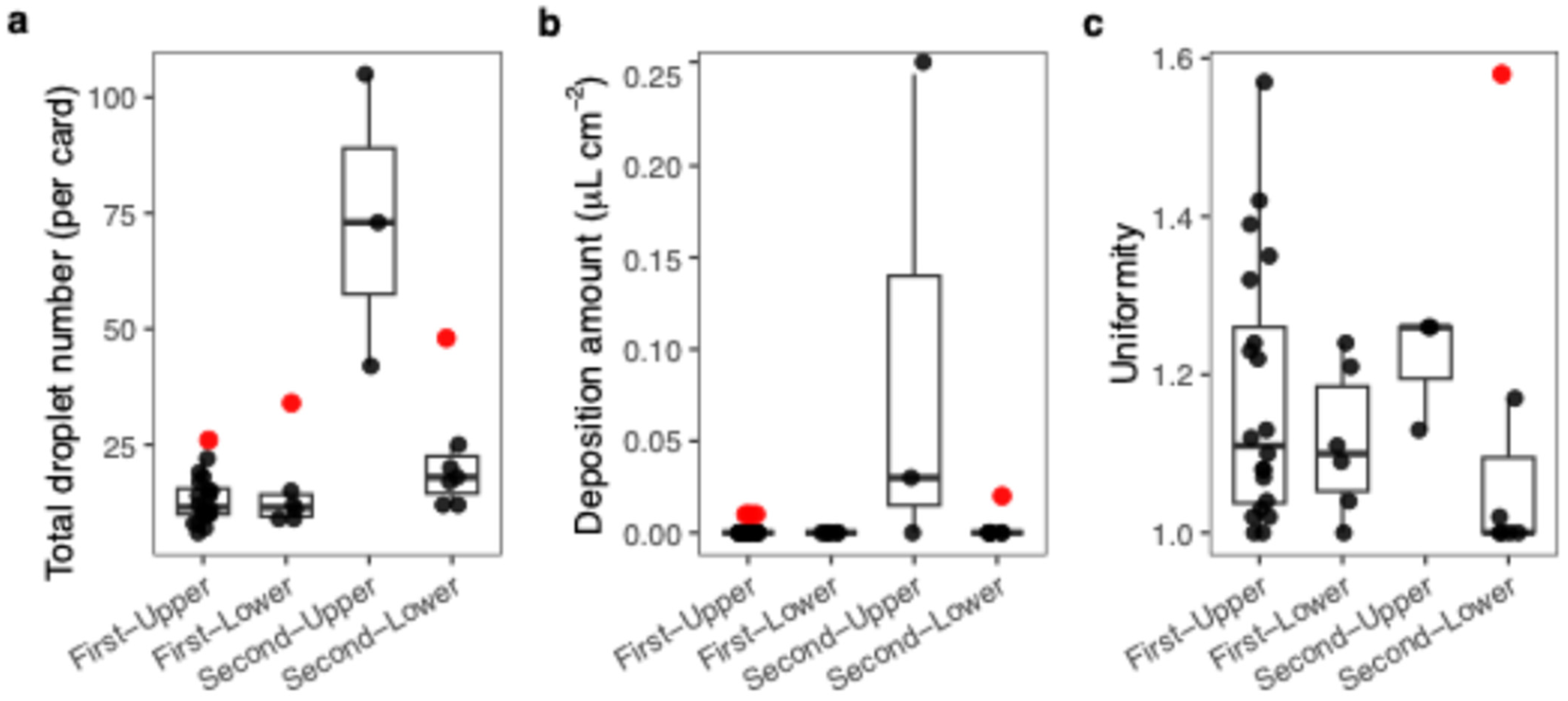
We first evaluated whether aerial spraying generated measurable droplet deposition in treated stands and whether deposition differed between spray rounds and vertical strata (Figure 1). Across all field cards, the mean total droplet number (Figure 1a) was 20.14 droplets per card, the mean deposition amount (Figure 1b) was 0.009 μL cm−2, and the mean uniformity index (Figure 1c) was 1.154. The second spray produced a higher mean droplet number than the first spray (37.20 ± 9.72 vs. 13.58 ± 1.23 droplets per card). Deposition amount was also numerically higher in the second spray, although with greater variability (0.030 ± 0.025 vs. 0.0012 ± 0.0006 μL cm−2). In contrast, deposition uniformity was similar between spray rounds (1.142 ± 0.059 vs. 1.158 ± 0.030).
Deposition patterns also differed between strata (Figure 1). In the first spray, upper- and lower-stratum cards did not differ significantly in total droplet number, deposition amount, or uniformity (all p > 0.45). In the second spray, upper-stratum cards had significantly higher total droplet number than lower-stratum cards (73.33 ± 18.19 vs. 21.71 ± 4.70 droplets per card; p < 0.001; Figure 1a). Deposition amount also differed significantly between strata in the second spray, with higher values in the upper stratum (0.093 ± 0.079 vs. 0.003 ± 0.003 μL cm−2; p = 0.0005; Figure 1b), whereas uniformity remained similar between strata (p = 0.35; Figure 1c).
Analysis of the two-factor model indicated that total droplet number was significantly affected by spray round (F1,32 = 31.59, p < 0.001), stratum (F1,32 = 4.49, p = 0.042), and their interaction (F1,32 = 14.90, p < 0.001). Deposition amount showed the same pattern, with significant effects of spray round (F1,32 = 9.26, p = 0.0047), stratum (F1,32 = 5.03, p = 0.032), and the spray round × stratum interaction (F1,32 = 9.84, p = 0.0036). By contrast, uniformity was not significantly affected by spray round (F1,32 = 0.067, p = 0.798), stratum (F1,32 = 1.32, p = 0.259), or their interaction (F1,32 = 0.137, p = 0.714). In summary, vertical differences between upper and lower strata were stronger in the second spray than in the first for total droplet number and deposition amount, but not for uniformity.

3.2. Thiacloprid Caused Strong Acute Mortality

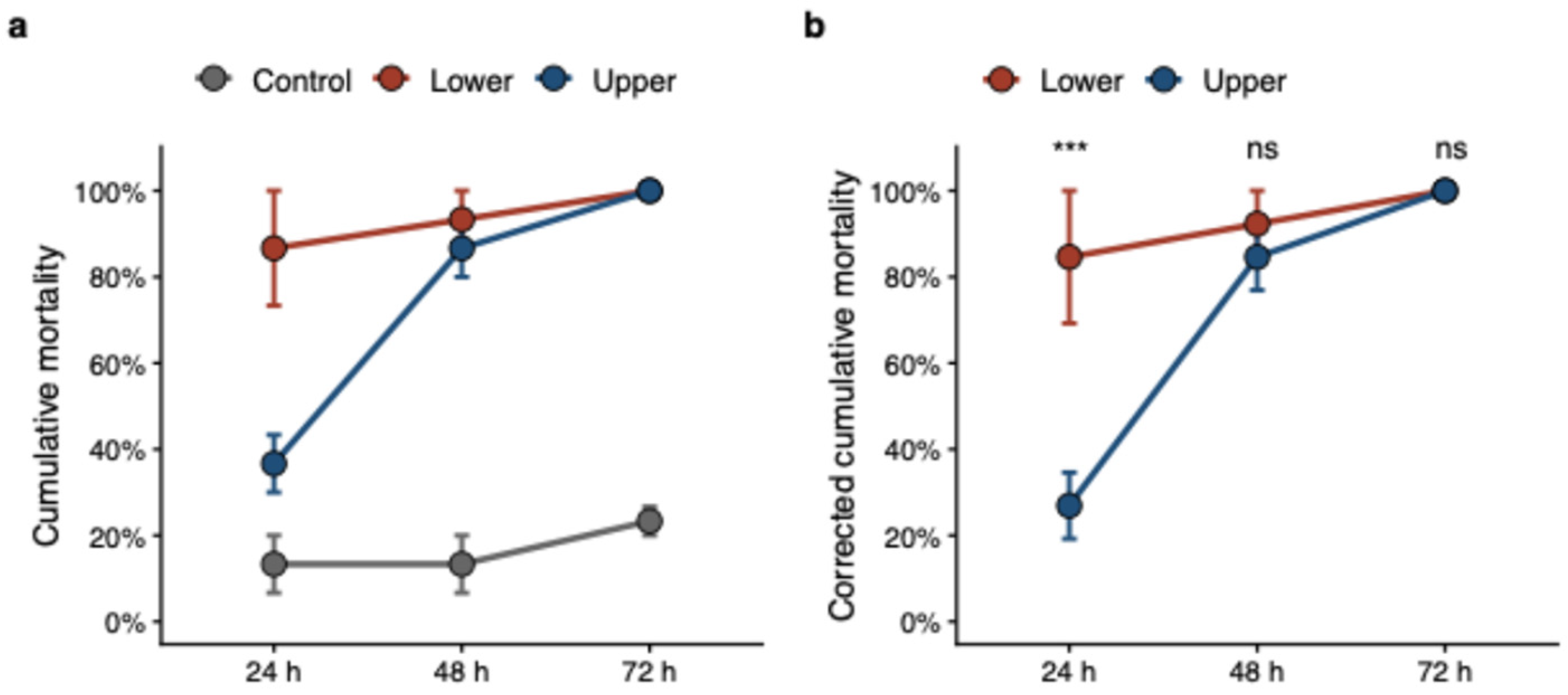
We tested whether spray deposition translated into short-term toxicity in adult M. alternatus using branches collected from the upper and lower strata immediately after aerial spraying (Figure 2). Mortality increased rapidly in both treatments, but mortality was faster in the lower stratum during the first 24 h (Figure 2a). Mean cumulative mortality in the lower stratum reached 86.7 ± 13.3% at 24 h, 93.3 ± 6.7% at 48 h, and 100% at 72 h, whereas the corresponding values in the upper stratum were 36.7 ± 6.7%, 86.7 ± 6.7%, and 100%, respectively. Control mortality remained low throughout the assay, with mean cumulative mortality of 13.3 ± 6.7% at 24 h and 48 h and 23.3 ± 3.3% at 72 h.
The same pattern was evident after Abbott correction (Figure 2b). Branches collected from the lower stratum produced a faster initial toxic effect, but both strata achieved complete mortality within 72 h. Specifically, mean corrected cumulative mortality in the lower stratum reached 84.6 ± 15.4% at 24 h, 92.3 ± 7.7% at 48 h, and 100% at 72 h, whereas the corresponding values in the upper stratum were 26.9 ± 7.7%, 84.6 ± 7.7%, and 100%. The difference between strata was significant at 24 h (Fisher’s exact test, p < 0.001), but not at 48 h (p = 0.671) or 72 h (p = 1.000).

3.3. Residual Efficacy Declined Sharply Within One Month

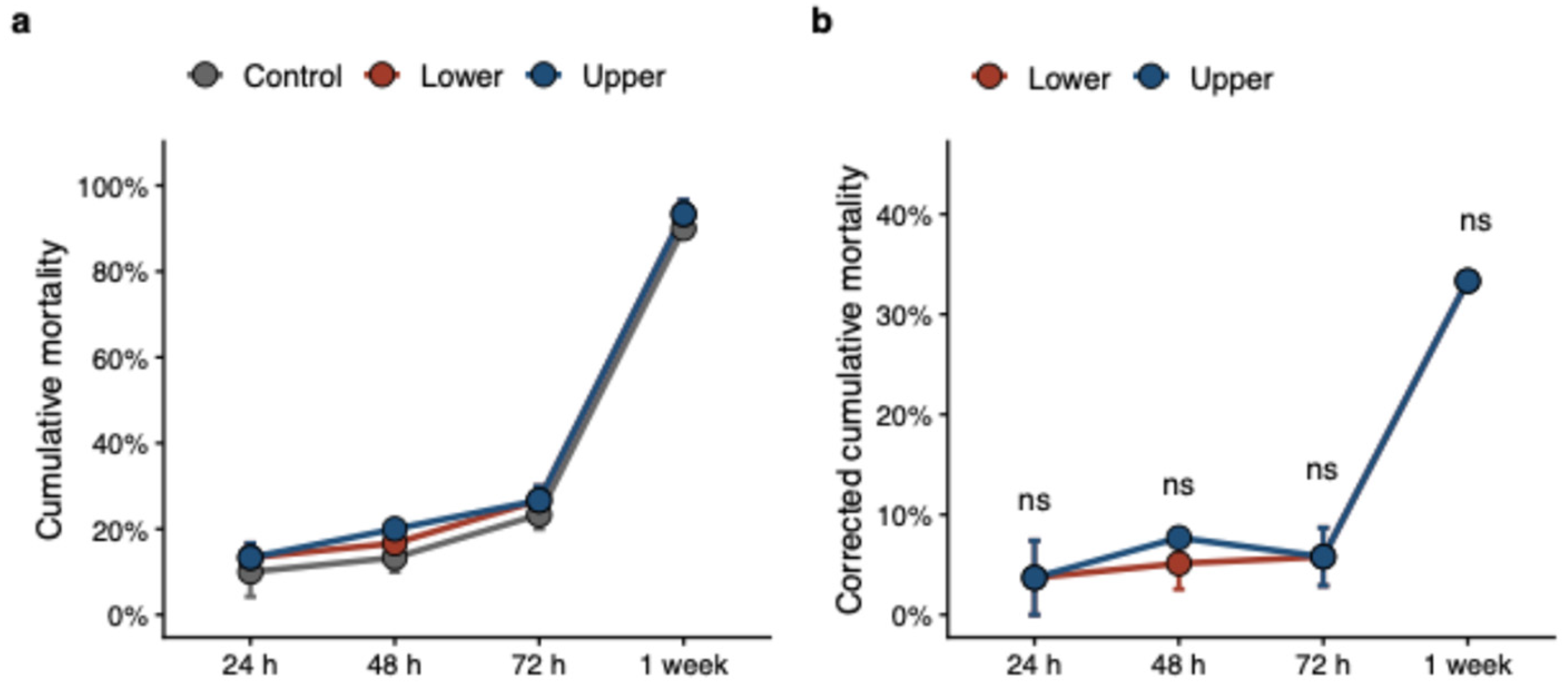
We evaluated whether branches collected one month after aerial spraying retained insecticidal activity against adult M. alternatus (Figure 3). Residual efficacy was low in both strata throughout most of the assay (Figure 3a). Mean cumulative mortality remained low at 24–72 h in both treatments, ranging from 13.3 to 26.7% in raw mortality. Control mortality over the same period ranged from 10.0 to 23.3%, indicating that treated branches produced little additional mortality above background levels.
The same pattern was evident after Abbott correction (Figure 3b). The strong acute toxicity observed immediately after spraying had largely disappeared within one month. Mean corrected cumulative mortality in the lower stratum was 3.7 ± 3.7% at 24 h, 5.1 ± 2.6% at 48 h, and 5.8 ± 2.9% at 72 h, whereas the corresponding values in the upper stratum were 3.7 ± 3.7%, 7.7% ± 0.0%, and 5.8 ± 2.9%, respectively. At one week, corrected cumulative mortality reached 33.3% in both strata. No significant differences were detected between upper and lower strata at any observation time (all p = 1.000).

3.4. Field Trapping Showed Rapid Short-Term Suppression but a Subsequent Rebound of Monochamus alternatus

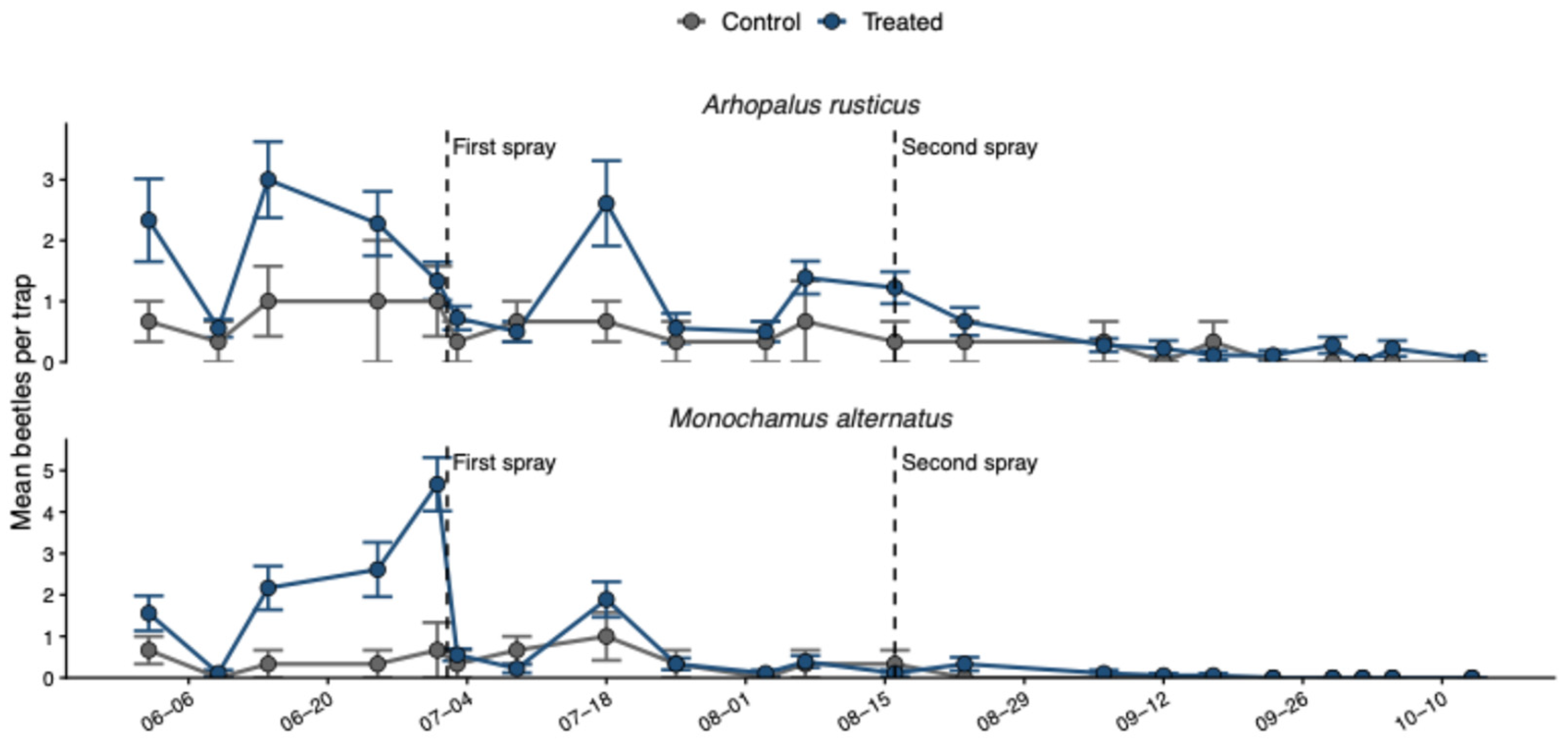
Field capture patterns were compared with the short-term toxicity and rapid loss of residual efficacy observed in the laboratory bioassays (Figure 4; Table 1). In the treated area, M. alternatus captures increased through late June and reached 4.67 adults per trap on 1 July, immediately before the first spray. By 9 July, captures had dropped to 0.22 adults per trap, representing a 95.2% reduction in trap catch relative to the immediately pre-spray sample. However, captures rebounded to 1.89 adults per trap by 18 July, corresponding to an 8.5-fold increase relative to 9 July. Thereafter, captures remained comparatively low through August and approached zero later in the season. In the control area, M. alternatus captures remained low throughout the monitoring period and did not show an equally abrupt post-spray decline. A phase-based negative binomial mixed model detected significant overall effects of area (χ2 = 4.75, df = 1, p = 0.029) and phase (χ2 = 173.53, df = 4, p < 0.001), whereas the area × phase interaction was not significant (χ2 = 7.59, df = 4, p = 0.108). Thus, captures differed overall between treated and control areas and varied strongly among seasonal phases, but the short-term post-spray reduction in captures did not translate into a statistically detectable phase-specific treatment effect. Model-based phase estimates further indicated that M. alternatus abundance was significantly higher in the treated area than in the control area before the first spray (estimated mean 2.00 vs. 0.34 adults per trap; control/treated ratio = 0.17, p = 0.003), whereas contrasts among later phases were not significant after Holm adjustment.
A partially similar but not identical pattern was observed for the co-occurring cerambycid A. rusticus (Figure 4; Table 1). In the treated area, A. rusticus activity peaked earlier than that of M. alternatus, with captures already high in mid-June. Following the first spray, mean captures declined from 1.50 adults per trap on 1 July to 0.50 adults per trap on 9 July, but rebounded to 2.61 adults per trap by 18 July and then declined gradually toward the end of the season. The negative binomial model likewise detected significant overall effects of area (χ2 = 4.70, df = 1, p = 0.030) and phase (χ2 = 140.25, df = 4, p < 0.001), but not their interaction (χ2 = 1.53, df = 4, p = 0.821). Phase-specific contrasts for A. rusticus were not significant after Holm adjustment (all p ≥ 0.063).

3.5. Integrated Phase-Based Modeling Summarized Species-Specific Field Responses to Aerial Spraying

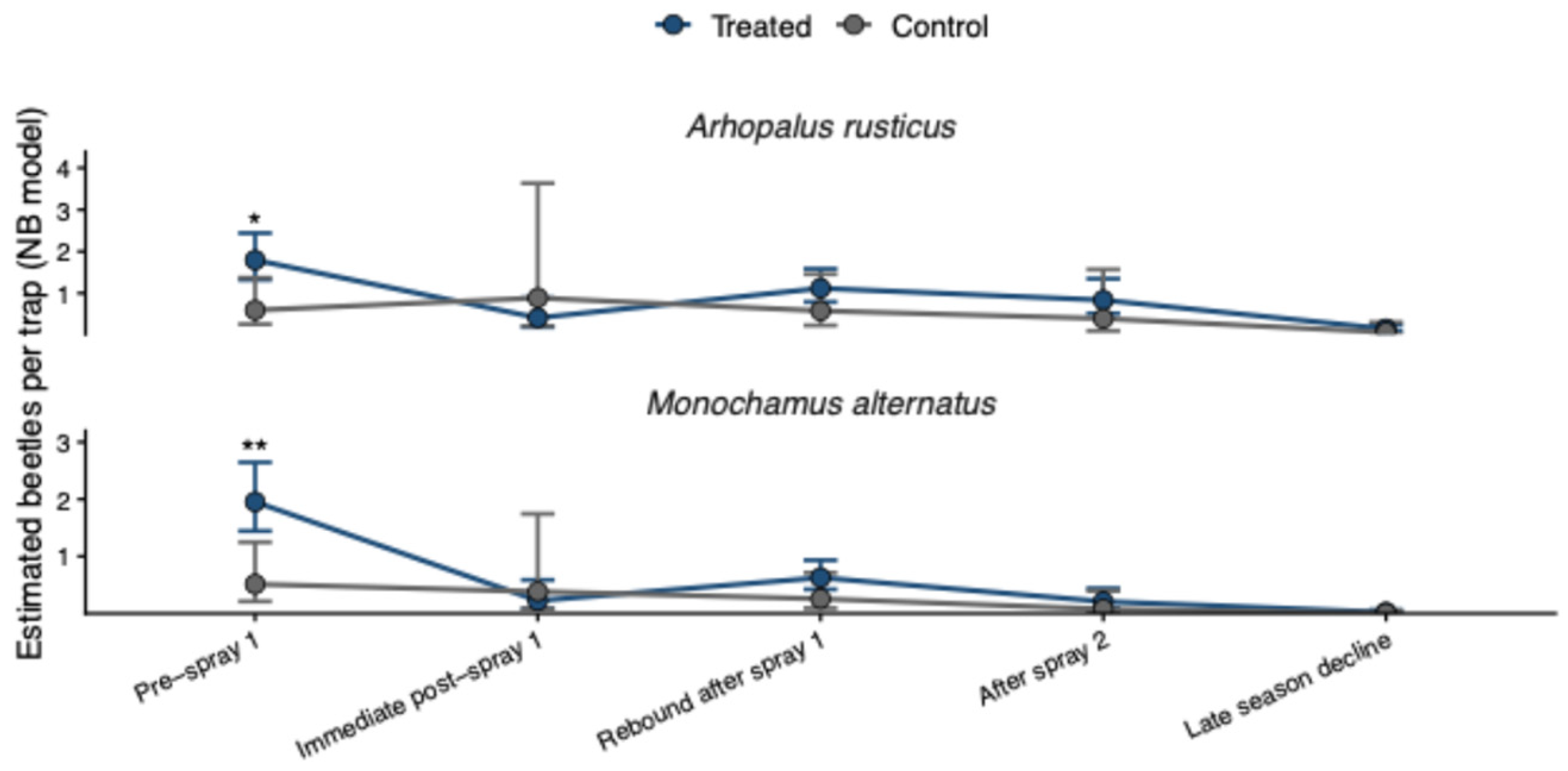
An integrated negative binomial mixed model was used to summarize field responses across both beetle species, treatment areas, and seasonal phases (Figure 5). The final model retained all two-way interactions but not the three-way interaction, indicating that temporal responses differed between species and between treated and control areas, whereas the phase-dependent treatment effect did not differ strongly between species. Relative to the pre-spray 1 phase in treated M. alternatus, capture rates declined significantly in the immediate post-spray 1, rebound after spray 1, after spray 2, and late-season phases (all p < 0.001). Although the two species did not differ significantly in pre-spray treated abundance (species main effect: z = −0.39, p = 0.697), A. rusticus showed relatively higher capture rates than M. alternatus during the rebound phase after the first spray (z = 2.52, p = 0.012), after the second spray (z = 3.31, p < 0.001), and during the late-season decline (z = 3.40, p < 0.001). The area × phase interaction was significant only for the immediate post-spray 1 phase (z = 2.52, p = 0.012), indicating that the treated-versus-control difference changed most strongly immediately after the first spray.

4. Discussion

Our results indicate that the main limitation of the 2022 aerial spray program was not insufficient insecticidal potency, but a mismatch between a short-lived toxic window and the longer seasonal activity window of adult beetles. Droplet monitoring confirmed that insecticide reached treated stands and produced spatially structured deposition, with stronger vertical stratification during the second spray than during the first. This exposure resulted in strong acute toxicity in branch-feeding bioassays: branches collected immediately after spraying caused rapid mortality in M. alternatus, with both strata reaching 100% mortality within 72 h, although mortality increased faster in the lower stratum during the first 24 h. By contrast, the same bioassay one month later showed that this effect had largely disappeared, with corrected mortality remaining near background levels and no detectable stratum difference. Field trapping was consistent with this short-lived control window: M. alternatus captures declined sharply after the first spray but rebounded soon afterward, while A. rusticus showed a partially different seasonal trajectory. Overall, operational efficacy in this system depended less on immediate toxic potency than on temporal overlap between insecticidal persistence and adult beetle activity, highlighting a broader limitation of short-persistence insecticides in seasonally extended vector systems.
The deposition and acute-bioassay results indicate that the spray operation generated biologically meaningful exposure in the stand, rather than merely leaving detectable droplets on monitoring cards. In forest aerial spraying, canopy structure commonly creates vertical heterogeneity in droplet interception and penetration, so differences between upper and lower strata are expected under operational conditions [31]. Our deposition data matched this pattern, especially in the second application. However, branches from both sampled strata still resulted in complete mortality within 72 h, indicating that insecticide delivery in both the lower and upper/open positions exceeded the threshold for strong acute toxicity. Deposition metrics describe physical delivery, whereas insect mortality reflects realized exposure after contact and feeding [33,34,35]. The faster early mortality in the lower stratum therefore suggests that vertical differences influenced the rate at which toxic exposure was expressed, rather than the ultimate capacity of the treatment to cause lethal effects. Insecticidal performance on plant surfaces depends not only on the amount deposited, but also on how residues are retained, redistributed, and remain biologically available under local microenvironmental conditions such as light, temperature, and moisture [36,37,38]. Taken together, these results indicate that spray deposition across strata was sufficient for acute lethality, even though vertical variation may have shaped how quickly intoxication developed. Operationally, this suggests that improving spray penetration may influence the speed of initial knockdown, but not necessarily the ultimate magnitude of acute control when deposition is already sufficient across strata.
The main constraint, however, was not weak acute toxicity but the rapid loss of residual efficacy after application. One month after spraying, treated branches caused little additional mortality above background levels, indicating that biologically effective exposure was short-lived under field conditions. For aerial forest protection, successful suppression depends not only on immediate lethality but also on whether active residues persist long enough to maintain toxic pressure after application [15,39,40]. In our system, the spray therefore appears to have functioned as a brief toxic pulse: it produced strong mortality soon after treatment, but did not provide sustained biologically active residues across the following weeks. Once residues declined below an effective threshold, beetles active later in the season would have encountered much weaker toxic pressure, reducing the capacity of the treatment to extend suppression beyond the immediate post-spray period [41,42,43].
Field rebound is thus better interpreted as a problem of temporal mismatch than as simple treatment failure. The first spray was applied after M. alternatus activity had already increased, so it intersected an ongoing population process rather than preventing it from developing. The sharp decline by 9 July shows that the treatment achieved real short-term suppression, whereas the rebound by 18 July indicates that this suppression did not extend across the full period of adult activity and supplementary feeding [39]. At the field scale, the outcome was therefore determined less by whether the spray could kill beetles immediately than by how closely the insecticidal window overlapped with the seasonal activity window of the population [44,45]. The second spray, by contrast, was applied when captures were already much lower, so the opportunity for additional suppression was correspondingly reduced. More broadly, these results suggest that the key limitation was not failure of acute toxicity, but the lack of temporal alignment between a short-lived control window and a longer period of beetle emergence, feeding, and movement.
The response of A. rusticus provides a useful comparison with the principal target species, although not a full assemblage-level test. Although A. rusticus showed the same broad pattern of short-term suppression after spraying, its seasonal trajectory differed from that of M. alternatus: activity peaked earlier and remained relatively higher later in the season. The integrated model did not support a strong species-specific treatment-by-phase interaction, indicating that the immediate suppressive effect of spraying was not unique to M. alternatus. At the same time, captures varied between species across phases, showing that the two cerambycids followed different seasonal schedules. Aerial spraying in this system therefore acted not on a single target clock but on a temporally structured assemblage of co-occurring beetles whose activity windows only partly overlapped. Spray timing should therefore be evaluated not only against M. alternatus phenology, but also against the broader beetle assemblage in the pine wilt–affected stand. Ecologically, these co-occurring cerambycids represent a phenologically structured assemblage, so a single spray event may function as a shared timed disturbance while producing species-specific exposure depending on when each species is active [24,26]. Our results support the classic ecological hypothesis that phenology structures species-specific exposure to the same disturbance by determining when individuals are active and exposed [46,47]. In our system, partial phenological separation meant that the same short control pulse intersected different portions of the seasonal activity schedules of the two cerambycids, rather than imposing equivalent exposure on both species [24,27].

5. Conclusions

In this pine wilt system, aerial spraying functioned as a short control window superimposed on a longer period of adult beetle activity, illustrating a timing problem that may also occur in other vector-borne forest disease systems managed through aerial insecticide applications. The practical consequence was that strong early suppression did not automatically translate into sustained field control. What mattered was not rapid knockdown alone, but whether biologically effective exposure persisted long enough to cover the relevant seasonal period of adult emergence, feeding, and movement, as evaluated here by integrating deposition measurements, acute and residual branch bioassays, and field trapping. The partially divergent seasonal responses of M. alternatus and A. rusticus further showed that aerial spraying targeted a phenologically structured cerambycid assemblage rather than a single target species, highlighting the need to consider co-occurring beetle phenology when designing and evaluating aerial spray programs. Because this study was limited to a single operational spray program in one year, and residue decline was inferred from bioassay performance rather than measured directly, future evaluations should combine field residue measurements, trap-based phenology, and comparisons among formulations with different residual properties. Under these conditions, improving control will depend on aligning spray timing and formulation persistence with local seasonal activity dynamics rather than relying solely on short-term toxicity.

Author Contributions

Conceptualization, H.Z. and B.Z.; methodology, Y.L. (Yu Liu), Y.L. (Yanzhuo Liu), H.Z. and B.Z.; formal analysis, Y.L. (Yanzhuo Liu); investigation, Y.L. (Yu Liu), Q.M., H.Z. and B.Z.; data curation, Y.L. (Yu Liu) and Y.L. (Yanzhuo Liu); visualization, Y.L. (Yanzhuo Liu); writing—original draft preparation, Y.L. (Yanzhuo Liu); writing—review and editing, Y.L. (Yu Liu), Y.L. (Yanzhuo Liu) and B.Z. All authors have read and agreed to the published version of the manuscript.

Funding

This research was funded by the 2022 Procurement Project for Aerial Pesticide Application to Control Monochamus alternatus in Chengyang District, Qingdao City (6602422344) and China Scholarship Council (202208370089).

Data Availability Statement

The data presented in this study are available upon request from the corresponding authors.

Acknowledgments

We would like to thank Hancheng Ma, Zhikun Pan and Jiaxuan Zhang for providing experimental assistance.

Conflicts of Interest

The authors declare no conflicts of interest.

References

  1. Boyd, I.L.; Freer-Smith, P.H.; Gilligan, C.A.; Godfray, H.C.J. The Consequence of Tree Pests and Diseases for Ecosystem Services. Science 2013, 342, 1235773. [Google Scholar] [CrossRef]
  2. Freer-Smith, P.H.; Webber, J.F. Tree pests and diseases: The threat to biodiversity and the delivery of ecosystem services. Biodivers. Conserv. 2017, 26, 3167–3181. [Google Scholar] [CrossRef]
  3. Dudney, J.; Edwards, J.; Harvey, B.J.; Seidl, R. Climate Change Effects on Interacting Disturbances in Forest Ecosystems. Annu. Rev. Ecol. Evol. Syst. 2025, 56, 393–420. [Google Scholar] [CrossRef]
  4. Wielkopolan, B.; Jakubowska, M.; Obrępalska-Stęplowska, A. Beetles as Plant Pathogen Vectors. Front. Plant Sci. 2021, 12, 748093. [Google Scholar] [CrossRef] [PubMed]
  5. Back, M.A.; Bonifácio, L.; Inácio, M.L.; Mota, M.; Boa, E. Pine Wilt Disease: A Global Threat to Forestry. Plant Pathol. 2024, 73, 1026–1041. [Google Scholar] [CrossRef]
  6. Daugherty, M.P.; Almeida, R.P.P. Understanding How an Invasive Vector Drives Pierce’s Disease Epidemics: Seasonality and Vine-to-Vine Spread. Phytopathology 2019, 109, 277–285. [Google Scholar] [CrossRef]
  7. Chandi, R.S. Integrated Management of Insect Vectors of Plant Pathogens. Agric. Rev. 2021, 42, 87–92. [Google Scholar] [CrossRef]
  8. Jung, J.-M.; Yoon, S.; Hwang, J.; Park, Y.; Lee, W.-H. Analysis of the Spread Distance of Pine Wilt Disease Based on a High Volume of Spatiotemporal Data Recording of Infected Trees. For. Ecol. Manag. 2024, 553, 121612. [Google Scholar] [CrossRef]
  9. Chu, X.; Ma, Q.; Yang, M.; Li, G.; Liu, J.; Liang, G.; Wu, S.; Wang, R.; Zhang, F.; Hu, X. Diversity and Distribution of Xylophagous Beetles from Pinus thunbergii Parl. and Pinus massoniana Lamb. Infected by Pine Wood Nematode. Forests 2021, 12, 1549. [Google Scholar] [CrossRef]
  10. Ji, Y.; Song, C.; Chen, L.; Zheng, X.; Jia, C.; Liu, Y. Interspecific Relationship Between Monochamus alternatus Hope and Arhopalus rusticus (L.) in Pinus thunbergii Affected by Pine Wilt Disease. Forests 2024, 15, 2037. [Google Scholar] [CrossRef]
  11. Wu, S.; Wu, J.; Wang, Y.; Qu, Y.; He, Y.; Wang, J.; Cheng, J.; Zhang, L.; Cheng, C. Discovery of entomopathogenic fungi across geographical regions in southern China on pine sawyer beetle Monochamus alternatusand implication for multi-pathogen vectoring potential of this beetle. Front. Plant Sci. 2022, 13, 1061520. [Google Scholar] [CrossRef]
  12. Zhao, H.; Xian, X.; Yang, N.; Guo, J.; Zhao, L.; Shi, J.; Liu, W. Risk Assessment Framework for Pine Wilt Disease: Estimating the Introduction Pathways and Multispecies Interactions among the Pine Wood Nematode, Its Insect Vectors, and Hosts in China. Sci. Total Environ. 2023, 905, 167075. [Google Scholar] [CrossRef]
  13. Maehara, N.; He, X.; Shimazu, M. Maturation Feeding and Transmission of Bursaphelenchus xylophilus (Nematoda: Parasitaphelenchidae) by Monochamus alternatus (Coleoptera: Cerambycidae) Inoculated with Beauveria bassiana (Deuteromycotina: Hyphomycetes). J. Econ. Entomol. 2007, 100, 49–53. [Google Scholar] [CrossRef] [PubMed]
  14. Akbulut, S.; Stamps, W.T. Insect vectors of the pinewood nematode: A review of the biology and ecology of Monochamus species. For. Pathol. 2012, 42, 89–99. [Google Scholar] [CrossRef]
  15. Jung, J.K.; Lee, U.G.; Cha, D.; Kim, D.S.; Jung, C. Can Insecticide Applications Used to Kill Vector Insects Prevent Pine Wilt Disease? Pest Manag. Sci. 2021, 77, 4923–4929. [Google Scholar] [CrossRef]
  16. Gu, D.; Liu, T.; Chen, Z.; Yuan, Y.; Yu, L.; Han, S.; Li, Y.; Cheng, X.; Liang, Y.; Wang, L.; et al. Research Progress in Chemical Control of Pine Wilt Disease. Forests 2026, 17, 137. [Google Scholar] [CrossRef]
  17. Mamiya, Y. History of Pine Wilt Disease in Japan. J. Nematol. 1988, 20, 219–226. [Google Scholar] [CrossRef]
  18. Yao, W.; Guo, S.; Wang, J.; Chen, C.; Yu, F.; Li, X.; Xu, T.; Lan, Y. Droplet Deposition and Pest Control Efficacy on Pine Trees from Aerial Application. Pest Manag. Sci. 2022, 78, 3324–3336. [Google Scholar] [CrossRef] [PubMed]
  19. Leroy, B.M.L. Global Insights on Insecticide Use in Forest Systems: Current Use, Impacts and Perspectives in a Changing World. Curr. For. Rep. 2024, 11, 6. [Google Scholar] [CrossRef]
  20. Toshiya, I.; Nobuo, E.; Akiomi, Y.; Katsuo, O.; Takaaki, T. Attractants for the Japanese Pine Sawyer, Monochamus alternatus Hope (Coleoptera: Cerambycidae). Appl. Entomol. Zool. 1980, 15, 358–361. [Google Scholar] [CrossRef]
  21. EPPO. Monochamus alternatus. EPPO Datasheets on Pests Recommended for Regulation. 2026. Available online: https://gd.eppo.int (accessed on 1 April 2026).
  22. Suh, D.Y.; Jung, J.K.; Lee, S.K.; Seo, S.T. Effect of Aerial Spraying of Thiacloprid on Pine Sawyer Beetles (Monochamus alternatus) and Honey Bees (Apis mellifera) in Pine Forests. Entomol. Res. 2021, 51, 83–89. [Google Scholar] [CrossRef]
  23. Stein, F.; Fischer, R.; Bräsicke, N. Replication Defines Reliability—A Meta-Analysis of Aerial Insecticide Effects on Forest Arthropods. For. Ecol. Manag. 2025, 597, 123169. [Google Scholar] [CrossRef]
  24. Hanks, L.M.; Reagel, P.F.; Mitchell, R.F.; Wong, J.C.; Meier, L.R.; Silliman, C.A.; Graham, E.E.; Striman, B.L.; Robinson, K.P.; Mongold-Diers, J.A.; et al. Seasonal phenology of the cerambycid beetles of east-central Illinois. Ann. Entomol. Soc. Am. 2014, 107, 211–226. [Google Scholar] [CrossRef]
  25. Handley, K.; Hough-Goldstein, J.; Hanks, L.M.; Millar, J.G.; D’Amico, V. Species Richness and Phenology of Cerambycid Beetles in Urban Forest Fragments of Northern Delaware. Ann. Entomol. Soc. Am. 2015, 108, 251–262. [Google Scholar] [CrossRef]
  26. Wang, Y.; Chen, F.; Wang, L.; Li, M. Investigation of Beetle Species That Carry the Pine Wood Nematode, Bursaphelenchus xylophilus (Steiner and Buhrer) Nickle, in China. J. For. Res. 2021, 32, 1745–1751. [Google Scholar] [CrossRef]
  27. Mitchell, R.F.; Reagel, P.F.; Wong, J.C.; Meier, L.R.; Silva, W.D.; Mongold-Diers, J.; Hanks, L.M. Cerambycid Beetle Species with Similar Pheromones Are Segregated by Phenology and Minor Pheromone Components. J. Chem. Ecol. 2015, 41, 431–440. [Google Scholar] [CrossRef] [PubMed]
  28. Burton, P.J.; Jentsch, A.; Walker, L.R. The Ecology of Disturbance Interactions. BioScience 2020, 70, 854–870. [Google Scholar] [CrossRef]
  29. Cleland, E.E.; Wolkovich, E. Effects of Phenology on Plant Community Assembly and Structure. Annu. Rev. Ecol. Evol. Syst. 2024, 55, 471–492. [Google Scholar] [CrossRef]
  30. Teske, M.E.; Thistle, H.W.; Schou, W.C.; Miller, P.C.H.; Strager, J.M.; Richardson, B.; Butler Ellis, M.C.; Barry, J.W.; Twardus, D.B.; Thompson, D.G. A Review of Computer Models for Pesticide Deposition Prediction. Trans. ASABE. 2011, 54, 789–801. [Google Scholar] [CrossRef]
  31. Thistle, H.W.; Reardon, R.C.; Bonds, J.A.; Fritz, B.L.; Hoffmann, W.C.; Kees, G.J.; Grob, I.J.; Hewitt, A.J.; O’Donnell, C.J.; Felton, K.; et al. Aerially Released Spray Penetration in a Tall Coniferous Forest Canopy. Trans. ASABE. 2016, 59, 1231–1239. [Google Scholar] [CrossRef]
  32. Abbott, W.S. A Method of Computing the Effectiveness of an Insecticide. J. Econ. Entomol. 1925, 18, 265–267. [Google Scholar] [CrossRef]
  33. Cooke, B.J.; Régnière, J. Predictability and Measurability of Bacillus thuringiensis Efficacy against Spruce Budworm (Lepidoptera: Tortricidae). Environ. Entomol. 1999, 28, 711–721. [Google Scholar] [CrossRef]
  34. Van Frankenhuyzen, K.; Nystrom, C.; Dedes, J.; Seligy, V.L. Mortality, Feeding Inhibition, and Recovery of Spruce Budworm (Lepidoptera: Tortricidae) Larvae Following Aerial Application of a High-Potency Formulation of Bacillus thuringiensis subsp. kurstaki. Can. Entomol. 2000, 132, 505–518. [Google Scholar] [CrossRef]
  35. Fuentealba, A.; Pelletier-Beaulieu, É.; Dupont, A.; Hébert, C.; Berthiaume, R.; Bauce, É. Optimizing Bacillus thuringiensis (Btk) Aerial Spray Prescriptions in Mixed Balsam Fir-White Spruce Stands against the Eastern Spruce Budworm. Forests 2023, 14, 1289. [Google Scholar] [CrossRef]
  36. Wauchope, R.D.; Rojas, K.W.; Ahuja, L.R.; Ma, Q.; Malone, R.W.; Ma, L. Documenting the Pesticide Processes Module of the ARS RZWQM Agroecosystem Model. Pest Manag. Sci. 2004, 60, 222–239. [Google Scholar] [CrossRef]
  37. Lyons, S.M.; Hageman, K.J. Foliar Photodegradation in Pesticide Fate Modeling: Development and Evaluation of the Pesticide Dissipation from Agricultural Land (PeDAL) Model. Environ. Sci. Technol. 2021, 55, 4842–4850. [Google Scholar] [CrossRef]
  38. Kinross, A.D.; Hageman, K.J.; Luu, C. Investigating the Effects of Temperature, Relative Humidity, Leaf Collection Date, and Foliar Penetration on Leaf–Air Partitioning of Chlorpyrifos. Environ. Sci. Technol. 2022, 56, 13058–13065. [Google Scholar] [CrossRef]
  39. Li, H.M.; Shen, P.Y.; Fu, P.; Lin, M.S.; Moens, M. Characteristics of the Emergence of Monochamus alternatus, the Vector of Bursaphelenchus xylophilus (Nematoda: Aphelenchoididae), from Pinus thunbergii Logs in Nanjing, China, and of the Transmission of the Nematodes through Feeding Wounds. Nematology 2007, 9, 853–858. [Google Scholar] [CrossRef]
  40. Wagenhoff, E.; Blum, R.; Henke, L.; Delb, H. Aerial Spraying of NeemAzal®-T/S against the Forest Cockchafer (Melolontha hippocastani, Coleoptera: Scarabaeidae) in South-West Germany: The Effects of Two Field Trials Performed in 2007 and 2008 on Local Populations. J. Plant Dis. Prot. 2015, 122, 169–182. [Google Scholar] [CrossRef]
  41. Liess, M.; Pieters, B.J.; Duquesne, S. Long-Term Signal of Population Disturbance after Pulse Exposure to an Insecticide: Rapid Recovery of Abundance, Persistent Alteration of Structure. Environ. Toxicol. Chem. 2006, 25, 1326–1331. [Google Scholar] [CrossRef]
  42. Buckman, K.A.; Campbell, J.F.; Subramanyam, B. Tribolium castaneum (Coleoptera: Tenebrionidae) Associated with Rice Mills: Fumigation Efficacy and Population Rebound. J. Econ. Entomol. 2013, 106, 499–512. [Google Scholar] [CrossRef]
  43. Xi, N.; Li, Y.; Xia, X. A Review of Pesticide Phototransformation on the Leaf Surface: Models, Mechanism, and Influencing Factors. Chemosphere 2022, 308, 136260. [Google Scholar] [CrossRef]
  44. Fettig, C.J. Nantucket Pine Tip Moth Phenology and Timing of Insecticide Spray Applications in Seven Southeastern States; US Department of Agriculture, Forest Service, Southern Research Station: Asheville, NC, USA, 2000; Volume 18. [CrossRef]
  45. Herms, D.A. Using Degree-Days and Plant Phenology to Predict Pest Activity. IPM Midw. Landsc. 2004, 58, 49–59. Available online: https://pesticidecert.cfans.umn.edu/sites/pesticidecert.cfans.umn.edu/files/2022-06/049DegreeDays.pdf (accessed on 1 April 2026).
  46. Crawley, M.J. Timing of Disturbance and Coexistence in a Species-Rich Ruderal Plant Community. Ecology 2004, 85, 3277–3288. [Google Scholar] [CrossRef]
  47. Wolkovich, E.M.; Cleland, E.E. Phenological Niches and the Future of Invaded Ecosystems with Climate Change. AoB Plants 2014, 6, plu013. [Google Scholar] [CrossRef]
Figure 1. Spray deposition in the upper and lower strata during the first and second aerial applications of 40% thiacloprid suspension concentrate in Japanese black pine stands in Chengyang District, Qingdao, Shandong, China. Panels show (a) total droplet number per card, (b) deposition amount (μL cm−2), and (c) uniformity. Each point represents one water-sensitive paper card. Boxes indicate the interquartile range with the median shown by the horizontal line, and whiskers extend to 1.5 × IQR. Red points indicate outliers identified by the 1.5 × IQR rule. Upper and lower strata correspond to cards positioned at 4.0 m and 1.5 m above ground, respectively.
Forests 17 00685 g001
Figure 2. Acute toxicity of aerially applied thiacloprid to adult Monochamus alternatus in branch-feeding bioassays conducted immediately after spraying. (a) Raw cumulative mortality in the control, lower-stratum, and upper-stratum treatments at 24, 48, and 72 h. (b) Abbott-corrected cumulative mortality in the lower- and upper-stratum treatments. Points represent mean mortality, and error bars indicate SE. Asterisks denote significant differences between the lower and upper strata at a given time point based on Fisher’s exact tests (*** p < 0.001; ns, not significant).
Forests 17 00685 g002
Figure 3. Residual toxicity of aerially applied thiacloprid to adult Monochamus alternatus in branch-feeding bioassays conducted one month after spraying. (a) Raw cumulative mortality in the control, lower-stratum, and upper-stratum treatments at 24, 48, and 72 h and one week. (b) Abbott-corrected cumulative mortality in the lower- and upper-stratum treatments. Points represent mean mortality, and error bars indicate SE. No significant differences were detected between the lower and upper strata at any observation time (Fisher’s exact tests; all p > 0.05; ns, not significant).
Forests 17 00685 g003
Figure 4. Seasonal dynamics of trap captures for Monochamus alternatus and the co-occurring cerambycid Arhopalus rusticus in treated and untreated control areas during the 2022 aerial spray program in Chengyang District, Qingdao, Shandong, China. Points represent mean beetle captures per trap on each monitoring date, and error bars indicate SE. Dashed vertical lines indicate the dates of the first (2 July) and second (16 August) aerial applications of 40% thiacloprid suspension concentrate. The upper panel shows A. rusticus and the lower panel shows M. alternatus.
Forests 17 00685 g004
Figure 5. Phase-based negative binomial model estimates of beetle captures per trap for Monochamus alternatus and Arhopalus rusticus in treated and control areas. Points represent model-predicted mean captures per trap, and error bars indicate 95% confidence intervals. Seasonal phases were defined as Pre-spray 1, Immediate post-spray 1, Rebound after spray 1, After spray 2, and Late season decline. Asterisks indicate significant treated-versus-control contrasts within a phase after Holm adjustment (* p < 0.05, ** p < 0.01). Final integrated negative binomial mixed model fit: n = 840 trap-date observations, log-likelihood = −786.0, AIC = 1608.0, BIC = 1693.0.
Forests 17 00685 g005
Table 1. Phase-based negative binomial mixed-model estimates and treated-versus-control contrasts for Monochamus alternatus and Arhopalus rusticus. Species indicates the focal beetle species analyzed. Phase denotes the seasonal phase used in the negative binomial mixed models: Pre-spray 1, Immediate post-spray 1, Rebound after spray 1, After spray 2, and Late season decline. Control and Treated are model-predicted mean beetle captures per trap for the control and treated areas, respectively. Ratio is the control/treated contrast on the response scale; values < 1 indicate higher captures in the treated area, whereas values > 1 indicate higher captures in the control area. z is the Wald z statistic for the treated-versus-control contrast within each phase. p gives the Holm-adjusted p-value for that contrast. Models were fitted with trap identity as a random effect.
SpeciesPhaseControl (Estimated Mean per Trap)Treated (Estimated Mean per Trap)Control/Treated Ratiozp
Monochamus alternatusPre-spray 10.342.000.17−2.940.003
Immediate post-spray 10.580.193.071.010.312
Rebound after spray 10.360.600.60−0.780.433
After spray 20.140.190.73−0.270.790
Late season decline0.000.020.000.000.997
Arhopalus rusticusPre-spray 10.771.750.44−1.860.063
Immediate post-spray 10.620.451.380.340.733
Rebound after spray 10.451.160.39−1.720.085
After spray 20.310.860.36−1.220.221
Late season decline0.080.150.52−0.820.413
Disclaimer/Publisher’s Note: The statements, opinions and data contained in all publications are solely those of the individual author(s) and contributor(s) and not of MDPI and/or the editor(s). MDPI and/or the editor(s) disclaim responsibility for any injury to people or property resulting from any ideas, methods, instructions or products referred to in the content.