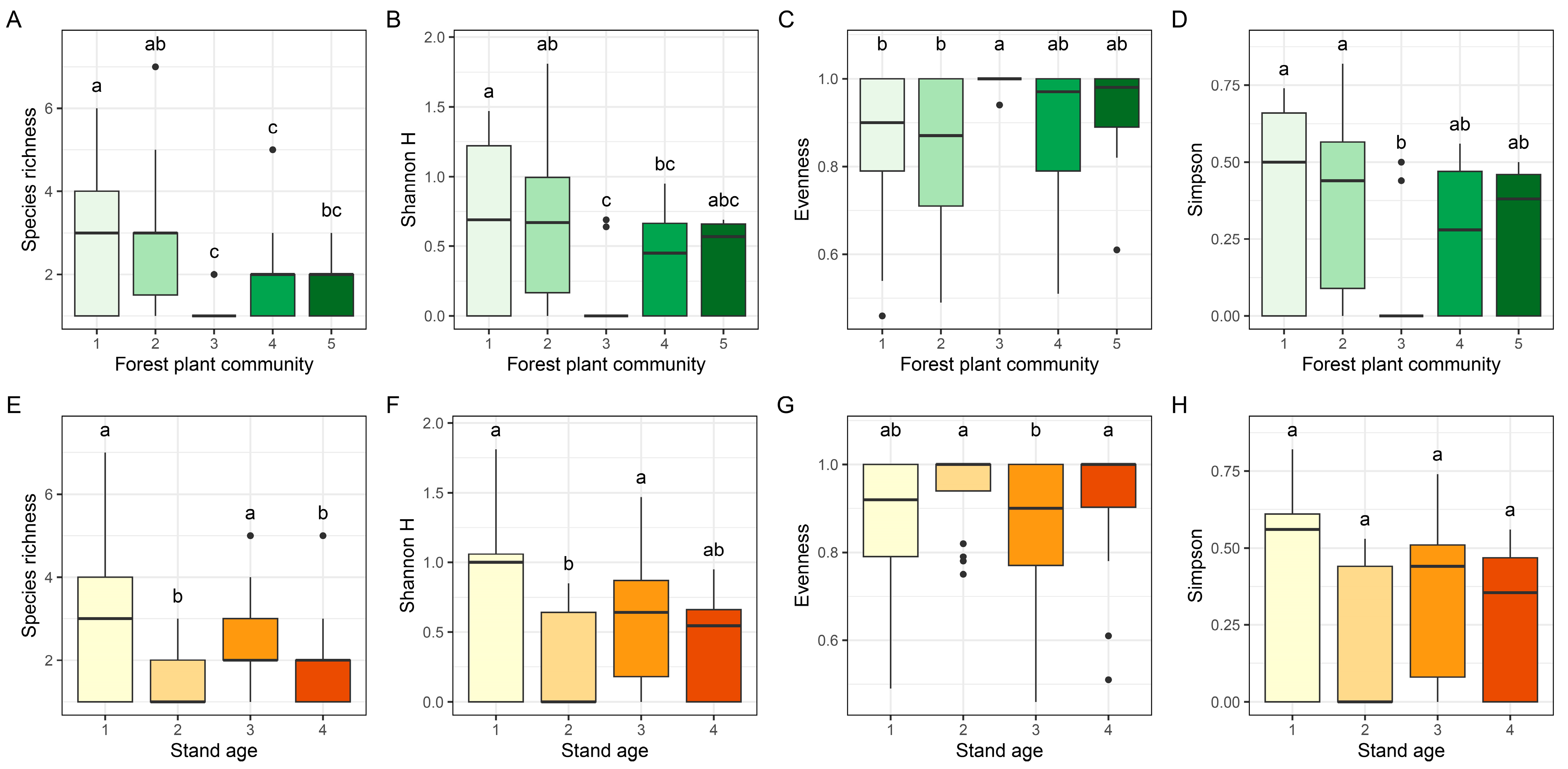
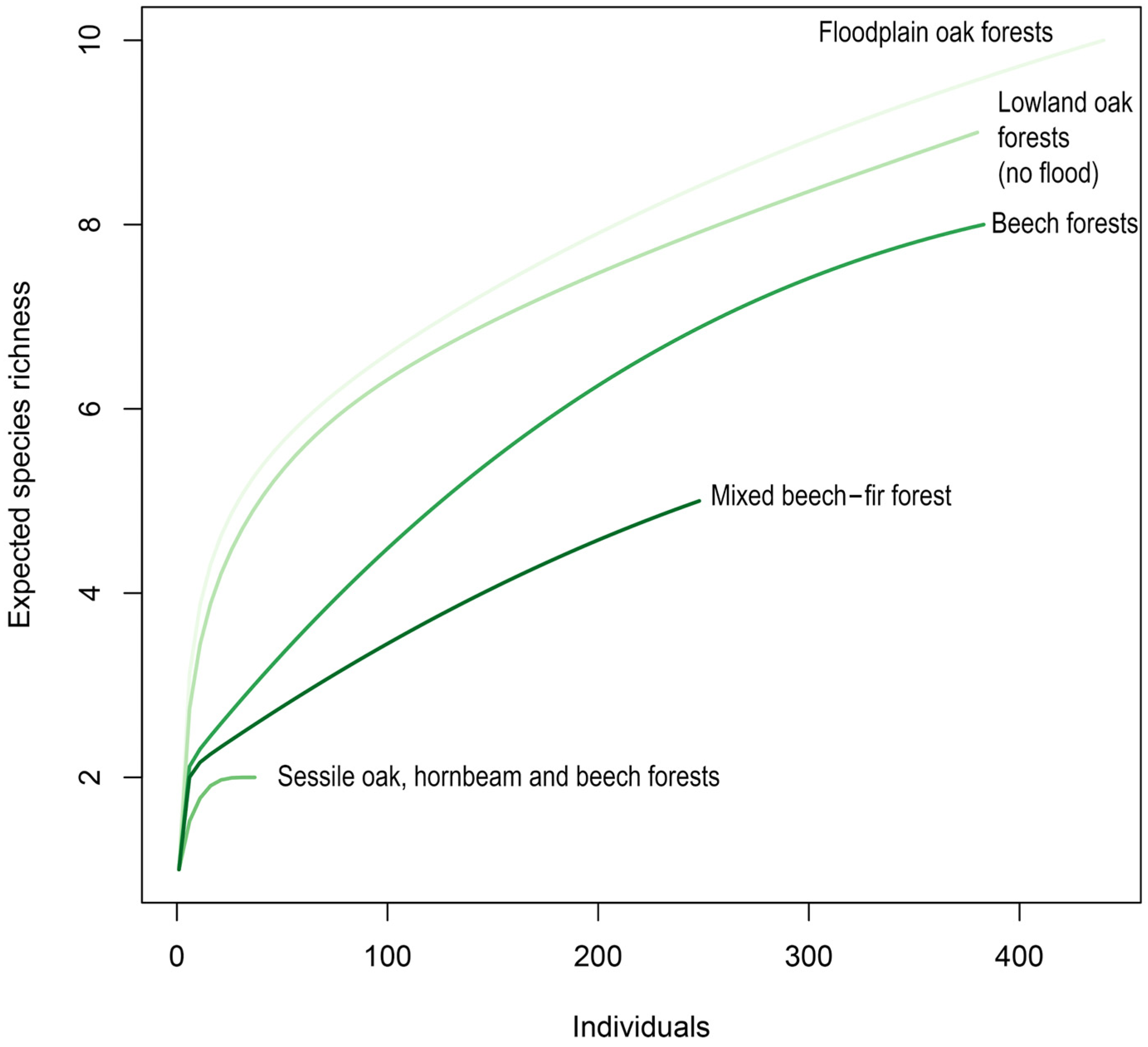
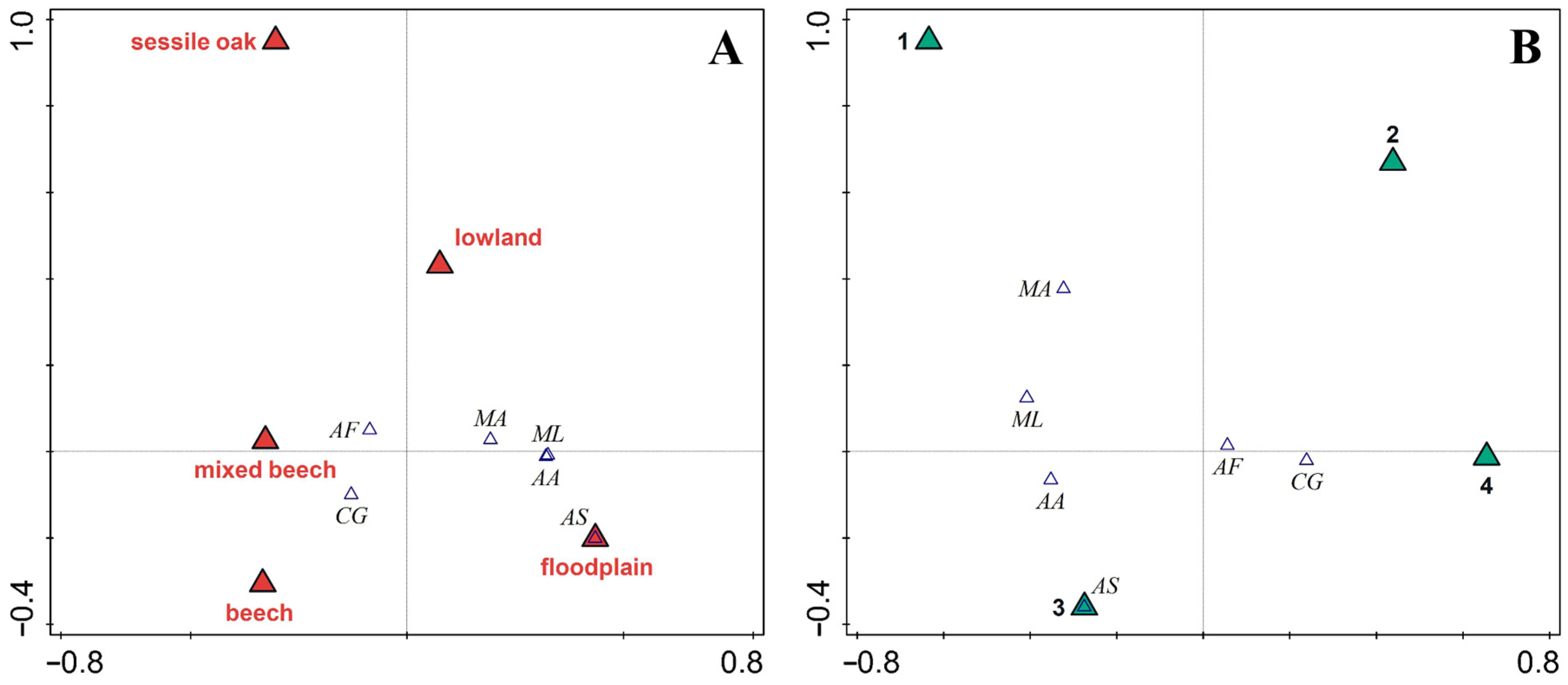
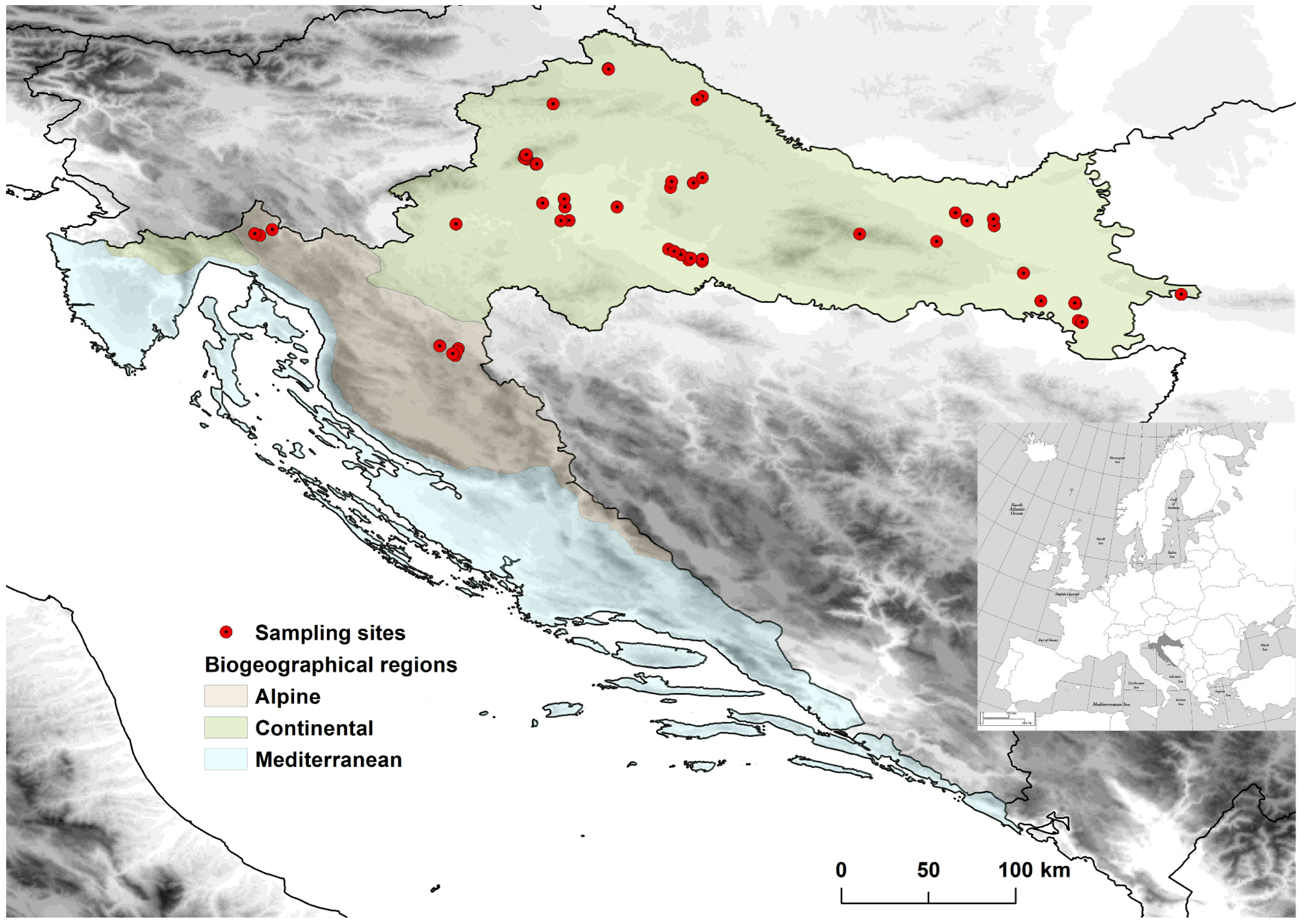
Impact of Forest Plant Communities and Stand Age on Small Mammal Diversity

 ,
,  , , ,
, , ,  and
and
Abstract
1. Introduction
2. Materials and Methods
3. Results
4. Discussion
5. Conclusions
Author Contributions
Funding
Institutional Review Board Statement
Data Availability Statement
Conflicts of Interest
References
- LaRue, E.A.; Knott, J.A.; Domke, G.M.; Chen, H.Y.; Guo, Q.; Hisano, M.; Oswalt, C.; Oswalt, S.; Kong, N.; Potter, K.M.; et al. Structural diversity as a reliable and novel predictor for ecosystem productivity. Front. Ecol. Environ. 2023, 21, 33–39. [Google Scholar] [CrossRef]
- McCarragher, S.; Rigg, L.S. Temperate forest ecosystems. In International Encyclopedia of Geography; Wiley Online Library: Hoboken, NJ, USA, 2016; pp. 1–14. [Google Scholar] [CrossRef]
- Čepelka, L.; Dokulilová, M. Ecological Roles and Forest Management Implications of Small Terrestrial Mammals in Temperate and Boreal Forests—A Review. Forests 2025, 16, 994. [Google Scholar] [CrossRef]
- Cano-Martínez, R.; Carricondo-Sanchez, D.; Devineau, O.; Odden, M. Small rodent cycles influence interactions among predators in a boreal forest ecosystem. Mammal. Res. 2021, 66, 583–593. [Google Scholar] [CrossRef]
- Moore, N.B.; Stephens, R.B.; Rowe, R.J. Nutritional and environmental factors influence small mammal seed selection in a northern temperate forest. Ecosphere 2022, 13, e4036. [Google Scholar] [CrossRef]
- Greiser, C.; Hederová, L.; Vico, G.; Wild, J.; Macek, M.; Kopecký, M. Higher soil moisture increases microclimate temperature buffering in temperate broadleaf forests. Agric. For. Meteorol. 2024, 345, 109828. [Google Scholar] [CrossRef]
- Suchomel, J.; Šipoš, J.; Košulič, O. Management intensity and forest successional stages as significant determinants of small mammal communities in a lowland floodplain forest. Forests 2020, 11, 1320. [Google Scholar] [CrossRef]
- Sullivan, T.P.; Sullivan, D.S. Influence of variable retention harvests on forest ecosystems. II. Diversity and population dynamics of small mammals. J. Appl. Ecol. 2001, 38, 1234–1252. [Google Scholar] [CrossRef]
- Schmid-Holmes, S.; Drickamer, L.C. Impact of forest patch characteristics on small mammal communities: A multivariate approach. Biol. Conserv. 2001, 99, 293–305. [Google Scholar] [CrossRef]
- Lindenmayer, D.B.; Cunningham, R.B.; Pope, M.L. A large-scale “experiment” to examine the effects of landscape context and habitat fragmentation on mammals. Biol. Conserv. 1999, 88, 387–403. [Google Scholar] [CrossRef]
- Pearson, D.E.; Ruggiero, L.F. Transect versus grid trapping arrangements for sampling small-mammal communities. Wildl. Soc. Bull. 2003, 31, 454–459. [Google Scholar] [CrossRef]
- Maser, C.; Trappe, J.M.; Nussbaum, R.A. Fungal-small mammal interrelationships with emphasis on Oregon coniferous forests. Ecology 1978, 59, 799–809. [Google Scholar] [CrossRef]
- Carey, A.B.; Johnson, M.L. Small mammals in managed, naturally young, and old-growth forests. Ecol. Appl. 1995, 5, 336–352. [Google Scholar] [CrossRef]
- Beese, W.J.; Deal, J.; Dunsworth, B.G.; Mitchell, S.J.; Philpott, T.J. Two decades of variable retention in British Columbia: A review of its implementation and effectiveness for biodiversity conservation. Ecol. Process. 2019, 8, 33. [Google Scholar] [CrossRef]
- Zwolak, R. A meta-analysis of the effects of wildfire, clearcutting, and partial harvesting on the abundance of North American small mammals. For. Ecol. Manag. 2009, 258, 539–545. [Google Scholar] [CrossRef]
- Vanroy, T.; Baeten, L.; Martel, A.; Catfolis, B.; Fonville, M.; Lens, L.; Pasmans, F.; Sprong, H.; Strubbe, D.; Verbrugghe, E.; et al. Influence of forest structural complexity on small mammal body condition and its impact on tick burden and pathogen prevalence. Parasites Vectors 2025, 18, 227. [Google Scholar] [CrossRef]
- Dri, G.F.; Bogdziewicz, M.; Hunter, M.; Witham, J.; Mortelliti, A. Coupled effects of forest growth and climate change on small mammal abundance and body weight: Results of a 39-year field study. J. Anim. Ecol. 2025, 94, 2118–2129. [Google Scholar] [CrossRef]
- Llanos-Guerrero, C.; Freixas-Mora, L.; Vilella, M.; Bartrina, C.; Torre, I. Seed Availability and Small Mammal Populations: Insights from Mediterranean Forests. Forests 2024, 15, 1148. [Google Scholar] [CrossRef]
- Bogdziewicz, M.; Zwolak, R.; Crone, E.E. How do vertebrates respond to mast seeding? Oikos 2016, 125, 300–307. [Google Scholar] [CrossRef]
- Bjedov, L.; Svoboda, P.; Tadin, A.; Habuš, J.; Štritof, Z.; Labaš, N.; Vucelja, M.; Markotić, A.; Turk, N.; Margaletić, J. Influence of beech mast on small rodent populations and hantavirus prevalence in Nacional Park „Plitvice lakes“ and Nature Park „Medvednica“. Šumarski List 2016, 140, 455–463. [Google Scholar] [CrossRef]
- Lebl, K.; Kürbisch, K.; Bieber, C.; Ruf, T. Energy or information? The role of seed availability for reproductive decisions in edible dormice. J. Comp. Physiol. B 2010, 180, 447–456. [Google Scholar] [CrossRef] [PubMed]
- Bähner, K.W.; Tabarelli, M.; Büdel, B.; Wirth, R. Habitat fragmentation and forest management alter woody plant communities in a Central European beech forest landscape. Biodivers. Conserv. 2020, 29, 2729–2747. [Google Scholar] [CrossRef]
- Yoshida, T.; Naito, S.; Nagumo, M.; Hyodo, N.; Inoue, T.; Umegane, H.; Yamazaki, H.; Miya, H.; Nakamura, F. Structural complexity and ecosystem functions in a natural mixed forest under a single-tree selection silviculture. Sustainability 2017, 9, 2093. [Google Scholar] [CrossRef]
- Anić, I. History of Pedunculate Oak Forest Regeneration in Croatia. Šumarski List 2025, 149, 279–290. [Google Scholar] [CrossRef]
- Vucelja, M.; Margaletić, J.; Bjedov, L.; Šango, M.; Moro, M. Small rodent damage on stem and root of pendunculate oak (Quercus robur L.). Šumarski List 2014, 138, 283–290. [Google Scholar]
- Margaletić, J. Rodents and their harmful effects on Turopoljski lug (Turopolje Grove) and on Croatian forests. Glas. Šumske Pokuse Ann. Exp. Silvarum Cult. Provehendis 1998, 35, 143–189. [Google Scholar]
- Čavlović, J.; Andabaka, M.; Božić, M.; Teslak, K.; Beljan, K. Current Status and Recent Stand Structure Dynamics in Mixed Silver Fir—European Beech Forests in Croatian Dinarides: Are There Differences between Managed and Unmanaged Forests? Sustainability 2021, 13, 9179. [Google Scholar] [CrossRef]
- Zárybnická, M.; Riegert, J.; Bejček, V.; Sedláček, F.; Šťastný, K.; Šindelář, J.; Heroldová, M.; Vilímová, J.; Zima, J. Long-term changes of small mammal communities in heterogenous landscapes of Central Europe. Eur. J. Wildl. Res. 2017, 63, 89. [Google Scholar] [CrossRef]
- Sikes, R.S. 2016 Guidelines of the American Society of Mammalogists for the use of wild mammals in research and education. J. Mammal. 2016, 97, 663–688. [Google Scholar] [CrossRef]
- Irwin, D.M.; Kocher, T.D.; Wilson, A.C. Evolution of the Cytochrome b Gene of Mammals. J. Mol. Evol. 1991, 32, 128–144. [Google Scholar] [CrossRef]
- Folmer, O.; Black, M.; Hoeh, W.; Lutz, R.; Vrijenhoek, R. DNA Primers for Amplification of Mitochondrial Cytochrome c Oxidase Subunit I from Diverse Metazoan Invertebrates. Mol. Mar. Biol. Biotechnol. 1994, 3, 294–299. [Google Scholar] [PubMed]
- Oksanen, J.; Simpson, G.; Blanchet, F.G.; Kindt, R.; Legendre, P.; Minchin, P.R.; O’Hara, R.B.; Solymos, P.; Stevens, M.H.H.; Szoecs, E.; et al. Vegan: Community Ecology Package, Version 2.6-4; The Comprehensive R Archive Network: Vienna, Austria, 2022. [Google Scholar]
- Pearce, J.; Venier, L. Small mammals as bioindicators of sustainable boreal forest management. For. Ecol. Manag. 2005, 208, 153–175. [Google Scholar] [CrossRef]
- Carey, A.B.; Harrington, C.A. Small mammals in young forests: Implications for management for sustainability. For. Ecol. Manag. 2001, 154, 289–309. [Google Scholar] [CrossRef]
- Gaston, K.J.; Spicer, J.I. Biodiversity: An Introduction, 2nd ed.; Blackwell Publishing: Hoboken, NJ, USA, 2004; ISBN 1405118571. [Google Scholar]
- Morin, P.J. Community Ecology: Pattern and Process, 2nd ed.; Wiley-Blackwell: Oxford, UK, 2011; ISBN 978-1-444-34194-2. [Google Scholar]
- Ellison, L.E.; van Riper, C., III. A comparison of small-mammal communities in a desert riparian floodplain. J. Mammal. 1998, 79, 972–985. [Google Scholar] [CrossRef] [PubMed]
- Romanowski, J.; Dudek-Godeau, D.; Lesiński, G. The Diversity of Small Mammals along a Large River Valley Revealed from Pellets of Tawny Owl Strix aluco. Biology 2023, 12, 1118. [Google Scholar] [CrossRef]
- Vukelić, J. (Ed.) Poplavne Šume u Hrvatskoj (Floodplain Forests in Croatia); Akademija Šumarskih Znanosti: Zagreb, Croatia; Hrvatske Šume d.o.o.: Zagreb, Croatia; Gradski ured za Poljoprivredu i Šumarstvo: Zagreb, Croatia, 2005; ISBN 953-98571-2-0. [Google Scholar]
- Margaletić, J.; Glavaš, M.; Bäumler, W. The development of mice and voles in an oak forest with a surplus of acorns. Anz. Schädlingskunde 2002, 75, 95–98. [Google Scholar] [CrossRef]
- Santini, L. European Field Voles of the Genus Pitymys McMurtrie and their Damage in Agriculture, Horticulture and Forestry. EPPO Bull. 1977, 7, 243–253. [Google Scholar] [CrossRef]
- Sullivan, T.P.; Sullivan, D.S. Woody debris, voles, and trees: Influence of habitat structures (piles and windrows) on long-tailed vole populations and feeding damage. For. Ecol. Manag. 2012, 263, 189–198. [Google Scholar] [CrossRef]
- Sullivan, T.P.; Sullivan, D.S. Voles, trees, and woody debris structures as habitat: Balancing forest crop protection and biodiversity. Crop Prot. 2014, 60, 70–77. [Google Scholar] [CrossRef]
- Krojerová-Prokešová, J.; Homolka, M.; Heroldová, M.; Barančeková, M.; Baňař, P.; Kamler, J.; Modlinger, R.; Purchart, L.; Zejda, J.; Suchomel, J. Patterns of vole gnawing on saplings in managed clearings in Central European forests. For. Ecol. Manag. 2018, 408, 137–147. [Google Scholar] [CrossRef]
- Jensen, T.S. Seed-seed predator interactions of European beech, Fagus silvatica and forest rodents, Clethrionomys glareolus and Apodemus flavicollis. Oikos 1985, 44, 149–156. [Google Scholar] [CrossRef]
- Pucek, Z.; Jędrzejewski, W.; Jędrzejewska, B.; Pucek, M. Rodent population dynamics in a primeval deciduous forest (Białowieża National Park) in relation to weather, seed crop, and predation. Acta Theriol. 1993, 38, 199–232. [Google Scholar] [CrossRef]
- Suchomel, J.; Purchart, L.; Čepelka, L.; Heroldová, M. Structure and diversity of small mammal communities of mountain forests in Western Carpathians. Eur. J. For. Res. 2014, 133, 481–490. [Google Scholar] [CrossRef]
- Vapalahti, O.; Mustonen, J.; Lundkvist, A.; Henttonen, H.; Plyusnin, A.; Vaheri, A. Hantavirus infections in Europe. Lancet Infect. Dis. 2003, 3, 653–661. [Google Scholar] [CrossRef]
- Reil, D.; Imholt, C.; Drewes, S.; Ulrich, R.G.; Eccard, J.A.; Jacob, J. Environmental conditions in favour of a hantavirus outbreak in 2015 in Germany? Zoonoses Public Health 2016, 63, 83–88. [Google Scholar] [CrossRef]
- Balčiauskas, L.; Čepukienė, A.; Balčiauskienė, L. Small mammal community response to early meadow–forest succession. For. Ecosyst. 2017, 4, 115. [Google Scholar] [CrossRef]
- Jasiulionis, M.; Čepukienė, A.; Balčiauskas, L. Small mammal community changes during succession of the planted forest. Acta Zool. Litu. 2011, 21, 293–300. [Google Scholar] [CrossRef]
- Borowski, Z.; Bartoń, K.; Staniszewski, J. Is mowing effective in reducing rodent damage to forest plantations? Pest Manag. Sci. 2024, 80, 5519–5526. [Google Scholar] [CrossRef] [PubMed]
- Gallé, R.; Maák, I.; Szpisjak, N. The effects of habitat parameters and forest age on the ground dwelling spiders of lowland poplar forests (Hungary). J. Insect Conserv. 2014, 18, 791–799. [Google Scholar] [CrossRef]
- Schall, P.; Gossner, M.M.; Heinrichs, S.; Fischer, M.; Boch, S.; Prati, D.; Jung, K.; Baumgartner, V.; Blaser, S.; Böhm, S.; et al. The impact of even-aged and uneven-aged forest management on regional biodiversity of multiple taxa in European beech forests. J. Appl. Ecol. 2018, 55, 267–278. [Google Scholar] [CrossRef]
- Hédl, R.; Šipoš, J.; Chudomelová, M.; Utinek, D. Dynamics of herbaceous vegetation during four years of experimental coppice introduction. Folia Geobot. 2017, 52, 83–99. [Google Scholar] [CrossRef]
- Machar, I.; Schlossarek, M.; Pechanec, V.; Uradnicek, L.; Praus, L.; Sıvacıoğlu, A. Retention forestry supports bird diversity in managed, temperate hardwood floodplain forests. Forests 2019, 10, 300. [Google Scholar] [CrossRef]
- Šipoš, J.; Hédl, R.; Hula, V.; Chudomelová, M.; Košulič, O.; Niedobová, J.; Riedl, V. Patterns of functional diversity of two trophic groups after canopy thinning in an abandoned coppice. Folia Geobot. 2017, 52, 45–58. [Google Scholar] [CrossRef]
- Bogdziewicz, M.; Zwolak, R. Responses of small mammals to clear-cutting in temperate and boreal forests of Europe: A meta-analysis and review. Eur. J. For. Res. 2014, 133, 199. [Google Scholar] [CrossRef]
- Sands, R. (Ed.) Forestry in a Global Context; CABI: Wallingford, UK, 2013; ISBN 978-1-78064-158-4. [Google Scholar]
- McDermott, C.; Cashore, B.; Kanowski, P. Global Environmental Forest Policies: An International Comparison; Routledge: London, UK, 2010. [Google Scholar] [CrossRef]
- Aubry, K.B.; Halpern, C.B.; Maguire, D.A. Ecological effects of variable retention harvests in the northwestern United States: The DEMO study. For. Snow Landsc. Res. 2004, 78, 119–137. [Google Scholar]
- Work, T.T.; Spence, J.R.; Volney, W.J.A.; Morgantini, L.E.; Innes, J.L. Integrating biodiversity and forestry practices in western Canada. For. Chron. 2003, 79, 906–916. [Google Scholar] [CrossRef]
- Gustafsson, L.; Kouki, J.; Sverdrup-Thygeson, A. Tree retention as a conservation measure in clear-cut forests of northern Europe: A review of ecological consequences. Scand. J. For. Res. 2010, 25, 295–308. [Google Scholar] [CrossRef]
- Gustafsson, L.; Baker, S.C.; Bauhus, J.; Beese, W.J.; Brodie, A.; Kouki, J.; Lindenmayer, D.B.; Lohmus, A.; Pastur, G.M.; Messier, C.; et al. Retention forestry to maintain multifunctional forests: A world perspective. BioScience 2012, 62, 633–645. [Google Scholar] [CrossRef]
- Pastur, G.M.; Lencinas, M.V.; Cellini, J.M.; Peri, P.L.; Esteban, R.S. Timber management with variable retention in Nothofagus pumilio forests of Southern Patagonia. For. Ecol. Manag. 2009, 258, 436–443. [Google Scholar] [CrossRef]
- Baker, S.C.; Read, S.M. Variable retention silviculture in Tasmania’s wet forests: Ecological rationale, adaptive management and synthesis of biodiversity benefits. Aust. For. 2011, 74, 218–232. [Google Scholar] [CrossRef]
- Lõhmus, A.; Lõhmus, P. Epiphyte communities on the trunks of retention trees stabilise in 5 years after timber harvesting, but remain threatened due to tree loss. Biol. Conserv. 2010, 143, 891–898. [Google Scholar] [CrossRef]
- Amori, G.; Mazzei, A.; Storino, P.; Urso, S.; Luzzi, G.; Aloise, G.; Gangale, C.; Ouzounov, D.; Luiselli, L.; Pizzolotto, R.; et al. Forest management and conservation of faunal diversity in Italy: A review. Plant Biosyst. 2021, 155, 1226–1239. [Google Scholar] [CrossRef]
- Fedrowitz, K.; Koricheva, J.; Baker, S.C.; Lindenmayer, D.B.; Palik, B.; Rosenvald, R.; Beese, W.; Franklin, J.F.; Kouki, J.; Macdonald, E.; et al. Can retention forestry help conserve biodiversity? A meta-analysis. J. Appl. Ecol. 2014, 51, 1669–1679. [Google Scholar] [CrossRef]



| Forest Plant Community | Mixed Beech– Fir Forests | Beech Forests | Sessile Oak, Hornbeam and Beech Forests | Lowland Oak Forests (No Flood) | Floodplain Oak Forests | Total | ||||||
|---|---|---|---|---|---|---|---|---|---|---|---|---|
| Species | N | % | N | % | N | % | N | % | N | % | N | % |
| Clethrionomys glareolus | 80 | 32.3 | 181 | 39.2 | 4 | 10.8 | 47 | 12.0 | 68 | 15.5 | 380 | 24.1 |
| Apodemus flavicollis | 164 | 66.1 | 270 | 58.4 | 33 | 89.2 | 231 | 58.8 | 126 | 28.6 | 824 | 52.2 |
| Apodemus sylvaticus | 0 | 0 | 0 | 0 | 0 | 0 | 0 | 0 | 2 | 0.5 | 2 | 0.1 |
| Apodemus agrarius | 0 | 0 | 2 | 0.4 | 0 | 0 | 86 | 21.9 | 193 | 43.9 | 281 | 17.8 |
| Microtus arvalis | 2 | 0.8 | 2 | 0.4 | 0 | 0 | 9 | 2.3 | 13 | 3.0 | 26 | 1.6 |
| Microtus lavernedii | 0 | 0 | 0 | 0 | 0 | 0 | 14 | 3.6 | 32 | 7.3 | 46 | 2.9 |
| Microtus lichtensteini | 0 | 0 | 0 | 0 | 0 | 0 | 0 | 0 | 1 | 0.2 | 1 | 0.1 |
| Glis glis | 1 | 0.4 | 1 | 0.2 | 0 | 0 | 0 | 0 | 0 | 0 | 2 | 0.1 |
| Muscardinus avellanarius | 0 | 0 | 0 | 0 | 0 | 0 | 1 | 0.3 | 0 | 0 | 1 | 0.1 |
| Sorex araneus | 1 | 0.4 | 0 | 0 | 0 | 0 | 0 | 0 | 1 | 0.2 | 2 | 0.1 |
| Crocidura leucodon | 0 | 0 | 1 | 0.2 | 0 | 0 | 0 | 0 | 0 | 0 | 1 | 0.1 |
| Crocidura suaveolens | 0 | 0 | 1 | 0.2 | 0 | 0 | 1 | 0.3 | 0 | 0 | 2 | 0.1 |
| Neomys milleri | 0 | 0 | 3 | 0.6 | 0 | 0 | 3 | 0.8 | 3 | 0.7 | 9 | 0.6 |
| Neomys fodiens | 0 | 0 | 1 | 0.2 | 0 | 0 | 1 | 0.3 | 1 | 0.2 | 3 | 0.2 |
| Total | 248 | 15.7 | 462 | 29.2 | 37 | 2.3 | 393 | 24.9 | 440 | 27.8 | 1580 | 100 |
| Total species | 5 | 9 | 2 | 9 | 10 | 14 | ||||||
| Stand Age | 1–30 | 31–80 | 81< | Uneven-Aged | Total | |||||
|---|---|---|---|---|---|---|---|---|---|---|
| Species | N | % | N | % | N | % | N | % | N | % |
| Clethrionomys glareolus | 17 | 8.7 | 35 | 24.5 | 124 | 16.7 | 172 | 42.5 | 348 | 23.4 |
| Apodemus flavicollis | 78 | 39.8 | 104 | 72.7 | 361 | 48.5 | 223 | 55.1 | 766 | 51.5 |
| Apodemus sylvaticus | 0 | 0 | 0 | 0 | 2 | 0.3 | 0 | 0 | 2 | 0.1 |
| Apodemus agrarius | 62 | 31.6 | 1 | 0.7 | 216 | 29.0 | 0 | 0 | 279 | 18.8 |
| Microtus arvalis | 12 | 6.1 | 3 | 2.1 | 10 | 1.3 | 1 | 0.2 | 26 | 1.7 |
| Microtus lavernedii | 17 | 8.7 | 0 | 0 | 29 | 3.9 | 0 | 0 | 46 | 3.1 |
| Microtus lichtensteini | 0 | 0 | 0 | 0 | 1 | 0.1 | 0 | 0 | 1 | 0.1 |
| Glis glis | 0 | 0 | 0 | 0 | 0 | 0 | 2 | 0.5 | 2 | 0.1 |
| Muscardinus avellanarius | 1 | 0.5 | 0 | 0 | 0 | 0 | 0 | 0 | 1 | 0.1 |
| Sorex araneus | 1 | 0.5 | 0 | 0 | 0 | 0 | 1 | 0.2 | 2 | 0.1 |
| Crocidura leucodon | 0 | 0 | 0 | 0 | 0 | 0 | 1 | 0.2 | 1 | 0.1 |
| Crocidura suaveolens | 1 | 0.5 | 0 | 0 | 0 | 0 | 1 | 0.2 | 2 | 0.1 |
| Neomys milleri | 6 | 3.1 | 0 | 0 | 0 | 0 | 3 | 0.7 | 9 | 0.6 |
| Neomys fodiens | 1 | 0.5 | 0 | 0 | 1 | 0.1 | 1 | 0.2 | 3 | 0.2 |
| Total | 196 | 13.2 | 143 | 9.6 | 744 | 50.0 | 405 | 27.2 | 1488 | 100 |
| Total species | 10 | 4 | 8 | 9 | 14 | |||||
| Forest Plant Community | Explains % | Pseudo-F | p |
| Mixed beech–fir forest | 4.3 | 5.5 | 0.011 |
| Beech forests | 8.3 | 11.2 | 0.001 |
| Sessile oak, hornbeam and beech forests | 1.0 | 1.3 | 0.251 |
| Lowland oak forests (no flood) | 1.9 | 2.4 | 0.059 |
| Floodplain oak forests | 16.1 | 23.6 | 0.001 |
| Stand Age | Explains % | Pseudo-F | p |
| 1 (1–30) | 4.7 | 6.0 | 0.002 |
| 2 (31–80) | 2.2 | 2.8 | 0.051 |
| 3 (81<) | 5.8 | 7.6 | 0.001 |
| 4 (uneven-aged) | 10.5 | 14.4 | 0.001 |
Disclaimer/Publisher’s Note: The statements, opinions and data contained in all publications are solely those of the individual author(s) and contributor(s) and not of MDPI and/or the editor(s). MDPI and/or the editor(s) disclaim responsibility for any injury to people or property resulting from any ideas, methods, instructions or products referred to in the content. |
© 2026 by the authors. Licensee MDPI, Basel, Switzerland. This article is an open access article distributed under the terms and conditions of the Creative Commons Attribution (CC BY) license.
Share and Cite
Bjedov, L.; Vucelja, M.; Margaletić, J.; Krapinec, K.; Tomljanović, K.; Temunović, M. Impact of Forest Plant Communities and Stand Age on Small Mammal Diversity. Forests 2026, 17, 687. https://doi.org/10.3390/f17060687
Bjedov L, Vucelja M, Margaletić J, Krapinec K, Tomljanović K, Temunović M. Impact of Forest Plant Communities and Stand Age on Small Mammal Diversity. Forests. 2026; 17(6):687. https://doi.org/10.3390/f17060687
Chicago/Turabian StyleBjedov, Linda, Marko Vucelja, Josip Margaletić, Krešimir Krapinec, Kristijan Tomljanović, and Martina Temunović. 2026. "Impact of Forest Plant Communities and Stand Age on Small Mammal Diversity" Forests 17, no. 6: 687. https://doi.org/10.3390/f17060687
APA StyleBjedov, L., Vucelja, M., Margaletić, J., Krapinec, K., Tomljanović, K., & Temunović, M. (2026). Impact of Forest Plant Communities and Stand Age on Small Mammal Diversity. Forests, 17(6), 687. https://doi.org/10.3390/f17060687