Article

Plowing vs. Herbaceous Layer Conservation Under Different Drought Stress Levels in Olive Groves: Interactions Between Tree Yield-Quality and Their Microsite


by
Aida López-Sánchez
1,*,
Juan Carlos López-Almansa
1,
Cristina Lucini
2,
María López
3 and
Javier Velázquez
1
1
Technologies and Methods for the Sustainable Management of Natural, Rural, and Urban Environments Group (TEMSUS), Universidad Católica de Ávila, Calle de los Canteros, s/n, 05005 Ávila, Spain
2
Plant Production and Agrifood Quality Research Group (PROVECAv), Universidad Católica de Ávila, Calle de los Canteros, s/n, 05005 Ávila, Spain
3
Mensoft Consultores S.L., Avda. Alberto Alcocer, 46 B-4º B, 28016 Madrid, Spain
*
Author to whom correspondence should be addressed.
Forests 2026, 17(5), 602; https://doi.org/10.3390/f17050602
Submission received: 15 April 2026 / Revised: 8 May 2026 / Accepted: 13 May 2026 / Published: 15 May 2026
(This article belongs to the Section Forest Ecology and Management)

Abstract

Agroforestry and perennial tree crop production systems, particularly in Mediterranean regions, exhibit a high degree of integration among trees, herbaceous, and soil components. They provide essential services including provisioning, regulation, support, and cultural services, which enhance human health, well-being, and economic stability. However, guaranteeing their long-term resilience in the face of environmental challenges, including drought and soil degradation, is essential for the sustainable management of these systems. We examine the impact of microsite conditions (soil and herbaceous layer) and their management on olive trees (Olea europaea L.) under varying levels of drought stress. A fully factorial design was implemented in a Spanish agroforestry system, combining two irrigation regimes (rainfed vs. summer irrigation) and two soil management practices (customary plowing vs. herbaceous layer conservation) across four independent and replicated zones. Twelve olive trees per zone were individually monitored, treating each tree as the experimental unit, with one 50 × 50 cm sampling plot per tree in which microsite conditions were characterized for each tree. Plowed areas (shallow tillage) showed lower industrial extraction yield (%), fat yield based on dry matter (%), olive maturity and phytosanitary status compared to areas conserving their herbaceous layer cover (0.81, 0.96, 0.92, and 0.65-fold lower, respectively). Rainfed areas (i.e., those without supplemental water supply) showed a reduction in both industrial extraction yield (%), olive yield (kg tree−1) and oil yield (kg ha−1) (0.77, 0.86 and 0.67-fold lower, respectively). Under combined tillage and water-deficit conditions, oil yield (kg ha−1), industrial extraction yield (%), and total phenolic content (ppm) were considerably lower (0.50, 0.60, and 0.67-fold lower, respectively). Furthermore, low quality of the herbaceous layer dominated by nitrophilous invasive species were associated with decreased leaf nutrient content, lower industrial extraction yield, reduced olive maturity and poorer phytosanitary status of olives. These findings suggest that maintaining a spontaneous herbaceous layer with a high-quality species (legume incorporation) and well-managed herbaceous cover, i.e., repeated mowing of the herbaceous layer instead of customary plowing, can enhance sustainable olive production by improving soil resilience, reducing water stress, and optimizing nutrient use, thereby supporting long-term ecosystem stability and agricultural productivity.

1. Introduction

Agroforestry and perennial tree crop production systems, particularly in Mediterranean regions, exhibit a high degree of integration among tree, herbaceous, and soil components. These components interact dynamically to ensure the maintenance of ecosystem services and agricultural productivity [1]. It is widely recognized that these systems, such as olive groves and Dehesas (Spanish agroforestry systems historically shaped by humans through modification of existing oak-dominated forests [2,3]), provide essential services including provisioning, regulation, support, and cultural services, which enhance human health, well-being, and economic stability [4]. Management strategies that integrate production and conservation will help to guarantee long-term resilience in the face of environmental challenges, including drought and soil degradation, thus defining the sustainability of these environments [5].
The interactions between the arboreal and herbaceous strata are a critical factor in understanding the functionality of these tree-dominated systems. Maintaining equilibrium between the strata is imperative, as their dynamics influence various aspects of the ecosystem, including production, carbon sequestration, water retention, and nutrient cycling. Scholes and Archer [6] and Hanan and Lehmann [7] have carefully documented the reciprocal effects between trees and herbaceous vegetation in savannas, stressing how the herbaceous layer might both support and compete with trees, thereby affecting their growth, health, and sustainability. Conversely, trees contribute significantly to the increase in soil fertility in Dehesas [8] and can significantly change the composition and output of herbaceous populations, influencing microclimate and resource availability [9]. These interactions are typically governed by a dynamic balance between competitive and facilitative mechanisms. Herbaceous vegetation may compete with trees for limiting resources such as water and nutrients, especially under drought conditions, whereas facilitative effects may arise through improvements in soil structure, organic matter accumulation, infiltration, erosion control, and microclimatic buffering.
Recent research has focused on the necessity of soil management in mediating these interactions [10], particularly in the case of olive groves, which constitute one of the most important tree cultivations in the Mediterranean Basin. For example, Gómez et al. [11] compared soil organic carbon (SOC) stocks in olive groves with various planting systems to help to improve SOC sequestration by means of higher tree densities and practices like mulching and cover cropping. In line with this, Nieto et al. [12] simulated SOC reserves with the RothC model under several management conditions (tillage and mulching with olive prunings and residues) in a Mediterranean olive grove. Their results highlighted the importance of sustainable management practices in maintaining soil health, carbon sequestration, and long-term productivity in olive groves. Similarly, Zipori et al. [13] underlined the necessity of combined nutrient management strategies, considering environmental elements together with plant reactions. Sometimes, practices like conventional plowing, which lead to reduced organic matter, poorer soil structure, and decreased microbial activity, result in significant soil losses [10,14,15], thereby influencing olive development and yield. In that context, it has been sometimes found that the presence of an herbaceous cover reduces olive yield [10,16,17], although other studies did not find differences [18,19] or have even observed higher yields in herbaceous-covered areas [20]. These contrasting responses likely reflect differences in climatic conditions, soil characteristics, irrigation availability, herbaceous species composition, and management intensity among studies. In Mediterranean environments, where water availability is often the main limiting factor, herbaceous cover may intensify competition for water and nutrients under warmer and drier conditions [21], or during specific dry years [22]. On the other hand, many positive effects of maintaining a herbaceous cover have been reported: it improves olive fruit development and oil quality [23]; moderates soil temperature [24]; favors the vertical water movement down to deeper horizons [22,24,25]; prevents soil loss [14,26,27,28]; improves soil fertility [16,17,22]; and positively affects the abundance and biodiversity of plants [19], microbial [29] and microarthropod [18]. Different soil conservation practices, such as maintaining cover crops and reducing tillage, could therefore greatly impact soil ecosystems in olive groves, as cover crops improve soil health and water retention, reducing erosion and enhancing nutrient cycling.
The herbaceous layer affects not only soil properties but also tree physiology (due to the grass effects in water availability, nutrients, edaphic microfauna or microclimate, among other factors) and ecosystem characteristics. For example, according to Marañón-Jiménez et al. [17], herbaceous cover decreased foliar N and P content in olive trees (Olea europaea L.) in a 20-year-old olive grove in southern Spain. Consequently, by means of interactions among the herbaceous layer, soil properties, and olive tree performance, olive agroecosystems could directly influence olive health, fruit yield, oil quality, and system sustainability. Good management can therefore improve long-term soil health and productivity [17,18,30] even if herbaceous cover can compete for water and nutrients during drought [17,21]. The balance between these ecological mechanisms (e.g., competitive and facilitative effects) is expected to depend strongly on water availability and management intensity, with competition potentially dominating under severe drought, while facilitative effects may become more relevant under lower drought conditions.
These advances improve the capacity for management and adaptation to environmental changes. Climate change is a major threat to Mediterranean olive groves that require adaptive solutions. Growing pressures on olive groves driven by climate variability and inadequate management highlight the need for sustainable farming techniques to maintain production and quality standards [25,31,32,33]. Despite recent studies examining the effects of herbaceous covers on nutrient cycling in Mediterranean olive groves [17], the physiological and ecological mechanisms linking herbaceous cover to olive yield and oil quality remain incompletely understood [10,34]. Specifically, it is unclear how soil management and water availability interactively influence olive tree yield, oil quality, and microsite conditions. The role of herbaceous cover, either as a competitor for water and nutrients or as facilitator through improvements in soil functioning, moisture retention, and microclimatic regulation under Mediterranean drought, remains unresolved. Understanding how these mechanisms interact under different management and irrigation scenarios is essential to improve the sustainability and resilience of olive groves.
To elucidate the impact of the herbaceous layer and soil properties on olive yield and oil quality under these constraints, experimental field research is necessary. The objective of this study was to examine the impact of microsite conditions and their management on olive trees under varying levels of drought stress, considering the ecological mechanisms associated with plant–soil interactions. In particular, the herbaceous layer may exert both competitive effects (through water and nutrient competition with olive trees) and facilitative effects (through improvements in soil structure, organic matter inputs, moisture retention, and microclimatic regulation). The balance between these mechanisms is expected to vary depending on water availability and management intensity. Specifically, the following hypotheses were formulated: (A) the combination of customary plowing and the absence of summer irrigation (i.e., double stress) will interactively reduce olive tree yield and quality, such that the negative effects of drought on fruit yield, total phenolic content, maturity index, and phytosanitary status will be amplified in plowed compared to herbaceous-covered areas; and (B) variations in microsite conditions and herbaceous layer biomass, will affect leaf nutrient concentrations, and olive and oil yield and quality, through their influence on water and nutrient availability and microclimatic conditions.
With this study, we aim to improve understanding of how soil management and water availability interact to affect olive tree yield, oil quality, and microsite conditions, providing insight into mechanisms that can inform more sustainable management practices.

2. Materials and Methods

2.1. Study Area

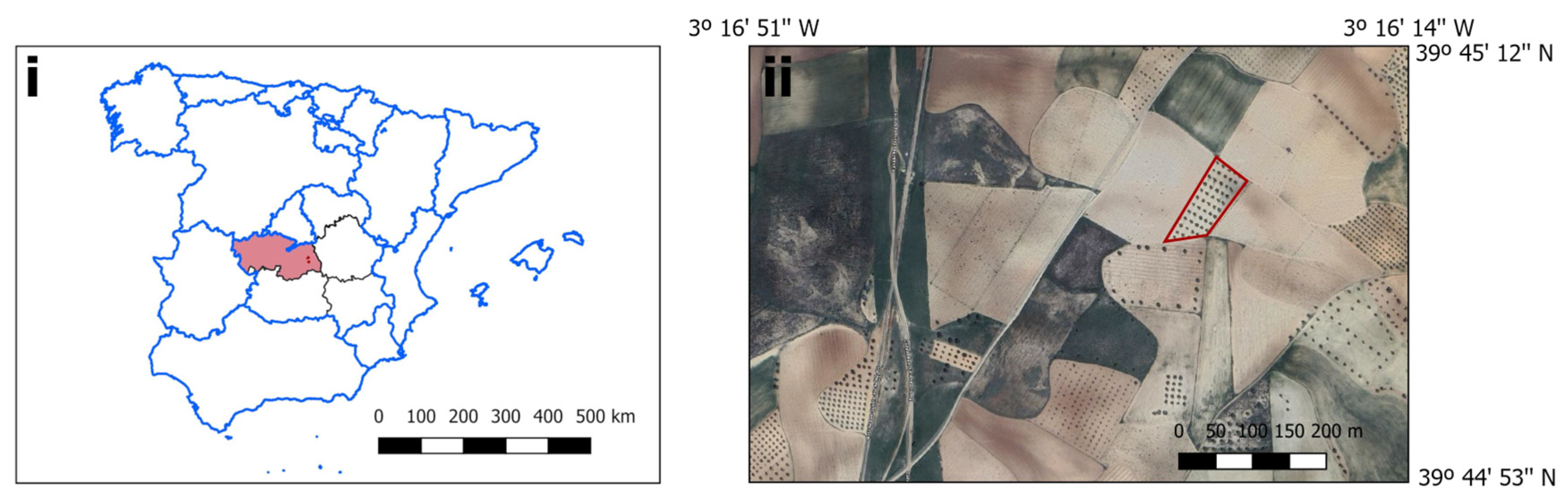
The study has been carried out in an olive grove located in the province of Toledo, in Central Spain, in the municipality of Corral de Almaguer (39°45′05.2″ N 3°16′25.1″ W, 724 m a.s.l; Figure 1). In this area, the climate is characterized as a continentalized Mediterranean climate (with summer drought, cool winters, hot summers, and low rainfall concentrated in the winter period), an average annual temperature of 14.3 °C and an average annual rainfall of 418 mm, according to the Digital Climate Atlas of the Iberian Peninsula (https://opengis.grumets.cat/wms/iberia/index.htm accessed on 1 October 2024; [35]). It presents poorly developed soils of the Entisol type, characterized by a sandy texture, alkaline reaction, and low organic matter content in the superficial horizon (<1%). Vegetation was constituted by the planted olive trees and some annual ephemeral ruderal weeds belonging mainly to the Stellarietea and Artemisietea vulgaris classes [36].

2.2. Study Species Description

The olive tree (Olea europaea L. cv Picual) is a small evergreen tree of great economic importance due to its fruit, used both for direct consumption and, especially, to produce oil. It is naturally found throughout the Mediterranean Basin, Macaronesia, and western Asia, and its cultivation appears to have originated in Asia Minor approximately 6000 years ago [31,37,38,39]. It has low water requirements and typically thrives in soil with a pH between 5.5 and 8.5. However, it prefers well-aerated soils, which makes clay soils unsuitable for this species [39,40]. Climatically, it is a thermophilic species, especially in the wild varieties, although there are cultivars that are much more resistant to cold and can withstand temperatures down to −10 °C [39]. Consequently, the ideal climatic conditions are constituted by a Mediterranean climate with not very cold winters and dry and warm or hot summers.
Flowering occurs between April and May, with ripening in the following winter. Masting, which causes years with high production alternating with others of much lower production, is very marked [41]. Alternate bearing is genetically determined [42], although environmental factors (especially winter temperatures) and cultivation techniques can largely affect its manifestation [43].
Traditionally, the olive tree has been cultivated in dry farming systems with shallow tillage to remove the herbaceous layer. However, in some areas, this tillage is not performed, allowing the herbaceous layer to grow between the olive trees and maintaining the olive grove in a more natural state. In contrast, in recent decades, intensive or super-intensive irrigated cultivation has become more widespread worldwide [44].

2.3. Experimental Design

Fieldwork was conducted in 2024. The experiment followed a fully factorial design combining two irrigation regimes (rainfed vs. summer irrigation) and two soil management practices (customary plowing vs. herbaceous layer conservation). Summer irrigation was done during July and August, with water applied every other week. On the weeks when irrigation was applied, it lasted for 5 to 6 h, as the system is powered by solar panels. Customary plowing was carried out year-round through shallow tillage. Four independent and replicated zones (≈0.135 ha per zone) were established to represent all treatment combinations: irrigated land-herbaceous cover, irrigated land-customary plowing, rainfed-herbaceous cover, and rainfed-customary plowing. Zones were randomly assigned within the orchard to minimize the influence of pre-existing site heterogeneity (e.g., slope, soil depth, and previous land use).
Within each zone, 12 olive trees were georeferenced and tagged for individual identification, resulting in a total of 48 trees. Each tree was treated as an independent experimental unit, as trees were sufficiently spaced to avoid inter-tree root or canopy interactions. To assess microsite effects, particularly soil properties and herbaceous vegetation, one sampling plot (50 × 50 cm) was established per tree. Each plot was located under the canopy, at half the crown radius (2.10 ± 0.20 m) from the trunk, and always oriented towards the southwest. This consistent orientation was chosen to standardize sampling conditions, as previous studies reported no significant effects of canopy aspect (reviewed by López-Sánchez [9]). The southwest orientation was selected to ensure comparable exposure to prevailing solar radiation and microclimatic conditions during the driest and warmest part of the day, minimizing potential variability associated with within-canopy spatial heterogeneity.
In addition, multiple leaf and fruit-related variables, explained below, were measured for each individual tree.

2.4. Data Collection and Processing

2.4.1. Soil Data

Several soil properties were assessed from the sampling plots (50 × 50 cm). Field sampling was conducted in late summer 2024, before to the onset of autumn rainfall. For each plot, a 1 kg soil sample was collected from the 0–20 cm depth layer, using a spade, positioned immediately to the right of the plot to avoid disturbing the herbaceous layer. Samples were properly packaged and transported to the laboratory. In the lab, soil samples were air-dried at 25°C for 48 h, with periodic manual rotation to ensure uniform drying. Roots, stones, and other coarse debris were removed by sieving through a 2 mm mesh. The processed soil was then subjected to both physical and chemical analyses.
Soil texture was determined using the Bouyoucos hydrometer method and classified according to the USDA system, yielding percentages of sand, silt, and clay. The organic matter content (OM) [%] in the fine earth fraction was measured using the Walkley and Black dichromate oxidation method. Soil pH was measured potentiometrically in both distilled water (1:2.5 w/v) and KCl solution (1:1.5 w/v). Electrical conductivity (EC) [μS/cm] was also determined potentiometrically using a 1:1.5 soil-to-water suspension. Carbonate content (hereafter referred to as carbonates) [g/100 g] was quantified using a Bernard calcimeter (Pobel, Madrid, Spain), and active lime [CaCO3 g/100 g] was measured via 0.2 N ammonium oxalate extraction, with CO2 release compared to a CaCO3 standard. Total nitrogen (N [%]) was determined using the Kjeldahl method (DKL Heating Digester, VELP Scientifica, Usmate, MB, Italy; and Distillation Unit K-355, Büchi Labortechnik AG, Flawil, Switzerland), involving acid digestion with concentrated H2SO4 (Scharlab, S.L., Sentmenat, Barcelona, Spain) at 390 °C. The C/N ratio was calculated as the proportion of organic carbon [mg/g] to total nitrogen [mg/g]. Available phosphorus (P [mg/kg]) was determined using the Olsen method, involving extraction with NaHCO3 (Scharlab, S.L., Sentmenat, Barcelona, Spain), followed by colorimetric analysis. Finally, concentrations of exchangeable metals, including Na, K, Ca, Mg, Zn, Fe, Cu, and Mn [mg/kg], were analyzed via Inductively Coupled Plasma Optical Emission Spectroscopy (ICP-OES; Avio 200 IPC-OES, PerkinElmer, Waltham, MA, USA) after acid digestion with aqua regia and nitric acid, and stabilization with 5% HCl (Scharlab, S.L., Sentmenat, Barcelona, Spain).

2.4.2. Herbaceous Vegetation Data

Data on the herbaceous layer were collected from each 50 × 50 cm sampling plot during mid-spring 2024, coinciding with the peak of maximum vegetative growth. The following variables were recorded: herbaceous cover (%), species richness (i.e., number of species), and floristic composition. Species were identified to the species or morphospecies level (genus level when species identification was not possible). Each species or morphospecies was quantified by its relative cover (%) within the plot. The height of herbaceous vegetation (HHV) [cm] was measured from ground level to the top of the tallest and most representative individuals. The volume of herbaceous vegetation (VHV) [m3] was calculated during post-field data analysis using the following formula:
V H V m 3 = %   H e r b a c e o u s   c o v e r 100 × P l o t   a r e a   m 2 × H H V   ( m )
In addition, the aboveground herbaceous biomass (hereafter referred to as biomass) was mowed at ground level within each plot. The biomass was carefully collected, packaged, and immediately transported to the laboratory, where it was weighed fresh with a scale (FR-320 precision balance, Gram Precision S.L., L’Hospitalet de Llobregat, Barcelona, Spain), then oven-dried at 80 °C to constant weight (drying oven, J.P. Selecta S.A., Abrera, Barcelona, Spain). The resulting dry matter (DM) was recorded per plot, expressed in kg·ha−1, and further classified by functional group (grasses, legumes, and forbs). Moisture content (hereafter referred to as herb moisture) [%] was calculated gravimetrically during post-laboratory analysis, based on the difference between fresh and dry biomass weight.

2.4.3. Leaf Data

Leaf sampling was conducted in late autumn 2024. From each olive tree, a sample of 200 mature leaves was collected, properly packaged, and transported to the laboratory for chemical analysis. Once in the laboratory, samples were oven-dried, and subsequently ground using a mill (TUBE MILL C S000, IKA-Werke GmbH & Co. KG, Staufen, Germany) until a homogeneous powder with a particle size below 0.5 mm was obtained by sieving (Filtra Vibración, S.L., Badalona, Barcelona, Spain). The following nutrient parameters were determined: total nitrogen (N) [%] was quantified using the Kjeldahl method, which involved acid digestion with concentrated H2SO4 and salicylic acid for 12 h; total phosphorus (P) [mg kg−1] was determined using the vanadomolybdate colorimetric method, followed by spectrometry analysis (GENESYS UV-Vis spectrophotometer, Thermo Fisher Scientific, Waltham, MA, USA); mineral elements (Na, K, Ca, Mg, Zn, Fe, Cu, and Mn) [mg kg−1] were measured using Inductively Coupled Plasma Optical Emission Spectroscopy (ICP-OES; Avio 200 IPC-OES, PerkinElmer, Waltham, MA, USA). For the quantification of all mineral elements, standard calibration curves were generated and used to ensure accuracy and precision in measurement.

2.4.4. Olive and Oil Data

Sampling of olives was conducted in early winter 2024 (early harvesting) and was divided into two stages. In the first stage, a 3 kg sample of olives was collected from each individual tree using hand shakers, ensuring homogeneity by sampling from different parts of the canopy (inner vs. outer, and across the four cardinal directions). In the second stage, a 20 kg composite olive sample was collected from a group of four trees within the same treatment zone (i.e., same irrigation and soil management regime) using hand shakers provided by farmers. All samples were properly packaged and immediately transported to the laboratory. In addition, the remaining olives from each tree were weighed to calculate the total olive yield [kg tree−1].
The 3 kg olive samples were used for fruit characterization. Mineral composition of the olive paste (mill, MC2 Ingeniería y Sistemas S.L., Sevilla, Spain), including Na, K, Ca, Mg, Zn, Fe, Cu, Mn, B, and P [mg kg−1], was determined using Inductively Coupled Plasma Optical Emission Spectroscopy (ICP-OES) after acid digestion. Fat and moisture contents of both olive pastes and pomaces were measured using Near-Infrared Spectroscopy (NIR; FOSS Analytical A/S, Hillerød, Denmark), covering the wavelength range of 850–1050 nm in transmission mode. Based on this data, fat yield based on dry matter (FYDM) [%] was calculated using the formula
% F Y D M = F a t   c o n t e n t   ( % ) 100 M o i s t u r e   c o n t e n t   ( % ) × 100
In addition, total phenolic content (ppm) was determined using the Folin–Ciocalteu colorimetric method (solution, Na2CO3 20%; Na2CO3 Panreac). Maturity index (MI) was measured by classifying 100 olives per sample into eight groups based on skin and mesocarp coloration: 0—bright green skin; 1—yellow-green skin; 2—green skin with purple spots; 3—reddish-purple skin; 4—black skin with white mesocarp; 5—black skin with less than 50% black mesocarp; 6—black skin with 50% to less than 100% black mesocarp; and 7—black skin with completely dark mesocarp. The MI was calculated using the equation
M I = i × n i 100
where i is the category number (0–7), and nᵢ is the number of fruits in each category.
Finally, phytosanitary status was evaluated through visual inspection, recording the number of fruits affected by pests (e.g., Bactrocera oleae (Rossi)), pathogens (e.g., Colletotrichum spp.), or mechanical damage. Based on the proportion of affected fruits, a phytosanitary rating was assigned: 5—less than 5% affected; 4—5% affected; 3.5—10%–15% affected; 3—15%–20% affected; 2.5—20%–30% affected; 2—30%–40% affected; 1—more than 40% affected; and 0 for 100% of affected fruits (fallen fruits on soil).
The 20 kg composite olive samples were used to extract oil via the Abencor system (MC2 Ingeniería y Sistemas S.L., Sevilla, Spain), simulating industrial milling conditions. This process allowed the determination of Industrial Extraction Yield (IEY). Finally, olive oil yield [kg ha−1] was calculated by integrating the total olive yield per tree with the planting frame configuration (8 × 10 m, equivalent to 125 trees ha−1).

2.5. Statistical Analysis

In order to investigate (A) the effect of different irrigation regimes and soil management practices on olive tree yield and quality, and (B) the variations in microsite conditions surrounding olive trees (including soil characteristics and herbaceous layer) on leaf, fruit and oil traits under varying levels of drought stress, we developed a total of fifteen maximal Generalized Linear Models (GLMs), each incorporating all relevant predictors [45] see Table 1).
For hypothesis A, the structure of the maximal model was defined as response variable ~ irrigation regime × soil management. The irrigation regime factor included two levels: (1) rainfed (no supplementary irrigation) and (2) summer irrigation (supplementary watering applied during July and August. Soil management also comprised two levels: (1) customary plowing and (2) herbaceous layer conservation. The interaction between the two predictors was explicitly included in the model (Table 1). For hypothesis B, we selected only the subset of olive trees under the herbaceous layer conservation. The structure of the corresponding maximal model was response variable ~ soil properties + herbaceous layer + irrigation regime. As in the previous analysis, the irrigation regime included two levels: rainfed and summer irrigation.
To ensure the inclusion of independent variables in the maximal model, we first constructed two separate Pearson correlation matrices—one for soil variables and another for herbaceous layer variables (Tables S1 and S2; respectively). Variables showing strong collinearity (|Pearson coefficient| > |0.75|) were excluded from simultaneous inclusion. Among soil variables, only sand and silt were strongly correlated (Pearson r = |0.949|; Table S1). For the herbaceous layer, herbaceous height and volume (Pearson r = |0.777|), as well as total herbaceous dry matter and forb dry matter (r = |0.993|), showed high collinearity (Table S2). Consequently, the predictors included in the maximal models were: (i) soil properties: pH_H2O, pH_KCl, EC, sand, clay, carbonates, active lime, OM, and C/N ratio; and (ii) herbaceous layer: HHV, herb moisture, grass DM, total DM, and species richness.
For leaf nutrient data, we first performed a Principal Component Analysis (PCA) [46] and subsequently selected the main principal components summarizing leaf nutrient variation to be used as response variables in the maximal models. To select the components that explained enough variance, the method of Bendixen [47] was used.
Table 1. Summary of maximal models performed for data analysis in this study.
Hypothesis aModelResponse VariablePredictor bError Distribution (Power Lambda Link Function) c
AIOlive yield (kg tree−1)IR × SMGaussian (1)
IIOlive oil yield (kg ha−1)IR × SMGaussian (1)
IIIIndustrial extraction yield (%)IR × SMGamma (2)
IVFat yield based on dry matter (%)IR × SMGamma (2)
VTotal phenolic content (ppm)IR × SMGaussian (1)
VIMaturity indexIR × SMGaussian (1)
VIIPhytosanitary statusIR × SMGamma (0.5)
BVIIIPCA (Leaf nutrients) dSP + H + IRGaussian (1)
IXOlive yield (kg tree−1)SP + H + IRGaussian (1)
XOlive oil yield (kg ha−1)SP + H + IRGaussian (1)
XIIndustrial extraction yield (%)SP + H + IRGamma (2)
XIIFat yield based on dry matter (%)SP + H + IRGaussian (1)
XIIITotal phenolic content (ppm)SP + H + IRGaussian (1)
XIVMaturity indexSP + H + IRGaussian (1)
XVPhytosanitary statusSP + H + IRGamma (2)
a A: The effect of different irrigation regimes and soil management practices on olive tree yield and quality. B: The influence of microsite conditions surrounding olive trees (including soil characteristics and herbaceous layer) on leaf, fruit and oil traits under varying levels of drought stress. PCA: Principal component analysis. b IR: Irrigation regime (summer irrigation vs. rainfed); SM: Soil management (customary plowing vs. herbaceous layer conservation); SP: Soil properties; H: Herbaceous variables. c Power lambda link function [g(μ) = μλ] is the lambda (λ, numeric value inside the brackets) used for monotonic transformations [48]. d Three different models, one for each principal component.
Box–Cox transformations [48] were applied when necessary to estimate the lambda parameter that maximizes the likelihood. Accordingly, some response variables were modeled using a Gamma error distribution with the corresponding power (lambda) link function (Table 1). When monotonic transformations were not required, response variables were modeled using a Gaussian error distribution with an identity link function (Table 1).
We used a model averaging approach following Burnham and Anderson [49]. First, we fitted the maximal model including all predictors. Then, using the “dredge” function from the MuMIn package in R, we generated and ranked all possible models based on Akaike Information Criterion (AIC) weights. We retained the top models—defined as those with ΔAIC < 2 and the highest AIC weights > 95% [49]. Finally, we estimated model-averaged coefficients and calculated the relative importance of each predictor (ranging from 0 to 1) using the “model.avg” function in MuMIn.
Additionally, we performed a new Principal Component Analysis (PCA) to identify the main components summarizing nutrient variation in soil, leaves, and olives, and to explore correlations among these compartments.
All data processing and statistical analyses were conducted using R version 4.4.1 [50], with the following packages: ggplot2 [51], moments [52], caret [53], factoextra [54], and MuMIn [55].

3. Results

3.1. Soils and Vegetation

Analysis of the soils indicates that the pH range is between 8.1 and 9.3, classifying them as basic or alkaline. The carbonate content is notably high, with most samples exhibiting levels exceeding 50%. Texturally, the soil is predominantly loam and sandy loam, with sand percentages ranging from 33.4% to 77.0%, silt percentages ranging from 10.2% to 44.2%, and clay percentages ranging from 12.8% to 26.0%. Levels of organic matter have been generally low (between 1.0 and 2.5%) or medium (between 2.6 and 5.0%). The electrical conductivity of the soil has been low, with values consistently below 0.8.
A total of 10 plant species or morphospecies (or genera, when species identification was not possible) were identified in the natural herbaceous layer (Table 2). They represented 4 botanical families, mainly Poaceae (40 %) and Asteraceae (30%). The most frequent species was Brassica nigra, which appeared in 16 out of 24 sampling plots, followed by Picnomon acarna (L) Cass. (13 sampling plots), Bromus tectorum L. and Brassica barrelieri (L) Janka (10 sampling plots).
The composition of the herbaceous layer in the study area was indicative of communities belonging to the Stellarietea class, as evidenced by the presence of Bromus tectorum. Specifically, the presence of annual nitrophilous (Sisymbrietalia officinalis) and sub-nitrophilous (Thero-Brometalia) communities was particularly notable [56]. Siymbrietalia officinalis represents ephemeral herbaceous communities dominated by nitrophilous annual species, typically found in trampled habitats such as paths, roadsides and rural areas [56]. Species typical of these communities identified in the study included taxa belonging to Sisymbrion officinalis, represented by Hordeum murinum L. and Brassica nigra (L) W.D.J. Koch, and Hordeion leporini Link, represented by Anacyclus clavatus (Desf.) Pers. [56]. Thero-Brometalia comprises sub-nitrophilous Mediterranean ephemeral grasslands, mainly consisting of spring-flowering annuals associated with traditional agriculture practices such as plowing. Species characteristic of this group included Bromus diandrus Roth and Bromus rubens L., and, within the Alysso-Brassicion barrelieri alliance—found in meso- to supra-Mediterranean, semi-continental regions of Western Iberia on poor, sandy, siliceous soils—Brassica barrelieri [56].
Additionally, we identified pioneer perennial ruderal assemblages, often dominated by thistle species and corresponding to the Onopordenea acanthii alliance within the Artemisietea vulgaris class [56].
Regarding weed abundance, a marginal decrease (p = 0.075) in grass cover measured as a percentage was observed in plots situated near trees lacking irrigation (51.08 ± 6.82) when compared to plots situated near olive trees receiving supplementary summer irrigation (67.08 ± 5.02).

3.2. Soil Management and Irrigation Regime Effect on Olive Trees: Yield and Quality

Analysis of the olives and oil indicates that olive and oil yields ranged from 14.94 to 34.72 kg per tree, indicating moderate variability in individual productivity, and from 206.88 to 762.16 kg per hectare, respectively, reflecting significant differences in production efficiency at the plot level. The industrial extraction yield and FYDM range varied from 10.76% to 19.04% (15% is acceptable for the industry) and from 37.86% to 47.52% (considered high, important for the final quality of the oil), respectively. The maturity index ranged from 3.22 to 4.80, indicating that the olives had purple-red and black skin with white mesocarp, were sufficiently ripe for oil extraction, and would provide acceptable sensory quality. The phytosanitary status was low, with most samples ranging between 1 and 3, indicating damage ranging from 15% to over 40% of the affected olives. The total phenolic content ranged from 2471.30 to 6532.76 ppm, indicating good oil quality with health properties.
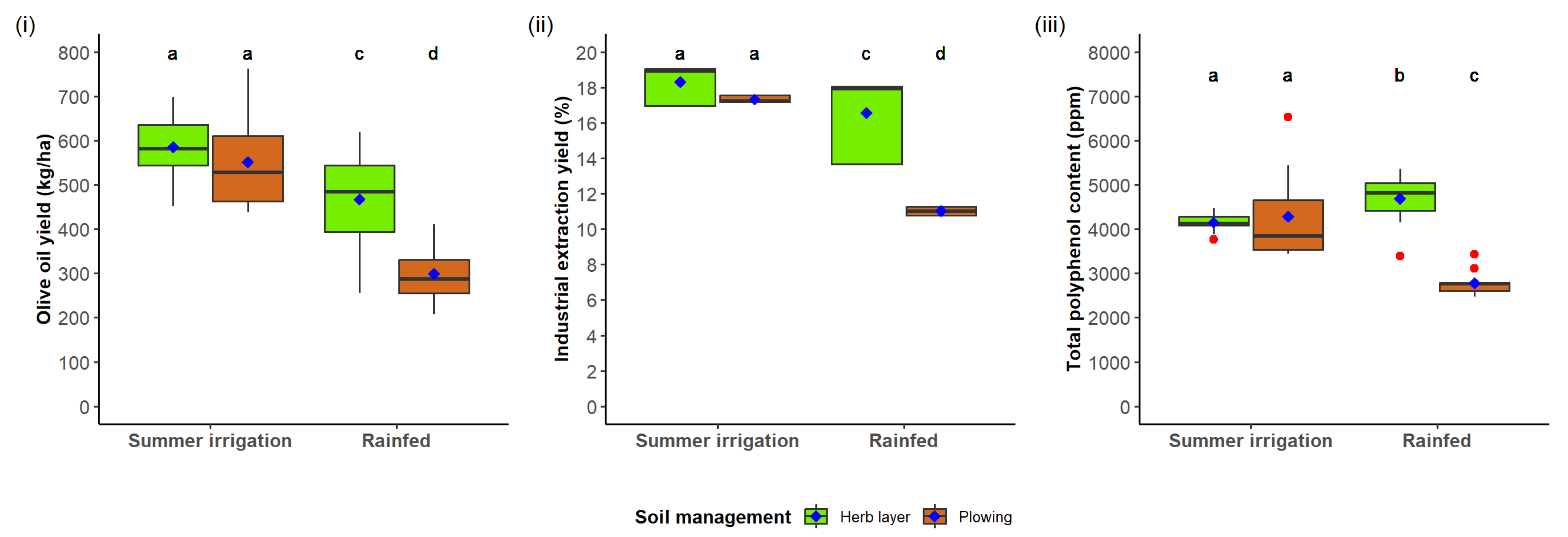
Customary plowing and irrigation regimes significantly affected olive tree yield (Table 3). Specifically, olive yield, olive oil yield, and industrial yield were significantly higher (p = 0.006, p = 0.003 and p = 0.001; respectively, Table 3) in olive trees receiving supplementary summer irrigation (25.46 ± 4.39 kg tree−1, 568.9 ± 94.21 kg ha−1, 17.82 ± 0.86%; respectively) compared to those without irrigation (22.08 ± 4.07 kg tree−1, 382.85 ± 121.30 kg ha−1, 13.78 ± 3.19%; respectively). Furthermore, olive oil yield and industrial yield were significantly lower (p = 0.015 and p < 0.001; respectively, Table 3) in rainfed conditions when customary plowing was applied (298.63 ± 61.50 kg ha−1, 11.01 ± 0.22%; respectively), indicating an interaction between the two stress factors (Figure 2i,ii), compared to areas without any of the two stresses—irrigated land-herbaceous cover—(585.71 ± 78.76 kg ha−1, 18.31 ± 0.99%; respectively). FYDM was significantly higher in areas where the herbaceous layer was preserved (p = 0.002).
Olive tree quality was also influenced by soil management type and irrigation regime (Table 3). Total phenolic content was significantly higher (p = 0.030; Table 3) in olive trees without supplementary irrigation (4682.27 ± 560.79 ppm) compared to summer irrigated trees (4148.66 ± 206.76 ppm) in areas with herbaceous vegetation cover. However, under customary plowing, phenolic content was substantially lower (p < 0.001) in rainfed conditions when customary plowing was applied (2784.40 ± 257.07 ppm), reflecting an interaction between these stress factors (Figure 2iii), compared to areas without any of the two stresses (irrigated land-herbaceous cover). Additionally, the phytosanitary status of olives was significantly poorer (p < 0.001; Table 3), and the olive maturity stage index was marginally lower (p = 0.076; Table 3) in trees under customary plowing (1.46 ± 0.57, 3.68 ± 0.23, respectively) compared to those with herbaceous layer conservation (2.25 ± 0.72, 3.97 ± 0.39; respectively).

3.3. Microsite Effects

3.3.1. Leaf Nutrients

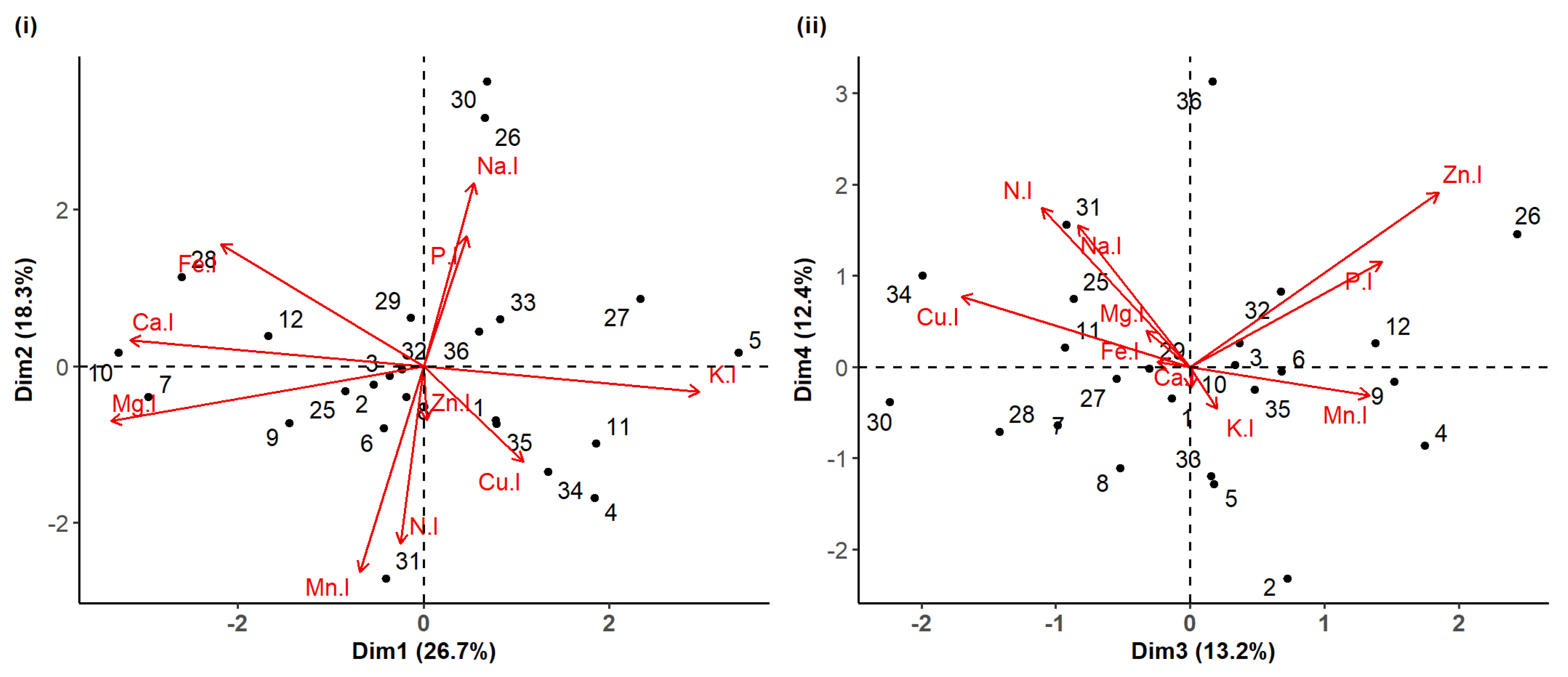
Leaf nutrients were grouped into three principal components, as the fourth component comprised nutrients already represented in the other three dimensions (Figure 3 and Figure S1). The first principal component (PC1) was primarily associated with Mg, Ca and Fe (deficit), and K (excess). The second component (PC2) grouped Mn and N (deficit), and Na (excess). The third component (PC3) included Cu (deficit), and Zn and P (excess; Figure 3 and Figure S1).
PC1 significantly increased with higher total herb biomass (p = 0.009) and showed marginal increases with higher grass yield (p = 0.090) and species richness (p = 0.063; Table S3). No significant differences (p > 0.05) in PC1 were observed according to soil properties or irrigation regime (Table S3).
PC2 significantly decreased with increasing sand content in the soil (p = 0.027) and marginally increased with greater species richness of the herbaceous vegetation (p = 0.066; Table S4). No significant differences (p > 0.05) in PC2 were found for other soil properties or irrigation regime (Table S4).
PC3 significantly decreased with increasing soil pH (p = 0.014; Table S5). No significant differences (p > 0.05) in PC3 were observed for other soil properties, herbaceous vegetation metrics, or irrigation regime (Table S5).

3.3.2. Olive Tree Yield and Quality

Olive yield was positively associated with higher sand content in the soil (p = 0.024; Table S6), which is strongly correlated with silt content (Pearson’s r = |0.949|; Table S1). Additionally, olive yield was marginally higher with higher soil carbonate content (p = 0.063) and higher herbaceous moisture (p = 0.096; Table S6). Olive oil yield was significantly higher in areas with greater sand content (p = 0.040), likewise correlated with silt content (Pearson’s r = |0.949|; Table S1). It was also positively associated with higher soil carbonate levels (p = 0.003), soil electrical conductivity (p = 0.021), and herbaceous moisture (p = 0.027; Table S7). Similarly, industrial extraction yield was positively associated with higher soil carbonate content (p = 0.006), soil electrical conductivity (p < 0.001), herbaceous moisture (p = 0.035), and soil pH (p = 0.021; Table S8). Conversely, industrial extraction yield was significantly lower with higher soil organic matter content (p = 0.039), and with higher herbaceous dry matter, both total dry matter (p = 0.001)—which is highly correlated with forb dry matter (Pearson’s r = |0.993|; Table S2)—and grass dry matter (p = 0.007; Table S8). Fat yield based on dry matter (FYDM) was significantly higher in soils with greater sand content (p = 0.002), also correlated with silt content (Pearson’s r = |0.949|; Table S1), and in more alkaline soils (p < 0.038; Table S9). Additionally, FYDM was marginally lower with higher soil carbonate content (p = 0.079) and marginally higher with higher species richness of the herbaceous layer (p = 0.066; Table S9).
Total phenolic content was significantly higher in more alkaline soils (p = 0.001) and in soils with higher electrical conductivity (p < 0.002; Table S10). Additionally, total phenolic content was marginally higher with higher carbonate levels in soil (p = 0.092; Table S10). The olive maturity index was significantly lower in areas where the herbaceous layer was dominated by grasses compared to those dominated by forbs (p < 0.001), and it was significantly higher in areas with higher sand content (p = 0.024; Table S11),which is strongly correlated with silt content (Pearson’s r = |0.949|; Table S1). Olive phytosanitary status was significantly poorer in soils with higher clay content compared to sandy soils (p < 0.05), in soils with a higher C/N ratio (p = 0.005), and in soils with greater herbaceous layer dry matter (total dry matter, p < 0.001)—which is highly correlated with forb (Pearson’s r = |0.993|)—and grass dry matter (p = 0.006), as well as with higher soil organic matter content (Table S12). Conversely, phytosanitary status was significantly higher with higher soil electrical conductivity (p < 0.001), greater herbaceous layer height (p = 0.015)—and thus with higher herbaceous volume (Pearson’s r = |0.777|; Table S2)—particularly under rainfed treatment (no summer irrigation; p = 0.017; Table S12).

3.3.3. Nutrient Cycle: Soil–Leaves–Olives

The PCA results were explained by eight principal components (PCs) (Table S13), which accounted for approximately 80% of the total variance (Figure S2). Soil nutrients were primarily associated with PC1, which included P, Mn, Mg, K, N, Ca, and Fe, all positively correlated with each other (Table S13 and Figure S3). Thus, the abundance of one nutrient was correlated with the abundance of the others, and vice versa. Zn was mostly independent, associated with PC2 (Table S13 and Figure S3), although it showed some positive correlation with Na and a negative correlation with Ca related to PC3 (Table S13 and Figure S3). Cu behaved as an independent variable on PC5 (Table S13 and Figure S4).
Leaf nutrients were homogeneously distributed across several PCs (Table S13). Ca, Mg, and Fe were positively correlated (PC2; Table S13 and Figure S3), while K was negatively correlated with them within the same component. Na was independent on PC3 (Table S13 and Figure S3). N, Cu, and Mn were positively correlated on PC5 (Table S13 and Figure S4). Cu exhibited a negative correlation with Zn on PC6 (Table S13 and Figure S4).
Olive nutrients were distributed mainly across PC1, PC2, and PC3 (Table S13). Na and iron Fe were positively correlated on PC1, whereas P was negatively correlated with them (Table S13 and Figure S3). Mn, Ca, Mg, Fe, and Na were positively correlated on PC2 (Table S13 and Figure S3). Cu, K, Mg, Zn, and Mn were positively correlated on PC3 (Table S13 and Figure S3). B was independent on PC4 (Table S13 and Figure S3).
The distribution of nutrients among soil, leaves, and olives revealed notable patterns for several elements. P content in the soil was directly related to P concentration in olives (Table 4). Na, K, and Cu levels in the soil were positively correlated with their respective concentrations in the leaves (Table 4). In contrast, Fe, Zn, and Cu in the soil were negatively correlated with their concentrations in olives. Similarly, Zn and Mn in the soil showed negative correlations with their respective concentrations in the leaves (Table 4). Leaf nutrient content also showed clear relationships with nutrient levels in olives. Specifically, Ca, Mg, Fe, and Zn in leaves were positively correlated with their concentrations in olives, while Cu in leaves was negatively correlated with Cu in olives (Table 4). Moreover, additional interactions were suggested by the biplot of the first two principal components (Figure S3), such as an opposing directional pattern between K in leaves and K in olives.

4. Discussion

Olive groves are an important perennial tree crop production system characteristic of Mediterranean landscapes that have been managed for millennia, especially due to the high value of the fruit, which is predominantly utilized for oil extraction. These systems are well-adapted to arid and semi-arid environments and are highly resilient to drought and tolerant to poor soils. Therefore, they play an important role in biodiversity conservation [57], supporting diverse species and contributing to the cultural landscape of the Mediterranean basin, as well as to regional economies, thereby helping sustain many rural families [58,59].
Nonetheless, conventional agronomic practices, such as tillage or plowing, have resulted in numerous negative ecological effects [60], including biodiversity loss [61], soil erosion [14,26,27], decline in organic matter [62], and disruption of soil microbial communities [13,34]. The present study yielded findings of particular interest concerning the effect of maintaining an herbaceous layer as a substitute for customary plowing [19,32].

4.1. Customary Plowing vs. Herbaceous Layer Conservation Under Different Drought Stress Levels: Olive Tree Yield and Quality

Previous studies have not been consistent in assessing the impact of conventional plowing practices on olive yield and quality. According to some authors [16,17,63], plowed areas exhibited significantly higher yield; however, according to other authors [18,19,26,30,64], there were no differences found, and even, in some cases, lower production was observed in plowed areas [20,64]. In our case, we have not detected differences in olive yield when comparing plowed areas to areas conserving their herbaceous layer cover, but we have detected lower industrial extraction yield, fat yield based on dry matter, maturity index and phytosanitary status in plowed areas compared to areas conserving their herbaceous layer cover (0.81, 0.96, 0.92, 0.65-fold lower, respectively), thus indicating better oil quality when a natural cover crop is maintained. Gucci et al. [63] and Pedraza and González-Andújar [19], however, did not find differences in oil quality when comparing plowed and natural-covered areas. These differences could be related to varietal or ecological (for example, edaphic) differences.
Our study finds that rainfed olives (i.e., when no additional water is supplied during periods of severe drought—typically in summer) showed a reduction in olive yield, industrial extraction yield, and oil yield (0.86, 0.77, and 0.67-fold lower, respectively) when compared to irrigated ones, similarly to the findings of other authors [13,65,66,67,68,69,70]. It also showed that total polyphenolic content was higher in rainfed olives in areas with herbaceous vegetation cover, as previously reported in cv. Leccino [71] and in cv. Frantoio [72], though Inglese [67] found that it was higher in irrigated trees in cv. Carolea; although we did not analyze it, Inglese et al. [67], Servili et al. [71] and Caruso et al. [72] also found that hydric regime did not influence fatty acid composition, acidity or peroxide index. Finally, under combined customary plowing and rainfed conditions (i.e., dual stress from tillage and water deficit), oil yield, industrial extraction yield, and total polyphenolic content were considerably lower in the present study, as previous research has also found [10,16].
Certain soil management strategies, such as conventional plowing, have been shown to have substantial adverse effects on soil quality, which is the most important factor influencing vegetation growth and development, and thus also influences fruit yield and quality. Gómez et al. [11,22] and Arias-Giraldo et al. [34] reported higher erosion rates (>5–12 t ha−1 year−1, which exceed tolerable thresholds), as well as increased runoff and nutrient losses in traditional plowed soils. Arias-Giraldo et al. [34] also described that, compared to natural grass cover, conservation tillage—a soil management practice that generates less negative impact than plowing—showed lower levels of soil aggregates, water-holding capacity, organic matter and biological biodiversity in interrows (between trees) areas. However, Gómez et al. [60] showed that the impact of cover crops can vary depending on soil type, slope and management, sometimes reducing runoff and in other cases having little or no effect. Therefore, the maintenance of spontaneous herbaceous layers in olive groves might have the potential to mitigate soil damage and consequently improve tree productivity (olives and oil). The herbaceous layer has a significant effect on floristic diversity and can indirectly influence ecosystem resilience and productivity [17]. Additionally, it contributes to the control of soil erosion, enhances nutrient availability, and increases microbial activity, thereby supporting the development of olive groves [28,73]. Several studies have also indicated that cover crops enhance quality over yield in olive production [73,74], whereas other studies highlight that the use of leguminous species is more beneficial than that of grasses [75,76]. In this regard, it is noteworthy that the present study did not detect any legumes in the natural herbaceous layer.

4.2. Microsite Effects (Soil and Herbaceous Layer) on Leaves, Olives and Oil Under Different Drought Stress Levels

Soil management is a fundamental element for the adequate development of olive trees [77]. Therefore, the utilization or abstention from plowing, as well as the presence or absence of a spontaneous herbaceous layer, can lead to differences in olive oil production levels and quality, as shown, for example, by the influence of soil properties on the fatty acid profile of olive oils [78]. Similarly, Baiano et al. [79] demonstrated that cultivation of the same olive variety in different soil environments can result in oils with distinct quality characteristics.
Our results show that olive trees were significantly affected by microsite effects, which altered leaf nutrient availability, olive and oil yield and quality, as previously reported by de Torres et al. [80]. Sandy textures reduced sodium content but increased manganese and nitrogen in leaves. Sandy and silty soils also increased olive and oil yield, enhanced fat yield based on dry matter, and improved the phytosanitary status of the olives. Furthermore, these sandy-silty textures also increased the maturity index of olives. This may be of practical interest since, as olives usually ripen in late autumn or in early winter, it enables the beginning of harvesting during extended daylight hours and, in principle, with more favorable temperatures. In short, according to our data, the presence of sandy and silty soil is highly favorable in Olea europaea cv. Picual.
According to Beheiry et al. [81], the application of acidifying agents to an alkaline soil in an Olea europaea cv. Picual olive groves in Egypt resulted in increased levels of P, K, Na, Ca, Mg, Mn, Zn, and Cu in the leaves. Only Fe and, in some cases, N levels decreased. However, our data indicates that only Zn and P content in leaves increased with a lower pH, with Cu levels decreasing, and the remaining elements not showing a significant variation. In addition, our results show that alkaline pH combined with higher carbonate content in soil increased olive and oil yield, industrial extraction yield and fat yield based on dry matter. These results are also in contrast with those of Beheiry et al. [81], who found that oil content and total olive yield were higher when applying acidifying agents in an alkaline soil. According to our data, alkaline soils also had a significant impact on the concentration of polyphenols, which are widely regarded as indicators of olive oil quality, since these compounds significantly contribute to their cardioprotective effects [82] and have been shown to improve the stability of the oil [83], thereby delaying the onset of rancidity and, consequently, extending oil life.
In this study, higher electrical conductivity in the soil increased the oil yield and the industrial extraction yield and improved phytosanitary status. On the other hand, an increase in the amount of organic matter in the soil has been shown to have a negative impact on the industrial extraction yield and phytosanitary status of olives. Phytosanitary status also decreased with a higher C/N ratio, which indicates an organic matter accumulation with low N content essential to plant growth.
The present study found that the herbaceous layer has a significant impact on the nutrients and quality of olives and oil. Higher total herbaceous biomass increased magnesium, calcium, iron, and potassium content in leaves, specifically if grasses dominated over forbs in floristic composition. This contrasts with the findings of Marañón-Jiménez et al. [17], which reported no differences in the nutrients present in the tree leaves except for a decrease in N and P levels in herbaceous treatment compared to non-herbaceous treatment (though in this case it was maintained not through tillage but by using herbicides).
On the other hand, highly demanding herbaceous biomass reduced industrial extraction yield, maturity index, and made olives show a worse phytosanitary status. This could be related to the absence of legumes in the herbaceous layer, as it has been demonstrated that legumes decrease C/N levels [26] and favor plants’ phytosanitary status and productivity [84,85]. Anyway, we found a better olive phytosanitary status with high height and volume of the herbaceous layer, perhaps related to the findings that herbaceous plants remove ammonium and nitrate from the soil and incorporate them into plant molecules, thus favoring mineralization and enhancing the residence time of the N in the system [86]. In addition, higher levels of herbaceous moisture were associated with an increase in olive and industrial extraction yields. This may be due to the fact that higher levels of herbaceous moisture could be associated with microsites characterized by wetter soils, and in fact, it has been shown that maintaining an herbaceous layer in olive groves can increase the water stored in the soil thanks to reduced water runoff and increased infiltration [22,24,25].
Higher species richness in the herbaceous layer was related to a higher sodium and potassium content in leaves, but was also related to a deficit of manganese, nitrogen, magnesium, calcium and iron. Higher species richness also reduced the fat yield based on dry matter of olive, which could be related to the greater competition between forbs and olive trees for those deficient nutrients that we have just indicated. In the study area, furthermore, most of the species were nitrogen demanding, and this competition with olive trees could affect the lower N content in the leaves of the trees. The low quality of the herbaceous layer includes invasive species (e.g., Anacyclus clavatus, Hordeum murinum), which present a high demand for nitrogen and several other nutrients, particularly in spring when they grow very fast. Rodríguez-Lizana et al. [73] found better fertilization of C and N content in Brachypodium distachyon L. or Sinapis alba L. cover crops than in spontaneous vegetation cover crops, which included ruderal plants characteristic of the Stellarietea class found in the present study. The ruderal plants used soil nutrients significantly, releasing lower amounts of C and N in soil residues, and thus, soils received less fertilization. Pedraza and González-Andujar [19] showed that grass cover crops reduce the diversity and abundance of ruderal plants, promoting less-competitive and demanding species.
This highlights the importance of establishing high-quality herbaceous cover, particularly through the introduction of species-rich mixtures, including legumes. These cover crops not only improve soil nutrient cycling but also enhance soil structure, water retention, and biodiversity, contributing to a more resilient and sustainable agroecosystem [87]. Herbaceous management such as repeated grass mowing instead of customary plowing or controlled extensive sheep grazing, which are well-adapted to Mediterranean ecosystems, is essential to reduce nutrient competition and improve soil water storage capacity [18,30].
In general, irrigation treatment did not have a significant effect on the zones with an herbaceous layer; there was even a negative effect of the extra watering in summer, declining the phytosanitary status of olives.
Finally, in the study area, the distribution of nutrients throughout soil, leaves and olives was remarkable. It is well known that nutrient concentrations in olive leaves fluctuate throughout the various phenological stages of the tree, from bud break through flowering and fruiting [88,89]. In areas where adult olive trees conserved their herbaceous vegetation layer, certain soil nutrients appeared to influence leaf and olive concentrations in complex ways. For instance, a higher abundance of Zn in soil was associated with lower Zn concentrations in both leaves and olives, suggesting that the herbaceous vegetation may uptake Zn and limit its availability to the trees. Similarly, elevated soil Cu increased Cu in leaves but decreased it in olives, indicating potential competition for this nutrient within the tree. Mn and Fe also decreased in leaves and olives, respectively, despite being abundant in soil, which may reflect uptake by the herbaceous layer. In contrast, Na, K and P levels in leaves and olives were maintained even when abundant in soil, suggesting minimal competition with the herbaceous layer. Finally, while Ca, Mg, and Fe concentrations did not indicate competition between leaves and olives, K showed an inverse correlation between these organs, pointing to internal allocation dynamics within the tree. In young olive groves, Erel et al. [90] observed that higher foliar concentrations of P and K were associated with reduced fruit growth. In our study, P and K were generally abundant in both leaves and olives, and we did not detect a clear competition pattern between leaves and fruits for these nutrients. Thus, our findings do not directly confirm the relationships reported by Erel et al. [90], suggesting that nutrient dynamics may differ between young and mature trees or under different microsite and management conditions. Similarly, while Lavee [41] highlighted that low N, P, and K reduce flowering and fruit set, our results indicate that nutrient availability in the studied mature trees was sufficient, and no strong nutrient limitations were observed. Additionally, both the physicochemical characteristics of the soil and its management—whether bare soil or with a cover crop—affect nutrient uptake by the olive tree [91]. Macronutrients are essential for proper flowering and fruit set. N, P, and K are fundamental for drupe development and the resulting composition of the olive oil [92].

5. Conclusions

Olive groves are resilient agroforestry and perennial tree crop production systems essential to Mediterranean biodiversity, culture, rural economies and the preservation of cultural landscapes. However, conventional practices such as customary plowing have been shown to cause serious ecological damage, including negative impact on soil structure, biodiversity loss, disruption of soil microbial communities and olive yield and quality.
This study highlights the benefits of maintaining a spontaneous herbaceous layer instead of traditional tillage. The research evidence that plowed groves, particularly under drought stress (combined stress), suffer reduced oil extraction, lower phenolic content, and poorer phytosanitary status. Soil management and microsite characteristics influence nutrient availability, olive yield, and oil quality. Our results indicate that certain soil properties, such as texture and pH, can modulate these effects, highlighting the importance of site-specific management strategies to optimize production and tree health. The composition and quality of the herbaceous layer also played a critical role. Grass-dominated covers with high biomass and moisture improved certain leaf nutrient contents. However, the absence of legumes and excessive herbaceous biomass of these ruderal vegetation or nutrient-demanding species may compete with olive trees, lowering yield and quality. Further research could explore whether incorporating high-quality cover crops, such as legumes, may enhance soil conditions and further improve tree productivity compared to ruderal vegetation.
Therefore, maintaining a spontaneous herbaceous layer promoting high-quality (diverse species mixtures including legumes) and well-managed herbaceous covers (e.g., mowing or controlled grazing instead of plowing) could promote sustainable olive production by improving soil resilience, reducing water stress, and optimizing nutrient use, thereby supporting long-term ecosystem stability and agricultural productivity of Mediterranean agroecosystems.

Supplementary Materials

The following supporting information can be downloaded at: https://www.mdpi.com/article/10.3390/f17050602/s1, Table S1. Pearson correlation matrix for soil properties. Table S2. Pearson correlation matrix for herbaceous layer variables. Table S3. Summary of the top generalized linear models (ΔAIC < 2) to analyze PC1 of leaf nutrients (VIIIa maximal model) depending on soil properties, herbaceous vegetation and irrigation treatment. Table S4. Summary of the top generalized linear models (ΔAIC < 2) to analyze PC2 of leaf nutrients (VIIIb maximal model) depending on soil properties, herbaceous vegetation and irrigation treatment. Table S5. Summary of the top generalized linear models (ΔAIC < 2) to analyze PC3 of leaf nutrients (VIIIc maximal model) depending on soil properties, herbaceous vegetation and irrigation treatment. Table S6. Summary of the top generalized linear models (ΔAIC < 2) to analyze olive yield (IX maximal model) depending on soil properties, herbaceous vegetation and irrigation treatment. Table S7. Summary of the top generalized linear models (ΔAIC < 2) to analyze olive oil yield (X maximal model) depending on soil properties, herbaceous vegetation and irrigation treatment. Table S8. Summary of the top generalized linear models (ΔAIC < 2) to analyze industrial extraction yield (XI maximal model) depending on soil properties, herbaceous vegetation and irrigation treatment. Table S9. Summary of the top generalized linear models (ΔAIC < 2) to analyze fat yield based on dry matter (XII maximal model) depending on soil properties, herbaceous vegetation and irrigation treatment. Table S10. Summary of the top generalized linear models (ΔAIC < 2) to analyze total polyphenols (XIII maximal model) depending on soil properties, herbaceous vegetation and irrigation treatment. Table S11. Summary of the top generalized linear models (ΔAIC < 2) to analyze olive maturity index (XIV maximal model) depending on soil properties, herbaceous vegetation and irrigation treatment. Table S12. Summary of the top generalized linear models (ΔAIC < 2) to analyze olive phytosanitary status (XV maximal model) depending on soil properties, herbaceous vegetation and irrigation treatment. Table S13. Contribution of each nutrient to the eight principal components. Figure S1. Nutrient contribution to the one to four dimensions resulted from Principal Component Analysis. Figure S2. Explained variance distribution by each dimension or principal component. Figure S3. Nutrient distribution and contribution in one to four dimensions resulted from Principal Component Analysis. Figure S4. Nutrient distribution and contribution in the four to eight dimensions resulted from Principal Component Analysis.

Author Contributions

Conceptualization, M.L. and A.L.-S.; Methodology, A.L.-S. and J.C.L.-A.; Software, A.L.-S.; Formal analysis, A.L.-S.; Investigation, A.L.-S., J.C.L.-A. and M.L.; Resources: M.L.; Data curation: A.L.-S.; Writing—original draft preparation, A.L.-S., J.C.L.-A. and J.V.; Writing—review and editing, A.L.-S., J.C.L.-A., J.V. and C.L.; Visualization: A.L.-S., J.C.L.-A. and J.V.; Supervision, A.L.-S. All authors have read and agreed to the published version of the manuscript.

Funding

This research has been funded by the company Mensoft Consultores S.L. through the Olipasto24 and Olipasto24 II contracts (COL 2024_009 and COL 2024_014, respectively) with the Universidad Católica de Ávila.

Data Availability Statement

The data presented in this study is available on request from the corresponding author. The data is not publicly available due to restrictions related to the research project and confidentiality agreements with the company that funded the study, and therefore cannot be shared without their prior consent.

Acknowledgments

We thank the technicians from Mensoft Consultores S.L. for fieldwork. We also thank Rafa Juárez Carpintero and Juan Juárez Carpintero for facilitating the property access and supporting fieldwork. We also thank laboratories (Centro de Análisis del Medio Natural) from UCAV for leaf, soil and herbaceous analysis, especially Lidia Álvarez for facilitating communication with labs and technical lab support. We also thank Ctaex for olive and oil lab analysis, and especially Alfonso Montaño and Sofía Redondo, for technical consulting support.

Conflicts of Interest

Author María López is an employee of Mensoft Consultores S.L., which provided funding for this study. Mensoft Consultores S.L. contributed to the conceptualization of the study by providing the initial applied idea and provided resources for its implementation. The company also participated in data collection under the instructions and supervision of the authors. The founder had no role in the study design, methodology, formal analyses, data interpretation, writing of the manuscript, or the decision to publish the results. The authors were responsible for the study design, methodology, data analysis, interpretation of results, writing of the manuscript, and the decision to publish the results. The remaining authors declare no conflicts of interest.

References

  1. Santos, M.; Mosquera-Losada, M.R.; Gonçalves, B. Editorial: Can the Trees Save the Crops? Predicting the Services Provided by Traditional and Novel Agroforests in Changing Mediterranean Landscapes. Front. Ecol. Evol. 2023, 11, 1168247. [Google Scholar] [CrossRef]
  2. Stevenson, A.C.; Harrison, R.J. Ancient Forests in Spain: A Model for Land-Use and Dry Forest Management in South-West Spain from 4000 BC to 1900 AD. Proc. Prehist. Soc. 1992, 58, 227–247. [Google Scholar] [CrossRef]
  3. Joffre, R.; Rambal, S.; Ratte, J. The Dehesa System of Southern Spain and Portugal as a Natural Ecosystem Mimic. Agrofor. Syst. 1999, 45, 57–79. [Google Scholar] [CrossRef]
  4. Moreno, G.; Aviron, S.; Berg, S.; Crous-Duran, J.; Franca, A.; De Jalón, S.G.; Hartel, T.; Mirck, J.; Pantera, A.; Palma, J.H.N.; et al. Agroforestry Systems of High Nature and Cultural Value in Europe: Provision of Commercial Goods and Other Ecosystem Services. Agrofor. Syst. 2018, 92, 877–891. [Google Scholar] [CrossRef]
  5. Sardans, J.; Peñuelas, J. Plant-Soil Interactions in Mediterranean Forest and Shrublands: Impacts of Climatic Change. Plant Soil 2013, 365, 1–33. [Google Scholar] [CrossRef]
  6. Scholes, R.J.; Archer, S.R. Tree-Grass Interactions in Savannas. Annu. Rev. Ecol. Syst. 1997, 28, 517–544. [Google Scholar] [CrossRef]
  7. Hanan, N.P.; Lehmann, C.E.R. Tree–Grass Interactions in Savannas: Paradigms, Contradictions, and Conceptual Models. In Ecosystem Function in Savannas; CRC Press: London, UK, 2010; pp. 39–53. [Google Scholar] [CrossRef]
  8. Moreno, B.; Garcia-Rodriguez, S.; Cañizares, R.; Castro, J.; Benítez, E. Rainfed Olive Farming in South-Eastern Spain: Long-Term Effect of Soil Management on Biological Indicators of Soil Quality. Agric. Ecosyst. Environ. 2009, 131, 333–339. [Google Scholar] [CrossRef]
  9. Lopez Sanchez, A. Balancing Management and Preservation of Mediterranean Scattered Oak Woodlands (Dehesas) in Human-Dominated Landscapes. Ph.D. Thesis, Universidad Politécnica de Madrid, Madrid, Spain, 2015. [Google Scholar] [CrossRef]
  10. Gómez, J.A. Sustainability Using Cover Crops in Mediterranean Tree Crops, Olives and Vines—Challenges and Current Knowledge. Hung. Geogr. Bull. 2017, 66, 13–28. [Google Scholar] [CrossRef]
  11. Gómez, J.A.; Reyna-Bowen, L.; Rebollo, P.F.; Soriano, M.-A. Comparison of Soil Organic Carbon Stocks Evolution in Two Olive Orchards with Different Planting Systems in Southern Spain. Agriculture 2022, 12, 432. [Google Scholar] [CrossRef]
  12. Nieto, O.M.; Castro, J.; Fernández, E.; Smith, P. Simulation of Soil Organic Carbon Stocks in a Mediterranean Olive Grove under Different Soil-management Systems Using the RothC Model. Soil Use Manag. 2010, 26, 118–125. [Google Scholar] [CrossRef]
  13. Zipori, I.; Erel, R.; Yermiyahu, U.; Ben-Gal, A.; Dag, A. Sustainable Management of Olive Orchard Nutrition: A Review. Agriculture 2020, 10, 11. [Google Scholar] [CrossRef]
  14. Espejo-Pérez, A.J.; Rodríguez-Lizana, A.; Ordóñez, R.; Giráldez, J.V. Soil Loss and Runoff Reduction in Olive-Tree Dry-Farming with Cover Crops. Soil Sci. Soc. Am. J. 2013, 77, 2140–2148. [Google Scholar] [CrossRef]
  15. Sastre, B.; Barbero-Sierra, C.; Bienes, R.; Marques, M.J.; García-Díaz, A. Soil Loss in an Olive Grove in Central Spain under Cover Crops and Tillage Treatments, and Farmer Perceptions. J. Soils Sediments 2017, 17, 873–888. [Google Scholar] [CrossRef]
  16. Ferreira, I.Q.; Arrobas, M.; Claro, A.M.; Rodrigues, M.A. Soil Management in Rainfed Olive Orchards May Result in Conflicting Effects on Olive Production and Soil Fertility. Span. J. Agric. Res. 2013, 11, 472–480. [Google Scholar] [CrossRef]
  17. Marañón-Jiménez, S.; Serrano-Ortíz, P.; Peñuelas, J.; Meijide, A.; Chamizo, S.; López-Ballesteros, A.; Vicente-Vicente, J.L.; Fernández-Ondoño, E. Effects of Herbaceous Covers and Mineral Fertilizers on the Nutrient Stocks and Fluxes in a Mediterranean Olive Grove. Eur. J. Agron. 2022, 140, 126597. [Google Scholar] [CrossRef]
  18. Vignozzi, N.; Agnelli, A.E.; Brandi, G.; Gagnarli, E.; Goggioli, D.; Lagomarsino, A.; Pellegrini, S.; Simoncini, S.; Simoni, S.; Valboa, G.; et al. Soil Ecosystem Functions in a High-Density Olive Orchard Managed by Different Soil Conservation Practices. Appl. Soil Ecol. 2019, 134, 64–76. [Google Scholar] [CrossRef]
  19. Pedraza, V.; Gonzalez-Andujar, J.L. Integrated Weed Management in Olive Orchard: The Effect of Spontaneous Grass Cover Crops on Weed Community, Olive Production and Soil Fertility. Eur. J. Agron. 2025, 169, 127706. [Google Scholar] [CrossRef]
  20. Arampatzis, G.; Hatzigiannakis, E.; Pisinaras, V.; Kourgialas, N.; Psarras, G.; Kinigopoulou, V.; Panagopoulos, A.; Koubouris, G. Soil Water Content and Olive Tree Yield Responses to Soil Management, Irrigation, and Precipitation in a Hilly Mediterranean Area. J. Water Clim. Change 2018, 9, 672–678. [Google Scholar] [CrossRef]
  21. Morugán-Coronado, A.; Linares, C.; Gómez-López, M.D.; Faz, Á.; Zornoza, R. The Impact of Intercropping, Tillage and Fertilizer Type on Soil and Crop Yield in Fruit Orchards under Mediterranean Conditions: A Meta-Analysis of Field Studies. Agric. Syst. 2020, 178, 102736. [Google Scholar] [CrossRef]
  22. Gómez, J.A.; Guzmán, M.G.; Giráldez, J.V.; Fereres, E. The Influence of Cover Crops and Tillage on Water and Sediment Yield, and on Nutrient, and Organic Matter Losses in an Olive Orchard on a Sandy Loam Soil. Soil Tillage Res. 2009, 106, 137–144. [Google Scholar] [CrossRef]
  23. García-González, I.; García-Díaz, A.; Sastre, B.; Teutscherova, N.; Pérez, M.Á.; Bienes, R.; Espejo, R.; Hontoria, C. Mycorrhizal, Nutritional and Virgin Olive Oil Parameters Affected by Groundcovers. J. Plant Nutr. Soil Sci. 2019, 182, 815–823. [Google Scholar] [CrossRef]
  24. Kairis, O.; Karavitis, C.; Kounalaki, A.; Salvati, L.; Kosmas, C. The Effect of Land Management Practices on Soil Erosion and Land Desertification in an Olive Grove. Soil Use Manag. 2013, 29, 597–606. [Google Scholar] [CrossRef]
  25. Novara, A.; Cerda, A.; Barone, E.; Gristina, L. Cover Crop Management and Water Conservation in Vineyard and Olive Orchards. Soil Tillage Res. 2021, 208, 104896. [Google Scholar] [CrossRef]
  26. Hernández, A.J.; Lacasta, C.; Pastor, J. Effects of Different Management Practices on Soil Conservation and Soil Water in a Rainfed Olive Orchard. Agric. Water Manag. 2005, 77, 232–248. [Google Scholar] [CrossRef]
  27. Beniaich, A.; Silva, M.L.N.; Guimarães, D.V.; Bispo, D.F.A.; Avanzi, J.C.; Curi, N.; Pio, R.; Dondeyne, S. Assessment of Soil Erosion in Olive Orchards (Olea europaea L.) under Cover Crops Management Systems in the Tropical Region of Brazil. Rev. Bras. Ciênc. Solo 2020, 44, e0190088. [Google Scholar] [CrossRef]
  28. Oliveira, E.M.D.; Hermógenes, G.M.; Brito, L.D.C.; Silva, B.M.; Avanzi, J.C.; Beniaich, A.; Silva, M.L.N. Cover Crop Management Systems Improves Soil Quality and Mitigate Water Erosion in Tropical Olive Orchards. Sci. Hortic. 2024, 330, 113092. [Google Scholar] [CrossRef]
  29. Castellano-Hinojosa, A.; Strauss, S.L. Impact of Cover Crops on the Soil Microbiome of Tree Crops. Microorganisms 2020, 8, 328. [Google Scholar] [CrossRef]
  30. Palese, A.M.; Vignozzi, N.; Celano, G.; Agnelli, A.E.; Pagliai, M.; Xiloyannis, C. Influence of Soil Management on Soil Physical Characteristics and Water Storage in a Mature Rainfed Olive Orchard. Soil Tillage Res. 2014, 144, 96–109. [Google Scholar] [CrossRef]
  31. Blázquez, J.M. The Origin and Expansion of Olive Cultivation; World Olive Encyclopaedia; International Olive Council: Madrid, Spain, 2018. [Google Scholar]
  32. Kavvadias, V.; Koubouris, G. Sustainable Soil Management Practices in Olive Groves. In Soil Fertility Management for Sustainable Development; Panpatte, D.G., Jhala, Y.K., Eds.; Springer: Singapore, 2019; pp. 167–188. ISBN 978-981-13-5903-3. [Google Scholar] [CrossRef]
  33. Michalopoulos, G.; Kasapi, K.A.; Koubouris, G.; Psarras, G.; Arampatzis, G.; Hatzigiannakis, E.; Kavvadias, V.; Xiloyannis, C.; Montanaro, G.; Malliaraki, S.; et al. Adaptation of Mediterranean Olive Groves to Climate Change through Sustainable Cultivation Practices. Climate 2020, 8, 54. [Google Scholar] [CrossRef]
  34. Arias-Giraldo, L.F.; Guzmán, G.; Montes-Borrego, M.; Gramaje, D.; Gómez, J.A.; Landa, B.B. Going Beyond Soil Conservation with the Use of Cover Crops in Mediterranean Sloping Olive Orchards. Agronomy 2021, 11, 1387. [Google Scholar] [CrossRef]
  35. Ninyerola, M.; Pons, X.; Roure, J.M. Atlas Climático Digital de La Península Ibérica. Metodología y Aplicaciones En Bioclimatología y Geobotánica; Universidad Autónoma de Barcelona: Bellaterra, Spain, 2005; ISBN 84-932860-8-7. [Google Scholar]
  36. Rivas-Martínez, S.; Fernández-González, F.; Loidi, J.; Lousã, M.; Penas, A. Syntaxonomical Checklist of Vascular Plant Communities of Spain and Portugal to Association Level. Itinera Geobot. 2001, 14, 5–341. Available online: https://floramontiberica.wordpress.com/wp-content/uploads/2013/01/itinerageobotanica_14_2001.pdf (accessed on 1 October 2024).
  37. Barranco, D.; Cimato, A.; Fiorino, P.; Rallo, L.; Touzani, A.; Castañeda, C.; Serafini, F.; Trujillo, I. World Catalogue of Olive Varieties; International Olive Council: Madrid, Spain, 2000; p. 360. [Google Scholar]
  38. Bartolini, G.; Petruccelli, R. Classification, Origin, Diffusion and History of the Olive; Food and Agriculture Organization: Rome, Italy, 2002. [Google Scholar]
  39. Barranco, D.; Fernández-Escobar, R.; Rallo, L. El Cultivo Del Olivo; Ediciones Mundi-Prensa, Madrid; Mundi-Prensa: Madrid, Spain, 2017; p. 994. [Google Scholar]
  40. Fontanazza, G. Genetic Aspects and Propagation Techniques for Intensive Cultivation. In World Olive Encyclopaedia; International Olive Council: Madrid, Spain, 1996; pp. 114–144. [Google Scholar]
  41. Lavee, S. Biology and Physiology of the Olive. In World Olive Encyclopaedia; International Olive Council: Madrid, Spain, 1996; pp. 59–110. [Google Scholar]
  42. Yanik, H.; Turktas, M.; Dundar, E.; Hernandez, P.; Dorado, G.; Unver, T. Genome-Wide Identification of Alternate Bearing-Associated microRNAs (miRNAs) in Olive (Olea europaea L.). BMC Plant Biol. 2013, 13, 10. [Google Scholar] [CrossRef]
  43. Kour, D.; Bakshi, P.; Wali, V.K.; Sharma, N.; Sharma, A.; Iqbal, M. Alternate Bearing in Olive—A Review. Int. J. Curr. Microbiol. Appl. Sci. 2018, 7, 2281–2297. [Google Scholar] [CrossRef]
  44. Guerrero-Casado, J.; Carpio, A.J.; Tortosa, F.S.; Villanueva, A.J. Environmental Challenges of Intensive Woody Crops: The Case of Super High-Density Olive Groves. Sci. Total Environ. 2021, 798, 149212. [Google Scholar] [CrossRef]
  45. Venables, W.N.; Ripley, B.D. Modern Applied Statistics with S; Springer: Berlin/Heidelberg, Germany, 2002. [Google Scholar]
  46. Hervé, A.; Williams, L.J. Principal Component Analysis. Wiley Interdiscip. Rev. Comput. Stat. 2010, 2, 433–459. [Google Scholar] [CrossRef]
  47. Bendixen, M.T. Compositional Perceptual Mapping Using Chi-squared Trees Analysis and Correspondence Analysis. J. Mark. Manag. 1995, 11, 571–581. [Google Scholar] [CrossRef]
  48. Box, G.E.P.; Cox, D.R. An Analysis of Transformations. J. R. Stat. Soc. Ser. B Methodol. 1964, 26, 211–252. [Google Scholar] [CrossRef]
  49. Burnham, K.P.; Anderson, D.R. Model Selection and Multi-Model Inference: A Practical Information-Theoretic Approach, 2nd ed.; Springer: Berlin/Heidelberg, Germany, 2002; ISBN 1-280-00948-9. [Google Scholar]
  50. R Core Team. R: A Language and Environment for Statistical Computing Editorial: R Foundation for Statistical Computing. 2024. Available online: https://www.R-project.org/ (accessed on 1 October 2024).
  51. Wickham, H. Ggplot2: Elegant Graphics for Data Analysis; Springer: New York, NY, USA, 2016. [Google Scholar]
  52. Komsta, L.; Novomestky, F. Moments: Moments, Cumulants, Skewness, Kurtosis and Related Tests. 2022. Available online: https://cran.rstudio.com/web/packages/moments/moments.pdf (accessed on 1 October 2024).
  53. Kuhn, M. Building Predictive Models in R Using the Caret Package. J. Stat. Softw. 2008, 28, 1–26. [Google Scholar] [CrossRef]
  54. Kassambara, A.; Mundt, F. Factoextra: Extract and Visualize the Results of Multivariate Data Analyses. R Package Version 1.0.7. 2020. Available online: https://CRAN.R-Project.Org/Package=factoextra (accessed on 1 October 2024).
  55. Barton, K. R Package, Version 1.48.11; MuMIn: Multi-Model Inference. 2025. Available online: https://CRAN.R-project.org/package=MuMIn (accessed on 1 October 2024).
  56. Rivas-Martínez, S.; Díaz, T.E.; Fernández-González, F.; Izco, J.; Loidi, J.; Lousa, M.; Penas, A. Vascular Plant Communities of Spain and Portugal. Addenda to the Syntaxonomical Checklist of 2001. Itinera Geobot. 2002, 15, 433–922. Available online: https://floramontiberica.wordpress.com/wp-content/uploads/2013/01/itinerageobotanica_15_2002.pdf (accessed on 1 October 2024).
  57. Rey, P.J.; Manzaneda, A.J.; Valera, F.; Alcántara, J.M.; Tarifa, R.; Isla, J.; Molina-Pardo, J.L.; Calvo, G.; Salido, T.; Gutiérrez, J.E.; et al. Landscape-Moderated Biodiversity Effects of Ground Herb Cover in Olive Groves: Implications for Regional Biodiversity Conservation. Agric. Ecosyst. Environ. 2019, 277, 61–73. [Google Scholar] [CrossRef]
  58. Egea, P.; Pérez, Y.; Pérez, L. Sustainability and Multifunctionality of Protected Designations of Origin of Olive Oil in Spain. Land Use Policy 2016, 58, 264–275. [Google Scholar] [CrossRef]
  59. Rodríguez-Cohard, J.C.; Sánchez-Martínez, J.D.; Gallego-Simón, V.J. Olive Crops and Rural Development: Capital, Knowledge and Tradition. Reg. Sci. Policy Pract. 2019, 11, 935–949. [Google Scholar] [CrossRef]
  60. Gómez, J.A.; Llewellyn, C.; Basch, G.; Sutton, P.B.; Dyson, J.S.; Jones, C.A. The Effects of Cover Crops and Conventional Tillage on Soil and Runoff Loss in Vineyards and Olive Groves in Several Mediterranean Countries. Soil Use Manag. 2011, 27, 502–514. [Google Scholar] [CrossRef]
  61. Tarifa, R.; Martínez-Núñez, C.; Valera, F.; González-Varo, J.P.; Salido, T.; Rey, P.J. Agricultural Intensification Erodes Taxonomic and Functional Diversity in Mediterranean Olive Groves by Filtering out Rare Species. J. Appl. Ecol. 2021, 58, 2266–2276. [Google Scholar] [CrossRef]
  62. Pedraza, V.; González-Andújar, J.L.; Huet, V.; Tuteirihia, P.; Lecourt, J. Integrated Weed Management in Perennial Woody Crops; Advances in Integrated Weed Management; Burleigh Dodds Science Publishing: Cambridge, UK, 2022. [Google Scholar]
  63. Gucci, R.; Caruso, G.; Bertolla, C.; Urbani, S.; Taticchi, A.; Esposto, S.; Servili, M.; Sifola, M.I.; Pellegrini, S.; Pagliai, M.; et al. Changes of Soil Properties and Tree Performance Induced by Soil Management in a High-Density Olive Orchard. Eur. J. Agron. 2012, 41, 18–27. [Google Scholar] [CrossRef]
  64. Gómez, J. Effects of Tillage Method on Soil Physical Properties, Infiltration and Yield in an Olive Orchard. Soil Tillage Res. 1999, 52, 167–175. [Google Scholar] [CrossRef]
  65. Goldhamer, D.A.; Dunai, J.; Ferguson, L.F. Irrigation Requirements of Olive Trees and Responses to Sustained Deficit Irrigation. Acta Hortic. 1994, 356, 172–175. [Google Scholar] [CrossRef]
  66. Michelakis, N.; Clapaki, G.; Vouyoukalou, E. Plant Growth and Yield Response of the Olive Tree Cv. Kalamon, for Different Levels of Soil Water Potential and Methods of Irrigation. Adv. Hortic. Sci. 1995, 9, 1000–1004. [Google Scholar] [CrossRef]
  67. Inglese, P.; Barone, E.; Gullo, G. The Effect of Complementary Irrigation on Fruit Growth, Ripening Pattern and Oil Characteristics of Olive (Olea europaea L.) Cv. Carolea. J. Hortic. Sci. 1996, 71, 257–263. [Google Scholar] [CrossRef]
  68. Lavee, S.; Hanoch, E.; Wodner, M.; Abramowitch, H. The Effect of Predetermined Deficit Irrigation on the Performance of Cv. Muhasan Olives (Olea europaea L.) in the Eastern Coastal Plain of Israel. Sci. Hortic. 2007, 112, 156–163. [Google Scholar] [CrossRef]
  69. Palese, A.M.; Nuzzo, V.; Favati, F.; Pietrafesa, A.; Celano, G.; Xiloyannis, C. Effects of Water Deficit on the Vegetative Response, Yield and Oil Quality of Olive Trees (Olea europaea L., Cv Coratina) Grown under Intensive Cultivation. Sci. Hortic. 2010, 125, 222–229. [Google Scholar] [CrossRef]
  70. Araújo, M.; Rodrigues, N.; Santos, C.; Pinto, D.C.G.A.; Pereira, J.A.; Silva, A.M.S.; Dias, M.C. Effects of Summer Water Deficit Stress on Olive Fruits and Oil Quality. Horticulturae 2024, 10, 1349. [Google Scholar] [CrossRef]
  71. Servili, M.; Esposto, S.; Lodolini, E.; Selvaggini, R.; Taticchi, A.; Urbani, S.; Montedoro, G.; Serravalle, M.; Gucci, R. Irrigation Effects on Quality, Phenolic Composition, and Selected Volatiles of Virgin Olive Oils Cv. Leccino. J. Agric. Food Chem. 2007, 55, 6609–6618. [Google Scholar] [CrossRef]
  72. Caruso, G.; Gucci, R.; Urbani, S.; Esposto, S.; Taticchi, A.; Di Maio, I.; Selvaggini, R.; Servili, M. Effect of Different Irrigation Volumes during Fruit Development on Quality of Virgin Olive Oil of Cv. Frantoio. Agric. Water Manag. 2014, 134, 94–103. [Google Scholar] [CrossRef]
  73. Rodríguez-Lizana, A.; Repullo-Ruibérriz De Torres, M.Á.; Carbonell-Bojollo, R.; Moreno-García, M.; Ordóñez-Fernández, R. Study of C, N, P and K Release from Residues of Newly Proposed Cover Crops in a Spanish Olive Grove. Agronomy 2020, 10, 1041. [Google Scholar] [CrossRef]
  74. Herencia, J.F. Soil Quality Indicators in Response to Long-Term Cover Crop Management in a Mediterranean Organic Olive System. Biol. Agric. Hortic. 2018, 34, 211–231. [Google Scholar] [CrossRef]
  75. Pardini, A.; Faiello, C.; Longhi, F.; Mancuso, S.; Snowball, R. Cover Crop Species and Their Management in Vineyards and Olive Groves. Adv. Hortic. Sci. 2002, 16, 225–234. [Google Scholar] [CrossRef]
  76. Chehab, H.; Tekaya, M.; Gouiaa, M.; Mahjoub, Z.; Laamari, S.; Sfina, H.; Chihaoui, B.; Boujnah, D.; Mechri, B. The Use of Legume and Grass Cover Crops Induced Changes in Ion Accumulation, Growth and Physiological Performance of Young Olive Trees Irrigated with High-Salinity Water. Sci. Hortic. 2018, 232, 170–174. [Google Scholar] [CrossRef]
  77. Evangelou, E.; Giourga, C. Identification of Soil Quality Factors and Indicators in Mediterranean Agro-Ecosystems. Sustainability 2024, 16, 10717. [Google Scholar] [CrossRef]
  78. Cetınkaya, H.; Kulak, M. Soil Characteristics Influence the Fatty Acid Profile of Olive Oils. Sci. Pap. Ser. B Hortic. 2016, 60, 53–57. [Google Scholar]
  79. Baiano, A.; Terracone, C.; Viggiani, I.; Nobile, M.A.D. Effects of Cultivars and Location on Quality, Phenolic Content and Antioxidant Activity of Extra-Virgin Olive Oils. J. Am. Oil Chem. Soc. 2013, 90, 103–111. [Google Scholar] [CrossRef]
  80. Repullo-Ruibérriz De Torres, M.A.; Carbonell-Bojollo, R.M.; Moreno-García, M.; Ordóñez-Fernández, R.; Rodríguez-Lizana, A. Soil Organic Matter and Nutrient Improvement through Cover Crops in a Mediterranean Olive Orchard. Soil Tillage Res. 2021, 210, 104977. [Google Scholar] [CrossRef]
  81. Beheiry, H.R.; Awad, A.A.M.; Hussein, H.A.Z. Response of Multi-Stressed Olea europaea Trees to the Adjustment of Soil pH by Acidifying Agents: Impacts on Nutrient Uptake and Productivity. Agronomy 2023, 13, 539. [Google Scholar] [CrossRef]
  82. George, C. Testing for Sustainable Development through Environmental Assessment. Environ. Impact Assess. Rev. 1999, 19, 175–200. [Google Scholar] [CrossRef]
  83. Gutiérrez, F.; Arnaud, T.; Garrido, A. Contribution of Polyphenols to the Oxidative Stability of Virgin Olive Oil. J. Sci. Food Agric. 2001, 81, 1463–1470. [Google Scholar] [CrossRef]
  84. Granatstein, D.; Davenport, J.R.; Kirby, E. Growing Legumes in Orchard Alleys as an Internal Nitrogen Source. HortScience 2017, 52, 1283–1287. [Google Scholar] [CrossRef]
  85. Tagliavini, M.; Asensio, D.; Andreotti, C. Increasing Nitrogen Cycling in Deciduous Fruit Orchards and Vineyards to Enhance N Use Efficiency and Reduce N Losses—A Review. Eur. J. Agron. 2025, 167, 127561. [Google Scholar] [CrossRef]
  86. Regehr, A.; Oelbermann, M.; Videla, C.; Echarte, L. Gross Nitrogen Mineralization and Immobilization in Temperate Maize-Soybean Intercrops. Plant Soil 2015, 391, 353–365. [Google Scholar] [CrossRef]
  87. Rodrigues, M.Â.; Dimande, P.; Pereira, E.L.; Ferreira, I.Q.; Freitas, S.; Correia, C.M.; Moutinho-Pereira, J.; Arrobas, M. Early-Maturing Annual Legumes: An Option for Cover Cropping in Rainfed Olive Orchards. Nutr. Cycl. Agroecosyst. 2015, 103, 153–166. [Google Scholar] [CrossRef]
  88. Stateras, D.C.; Moustakas, N.K. Seasonal Changes of Macro- and Micro-Nutrients Concentration in Olive Leaves. J. Plant Nutr. 2017, 41, 186–196. [Google Scholar] [CrossRef]
  89. Manolikaki, I.; Digalaki, N.; Psarras, G.; Tzerakis, C.; Sergentani, C.; Papamanolioudaki, A.; Tul, S.; Koubouris, G. Seasonal Variation of Leaf Ca, Fe, and Mn Concentration in Six Olive Varieties. Int. J. Plant Biol. 2022, 13, 95–105. [Google Scholar] [CrossRef]
  90. Erel, R.; Dag, A.; Ben-Gal, A.; Schwartz, A.; Yermiyahu, U. Flowering and Fruit Set of Olive Trees in Response to Nitrogen, Phosphorus, and Potassium. J. Am. Soc. Hortic. Sci. 2008, 133, 639–647. [Google Scholar] [CrossRef]
  91. Bechara, E.; Papafilippaki, A.; Doupis, G.; Sofo, A.; Koubouris, G. Nutrient Dynamics, Soil Properties and Microbiological Aspects in an Irrigated Olive Orchard Managed with Five Different Management Systems Involving Soil Tillage, Cover Crops and Compost. J. Water Clim. Change 2018, 9, 736–747. [Google Scholar] [CrossRef]
  92. Dag, A.; Ben-David, E.; Kerem, Z.; Ben-Gal, A.; Erel, R.; Basheer, L.; Yermiyahu, U. Olive Oil Composition as a Function of Nitrogen, Phosphorus and Potassium Plant Nutrition. J. Sci. Food Agric. 2009, 89, 1871–1878. [Google Scholar] [CrossRef]
Figure 1. Study area: (i) location of the studied olive grove within the province of Toledo in Spain; (ii) aerial view of the studied olive grove. Aerial image: PNOA-IGN/CNIG. Blue lines indicate the boundaries of Spanish autonomous communities. Black lines indicate province boundaries within the autonomous community where the study area is located. The province in which the study area is located is shaded in pink. The red polygon represents the study area perimeter.
Forests 17 00602 g001
Figure 2. Effect of the interaction between irrigation regime and soil management on: (i) olive oil yield, (ii) industrial extraction yield, and (iii) total phenolic content. Irrigation regime levels: rainfed (no supplementary summer irrigation) versus summer irrigation (supplementary watering applied during July and August). Soil management levels: customary plowing versus herbaceous layer conservation. Different letters above the boxes indicate significant differences (p < 0.05). Red dots are outliers. The sample size was n = 48.
Forests 17 00602 g002
Figure 3. Nutrient distribution across the first four principal components obtained from principal component analysis (PCA): (i) nutrient distribution along the PCA1 and PCA2 axes, and (ii) nutrient distribution along the PCA3 and PCA4 axes. Each point represents an olive tree with herbaceous layer conservation. Arrows indicate the direction and magnitude of nutrient loadings. Dashed lines indicate the origin of the PCA axes (PC = 0).
Forests 17 00602 g003
Table 2. Sample species/genera.
Species/GenusFamilyPhytosociological Classification 1Number of Sampling Plots
Bromus diandrusPoaceaeThero-Brometalia2
Bromus rubensPoaceaeThero-Brometalia5
Bromus tectorumPoaceaeStellarietea mediae10
Hordeum murinumPoaceaeSisymbrion officinalis4
Brassica barrelieriBrassicaceaeAlysso granatensis-
Brassicion barrelieri
10
Brassica nigraBrassicaceaeSisymbrion officinalis16
Galium sp.Rubiaceae-2
Anacyclus clavatusAsteraceaeHordeion leporini2
Carduus pycnocephalusAsteraceaeOnopordenea acanthii5
Picnomon acarnaAsteraceaeOnopordenea acanthii13
1 According to Rivas-Martínez et al. [56] and https://e-veg.net/en/homepage accessed on 1 October 2024.
Table 3. Summary of the top generalized linear models (ΔAIC < 2) to analyze olive tree yield (I, II, III and IV models) and quality (V, VI and VII models) depending on irrigation regime and soil management.
ModelResponse VariablePredictorsImportance aLevelsCoeff.SEz-Valuep (>|z|)
IOlive yield
(kg tree−1)
Intercept 25.6310.93426.719<0.001
Irrigation regime (IR)0.95Rainfed−3.4801.2252.7660.006
Soil management (SM)0.35Plowing−0.5071.2330.4000.689
IIOlive oil yield (kg ha−1)Intercept 585.7126.322.274<0.001
Irrigation regime (IR)1Rainfed−118.6337.19−3.1900.003
Soil management (SM)1Plowing−34.6437.19−0.9320.357
IT × SM0.91IRRainfed × SMPlowing−133.8152.59−2.5440.015
IIIIndustrial extraction yield (%)Intercept 335.3813.6424.580<0.001
Irrigation regime (IR)1Rainfed−61.4817.62−3.4900.001
Soil management (SM)1Plowing−35.1618.31−1.9200.061
IT × SM1IRRainfed × SMPlowing−117.4422−5.339<0.001
IVFat yield based on dry matter (%)Intercept 1989.8235.7754.136<0.001
Irrigation regime (IR)0.99Rainfed92.5145.211.9920.050
Soil management (SM)0.87Plowing−137.3244.033.0350.002
IT × SM0.21IRRainfed × SMPlowing−23.9178.630.2960.767
VTotal phenolic content (ppm)Intercept 4148.7168.924.566<0.001
Irrigation regime (IR)1Rainfed534.2238.82.2370.030
Soil management (SM)1Plowing133238.80.5570.581
IT × SM1IRRainfed × SMPlowing−2031.4337.8−6.015<0.001
VIMaturity indexIntercept 4.0380.0871745.209<0.001
Irrigation regime (IR)0.91Rainfed−0.1410.122791.1260.260
Soil management (SM)0.99Plowing−0.2230.122791.7770.076
IT × SM0.45IRRainfed × SMPlowing−0.2400.174161.3400.180
VIIPhytosanitary statusIntercept 5.06970.75646.525<0.001
Irrigation regime (IR)0.34Rainfed−0.05630.57880.0950.925
Soil management (SM)1Plowing−2.93520.80363.556<0.001
a Importance: Importance of predictor variables in the model averaging analysis. Results from the irrigation regime and soil management are against summer irrigation and herbaceous layer conservation, respectively. Bold type indicates statistical significance (p < 0.05), and italic type indicates marginal statistical significance (p < 0.10).
Table 4. Summary of the eight principal components and nutrients from soil, leaves and olives associated with each component.
DimensionDirectionSoilLeavesOlives
PC1+ Na, Fe
P, Mn, Mg, K, NCa, Fe P
PC2+ K
ZnCa, Mg, FeMn, Ca, Mg, Fe, Na
PC3+Na, ZnNa
Ca Cu, K, Mg, Zn, Mn
PC4+ Mg
KKB, Ca, Mn
PC5+CuN, Cu, MnFe
Na, FeK
PC6+NaZnZn, Cu
FeCuMg
PC7+N, CuP, Zn
Zn Zn, Cu
PC8+Cu, Mn, Fe
Mn, K, ZnMg
Nutrients in bold are primarily associated with this principal component (PC), as it combines both high explained variance and high loading coefficients. Italicized nutrients exhibit high loading coefficients on the component but are associated with lower explained variance. Underlined nutrients contribute to components with high explained variance but have lower loading coefficients (Table S13).
Disclaimer/Publisher’s Note: The statements, opinions and data contained in all publications are solely those of the individual author(s) and contributor(s) and not of MDPI and/or the editor(s). MDPI and/or the editor(s) disclaim responsibility for any injury to people or property resulting from any ideas, methods, instructions or products referred to in the content.