Article

Climate Change Drives Shifts in Suitable Habitats and Habitat Fragmentation of Quercus baronii Forests in China


1
Research Center for Engineering Ecology and Nonlinear Science, North China Electric Power University, Beijing 102206, China
2
Theoretical Ecology and Engineering Ecology Research Group, School of Life Sciences, Shandong University, Qingdao 250100, China
3
School of Engineering, RMIT University, P.O. Box 71, Bundoora, VIC 3083, Australia
*
Author to whom correspondence should be addressed.
Forests 2026, 17(5), 598; https://doi.org/10.3390/f17050598
Submission received: 26 March 2026 / Revised: 25 April 2026 / Accepted: 12 May 2026 / Published: 15 May 2026
(This article belongs to the Section Forest Ecology and Management)

Abstract

Quercus baronii Skan (Q. baronii) is an ecologically important tree species in arid and soil erosion-prone areas of northern China, and also holds significant potential as a bioenergy tree species, providing substantial ecological benefits. Global climate change has profoundly influenced the suitable habitats and habitat fragmentation of Quercus baronii forests. This study employed the Maximum Entropy (MaxEnt) model to project the current and future suitable habitats of Q. baronii forests, along with their trends of contraction and expansion. Concurrently, composite landscape indices were used to assess the fragmentation of these suitable habitats. The results indicate that the suitable habitats for Q. baronii forests are primarily located in the eastern part of Northwest China, the northern part of Central China, and the southern part of North China. Minimum temperature of the coldest month (bio6), annual precipitation (bio12), and temperature seasonality (bio4) emerged as the primary determinants of habitat suitability. Under three future climate scenarios, the centroid of suitable habitats for Q. baronii forests is projected to shift towards higher latitudes in the northwest, with the elevation of suitable habitats also gradually rising in tandem with increased carbon emissions. Under low carbon emission scenarios, the extent of suitable habitat for Q. baronii forests is expected to expand; under medium and high carbon emission scenarios, it is expected to first increase and then decline. Although over two-thirds of the suitable habitat for Q. baronii forests is projected to remain relatively intact, future suitable habitats are expected to be more fragmented compared to the present. This fragmentation is projected to intensify with increasing carbon emissions, primarily occurring at the edges of the suitable areas. The results of this study lay the groundwork for both the preservation of forest biodiversity and the ecological conservation and sustainable management of temperate broad-leaved forest ecosystems.

1. Introduction

Climate change is directly and profoundly reshaping the geographical distribution of species worldwide by altering the spatiotemporal patterns of key climatic elements such as temperature and precipitation [1,2]. Many species are gradually shifting towards higher latitudes or elevations in pursuit of suitable climates. With rapid climate change, forests, which are the mainstay of terrestrial ecosystems and carriers of biodiversity, are facing habitat loss and even species extinction [3,4]. These changes pose significant challenges to terrestrial ecosystems, including potential productivity declines and biodiversity loss [5,6]. Simultaneously, they contribute to the loss of terrestrial ecosystem carbon sinks, exacerbating climate change [7].
Species of the genus Quercus are important components of many forest ecosystems in the Northern Hemisphere [8]. Quercus baronii Skan (Q. baronii), a species endemic to China, is classified under the genus Quercus L. within the Fagaceae family and typically grows as a semi-evergreen tree or shrub [9]. Quercus baronii has multiple uses; its seeds can be used for food, wine-making, textile sizing, and feed processing; its bark and cupules are important chemical raw materials for extracting tannin; its wood is a high-quality material for vehicle and furniture manufacturing, and also serves as good fuelwood [10]. Quercus baronii provides significant ecological benefits and can be used ecologically for vegetation restoration and soil and water conservation. It is not only an excellent ecological tree species in arid and soil erosion-prone areas of northern China but also a promising bioenergy tree species [11]. Despite its broad prospects for comprehensive utilization, research on Q. baronii is relatively scarce [12,13]. Existing studies primarily focus on physiological characteristics and genetic diversity [14,15], but few have predicted changes in its suitable habitat and fragmentation under future climate conditions. Therefore, in the context of global climate change, projecting suitable habitat shifts of Q. baronii forests and associated habitat fragmentation has become crucial for guiding conservation strategies and the sustainable management of temperate broad-leaved forest ecosystems.
Species Distribution Models (SDMs) predict and evaluate habitat suitability by integrating species distribution data with environmental factors [16]. Among these, MaxEnt stands out due to its low data requirements, high predictive accuracy, and ease of use [17]. Leveraging its superior predictive capability, MaxEnt has found extensive use across multiple disciplines, such as the conservation of endangered plants, scientific cultivation of medicinal plants, assessment of species richness, management of invasive alien species, and pest prevention and control [18,19,20,21,22]. Furthermore, landscape pattern analysis tools have become key methods for assessing the degree of species habitat fragmentation [23,24]. Fragstats 4.3 is extensively used for landscape pattern analysis; its moving window approach enables the visualization of landscape indices, thereby enabling the evaluation of species habitat fragmentation. Compared to quantitative evaluation using a single index, this method more accurately reflects the actual degree of fragmentation in suitable habitats [25], and is now widely employed to assess species habitat fragmentation [26,27].
This study, based on vegetation distribution data and environmental factor data, utilized the MaxEnt model in combination with FragStats 4.3 to conduct a comprehensive analysis of suitable habitats and influencing factors of Q. baronii forests, while also assessing their habitat fragmentation. We propose the following research hypotheses: the distribution of Q. baronii forests is predominantly controlled by climatic factors; future climate change will shift its suitable habitats toward higher latitudes and elevations, and will also increase habitat fragmentation, thereby reducing habitat connectivity and impeding species dispersal. The research set out to (1) identify the primary environmental drivers of suitable habitat distribution for Q. baronii forests; (2) project the contraction, expansion, and spatial shifts of suitable habitats for Q. baronii forests across different carbon emission scenarios; and (3) quantify the spatial extent and severity of habitat fragmentation for Q. baronii forests under various climate scenarios. To achieve these objectives, we performed environmental variable screening and correlation analysis, multi-climate-scenario predictions using an optimized MaxEnt model, and landscape pattern analysis using a moving window approach in FragStats 4.3. The findings of this work offer a scientific reference for the long-term conservation and stewardship of Q. baronii forests, and advance the understanding of how to enhance carbon sinks in temperate forest ecosystems.

2. Materials and Methods

2.1. Data Screening and Preprocessing

The baseline map of China was sourced from the Resource and Environmental Science and Data Center [28]. Distribution records of Q. baronii forests came from the Vegetation Atlas of China (1:1,000,000) (Science Press, 2001) [29]. Polygons representing Q. baronii forest stands in the atlas were digitized and converted to raster data using ArcGIS 10.8, from which the geographic coordinates of each grid cell were obtained. To reduce spatial autocorrelation and associated model biases, ENMtools (version 1.3) was applied to thin the occurrence records, keeping only one occurrence point within each 1 km × 1 km raster cell. After screening, a total of 953 spatial distribution points for Q. baronii forests were obtained (Figure 1).
For this study, 40 environmental variables were selected (Table S1). Among them, current and future bioclimatic variables and the elevation data were retrieved from the WorldClim database [30]; the future climate data in the WorldClim dataset have been bias-corrected and downscaled; soil variable data were extracted from the Harmonized World Soil Database [31]; slope and aspect data were computed from this same elevation layer processed in ArcGIS 10.8; and human activity variables were retrieved from the global human footprint dataset, version 3 [32]. The resolution for all the above data was 1 km.
This study used future bioclimatic variables from the BCC-CSM2-MR model, which performs strongly among CMIP6 models in simulating East Asian summer monsoon precipitation patterns and has shown high overall accuracy in topographically complex river basins in China [33,34]. Three Shared Socioeconomic Pathway (SSP) scenarios—SSP126, SSP370, and SSP585—represent low, medium, and high carbon emission climate scenarios, respectively [35,36]. For each scenario, three time periods were analyzed: 2041–2060, 2061–2080, and 2081–2100.
ArcGIS 10.8.2 was used to extract, clip, resample, and reproject the data, ensuring that the resolution, spatial reference, and boundaries of the environmental layers were consistent with the species occurrence point data. All layers were resampled to a uniform 1 km resolution for subsequent analysis and modeling. Given the focus on future climatic scenarios, the role of topography and soil variables was assumed to be very limited over the temporal scale considered. Therefore, terrain and soil conditions were held constant in future projections.

2.2. Selection of Environment Variables

To minimize the multicollinearity among environmental variables and its impact on model performance correlation analysis was performed. An initial MaxEnt (version 3.4.4) run incorporated all 40 environmental predictors and the species occurrence points [37,38], and variables with a contribution rate ≤ 0.5% were excluded (Table S1). Subsequently, the retained variables were tested for Pearson correlations in SPSS 27.0. When the absolute Pearson’s r between any two variables was greater than 0.8, their percent contributions of the two variables (from the initial MaxEnt run) were compared, and the one with the lower contribution was excluded [19]. This procedure produced a final selection of 11 environmental variables for model building (Table S1).

2.3. Estimating Suitable Habitats and Centroid Shift for Q. baronii Forests

To select appropriate model parameters, this study considered 29 possible combinations of five basic feature types and eight regularization multiplier settings (0.5–4, step 0.5). A total of 232 parameter configurations were tested using the ‘kuenm’ R package (version 1.1.10) [39]. Low omission error (omission rate < 5%) and minimal model complexity guided the selection of the optimal parameter combination [40]. The optimal model configuration was achieved by setting the regularization multiplier (RM) to 1 and the feature class (FC) to QTH. After optimization, the AICc values were minimized, and the AUC value was 0.964 ± 0.002 (Figure S4). The occurrence data and environmental predictors were then loaded into MaxEnt under the optimized parameter settings. The presence points were randomly split into a training set (75%) and a testing set (25%); this procedure was repeated across 10 replicate runs. The jackknife test [41], percent contribution, and permutation importance were applied to assess variable importance. Generally, a probability value > 0.5 for an environmental variable indicates suitable conditions. Model performance was evaluated using the Area Under the Receiver Operating Characteristic Curve (AUC). AUC values range from 0 to 1, with higher values indicating better predictive performance. Generally, model performance was classified as poor (AUC 0.5–0.7), acceptable (0.7–0.8), good (0.8–0.9), or excellent (>0.9) following standard conventions [16].
The MaxEnt output layers were transferred to ArcGIS for post-processing. The reclassification method was used to categorize suitable habitats based on occurrence probability. The four categories of suitability were delineated based on occurrence probability: unsuitable (0–0.1), poorly suitable (0.1–0.3), moderately suitable (0.3–0.5), and highly suitable (0.5–1). The area of each category of suitability was computed using the Raster Calculator. Subsequently, the suitable areas from different time periods were exported. Employing ArcGIS 10.8’s SDM toolbox, current and future suitable areas were compared, yielding three categories of change: expansion, stable, and contraction. Finally, the centroids of suitable habitats for each period were determined via the mean center approach. The centroid trajectories were then analyzed to determine the horizontal migration trends of suitable habitats. By integrating elevation data with suitable area data, the area of suitable habitat at different elevations was calculated. Changes in suitable area within the same elevation gradients and the median elevation weighted by suitable area were used to investigate vertical migration trends.

2.4. Calculation of Habitat Fragmentation of Q. baronii Forests

Habitat fragmentation within the suitable habitat of Q. baronii forests was quantified using Fragstats 4.3. The MaxEnt predictions were reclassified into two categories: suitable areas and others. The resulting raster file was then imported into Fragstats 4.3. The moving window spatial analysis method was employed [42], with selected landscape metrics including Edge Density (ED), Patch Density (PD), and Mean Patch Area (MPA) [43]. This allowed for the derivation of spatial distribution patterns for these three landscape metrics under both current and future climate scenarios. Subsequently, ArcGIS 10.8 was used to apply range standardization to the resulting landscape pattern analysis outputs. The three standardized landscape indices were then integrated to obtain a final habitat fragmentation result [27]. This fragmentation result was classified into four levels: 0–0.2 (not fragmented), 0.2–0.4 (low fragmentation), 0.4–0.7 (moderate fragmentation), and 0.7–1.0 (high fragmentation).

3. Results

3.1. Habitat Suitability and Dominant Environmental Variables

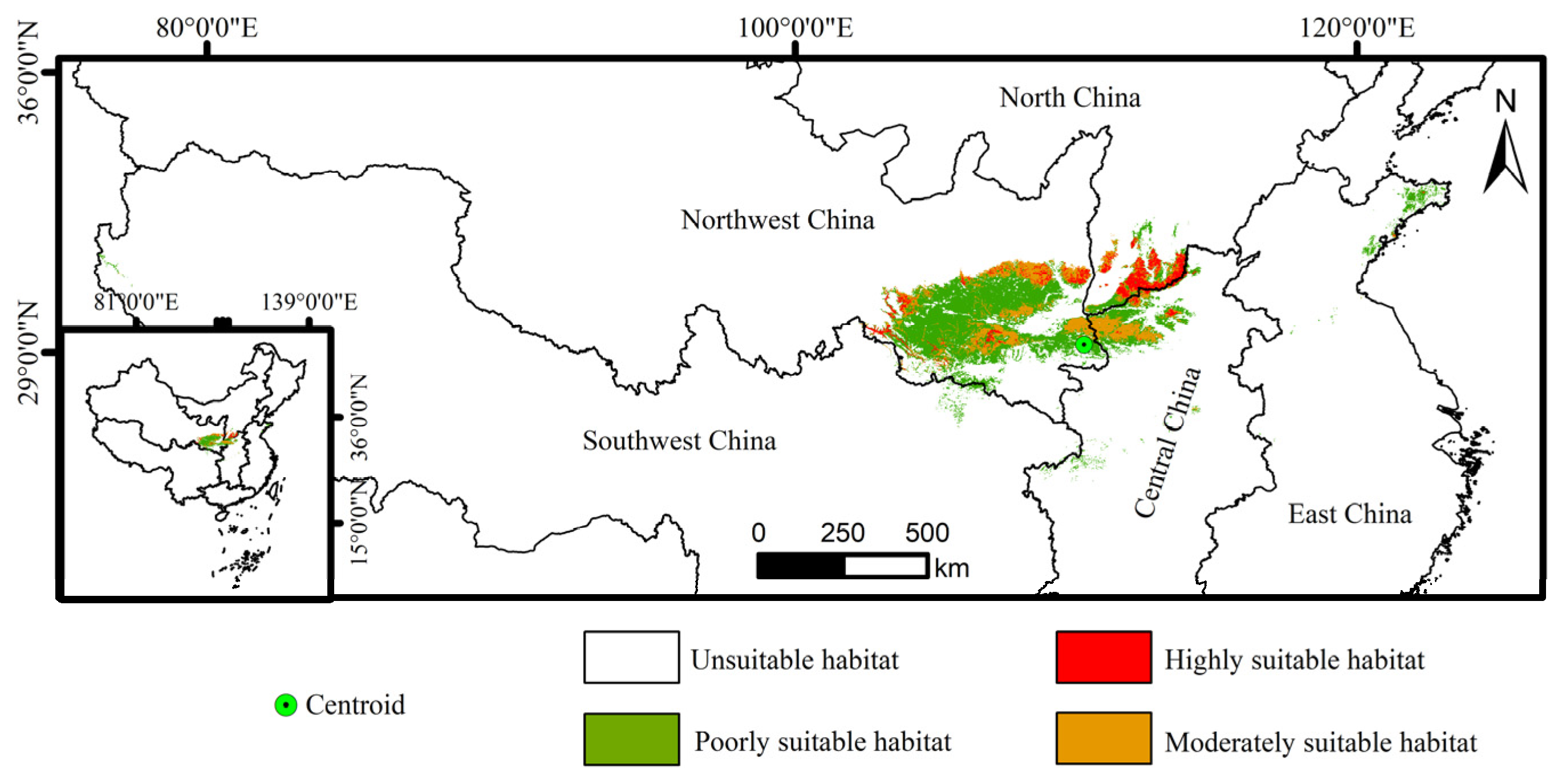
Currently, the potential suitable habitats for Q. baronii forests are primarily distributed in the eastern part of Northwest China, the northern part of Central China, and the southern part of North China, with scattered occurrences also in East and Northwest China. A total of 1.96% of the study area was classified as suitable habitat (Figure 2). The centroid of the suitable habitats for Q. baronii forests is located in the southeastern part of Shaanxi Province, China. The spatial pattern of habitat suitability was markedly heterogeneous. Highly suitable areas constituted only 10.28% of the overall suitable extent, and were predominantly clustered in eastern North China, with sporadic records in East and Northwest China. The majority of the suitable range consisted of poorly suitable habitats (64.58%), which were widespread across the eastern part of Northwest China and had scattered distributions in North, Central, East, and Southwest China. Moderately suitable habitats (25.14%) occupied a transitional zone, primarily in eastern Northwest China and northern Central China (Figure 2).
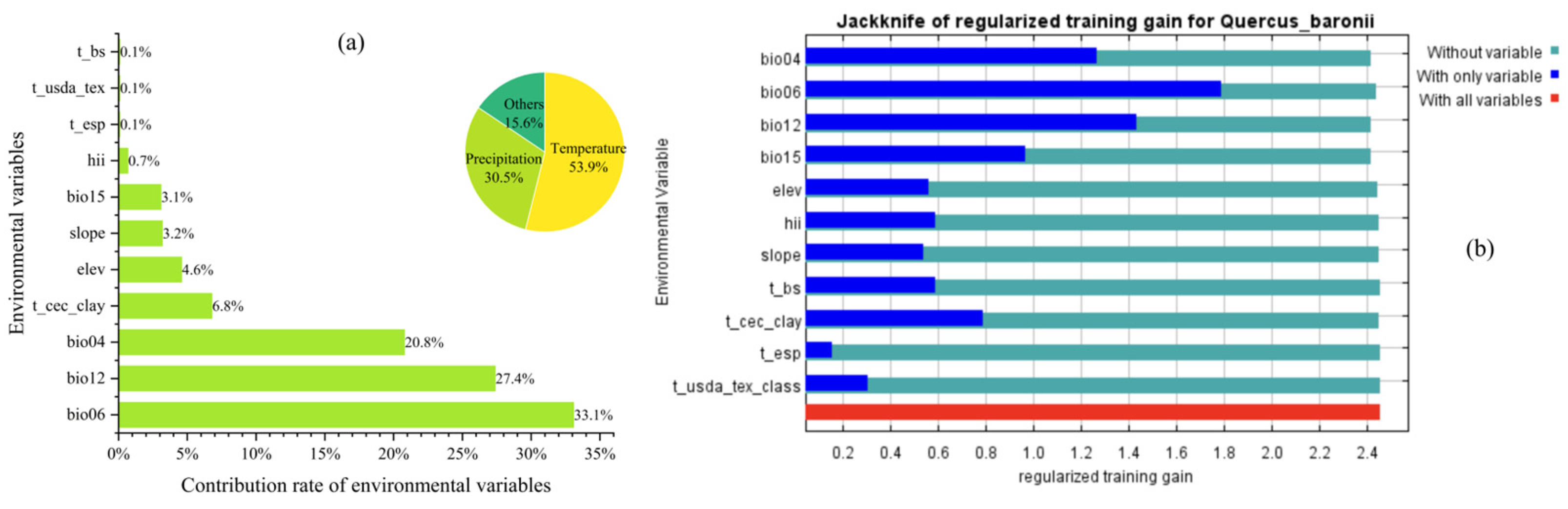
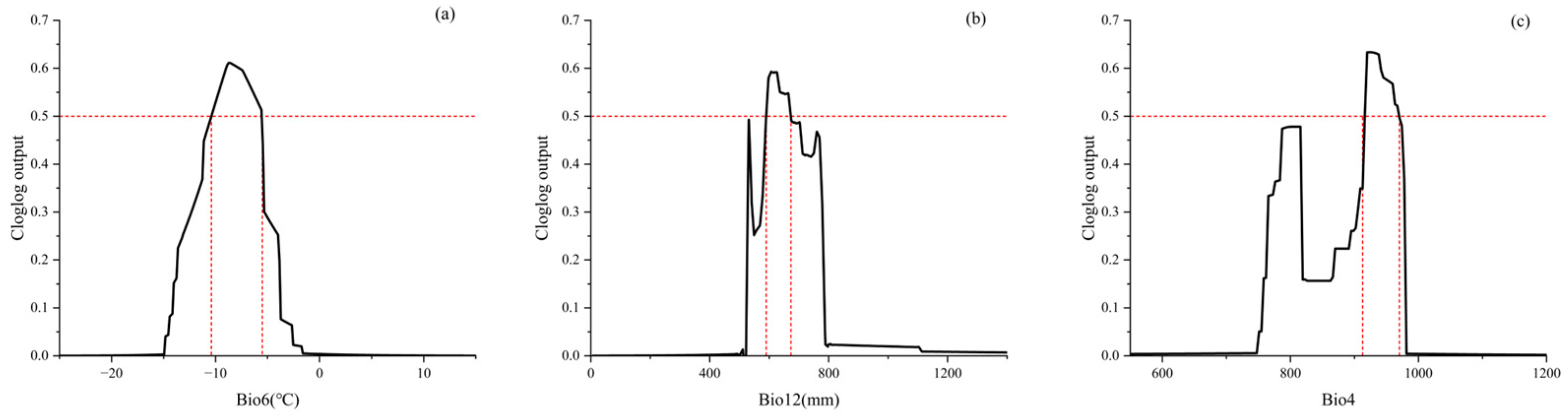
Among the 11 environmental variables influencing the distribution of Q. baronii forests, the minimum temperature of the coldest month (bio6) was the most critical limiting factor, with an individual contribution of 33.1% (Figure 3a). The combined contribution of climatic factors was 84.4%, while the impacts of topography, soil, and human activities were relatively minor. According to the regularized training gain, the factors identified with the highest contributions were the minimum temperature of the coldest month (bio6), annual precipitation (bio12), temperature seasonality (bio4), and precipitation seasonality (bio15) (Figure 3b). Among the climatic variables, the three contributors were bio6, bio12 and bio4, which together explained 81.3% of the total contribution. Integrating the results of environmental factor contributions and the jackknife test, climatic factors emerged as the primary determinants of habitat suitability for Q. baronii forests. Among these, temperature variables were the primary determinants of the potential distribution, suggesting that temperature influences the distribution of Q. baronii forests more strongly than precipitation does. The suitable habitats of Q. baronii forests were primarily controlled by bio6, bio12 and bio4. The optimal environmental conditions for the survival of Q. baronii forests were bio6 ranging from −10.5 °C to −4.5 °C (Figure 4a), bio12 between 590 and 673 mm (Figure 4b), and bio4 between 916 and 970 (Figure 4c).

3.2. Shrinkage, Expansion, and Spatial Shifts of Suitable Habitats for Q. baronii Forests

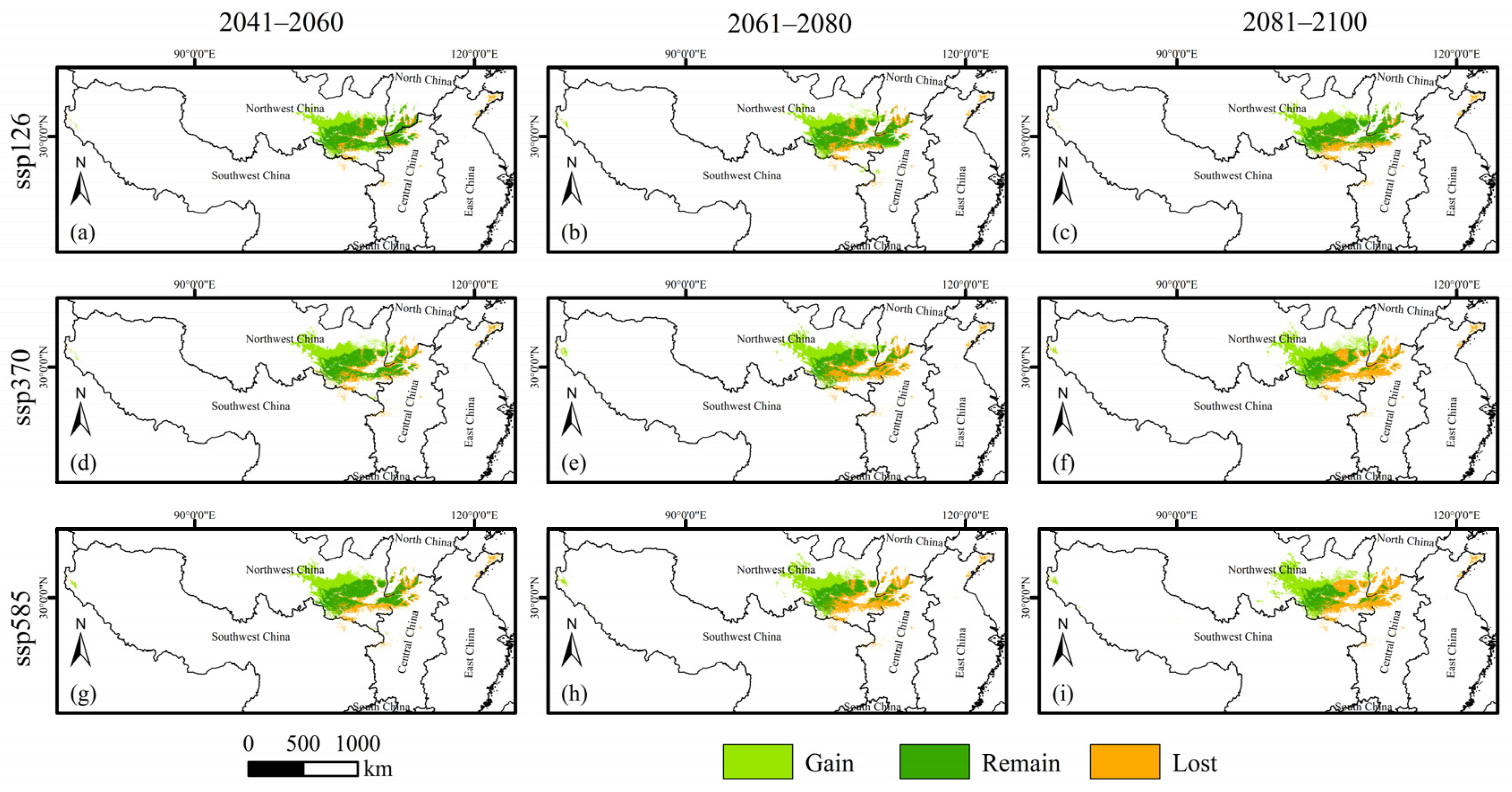
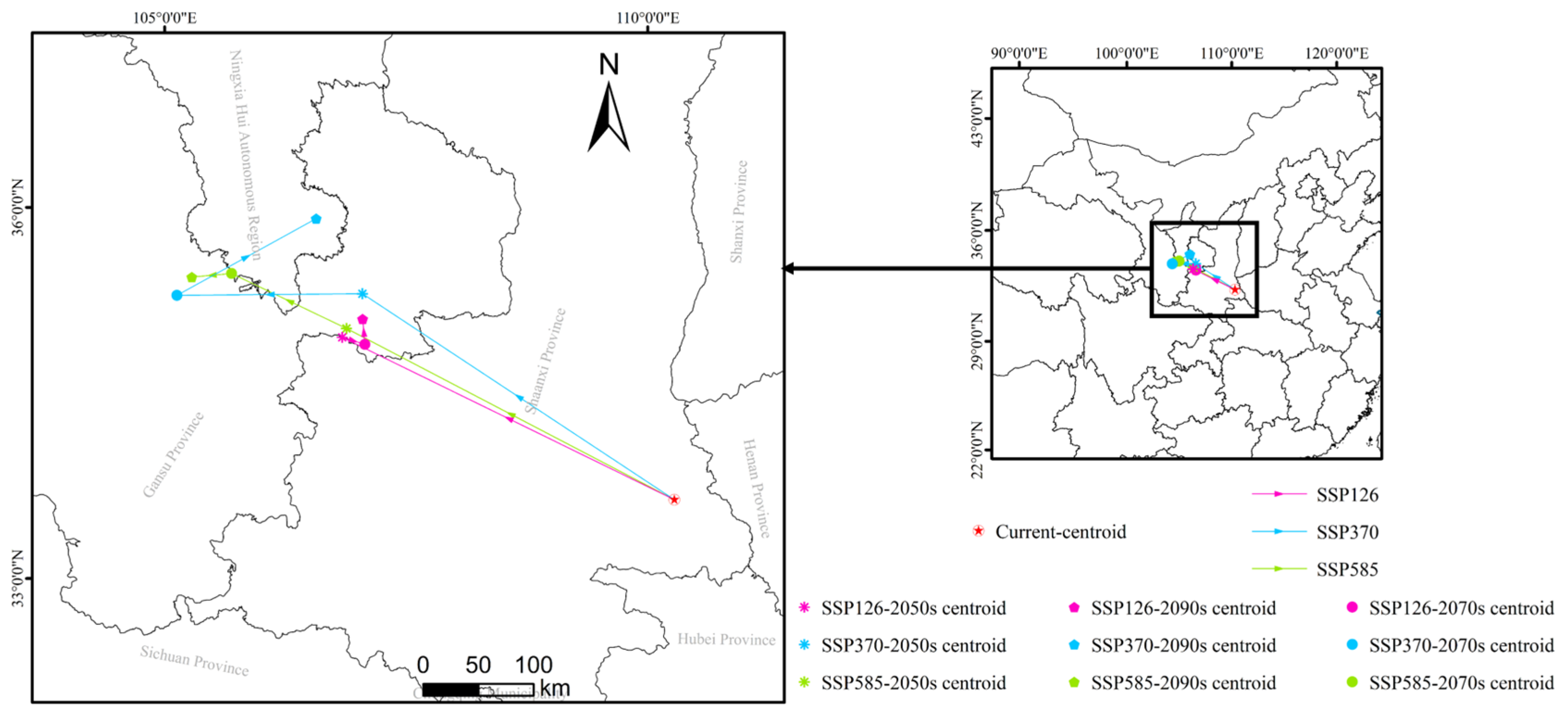
Global climate change profoundly influences the suitable habitats of Q. baronii forests. Under the three future climate scenarios, the expansion of suitable habitats for Q. baronii forests is projected to be mainly concentrated at the northwestern edges of their current range, while habitat loss is expected to occur primarily at the southern and eastern margins of the total suitable area (Figure 5 and Figures S1). Under SSP126, the extent of suitable habitat for Q. baronii forests shows an overall expansion trend, with the most pronounced increase occurring during 2041–2060, when it expands by 13.6%. In contrast, for SSP370 and SSP585, the suitable areas first expand and then contract, with the most substantial reduction (12.9%) projected during 2081–2100 under SSP585. To adapt to climate change, the suitable habitat centroid for Q. baronii forests is projected to migrate towards higher latitudes in northwestern China under different emission scenarios, moving from southeastern Shaanxi Province to northwestern Shaanxi Province, Gansu Province, and the Inner Mongolia region (Figure 6). Simultaneously, with increasing carbon emissions, the elevation of suitable habitats for Q. baronii forests is projected to gradually rise (Figure S2). Under the SSP585 climate scenario during 2081–2100, the habitat migration elevation reaches its maximum, rising from the current 1255 m to 2111 m.

3.3. Fragmentation of Suitable Habitat

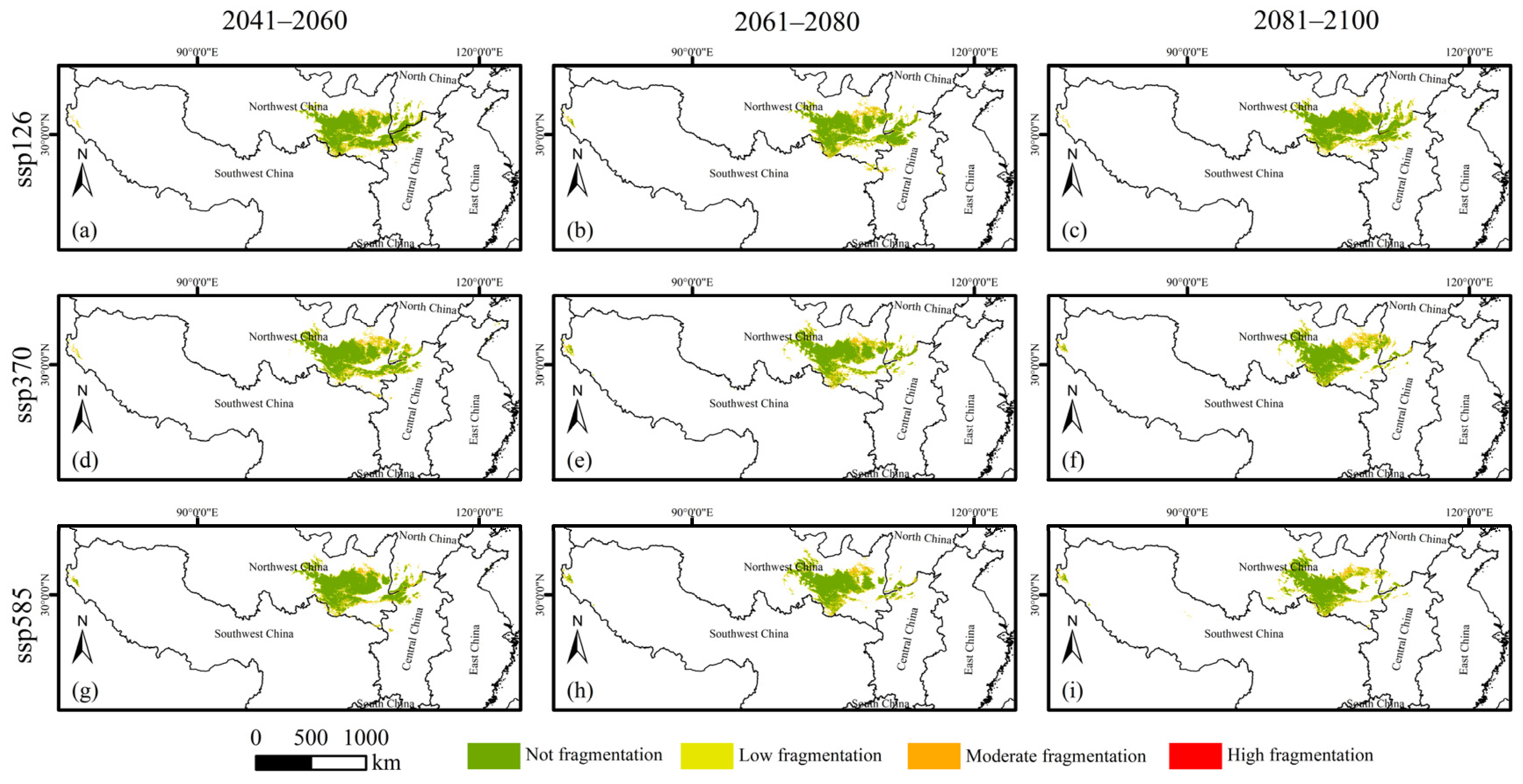
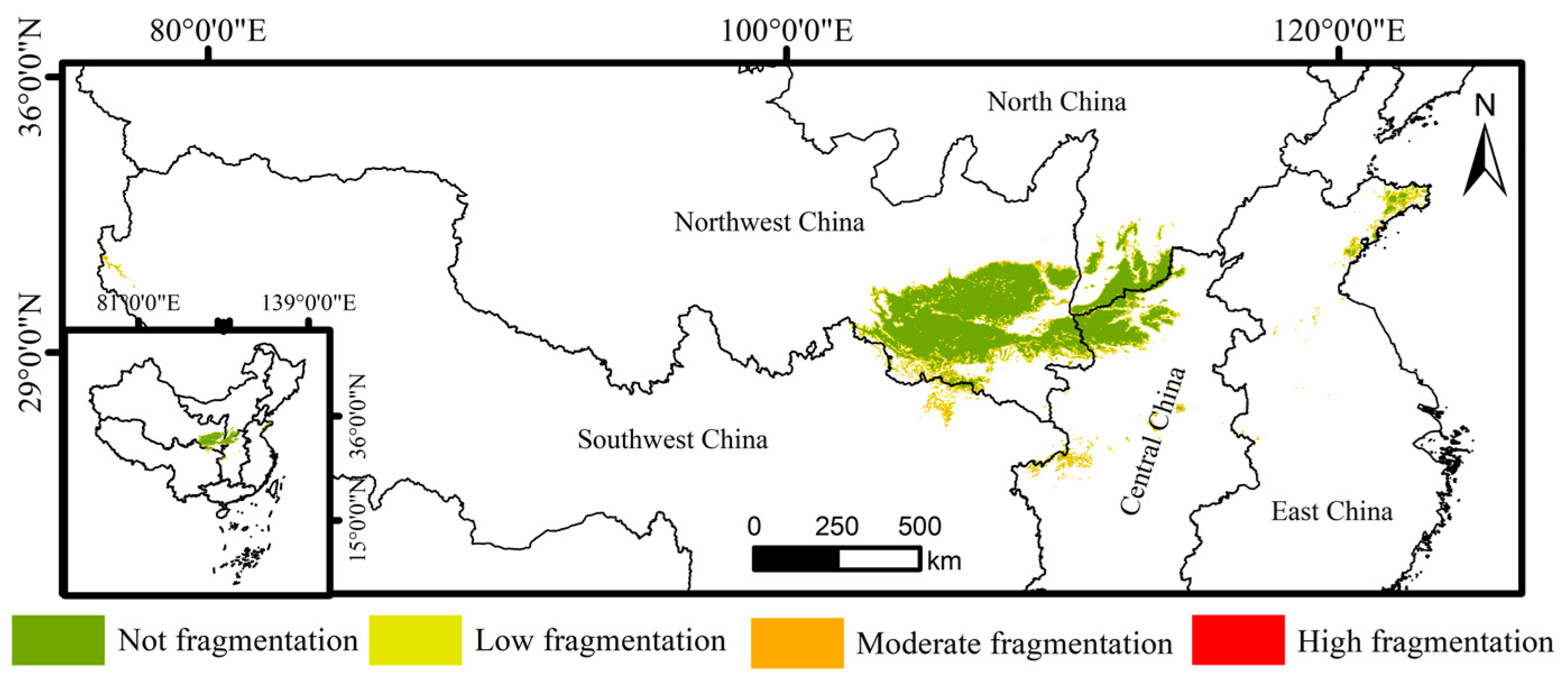
Habitat fragmentation of Q. baronii forests is primarily concentrated at the edges of suitable areas, while the interior of these habitats remains relatively intact (Figure 7). Currently, 22.4% of the suitable habitat area for Q. baronii forests exhibits low fragmentation, 7.8% exhibits moderate fragmentation, and 0.2% exhibits high fragmentation. Under the SSP126 low-emission pathway, fragmentation within the suitable range for Q. baronii forests decreases as the potential suitable area expands. During 2081–2100, the total proportion of the three fragmentation categories decreases by 2.6% (Figure 8a–c and Figure S3). With intensifying climate change, the suitable habitat area for Q. baronii forests gradually diminishes, and fragmentation becomes increasingly apparent. For both SSP370 and SSP585, the degree of fragmentation in suitable habitats for Q. baronii forests reaches its peak during 2081–2100, with the total proportion of the three fragmentation categories reaching 37.4% and 34.2%, respectively (Figure 8d–i and Figure S3). The proportion of highly fragmented area remains largely unchanged, while low- and moderate-fragmentation areas expanded by 6.9% and 3.8%, respectively.

4. Discussion

The prevalence of MaxEnt in ecological niche modeling is largely attributed to its robust performance in predicting species distributions. Previous studies using the MaxEnt model for predictions often employed default parameters, which can lead to overfitting, increased complexity, reduced accuracy, and sometimes yield results that are difficult to interpret [44]. To address these issues, the model can be optimized to enhance predictive accuracy [44,45,46,47]. Parameter optimization for the model was performed employing the ‘kuenm’ R package. Furthermore, the predicted distribution was largely consistent with the current distribution of Q. baronii forests, indicating that the optimized MaxEnt model effectively avoided overfitting and reliably simulated the potential geographical distribution of Q. baronii forests.
Climatic factors significantly influence the geographical distribution of plants, with hydrothermal conditions playing a key role in shaping distribution patterns [48]. The evaluation of environmental factor contributions indicated that the key drivers shaping the suitable areas of Q. baronii forests are bio6, bio12 and bio4. This indicates that temperature and precipitation predominantly control the distribution of Q. baronii forests. Although seeds of temperate oak forests can germinate at lower temperatures, suitable temperatures can promote seed germination, shorten the growing season, and mitigate the risk of mortality from prolonged desiccation [8]. The decomposition of foliar litter during winter provides essential nutrients for plant growth in the following growing season. Studies have shown that the contribution of soil fauna to litter decomposition is significantly correlated with winter temperature and soil moisture, with temperature being the primary controlling factor in foliar litter decomposition [49]. High temperature seasonality implies temperature instability. High temperatures can impair the morphological traits of woody plants, and extended periods of heat can adversely affect seed germination, growth, and development [50]. Simultaneously, prolonged low temperatures can cause freezing damage to trees, potentially damaging cellular membrane systems, metabolic functions, and fibrous network structures, and even leading to cell death [51]. Therefore, extreme temperature variations can adversely affect Q. baronii forests. Additionally, as Q. baronii forests are mainly distributed across arid and semi-arid regions of Northwest and North China, the role of precipitation cannot be overlooked [13]. When precipitation is scarce and water sources are insufficient, trees may allocate more biomass to roots to absorb soil moisture [52], thereby limiting growth. Studies have shown that bio6, bio12 and bio4 are the main bioclimatic variables influencing the distribution patterns of Quercus species richness in China [53,54], which aligns with our findings.
In response to climate change, species shift their geographic ranges to track previously suitable climatic conditions [55]. The distributions of many species are currently shifting towards higher latitudes or elevations in response to climate change [56,57]. Our study on Q. baronii forests also observed this trend, which becomes more pronounced with increasing carbon emissions. The centroid of suitable habitats for Q. baronii forests is projected to shift northwestward and to higher elevations, with the maximum elevational change occurring across the 2081–2100 time slice under the SSP585 climate scenario. However, when climate change is rapid, vegetation may struggle to respond in a timely manner, potentially leading to a gradual reduction in species habitat ranges and even species extinction [58,59,60]. With increasing carbon emissions, the suitable habitat area for Q. baronii forests undergoes significant changes. Particularly across the 2081–2100 time slice under the SSP585 scenario, the reduction in habitat area for Q. baronii forests reaches a maximum of 12.9%. Research suggests that, in response to climate warming, suitable habitats for certain Quercus species are projected to contract over time, a trend that aligns with our results [61].
Habitat fragmentation, the process where continuous, intact forests are divided into smaller, more isolated patches, poses a threat to biodiversity by hindering species movement, reducing population sizes, and altering ecosystem dynamics [62]. Studies suggest that in fragmented landscapes, rapid climate change can potentially overwhelm the adaptive capacity of many plant populations [63]. This study employed a moving window approach, integrating multiple landscape metrics to obtain the spatial distribution of fragmentation in suitable habitats for Q. baronii forests. Our results show that both current and future suitable habitats for Q. baronii forests remain relatively intact, with over two-thirds of the suitable area classified as non-fragmented. Areas with higher fragmentation are mainly distributed at periphery of the suitable range. Relative to SSP126, the extent of suitable habitat for Q. baronii forests under medium- and high-emission scenarios experiences greater loss and exhibits relatively higher fragmentation. As Q. baronii forests primarily rely on seed dispersal, habitat fragmentation can lead to the loss of seed dispersers, resulting in low forest regeneration rates and making outward diffusion difficult [64]. Concurrently, under high-emission scenarios, frequent extreme climate events can affect the stability of species’ geographical distributions [65,66,67], thereby impacting the stability of landscape metrics.
Habitat fragmentation diminishes species diversity and can undermine critical ecosystem processes by reducing biomass and disrupting nutrient cycling [68]. Areas with higher fragmentation for Q. baronii forests are mainly located at the edges of suitable habitats. Research indicates that distance from the forest edge significantly influences seed dispersal and predation by rodents, with seed removal rates increasing significantly with distance from the edge, thereby hindering forest regeneration [69]. Moreover, average temperatures at forest edges are consistently higher than in the interior, often exceeding the optimal temperature for vegetation productivity, which can impede ecosystem productivity and resilience [70]. Forest fragmentation creates edges, and as forest fragments shrink, the influence of these edges intensifies. Ignoring the effects of forest edges could lead to significant overestimation of carbon sink potential. Spatially optimized afforestation can maximize climate mitigation and ecological benefits. To better protect the habitats of Q. baronii forests and enhance forest ecosystem carbon sinks, artificial afforestation should be carried out in suitable areas. Studies suggest that afforestation optimized for edge effects could increase carbon sink growth by 51% [71]. Therefore, protected areas should be established within current distribution ranges and highly suitable zones to mitigate the threat of forest loss from climate change and human disturbance. Simultaneously, the impacts of suitable habitat and its fragmentation should be comprehensively considered. Afforestation at the edges of suitable areas could help reduce the negative effects of fragmentation and forest edges. We acknowledge that using only a single species distribution model (MaxEnt) in this study may introduce bias and uncertainty. To formulate more refined management and conservation policies, future research could incorporate plant phenological responses into species distribution models, develop ensemble models, apply deep learning for species distribution prediction, or integrate historical biogeographical processes, dispersal limitations, and interspecific interactions into the modeling framework to validate the accuracy of distribution forecasts.

5. Conclusions

Quercus baronii is an ecologically significant tree in arid and soil erosion-prone areas of northern China, and also holds significant potential as a bioenergy tree species. Quercus baronii forests play an important role in mitigating climate change and maintaining ecosystem stability. Global climate change has profoundly influenced the suitable habitats and habitat fragmentation of Q. baronii forests. The MaxEnt model was applied to conduct a comprehensive analysis and projection of the suitable habitats, environmental drivers, and spatial shifts of Q. baronii forests across three emission pathways (SSP126, SSP370, SSP585) for current and future conditions. Concurrently, Fragstats 4.3 was used to quantify fragmentation of suitable habitats of Q. baronii forests. The following conclusions were drawn: (1) Currently, the suitable habitats for Q. baronii forests are primarily distributed in Northwest, Central, and North China. The center of the suitable range falls within the eastern part of Northwest China. (2) Quercus baronii forests are susceptible to temperature and precipitation factors, while the impacts of topography, soil, and human activities are relatively minor. The primary environmental determinants of Q. baronii forest distribution and their optimal ranges are: minimum temperature of the coldest month (bio6, −10.5 °C to −4.5 °C), followed by annual precipitation (bio12, 590–673 mm) and temperature seasonality (bio4, 916–970). (3) Compared to the present, the suitable habitat area for Q. baronii forests is projected to expand under the low carbon emission scenario, but initially increase and then decrease across the medium- and high-emission pathways. With rising carbon emissions, the extent of suitable habitats for Q. baronii forests gradually decreases. The distribution center of Q. baronii forests is projected to shift towards higher latitudes in Northwest China and also towards higher elevations. (4) Over two-thirds of the suitable habitat for Q. baronii forests remains relatively intact, with fragmentation primarily occurring along the margins of suitable habitats. The intensity of habitat fragmentation for Q. baronii forests is projected to rise above present levels under future climate conditions, with a continued upward trend that strengthens as carbon emissions rise. These findings lay the groundwork for both the preservation of forest biodiversity and the ecological conservation and sustainable management of temperate broad-leaved forest ecosystems.

Supplementary Materials

The following supporting information can be downloaded at https://www.mdpi.com/article/10.3390/f17050598/s1. Figure S1: Habitat suitability for Quercus baronii Skan (Q. baronii) forests in future climates; Figure S2: Trapezoidal diagram of potential suitable habitats of Q. baronii forests across elevations across different climate scenarios; Figure S3: Proportion of each fragmentation level across climate scenarios; Figure S4: (A) Model tuning and selection results based on the kuenm R package; (B) AUC for the optimized MaxEnt model; Table S1: Summary of the candidate environmental variables used in variable screening.

Author Contributions

Conceptualization, H.Z.; methodology, H.Z.; software, J.G.; validation, H.Z., Y.Z. and Z.W.; formal analysis, J.G.; investigation, H.Z. and J.G.; resource, H.Z.; data curation, J.G.; writing—original draft preparation, H.Z. and J.G.; writing—review and editing, H.Z., J.G., Y.Z., Z.W. and Z.L.; visualization, J.G.; supervision, H.Z.; project administration, H.Z. and Z.L.; funding acquisition, H.Z. All authors have read and agreed to the published version of the manuscript.

Funding

This research was funded by the National Water Pollution Control and Treatment Science and Technology Major Project (2017ZX07101) and the Discipline Construction Program of Huayong Zhang, Distinguished Professor of Shandong University, School of Life Sciences (61200082363001).

Data Availability Statement

All links to input data are reported in the manuscript and all output data are available upon request to the authors.

Conflicts of Interest

The authors declare no conflicts of interest.

References

  1. Lawlor, J.A.; Comte, L.; Grenouillet, G.; Lenoir, J.; Baecher, J.A.; Bandara, R.M.W.J.; Bertrand, R.; Chen, I.-C.; Diamond, S.E.; Lancaster, L.T.; et al. Mechanisms, Detection and Impacts of Species Redistributions under Climate Change. Nat. Rev. Earth Environ. 2024, 5, 351–368. [Google Scholar] [CrossRef] [Scilit]
  2. Wang, W.J.; Thompson, F.R., III; He, H.S.; Fraser, J.S.; Dijak, W.D.; Jones-Farrand, T. Climate Change and Tree Harvest Interact to Affect Future Tree Species Distribution Changes. J. Ecol. 2019, 107, 1901–1917. [Google Scholar] [CrossRef] [Scilit]
  3. Xu, W.; Prescott, C.E. Can Assisted Migration Mitigate Climate-Change Impacts on Forests? For. Ecol. Manag. 2024, 556, 121738. [Google Scholar] [CrossRef] [Scilit]
  4. Boonman, C.C.F.; Serra-Diaz, J.M.; Hoeks, S.; Guo, W.-Y.; Enquist, B.J.; Maitner, B.; Malhi, Y.; Merow, C.; Buitenwerf, R.; Svenning, J.-C. More than 17,000 Tree Species Are at Risk from Rapid Global Change. Nat. Commun. 2024, 15, 166. [Google Scholar] [CrossRef] [Scilit]
  5. Zeng, Z.; Wu, W.; Li, Y.; Huang, C.; Zhang, X.; Peñuelas, J.; Zhang, Y.; Gentine, P.; Li, Z.; Wang, X.; et al. Increasing Meteorological Drought under Climate Change Reduces Terrestrial Ecosystem Productivity and Carbon Storage. One Earth 2023, 6, 1326–1339. [Google Scholar] [CrossRef] [Scilit]
  6. Wiens, J.J.; Zelinka, J. How Many Species Will Earth Lose to Climate Change? Glob. Change Biol. 2024, 30, e17125. [Google Scholar] [CrossRef] [Scilit]
  7. Bonan, G.B. Forests and Climate Change: Forcings, Feedbacks, and the Climate Benefits of Forests. Science 2008, 320, 1444–1449. [Google Scholar] [CrossRef] [Scilit] [PubMed]
  8. Xia, K.; Daws, M.I.; Peng, L.-L. Climate Drives Patterns of Seed Traits in Quercus Species across China. New Phytol. 2022, 234, 1629–1638. [Google Scholar] [CrossRef] [Scilit]
  9. Yang, Y.; Zhou, T.; Yang, J.; Meng, X.; Zhu, J.; Zhao, G. The Complete Chloroplast Genome of Quercus Baronii (Quercus L.). Mitochondrial DNA Part A 2017, 28, 290–291. [Google Scholar] [CrossRef] [Scilit]
  10. Ma, Z.; Shangguan, T.; Teng, C. Vegetation of Shanxi; China Science & Technology Press: Beijing, China, 2001; ISBN 7-5046-3108-6. [Google Scholar]
  11. Wei, J.; Miao, Y.; Bi, R. Altitudinal variation of leaf traits of Quercus baronii in Yunqiu Mountain. Guihaia 2014, 34, 281–285. Available online: http://gxzw.ijournals.cn/gxzw/ch/reader/view_abstract.aspx?journal_id=gxzw&file_no=20140226&html_url=gxzw/article/html/20140226 (accessed on 17 December 2025).
  12. Zhang, X. Vegetation of China and Its Geographic Pattern Illustration of the Vegetation Map of the People’s Republic of China (1:1 000 000) Volume II; Geological Publishing House: Beijing, China, 2007; ISBN 978-7-116-05146-1. [Google Scholar]
  13. Song, H.; Zhang, X.; Wang, X.; Wang, Y.; Li, S.; Xu, Y. Not the Expected Poleward Migration: Impact of Climate Change Scenarios on the Distribution of Two Endemic Evergreen Broad-Leaved Quercus Species in China. Sci. Total Environ. 2023, 889, 164273. [Google Scholar] [CrossRef] [Scilit]
  14. Chang, Z.; Zhang, L.; Huang, Y.; Chen, X.; Yang, J. Species Differentiation of Two Endemic Montane Oaks in China: Population Genetics, Ecological Niche and Leaf Morphology Analyses. Forests 2025, 16, 549. [Google Scholar] [CrossRef] [Scilit]
  15. Yang, Y.; Zhou, T.; Duan, D.; Yang, J.; Feng, L.; Zhao, G. Comparative Analysis of the Complete Chloroplast Genomes of Five Quercus Species. Front. Plant Sci. 2016, 7, 959. [Google Scholar] [CrossRef] [Scilit]
  16. Zhang, F.-G.; Liang, F.; Wu, K.; Xie, L.; Zhao, G.; Wang, Y. The Potential Habitat of Angelica Dahurica in China under Climate Change Scenario Predicted by Maxent Model. Front. Plant Sci. 2024, 15, 1388099. [Google Scholar] [CrossRef] [Scilit]
  17. Ahmadi, M.; Hemami, M.; Kaboli, M.; Shabani, F. MaxEnt Brings Comparable Results When the Input Data Are Being Completed; Model Parameterization of Four Species Distribution Models. Ecol. Evol. 2023, 13, e9827. [Google Scholar] [CrossRef] [Scilit] [PubMed]
  18. Chen, J.; Wu, L.; Yang, C.; Qiu, Q.; Wang, Y.; Li, Z.; Xia, C.; Chen, J.; Wu, L.; Yang, C.; et al. Predicting Potential Habitats of the Endangered Mangrove Species Acanthus Ebracteatus Under Current and Future Climatic Scenarios Based on MaxEnt and OPGD Models. Plants 2025, 14, 2827. [Google Scholar] [CrossRef] [Scilit]
  19. Wang, E.; Lu, Z.; Rohani, E.R.; Ou, J.; Tong, X.; Han, R. Current and Future Distribution of Forsythia Suspensa in China under Climate Change Adopting the MaxEnt Model. Front. Plant Sci. 2024, 15, 1394799. [Google Scholar] [CrossRef] [Scilit] [PubMed]
  20. Yang, Q.; Ye, X.; Guo, G.; Li, L. Effects of Climate Change on the Richness Distribution of Phyllostachys Species in China. J. For. Res. 2025, 36, 132. [Google Scholar] [CrossRef] [Scilit]
  21. Shen, S.; Zheng, F.; Zhang, W.; Xu, G.; Li, D.; Yang, S.; Jin, G.; Clements, D.R.; Nikkel, E.; Chen, A.; et al. Potential Distribution and Ecological Impacts of Acmella Radicans (Jacquin) R.K. Jansen (a New Yunnan Invasive Species Record) in China. BMC Plant Biol. 2024, 24, 494. [Google Scholar] [CrossRef] [Scilit]
  22. Zhao, J.; Ma, L.; Song, C.; Xue, Z.; Zheng, R.; Yan, X.; Hao, C. Modelling Potential Distribution of Tuta Absoluta in China under Climate Change Using CLIMEX and MaxEnt. J. Appl. Entomol. 2023, 147, 895–907. [Google Scholar] [CrossRef] [Scilit]
  23. Zhang, H.; Zhang, B.; Zhang, Y.; Wang, Z.; Liu, Z. Climate Change Drives Shifts in Suitable Habitats of Three Stipa Purpurea Alpine Steppes on the Western Tibetan Plateau. Diversity 2025, 17, 145. [Google Scholar] [CrossRef] [Scilit]
  24. Zhang, H.; Liu, P.; Zhang, Y.; Wang, Z.; Liu, Z. Global Warming and Landscape Fragmentation Drive the Adaptive Distribution of Phyllostachys Edulis in China. Forests 2024, 15, 2231. [Google Scholar] [CrossRef] [Scilit]
  25. Ran, Q.; Wei, H.; Zhao, Z.; Zhang, Q.; Liu, J.; Gu, W. Impact of climate change on the potential distribution and habitat fragmentation of the relict plant Cathaya argyrophylla Chun et Kuang. Acta Ecol. Sin. 2019, 39, 2481–2493. [Google Scholar] [CrossRef] [Scilit]
  26. Kotlov, I.; Chernenkova, T.; Belyaeva, N. Vegetation Response Patterns to Landscape Fragmentation in Central Russian Forests. Land 2025, 14, 2441. [Google Scholar] [CrossRef] [Scilit]
  27. Zhang, H.; Zhou, Y.; Ji, X.; Wang, Z.; Liu, Z. Climate Change Drives the Adaptive Distribution and Habitat Fragmentation of Betula Albosinensis Forests in China. Forests 2025, 16, 184. [Google Scholar] [CrossRef] [Scilit]
  28. Resource and Environmental Science Data Platform. Available online: https://www.resdc.cn/ (accessed on 17 September 2025).
  29. Hou, X. Vegetation Atlas of China; Scientific Press: Beijing, China, 2001. [Google Scholar]
  30. WorldClim. Available online: https://worldclim.org/ (accessed on 15 August 2025).
  31. Harmonized World Soil Database v1.2|FAO SOILS PORTAL|Food and Agriculture Organization of the United Nations. Available online: https://www.fao.org/soils-portal/data-hub/soil-maps-and-databases/harmonized-world-soil-database-v12/en/ (accessed on 15 August 2025).
  32. NASA’s Earth Science Data Systems. Last of the Wild Project, Version 2, 2005 (LWP-2): Global Human Footprint Dataset (Geographic)|NASA Earthdata. Available online: https://www.earthdata.nasa.gov/data/ (accessed on 15 August 2025).
  33. Xin, X.; Wu, T.; Zhang, J.; Yao, J.; Fang, Y. Comparison of CMIP6and CMIP5 Simulations of Precipitation in China and the East Asian Summer Monsoon. Int. J. Climatol. 2020, 40, 6423–6440. [Google Scholar] [CrossRef] [Scilit]
  34. Jin, H.; Chen, X.; Zhong, R.; Wu, P.; Li, D. Spatio-Temporal Changes of Precipitation in the Hanjiang River Basin under Climate Change. Theor. Appl. Clim. 2021, 146, 1441–1458. [Google Scholar] [CrossRef] [Scilit]
  35. Fan, Y.; Zhang, X.; Yang, J.; Yang, J.; Zhang, H.; Yang, B.; Li, X. Prediction of Global Potential Distribution and Assessment of Habitat Suitability for Xanthium Spinosum Driven by Climate Change. Front. Plant Sci. 2025, 16, 1690546. [Google Scholar] [CrossRef] [Scilit]
  36. Shi, X.; Wang, J.; Zhang, L.; Chen, S.; Zhao, A.; Ning, X.; Fan, G.; Wu, N.; Zhang, L.; Wang, Z. Prediction of the Potentially Suitable Areas of Litsea Cubeba in China Based on Future Climate Change Using the Optimized MaxEnt Model. Ecol. Indic. 2023, 148, 110093. [Google Scholar] [CrossRef] [Scilit]
  37. Phillips, S.J.; Anderson, R.P.; Schapire, R.E. Maximum Entropy Modeling of Species Geographic Distributions. Ecol. Model. 2006, 190, 231–259. [Google Scholar] [CrossRef] [Scilit]
  38. Phillips, S.J.; Anderson, R.P.; Dudík, M.; Schapire, R.E.; Blair, M.E. Opening the Black Box: An Open-source Release of Maxent. Ecography 2017, 40, 887–893. [Google Scholar] [CrossRef] [Scilit]
  39. Cobos, M.E.; Peterson, A.T.; Barve, N.; Osorio-Olvera, L. Kuenm: An R Package for Detailed Development of Ecological Niche Models Using Maxent. PeerJ 2019, 7, e6281. [Google Scholar] [CrossRef] [Scilit]
  40. Noedoost, F.; Behroozian, M.; Karami, S.; Joharchi, M.R. Potential Impacts of Climate Change on the Geographic Distribution of Achillea Eriophora DC., a Medicinal Species Endemic to Iran in Southwestern Asia. Ecol. Evol. 2024, 14, e11241. [Google Scholar] [CrossRef] [Scilit] [PubMed]
  41. Shcheglovitova, M.; Anderson, R.P. Estimating Optimal Complexity for Ecological Niche Models: A Jackknife Approach for Species with Small Sample Sizes. Ecol. Model. 2013, 269, 9–17. [Google Scholar] [CrossRef] [Scilit]
  42. Wang, X.; Liu, G.; Xiao, S.; Quan, M. Habitat Suitability Distribution and Fragmentation of Camellia Oleifera in China under Current and Future Climate Scenarios Based on MaxEnt and Fragstats. Environ. Monit. Assess. 2025, 197, 1113. [Google Scholar] [CrossRef] [Scilit]
  43. Ma, J.; Li, J.; Wu, W.; Liu, J. Global Forest Fragmentation Change from 2000 to 2020. Nat. Commun. 2023, 14, 3752. [Google Scholar] [CrossRef] [Scilit]
  44. Zhu, D.P.; Yang, L.; Li, Y.; Huang, P.; Yao, B.; Kong, Z.; Xiang, Y. Predicting the Potential Distribution of the Endangered Pyrethrum Tatsienense in China Using an Optimized Maxent Model Under Climate Change Scenarios. Ecol. Evol. 2024, 14, e70503. [Google Scholar] [CrossRef] [Scilit]
  45. Zhao, Z.; Yang, L.; Chen, X. Globally Suitable Areas for Lycorma Delicatula Based on an Optimized Maxent Model. Ecol. Evol. 2024, 14, e70252. [Google Scholar] [CrossRef] [Scilit]
  46. Dong, P.; Wang, L.; Wang, L.; Lei, M.; Qiu, D.; Bai, G.; Guo, F.-X.; Chen, Y. Investigating the Distributional Response of the Rare and Endangered Plant Fritillaria Przewalskii to Climate Change Based on Optimized MaxEnt Model. Sci. Rep. 2025, 15, 35939. [Google Scholar] [CrossRef] [Scilit] [PubMed]
  47. Shan, Y.; Shen, H.; Huang, L.; Hamezah, H.S.; Han, R.; Ren, X.; Zhang, C.; Tong, X. Optimized MaxEnt Analysis Revealing the Change of Potential Distribution Area of Lygodium Japonicum in China Driven by Global Warming. Front. Plant Sci. 2025, 16, 1601956. [Google Scholar] [CrossRef] [Scilit]
  48. Ramírez-Preciado, R.P.; Gasca-Pineda, J.; Arteaga, M.C. Effects of Global Warming on the Potential Distribution Ranges of Six Quercus Species (Fagaceae). Flora 2019, 251, 32–38. [Google Scholar] [CrossRef] [Scilit]
  49. Peng, Y.; Yang, W.; Li, J.; Wang, B.; Zhang, C.; Yue, K.; Wu, F. Contribution of Soil Fauna to Foliar Litter-Mass Loss in Winter in an Ecotone between Dry Valley and Montane Forest in the Upper Reaches of the Minjiang River. PLoS ONE 2015, 10, e0124605. [Google Scholar] [CrossRef] [Scilit]
  50. Zhou, C.; Wu, S.; Li, C.; Quan, W.; Wang, A. Response Mechanisms of Woody Plants to High-Temperature Stress. Plants 2023, 12, 3643. [Google Scholar] [CrossRef] [Scilit] [PubMed]
  51. Song, X.; Gao, T.; Ai, M.; Gao, S. Experimental Investigation of Freeze Injury Temperatures in Trees and Their Contributing Factors Based on Electrical Impedance Spectroscopy. Front. Plant Sci. 2024, 15, 1326038. [Google Scholar] [CrossRef] [Scilit]
  52. Luo, Y.; Wang, X.; Zhang, X.; Booth, T.H.; Lu, F. Root:Shoot Ratios across China’s Forests: Forest Type and Climatic Effects. For. Ecol. Manag. 2012, 269, 19–25. [Google Scholar] [CrossRef] [Scilit]
  53. Sun, S.; Zhang, Y.; Wang, N.; Yang, W.; Zhai, Y.; Wang, H.; Fan, P.; You, C.; Zheng, P.; Wang, R. Changing Effects of Energy and Water on the Richness Distribution Pattern of the Quercus Genus in China. Front. Plant Sci. 2024, 15, 1301395. [Google Scholar] [CrossRef] [Scilit]
  54. Sun, S.; Zhang, Y.; Huang, D.; Wang, H.; Cao, Q.; Fan, P.; Yang, N.; Zheng, P.; Wang, R. The Effect of Climate Change on the Richness Distribution Pattern of Oaks (Quercus L.) in China. Sci. Total Environ. 2020, 744, 140786. [Google Scholar] [CrossRef] [Scilit]
  55. Davis, M.B.; Shaw, R.G.; Etterson, J.R. Evolutionary Responses to Changing Climate. Ecology 2005, 86, 1704–1714. [Google Scholar] [CrossRef] [Scilit]
  56. Chen, I.-C.; Hill, J.K.; Ohlemüller, R.; Roy, D.B.; Thomas, C.D. Rapid Range Shifts of Species Associated with High Levels of Climate Warming. Science 2011, 333, 1024–1026. [Google Scholar] [CrossRef] [Scilit] [PubMed]
  57. Zhao, Y.; Xu, L.; Zhang, Y.; Wen, Y.; Zhang, D. Climate-Change Impacts on Distribution, Habitats, Sustainability and Cultivation Planning of Two Economically and Ecologically Important Forest Trees (China Fir and Masson Pine) in China. Glob. Ecol. Conserv. 2025, 57, e03349. [Google Scholar] [CrossRef] [Scilit]
  58. Engler, R.; Randin, C.F.; Thuiller, W.; Dullinger, S.; Zimmermann, N.E.; Araújo, M.B.; Pearman, P.B.; Lay, G.L.; Piedallu, C.; Albert, C.H.; et al. 21st Century Climate Change Threatens Mountain Flora Unequally across Europe. Glob. Change Biol. 2011, 17, 2330–2341. [Google Scholar] [CrossRef] [Scilit]
  59. Dyderski, M.K.; Paź, S.; Frelich, L.E.; Jagodziński, A.M. How Much Does Climate Change Threaten European Forest Tree Species Distributions? Glob. Change Biol. 2018, 24, 1150–1163. [Google Scholar] [CrossRef] [Scilit]
  60. Neilson, R.P.; Pitelka, L.F.; Solomon, A.M.; Nathan, R.; Midgley, G.F.; Fragoso, J.M.V.; Lischke, H.; Thompson, K. Forecasting Regional to Global Plant Migration in Response to Climate Change. BioScience 2005, 55, 749–759. [Google Scholar] [CrossRef] [Scilit]
  61. Guo, Y.; Zhao, Z.; Wang, J. Projected Degradation of Quercus Habitats in Southern China under Future Global Warming Scenarios. For. Ecol. Manag. 2024, 568, 122133. [Google Scholar] [CrossRef] [Scilit]
  62. Zou, Y.; Crowther, T.W.; Smith, G.R.; Ma, H.; Mo, L.; Bialic-Murphy, L.; Potapov, P.; Gawecka, K.A.; Xu, C.; Negret, P.J.; et al. Fragmentation Increased in over Half of Global Forests from 2000 to 2020. Science 2025, 389, 1151–1156. [Google Scholar] [CrossRef] [Scilit]
  63. Jump, A.S.; Peñuelas, J. Running to Stand Still: Adaptation and the Response of Plants to Rapid Climate Change. Ecol. Lett. 2005, 8, 1010–1020. [Google Scholar] [CrossRef] [Scilit]
  64. Niu, H.; Wang, X.; Zhang, H.; Wang, D. Oak, Quercus Chenii, Dispersal in Fragmented Urban Forests: Acorn Horizontal and Vertical Dispersal, Seedling Establishment and Growth. Urban Ecosyst. 2020, 23, 379–388. [Google Scholar] [CrossRef] [Scilit]
  65. van der Wiel, K.; Bintanja, R. Contribution of Climatic Changes in Mean and Variability to Monthly Temperature and Precipitation Extremes. Commun. Earth Environ. 2021, 2, 1. [Google Scholar] [CrossRef] [Scilit]
  66. Zeng, Z.; Wu, W.; Peñuelas, J.; Li, Y.; Jiao, W.; Li, Z.; Ren, X.; Wang, K.; Ge, Q. Increased Risk of Flash Droughts with Raised Concurrent Hot and Dry Extremes under Global Warming. npj Clim. Atmos. Sci. 2023, 6, 134. [Google Scholar] [CrossRef] [Scilit]
  67. Lemordant, L.; Gentine, P. Vegetation Response to Rising CO2 Impacts Extreme Temperatures. Geophys. Res. Lett. 2019, 46, 1383–1392. [Google Scholar] [CrossRef] [Scilit]
  68. Haddad, N.M.; Brudvig, L.A.; Clobert, J.; Davies, K.F.; Gonzalez, A.; Holt, R.D.; Lovejoy, T.E.; Sexton, J.O.; Austin, M.P.; Collins, C.D.; et al. Habitat Fragmentation and Its Lasting Impact on Earth’s Ecosystems. Sci. Adv. 2015, 1, e1500052. [Google Scholar] [CrossRef] [Scilit]
  69. Wang, X.; Zhang, L.; Huo, X.; Zhang, G.; Yu, F. Reduced Rodent-Mediated Seed Dispersal at Forest Edge Hinders Regeneration. Glob. Ecol. Conserv. 2025, 59, e03571. [Google Scholar] [CrossRef] [Scilit]
  70. Reek, J.E.; Crowther, T.W.; Lauber, T.; Schemm, S.; Parastatidis, D.; Chrysoulakis, N.; Huang, M.; Piao, S.; Zohner, C.M.; Smith, G.R. Forest Edges Are Globally Warmer than Interiors and Exceed Optimal Temperatures for Vegetation Productivity. Commun. Earth Environ. 2025, 6, 635. [Google Scholar] [CrossRef] [Scilit]
  71. Dong, Y.; Yu, Z.; Pugh, T.; Agathokleous, E.; Zhang, F.; Sitch, S.; You, W.; Han, W.; Olin, S.; Liu, S.; et al. Enhancing Carbon Sinks in China Using a Spatially-Optimized Forestation Strategy. Nat. Commun. 2026, 17, 1576. [Google Scholar] [CrossRef] [Scilit]
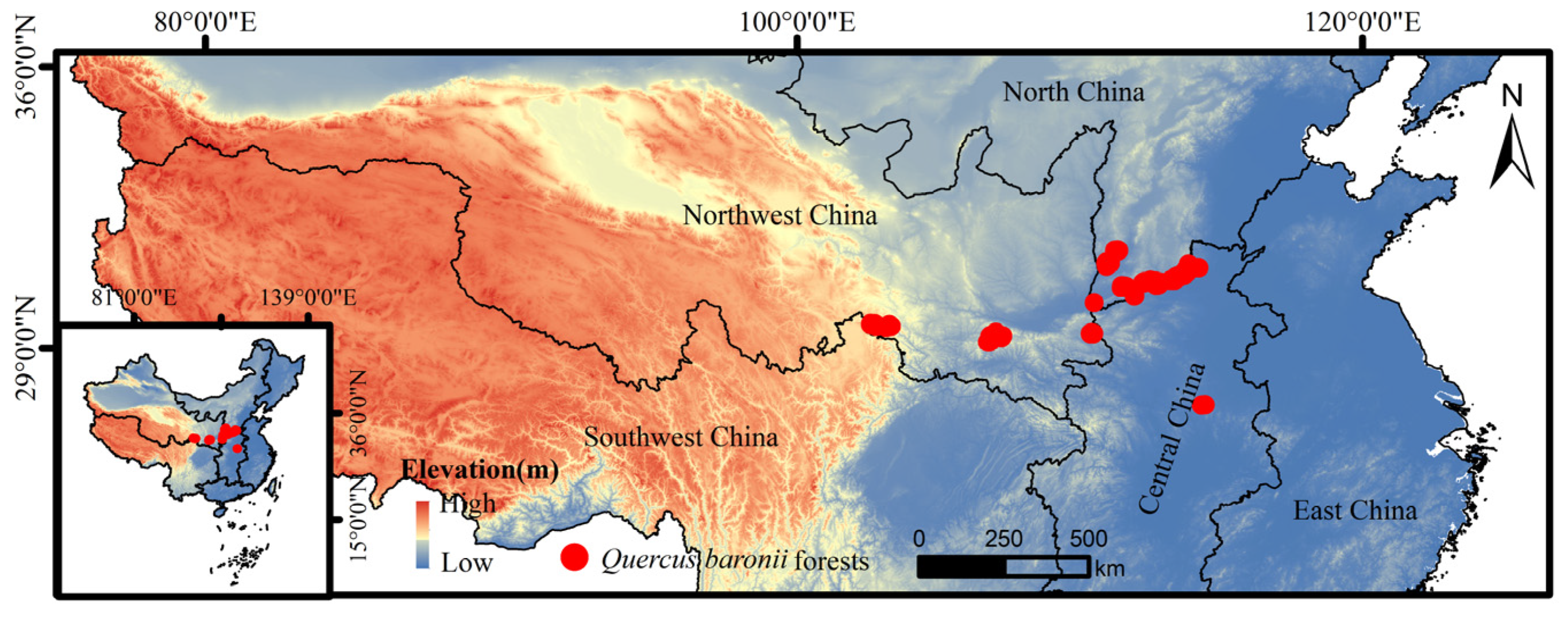
Figure 1. Spatial distribution of Quercus baronii Skan (Q. baronii) forests occurrence points in China.
Forests 17 00598 g001
Figure 2. Suitable habitats of Q. baronii forests under current climate in China.
Forests 17 00598 g002
Figure 3. (a) Variable contributions to habitat suitability for Q. baronii forests; (b) results of Jackknife test (see Table S1 for full variable names).
Forests 17 00598 g003
Figure 4. Response curves for the main factors affecting the distribution of Q. baronii forests (ac). (Variable abbreviations are listed in Table S1).
Forests 17 00598 g004
Figure 5. Spatial changes in suitable areas for Q. baronii forests over different time periods and under climate scenarios in China (ai).
Forests 17 00598 g005
Figure 6. Centroid shift of suitable habitats for Q. baronii forests across multiple time periods and climate scenarios.
Forests 17 00598 g006
Figure 7. Current fragmentation patterns in suitable areas for Q. baronii forests.
Forests 17 00598 g007
Figure 8. Fragmentation patterns of suitable habitats of Q. baronii forests across multiple time periods and climate scenarios (ai).
Forests 17 00598 g008
Disclaimer/Publisher’s Note: The statements, opinions and data contained in all publications are solely those of the individual author(s) and contributor(s) and not of MDPI and/or the editor(s). MDPI and/or the editor(s) disclaim responsibility for any injury to people or property resulting from any ideas, methods, instructions or products referred to in the content.