


Abstract
Urban trees are increasingly exposed to persistent anthropogenic drivers that extend beyond climatic forcing and fundamentally alter the conditions of secondary growth. While climatic controls of cambial phenology and xylogenesis are well established, the mechanisms by which non-climatic drivers regulate cambial activity and wood formation remain fragmented and are often inferred only indirectly. Here, we develop a cambium-centred framework to synthesise current evidence on how anthropogenic drivers shape wood formation in urban and peri-urban trees. To our knowledge, this is among the first syntheses explicitly linking anthropogenic drivers to distinct stages of xylogenesis. Anthropogenic drivers are typically chronic, spatially heterogeneous, and temporally decoupled from seasonal climatic rhythms, and may alter cambial kinetics and generate anatomical signatures not captured by ring width alone. We evaluate major driver domains, including root-zone constraints, altered hydrology, urban microclimate, pollution, salinity, and mechanical disturbance, while also considering emerging drivers such as artificial light at night and microplastics. Evidence is stratified into three levels: direct observations, indirect physiological evidence, and mechanistic plausibility. Across driver classes, three recurrent anatomical patterns emerge: reduced conduit size under hydraulic or osmotic stress; anomalies in wall deposition under carbon limitation or oxidative stress; and pronounced circumferential heterogeneity under spatially localised forcing. Integrative approaches combining xylogenesis monitoring, quantitative wood anatomy, dendrometer observations and spatially explicit sampling are essential to disentangle anthropogenic from climatic effects and improve assessment of tree resilience.
1. Introduction
Trees growing in contemporary landscapes experience environmental forcing that extends well beyond climate alone. Secondary growth and xylem differentiation are regulated by external and internal factors controlling cambial cell division, enlargement, wall deposition, and lignification within the vascular cambium [1,2,3,4,5,6,7,8]. At the same time, anthropogenic pressures increasingly modify the physical and physiological environments in which these processes take place [9,10,11,12,13]. Urbanisation, transport infrastructure, soil sealing, compaction, altered drainage, atmospheric pollution, particulate deposition, salinity, and recurrent management interventions reshape both belowground and aboveground conditions in which woody plants develop [9,10,11,12,13]. In cities and peri-urban systems, these pressures often co-occur, overlap in time, and vary sharply over short distances; in managed forests, they are superimposed on silvicultural interventions that modify competition, resource supply, exposure, and mechanical loading [11,13]. Consequently, trees in anthropogenic environments experience a complex mosaic of non-climatic constraints acting continuously, intermittently, or directionally across both the rooting zone and the stem.
The vascular cambium acts as a central integrator of these environmental signals, coordinating radial growth, hydraulic transport, biomechanical support, and long-term allocation to woody tissues [1,2,3,4]. Its developmental activity is expressed through xylogenesis, comprising cambial division, cell enlargement, secondary wall deposition, and lignification [4,5,6,7,8,14,15]. These phases differ in timing, resource requirements, and physiological sensitivity [5,6,7,8,16,17,18]. Importantly, kinetic analyses of tracheid development demonstrate that tree-ring structure emerges from the duration and rate of developmental processes rather than from a single integrated growth signal [5,6,7]. As a result, the same annual ring may retain multiple distinct imprints of environmental forcing at intra-annual resolution, including variation in conduit size and density, density anomalies, reaction tissues, traumatic structures, and altered earlywood–latewood transitions [14,15,16,17]. This developmental specificity is particularly important in anthropogenic settings. Climatic forcing is often seasonally coherent, whereas anthropogenic drivers are frequently chronic, spatially localised, asymmetric, or decoupled from seasonal cues [9,10,11,12,13,16]. A tree may experience root restriction on one side, splash-zone salinity along a road-facing sector, localised cambial injury following pruning or impact, elevated dust deposition on one traffic-exposed flank, or pulsed irrigation unrelated to phenological demand [19,20,21]. Under such conditions, annual radial increment alone is often insufficient, as it integrates multiple processes into a single annual metric and may obscure the developmental pathway through which stress is expressed [14,15,16,17]. By contrast, cambial monitoring and trait-based wood analysis can identify whether forcing primarily constrained cell production, enlargement, wall deposition, or maturation, and whether the signal was circumferentially homogeneous or sectorial.
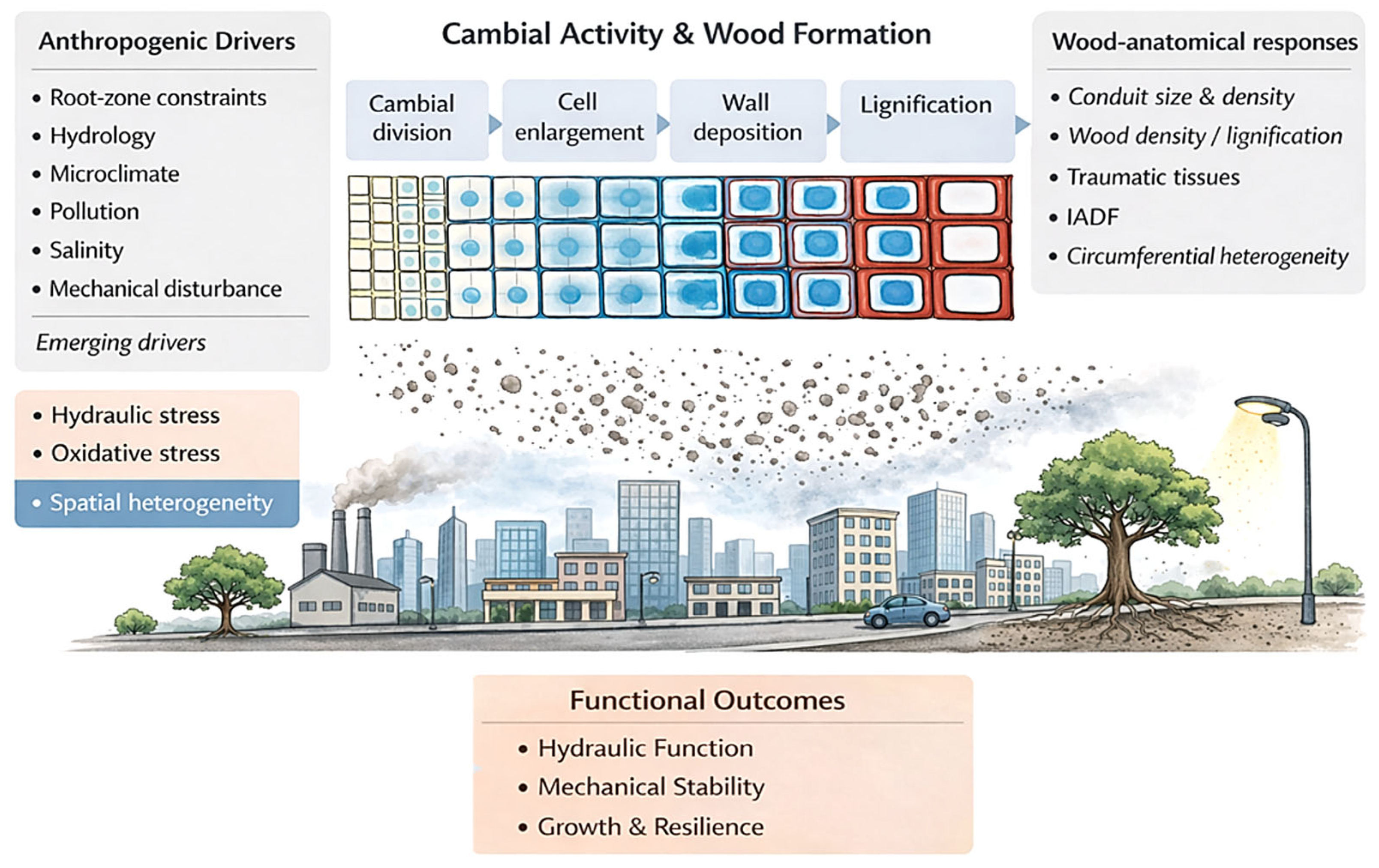
A cambium-centred perspective is therefore particularly well suited to synthesising anthropogenic effects on tree growth (Figure 1). It allows environmental drivers to be interpreted not only as stress categories, but as developmental constraint systems acting on distinct stages of wood formation [5,6,7,8,14]. It also provides a mechanistic bridge between urban forestry, tree physiology, plant hydraulics, dendroecology, and wood anatomy [14,15,16,17,18]. This is especially relevant because recurrent anthropogenic pressures frequently push trees toward structurally conservative hydraulic strategies, including reduced conduit diameter, altered conduit frequency, and denser or mechanically reinforced tissues, while other drivers may compromise wall formation or induce traumatic reactions [15,16,17,18].
Figure 1.
Conceptual cambium-centred framework of anthropogenic regulation of wood formation. Anthropogenic drivers act as phase-specific developmental constraints on xylogenesis (cambial division, cell enlargement, wall deposition, and lignification), generating distinct wood-anatomical signatures. These include variation in conduit size and density, modifications in wood density and lignification, traumatic tissues, intra-annual density fluctuations (IADFs), and circumferential heterogeneity. By linking environmental forcing to developmental processes and anatomical traits, the framework provides a mechanistic basis for interpreting tree responses and assessing functional outcomes such as hydraulic function, mechanical stability, and resilience.
The objective of this review is not to treat all anthropogenic influences on trees as equally resolved. Instead, the manuscript applies an explicit evidence hierarchy. Drivers supported by cambial phenology, xylogenesis studies, tree-ring anatomy, or quantitative wood-anatomical observations are treated as core sections [4,5,6,7,8,14,15,16,17,20,21]. Drivers for which evidence remains indirect or largely mechanistic are retained as frontier topics, but are clearly identified as such [22,23,24,25,26,27,28,29]. Within this framework, we address four questions: (i) which anthropogenic drivers currently have the strongest evidence for effects on cambial activity and wood formation; (ii) which stages of xylogenesis they most likely affect; (iii) which anatomical signatures are most diagnostic of anthropogenic forcing; and (iv) how such responses should be monitored and assessed.
To avoid conceptual drift, the review focuses primarily on urban and peri-urban trees. Managed forests are included where silvicultural interventions serve as explicit anthropogenic analogues that modify cambial behaviour and xylem differentiation through altered competition, resource supply, exposure, or mechanical loading [11,13]. This framing maintains a clear urban focus while preserving relevant comparative evidence. Overall, this review provides an integrative synthesis linking anthropogenic drivers to phase-specific processes of xylogenesis within a cambium-centred framework.
2. Review Scope and Organising Framework
This review prioritises peer-reviewed studies that either (i) directly monitored cambial activity or xylogenesis through microcoring or related methods [4,5,6,7,8,30]; (ii) quantified wood-anatomical, densitometric, or tree-ring traits interpretable in relation to anthropogenic forcing [14,15,16,17,20,21]; or (iii) provided physiological or mechanistically interpretable support on the regulation of secondary growth [18,19,20,21,22,23,24,25,26,27,28,29,31,32,33,34,35,36,37,38]. Literature was identified through iterative searches in major scientific databases (Web of Science, Scopus, Google Scholar), complemented by ResearchRabbit and backward/forward citation tracking. Studies were selected according to their relevance to cambial activity, xylogenesis, and wood-anatomical responses to anthropogenic drivers, prioritising direct or mechanistically interpretable evidence. The literature is weighted according to its proximity to cambial and wood-formational processes. Accordingly, three evidentiary levels are distinguished. The first category, direct evidence, includes studies on cambial phenology, xylem differentiation, wood density, and quantitative wood anatomy in woody stems or roots [4,5,6,7,8,14,15,16,17,20,21,30,35,39]. The second, indirect evidence, encompasses studies showing that anthropogenic drivers modify root-zone physics, water relations, carbon balance, phenology, leaf anatomical function, or oxidative status in ways likely to influence wood formation, even when cambial processes were not directly monitored [9,10,11,12,13,19,20,21,24,31,32,33,34,36,37,38,40,41,42,43]. The third, mechanistic plausibility, refers to situations in which general plant biology, mechanobiology, or environmental physiology provides a credible pathway linking a driver to secondary growth, but direct arboreal evidence remains scarce [22,23,24,25,26,27,28,29,44,45].
This evidence-weighted structure is essential because anthropogenic drivers differ markedly in the maturity of their literature. Root-zone disturbance, altered urban hydrology, salinity, ozone exposure, and mechanical wounding already have interpretable links to cambial activity or wood traits [10,12,19,20,21,30,39]. By contrast, chronic anthropogenic vibration, artificial light at night (ALAN), and microplastics remain emerging topics for which the conceptual rationale is stronger than the currently available anatomical evidence [22,23,24,25,26,27,28,29,44,45,46,47,48,49]. Particulate deposition occupies an intermediate position: it is clearly anthropogenic and physiologically relevant, yet current evidence is largely leaf-based and has not yet been convincingly linked to cambial or xylem responses [50].
Throughout the manuscript, when a driver is supported only by leaf physiology, seedling experiments, soil-property changes, or general plant mechanobiology, links to cambial activity and wood anatomy are treated as hypothesised rather than demonstrated. Maintaining this distinction is essential to avoid overstating the anatomical relevance of emerging stressors.
Limitations of the current evidence base should be explicitly acknowledged. First, studies directly assessing cambial activity and xylogenesis remain comparatively scarce relative to broader dendroecological or physiological investigations. Many conclusions therefore rely on indirect inference from leaf physiology, radial increment, or hydraulic traits rather than direct observation of developmental processes. Second, the available literature is strongly biased toward temperate species and Northern Hemisphere systems, whereas tropical, Mediterranean, and arid urban environments remain substantially underrepresented. Third, mature urban trees are substantially underrepresented relative to forest stands, seedlings, or experimental systems. Extrapolation from forest to urban conditions should therefore be treated cautiously, as urban trees experience distinct rooting constraints, thermal regimes, pollution exposure, irrigation patterns, and management histories. Finally, methodological differences among studies, including the use of dendrometers, microcoring, tree-ring analysis, or pot experiments, complicate cross-study comparison across driver categories and levels of evidence.
Artificial intelligence (AI) tools were used to assist with language refinement, text organisation, and the development of graphical elements in this manuscript. These tools contributed to improving clarity and visual presentation but were not used to generate scientific content, interpret data, or draw conclusions. All content and figures were critically reviewed and approved by the authors, who take full responsibility for the work.
3. Cambial Activity and Wood Anatomy as Indicators of Environmental Forcing
Cambial activity and wood formation processes provide a uniquely sensitive record of environmental forcing, as each stage of wood formation is governed by distinct physiological constraints [4,5,6,7,8] (Figure 1). Cambial division controls cell production; cell enlargement depends primarily on turgor and water availability; secondary wall deposition and lignification require carbon supply, metabolic activity, and coordinated source–sink dynamics [4,5,6,7,8,14,15,16,17]. Consequently, final wood structure results from the timing and rate of these stage-dependent processes, rather than from a single integrated growth signal [5,6,7]. Unlike climatic seasonality, many anthropogenic drivers persist year-round or occur independently of phenological timing, potentially generating asynchronous or prolonged developmental responses. This distinction is important for interpreting anthropogenic effects on wood formation. Anthropogenic drivers that reduce water availability or increase evaporative demand are expected to constrain cell enlargement first, leading to smaller conduit lumina and shifts towards hydraulically safer, but potentially less efficient, xylem architecture [15,16,17,18]. In contrast, drivers that impair carbon assimilation or increase oxidative stress may preferentially affect wall deposition and lignification, producing density anomalies, incomplete wall thickening, or altered seasonal allocation patterns [14,15,16,17,20,21].
Mechanical disturbance represents a distinct mechanobiological pathway, as it can directly disrupt cambial continuity and trigger localised tissue reorganisation [16,25,26,27]. This may result in traumatic tissues, irregular conduit arrangement, and pronounced circumferential heterogeneity [16,25,26,27]. Importantly, many anthropogenic drivers are spatially localised rather than uniform, meaning their anatomical signatures are often sectorial rather than tree-wide [9,10,11,12,13,16].
Thus, anthropogenic forcing may also be expressed through discontinuous cambial activity and sectorial growth patterns, including wedging rings or locally reduced increments. Such patterns are consistent with spatially heterogeneous constraints acting unevenly around the stem and reflect local suppression or reactivation of cambial division, rather than whole-stem growth responses. While not diagnostic on their own, these features further highlight the importance of considering circumferential variability when interpreting wood formation under anthropogenic influence.
High-resolution xylogenesis studies further demonstrate that short-term disturbances can be preserved as intra-annual features, including density fluctuations, altered earlywood–latewood transitions, and localised structural anomalies [5,6,7,8,16,17]. These characteristics provide a substantial interpretive advantage over integrated annual growth metrics, which cannot resolve either the timing or mechanistic basis of stress responses [14,15,16,17].
A key implication is that spatial variability should not be interpreted merely as analytical noise, but as biologically meaningful information. Oriented multi-radius sampling is therefore essential when anthropogenic forcing is suspected [14,15,16,17]. Extending this perspective to roots [51,52] further reinforces the principle that cambial activity integrates not only climatic variability [53], but also physical disturbance, hydraulic disruption, and substrate-related instability [51,52,54].
4. Anthropogenic Drivers with the Strongest Current Evidence
4.1. Root-Zone Physical Constraints and Altered Urban Hydrology
Root-zone physical disturbance is currently among the best-supported anthropogenic influences on secondary growth in urban trees [9,10,12,30]. Urban soils commonly exhibit compaction, sealing, shallow effective rooting depth, limited rooting volume, disturbed structure, and contamination [9,10]. These changes reduce macroporosity, restrict gas exchange, limit root proliferation, and alter water storage and infiltration [9,10,12]. Notably, the same altered soil system can intensify drought during dry periods and promote root-zone hypoxia after rainfall, as dense, sealed soils impede infiltration and slow drainage [9,10].
From a developmental perspective, these constraints appear to affect cell enlargement most consistently [5,6,7,8,14,15,16,17]. Reduced water uptake and lower turgor pressure are generally associated with the production of smaller conduits, often accompanied by apparent increases in conduit density or shifts toward conservative hydraulic architecture [15,16,17,18]. Where root-zone stress additionally constrains whole-tree carbon gain or increases maintenance costs, cambial productivity and wall formation may decline [9,10,12].
Altered urban hydrology adds further complexity to these responses. In cities, water supply is frequently pulsed and spatially uneven [9,10]. Irrigation, runoff redistribution, tree pits, compacted substrates, and rapid drying near impervious surfaces may partially decouple water availability from atmospheric demand and phenological timing. These dynamics may increase the occurrence of intra-annual density fluctuations and irregular earlywood–latewood transitions [16,17].
Recent urban studies support this interpretation by showing that impervious cover and surface paving can constrain growth, physiology, and cooling performance, largely through effects on soil moisture availability and rooting conditions [55,56,57]. Surface paving has in some cases been identified as more influential than tree species in determining physiology, growth, and cooling effects in some urban settings [56]. Growth and cooling potential also vary systematically across imperviousness gradients, reinforcing the role of root-zone water limitation and restricted infiltration as major urban constraints [57]. Global syntheses of urban irrigation practices show that irrigation regimes are highly variable, often weakly monitored, and frequently constrained by budget, infrastructure, and governance, implying that hydrological forcing in cities is not only heterogeneous in space but also unevenly distributed across management contexts in time and management intensity [58,59,60,61,62]. However, many available studies remain geographically restricted and species-specific, with temperate broadleaf species disproportionately represented. Long-term xylogenesis observations in mature urban trees are still limited, and direct comparison among studies is complicated by differences in sampling design, irrigation history, and urban intensity gradients.
More recent evidence shows that extreme urban summers can induce marked growth decline and delayed recovery, particularly in small-diameter trees and in microsites with high surrounding impervious cover [59]. In Sydney, an extreme summer decreased urban tree growth by 64%, with the most drought-stressed individuals among small trees surrounded by high proportions of impervious surface; recovery in subsequent years was slower in the most heat- and drought-stressed individuals. These findings are especially valuable because they provide direct, rather than inferred, evidence of legacy effects. Complementary dendroecological work comparing urban and rural forests shows stronger growth decline and greater water limitation in urban than in rural stands for some species, indicating that urbanisation may amplify growth suppression rather than simply modify background climate sensitivity [60].
Construction activity and routine street-tree management can further exacerbate root-zone disturbance by generating abrupt root loss and chronic damage [12]. Dendrogeomorphological evidence demonstrates that woody tissues can directly record localised physical disturbance in the rooting environment. Exposed roots of Scots pine have been shown to register soil erosion processes with high spatial precision, indicating that cambial activity responds directly to substrate instability and mechanical disturbance [51]. Although derived from non-urban systems, this evidence supports the broader interpretation that: root-zone alteration—whether caused by erosion, compaction, excavation, or infrastructure—can generate anatomically interpretable signatures in woody tissues.
4.2. Urban Microclimate, Atmospheric Pollution, and Particulate Deposition
Urban microclimate and atmospheric chemistry should be considered interacting rather than isolated drivers [11,13,31,32,33,34]. Urban heat-island effects raise air and surface temperatures and often increase vapour pressure deficit, intensifying evaporative demand and potentially shifting the seasonal timing of tree activity relative to soil-water availability [31,32,33,34]. In some contexts, warmer springs may promote earlier onset of growth and longer growing seasons, but these apparent advantages can be offset or reversed if rootable soil volume is small, soils dry rapidly, or summer heat and drought intensify [11,31,32,33,34].
Recent research on urban tree growth highlights that urban environments do not generate a single, uniform growth response. Trees in some cities may exhibit enhanced long-term growth under warmer conditions and increased atmospheric carbon availability, whereas others show reduced growth or stronger drought limitation because local edaphic and atmospheric stress outweigh thermal benefits [31,32,33,34]. This heterogeneity aligns with dendroecological evidence showing stronger growth decline and water limitation in urban than in rural stands for some species [60]. Interpretation is further complicated by substantial interspecific variability in drought tolerance, stomatal regulation, and hydraulic strategy. Urban trees cannot therefore be assumed to respond uniformly to heat-island conditions, even within the same city or microsite category.
High-resolution dendrometer studies indicate that urban conditions can alter daily stem water dynamics and amplify drought stress even under the same regional weather regime [36]. Comparisons of park and street trees show clear seasonal differences in sap flow and leaf water potential, demonstrating that trees in different urban microsites may experience contrasting hydraulic trajectories across the same summer [58]. Where xylem anatomy has been quantified along urban gradients, common signals include reduced radial growth, modified conduit dimensions, and shifts in theoretical hydraulic conductivity, although species differ in the magnitude and direction of these responses [35]. Recent work on Celtis occidentalis across park-to-street gradients further shows that vessel anatomy may shift toward hydraulic safety or efficiency depending on local site conditions, reinforcing the view that urban trees acclimate anatomically rather than responding through a single generic “urban stress” syndrome [55].
Recent field evidence cautions against an overly linear interpretation in which extreme heat necessarily causes stomatal collapse and loss of cooling function. During record-breaking heatwaves, Platanus × acerifolia in Geneva maintained relatively high transpiration and cooling capacity despite air temperatures above 39 °C, indicating that some urban trees can sustain latent heat dissipation under acute summer extremes [62]. This observation does not contradict the hydraulic framework developed here; rather, it shows that heat-wave responses are species-, site-, and water access-dependent, and that urban cooling function cannot be inferred from atmospheric heat alone.
Among atmospheric pollutants, ozone is currently one of the best-resolved drivers from a cambium-centred perspective because evidence extends beyond leaf-level injury to radial growth dynamics, sap flow, xylem morphology, and lignification [20,21,37,38]. Long-term ozone exposure has been associated with altered radial stem growth, reduced sap flux, and modified xylem morphology in ozone-sensitive poplar [20]. Experimental evidence also shows that elevated ozone can alter lignification, indicating that atmospheric chemistry may influence wall formation and not only primary carbon assimilation [21]. More broadly, studies from polluted forest environments indicate that pollutant histories may be reflected as narrower rings, reduced earlywood tracheid dimensions, and other wood-formational anomalies consistent with reduced cambial activity and impaired differentiation [39].
In addition to gaseous pollutants, particulate deposition represents an indirect yet biologically meaningful driver. Dust deposition on Robinia pseudoacacia has been shown to modify leaf anatomical and ecophysiological traits, including lamina structure and PSII performance, indicating that chronic particle loading can alter source physiology in ways likely to influence cambial activity indirectly through changes in carbon balance and photoprotective allocation [50]. Current evidence on particulate deposition is primarily derived from leaf-level anatomical and ecophysiological responses, including effects on photosynthetic performance and carbon balance. While these findings provide a plausible pathway linking particulate exposure to wood formation, direct evidence on cambial activity, xylogenesis, or mature wood anatomy remains lacking. Accordingly, particulate deposition is treated here as an indirect driver of secondary growth.
4.3. Salinity and Roadside Soil Chemistry
Salinity, particularly from de-icing practices, is one of the clearest examples of a directional anthropogenic driver with predictable developmental consequences [19,40,41]. Road salts increase sodium and chloride concentrations in roadside soils, alter soil pH, reduce osmotic potential, and add ionic toxicity to root systems that are often already constrained by compaction and restricted volume [19,40,41]. Because deposition, splash, and runoff are spatially patterned, exposure is frequently strongest on the road-facing side or along specific root-zone sectors [40,41].
The most plausible cambial consequence is a conservative hydraulic adjustment. Osmotic stress reduces the turgor available for enlargement, favouring smaller lumina, while ion toxicity can impair root function and disrupt differentiation more broadly [15,16,17,18,19]. Under repeated exposure, this may produce reduced conduit size, altered conduit density, greater local density, and strong circumferential heterogeneity. Although detailed vessel-anatomical evidence under salinity often comes from mangrove and halophytic systems rather than urban street trees, these studies remain highly informative because they consistently demonstrate relationships between salinity gradients and vessel traits [42,43]. Mechanistically, the translation of osmotic limitation into altered xylem architecture is well supported; what remains less developed is the amount of urban street-tree anatomy available from long-term field settings.
4.4. Mechanical Disturbance, Wounding, and Vibration
Mechanical disturbance influences secondary growth through at least two distinct pathways. The first is direct cambial disruption caused by bark abrasion, pruning cuts, impacts, repeated wound reopening, or related forms of tissue injury [16,25,26,27,54]. These events interrupt cambial continuity and trigger local defence responses, compartmentalisation, and tissue reorganisation. Anatomically, such responses may include callus formation, traumatic tissue, altered fibre orientation, abrupt conduit rearrangement, and highly localised changes in growth rate and density [16,25,26,27,54]. Studies on wounded stems show that anatomical reorganisation may persist for several years around the injury margin. Mechanical damage has been associated with reduced vessel lumen size, increased vessel and ray numbers, and localised xylem restructuring, suggesting a shift towards hydraulically safer, but potentially less efficient, architecture in the injured sector [54]. Such studies are valuable because they illustrate how anthropogenic injury can produce a sectorial anatomical signal that may be missed by single-radius sampling. The second pathway is mechanoperception without overt tissue rupture. Plants perceive mechanical stimuli through mechanosensitive channels and related signalling pathways involving calcium, reactive oxygen species, phytohormones, and structural feedback between the cell wall and cytoskeleton [25,26,27,28,29]. In woody plants, this mechanobiological sensitivity underlies thigmomorphogenesis and reaction wood formation [26,27,28,29]. This mechanistic framework supports the plausibility of chronic anthropogenic vibration as a plausible but insufficiently validated influence on cambial regulation. Transport infrastructure, traffic, railways, and construction can generate persistent substrate-borne vibration that may be conceptualised as part of the urban vibroscape rather than as random background noise [22]. Studies in plant mechanobiology and sound-evoked responses indicate that plants can respond physiologically to mechanical and vibrational cues [23,24,26,27,28,29]. However, direct demonstrations that chronic traffic-derived vibration alters cambial kinetics, xylogenesis stages, or mature wood anatomy in trees remain scarce. Accordingly, vibration is treated here as a mechanistically supported but insufficiently validated hypothesis, rather than as a directly demonstrated regulator of wood formation in mature urban trees.
4.5. Silvicultural Interventions in Managed Forests
Silvicultural interventions are included in this review because they represent explicit anthropogenic influences on secondary growth, even if they are not uniformly stressful [11,13]. Thinning, pruning, fertilisation, irrigation, and stand restructuring modify competition, light availability, soil resource supply, aerodynamic exposure, and biomechanical loading [11,13,16]. Depending on context, such interventions may enhance growth by relieving competition or increase vulnerability under particular site conditions by exposing trees to higher evaporative demand, thermal stress, or wind loading [11,13]. Recent comparative wood-anatomical analysis of European larch, Norway spruce, and European beech in mixed and monoculture stands under contrasting climatic conditions is relevant here because it shows that stand composition and competition regime can influence vessel and tracheid traits, radial increment, and seasonal wood development in species-specific ways [53]. These results support the interpretation that stand structure should not be treated merely as a background descriptor, but as a human-mediated influence on cambial behaviour and xylem differentiation. For the purposes of this review, managed forests are therefore retained not as an equivalent evidence base to urban systems, but as a comparative evidence domain that helps clarify how human-driven structural change may influence secondary growth. Although these studies provide valuable mechanistic analogues, direct extrapolation to urban systems remains limited because urban trees experience distinct rooting environments, disturbance regimes, and management objectives compared with managed forest stands.
5. Emerging Drivers with Limited Direct Evidence
The following drivers are included as emerging dimensions of anthropogenic influence. Their inclusion should not be interpreted as evidence of established effects on cambial activity, but rather highlights plausible mechanisms that require targeted testing in future research. An evidence-weighted synthesis of the main anthropogenic drivers, their likely developmental targets, anatomical signatures, and corresponding evidence levels is provided in Table 1.
Table 1.
Evidence-weighted synthesis of anthropogenic drivers potentially affecting secondary growth. Evidence levels were assigned qualitatively based on the proximity of available support to cambial and wood-formational processes. “Strong” indicates multiple studies directly assessing cambial activity, xylogenesis, or quantitative wood anatomy in mature trees. “Moderate” indicates partial direct support combined with physiological or dendroecological inference. “Indirect” refers to support derived primarily from physiological, leaf-level, seedling, or environmental studies without direct assessment of secondary growth. “Mechanistic plausibility” refers to drivers supported mainly by general physiological or mechanobiological principles, but lacking direct evidence in mature woody tissues.
Evidence-weighted synthesis of anthropogenic drivers potentially affecting secondary growth. Evidence levels reflect the proximity of available support to cambial and wood-formational processes, distinguishing among direct observations, indirect physiological inference, and mechanistic plausibility.
5.1. Artificial Light at Night
Artificial light at night (ALAN) is an emerging anthropogenic driver with demonstrated effects on plant phenology and physiology, but there is limited direct evidence linking it to cambial activity or wood formation [44,45]. ALAN can alter photoperiod perception, delay leaf senescence, and modify seasonal carbon dynamics, potentially influencing the timing and duration of cambial activity.
However, current evidence is mainly based on phenological observations and leaf-level responses, with very limited direct investigation of xylogenesis or wood-anatomical traits. Consequently, while plausible pathways linking ALAN to secondary growth exist, its effects on cambial processes remain insufficiently resolved. In this review, ALAN is therefore considered an emerging driver supported primarily by indirect evidence.
5.2. Microplastics
Microplastics are retained as a clearly defined emerging driver. Experimental studies show that soil microplastics can alter soil physical properties, affect water retention and aggregation, and influence plant growth, physiology, osmotic regulation, and antioxidant responses [46,47,48,49]. Recent work in woody seedlings, including Chinese fir, Phoebe bournei, and beech, suggests that microplastics may influence tree performance through root-zone modification and altered water relations [48,49].
However, the current evidence base is still dominated by seedling studies, pot experiments, and endpoints distant from cambial development. There is not yet sufficient direct support to consider microplastics as established regulators of cambial phenology or wood anatomy in mature trees. Accordingly, in this review, microplastics are treated as an emerging driver supported by indirect evidence only.
6. Monitoring and Assessment of Tree Responses to Anthropogenic Forcing
The diagnostic framework outlined in Table 1 provides a basis for selecting appropriate monitoring approaches.
6.1. Why Annual Ring Width Is Not Enough
In anthropogenic environments, annual radial increment is often too integrative to resolve the developmental pathway through which stress was expressed. Different drivers may reduce cell production, constrain enlargement, delay wall deposition, alter lignification, or induce highly localised cambial disruption, yet these distinct mechanisms can converge on similar end-of-season radial increments. Kinetic analyses of xylogenesis demonstrate that tree-ring structure is the emergent outcome of stage-dependent developmental rates rather than a single cumulative process [5,6,7]. Ring width is therefore useful, but insufficient as a stand-alone response variable where forcing is spatially heterogeneous, temporally pulsed, or developmentally decoupled.
6.2. Direct Monitoring of Cambial Activity and Xylogenesis
Repeated microcoring remains the most direct method for assessing how anthropogenic forcing alters cambial phenology and xylogenesis. By distinguishing cambial division, cell enlargement, wall thickening, and lignification, it allows stress effects to be assigned to specific developmental phases rather than inferred retrospectively from final ring structure [4,5,6,7,8,30,52]. This is particularly valuable where environmental drivers vary within the same growing season, as occurs under pulsed irrigation, episodic salinity, localised wounding, or short-lived atmospheric peaks.
6.3. Quantitative Wood Anatomy and Density-Based Assessment
Quantitative wood anatomy [8] offers the retrospective, trait-based counterpart to direct cambial monitoring. Conduit dimensions, conduit density, wall thickness, tissue proportions, ray traits, and density profiles can indicate whether anthropogenic forcing primarily affected hydraulic efficiency, hydraulic safety, carbon allocation, or biomechanical adjustment [8,14,15,16,17,18]. Densitometric methods provide complementary information on wall deposition and seasonal tissue contrast, while methodological reviews highlight both their interpretive value and the need for rigour in cross-study comparisons [63].
6.4. Dendrometers: Opportunities and Pitfalls
Dendrometers provide high-temporal-resolution measurements of stem radial dynamics and are increasingly used to assess tree responses to urban environmental stressors, including drought, heat, and pulsed irrigation regimes [36,64,65,66]. In contrast to retrospective wood-anatomical analyses, dendrometers allow near-continuous monitoring of stem expansion and contraction during the growing season and can therefore capture short-term responses to fluctuating environmental conditions.
However, dendrometer signals integrate both irreversible radial growth and reversible stem shrinkage associated with changes in stem water status. Consequently, variations in stem radius cannot be interpreted directly as cambial activity or xylem production without complementary observations. This limitation is particularly important in urban environments, where rapid fluctuations in temperature, vapour pressure deficit, irrigation, and soil moisture may strongly influence stem hydration dynamics independently of actual wood formation.
Their interpretive value is strongest when combined with direct observations of cambial activity, quantitative wood anatomy, sap flow measurements, environmental monitoring, or tools that integrate dendrometer series with xylogenesis imagery [64,65,66].
6.5. Spatially Explicit and Multi-Organ Assessment
Because many anthropogenic drivers are spatially localised, sampling design is a critical component of assessment. Oriented multi-radius sampling, targeted sampling around wound margins, and, where feasible, parallel stem–root monitoring are essential for detecting sectorial or organ-specific responses that would otherwise be obscured by single-core approaches. This is evident in studies of roadside salinity, injury-induced wood reorganisation, exposed roots under erosion, and stem–root comparisons under water limitation [51,52,54].
6.6. Coupling Wood Assessment with Environmental Characterization
Cambial and anatomical assessments should be combined with environmental characterisation. Measurements of stem dynamics, sap flow, leaf water potential, soil moisture, foliar ions, pollutant exposure, dust load, and microclimate are essential for determining whether observed changes in wood formation arise primarily from hydraulic, osmotic, oxidative, thermal, or mechanical constraints [20,36,50,58]. For ALAN, this requires explicit characterisation of nocturnal light exposure; for vibration, measurement of realistic substrate-borne exposure regimes.
This is particularly important because irrigation practices in cities are highly variable and often not guided by formal monitoring. A global assessment across 109 cities showed that more than half of respondents reported no water-use monitoring systems, and only a small minority consistently used water-efficient irrigation technologies [61]. Monitoring design should therefore be driver-specific and evidence-based, rather than relying on a single proxy.
6.7. Toward a Diagnostic Framework
A pragmatic diagnostic framework can be outlined. Smaller conduits, often accompanied by increased conduit density, most strongly indicate hydraulic or osmotic limitation. Density and lignification anomalies suggest carbon limitation, oxidative stress, or disruption of wall deposition. Sectorial traumatic patterns, abrupt conduit rearrangement, and reaction tissues are consistent with localised mechanical or chemical disturbance. Irregular earlywood–latewood transitions and intra-annual density fluctuations indicate pulsed or developmentally decoupled hydrological forcing. While none of these signals is uniquely diagnostic, together they provide a much stronger basis for inference than ring width alone.
7. Interactions with Climate and Legacy Effects
Anthropogenic drivers rarely act independently of climate. Instead, they modify how climatic variability is experienced by the tree [11,13,16,20,21,31,32,33,34,35,36,37,38,39]. Species-specific sensitivity further complicates interpretation of anthropogenic effects. Trees differ substantially in hydraulic strategy, drought tolerance, phenological plasticity, and capacity to compartmentalise injury, meaning that similar urban stressors may produce contrasting cambial and anatomical responses across taxa. This variability is particularly important in cities, where species composition is often highly heterogeneous and includes both native and non-native taxa with differing adaptive capacities.
Compaction, sealing, rooting restriction, and impervious cover reduce infiltration and access to stored soil water, thereby intensifying drought beyond what regional precipitation alone would predict [9,10,12,56,57]. Urban heat islands elevate baseline temperature and vapour pressure deficit, increasing transpirational demand and potentially shifting phenology into periods of higher hydraulic risk [31,32,33,34,35,36]. Atmospheric pollutants such as ozone further reduce recovery capacity by increasing oxidative stress and disrupting stomatal regulation and carbon gain [20,21,37,38].
Trait-level wood analysis is particularly valuable under these conditions because it allows identification of which developmental phase was constrained [14,15,16,17]. It also helps explain why anthropogenic signatures may persist beyond the original exposure. Repeated production of smaller conduits, denser tissues, persistent eccentricity, reaction wood, or locally damaged xylem may alter future hydraulic and mechanical performance even after stress is reduced [15,16,17,18,25,26,27,28,29,54].
Recent evidence strengthens the concept of post-stress legacy. Growth recovery after extreme events can be delayed in the most stressed individuals, and reductions in radial growth may persist beyond the event year [59]. Likewise, stronger decline trajectories in urban compared to rural forests indicate that urbanisation can amplify both short-term water limitation and long-term growth sensitivity [60]. Anatomical configurations formed under repeated anthropogenic stress may therefore precondition trees, influencing their performance during subsequent climatic extremes. Understanding these legacy effects is essential for evaluating resilience rather than short-term growth responses.
8. Research Priorities
Several research priorities emerge from the current literature. First, causal inference must be strengthened. A substantial proportion of the available evidence still relies on end-of-season radial increment, broad urbanisation gradients, or leaf-level physiology, from which developmental mechanisms are inferred only indirectly. This limits the ability to identify which specific phases of wood formation are affected by anthropogenic drivers and to disentangle their effects from climatic forcing. Future studies should more consistently combine direct cambial monitoring with concurrent environmental characterisation, rather than treating annual ring width as a sufficient proxy for wood-formational dynamics. Such integrative approaches are essential for improving mechanistic understanding of secondary growth and for providing a more robust basis to interpret tree responses under complex and spatially heterogeneous urban conditions.
Second, sampling design must explicitly reflect the spatial structure of anthropogenic forcing. Roadside salinity, paving, trenching, impact wounds, biased pruning, root severance, and trail-induced erosion may all produce sectorial or directional responses, meaning that single-radius sampling may underestimate or entirely miss the relevant signal [14,15,16,17,19,30,40,41,42,43,51,54].
Third, emerging drivers should be evaluated through calibrated and explicitly mechanistic experimental designs before receiving interpretive weight comparable to better-resolved drivers in synthesis papers. Chronic anthropogenic vibration represents the clearest example, but particulate deposition, ALAN, and microplastics likewise require direct evaluation through assessment of cambial phenology, xylem differentiation, and mature wood traits in field-grown trees. For ALAN, future experimental designs should combine controlled nocturnal illumination regimes with repeated microcoring, stem dendrometers, and phenological monitoring in mature urban trees exposed to contrasting light spectra, intensities, and exposure durations. For particulate deposition, paired sampling along traffic gradients combined with quantitative wood anatomy and foliar physiological measurements could help determine whether chronic particle exposure influences cambial kinetics or secondary wall deposition. Anthropogenic vibration should be evaluated through controlled seedling experiments using calibrated substrate-borne vibration combined with high-resolution xylogenesis monitoring and reaction wood assessment.
Fourth, stronger integration across disciplines remains necessary. Progress will depend on closer integration among urban ecology, plant hydraulics, wood anatomy, dendroecology, mechanobiology, soil science, dendrogeomorphology, environmental monitoring, and urban water governance [3,6,8,14,15,18,25,26,27,28,29,51,61].
Finally, legacy effects deserve more explicit attention. Future work should move beyond short-term growth responses and examine how anthropogenic forcing reshapes hydraulic safety, biomechanical stability, recovery trajectories, and resilience to subsequent climatic extremes.
9. Conclusions
Anthropogenic influences on secondary growth are increasingly recognised as mechanistically distinct from climatic forcing [9,10,11,12,13,31,32,33,34,35,36,37,38,39]. While climatic forcing is generally seasonally coherent, anthropogenic pressures are often persistent, spatially heterogeneous, and temporally decoupled from phenological rhythms [9,10,11,12,13,16]. Consequently, they generate anatomical signatures that are frequently asymmetric, sectorial, and poorly captured by annual radial increment alone [14,15,16,17]. A central conclusion of this review is that anthropogenic drivers influence wood formation through identifiable developmental pathways. Rather than uniformly reducing growth, they constrain distinct stages of xylogenesis—cell division, enlargement, wall deposition, or lignification—with distinct anatomical outcomes [5,6,7,8,14,15,16,17]. Current evidence suggests three recurrent anatomical patterns across several anthropogenic driver classes: (i) reduced conduit dimensions under hydraulic or osmotic limitation [15,16,17,18,19,40,41,42,43]; (ii) anomalies in wall formation and density under carbon limitation or oxidative stress [20,21,37,38,39]; and (iii) marked circumferential heterogeneity under spatially localised disturbance, including sectorial growth, wedging rings, and discontinuous cambial activity [14,15,16,17,25,26,27,28,29,51,54]. At the same time, the strength of evidence varies substantially across drivers. Root-zone disturbance, altered hydrology, pollution, salinity, and mechanical damage are supported by direct or indirect observations of cambial and wood-formational processes [9,10,11,12,13,14,15,16,17,18,19,20,21,30,31,32,33,34,35,36,37,38,39,40,41,42,43]. In contrast, emerging drivers such as anthropogenic vibration, artificial light at night (ALAN), and microplastics remain supported primarily by indirect or conceptually supported evidence [22,23,24,25,26,27,28,29,44,45,46,47,48,49]. Maintaining this evidentiary distinction is essential to avoid overinterpretation. A cambium-centred framework therefore provides a unifying approach linking environmental forcing to developmental processes, anatomical traits, and functional outcomes. It also emphasises the importance of integrating cambial monitoring, quantitative wood anatomy, dendrometer measurements, and spatially explicit sampling designs [4,5,6,7,8,14,15,16,17,18,36,64,65]. Such integration is required not only to disentangle anthropogenic from climatic effects, but also to understand how repeated disturbance influences long-term tree resilience. Future progress will require coordinated, multi-scale approaches that explicitly link environmental forcing to specific stages of wood formation. This will be critical not only for improving mechanistic understanding of cambial processes, but also for enhancing the capacity to assess tree resilience, predict responses to multiple interacting stressors, and support evidence-based management of urban forests in rapidly changing environments. This integrative framework may also support closer collaboration among urban forest managers, plant physiologists, wood anatomists, dendroecologists, and urban planners in developing resilience-oriented strategies for urban-tree selection, monitoring, and management.
Author Contributions
Conceptualization, A.B. and M.M.; writing—original draft preparation, A.B.; writing—review and editing, A.B. and M.M.; supervision, M.M. All authors have read and agreed to the published version of the manuscript.
Funding
This research received no external funding.
Data Availability Statement
The original contributions presented in this study are included in the article. Further inquiries can be directed to the corresponding author.
Acknowledgments
The Authors wish to thank Luka Krže for helping with sampling. The authors thank colleagues and collaborators who contributed to discussions on wood formation, urban tree stress, and mechanobiology. The authors acknowledge the use of artificial intelligence (AI) tools (e.g., ChatGPT-5) to assist with language editing, text structuring, and the development of graphical concepts during manuscript preparation. All outputs were critically reviewed, revised, and validated by the authors, who take full responsibility for the final content and figures. The authors gratefully acknowledge the Slovenian Research and Innovation Agency (ARIS) and programme P4-0015, Wood and Lignocellulosic Composites, for their the support and collaboration.
Conflicts of Interest
The authors declare no conflicts of interest.
References
- Wang, D.; Chen, Y.; Li, W.; Li, Q.; Lu, M.; Zhou, G.; Chai, G. Vascular cambium: The source of wood formation. Front. Plant Sci. 2021, 12, 700928. [Google Scholar] [CrossRef] [Scilit] [PubMed]
- Groover, A. The vascular cambium revisited. IAWA J. 2023, 44, 531–538. [Google Scholar] [CrossRef] [Scilit]
- Fonti, P.; von Arx, G.; Garcia-Gonzalez, I.; Eilmann, B.; Sass-Klaassen, U.; Gärtner, H.; Eckstein, D. Studying global change through investigation of the plastic responses of xylem anatomy in tree rings. New Phytol. 2010, 185, 42–53. [Google Scholar] [CrossRef] [Scilit]
- Rossi, S.; Deslauriers, A.; Anfodillo, T. Assessment of cambial activity and xylogenesis by microsampling tree species: An example at the alpine timberline. IAWA J. 2006, 27, 383–394. [Google Scholar] [CrossRef] [Scilit]
- Cuny, H.E.; Rathgeber, C.B.K.; Frank, D.; Fonti, P.; Fournier, M. Kinetics of tracheid development explain conifer tree-ring structure. New Phytol. 2014, 203, 1231–1241. [Google Scholar] [CrossRef] [Scilit]
- Rathgeber, C.B.K.; Cuny, H.E.; Fonti, P. Biological basis of tree-ring formation: A crash course. Front. Plant Sci. 2016, 7, 734. [Google Scholar] [CrossRef] [Scilit]
- Prislan, P.; Schmitt, U.; Koch, G.; Gričar, J.; Čufar, K. Seasonal ultrastructural changes in the cambial zone of beech (Fagus sylvatica) grown at two different altitudes. IAWA J. 2011, 32, 443–459. [Google Scholar] [CrossRef] [Scilit]
- von Arx, G.; Crivellaro, A.; Prendin, A.L.; Čufar, K.; Carrer, M. Quantitative wood anatomy—Practical guidelines. Front. Plant Sci. 2016, 7, 781. [Google Scholar] [CrossRef] [Scilit]
- Sieghardt, M.; Mursch-Radlgruber, E.; Paoletti, E.; Couenberg, E.; Dimitrakopoulos, A.; Rego, F.; Hatzistathis, A.; Randrup, T.B. The abiotic urban environment: Impact of urban growing conditions on urban vegetation. In Urban Forests and Trees; Springer: Berlin/Heidelberg, Germany, 2005; pp. 281–323. [Google Scholar] [CrossRef] [Scilit]
- Day, S.D.; Wiseman, P.E.; Dickinson, S.B.; Harris, J.R. Tree root ecology in the urban environment and implications for a sustainable rhizosphere. Arboric. Urban For. 2010, 36, 193–205. [Google Scholar] [CrossRef] [Scilit]
- Wilmking, M.; van der Maaten-Theunissen, M.; van der Maaten, E.; Scharnweber, T.; Buras, A.; Biermann, C.; Gurskaya, M.; Hallinger, M.; Lange, J.; Shetti, R.; et al. Global assessment of relationships between climate and tree growth. Glob. Change Biol. 2020, 26, 3212–3220. [Google Scholar] [CrossRef] [Scilit] [PubMed]
- Shi, F.; Meng, Q.; Pan, L.; Wang, J. Root damage of street trees in urban environments: An overview of its hazards, causes, and prevention and control measures. Sci. Total Environ. 2023, 904, 166728. [Google Scholar] [CrossRef] [Scilit]
- Vacek, Z.; Vacek, S.; Cukor, J. European forests under global climate change: Review of tree growth processes, crises and management strategies. J. Environ. Manag. 2023, 332, 117353. [Google Scholar] [CrossRef] [Scilit] [PubMed]
- De Micco, V.; Carrer, M.; Rathgeber, C.B.K.; Camarero, J.J.; Voltas, J.; Cherubini, P.; Battipaglia, G. From xylogenesis to tree rings: Wood traits to investigate tree response to environmental changes. IAWA J. 2019, 40, 155–182. [Google Scholar] [CrossRef] [Scilit]
- Hacke, U.G.; Sperry, J.S. Functional and ecological xylem anatomy. Perspect. Plant Ecol. Evol. Syst. 2001, 4, 97–115. [Google Scholar] [CrossRef] [Scilit]
- De Micco, V.; Campelo, F.; Balzano, A.; Cherubini, P. Intra-annual density fluctuations in tree rings: How, when, where, and why? IAWA J. 2016, 37, 232–259. [Google Scholar] [CrossRef] [Scilit]
- Balzano, A.; Čufar, K.; Battipaglia, G.; Merela, M.; Prislan, P.; Aronne, G.; De Micco, V. Xylogenesis reveals the genesis and ecological signal of IADFs in Pinus pinea L. and Arbutus unedo L. Ann. Bot. 2018, 121, 1231–1242. [Google Scholar] [CrossRef] [Scilit]
- Gleason, S.M.; Westoby, M.; Jansen, S.; Choat, B.; Hacke, U.G.; Pratt, R.B.; Bhaskar, R.; Brodribb, T.J.; Bucci, S.J.; Cao, K.; et al. Weak tradeoff between xylem safety and xylem-specific hydraulic efficiency across the world’s woody plant species. New Phytol. 2016, 209, 123–136. [Google Scholar] [CrossRef] [Scilit]
- Munns, R.; Tester, M. Mechanisms of salinity tolerance. Annu. Rev. Plant Biol. 2008, 59, 651–681. [Google Scholar] [CrossRef] [Scilit]
- Giovannelli, A.; Traversi, M.L.; Anichini, M.; Hoshika, Y.; Fares, S.; Paoletti, E. Effect of long-term vs. short-term ambient ozone exposure on radial stem growth, sap flux and xylem morphology of O3-sensitive poplar trees. Forests 2019, 10, 396. [Google Scholar] [CrossRef] [Scilit]
- Richet, N.; Afif, D.; Tozo, K.; Pollet, B.; Maillard, P.; Huber, F.; Priault, P.; Banvoy, J.; Gross, P.; Dizengremel, P.; et al. Elevated CO2 and/or ozone modify lignification in the wood of poplars (Populus tremula × alba). J. Exp. Bot. 2012, 63, 4291–4301. [Google Scholar] [CrossRef] [Scilit]
- Sturm, R.; Polajnar, J.; Virant-Doberlet, M. Practical issues in studying natural vibroscape and biotic noise. In Biotremology: Studying Vibrational Behavior; Springer: Cham, Switzerland, 2019; pp. 125–148. [Google Scholar] [CrossRef] [Scilit]
- Jung, J.; Kim, S.K.; Kim, J.Y.; Jeong, M.J.; Ryu, C.M. Beyond chemical triggers: Evidence for sound-evoked physiological reactions in plants. Front. Plant Sci. 2018, 9, 25. [Google Scholar] [CrossRef] [Scilit] [PubMed]
- Appel, H.M.; Cocroft, R.B. Plants respond to leaf vibrations caused by insect herbivore chewing. Oecologia 2014, 175, 1257–1266. [Google Scholar] [CrossRef] [Scilit] [PubMed]
- Haswell, E.S.; Phillips, R.; Rees, D.C. Mechanosensitive channels: What can they do and how do they do it? Structure 2011, 19, 1356–1369. [Google Scholar] [CrossRef] [Scilit]
- Monshausen, G.B.; Haswell, E.S. A force of nature: Molecular mechanisms of mechanoperception in plants. J. Exp. Bot. 2013, 64, 4663–4680. [Google Scholar] [CrossRef] [Scilit]
- Moulia, B.; Coutand, C.; Julien, J.-L. Mechanosensitive control of plant growth: Bearing the load, sensing, transducing, and responding. Front. Plant Sci. 2015, 6, 52. [Google Scholar] [CrossRef] [Scilit]
- Telewski, F.W. A unified hypothesis of mechanoperception in plants. Am. J. Bot. 2006, 93, 1466–1476. [Google Scholar] [CrossRef] [Scilit]
- Hamant, O.; Haswell, E.S. Life behind the wall: Sensing mechanical cues in plants. BMC Biol. 2017, 15, 59. [Google Scholar] [CrossRef] [Scilit]
- Marion, L.; Gričar, J.; Oven, P. Wood formation in urban Norway maple trees studied by the micro-coring method. Dendrochronologia 2007, 25, 97–102. [Google Scholar] [CrossRef] [Scilit]
- Pretzsch, H.; Biber, P.; Uhl, E.; Dahlhausen, J.; Schütze, G.; Perkins, D.; Rötzer, T.; Caldentey, J.; Koike, T.; van Con, T.; et al. Climate change accelerates growth of urban trees in metropolises worldwide. Sci. Rep. 2017, 7, 15403. [Google Scholar] [CrossRef] [Scilit]
- Percival, G.C. Heat tolerance of urban trees—A review. Urban For. Urban Green. 2023, 89, 128093. [Google Scholar] [CrossRef] [Scilit]
- Martínez-Villa, J.A.; Paquette, A.; Feeley, K.J.; Morales-Morales, P.A.; Messier, C.; Durán, S.M. Changes in morphological and physiological traits of urban trees in response to elevated temperatures within an urban heat island. Tree Physiol. 2024, 44, tpae145. [Google Scholar] [CrossRef] [Scilit]
- Rahman, M.A.; Moser, A.; Gold, A.; Rötzer, T.; Pauleit, S. Vertical air temperature gradients under the shade of two contrasting urban tree species during different types of summer days. Sci. Total Environ. 2019, 633, 100–111. [Google Scholar] [CrossRef] [Scilit]
- Gao, X.; Zhao, B.; Chen, Z.; Song, W.; Li, Z.; Wang, X. The impact of urbanization on tree growth and xylem anatomical characteristics. Biology 2023, 12, 1373. [Google Scholar] [CrossRef] [Scilit]
- Rocha, E.; Holzkämper, S. Assessing urban climate effects on Pinus sylvestris with point dendrometers: A case study from Stockholm, Sweden. Trees 2023, 37, 31–40. [Google Scholar] [CrossRef] [Scilit]
- Matyssek, R.; Karnosky, D.F.; Wieser, G.; Percy, K.; Oksanen, E.; Grams, T.E.E.; Kubiske, M.; Hanke, D.; Pretzsch, H. Advances in understanding ozone impact on forest trees: Messages from novel phytotron and free-air fumigation studies. Environ. Pollut. 2010, 158, 1990–2006. [Google Scholar] [CrossRef] [Scilit] [PubMed]
- Marzuoli, R.; Monga, R.; Finco, A.; Gerosa, G. Assessing the impact of ozone on forest trees in an integrative perspective. Forests 2019, 10, 1144. [Google Scholar] [CrossRef] [Scilit]
- Myskow, E.; Błas, M.; Sobik, M.; Godek, M.; Owczarek, P. The effect of pollutant fog deposition on the wood anatomy of subalpine Norway spruce. Eur. J. For. Res. 2019, 138, 187–201. [Google Scholar] [CrossRef] [Scilit]
- Czerniawska-Kusza, I.; Kusza, G.; Dużyński, M. Effect of deicing salts on urban soils and health status of roadside trees in the Opole region. Environ. Toxicol. 2004, 19, 296–301. [Google Scholar] [CrossRef] [Scilit]
- Ordonez-Barona, C.; Sabetski, V.; Millward, A.A.; Steenberg, J. De-icing salt contamination reduces urban tree performance in structural soil cells. Environ. Pollut. 2018, 234, 562–571. [Google Scholar] [CrossRef] [Scilit]
- Schmitz, N.; Verheyden, A.; Beeckman, H.; Kairo, J.G.; Koedam, N. Influence of a salinity gradient on the vessel characters of the mangrove species Rhizophora mucronata. Ann. Bot. 2006, 98, 1321–1330. [Google Scholar] [CrossRef] [Scilit]
- Robert, E.M.R.; Koedam, N.; Beeckman, H.; Schmitz, N. A safe hydraulic architecture as wood anatomical explanation for the difference in distribution of the mangroves Avicennia and Rhizophora. Funct. Ecol. 2009, 23, 649–657. [Google Scholar] [CrossRef] [Scilit]
- Meng, L.; Zhou, Y.; Roman, M.O.; Stokes, E.C.; Wang, Z.; Asrar, G.R.; Mao, J. Artificial light at night: An underappreciated effect on phenology of deciduous woody plants. Proc. Natl. Acad. Sci. USA Nexus 2022, 1, pgac046. [Google Scholar] [CrossRef] [Scilit]
- Friulla, L.; Varone, L. Artificial light at night (ALAN) as an emerging urban stressor for tree phenology and physiology: A review. Urban Sci. 2025, 9, 14. [Google Scholar] [CrossRef] [Scilit]
- Rillig, M.C.; Lehmann, A.; de Souza Machado, A.A.; Yang, G. Microplastic effects on plants. New Phytol. 2019, 223, 1066–1070. [Google Scholar] [CrossRef] [Scilit] [PubMed]
- de Souza Machado, A.A.; Lau, C.W.; Till, J.; Kloas, W.; Lehmann, A.; Becker, R.; Rillig, M.C. Microplastics can change soil properties and affect plant performance. Environ. Sci. Technol. 2019, 53, 6044–6052. [Google Scholar] [CrossRef] [Scilit]
- Li, Y.; Chen, Y.; Li, P.; Huang, H.; Xue, K.; Cai, S.; Liao, X.; Jin, S.; Zheng, D. Microplastics in soil affect the growth and physiological characteristics of Chinese fir and Phoebe bournei seedlings. Environ. Pollut. 2024, 358, 124503. [Google Scholar] [CrossRef] [Scilit] [PubMed]
- Lasota, J.; Błońska, E.; Kempf, M.; Kempf, P.; Tabor, S. Impact of various microplastics on the morphological characteristics and nutrition of the young generation of beech (Fagus sylvatica L.). Sci. Rep. 2024, 14, 19284. [Google Scholar] [CrossRef] [Scilit]
- De Micco, V.; Amitrano, C.; Balzano, A.; Cirillo, C.; Izzo, L.G.; Vitale, E.; Arena, C. Anthropogenic dusts influence leaf anatomical and eco-physiological traits of black locust (Robinia pseudoacacia L.) growing on Vesuvius Volcano. Forests 2023, 14, 212. [Google Scholar] [CrossRef] [Scilit]
- Matulewski, P. Scots pine roots (Pinus sylvestris L.) as dendrogeomorphological indicators of soil erosion on a hiking trail in the Brodnica Lakeland, Poland NE. CATENA 2024, 245, 108316. [Google Scholar] [CrossRef] [Scilit]
- Dimitrova, A.; Balzano, A.; Tsedensodnom, E.; Byambadorj, S.-O.; Nyam-Osor, B.; Scippa, G.S.; Merela, M.; Chiatante, D.; Montagnoli, A. The adaptability of Ulmus pumila and the sensitivity of Populus sibirica to semi-arid steppe is reflected in the stem and root vascular cambium and anatomical wood traits. Front. Plant Sci. 2024, 15, 1393245. [Google Scholar] [CrossRef] [Scilit]
- Pipíšková, V.; Balzano, A.; Basu, S.; Merela, M.; Bednář, P.; Světlík, J. Comparative analysis of wood anatomy of European larch, Norway spruce, and European beech in mixed and monoculture stands under contrasting climatic conditions. Dendrochronologia 2025, 92, 126364. [Google Scholar] [CrossRef] [Scilit]
- Arbellay, E.; Fonti, P.; Stoffel, M. Duration and extension of anatomical changes in wood structure after cambial injury. J. Exp. Bot. 2012, 63, 3271–3277. [Google Scholar] [CrossRef] [Scilit]
- Rissanen, K.; Vitali, V.; Kneeshaw, D.; Paquette, A. Vessel anatomy of urban Celtis occidentalis trees varies to favour safety or efficiency depending on site conditions. Trees 2025, 39, 29. [Google Scholar] [CrossRef] [Scilit]
- Konarska, J.; Tarvainen, L.; Bäcklin, O.; Räntfors, M.; Uddling, J. Surface paving more important than species in determining the physiology, growth and cooling effects of urban trees. Landsc. Urban Plan. 2023, 240, 104872. [Google Scholar] [CrossRef] [Scilit]
- Pattnaik, N.; Honold, M.; Franceschi, E.; Moser-Reischl, A.; Rötzer, T.; Pretzsch, H.; Pauleit, S.; Rahman, M.A. Growth and cooling potential of urban trees across different levels of imperviousness. J. Environ. Manag. 2024, 361, 121242. [Google Scholar] [CrossRef] [Scilit] [PubMed]
- Rissanen, K.; Lapa, G.; Houle, D.; Kneeshaw, D.; Paquette, A. Differing seasonal trends in water use and water status between park and street trees. Urban For. Urban Green. 2025, 105, 128690. [Google Scholar] [CrossRef] [Scilit]
- Marchin, R.M.; Esperon-Rodriguez, M.; Tjoelker, M.G.; Ellsworth, D.S. Understanding urban tree heat and drought stress by tracking growth and recovery following an extreme year. Landsc. Urban Plan. 2025, 261, 105394. [Google Scholar] [CrossRef] [Scilit]
- Wu, Q.; Zaw, Z.; Yang, J.; Yang, R.; Li, Z.; Hauer, R.J.; Li, H.; Fan, Z.; Lu, H.; Sterck, F. Urbanization associated with greater tree growth declines in urban than in rural forests. Urban For. Urban Green. 2025, 104, 128599. [Google Scholar] [CrossRef] [Scilit]
- Esperon-Rodriguez, M.; Gallagher, R.V.; Russo, A.; Power, S.A.; Calaza-Martínez, P.; Capela Lourenço, T.; Cariñanos, P.; Eleuterio, A.A.; Guo, Z.; Lee, G.; et al. Global trends in urban forest irrigation: Environmental influences, challenges and opportunities for sustainable practices across 109 cities worldwide. Sustain. Cities Soc. 2025, 130, 106510. [Google Scholar] [CrossRef] [Scilit]
- Bachofen, C.; Peillon, M.; Meili, N.; Bourgeois, I.; Grossiord, C. High transpirational cooling by urban trees despite extreme summer heatwaves. Urban For. Urban Green. 2025, 107, 128819. [Google Scholar] [CrossRef] [Scilit]
- Björklund, J.; Seftigen, K.; Fonti, P.; Nievergelt, D.; von Arx, G. Dendroclimatic potential of dendroanatomy in temperature-sensitive Pinus sylvestris. Dendrochronologia 2020, 60, 125673. [Google Scholar] [CrossRef] [Scilit]
- Miller, T.W.; Stangler, D.F.; Larysch, E.; Honer, H.; Seifert, T.; Kahle, H.P. A methodological framework to optimize models predicting critical dates of xylem phenology based on dendrometer data. Dendrochronologia 2022, 72, 125940. [Google Scholar] [CrossRef] [Scilit]
- Knüsel, S.; Peters, R.L.; Haeni, M.; Wilhelm, M.; Zweifel, R. Processing and extraction of seasonal tree physiological parameters from stem radius time series. Forests 2021, 12, 765. [Google Scholar] [CrossRef] [Scilit]
- Cruz-García, R.; Balzano, A.; Čufar, K.; Scharnweber, T.; Smiljanić, M.; Wilmking, M. Combining dendrometer series and xylogenesis imagery—DevX, a simple visualization tool to explore plant secondary growth phenology. Front. For. Glob. Change 2019, 2, 60. [Google Scholar] [CrossRef] [Scilit]

Disclaimer/Publisher’s Note: The statements, opinions and data contained in all publications are solely those of the individual author(s) and contributor(s) and not of MDPI and/or the editor(s). MDPI and/or the editor(s) disclaim responsibility for any injury to people or property resulting from any ideas, methods, instructions or products referred to in the content. |
© 2026 by the authors. Licensee MDPI, Basel, Switzerland. This article is an open access article distributed under the terms and conditions of the Creative Commons Attribution (CC BY) license.