Article

Wildfire-Altered Soil Physical Properties Drive Nitrogen Cycling Through Enzymatic Mediation in a Karst Forest


1
College of Tourism, Kaili University, Kaili 556011, China
2
College of Forestry, Sichuan Agricultural University, The Center of Carbon Sink Research, Chengdu 611130, China
3
Chongqing Fuling District Forestry Bureau, Chongqing 408099, China
4
National Ecological Science Data Center Guangdong Branch, South China Botanical Garden, Chinese Academy of Sciences, Guangzhou 510650, China
5
Guangxi Key Laboratory of Plant Conservation and Restoration Ecology in Karst Terrain, Guangxi Institute of Botany, Guangxi Zhuang Autonomous Region and Chinese Academy of Sciences, Guilin 541006, China
6
College of Life Science, Mianyang Normal University, Mianyang 621000, China
*
Author to whom correspondence should be addressed.
Forests 2026, 17(5), 592; https://doi.org/10.3390/f17050592
Submission received: 16 April 2026 / Revised: 9 May 2026 / Accepted: 12 May 2026 / Published: 13 May 2026
(This article belongs to the Special Issue Fire Ecology and Management in Forest—3rd Edition)

Abstract

Wildfires severely disrupt soil nitrogen (N) cycling, yet the mechanisms driving this disruption in fragile karst forest ecosystems remain poorly understood. We investigated how wildfires affect soil N transformation dynamics and the microclimatic drivers of these dynamics in a karst forest. Using an in situ paired burned versus unburned plot design, we evaluated post-fire soil physicochemical properties, N fractions, and N-acquiring enzyme activities in the 0–10 cm soil layer. Wildfires significantly deteriorated the soil microenvironment, increasing mean soil temperature by 9.93% and bulk density by 36.66%, while sharply reducing soil water content, porosity, and saturated hydraulic conductivity. Consequently, the fires severely depleted total and organic soil N pools. Furthermore, N-acquiring enzymes (urease, protease, nitrate reductase, and nitrite reductase) initially declined in activity before gradually recovering. Notably, partial least squares structural equation modeling (PLS-SEM) revealed a fundamental shift in the drivers of nitrogen transformation. In unburned soil, abiotic climatic factors regulated N dynamics. After wildfire, enzyme-mediated biological processes controlled N dynamics, and these processes were constrained by altered soil physics. Restoring soil physical structure and stimulating enzymatic mineralization are therefore critical, rate-limiting steps for the recovery of soil N reservoirs in fire-prone karst landscapes.

1. Introduction

Forest fires are one of the most severe disturbances affecting global forest ecosystems, causing significant changes in vegetation structure, soil properties, and nutrient cycling processes [1,2]. In karst regions, characterized by fragile environments with thin soil layers, high rock exposures, and unique hydrological processes [3], wildfires can induce catastrophic ecological impacts due to the synergistic effects of fire disturbance and inherent environmental sensitivity [4,5]. For example, in karst regions, the shallow soil layer is hard to support the growth requirements of trees after a fire [6]. Moreover, severe soil erosion causes substantial losses of soil organic matter (SOM), nitrogen (N) and phosphorus (P), further limiting microbial community diversity [7,8]. As a key factor of ecosystem functioning, soil N plays a pivotal role in regulating vegetation recovery [9,10], microbial activity [11,12], and long-term ecosystem resilience [13,14]. Recent evidence indicates that uncertainty remains regarding the driving mechanism of ecological soil N turnover in karst forests following wildfire damage. Wang et al. [15] demonstrated through prescribed fires that SOC and microbial community structure in karst forest land are important factors affecting N turnover, while Li et al. [16] confirmed the interaction between soil N and microbial communities. These findings highlight the complexity of N dynamics in post-fire karst ecosystems, yet the specific mechanisms linking microenvironmental changes to N transformation are still not fully elucidated. For example, the microenvironment of karst soil post-wildfire can markedly change, and the interactions among physical, chemical, and biological factors involved in N-conversion remain unclear.
Although there is growing concern about the effect of wildfires on forest soil ecology, existing studies primarily focus on non-karst forests, neglecting the distinct biogeochemical sensitivities of karst ecosystems [17]. Meanwhile, due to the complex interaction between the microenvironmental changes caused by wildfires and the N cycling [18,19], the pathways by which karst forests with high N loss characteristics respond to wildfire disturbances may exhibit greater variability [20]. Recent research highlights the importance of shifts in soil temperature, moisture, and pH in driving post-fire N mineralization and nitrification rates (e.g., Brady et al. [21]). However, these mechanisms are further complicated in karst systems by factors such as rapid leaching [21], high calcium carbonate content [22], and heterogeneous substrate conditions [16], which can profoundly influence N retention, transformation pathways, and microbial metabolisms. Furthermore, the dual effects of burned C source and karstic leaching dynamics on N availability remain underexplored [23], particularly in relation to fluctuating microenvironmental conditions [24]. Current knowledge gaps exist in disentangling how microenvironment-driven variations in temperature and moisture, coupled with karst-specific soil properties, collectively shape the temporal dynamics of soil N transformations after wildfires.
Therefore, a key research question has been raised: how do post-fire microenvironmental changes (e.g., increased temperature fluctuations, altered moisture regimes) interact with karst soil physicochemical properties (e.g., pH levels, dense low-porosity soil, and calcified soil) to regulate the transformation dynamics and forms of soil N in burned forests? Addressing this question is essential for predicting nutrient availability for forest recovery, assessing ecosystem resilience, and informing fire management strategies in vulnerable karst landscapes.
This study aims to elucidate the mechanisms underlying soil N transformation dynamics and their microclimatic drivers in karst forests affected by wildfires. Specifically, we tested the following hypotheses:
  • Wildfires severely degrade the soil hydrothermal regime and disrupt the physical structural stability of karst soils, primarily through increased bulk density and reduced porosity.
  • Post-fire conditions suppress the activity of N-acquiring enzymes, thereby limiting the mineralization of soil organic nitrogen (SON) into available nitrogen (AN) and driving depletion of the overall soil N pool.
  • Wildfires fundamentally alter the ecological mechanisms governing the soil N cycling, shifting regulatory control from abiotic environmental conditions to pronounced dependence on altered soil physicochemical properties and biotic limiting factors.
By employing a paired burned-unburned plot design, we provide in situ evidence into the interactions between microclimate disturbance (soil temperature and moisture), soil properties (bulk density, pH, and porosity), and N dynamics in a karst forest ecosystem. The results will not only advance our mechanistic understanding of post-fire N cycling but also inform sustainable land management practices in karst landscapes subjected to increasing fire frequencies.

2. Materials and Methods

2.1. Study Area

The study area is located in Maxiang Village, Daihua Town, Changshun County, Southern Guizhou Province, China (25°46′45.37″ N, 106°24′38.26″ E, 1185 m a.s.l.). The region is characterized by typical karst topography with severe rocky desertification, featuring thin soil layers, high limestone exposures [25]. It has a mid-subtropical humid monsoon climate, with mean annual temperatures ranging from 14.7 to 16.9 °C and mean annual precipitation of 1204.9 mm, exhibiting synchronous warm and humid seasons [26]. The soil is classified as yellow soil (Cambisol), based on the World Reference Base for Soil Resources (WRB) [27]. The dominant above-ground trees are Pinus massoniana L., Liquidambar formosana H., Quercus fabri H., and Eucalyptus robusta S., while the shrubs are Pyracantha fortuneana (M.) L., Platycarya strobilacea S. & Z., Itea chinensis H. & A., and Rubus spp. The main herbaceous plants are Ficus tikoua B., Woodwardia japonica (L.f.) S., Cyrtomium fortunei S., Achyranthes aspera L.
The study site experienced a severe wildfire on 1 April 2024, which burned approximately 73.44 ha of forested land and persisted until 2 April. The fire broke out in the border area between Maxiang Village, Daihua Town, Changshun County and Xinan Village, Wangyou Town, Huishui County. Based on a survey of burned areas conducted in June 2024, wildfire types included surface fire and crown fire. According to forest fire severity classification standards [28], the char height of trees ranged from 2.0 to 5.0 m, and understory shrubs and surface litter were almost entirely consumed (>50%), corresponding to moderate severity. Tree mortality rate was ≤30%. The surface was covered with a 2.0 to 3.0 cm depth pyrolyzed layer, primarily composed of fragmented burned twigs and needles. The terrain of the fire area is mainly low mountains and hills, with mountain valleys, presenting a landscape pattern where cultivated land and forest land are interwoven. Near the burning area (<250 m), there is an unburned forest. The two areas are separated by an agricultural irrigation reservoir (an irregular plane of 60 m × 55 m, with an area of 188 m2), which blocks the spread path of wildfire. In situ paired experiments are carried out in environments with similar slopes and orientations, as well as similar plant communities and microclimates within these areas.

2.2. Experimental Design

To isolate the effects of wildfire from underlying environmental variability, we employed a paired burned-unburned plot design. The study encompassed two distinct treatment conditions: wildfire-affected forest (WF) and adjacent unburned control forest (CK), with each forest plot measuring approximately 100 m × 100 m. Five replicate plots (20 m × 20 m each) were established for both WF and CK treatments using a random sampling approach. In each established plot, the subplot located at 10 m × 10 m in the center is taken as the random sampling area. This design ensured spatial representativeness while minimizing the influence of topographic heterogeneity. Sampling was conducted three months post-fire (July 2024) to capture early responses in soil N transformations and microclimate conditions. A total of 8 quarterly sampling events were conducted between July 2024 (summer) and April 2026. Given the shallow soil profiles typical of karst ecosystems and the concentration of microbial activity in the surface layers, the 0–10 cm depth was selected as the focal horizon. Since June 2024 (after the initial site investigation and layout), the soil temperature of the 0–10cm depth was monitored by temperature sensors (Maxim/Dallas Semiconductor iButton DS 1923-F5, Sunnyvale, CA, USA).

2.3. Soil Sampling

After removing fresh litter and debris, five subsamples were collected from randomly distributed points within the subplot using a soil auger (Φ 5 cm). Subsamples were homogenized to form a composite soil sample, resulting in five replicates per treatment (WF and CK; n = 5 per treatment). Concurrently, two ring cutters (Φ 5.15 cm × 5.00 cm, 100 cm3) were used to collect undisturbed soil cores from the 0–5 cm and 5–10 cm layers sequentially at the same point to determine soil bulk density and porosity. Upon collection, all soil samples were immediately placed in a portable cooler with ice packs and transported to the laboratory within 24 h.
In the laboratory, each composite sample was processed as follows:
  • Roots, stones, and plant debris were manually removed.
  • A portion of the soil was sieved through a 2 mm mesh and stored at 4 °C for the analysis of soil microbial biomass nitrogen (MBN) and enzyme activities.
  • The remaining soil was air-dried, ground, and passed through a 0.15 mm sieve for the determination of soil physicochemical properties.

2.4. Analysis of Soil Samples

2.4.1. Soil Physical and Chemical Properties

Gravimetric soil water content (SWC) was determined by the oven-drying method (dried at 105 ± 5 °C to constant mass) [29]. Soil pH was measured in a 1:2.5 soil-to-deionized water suspension using a glass electrode pH meter [30]. Soil bulk density (BD) was determined using the core sampling method [31]. Undisturbed soil cores within ring cutters were collected from 0 to 5 cm and 5 to 10 cm depths, oven-dried at 105 °C for 24 h, and BD was calculated as dry mass divided by core volume. The soil BD within the two ring cutters was measured respectively, and the sum of them was divided by 2 to obtain the BD of 0–10 cm soil. Soil particle density (SPD) was determined by the improved specific gravity flask method [32]. Soil porosity (SP) is calculated based on the measured BD and SPD using the formula SP = (1 − BD/SPD) × 100% [33]. Saturated hydraulic conductivity (Ks) was measured using the constant head method on 100 cm3 undisturbed soil cores in a permeameter (Jianke TST-55, Tianjin, China) [33].

2.4.2. Soil N Pools

Total nitrogen (TN) was determined by the elemental analyzer (Perkin Elmer PE2400II, Shanghai, China) [34]. Ammonium (NH4+) and nitrate (NO3) were extracted with 2 mol·L−1 KCl solution (1:5 soil/solution ratio) and measured by colorimetric methods with an ultraviolet spectrophotometer (Shimadzu UV-1900i Plus, Kyoto, Japan) at 675 nm (NH4+) and 220 nm and 275 nm (NO3) [35]. Available nitrogen (AN) was operationally defined as the sum of extractable NH4+ and NO3 [36]. Assuming that AN corresponds to inorganic N, soil organic N (SON) was calculated as the difference between TN and AN [37]. Microbial biomass nitrogen (MBN) was determined by the chloroform fumigation–extraction method [35]. Fresh soil (5 g) was fumigated with ethanol-free chloroform for 24 h, then extracted with 25 mL of 0.5 mol L−1 K2SO4 by shaking for 1 h. Extractable total N in fumigated and non-fumigated extracts was measured with a TOC/TN analyzer (Shimadzu TOC-VcPH+TNM-1, Kyoto, Japan) after filtration through a 0.45 µm membrane, and MBN was calculated as the N flush divided by a factor of 0.54 [38].

2.4.3. Soil Enzyme Activities

Urease (URE) activity was quantified by the indophenol blue colorimetric method, with urea as the substrate, and the concentration of the blue product of ammonia and sodium phenolate-sodium hypochlorite after culture was determined [35]. The protease (PRO) activity was quantified by the folinphenol method, using casein as the substrate, through the color reaction of Folin reagent with the hydrolysis product tyrosine [39]. Nitrate reductase (NR) activity was calculated by the sulfame-naphthylamine colorimetric method, which determined the NO2 generated by the enzymatic reduction in NO3 [40]. Nitrite reductase (NiR) activity in catalyzing the conversion of NO2 to NH3 was measured by the indophenol blue method [40].

2.5. Data Analysis

The continuously monitored soil temperature is calculated as the monthly mean temperature, and at the same time, it is calculated as the seasonal mean temperature based on the classification of seasonal sampling for analysis with other variables. The quantitative analysis results of the remaining variables (soil physicochemical properties, soil N components and N-acquisition enzymes) are taken as the characteristics of the corresponding variable in the corresponding season.
The independent and interactive effects of wildfire treatment (T) and seasons (S) on the measured variables were evaluated using a linear mixed model (LME):
Y = T + S + T × S + ω plot + δ
where ω is a random factor used to explain the temporal autocorrelation between repeated measurements and the spatial autocorrelation between each sample plot during the study period, and δ is the random sampling error. Limited maximum likelihood analysis was conducted using the lme4 package (v2.0-1)_ [41]. The Shapiro–Wilk test was used to test the model residuals, and most models met the normality assumption of α = 0.05. Meanwhile, in combination with the multicomp package (v1.4-30) [42], the inter-group differences in these measurement variables under different treatments in various seasons were evaluated.
The correlation coefficients between the soil N components, soil physicochemical properties, and N-acquiring enzymes were assessed and ranked by partial least squares (PLS) regression analysis using the pls package (v 2.9-0) [34]. The correlation was considered significant when the variable importance in projection (VIP) was >1 (p  <  0.05).
To clarify the direct and indirect effects of microclimate (soil temperature and SWC), soil physical properties (BD, SPD, SP, and Ks), pH, and N-acquiring enzymes (URE, PRO, NR, and NiR) caused by wildfires on the N components (TN, SON, MBN, NH4+, NO3, and AN), an ecological association model was constructed using PLS-SEM [34]. The path coefficient estimation and determination coefficient (R2) in the model are carried out using the plspm package (v0.6.0).
All analyses and figures were performed in R (v4.5.3).

3. Results

3.1. Soil Physicochemical Properties

Wildfire significantly altered the physicochemical properties of 0–10 cm soil (p < 0.01 or p < 0.001), but only soil temperature, SWC and Ks changed significantly with the seasons (p < 0.01 and p < 0.001; Table 1). The interaction effect between wildfire and season is only effective for Ks (p < 0.01; Table 1).
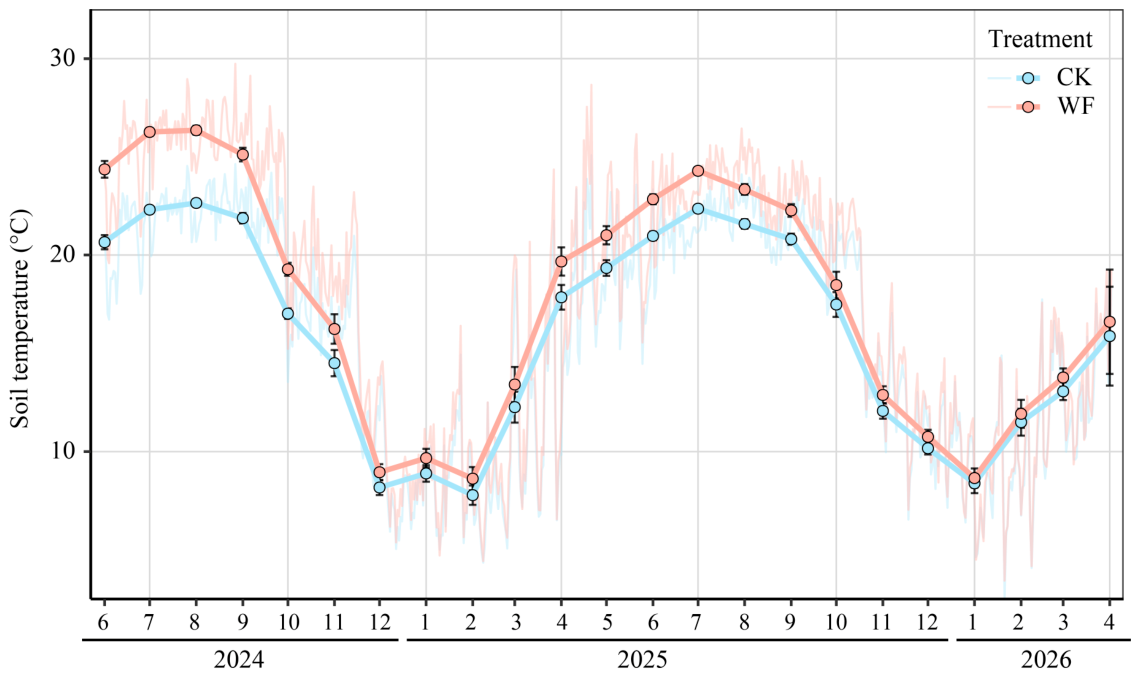
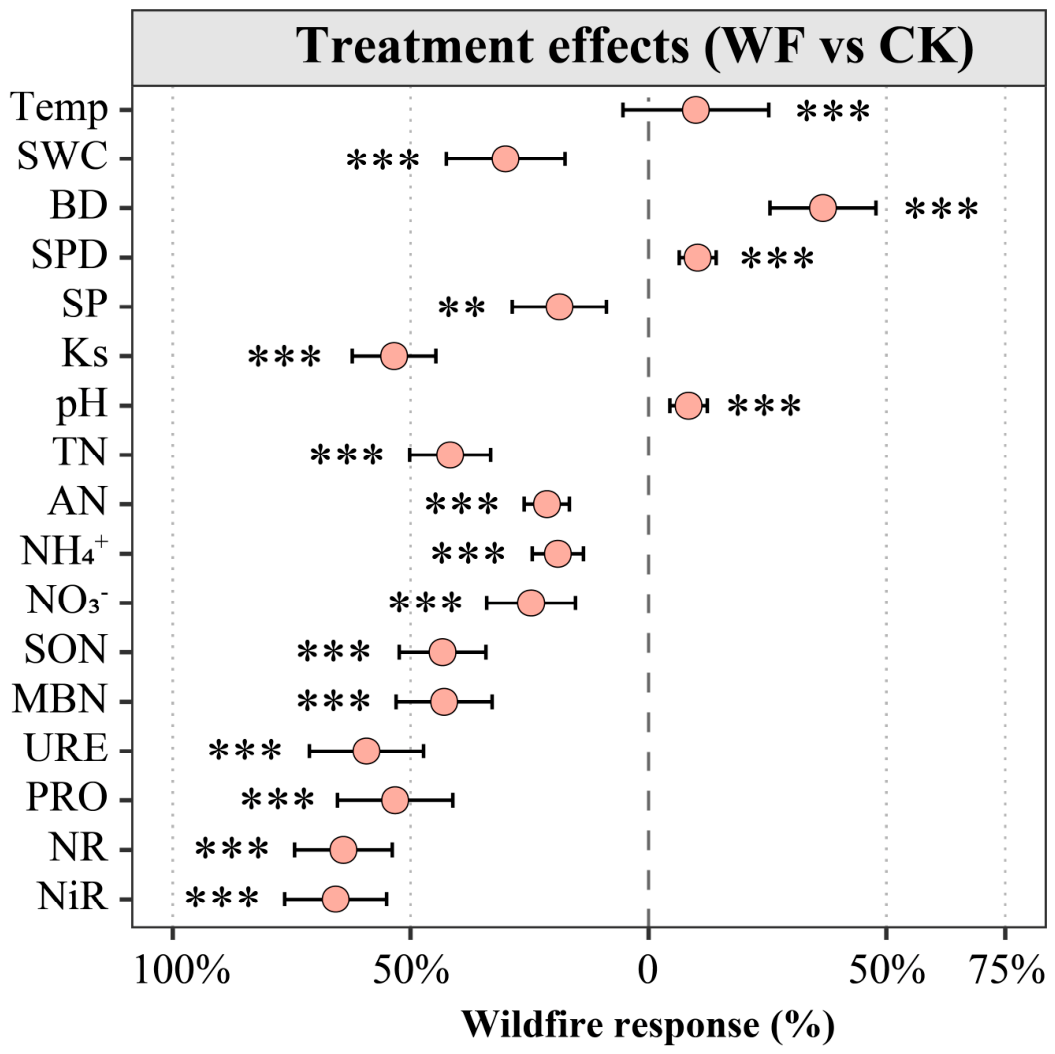
The soil temperatures of both the unburned and burned plots exhibited a seasonal pattern, namely high temperatures in summer and low temperatures in winter (Figure 1). During summer and the period around it (April to October), the soil temperature in WF was higher than that in CK, while the temperature difference in two plots was relatively small during winter (Figure 1). Overall, wildfire led to a significant 9.93% increase in mean soil temperature (p < 0.001; Figure 2). The burned plot exhibits a wider range of temperature fluctuations (Figure 1).
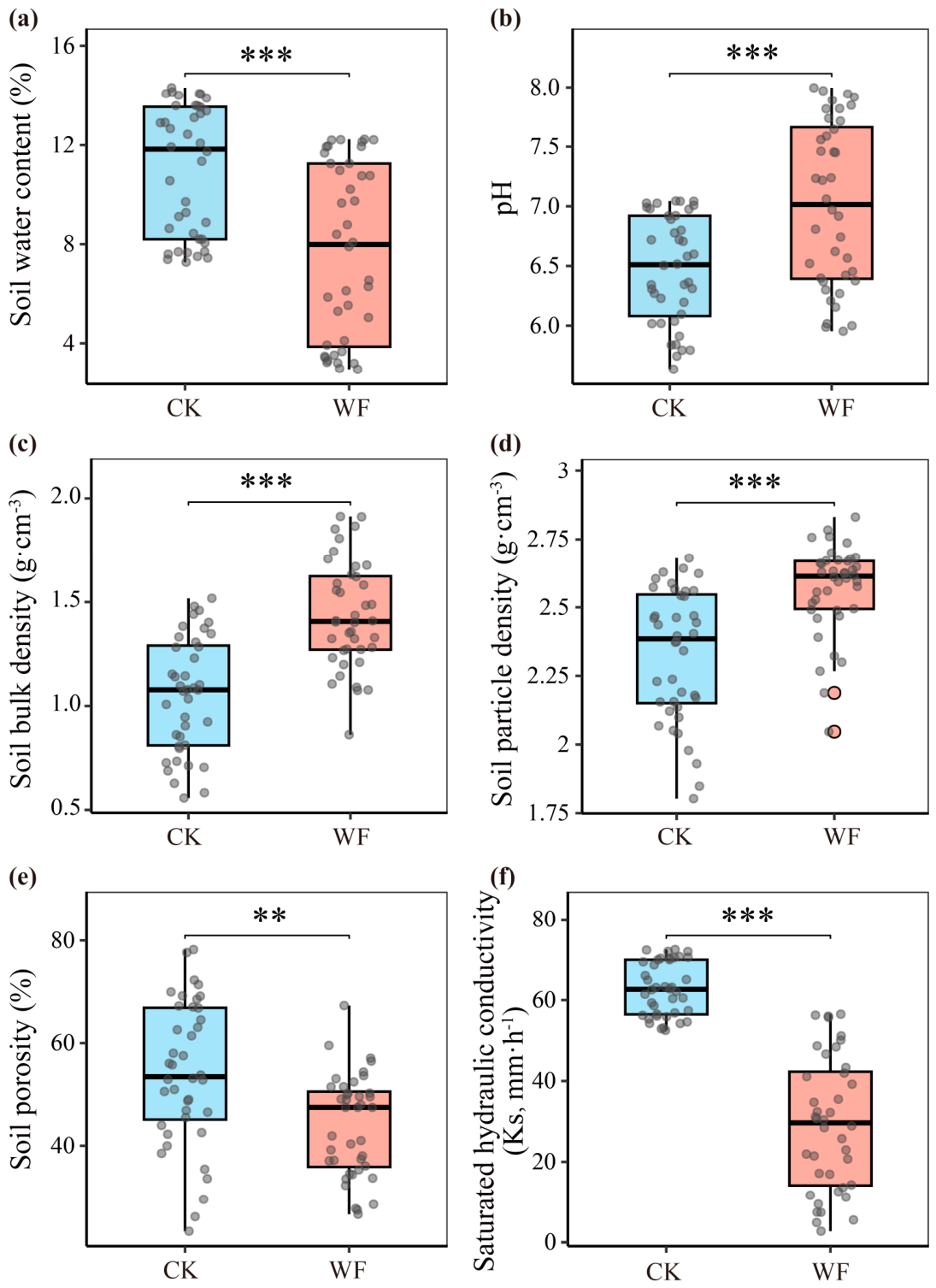
Compared with the unburned plot, the mean SWC of the burned plot decreased significantly from 11.00% to 7.70% (p < 0.001; Figure 2 and Figure 3a). Wildfires led to significant soil alkalization (p < 0.001), with a mean pH increase of approximately 0.54 (Figure 2 and Figure 3b). The BD and SPD of the burned plot were significantly higher than those of CK (mean BD: +36.66%, p < 0.001; mean SPD: +10.31%, p < 0.001; Figure 2), while the SP of the burned plot was significantly decreased by 18.74% compared with the unburned plot (p < 0.01; Figure 2), suggesting an alteration of the soil physical structure (p < 0.01; Figure 2 and Figure 3c,d,e). Wildfire significantly decreased the saturated water conductivity of soil by approximately 53.45% (p < 0.001; Figure 2 and Figure 3f).

3.2. Soil N Components

Wildfire had significant effects on the N components in the 0–10 cm soil (p < 0.001), and the season significantly affected all N components (p < 0.05 and p < 0.001) except NH4+ (Table 1). The interaction effect between wildfire and season is only significant for NO3 (p < 0.01; Table 1).
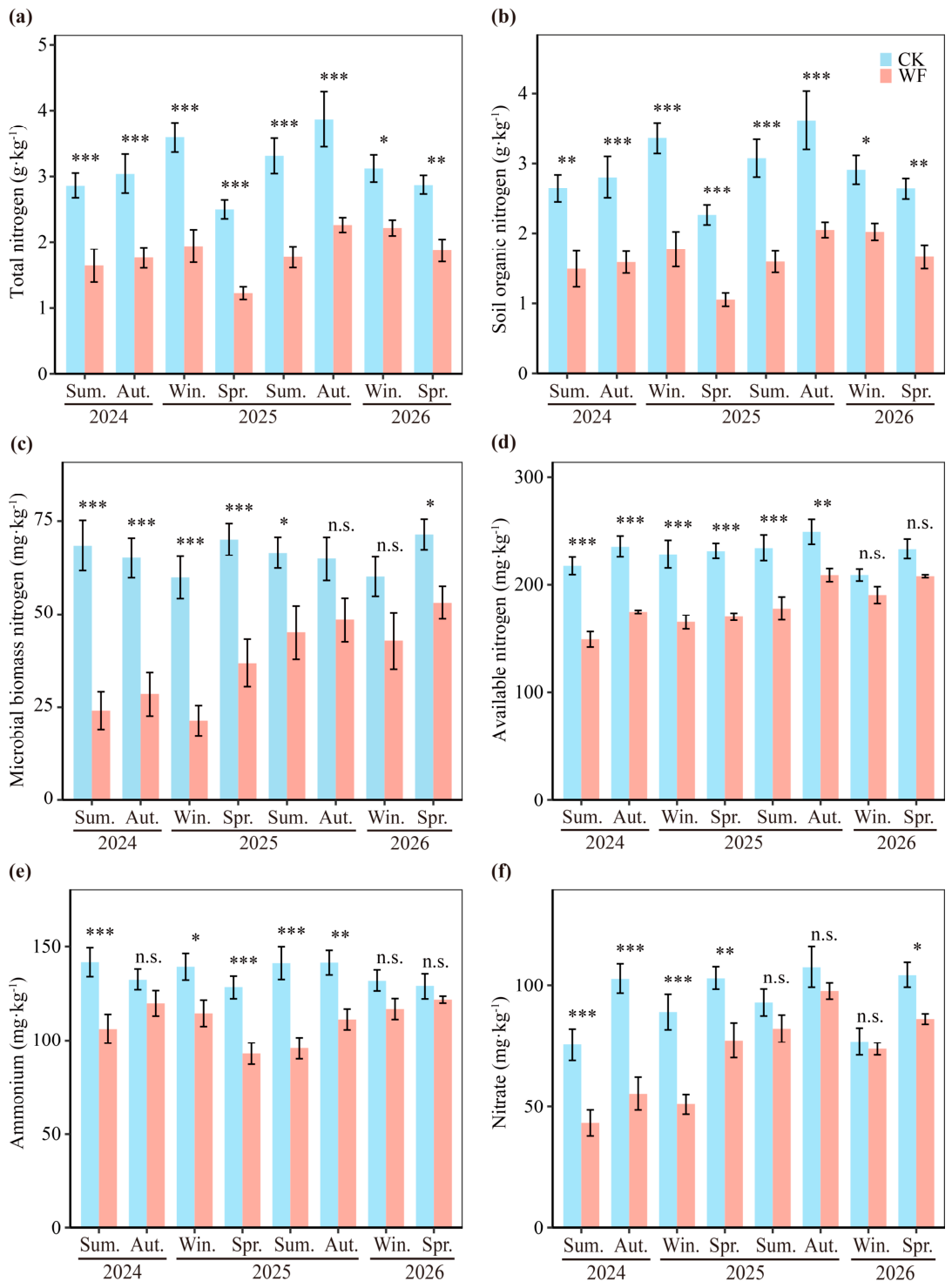
Compared with the unburned plot, the TN and SON contents of the burned plot significantly decreased by 41.66% and 43.26% respectively throughout the entire experimental period (Figure 2 and Figure 4a,b). Wildfires have led to the continuous loss of TN and SON pools in 0–10cm soil over the entire experimental period. The MBN and AN contents of the burned plot decreased by 42.93% and 21.38% respectively compared with the unburned plot, but the contents of these active N rebounded to nearly CK levels in the later periods of the experiment (from autumn 2025 to spring 2026; Figure 2 and Figure 4c,d). The dynamic responses of NH4+ and NO3 constituting AN to wildfire are inconsistent (Figure 4e,f). The NH4+ content showed obvious seasonal dynamics due to wildfire (the mean NH4+ is 19.09% lower than CK; Figure 2). It shows no significant difference from CK in the autumn of 2024, winter and spring of 2026, but is significantly lower than CK in the remaining periods. The NO3 content showed a recovery trend over time (the mean NO3 is 24.68% lower than CK; Figure 2). Except for the period from summer 2025 to winter 2026 when there was no significant difference from CK, it was significantly lower than CK in all other periods.

3.3. N-Acquiring Enzymes

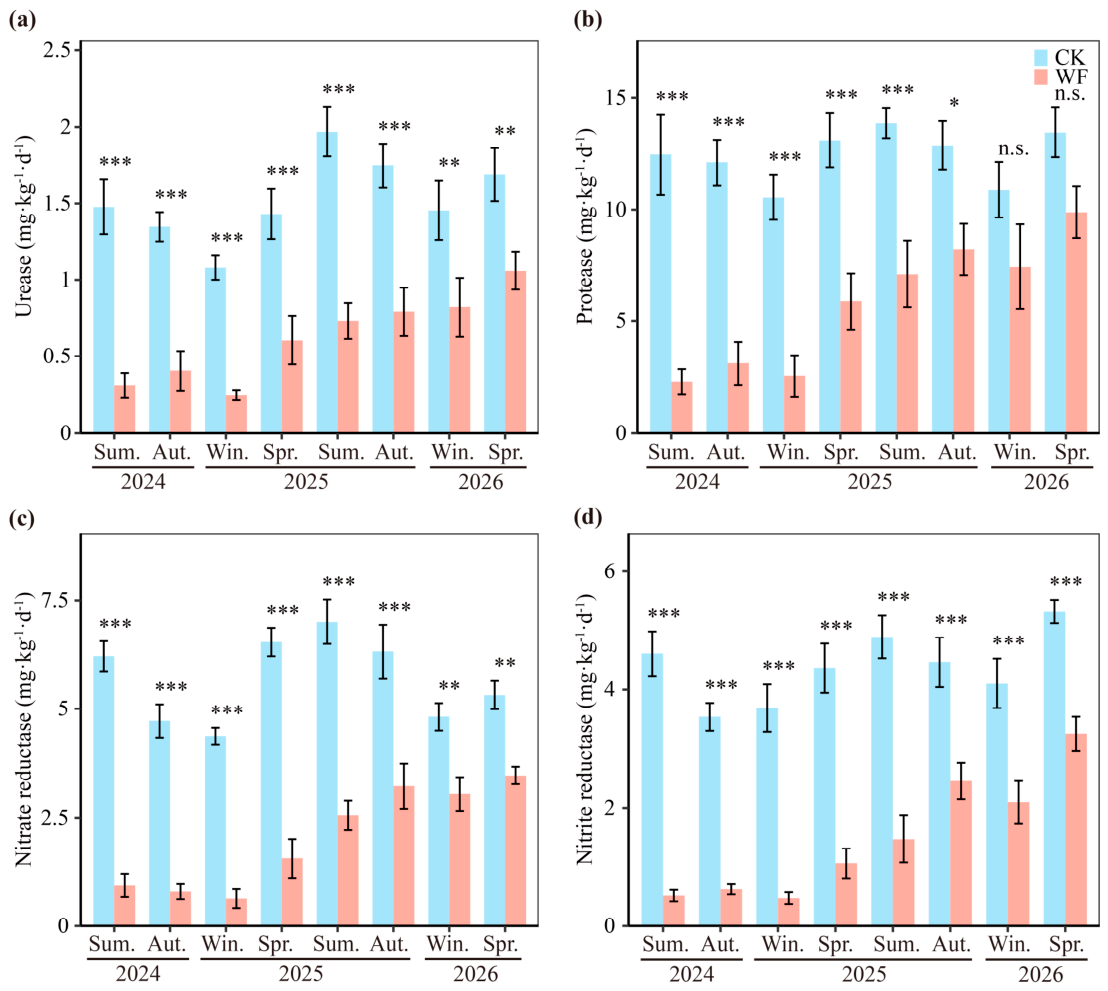
Wildfire and season had significant individual effects on the activities of all N-acquiring enzymes in the 0–10 cm soil (p < 0.01 or p < 0.001; Table 1). The interaction effect of wildfire and season had significant effects on NR (p < 0.001) and NiR (p < 0.05), but did not affect URE and PRO (Table 1).
After wildfire, the activities of soil URE, PRO, NR and NiR showed a dynamic pattern of significant short-term decrease followed by a gradual recovery (Figure 5). The URE (mean URE: −59.26%, p < 0.001; Figure 2), NR (mean NR: −64.11%, p < 0.001; Figure 2) and NiR (mean NiR: −65.75%, p < 0.001; Figure 2) activities of the burned plot were significantly lower than those of the unburned plot in all seasons during the entire experimental period (Figure 5a,c,d), indicating that wildfire continuously inhibited the efficiency of SON mineralization and N denitrification. Although PRO activity was significantly inhibited in the early and middle periods of the experimental period (summer 2024 to autumn 2025), by the time it gradually rebounded to winter 2026 and spring 2026, there was no significant difference between the burned and unburned plots (Figure 5b). Wildfires decreased PRO activity by 53.24% overall (p < 0.001; Figure 2).

3.4. The Correlations of Soil Microclimate, Physicochemical Properties, Enzymes and N Components After Wildfires

PLS regression analysis assessed how wildfires changed the key drivers of soil N components (Figure S1). In the unburned plot, the N components (especially TN, SON and AN) are mainly negatively regulated by abiotic factors, among which SWC and pH show the highest negative regression coefficients (VIP > 1; Figure S1a,b,d). However, in the burned plot, biotic factors related to enzyme activity (e.g., NR and NiR) became the most significant positive factors driving various N components (VIP > 1; Figure S1e,f). In addition, the soil physical properties after wildfire (e.g., the saturated water conductivity Ks) also showed a significant positive driving effect on the N component (VIP > 1; Figure S1d,f).
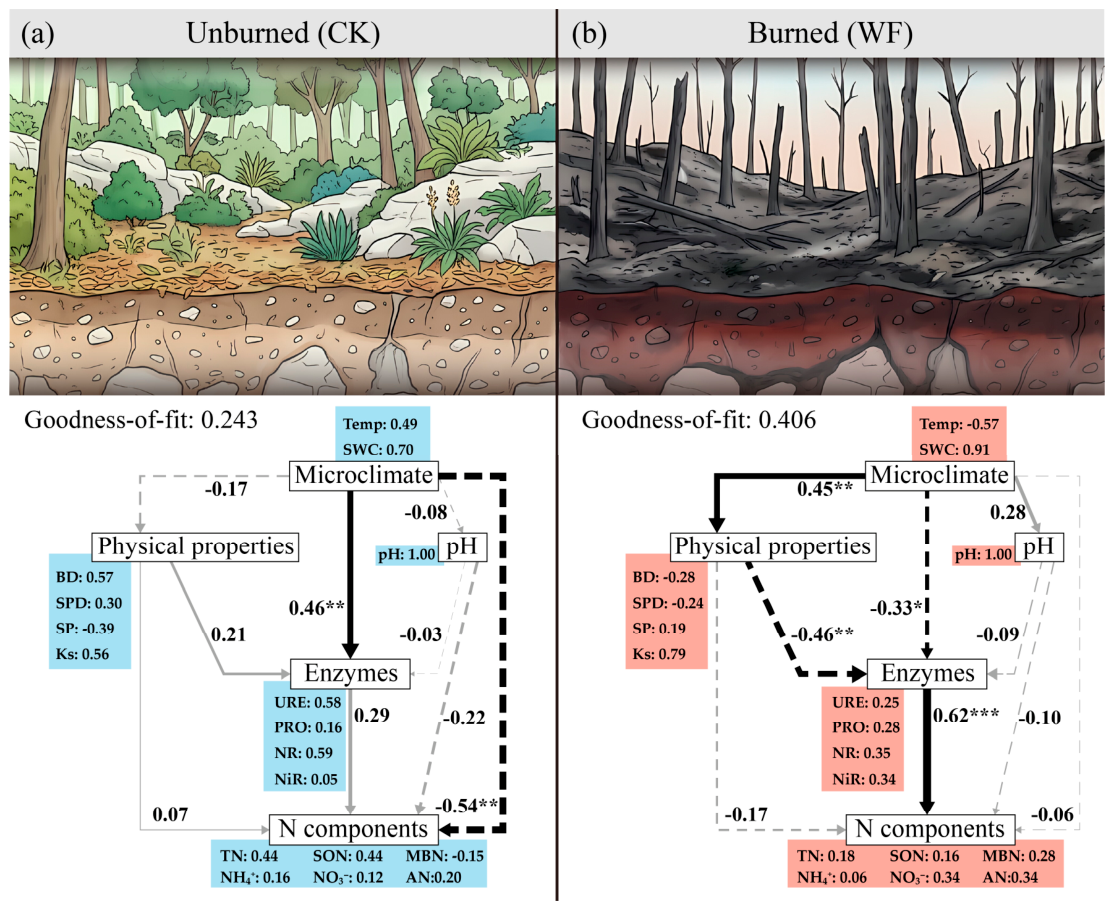
The GoF represents the goodness of fit of PLS-SEM, and a value > 0.36 indicates that the model has good representativeness [43]. Our results showed that the burned plot exhibited good overall representativeness (GoF = 0.406) in the pathway framework of “microclimate—soil physicochemical properties—enzyme activity -N components”, but the goodness-of-fit of the unburned plot was not well representative (GoF = 0.243; Figure 6). The significant differences between the unburned and burned plots indicated that wildfires significantly altered various ecological mechanism models related to soil N transformation.
In the unburned plot, microclimatic factors exerted a direct negative effect on N components while simultaneously promoting enzyme activity (Figure 6a). Although the path coefficients from enzyme activity and pH to N components were relatively high, these effects were not statistically significant (coefficients are 0.29 and −0.22, respectively). In contrast, within the burned plot, the direct influence of microclimate on N components disappeared (Figure 6b). Microclimate significantly positively affected soil physical properties (coefficient = 0.45, p < 0.01), which in turn drove enzyme activity negatively through both direct (coefficient = −0.33, p < 0.05) and indirect pathways (coefficient = −0.46, p < 0.01). Meanwhile, a significant positive correlation emerged between enzyme activity and N components (coefficient = 0.62, p < 0.001). Overall, the effect of enzyme activity on N components was significantly amplified after the wildfire, indicating that post-fire soil N dynamics became more dependent on enzyme-mediated biological processes.

4. Discussion

4.1. Fire-Induced Deterioration of Soil Hydrothermal Regimes and Physicochemical Properties

Wildfire significantly altered the soil hydrothermal buffering capacity and physicochemical properties of the karst soil. Fires usually lead to a reduction in organic matter in the soil and the disintegration of microaggregates, affecting soil structure and thermal conductivity [19]. Meanwhile, it enhances the soil hydrophobicity and prolongs the water infiltration time [44]. We found that the mean soil temperature increased significantly after wildfires and there were more obvious soil temperature fluctuations. Similar studies in high-altitude forests of New Mexico also found that logging and planned burning could lead to a significant increase in soil temperature by 1.4 °C to 2.7 °C, and burning was the main cause of the temperature difference [45]. Calderisi et al. [46] also reported in their Western Mediterranean study that soil temperatures in burned plots remained consistently higher than those in control plots during the growing season, with a mean temperature difference of 1.14 ± 0.06 °C. The increase in temperature is due to the destruction of the insulation effect of the organic layer, which reduces heat buffering and makes the soil vulnerable to changes in external temperature [47]. In addition, the loss of the canopy caused by the fire weakened the shading effect, allowing more solar radiation to directly reach and heat the soil surface, thereby significantly increasing the soil temperature [48]. This indicates a loss of the insulating effect provided by vegetation and litter, exposing the soil directly to atmospheric temperature variations. Compared with winter, the intergroup differences in soil temperature are more significant in summer and around that time. Because the solar radiation in summer in the monsoon region is higher than that in winter [49], the soil surface after wildfire receives more solar radiation and shows a more sensitive response [46,50]. The increase in soil temperature in the burning sample plots is also affected by surface cover. The loss of vegetation and surface cover reduces the thermal buffering capacity of the soil, and the darkened surface absorbs additional heat, making it more vulnerable to drastic changes in environmental temperature [50,51]. Likewise, the SWC in the burned plots decreased significantly from 11.00% to 7.70% (Figure 3a). Baur et al. [52] suggested in a global-scale analysis that 67% of burned areas exhibited increased soil water loss rates, with an average increase of approximately 17%. The reduction in vegetation coverage, loss of organic insulation layers, and deposition of surface ash synergistically warm the soil, thereby accelerating soil water evaporation through elevated temperatures [53]. More critically, the severe deterioration of soil physical properties caused by wildfires is also a potential mechanism that limits SWC [44]: the BD increased by 36.66%, while the SP decreased by 18.74% (Figure 2 and Figure 3c,e). This compaction effect should be particularly detrimental in karst regions where the soil layer is naturally thin [54]. The drastic decline in Ks could be attributed to the breakdown of soil aggregates and the potential formation of hydrophobic layers triggered by heat shock, which exacerbates surface sealing [44,55,56].
Furthermore, wildfire induced significant chemical alkalization of the soil. Dhungana et al. [57] demonstrated in their long-term study of high-elevation coniferous mixed forests in Nepal that wildfire elevated soil pH by 3% relative to control plots over a 14-year period. This ash-induced alkalization is a typical abiotic legacy of fire, resulting from the rapid volatilization of organic acids and the deposition of basic cations (such as calcium and potassium) contained in the ash layer [58,59]. Meanwhile, the increase in the content of exchangeability cations (e.g., Ca2+, K+ and Mg2+) in the soil after wildfires is a potential factor affecting the pH buffering capacity in the short term, but the long-term impact of this change on soil pH remains unclear [60]. Our study has not yet focused on the interaction mechanism between cation exchange capacity (CEC) and soil pH. In the context of karst ecosystems, which are rich in carbonates, this wildfire-induced pH shift may have dual implications. On the one hand, the elevated pH can directly alter the surface charge properties of soil colloids, potentially affecting nutrient retention [16]. On the other hand, this shift in pH acts as a crucial environmental filter that mediates the subsequent recovery of microbial communities and enzyme activities [22,61].
These changes in the soil physicochemical properties may have created a more severe and sensitive soil microenvironment, restricting water infiltration, which could become a key limiting factor for the ecosystem of the fragile karst landscape. Importantly, these findings validate Hypothesis 1, indicating that wildfires deteriorate the hydrothermal conditions of soil and significantly disrupt the physical structural stability of karst soil, manifested as an increase in BD and a decrease in SP, thereby exacerbating environmental stressors and hindering ecological recovery.

4.2. Enzymatic Responses and Their Constraints on Soil N Mineralization

Wildfire exerted profound effects on the biochemical processes of soil N cycling. The activities of all the measured N-acquiring enzymes were significantly disrupted by wildfire and required sufficient time to recover gradually. Similarly, a global-scale meta-analysis revealed that fire reduced the activity of N-acquiring hydrolytic enzymes (NAG + URE) by an average of approximately 25%, with concurrent declines observed in C- and P-acquiring enzymes [62]. The significant inhibition of these enzyme activities mainly occurred in the early and middle stages after the wildfire, resulting in an overall decrease of approximately 53% to 66% in their levels. This finding contrasts with studies in subtropical-warm temperate transition forests, where enzyme activity declines progressively over years following disturbances [63]. Compared with wildfires that inhibit the activity of enzymes involved in the C cycling for a long time (>40 years), although soil N-related enzyme activities change significantly in the early stages after wildfires, the N cycling can usually return to stability in a relatively short period of time (4~13 years) [64]. During June 2024 to May 2026 (two complete annual cycles), we observed a faster recovery rate of soil N-acquiring enzymes after wildfire in karst areas, which is potentially due to the following aspects: first, the fire intensity in this area may be lower. The recovery rate of soil enzyme activities was generally significantly faster in lightly burned areas than in severely burned ones [65,66]. Second, wildfires cause soil alkalization, which may promote an increase in the activity of certain n-related enzymes (e.g., urease and protease) [61]. This severe enzymatic suppression provides a direct biological explanation for the observed overall depletion of SON and TN, which decreased by 43.26% and 41.66%, respectively (Figure 4).
It can be assumed that the initial burning and the subsequent harsh physical environment (high temperature, low moisture, and compaction) damaged the microbial community structure, leading to a functional bottleneck in organic N mineralization [67,68]. Microbial community analysis showed that although bacterial diversity decreased in the early stage, it rebounded faster than fungi [69,70]. Some microbes (e.g., actinomycetes, acidobacteria and firmicutes) are thermotolerant and capable of converting N, possibly explaining the rapid recovery of enzyme activity [69,71]. Although MBN and enzyme activities showed signs of recovery in later seasons, the persistent deficit in the SON pool suggests that the restoration of the soil N capital lags behind the recovery of microbial biomass. This decoupling between microbial activity rebound and N pool replenishment aligns with long-term studies [16,52,53] showing slower recovery of soil N cycling compared to biological responses. This temporal mismatch highlights that, while microbial communities can recover rapidly via recolonization and adaptation [16,19,72], the rebuilding of organic N reservoirs (e.g., through plant litter inputs and microbial necromass accumulation) requires prolonged vegetation recovery and stable environmental conditions [72,73]. Furthermore, the karst environment’s inherent vulnerability to nutrient leaching may exacerbate SON losses, necessitating active management to mitigate long-term N deficits [74]. The rebuilding of the organic N pool is a rate-limiting step in the post-fire recovery of karst forests [75].
These findings validate Hypothesis 2. The overall decrease in N-acquisition enzyme activity became the main factor inhibiting the mineralization of soil organic N pools, which reflects that the reduction in enzyme activity after wildfire will not only change soil N availability but also continue to affect soil N pool health [76]. At the same time, the recovery process of various soil N components lags behind the recovery of enzyme activities, which highlights the necessity of adopting targeted management strategies to accelerate SON supplementation and enzyme-mediated mineralization processes [77].

4.3. The Shift in Dominant Drivers of N Transformation from Abiotic to Biotic Factors

The most significant insight from our study is the fundamental shift in the ecological drivers of soil N transformation following wildfire (Figure 6). In the unburned plot, soil N components were primarily regulated by abiotic factors, particularly SWC and pH, which exerted negative direct effects. Multiple studies [24,61,67,78] shown that soil moisture, pH, and nutrient status are key factors regulating microorganisms and N transformation in forests that have not been disturbed by fire or have been restored for a long time. However, in the burned plot, this direct abiotic control was replaced by a complex mediation of biotic factors and soil physical properties. Several of studies [16,78,79] observed that wildfires significantly alter physical properties (e.g., soil moisture, bulk density, and water conductivity), and thereby indirectly affect the N cycling through microbial communities and enzyme activity. The PLS-SEM results highlight a pivotal shift: the direct effects of microclimate factors in CK on N components vanished post-fire. Instead, soil physical properties (e.g., Ks) emerged as a central mediator, indirectly driving N transformation through its strong positive correlation with microbial enzyme activities. Similarly, evidence in the forests of Northeast China indicates that the pathway of “soil physicochemical properties—microbial/enzyme—N cycling” becomes significant in SEM after a wildfire [80]. Wildfire can alter the physical structure of the soil (such as reduced porosity and ash accumulation) and induce alkalization (increased pH). This microenvironmental change makes enzyme activity replace climatic factors as the key driver of N turnover [67,78,80]. This mechanism shift underscores that wildfire disturbance transfers the control of N cycling from “external climatic constraints” to “internal biological mediation.”
In the context of karst forests, this implies that the recovery of microbial functional processes and the restoration of soil physical structure (porosity and conductivity) are more critical than climatic conditions for determining the trajectory of N cycling after fire. Post-fire recovery strategies should prioritize improving soil structure through mulching to increase porosity and activate microbial potential, and at the same time accelerate the enzymatic N mineralization process through the addition of organic residues or biochar [78,81]; at the monitoring level, the focus should be on tracking enzyme activity based on traditional physical and chemical indicators, as key early indicators for evaluating the restoration of N cycling functions [63,67,82]. Notably, this biotic-driven system is more vulnerable to secondary disturbances (e.g., drought, re-burning) due to its reliance on microbial functional integrity [83,84]. Thus, maintaining soil structural stability and microbial diversity is crucial for long-term N cy-cling resilience in post-fire karst ecosystems.
Our results provide robust support for Hypothesis 3, which posited that wildfires will enhance the regulatory effects of soil physical properties and biological factors. Collectively, these results emphasize the crucial role of post-wildfire soil physical properties and enzymatic reactions in the soil N-turnover. Compared with the natural recovery without interference after disasters, improving the physical structure of the soil and promoting enzyme activity can accelerate the reconstruction of the N pool and N availability of forest soil.

5. Conclusions

This study reveals that wildfire fundamentally alters the regulatory mechanisms of soil N cycling in karst forests. We observed a critical mechanism shift: from an abiotic-dominated system (controlled by microclimate) in unburned forests, to a biotic-mediated system (driven by N-acquiring enzymes) in burned forests. This shift indicates that post-fire N dynamics are no longer primarily constrained by external climate, but are instead internally gated by the recovery of microbial functional potential and the amelioration of soil physical properties. Notably, we identified a decoupling between rapid microbial functional recovery and the slow replenishment of the soil organic N pool. The variation highlights that the restoration of soil N pool represents the rate-limiting step in the recovery of these fragile ecosystems. Therefore, the recovery strategy after wildfires should focus on the reconstruction of soil physical structure and the improvement of enzymatic reaction conditions, rather than merely concentrating on the restoration of surface vegetation.
This conclusion is based on research over two years after the fire and can only reflect short-term responses. The long-term response (5 to 50 years) of the recovery of soil N cycling remains uncertain and requires long-term monitoring. In addition, future research on the composition of microbial communities needs to be integrated to clarify the specific groups that drive these enzymatic changes and verify the universality of this mechanism in different karst landscapes with varying degrees of fire severity.

Supplementary Materials

The following supporting information can be downloaded at: https://www.mdpi.com/article/10.3390/f17050592/s1. Figure S1: Standardized regression coefficients from Partial Least Squares (PLS) regression analysis assessing the correlation between N components and soil physicochemical properties, N-acquiring enzymes. Table S1: PLS-SEM output results of CK and WF.

Author Contributions

F.Y. and Y.L. conceived and designed the experiments; F.Y., Y.L., X.Z. and K.Y. performed field work; F.Y., Y.L., X.Z. and K.Y. performed laboratory work; F.Y. and Y.L. analyzed the data; and F.Y. wrote the paper with assistance of Y.L., K.Y., Y.T. and J.Y. All authors have read and agreed to the published version of the manuscript.

Funding

This research was supported by the Growth of Young Scientific and Technological Talents of Guizhou Educational Commission (grant No. [2024] 227), the Specialized Fund for the Doctoral of Kaili University (grant No. BS20240202, and BS202502001), the Guizhou Provincial Science and Technology Projects (No. QKHJC [2025] Youth 238), the Fund of Guangxi Key Laboratory of plant Conservation and Restoration Ecology in Karst Terrain (No. 22-035-26), the Basic Scientific Research Fund of Guangxi Institute of Botany (GuiZhiYe 202406), the Scientific Research Initiation Project of Mianyang Normal University (QD2023A34).

Data Availability Statement

All data are available on reasonable request to the corresponding author.

Conflicts of Interest

The authors declare no conflicts of interest.

References

  1. Pellegrini, A.F.A.; Ahlström, A.; Hobbie, S.E.; Reich, P.B.; Nieradzik, L.P.; Staver, A.C.; Scharenbroch, B.C.; Jumpponen, A.; Anderegg, W.R.L.; Randerson, J.T.; et al. Fire Frequency Drives Decadal Changes in Soil Carbon and Nitrogen and Ecosystem Productivity. Nature 2018, 553, 194–198. [Google Scholar] [CrossRef]
  2. Halofsky, J.E.; Peterson, D.L.; Harvey, B.J. Changing Wildfire, Changing Forests: The Effects of Climate Change on Fire Regimes and Vegetation in the Pacific Northwest, USA. Fire Ecol. 2020, 16, 4. [Google Scholar] [CrossRef]
  3. Wang, K.; Zhang, C.; Chen, H.; Yue, Y.; Zhang, W.; Zhang, M.; Qi, X.; Fu, Z. Karst Landscapes of China: Patterns, Ecosystem Processes and Services. Landsc. Ecol. 2019, 34, 2743–2763. [Google Scholar] [CrossRef]
  4. Vilhar, U.; Kermavnar, J.; Kozamernik, E.; Petrič, M.; Ravbar, N. The Effects of Large-Scale Forest Disturbances on Hydrology—An Overview with Special Emphasis on Karst Aquifer Systems. Earth-Sci. Rev. 2022, 235, 104243. [Google Scholar] [CrossRef]
  5. Čahojová, L.; Jakob, A.; Breg Valjavec, M.; Čarni, A. Response of Vulnerable Karst Forest Ecosystems under Different Fire Severities in the Northern Dinaric Karst Mountains (Slovenia). Fire Ecol. 2024, 20, 38. [Google Scholar] [CrossRef]
  6. Chen, H.; Li, D.; Xiao, K.; Wang, K. Soil Microbial Processes and Resource Limitation in Karst and Non-karst Forests. Funct. Ecol. 2018, 32, 1400–1409. [Google Scholar] [CrossRef]
  7. Cheng, Z.; Wu, S.; Du, J.; Pan, H.; Lu, X.; Liu, Y.; Yang, L. Variations in the Diversity and Biomass of Soil Bacteria and Fungi under Different Fire Disturbances in the Taiga Forests of Northeastern China. Forests 2023, 14, 2063. [Google Scholar] [CrossRef]
  8. Qu, H.; Jiang, S.; Cheng, Z.; Wei, D.; Yang, L.; Zhou, J. Thresholds and Trade-Offs: Fire Severity Modulates Soil Microbial Biomass-Function Coupling in Taiga Forests, Northeast of China. Microorganisms 2025, 13, 1318. [Google Scholar] [CrossRef]
  9. Qiu, K.; Xie, Y.; Xu, D.; Pott, R. Ecosystem Functions Including Soil Organic Carbon, Total Nitrogen and Available Potassium Are Crucial for Vegetation Recovery. Sci. Rep. 2018, 8, 7607. [Google Scholar] [CrossRef] [PubMed]
  10. Yang, L.; Liu, L.; Yang, H.; Yang, S.; Zhu, T.; Meng, L.; Wen, D. Changes in Plant Nitrogen Uptake Strategies Following Vegetation Recovery in Karst Regions. Forests 2025, 16, 839. [Google Scholar] [CrossRef]
  11. Jia, X.; Zhong, Y.; Liu, J.; Zhu, G.; Shangguan, Z.; Yan, W. Effects of Nitrogen Enrichment on Soil Microbial Characteristics: From Biomass to Enzyme Activities. Geoderma 2020, 366, 114256. [Google Scholar] [CrossRef]
  12. Wang, X.; Feng, J.; Ao, G.; Qin, W.; Han, M.; Shen, Y.; Liu, M.; Chen, Y.; Zhu, B. Globally Nitrogen Addition Alters Soil Microbial Community Structure, but Has Minor Effects on Soil Microbial Diversity and Richness. Soil. Biol. Biochem. 2023, 179, 108982. [Google Scholar] [CrossRef]
  13. Rastetter, E.B.; Kling, G.W.; Shaver, G.R.; Crump, B.C.; Gough, L.; Griffin, K.L. Ecosystem Recovery from Disturbance Is Constrained by N Cycle Openness, Vegetation-Soil N Distribution, Form of N Losses, and the Balance between Vegetation and Soil-Microbial Processes. Ecosystems 2021, 24, 667–685. [Google Scholar] [CrossRef]
  14. Nieland, M.A.; Moley, P.; Hanschu, J.; Zeglin, L.H. Differential Resilience of Soil Microbes and Ecosystem Functions Following Cessation of Long-Term Fertilization. Ecosystems 2021, 24, 2042–2060. [Google Scholar] [CrossRef]
  15. Wang, G.; Zhu, T.; Zhou, J.; Yu, Y.; Petropoulos, E.; Müller, C. Slash-and-Burn in Karst Regions Lowers Soil Gross Nitrogen (N) Transformation Rates and N-Turnover. Geoderma 2022, 425, 116084. [Google Scholar] [CrossRef]
  16. Li, X.; Han, Y.; Zhang, Y.; Shao, Q.; Dong, C.; Li, J.; Ding, B.; Zhang, Y. Effects of Wildfire on Soil Microbial Communities in Karst Forest Ecosystems of Southern Guizhou Province, China. Appl. Environ. Microbiol. 2024, 90, e01245-24. [Google Scholar] [CrossRef] [PubMed]
  17. Lv, Q.; Chen, Z.; Wu, C.; Peñuelas, J.; Fan, L.; Su, Y.; Yang, Z.; Li, M.; Gao, B.; Hu, J.; et al. Increasing Severity of Large-Scale Fires Prolongs Recovery Time of Forests Globally since 2001. Nat. Ecol. Evol. 2025, 9, 980–992. [Google Scholar] [CrossRef]
  18. Certini, G. Effects of Fire on Properties of Forest Soils: A Review. Oecologia 2005, 143, 1–10. [Google Scholar] [CrossRef] [PubMed]
  19. Agbeshie, A.A.; Abugre, S.; Atta-Darkwa, T.; Awuah, R. A Review of the Effects of Forest Fire on Soil Properties. J. For. Res. 2022, 33, 1419–1441. [Google Scholar] [CrossRef]
  20. Li, D.; Yang, Y.; Chen, H.; Xiao, K.; Song, T.; Wang, K. Soil Gross Nitrogen Transformations in Typical Karst and Nonkarst Forests, Southwest China. J. Geophys. Res. Biogeosciences 2017, 122, 2831–2840. [Google Scholar] [CrossRef]
  21. Brady, M.K.; Hanan, E.J.; Dickinson, M.B.; Miesel, J.R.; Wade, L.; Greenberg, J. How Interactions between Wildfire and Seasonal Soil Moisture Fluxes Drive Nitrogen Cycling in Northern Sierra Nevada Forests. Int. J. Wildland Fire 2022, 31, 786–798. [Google Scholar] [CrossRef]
  22. Liu, G.; Gu, Z.; Liu, X.; Li, B. Microenvironment Heterogeneity Affected by Anthropogenic Wildfire-Perturbed Soil Mediates Bacterial Community in Pinus tabulaeformis Forests. Front. Microbiol. 2024, 15, 1415726. [Google Scholar] [CrossRef] [PubMed]
  23. Gustine, R.N.; Hanan, E.J.; Robichaud, P.R.; Elliot, W.J. From Burned Slopes to Streams: How Wildfire Affects Nitrogen Cycling and Retention in Forests and Fire-Prone Watersheds. Biogeochemistry 2022, 157, 51–68. [Google Scholar] [CrossRef]
  24. Fultz, L.M.; Moore-Kucera, J.; Dathe, J.; Davinic, M.; Perry, G.; Wester, D.; Schwilk, D.W.; Rideout-Hanzak, S. Forest Wildfire and Grassland Prescribed Fire Effects on Soil Biogeochemical Processes and Microbial Communities: Two Case Studies in the Semi-Arid Southwest. Appl. Soil. Ecol. 2016, 99, 118–128. [Google Scholar] [CrossRef]
  25. Chen, R.; Ye, C.; Cai, Y.; Xing, X. Integrated Restoration of Small Watershed in Karst Regions of Southwest China. AMBIO 2012, 41, 907–912. [Google Scholar] [CrossRef]
  26. Ren, Q.; Weng, L.; Wu, X.; Xie, Q.; Luo, S. Spatiotemporal variation characteristics of climate potential production in Guizhou province. Chin. J. Agrometeorol. 2025, 46, 872–882. [Google Scholar] [CrossRef]
  27. Hu, J.; Ci, E.; Li, S.; Lian, M.; Zhong, S. The Pedogenesis of Soil Derived from Carbonate Rocks along a Climosequence in a Subtropical Mountain, China. Forests 2021, 12, 1044. [Google Scholar] [CrossRef]
  28. Yang, Y.; Hu, X.; Han, M.; He, K.; Liu, B.; Jin, T.; Cao, X.; Wang, Y.; Huang, J. Post-Fire Temporal Trends in Soil Properties and Revegetation: Insights from Different Wildfire Severities in the Hengduan Mountains, Southwestern China. CATENA 2022, 213, 106160. [Google Scholar] [CrossRef]
  29. Wilke, B.-M. Determination of Chemical and Physical Soil Properties. In Monitoring and Assessing Soil Bioremediation; Soil Biology; Springer: Berlin/Heidelberg, Germany, 2005; Volume 5, pp. 47–95. [Google Scholar]
  30. Thomas, G.W. Soil pH and Soil Acidity. In Methods of Soil Analysis; Sparks, D.L., Page, A.L., Helmke, P.A., Loeppert, R.H., Soltanpour, P.N., Tabatabai, M.A., Johnston, C.T., Sumner, M.E., Eds.; Wiley: Hoboken, NJ, USA, 1996; Volume 5, pp. 475–490. [Google Scholar]
  31. Walter, K.; Don, A.; Tiemeyer, B.; Freibauer, A. Determining Soil Bulk Density for Carbon Stock Calculations: A Systematic Method Comparison. Soil Sci. Soc. Am. J. 2016, 80, 579–591. [Google Scholar] [CrossRef]
  32. Bartley, P.C.; Amoozegar, A.; Fonteno, W.C.; Jackson, B.E. Particle Densities of Horticultural Substrates. HortScience 2022, 57, 379–383. [Google Scholar] [CrossRef]
  33. Usowicz, B.; Lipiec, J. Spatial Variability of Saturated Hydraulic Conductivity and Its Links with Other Soil Properties at the Regional Scale. Sci. Rep. 2021, 11, 8293. [Google Scholar] [CrossRef] [PubMed]
  34. Liu, Y.; Zou, X.; Chen, H.Y.H.; Delgado-Baquerizo, M.; Wang, C.; Zhang, C.; Ruan, H. Fungal Necromass Is Reduced by Intensive Drought in Subsoil but Not in Topsoil. Glob. Change Biol. 2023, 29, 7159–7172. [Google Scholar] [CrossRef]
  35. Yang, F.; Ni, X.; Zeng, X.; Li, H.; Tan, B.; Liang, Z.; Liu, B.; Xu, Z.; Zhang, J. Short-Term Winter Snow Reduction Stimulates Soil Nutrient Leaching without Changing the Microbial Biomass in an Alpine Fir Forest. Glob. Ecol. Conserv. 2021, 25, e01434. [Google Scholar] [CrossRef]
  36. Zulu, S.G.; Motsa, N.M.; Magwaza, L.S.; Ncama, K.; Sithole, N.J. Effects of Different Tillage Practices and Nitrogen Fertiliser Application Rates on Soil-Available Nitrogen. Agronomy 2023, 13, 785. [Google Scholar] [CrossRef]
  37. Li, H.; Zhou, B.; Zhuo, Z.; Wang, L.; Wang, Z.; Xie, C.; Jiang, F.; Lin, J.; Huang, Y.; Zhang, Y. Effects of Cover Measures on Soil Organic Nitrogen Fractions and Total Soluble Nitrogen Pools in Citrus Orchards of the Red Soil Hilly Region of Southern China. Agriculture 2024, 14, 1879. [Google Scholar] [CrossRef]
  38. Joergensen, R.G.; Mueller, T. The Fumigation-Extraction Method to Estimate Soil Microbial Biomass: Calibration of the kEN Value. Soil. Biol. Biochem. 1996, 28, 33–37. [Google Scholar] [CrossRef]
  39. Coelmont, T.; Van Gaelen, P.; Smets, I. Quantification of Hydrolysis Activity in a Biological Wastewater Treatment Context. Appl. Microbiol. Biotechnol. 2023, 107, 2143–2153. [Google Scholar] [CrossRef]
  40. Li, Z.; Reichel, R.; Li, Z.; Yang, K.; Zhang, L.; Tan, B.; Yin, R.; Zhao, K.; Xu, Z. Effects of Snow Absence on Available N Pools and Enzyme Activities within Soil Aggregates in a Spruce Forest on the Eastern Tibetan Plateau. Soil. Ecol. Lett. 2022, 4, 376–382. [Google Scholar] [CrossRef]
  41. Bates, D.; Mächler, M.; Bolker, B.; Walker, S. Fitting Linear Mixed-Effects Models Using Lme4. J. Stat. Soft. 2015, 67, 1–48. [Google Scholar] [CrossRef]
  42. Hothorn, T.; Bretz, F.; Westfall, P. Simultaneous Inference in General Parametric Models. Biom. J. 2008, 50, 346–363. [Google Scholar] [CrossRef] [PubMed]
  43. Al-Taie, M.; Lane, M.; Cater-Steel, A. An Empirical Assessment of the CIO Role Expectations Instrument Using PLS Path Modelling. Commun. Assoc. Inf. Syst. 2018, 42, A1. [Google Scholar] [CrossRef]
  44. Sion, B.; Samburova, V.; Berli, M.; Baish, C.; Bustarde, J.; Houseman, S. Assessment of the Effects of the 2021 Caldor Megafire on Soil Physical Properties, Eastern Sierra Nevada, USA. Fire 2023, 6, 66. [Google Scholar] [CrossRef]
  45. Parmenter, R.R.; Losleben, M.V. Influence of Mixed Conifer Forest Thinning and Prescribed Fire on Soil Temperature and Moisture Dynamics in Proximity to Forest Logs: A Case Study in New Mexico, USA. Forests 2023, 14, 1117. [Google Scholar] [CrossRef]
  46. Calderisi, G.; Salaris, E.; Cogoni, D.; Rossetti, I.; Murtas, F.; Fenu, G. Relationship Between Post-Fire Vegetation Recovery and Soil Temperature in the Mediterranean Forest. Fire 2025, 8, 91. [Google Scholar] [CrossRef]
  47. Harden, J.W.; Manies, K.L.; Turetsky, M.R.; Neff, J.C. Effects of Wildfire and Permafrost on Soil Organic Matter and Soil Climate in Interior Alaska. Glob. Change Biol. 2006, 12, 2391–2403. [Google Scholar] [CrossRef]
  48. Xu, Y.; Zhuang, Q.; Zhao, B.; Billmire, M.; Cook, C.; Graham, J.; French, N.H.; Prinn, R. Impacts of Wildfires on Boreal Forest Ecosystem Carbon Dynamics from 1986 to 2020. Environ. Res. Lett. 2024, 19, 064023. [Google Scholar] [CrossRef]
  49. Kutzbach, J.E.; Otto-Bliesner, B.L. The Sensitivity of the African-Asian Monsoonal Climate to Orbital Parameter Changes for 9000 Years B.P. in a Low-Resolution General Circulation Model. J. Atmos. Sci. 1982, 39, 1177–1188. [Google Scholar] [CrossRef]
  50. Yakimov, N.; Ponomarev, E. Dynamics of Post-Fire Effects in Larch Forests of Central Siberia Based on Satellite Data. E3S Web Conf. 2020, 149, 03008. [Google Scholar] [CrossRef]
  51. Yakimov, N.D.; Ponomarev, E.I.; Ponomareva, T.V. Satellite Monitoring of the State and Dynamics of Disturbed Natural and Technogenic Landscapes in Siberia. In Proceedings of the Spatial Data Processing for Monitoring of Natural and Anthropogenic Processes 2021, Novosibirsk, Russia, 24–27 August 2021; pp. 585–593. [Google Scholar]
  52. Baur, M.J.; Friend, A.D.; Pellegrini, A.F.A. Widespread and Systematic Effects of Fire on Plant–Soil Water Relations. Nat. Geosci. 2024, 17, 1115–1120. [Google Scholar] [CrossRef]
  53. Cooperdock, S.C.; Hawkes, C.V.; Xu, D.R.; Breecker, D.O. Soil Water Content and Soil Respiration Rates Are Reduced for Years Following Wildfire in a Hot and Dry Climate. Glob. Biogeochem. Cycles 2020, 34, e2020GB006699. [Google Scholar] [CrossRef]
  54. Qin, X.; Wang, Y.; Hou, D.; Li, Y. Assessment of High-Severity Post-Fire Soil Quality and Its Recovery in Dry/Warm Valley Forestlands in Southwest China through Selecting the Minimum Data Set and Soil Quality Index. Forests 2024, 15, 1727. [Google Scholar] [CrossRef]
  55. Fox, D.M.; Darboux, F.; Carrega, P. Effects of Fire-induced Water Repellency on Soil Aggregate Stability, Splash Erosion, and Saturated Hydraulic Conductivity for Different Size Fractions. Hydrol. Process. 2007, 21, 2377–2384. [Google Scholar] [CrossRef]
  56. Negri, S.; Arcenegui, V.; Mataix-Solera, J.; Bonifacio, E. Extreme Water Repellency and Loss of Aggregate Stability in Heat-Affected Soils around the Globe: Driving Factors and Their Relationships. CATENA 2024, 244, 108257. [Google Scholar] [CrossRef]
  57. Dhungana, B.P.; Chhetri, V.T.; Baniya, C.B.; Sharma, S.P.; Ghimire, P.; Vista, S.P. Post-Fire Effects on Soil Properties in High Altitude Mixed-Conifer Forest of Nepal. Trees For. People 2024, 17, 100633. [Google Scholar] [CrossRef]
  58. Ulery, A.L.; Graham, R.C.; Amrhein, C. Wood-Ash Composition and Soil Ph Following Intense Burning. Soil. Sci. 1993, 156, 358–364. [Google Scholar] [CrossRef]
  59. Marcotte, A.L.; Limpens, J.; Stoof, C.R.; Stoorvogel, J.J. Can Ash from Smoldering Fires Increase Peatland Soil pH? Int. J. Wildland Fire 2022, 31, 607–620. [Google Scholar] [CrossRef]
  60. Salgado, L.; Alvarez, M.G.; Díaz, A.M.; Gallego, J.R.; Forján, R. Impact of Wildfire Recurrence on Soil Properties and Organic Carbon Fractions. J. Environ. Manag. 2024, 354, 120293. [Google Scholar] [CrossRef] [PubMed]
  61. Liu, G.; Li, B.; Li, J.; Gu, Z.; Liu, X. Wildfire Impacts Pinus Tabulaeformis Forests on Soil Properties, Actinobacteriota, and Enzyme Activity in Northern China: Direct Effects or Mutual Interactions? Forests 2025, 16, 344. [Google Scholar] [CrossRef]
  62. Pei, J.; Wan, J.; Wang, H.; Fang, C.; Nie, M.; Li, J. Changes in the Activity of Soil Enzymes after Fire. Geoderma 2023, 437, 116599. [Google Scholar] [CrossRef]
  63. Hu, M.; Wang, J.; Lu, L.; Shao, P.; Zhou, Z.; Wang, D.; Han, S.; Osborne, B.; Chen, J. Post-fire Soil Extracellular Enzyme Activities in Subtropical–Warm Temperate Climate Transitional Forests. Land. Degrad. Dev. 2023, 34, 1973–1983. [Google Scholar] [CrossRef]
  64. Dove, N.C.; Safford, H.D.; Bohlman, G.N.; Estes, B.L.; Hart, S.C. High-severity Wildfire Leads to Multi-decadal Impacts on Soil Biogeochemistry in Mixed-conifer Forests. Ecol. Appl. 2020, 30, e02072. [Google Scholar] [CrossRef]
  65. Zalman, C.; Hanna, E.; Rush, J.; Boise, K.; Larios, L. Vegetation Type and Fire Severity Mediate Short-Term Post Fire Soil Microbial Responses. Plant Soil. 2023, 484, 155–170. [Google Scholar] [CrossRef]
  66. Schill, M.L.; Baird, R.; Brown, S.P.; Veach, A.M. Wildfire Severity Alters Soil Microbial Exoenzyme Production and Fungal Abundances in the Southern Appalachian Mountains. Pedosphere 2024, 34, 865–878. [Google Scholar] [CrossRef]
  67. Zhou, Y.; Biro, A.; Wong, M.Y.; Batterman, S.A.; Staver, A.C. Fire Decreases Soil Enzyme Activities and Reorganizes Microbially Mediated Nutrient Cycles: A Meta-analysis. Ecology 2022, 103, e3807. [Google Scholar] [CrossRef]
  68. Wang, Q.; Zhong, M.; Wang, S. A Meta-Analysis on the Response of Microbial Biomass, Dissolved Organic Matter, Respiration, and N Mineralization in Mineral Soil to Fire in Forest Ecosystems. For. Ecol. Manag. 2012, 271, 91–97. [Google Scholar] [CrossRef]
  69. Meng, M.; Wang, B.; Zhang, Q.; Tian, Y. Driving Force of Soil Microbial Community Structure in a Burned Area of Daxing’anling, China. J. For. Res. 2021, 32, 1723–1738. [Google Scholar] [CrossRef]
  70. Pulido-Chavez, M.F.; Randolph, J.W.J.; Zalman, C.; Larios, L.; Homyak, P.M.; Glassman, S.I. Rapid Bacterial and Fungal Successional Dynamics in First Year after Chaparral Wildfire. Mol. Ecol. 2023, 32, 1685–1707. [Google Scholar] [CrossRef]
  71. Jiang, S.; Qu, H.; Cheng, Z.; Fu, X.; Yang, L.; Zhou, J. Actinobacteria Emerge as Novel Dominant Soil Bacterial Taxa in Long-Term Post-Fire Recovery of Taiga Forests. Microorganisms 2025, 13, 1262. [Google Scholar] [CrossRef]
  72. Cotrufo, M.F.; Wallenstein, M.D.; Boot, C.M.; Denef, K.; Paul, E. The Microbial Efficiency-Matrix Stabilization (MEMS) Framework Integrates Plant Litter Decomposition with Soil Organic Matter Stabilization: Do Labile Plant Inputs Form Stable Soil Organic Matter? Glob. Change Biol. 2013, 19, 988–995. [Google Scholar] [CrossRef] [PubMed]
  73. Bouskill, N.J.; Mekonnen, Z.; Zhu, Q.; Grant, R.; Riley, W.J. Microbial Contribution to Post-Fire Tundra Ecosystem Recovery over the 21st Century. Commun. Earth Environ. 2022, 3, 26. [Google Scholar] [CrossRef]
  74. Xiao, S.; Zhang, W.; Ye, Y.; Zhao, J.; Wang, K. Soil Aggregate Mediates the Impacts of Land Uses on Organic Carbon, Total Nitrogen, and Microbial Activity in a Karst Ecosystem. Sci. Rep. 2017, 7, 41402. [Google Scholar] [CrossRef] [PubMed]
  75. Choromanska, U. Microbial Activity and Nitrogen Mineralization in Forest Mineral Soils Following Heating: Evaluation of Post-Fire Effects. Soil. Biol. Biochem. 2002, 34, 263–271. [Google Scholar] [CrossRef]
  76. Pellegrini, A.F.A.; Caprio, A.C.; Georgiou, K.; Finnegan, C.; Hobbie, S.E.; Hatten, J.A.; Jackson, R.B. Low-intensity Frequent Fires in Coniferous Forests Transform Soil Organic Matter in Ways That May Offset Ecosystem Carbon Losses. Glob. Change Biol. 2021, 27, 3810–3823. [Google Scholar] [CrossRef] [PubMed]
  77. Knelman, J.; Graham, E.; Ferrenberg, S.; Lecoeuvre, A.; Labrado, A.; Darcy, J.; Nemergut, D.; Schmidt, S. Rapid Shifts in Soil Nutrients and Decomposition Enzyme Activity in Early Succession Following Forest Fire. Forests 2017, 8, 347. [Google Scholar] [CrossRef]
  78. Zhou, H.; Yang, M.; Luo, X.; Yang, Z.; Wang, L.; Liu, S.; Zhang, Q.; Luo, M.; Ou, J.; Xiong, S.; et al. Short-Term Impacts of Fire and Post-Fire Restoration Methods on Soil Properties and Microbial Characteristics in Southern China. Fire 2024, 7, 474. [Google Scholar] [CrossRef]
  79. Arunrat, N.; Kongsurakan, P.; Solomon, L.W.; Sereenonchai, S. Fire Impacts on Soil Properties and Implications for Sustainability in Rotational Shifting Cultivation: A Review. Agriculture 2024, 14, 1660. [Google Scholar] [CrossRef]
  80. Jia, W.; Shu, Y.; Zhao, P.; Zhou, M.; Yue, Y. Effects of Fire Intensity on Soil Microbial Diversity and Nitrogen Cycling Functional Genes in Forests (Northeast China). Front. Microbiol. 2025, 16, 1615520. [Google Scholar] [CrossRef]
  81. Yang, M.; Luo, X.; Cai, Y.; Mwangi, B.N.; Khan, M.S.; Haider, F.U.; Huang, W.; Cheng, X.; Yang, Z.; Zhou, H.; et al. Effect of Fire and Post-Fire Management on Soil Microbial Communities in a Lower Subtropical Forest Ecosystem after a Mountain Fire. J. Environ. Manag. 2024, 351, 119885. [Google Scholar] [CrossRef]
  82. Guo, Z.; Zhang, X.; Green, S.M.; Dungait, J.A.J.; Wen, X.; Quine, T.A. Soil Enzyme Activity and Stoichiometry along a Gradient of Vegetation Restoration at the Karst Critical Zone Observatory in Southwest China. Land. Degrad. Dev. 2019, 30, 1916–1927. [Google Scholar] [CrossRef]
  83. Hinojosa, M.B.; Laudicina, V.A.; Parra, A.; Albert-Belda, E.; Moreno, J.M. Drought and Its Legacy Modulate the Post-fire Recovery of Soil Functionality and Microbial Community Structure in a Mediterranean Shrubland. Glob. Change Biol. 2019, 25, 1409–1427. [Google Scholar] [CrossRef] [PubMed]
  84. Dove, N.C.; Taş, N.; Hart, S.C. Ecological and Genomic Responses of Soil Microbiomes to High-Severity Wildfire: Linking Community Assembly to Functional Potential. ISME J. 2022, 16, 1853–1863. [Google Scholar] [CrossRef] [PubMed]
Figure 1. Monthly dynamics in soil temperatures of 0–10 cm depth between the unburned (CK) and burned (WF) plots.
Forests 17 00592 g001
Figure 2. Mean and SE of differences in the soil physicochemical properties, soil N components, and N-acquiring enzymes between the unburned (CK) and burned (WF) plots expressed in % [(WF − CK)/(CK)  ×  100]. ** p < 0.01, *** p < 0.001. For variables acronyms, see Table 1 note.
Forests 17 00592 g002
Figure 3. Differences in soil physicochemical properties of a karst forest between unburned (CK) and burned (WF); (a) soil water content (SWC), (b) soil pH (pH), (c) soil bulk density (SBD), (d) soil particle density (SPD), (e) soil porosity (SP), (f) soil saturated hydraulic conductivity (Ks). asterisks Indicates significance, with significance levels of ** p < 0.01, and *** p < 0.001.
Forests 17 00592 g003
Figure 4. Seasonal dynamics of soil N components between unburned (CK) and burned (WF) during 2024–2026; (a) total nitrogen (TN), (b) soil organic nitrogen (SON), (c) microbial biomass nitrogen (MBN), (d) available nitrogen (AN), (e) ammonium (NH4+), and (f) nitrate (NO3). asterisks Indicates significance difference between CK and WF at same season, with significance levels of * p < 0.05, ** p < 0.01, and *** p < 0.001, n.s. no significant.
Forests 17 00592 g004
Figure 5. Seasonal dynamics of soil N-acquiring enzyme activities between unburned (CK) and burned (WF) during 2024–2026; (a) urease (URE), (b) protease (PRO), (c) nitrate reductase (NR), and (d) nitrite reductase (NiR). asterisks Indicates significance difference between CK and WF at same season, with significance levels of * p < 0.05, ** p < 0.01, and *** p < 0.001.
Forests 17 00592 g005
Figure 6. Partial least squares path model (PLS-SEM) for N transformation, showing its relationship with the factors of microclimate, soil physical properties, pH, N-acquiring enzymes, and N components in a karst forest 0–10 cm soil between the unburned (CK, (a)) and the burned (WF, (b)) plots. Black lines indicate significant effects, and grey lines indicate insignificant effects (p > 0.05). Solid and dashed lines show positive and negative correlations, respectively. Numbers listed by arrows are standardized path coefficients. The text and numbers in the blue and red squares next to the latent variable (white box) represent the observed variables of the outer model of this variable and their weights. The model was assessed using goodness of fit (GoF) statistics, and a GoF value > 0.36 indicates good representativeness. * p < 0.05, ** p < 0.01, and *** p < 0.001.
Forests 17 00592 g006
Table 1. Individual and interactive effects of wildfire treatment (T) and season (S) on soil physicochemical properties, soil N components, and N-acquiring enzymes, analyzed using linear mixed-effects models (LME).
VariablesTreatment (T)Season (S)T × S
FpFpFp
Soilphysicochemical properties
Temp117.76<0.001 ***4.49<0.001 ***0.65n.s.
SWC27.28<0.001 ***3.36<0.01 **1.07n.s.
pH16.54<0.001 ***0.32n.s.0.31n.s.
BD34.98<0.001 ***0.10n.s.0.15n.s.
SPD22.78<0.001 ***0.16n.s.0.08n.s.
SP11.52<0.01 **0.04n.s.0.08n.s.
Ks219.66<0.001 ***4.39<0.001 ***3.71<0.01 **
Soil N components
TN117.76<0.001 ***4.49<0.001 ***0.65n.s.
AN112.86<0.001 ***4.67<0.001 ***2.05n.s.
NH4+52.35<0.001 ***1.21n.s.1.70n.s.
NO353.74<0.001 ***10.01<0.001 ***2.96<0.01 **
SON109.19<0.001 ***4.33<0.001 ***0.60n.s.
MBN81.96<0.001 ***2.43<0.05 *1.58n.s.
N-acquiring enzymes
URE126.61<0.001 ***5.00<0.001 ***0.96n.s.
PRO95.36<0.001 ***3.51<0.01 **1.71n.s.
NR304.94<0.001 ***8.51<0.001 ***5.06<0.001 ***
NiR261.52<0.001 ***8.68<0.001 ***2.39<0.05 *
The F-value of fixed effects reflects the explanatory of influencing factors on variables and is evaluated using the Satterthwaite degree of freedom approximation method. * p < 0.05, ** p < 0.01, *** p < 0.001, n.s. no significant. Temp, soil temperature; SWC, soil water content; BD, bulk density; SPD, Soil particle density; SP, soil porosity; Ks, saturated hydraulic conductivity; TN, total nitrogen; AN, available nitrogen; NH4+, ammonium; NO3, nitrate; SON, soil organic nitrogen; MBN, microbial biomass nitrogen; URE, urease; PRO, protease; NR, nitrate reductase; NiR, nitrite reductase.
Disclaimer/Publisher’s Note: The statements, opinions and data contained in all publications are solely those of the individual author(s) and contributor(s) and not of MDPI and/or the editor(s). MDPI and/or the editor(s) disclaim responsibility for any injury to people or property resulting from any ideas, methods, instructions or products referred to in the content.