Family Businesses in the Wood-Processing and Furniture Industry and Their Role in Sustainable Forest-Based Development


Abstract
1. Introduction
2. Materials and Methods
2.1. Population and Sample
2.2. Representativeness of the Sample
- (i)
- classification according to SK NACE division (C16 wood-processing businesses and C31 furniture businesses), and
- (ii)
- business size based on the number of employees, following the categories defined by the European Commission Recommendation 2003/361/EC.
- (i)
- majority voting rights held by family members,
- (ii)
- participation of family members in statutory or managerial positions, and/or
- (iii)
- economic benefit from the business exceeding 50% of after-tax profits. In the case of sole proprietors, the business was classified as a family business if at least one family member was employed in the business.
2.3. Data Analysis
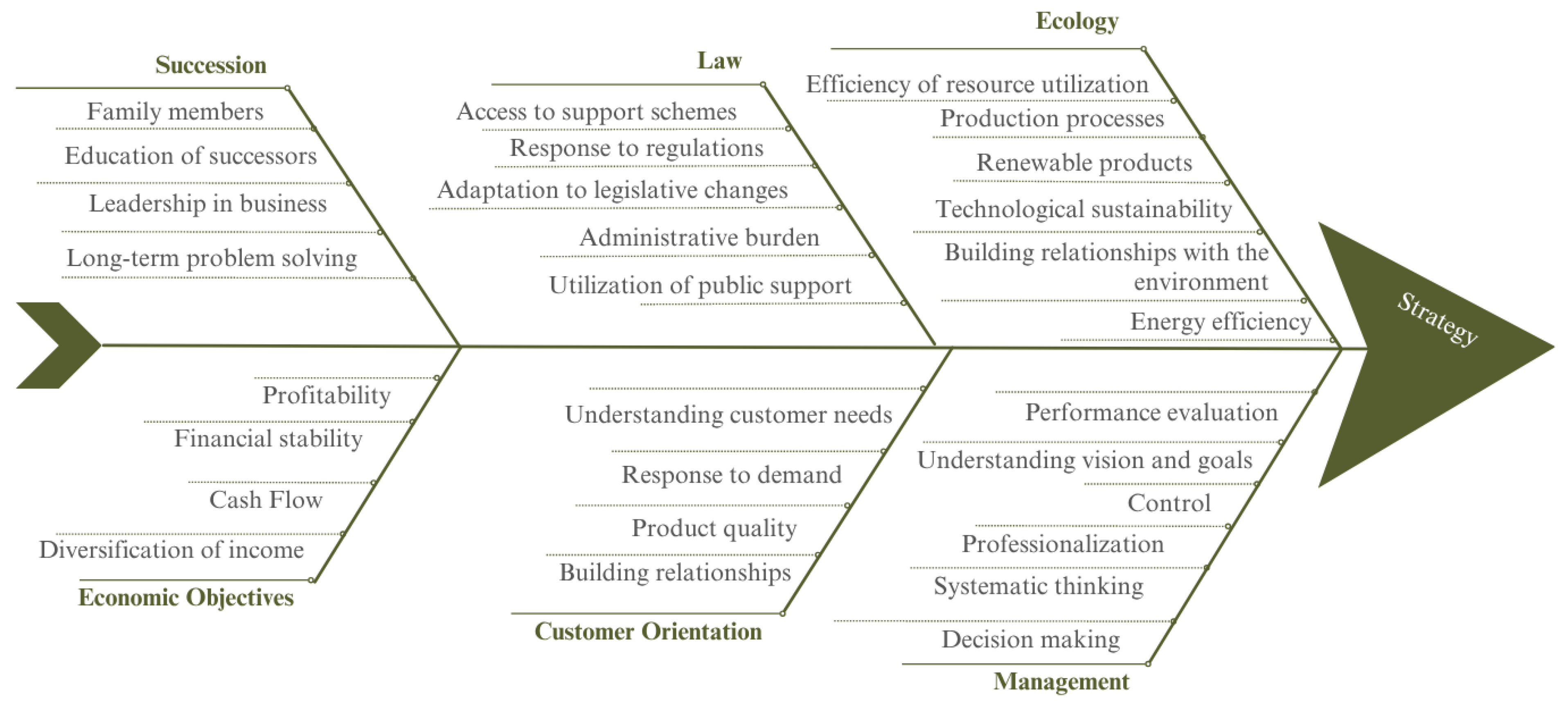
2.4. Development of the Strategy Framework
3. Results
3.1. Descriptive Profile of the Analyzed Family Businesses and Summary of Questionnaire Responses
3.2. Perception of External Determinants
3.3. Importance of Non-Economic Goals in Family Businesses
4. Discussion
4.1. Summary of the Main Findings
4.2. Perception of External Determinants and Market Orientation
4.3. Relational Characteristics
4.4. Strategic Implications for the Forest-Based Sector
4.5. Limitations and Future Research
5. Conclusions
Supplementary Materials
Author Contributions
Funding
Data Availability Statement
Acknowledgments
Conflicts of Interest
References
- Nummelin, T.; Hänninen, R.; Kniivilä, M. Exploring Forest Sector Research Subjects and Trends from 2000 to 2019 Using Topic Modeling. Curr. For. Rep. 2021, 7, 267–281. [Google Scholar] [CrossRef] [Scilit]
- Linser, S.; Wolfslehner, B.; Asmar, F.; Bridge, S.R.J.; Gritten, D.; Guadalupe, V.; Jafari, M.; Johnson, S.; Laclau, P.; Robertson, G. 25 Years of Criteria and Indicators for Sustainable Forest Management: Why Some Intergovernmental C&I Processes Flourished While Others Faded. Forests 2018, 9, 515. [Google Scholar] [CrossRef] [Scilit]
- Gold, S.; Rubik, F. Consumer Attitudes towards Timber as a Construction Material and towards Timber Frame Houses. J. Clean. Prod. 2009, 17, 303–309. [Google Scholar] [CrossRef] [Scilit]
- Hetemäki, L.; Hanewinkel, M.; Muys, B.; Ollikainen, M.; Palahí, M.; Trasobares, A.; Potočnik, J. Leading the Way to a European Circular Bioeconomy Strategy; European Forest Institute: Joensuu, Finland, 2017; Available online: https://efi.int/publications-bank/leading-way-european-circular-bioeconomy-strategy (accessed on 20 April 2026).
- Hetemäki, L.; Hanewinkel, M.; Muys, B.; Ollikainen, M.; Palahí, M.; Trasobares, A. Future of the European Forest-Based Sector; European Forest Institute: Joensuu, Finland, 2014; Available online: www.alphagalileo.org/Uploads/imported/129940_efi_fstp_5_2017.pdf (accessed on 20 April 2026).
- Toppinen, A.; Sauru, M.; Pätäri, S.; Lähtinen, K.; Tuppura, A. Internal and External Factors of Competitiveness Shaping the Future of Wooden Multistory Construction in Finland and Sweden. Constr. Manag. Econ. 2019, 37, 201–216. [Google Scholar] [CrossRef] [Scilit]
- Hansen, E.; Nybakk, E.; Panwar, R. Innovation Insights from North American Forest Sector Research: A Literature Review. Forests 2014, 5, 1341–1355. [Google Scholar] [CrossRef] [Scilit]
- Pätäri, S.; Kyläheiko, K.; Sandström, J. Opening Up New Strategic Options in the Pulp and Paper Industry: Case Biorefineries. For. Policy Econ. 2011, 13, 456–464. [Google Scholar] [CrossRef] [Scilit]
- Miller, D.; Le Breton-Miller, I. Family Governance and Firm Performance: Agency, Stewardship, and Capabilities. Fam. Bus. Rev. 2006, 19, 73–87. [Google Scholar] [CrossRef] [Scilit]
- Gómez-Mejía, L.R.; Haynes, K.T.; Núñez-Nickel, M.; Jacobson, K.J.; Moyano-Fuentes, J. Socioemotional Wealth and Business Risks in Family-Controlled Firms. Adm. Sci. Q. 2007, 52, 106–137. [Google Scholar] [CrossRef] [Scilit]
- van Dulmen, N.; Blanco Rocha, C.F.; Toboso-Chavero, S.; Heijungs, R.; Guinée, J. Evaluating the Landscape of Social Assessment Methods: Integrating the Social Dimension in Sustainability Assessment of Product Value Chains. Int. J. Life Cycle Assess. 2025, 30, 3622–3641. [Google Scholar] [CrossRef] [Scilit] [PubMed]
- Leskinen, P.; Cardellini, G.; González-García, S.; Hurmekoski, E.; Sathre, R.; Seppälä, J.; Verkerk, P.J. Substitution Effects of Wood-Based Products in Climate Change Mitigation; European Forest Institute: Joensuu, Finland, 2018. [Google Scholar] [CrossRef] [Scilit]
- Berrone, P.; Cruz, C.; Gómez-Mejía, L.R. Socioemotional Wealth in Family Firms: Theoretical Dimensions, Assessment Approaches, and Agenda for Future Research. Fam. Bus. Rev. 2012, 25, 258–279. [Google Scholar] [CrossRef] [Scilit]
- Calvano, S.; Negro, F.; Blanc, S.; Bruzzese, S.; Brun, F.; Zanuttini, R. Adding Value to Wood-Based Products: A Systematic Literature Review on Drivers. Forests 2025, 16, 590. [Google Scholar] [CrossRef] [Scilit]
- Khan, M.T.; Pettenella, D.; Masiero, M. Material Flow Analysis of the Wood-Based Value Chains in a Rapidly Changing Bioeconomy: A Literature Review. Forests 2024, 15, 2112. [Google Scholar] [CrossRef] [Scilit]
- Mensah, P.; Pimenta, A.S.; de Melo, R.R.; Amponsah, J.; Tuo, G.; Chakurah, I.; Ampadu, S.D.; Buckman, I.; Nikoi, M.; Minkah, E.; et al. The Global Supply Chain of Wood Products: A Literature Review. Forests 2025, 16, 1036. [Google Scholar] [CrossRef] [Scilit]
- Ministry of Labour, Social Affairs and Family of the Slovak Republic. Act No. 112/2018 Coll. on the Social Economy and Social Enterprises; MPSVR SR: Bratislava, Slovakia, 2022. Available online: https://www.slov-lex.sk/ezbierky/pravne-predpisy/SK/ZZ/2018/112/20260101 (accessed on 20 April 2026).
- Hetemäki, L.; Kangas, J. Forest Bioeconomy, Climate Change and Managing the Change. In Forest Bioeconomy and Climate Change; Springer: Cham, Switzerland, 2022; pp. 1–17. [Google Scholar]
- Linser, S.; Lier, M. The Contribution of Sustainable Development Goals and Forest-Related Indicators to National Bioeconomy Progress Monitoring. Sustainability 2020, 12, 2898. [Google Scholar] [CrossRef] [Scilit]
- D’Amato, D.; Droste, N.; Allen, B.; Kettunen, M.; Lähtinen, K.; Korhonen, J.; Leskinen, P.; Matthies, B.D.; Toppinen, A. Green, Circular, Bio Economy: A Comparative Analysis of Sustainability Avenues. J. Clean. Prod. 2017, 168, 716–734. [Google Scholar] [CrossRef] [Scilit]
- Barros-Contreras, I.; Basco, R.; Martín-Cruz, N.; Hernangómez, J. Strategic management in family business. The missing concept of the familiness learning mechanism. J. Fam. Bus. Manag. 2022, 12, 67–89. [Google Scholar] [CrossRef] [Scilit]
- Li, N.; Toppinen, A.; Lantta, M. Managerial Perceptions of SMEs in the Wood Industry Supply Chain on Corporate Responsibility and Competitive Advantage. J. Small Bus. Manag. 2016, 54, 162–186. [Google Scholar] [CrossRef] [Scilit]
- Zellweger, T.M.; Nason, R.S.; Nordqvist, M.; Brush, C.G. Why Do Family Firms Strive for Nonfinancial Goals? Entrep. Theory Pract. 2013, 37, 229–248. [Google Scholar] [CrossRef] [Scilit]
- Chrisman, J.J.; Sharma, P.; Steier, L.P.; Chua, J.H. The Influence of Family Goals, Governance, and Resources on Firm Outcomes. Entrep. Theory Pract. 2013, 37, 1249–1261. [Google Scholar] [CrossRef] [Scilit]
- Herrera, J.; De las Heras-Rosas, C. Economic, Non-Economic and Critical Factors for the Sustainability of Family Firms. J. Open Innov. 2020, 6, 119. [Google Scholar] [CrossRef] [Scilit]
- Bannò, M.; D’Allura, G. How Do Non-Economic Goals Affect Family Firm’s Propensity to Innovate in Automation? Eur. J. Innov. Manag. 2022, 25, 961–983. [Google Scholar] [CrossRef] [Scilit]
- Weiss, G.; Hansen, E.; Ludvig, A.; Nybakk, E.; Toppinen, A. Innovation Governance in the Forest Sector. For. Policy Econ. 2021, 130, 102506. [Google Scholar] [CrossRef] [Scilit]
- Hart, S.L.; Dowell, G. Invited Editorial: A Natural-Resource-Based View of the Firm: Fifteen Years After. J. Manag. 2011, 37, 1464–1479. [Google Scholar] [CrossRef] [Scilit]
- Dangelico, R.M.; Pujari, D. Mainstreaming Green Product Innovation. J. Bus. Ethics 2010, 95, 471–486. [Google Scholar] [CrossRef] [Scilit]
- He, J.; Yang, Q.; Zhao, Y. Research on the diffusion effects of data value in supply chains. J. Asian Econ. 2025, 101, 102064. [Google Scholar] [CrossRef] [Scilit]
- Rusanen, K.; Hujala, T.; Pykäläinen, J. Research Approaches to Sustainable Forest-Based Value Creation: A Literature Review. For. Policy Econ. 2024, 163, 103222. [Google Scholar] [CrossRef] [Scilit]
- Jelačić, D.; Pirc Barčić, A. Sustainable Production Management Model for Small and Medium Enterprises. Sustainability 2021, 13, 6220. [Google Scholar] [CrossRef] [Scilit]
- Ahmadi, E.; Mohammadi, P.; Mokhatab Rafei, F.; Sana, S.S. Behavioral Factors and Capital Structure: Identification and Prioritization of Influential Factors. Data Sci. Financ. Econ. 2025, 5, 76–104. [Google Scholar] [CrossRef] [Scilit]
- Teece, D.J. Business Models and Dynamic Capabilities. Long Range Plan. 2018, 51, 40–49. [Google Scholar] [CrossRef] [Scilit]
- Näyhä, A.; Pesonen, H.-L. Strategic Change in the Forest Industry. Technol. Forecast. Soc. Change 2014, 81, 259–271. [Google Scholar] [CrossRef] [Scilit]
- Laakkonen, A.; Heiskanen, A.; Näyhä, A.; Toppinen, A.; Hurmekoski, E. Corporate foresight among small- and medium-sized enterprises in forest-based bioeconomy: Conceptual framework and empirical evidence from Finland. Can. J. For. Res. 2026, 56, 1–21. [Google Scholar] [CrossRef] [Scilit]
- Ayonghe, A.N.; Guillén, L.A.; Linser, S.; Toppinen, A. Sustainability barriers in Nordic forestry: A systematic review. Sustain. Futures 2025, 10, 101467. [Google Scholar] [CrossRef] [Scilit]
- Pasaribu, G.; Winarni, I.; Gusti, R.E.P.; Maharani, R.; Fernandes, A.; Harianja, A.H.; Saragih, G.S.; Turjaman, M.; Tampubolon, A.P.; Kuspradini, H.; et al. Current challenges and prospects of Indonesian non-timber forest products (NTFPs): A review. Forests 2021, 12, 1743. [Google Scholar] [CrossRef] [Scilit]
- Sakagami, M.; Sakaguchi, D. Estimating Preferences for Wood Furniture. Forests 2022, 13, 687. [Google Scholar] [CrossRef] [Scilit]
- Hansmann, R.; Köllner, T.; Scholz, R.W. Influence of Consumers’ Orientations on Preferences. For. Policy Econ. 2006, 8, 239–250. [Google Scholar] [CrossRef] [Scilit]
- Toppinen, A.; Toivonen, R.; Valkeapää, A.; Rämö, A.-K. Consumer Perceptions of Environmental and Social Sustainability of Wood Products in the Finnish Market. Scand. J. For. Res. 2013, 28, 775–783. [Google Scholar] [CrossRef] [Scilit]
- Panico, T.; Caracciolo, F.; Furno, M. Analysing the consumer purchasing behaviour for certified wood products in Italy. For. Policy Econ. 2022, 136, 102670. [Google Scholar] [CrossRef] [Scilit]
- Makkonen, M.; Sundqvist-Andberg, H. Customer value creation in B2B relationships: Sawn timber value chain perspective. J. For. Econ. 2017, 29, 94–106. [Google Scholar] [CrossRef] [Scilit]
- Toppinen, A.; Toivonen, R.; Mutanen, A.; Goltsev, V.; Tatti, N. Sources of competitive advantage in woodworking firms of Northwest Russia. Int. J. Emerg. Mark. 2007, 2, 383–394. [Google Scholar] [CrossRef] [Scilit]
- Korhonen, J.E.; Hurmekoski, E.; Hansen, E.; Toppinen, A. Firm-level competitiveness in the forest industries: Review and research implications in the context of bioeconomy strategies. Can. J. For. Res. 2018, 48, 141–152. [Google Scholar] [CrossRef] [Scilit]
- Sakawa, H.; Watanabe, N. Family Control and Corporate Innovation. Sustainability 2021, 13, 5044. [Google Scholar] [CrossRef] [Scilit]
- Berrone, P.; Cruz, C.; Gómez-Mejía, L.R.; Larraza-Kintana, M. Socioemotional Wealth and Corporate Responses. J. Bus. Ethics 2010, 95, 135–147. [Google Scholar]
- Sageder, M.; Mitter, C.; Feldbauer-Durstmüller, B. Image and reputation of family firms: A systematic literature review of the state of research. Rev. Manag. Sci. 2018, 12, 335–377. [Google Scholar] [CrossRef] [Scilit]
- Reina, W.; Pla-Barber, J.; Villar, C. Socioemotional wealth in family business research: A systematic literature review on its definition, roles and dimensions. Eur. Manag. J. 2023, 41, 1000–1020. [Google Scholar] [CrossRef] [Scilit]
- Chrisman, J.J.; Chua, J.H.; Sharma, P. Strategic Management Theory of the Family Firm. Entrep. Theory Pract. 2005, 29, 555–575. [Google Scholar] [CrossRef] [Scilit]
- Deferne, M.; Bertschi-Michel, A.; de Groote, J. The role of trust in family business stakeholder relationships: A systematic literature review. J. Fam. Bus. Strategy 2023, 14, 100501. [Google Scholar] [CrossRef] [Scilit]
- Chaudhary, S.; Dhir, A.; Ferraris, A.; Bertoldi, B. Trust and reputation in family businesses: A systematic literature review of past achievements and future promises. J. Bus. Res. 2021, 137, 143–161. [Google Scholar] [CrossRef] [Scilit]
- Nowak, M.; Zajkowski, R.; Pawłowska-Nowak, M. Prediction of Sustainability Index in Family Firms. Sustainability 2025, 17, 7226. [Google Scholar] [CrossRef] [Scilit]
- Hurmekoski, E.; Hetemäki, L.; Jänis, J. Outlook for the Forest-Based Bioeconomy. In Forest Bioeconomy and Climate Change; Springer: Cham, Switzerland, 2022; pp. 55–89. [Google Scholar]
- Caputo, J.; Butler, B.J.; Markowski-Lindsay, M.; Catanzaro, P. A Survival Analysis of Family Forest Owners in the USA: Estimating Life Expectancy and 5-Year Survivorship. Small-Scale For. 2023, 22, 713–731. [Google Scholar] [CrossRef] [Scilit]
- Hetemäki, L.; Seppälä, J. Planetary Boundaries and Forest Sector. In Forest Bioeconomy and Climate Change; Springer: Cham, Switzerland, 2022; pp. 19–31. [Google Scholar]
- Makkonen, M. Renewing the Sawmill Industry. Doctoral Thesis, University of Helsinki, Helsinki, Finland, 2019. [Google Scholar] [CrossRef] [Scilit]
- Halaj, D. Marketing Support of Decision-Making at the Forest Enterprise. Cent. Eur. For. J. 2019, 65, 223–232. [Google Scholar] [CrossRef] [Scilit]
- Andanawarih, P.P.; Ardiansyah, L.Y.; Dhamayanti, Y. Exploring the nexus of ESG, family firms, and financial risk in Indonesia. Pena J. Ilmu Pengetah. Dan Teknol. 2025, 39, 91–112. [Google Scholar]
- Neykov, N.; Sedliacikova, M.; Antov, P.; Potkány, M.; Kitchoukov, E.; Halalisan, A.-F.; Poláková, N. Efficiency of Micro and Small Wood-Processing Enterprises in the EU—Evidence from DEA and Fractional Regression Analysis. Forests 2024, 15, 58. [Google Scholar] [CrossRef] [Scilit]
- Capolupo, P.; Papa, A.; Fiano, F.; Gregori, G.L. Strategic marketing in family firms: Taking stock of prior knowledge and looking forward. Int. Mark. Rev. 2025, ahead-of-print. [Google Scholar] [CrossRef] [Scilit]
- Falcone, P.M.; Tani, A.; Tartiu, V.E.; Imbriani, C. Towards a sustainable forest-based bioeconomy in Italy: Findings from a SWOT analysis. For. Policy Econ. 2020, 110, 101910. [Google Scholar] [CrossRef] [Scilit]
- De Massis, A.; Frattini, F.; Pizzurno, E.; Cassia, L. Product Innovation in Family Firms. J. Small Bus. Manag. 2015, 53, 1–36. [Google Scholar] [CrossRef] [Scilit]
- Niebla-Zatarain, J.C.; Pinedo-de-Anda, F.J.; Leyva-Duarte, E. Entrepreneurship in Family Business. J. Intell. Fuzzy Syst. 2020, 38, 5589–5604. [Google Scholar] [CrossRef] [Scilit]
- Klitkou, A.; Jolly, S.; Suvinen, N. Systemic Intermediaries and the Transition toward Forest-Based Bioeconomy in the North. Rev. Evol. Polit. Econ. 2023, 4, 321–348. [Google Scholar] [CrossRef] [Scilit]
- de Almeida Barbosa Franco, J.; Franco Junior, A.; Battistelle, R.A.G.; Bezerra, B.S. Dynamic Capabilities: Unveiling Key Resources for Environmental Sustainability and Economic Sustainability, and Corporate Social Responsibility towards Sustainable Development Goals. Resources 2024, 13, 22. [Google Scholar] [CrossRef] [Scilit]
- Imbrenda, V.; Coluzzi, R.; Mariani, F.; Nosova, B.; Cudlinova, E.; Salvia, R.; Quaranta, G.; Salvati, L.; Lanfredi, M. Working in (Slow) Progress: Socio-Environmental and Economic Dynamics in the Forestry Sector and the Contribution to Sustainable Development in Europe. Sustainability 2023, 15, 10271. [Google Scholar] [CrossRef] [Scilit]
- Heiskanen, A.; Hurmekoski, E.; Toppinen, A.; Näyhä, A. Exploring the unknowns: State of the art in qualitative forest-based sector foresight research. For. Policy Econ. 2022, 135, 102643. [Google Scholar] [CrossRef] [Scilit]
- Jonsson, R. The Swedish forest-based sector in turbulent times. Forests 2026, 17, 141. [Google Scholar] [CrossRef] [Scilit]


| Code | Activity Description | Division |
|---|---|---|
| 16000 | Manufacture of wood and of products of wood and cork, except furniture | C16 |
| 16100 | Sawmilling and planing of wood | C16 |
| 16200 | Manufacture of products of wood, cork, straw and plaiting materials | C16 |
| 16210 | Manufacture of veneer sheets and wood-based panels | C16 |
| 16220 | Manufacture of assembled parquet floors | C16 |
| 16230 | Manufacture of other builders’ carpentry and joinery | C16 |
| 16231 | Manufacture of builders’ carpentry and joinery elements | C16 |
| 16232 | Manufacture of prefabricated wooden buildings | C16 |
| 16239 | Manufacture of other builders’ carpentry and joinery n.e.c. | C16 |
| 16240 | Manufacture of wooden containers | C16 |
| 16290 | Manufacture of other products of wood, cork, straw and plaiting materials n.e.c. | C16 |
| 31000 | Manufacture of furniture | C31 |
| 31010 | Manufacture of office and shop furniture | C31 |
| 31020 | Manufacture of kitchen furniture | C31 |
| Code | Determinant | −2 | −1 | 0 | 1 | 2 |
|---|---|---|---|---|---|---|
| 1 | Customers | 2% | 1% | 13% | 21% | 63% |
| 2 | Suppliers | 8% | 12% | 14% | 26% | 40% |
| 3 | Intermediaries | 14% | 15% | 40% | 16% | 15% |
| 4 | Competitors | 1% | 11% | 22% | 33% | 33% |
| 5 | Public | 8% | 2% | 23% | 27% | 40% |
| Code | Determinant | −2 | −1 | 0 | 1 | 2 |
|---|---|---|---|---|---|---|
| 1 | Family and business life integration | 7% | 3% | 13% | 21% | 56% |
| 2 | Long-term growth and sustainability goals, and responsible ownership | 2% | 3% | 8% | 22% | 65% |
| 3 | Tradition | 7% | 6% | 9% | 15% | 63% |
| 4 | Family brand | 13% | 3% | 16% | 12% | 55% |
| 5 | Long-term relationships and reputation | 0% | 1% | 6% | 17% | 77% |
| 6 | Informality | 4% | 6% | 22% | 22% | 45% |
| 7 | Trust | 2% | 1% | 4% | 19% | 73% |
| 8 | Participation, engagement, and personal interest in business growth | 2% | 2% | 6% | 19% | 71% |
| 9 | Simplified decision-making process and greater decision-making flexibility | 5% | 3% | 9% | 23% | 59% |
| 10 | Orientation towards customer, employee, and local community satisfaction | 1% | 2% | 6% | 21% | 69% |
| 11 | Strong sense of socially responsible behavior | 2% | 7% | 12% | 21% | 58% |
| 12 | Value-based and emotional management style | 4% | 6% | 10% | 27% | 53% |
| 13 | Employee loyalty | 2% | 6% | 14% | 29% | 49% |
| Code | Determinant | Sum of Ranks | Mean Rank | H-Test | p-Value |
|---|---|---|---|---|---|
| 1 | Customers | 606,025.5 | 1402.84 | 302.091 | 0.000 |
| 2 | Suppliers | 473,782.5 | 1096.72 | ||
| 3 | Intermediaries | 303,091.5 | 701.60 | ||
| 4 | Competitors | 466,066.5 | 1078.86 | ||
| 5 | Public | 484,914.0 | 1122.49 |
| Determinant | Multiple Comparison | ||||
|---|---|---|---|---|---|
| Customers | Suppliers | Intermediaries | Competitors | Public | |
| Customers | 0.000 | 0.000 | 0.000 | 0.000 | |
| Suppliers | 0.000 | 0.000 | 1.000 | 1.000 | |
| Intermediaries | 0.000 | 0.000 | 0.000 | 0.000 | |
| Competitors | 0.000 | 1.000 | 0.000 | 1.000 | |
| Public | 0.000 | 1.000 | 0.000 | 1.000 | |
| Code | Characteristic | Sum of Ranks | Mean Rank | H-Test | p-Value |
|---|---|---|---|---|---|
| 1 | Long-term relationships and reputation | 1,952,418 | 4519.49 | 543.44 | 0.000 |
| 2 | Trust | 1,885,527 | 4364.65 | ||
| 3 | Participation, engagement, and personal involvement | 1,842,777 | 4265.69 | ||
| 4 | Customer satisfaction orientation | 1,826,169 | 4227.24 | ||
| 5 | Long-term growth and sustainability goals | 1,757,442 | 4068.15 | ||
| 6 | Simpler decision-making process | 1,648,794 | 3816.65 | ||
| 7 | Tradition | 1,644,813 | 3807.44 | ||
| 8 | Stronger long-term commitment to employees | 1,637,214 | 3789.85 | ||
| 9 | Strong sense of social responsibility | 1,615,242 | 3738.99 | ||
| 10 | Integration of family and business life | 1,564,143 | 3620.70 | ||
| 11 | Value-based and emotional management style | 1,547,451 | 3582.06 | ||
| 12 | Employee loyalty | 1,493,727 | 3457.70 | ||
| 13 | Family brand | 1,480,710 | 3427.57 | ||
| 14 | Informality | 1,385,826 | 3207.93 | ||
| 15 | Emphasis on non-economic goals | 1,334,586 | 3089.32 | ||
| 16 | High innovation potential | 1,224,327 | 2834.09 | ||
| 17 | Family council and family protocol | 1,129,674 | 2614.99 |
Disclaimer/Publisher’s Note: The statements, opinions and data contained in all publications are solely those of the individual author(s) and contributor(s) and not of MDPI and/or the editor(s). MDPI and/or the editor(s) disclaim responsibility for any injury to people or property resulting from any ideas, methods, instructions or products referred to in the content. |
© 2026 by the authors. Licensee MDPI, Basel, Switzerland. This article is an open access article distributed under the terms and conditions of the Creative Commons Attribution (CC BY) license.
Share and Cite
Sedliačiková, M.; Kostúr, M.; Osvaldová, M. Family Businesses in the Wood-Processing and Furniture Industry and Their Role in Sustainable Forest-Based Development. Forests 2026, 17, 589. https://doi.org/10.3390/f17050589
Sedliačiková M, Kostúr M, Osvaldová M. Family Businesses in the Wood-Processing and Furniture Industry and Their Role in Sustainable Forest-Based Development. Forests. 2026; 17(5):589. https://doi.org/10.3390/f17050589
Chicago/Turabian StyleSedliačiková, Mariana, Marek Kostúr, and Mária Osvaldová. 2026. "Family Businesses in the Wood-Processing and Furniture Industry and Their Role in Sustainable Forest-Based Development" Forests 17, no. 5: 589. https://doi.org/10.3390/f17050589
APA StyleSedliačiková, M., Kostúr, M., & Osvaldová, M. (2026). Family Businesses in the Wood-Processing and Furniture Industry and Their Role in Sustainable Forest-Based Development. Forests, 17(5), 589. https://doi.org/10.3390/f17050589