Article

Family Businesses in the Wood-Processing and Furniture Industry and Their Role in Sustainable Forest-Based Development


by
Mariana Sedliačiková
,
Marek Kostúr
and
Mária Osvaldová
*
Faculty of Wood Sciences and Technology, Technical University in Zvolen, T. G. Masaryka 24, 960 01 Zvolen, Slovakia
*
Author to whom correspondence should be addressed.
Forests 2026, 17(5), 589; https://doi.org/10.3390/f17050589
Submission received: 9 April 2026 / Revised: 24 April 2026 / Accepted: 27 April 2026 / Published: 12 May 2026
(This article belongs to the Special Issue Economic Optimization and Sustainable Management in Forest Resources)

Abstract

Family businesses represent an important part of the wood-processing and furniture industry and may play a significant role in sustainable forest-based development. This study aims to analyze how family businesses perceive selected external determinants of the microeconomic environment, assess the role of non-economic goals in their management, and propose a strategic framework for their sustainable development. The research was conducted in Slovakia through a questionnaire survey administered between August 2024 and May 2025. The final dataset included 507 valid responses, of which 432 businesses were identified as family businesses. The data were analyzed using non-parametric statistical methods, particularly the Kruskal–Wallis test and multiple comparison analysis. The results confirmed significant differences in the perceived importance of external determinants, with customers identified as the most important factor and intermediaries as the least important. The findings also showed that non-economic goals, such as sustainability and intergenerational continuity, are relevant, although not the most prominent characteristic. Relational factors, especially trust, reputation, and long-term relationships, play a more central role. Based on these findings, a conceptual strategic framework was developed using the Ishikawa diagram. The study highlights the role of family businesses in long-term competitiveness and sustainable forest-based development.

1. Introduction

Wood has long represented one of the most important natural raw materials used by mankind. Despite the development of many alternative materials, wood has retained its importance due to its renewable character, ecological properties, and wide applicability in industry and everyday life [1,2,3]. It is used in construction, the pulp and paper industry, the woodworking and furniture sectors, and many other areas of the economy. Because wood originates directly from forest ecosystems, its processing and utilization are closely linked to sustainable forest management and the long-term availability of natural resources [4,5,6].
The woodworking and furniture industry therefore represents an important component of the forest-based economy. In many European countries, including Slovakia, this sector plays a significant role in regional development, employment, and value creation. At the same time, industry operates in an environment characterized by increasing global competition, technological change, and growing requirements for environmental responsibility [7,8]. Businesses must constantly adapt to market conditions, regulatory frameworks, and evolving customer expectations to maintain their competitiveness and long-term stability [9,10]. The close interconnection between wood processing and furniture manufacturing lies in their shared value chain, where primary wood processing provides essential inputs for furniture production, making it appropriate to analyze these sectors jointly within the forest-based industry context. From the perspective of sustainable forest-based development, the behavior of wood-processing and furniture businesses is important not only at the business level, but also at the level of the whole value chain [11,12,13]. Decisions about products, quality, innovation, and market orientation can indirectly influence how wood resources are used, which assortments are preferred, and how strongly businesses support traceability, certification, and more efficient use of raw materials [14]. In this way, business strategies in wood-based industries are closely linked to broader forestry goals, such as better use of wood resources, support for the cascading use of wood, and the long-term development of the forest-based bioeconomy [15,16].
In this study, family businesses are defined in accordance with the Slovak legislative framework (Act No. 112/2018 Coll., as amended), which considers a business to be a family business if members of the same family are involved in ownership, management, or benefit from the business under defined conditions [17]. Their management is frequently influenced not only by economic performance but also by long-term continuity, preservation of the business for future generations, and responsibility toward employees and local communities [18,19]. Such characteristics may affect how family businesses respond to external pressures, how they perceive their market environment, and how they formulate their development strategies [20,21].
Businesses operating in the wood-processing sector face several external determinants of the microeconomic environment, including supplier relations, competition, access to finance, technological development, and regulatory requirements [22]. The perception of these determinants may differ depending on firm size, available resources, and internal governance structure. Understanding these differences is important because they influence strategic decisions, investment behavior, and the ability of business to ensure sustainable development [23,24,25].
In addition to economic objectives, family businesses are frequently characterized by the pursuit of non-economic goals. These include long-term stability of income, sustainability of production, preservation of the company for future generations, and the building of a family legacy. Such goals may shape managerial decisions, influence risk-taking, and determine how businesses approach innovation, cooperation, and resource use [25,26]. For businesses in the forest-based sector, these priorities may also indirectly influence the use of wood resources and the sustainability orientation of the industry [27,28,29].
Increasing attention has been paid to the role of firm-level behavior and managerial orientation in shaping broader value-chain outcomes. Individual decision-making processes within firms can significantly influence supply chain performance, resource allocation, and value creation across the entire production system. Firm-level decisions related to data utilization and value perception can generate diffusion effects across supply chains, affecting efficiency, coordination, and overall economic outcomes [30].
Similarly, previous research emphasizes the relevance of sustainable forest-based value creation and the role of small and medium-sized enterprises in shaping sustainable development in the wood-processing and furniture industry [31,32]. Behavioral determinants can also be systematically identified, compared, and prioritized using analytical approaches, providing deeper insights into decision-making processes within firms [33]. Such approaches are particularly relevant for family businesses, where managerial behavior is often influenced by non-economic goals, values, and long-term orientation.
Despite the growing body of literature on family businesses and sustainability, there remains a research gap in understanding how family businesses in the wood-processing and furniture industry perceive external determinants of their business environment and how non-economic goals are integrated into their strategic decision-making. Existing studies often focus either on general family business characteristics or on broader forest-sector dynamics, without explicitly linking these perspectives. Moreover, empirical evidence from Central and Eastern European countries, including Slovakia, is still limited. At the same time, only limited attention has been given to the role of family businesses in forest-based value chains. This is important, especially in countries where small and medium-sized enterprises form a large part of the wood-processing and furniture industry [31,32]. Studying these businesses can help explain how company-level priorities are reflected in wider sustainability outcomes in the forest-based sector, especially in relation to resource use, market behavior, environmental responsibility, and long-term continuity.
It follows from the above that it is necessary to analyze how family businesses in the wood-processing and furniture industry perceive external determinants of their business environment and how non-economic objectives influence their development orientation. Understanding these factors can contribute to the formulation of development strategies that support both business competitiveness and long-term sustainability in the forest-based sector [31,34,35].
The main objective of this paper is to analyze the perception of external determinants and the role of non-economic goals in family businesses of the wood-processing and furniture industry and based on the results, to propose a framework for a sustainable development strategy for these businesses. The contribution of this paper can be summarized in three main aspects. First, it provides empirical evidence on how family businesses in the wood-processing and furniture industry perceive external determinants of the microeconomic environment, contributing to the limited research in the context of Central and Eastern Europe. Second, it indicates that non-economic goals, although relevant, do not represent the most dominant characteristic of family businesses, as relational factors such as trust, reputation, and long-term relationships play a more central role in managerial behavior. Third, based on the empirical findings and relevant literature, the study proposes a conceptual strategic framework for the sustainable development of family businesses in the forest-based sector.
This study contributes to the field of forest economics, policy, and social science by examining how firm-level perceptions and managerial priorities in downstream wood-processing and furniture businesses influence wider forest-based value chains. In this respect, family businesses are relevant not only as economic actors, but also as decision-making units whose market orientation, resource-use preferences, and long-term strategic behavior may affect value creation, traceability, resource efficiency, and the sustainable management of forest-based resources.
The following hypotheses were defined from the literature review:
Hypothesis 1 (H1).
It is assumed that significant differences exist in the perceived importance of selected external determinants of the microeconomic environment among family businesses operating in the wood-processing and furniture industry.
Hypothesis 2 (H2).
It is assumed that non-economic goals, such as sustainability, long-term stable income, and intergenerational continuity, represent an important component of the managerial orientation of family businesses in the wood-processing and furniture industry.

2. Materials and Methods

2.1. Population and Sample

The research focuses on businesses operating in the wood-processing and furniture industry in Slovakia. The basic population consisted of 2722 businesses that met the inclusion criteria based on their classification in the SK NACE system, namely division C16 (manufacture of wood and products of wood and cork, except furniture) and division C31 (manufacture of furniture). The contact database was obtained from the Finstat register.
To allow the generalization of results to the entire population of businesses in the Slovak wood-processing and furniture industry, the minimum required sample size was determined in advance. The calculation was based on a confidence level of 95 percent, an allowable sampling error of 5 percent, population size n = 2722, and parameter p = 0.5, which represents the most conservative estimate of variability. Under these conditions, the minimum sample size was determined to be 337 businesses.
Data collection was conducted through an online survey administered between August 2024 and May 2025. Businesses were contacted electronically using addresses obtained from the Finstat database. The final dataset included 507 valid responses.
Data were collected using a structured and anonymous questionnaire consisting of 38 items, designed to ensure objective responses from participating businesses. To reduce the time burden on respondents and enable consistent data evaluation, the questionnaire was composed primarily of closed-ended questions, supplemented by semi-closed questions with another option and scale-based questions. Most of the items were evaluated using a five-point Likert scale, allowing respondents to express the degree of importance or agreement with individual statements (Supplementary File S1).
The questionnaire was divided into several thematic sections. The first section included identification questions, focusing on business characteristics such as business size, level of operation, length of market presence, industry classification according to SK NACE, and identification of family businesses. The second section addressed determinants influencing business activities, covering both microeconomic and macroeconomic factors. The third section focused on the perception of sustainability, particularly in relation to ecological aspects and succession processes. The fourth section examined strategic orientation and development, while the final section aimed at the identification of strategy and development practices, with an emphasis on addressing key challenges faced by businesses.

2.2. Representativeness of the Sample

In addition to meeting the minimum sample size requirement, it was necessary to verify whether the research sample adequately reflected the structure of the basic population. Representativeness was assessed using two key characteristics:
(i)
classification according to SK NACE division (C16 wood-processing businesses and C31 furniture businesses), and
(ii)
business size based on the number of employees, following the categories defined by the European Commission Recommendation 2003/361/EC.
A comparison of the population and sample structure according to industry classification showed very similar distributions. In the population, wood-processing businesses represented 95.45 percent and furniture businesses 4.55 percent. In the research sample, the proportions were 95.27 percent and 4.73 percent, respectively.
To statistically verify representativeness, Pearson’s chi-square goodness-of-fit test was applied. The test confirmed that the differences between the population and the sample structure were not statistically significant, as the obtained p-value of 0.847 exceeded the significance level of 0.05. The research sample can therefore be considered representative with respect to industry structure.
The research sample was drawn from a population of 2722 active businesses operating in the wood-processing and furniture industry in Slovakia. The population was defined based on data obtained from the Finstat database as of 20 June 2025. Using a pseudorandom number generator, businesses were selected to ensure random sampling and equal probability of inclusion.
Family businesses were identified in accordance with the legislative definition established in the Slovak Republic by the amendment to Act No. 112/2018 Coll. on the Social Economy and Social Businesses, effective from July 2023.
According to this definition, a business is considered a family business if members of the same family are defined as spouses, direct relatives, siblings, and relatives up to the fourth degree and their spouses meet specific conditions related to ownership, management, or economic benefit from the business.
In particular, the classification of family businesses was based on criteria such as:
(i)
majority voting rights held by family members,
(ii)
participation of family members in statutory or managerial positions, and/or
(iii)
economic benefit from the business exceeding 50% of after-tax profits. In the case of sole proprietors, the business was classified as a family business if at least one family member was employed in the business.
Based on these criteria, out of 507 valid responses, 432 businesses were identified as family businesses and included in the subsequent analysis.
The analyzed enterprises were classified according to the SK NACE classification of economic activities, as shown in Table 1. The sample covers a wide spectrum of activities within the wood-processing (C16) and furniture manufacturing (C31) sectors, ensuring a comprehensive representation of the forest-based industry.
A total of 507 enterprises operating in the wood-processing and furniture industry in Slovakia participated in the research. In accordance with the main objective of the study, only enterprises meeting the criteria of family businesses were included in the subsequent analysis, resulting in a final sample of 432 family firms. The identification of family businesses was based on the legislative definition introduced by Act No. 112/2018 Coll. on the Social Economy and Social Enterprises, effective from July 2023.
From the sectoral perspective, the sample was dominated by enterprises operating in the wood-processing industry (Division C16), which accounted for approximately 95% of the analyzed firms (483 enterprises), while the remaining 5% (24 enterprises) represented furniture manufacturing (Division C31). This structure reflects the composition of the forest-based sector in Slovakia, where primary wood processing prevails over furniture production.
In terms of enterprise size, micro-enterprises (1–9 employees) formed the largest group (40%), followed by small enterprises (10–49 employees) with 38% and medium-sized enterprises (50–249 employees) with 19%. Large enterprises (250+ employees) accounted for only 3% of the sample. This distribution confirms the dominance of small and medium-sized enterprises in the sector analyzed.
Regarding the length of market presence, most enterprises (50%) have been operating for more than 25 years, indicating a high level of stability and continuity. Enterprises operating for 15–24 years represented 24% of the sample, while 21% had been active for 5–14 years. Only 5% of enterprises had been operating for less than 5 years.
From the perspective of legal form, the sample was strongly dominated by limited liability companies (88%), followed by sole proprietors (7%) and joint-stock companies (5%). Other legal forms, such as general partnerships or cooperatives, were not represented in the sample.

2.3. Data Analysis

Given the ordinal nature of the data, the analysis was based on rank-based non-parametric testing. The Kruskal–Wallis test was applied as a robust procedure for identifying differences in the perceived importance of the analyzed determinants and characteristics, followed by post hoc multiple comparisons of mean ranks.
All statistical analyses were performed using STATISTICA software, version 14. The software was used to conduct non-parametric tests, including the Kruskal–Wallis test and subsequent multiple comparison analysis.
For determinants and characteristics where statistically significant differences were identified, post hoc multiple comparison analysis of mean ranks was subsequently performed. The analyses were conducted on the responses of family businesses included in the final sample. Statistical analyses were conducted using standard statistical software, and the significance level was set at α = 0.05.
The Kruskal–Wallis test was used to examine differences in the perceived importance of individual determinants and characteristics based on ordinal data obtained from Likert-scale responses. In this context, the grouping variable was represented by the type of determinant or characteristic (e.g., customers, suppliers, competitors, intermediaries, and public for external environment factors), while the dependent variable was the perceived importance assigned by respondents. All variables were measured using a five-point Likert scale, which justifies the use of a non-parametric test. The test therefore evaluates whether statistically significant differences exist in how individual determinants or characteristics are perceived across the sample analyzed of family businesses.

2.4. Development of the Strategy Framework

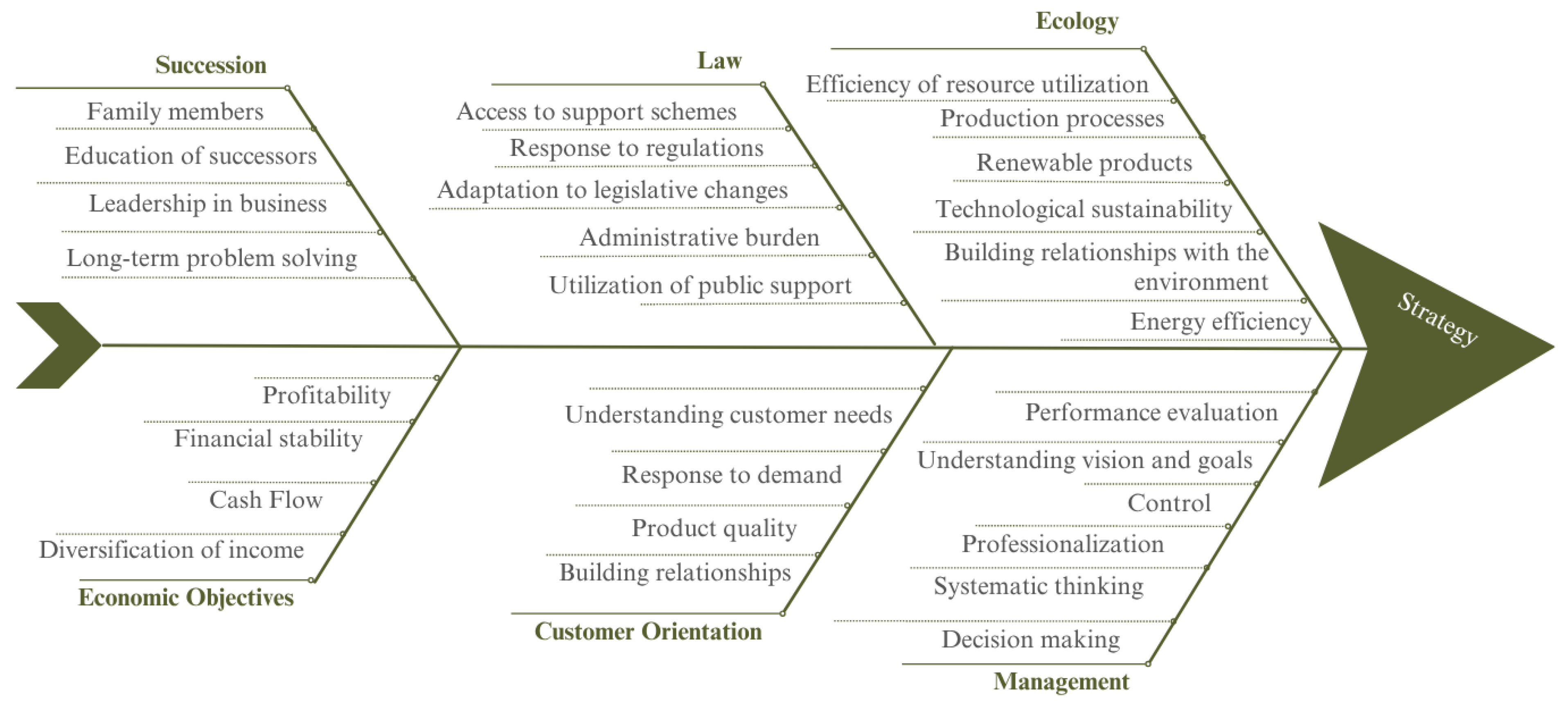
In order to translate the empirical findings into a practical strategic framework, the Ishikawa diagram was applied as a conceptual analytical tool. The Ishikawa diagram is widely used in management and decision-making processes to identify and structure key factors influencing a particular outcome and to visualize causal relationships between them.
In this study, the construction of the Ishikawa diagram followed a structured procedure based on the results of the empirical analysis. First, determinants and characteristics that showed statistically significant differences in their perceived importance were identified using the statistical analysis. Subsequently, those factors that reached higher mean rank values and were considered strategically relevant for the sustainable development of family businesses were selected as key inputs for the framework. These factors formed the basis for the individual branches of the Ishikawa diagram.
In the next step, the identified determinants were grouped into broader thematic categories. The grouping was based on the conceptual similarity of determinants, their functional role in business management, and their relevance to strategic development, as identified in the literature. The categorization process followed a systematic but interpretative approach, combining empirical results with theoretical knowledge from the fields of family business, sustainability, and the forest-based sector.
The main categories of determinants represent the primary branches of the Ishikawa diagram, while individual determinants identified through the empirical analysis form secondary branches. This structure enables the visualization of relationships between external environmental conditions, internal organizational factors, and strategic objectives of businesses.
Based on this structured procedure, the Ishikawa diagram was subsequently used as a foundation for the formulation of a strategy for the sustainable development of family businesses in the wood-processing and furniture industry. The diagram therefore represents not only an analytical tool but also a methodological step linking empirical results with the development of strategic recommendations.

3. Results

3.1. Descriptive Profile of the Analyzed Family Businesses and Summary of Questionnaire Responses

The analyzed sample consisted of 432 family businesses operating in the wood-processing and furniture industry in Slovakia. Its main structural characteristics are presented in Section 2.2.
Table 2 presents the distribution of responses evaluating the importance of selected external microenvironment determinants using a five-point scale ranging from −2 (very low importance) to +2 (very high importance). The results indicate that customers are perceived as the most important determinant, with 63% of respondents assigning the highest importance level (+2) and only a negligible proportion indicating low importance.
Suppliers and the public were also evaluated as relatively important determinants, with 40% of respondents assigning them the highest importance level. Competitors show a more balanced distribution, with the majority of responses concentrated in the positive part of the scale (+1 and +2). In contrast, intermediaries were perceived as the least important determinant, with the largest share of responses (40%) concentrated at the neutral level (0) and relatively higher proportions of negative evaluations compared to other factors.
The response distribution (Table 3) indicates that the strongest emphasis was placed on long-term relationships and reputation, with 77% of respondents assigning the highest importance level. This is followed by trust (73%), participation and engagement in business activities (71%), and a focus on customer, employee, and community satisfaction (69%), all of which rank among the most highly valued characteristics.
A similarly high level of importance was observed for long-term growth and sustainability goals (65%) and tradition (63%), highlighting the relevance of continuity-oriented factors in family businesses. In contrast, characteristics such as employee loyalty, informality, and value-based management exhibit a more evenly distributed pattern of responses, with a greater concentration around moderate levels of importance. Overall, the findings point to the dominance of relational and long-term oriented characteristics within family business management.

3.2. Perception of External Determinants

The first hypothesis assumed that significant differences between determinants exist in the perceived importance of selected external determinants of the microeconomic environment among family businesses operating in the wood-processing and furniture industry. To verify this hypothesis, the Kruskal–Wallis test was applied to compare the mean ranks of the analyzed external determinants. The results presented in Table 4 confirmed the existence of statistically significant differences among the analyzed determinants of the external microeconomic environment (H = 302.091; p < 0.001). From the perspective of mean ranks, the highest values were recorded for determinants related to customers, followed by the public, suppliers, and competitors, while the lowest mean rank was observed for intermediaries.
These differences can be explained by the economic structure of the wood-processing and furniture industry. Enterprises in this sector are strongly demand-driven, as their production is closely linked to final consumption and customer-specific requirements. As a result, customer-related determinants directly influence revenues, product design, and market positioning, which explains their dominant perception.
In contrast, intermediaries appear to play a less significant role, which may be associated with the prevalence of direct business relationships and shorter supply chains in family firms. Many enterprises establish long-term partnerships directly with customers or suppliers, thereby reducing their dependence on intermediaries. This may explain the lower perceived importance of intermediaries compared to other external determinants.
These results indicate that individual actors of the external microenvironment differ in their perceived importance of family businesses operating in the wood-processing and furniture industry. To examine these differences in greater detail, a multiple comparison analysis was performed (Table 5). The results confirmed statistically significant differences between most of the determinants analyzed.
Determinants associated with customers differed significantly from all other determinants of the microenvironment. Significant differences were also identified between intermediaries and the remaining groups of determinants. In contrast, no statistically significant differences were observed in several cases between suppliers, competitors, and the public, indicating a relatively similar perceived importance of these determinants.
The reliability of the measurement scales was assessed using Cronbach’s alpha coefficient, which evaluates the internal consistency of multi-item constructs. The analysis showed that the values of Cronbach’s alpha ranged from α = 0.78 to α = 0.91, indicating acceptable to high reliability of the applied measurement scales.
Content validity of the questionnaire was ensured through literature-based development of items, their adaptation to the conditions of the wood-processing and furniture industry, and subsequent pilot testing. The structure of the questionnaire was aligned with the research objectives and hypotheses, ensuring that the selected items adequately capture the investigated constructs.
Following the Kruskal–Wallis test, post hoc analysis was performed using pairwise multiple comparisons of mean ranks to identify statistically significant differences between individual groups of determinants. A Bonferroni-adjusted significance level was applied to control for Type I error.

3.3. Importance of Non-Economic Goals in Family Businesses

The second hypothesis stated that non-economic goals, such as sustainability, long-term stable income, and business continuity across generations, are an important part of the managerial orientation of family businesses in the wood-processing and furniture industry. To test this hypothesis, the importance of selected entrepreneurial characteristics was analyzed using the Kruskal–Wallis test (Table 6). The results showed statistically significant differences among the analyzed characteristics (H = 543.44; p < 0.001), which means that they were not perceived equally.
From the perspective of mean ranks, the highest values were recorded for long-term relationships and reputation, followed by trust, participation and engagement, and customer satisfaction orientation. In contrast, the emphasis on non-economic goals achieved a lower mean rank than the dominant relational and trust-based characteristics. The lowest values were observed for family council and family protocol and for high innovation potential.
These findings indicate that although non-economic goals are present and considered important by family businesses, they do not represent the most dominant characteristic when compared to relational and reputation-based factors. Based on these results, Hypothesis 2 can be considered supported only in part. While non-economic goals form an important component of family business orientation, the analysis suggests that relational factors, such as trust, reputation, and long-term relationships, play a more prominent role in shaping managerial behavior in family businesses.

4. Discussion

4.1. Summary of the Main Findings

The results of the study provide new insights into the determinants influencing the development and sustainability of family businesses operating in the wood-processing and furniture industry. The findings confirmed that significant differences exist in how family businesses perceive external determinants of the microeconomic environment, thereby supporting Hypothesis 1 (H1). This indicates that individual determinants are not perceived uniformly and that their importance varies depending on specific business conditions.

4.2. Perception of External Determinants and Market Orientation

These results suggest that family businesses differentiate between individual actors of the microeconomic environment, with customer-related determinants representing the most influential factors. The highest mean rank values were recorded for determinants associated with customers, while intermediaries were perceived as the least influential determinants. This finding reflects the strong orientation of businesses toward market demand and customer relationships, which are essential for maintaining competitiveness in the forest-based sector. Similar conclusions were reported by Toppinen et al. [6], who emphasize that internal resources and business size influence how forest-sector companies react to market pressures and competitive dynamics. Other studies also indicate that businesses operating in forest-based industries must adapt flexibly to changing market conditions and customer requirements [35,36,37,38]. In the context of sustainable forest-based development, strong emphasis on customers may have a wider meaning than only better market performance. Customer expectations are increasingly related not only to price and quality, but also to environmental aspects of products, transparency of raw material origin, durability, and responsible use of renewable resources [39,40,41,42]. For family businesses in the wood-processing industry, such expectations may create stronger pressure to use certified inputs, reduce material waste, improve resource efficiency, and develop products with a longer service life. Although these forestry-related outcomes were not measured directly in this study, the results suggest that customer orientation may be one of the important links between business behavior and sustainability in the forest-based sector [43].
The dominance of customer-related determinants can be explained by the nature of the wood-processing and furniture industry, where businesses are closely linked to final demand and product customization. In contrast, intermediaries may be perceived as less influential due to the prevalence of direct business relationships and shorter supply chains in many family businesses. These findings are consistent with studies highlighting the importance of market orientation and customer relationships in forest-based industries [44,45]. Research by Sakawa et al. [46] and Berrone et al. [47] further emphasizes that customer orientation and relationship management represent critical determinants of competitiveness in wood-processing and furniture businesses.

4.3. Relational Characteristics

Another important finding concerns the characteristics that shape the managerial behavior of family businesses. The results revealed that relational factors such as long-term relationships, reputation, trust, and personal engagement play a dominant role in family business management. These characteristics correspond with the theoretical perspective of socioemotional wealth, which suggests that family businesses prioritize long-term relationships, reputation, and continuity as key elements of their strategic orientation [48,49,50]. According to Berrone et al. [47], these non-financial objectives significantly influence managerial decision-making in family businesses. Other authors have similarly pointed out that relational capital and long-term stakeholder relationships represent important sources of competitive advantage in family businesses [48,51,52].
The results related to Hypothesis 2 (H2) provide a more nuanced interpretation. While the analysis confirmed that non-economic goals, such as sustainability, long-term stability, and intergenerational continuity, are present and relevant in family businesses, they were not identified as the most dominant characteristic. Previous research has shown that family businesses frequently pursue non-financial objectives and tend to adopt a long-term orientation in strategic decision-making [23,24,50]. Recent research has also shown that sustainability in family firms can be understood as a broader multidimensional orientation rather than as a single isolated objective [53]. In the forest-based context, this orientation should also be interpreted within wider bioeconomy transformations and long-term sectoral change [54]. Such a long-term perspective is consistent with continuity-oriented decision making in forest-related contexts [55]. In addition, sustainability debates in the forest-based sector increasingly take into account broader environmental limits and systemic responsibilities [56]. In particular, the ranking of entrepreneurial characteristics showed that the emphasis on non-economic goals achieved lower mean rank values than relational factors such as trust and reputation.
This finding suggests that non-economic goals represent an important component of family business orientation rather than its primary defining feature. A possible explanation is that economic and non-economic objectives are closely interconnected in family businesses, and relational factors may provide the basis through which these goals are pursued. Sustainability-oriented behavior is therefore likely to be linked to broader strategic capabilities, resource stewardship, and environmental innovation rather than to a single isolated managerial characteristic [28,29,57]. From a forest-sector perspective, this result is also important because non-economic and relational goals may support a more long-term approach to resource use and business continuity. In family businesses, concerns about reputation, continuity between generations, and responsibility toward the local community may encourage more stable supplier relationships, more responsible sourcing of raw materials, and gradual investment in environmentally sound technologies. This is particularly relevant in forest-based industries, where businesses depend on renewable natural resources and where long-term balance is often more important than short-term gains.

4.4. Strategic Implications for the Forest-Based Sector

The strategic framework presented in Figure 1 represents a conceptual tool developed through the integration of empirical findings and relevant literature. It shows that the sustainable development of family businesses in the wood-processing and furniture industry depends on the interaction of internal managerial factors, customer orientation, economic objectives, regulatory conditions, environmental aspects, and succession processes. In this framework, relational and internal factors are closely linked with external conditions, while environmental and economic aspects act as cross-cutting dimensions influencing several areas of strategic decision-making.
From a practical perspective, strategic development in family firms is also linked to marketing-based decision support and the ability to respond to changing market signals [58]. Recent research further suggests that ESG-related considerations may affect how family firms evaluate long-term risk and strategic priorities [59]. Evidence from wood-processing enterprises also confirms the importance of efficiency and modernization for firm competitiveness [60]. Strategic marketing perspectives further indicate that family firms need to align internal capabilities with external market pressures [61]. Similar multidimensional approaches to strategy formulation in forest-based industries have been suggested in previous studies [35,45,62], which emphasize the importance of integrating economic, environmental, and institutional factors when designing strategies for sustainable development. Other authors also point out that strategic frameworks in forest-sector businesses must consider both internal capabilities and external environmental pressures [35,45]. Related research in family business also stresses the role of innovation capabilities [63], entrepreneurial renewal [64], and wider innovation and networking dynamics in forest-based sustainability transitions [65].
From a broader perspective, these findings highlight the need to balance economic performance, environmental responsibility, and effective management practices in the sustainable development of family businesses in the wood-processing and furniture industry. Sustainable resource management and technological innovation represent important factors supporting competitiveness in the forest-based sector [66,67]. Foresight-based research in the forest sector likewise highlights the importance of anticipating uncertainty and long-term structural change [68]. Recent analyses also show that the forest-based sector operates in an increasingly turbulent environment, which makes adaptive strategic frameworks even more relevant [69]. At the same time, the importance of succession and long-term orientation reflects the specific characteristics of family businesses, which distinguish them from non-family businesses and influence their strategic decision-making processes. Several studies also highlight the role of innovation and technological modernization in strengthening the competitiveness of wood-processing companies [27,60]. These implications are relevant to current debates on economic optimization and sustainable management in forest resources because downstream firms influence how wood is allocated, processed, valorized, and transferred across value chains. In this sense, strategic choices in family businesses affect not only firm competitiveness, but also broader forest-sector outcomes related to supply-chain coordination, efficient material use, technological upgrading, and the economic viability of sustainable forest resource management. These implications should be interpreted as firm-level strategic implications within forest-based value chains, rather than as a direct measurement of forest management outcomes.

4.5. Limitations and Future Research

Despite these contributions, the study has several limitations. The research focused primarily on businesses operating in the Slovak wood-processing and furniture industry, which may limit the generalizability of the findings to other national contexts. Furthermore, the results are based on questionnaire data reflecting the perceptions of respondents, which may introduce subjective bias. Future research could expand the analysis to other countries or compare family and non-family businesses within the forest-based sector. Comparative studies across different regions and institutional environments could provide deeper insights into how contextual factors influence strategic decision-making in family businesses [21,24,50]. The study also has implications for the wider forest-based sector. By showing that family businesses place strong emphasis on customer relationships, continuity, and selected non-economic goals, the results improve our understanding of how business-level decision making may influence sustainable forest-based development. More specifically, the findings suggest that the long-term competitiveness of wood-processing and furniture businesses is closely connected with responsible resource use, adaptation to environmental requirements, and the strengthening of stable and resilient forest-based value chains. One limitation of the study is related to the applied statistical approach. The Kruskal–Wallis test was selected in accordance with the exploratory and comparative objective of the study and the ordinal nature of the data. While this approach makes it possible to identify differences in perceived importance across the analyzed determinants and characteristics, it was not intended to examine latent structures or explanatory relationships among variables. Future research could therefore apply factor analysis or regression-based models to investigate these relationships in greater depth.

5. Conclusions

This study examined the perception of external microeconomic determinants and the role of non-economic goals in family businesses operating in the wood-processing and furniture industry in Slovakia. Based on empirical analysis, the study also proposed a strategic framework for the sustainable development of these businesses.
The results confirmed that significant differences exist in how family businesses perceive external determinants of their business environment, thereby supporting Hypothesis 1. Customer-related determinants were identified as the most influential factors, while intermediaries were perceived as the least important. These findings highlight the strong market orientation of family businesses and emphasize the importance of customer relationships as a key driver of competitiveness in the forest-based sector.
In contrast, the results related to non-economic goals provide a more complex picture. Although non-economic objectives such as sustainability, long-term stability, and intergenerational continuity were confirmed to be relevant in family businesses, they were not identified as the most prominent characteristic. Instead, relational factors, particularly trust, reputation, and long-term relationships, were found to play a more central role in shaping managerial behavior. Hypothesis 2 can therefore be considered only partially supported. This finding suggests that non-economic goals are embedded within broader relational and value-based structures rather than functioning as a standalone defining feature of family businesses.
The proposed strategic framework, developed using the Ishikawa diagram, integrates key determinants into six main areas: succession, legal environment, ecology, economic objectives, customer orientation, and management. The framework provides a structured approach to understanding the interactions between internal and external factors influencing business development and offers a practical tool for strategic decision-making in family businesses within the forest-based sector.
From a theoretical perspective, the study contributes to bridging the gap between family business research and forest-sector studies by linking the perception of external determinants with the strategic role of non-economic goals. From a practical perspective, the findings can support managers and owners of family businesses in designing strategies that balance economic performance with long-term sustainability and intergenerational continuity.
Despite these contributions, the study has several limitations. The research was conducted in the Slovak context, which may limit the generalizability of the findings to other countries. Furthermore, the results are based on subjective perceptions of respondents. Future research should focus on comparative analyses across countries, as well as on evaluating the practical application and effectiveness of the proposed strategic framework in different segments of the forest-based industry.

Supplementary Materials

The following supporting information can be downloaded at: https://www.mdpi.com/article/10.3390/f17050589/s1, File S1. Strategy of Development and Sustainability of Enterprises in the Wood Processing Industry.

Author Contributions

Conceptualization, M.S., M.K. and M.O.; methodology, M.S., M.K. and M.O.; software, M.K. and M.O.; validation, M.S.; formal analysis, M.S., M.K. and M.O.; investigation, M.S., M.K. and M.O.; resources, M.S., M.K. and M.O.; data curation, M.S., M.K. and M.O.; writing—original draft preparation, M.S., M.K. and M.O.; writing—review and editing, M.S., M.K. and M.O.; visualization, M.S., M.K. and M.O.; supervision, M.S., M.K. and M.O.; project administration, M.S., M.K. and M.O. All authors have read and agreed to the published version of the manuscript.

Funding

This research was supported by projects VEGA no. 1/0011/24, APVV-18-0520, APVV-21-0051, APVV-22-0238, APVV-23-0116, COST CA23117, COST CA23157 also this research was funded by the EU NextGenerationEU through the Recovery and Resilience Plan for Slovakia under the project No. 09I03-03-V05-00016 (IPA ESG no. 3/2024, IPA ESG no. 4/2024).

Data Availability Statement

The data presented in this study are available on request from the corresponding author due to privacy.

Acknowledgments

The authors are thankful to IPA ESG 03/2024.

Conflicts of Interest

The authors declare no conflicts of interest.

References

  1. Nummelin, T.; Hänninen, R.; Kniivilä, M. Exploring Forest Sector Research Subjects and Trends from 2000 to 2019 Using Topic Modeling. Curr. For. Rep. 2021, 7, 267–281. [Google Scholar] [CrossRef] [Scilit]
  2. Linser, S.; Wolfslehner, B.; Asmar, F.; Bridge, S.R.J.; Gritten, D.; Guadalupe, V.; Jafari, M.; Johnson, S.; Laclau, P.; Robertson, G. 25 Years of Criteria and Indicators for Sustainable Forest Management: Why Some Intergovernmental C&I Processes Flourished While Others Faded. Forests 2018, 9, 515. [Google Scholar] [CrossRef] [Scilit]
  3. Gold, S.; Rubik, F. Consumer Attitudes towards Timber as a Construction Material and towards Timber Frame Houses. J. Clean. Prod. 2009, 17, 303–309. [Google Scholar] [CrossRef] [Scilit]
  4. Hetemäki, L.; Hanewinkel, M.; Muys, B.; Ollikainen, M.; Palahí, M.; Trasobares, A.; Potočnik, J. Leading the Way to a European Circular Bioeconomy Strategy; European Forest Institute: Joensuu, Finland, 2017; Available online: https://efi.int/publications-bank/leading-way-european-circular-bioeconomy-strategy (accessed on 20 April 2026).
  5. Hetemäki, L.; Hanewinkel, M.; Muys, B.; Ollikainen, M.; Palahí, M.; Trasobares, A. Future of the European Forest-Based Sector; European Forest Institute: Joensuu, Finland, 2014; Available online: www.alphagalileo.org/Uploads/imported/129940_efi_fstp_5_2017.pdf (accessed on 20 April 2026).
  6. Toppinen, A.; Sauru, M.; Pätäri, S.; Lähtinen, K.; Tuppura, A. Internal and External Factors of Competitiveness Shaping the Future of Wooden Multistory Construction in Finland and Sweden. Constr. Manag. Econ. 2019, 37, 201–216. [Google Scholar] [CrossRef] [Scilit]
  7. Hansen, E.; Nybakk, E.; Panwar, R. Innovation Insights from North American Forest Sector Research: A Literature Review. Forests 2014, 5, 1341–1355. [Google Scholar] [CrossRef] [Scilit]
  8. Pätäri, S.; Kyläheiko, K.; Sandström, J. Opening Up New Strategic Options in the Pulp and Paper Industry: Case Biorefineries. For. Policy Econ. 2011, 13, 456–464. [Google Scholar] [CrossRef] [Scilit]
  9. Miller, D.; Le Breton-Miller, I. Family Governance and Firm Performance: Agency, Stewardship, and Capabilities. Fam. Bus. Rev. 2006, 19, 73–87. [Google Scholar] [CrossRef] [Scilit]
  10. Gómez-Mejía, L.R.; Haynes, K.T.; Núñez-Nickel, M.; Jacobson, K.J.; Moyano-Fuentes, J. Socioemotional Wealth and Business Risks in Family-Controlled Firms. Adm. Sci. Q. 2007, 52, 106–137. [Google Scholar] [CrossRef] [Scilit]
  11. van Dulmen, N.; Blanco Rocha, C.F.; Toboso-Chavero, S.; Heijungs, R.; Guinée, J. Evaluating the Landscape of Social Assessment Methods: Integrating the Social Dimension in Sustainability Assessment of Product Value Chains. Int. J. Life Cycle Assess. 2025, 30, 3622–3641. [Google Scholar] [CrossRef] [Scilit] [PubMed]
  12. Leskinen, P.; Cardellini, G.; González-García, S.; Hurmekoski, E.; Sathre, R.; Seppälä, J.; Verkerk, P.J. Substitution Effects of Wood-Based Products in Climate Change Mitigation; European Forest Institute: Joensuu, Finland, 2018. [Google Scholar] [CrossRef] [Scilit]
  13. Berrone, P.; Cruz, C.; Gómez-Mejía, L.R. Socioemotional Wealth in Family Firms: Theoretical Dimensions, Assessment Approaches, and Agenda for Future Research. Fam. Bus. Rev. 2012, 25, 258–279. [Google Scholar] [CrossRef] [Scilit]
  14. Calvano, S.; Negro, F.; Blanc, S.; Bruzzese, S.; Brun, F.; Zanuttini, R. Adding Value to Wood-Based Products: A Systematic Literature Review on Drivers. Forests 2025, 16, 590. [Google Scholar] [CrossRef] [Scilit]
  15. Khan, M.T.; Pettenella, D.; Masiero, M. Material Flow Analysis of the Wood-Based Value Chains in a Rapidly Changing Bioeconomy: A Literature Review. Forests 2024, 15, 2112. [Google Scholar] [CrossRef] [Scilit]
  16. Mensah, P.; Pimenta, A.S.; de Melo, R.R.; Amponsah, J.; Tuo, G.; Chakurah, I.; Ampadu, S.D.; Buckman, I.; Nikoi, M.; Minkah, E.; et al. The Global Supply Chain of Wood Products: A Literature Review. Forests 2025, 16, 1036. [Google Scholar] [CrossRef] [Scilit]
  17. Ministry of Labour, Social Affairs and Family of the Slovak Republic. Act No. 112/2018 Coll. on the Social Economy and Social Enterprises; MPSVR SR: Bratislava, Slovakia, 2022. Available online: https://www.slov-lex.sk/ezbierky/pravne-predpisy/SK/ZZ/2018/112/20260101 (accessed on 20 April 2026).
  18. Hetemäki, L.; Kangas, J. Forest Bioeconomy, Climate Change and Managing the Change. In Forest Bioeconomy and Climate Change; Springer: Cham, Switzerland, 2022; pp. 1–17. [Google Scholar]
  19. Linser, S.; Lier, M. The Contribution of Sustainable Development Goals and Forest-Related Indicators to National Bioeconomy Progress Monitoring. Sustainability 2020, 12, 2898. [Google Scholar] [CrossRef] [Scilit]
  20. D’Amato, D.; Droste, N.; Allen, B.; Kettunen, M.; Lähtinen, K.; Korhonen, J.; Leskinen, P.; Matthies, B.D.; Toppinen, A. Green, Circular, Bio Economy: A Comparative Analysis of Sustainability Avenues. J. Clean. Prod. 2017, 168, 716–734. [Google Scholar] [CrossRef] [Scilit]
  21. Barros-Contreras, I.; Basco, R.; Martín-Cruz, N.; Hernangómez, J. Strategic management in family business. The missing concept of the familiness learning mechanism. J. Fam. Bus. Manag. 2022, 12, 67–89. [Google Scholar] [CrossRef] [Scilit]
  22. Li, N.; Toppinen, A.; Lantta, M. Managerial Perceptions of SMEs in the Wood Industry Supply Chain on Corporate Responsibility and Competitive Advantage. J. Small Bus. Manag. 2016, 54, 162–186. [Google Scholar] [CrossRef] [Scilit]
  23. Zellweger, T.M.; Nason, R.S.; Nordqvist, M.; Brush, C.G. Why Do Family Firms Strive for Nonfinancial Goals? Entrep. Theory Pract. 2013, 37, 229–248. [Google Scholar] [CrossRef] [Scilit]
  24. Chrisman, J.J.; Sharma, P.; Steier, L.P.; Chua, J.H. The Influence of Family Goals, Governance, and Resources on Firm Outcomes. Entrep. Theory Pract. 2013, 37, 1249–1261. [Google Scholar] [CrossRef] [Scilit]
  25. Herrera, J.; De las Heras-Rosas, C. Economic, Non-Economic and Critical Factors for the Sustainability of Family Firms. J. Open Innov. 2020, 6, 119. [Google Scholar] [CrossRef] [Scilit]
  26. Bannò, M.; D’Allura, G. How Do Non-Economic Goals Affect Family Firm’s Propensity to Innovate in Automation? Eur. J. Innov. Manag. 2022, 25, 961–983. [Google Scholar] [CrossRef] [Scilit]
  27. Weiss, G.; Hansen, E.; Ludvig, A.; Nybakk, E.; Toppinen, A. Innovation Governance in the Forest Sector. For. Policy Econ. 2021, 130, 102506. [Google Scholar] [CrossRef] [Scilit]
  28. Hart, S.L.; Dowell, G. Invited Editorial: A Natural-Resource-Based View of the Firm: Fifteen Years After. J. Manag. 2011, 37, 1464–1479. [Google Scholar] [CrossRef] [Scilit]
  29. Dangelico, R.M.; Pujari, D. Mainstreaming Green Product Innovation. J. Bus. Ethics 2010, 95, 471–486. [Google Scholar] [CrossRef] [Scilit]
  30. He, J.; Yang, Q.; Zhao, Y. Research on the diffusion effects of data value in supply chains. J. Asian Econ. 2025, 101, 102064. [Google Scholar] [CrossRef] [Scilit]
  31. Rusanen, K.; Hujala, T.; Pykäläinen, J. Research Approaches to Sustainable Forest-Based Value Creation: A Literature Review. For. Policy Econ. 2024, 163, 103222. [Google Scholar] [CrossRef] [Scilit]
  32. Jelačić, D.; Pirc Barčić, A. Sustainable Production Management Model for Small and Medium Enterprises. Sustainability 2021, 13, 6220. [Google Scholar] [CrossRef] [Scilit]
  33. Ahmadi, E.; Mohammadi, P.; Mokhatab Rafei, F.; Sana, S.S. Behavioral Factors and Capital Structure: Identification and Prioritization of Influential Factors. Data Sci. Financ. Econ. 2025, 5, 76–104. [Google Scholar] [CrossRef] [Scilit]
  34. Teece, D.J. Business Models and Dynamic Capabilities. Long Range Plan. 2018, 51, 40–49. [Google Scholar] [CrossRef] [Scilit]
  35. Näyhä, A.; Pesonen, H.-L. Strategic Change in the Forest Industry. Technol. Forecast. Soc. Change 2014, 81, 259–271. [Google Scholar] [CrossRef] [Scilit]
  36. Laakkonen, A.; Heiskanen, A.; Näyhä, A.; Toppinen, A.; Hurmekoski, E. Corporate foresight among small- and medium-sized enterprises in forest-based bioeconomy: Conceptual framework and empirical evidence from Finland. Can. J. For. Res. 2026, 56, 1–21. [Google Scholar] [CrossRef] [Scilit]
  37. Ayonghe, A.N.; Guillén, L.A.; Linser, S.; Toppinen, A. Sustainability barriers in Nordic forestry: A systematic review. Sustain. Futures 2025, 10, 101467. [Google Scholar] [CrossRef] [Scilit]
  38. Pasaribu, G.; Winarni, I.; Gusti, R.E.P.; Maharani, R.; Fernandes, A.; Harianja, A.H.; Saragih, G.S.; Turjaman, M.; Tampubolon, A.P.; Kuspradini, H.; et al. Current challenges and prospects of Indonesian non-timber forest products (NTFPs): A review. Forests 2021, 12, 1743. [Google Scholar] [CrossRef] [Scilit]
  39. Sakagami, M.; Sakaguchi, D. Estimating Preferences for Wood Furniture. Forests 2022, 13, 687. [Google Scholar] [CrossRef] [Scilit]
  40. Hansmann, R.; Köllner, T.; Scholz, R.W. Influence of Consumers’ Orientations on Preferences. For. Policy Econ. 2006, 8, 239–250. [Google Scholar] [CrossRef] [Scilit]
  41. Toppinen, A.; Toivonen, R.; Valkeapää, A.; Rämö, A.-K. Consumer Perceptions of Environmental and Social Sustainability of Wood Products in the Finnish Market. Scand. J. For. Res. 2013, 28, 775–783. [Google Scholar] [CrossRef] [Scilit]
  42. Panico, T.; Caracciolo, F.; Furno, M. Analysing the consumer purchasing behaviour for certified wood products in Italy. For. Policy Econ. 2022, 136, 102670. [Google Scholar] [CrossRef] [Scilit]
  43. Makkonen, M.; Sundqvist-Andberg, H. Customer value creation in B2B relationships: Sawn timber value chain perspective. J. For. Econ. 2017, 29, 94–106. [Google Scholar] [CrossRef] [Scilit]
  44. Toppinen, A.; Toivonen, R.; Mutanen, A.; Goltsev, V.; Tatti, N. Sources of competitive advantage in woodworking firms of Northwest Russia. Int. J. Emerg. Mark. 2007, 2, 383–394. [Google Scholar] [CrossRef] [Scilit]
  45. Korhonen, J.E.; Hurmekoski, E.; Hansen, E.; Toppinen, A. Firm-level competitiveness in the forest industries: Review and research implications in the context of bioeconomy strategies. Can. J. For. Res. 2018, 48, 141–152. [Google Scholar] [CrossRef] [Scilit]
  46. Sakawa, H.; Watanabe, N. Family Control and Corporate Innovation. Sustainability 2021, 13, 5044. [Google Scholar] [CrossRef] [Scilit]
  47. Berrone, P.; Cruz, C.; Gómez-Mejía, L.R.; Larraza-Kintana, M. Socioemotional Wealth and Corporate Responses. J. Bus. Ethics 2010, 95, 135–147. [Google Scholar]
  48. Sageder, M.; Mitter, C.; Feldbauer-Durstmüller, B. Image and reputation of family firms: A systematic literature review of the state of research. Rev. Manag. Sci. 2018, 12, 335–377. [Google Scholar] [CrossRef] [Scilit]
  49. Reina, W.; Pla-Barber, J.; Villar, C. Socioemotional wealth in family business research: A systematic literature review on its definition, roles and dimensions. Eur. Manag. J. 2023, 41, 1000–1020. [Google Scholar] [CrossRef] [Scilit]
  50. Chrisman, J.J.; Chua, J.H.; Sharma, P. Strategic Management Theory of the Family Firm. Entrep. Theory Pract. 2005, 29, 555–575. [Google Scholar] [CrossRef] [Scilit]
  51. Deferne, M.; Bertschi-Michel, A.; de Groote, J. The role of trust in family business stakeholder relationships: A systematic literature review. J. Fam. Bus. Strategy 2023, 14, 100501. [Google Scholar] [CrossRef] [Scilit]
  52. Chaudhary, S.; Dhir, A.; Ferraris, A.; Bertoldi, B. Trust and reputation in family businesses: A systematic literature review of past achievements and future promises. J. Bus. Res. 2021, 137, 143–161. [Google Scholar] [CrossRef] [Scilit]
  53. Nowak, M.; Zajkowski, R.; Pawłowska-Nowak, M. Prediction of Sustainability Index in Family Firms. Sustainability 2025, 17, 7226. [Google Scholar] [CrossRef] [Scilit]
  54. Hurmekoski, E.; Hetemäki, L.; Jänis, J. Outlook for the Forest-Based Bioeconomy. In Forest Bioeconomy and Climate Change; Springer: Cham, Switzerland, 2022; pp. 55–89. [Google Scholar]
  55. Caputo, J.; Butler, B.J.; Markowski-Lindsay, M.; Catanzaro, P. A Survival Analysis of Family Forest Owners in the USA: Estimating Life Expectancy and 5-Year Survivorship. Small-Scale For. 2023, 22, 713–731. [Google Scholar] [CrossRef] [Scilit]
  56. Hetemäki, L.; Seppälä, J. Planetary Boundaries and Forest Sector. In Forest Bioeconomy and Climate Change; Springer: Cham, Switzerland, 2022; pp. 19–31. [Google Scholar]
  57. Makkonen, M. Renewing the Sawmill Industry. Doctoral Thesis, University of Helsinki, Helsinki, Finland, 2019. [Google Scholar] [CrossRef] [Scilit]
  58. Halaj, D. Marketing Support of Decision-Making at the Forest Enterprise. Cent. Eur. For. J. 2019, 65, 223–232. [Google Scholar] [CrossRef] [Scilit]
  59. Andanawarih, P.P.; Ardiansyah, L.Y.; Dhamayanti, Y. Exploring the nexus of ESG, family firms, and financial risk in Indonesia. Pena J. Ilmu Pengetah. Dan Teknol. 2025, 39, 91–112. [Google Scholar]
  60. Neykov, N.; Sedliacikova, M.; Antov, P.; Potkány, M.; Kitchoukov, E.; Halalisan, A.-F.; Poláková, N. Efficiency of Micro and Small Wood-Processing Enterprises in the EU—Evidence from DEA and Fractional Regression Analysis. Forests 2024, 15, 58. [Google Scholar] [CrossRef] [Scilit]
  61. Capolupo, P.; Papa, A.; Fiano, F.; Gregori, G.L. Strategic marketing in family firms: Taking stock of prior knowledge and looking forward. Int. Mark. Rev. 2025, ahead-of-print. [Google Scholar] [CrossRef] [Scilit]
  62. Falcone, P.M.; Tani, A.; Tartiu, V.E.; Imbriani, C. Towards a sustainable forest-based bioeconomy in Italy: Findings from a SWOT analysis. For. Policy Econ. 2020, 110, 101910. [Google Scholar] [CrossRef] [Scilit]
  63. De Massis, A.; Frattini, F.; Pizzurno, E.; Cassia, L. Product Innovation in Family Firms. J. Small Bus. Manag. 2015, 53, 1–36. [Google Scholar] [CrossRef] [Scilit]
  64. Niebla-Zatarain, J.C.; Pinedo-de-Anda, F.J.; Leyva-Duarte, E. Entrepreneurship in Family Business. J. Intell. Fuzzy Syst. 2020, 38, 5589–5604. [Google Scholar] [CrossRef] [Scilit]
  65. Klitkou, A.; Jolly, S.; Suvinen, N. Systemic Intermediaries and the Transition toward Forest-Based Bioeconomy in the North. Rev. Evol. Polit. Econ. 2023, 4, 321–348. [Google Scholar] [CrossRef] [Scilit]
  66. de Almeida Barbosa Franco, J.; Franco Junior, A.; Battistelle, R.A.G.; Bezerra, B.S. Dynamic Capabilities: Unveiling Key Resources for Environmental Sustainability and Economic Sustainability, and Corporate Social Responsibility towards Sustainable Development Goals. Resources 2024, 13, 22. [Google Scholar] [CrossRef] [Scilit]
  67. Imbrenda, V.; Coluzzi, R.; Mariani, F.; Nosova, B.; Cudlinova, E.; Salvia, R.; Quaranta, G.; Salvati, L.; Lanfredi, M. Working in (Slow) Progress: Socio-Environmental and Economic Dynamics in the Forestry Sector and the Contribution to Sustainable Development in Europe. Sustainability 2023, 15, 10271. [Google Scholar] [CrossRef] [Scilit]
  68. Heiskanen, A.; Hurmekoski, E.; Toppinen, A.; Näyhä, A. Exploring the unknowns: State of the art in qualitative forest-based sector foresight research. For. Policy Econ. 2022, 135, 102643. [Google Scholar] [CrossRef] [Scilit]
  69. Jonsson, R. The Swedish forest-based sector in turbulent times. Forests 2026, 17, 141. [Google Scholar] [CrossRef] [Scilit]
Figure 1. Strategy of development and sustainability of family businesses in wood and furniture industry.
Forests 17 00589 g001
Table 1. Structure of analyzed enterprises according to SK NACE classification.
CodeActivity DescriptionDivision
16000Manufacture of wood and of products of wood and cork, except furnitureC16
16100Sawmilling and planing of woodC16
16200Manufacture of products of wood, cork, straw and plaiting materialsC16
16210Manufacture of veneer sheets and wood-based panelsC16
16220Manufacture of assembled parquet floorsC16
16230Manufacture of other builders’ carpentry and joineryC16
16231Manufacture of builders’ carpentry and joinery elementsC16
16232Manufacture of prefabricated wooden buildingsC16
16239Manufacture of other builders’ carpentry and joinery n.e.c.C16
16240Manufacture of wooden containersC16
16290Manufacture of other products of wood, cork, straw and plaiting materials n.e.c.C16
31000Manufacture of furnitureC31
31010Manufacture of office and shop furnitureC31
31020Manufacture of kitchen furnitureC31
Table 2. Perceived Importance of External Microenvironment Determinants Based on Likert Scale Response (in%).
CodeDeterminant−2−1012
1Customers2%1%13%21%63%
2Suppliers8%12%14%26%40%
3Intermediaries14%15%40%16%15%
4Competitors1%11%22%33%33%
5Public8%2%23%27%40%
Table 3. Distribution of Responses Evaluating the Importance of Entrepreneurial Characteristics of Family Businesses.
CodeDeterminant−2−1012
1Family and business life integration7%3%13%21%56%
2Long-term growth and sustainability goals, and responsible ownership2%3%8%22%65%
3Tradition7%6%9%15%63%
4Family brand13%3%16%12%55%
5Long-term relationships and reputation0%1%6%17%77%
6Informality4%6%22%22%45%
7Trust2%1%4%19%73%
8Participation, engagement, and personal interest in business growth2%2%6%19%71%
9Simplified decision-making process and greater decision-making flexibility5%3%9%23%59%
10Orientation towards customer, employee, and local community satisfaction1%2%6%21%69%
11Strong sense of socially responsible behavior2%7%12%21%58%
12Value-based and emotional management style4%6%10%27%53%
13Employee loyalty2%6%14%29%49%
Table 4. Results of the Kruskal–Wallis test for differences in external microenvironment determinants.
CodeDeterminantSum of RanksMean RankH-Testp-Value
1Customers606,025.51402.84302.0910.000
2Suppliers473,782.51096.72
3Intermediaries303,091.5701.60
4Competitors466,066.51078.86
5Public484,914.01122.49
Table 5. Post hoc multiple comparison analysis of external microenvironment determinants.
DeterminantMultiple Comparison
CustomersSuppliersIntermediariesCompetitorsPublic
Customers 0.0000.0000.0000.000
Suppliers0.000 0.0001.0001.000
Intermediaries0.0000.000 0.0000.000
Competitors0.0001.0000.000 1.000
Public0.0001.0000.0001.000
Table 6. Results of the Kruskal–Wallis test evaluating differences in entrepreneurial characteristics of family businesses.
CodeCharacteristicSum of RanksMean RankH-Testp-Value
1Long-term relationships and reputation1,952,4184519.49543.440.000
2Trust1,885,5274364.65
3Participation, engagement, and personal involvement1,842,7774265.69
4Customer satisfaction orientation1,826,1694227.24
5Long-term growth and sustainability goals1,757,4424068.15
6Simpler decision-making process1,648,7943816.65
7Tradition1,644,8133807.44
8Stronger long-term commitment to employees1,637,2143789.85
9Strong sense of social responsibility1,615,2423738.99
10Integration of family and business life1,564,1433620.70
11Value-based and emotional management style1,547,4513582.06
12Employee loyalty1,493,7273457.70
13Family brand1,480,7103427.57
14Informality1,385,8263207.93
15Emphasis on non-economic goals1,334,5863089.32
16High innovation potential1,224,3272834.09
17Family council and family protocol1,129,6742614.99
Disclaimer/Publisher’s Note: The statements, opinions and data contained in all publications are solely those of the individual author(s) and contributor(s) and not of MDPI and/or the editor(s). MDPI and/or the editor(s) disclaim responsibility for any injury to people or property resulting from any ideas, methods, instructions or products referred to in the content.