Short-Term Physiological Responses of Black Locust Saplings to Trichoderma-Based Root Priming Under Field Drought Conditions

 ,
,  ,
,  ,
,  , , ,
, , ,  and
and
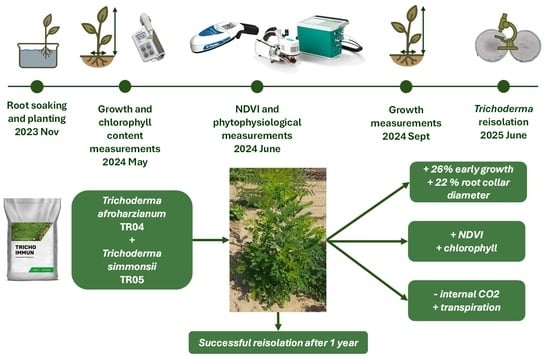
Abstract
1. Introduction
2. Materials and Methods
2.1. Experimental Site and Plant Material
2.2. Meteorological Data
2.3. Data Collection
2.4. Methods for Endophytic Trichoderma Isolation and Molecular Identification
2.5. Data Analysis
3. Results
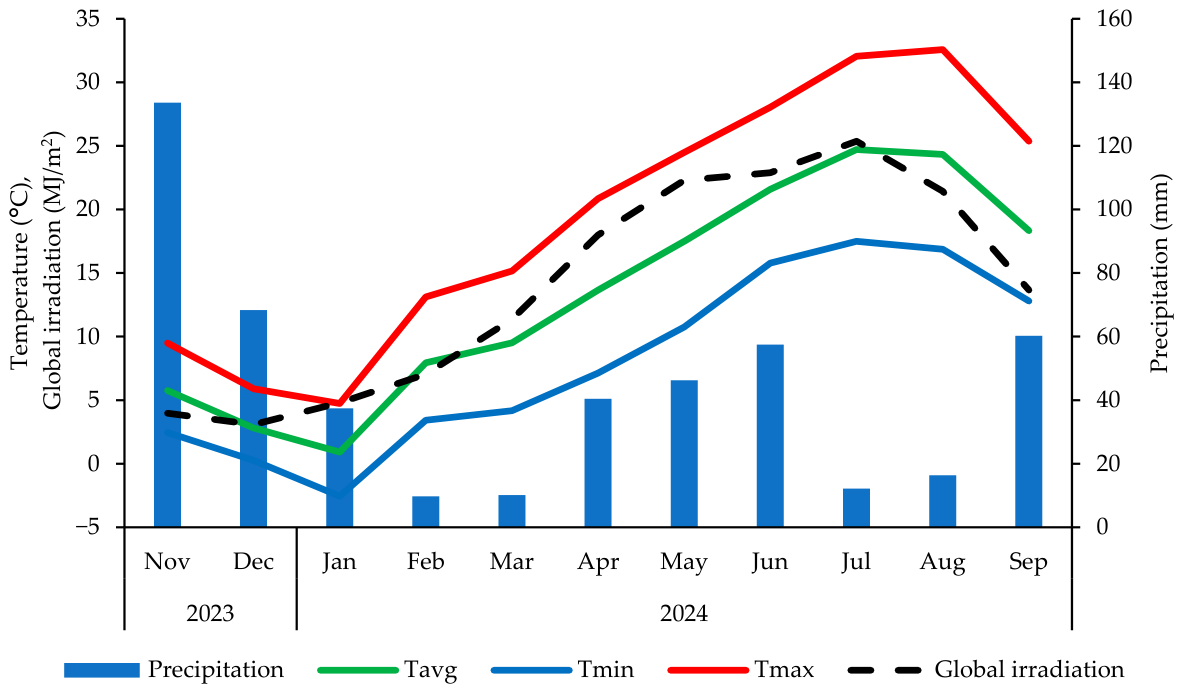
3.1. Meteorological Background
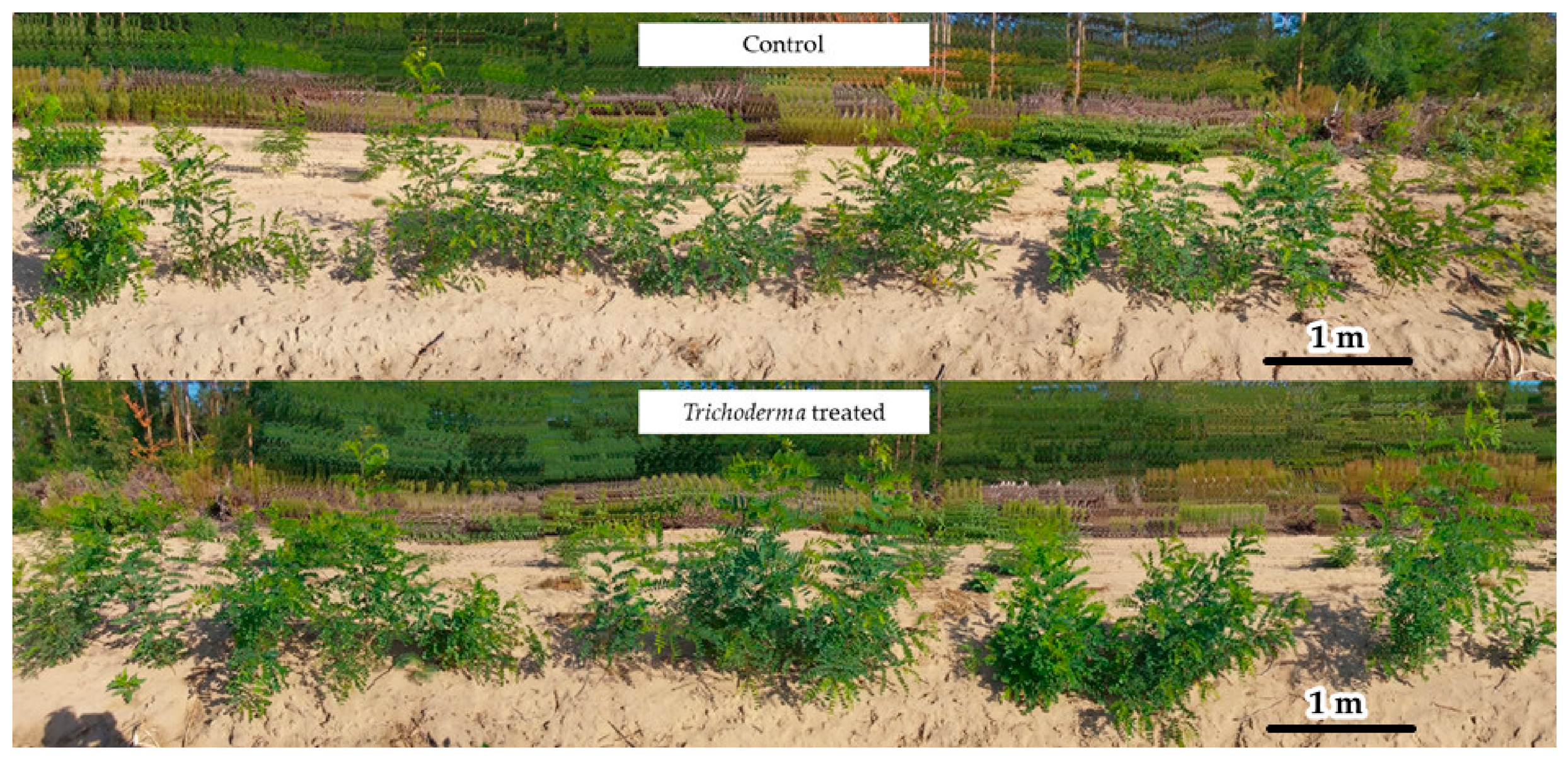
3.2. Growth Parameters
3.3. Impact of Trichoderma Treatment on Plant Physiological Performance
3.4. Outcomes of Endophytic Trichoderma Isolation and Molecular Identification
4. Discussion
5. Conclusions
Author Contributions
Funding
Data Availability Statement
Acknowledgments
Conflicts of Interest
Abbreviations
| NDVI | normalized difference vegetation index |
| RCD | root collar diameter |
| SPAD | Soil–Plant Analysis Development |
| PA | Arany plasticity index |
| SPM | settleable particulate matter |
| hy | Kuron’s hygroscopicity |
| RCBD | randomized complete block design |
| CFU | colony-forming unit |
| FAI | forestry aridity index |
| PPFD | photosynthetic photon flux density |
| ITS | Internal Transcribed Spacer |
| Ci | internal CO2 concentration |
| gtc | stomatal conductance |
| Tair-Tleaf | leaf–air temperature difference |
| Tr | transpiration rate |
| PSII | efficiency of photosystem II |
| ETR | electron transport rate |
| A | photosynthetic assimilation rate |
| WUE | water-use efficiency |
| rDNA | ribosomal DNA |
References
- Nicolescu, V.-N.; Rédei, K.; Mason, W.L.; Vor, T.; Pöetzelsberger, E.; Bastien, J.-C.; Brus, R.; Benčať, T.; Đodan, M.; Cvjetkovic, B.; et al. Ecology, Growth and Management of Black Locust (Robinia pseudoacacia L.), a Non-Native Species Integrated into European Forests. J. For. Res. 2020, 31, 1081–1101. [Google Scholar] [CrossRef]
- Rédei, K.; Osváth-Bujtás, Z.; Veperdi, I. Black Locust (Robinia pseudoacacia L.) Improvement in Hungary: A Review. Acta Silv. Lignaria Hung. 2008, 4, 127–132. [Google Scholar] [CrossRef]
- Gasol, C.M.; Brun, F.; Mosso, A.; Rieradevall, J.; Gabarrell, X. Economic Assessment and Comparison of Acacia Energy Crop with Annual Traditional Crops in Southern Europe. Energy Policy 2010, 38, 592–597. [Google Scholar] [CrossRef]
- Komán, S. Energy-Related Characteristics of Poplars and Black Locust. BioResources 2018, 13, 4323–4331. [Google Scholar] [CrossRef]
- Nicolescu, V.-N.; Hernea, C.; Bakti, B.; Keserű, Z.; Antal, B.; Rédei, K. Black Locust (Robinia pseudoacacia L.) as a Multi-Purpose Tree Species in Hungary and Romania: A Review. J. For. Res. 2018, 29, 1449–1463. [Google Scholar] [CrossRef]
- Böhm, C.; Quinkenstein, A.; Freese, D. Yield Prediction of Young Black Locust (Robinia pseudoacacia L.) Plantations for Woody Biomass Production Using Allometric Relations. Ann. For. Res. 2011, 54, 215–227. [Google Scholar] [CrossRef]
- Hu, B.; Zhou, M.; Dannenmann, M.; Saiz, G.; Simon, J.; Bilela, S.; Liu, X.; Hou, L.; Chen, H.; Zhang, S.; et al. Comparison of Nitrogen Nutrition and Soil Carbon Status of Afforested Stands Established in Degraded Soil of the Loess Plateau, China. For. Ecol. Manag. 2017, 389, 46–58. [Google Scholar] [CrossRef]
- Du, B.; Pang, J.; Hu, B.; Allen, D.E.; Bell, T.L.; Pfautsch, S.; Netzer, F.; Dannenmann, M.; Zhang, S.; Rennenberg, H. N2-Fixing Black Locust Intercropping Improves Ecosystem Nutrition at the Vulnerable Semi-Arid Loess Plateau Region, China. Sci. Total Environ. 2019, 688, 333–345. [Google Scholar] [CrossRef] [PubMed]
- Keresztesi, B. Breeding and Cultivation of Black Locust, Robinia pseudoacacia, in Hungary. For. Ecol. Manag. 1983, 6, 217–244. [Google Scholar] [CrossRef]
- Boring, L.R.; Swank, W.T. The Role of Black Locust (Robinia Pseudo-Acacia) in Forest Succession. J. Ecol. 1984, 72, 749. [Google Scholar] [CrossRef]
- Cierjacks, A.; Kowarik, I.; Joshi, J.; Hempel, S.; Ristow, M.; Von Der Lippe, M.; Weber, E. Biological Flora of the British Isles: Robinia pseudoacacia. J. Ecol. 2013, 101, 1623–1640. [Google Scholar] [CrossRef]
- Vítková, M.; Müllerová, J.; Sádlo, J.; Pergl, J.; Pyšek, P. Black Locust (Robinia pseudoacacia) Beloved and Despised: A Story of an Invasive Tree in Central Europe. For. Ecol. Manag. 2017, 384, 287–302. [Google Scholar] [CrossRef]
- Sádlo, J.; Vítková, M.; Pergl, J.; Pyšek, P. Towards Site-Specific Management of Invasive Alien Trees Based on the Assessment of Their Impacts: The Case of Robinia pseudoacacia. NeoBiota 2017, 35, 1–34. [Google Scholar] [CrossRef]
- Ferreira, N.C.D.F.; Ramos, M.L.G.; Gatto, A. Use of Trichoderma in the Production of Forest Seedlings. Microorganisms 2024, 12, 237. [Google Scholar] [CrossRef] [PubMed]
- Contreras-Cornejo, H.A.; Macías-Rodríguez, L.; Vergara, A.G.; López-Bucio, J. Trichoderma Modulates Stomatal Aperture and Leaf Transpiration Through an Abscisic Acid-Dependent Mechanism in Arabidopsis. J. Plant Growth Regul. 2015, 34, 425–432. [Google Scholar] [CrossRef]
- Sood, M.; Kapoor, D.; Kumar, V.; Sheteiwy, M.S.; Ramakrishnan, M.; Landi, M.; Araniti, F.; Sharma, A. Trichoderma: The “Secrets” of a Multitalented Biocontrol Agent. Plants 2020, 9, 762. [Google Scholar] [CrossRef] [PubMed]
- Shoresh, M.; Harman, G.E.; Mastouri, F. Induced Systemic Resistance and Plant Responses to Fungal Biocontrol Agents. Annu. Rev. Phytopathol. 2010, 48, 21–43. [Google Scholar] [CrossRef]
- López-Bucio, J.; Pelagio-Flores, R.; Herrera-Estrella, A. Trichoderma as Biostimulant: Exploiting the Multilevel Properties of a Plant Beneficial Fungus. Sci. Hortic. 2015, 196, 109–123. [Google Scholar] [CrossRef]
- Stewart, A.; Hill, R. Applications of Trichoderma in Plant Growth Promotion. In Biotechnology and Biology of Trichoderma; Gupta, V.G., Schmoll, M., Herrera-Estrella, A., Upadhyay, R.S., Druzhinina, I., Tuohy, M., Eds.; Elsevier: Amsterdam, The Netherlands, 2014; pp. 415–428. [Google Scholar]
- Santos, M.F.D.; Costa, D.L.D.; Vieira, T.A.; Lustosa, D.C. Effect of Trichoderma Spp. Fungus for Production of Seedlings in Enterolobium Schomburgkii (Benth.) Benth. Aust. J. Crop Sci. 2019, 13, 1706–1711. [Google Scholar] [CrossRef]
- Griebeler, A.M.; Araujo, M.M.; Tabaldi, L.A.; Steffen, G.P.K.; Turchetto, F.; Rorato, D.G.; Barbosa, F.M.; Berghetti, Á.L.P.; Nhantumbo, L.S.; Lima, M.S. Type of Container and Trichoderma Spp. Inoculation Enhance the Performance of Tree Species in Enrichment Planting. Ecol. Eng. 2021, 169, 106317. [Google Scholar] [CrossRef]
- Zhang, R.; Yan, Z.; Wang, Y.; Chen, X.; Yin, C.; Mao, Z. Effects of Trichoderma harzianum Fertilizer on the Soil Environment of Malus Hupehensis Rehd. Seedlings under Replant Conditions. HortScience 2021, 56, 1073–1079. [Google Scholar] [CrossRef]
- Peccatti, A.; Rovedder, A.P.M.; Steffen, G.P.K.; Maldaner, J.; Camargo, B.; Dalcul, L.P.; Neuenschwander, F.; Hummel, R.B.; Capitani, L.C. Biological Inputs in Promoting the Growth of Bauhinia forficata Link. Seedlings. Ciênc. Florest. 2020, 30, 367. [Google Scholar] [CrossRef]
- Batista, K.O.M.; Silva, D.V.; Nascimento, V.L.; De Souza, D.J. Effects of Trichoderma strigosellum in Eucalyptus urophylla Development and Leaf-Cutting Ant Behavior. J. Fungi 2021, 8, 15. [Google Scholar] [CrossRef] [PubMed]
- Thapa, A.; Hasan, M.R.; Kabir, A.H. Trichoderma afroharzianum T22 Induces Rhizobia and Flavonoid-Driven Symbiosis to Promote Tolerance to Alkaline Stress in Garden Pea. Plant Cell Environ. 2025, pce.15581. [Google Scholar] [CrossRef] [PubMed]
- Vaccaro, F.; Bettini, P.P.; Courty, P.-E.; Mengoni, A.; Passeri, I.; Sarrocco, S.; Fagorzi, C. Toward Deciphering the Molecular Dialogue in the Rhizomicrobiota: Transcriptomic Profiling of Trichoderma in Rhizobia Interaction. Microbiol. Res. 2025, 297, 128180. [Google Scholar] [CrossRef]
- Appiah, E.A.; Virág, C.I.; Kutasy, E. Biostimulant Induce Growth, Chlorophyll Content and Fresh Herbage Yield of Alfalfa (Medicago sativa L.) and Variegated Alfalfa (Medicago × Varia Martyn) Plant. Acta Agrar. Debr. 2024, 1, 19–25. [Google Scholar] [CrossRef] [PubMed]
- Kovács, C.; Csótó, A.; Pál, K.; Nagy, A.; Fekete, E.; Karaffa, L.; Kubicek, C.P.; Sándor, E. The Biocontrol Potential of Endophytic Trichoderma Fungi Isolated from Hungarian Grapevines. Part I. Isolation, Identification and In Vitro Studies. Pathogens 2021, 10, 1612. [Google Scholar] [CrossRef]
- Csótó, A.; Kovács, C.; Pál, K.; Nagy, A.; Peles, F.; Fekete, E.; Karaffa, L.; Kubicek, C.P.; Sándor, E. The Biocontrol Potential of Endophytic Trichoderma Fungi Isolated from Hungarian Grapevines, Part II, Grapevine Stimulation. Pathogens 2022, 12, 2. [Google Scholar] [CrossRef]
- Csótó, A.; Tóth, G.; Riczu, P.; Zabiák, A.; Tarjányi, V.; Fekete, E.; Karaffa, L.; Sándor, E. Foliar Spraying with Endophytic Trichoderma Biostimulant Increases Drought Resilience of Maize and Sunflower. Agriculture 2024, 14, 2360. [Google Scholar] [CrossRef]
- Mátyás, C.; Berki, I.; Bidló, A.; Csóka, G.; Czimber, K.; Führer, E.; Gálos, B.; Gribovszki, Z.; Illés, G.; Hirka, A.; et al. Sustainability of Forest Cover under Climate Change on the Temperate-Continental Xeric Limits. Forests 2018, 9, 489. [Google Scholar] [CrossRef]
- Führer, E.; Jagodics, A.; Machon, A.; Szabados, I.; Horváth, L. Application of a New Aridity Index in Hungarian Forestry Practice. Időjárás Q. J. Hung. Meteorol. Serv. 2011, 115, 205–216. [Google Scholar]
- Rouse, J.W.; Haas, R.H.; Schell, J.A.; Deering, D.W. Monitoring Vegetation Systems in the Great Plains with ERTS. In Third Earth Resources Technology Satellite-1 Symposium; Freden, S.C., Mercanti, E.P., Becker, M.A., Eds.; Volume 1 Technical Presentations; NASA: Washington, DC, USA, 1974; p. 309. [Google Scholar]
- Rai, S.; Kashyap, P.L.; Kumar, S.; Srivastava, A.K.; Ramteke, P.W. Comparative Analysis of Microsatellites in Five Different Antagonistic Trichoderma Species for Diversity Assessment. World J. Microbiol. Biotechnol. 2016, 32, 8. [Google Scholar] [CrossRef]
- Erdődiné Molnár, Z.; Kovács, A. 2024-es év Agrometeorológiai Áttekintése. Available online: https://www.met.hu/ismeret-tar/erdekessegek_tanulmanyok/index.php?id=3512&hir=A_2024-es_ev_agrometeorologiai_attekintese (accessed on 13 September 2025).
- Huntley, J.C. Robinia pseudoacacia L. Black Locust. Silvics of North America. In Silvics of North America; Burns, R.M., Honkala, B.H., Eds.; Volume 2 Hardwoods; Agric. Handbook; U.S. Department of Agriculture Forest Service: Washington, DC, USA, 1990; pp. 755–761. [Google Scholar]
- Ábri, T.; Borovics, A.; Csajbók, J.; Kovács, E.; Koltay, A.; Keserű, Z.; Rédei, K. Differences in the Growth and the Ecophysiology of Newly Bred, Drought-Tolerant Black Locust Clones. Forests 2023, 14, 1802. [Google Scholar] [CrossRef]
- Ábri, T.; Csajbók, J.; Keserű, Z.; Szabó, G.; Szabó, L. Growth and Multispectral Analysis of New Black Locust (Robinia pseudoacacia L.) Clones. Forests 2026, 17, 208. [Google Scholar] [CrossRef]
- Yu, C.; Jiang, X.; Xu, H.; Ding, G. Trichoderma Longibrachiatum Inoculation Improves Drought Resistance and Growth of Pinus Massoniana Seedlings through Regulating Physiological Responses and Soil Microbial Community. J. Fungi 2023, 9, 694. [Google Scholar] [CrossRef] [PubMed]
- Yin, D.; Deng, X.; Song, R. Synergistic Effects between Suilllus luteus and Trichoderma virens on Growth of Korean Spruce Seedlings and Drought Resistance of Scotch Pine Seedlings. J. For. Res. 2016, 27, 193–201. [Google Scholar] [CrossRef]
- Jin, T.; Liu, G.; Fu, B.; Ding, X.; Yang, L. Assessing Adaptability of Planted Trees Using Leaf Traits: A Case Study with Robinia pseudoacacia L. in the Loess Plateau, China. Chin. Geogr. Sci. 2011, 21, 290–303. [Google Scholar] [CrossRef]
- Haase, D.L. Understanding Forest Seedling Quality: Measurements and Interpretation. Tree Plant. Notes 2008, 52, 24–30. [Google Scholar]
- Pinto, J.R. Morphology Targets: What Do Seedling Morphological Attributes Tell Us? In USDA Forest Service Proceedings; Haase, D.L., Pinto, J.R., Eds.; National Proceedings: Forest and Conservation Nursery Associations; USDA Forest Service, Rocky Mountain Research Station: Fort Collins, CO, USA, 2010; pp. 74–79. [Google Scholar]
- Harman, G.E.; Howell, C.R.; Viterbo, A.; Chet, I.; Lorito, M. Trichoderma Species—Opportunistic, Avirulent Plant Symbionts. Nat. Rev. Microbiol. 2004, 2, 43–56. [Google Scholar] [CrossRef]
- Choi, D.; Jang, W.; Toda, H.; Yoshikawa, M. Differences in Characteristics of Photosynthesis and Nitrogen Utilization in Leaves of the Black Locust (Robinia pseudoacacia L.) According to Leaf Position. Forests 2021, 12, 348. [Google Scholar] [CrossRef]
- Pilar Santamarina, M.; Roselló, J. Influence of Temperature and Water Activity on the Antagonism of Trichoderma harzianum to Verticillium and Rhizoctonia. Crop Prot. 2006, 25, 1130–1134. [Google Scholar] [CrossRef]
- Caccavo, V.; Forlano, P.; Mang, S.; Fanti, P.; Nuzzaci, M.; Battaglia, D.; Trotta, V. Effects of Trichoderma harzianum Strain T22 on the Arthropod Community Associated with Tomato Plants and on the Crop Performance in an Experimental Field. Insects 2022, 13, 418. [Google Scholar] [CrossRef]
- Halleen, F.; Fourie, P.H. An Integrated Strategy for the Proactive Management of Grapevine Trunk Disease Pathogen Infections in Grapevine Nurseries. S. Afr. J. Enol. Vitic. 2016, 37, 104–114. [Google Scholar] [CrossRef]
- Simon, D.A.; Winterhagen, P.; Walter, R.; Wetzel, T.; Kortekamp, A.; Von Tiedemann, A.; Eder, J. Hot Water Treatment Combined with Trichoderma Inoculation in the Nursery Protects Planting Material against Grapevine Trunk Disease. OENO One 2025, 59. [Google Scholar] [CrossRef]
- Takahashi, Y.; Joo, H.; Pankasem, N.; Hsu, P.-K.; Schroeder, J.I. Stomatal CO2 Sensing in Plants: Control of Gas Exchange and Interactions with Environmental Stimuli. Plant Cell Physiol. 2025, 66, 1259–1273. [Google Scholar] [CrossRef] [PubMed]
- Flexas, J.; Ribas-Carbó, M.; Diaz-Espejo, A.; Galmés, J.; Medrano, H. Mesophyll Conductance to CO2: Current Knowledge and Future Prospects. Plant Cell Environ. 2008, 31, 602–621. [Google Scholar] [CrossRef]
- Meena, M.; Swapnil, P.; Zehra, A.; Dubey, M.K.; Upadhyay, R.S. Antagonistic Assessment of Trichoderma spp. by Producing Volatile and Non-Volatile Compounds against Different Fungal Pathogens. Arch. Phytopathol. Plant Prot. 2017, 50, 629–648. [Google Scholar] [CrossRef]
- Wang, L.; Dai, Y.; Sun, J.; Wan, X. Differential Hydric Deficit Responses of Robinia pseudoacacia and Platycladus orientalis in Pure and Mixed Stands in Northern China and the Species Interactions under Drought. Trees 2017, 31, 2011–2021. [Google Scholar] [CrossRef]
- Guo, H.; Wang, Y.; Li, G.; Du, S. Effects of Rainfall Exclusion Treatment on Photosynthetic Characteristics of Black Locust in the Sub-Humid Region of the Loess Plateau, China. Plants 2024, 13, 704. [Google Scholar] [CrossRef]
- Liu, B.; Tang, X.; Wang, L.; Zhang, P.; He, J.; Yue, C. Physiological Responses of a Black Locust Plantation to Drought Stress Based on a Throughfall Exclusion Experiment in Semi-Arid Northwestern China. For. Int. J. For. Res. 2025, 98, 220–232. [Google Scholar] [CrossRef]
- Kane, C.N.; Jordan, G.J.; Jansen, S.; McAdam, S.A.M. A Permeable Cuticle, Not Open Stomata, Is the Primary Source of Water Loss From Expanding Leaves. Front. Plant Sci. 2020, 11, 774. [Google Scholar] [CrossRef]
- Oliveira, C.M.; Almeida, N.O.; Da Rocha, M.R.; Rezende, M.H.; Carneiro, R.G.D.S.; Ulhoa, C.J. Anatomical Changes Induced by Isolates of Trichoderma Spp. in Soybean Plants. PLoS ONE 2020, 15, e0242480. [Google Scholar] [CrossRef]



| Date | Parameter | Control | Trichoderma-Treated | Difference (%) 2 | p 3 | ||
|---|---|---|---|---|---|---|---|
| N 1 | Mean ± SE | N 1 | Mean ± SE | ||||
| 28 May 2024 | Root collar diameter (cm) | 161 | 2.72 ± 0.07 | 90 | 3.32 ± 0.11 | 21.96 | <0.001 |
| Height (cm) | 15.37 ± 0.60 | 19.32 ± 0.93 | 25.75 | 0.001 | |||
| 24 September 2024 | Height (cm) | 82 | 122.79 ± 6.30 | 92 | 124.46 ± 5.96 | 1.36 | 0.306 |
| Date | Parameter 1 | Control | Trichoderma-Treated | Difference (%) 3 | p 4 | ||
|---|---|---|---|---|---|---|---|
| N 2 | Mean ± SE | N 2 | Mean ± SE | ||||
| 28 May 2024 | SPAD | 161 | 31.74 ± 0.5 | 90 | 34.64 ± 0.61 | 9.14 | <0.001 |
| 6 June 2024 | NDVI | 84 | 0.36 ± 0.01 | 89 | 0.4 ± 0.01 | 11.11 | 0.012 |
| A (µmol m−2 s−1) | 72 | 9.68 ± 0.35 | 75 | 9.38 ± 0.36 | −3.1 | 0.396 | |
| Ci (µmol mol−1) | 274.61 ± 3.53 | 264.03 ± 3.32 | −3.85 | 0.01 | |||
| ETR (µmol s−1) | 158.57 ± 4.35 | 165.88 ± 4.99 | 4.6 | 0.281 | |||
| gtc (mol m−2 s−1) | 0.1 ± 0 | 0.09 ± 0 | −10 | 0.019 | |||
| PSII | 0.25 ± 0.01 | 0.26 ± 0.01 | 4 | 0.283 | |||
| Tair-Tleaf (°C) | −0.51 ± 0.06 | −0.31 ± 0.07 | −39.22 | 0.02 | |||
| Tr (mmol m−2 s−1) | 3.36 ± 0.09 | 3.65 ± 0.09 | 8.63 | 0.009 | |||
| WUE (kg m−3) | 7.13 ± 0.22 | 6.32 ± 0.18 | −11.36 | 0.03 | |||
| Microsatellite Marker | Applied Trichoderma Strains | Re-Isolated Trichoderma Strains | ||
|---|---|---|---|---|
| TR04 | TR05 | 1 | 2 | |
| ThSSR4 | 160 | 160 | 160 | 160 |
| ThSSR6 | 390 | 390 | 390 | 390 |
| TvSSR1 | 430 | 430 | 430 | 430 |
| TvSSR5 | 200 | 200 | 200 | 200 |
Disclaimer/Publisher’s Note: The statements, opinions and data contained in all publications are solely those of the individual author(s) and contributor(s) and not of MDPI and/or the editor(s). MDPI and/or the editor(s) disclaim responsibility for any injury to people or property resulting from any ideas, methods, instructions or products referred to in the content. |
© 2026 by the authors. Licensee MDPI, Basel, Switzerland. This article is an open access article distributed under the terms and conditions of the Creative Commons Attribution (CC BY) license.
Share and Cite
Csótó, A.; Csajbók, J.; Ábri, T.; Pál, K.; Zabiák, A.; Mihály, K.; Kocsis, I.A.; Sándor, E. Short-Term Physiological Responses of Black Locust Saplings to Trichoderma-Based Root Priming Under Field Drought Conditions. Forests 2026, 17, 582. https://doi.org/10.3390/f17050582
Csótó A, Csajbók J, Ábri T, Pál K, Zabiák A, Mihály K, Kocsis IA, Sándor E. Short-Term Physiological Responses of Black Locust Saplings to Trichoderma-Based Root Priming Under Field Drought Conditions. Forests. 2026; 17(5):582. https://doi.org/10.3390/f17050582
Chicago/Turabian StyleCsótó, András, József Csajbók, Tamás Ábri, Károly Pál, Andrea Zabiák, Kata Mihály, István Attila Kocsis, and Erzsébet Sándor. 2026. "Short-Term Physiological Responses of Black Locust Saplings to Trichoderma-Based Root Priming Under Field Drought Conditions" Forests 17, no. 5: 582. https://doi.org/10.3390/f17050582
APA StyleCsótó, A., Csajbók, J., Ábri, T., Pál, K., Zabiák, A., Mihály, K., Kocsis, I. A., & Sándor, E. (2026). Short-Term Physiological Responses of Black Locust Saplings to Trichoderma-Based Root Priming Under Field Drought Conditions. Forests, 17(5), 582. https://doi.org/10.3390/f17050582