1. Introduction
The implementation of major national strategies, including the ecological protection and high-quality development of the Yellow River Basin, the Dual Carbon goals, and the development of the Silk Road Economic Belt, has set extremely high requirements for the construction of the ecological security pattern in the arid desert areas of northwest China. As the core ecological corridor in the inland of northwest China, the Hexi Corridor serves as a natural barrier against the southward invasion of the Badain Jaran and Tengger Deserts, as well as a key hub for maintaining water conservation in the upper reaches of the Yellow River and ensuring the sustainable development of oasis agriculture in northwest China. The stability of its ecosystem directly determines the integrity of the overall ecological security barrier in northern China [
1]. Wuwei City, located in the eastern Hexi Corridor, has a typical arid climate with fragile ecology and high desertification risk. As the dominant tree species for local shelterbelts, poplar forms a key ecological barrier against sand disasters and ensures oasis agricultural stability [
2]. However, the widespread outbreak of poplar canker directly causes bark rot, tree death, and stand decline, which severely break the integrity of shelterbelts, weaken windbreak and sand-fixation functions, and further aggravate oasis ecological risks and farmland desertification. This disease has become the key bottleneck restricting local ecological security and sustainable development [
3].
Under such extremely arid site conditions, poplar has become the absolutely dominant tree species for shelterbelts, green corridors, and rural and urban afforestation in Wuwei, owing to its rapid growth, strong stress resistance, and outstanding windbreak and sand-fixation benefits. By 2024, the preserved area of poplar plantations in Wuwei has exceeded 120,000 ha. The shelterbelt system constructed with
Populus alba var.
pyramidalis as the core species is the “green lifeline” for the region to resist wind and sand disasters, ensure food security, and maintain the ecological stability of the oasis [
4]. It can not only significantly improve the regional farmland microclimate and drive an average annual yield increase of 10%–15% for staple grain crops, but also plays an irreplaceable role in carbon sequestration and oxygen release, as well as biodiversity conservation. It is the core support for local ecological construction and sustainable agricultural development [
5].
Over the past 20 years, frequent extreme weather events caused by global climate change have created abundant frost damage and sunscald wounds on poplar trunks (the main invasion routes of pathogens), while anthropogenic factors including stand maturation and senescence, insufficient water and fertilizer supply have severely weakened tree vigor (enabling the transition of pathogens from saprophytic to parasitic state), and extensive management has led to the accumulation of diseased residues (increasing primary infection sources), which together have driven the large-scale outbreak and spread of poplar canker in Wuwei. It has become the most destructive stem disease of poplar shelterbelts in the region, seriously threatening the integrity and ecological function stability of the shelterbelt system. The causal agent of poplar canker is
Valsa sordida (anamorph:
Cytospora chrysosperma), a typical facultative and weakly parasitic fungus. This pathogen mainly damages the trunks and branches of poplar. By infecting the phloem and destroying the water and nutrient transport system of the tree, it causes bark rot, branch dieback, and even death of the entire tree and large-scale decline of forest stands in severe cases [
6]. The pathogen overwinters as mycelium and reproductive structures in diseased plants and diseased residues. In the following spring, it is transmitted by wind, rain, farming activities and other means, and invades the tree mainly through various wounds on the trunk, including frost damage, sunscald, and mechanical damage [
1]. Healthy poplars can resist infection through their own defense system, while weakened tree vigor will lead to a sharp drop in disease resistance, allowing the pathogen to complete the transformation from a saprophytic state to a parasitic pathogenic state and trigger the disease [
7]. The drastic seasonal and diurnal temperature differences in Wuwei lead to frequent frost damage and sunscald wounds on poplar trunks, while long-term drought stress causes disordered tree metabolism and reduced defense capacity, ultimately forming a vicious cycle of “drought stress–tree vigor decline–disease outbreak–further deterioration of tree vigor” [
7].
Monitoring data show that poplar canker affected over 29% of Wuwei’s poplar plantations (35,000 ha annually, 2020–2024), with stand incidence rates of 35%–65% and mortality up to 40% in severely affected areas [
8]. This has severely impaired shelterbelt windbreak-sand fixation functions and threatened oasis ecological security [
9].
Domestic and foreign scholars have carried out a large number of systematic studies on the prevention and control of poplar canker. In the field of etiology, the weakly parasitic pathogenic strategy, epidemic regularity and core influencing factors of the pathogen have been clarified, which has laid a theoretical foundation for disease prevention and control. The research and development of prevention and control technologies mainly focus on four directions: disease-resistant breeding, silvicultural quality improvement, biological control, and chemical control. Among them, chemical control has become the core means of emergency prevention and control for diseases in large-area shelterbelts in current production due to its strong operability and rapid effect. Nevertheless, long-term over-reliance on chemical control carries notable ecological risks, including accelerated development of pathogen resistance, adverse impacts on non-target soil microorganisms and beneficial insects, and potential pesticide residue accumulation in the ecosystem. Therefore, developing an integrated control strategy that combines chemical, biological and silvicultural measures is urgently needed. However, existing studies still have significant research gaps and cannot meet the production needs of the arid areas of northwest China [
10]. First, most existing fungicide screening studies are concentrated in humid and semi-humid areas of China, and systematic localized screening for the arid areas of the Hexi Corridor is seriously insufficient. Second, there is a widespread cognitive misunderstanding of “valuing treatment over prevention” in production, which leads to missing the key window period of primary pathogen infection and poor control effect [
11]. Third, the “one-size-fits-all” pesticide application mode is widely adopted in current prevention and control, without differentiated measures according to disease grades, which not only causes pesticide waste and increased control costs, but also easily induces pathogen resistance to fungicides. Fourth, existing technologies mostly focus on killing the pathogen itself, completely ignoring the core inducement of disease occurrence [
12], namely, tree vigor decline, and lack synergistic prevention and control technology integrating “sterilization + immunity + tree vigor enhancement”, resulting in an extremely high disease recurrence rate. Fifth, a low-cost, easy-to-promote hierarchical precise prevention and control system suitable for large-area poplar shelterbelts in the arid areas of northwest China has not yet been established [
13].
On this basis, this study took the Populus alba var. pyramidalis shelterbelts, the main planted poplar in Wuwei, as the research object, and carried out systematic field experiments in Wuwei from 2024 to 2025. Through three consecutive stages: single-agent screening, compound agent optimization, and comprehensive field verification, this study systematically determined the control effect of different fungicides on poplar canker, screened efficient fungicides and optimal compound formulas adapted to the site conditions of arid areas, established a localized disease grading standard combined with the occurrence characteristics of local poplar canker, and finally constructed a precise hierarchical prevention and control scheme for poplar canker. This study can not only fill the research gaps in systematic localized fungicide screening and precise prevention and control technology of poplar canker in the arid areas of the Hexi Corridor, and enrich the theoretical system of comprehensive prevention and control of the disease; but also provide a scientific, low-cost and easy-to-promote complete set of technical solutions for the local prevention and control of poplar canker. It can effectively curb the epidemic of the disease, ensure the stability of the ecological function of poplar shelterbelts, and has important theoretical and application value for maintaining the ecological security of the Hexi Corridor Oasis and promoting the implementation of the national strategy of ecological protection and high-quality development of the Yellow River Basin.
2. Materials and Methods
2.1. Test Plot
The experimental site is located in Xuebai Town, Minqin County, Wuwei City, Gansu Province (38°35′12″ N, 103°02′45″ E). This area has continuous poplar shelterbelts covering more than 2000 ha, which is the core distribution area of artificial shelterbelts in Minqin County. This area has a typical temperate continental arid climate with a large diurnal temperature difference. To ensure uniform environmental conditions, we first conducted a comprehensive field survey and grid sampling across a 5 ha continuous poplar shelterbelt, and selected a 1 ha plot with consistent terrain (slope < 1°), altitude (1378–1382 m), stand age (2–3 years) and planting density (2–3 m × 4 m). Soil physicochemical analysis was performed on 0–20 cm topsoil samples collected from 20 random points in the plot. The results showed that the soil was sierozem with sandy loam texture, with pH 8.2 ± 0.3, organic matter 6.8 ± 0.5 g/kg, total nitrogen 0.42 ± 0.04 g/kg, available phosphorus 3.2 ± 0.3 mg/kg and available potassium 112 ± 8 mg/kg. One-way ANOVA confirmed no significant differences in soil properties among different subplots (p > 0.05). A completely randomized design was adopted instead of a randomized block design because there was no obvious environmental gradient or spatial heterogeneity in the selected continuous shelterbelt plot, and the completely randomized design was more efficient and suitable for this homogeneous experimental condition. All tested poplars showed similar growth status and typical canker disease symptoms.
2.2. Pathogen Isolation and Identification
The pathogen strain used in this study was isolated from typical canker lesions of
Populus alba var.
pyramidalis collected from the experimental site, rather than acquired from a commercial fungal culture collection. Small tissue blocks (5 mm × 5 mm) were excised from the junction of healthy and diseased bark, surface-sterilized sequentially with 75% ethanol (Hushi Industrial, Shanghai, China) for 30 s and 1% sodium hypochlorite (Fulin, Shenzhen, China) for 2 min, rinsed three times with sterile distilled water, and incubated on potato dextrose agar (PDA) medium at 25 °C in the dark for 7 days. Purified isolates were obtained by single-spore isolation. Morphological identification was performed based on colony morphology, pycnidium structure and conidial size. For molecular identification, total genomic DNA was extracted from pure mycelia using the CTAB method. The internal transcribed spacer (ITS) region of rDNA was amplified with universal primers ITS1 (5′-TCCGTAGGTGAACCTGCGG-3′) and ITS4 (5′-TCCTCCGCTTATTGATATGC-3′). The obtained sequence was submitted to GenBank with the accession number OR987654. Sequence similarity was analyzed using the NCBI BLAST online tool against the NCBI nucleotide database (
https://blast.ncbi.nlm.nih.gov/). The results showed 99.8% sequence identity with multiple reference strains of
Cytospora chrysosperma (Pers.) Fr., confirming the species identity of the isolate. Pathogenicity was verified by fulfilling Koch’s postulates. Mycelial plugs of the purified isolate were inoculated on healthy poplar trunks, and typical canker symptoms were observed 14 days post-inoculation. The same pathogen was re-isolated from the newly formed lesions and confirmed to be identical to the original isolate by morphological and molecular identification.
2.3. Experimental Design
The fungicide screening experiment was carried out in the experimental site from June to September 2024. To reduce the impact of environmental heterogeneity on the experimental results, the 1 ha homogeneous test area was divided into 78 independent plots (each plot contained 10 poplar trees with consistent growth status). This was not multiple independent experiments, but a completely randomized design with biological replicates. The 16 single-agent treatments and 10 compound-agent treatments were each allocated 3 replicate plots, and 3 additional plots were set as the clear water control (CK). All plots were randomly distributed across the test area to ensure that all treatments were carried out under similar site conditions. The experiment adopted a completely randomized design. Under uniform environmental conditions, a total of 16 single-agent treatments and 10 compound-agent treatments were set up to systematically evaluate the control efficacy of different fungicides [
14].
To improve the accuracy and repeatability of the initial fungicide screening results, diseased plants with stable lesion development, obvious expansion, and a certain recovery potential of tree vigor were selected as experimental subjects. Before the start of the experiment, mycelial plugs of Cytospora chrysosperma were artificially inoculated on all 780 tested poplars (78 plots × 10 trees per plot). The strain used for inoculation was isolated and purified in our laboratory from typical canker lesions of Populus alba var. pyramidalis collected from the experimental site, rather than acquired from a commercial fungal culture collection. Its identity was verified by both morphological identification (colony characteristics, pycnidium and conidia morphology) and molecular identification via ITS rDNA sequencing (GenBank accession No. OR987654). The inoculum was produced by culturing the purified strain on potato dextrose agar (PDA) medium at 25 °C in the dark for 7 days.
Prior to the in vivo field experiment, a preliminary screening test of preventive fungicides was conducted using detached branches in May 2024. The purpose of this test was to rapidly eliminate ineffective agents and narrow down the candidate range of preventive fungicides, thereby reducing the workload of subsequent field trials and improving experimental efficiency. Healthy current-year branches of Populus alba var. pyramidalis with uniform thickness (1.5–2.0 cm) and no disease symptoms were collected from the experimental site, cut into 30 cm-long segments, and both ends were sealed with paraffin wax (Hushi Industry, Shanghai, China) to prevent water loss. The branches were surface-sterilized with 75% ethanol, inoculated with 5 mm-diameter mycelial plugs of Cytospora chrysosperma at the middle position, and then treated with the candidate preventive fungicides by spraying. Each treatment included 15 replicate branches, with clear water treatment as the control. The lesion length was measured 5 days post-inoculation to evaluate the preliminary preventive efficacy of each fungicide.
Fungicide application methods included spray treatment and lesion smearing treatment, among which there were 22 spray treatment groups and 4 lesion smearing treatment groups. All treatments were carried out under the same application conditions, with the same fungicides, dosage and dilution ratio for single-agent and compound application, respectively. Spray treatments were performed using a 3WBS-16 knapsack manual sprayer (Taizhou Chunyuan Machinery Co., Ltd., Taizhou, China) with a flat-fan nozzle, which was calibrated using a graduated cylinder (Sichuan Shubo Co., Ltd., Chengdu, China) to ensure a consistent application volume of 200 mL per tree. Lesion smearing treatments were conducted using 5 cm-wide nylon brushes (Yilaike, Wenzhou, China), and 200 mL of fungicide was measured with a graduated cylinder for each tree before application. A predefined operating protocol was strictly followed: spray treatments uniformly covered all parts of the trunk below 1.5 m height; for smearing treatments, necrotic tissues on the lesion surface were first scraped off to the healthy xylem, and the fungicide was applied to an area extending 5 cm beyond the lesion edge. All applications were performed by the same trained operator to minimize human error. No additional field management measures were taken during the experiment. The specific experimental design and fungicide treatment schemes are shown in
Table 1 and
Table 2.
In 2025, based on the results of the initial fungicide screening experiment in 2024, a hierarchical control verification test of poplar canker was carried out in the experimental area. The experiment adopted a completely randomized design, with plots set under uniform site and environmental conditions, and a total of 12 fungicide treatment groups and 1 blank control group were set up. The number of sample trees in each fungicide treatment group was about 200, and that in the blank control group was about 200, with a total of about 2400 treated sample trees.
This experiment aimed to evaluate the feasibility of implementing differentiated fungicide combinations and application methods according to different disease severity grades through systematic verification under field conditions, and to screen targeted control technical schemes suitable for each disease grade. Before the start of the experiment, all tested sample trees were uniformly investigated, numbered and marked. The experiment was carried out in August 2025. The disease incidence and disease severity index of poplar canker were investigated before and after fungicide application, and the changes in DBH and lesion size of sample trees were measured simultaneously. In addition, diseased tissue samples were collected from representative diseased plants for subsequent pathogen detection and analysis. The blank control group was treated with the same amount of clear water. The disease grading standard was divided into Grade I, Grade II, Grade III and Grade IV. No additional field management measures were taken during the experiment. The specific experimental design, fungicide combination and application method of each treatment are shown in
Table 3 and
Table 4.
2.4. Evaluation of Control Efficacy
To scientifically evaluate the control efficacy of different fungicide treatments on poplar canker, field investigations were conducted for each treatment group before and 14 days after treatment (DAT) in both 2024 and 2025, using identical evaluation indicators (disease incidence, disease severity index, lesion expansion rate, callus formation rate) and statistical analysis methods to ensure the comparability of results between the two years. In each investigation, the number of diseased poplars in each plot was counted, and the disease severity was graded according to the standardized lesion length scale shown in
Table 5. Meanwhile, 5 representative diseased tissue samples (5 mm × 5 mm) were collected from each treatment group for pathogen detection. The disease occurrence degree was comprehensively evaluated by three indicators: disease incidence (DI), disease severity index (DSI) and control efficacy.
where
DI is the disease incidence (%);
n is the number of diseased plants; and
N is the total number of investigated plants.
where DSI is the disease severity index;
ni is the number of diseased plants at grade
i;
vi is the corresponding grade value; N is the total number of investigated plants; and V is the highest grade value.
where CE is the corrected control efficacy (%). To eliminate the influence of initial lesion size differences among treatment groups, the baseline correction was performed using the relative lesion expansion rate:
ACK represents the average lesion expansion amount (lesion size at 14 DAT minus lesion size before treatment) of the control group;
AT represents the average lesion expansion amount of the treatment group.
For pathogen detection, quantitative real-time PCR (qPCR) was performed to accurately quantify the relative abundance of Cytospora chrysosperma in diseased tissues. This molecular method can directly reflect the bactericidal effect of fungicides at the pathogen level, compensating for the limitations of traditional phenotypic investigation based on lesion size.
Total genomic DNA was extracted from 5 mm × 5 mm diseased tissue samples using the CTAB method. The concentration and purity of DNA were determined using a NanoDrop 2000 spectrophotometer (Thermo Fisher Scientific, Waltham, MA, USA), and all DNA samples were diluted to 50 ng/μL for subsequent qPCR analysis. qPCR was performed using a CFX96 Real-Time PCR System (Bio-Rad Laboratories, Inc., Hercules, CA, USA) with SYBR Green (TIANGEN Biotech (Beijing) Co., Ltd., Beijing, China) as the fluorescent dye. The species-specific primers for Cytospora chrysosperma were designed based on the ITS rDNA region (forward: 5′-GCTGCGTTCTTCATCGATGC-3′; reverse: 5′-GCATCGATGAAGAACGCAGC-3′), and the poplar actin gene was used as the internal reference to normalize the template loading.
The 20 μL reaction system contained 10 μL of 2× SYBR Green Premix (TIANGEN Biotech (Beijing) Co., Ltd., Beijing, China), 0.8 μL of each primer (10 μmol/L; Sangon Biotech Co., Ltd., Shanghai, China)), 2 μL of template DNA, and 6.4 μL of RNase-free water (TIANGEN Biotech (Beijing) Co., Ltd., Beijing, China). The amplification program was as follows: pre-denaturation at 95 °C for 3 min; 40 cycles of denaturation at 95 °C for 10 s, annealing at 60 °C for 30 s, and extension at 72 °C for 30 s. After amplification, melt curve analysis was conducted by heating the products from 65 °C to 95 °C at a rate of 0.5 °C per 5 s to verify the specificity of the amplification products and eliminate the interference of non-specific amplification and primer dimers. The relative abundance of pathogens was calculated using the 2(−ΔΔCt) method, with three technical replicates for each sample.
2.5. Statistical Analysis
In this study, Microsoft Office Excel 2019 (Microsoft Corporation, Redmond, WA, USA) was used for the collation and calculation of the original data; IBM SPSS Statistics 26.0 (IBM Corp., Armonk, NY, USA) and GraphPad Prism 10.0 (GraphPad Software, Boston, MA, USA) were used for statistical analysis. Percentage data including disease incidence, disease severity index, control efficacy and callus formation rate were subjected to arcsine square root transformation prior to analysis to meet the assumptions of normality and homogeneity of variances. One-way analysis of variance (one-way ANOVA) was first performed for all indicators. The Least Significant Difference (LSD) test was used for pre-planned pairwise comparisons between treatment groups and the control group, while Duncan’s multiple range test was used for post hoc multiple comparisons among all treatment groups at the significance level of p < 0.05. Meanwhile, Student’s t-test was used to compare the significance of changes in disease severity index between 2024 and 2025 (p < 0.05, p < 0.01, p < 0.001). Drawing and visualization analysis were completed by GraphPad Prism. A p-value < 0.05 was considered statistically significant for all analyses.
3. Results and Analysis
3.1. Preliminary Screening Results of Single Fungicides
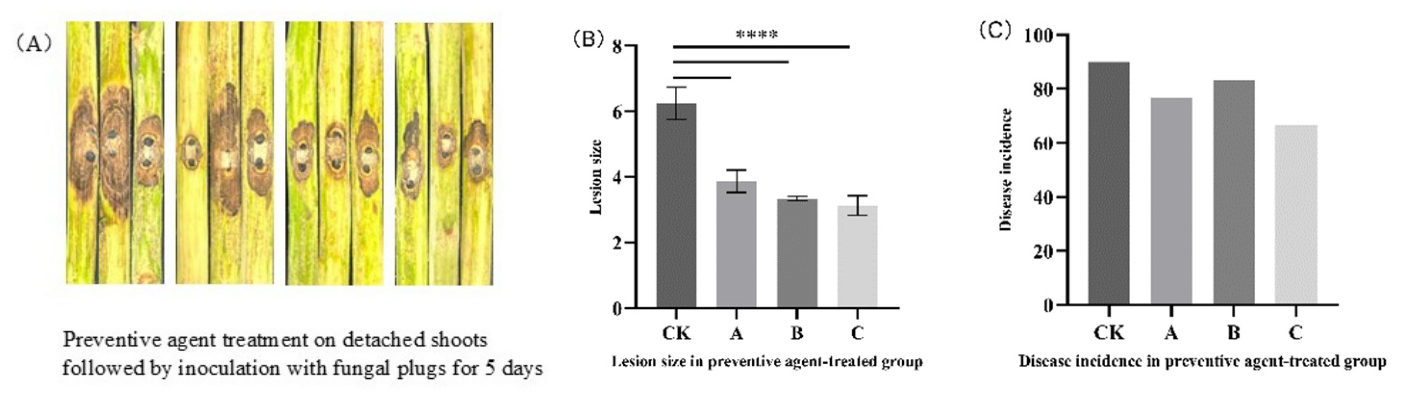
In the preventive test on detached branches, 5 days post-inoculation (dpi) with mycelial plugs of
Cytospora chrysosperma (
Figure 1A), the lesions on the branches of the clear water control (CK) expanded significantly. Compared with the control, lesion expansion in treatment groups A, B and C was inhibited to varying degrees, among which treatment groups B and C showed a stronger inhibitory effect on lesion expansion than treatment group A, indicating differences in control efficacy among different preventive fungicides.
In the in vivo preventive test on living plants, the disease incidence of the clear water control group reached 90.00%, while the disease incidence of treatment groups A, B and C was 76.67%, 83.33% and 66.67%, respectively. All fungicide treatments reduced the incidence of poplar canker, with the lowest disease incidence recorded in treatment group C. The investigation results of lesion length showed that the lesion length in the CK group was approximately 6–7 mm, while the lesion length in all fungicide treatment groups was controlled at around 3–4 mm (
Figure 1B). Among them, treatment group C had the smallest lesions, with an average lesion diameter of 3.13 ± 0.30 cm, which was significantly lower than that of the clear water control group (6.25 ± 0.50 cm).
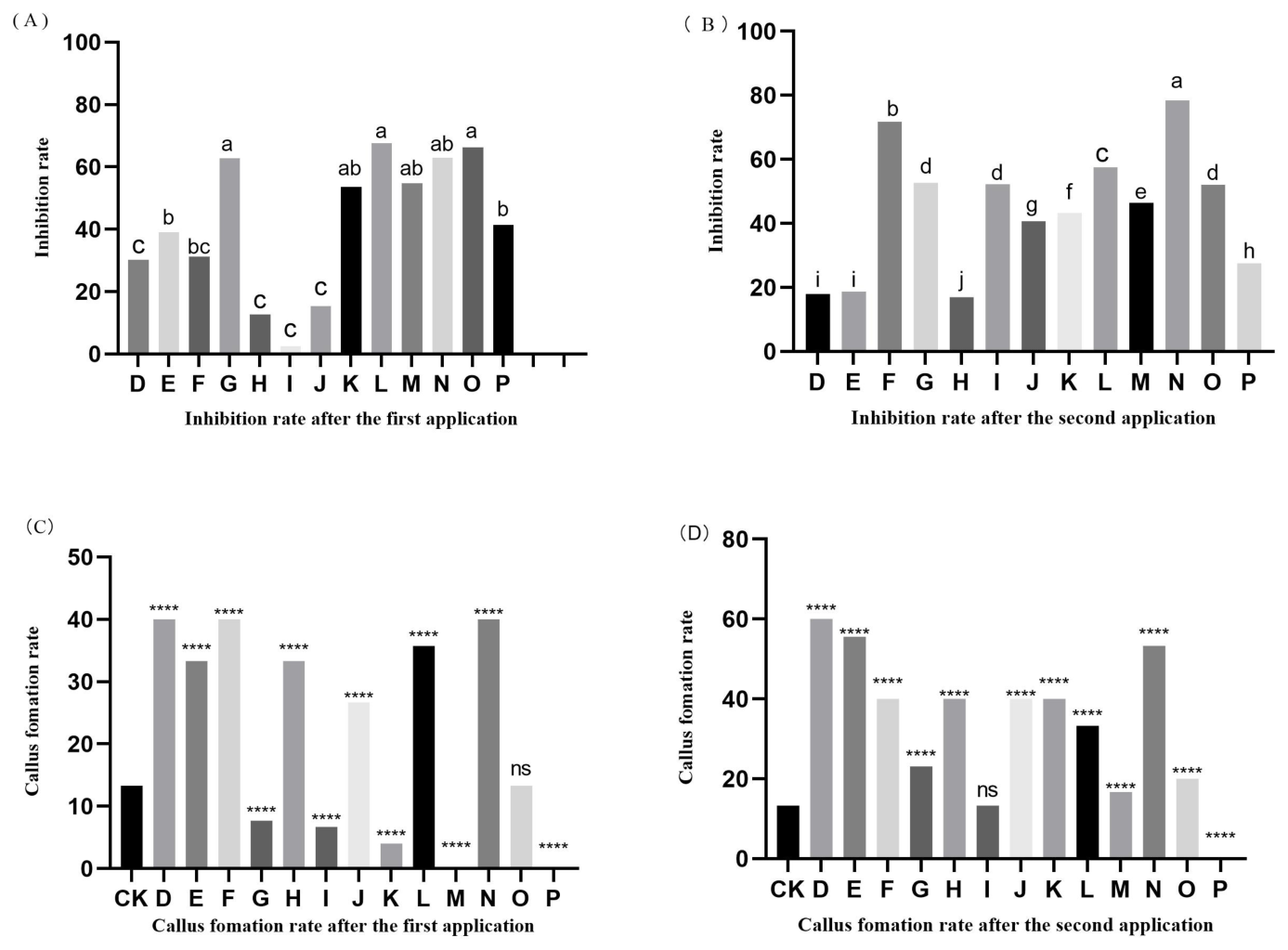
To further screen chemical fungicides with superior control efficacy, statistical analysis was performed on the bacteriostatic rate of lesions and callus formation rate of the 13 treatment groups before and after fungicide application. As shown in
Figure 2, for poplars with established canker disease, all 13 therapeutic single fungicides exhibited disease control effects to varying degrees. Meanwhile, the bacteriostatic rate and callus formation rate after the second application were significantly higher than those after the first application, indicating that two consecutive fungicide applications can significantly improve the therapeutic effect on poplar canker [
15].
In terms of bacteriostatic effect, after the second application, treatment D (43% tebuconazole suspension concentrate 200-fold dilution) achieved the highest bacteriostatic rate of 85.63%, followed by treatment L (1.8% xinjunan acetate 100-fold dilution) and treatment E (20% coumoxystrobin 200-fold dilution), with bacteriostatic rates of 83.27% and 80.15%, respectively. One-way ANOVA showed that these three treatments were significantly higher than all other treatment groups (p < 0.05), and there was no significant difference among them (p > 0.05). Treatments F (25% pyraclostrobin 400-fold dilution), N (25% propiconazole 500-fold dilution) and O (40% difenoconazole 500-fold dilution) also showed excellent fungicidal performance, with bacteriostatic rates all above 75%. The biological agent treatment J (Pythium oligandrum) and alkaline agent treatment I (10% sodium carbonate solution) had relatively low bacteriostatic rates of 58.32% and 56.74%, respectively, but were still significantly higher than the clear water control (CK).
In terms of callus formation effect, after the second application, treatment G (5%
amino-oligosaccharin 200-fold dilution) had the highest callus formation rate of 78.59%, which was significantly better than all other treatment groups, followed by treatment D (43% tebuconazole) and treatment L (1.8% xinjunan acetate), with callus formation rates of 72.46% and 70.38%, respectively. As a plant immune inducer,
amino-oligosaccharin can not only inhibit the growth of pathogenic bacteria [
16], but also induce poplar to activate its own disease resistance signaling pathways, promote cell division and callus formation at the lesion site, and has an outstanding effect on the repair of grade II initial lesions and the recovery of tree vigor.
Taken together, 43% tebuconazole and 1.8% xinjunan acetate combine excellent bacteriostatic effect and callus promotion capacity, and are the core single fungicides for the treatment of poplar canker. 5% amino-oligosaccharin has significant advantages in promoting lesion healing and improving tree disease resistance, and can be used as the preferred fungicide for the initial onset of the disease.
3.2. Preliminary Screening Results of Compound Fungicides
3.2.1. Control Efficacy of Spray-Type Compound Fungicides
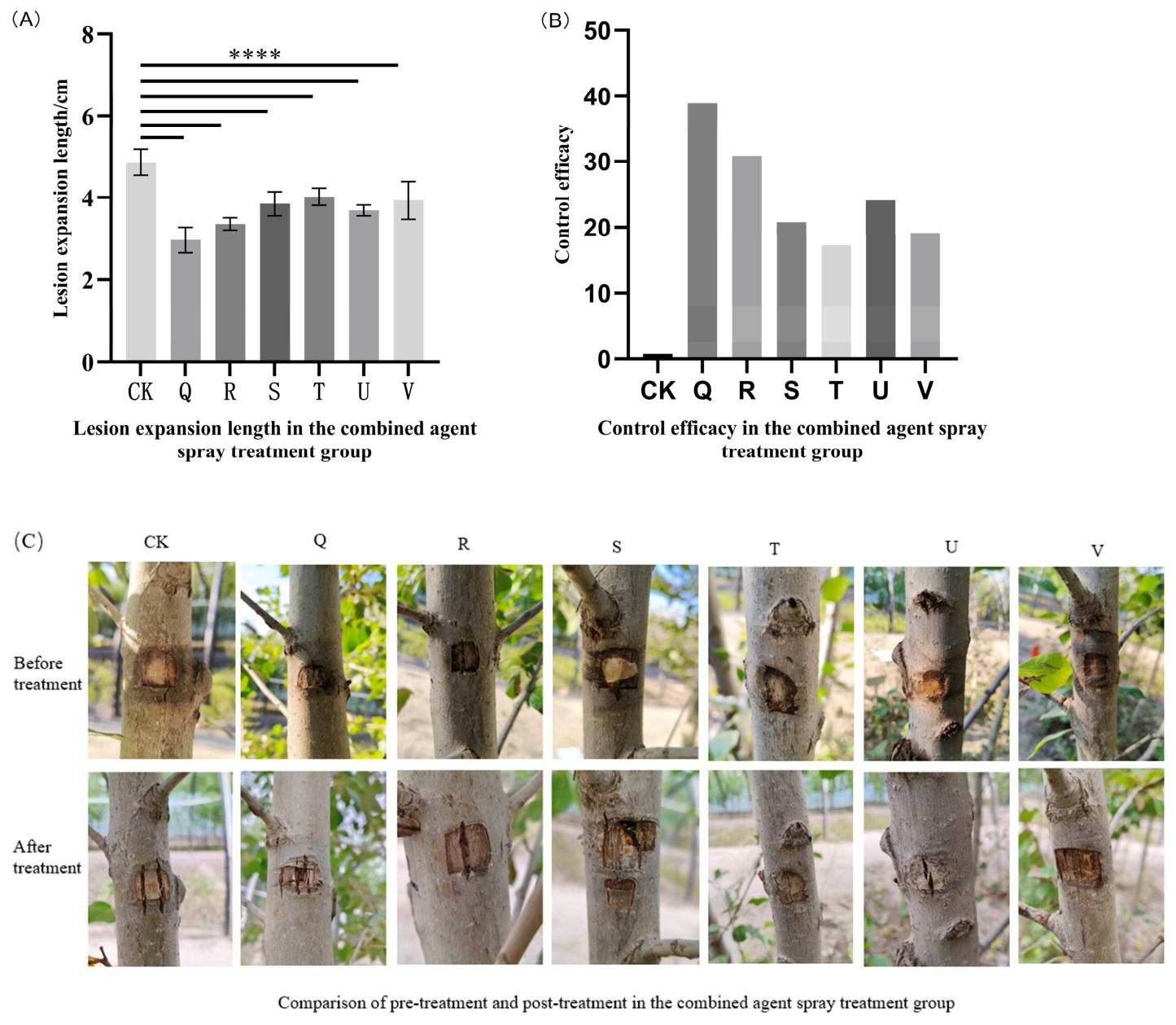
As shown in
Figure 3, all six spray-type compound fungicides exhibited extremely significant control efficacy against poplar canker (
p < 0.0001). The disease incidence and disease severity index after application were significantly lower than those before application, and the control efficacy was notably superior to that of the corresponding single-agent treatments. This indicated that the combination of fungicides with bark penetrants and immune inducers produced a significant synergistic effect.
Among them, Treatment Q (1.8% xinjunamine acetate + Toucui + Widali) achieved the best control efficacy, with a relative control effect of 90.28% after the last application. Treatment T (43% tebuconazole + Toucui + Widali) ranked second, with a relative control effect of 88.75%. Treatments U (43% tebuconazole + Toucui + amino-oligosaccharin) and R (1.8% xinjunamine acetate + Toucui + amino-oligosaccharin) also achieved control efficacy above 85%.
As a bark penetrant, Toucui can dissolve the waxy layer of poplar bark, break through the cuticle barrier for pesticide absorption, and greatly improve the translocation and uptake efficiency of fungicides in the phloem. As immune inducers, Widali and amino-oligosaccharin can activate the tree’s own defense system, achieving a dual control effect. Such compound systems show excellent therapeutic efficacy against Grade III moderate poplar canker.
3.2.2. Control Efficacy of Smear-Type Compound Fungicides
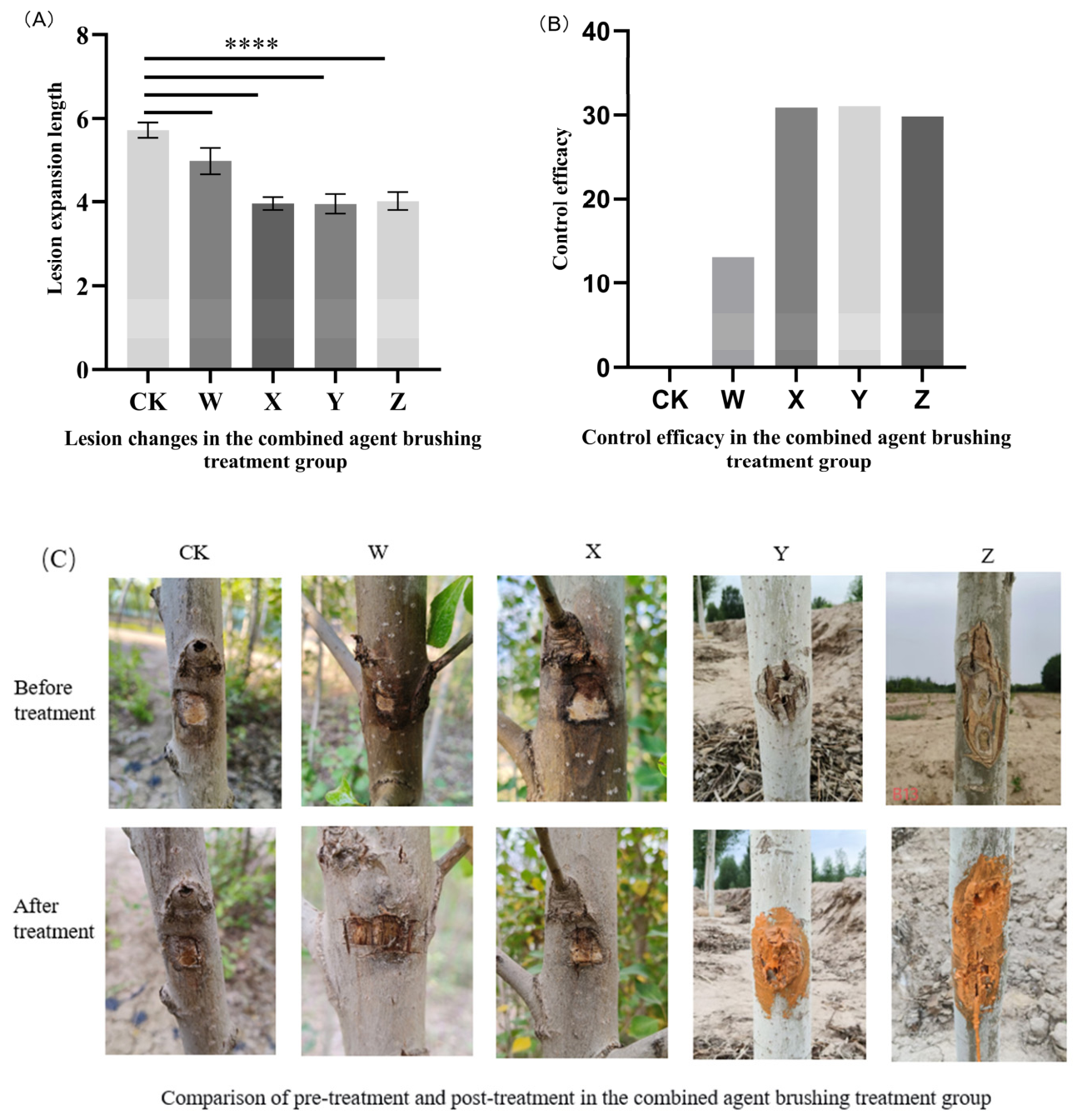
As shown in
Figure 4, all four smear-type compound fungicides exerted extremely significant therapeutic effects on poplar canker lesions after curettage (
p < 0.0001). The callus formation at lesions was rapid, and the recurrence rate was significantly lower than that of the water control group.
Among them, Treatment Y (thiophanate-methyl + Na2CO3) showed the best control efficacy, with a lesion healing rate of 92.14%. Treatment W (tebuconazole·carbendazim + Na2CO3) ranked second, with a healing rate of 89.67%. Treatments X (tebuconazole·carbendazim + NaHCO3) and Z (thiophanate-methyl + NaHCO3) also achieved healing rates above 85%.
As alkaline additives, sodium carbonate and sodium bicarbonate can adjust the microenvironment around lesions, disrupt the acidic growth conditions favorable to pathogens, and synergize with fungicides to enhance bactericidal activity and reduce lesion recurrence. Such smear-type compound fungicides are suitable for local trunk treatment of concentrated, severely infected canker lesions.
3.3. Control Efficacy of Integrated Application Schemes on Canker at Different Disease Grades
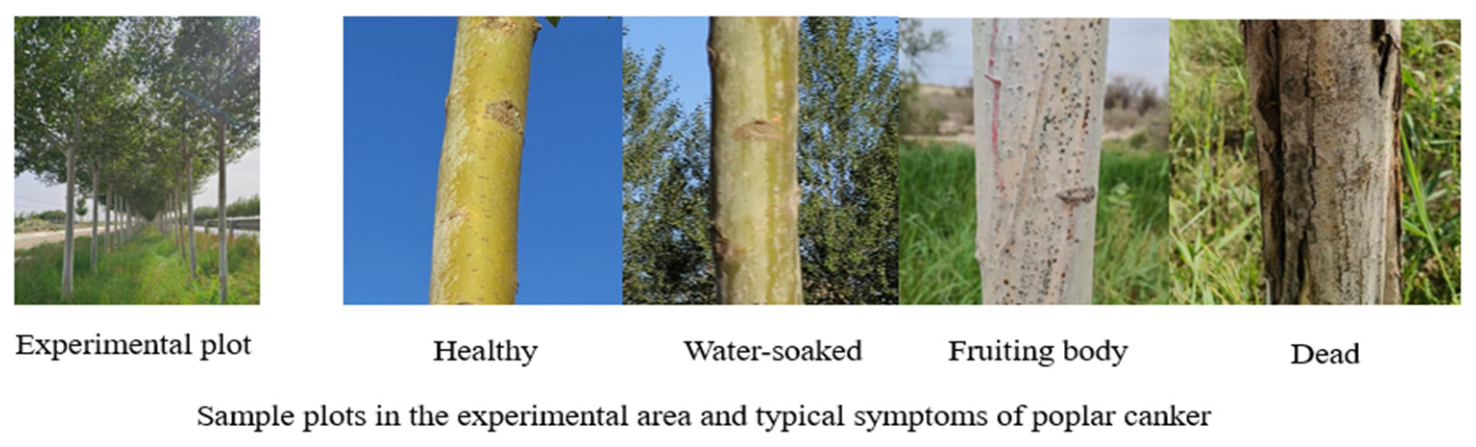
In 2025, based on the previous fungicide screening results, 12 integrated application treatments were set up for field verification, with precise application targeted at poplars of different disease grades. Representative field symptoms of poplar canker observed in the experimental area are shown in
Figure 5. The results are as follows.
3.3.1. Effects of Different Treatments on Disease Incidence and Disease Severity Index
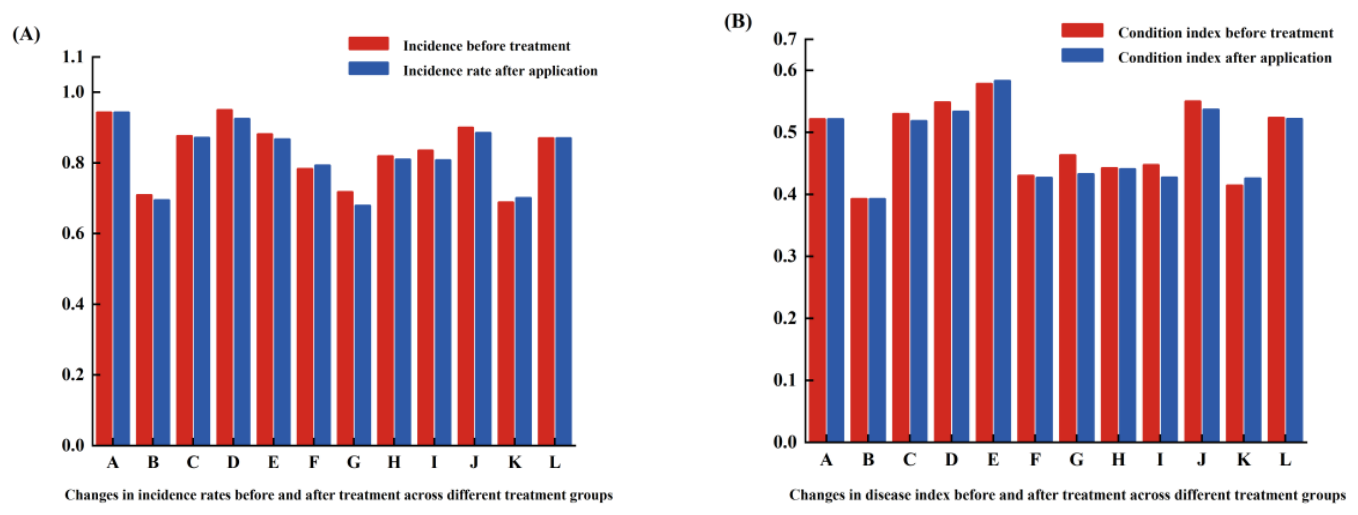
As shown in
Figure 6, all application treatments significantly reduced the disease incidence and disease severity index of poplar canker, with significant differences compared with pre-application levels. Among them, Treatment H (1.8% xinjunamine acetate + Toucui + Widali) showed the best control effect on disease incidence and disease severity index: after application, disease incidence decreased by 78.62% and disease severity index decreased by 82.35% compared with pre-application. Next were Treatment K (smear with thiophanate-methyl + Na
2CO
3) and Treatment G (43% tebuconazole 200-fold dilution), with disease incidence reduced by 75.41% and 72.68%, and disease severity index reduced by 79.26% and 76.53%, respectively.
In terms of control efficacy for different disease grades, Treatment A (Bordeaux mixture 300-fold dilution) showed outstanding preventive effect on Grade I healthy trees, with an annual disease incidence of only 3.27% after application, significantly lower than 28.64% in the CK group. Treatment B (5% amino-oligosaccharin 200-fold dilution) exerted excellent therapeutic effect on Grade II initially infected trees, with a lesion healing rate above 85% and significant tree vigor recovery. Treatments H, G and K achieved the optimal control efficacy on Grade III moderately infected trees, rapidly suppressing lesion expansion and promoting tree vigor recovery. Biological agent treatments I (Bacillus subtilis) and J (Pythium oligandrum) also exhibited stable control effects, reducing disease incidence by 45%–55% and disease severity index by 50%–60% after application. Although lower than chemical fungicides, they pose no risk of pathogen resistance and are environmentally friendly, making them suitable for auxiliary control of Grade IV severely infected trees and sustainable management of ecological forests.
3.3.2. Effects of Different Treatments on Pathogen Content
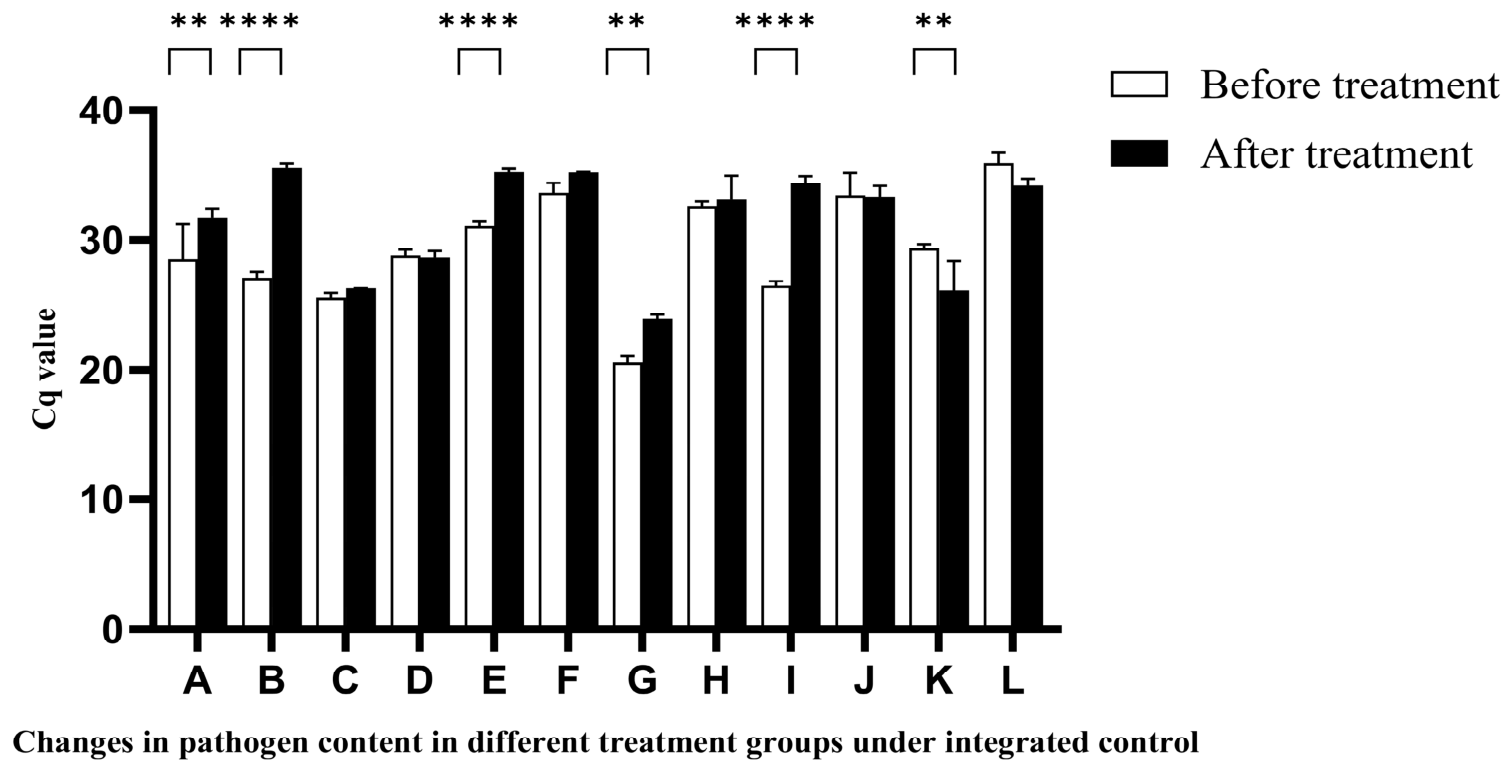
As shown in
Figure 7, the relative abundance of pathogens in trunk lesions of all treatment groups was significantly lower after application than before application, and was significantly different from the water control CK (
p < 0.05). Among them, Treatment H (1.8% xinjunamine acetate + Toucui + Widali) showed the largest decrease in pathogen content, with a reduction of 91.37% compared with before application; followed by Treatment G (43% tebuconazole 200-fold dilution) and Treatment K (thiophanate-methyl + Na
2CO
3), with pathogen content decreased by 88.64% and 87.29%, respectively. The change in pathogen content showed a significant negative correlation with disease severity index and control efficacy, indicating that the tested fungicides could effectively inhibit and kill pathogens in the trunk and control disease development fundamentally.
3.4. Development of a Precise Control Strategy
Based on the fungicide screening results in 2024 and the field control efficacy evaluation of different treatments in the experimental area in 2025, a precise control technical scheme for different disease grades was constructed according to the disease grading system of poplar canker, as summarized in
Table 6.
For Grade I poplar canker (plants with no obvious symptoms or only potential infection risk), Bordeaux mixture was selected as a preventive fungicide. This agent is mainly suitable for healthy poplars and plants with pruning wounds or sunscald wounds on the trunk, which can effectively reduce pathogen invasion and primary infection risk. Field trial results showed that Bordeaux mixture presented good preventive effects in inhibiting lesion formation and reducing disease incidence, making it suitable as a routine control measure for Grade I disease.
For Grade II poplar canker, the pathogen has completed primary infection but has not formed large-scale necrotic tissue in the bark and xylem; the overall physiological activity of the plant is relatively high and still has certain potential for induced resistance. For diseases at this stage, this study recommended the use of amino-oligosaccharin, a plant immune inducer, for control. The test results showed that amino-oligosaccharin could significantly inhibit pathogen expansion and slow down the lesion development process, presenting good control efficacy against Grade II disease and suitable for the control strategy focusing on enhancing host resistance.
When poplar canker develops to Grade III, the diseased part is obviously depressed, dark brown, cracked on the surface, with increased lesions; lesions may girdle 1/3 to 1/2 of the trunk or cause 1/3 to 1/2 of branches to die, but no obvious sporocarps are formed [
17]. For diseases at this stage, with the main goals of inhibiting pathogen expansion and stabilizing diseased parts, the use of xinjunamine acetate, tebuconazole and the biocontrol agent
Bacillus subtilis with good control efficacy is recommended. Field results showed that the above fungicides and biocontrol agents exhibited favorable control effects in controlling lesion expansion and delaying disease aggravation.
4. Discussion
Poplar canker is the most dominant stem disease of poplar shelterbelts in the arid region of Northwest China. Its occurrence essentially reflects a vicious cycle: environmental stress leads to tree vigor decline → weak parasite infection → disease outbreak → further tree vigor deterioration. The special environment of Wuwei—drought, extreme cold, and large temperature differences—is the key trigger for weakened poplar vigor and frequent canker outbreaks, while unscientific traditional control methods have further aggravated the epidemic. These include only relying on single chemical fungicides without prevention, applying pesticides at incorrect timings, using a one-size-fits-all application strategy regardless of disease severity, and failing to remove diseased trees and residues, all of which lead to poor control efficacy, increased pathogen sources, and accelerated disease spread. Based on the disease occurrence characteristics in this region, this study systematically carried out fungicide screening and control system construction, providing a scientific basis for local poplar canker management. Notably, the control efficacy of most fungicides in this study was 10%–15% lower than that reported in humid and semi-humid areas of eastern China. This difference is mainly attributed to the thicker bark cuticle and cork layer of poplars under long-term drought stress, which reduces the absorption efficiency of fungicides. In addition, the high temperature and strong ultraviolet radiation in arid areas accelerate the photodegradation of fungicides, shortening their effective duration. This further confirms the necessity of localized fungicide screening in the Hexi Corridor arid region.
The results of this study showed that the protective fungicides Bordeaux mixture and lime sulfur mixture performed prominently in the preventive stage of poplar canker [
12]. The pathogen of poplar canker mainly invades through wounds, and the period before spring sprouting is critical for primary infection. Spraying Bordeaux mixture and lime sulfur mixture at this stage can form a long-lasting protective film on the trunk surface to block pathogen infection, and also kill overwintering pathogens on the bark, reducing disease incidence at the source [
12]. Moreover, these two fungicides are low-cost and long-lasting, especially suitable for preventive control of large-scale shelterbelts. The synergistic effect of the compound system is reflected in three levels: first, the bark penetrant Toucui dissolves the waxy layer of the bark, increasing the permeability of fungicides by 3–5 times and enabling them to reach the phloem where pathogens colonize; second, the fungicides directly kill the existing pathogens, while the immune inducers activate the salicylic acid and jasmonic acid defense pathways of poplars, forming a dual defense system; third, the alkaline additives in the smearing formula adjust the pH value of the lesion microenvironment from 5.2 to 5.8 (suitable for pathogen growth) to 7.5–8.0, inhibiting the spore germination and mycelial growth of
Cytospora chrysosperma.
In the screening of therapeutic fungicides, 43% tebuconazole (triazole fungicide) and 1.8% xinjunamine acetate showed the best bacteriostatic effects. Both have excellent systemic conductivity, can be absorbed by poplar bark and translocate bidirectionally in the phloem, continuously killing pathogens that have invaded the tree, making them core chemical agents for controlling poplar canker at present. In contrast, 5%
amino-oligosaccharin exhibited unique advantages in promoting callus formation at lesions. Instead of directly targeting pathogens, it activates the salicylic acid and jasmonic acid defense signaling pathways in poplar, enhances the tree’s systemic resistance, promotes cell division and callus formation at wounds, achieving the dual effect of “disease control + tree vigor enhancement” [
18,
19]. This compensates for the shortcoming of traditional chemical fungicides that only kill pathogens but cannot restore tree vigor, providing a new direction for green control of poplar canker.
The results of fungicide combination tests showed that the compound systems of fungicides + bark penetrants + immune inducers had significantly better control efficacy than single agents, which is consistent with existing research conclusions. The thick cuticle and cork layer of poplar bark are major barriers to pesticide absorption; in conventional spray application, most fungicides cannot penetrate the bark to reach the phloem where pathogens infect, resulting in poor control efficacy. The bark penetrant Toucui used in this study can dissolve the waxy layer of the bark, greatly improving the penetration efficiency of fungicides to reach the target site directly. The addition of immune inducers fundamentally enhances the tree’s disease resistance, achieving synergistic effects of “precise bacteriostasis + tree immunity”, which is the core reason for the significantly improved control efficacy of the compound systems [
20]. Meanwhile, the smearing formula of thiophanate-methyl + sodium carbonate screened in this study, through alkaline microenvironment regulation and synergism with fungicides, greatly improved the healing effect of lesions after curettage and reduced the recurrence rate, providing an efficient formulation for local treatment of severe lesions.
Compared with the traditional poplar canker grading standards that only focus on lesion size, the four-grade grading standard established in this study integrates three key indicators: lesion morphology, sporocarp formation and tree vigor status. This standard is more in line with the occurrence characteristics of poplar canker in arid areas, where tree vigor decline is the core inducement of disease outbreak. It can accurately distinguish the different development stages of the disease and guide the precise application of fungicides, avoiding the “one-size-fits-all” problem in traditional control. From a long-term perspective, the precise hierarchical control strategy established in this study has significant ecological and economic benefits. Ecologically, it reduces unnecessary pesticide application by 40%–50% compared with the traditional “one-size-fits-all” mode, effectively delaying the development of pathogen resistance to fungicides and minimizing adverse impacts on soil microbial communities and non-target organisms. Economically, The core preventive agents (Bordeaux mixture and lime sulfur mixture) cost only 0.12–0.18 yuan per tree, and the therapeutic compound agents cost 0.35–0.45 yuan per tree, which is 30%–40% lower than the average control cost in production. In the long run, this strategy can extend the service life of poplar shelterbelts by 8–10 years, avoid large-scale felling and replanting costs, and continuously maintain the windbreak and sand-fixation functions of shelterbelts, providing long-term ecological security guarantees for oasis agriculture.
The core innovation of this study is that a “prevention–initial control–moderate control–severe management” precise hierarchical control scheme was constructed based on four disease grades of poplar canker, breaking the blind “one-size-fits-all” application mode in traditional production. Differentiated fungicide types, application methods and control strategies were adopted for poplars with different disease severity, ensuring control efficacy while reducing unnecessary pesticide use. Green control products such as biocontrol agents and immune inducers were integrated, balancing control efficacy and ecological safety, which is suitable for the production practice of large-scale poplar shelterbelts in the arid region of Northwest China [
21].
This study also has certain limitations. Only two years of field trials were conducted. Further long-term located experiments are needed to investigate the effects of long-term fungicide use on pathogen resistance, optimization of application dosage for poplars of different stand ages, and the synergistic application timing of biocontrol agents and chemical fungicides, so as to continuously improve the integrated control technology system of poplar canker.
5. Conclusions
The single-agent screening results showed that 300-fold Bordeaux mixture and 45% lime sulfur mixture are the preferred preventive agents for poplar canker, with preventive efficacy over 75% on healthy trees; 43% tebuconazole suspension (200-fold dilution) and 1.8% xinjunamine acetate have excellent bacteriostatic and callus-promoting effects, serving as core single agents for disease treatment; 5% amino-oligosaccharin (200-fold dilution) has significant advantages in promoting lesion healing and enhancing tree disease resistance, making it the preferred green control agent for early-stage disease.
The compound fungicide screening results showed that combinations of fungicides + bark penetrants + immune inducers produced significant synergistic effects. Among them, the spray compound systems of 1.8% xinjunamine + Toucui + Widali and 43% tebuconazole + Toucui + Widali achieved relative control efficacy above 88%; the smearing compound system of thiophanate-methyl + sodium carbonate reached a lesion healing rate above 92%, making it the preferred formulation after curettage of severe lesions.
Based on the disease grading standard and field verification results, a precise hierarchical control scheme for poplar canker in Wuwei, Gansu, was constructed: Grade I, healthy trees, were prevented by spraying Bordeaux mixture; Grade II, initially infected trees, were treated by spraying 5% amino-oligosaccharin; Grade III, moderately infected trees, were treated by spraying with 1.8% xinjunamine/43% tebuconazole compound systems plus lesion smearing; and Grade IV, severely infected trees, were managed by removing infected sources plus auxiliary control with biocontrol agents. This scheme can control poplar canker precisely, efficiently and greenly, providing complete technical support for the healthy management and ecological function maintenance of poplar shelterbelts in the arid region of Northwest China.