Climate Change Impacts on Native and Exotic Mangrove Distributions and Niche Overlap Analysis


 ,
,  , ,
, ,
Abstract
1. Introduction
2. Materials and Methods
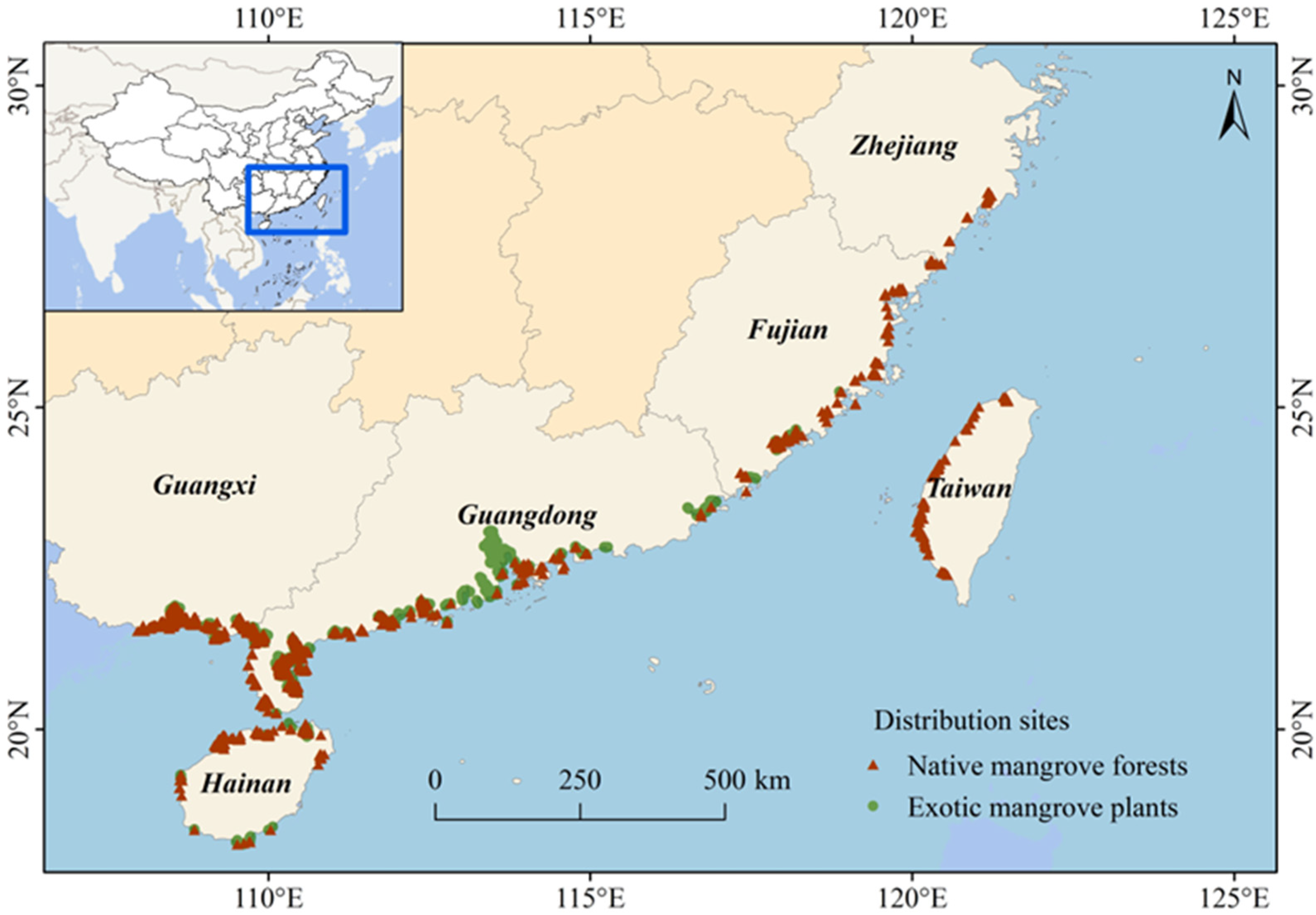
2.1. Study Area
2.2. Mangrove Distribution Data
2.3. Environmental Dataset and Climate Change Scenarios
2.4. Potential Suitable Habitat and Niche Overlap Analysis
3. Results
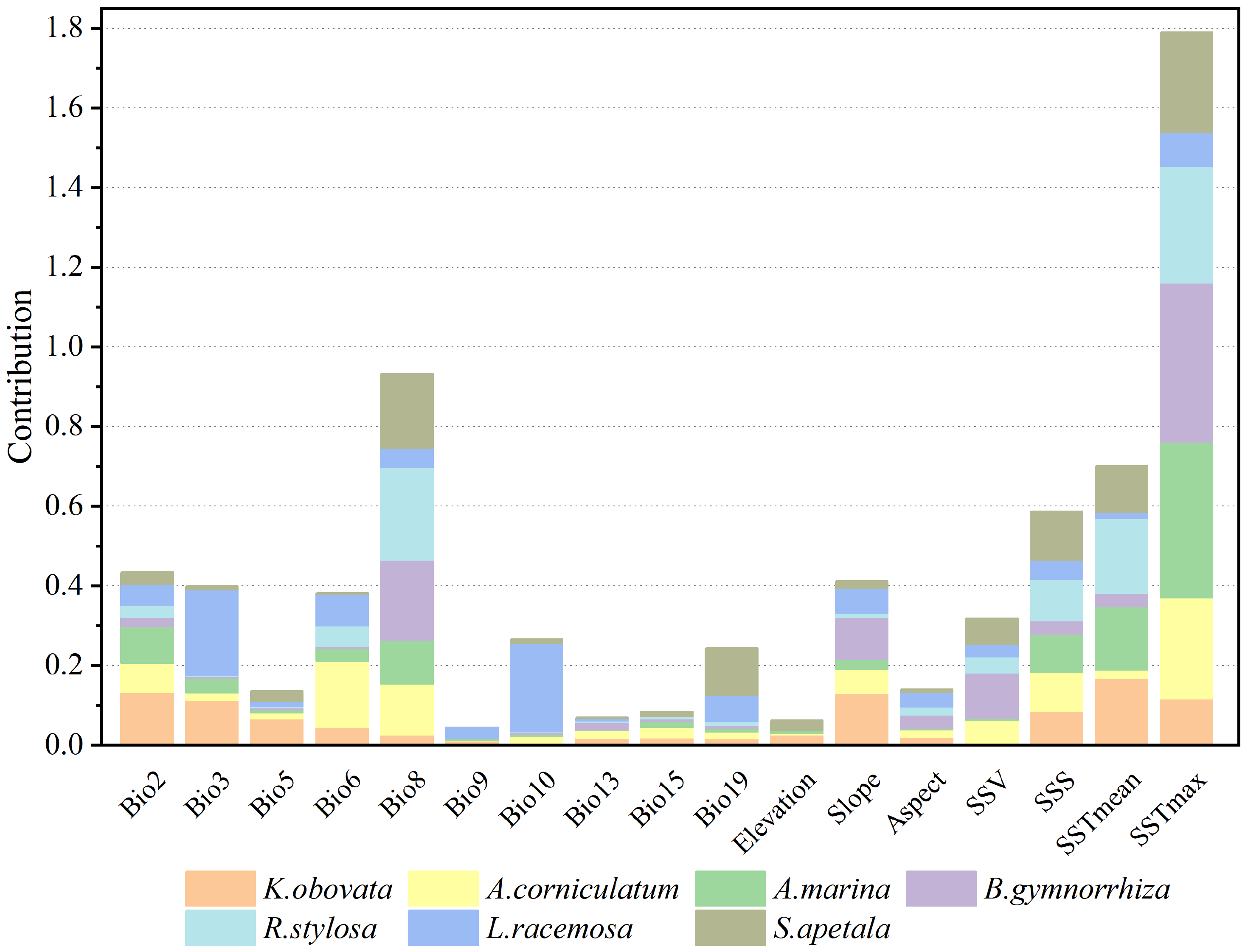
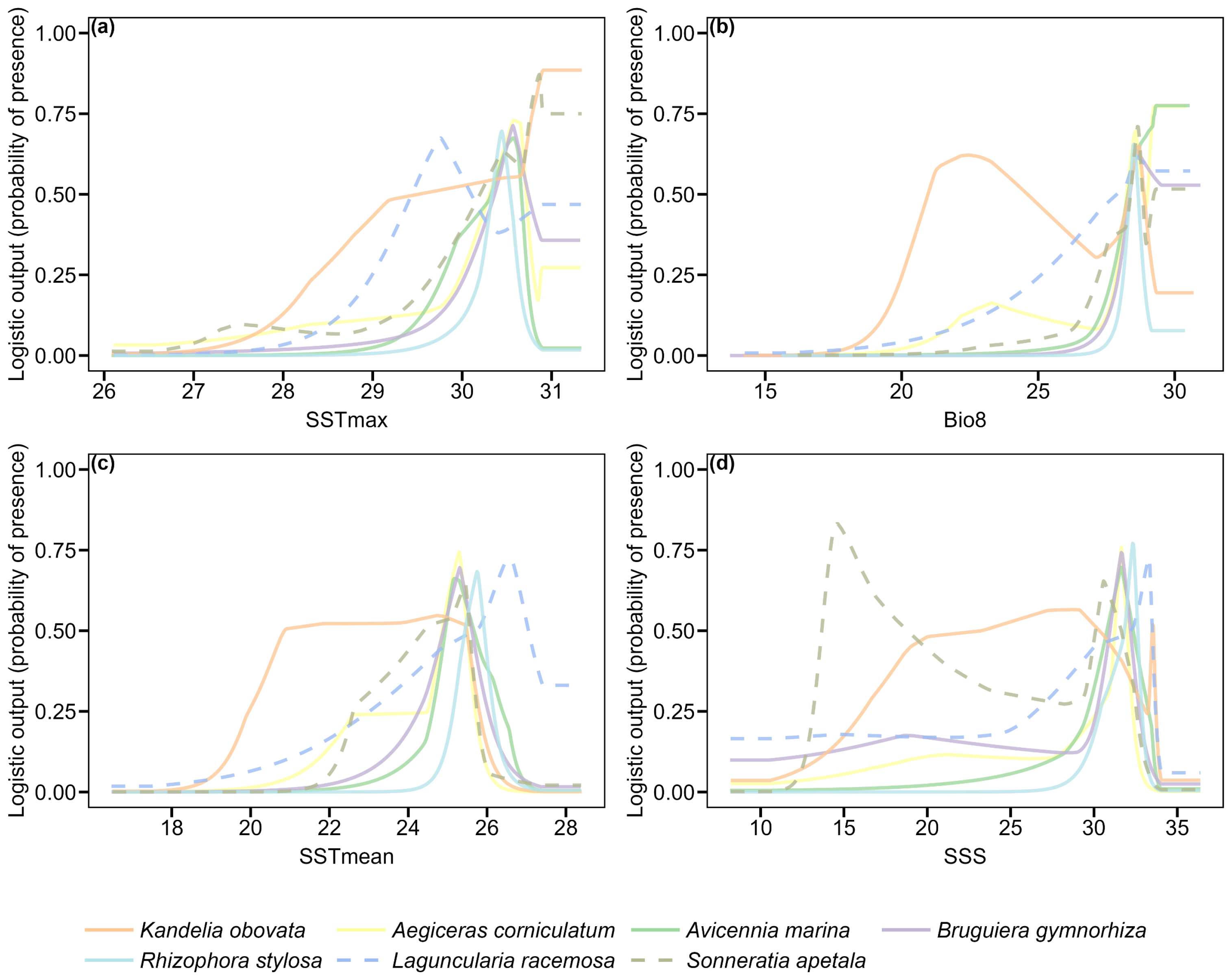
3.1. Assessment of Model Performance and Identification of Key Environmental Variables
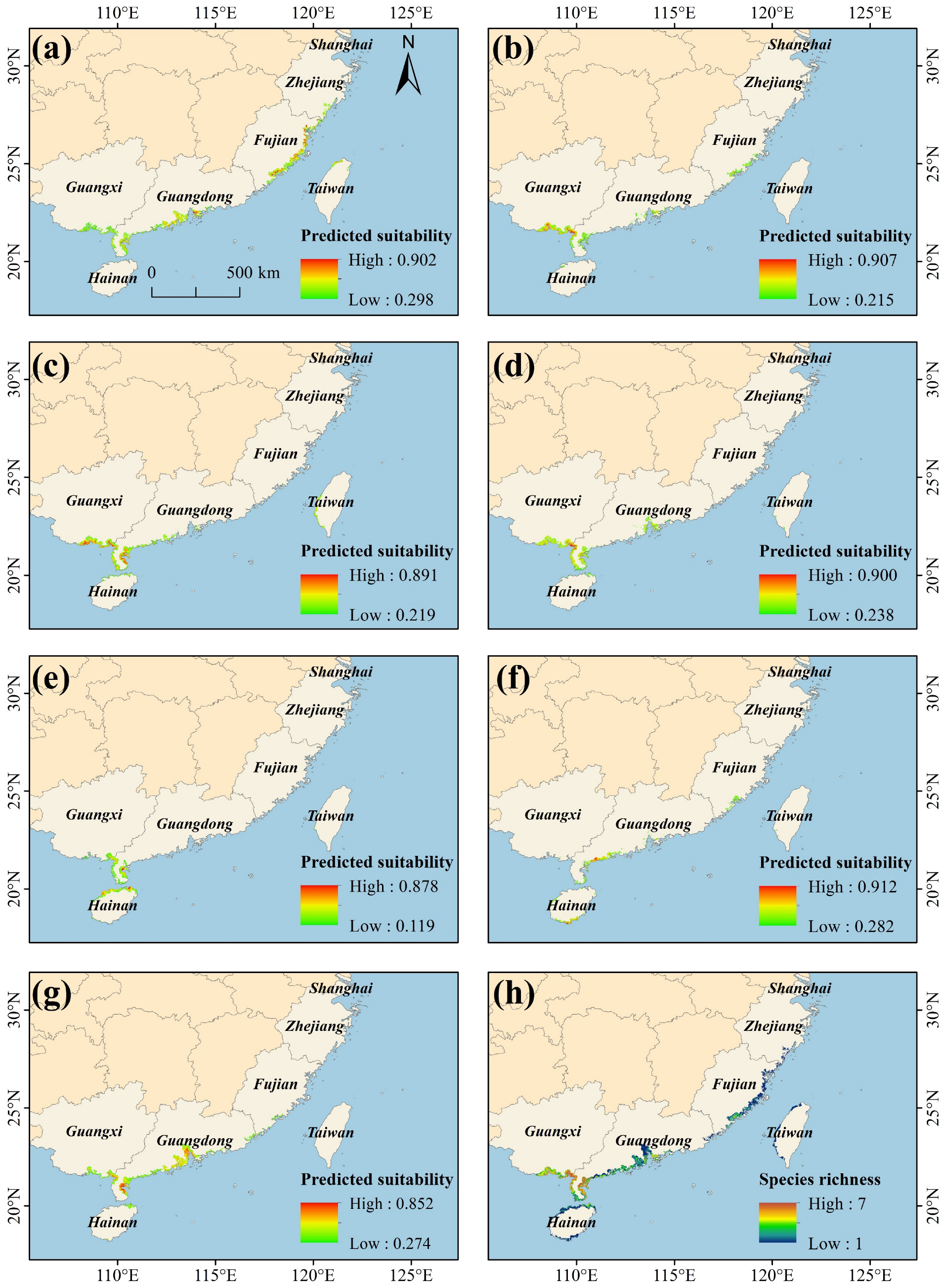
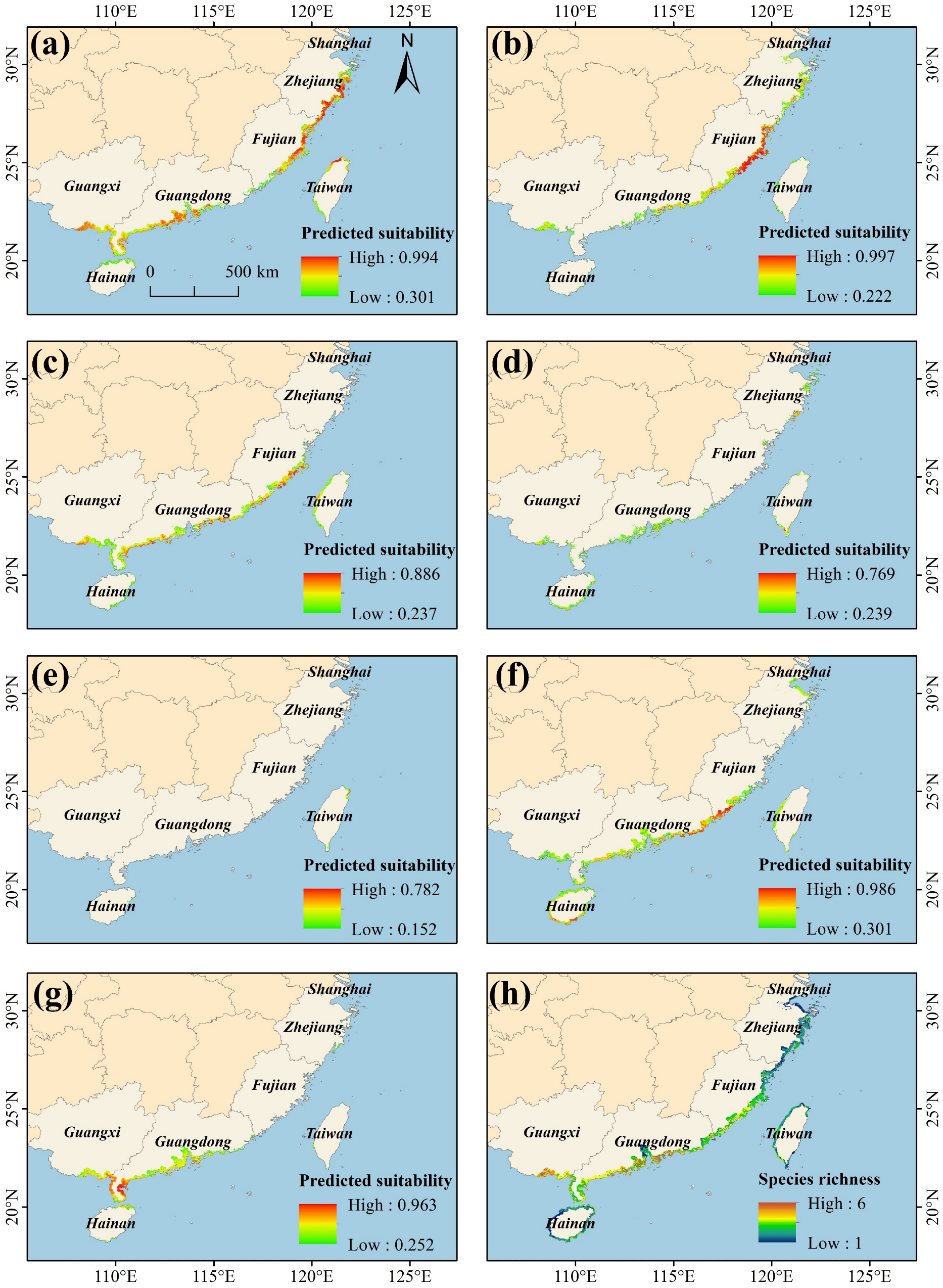
3.2. Suitability of the Mangrove Forest Habitat
3.2.1. Suitable Habitats for Mangrove Forests Under Current Climate Scenarios
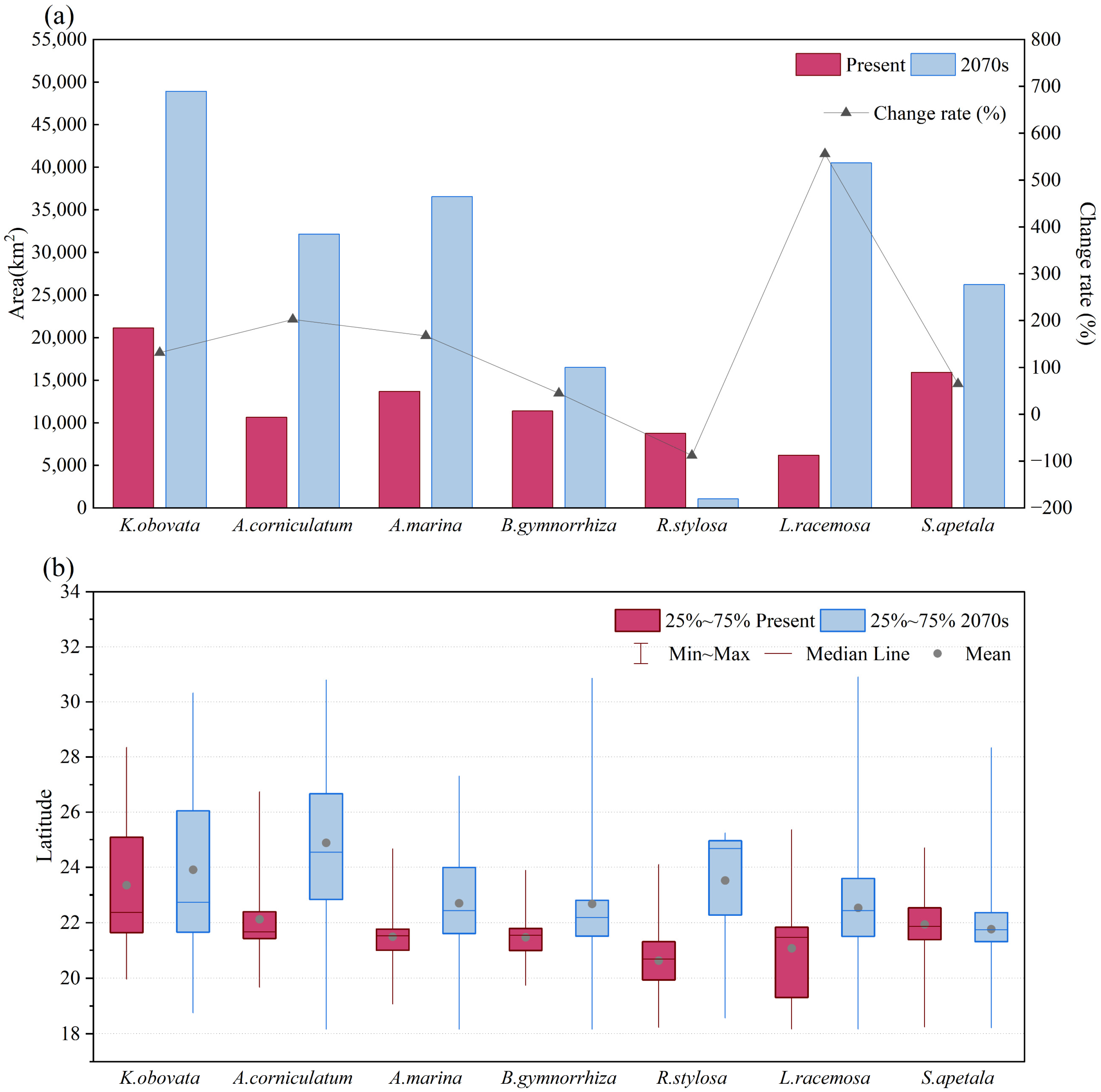
3.2.2. Distribution of Mangrove Habitats Under Future Climate Scenarios
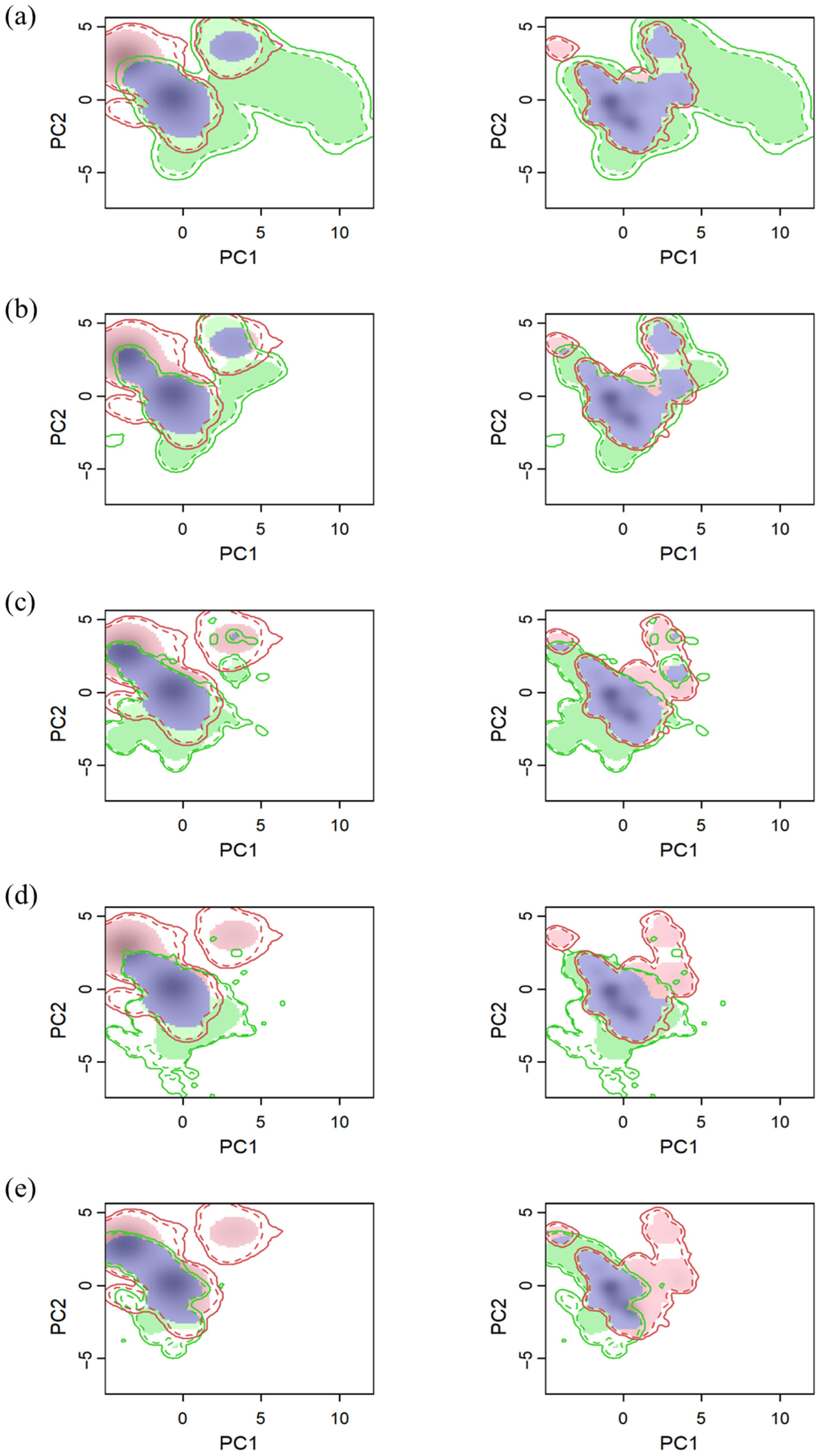
3.3. Current Ecological Niche Overlap Between Native and Invasive Mangroves
4. Discussion
4.1. Key Environmental Factors Influencing Suitability
4.2. Changes in the Suitable Habitats and Species Richness of Mangroves Under Climate Change
4.3. Assessment of Invasion Risk from the Perspective of Niche Overlap
4.4. Uncertain Niche Assessment and Potential Invasion Risks
5. Conclusions
Author Contributions
Funding
Data Availability Statement
Conflicts of Interest
References
- Duke, N.C.; Meynecke, J.-O.; Dittmann, S.; Ellison, A.M.; Anger, K.; Berger, U.; Cannicci, S.; Diele, K.; Ewel, K.C.; Field, C.D.; et al. A World Without Mangroves? Science 2007, 317, 41–42. [Google Scholar] [CrossRef]
- Donato, D.C.; Kauffman, J.B.; Murdiyarso, D.; Kurnianto, S.; Stidham, M.; Kanninen, M. Mangroves among the most carbon-rich forests in the tropics. Nat. Geosci. 2011, 4, 293–297. [Google Scholar] [CrossRef]
- Jennerjahn, T.C.; Ittekkot, V. Relevance of mangroves for the production and deposition of organic matter along tropical continental margins. Naturwissenschaften 2002, 89, 23–30. [Google Scholar] [CrossRef]
- Dittmar, T.; Hertkorn, N.; Kattner, G.; Lara, R.J. Mangroves, a major source of dissolved organic carbon to the oceans. Glob. Biogeochem. Cycles 2006, 20, GB1012. [Google Scholar] [CrossRef]
- Pérez, A.; Machado, W.; Gutierrez, D.; Stokes, D.; Sanders, L.; Smoak, J.M.; Santos, I.; Sanders, C.J. Changes in organic carbon accumulation driven by mangrove expansion and deforestation in a New Zealand estuary. Estuar. Coast. Shelf Sci. 2017, 192, 108–116. [Google Scholar] [CrossRef]
- Rull, V. Responses of Caribbean Mangroves to Quaternary Climatic, Eustatic, and Anthropogenic Drivers of Ecological Change: A Review. Plants 2022, 11, 3502. [Google Scholar] [CrossRef] [PubMed]
- Alongi, D.M.; Mukhopadhyay, S.K. Contribution of mangroves to coastal carbon cycling in low latitude seas. Agric. For. Meteorol. 2015, 213, 266–272. [Google Scholar] [CrossRef]
- Chen, L.; Wang, W.; Zhang, Y.; Lin, G. Recent progresses in mangrove conservation, restoration and research in China. J. Plant Ecol. 2009, 2, 45–54. [Google Scholar] [CrossRef]
- Jia, M.; Wang, Z.; Zhang, Y.; Mao, D.; Wang, C. Monitoring loss and recovery of mangrove forests during 42 years: The achievements of mangrove conservation in China. Int. J. Appl. Earth Obs. Geoinf. 2018, 73, 535–545. [Google Scholar] [CrossRef]
- Fan, H.; Wang, W. Some thematic issues for mangrove conservation in China. J. Xiamen Univ. Nat. Sci. 2017, 56, 323–330. [Google Scholar] [CrossRef]
- Chen, B.; Yu, W.; Liu, W.; Liu, Z. An assessment on restoration of typical marine ecosystems in China—Achievements and lessons. Ocean Coast. Manag. 2012, 57, 53–61. [Google Scholar] [CrossRef]
- Hamilton, S.E.; Casey, D. Creation of a high spatio-temporal resolution global database of continuous mangrove forest cover for the 21st century (CGMFC-21). Glob. Ecol. Biogeogr. 2016, 25, 729–738. [Google Scholar] [CrossRef]
- Jayanthi, M.; Thirumurthy, S.; Nagaraj, G.; Muralidhar, M.; Ravichandran, P. Spatial and temporal changes in mangrove cover across the protected and unprotected forests of India. Estuar. Coast. Shelf Sci. 2018, 213, 81–91. [Google Scholar] [CrossRef]
- Fan, H.; Mo, Z. The History, Achievements and Lessons Learnt for Mangrove Restoration in Guangxi, China. Guangxi Sci. 2018, 25, 363–371+387. [Google Scholar] [CrossRef]
- Ren, H.; Lu, H.; Shen, W.; Huang, C.; Guo, Q.; Li, Z.; Jian, S. Sonneratia apetala Buch.Ham in the mangrove ecosystems of China: An invasive species or restoration species? Ecol. Eng. 2009, 35, 1243–1248. [Google Scholar] [CrossRef]
- Ren, H.; Jian, S.; Lu, H.; Zhang, Q.; Shen, W.; Han, W.; Yin, Z.; Guo, Q. Restoration of mangrove plantations and colonisation by native species in Leizhou bay, South China. Ecol. Res. 2008, 23, 401–407. [Google Scholar] [CrossRef]
- Chen, L.; Peng, S.; Li, J.; Lin, Z.; Zeng, Y. Competitive Control of an Exotic Mangrove Species: Restoration of Native Mangrove Forests by Altering Light Availability. Restor. Ecol. 2013, 21, 215–223. [Google Scholar] [CrossRef]
- Lu, C.; Liao, B. Consideration on Ecological Function of Alien Mangrove Plants Sonneratia apetala and Laguncularia racemosa. Wetl. Sci. 2019, 17, 682–688. [Google Scholar] [CrossRef]
- Liu, R. The mangrove species selection for afforestation-taking Luoyangjiang River wetland as an example. J. Fujian For. Sci. Technol. 2008, 35, 231–234. [Google Scholar] [CrossRef]
- Austin, M. Species distribution models and ecological theory: A critical assessment and some possible new approaches. Ecol. Model. 2007, 200, 1–19. [Google Scholar] [CrossRef]
- Fourcade, Y.; Besnard, A.G.; Secondi, J. Paintings predict the distribution of species, or the challenge of selecting environmental predictors and evaluation statistics. Glob. Ecol. Biogeogr. 2018, 27, 245–256. [Google Scholar] [CrossRef]
- Xu, Z.; Peng, H.; Peng, S. The development and evaluation of species distribution models. Acta Ecol. Sin. 2015, 35, 557–567. [Google Scholar] [CrossRef]
- Valavi, R.; Guillera-Arroita, G.; Lahoz-Monfort, J.J.; Elith, J. Predictive performance of presence-only species distribution models: A benchmark study with reproducible code. Ecol. Monogr. 2022, 92, e01486. [Google Scholar] [CrossRef]
- Lin, P.; Fu, Q. Environmental Ecology and Economic Utilization of Mangroves in China; Higher Education Press: Beijing, China, 1995. [Google Scholar]
- Liao, B.; Zhang, Q. Area, distribution and species composition of mangroves in China. Wetl. Sci. 2014, 12, 435–440. [Google Scholar] [CrossRef]
- Li, F.L.; Zhong, L.; Cheung, S.G.; Wong, Y.S.; Shin, P.K.S.; Lei, A.P.; Zhou, H.C.; Song, X.; Tam, N.F.Y. Is Laguncularia racemosa more invasive than Sonneratia apetala in northern Fujian, China in terms of leaf energetic cost? Mar. Pollut. Bull. 2020, 152, 110897. [Google Scholar] [CrossRef]
- Peng, Y.; Diao, J.; Zheng, M.; Guan, D.; Zhang, R.; Chen, G.; Lee, S.Y. Early growth adaptability of four mangrove species under the canopy of an introduced mangrove plantation: Implications for restoration. For. Ecol. Manag. 2016, 373, 179–188. [Google Scholar] [CrossRef]
- Zhao, C.; Jia, M.; Zhang, R.; Wang, Z.; Ren, C.; Mao, D.; Wang, Y. Mangrove species mapping in coastal China using synthesized Sentinel-2 high-separability images. Remote Sens. Environ. 2024, 307, 114151. [Google Scholar] [CrossRef]
- Zhao, C.; Li, Y.; Wang, Z.; Jia, M. Distribution of Exotic Mangroves Sonneratia apetala in China for 2024. V3. Science Data Bank. 2025. Available online: https://www.scidb.cn/en/detail?dataSetId=2e9b1fef0dff472bb10728852c48a1d6 (accessed on 23 December 2024).
- Osland, M.J.; Feher, L.C.; Griffith, K.T.; Cavanaugh, K.C.; Enwright, N.M.; Day, R.H.; Stagg, C.L.; Krauss, K.W.; Howard, R.J.; Grace, J.B.; et al. Climatic controls on the global distribution, abundance, and species richness of mangrove forests. Ecol. Monogr. 2017, 87, 341–359. [Google Scholar] [CrossRef]
- Yuvaraj, E.; Dharanirajan, K.; Jayakumar, S.; Saravanan. Geomorphic settings of mangrove ecosystem in South Andaman Island: A geospatial approach. J. Earth Syst. Sci. 2014, 123, 1819–1830. [Google Scholar] [CrossRef]
- Wu, T.; Lu, Y.; Fang, Y.; Xin, X.; Li, L.; Li, W.; Jie, W.; Zhang, J.; Liu, Y.; Zhang, L.; et al. The Beijing Climate Center Climate System Model (BCC-CSM): The main progress from CMIP5 to CMIP6. Geosci. Model Dev. 2019, 12, 1573–1600. [Google Scholar] [CrossRef]
- Fricko, O.; Havlik, P.; Rogelj, J.; Klimont, Z.; Gusti, M.; Johnson, N.; Kolp, P.; Strubegger, M.; Valin, H.; Amann, M.; et al. The marker quantification of the Shared Socioeconomic Pathway 2: A middle-of-the-road scenario for the 21st century. Glob. Environ. Change 2017, 42, 251–267. [Google Scholar] [CrossRef]
- Zhang, C.; Wu, S.; Leng, G. Possible NPP changes and risky ecosystem region identification in China during the 21st century based on BCC-CSM2. J. Geogr. Sci. 2020, 30, 1219–1232. [Google Scholar] [CrossRef]
- Liu, C.; White, M.; Newell, G. Measuring and comparing the accuracy of species distribution models with presence–absence data. Ecography 2011, 34, 232–243. [Google Scholar] [CrossRef]
- Young, A.; Runting, R.K.; Kujala, H.; Konlechner, T.M.; Strain, E.M.A.; Morris, R.L. Identifying opportunities for living shorelines using a multi-criteria suitability analysis. Reg. Stud. Mar. Sci. 2023, 61, 102857. [Google Scholar] [CrossRef]
- Merckx, B.; Steyaert, M.; Vanreusel, A.; Vincx, M.; Vanaverbeke, J. Null models reveal preferential sampling, spatial autocorrelation and overfitting in habitat suitability modelling. Ecol. Model. 2011, 222, 588–597. [Google Scholar] [CrossRef]
- Allouche, O.; Tsoar, A.; Kadmon, R. Assessing the accuracy of species distribution models: Prevalence, kappa and the true skill statistic (TSS). J. Appl. Ecol. 2006, 43, 1223–1232. [Google Scholar] [CrossRef]
- Cohen, J. A coefficient of agreement for nominal scales. Educ. Psychol. Meas. 1960, 20, 37–46. [Google Scholar] [CrossRef]
- Di Cola, V.; Broennimann, O.; Petitpierre, B.; Breiner, F.T.; D’Amen, M.; Randin, C.; Engler, R.; Pottier, J.; Pio, D.; Dubuis, A.; et al. ecospat: An R package to support spatial analyses and modeling of species niches and distributions. Ecography 2017, 40, 774–787. [Google Scholar] [CrossRef]
- Liao, J.; Xiong, C.-H.; Li, G.-C.; Li, J.-Y.; Yang, Y.-F.; Zhang, S.-Y.; Li, Y.-Y.; Zeng, K.-L.; Hu, M.-L.; Guo, Y.-S.; et al. Modeling habitat distribution and niche overlap of Asian horseshoe crabs: Implications for conservation. PLoS ONE 2025, 20, e0324471. [Google Scholar] [CrossRef]
- Friess, D.A.; Adame, M.F.; Adams, J.B.; Lovelock, C.E. Mangrove forests under climate change in a 2 °C world. Wiley Interdiscip. Rev. Clim. Change 2022, 13, e792. [Google Scholar] [CrossRef]
- Fazlioglu, F.; Wan, J.S.H.; Chen, L. Latitudinal shifts in mangrove species worldwide: Evidence from historical occurrence records. Hydrobiologia 2020, 847, 4111–4123. [Google Scholar] [CrossRef]
- Chuine, I.; Beaubien, E.G. Phenology is a major determinant of tree species range. Ecol. Lett. 2001, 4, 500–510. [Google Scholar] [CrossRef]
- Ximenes, A.C.; Ponsoni, L.; Lira, C.F.; Dahdouh-Guebas, F.; Koedam, N. Seasonal atmospheric and oceanographic factors influencing poleward mangrove expansion in the southeastern American coast. Estuar. Coast. Shelf Sci. 2021, 262, 107607. [Google Scholar] [CrossRef]
- Duke, N.C.; Ball, M.C.; Ellison, J.C. Factors Influencing Biodiversity and Distributional Gradients in Mangroves. Glob. Ecol. Biogeogr. Lett. 1998, 7, 27. [Google Scholar] [CrossRef]
- Cortés, I.M.; Lorenzo-Trueba, J.; Rovai, A.S.; Twilley, R.R.; Chopping, M.; Fatoyinbo, T. Net evaporation-induced mangrove area loss across low-lying Caribbean islands. Environ. Res. Clim. 2024, 3, 045004. [Google Scholar] [CrossRef]
- Chapman, S.K.; Feller, I.C.; Canas, G.; Hayes, M.A.; Dix, N.; Hester, M.; Morris, J.; Langley, J.A. Mangrove growth response to experimental warming is greatest near the range limit in northeast Florida. Ecology 2021, 102, e03320. [Google Scholar] [CrossRef] [PubMed]
- Xu, T.; Li, R.; Wang, W.; Tang, L. Subtropical mangroves poleward shift to the Yangtze Estuary under different carbon emission scenarios. J. Hydrol. 2024, 637, 131356. [Google Scholar] [CrossRef]
- Cui, L.; Berger, U.; Cao, M.; Zhang, Y.; He, J.; Pan, L.; Jiang, J. Conservation and Restoration of Mangroves in Response to Invasion of Spartina alterniflora Based on the MaxEnt Model: A Case Study in China. Forests 2023, 14, 1220. [Google Scholar] [CrossRef]
- Hu, W.; Wang, Y.; Dong, P.; Zhang, D.; Yu, W.; Ma, Z.; Chen, G.; Liu, Z.; Du, J.; Chen, B.; et al. Predicting potential mangrove distributions at the global northern distribution margin using an ecological niche model: Determining conservation and reforestation involvement. For. Ecol. Manag. 2020, 478, 118517. [Google Scholar] [CrossRef]
- Zheng, J.; Wei, H.; Chen, R.; Liu, J.; Wang, L.; Gu, W. Invasive Trends of Spartina alterniflora in the Southeastern Coast of China and Potential Distributional Impacts on Mangrove Forests. Plants 2023, 12, 1923. [Google Scholar] [CrossRef]
- Luo, S.; Chui, T.F.M. Annual variations in regional mangrove cover in southern China and potential macro-climatic and hydrological indicators. Ecol. Indic. 2020, 110, 105927. [Google Scholar] [CrossRef]
- Cannon, D.; Kibler, K.; Donnelly, M.; McClenachan, G.; Walters, L.; Roddenberry, A.; Phagan, J. Hydrodynamic habitat thresholds for mangrove vegetation on the shorelines of a microtidal estuarine lagoon. Ecol. Eng. 2020, 158, 106070. [Google Scholar] [CrossRef]
- Wang, G.; Guan, D.; Xiao, L.; Peart, M.R. Ecosystem carbon storage affected by intertidal locations and climatic factors in three estuarine mangrove forests of South China. Reg. Environ. Change 2019, 19, 1701–1712. [Google Scholar] [CrossRef]
- Li, L.; Liu, W.; Wei, J.; Xue, Y.; Jiang, W.; Liu, Z. Potential Suitable Areas and Ecological Niche Overlap of Derris trifoliata, Aegiceras corniculatum and Avicennia marina in Beibu Gulf of Guangxi. Wetl. Sci. 2024, 22, 327–336. [Google Scholar] [CrossRef]
- Zhang, S.; Huang, H.; Peng, D.; Zhu, Y.; Dong, D.; Huang, H.; Chu, J. Potential distribution projections of mangrove forests and invasive plants under climate change: Case insights from mangrove management in Guangdong Province, China. Mar. Pollut. Bull. 2025, 218, 118131. [Google Scholar] [CrossRef]
- Wang, Y. Impacts, challenges and opportunities of global climate change on mangrove ecosystems. J. Trop. Oceanogr. 2021, 40, 1–14. [Google Scholar] [CrossRef]
- Godoy, M.D.P.; Lacerda, L.D.D. Mangroves Response to Climate Change: A Review of Recent Findings on Mangrove Extension and Distribution. An. Acad. Bras. Ciênc. 2015, 87, 651–667. [Google Scholar] [CrossRef]
- Chen, X.; Lin, P. Response and roles of mangroves in China to global climate changes. Trans. Oceanol. Limnol. 1999, 11–17. [Google Scholar] [CrossRef]
- Giri, C.; Long, J. Is the Geographic Range of Mangrove Forests in the Conterminous United States Really Expanding? Sensors 2016, 16, 2010. [Google Scholar] [CrossRef]
- Saintilan, N.; Wilson, N.C.; Rogers, K.; Rajkaran, A.; Krauss, K.W. Mangrove expansion and salt marsh decline at mangrove poleward limits. Glob. Change Biol. 2014, 20, 147–157. [Google Scholar] [CrossRef]
- Raw, J.L.; Van Der Stocken, T.; Carroll, D.; Harris, L.R.; Rajkaran, A.; Van Niekerk, L.; Adams, J.B. Dispersal and coastal geomorphology limit potential for mangrove range expansion under climate change. J. Ecol. 2023, 111, 139–155. [Google Scholar] [CrossRef]
- Pickens, C.N.; Sloey, T.M.; Hester, M.W. Influence of salt marsh canopy on black mangrove (Avicennia germinans) survival and establishment at its northern latitudinal limit. Hydrobiologia 2019, 826, 195–208. [Google Scholar] [CrossRef]
- Guo, H.; Zhang, Y.; Lan, Z.; Pennings, S.C. Biotic interactions mediate the expansion of black mangrove (Avicennia germinans) into salt marshes under climate change. Glob. Change Biol. 2013, 19, 2765–2774. [Google Scholar] [CrossRef]
- Zhong, C.; Li, S.; Yang, Y.; Zhang, Y.; Lin, Z. Analysis of the introduction effect of a mangrove species Laguncularia racemosa. J. Fujian For. Sci. Technol. 2011, 8, 96–99. [Google Scholar] [CrossRef]
- Shen, Z.-J.; Qin, Y.-Y.; Luo, M.-R.; Li, Z.; Ma, D.-N.; Wang, W.-H.; Zheng, H.-L. Proteome analysis reveals a systematic response of cold-acclimated seedlings of an exotic mangrove plant Sonneratia apetala to chilling stress. J. Proteom. 2021, 248, 104349. [Google Scholar] [CrossRef]
- Lang, T.; Tang, Y.; Tam, N.F.; Gan, K.; Wu, J.; Wu, W.; Fu, Y.; Li, M.; Hu, Z.; Li, F.; et al. Microcosm study on cold adaptation and recovery of an exotic mangrove plant, Laguncularia racemosa in China. Mar. Environ. Res. 2022, 176, 105611. [Google Scholar] [CrossRef]
- Wang, W.; Wang, M. Mangroves in China; Science Press: Beijing, China, 2007; ISBN 978-7-03-018633-8. [Google Scholar]
- Sun, L.; Li, M.; Chen, Y.; Huang, L. Status of Endangered Mangrove Tree Species in China and Its Endangerment Mechanism. World For. Res. 2024, 37, 78–84. [Google Scholar] [CrossRef]
- Wang, X.; Zhou, L.; Lu, C. Do environmental factors affect the male frequency of exotic mangrove species Laguncularia racemosa (Combretaceae) along the southeast coast of China? Aquat. Ecol. 2018, 52, 235–244. [Google Scholar] [CrossRef]
- Zhou, T.; Liu, S.; Feng, Z.; Liu, G.; Gan, Q.; Peng, S. Use of exotic plants to control Spartina alterniflora invasion and promote mangrove restoration. Sci. Rep. 2015, 5, 12980. [Google Scholar] [CrossRef]
- Funk, J.L.; Vitousek, P.M. Resource-use efficiency and plant invasion in low-resource systems. Nature 2007, 446, 1079–1081. [Google Scholar] [CrossRef]
- Matzek, V. Superior performance and nutrient-use efficiency of invasive plants over non-invasive congeners in a resource-limited environment. Biol. Invasions 2011, 13, 3005–3014. [Google Scholar] [CrossRef]
- Bai, J.; Meng, Y.; Gou, R.; Dai, Z.; Zhu, X.; Lin, G. The linkages between stomatal physiological traits and rapid expansion of exotic mangrove species (Laguncularia racemosa) in new territories. Front. Mar. Sci. 2023, 10, 1136443. [Google Scholar] [CrossRef]
- Li, F.-L.; Yang, L.; Zan, Q.-J.; Shin, P.-K.S.; Cheung, S.-G.; Wong, Y.-S.; Tam, N.F.-Y.; Lei, A.-P. Does energetic cost for leaf construction in Sonneratia change after introduce to another mangrove wetland and differ from native mangrove plants in South China? Mar. Pollut. Bull. 2017, 124, 1071–1077. [Google Scholar] [CrossRef]
- Zhu, D.; Hui, D.; Huang, Z.; Qiao, X.; Tong, S.; Wang, M.; Yang, Q.; Yu, S. Comparative impact of light and neighbor effect on the growth of introduced species Sonneratia apetala and native mangrove species in China: Implications for restoration. Restor. Ecol. 2022, 30, e13522. [Google Scholar] [CrossRef]
- Chen, J.; Li, N.; Liu, Q.; Zhong, C.; Huang, M.; Zeng, J. Antioxidant defense and photosynthesis for non-indigenous mangrove species Sonneratia apetala and Laguncularia racemosa under NaCl stress. Chin. J. Plant Ecol. 2013, 37, 443–453. [Google Scholar] [CrossRef]
- Liao, B.; Li, M.; Zheng, S.; Chen, Y.; Zhong, C.; Huang, Z. Niches of several mangrove species in Dongzhai Harbor of Hainan Island. Chin. J. Appl. Ecol. 2005, 16, 403–407. [Google Scholar] [CrossRef]
- Nevill, P.G.; Tomlinson, S.; Elliott, C.P.; Espeland, E.K.; Dixon, K.W.; Merritt, D.J. Seed production areas for the global restoration challenge. Ecol. Evol. 2016, 6, 7490–7497. [Google Scholar] [CrossRef]
- Liu, Q.; Zhang, Y.; Zhong, C.; Yang, Y.; Li, D.; Zhang, S.; Zhang, J. Study on invasiveness of exotic mangrove species Laguncularia racemosa C. F. Gaertn. Hubei Agric. Sci. 2019, 58, 60–64+67. [Google Scholar] [CrossRef]
- Wang, B.; Yang, S.; Liu, Q.; Zhong, C.; Gul, J.; He, F.; Yang, Y. Artificial planting and natural spread of exotic mangrove species Sonneratia apetala and Laguncularia racemosa in Dongzhai Harbor, Hainan. Chin. J. Ecol. 2020, 39, 1778–1786. [Google Scholar] [CrossRef]
- Li, M.; Liao, B.; Zheng, S.; Chen, Y. Allelopathic Effects of Sonneratia apetala Aqueous Extracts on Growth Performance of Some Indigenous Mangroves. For. Res. 2004, 17, 641–645. [Google Scholar] [CrossRef]
- Wang, X.; Zhou, L.; Lu, C. Allelopathic effects of exotic mangrove species Laguncularia racemosa on leaf ultrastructure of Bruguiera gymnorhiza seedlings. Ecol. Sci. 2017, 36, 177–185. [Google Scholar] [CrossRef]
- Dukes, J.S.; Mooney, H.A. Does global change increase the success of biological invaders? Trends Ecol. Evol. 1999, 14, 135–139. [Google Scholar] [CrossRef]
- Davis, M.A.; Grime, J.P.; Thompson, K. Fluctuating resources in plant communities: A general theory of invasibility. J. Ecol. 2000, 88, 528–534. [Google Scholar] [CrossRef]




| Data Types | Variables | Variable Description | Unit |
|---|---|---|---|
| Bioclimate | Bio2 | Mean diurnal range | °C |
| Bio3 | Isothermality | % | |
| Bio5 | Max temperature of warmest month | °C | |
| Bio6 | Min temperature of coldest month | °C | |
| Bio8 | Mean temperature of wettest quarter | °C | |
| Bio9 | Mean temperature of driest quarter | °C | |
| Bio10 | Mean temperature of warmest quarter | °C | |
| Bio13 | Precipitation of wettest month | mm | |
| Bio15 | Precipitation seasonality | % | |
| Bio19 | Precipitation of coldest quarter | mm | |
| Topography | Elevation | Surface elevation | m |
| Slope | Slope | ° | |
| Aspect | Aspect | ° | |
| Marine | SSS | Mean sea surface salinity | ‰ |
| SSV | Mean sea surface water velocity | m·s−1 | |
| SSTmean | Mean sea surface temperature | °C | |
| SSTmax | Mean long-term maximum sea surface temperature | °C |
| Species | AUC | TSS |
|---|---|---|
| Kandelia obovata | 0.895 | 0.632 |
| Aegiceras corniculatum | 0.950 | 0.761 |
| Avicennia marina | 0.933 | 0.765 |
| Bruguiera gymnorhiza | 0.924 | 0.669 |
| Rhizophora stylosa | 0.957 | 0.777 |
| Laguncularia racemosa | 0.940 | 0.704 |
| Sonneratia apetala | 0.936 | 0.796 |
| Laguncularia racemosa | Sonneratia apetala | |
|---|---|---|
| Kandelia obovata | 0.129 | 0.136 |
| Aegiceras corniculatum | 0.285 | 0.340 |
| Avicennia marina | 0.246 | 0.282 |
| Bruguiera gymnorrhiza | 0.233 | 0.165 |
| Rhizophora stylosa | 0.323 | 0.210 |
Disclaimer/Publisher’s Note: The statements, opinions and data contained in all publications are solely those of the individual author(s) and contributor(s) and not of MDPI and/or the editor(s). MDPI and/or the editor(s) disclaim responsibility for any injury to people or property resulting from any ideas, methods, instructions or products referred to in the content. |
© 2026 by the authors. Licensee MDPI, Basel, Switzerland. This article is an open access article distributed under the terms and conditions of the Creative Commons Attribution (CC BY) license.
Share and Cite
Liu, Z.; Zhao, X.; Guo, L.; Chang, M.; Wang, X.; Peng, B.; Wang, W. Climate Change Impacts on Native and Exotic Mangrove Distributions and Niche Overlap Analysis. Forests 2026, 17, 553. https://doi.org/10.3390/f17050553
Liu Z, Zhao X, Guo L, Chang M, Wang X, Peng B, Wang W. Climate Change Impacts on Native and Exotic Mangrove Distributions and Niche Overlap Analysis. Forests. 2026; 17(5):553. https://doi.org/10.3390/f17050553
Chicago/Turabian StyleLiu, Zhimin, Xiao Zhao, Linhao Guo, Ming Chang, Xuemei Wang, Bo Peng, and Weiwen Wang. 2026. "Climate Change Impacts on Native and Exotic Mangrove Distributions and Niche Overlap Analysis" Forests 17, no. 5: 553. https://doi.org/10.3390/f17050553
APA StyleLiu, Z., Zhao, X., Guo, L., Chang, M., Wang, X., Peng, B., & Wang, W. (2026). Climate Change Impacts on Native and Exotic Mangrove Distributions and Niche Overlap Analysis. Forests, 17(5), 553. https://doi.org/10.3390/f17050553