Forest Type and Environmental Gradients Shape Bryophyte Functional Diversity: Evidence from Epigeic Bryophytes in Beech Forests and Pine Plantations



Abstract
1. Introduction
2. Materials and Methods
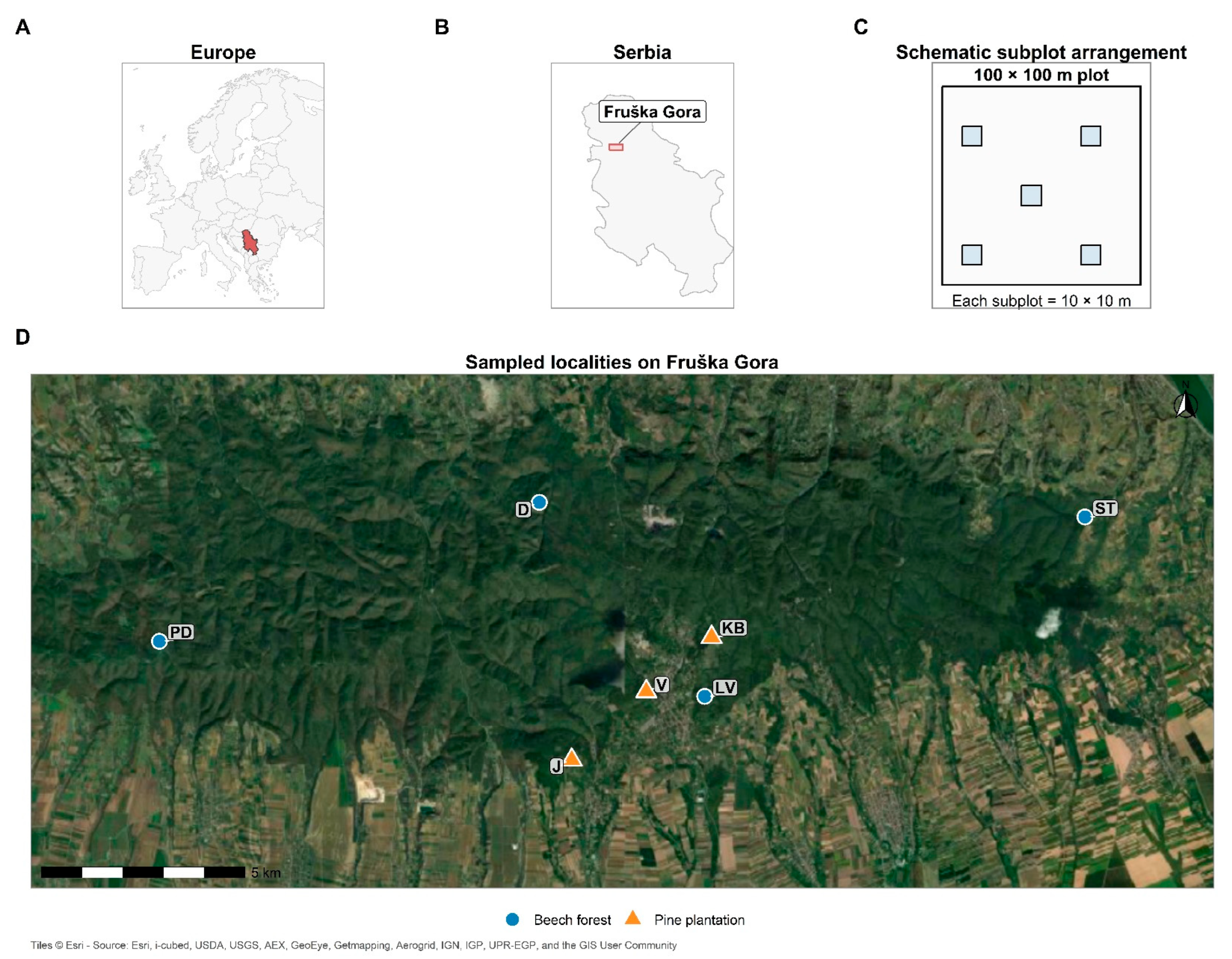
2.1. Study Site and Data Collection
2.2. Bryophyte Survey and Taxonomic Standardization
2.3. Environmental Data
2.4. Bryophyte Functional Traits
2.5. Statistical Analyses
2.5.1. Community Data Transformation and Gradient Assessment
2.5.2. Species–Environment Relationships
2.5.3. Trait–Environment Relationships
2.5.4. Functional Diversity Analysis
2.5.5. Statistical Software
3. Results
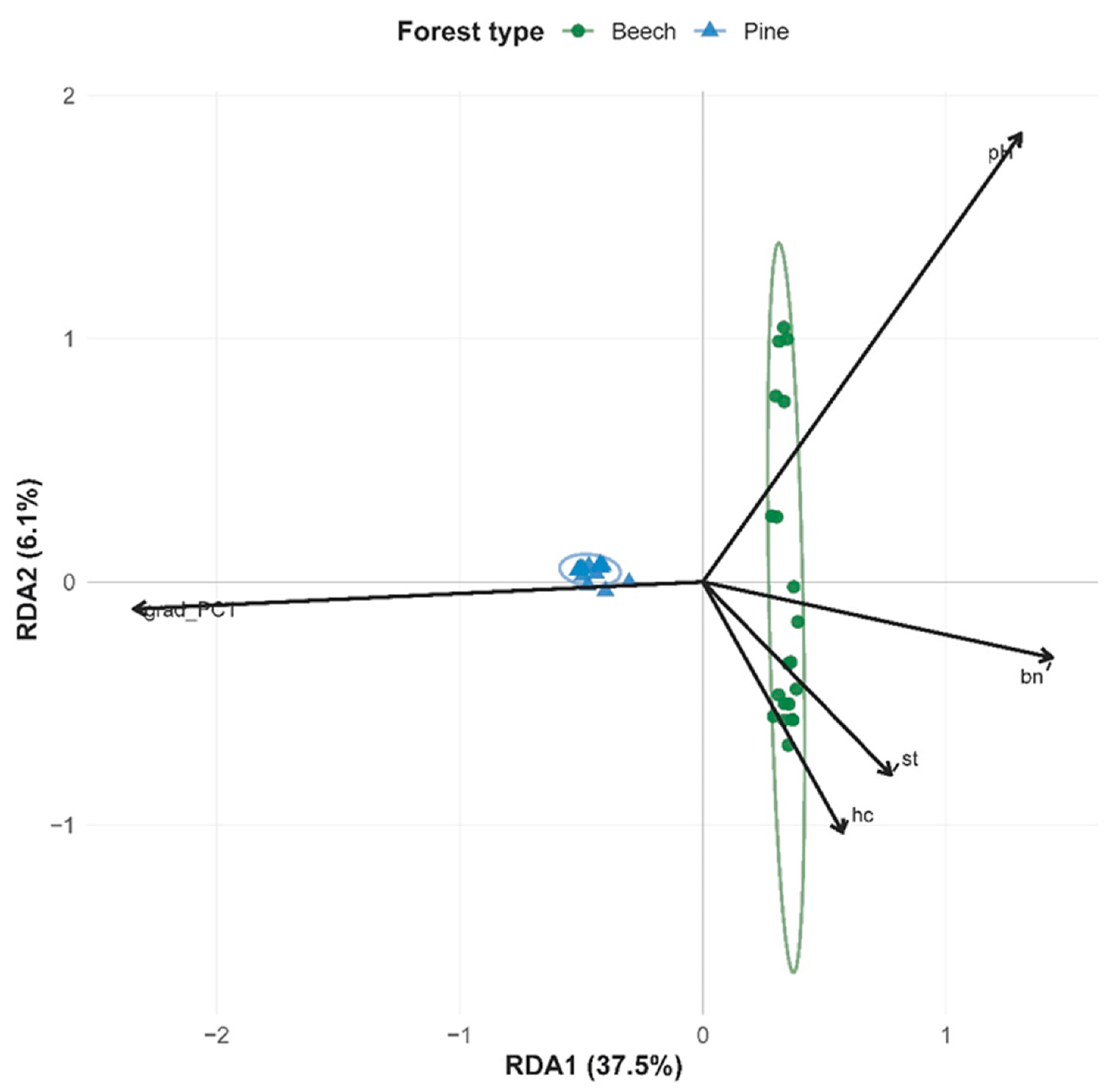
3.1. Species Composition Along Environmental Gradients
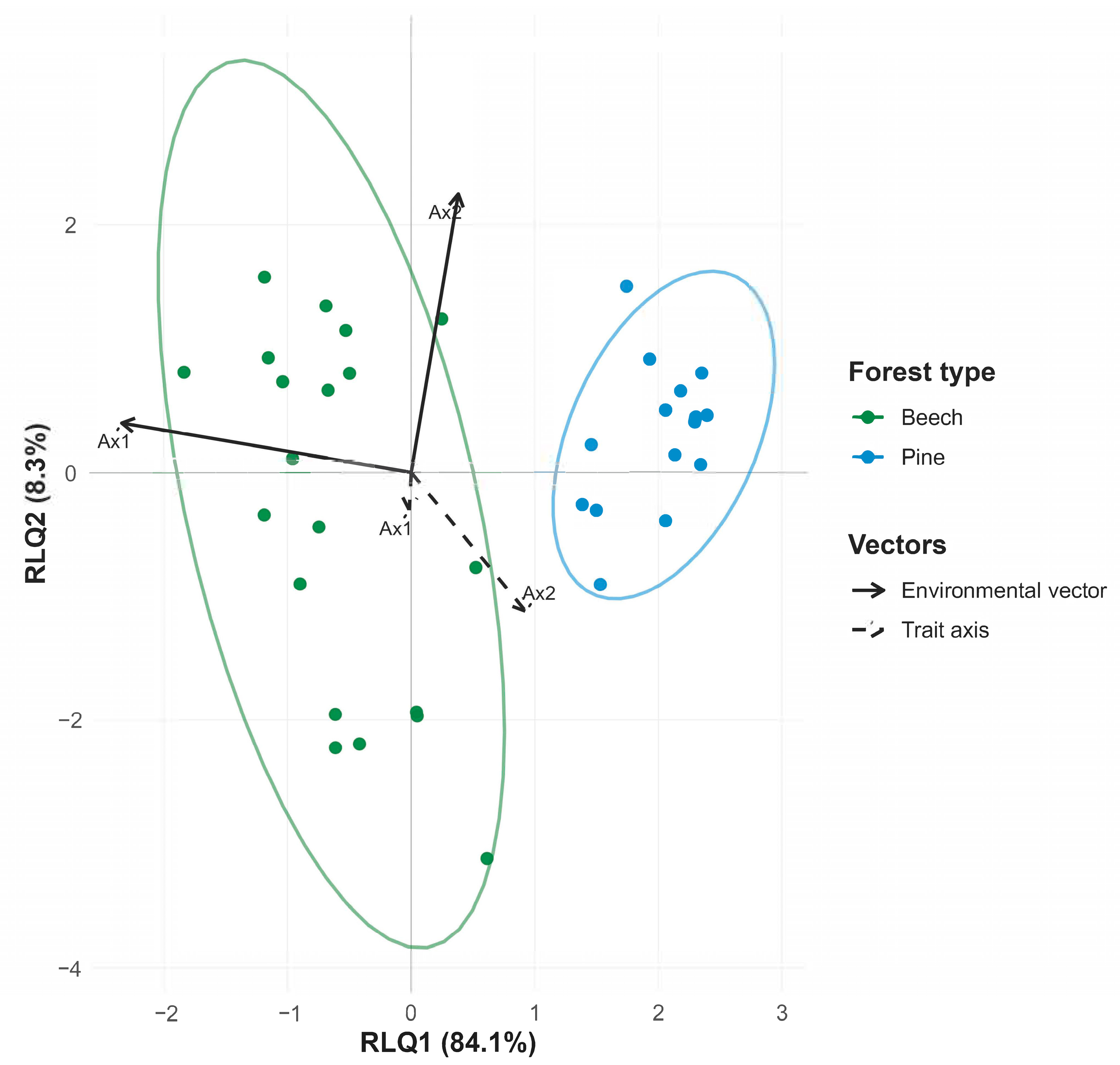
3.2. Trait–Environment Coupling
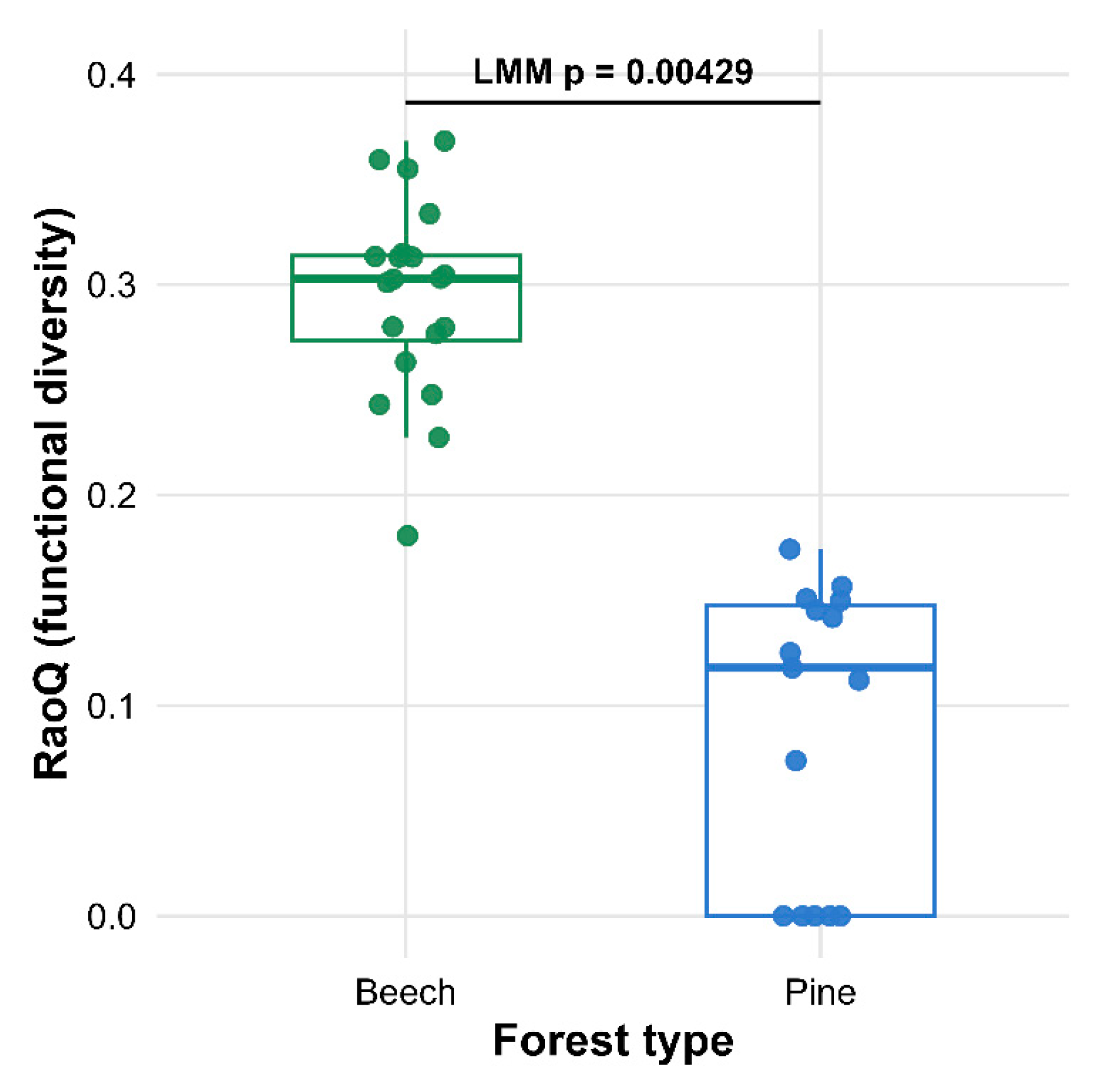
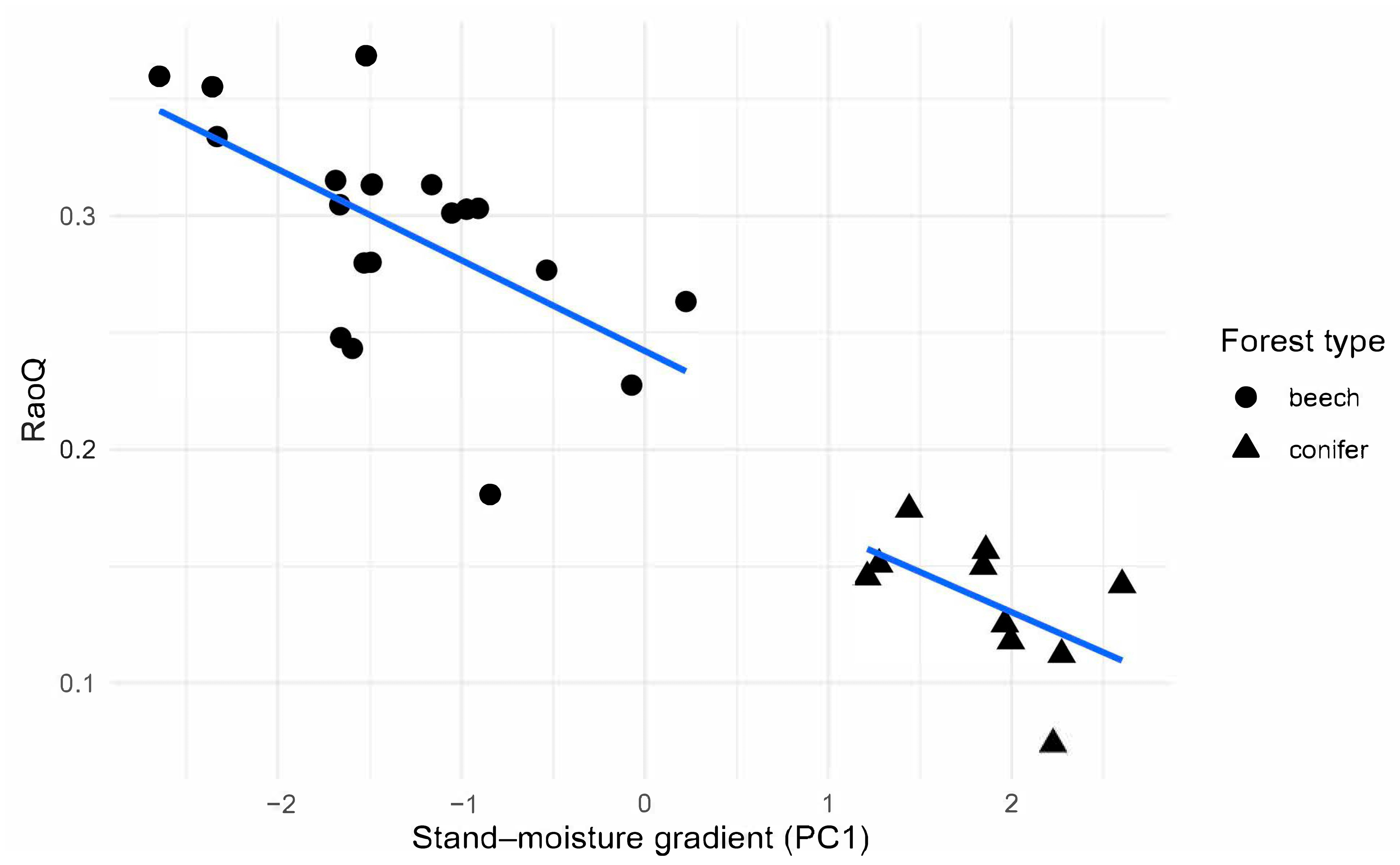
3.3. Functional Diversity Patterns
3.4. Environmental Drivers of Functional Diversity
4. Discussion
4.1. Environmental Control of Bryophyte Community Composition
4.2. Trait-Environment Coupling and Functional Filtering
4.3. Functional Differentiation and Homogenization Between Beech Forests and Pine Plantations
5. Conclusions
Supplementary Materials
Author Contributions
Funding
Data Availability Statement
Conflicts of Interest
References
- Müller, J.; Boch, S.; Prati, D.; Socher, S.A.; Pommer, U.; Hessenmöller, D.; Schulze, E.-D.; Fischer, M. Effects of forest management on bryophyte diversity and composition in temperate forests. For. Ecol. Manag. 2019, 432, 850–859. [Google Scholar] [CrossRef]
- Stefańska-Krzaczek, E.; Swacha, G.; Żarnowiec, J.; Raduła, M.W.; Kącki, Z.; Staniaszek-Kik, M. Central European Forest floor bryophytes: Richness, species composition, coexistence and diagnostic significance across environmental gradients of forest habitats. Ecol. Indic. 2022, 139, 108954. [Google Scholar] [CrossRef]
- Tang, Q.; Liu, Y.; Lou, Y.; Ho, B.-C.; Jin, X.; Wei, Y. Bryophyte diversity, distribution pattern and their environmental drivers in the forest along the vertical gradient of a mature tiankeng, China. Glob. Ecol. Conserv. 2025, 62, e03821. [Google Scholar] [CrossRef]
- Rydin, H. Population and Community Ecology of Bryophytes. In Bryophyte Biology; Goffinet, B., Shaw, J.A., Eds.; Cambridge University Press: Cambridge, UK, 2009; pp. 445–486. [Google Scholar]
- Vitt, D.H.; Wieder, R.K. The Structure and Function of Bryophyte-Dominated Peatlands. In Bryophyte Biology, 2nd ed.; Goffinet, B., Shaw, A.J., Eds.; Cambridge University Press: Cambridge, UK, 2009; pp. 357–391. [Google Scholar]
- Eldridge, D.J.; Guirado, E.; Reich, P.B.; Ochoa-Hueso, R.; Berdugo, M.; Sáez-Sandino, T.; Blanco-Pastor, J.L.; Tedersoo, L.; Plaza, C.; Ding, J.; et al. The global contribution of soil mosses to ecosystem services. Nat. Geosci. 2023, 16, 430–438. [Google Scholar] [CrossRef]
- Elbert, W.; Weber, B.; Burrows, S.; Steinkamp, J.; Büdel, B.; Andreae, M.O.; Pöschl, U. Contribution of cryptogamic covers to the global cycles of carbon and nitrogen. Nat. Geosci. 2012, 5, 459–462. [Google Scholar] [CrossRef]
- Porada, P.; Weber, B.; Elbert, W.; Pöschl, U.; Kleidon, A. Estimating impacts of lichens and bryophytes on global biogeochemical cycles. Glob. Biogeochem. Cycles 2014, 28, 71–85. [Google Scholar] [CrossRef]
- Kolari, P.; Pumpanen, J.; Rannik, Ü.; Ilvesniemi, H.; Hari, P.; Berninger, F. Forest floor vegetation plays an important role in photosynthetic production of boreal forests. For. Ecol. Manag. 2006, 221, 241–248. [Google Scholar] [CrossRef]
- Ah-Peng, C.; Cardoso, A.W.; Flores, O.; West, A.; Wilding, N.; Strasberg, D.; Hedderson, T.A.J. The role of epiphytic bryophytes in interception, storage, and regulated release of atmospheric moisture in a tropical montane cloud forest. J. Hydrol. 2017, 548, 665–673. [Google Scholar] [CrossRef]
- Glime, J.M. Bryophyte Ecology; Michigan Technological University: Houghton, MI, USA, 2017; Available online: https://digitalcommons.mtu.edu/oabooks/4/ (accessed on 20 February 2026).
- Fenton, N.J.; Lecomte, N.; Légaré, S.; Bergeron, Y. Paludification in black spruce (Picea mariana) forests of eastern Canada: Potential factors and management implications. For. Ecol. Manag. 2005, 213, 151–159. [Google Scholar] [CrossRef]
- Sun, S.-Q.; Wu, Y.-H.; Wang, G.-X.; Zhou, J.; Yu, D.; Bing, H.-J.; Luo, J. Bryophyte species richness and composition along an altitudinal gradient in Gongga Mountain, China. PLoS ONE 2013, 8, e58131. [Google Scholar] [CrossRef] [PubMed]
- Heilmann-Clausen, J.; Aude, E.; van Dort, K.; Christensen, M.; Piltaver, A.; Veerkamp, M.; Walleyn, R.; Siller, I.; Standovár, T.; Ódor, P. Communities of wood-inhabiting bryophytes and fungi on dead beech logs in Europe—Reflecting substrate quality or shaped by climate and forest conditions? J. Biogeogr. 2014, 41, 2269–2282. [Google Scholar] [CrossRef]
- Alegro, A.; Šegota, V.; Rimac, A.; Papp, B. Diversity, ecology and phytogeography of bryophytes across temperate forest communities—Insight from Mt. Papuk (Croatia, SE Europe). Plants 2023, 12, 3346. [Google Scholar] [CrossRef] [PubMed]
- Tinya, F.; Márialigeti, S.; Király, I.; Németh, B.; Ódor, P. The effect of light conditions on herbs, bryophytes and seedlings of temperate mixed forests in Őrség, Western Hungary. Plant Ecol. 2009, 204, 69–81. [Google Scholar] [CrossRef]
- Silva, A.M.; Oliveira, R.R.; Conceição, G.M. Musgos (Bryophyta) do Morro do Alecrim, centro urbano de Caxias, Maranhão, Brasil. Rev. Arq. Cient. 2018, 1, 55–62. [Google Scholar] [CrossRef]
- Ilić, M.; Igić, R.; Ćuk, M.; Veljić, M.; Radulović, S.; Orlović, S.; Vukov, D. Environmental drivers of ground-floor bryophytes diversity in temperate forests. Oecologia 2023, 202, 275–285. [Google Scholar] [CrossRef]
- Márialigeti, S.; Németh, B.; Tinya, F.; Ódor, P. The effects of stand structure on ground-floor bryophyte assemblages in temperate mixed forests. Biodivers. Conserv. 2009, 18, 2223–2241. [Google Scholar] [CrossRef]
- Király, I.; Ódor, P. The effect of stand structure and tree species composition on epiphytic bryophytes in mixed deciduous–coniferous forests of Western Hungary. Biol. Conserv. 2010, 143, 2063–2069. [Google Scholar] [CrossRef]
- Erfanzadeh, R. Impact of phanerogam and soil characteristics on bryophyte assemblages with respect to restoration practices (case study: IJzermonding, Belgium). Ecopersia 2013, 1, 41–51. [Google Scholar]
- Czerepko, J.; Gawryś, R.; Mańk, K.; Janek, M.; Tabor, J.; Skalski, Ł. The influence of forest management in the Białowieża Forest on the species structure of the forest community. For. Ecol. Manag. 2021, 496, 119363. [Google Scholar] [CrossRef]
- Paillet, Y.; Bergès, L.; Hjältén, J.; Ódor, P.; Avon, C.; Bernhardt-Römermann, M.; Bijlsma, R.J.; de Bruyn, L.; Fuhr, M.; Grandin, U.; et al. Biodiversity differences between managed and unmanaged forests: Meta-analysis of species richness in Europe. Conserv. Biol. 2010, 24, 101–112. [Google Scholar] [CrossRef] [PubMed]
- Nihlgård, B. Pedological influence of spruce planted on former beech forest soils in Scania, South Sweden. Oikos 1971, 22, 302–314. [Google Scholar] [CrossRef]
- Buck, J.R.; Clair, S.B.S. Aspen increase soil moisture, nutrients, organic matter and respiration in Rocky Mountain Forest communities. PLoS ONE 2012, 7, e52369. [Google Scholar] [CrossRef]
- Vukov, D.; Galić, Z.; Rućando, M.; Ilić, M.; Ćuk, M.; Igić, D.; Igić, R.; Orlović, S. Effects of Natural Broadleaved Regeneration vs. Conifer Restoration on the Herb Layer and Microclimate. Arch. Biol. Sci. 2016, 68, 483–493. [Google Scholar] [CrossRef]
- Rola, K.; Plášek, V.; Rożek, K.; Zubek, S. Effect of tree species identity and related habitat parameters on understorey bryophytes—Interrelationships between bryophyte, soil and tree factors in a 50-year-old experimental forest. Plant Soil 2021, 466, 613–630. [Google Scholar] [CrossRef]
- Stanton, D.E.; Coe, K.K. 500 million years of charted territory: Functional ecological traits in bryophytes. Bryophyt. Divers. Evol. 2021, 43, 234–252. [Google Scholar] [CrossRef]
- Coe, K.K.; Carter, B.; Slate, M.; Stanton, D. Moss Functional Trait Ecology: Trends, Gaps, and Biases in the Current Literature. Am. J. Bot. 2024, 111, e16288. [Google Scholar] [CrossRef] [PubMed]
- Kutnar, L.; Kermavnar, J.; Sabovljević, M.S. Bryophyte diversity, composition and functional traits in relation to bedrock and tree species composition in close-to-nature managed forests. Eur. J. For. Res. 2023, 142, 865–882. [Google Scholar] [CrossRef]
- Chen, Y.; Niu, S.; Li, P.; Jia, H.; Wang, H.; Ye, Y.; Yuan, Z. Stand Structure and Substrate Diversity as Two Major Drivers for Bryophyte Distribution in a Temperate Montane Ecosystem. Front. Plant Sci. 2017, 8, 874. [Google Scholar] [CrossRef]
- Slate, M.L.; Rosenstiel, T.N.; Eppley, S.M. Sex-Specific Morphological and Physiological Differences in the Moss Ceratodon purpureus (Dicranales). Ann. Bot. 2017, 120, 845–854. [Google Scholar] [CrossRef] [PubMed]
- Moore, J.D.; Kollar, L.M.; McLetchie, D.N. Does Selection for Gamete Dispersal and Capture Lead to a Sex Difference in Clump Water-Holding Capacity? Am. J. Bot. 2016, 103, 1449–1457. [Google Scholar] [CrossRef]
- Castetter, R.C.; McLetchie, D.N.; Eppley, S.M.; Stark, L.R. Sex Ratio and Sex Expression in an Urban Population of the Silver Moss, Bryum argenteum Hedw. J. Bryol. 2019, 41, 227–235. [Google Scholar] [CrossRef]
- Horvat, V.; Heras, P.; García-Mijangos, I.; Biurrun, I. Intensive Forest Management Affects Bryophyte Diversity in the Western Pyrenean Silver Fir-Beech Forests. Biol. Conserv. 2017, 215, 81–91. [Google Scholar] [CrossRef]
- Żarnowiec, J.; Staniaszek-Kik, M.; Chmura, D. Trait-Based Responses of Bryophytes to the Decaying Logs in Central European Mountain Forests. Ecol. Indic. 2021, 126, 107671. [Google Scholar] [CrossRef]
- van Zuijlen, K.; Nobis, M.P.; Hedenäs, L.; Hodgetts, N.; Alarcón, J.A.C.; Albertos, B.; Bernhardt-Römermann, M.; Gabriel, R.; Garilleti, R.; Lara, F.; et al. Bryophytes of Europe traits (BET) data set: A fundamental tool for ecological studies. J. Veg. Sci. 2023, 34, e13179. [Google Scholar] [CrossRef]
- Bernhardt-Römermann, M.; Poschlod, P.; Hentschel, J. BryForTrait—A Life-History Trait Database of Forest Bryophytes. J. Veg. Sci. 2018, 29, 798–800. [Google Scholar] [CrossRef]
- Ilić, M.; Igić, R.; Ćuk, M.; Vukov, D. Field Sampling Methods for Investigating Forest-Floor Bryophytes: Microcoenose vs. Random Sampling. Arch. Biol. Sci. 2018, 70, 589–598. [Google Scholar] [CrossRef]
- Hodgetts, N.G.; Söderström, L.; Blockeel, T.L.; Caspari, S.; Ignatov, M.S.; Konstantinova, N.A.; Lockhart, N.; Papp, B.; Schröck, C.; Sim-Sim, M.; et al. An Annotated Checklist of Bryophytes of Europe, Macaronesia and Cyprus. J. Bryol. 2020, 42, 1–116. [Google Scholar] [CrossRef]
- ISO 11461:2001; Soil Quality—Determination of Soil Water Content as a Volume Fraction Using Coring Sleeves—Gravimetric Method. International Organization for Standardization: Geneva, Switzerland, 2001.
- Mägdefrau, K. Life-forms of bryophytes. In Bryophyte Ecology; Smith, A.J.E., Ed.; Springer: Dordrecht, The Netherlands, 1982; pp. 45–58. [Google Scholar] [CrossRef]
- During, H.J. Ecological classifications of bryophytes and lichens. In Bryophytes and Lichens in a Changing Environment; Bates, J.W., Farmer, A.M., Eds.; Clarendon Press: Oxford, UK; New York, NY, USA, 1992; pp. 1–25. [Google Scholar]
- Legendre, P.; Gallagher, E.D. Ecologically meaningful transformations for ordination of species data. Oecologia 2001, 129, 271–280. [Google Scholar] [CrossRef]
- Šmilauer, P.; Lepš, J. Multivariate Analysis of Ecological Data Using CANOCO 5, 2nd ed.; Cambridge University Press: Cambridge, UK, 2014. [Google Scholar]
- Dolédec, S.; Chessel, D.; ter Braak, C.J.F.; Champely, S. Matching species traits to environmental variables: A new three-table ordination method. Environ. Ecol. Stat. 1996, 3, 143–166. [Google Scholar] [CrossRef]
- Dray, S.; Legendre, P. Testing the species traits–environment relationships: The fourth-corner problem revisited. Ecology 2008, 89, 3400–3412. [Google Scholar] [CrossRef] [PubMed]
- ter Braak, C.J.F.; Cormont, A.; Dray, S. Improved testing of species traits–environment relationships in the fourth-corner problem. Ecology 2012, 93, 1525–1526. [Google Scholar] [CrossRef]
- Oksanen, J.; Simpson, G.; Blanchet, F.; Kindt, R.; Legendre, P.; Minchin, P.; O’Hara, R.; Solymos, P.; Stevens, M.; Szoecs, E.; et al. Vegan: Community Ecology Package; R Package Version 2.7-2; R Foundation: Vienna, Austria, 2025; Available online: https://CRAN.R-project.org/package=vegan (accessed on 15 February 2026).
- Rao, C.R. Diversity and dissimilarity coefficients: A unified approach. Theor. Popul. Biol. 1982, 21, 24–43. [Google Scholar] [CrossRef]
- Dray, S.; Dufour, A.B. The ade4 package: Implementing the duality diagram for ecologists. J. Stat. Softw. 2007, 22, 1–20. [Google Scholar] [CrossRef]
- Laliberté, E.; Legendre, P. A distance-based framework for measuring functional diversity from multiple traits. Ecology 2010, 91, 299–305. [Google Scholar] [CrossRef]
- Laliberté, E.; Legendre, P.; Shipley, B. FD: Measuring Functional Diversity from Multiple Traits and Other Tools for Functional Ecology; R Package Version 1.0-12.3; R Foundation: Vienna, Austria, 2023. [Google Scholar]
- Bates, D.; Maechler, M.; Bolker, B.; Walker, S. Fitting linear mixed-effects models using lme4. J. Stat. Softw. 2015, 67, 1–48. [Google Scholar] [CrossRef]
- Fox, J.; Weisberg, S. An R Companion to Applied Regression, 3rd ed.; Sage: Thousand Oaks, CA, USA, 2019; Available online: https://www.john-fox.ca/Companion/ (accessed on 12 February 2026).
- Turetsky, M.R. The role of bryophytes in carbon and nitrogen cycling. Bryologist 2003, 106, 395–409. [Google Scholar] [CrossRef]
- Ren, J.; Liu, F.; Luo, Y.; Zhu, J.; Luo, X.Q.; Liu, R. The pioneering role of bryophytes in ecological restoration of manganese waste residue areas, southwestern China. J. Chem. 2021, 2021, 9969253. [Google Scholar] [CrossRef]
- Concostrina-Zubiri, L.; Berdugo, M.; Valencia, E.; Mendoza, B.J.; Maestre, F.T. Decomposition of dryland biocrust-forming lichens and mosses contributes to soil nutrient cycling. Plant Soil 2022, 481, 23–34. [Google Scholar] [CrossRef]
- Gu, J.; Song, X.; Ye, Y.; Shao, X.; Liao, Y.; Shao, X. Exploring the driving factors of bryophyte assemblage distribution patterns in Tibet. Front. Ecol. Evol. 2024, 12, 1376263. [Google Scholar] [CrossRef]
- Bartels, S.F.; Caners, R.T.; Ogilvie, J.; White, B.; Macdonald, S.E. Relating bryophyte assemblages to a remotely sensed depth-to-water index in boreal forests. Front. Plant Sci. 2018, 9, 858. [Google Scholar] [CrossRef]
- Startsev, N.; Lieffers, V.J.; Landhäusser, S.M. Effects of leaf litter on the growth of boreal feather mosses: Implications for forest floor development. J. Veg. Sci. 2008, 19, 253–260. [Google Scholar] [CrossRef]
- Violle, C.; Navas, M.-L.; Vile, D.; Kazakou, E.; Fortunel, C.; Hummel, I.; Garnier, E. Let the Concept of Trait Be Functional! Oikos 2007, 116, 882–892. [Google Scholar] [CrossRef]
- Possen, B.J.H.M.; Oksanen, E.; Rousi, M.; Ruhanen, H.; Heinonen, J.; Heiskanen, J.; Kärenlampi, S.; Vapaavuori, E. Trait syndromes underlying stand-level differences in growth and acclimation in 10 silver birch (Betula pendula Roth) genotypes. For. Ecol. Manag. 2015, 343, 87–98. [Google Scholar] [CrossRef]
- Mazziotta, A.; Granath, G.; Rydin, H.; Bengtsson, F.; Norberg, J. Scaling functional traits to ecosystem processes: Towards a mechanistic understanding in peat mosses. J. Ecol. 2019, 107, 843–859. [Google Scholar] [CrossRef]
- Alahuhta, J.; Erős, T.; Kärnä, O.-M.; Soininen, J.; Wang, J.; Heino, J. Understanding environmental change through the lens of trait-based, functional, and phylogenetic biodiversity in freshwater ecosystems. Environ. Rev. 2019, 27, 263–273. [Google Scholar] [CrossRef]
- Chin, A.R.O.; Guzmán-Delgado, P.; Görlich, A.; HilleRisLambers, J. Towards multivariate functional trait syndromes: Predicting foliar water uptake in trees. Ecology 2023, 104, e4112. [Google Scholar] [CrossRef]
- Paritsis, J.; Aizen, M.A. Effects of Exotic Conifer Plantations on the Biodiversity of Understory Plants, Epigeal Beetles and Birds in Nothofagus dombeyi Forests. For. Ecol. Manag. 2008, 255, 1575–1583. [Google Scholar] [CrossRef]
- McElhinny, C.; Gibbons, P.; Brack, C.; Bauhus, J. Forest and woodland stand structural complexity: Its definition and measurement. For. Ecol. Manag. 2005, 218, 1–24. [Google Scholar] [CrossRef]
- Flynn, D.F.B.; Gogol-Prokurat, M.; Nogeire, T.; Molinari, N.; Richers, B.T.; Lin, B.B.; Simpson, N.; Mayfield, M.M.; DeClerck, F. Loss of functional diversity under land-use intensification across multiple taxa. Ecol. Lett. 2009, 12, 22–33. [Google Scholar] [CrossRef] [PubMed]
- Laliberté, E.; Wells, J.A.; DeClerck, F.; Metcalfe, D.J.; Catterall, C.P.; Queiroz, C.; Aubin, I.; Bonser, S.P.; Ding, Y.; Fraterrigo, J.M.; et al. Land-use intensification reduces functional redundancy and response diversity in plant communities. Ecol. Lett. 2010, 13, 76–86. [Google Scholar] [CrossRef]
- Zeidler, M.; Šipoš, J.; Banaš, M.; Černohorský, J. Homogenization of bryophyte species after alpine grassland restoration. J. Environ. Manag. 2022, 319, 115628. [Google Scholar] [CrossRef] [PubMed]
- Mežaka, A.; Brūmelis, G.; Piterāns, A. Tree and stand-scale factors affecting richness and composition of epiphytic bryophytes and lichens in deciduous woodland key habitats. Biodivers. Conserv. 2012, 21, 3221–3241. [Google Scholar] [CrossRef]



| Functional Trait | Variable Type | Description |
|---|---|---|
| Autecological traits | ||
| indF | ordinal | indicator value F (moisture): 1 (extreme dryness) to 9 (wet-site indicator), x (indifferent) |
| indL | ordinal | indicator value L (light): 1 (deep shade) to 9 (full light), x (indifferent) |
| indR | ordinal | indicator value R (reaction/acidity): 1 (extreme acidity) to 9 (high pH soils), x (indifferent) |
| forest | ordinal | how strong species are bound to forest habitats; 1 (largely restricted to closed forest), 2 (prefers forest edges and clearings), 3 (occurs in forest as well as in open land), 4 (may occur in forest, but prefers open land) |
| hemeroby | ordinal | occurrence in the gradient of background human impact on the ecosystem; 1 (absent), 2 (absent to weak), 3 (weak), 4 (weak to moderate), 5 (moderate), 6 (moderate to strong), 7 (strong), 8 (strong to very strong), 9 (very strong) |
| Morphological traits | ||
| gform | categorical | growth form: acr (acrocarpous), fol (foliose), ple (pleurocarpous), sph (Sphagnum), tha (thalloid) |
| lform | categorical | life form, simplified system [42]: annual, cushion, dendroid, mat, rosette, turf, weft |
| lstrat_e | categorical | life strategy, extended system [43]: a (annual shuttle), c (colonist), ce (ephemeral colonists), cp (pioneer colonists), f (fugitive), l (long-lived shuttle), p (perennial), pc (competitive perennial), ps (stress tolerant perennials), s (short-lived shuttle) |
| size | numerical | mean size of shoot/gametophyte (mm) |
| Reproductive traits | ||
| smeand | numerical | mean spore diameter |
| vp | categorical | whether the species has vegetative propagules; 1 (present), 0 (absent) |
| sex | categorical | mating type/sexual condition (M (monoicous), D (dioicous), M/D (can be monoicous or dioicous)) |
| Df | Variance | Pseudo-F | Pr (>F) | VIF | |
|---|---|---|---|---|---|
| pH | 1 | 0.109 | 9.042 | 0.001 | 1.723 |
| Soil temperature | 1 | 0.042 | 3.458 | 0.008 | 1.158 |
| Herbaceous cover | 1 | 0.059 | 4.922 | 0.001 | 1.206 |
| Shrub number | 1 | 0.077 | 6.419 | 0.001 | 2.108 |
| grad_PC1 | 1 | 0.072 | 5.991 | 0.003 | 3.003 |
| total | 5 | 0.362 |
| Predictor | SumSq | Df | F | p |
|---|---|---|---|---|
| pH | 0.011 | 1 | 3.954 | 0.056 |
| Soil temperature | 0.011 | 1 | 4.159 | 0.051 |
| Herbaceous cover | 0.002 | 1 | 0.729 | 0.4 |
| Number of shrubs | 0.022 | 1 | 8.347 | 0.007 |
| grad_PC1 | 0.039 | 1 | 14.683 | 0.001 |
| Residuals | 0.077 | 29 |
| Predictor | β | SE | t | p | CI_low | CI_high |
|---|---|---|---|---|---|---|
| (Intercept) | 0.207 | 0.009 | 23.685 | 0 | 0.189 | 0.224 |
| pH | 0.023 | 0.012 | 1.989 | 0.056 | −0.001 | 0.047 |
| Soil temperature | 0.019 | 0.009 | 2.039 | 0.051 | −0.0001 | 0.039 |
| Herbaceous cover | 0.008 | 0.009 | 0.854 | 0.4 | −0.012 | 0.028 |
| Number of shrubs | 0.037 | 0.013 | 2.889 | 0.007 | 0.011 | 0.063 |
| grad_PC1 | −0.035 | 0.009 | −3.832 | 0.001 | −0.054 | −0.016 |
Disclaimer/Publisher’s Note: The statements, opinions and data contained in all publications are solely those of the individual author(s) and contributor(s) and not of MDPI and/or the editor(s). MDPI and/or the editor(s) disclaim responsibility for any injury to people or property resulting from any ideas, methods, instructions or products referred to in the content. |
© 2026 by the authors. Licensee MDPI, Basel, Switzerland. This article is an open access article distributed under the terms and conditions of the Creative Commons Attribution (CC BY) license.
Share and Cite
Ilić, M.; Ćuk, M.; Vukov, D. Forest Type and Environmental Gradients Shape Bryophyte Functional Diversity: Evidence from Epigeic Bryophytes in Beech Forests and Pine Plantations. Forests 2026, 17, 506. https://doi.org/10.3390/f17040506
Ilić M, Ćuk M, Vukov D. Forest Type and Environmental Gradients Shape Bryophyte Functional Diversity: Evidence from Epigeic Bryophytes in Beech Forests and Pine Plantations. Forests. 2026; 17(4):506. https://doi.org/10.3390/f17040506
Chicago/Turabian StyleIlić, Miloš, Mirjana Ćuk, and Dragana Vukov. 2026. "Forest Type and Environmental Gradients Shape Bryophyte Functional Diversity: Evidence from Epigeic Bryophytes in Beech Forests and Pine Plantations" Forests 17, no. 4: 506. https://doi.org/10.3390/f17040506
APA StyleIlić, M., Ćuk, M., & Vukov, D. (2026). Forest Type and Environmental Gradients Shape Bryophyte Functional Diversity: Evidence from Epigeic Bryophytes in Beech Forests and Pine Plantations. Forests, 17(4), 506. https://doi.org/10.3390/f17040506