Article

The Transport and Distribution of Polycyclic Aromatic Hydrocarbons (PAHs) Across the Hengduan Mountains, Southwest China

1
School of Metallurgy and Environment, Lanzhou University of Technology, Lanzhou 730050, China
2
State Key Laboratory of Environmental Chemistry and Ecotoxicology, Research Center for Eco-Environmental Sciences, Chinese Academy of Sciences, Beijing 100085, China
3
Water Supply Company of Liuyang City, Liuyang 410300, China
4
School of Environment, Hangzhou Institute for Advanced Study, University of Chinese Academy of Sciences, Hangzhou 310024, China
*
Author to whom correspondence should be addressed.
Forests 2026, 17(4), 502; https://doi.org/10.3390/f17040502
Submission received: 17 March 2026 / Revised: 11 April 2026 / Accepted: 15 April 2026 / Published: 18 April 2026
(This article belongs to the Special Issue Elemental Cycling in Forest Soils)

Abstract

Despite recent advances in polycyclic aromatic hydrocarbon (PAH) research on the Tibetan Plateau (TP), studies investigating the transport potential and accumulation dynamics of these contaminants in the Hengduan Mountains, especially in forest soils which are important sinks for atmospheric PAHs, remain scarce. In the present study, soil and lichen samples (partially located under the forest canopy) were concurrently collected from 62 sampling sites across the Hengduan Mountains to characterize the occurrence, spatial distribution patterns, and underlying controlling factors of PAHs. The total concentrations of the 16 US EPA priority PAHs (∑16PAHs) in soils and lichens ranged from 59.8 to 1163 ng/g and 174 to 3362 ng/g, respectively—values consistently higher than those reported in corresponding matrices from the northern and northwestern TP. Further, concentrations of PAHs in both soil and lichen under the forest canopy are significantly higher than those on the leeward slope without forest. Compositional fractionation of PAHs along the longitudinal and latitudinal gradients of sampling locations indicates significant modulation of PAH distribution by both the Indian monsoon and East Asian monsoon, a pattern further corroborated by air mass backward trajectory analysis. Our results confirm that PAHs can be transported to the southeastern TP slope via long-range atmospheric transport (LRAT). Notably, the combined effects of mountain cold-trapping and forest filtering jointly govern the deposition and spatial distribution of PAHs in this region.

1. Introduction

Polycyclic aromatic hydrocarbons (PAHs) are prototypical semi-volatile organic compounds (SVOCs) that constitute a prominent global environmental concern, owing to their strong bioaccumulative potential, inherent toxicity, and potential for long-range atmospheric transport (LRAT) [1]. As a class of carcinogenic organic compounds, PAHs have been designated as priority pollutants by the U.S. Environmental Protection Agency (EPA). Generally, these contaminants are ubiquitous in the environment and strongly correlated with regional energy structure, energy consumption intensity, and degree of industrialization and urbanization [2]. Notably, the atmosphere serves as the dominant transport pathway driving the global distribution of SVOCs [3,4]. Owing to LRAT, PAHs have been ubiquitously detected across diverse environmental matrices, including remote, historically considered pristine areas like the polar regions [5,6], open oceans [7], and Tibetan Plateau (TP) [8].
Monsoons, characterized as a long-duration, large-scale atmospheric circulation system, play a pivotal role in modulating the fate and transport processes of SVOCs [9]. As reported by Lavin et al. (2013) [10], northwesterly global-scale wind systems drive the transboundary transport of SVOCs originating from background atmospheric reservoirs across Australia and the Southern Hemisphere, with this atmospheric process directly modulating the pesticide profile signatures at high-elevation monitoring sites located in the western region of the Southern Alps. Tian et al. [11] established a clear causal link between the East Asian summer monsoon and the directional transport of hexachlorocyclohexanes (HCHs), demonstrating that this large-scale circulation system acts as a key conduit for HCH migration from southeastern to northeastern China. Multi-year monitoring data further revealed marked seasonal variability in SVOC concentrations across the southeastern TP, with these temporal trends showing a statistically significant association with the recurrent phase shifts in the Indian monsoon [2].
However, the LRAT and deposition of SVOCs in remote mountain ecosystems remain poorly constrained by a range of critical modulating factors: land cover and topographic heterogeneity, local anthropogenic or biogenic emissions, and spatial proximity to potential primary or secondary source regions [12]. Complementarily, findings from our prior investigations demonstrated that HCH and dichlorodiphenyltrichloroethane (DDT) residue concentrations in coniferous needles exhibited a statistically significant positive correlation with elevation across the southeastern TP [13]. Similarly, Zhu et al. [14] demonstrated that forests function as effective filters for SVOCs via comparative analyses of contaminant concentrations between forested stands and adjacent clearings. Against the backdrop of the aforementioned complexity in SVOC LRAT and deposition within remote mountain ecosystems, further targeted research is therefore warranted to elucidate the mechanistic underpinnings of SVOC migration pathways and identify the key biotic and abiotic factors governing the environmental fate of SVOCs in these sensitive high-elevation regions.
Notably, the TP—the largest and highest plateau on the planet—spans an area of 2.5 million square kilometers and boasts an average elevation exceeding 4000 m above sea level (a.s.l.). Its distinctive meteorological and topographic attributes collectively give rise to an extreme cold climate, coupled with sparse human habitation and negligible industrial and agricultural activities, thereby rendering the region a pristine, minimally disturbed alpine system ideal for investigating the LRAT of SVOCs. The Hengduan Mountains (Mts.) constitute a contiguous mountain range in southwest China and are characterized by typical parallel ridge–valley topographies, serving as a critical topographic link to the southeastern margin of the Tibetan Plateau (TP). This region is characterized by a typical monsoonal climate, where moisture transport exhibits distinct seasonal variability. Specifically, summer moisture is predominantly derived from the Bay of Bengal and the South China Sea, whereas autumn moisture mainly originates from the western Pacific Ocean. In contrast, the northern hemisphere westerlies deliver only limited water vapor to the region during winter and spring [9,15,16]. Together, the interplay between the complex topography and the monsoonal circulation makes the Hengduan Mountains the first site where we can decouple elevation-driven cold-trapping from valley-channeled advection of PAHs—a critical missing link for improving LRAT models beyond current polar- and alpine-centric frameworks [17].
While numerous studies have focused on the transport and distribution of PAHs across most regions of the TP, research remains scarce for the Hengduan Mountains—a critical southeastern TP component—where atmospheric circulation and geographical patterns are more complex than other TP regions due to unique topographic heterogeneity and the synergistic monsoon influences discussed earlier, presenting a distinctive opportunity to elucidate how global circulation dynamics regulate organic contaminant transport and address key gaps in regional and global SVOC cycling. To fill this void and advance understanding of PAH environmental behavior in this understudied alpine area, paired soil (as a contaminant sink) [18] and lichen (as a passive atmospheric sampler) [19,20] samples were collected from 62 sites across the Hengduan Mountains. There are three core objectives of this work: (1) characterize PAH concentrations and spatial distribution patterns in these matrices; (2) identify key biotic, abiotic, and meteorological factors governing PAH distribution; (3) delineate potential sources and dominant transport pathways, thereby providing empirical evidence for linkages between global circulation and contaminant accumulation in remote mountain ecosystems, complementing existing TP PAH research and offering novel insights for global environmental monitoring and pollution management.

2. Experimental Section

2.1. Study Area and Sampling

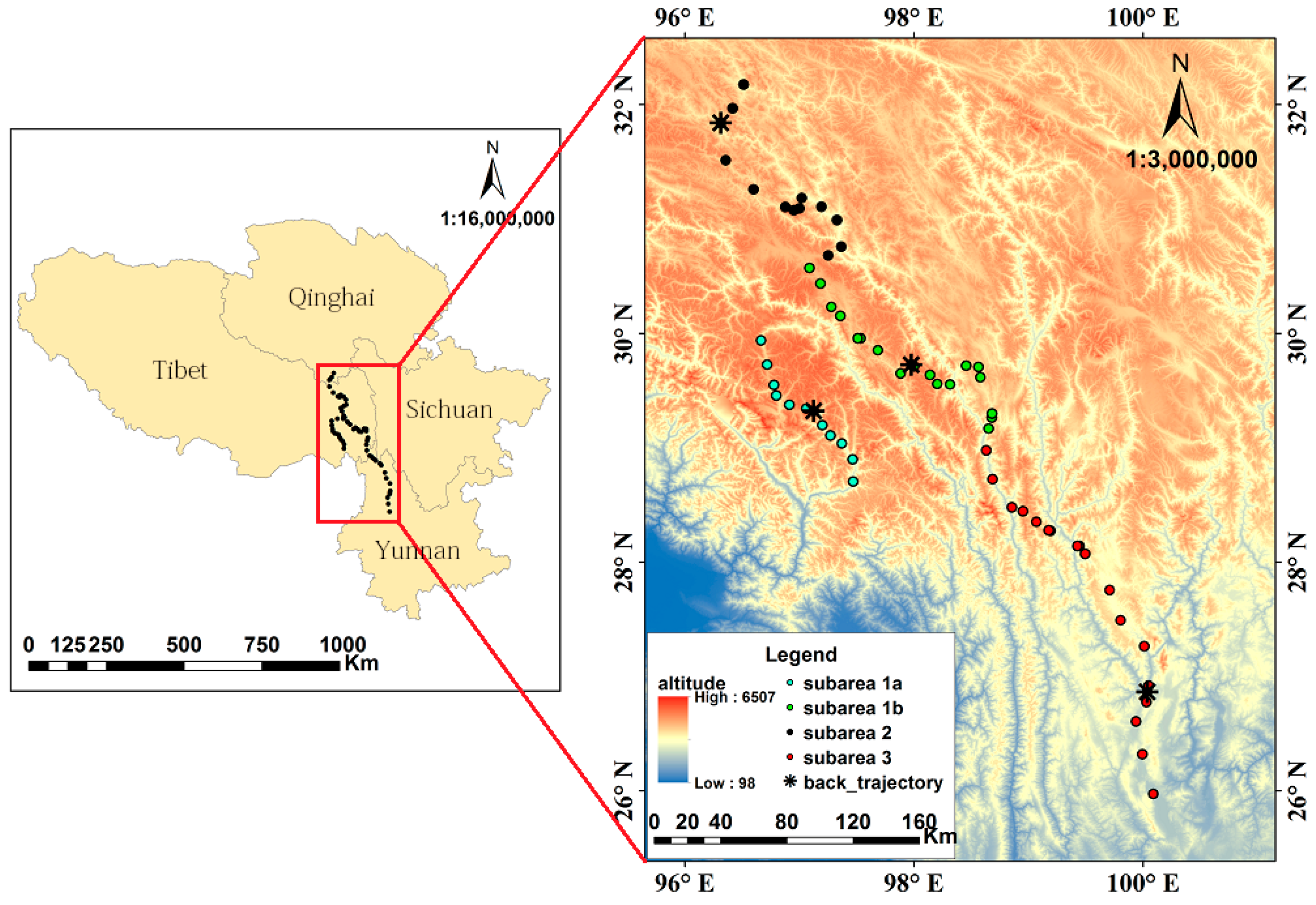
The Hengduan Mts. cover the easternmost section of the Tibet as well as the western Yunnan and Sichuan Provinces, touching upon parts of the southern Qinghai Province. Generally, the Hengduan Mts. are mainly controlled by two climate systems including the southwest monsoon of the Bay of Bengal and Indian Ocean, as well as the southeast monsoon from the western Pacific, which is the main precipitation air mass in summer [9,17]; and the westerly wind of the northern hemisphere in winter, carrying less water vapor. The sampling sites were located in the mountain slopes and stretch over three provincial areas, namely Yunnan, Tibet and Qinghai (Figure 1).
A total of 62 sample locations were selected across the south-to-north Hengduan Mts. at an altitude between 1930 m and 5094 m. Monsoonal circulation in the Hengduan Mts. expands to 40° N at the beginning of August but withdraws to 30° N in October. In order to learn more about the spatial changes in PAH concentrations, the study area was spatially divided into three sub-areas including the “central” (sub-area 1a and sub-area 1b), “northern” (sub-area 2), and “southern” (sub-area 3) Hengduan Mts, based on the meteorological conditions and the specific location (Figure 1). Sub-area 1a and sub-area 1b are located in Tibet. Sub-area 2 extends from Tibet to Qinghai and most of the sampling points are located in Tibet. Sub-area 3 is located in Yunnan and adjacent to urban areas and potential source areas.
Surface soil samples (0–5 cm) were collected using a stainless steel spade in August, 2013. Before collecting the soils, superficial litter and large roots, if present, were removed before the sample was taken. Composite lichen samples were gathered at 3–4 positions close to the soil site. All samples were sealed in zippered plastic bags individually and transported to the laboratory where they were stored at −20 °C until analysis. The geographical locations, elevations and related information are provided in Table S1 in the Supporting Information (SI).

2.2. Chemical Analysis

Sample pretreatment procedures and instrumental analysis are presented in detail in Text S1 of the SI. Briefly, soil and lichen samples were spiked with surrogate standards after being freeze-dried, ground and crushed, and then extracted using mixed solvents n-hexane and dichloromethane (1:1, v/v) by accelerated solvent extraction (Dionex ASE 350, Thermo Scientific, Waltham, MA, USA). The extracts were purified using multiple columns packed with 6 g of deactivated silica gel (3% of water), 4 g of deactivated aluminum oxide (2% of water) and 5 g anhydrous sodium sulfate from bottom to top. The eluted solvent was 50 mL of mixed hexane with dichloromethane in a ratio of 3:2 (v/v). The lichen extracts were further treated with gel permeation chromatography (GPC). The eluents were finally concentrated to 0.2 mL and spiked with injection standards of 2-fluorobiphenyl before instrumental analysis.
Concentrations of PAHs were measured with an Agilent gas chromatograph 7890 coupled with mass spectrometer 5975 (GC-MS, Agilent Technologies, Pimpri-Chinchwad, MA, USA). A DB-5 capillary column (30 m × 0.25 mm i.d. × 0.25 μm film thickness) was used for separation and an electron ionization (EI) source was used for detection. The MS was operated in selective ion monitoring (SIM) mode. Quantification was conducted by the internal standard method. The detailed instrumental analysis is described in Text S1 of the SI.
Total organic carbon (TOC) contents in soils were analyzed using a TOC analyzer (TOC-V, Shimadzu, Kyoto, Japan). The lipid content of lichen was determined gravimetrically.

2.3. Quality Control

A procedural blank was run every set of eight samples. Method detection limits (MDLs) were in the range of 0.04–0.97 ng/g dw, which was derived as 3 times the signal-to-noise value (S/N). The average recoveries of spiked surrogates in all samples were 62.7% ± 11.1%, 73.5% ± 10.1%, 89.9% ± 10.3% and 110.5% ± 16.6% for the deuterated PAHs. All the reported values were blank-corrected and subsequently corrected using the recoveries of the surrogates.

2.4. Air Back-Trajectories

The pathways of air mass to the sampling sites were determined to assess potential pollution source regions using NOAA’s hybrid single-particle Lagrangian integrated trajectory (HYSPLIT) model accessed on 5 January 2012, 15 July 2012, and 24 August 2012 (http://www.arl.noaa.gov/ready/hysplit4.html). Five-day air mass back-trajectories with a starting height of 500 m were generated for each sampling period. The geographical coordinates of each representative sampling point for the sub-areas were used to simulate air mass transport (Figure 1).

3. Results and Discussion

3.1. General Remark on Concentrations of PAHs

Statistical dry-weight-based (dw) concentrations of PAHs are shown in Table 1. TOC contents in soil and lipid contents in lichen are listed in Table S1. A comparison of PAH concentrations in this study with those reported in other remote areas is presented in Table S2.
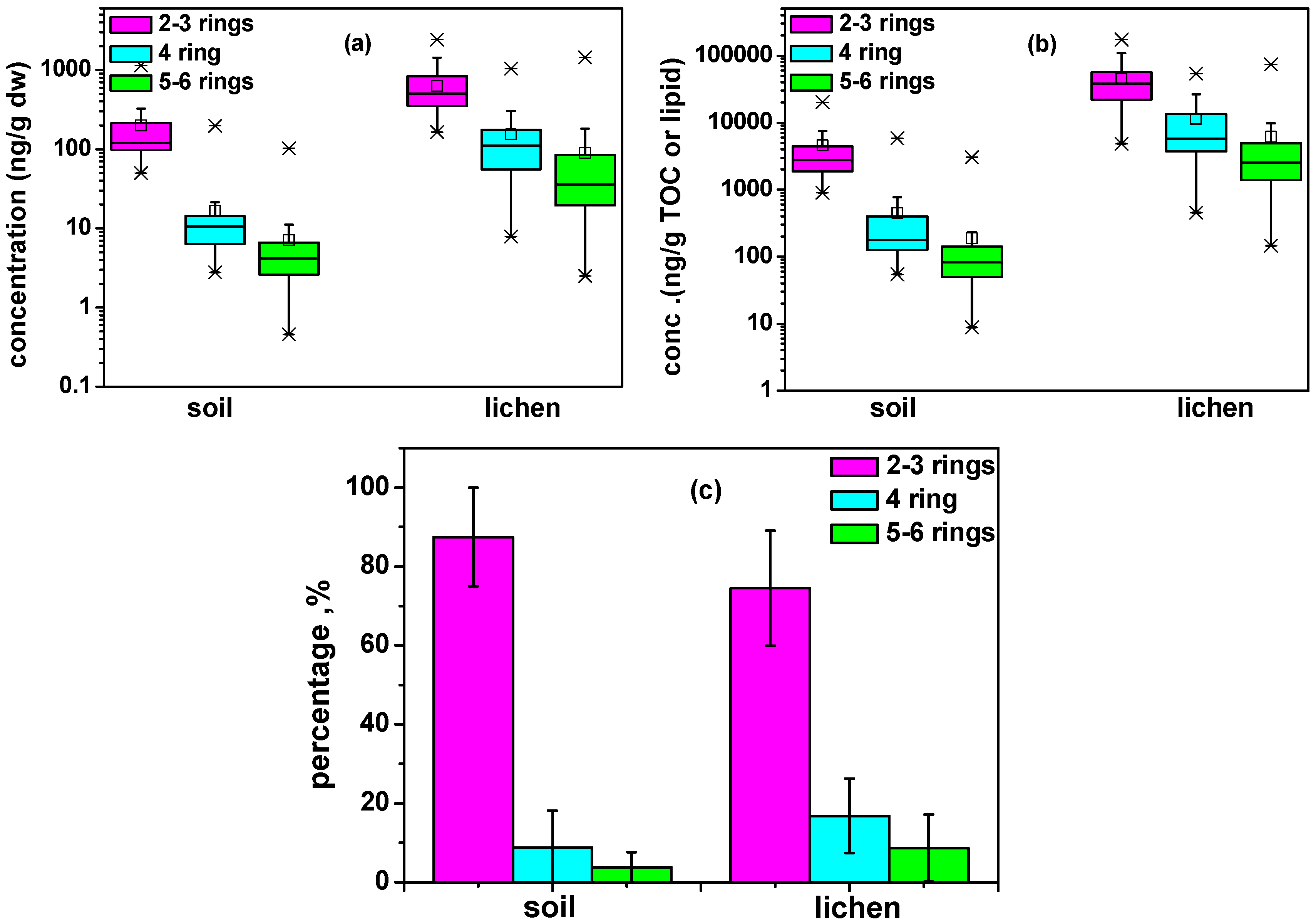
The concentrations of 16 US EPA priority PAHs (∑16PAHs) in soil and lichen samples ranged from 59.8 ng/g to 1163.3 ng/g (mean: 222.5 ng/g) and from 174.4 ng/g to 3362.1 ng/g (mean: 871.0 ng/g), respectively. Naphthalene (NAP) was identified as the most abundant congener, with an average value of 143.1 ng/g in soil and 358.3 ng/g in lichen. Low-molecular-weight (LMW) PAHs containing 2–3 aromatic rings dominated the compositional profiles, which accounted for an average of 83.8% and 72.6% of ∑16PAHs in soil and lichen, respectively. In the same sampling sites, PAH concentrations in lichen samples were significantly higher than those in soil samples (Figure 2a), suggesting a pronounced capacity of lichen for PAH bioaccumulation. Even after normalization to TOC content or lichen lipid content, this trend of elevated PAH levels in lichen relative to soil remained consistent (Figure 2b). PAH deposition in both matrices is a combined process involving both particle-associated and vapor phase fractions. Notably, the proportion of high-molecular-weight (HMW) PAHs (i.e., 4-ring and 5–6-ring congeners) in lichen was higher than that in soil (Figure 2c), implying that HMW PAHs are more prone to be taken up and retained by the lichen matrix than by the soil matrix. Lichen, characterized by a large specific surface area and the absence of a protective cuticular layer, can directly sorb atmosphere contaminants via surface interactions [21]. The surface adsorption process may predominate over lipid-mediated PAH accumulation, thereby enabling lichen to scavenge a greater quantity of particulate-phase PAHs from the atmosphere. This mechanism likely explains the observed higher relative abundance of 4–6-ring PAHs in lichen compared with soil.
PAH concentrations in the soils investigated herein were distinctly lower than those reported in urban regions, such as the north-central part of India [22] and Kathmandu in Nepal [23]. By contrast, these soil PAH concentrations were one to two orders of magnitude higher than the levels documented in the central TP [24] and the west or northwest TP [25], while being comparable to those in soils of the southeast TP [26]. Additionally, the soil PAH concentrations in this study were comparable to the values measured in soils from the Changbai Mountains [27] and the Dawangling alpine ecosystem in China [28], yet substantially higher than the corresponding levels reported in the central Italian Alps [29], Costa Rica [30], and western Canada [31]. For lichen samples, PAH concentrations were significantly higher than those in the western TP [32] and comparable to the levels detected in the Pyrenees mountains in Europe [33] and in the Dolomites, Italy [34]. Furthermore, lichen PAH concentrations were marginally higher than the values in the southeast TP [8] and one to two orders of magnitude higher than those in the remote Antarctic Peninsula [35].

3.2. Spatial Distribution

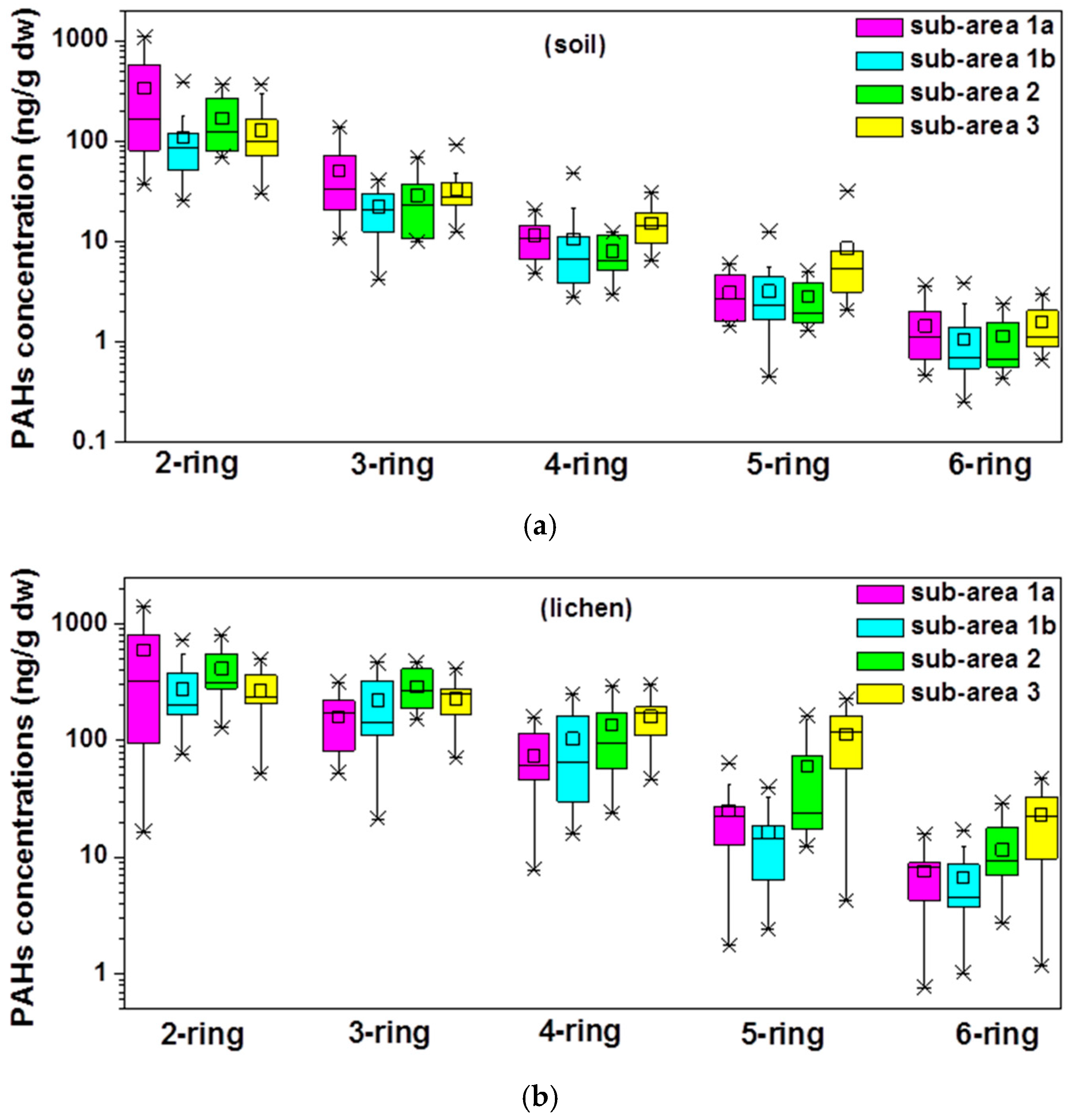
In general, concentrations of HMW PAHs (4–6 rings) in soil and lichen from the southern segment of the study area (i.e., sub-area 3) were higher than those detected in the central (sub-area 1a and 1b) and northern (sub-area 2) segment. By contrast, LMW PAHs (2–3 rings) exhibited no such latitudinal distribution pattern (Figure 3). Along the south-to-north transect, a marked increase in the relative proportion of volatile LMW PAHs (2–3 rings) with increasing latitude was observed in both soil and lichen samples (Figure S1); conversely, the proportion of HMW PAHs (4 rings and 5–6 rings) decreased progressively with latitude (Figure 3 and Figure S1). These observations imply that compositional fractionation of PAHs occurred during LRAT, driven by the prevailing Indian and East Asian monsoons [2,17,26,36]. Specifically, HMW PAHs tend to be preferentially deposited in proximity to emission sources, whereas LMW PAHs are more susceptible to LRAT. These results confirm that PAHs emitted from source regions in the southern Hengduan Mts. region—including urban areas in Yunnan and pollutants transported from the Indian subcontinent—act as both local contamination sources and precursors for LRAT. Concomitantly, the altitude of sampling sites exhibited a general increasing trend along the south-to-north latitudinal gradient (Figure 1). Furthermore, PAH fractionation during atmospheric transport was characterized by the preferential deposition of LMW PAHs, particularly in cold climatic conditions [35,37,38,39]. Collectively, particulate scavenging and cold condensation are proposed as the major mechanisms governing the compositional fractionation of PAHs along the studied latitudinal profile.
Principal component analysis (PCA) was employed to elucidate associations among PAH pollution profiles of sampling sites across different sub-areas. Three distinct clusters were identified from the PCA results (Figure S2). Sub-area 1a and sub-area 1b were grouped into the same cluster, indicating potentially similar PAH sources. In contrast, sub-areas 2 and 3 formed separate clusters, both distinct from the sub-area 1 cluster. This suggests significant differences in PAH distribution patterns and source contributions among the sub-areas, further verifying the rationality of the sub-area division in this study.
Sub-area 1a, located in the central Hengduan Mts., features a mountain-valley topography that functions as a channel for water and vapor transport. Sampling sites in sub-area 1b are roughly parallel to the mountain-valley corridors of sub-area 1a. According to the air back-trajectories in Figure S3, southwest winds and westerlies are the dominant air currents, prevailing in the sub-areas 1a and 1b year-round. Consistent with this, PCA results further corroborated that sub-areas 1a and 1b exhibit highly consistent PAH distribution patterns (Figure S2), likely attributed to their analogous topographic conditions and dominant airflow influences.
Sub-area 3, located in the southern Hengduan Mts, is in close proximity to the urban regions of Yunnan Province—areas with high population density, elevated energy consumption, and consequently enhanced PAH emissions [32]. Air masses originating from Yunnan are likely responsible for the significantly higher HMW PAH concentrations in sub-area 3 (Figure S3c) [40]. For sub-area 2 in the northern Hengduan Mts, the climate is primarily regulated by the Indian monsoon and westerlies, with additional impacts from secondary airflows (Figure S3c). These secondary currents (northwesterly and northeasterly winds) pass through Xinjiang and Qinghai, implying that energy consumption patterns in these regions may also modulate PAH distribution in sub-area 2.

3.3. Identifying Driving Factors on Deposition in Mountain Slopes

3.3.1. Comparison Between Windward and Leeward

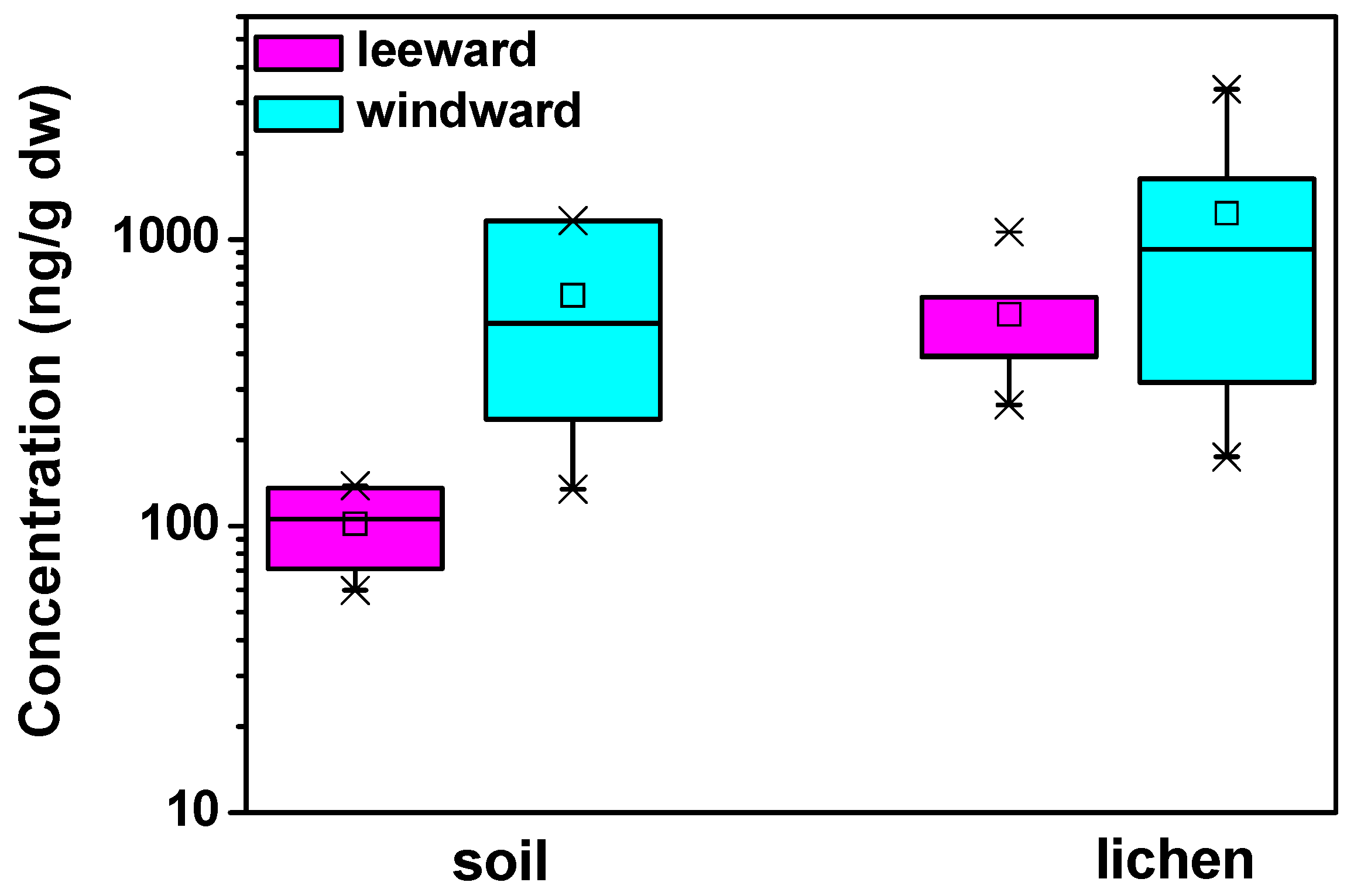
Sub-area 1a is situated in a mountain valley, which typically serves as the main channel for warm, humid air currents driven by the Indian monsoon. This valley is composed of a windward mountain slope and a leeward mountain slope. Notably, PAH concentrations in both soil and lichen on the windward slope are significantly higher than those on the leeward slope (Figure 4). This discrepancy is attributable to the windward slope being more strongly influenced by the humid summer monsoon along the valley, compared to the leeward slope [41]. On the one hand, precipitation on the windward side is greater than that on the leeward side [42], contributing to more intensive wet deposition of PAHs on the windward side. In mountainous regions, increasing precipitation at high altitudes can enhance the accumulation of semi-volatile organic pollutants at high altitudes [43]. On the other hand, the land cover types differ substantially between the two slopes: the windward slope is covered by forests, which can scavenge PAHs from the air and transfer them into the soil, whereas the leeward slope features a semi-arid meadow environment due to less precipitation [10]. In addition, the diurnal wind pattern—characterized by upslope winds during the warm daytime and downslope winds at night—also plays a role in regulating PAH deposition on the two slopes. A previous study conducted on south Island of New Zealand similarly documented that diurnal wind patterns may exert a stronger influence on the leeward slope than the windward slope of the mountain [10].

3.3.2. The Role Played by the Forest and Altitude

Principal component analysis combined with multiple linear regression analysis (PCA/MLRA) is widely used to quantify and apportion different sources of organic pollutants in the environment, such as source identification of PAHs in the urban atmosphere [44] and in remote Mt. Gongga [45]. In this study, PCA/MLRA was performed using the original data (latitude, longitude, altitude, TOC and ∑16PAHs) of windward slope soil samples in sub-area 1a. Latitude was excluded during stepwise statistical analysis due to its collinearity with latitude and altitude. The first two principal components (PCs) with eigenvalues greater than 1 accounted for 90.6% of the total variance in the dataset (Table S3). PC1, explaining 61.9% of the total variance, was strongly dominated by altitude and ∑16PAHs, indicating that altitude plays a key role in the deposition of PAHs [39,45]. PC2, explaining 28.7% of the total variance, was highly associated with TOC and ∑16PAHs. As SVOCs are lipophilic, soil TOC largely regulates the partitioning of SVOCs between air and soil/vegetation [46,47,48], highlighting forests’ role in transferring atmospheric PAHs to soil [49,50].
Temperature is a key factor regulating the global distribution of SVOCs. Certain POPs exhibit preferential deposition and accumulation in remote regions, including high latitudes and high elevations, with condensation favored in low-temperature environments [14]. This concentration magnification of POPs along altitudinal gradients in mountains has been termed “mountain cold-trapping” [39,51]. Given that temperature decreases with increasing altitude, PC1, strongly dominated by altitude and ∑16PAHs, confirmed mountain cold-trapping was an important factor regulating PAH distribution in high-mountain forest soils [43,51,52].
Furthermore, POPs repeatedly undergo exchange processes between the atmosphere and the terrestrial surface during LRAT, profoundly shaping the fate and distribution of SVOCs on regional and global scales. As extensive vegetation covers, forests have a significant impact on the atmospheric concentration of SVOCs [14,53,54] and enhance air-to-soil fluxes [52] by absorbing SVOCs in the atmosphere and transferring them to soil via fallen leaves. This capacity of forests to filter airborne organic pollutants has been named the “forest filter effect” [49,50], which effectively attenuates the LRAT of SVOCs [55]. Forested soils accumulate pollutants primarily through direct deposition and subsequent accumulation, rather than enhanced thermodynamic partitioning driven by low temperatures, as shown by a study from Liu et al. (2014b) [45]. Considering the facts that fallen leaves carry SVOCs and increase soil organic matter, PC2, highly associated with TOC and ∑16PAHs, indicated the forest filter effect was another important factor regulating PAH distribution in high-mountain forest soils.
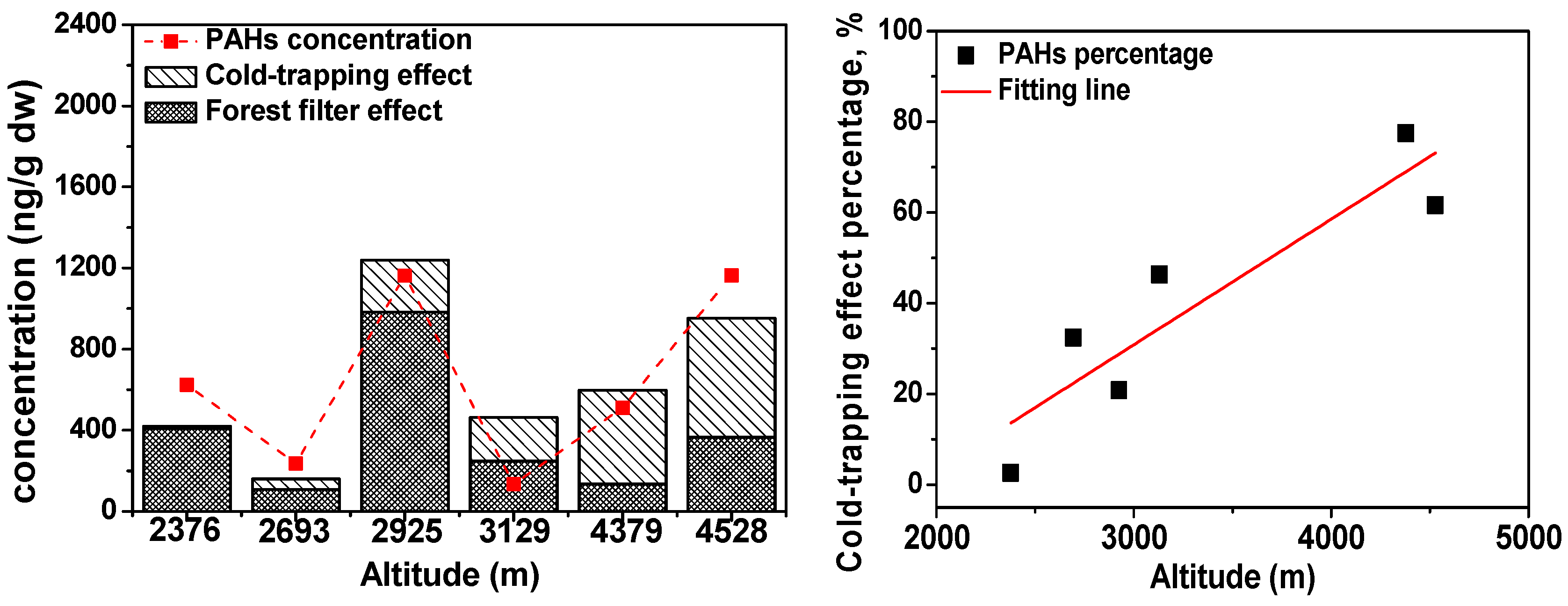
From the above analysis, the mountain cold-trapping effect and forest filter effect jointly regulated PAH distribution in high-mountain forest soils. The relative contribution of the mountain cold-trapping effect increased with altitude, exceeding 75% at higher-altitude sites (mean: 41.4%) (Figure 5), indicating its enhanced dominance with increasing elevation. At higher altitudes with low temperatures, the partition coefficients of SVOCs from the atmosphere to condensed phases increase significantly [5]. Additionally, low temperatures reduce microbial degradation rates and re-volatilization rates of SVOCs [12,43,52]. Furthermore, precipitation strongly influences scavenging of SVOCs from the atmosphere [12,53], and at higher altitudes, precipitation more frequently occurs as snow is a more efficient scavenger than rain [53,56,57,58]. Thus, lower temperatures and more efficient wet deposition (e.g., snow) facilitate enhanced PAH condensation and accumulation with increasing mountain altitude.
The forest filter effect accounted for an average proportion of 58.6% of the contribution to PAH distribution in this study area. Its relative contribution was positively correlated with TOC and, conversely, exhibited a negative linear correlation with altitude. This trend was consistently observed across sampling sites. Vegetation in the TP displays a distinct vertical zonation, with evergreen broad-leaved forest, mixed coniferous–broad-leaved forest, subalpine coniferous forest, and alpine shrub meadows distributed sequentially from low to high elevations [59]. Forest net primary productivity in the sampling region decreases with increasing altitude [60], resulting in greater leaf litter fall and subsequent accumulation in the soil of low-altitude ecosystems. In addition, SVOCs have been documented to deposit more heavily in deciduous forests than in coniferous forests [49]. Collectively, these observations confirm that the forest filter effect weakens progressively with rising altitude.

3.4. Source Assessment

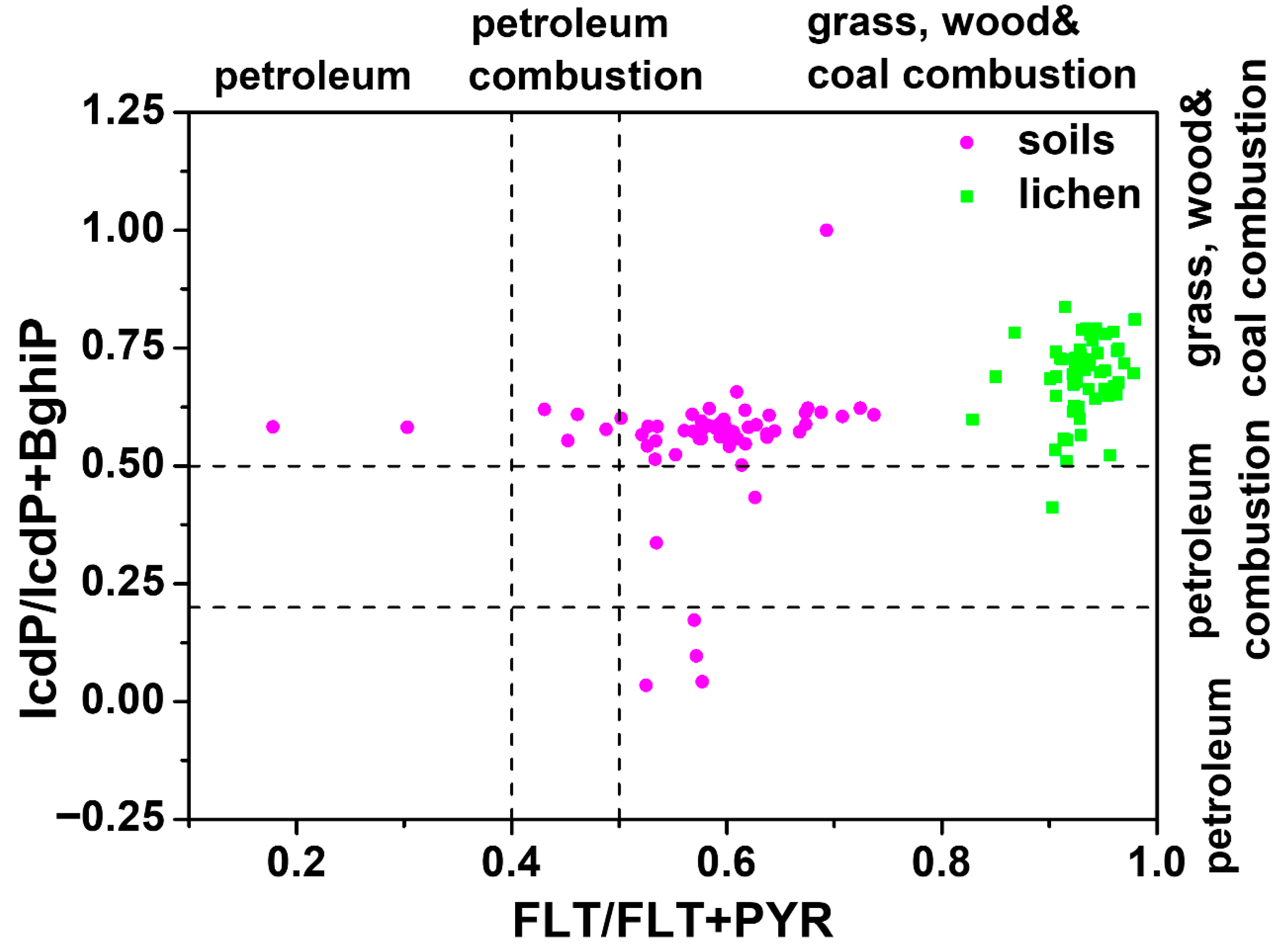
Of the 16 priority PAHs, fluoranthene (FLT) and pyrene (PYR), with a molecular weight (MW) of 202, as well as benzo[ghi]perylene (BghiP) and indeno[1,2,3-cd]pyrene (IcdP), with an MW of 276, exhibit distinct emission profiles from different sources. For this reason, the isomer ratio method has been widely employed for the qualitative source apportionment of PAHs. According to the diagnostic ratio criteria, FLT/(FLT+PYR) < 0.4 indicates petroleum-derived sources, 0.4 < FLT/(FLT+PYR) < 0.5 indicates petroleum combustion sources, and FLT/(FLT+PYR) > 0.5 indicates combustion of grass, wood, and coal; similarly, IcdP/(IcdP+BghiP) < 0.2 indicates petroleum-derived sources, 0.2 < IcdP/(IcdP+BghiP) < 0.5 indicates petroleum combustion sources, and IcdP/(IcdP+BghiP) > 0.5 indicates combustion of grass, wood, and coal [61]. Diagnostic ratio results (Figure 6) show that FLT/(FLT+PYR) values in most soil and lichen samples exceeded 0.5, and IcdP/(IcdP+BghiP) values in the majority of these samples were also above 0.5, collectively demonstrating that PAHs in these samples were predominantly derived from the combustion of grass, wood and coal. Notably, FLT/(FLT+PYR) and IcdP/(IcdP+BghiP) values differed distinctly between soil and lichen samples, suggesting disparities in PAH compositions between the two environmental matrices. However, in a very small number of samples, FLT/(FLT+PYR) and IcdP/(IcdP+BghiP) values were lower than 0.4 and 0.2, respectively, implying minor contributions from petroleum-derived and petroleum combustion sources.

4. Conclusions

Studies on the transport and accumulation of SVOCs in the Hengduan Mts., located in the southeast part of the TP, remain very limited. In the present study, PAHs were analyzed in a total of 124 soil and lichen samples across the Hengduan Mts. The concentrations of ∑16PAH in soils and lichen ranged from 59.8 to 1163 ng/g and from 174 to 3362 ng/g, respectively. Notably, the PAH concentrations in both soils and lichens were higher than those reported in the northern and northwestern regions of the TP. The compositional fractionation of PAHs along with the latitude (and altitude) of the sampling sites indicated the distribution of PAHs is significantly influenced by LRAT, by both the Indian monsoon and the East Asian monsoon. Furthermore, the mountain cold-trapping effect and forest filtering effect jointly dominated the deposition and spatial distribution of PAHs in the forest areas of the Hengduan Mts., southeast TP.

Supplementary Materials

The following supporting information can be downloaded at: https://www.mdpi.com/article/10.3390/f17040502/s1, Figure S1. The distribution of PAHs in soil and lichen from south-to-north transect; Figure S2. The PCA results of PAHs in soils (A) and lichen (B); Figure S3. The air back trajectories of representative points in Summer (A), in Winter (B), and in later Summer (C); Table S1. The detail information of sampling sites; Text S1: Detailed information of Sample Analysis.

Author Contributions

D.L.: Investigation, Methodology, Formal Analysis, Software, and Writing—Original Draft. K.C.: Formal Analysis, Software, and Validation. Y.W.: Methodology, Formal Analysis, and Software. T.X.: Investigation, Methodology, and Formal Analysis. R.Y.: Validation, Funding Acquisition, Resources, and Supervision. All authors have read and agreed to the published version of the manuscript.

Funding

This work was financially supported by the National Natural Science Foundation of China (22076204 and 21777184), Second Tibetan Plateau Scientific Expedition Research Program (STEP) (2019QZKK0605), Hongliu Excellent Young Scholars Fund of Lanzhou University of Technology (062314), Young Faculty Interdisciplinary Research Cultivation Program of Lanzhou University of Technology (LUTXKJC-25-062411), and Lanzhou Youth Science and Technology Talent Innovation Project (2024-QN-60).

Data Availability Statement

The original contributions presented in this study are included in the article/Supplementary Material. Further inquiries can be directed to the corresponding author.

Conflicts of Interest

Ting Xie is employed by the water supply company of Liuyang City; her employer’s company was not involved in this study, and there is no relevance between this research and their company. The remaining authors declare that the research was conducted in the absence of any commercial or financial relationships that could be construed as a potential conflict of interest. The funders had no role in the design of the study; in the collection, analyses, or interpretation of data; in the writing of the manuscript; or in the decision to publish the results.

References

  1. Wang, X.; Gong, P.; Yao, T. Progress about the research of atmospheric persistent organic pollutants in remote areas. Huan Jing Ke Xue 2008, 29, 273–282. [Google Scholar]
  2. Sheng, J.; Wang, X.; Gong, P.; Joswiak, D.R.; Tian, L.; Yao, T.; Jones, K.C. Monsoon-driven transport of organochlorine pesticides and polychlorinated biphenyls to the Tibetan Plateau: Three year atmospheric monitoring study. Environ. Sci. Technol. 2013, 47, 3199–3208. [Google Scholar] [CrossRef]
  3. Jaward, F.M.; Zhang, G.; Nam, J.J.; Sweetman, A.J.; Obbard, J.P.; Kobara, Y.; Jones, K.C. Passive air sampling of polychlorinated biphenyls, organochlorine compounds, and polybrominated diphenyl ethers across Asia. Environ. Sci. Technol. 2005, 39, 8638–8645. [Google Scholar] [CrossRef]
  4. Wurl, O.; Obbard, J.P. Organochlorine compounds in the marine atmosphere of Singapore. Atmos. Environ. 2005, 39, 7207–7216. [Google Scholar] [CrossRef]
  5. Mackay, D.; Wania, F. Transport of contaminants to the arctic—Partitioning, processes and models. Sci. Total Environ. 1995, 160–161, 25–38. [Google Scholar] [CrossRef]
  6. Tatton, J.O.; Ruzicka, J.H.A. Organochlorine pesticides in antarctica. Nature 1967, 215, 346–348. [Google Scholar] [CrossRef]
  7. Iwata, H.; Tanabe, S.; Sakal, N.; Tatsukawa, R. Distribution of persistent organochlorines in the oceanic air and surface seawater and the role of ocean on their global transport and fate. Environ. Sci. Technol. 1993, 27, 1080–1098. [Google Scholar] [CrossRef]
  8. Yuan, G.; Lang, X.; Sun, T. A Review of the research on persistent organic pollutants in Tibetan plateau. Geoscience 2012, 26, 910–916. [Google Scholar]
  9. Chen, M.; Wang, C.; Gao, K.; Wang, X.; Fu, J.; Gong, P.; Wang, Y. Perfluoroalkyl substances in precipitation from the Tibetan Plateau during monsoon season: Concentrations, source regions and mass fluxes. Chemosphere 2021, 282, 131105. [Google Scholar] [CrossRef] [PubMed]
  10. Lavin, K.S.; Hageman, K.J. Contributions of long-range and regional atmospheric transport on pesticide concentrations along a transect crossing a mountain divide. Environ. Sci. Technol. 2013, 47, 1390–1398. [Google Scholar] [CrossRef]
  11. Tian, C.; Ma, J.; Liu, L.; Jia, H.; Xu, D.; Li, Y.F. A modeling assessment of association between East Asian summer monsoon and fate/outflow of alpha-HCH in Northeast Asia. Atmos. Environ. 2009, 43, 3891–3901. [Google Scholar] [CrossRef]
  12. Wania, F.; Westgate, J.N. On the mechanism of mountain cold-trapping of organic chemicals. Environ. Sci. Technol. 2008, 42, 9092–9098. [Google Scholar] [CrossRef]
  13. Yang, R.; Yao, T.; Xu, B.; Jiang, G.; Zheng, X. Distribution of organochlorine pesticides (OCPs) in conifer needles in the southeast Tibetan Plateau. Environ. Pollut. 2008, 153, 92–100. [Google Scholar] [CrossRef]
  14. Zhu, N.L.; Schramm, K.W.; Wang, T.; Henkelmann, B.; Zheng, X.Y.; Fu, J.J.; Gao, Y.; Wang, Y.W.; Jiang, G.B. Environmental fate and behavior of persistent organic pollutants in Shergyla Mountain, southeast of the Tibetan Plateau of China. Environ. Pollut. 2014, 191, 166–174. [Google Scholar] [CrossRef]
  15. Wang, X.; Gong, P.; Sheng, J.; Joswiak, D.R.; Yao, T. Long-range atmospheric transport of particulate Polycyclic Aromatic Hydrocarbons and the incursion of aerosols to the southeast Tibetan Plateau. Atmos. Environ. 2015, 115, 124–131. [Google Scholar] [CrossRef]
  16. Luo, Y.; Sun, J.; Wang, P.; Li, Y.; Li, H.; Xiao, K.; Yang, R.; Zhang, Q.; Jiang, G. Age dependence accumulation of organochlorine pesticides and PAHs in needles with different forest types, southeast Tibetan Plateau. Sci. Total Environ. 2020, 716, 137176. [Google Scholar] [CrossRef]
  17. Wang, X.; Gong, P.; Wang, C.; Ren, J.; Yao, T. A review of current knowledge and future prospects regarding persistent organic pollutants over the Tibetan Plateau. Sci. Total Environ. 2016, 573, 139–154. [Google Scholar] [CrossRef] [PubMed]
  18. Wang, S.; Ni, H.G.; Sun, J.L.; Jing, X.; He, J.S.; Zeng, H. Polycyclic aromatic hydrocarbons in soils from the Tibetan Plateau, China: Distribution and influence of environmental factors. Environ. Sci.-Process. Impacts 2013, 15, 661–667. [Google Scholar] [CrossRef]
  19. Loppi, S.; Pozo, K.; Estellano, V.H.; Corsolini, S.; Sardella, G.; Paoli, L. Accumulation of polycyclic aromatic hydrocarbons by lichen transplants: Comparison with gas-phase passive air samplers. Chemosphere 2015, 134, 39–43. [Google Scholar] [CrossRef] [PubMed]
  20. Li, H.; Bu, D.; Gao, Y.; Zhu, N.; Wu, J.; Chen, X.; Fu, J.; Wang, Y.; Zhang, A.; Jiang, G. Long-range atmospheric transport and alpine condensation of short-chain chlorinated paraffins on the southeastern Tibetan Plateau. J. Environ. Sci. 2021, 99, 275–280. [Google Scholar] [CrossRef]
  21. Muir, D.C.G.; Segstro, M.D.; Welbourn, P.M.; Toom, D.; Eisenreich, S.J.; Macdonald, C.R.; Whelpdale, D.M. Patterns of accumulation of airborne organochlorine contaminants in lichens from the upper great lakes region of Ontario. Environ. Sci. Technol. 1993, 27, 1201−1210. [Google Scholar] [CrossRef]
  22. Masih, A.; Masih, J.; Taneja, A. Study of air-soil exchange of polycyclic aromatic hydrocarbons (PAHs) in the north-central part of India—A semi arid region. J. Environ. Monit. 2012, 14, 172–180. [Google Scholar] [CrossRef]
  23. Aichner, B.; Glaser, B.; Zech, W. Polycyclic aromatic hydrocarbons and polychlorinated biphenyls in urban soils from Kathmandu, Nepal. Org. Geochem. 2007, 38, 700–715. [Google Scholar] [CrossRef]
  24. Yuan, G.; Wu, L.; Sun, Y.; Li, J.; Li, J.; Wang, G. Polycyclic aromatic hydrocarbons in soils of the central Tibetan Plateau, China: Distribution, sources, transport and contribution in global cycling. Environ. Pollut. 2015, 203, 137–144. [Google Scholar] [CrossRef] [PubMed]
  25. Tao, S.; Wang, W.; Liu, W. Polycyclic aromatic hydrocarbons and organochlorine pesticides in surface soils from the Qinghai-Tibetan plateau. J. Environ. Monit. 2011, 13, 175–181. [Google Scholar] [CrossRef] [PubMed]
  26. Yang, Y.; Gai, N.; Geng, C.; Zhu, X.; Li, Y.; Xue, Y.; Yu, H.; Tan, K. East Asia monsoon’s influence on seasonal changes of beryllium-7 and typical POPs in near-surface atmospheric aerosols in mid-latitude city Qingdao, China. Atmos. Environ. 2013, 79, 802–810. [Google Scholar] [CrossRef]
  27. Zhao, X.G.; Kim, S.K.; Zhu, W.H.; Kannan, N.; Li, D.H. Long-range atmospheric transport and the distribution of polycyclic aromatic hydrocarbons in Changbai Mountain. Chemosphere 2015, 119, 289–294. [Google Scholar] [CrossRef]
  28. Shi, B.F.; Wu, Q.L.; Ouyang, H.X.; Liu, X.X.; Ma, B.; Zuo, W.Y.; Chen, S.Y. Distribution and source apportionment of polycyclic aromatic hydrocarbons in soils and leaves from high-altitude mountains in southwestern China. J. Environ. Qual. 2014, 43, 1942–1952. [Google Scholar] [CrossRef]
  29. Tremolada, P.; Parolini, M.; Binelli, A.; Ballabio, C.; Comolli, R.; Provini, A. Seasonal changes and temperature-dependent accumulation of polycyclic aromatic hydrocarbons in high-altitude soils. Sci. Total Environ. 2009, 407, 4269–4277. [Google Scholar] [CrossRef]
  30. Daly, G.L.; Lei, Y.D.; Castillo, L.E.; Muir, D.C.G.; Wania, F. Polycyclic aromatic hydrocarbons in Costa Rican air and soil: A tropical/temperate comparison. Atmos. Environ. 2007, 41, 7339–7350. [Google Scholar] [CrossRef]
  31. Choi, S.-D.; Shunthirasingham, C.; Daly, G.L.; Xiao, H.; Lei, Y.D.; Wania, F. Levels of polycyclic aromatic hydrocarbons in Canadian mountain air and soil are controlled by proximity to roads. Environ. Pollut. 2009, 157, 3199–3206. [Google Scholar] [CrossRef]
  32. Zhou, R.; Yang, R.; Jing, C. Polycyclic aromatic hydrocarbons in soils and lichen from the western Tibetan Plateau: Concentration profiles, distribution and its influencing factors. Ecotoxicol. Environ. Saf. 2018, 152, 151–158. [Google Scholar] [CrossRef] [PubMed]
  33. Blasco, M.; Domeno, C.; Lopez, P.; Nerin, C. Behaviour of different lichen species as biomonitors of air pollution by PAHs in natural ecosystems. J. Environ. Monit. 2011, 13, 2588–2596. [Google Scholar] [CrossRef]
  34. Nascimbene, J.; Tretiach, M.; Corana, F.; Lo Schiavo, F.; Kodnik, D.; Dainese, M.; Mannucci, B. Patterns of traffic polycyclic aromatic hydrocarbon pollution in mountain areas can be revealed by-lichen biomonitoring: A case study in the Dolomites (Eastern Italian Alps). Sci. Total Environ. 2014, 475, 90–96. [Google Scholar] [CrossRef]
  35. Cabrerizo, A.; Dachs, J.; Barcelo, D.; Jonest, K.C. Influence of organic matter content and human activities on the occurrence of organic pollutants in antarctic soils, lichens, grass, and mosses. Environ. Sci. Technol. 2012, 46, 1396–1405. [Google Scholar] [CrossRef]
  36. Franz, T.P.; Eisenreich, S.J. Snow scavenging of polychlorinated biphenyls and polycyclic aromatic hydrocarbons in Minnesota. Environ. Sci. Technol. 1998, 32, 1771–1778. [Google Scholar] [CrossRef]
  37. Wang, X.; Yao, T.; Cong, Z.; Yan, X.; Kang, S.; Zhang, Y. Concentration level and distribution of polycyclic aromatic hydrocarbons in soil and grass around Mt. Qomolangma, China. Chin. Sci. Bull. 2007, 52, 1405–1413. [Google Scholar] [CrossRef]
  38. Fernandez, P.; Grimalt, J.O.; Vilanova, R.M. Atmospheric gas-particle partitioning of polycyclic aromatic hydrocarbons in high mountain regions of Europe. Environ. Sci. Technol. 2002, 36, 1162–1168. [Google Scholar] [CrossRef]
  39. Abdul Hussain, B.; Westgate, J.; Hayward, S.; Shunthirasingham, C.; Brown, T.; Hung, H.; Lei, Y.; Wania, F. Polycyclic aromatic hydrocarbons and polychlorinated biphenyls in soils and atmosphere of Western Canadian mountains: The role of source proximity, precipitation, forest cover and mountain cold-trapping. Atmos. Environ. X 2019, 1, 100004. [Google Scholar] [CrossRef]
  40. Shen, H.; Tao, S.; Wang, R.; Wang, B.; Shen, G.; Li, W.; Su, S.; Huang, Y.; Wang, X.; Liu, W.; et al. Global time trends in PAH emissions from motor vehicles. Atmos. Environ. 2011, 45, 2067–2073. [Google Scholar] [CrossRef]
  41. Petrovic, A.; Westphal, H.; Hodhodi, B.; Slootmaker, T.; Alena, K.; Naji, A. Influence of windward versus leeward settings on microplastic distribution in beach sediments of Kish Island, Gulf region. Reg. Stud. Mar. Sci. 2022, 55, 102585. [Google Scholar] [CrossRef]
  42. Ren, W.; Yao, T.; Xie, S. Key drivers controlling the stable isotopes in precipitation on the leeward side of the central Himalayas. Atmos. Res. 2017, 189, 134–140. [Google Scholar] [CrossRef]
  43. Chen, D.; Liu, W.; Liu, X.; Westgate, J.N.; Wania, F. Cold-trapping of persistent organic pollutants in the mountain soils of western Sichuan, China. Environ. Sci. Technol. 2008, 42, 9086–9091. [Google Scholar] [CrossRef]
  44. Larsen, R.K.; Baker, J.E. Source apportionment of polycyclic aromatic hydrocarbons in the urban atmosphere: A comparison of three methods. Environ. Sci. Technol. 2003, 37, 1873–1881. [Google Scholar] [CrossRef] [PubMed]
  45. Liu, X.; Li, J.; Zheng, Q.; Bing, H.J.; Zhang, R.J.; Wang, Y.; Luo, C.L.; Liu, X.; Wu, Y.H.; Pan, S.H.; et al. Forest filter effect versus cold trapping effect on the altitudinal distribution of PCBs: A case study of Mt. Gongga, Eastern Tibetan Plateau. Environ. Sci. Technol. 2014, 48, 14377–14385. [Google Scholar] [CrossRef]
  46. Aichner, B.; Bussian, B.; Lehnik-Habrink, P.; Hein, S. Levels and spatial distribution of persistent organic pollutants in the environment: A case study of German forest soils. Environ. Sci. Technol. 2013, 47, 12703–12714. [Google Scholar] [CrossRef] [PubMed]
  47. Ribes, A.; Grimalt, J.O.; Garcia, C.J.T.; Cuevas, E. Temperature and organic matter dependence of the distribution of organochlorine compounds in mountain soils from the subtropical Atlantic (Teide, Tenerife Island). Environ. Sci. Technol. 2002, 36, 1879–1885. [Google Scholar] [CrossRef]
  48. Zheng, X.; Liu, X.; Jiang, G.; Wang, Y.; Zhang, Q.; Cai, Y.; Cong, Z. Distribution of PCBs and PBDEs in soils along the altitudinal gradients of Balang Mountain, the east edge of the Tibetan Plateau. Environ. Pollut. 2012, 161, 101–106. [Google Scholar] [CrossRef] [PubMed]
  49. Horstmann, M.; McLachlan, M.S. Atmospheric deposition of semivolatile organic compounds to two forest canopies. Atmos. Environ. 1998, 32, 1799–1809. [Google Scholar] [CrossRef]
  50. Luo, Y.; Yang, R.; Li, Y.; Wang, P.; Zhu, Y.; Yuan, G.; Zhang, Q.; Jiang, G. Accumulation and fate processes of organochlorine pesticides (OCPs) in soil profiles in Mt. Shergyla, Tibetan Plateau: A comparison on different forest types. Chemosphere 2019, 231, 571–578. [Google Scholar] [CrossRef]
  51. Blais, J.M.; Schindler, D.W.; Muir, D.C.G.; Kimpe, L.E.; Donald, D.B.; Rosenberg, B. Accumulation of persistent organochlorine compounds in mountains of western Canada. Nature 1998, 395, 585–588. [Google Scholar] [CrossRef]
  52. Tremolada, P.; Villa, S.; Bazzarin, P.; Bizzotto, E.; Comolli, R.; Vighi, M. POPs in mountain soils from the Alps and Andes: Suggestions for a ‘precipitation effect’ on altitudinal gradients. Water Air Soil Pollut. 2008, 188, 93–109. [Google Scholar] [CrossRef]
  53. Wang, X.; Sheng, J.; Gong, P.; Xue, Y.; Yao, T.; Jones, K.C. Persistent organic pollutants in the Tibetan surface soil: Spatial distribution, air-soil exchange and implications for global cycling. Environ. Pollut. 2012, 170, 145–151. [Google Scholar] [CrossRef] [PubMed]
  54. Wang, C.; Yang, T.; Zhao, Y.; Herath, H.; Shi, Z. The potential degradability of persistent organic pollutants (POPs) in soil: A perspective from soil aggregates. Environ. Pollut. 2025, 377, 126461. [Google Scholar] [CrossRef]
  55. Su, Y.S.; Wania, F. Does the forest filter effect prevent semivolatile organic compounds from reaching the Arctic? Environ. Sci. Technol. 2005, 39, 7185–7193. [Google Scholar] [CrossRef] [PubMed]
  56. Daly, G.L.; Wania, F. Organic contaminants in mountains. Environ. Sci. Technol. 2005, 39, 385–398. [Google Scholar] [CrossRef]
  57. Lei, Y.D.; Wania, F. Is rain or snow a more efficient scavenger of organic chemicals? Atmos. Environ. 2004, 38, 3557–3571. [Google Scholar] [CrossRef]
  58. Adhikai, N.; Adhikari, S. Precipitation chemistry in the westerly domain of the Tibetan Plateau. J. Trace Elem. Miner. 2023, 3, 100039. [Google Scholar] [CrossRef]
  59. Luo, J. Quantitative Analysis of Plant Communities in Mount Sejira. Master’s Thesis, Tibet University, Lhasa, China, 2008. [Google Scholar]
  60. Luo, T.; Li, W.; Luo, J.; Wang, Q. A comparative study on biological production of major vegetation types on the Tibetan Plateau. Acta Ecol. Sin. 1999, 19, 823–831. [Google Scholar]
  61. Wei, L.; Lv, J.; Zuo, P.; Li, Y.; Yang, R.; Zhang, Q.; Jiang, G. The occurrence and sources of PAHs, oxygenated PAHs (OPAHs), and nitrated PAHs (NPAHs) in soil and vegetation from the Antarctic, Arctic, and Tibetan Plateau. Sci. Total Environ. 2024, 912, 169394. [Google Scholar] [CrossRef]
Figure 1. Geographic location and sampling sites. Numerical information is summarized in the Supporting Information, Table S1.
Forests 17 00502 g001
Figure 2. Comparison of PAHs (ac) in soils and lichen on both a dry-weight and TOC- or lipid-weight basis. The box represents the data between the 25th and 75th percentiles. The small box and the horizontal line inside the box indicate the mean and median data. The whiskers above and below the box indicate the 95th and 5th percentiles, and the symbol “×” above and below them represents the outliers.
Forests 17 00502 g002
Figure 3. The distribution of PAHs in soils (a) and lichen (b).
Forests 17 00502 g003
Figure 4. Comparison of PAH concentrations and altitudinal distribution between windward and leeward slopes of the mountain.
Forests 17 00502 g004
Figure 5. Patterns of PAHs in O-Horizon soils by principal component analysis/multiple linear regression (PCA/MLRA).
Forests 17 00502 g005
Figure 6. Bivariate plot for diagnostic ratios of IcdP/(IcdP+BghiP) vs. FLT/(FLT+PYR).
Forests 17 00502 g006
Table 1. Statistical concentrations (min-max, mean, and ng/g dw) of PAHs in soil and lichen.
CompoundsSoilLichen
2–3 ringsNAP19.4–1041 (142)34.3–1278 (336)
ACY0.52–6.94 (1.86)0.36–13.2 (4.10)
ACP0.75–20.8 (4.48)3.85–105 (40.5)
FLR2.40–70.4 (13.5)2.69–59.8 (18.0)
PHE2.07–245 (24.4)6.22–188 (47.9)
ANT0.24–25.1 (2.50)1.03–112 (39.7)
4 ringsFLT0.08–69.7 (6.49)5.12–776 (157)
PYR0.35–47.5 (4.43)0.88–62.9 (11.8)
BaA0.31–26.7 (2.35)5.38–500 (58.4)
CHR0.53–44.4 (3.70)1.56–297 (35.6)
5–6 ringsBbF0.24–66.5 (4.43)0.26–206 (13.6)
BkF0.08–22.1 (1.67)14.4–185 (65.9)
BaP0.31–36.2 (2.45)0.35–455 (49.5)
IcdP0.03–34.9 (2.32)1.75–657 (37.5)
DahA0.08–6.79 (0.47)0.64–195 (14.1)
BghiP0.25–24.7 (1.98)0.76–128 (13.3)
16PAH 60–1163 (223)174–3362 (871)
Disclaimer/Publisher’s Note: The statements, opinions and data contained in all publications are solely those of the individual author(s) and contributor(s) and not of MDPI and/or the editor(s). MDPI and/or the editor(s) disclaim responsibility for any injury to people or property resulting from any ideas, methods, instructions or products referred to in the content.