AI-Based Modeling of Post-Fire Evapotranspiration Using Vegetation Recovery Indicators: Application to the 2022 Chongqing Burned Areas

Abstract
1. Introduction
2. Materials and Methods
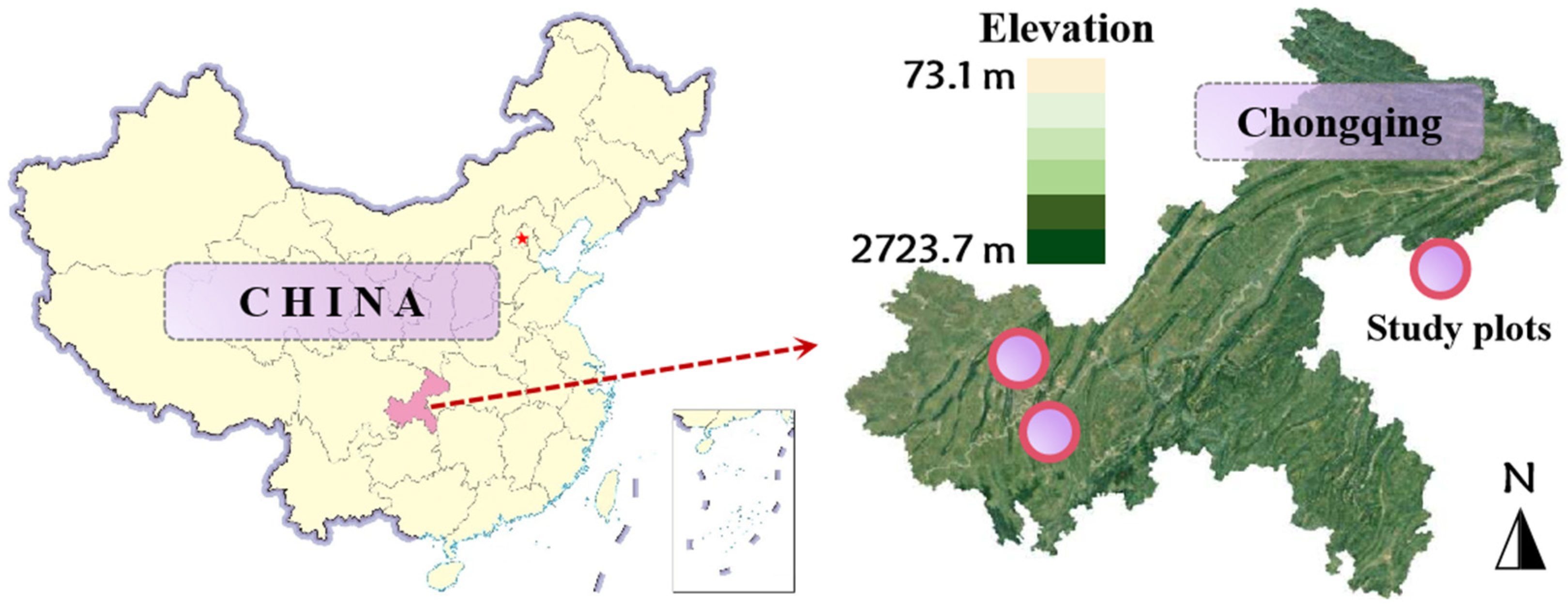
2.1. Information on the Study Area
2.2. Experimental Design and Field Measurements
2.3. ET Calculation and Modeling Framework
2.4. Model Evaluation and Interpretability Analysis
3. Results
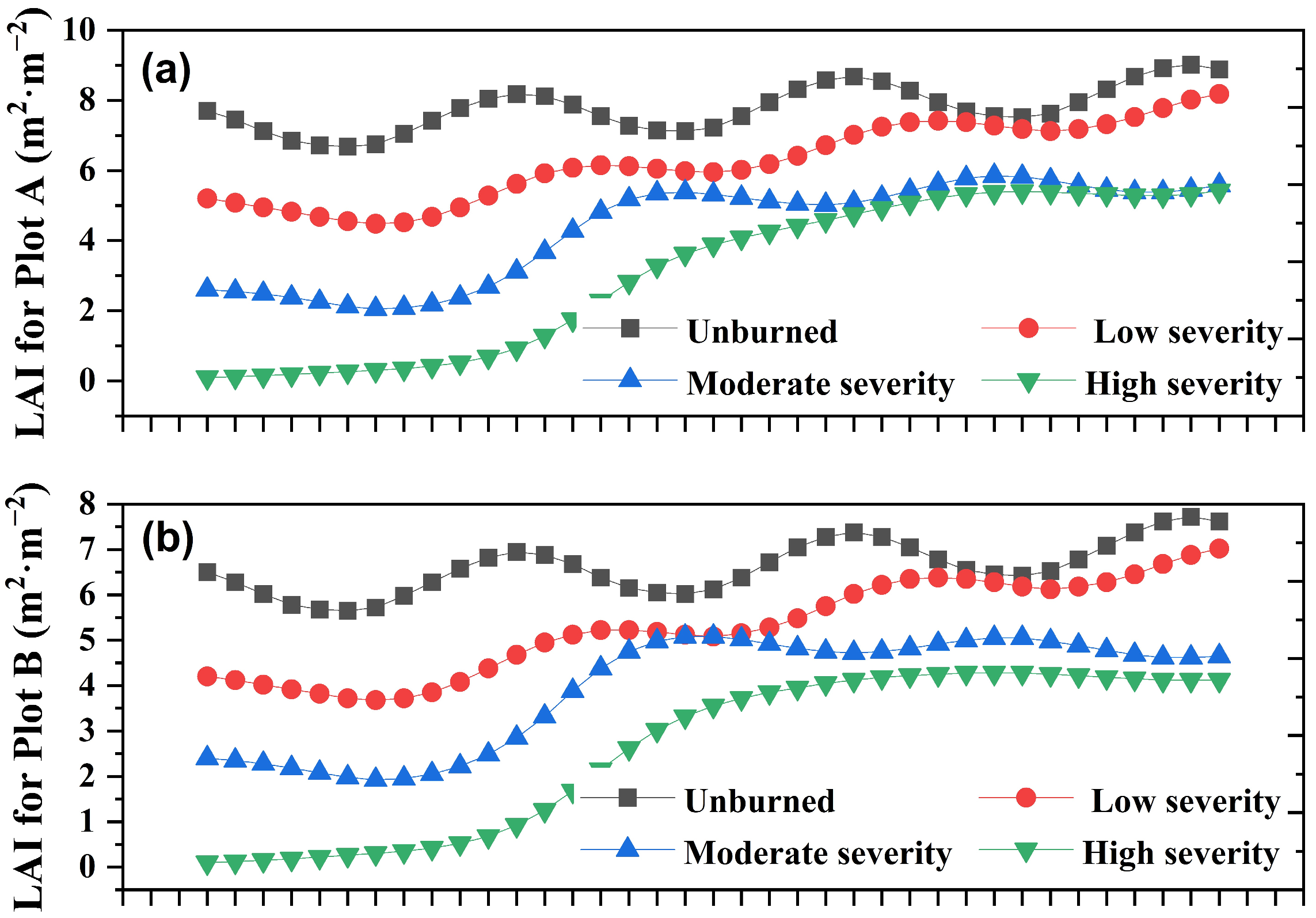
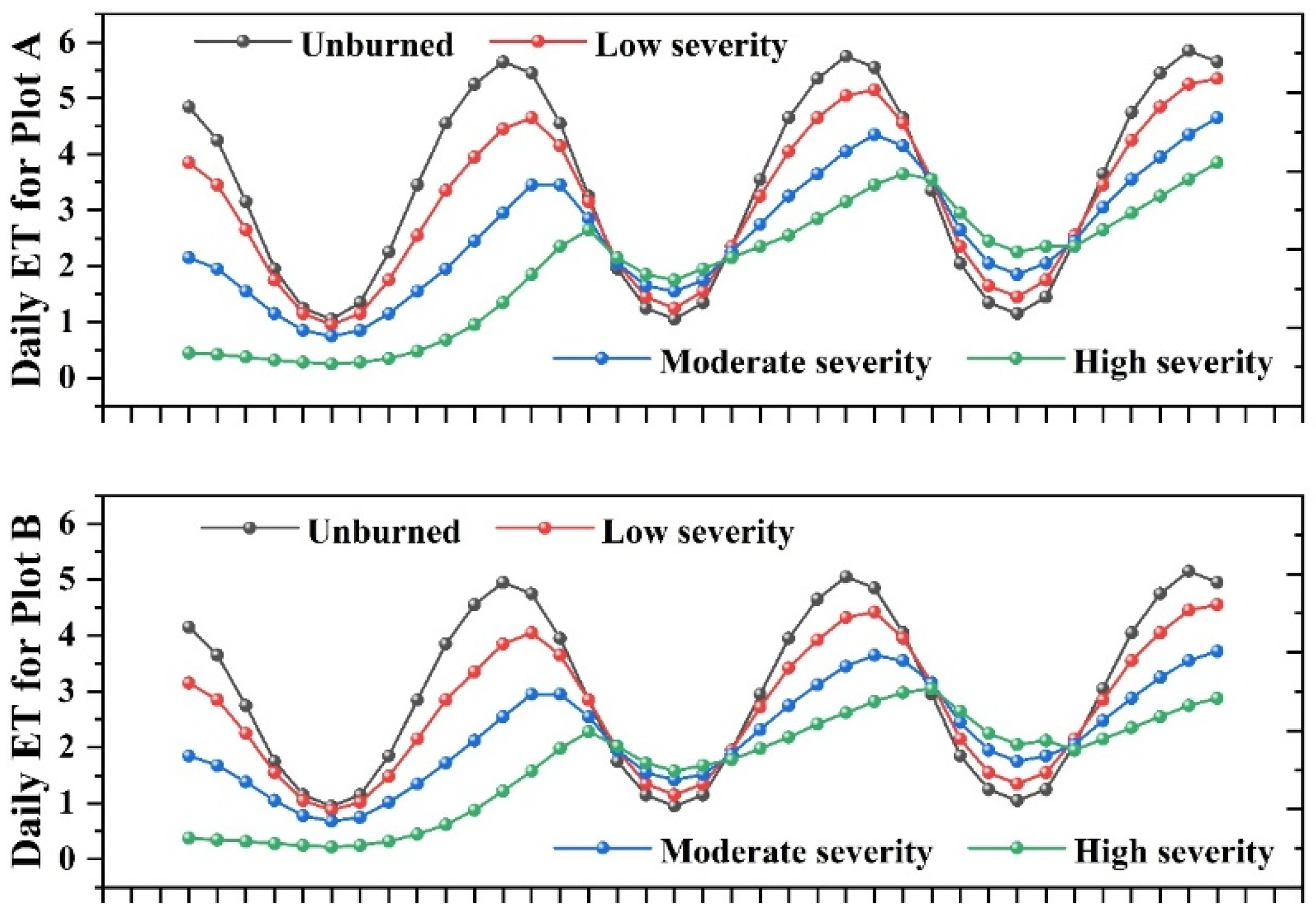
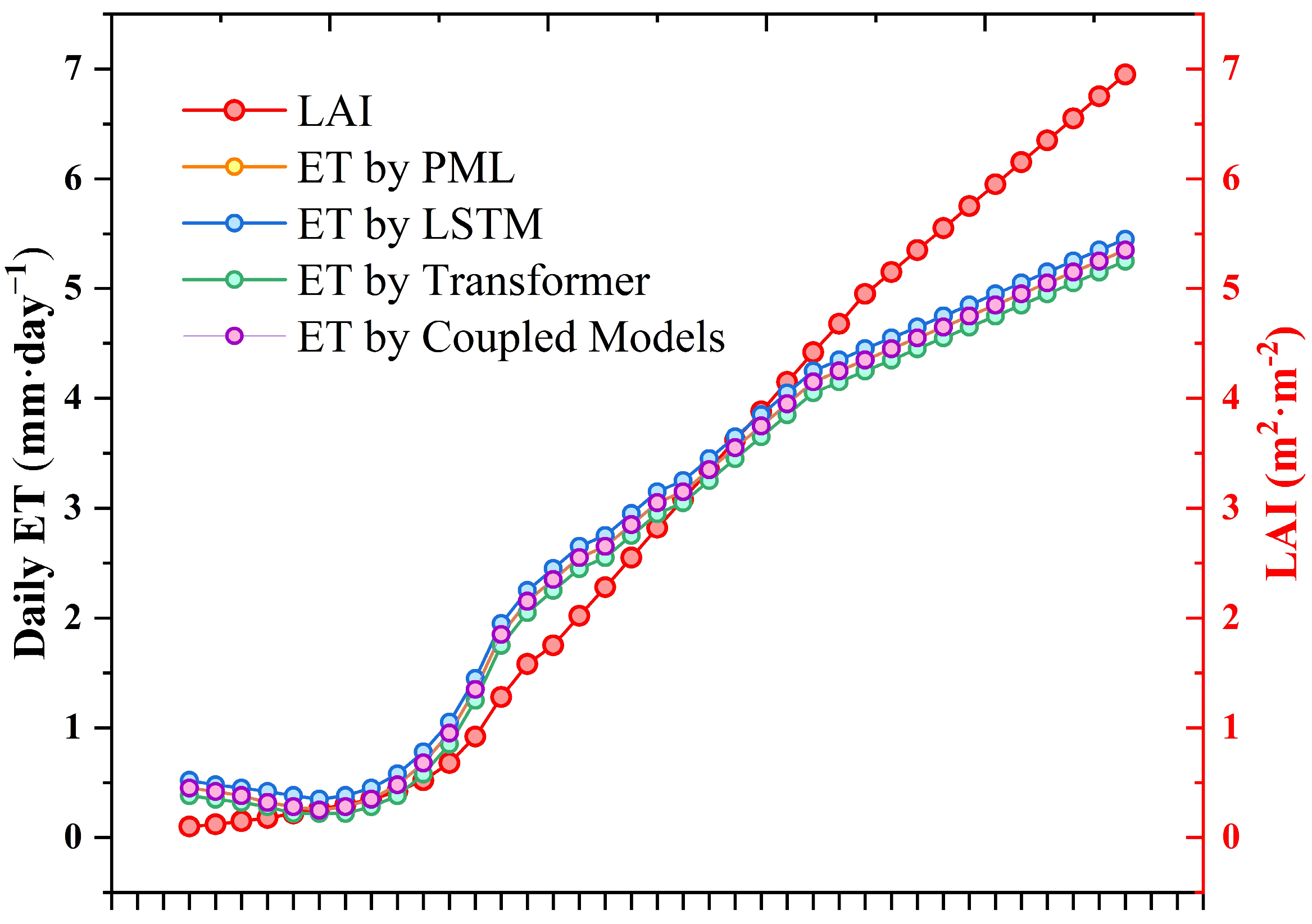
3.1. Post-Fire LAI Dynamics and ET Recovery Patterns
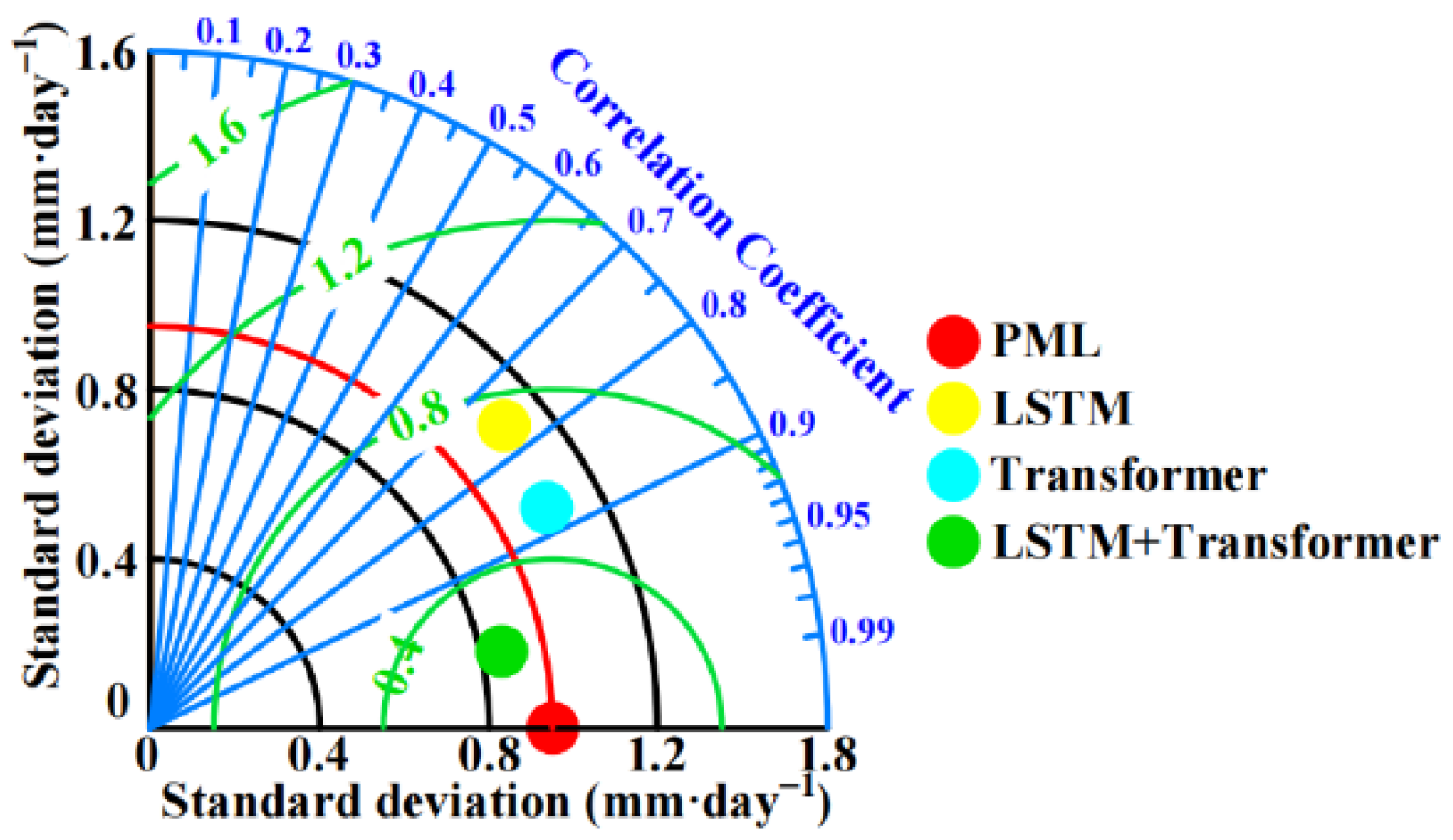
3.2. AI-Based ET Modeling Performance
4. Discussion
4.1. Coupled AI Model Outperforms Single Architectures by Capturing Phase-Dependent Ecohydrological Dynamics
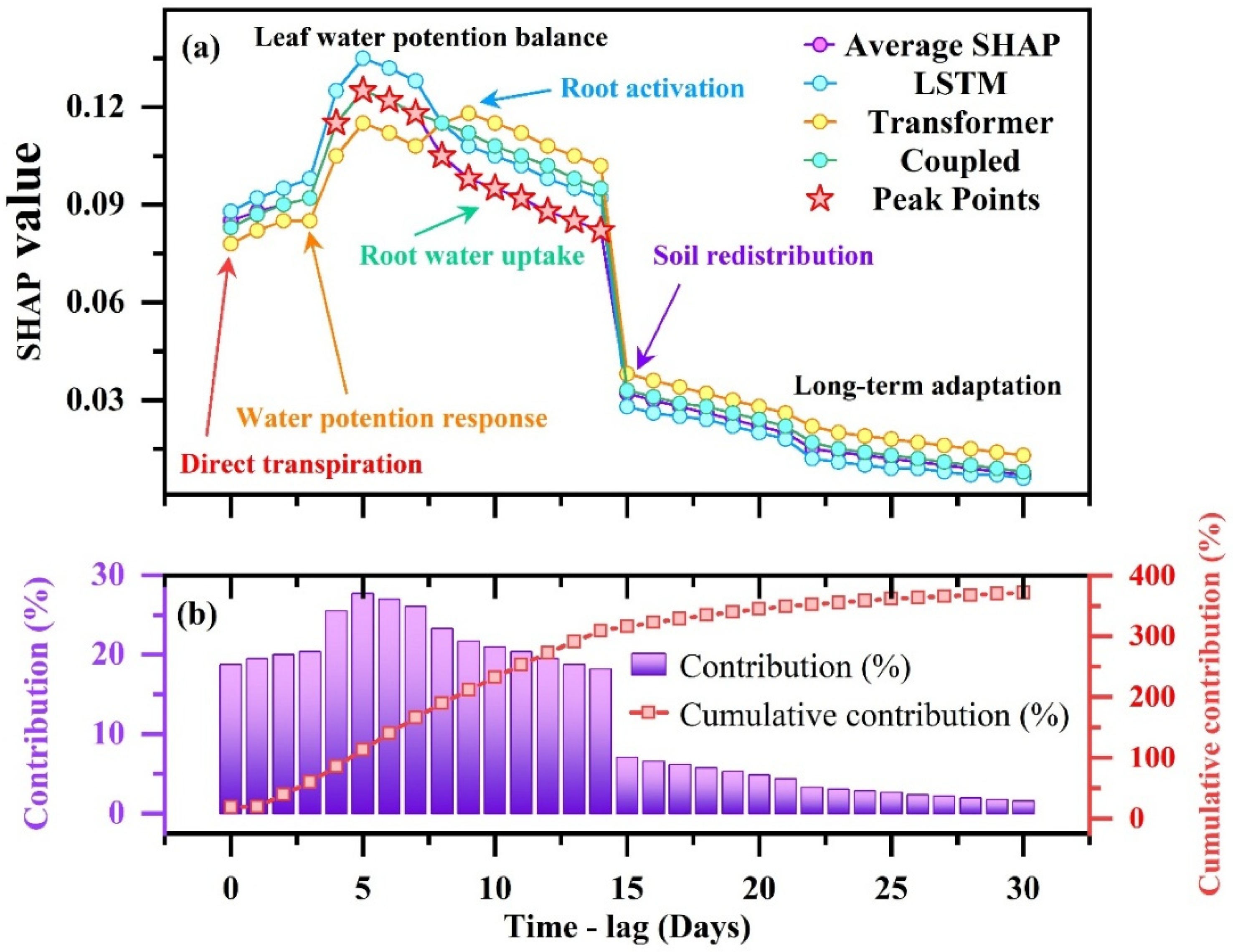
4.2. Phase-Dependent Factor Transitions and Hydraulic Time-Lag Effects Reveal Post-Fire Recovery Mechanisms
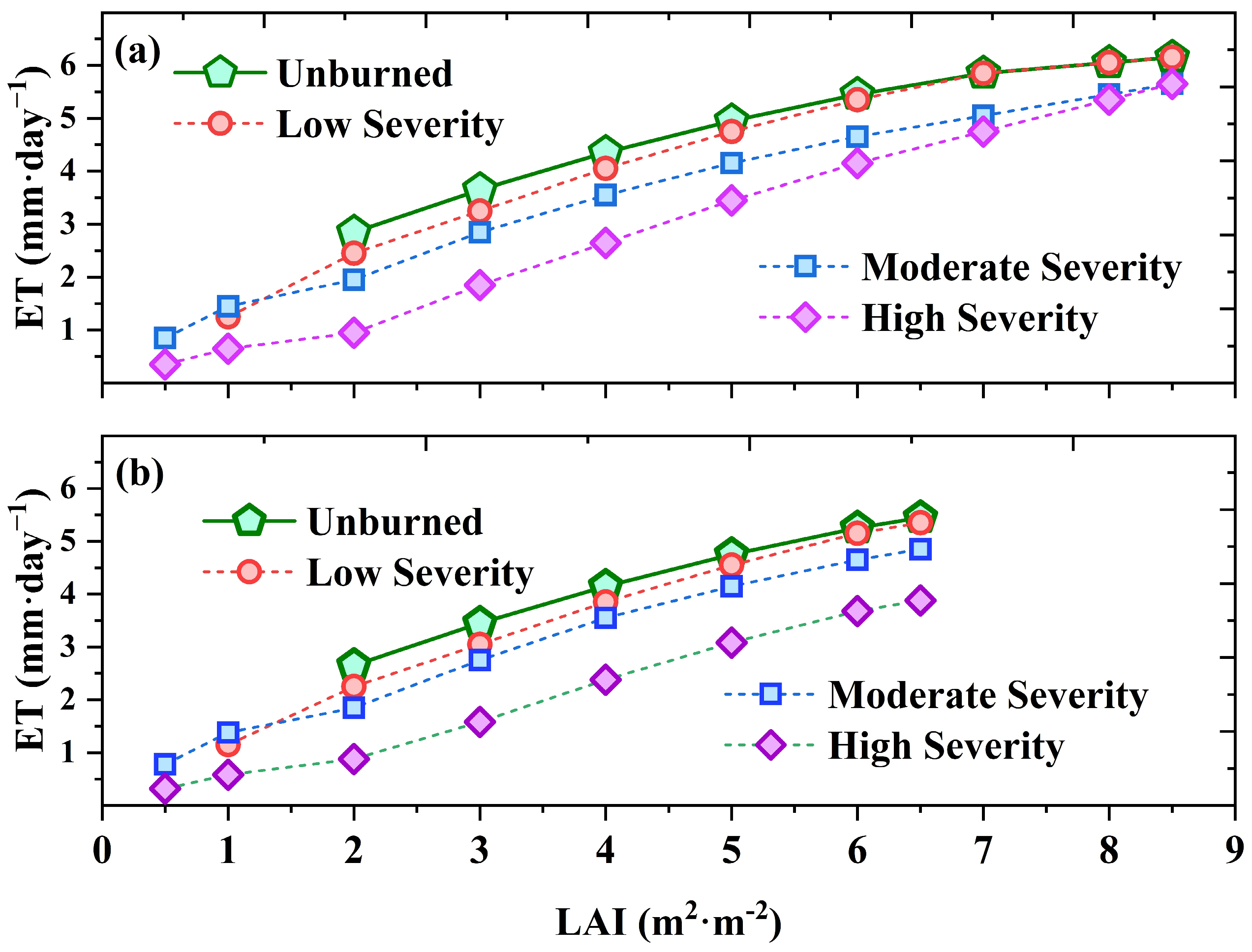
4.3. Persistent Hydraulic Limitations and Management Implications for Post-Fire Recovery Assessment
5. Conclusions
Author Contributions
Funding
Data Availability Statement
Conflicts of Interest
References
- Niccoli, F.; Marfella, L.; Kabala, J.P.; Rowe, J.; Marzaioli, R.; Rutigliano, F.A.; Glanville, H.C.; Battipaglia, G. Different responses of Pinus sylvestris L. and Larix decidua Mill. to forest fire in Central England (UK). Agric. For. Meteorol. 2025, 374, 110804. [Google Scholar] [CrossRef]
- Pérez-Carrasquilla, J.S.; Molina, M.J.; Mayer, K.; Dagon, K.; Fasullo, J.T.; Simpson, I.R. Observed and Modeled Amplification of the Frequency, Duration, and Extreme Heat Impacts of the Pacific Trough Regime. Earth’s Futur. 2025, 13, e2025EF007140. [Google Scholar] [CrossRef]
- Xu, Y.H.; Wang, X.T.; Ou, Q.; Zhou, Z.B.; Hoek, J.P.; Liu, G. Appearance of Recalcitrant Dissolved Black Carbon and Dissolved Organic Sulfur in River Waters Following Wildfire Events. Environ. Sci. Technol. 2024, 58, 7165–7175. [Google Scholar] [CrossRef]
- Zhao, Y.X.; Huang, Y.J.; Sun, X.P.; Dong, G.Y.; Li, Y.Q.; Ma, M.G. Forest Fire Mapping Using Multi-Source Remote Sensing Data: A Case Study in Chongqing. Remote Sens. 2023, 15, 2323. [Google Scholar] [CrossRef]
- Osborne, C.P.; Charles-Dominique, T.; Stevens, N.; Bond, W.J.; Midgley, G.; Lehmann, C.E.R. Human impacts in African savannas are mediated by plant functional traits. New Phytol. 2018, 220, 10–24. [Google Scholar] [CrossRef] [PubMed]
- Subhedar, R.; Ratnam, J.; Sankaran, M. Spatial Patterns of Woody Plants and Tree-Tree Interactions in an Indian Mesic Savanna. J. Veg. Sci. 2025, 36, e70089. [Google Scholar] [CrossRef]
- Taboada, A.; Fernández-García, V.; Marcos, E.; Calvo, L. Interactions between large high-severity fires and salvage logging on a short return interval reduce the regrowth of fire-prone serotinous forests. For. Ecol. Manag. 2018, 414, 54–63. [Google Scholar] [CrossRef]
- Fisher, J.B.; Melton, F.; Middleton, E.; Hain, C.; Anderson, M.; Allen, R.; McCabe, M.F.; Hook, S.; Baldocchi, D.; Townsend, P.A.; et al. The future of evapotranspiration: Global requirements for ecosystem functioning, carbon and climate feedbacks, agricultural management, and water resources. Water Resour. Res. 2017, 53, 2618–2626. [Google Scholar] [CrossRef]
- Miralles, D.G.; Gentine, P.; Seneviratne, S.A.; Teuling, A.J. Land-atmospheric feedbacks during droughts and heatwaves: State of the science and current challenges. Ann. N. Y. Acad. Sci. 2019, 1436, 19–35. [Google Scholar] [CrossRef]
- Leuning, R.; Zhang, Y.Q.; Rajaud, A.; Cleugh, H.; Tu, K. A simple surface conductance model to estimate regional evaporation using MODIS leaf area index and the Penman-Monteith equation. Water Resour. Res. 2008, 44, 1–17. [Google Scholar] [CrossRef]
- Ershadi, A.; McCabe, M.F.; Evans, J.P.; Chaney, N.W.; Wood, E.F. Multi-site evaluation of terrestrial evaporation models using FLUXNET data. Agric. For. Meteorol. 2014, 187, 46–61. [Google Scholar] [CrossRef]
- Mu, Q.Z.; Zhao, M.S.; Running, S.W. Improvements to a MODIS global terrestrial evapotranspiration algorithm. Remote Sens. Environ. 2011, 115, 1781–1800. [Google Scholar] [CrossRef]
- Kashyap, R.; Kuttippurath, J. Changing global vegetation-climate interactions constrain photosynthesis in the 21st century. J. Clean. Prod. 2026, 538, 147402. [Google Scholar] [CrossRef]
- Shen, J.M.; Yang, M.Y.; Zhang, J.; Chen, N.; Li, B.H. A New Custom Deep Learning Model Coupled with a Flood Index for Multi-Step-Ahead Flood Forecasting. Hydrology 2025, 12, 104. [Google Scholar] [CrossRef]
- Marjani, M.; Mahdianpari, M.; Ahmadi, S.A.; Hemmati, E.; Mohammadimanesh, F.; Mesgari, M.S. Application of Explainable Artificial Intelligence in Predicting Wildfire Spread: An ASPP-Enabled CNN Approach. IEEE Geosci. Remote Sens. Lett. 2024, 21, 2504005. [Google Scholar] [CrossRef]
- Hu, Q.X.; He, C.; Zhang, L.; Su, Y.M.; Zou, X.; Zhang, L. Potential Impacts of Wildfires on Regional Water Quality: A Case Study of the “8· 19” Forest Wildfire in Jiangjin, Chongqing. ACS EST Water 2025, 5, 1569–1581. [Google Scholar] [CrossRef]
- Wu, J.; Lyu, S. Public Participation in Wildfire Rescue and Management: A Case Study from Chongqing. Fire 2024, 7, 300. [Google Scholar] [CrossRef]
- Nourani, V.; Ahmadi, R.; Zhang, Y.Q.; Dabrowska, D. Ensemble machine learning-based extrapolation of Penman-Monteith-Leuning evapotranspiration data. Ecol. Indic. 2025, 170, 113012. [Google Scholar] [CrossRef]
- Sadeghzadeh, M.; Shiri, J.; Karimi, S.; Kisi, O. Interpretable Temperature-Based Deep Learning for Evapotranspiration: SHAP-Based Feature Analysis in CNN-GPU. Meteorol. Appl. 2026, 33, e70148. [Google Scholar] [CrossRef]
- Camps-Valls, G.; Martino, L.; Svendsen, D.H.; Campos-Taberner, M.; Muñoz-Marí, J.; Laparra, V.; Luengo, D.; García-Haro, F.J. Physics-aware Gaussian processes in remote sensing. Appl. Soft Comput. 2018, 68, 69–82. [Google Scholar] [CrossRef]
- Reichstein, M.; Camps-Valls, G.; Stevens, B.; Jung, M.; Denzler, J.; Carvalhais, N.; Prabhat, F. Deep learning and process understanding for data-driven Earth system science. Nature 2019, 566, 195–204. [Google Scholar] [CrossRef]
- Beucler, T.; Pritchard, M.; Rasp, S.; Ott, J.; Baldi, P.; Gentine, P. Enforcing Analytic Constraints in Neural Networks Emulating Physical Systems. Phys. Rev. Lett. 2021, 126, 98302. [Google Scholar] [CrossRef]
- Fang, K.; Kifer, D.; Lawson, K.; Feng, D.P.; Shen, C.P. The Data Synergy Effects of Time-Series Deep Learning Models in Hydrology. Water Resour. Res. 2022, 58, e2021WR029583. [Google Scholar] [CrossRef]
- Damour, G.; Simonneau, T.; Cochard, H.; Urban, L. An overview of models of stomatal conductance at the leaf level. Plant Cell Environ. 2010, 33, 1419–1438. [Google Scholar] [CrossRef]
- Jarvis, P.G.; McNaughton, K.G. Stomatal Control of Transpiration: Scaling Up from Leaf to Region. In Advances in Ecological Research; Academic Press: Cambridge, MA, USA, 1986; Volume 15, pp. 1–49. [Google Scholar]
- Tyree, M.T.; Ewers, F.W. The Hydraulic Architecture of Trees and Other Woody-Plants. New Phytol. 1991, 119, 345–360. [Google Scholar] [CrossRef]
- Cao, J.J.; Wang, J.J.; Yang, Q.P.; Guo, B.L.; Colombi, T.; Valverde-Barrantes, O.J.; Ding, J.X.; Zhang, Y.; Wu, H.F.; Feng, Z.P.; et al. Root anatomy governs bi-directional resource transfer in mycorrhizal symbiosis. Nat. Commun. 2025, 16, 8731. [Google Scholar] [CrossRef]
- Goulden, M.L.; Bales, R.C. California forest die-off linked to multi-year deep soil drying in 2012–2015 drought. Nat. Geosci. 2019, 12, 632–637. [Google Scholar] [CrossRef]
- Brodribb, T.J.; Powers, J.; Cochard, H.; Choat, B. Hanging by a thread? Forests and drought. Science 2020, 368, 261–266. [Google Scholar] [CrossRef] [PubMed]
- Tardieu, F.; Simonneau, T. Variability among species of stomatal control under fluctuating soil water status and evaporative demand: Modelling isohydric and anisohydric behaviours. J. Exp. Bot. 1998, 49, 419–432. [Google Scholar] [CrossRef]
- Dennison, P.E.; Brewer, S.C.; Arnold, J.D.; Moritz, M.A. Large wildfire trends in the western United States, 1984–2011. Geophys. Res. Lett. 2014, 41, 2928–2933. [Google Scholar] [CrossRef]
- Zhang, L.; Lau, W.; Tao, W.; Li, Z. Large Wildfires in the Western United States Exacerbated by Tropospheric Drying Linked to a Multi-Decadal Trend in the Expansion of the Hadley Circulation. Geophys. Res. Lett. 2020, 47, e2020GL087911. [Google Scholar] [CrossRef]
- Sankey, T.; Donager, J.; McVay, J.; Sankey, J.B. UAV lidar and hyperspectral fusion for forest monitoring in the southwestern USA. Remote Sens. Environ. 2017, 195, 30–43. [Google Scholar] [CrossRef]



| Date | LAI m2·m−2 | ET/PML mm·Day−1 | ET/LSTM mm·Day−1 | ET/Transformer mm·Day−1 | ET/Coupled mm·Day−1 | Stage | Restoration Ratio (%) |
|---|---|---|---|---|---|---|---|
| Aug-22 | 0.1 | 0.45 | 0.52 | 0.38 | 0.45 | I | 10 |
| Oct-22 | 0.15 | 0.38 | 0.45 | 0.32 | 0.38 | I | 8.4 |
| Dec-22 | 0.22 | 0.28 | 0.38 | 0.22 | 0.28 | I | 6.2 |
| Feb-23 | 0.3 | 0.28 | 0.38 | 0.22 | 0.28 | I→II | 6.2 |
| Apr-23 | 0.42 | 0.48 | 0.58 | 0.38 | 0.48 | II | 10.7 |
| Jun-23 | 0.68 | 0.95 | 1.05 | 0.85 | 0.95 | II | 21.1 |
| Jul-23 | 0.92 | 1.35 | 1.45 | 1.25 | 1.35 | II | 30 |
| Aug-23 | 1.28 | 1.85 | 1.95 | 1.75 | 1.85 | II | 41.1 |
| Oct-23 | 1.75 | 2.35 | 2.45 | 2.25 | 2.35 | II | 52.2 |
| Dec-23 | 2.28 | 2.65 | 2.75 | 2.55 | 2.65 | II→III | 58.9 |
| Mar-24 | 3.08 | 3.15 | 3.25 | 3.05 | 3.15 | III | 70 |
| Jul-24 | 3.88 | 3.75 | 3.85 | 3.65 | 3.75 | III | 83.3 |
| Dec-24 | 4.42 | 3.95 | 4.05 | 3.85 | 3.95 | III | 87.8 |
| Jul-25 | 5.32 | 4.35 | 4.45 | 4.25 | 4.35 | III | 96.7 |
| Aug-25 | 5.42 | 4.65 | 4.75 | 4.55 | 4.65 | III | 100 |
| CF | Stage I | Stage II | Stage III | Average | Plot A | Plot B |
|---|---|---|---|---|---|---|
| LAI | 15.2 | 52.8 | 48.5 | 45.2 | 48.5 | 41.8 |
| VPD | 28.5 | 22.5 | 26.2 | 25.1 | 23.8 | 26.5 |
| SWC | 42.5 | 12.5 | 5.5 | 14.8 | 12.5 | 17.2 |
| PAR | 9.5 | 8.2 | 15.8 | 9.8 | 9.5 | 10.2 |
| Ta | 3 | 3.2 | 3.2 | 3.2 | 3.8 | 2.5 |
| WS | 0.8 | 0.8 | 0.8 | 1.5 | 1.2 | 1.8 |
| PRCP | 0.5 | 0 | 0 | 0.4 | 0.7 | 0 |
| Burn Severity | First Peak | Second Peak | Time-Lag Characteristic | Ecological Mechanism |
|---|---|---|---|---|
| Unburned | 5 days | 12 days | Short lag period | Healthy vegetation with an intact hydraulic system, rapid response |
| Low Severity | 6 days | 13 days | Similar to unburned | Minor damage, fast recovery |
| Moderate Severity | 8 days | 16 days | Significantly extended | Partial root damage, impaired water conduction |
| High Severity | 12 days | 21 days | Substantially delayed | Severe root destruction, hydraulic system reconstruction required |
Disclaimer/Publisher’s Note: The statements, opinions and data contained in all publications are solely those of the individual author(s) and contributor(s) and not of MDPI and/or the editor(s). MDPI and/or the editor(s) disclaim responsibility for any injury to people or property resulting from any ideas, methods, instructions or products referred to in the content. |
© 2026 by the authors. Licensee MDPI, Basel, Switzerland. This article is an open access article distributed under the terms and conditions of the Creative Commons Attribution (CC BY) license.
Share and Cite
Zhao, Z.; Zhang, R. AI-Based Modeling of Post-Fire Evapotranspiration Using Vegetation Recovery Indicators: Application to the 2022 Chongqing Burned Areas. Forests 2026, 17, 410. https://doi.org/10.3390/f17040410
Zhao Z, Zhang R. AI-Based Modeling of Post-Fire Evapotranspiration Using Vegetation Recovery Indicators: Application to the 2022 Chongqing Burned Areas. Forests. 2026; 17(4):410. https://doi.org/10.3390/f17040410
Chicago/Turabian StyleZhao, Ziyan, and Rongfei Zhang. 2026. "AI-Based Modeling of Post-Fire Evapotranspiration Using Vegetation Recovery Indicators: Application to the 2022 Chongqing Burned Areas" Forests 17, no. 4: 410. https://doi.org/10.3390/f17040410
APA StyleZhao, Z., & Zhang, R. (2026). AI-Based Modeling of Post-Fire Evapotranspiration Using Vegetation Recovery Indicators: Application to the 2022 Chongqing Burned Areas. Forests, 17(4), 410. https://doi.org/10.3390/f17040410