1. Introduction
Silver birch (
Betula pendula Roth.), Norway spruce (
Picea abies (L.) H. Karst.), and Scots pine (
Pinus sylvestris L.) are the most common tree species in Lithuania and together account for approximately 76% of the total standing timber volume. The pure stands of these tree species consist of 82% for pine, 74% for spruce, and 62% for birch in Lithuania forests [
1]. For the last ten years in Lithuania, it has been recommended through reforestation and afforestation that forest stands be established with at least two different tree species through reforestation and afforestation. Numerous studies highlight the critical importance of species diversity for maintaining forest ecosystem functions and services [
2,
3]. Mixed-species stands are increasingly favored in forest management, due to evidence suggesting that they have greater potential for productivity, multifunctionality, and ecological value than monocultures [
2,
4].
Wood density is a fundamental indicator of wood quality [
5,
6]. The wood density is used as a primary metric for determining the suitability of timber for industrial applications such as construction lumber, pulp production, and furniture manufacturing [
7,
8]. It is strongly correlated with essential mechanical properties, including strength, stiffness, and hardness, and is a key variable for estimating the total mass of a tree [
6,
9,
10]. From an ecological perspective, wood density reflects the amount of carbon sequestered in the wood tissue, with denser wood storing higher quantities of carbon over its lifecycle [
9].
In modern forest management, there is a global shift away from even-aged monocultures toward more complex and heterogeneous stands, such as mixed-species configurations [
11,
12]. Boreal and temperate mixed wood forests are valued for their ability to provide greater resource heterogeneity and higher biodiversity than most pure species stands [
11]. Additionally, these complex structures can enhance stands’ resistance to environmental risks, including wind damage, disease, and insect outbreaks [
11]. Silvicultural treatments, such as shelterwood systems, further modify these interactions by altering the availability of light, nutrients, moisture, and temperature for understorey trees [
13].
The impact of species mixing on wood density is complex and varies significantly based on species-specific morphological plasticity and spatial arrangements within the stand [
12]. Generally, a negative correlation exists between the annual ring width and wood density in coniferous species like Norway spruce and Scots pine—lower growth rates often promote the production of higher-density wood [
9,
13]. In contrast, ring-porous hardwoods like oaks usually show an increase in density with faster growth rates, while diffuse-porous species like beech remain relatively unaffected by growth fluctuations [
12,
14].
While species mixing often leaves the wood density of certain species unaffected, research has demonstrated that Norway spruce wood density can increase significantly when grown in mixed stands with European beech compared to neighboring pure stands [
12]. Ultimately, the structural diversity found in mixed forests tends to produce a broader range of wood attributes and greater variability in quality profiles compared to the more uniform results that are typical of traditional monocultures.
Research indicates that wood density in pure and mixed stands of Scots pine (
Pinus sylvestris L.), Norway spruce (
Picea abies (L.) H. Karst.), and silver birch (
Betula pendula L. Roth.) is primarily determined by species characteristics, tree age, and growth rates, while the specific species composition of the stand (pure vs. mixed) often has a secondary influence [
15,
16]. Studies involving both pure and mixed stands suggest that individual tree variation is much greater than the variation between different stands [
17]. In Sweden, the stand-level variation explained only a small percentage (around 5%–7%) of the total wood density variation, whereas tree-to-tree differences within the same stand were far more substantial [
17].
There is a positive correlation between age and basic density, which is particularly evident in silver birch [
15]. Basic density is directly linked to fiber cell wall thickness; thicker walls result in a higher density, while larger lumen diameters are associated with lower density [
18]. In Scots pine, density typically increases down the stem toward breast height [
17].
For non-destructive wood density determination, different devices and methods are used. Microdrilling, often referred to by the commercial name resistography, is a semi-nondestructive mechanical method used to assess the internal properties of standing trees and structural timber [
19]. The technique involves driving a thin, rotating needle—typically with a 1.5 mm diameter shaft and a 3 mm wide triangular spade tip—into the wood at a constant feed speed and rotation rate [
20]. As the needle penetrates, the instrument measures the drilling resistance, which is recorded as torque or the energy consumed by the motor to maintain constant speed [
20]. There is a strong positive correlation between the drilling resistance amplitude and basic wood density [
20]. This allows researchers to predict the density across various species, including softwoods such as Southern Pine and hardwoods such as Eucalyptus [
20].
For more accurate wood density predictions, researchers often rely on the Global Wood Density Database, which contains more than 109,000 wood density records [
21]. Additionally, near-infrared spectroscopy (NIR) imaging systems are increasingly used as a method for estimating wood density [
22].The aim of this study was to evaluate the wood density by microdrilling in pure and mixed stands of Norway spruce, Scots pine and silver birch and to determine the relationships between the wood density and tree allometry parameters. The hypothesis of this study is that the admixture of tree species may increase the wood density. The main objective of this study is to establish the relationship between two methods used for determining wood density and to promote the use of the microdrilling technique in Lithuanian forestry practice as a reliable and rapid tool for wood density estimation.
2. Materials and Methods
2.1. Study Site
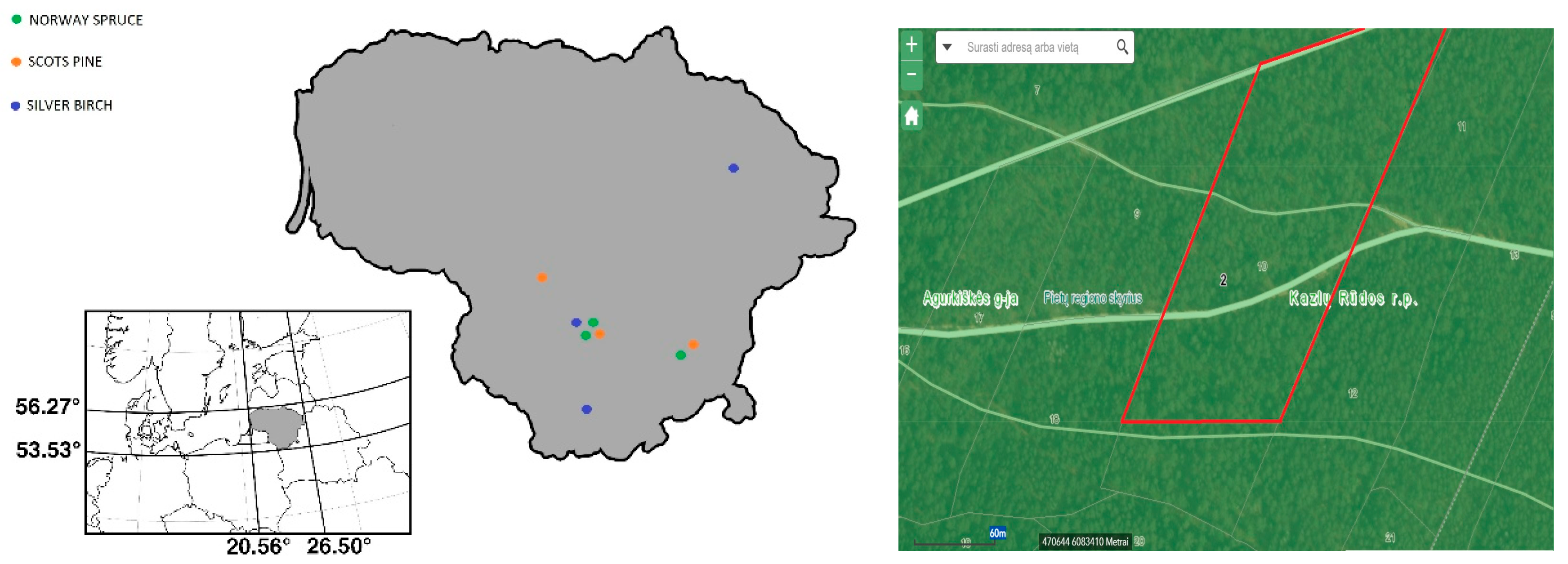
This study was conducted on 9 study plots located along the eastern coast of the Baltic Sea between latitudes 53°54′–56°27′ N and longitudes 20°56′–26°51′ E in Lithuania. The country covers an area of 65,200 km
2. It lies within the temperate climate zone, characterized by transitional conditions between the maritime climate of Western Europe and the continental climate of Eastern Europe [
23]. Lithuania lies within the southern part of the hemiboreal forest zone and is situated in a natural transition area between boreal and nemoral forests. Forests occupy approximately 2.2 million hectares, representing 33.9% of the national territory [
1]. Coniferous stands predominate, accounting for 55.5% of the total forest area. Scots pine (
Pinus sylvestris) is the most abundant species, covering 34.3% of the forested land, followed by Norway spruce (
Picea abies) with 21.2%, and silver birch (
Betula pendula) with 21.8% [
1].
2.2. Study Plots and Field Measurements
Based on defined criteria, nine study plots were chosen from forest inventory records, with three plots allocated to each dominant tree species (
Figure 1). The criteria included soil conditions (Nbl—infertile light soils with a normal moisture regime), stand age between 80 and 100 years old (5th age class), stocking density (0.7), and species composition. For each dominant species—Norway spruce, Scots pine, and silver birch—one plot represented a pure stand (10S, 10P, and 10B, respectively). The remaining plots consisted of mixed stands containing 70% of the dominant species and 30% of associated species, arranged as evenly as possible within each plot (7P3B, 7P3S, 7S3B, 7S3P, 7B3S, and 7B3P).
Within each study plot, two rectangular sample plots measuring 20 × 30 m were established, resulting in a total sampled area of 0.12 ha per study plot. The following stand and tree attributes were assessed: diameter at breast height (DBH), tree height (H), height to the base of the live crown (HL), crown width (CW), competition index (CI), and wood density (WD). A total of 809 trees were measured for analysis.
Diameter at breast height (1.3 m above ground) was measured using a caliper in two perpendicular directions (north–south and east–west). The mean of these two measurements was used as the final DBH value.
The tree height and height to crown base were measured using a Haglöf Vertex 3 ultrasonic hypsometer (Haglöf Sweden AB, Långsele, Sweden) in combination with a T3 transponder.
The crown width was determined by measuring the horizontal distance across the crown in two perpendicular directions (north–south and east–west), using a measuring tape. The average of the two measurements was taken as the crown width.
The measured DBH data were subsequently used to calculate the competition index (CI) following Hegyi’s method [
24], a widely applied index for quantifying competitive interactions between trees within forest stands.
where i—the target tree, j—the competing tree j, Di—the DBH of the target tree, Dj—the DBH of the competing tree j, Lij—the distance between the target tree i and competing tree j, and N—the number of competing trees. All trees at a distance of 1–2.8 m from the model trees were included to calculate the Hegyi CI.
Drilling resistance data were measured using an IML Resi PD500 (IML North America, LLC, Merdith, NH, USA) resistance drilling device. All trees were measured with a 500 mm drill at a drilling speed of 20 cm min−1 and a rotation speed of 2500 rpm. Resistance drilling was performed in the north–south (N–S) direction at breast height. The Resi data were analyzed using FWPA Resi Version 5.3.0 analysis software to convert the drilling resistance data to wood density.
In addition, 10 trees were randomly selected from each site and analyzed using a Pilodyn 6J (PROCEQ, Zurich, Switzerland) wood hardness device. Increment core samples were collected at breast height using a Pressler drill (Haglöf Sweden AB, Långsele, Sweden). The core samples were weighed and transported to the laboratory for wood density analysis.
The wood density of the core samples was determined using the LIGNOSTATION™ system (Rinntech-Metriwerk GmbH & Co. KG, Heidelberg, Germany). All measured wood density values with LIGNOSTATION were recalculated to a standard moisture content of 12%.
2.3. Statistical Analysis
For the normally distributed parameters, the analysis of variance (ANOVA), followed by Duncan’s multiple range test, was applied to determine whether statistically significant differences existed in the wood density between different sites for each tree species.
Pearson correlation analysis was performed to examine relationships among the measured parameters. General linear models were developed to describe wood density based on the tree growth parameters.
For the prediction of the wood density (WD) from the tree characteristics, the following equations were developed:
here, a0—are intercept; a1, a2, … xn—parameter estimates; DBH—diameter at breast height; H—tree height; HL—height to the base of the live crown; CW—crown width; and ε—error terms.
The analyses were conducted at a 95% confidence level using SAS software version 9.4 (SAS Institute Inc., Cary, NC, USA).
3. Results
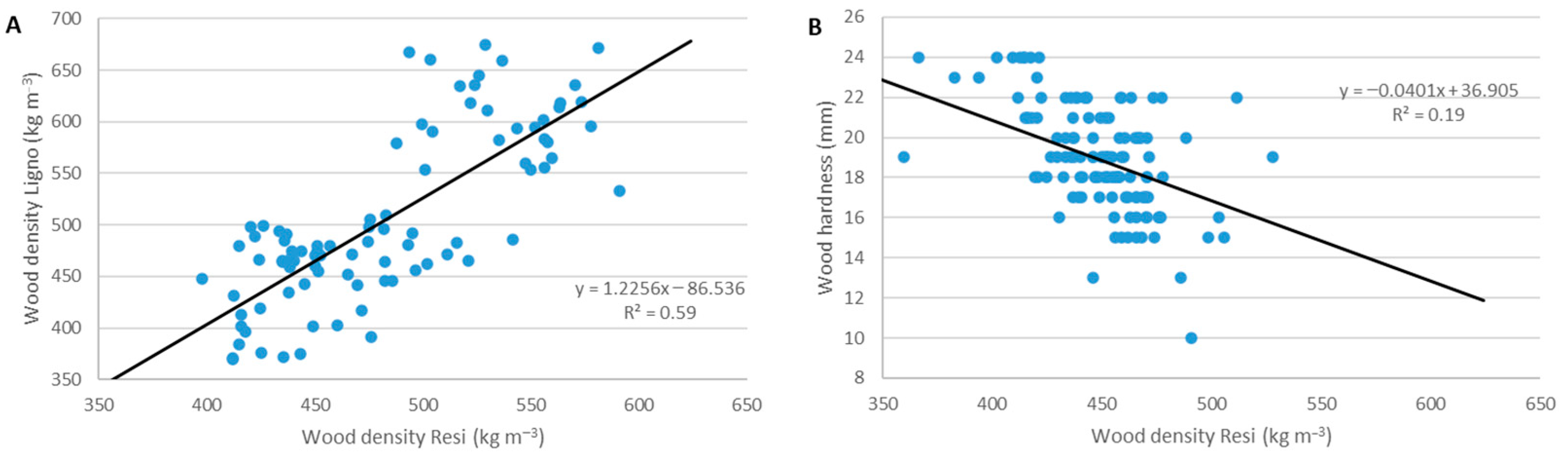
The wood density of tree core samples from randomly selected trees was analyzed using linear models to examine the relationship between the core sample wood density and drilling resistance-derived wood density. The coefficient of determination between the core sample wood density and Resi-derived wood density was R
2 = 0.59. In contrast, the relationship between wood hardness and Resi-derived wood density was weaker, with an R
2 value of 0.19 (
Figure 2). These results demonstrate that the microdrilling method is a reasonably reliable approach for predicting wood density, achieving an accuracy of approximately 60%. In contrast, the prediction of wood hardness using the microdrilling technique showed weak relationships. Overall, the microdrilling method appears to be a more useful and accurate non-destructive technique for estimating wood density compared with the wood hardness assessments obtained using the Pilodyn tool.
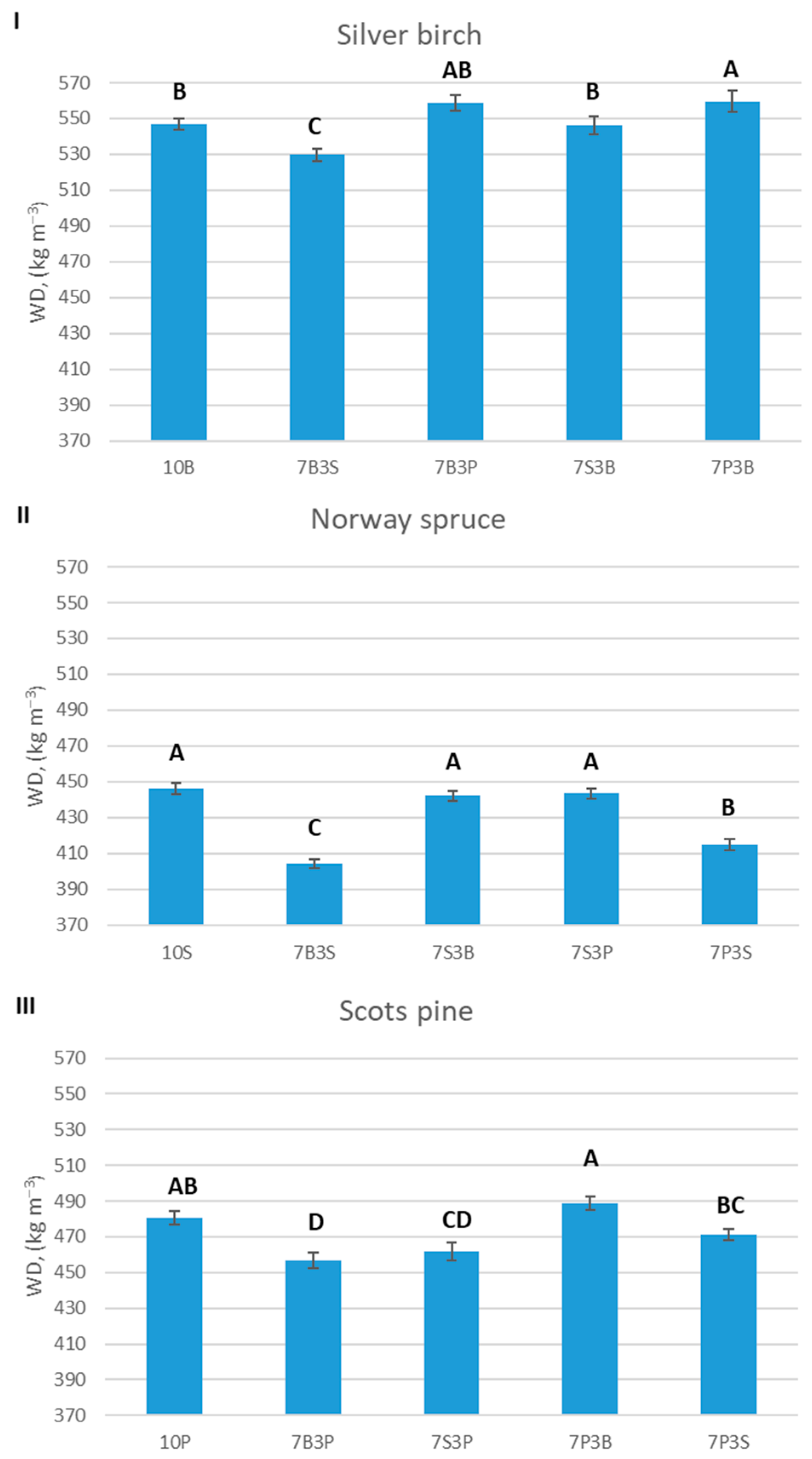
The wood density from microdrilling data varied for silver birch from 428 kg m−3 to 624 kg m−3, Norway spruce from 335 kg m−3 to 566 kg m−3, and Scots pine from 409 kg m−3 to 554 kg m−3. The mean wood density values for silver birch (546 kg m−3 ± 1.87 kg m−3), Norway spruce (437 kg m−3 ± 1.66 kg m−3), and Scots pine (476 kg m−3 ± 1.85 kg m−3) were converted from the drilling resistance data.
The wood density from the core samples’ data varied for silver birch from 534 kg m−3 to 674 kg m−3, Norway spruce from 369 kg m−3 to 498 kg m−3, and Scots pine from 371 kg m−3 to 509 kg m−3. The mean wood density values for silver birch (606 kg m−3 ± 7.08 kg m−3), Norway spruce (436 kg m−3 ± 7.70 kg m−3), and Scots pine (470 kg m−3 ± 4.78 kg m−3) were measured with the Lignostation system.
The mean silver birch wood density was higher in mixtures with Scots pine than in mixtures with Norway spruce or in pure silver birch stands. The difference in wood density between the pure silver birch stand and the lowest-value mixed stand (7B3S) was 6%.
In Norway spruce, stands with a 30% spruce proportion had statistically significantly lower mean wood density than stands with 70% and 100% Norway spruce. The difference in wood density between the pure Norway spruce stand and the lowest-value mixed stand (7B3S) was 10%.
For Scots pine, only the 7P3B site exhibited a higher wood density than the pure Scots pine stand, while all the other mixed pine sites had lower wood density values. The difference in wood density between the pure Scots pine stand and the lowest-value mixed stand (7B3P) was 7% (
Figure 3).
Correlation analysis between tree characteristics and wood density for different tree species showed that the strongest relationship was observed in Norway spruce, between its wood density and crown width (r = −0.41). Statistically significant correlations at the 0.05 confidence level were found between diameter at breast height (DBH) and wood density (WD) for all tree species. The correlation between DBH and tree height (H) was also significant across all species (r = 0.65 for silver birch; r = 0.85 for Norway spruce; r = 0.72 for Scots pine).
The strongest correlations overall were observed between DBH and crown width (CW), and between tree height (H) and height to the base of the live crown (HL), across all species. The competition index (CI) showed significant correlations with all other tree characteristics, including DBH, H, HL, and CW. The highest correlation coefficients for CI were observed with DBH and CW (
Table 1).
To predict the wood density from the tree characteristics, diameter at breast height (DBH), tree height (H), height to the base of the live crown (HL), and crown width (CW) were selected as explanatory variables. General linear models for wood density prediction were developed using these four main tree characteristics (DBH, H, HL, and CW).
The best-performing model, with the highest coefficient of determination (R2 = 0.43), was the combined model including all tree species. In this model, all selected explanatory variables were statistically significant at the 0.05 confidence level.
Different results were obtained when the same modeling approach was applied separately for each tree species. The model predicting the Norway spruce wood density achieved an R
2 value of 0.30, with three statistically significant parameters; crown width was not significant in the Norway spruce model. The predictive models for Scots pine and silver birch were weaker, with R
2 values of 0.13 and 0.05, respectively. In the Scots pine model, DBH and H were statistically significant, while in the silver birch model, DBH and CW were significant. Diameter at breast height (DBH) was the only parameter that was statistically significant across all developed models (
Table 2).
4. Discussion
The main aim of the study was to evaluate the effect of species mixtures on wood density and on the relationships between selected morphological characteristics of the tree trunk and the crown. The wood density was derived from drilling resistance data, using specialized software. To evaluate the accuracy of the resistography-derived wood density, relationships with the core sample wood density were established.
The correlation between wood density and wood resistance values has been evaluated in many studies. A study conducted by Gendvilas (2024) in Australia analyzed wood density prediction using drilling resistance values and reported that Resi amplitude accurately predicted basic wood density, with an adjusted R
2 of 0.84 [
20]. In contrast, a study in Romania reported a lower prediction accuracy for Norway spruce using microdrilling, with an R
2 of 0.36 [
19]. For radiata pine in Australia, the relationship between Resi amplitude and basic wood density reached R
2 = 0.86, and an equal R
2 = 0.86 was observed between SilviScan-measured wood density and Resi amplitude values [
25]. The study in Sweden analyzing Scots pine reported correlations between the unadjusted Resi wood density and SilviScan wood density of r = 0.53–0.59, while the correlation between the wood density and Pilodyn wood hardness was r = 0.38 [
6]. A Brazilian study reported a correlation of r = 0.67 between the resistance drilling amplitude and basic density [
18].
Overall, the variation in relationships between the resistance drilling parameters and wood density is considerable and depends on tree species, indicators, and applied methods. In comparison, our study obtained R2 = 0.59 for the linear relationship between Resi-derived wood density and Lignostation wood density, and R2 = 0.19 for the linear relationship between Resi-derived wood density and Pilodyn wood hardness.
A review by Pretzsch and Rais (2016) [
12] indicated that species mixing generally has a neutral effect on wood density. Among the analyzed studies, 11% reported an increase and 11% reported a decrease in wood density in mixed stands compared to pure stands, suggesting that wood density is not strongly influenced by species mixture alone. In our study (
Figure 3), the effect of mixture on mean wood density varied depending on the dominant tree species; however, in most cases, pure stands had an equal or slightly higher wood density than mixed stands, with only a few exceptions.
A Polish study, based on data from 17 sites, reported a mean wood density of 529 kg m
−3 for 50-year-old silver birch [
15], whereas our study found a mean of 546 kg m
−3. Another study using non-destructive techniques reported a mean birch wood density at breast height of 512 kg m
−3 [
26]. A Finnish study of 22-year-old silver birch found mean wood density values of 473–481 kg m
−3 at breast height [
27], while an analysis of 70-year-old silver birch revealed a mean wood density of 623 kg m
−3 along the stem [
7]. A Swedish progeny trial of 21-year-old Norway spruce reported a mean wood density of 430 kg m
−3 [
28]. An earlier Lithuanian study reported a mean Scots pine wood density of 572 kg m
−3 in infertile soils. [
29]. A study in Germany reported a 12% lower Scots pine wood density in mixed stands with European beech compared to pure stands [
30]. In our research, the greatest difference between pure Scots pine and mixed stands was 7% at the 7B3P site. A 40-year-old Scots pine genetic progeny trial in Sweden reported a mean wood density of 448 kg m
−3 [
6].
Arnič et al. (2022) in Slovenia analyzed relationships between resistance drilling density values and wood anatomical features [
9]. They found the strongest correlation between the Resi-derived wood density and tangential lumen diameter (r = 0.34). In Sweden, correlations between the Resi wood density and DBH (r = 0.18) and tree height (r = 0.30) were reported for Scots pine [
6]. A Lithuanian study reported a correlation of r = 0.23 between wood density and DBH for Norway spruce [
31]. In contrast, our study found correlations between Resi-derived wood density and DBH of r = 0.12 for silver birch, r = 0.31 for Norway spruce, and r = 0.24 for Scots pine.
Correlations between other tree characteristics were stronger. The relationship between DBH and H was r = 0.65 for silver birch, r = 0.85 for Norway spruce, and r = 0.72 for Scots pine. A Romanian study of mixed uneven-aged Norway spruce stands reported an exceptionally strong correlation between DBH and H (r = 0.96) [
32]. Analysis of Norwegian National Forest Inventory data concluded that extended mixed-effects models predicted tree heights without substantial bias for pine, spruce, and birch stands, both in pure and mixed conditions, when measured heights were available for estimating random effects [
33].
Prediction models for Norway spruce wood density based on DBH and microdrilling resistance achieved an R
2 of 0.50 when both parameters were combined [
19]. A Swedish model for predicting basic wood density achieved R
2 values of 0.50 for Norway spruce and 0.59 for Scots pine [
17]. In Finland, prediction models for Norway spruce wood density in uneven-aged stands achieved R
2 = 0.49 [
34]. By using the Global wood density database v2, researchers get prediction models for wood density R
2 = 0.59 by taking only one measurement from the tree species [
21].
In summary, differences in wood density between pure and mixed stands were relatively small (up to 10%). However, the drilling resistance device proved to be an effective tool for estimating wood density in Lithuanian forestry conditions. Linear models explained up to 43% of the variation in wood density based on tree characteristics, despite the generally low to moderate correlations between wood density and individual tree parameters.
This study has several limitations. First, the availability of suitable mixed stands meeting the selection criteria was limited due to historical reforestation practices in Lithuania. Second, stand age selection was constrained by national forest management regulations. In Lithuania, commercial thinning is based on the age of the dominant tree species (e.g., 61 years for birch, 71 years for spruce, and 101 years for pine). As forest policy and management practices evolve, an increasing number of mixed stands are being established. Therefore, this study provides insights into potential future outcomes under changing management conditions.
More extensive sampling of mixed and pure stands will be necessary to obtain more robust results. Additionally, more detailed wood property assessments, including destructive testing for the modulus of elasticity and modulus of rupture, are required to provide a more comprehensive evaluation of wood quality between pure and mixed stands in future research.
5. Conclusions
This study demonstrated that the wood density in pure and mixed stands of silver birch, Norway spruce, and Scots pine in Lithuania is primarily determined by species-specific characteristics, while stand composition (pure versus mixed) has a comparatively minor influence. Differences in mean wood density between pure and mixed stands were generally insignificant and did not exceed 6%–10%, indicating that species mixing does not substantially alter this key wood quality parameter.
The effect of the mixture varied by species: in some cases, mixed stands exhibited slightly lower wood density than pure stands, although exceptions were observed. Overall, no consistent pattern of density increase or decrease that was attributable solely to stand mixing was identified.
Resistance drilling proved to be a suitable semi-nondestructive method for estimating wood density under Lithuanian conditions, showing a moderate relationship with laboratory-determined density values. The mean wood density values were similar for Norway spruce and Scots pine and differ by 11% for silver birch.
The developed models explained up to 43% of the variation in wood density when all species were combined, whereas species-specific models showed lower explanatory power. Overall, the results support the conclusion that the transition toward mixed-species forest management is unlikely to cause significant changes in wood density and, consequently, in wood quality from a density perspective.




 ,
,